Chapter XIII
Reading edition
SUNDAY AND CONSCIENCE
Johnny could scarcely wait for nine o'clock of the next morning to come around. He wanted to see if his friend Louis was really alive and if he would be at 60th street gate.
Louis was there dancing about in a fever of anxiety. At John's appearance the two boys went off to talk about their mishaps. They had achieved more adventure than they had bargained for.
"Have you seen the papers?" said Louis.
"Yes."
"Have you told anybody yet?"
"No, and my folks thinks it's best never to say anything about it."
"Then we never will."
"Say, Louis," said John confidently, "there was five of the alfiredest best looking girls around at our house last night you ever saw. Fanny found them at the Beauty show a looking at the sights. They live in a town not very far from our farm and they are coming over to visit Fanny before they have to go into school. You have to come down and visit me while they are there or I will have to live in the barn."
The agreement was closed and the boys passed through the gates in quest of new adventures, as if nothing unusual had ever occurred to them.
However, they instinctively avoided Midway Plaisance, and decided to see what was on Wooded Island. They ranged through the hunter's camp, through the Japanese Hooden, and all over the island in the vain attempt to find something equal to their educated fancies of fun. Somehow Louis learned that there was to be a religious dance in the Quackahl cabin. Nothing else could have a place in the boys' minds until they had tickets for the show.
Inside the hut was a strange sight. Wanug had arranged four of his warriors on the east side of the hut, and these formed a quartet that produced the music for the fearful dance to follow. In the center of the hut a log fire burned briskly. The warriors had their faces smeared with Indian ink, and some of the beauty spots looked like demi-semiquavers on a sheet of music. The squaws, and even the papooses, were painted for the occasion, and everyone of the Quackahls were dressed in blue robes, ornamented with striking pearl buttons.
At a signal Hammasoloe suddenly sprang on the boards and began the mythical movement known as the cannibal dance. It was symbolic of a curious legend current among the Indians of Vancouver island, of a strange spirit that dwells among the mountains and spends most of his time eating the fat members of the Quackahl tribe. Hammasoloe took the part of the spirit and crouched down as if ready to spring on his prey. The sticks beat hard on the plank, and the music for the dance began.
A squaw pounded on a square box, which represented the Quackahl drum. Two warriors were deputed to watch Hammasoloe while he circled around the fire, for the usual ending to the dance is startlingly realistic. Usually the dancer becomes so excited that he bites the arms of those present in imitation of the actions of the great spirit on the mountains. Whenever his eyes glared and his looks became ferocious the warriors grasped his arms and quieted him. He disappeared behind a white curtain, and a few minutes afterward out sprang another warrior wearing a huge mask, representing a raven's head. The raven is a slave of the spirit and is supposed to be represented by one man.
But Awalaskaius played the part of the raven. His body proved as supple as a professional contortionist. He twisted his legs and whirled his head around and snapped his jaws in a remarkable manner. Cries that made the ears ring accompanied the dance.
When Awalaskaius had finished, Hammasoloe sprang out from behind the white curtain wearing a blue gown on which the figure of the Quackahl sun was worked. The rays of the sun were blazing red, and the man in the orb was depicted winking in a gracious manner.
Louder grew the noise, and the quartet taunted the spirit so much that he again disappeared. Then came forth Awalaskaius with a duck's head mask, which is the sign of the great spirit. Again he went through his curious contortions and scared some of the ladies, as he snapped his beak dangerously near them.
When the dance was done and the boys were once more outside they were quite satisfied with sight-seeing among savages and were quite contented to spend the remaining days of the week among the more prosaic and poetical scenes of the great Fair.
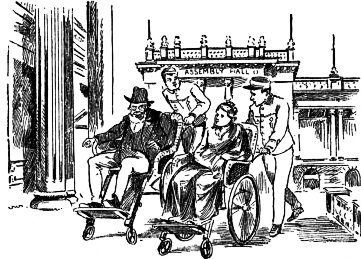
Uncle and Aunt had about walked themselves down in their sight-seeing, and were now enjoying the comforts of the rolling chairs and listening to the voluble information which the chair pushers thought it their duty to impart.
Fanny was walking near them in a never ceasing enjoyment of people and scenery. As they passed the Woman's building a large number of women were seen coming out together. On going over the viaduct two well dressed men from the Emerald Isle could be heard in critical conversation.
One of them said:
"Look, Pat! It's women again! Do ye mind that now. Look at um coom out ov that new building. It's the Fair that's bein' run by thim faymales. Soon they'll want to run the wurrld, and they'll be votin'. The divil will be to pay in a man's home. They should be taught their places at once. If my wife should git that strong minded sure I'd be packin' her off. Dacent homes are bein' ruined, Pat, and soon there'll be no homes. They meet in clubs to worship the rich, and who will do our mending and cook our meals? It's all wrong, all wrong. The women must be taught their places."
"VOLUBLE AND PERHAPS VALUABLE INFORMATION."
And the poor man looked worried. He is probably teaching Bridget her place today.
Aunt was looking wistfully over toward Wooded Island as if it reminded her of home.
"I tell ye, I haven't saw anything as nice as them flowers. They tell ye of the country, and its quiet over here. Ye get too much of a good thing sometimes out among the white buildings. It's sort o' dreamlike over here, ye know."
She was right, it is dreamlike and it is restful. Din and noise are far away and nothing breaks the stillness but the faint music as it floats down from the plaza. The azalias are in full bloom, and orchids and pansies and nearly every other blossom meet you at every turn.
They stopped at a place where a number of people were looking up at the roof of the Liberal Arts building. Countless small black specks could be seen moving along the roof. Then it was perceived that those specks were really men and women. It is only by such a comparison that they could realize the vastness of these buildings.
"What a jumble of bigness all this is!" Aunt exclaimed, "them people look just like flies on the ceiling or swallows on the peak of our new barn."
The chair pushers took them slowly through Wooded Island.
"What was that, Fanny, that you used to tell me about Alladin and his wonderful lamp?" said Uncle. "I keep a thinking' of that story every time I try to picture all these things at once. Here is fifteen acres of fairy land just like in the fairy books I used to buy for Mary."
They then went on with the crowd past the Government building and the Liberal Arts hall to the basin. On the viaduct, over behind the Statue of the Republic, they stopped to look over that never-fading picture there presented to view. Over the peristyle were written some of the sayings of great men. Fanny read one that heightened the scene into a thrill of thankfulness and patriotism: "We here highly resolve that government of the people, by the people, and for the people, shall not perish from the earth."
"Now," said Aunt. "I believe I know the meaning of this vast expenditure of money and energy. It is not only to show us and others that we have not all the brains; that we are not doing all that is done, but to teach us mutual gratitude for the great privileges of our republic, and fix firm the resolve in the breast of every man that our government of freedom and conscience shall live forever."
They went on out to the pier and dismissed their chairs for seats in the cool lake breeze, where they could see the people coming off of the steamers and approaching them down the long pier on the moving sidewalk.
Wearied with the constant commotion in which they had never been before, it was decided to return home and to spend the remainder of the week in rest and recuperation for another struggle with the world of culture in Jackson Park.
When Sunday came. Uncle was told that the Fair would be opened for visitors. He had been so busy sight-seeing that he had not read the papers or he would have known better. He did not know just what to do on that day, whether to go to church, or the parks, or the Fair, but he was anxious to see what the Fair looked like with most of the people promenading the streets all in their Sunday best. He came to Chicago to see the sights and seeing sights never appeared to him to be wrong. Every Sunday it was his custom to go out into the pasture and look at his jerseys, congratulate himself on how fast his herd was increasing, and contemplate the prospects for the future. Grass grew, the birds sang, the cattle bellowed, and nature was as bright on Sunday as any other day. Besides he had some neighbors who believed that Saturday was the holy Sabbath and he had never been able to disprove their arguments. He believed on general principles that the Fair should be closed on Sundays and that the grass ought not to grow, but since the grass did grow, he would profit by the increase and if the Fair was opened on Sundays, he would not miss its magnificent object lessons.
"Ah, Jeremiah," said Aunt, "every one of them big buildings comes over my spirit like a prayer and when I go inside I see the answer and the benevolence of God. To shut people out is like padlocking the orchards on Sunday, and stopping the machinery that makes the apples grow. Six days are the rich men's days and God made the Sabbath for the poor. Because our neighbor raises hogs and eats pork it is none of our business because we raise Jerseys and drink milk. The Good Book says: "Let no man, therefore, judge you in meat, or in drink, or in respect of any holy day, or of the new moon, or of the Sabbath days.""
They concluded to go back home and then stroll out, and in their walk to go into the first church they found.
They did so, and came into a great church just in time to hear the minister read the text: "And God said unto Jonah, Doest thou well to be angry for the gourd? And he said, I do well to be angry, even unto death. Then said the Lord, thou hast had pity on the gourd, for which thou hast not labored, neither madest it grow, which came up in a night and perished in a night; and should I not spare Nineveh?"
Uncle Jeremiah listened for the story of Jonah and the gourd to be applied in some way for a lesson to the hearers, but only once, when the minister told what he had seen in Palestine, did he become intelligible to Uncle. It was all so transcendently ethical. Uncle got a remote idea that Chicago was to be likened to Nineveh, and the gourd to the World's Fair, but when the sermon was done, and all said, he felt that he would have enjoyed the hour so much better in some of the quiet shades of one of the parks, where he would have heard so reverently the still small voice of nature's teachings.
After noon they went to Lincoln Park, and as they stood before Lincoln's statue, Aunt said: "This is greater than any sermon I ever heard." They read the words and sat on the bench encircling the statue, while Fanny read the sayings of Lincoln chiseled on the stone. Then they visited Grant's monument. They sat down on the stone steps and looked at the noble figure. Uncle was carried away with a religious patriotism that held all the emotions of divine presence.
"THIS IS GREATER THAN ANY SERMON I EVER HEARD."
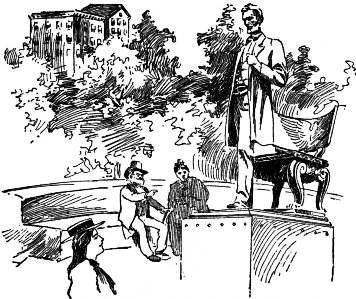
"There," said Aunt, "we are listening to another sermon that can not be surpassed by the tongues of men. A whole life of great deeds for our country is here speaking to us. No man can be a bad man if he were to come every Sunday and give his emotions up to the lessons of the lives of Grant and Lincoln. Divine emotion is not aroused alone by words from the pulpit or the silent walls of a house. Seeing is as great a means of God as hearing, but seeing receives its sermons from the infallible; hearing listens to that which may come only from the brain."
"THE POLICEMAN CAME OUT OF THE BOX AND WALKED RAPIDLY DOWN THE STREET."
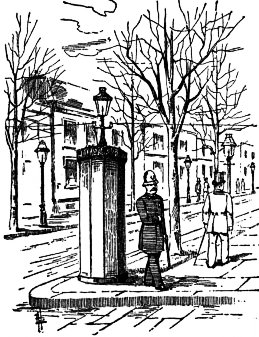
It was late in the afternoon when the four of them got off the cable car at Monroe and Dearborn streets and walked leisurely toward their hotel. At one of the street corners they saw a policeman come out of the patrol box and walk rapidly down the street. In a moment more he was joined by three other policemen from another street. Uncle turned to watch them, when suddenly they began to run, then faster, almost as in a race.
"Sure they're going to arrest somebody," said John, and he started after them at break-neck speed with visions of a murder probably being done just around the corner. Uncle became excited also and started after them followed by Aunt and Fanny, not knowing what else to do. Uncle and John reached the corner breathless and looked each way to see where the robbery or murder was being done, but what was their disgust to see the three policemen climbing into a cable car and calmly taking a seat. It was an outrageous sell on all of them, but it could not be helped, and there was no law by which they could sue the policemen for a false alarm. They had the right to run to catch a car if they wanted to. The family went on more deliberately now for they had no breath to spare and there was but little to be said. Uncle felt that Chicago was very much of a mockery anyhow. But he had seen enough to make him desire to see more.
The tremendous puffing and blowing of a tug was heard somewhere in the river and they concluded to go over to the bridge and see what it was. There was a mystery anyway about how those big boats got past the bridges.
Uncle and Aunt walked on over the bridge but John and Fanny stopped to hear the music made by a cornet band of girls on one of the excursion steamers. The tall masts of a lumber boat could be seen coming rapidly toward them in tow with an insignificant little steamer. There was a jing-aling two or three times of a bell hid somewhere in the framework of the bridge, teamsters and people were hurrying across, and all at once the bridge began to move. Johnny saw some people remaining on the bridge and catching Fanny by the hand he cried. "Here let's take a ride" and in a moment they were swayed past the street and out over the stream. Over at the other end they saw Uncle and Aunt holding desperately on to the railing. They had not been able to get over when the bridge moved away. Presently the boats were past and the bridge rapidly swung into place. Down the street half a block Johnny saw some steam issuing from the middle of the street. Instantly the idea of a volcanic eruption in the middle of Chicago possessed his mind. He called Fanny's attention to it and their curiosity was greatly excited. They had heard that Chicago was a very wicked place and their preacher had once remarked that he would not be surprised at any time to hear of an upheaval by the Lord sending the city over into the lake. In considerable dread lest the overthrow was about to take place, they walked towards the place along the sidewalk, as the famous Harry walked up to the guidepost at the country crossroads on that cloudy night so long ago. But they were greatly reassured when they found the people about them were so indifferent and they were chagrined to learn that they were again deceived. It was no volcano, there would be no terrible cataclysm, it was only an inoffensive man-hole to the sewers, into which the waste steam of one of the factories near by was escaping.
Meanwhile, Uncle and Aunt had stepped off of the bridge and were intensely bewildered all at once to find that the excursion steamer and the houses next to it had all apparently jumped across the river to their side.
"Did we come acrost that bridge?" Uncle asked.
"I know we never."
"How did we git acrost without coming acrost?"
"I can't see how anybody could come across without comin' across, and I know we never," said Aunt.
"Well, ef we hain't acrost, then the houses are acrost, and it is more natural fer us ter be crazy than for the houses to get acrost."
"Ask the policeman."
Uncle went up to the policeman and said: "Say, Mister, we want to know if you will be so kind as to tell us ef we are acrost or not acrost."
"Do you mean on the north side or the south side?"
"No; I mean on this side or the other side."
"Well, which side did you come from?"
"I thought I came from the other side," said Uncle, "but it seems now as if I came from this side and didn't go over to the other side at all."
"Where have you been?" asked the policeman, making a mighty effort to untangle himself.
Uncle was becoming impatient.
"I tell you I've been acrost that river 'cause I walked acrost, and then I never walked acrost again, and here I am not acrost, and I want to know how I got back acrost again."
"Say, old lady!" said the policeman, "ain't he crazy?"
"This is the first time I really ever thought so. We've been seeing too much, and I guess we're both crazy."
"In that case," replied the officer, "I am compelled to take charge of you."
"O Grandma!" cried Fanny, just then running up, "ain't this great. Johnny and I have been nearly half an hour trying to figure out how we got across the river, and I found out first. You see the bridge just went straight half around, and so when we got on this end here it carried us around to the other side and carried you back around to this side."
"Bless the Lord!" said Uncle, fervently; "Sarah and me ain't crazy yet, and the policeman needn't worry himself." But the policeman was gone.
"You see, Fanny, we couldn't make it out, and Sarah and me and the policeman all agreed that we was stark gone daft."
Uncle and Aunt now had enough for one day, and they heartily wished they were back on the farm. But they swallowed their discomfiture: and, after a good night's test at home, determined to visit the Board of Trade, where Bob Simmons had lost the fortune his father left him.
"IS THEM THE FELLERS THAT THE FARMERS IS AFRAID OF?"
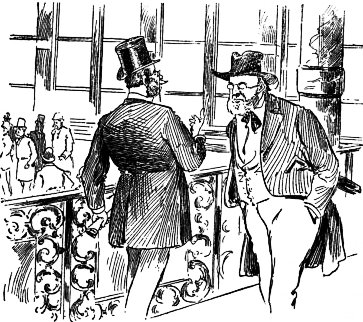
Uncle and family did not get around to the Board of Trade till nearly eleven o'clock the next morning. There was a wide entrance with a stairway on either side. Uncle saw the people in front of him, and he was accustomed to pass right in among the congregation and take his seat in the amen corner. He did not notice that the others had stopped at the door, but he plunged right ahead. The door-keeper evidently had his attention engaged at something else, for he let Uncle walk on in. Some one at the door spoke to the ladies and told them to take the left stairway to the gallery. They reached there just in time to see Uncle in a difficulty below. A young man had him by the arm and was pointing very vigorously toward the door.
"Who do you want to see, sir?"
"I want to see the Board of Trade. Where is it?"
"Go outside and up the stairs into the galleries and you can see it all you want to, but not here."
Uncle did as he was bid, but found that he was quite widely separated from his family, because he had been sent up the opposite stairway from them.
"I came up to see the Board of Trade," he said, confidently, to a well-dressed stranger next to him.
"Well, there it is in all its glory," said the stranger.
"Oh, I see! The board is that table where them fellers is a tickin' them machines. You see I thought they would be a setting and a trading across a long, wide board like they used to do at the country stores for counters. But them fellers down there acts like a lot of lunatics. I don't see how they can ever come to a bargain, yelling and spewing around that way. And then I don't see the bulls and bears that change the market."
The stranger thought it a useless job to try to enlighten him.
When Uncle and his family came down, he went up to the doorkeeper and asked, "Say, do you belong here?" The keeper nodded. "Did you know Bill Simmons what lost five thousand dollars here last year?" The door keeper shook his head. "Well, say, I just want to ask one more question. Are them people down there the bulls and bears themselves, and are they the Board of Trade and are they the people that the farmers are so afraid of?" The keeper nodded.
"Well," continued Uncle, "I've got this to say; any set of farmers as is fools enough to be afraid of them yelling idiots, aint got no backbone at all."
Chicago was unsettling many of Uncle's ideas, and he began to decide that the only real, bonafide thing he could swear by was his own farm, and that the great outside world was only a great circus of art and extravagant genius.