Chapter VIII
Reading edition
LA RABIDA
It was a warm summer day, and rolling chairs, launches and gondolas were in great demand. At Fanny's suggestion they decided to take an electric launch and go around to La Rabida, where the relics of Columbus were kept. She accosted one of the guards who attends to the moorings by asking how near the launch would take them to La Rabida.
"La-Ra-La what? I don't think I know what that is," said the guide.
"La Rabida is the convent—the Columbus relics are there. Columbus was the man who discovered America," Aunt volunteered to tell him.
"Oh, yes; I have heard of Columbus, of course, but I haven't been here very long."
"Well, the convent is over at the lake end of the Agricultural building. Do the launches go there?"
"The Agricultural building? Let me see; that is over——"
"Do you know where the colonnade is?"
"No. I don't."
"Ever hear of the grand basin, the gold statue, the lagoon?"
"Oh, yes; this is the lagoon."
"Well, how long will it be before a launch will come along?"
"BEFORE THEM WAS THE STRANGE OLD CONVENT."
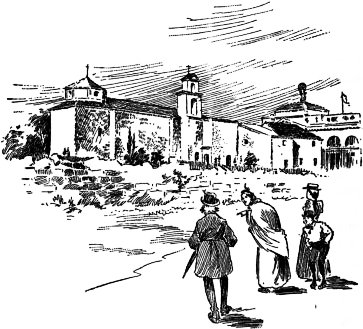
He went out to the edge of the landing and looked up the lagoon. Then he jerked out, "in three-quarters of a minute." He was provoked about something. It may have been because she wanted to know so much; it may have been for a latent discovery of a lack of knowledge on his part, or it may have been because Fanny had been laughing at something; Fanny laughs easily. She is just as likely to laugh where she ought to cry; the electric guard didn't see anything to laugh at. They sat down on a pile of lumber to wait the three-quarters of a minute. It was three-quarters, and several more. The guard said the warm weather had come unexpectedly. They would have the whole fifty-two launches running soon. But only about half the number had been necessary until now, and they were very busy and could not keep up the time. One came soon after that. As they were stepping in Fanny asked how much the round trips were. Some one said "25 cents in the Director General's schedule, but in the launches they are 50 cents." The captain, or the man who takes the money, heard him. He smiled, and charged them 25 cents apiece to La Rabida. Just afterward a man handed him $1 and said "Administration building—for two." The Administration building is considerably this side of La Rabida. The captain slipped the dollar into his pocket and passed on to the next. The woman said:
"Did he keep the whole of it?"
"Keep it? I should think he did. You don't get much back on these side experiences. I ought to have asked him how much it costs to go all the way."
But the man made no reply. He was meditating. He evidently had not read the morning papers. They gave all the prices—admissions and extra convenience.
It was with feelings of considerable curiosity, mingled with awe, that they approached La Rabida.
Before them was the strange old building which they knew was the convent where Columbus had received such rest, comfort and inspiration in his great enterprise that opened the door to modern civilization.
A number of tents were on the south of the house, and soldiers were to be seen standing about, with their heavy muskets, which mean nothing but that their lives are pledged to protect this collection, belonging to the Vatican and the descendants of Columbus. All the royal letters patent from the sovereigns of Spain to Columbus and many letters written by Columbus himself, are in the cases. His will is also there. The signature of Columbus is written in this way:
S. S. A. S. X. N. Y. Xpo Ferens.
At one end of this room is the collection of pictures loaned from the Vatican by Pope Leo. No one is allowed to go up the steps. One of the Columbian guards standing there said, in answer to one of Uncle's questions:
"This is the altar. It is sacred and no one is allowed up there, because these pictures are very valuable and very small."
The mention of the size in that connection meant that they could be carried off easily. But nothing could be carried off easily with those watchful "regulars" about. A contract was made by Spain with the United States before the collection left there that it should be guarded by a detachment of United States soldiers. That contract is fulfilled to the letter. No one is allowed even to touch the glasses of the case.
There are some wonderful pictures on the wall of Musaico Filato, which belong to Pope Leo. They are wonderfully beautiful as pictures, without thought of the thousands of tiny mosaics used in making the pictures, and that each one was placed in by hand. Some of the other pictures are wonderful, too—wonderful in their hideousness. No two artists seem to have the same idea of the features of Columbus. There seemed to be but one thing that they agreed upon fully, and that was that Columbus wore his hair chopped off on his neck. There is a great likeness there. Ferdinand and Isabella looked painfully disturbed on being trotted out at this World's Fair, and just exactly as if they never could have agreed on allowing Columbus or any one else to discover us. Some of the pictures were not numbered, and some of them had two numbers. The young lady who sold catalogues said they would be all right after a while.
"Say, can you tell me—is these 'ere things all Columbus' works—did 'e do 'em all?" asked Uncle.
"No, it is the history of his life."
"Didn't he do any of 'em?"
When the young lady shook her head, Uncle walked away, disappointed. He knew just what it was to dig and toll down on his farm, and he could gauge greatness only by labor. And if Columbus did not do any of it, paint any of the pictures, or build the convent, he could not understand what had made them go to so much expense to build the old convent when a good picture for a few dollars would serve just as well.
After going through the narrow entrance of La Rabida they found little dark rooms with pictures and maps and charts of Columbus and Isabel in many different forms. In the southwest room they found a table and doors and bricks and the key from the house of Columbus. In the case among the many sacred relics was a locket said to contain some of the dust of that great man. They saw the Lotto portrait which was used on the souvenir half dollars. There were the Indian idols which Columbus brought to Isabel, one of the canoes in which the Indians came out to meet him, and even one of the bolts to which Columbus was chained. Each one of the party were continually discovering the most wonderful things. Fanny found an autograph letter of the great Cortez and she wrote in her note book from the book of Waltzeemuller where he said, "Americus has discovered a fourth part more of the world and Europe and Asia are named for women this country ought to be called America or land of Americus because he has an acute intellect."
While she was writing this an old gentleman came up to her and said, "Say, Miss, I want to see the remains of Columbus, I heard they are here with a soldier on each side of his body."
Fanny pointed to the place where the locket was but he was disappointed and did not care to go "just to see a pinch of dust in a locket."
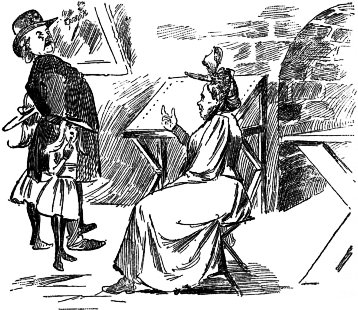
Aunt was sitting on her camp stool in the room where the table of Columbus was, but to get a nearer view of something she left it for a moment. Just then a family of man and wife with five children came in and found that they were standing at the table and by the door of Columbus. The woman saw the chair and supposing it to be a part of the Columbus furniture sat down in it. Then she arose and called her husband. "Henry come here and set in this chair. Thank God I've set where Columbus set." The husband sat in it awhile and then each one of the children time about, while Aunt Sarah waited patiently for them to get through, not wanting to break the pleasure of their great achievement.
"THANK GOD I'VE SET WHERE COLUMBUS SET."
Tired of further sight seeing, our family decided to leave the grounds, and started on their homeward journey with over two hours ahead of them. There was no use walking through streets when they could pass nearly the whole distance through buildings. This was one of the ways to economize on travel and time.
Across the bridge from La Rabida was the great archway entrance of the Agricultural hall. Around the old convent with its low-browed walls ran a width of fresh dirt at intervals over which were stuck the ancient signs, "Keep off the grass," but no grass was yet visible.
"That's what I don't like about this White City. So much of it is so, and so much of it ain't so that I never can tell what is so," said Uncle.
In the Agricultural hall there were never ending wonders for the farmer. All the agricultural ingenuity of the earth was centered here.
"Now, come on, father, we can see plows and lawn mowers when we get home."
But Uncle lingered longingly over a new device for lacerating the soil and destroying its noxious productions. Uncle and Aunt had ceased their usual exclamations after the first two or three days. In the first place exclamations, such as the good deacon would use, were entirely inadequate, and in the second place the cords of utterance had become exhausted.
"Well, ef they haint gone and got some dog fennel here. I wonder where the cuckle-burrs are, and the tick-seed, and the jimson weeds and the puff-balls. It's a mean discrimination to bring one of the nuisances without bringing them all."
They went through and out over the bridge of the south canal, on past the bandstand to the Administration building.
"What inspiring music," said Fanny. "It is hard to tell whether our eyes or our ears can bring us the most joy. Surely I can live to be a better woman now every day of my life."
As they entered the Administration building they saw a man in the center of the court looking up through the building at the great dome which seemed to pierce the sky. He leaned farther and farther back until he fell backwards and lay there on his back still gazing intently upward. A number of people rushed up to him horror stricken, as if he had just fallen from the top of the dome and they expected to see him a crushed mass. As they began to close up around him he yelled out: "O you get away you fool people, you don't know what a fine view I'm a getting of the top."
"HIS HALF-DOLLAR ENTRANCE FEE GAVE HIM THE RIGHT TO SEE THE DOME FROM THE MOST ADVANTAGEOUS POSITION."
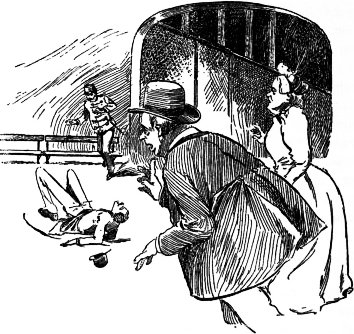
But one of the Columbian guards seemed to think that was not the legal way to view the dizzy heights of the building and forthwith jerked him to his feet and ushered him to the outside. The last seen of the man he was muttering, "Them fool builders put them picters clear up at the top and then the fool guards wont let a fellow enjoy them."
He evidently believed he had been treated outrageously in a free country by an autocratic guard, and that his fifty cents entrance fee entitled him to view any object in any position of vantage.
They went on into the Mines building where the sparkling ores of a thousand mines were in piles and pyramids or wrought into colonnades, facades and burnished domes. There were dazzling diamonds and beautiful opals, emeralds and gems from all parts of the earth; Michigan's copper globe, North Carolina's pavilion of mica designs, Montana's famous Rehan statue of solid silver resting on a plinth of gold, Arizona's old Spanish arastra and New Mexico's mining cabin.
From a northwest doorway they passed on out of this world of subterranean wonders across the street into the Transportation building.
"I don't believe these things are used anywhere," said Johnny. "They're like the four-legged woman—just made for show. Father, you can't expect me to ride in no common farm wagon after bringin' me to see this."
"These cars do represent awful improvement in three generations," said Uncle. "Now, it is supposed that when I was a boy I rode in that 'Flyer' there, or on the one they call 'Rocket;' but I didn't, 'cause I never seed a train till I was past twenty. Fanny would be supposed to ride up there in that gay three-story palace on wheels, and Johnny will get to ride a hundred and fifty miles an hour on that 'lectric railroad; but a common cattle car is fast enough for me. I don't know what the world's a comin' to when people rides a hundred and fifty miles an hour and choose to sleep fourteen stories high."
They had wandered around the locomotive section, and on their way curiously viewed the famous "John Bull," the oldest locomotive in America. Near by some workingmen throwing a pile of dirt into a cart, caught Uncle's eye.
"Well, look at them fellers. Ef my farm hands was to work that way I'd not get enough corn to feed my Jerseys a month."
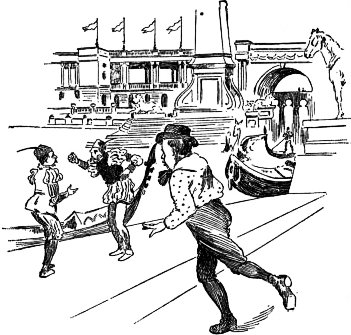
"A FIGHT, A FIGHT!"
He was quite disgusted with their slow and listless movements. They returned down another aisle and came out in front of the magnificent doorway of the building. They were just behind two elegantly dressed ladies, who were looking up at the decorations.
"Well, upon me wohd, do obswerve that dohway. How intwesting. I am shuah it seems to me to be pewfectly supub. It is so lovie, so sreet."
"O Grandpa," said Johnny, "do tell me what language they are talking."
"I don't know, Johnny; ask Fanny."
John's attention was here caught by the loud arguments of some gondoliers at the landing near by, and he ran down to see the fight he was sanguine enough to believe was about to take place.
They made noise enough to be sure but perhaps this was their way of attracting attention. There were at least a dozen excited foreigners gesticulating over some exciting topic. Evidently some foreigner had been riding and he thought the fare was too high. Noise and genteel swearing were the chief argument.
They swore in German, French and Russian; In Greek, Italian, Spanish, Prussian; In Turkish, Swedish, Japanese— You never heard such oaths as these. They scolded, railed and imprecated, Abased, defied and execrated; With malediction, ban and curse They simply went from bad to worse; Carramba! O, bismillah! Sacre! (And ones than which these aren't a marker.) The very air with curses quivered As each his favorite oath delivered; A moment's pause for breath, and then Each buckled up and cursed again.
But the storm ceased as quickly as it had begun and in a minute they were all as complacent and jolly as children.
Fanny read aloud to her grandfather the words over the archway:
"There be three things which make a nation great and prosperous: a fertile soil, busy workshops, and easy conveyance for men and goods from place to place."
"Grandpa, Bacon wrote that and he lived in the time of Shakespeare, when Elizabeth was Queen of England."
"Yes, yes, child, it's a great prophesy of our greatness. I thought before I came here that the soil done about all of it and what little was not done by the soil was done by the workshop but I see that there is just as much necessity and greatness outside of these things."
"Grandpa, let me read what is on the right side of the doorway: "Of all inventions, the alphabet and the printing press alone excepted, those inventions which abridge distance have done most for civilization." That was Macaulay, the great essayist and historian of England. I wish I had known he said that, for last month we debated in our literary society the question: "Resolved. That bullets have done more for the spread of civilization than books.""
It is rather an amusing thing to note how the exposition affects different people. Some of the visitors are of a type which nothing moves. They have lived all their lives in the pursuit of a placid routine of simple duties, and, while they have come to the fair from a sense of duty and fully intend to see all that may be seen, still they are prone to retire on occasion to some quiet corner where they can rest unobserved, and then their talk invariably drops into some simple, natural channel that is in accord with the tenor of their dally lives. Of course this is tinctured more or less with the unaccustomed sights and sounds about them, but not greatly so; for the most part they simply ignore their surroundings.
In strong contrast are the ones who have obviously got themselves up expressly for the fair regardless of expense; their clothes are new, and are chiefly noticeable for the quality which Stevenson refers to as "a kind of mercantile brilliancy." They are nearly as much occupied in allowing others the inestimable pleasure of gazing at them as they are in improving their own minds. They are visitors, pure and simple, and they are characterized by such an air of newness that even the flies avoid them for fear of sticking to the varnish.
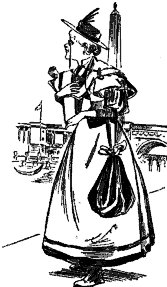
There is the girl with the notebook, a schoolmarm presumably, though heaven only knows, she may be a lecturer. She usually numbers glasses and a dark velvet bag among her accoutrements.
She is possessed of all of the catalogues and guide books sold on the grounds, and in the bag is a further supply of heavier literature for the improvement of her idle moments. It would puzzle anybody to find out when these idle moments occur, for when visible she is engaged in a frantic rush from place to place, pausing only for a moment to ask a question or jot down an impression, sometimes doing both at once without even looking at the dispenser of information.
She must have a miscellaneous mind, this girl, for anything seems to go with her from pig iron to poetry. One of her stopped for an instant in the Electricity building to inquire the name of a queer, compact, powerful looking machine. The impression which she received from the laconic attendant in charge went into her notebook in this form:
Multiple intensifier is round and black; looks powerful; attendant says 360 horse power. Mem., look up multiple intensifiers in Century dictionary on return, and find how they are applied to horses.
The machine in question was a dynamo, but perhaps she will never know.
In the Japanese section of the Manufactures building two dear little old women sat down to rest their tired feet in the midst of a bewildering display of pottery, whose brilliant tints contrasted strongly with the rusty crape and bombazine in which they were dressed.
"I don't see," said one of them, "the use of sending missionaries to Japan. I suppose they do worship all them things, but, even if they do, I think that if they had as much pretty china to home as they've got here, I'd be inclined to worship it myself. I just don't see how they can help doing it. Do you?"
"No, I don't," said the other. "It seems almost what you could expect. I don't believe they are so very bad after all. I can't believe that anyone who could make such lovely things could be a very wicked heathen. I should think the Japanese would almost feel like sending missionaries over here."
But Fanny was of a different type, she realized the sublime display of mind and she grew months in the excellence of womanhood every hour of her enthronement in the soul of this great panorama of intellect and labor. Aunt was silently seeing everything like the great dream that it was but Uncle was storing his mind with facts whereby he could confound his neighbors.
"It really seems strange to me," said Fanny, "to see how some of these people take the Fair for a circus. If the band played all the time they would never get a chance to look inside the buildings. The moment they get within earshot of the tuba horns they anchor themselves to benches or camp-stools and watch the leader swish the air with his baton. After the music stops they will begin hunting for more excitement, and may finally wander in among the pictures and admire some battle scene covering a whole wall. To-day I saw a young man and his girl standing before that wonderful statuary from the Trocadero palace looking the goddess in the eye while both were eating peanuts. They are after nothing but a good time, as at a country fair. I believe it is all because they don't understand what they are looking at. Grandpa, I can finish my education now and know how to bless you for your goodness to me. I am just beginning to see what a great privilege it is to live."