Chapter III
Reading edition
AROUND THE WORLD FOR TWENTY CENTS
The next day, when the "Alley L" road let them off at the station next to the electric road, they decided to ride around and view the "White City" from that elevated position. The intramural road is about three miles around, and makes the trip in seventeen minutes. It was like going around the world in that time, so much was to be seen on either side.
The four made a fine picture of age and youth gathering mental breadth from this great exhibition of human wisdom and achievement. They passed around the west end of Machinery hall and along the south side of it, then between the Agricultural annex and the stock pavilion. Here they emerged into what seemed to be the waste yard of the Exposition, debris of all kinds, beer houses, lunch rooms, hundreds of windmills flying in the breeze and heavily loaded cars, back of which could be seen bonfires of waste materials, these making a striking contrast to the white beauty and massive art on the opposite side of the car.
The queer looking Forestry building flew by, the leather exhibit was passed, and the train ran around a station not far from the Krupp gun works. They had not yet made the grand tour of the grounds, but another investment in tickets sent them back again, the way they had come, on the parallel track. When they reached the west side they looked away from the massive buildings across Stony Island avenue at the amusing medley of hotels, booths for lunches, and tents for blue snakes, sea monsters, and fat women strung along the front. Little merry-go-rounds buzzed like tops in cramped corners between pine lemonade stands and cheap shooting-galleries. Looking eastward, the eye rests with satisfaction upon the gilded satin of the Administration dome, and then it may take an observation to the westward of a flaunting placard:
Four Tintypes for Twenty-five Cents
Back of the sandwich counters and fortune-telling booths are stored the World's Fair hotels, looking like overgrown store boxes, with holes punched in them.
The train flew on, and uncle saw little of the outside because of his interest in the strange machinery that was propelling them forward. The engineer pulled a lever and then there was a buzz and a whirr; another lever was turned, and the car would come to a standstill at some station. It was amazing to see such simple movements by one man control such unseen energy. From the farm to the Exposition grounds was as marvelous a change as from one world to another, and to the simple genius of rural work it was like going from the peaceful valley to the mysteries beyond the clouds.
Past the Esquimau village, the richly varied city of state and foreign buildings came into view. All the varieties of architectural genius from the different countries of the world appeared one after another and it was easy to imagine a flight of incredible speed all over the earth. The terminal station at the northeast was reached and uncle wanted to ride back again. In this way the panorama of the great Fair was quite well fixed in their minds when they descended from the southeast station at the entrance of Agricultural hall. For once Uncle felt at home when he walked into that paradise of grass and grain.
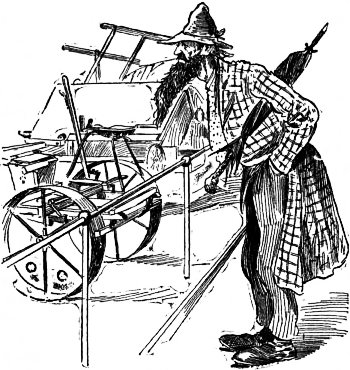
"HE STOOD CHEWING A WISP OF HAY."
"Every body but me and Sarah can scatter and we'll all meet at the far end of this house, or if not there at the south side of the Sixty-third street gate at six o'clock." Fanny and Johnny took Uncle at his word and were soon strolling among the booths, but they were more intent upon watching the maneuvers of the various types of people than of observing what the earth is able to produce out of its soil. They heard a band playing somewhere in the distance and they moved on that way.
As a curious observer of this moving world, Fanny made note of the many interesting exhibitions about her of country ignorance and enthusiasm. At one place she stopped near a tall, lank farmer, whose cowhide boots had left their massive imprint on every roadway on the grounds. He stood chewing a wisp of hay plucked from an exhibit, while he gazed in delight at the harvesters, plows and sheaves of wheat which stretched away before him in an endless vista.
"Wall, I swan," he at length confided to the dignified guard, who stood like a sign-post near the door, "this 'ere's the only thing I've seed 'minded me of hum. Bin tramping raound these 'ere grounds, scence 7 o'clock, b'gosh, an' ain't seen a blamed thing did my ole heart so much good as this show right here. By George! wish I'd a struck this buildin' fust thing I come in. Would a saved me a power of walkin'. Say, had a great show out our way a spell ago. Had a corn palace—Sioux City, you know. Be they goin' to have a corn palace at this 'ere fair?"
The guard unbent enough to guess not.
"Sho! y' don't say so. Wall, that's curious. Corn palace out to hum was the biggest show ever give out that way. And crowd! Say, I'll bet a nickel I've seed as many as hundreds of people thar in one day. In one day, reclect, all just looking at that there corn palace. Wonder these fellows didn't think of that. Would a drawd all the folks from out in our section, shore. Tell you what I don't like about this show," he went on, waxing confidential, "Too much furrin stuff here. Don't see nothing from Keokuk, Sioux City, Independence or even old Davenport. But all London and Berlin and Paris, and all them other places where they's kings and things. Ought to a give the folks here more of a show, b'gosh, same as we did out to hum. Why, they wasn't none of this statoo stuff thar, I tell you. Wasn't no picters and the like of that. What good is them picters over there, I'd like to know? Why, some on 'em, the folks ain't got a stitch of clothes on 'em, and you couldn't hang them air picters in a barn. Ought to have more of these things here—oats and wheat and seedin' machines. Them's what people want to see. And say, I was daown here below this mornin', and by gum, I seed the damdest lookin' fellows I ever seen in all my born days. They was heathen Turks, I reckon, with rags round their heads and wimmin's clo'es on all o' 'em. I was a-scared to stay there, b'gosh, and I jest lit out, I tell ye. Well, I'm goin' through here and see what you've got, but I jest tell you this is the part of this show that'll do. Yes, sir." And the rural visitor stalked away.
In less than two hours the brother and sister had reached the west doorway, but uncle and aunt were nowhere to be seen. Then they went up into the gallery to hear the musicians again. It was very evident that Agricultural hall had swallowed their grandparents for that day and the grandchildren were left to shift for themselves. It was now past noon and they were both hungry enough to welcome the first lunch counter they could find. One o'clock found them again wandering listlessly about the gallery absorbed in the sights about them.