Chapter VI
Reading edition
DANGERS OF THE GREAT CITY
Johnny was listlessly walking along in front of Dearborn Station, on Polk street, when he saw some fine looking apples on one of the fruit stands. Instantly the old orchard at home came into his mind, and with it a hunger for apples that could not be downed. Fishing up a dime from his pocket, it was not long till two apples were his, one of them undergoing a carving that only a country boy hungry for apples could perform. As he turned the corner he passed a number of bootblacks tossing pennies to the edge of the curbing, the one lodging his penny nearest the edge winning all the other pennies. Johnny watched them long enough to understand their gambling game and then moved on.
"Hi ther, kids," said one, "watch me git a free lunch."
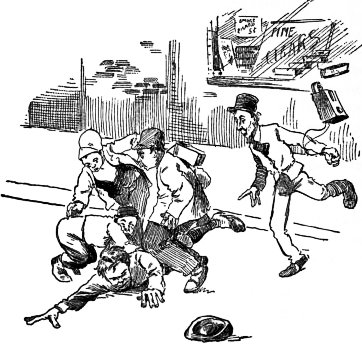
He came quickly up behind the unsuspecting boy and struck one of the apples out of his hand. But before he could pick it up, Johnny gave him a shove that sent him sprawling in the mud. Johnny stooped to regain his apple, but half a dozen of the other boys ran up and began striking him from all sides. His knife was open in his hand, and some one struck him a blow on the hand that knocked the knife into the gutter. Warding off the uncomfortable blows as fast as he could, he ran to get his knife. In an instant he was tripped down upon his face with half a dozen boys cuffing him about the head and shoulders.
"What you skates a-doin' there. Come off now; let a feller have a show!"
The boys were thrust back, and Johnny scrambled to his feet.
"Hello! If it ain't de kid wot's got de purty sister an' helped me to pepper de fake on Stony Island avenoo. Bin a-crapin', have ye, an' them fellers wuz a-doing ye up." It was the train-boy who had been of such service to Johnny's grandfather as they came into the city.
"BEEN A CRAPIN', HAVE YE!"
Johnny explained how it all happened, and they went away from the crowd. Johnny's clothes were soiled and his knife and apples were gone, but he was glad to get out of such a rough crowd.
"Where wuz ye goin'?"
"I've got an hour yet, when I am to meet Fanny at the north entrance to the store she's tradin' at. I couldn't stand taggin' after her, so she let me go."
Johnny had wandered from the store into the neighborhood of one of the most disreputable places in the city. He and his friend were coming up the street when the train-boy exclaimed: "Hi, thar, wot's yer sis doin' on dis devilish street wid dat thief yonder?"
Johnny looked where the boy was pointing, and, sure enough, Johnny saw his sister being escorted along the street by Mr. Blair, who had spoken to them of Mr. Moses on the train, and who had been with Fanny one day at the Fair.
"Why, ain't he all right," said John.
"Nary all right. Wusn't he helping to rob your grandad as he was a coming out of the train, and did'nt I nab his pal with the wad of stuff in his hand? He works with the feller what give yer old dad the short change."
Johnny would have started on a run after his sister but Louis said, "Hold on pard, I'm a running this. Ef your sis is all right, that feller is liable to git to travel over the road fer it. I've got it in fer that feller and you see if I don't git him pulled. I tell you if he gits your sis into one of them houses, she'll never come out alive fer she'll kill herself."
Johnny was white with fright but Louis laid his hand on Johnny's shoulder and said: "Now you watch the show."
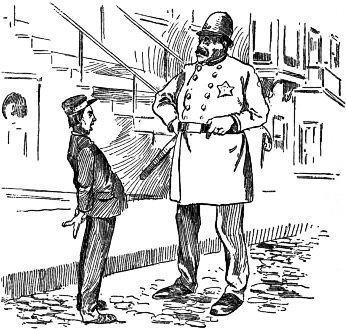
A policeman was at the next corner and Louis walked up to him with the air of one who had a most important communication to make.
"Me name is Louis Burjois, and dis is de brudder of dat gal wot you see walkin' over dere. She is an innercent gal, which dat feller is a-tollin' of her off. He's a pickpocket, and I'm one wot kin swear to it. We want him arrested an' jugged. We'll see to all de responsibility."
"Ah, you Arabs don't take me in that way. Git out. The gal knows her biz."
By this time Louis saw that the confidence man had stopped at one of the most prepossessing houses on the street. It was also one of the vilest and most dangerous places in the city. The door-bell had been rung, and there was not a moment to lose.
"SHE'S AN INNERCENT GIRL WHAT'S A GITTIN' TOLLED OFF."
"For God's sake run and yell!" and he gave Johnny a push in their direction, which was all he needed to send him flying up the street yelling and waving his hat and calling "Fanny! Fanny! Fanny!" like a boy gone mad.
The door had opened and Fanny was about to step inside, when she heard her name called. She turned around, but the young man crowded up behind her.
"Who is calling me?" she said. "It must be Johnny. Yes, it's his voice."
"No, it's only a bootblack," her companion said, harshly and excitedly.
"I know its Johnny," and she dodged by him out of the door. He tried to catch her by the arm, but, missing that, seized her dress, nearly tearing it off of her waist. At this moment Johnny dashed up, and, throwing his arms around her, cried: "O Fanny! Fanny! come quick! come away! don't wait a minute!" and he fairly dragged her to the sidewalk.
The young man disappeared through the door but not before he saw Louis come running up and shaking his fist at him yelling at the top of his voice, "O you horrible old cheese, I'll get your mug behind the bars some of these days in spite of yourself."
The policeman was placidly watching the scene, but concluding at last that something unusual was happening he came up and went into the house. A few minutes after he came out alone and walked measuredly on toward the end of his beat.
Fanny in the meantime had pinned her dress and was walking away with the two boys. She was not less excited than they were.
"What is the matter? I can't think. What has happened; there must be something awfully wrong."
"Well, you see, miss, that feller is the pall of the man what tried to rob your grandad and he was a taking of you to one of the worstestes places in Chicago."
"Why he showed me his detective star and also papers and business cards the other day at the Fair. I met him this time in the store. While we were talking there he showed me a blue book which he said was a list of the best society of Chicago, and he showed me his name and his sisters'. I didn't know anything how to trade at the big stores and he said it would please him so much to take me and introduce me to his mother and sisters, who lived only three or four blocks away, and one of his sisters would come back with me and I could do my trading in half the time and to so much better advantage. He talked so nicely that I didn't see how I could refuse to go."
"That's the chap exactly. He's a bad man, and I'm a going to run him in yet."
Louis gave a self satisfied toss of the head, clinched his fists and said, "Its lucky, awful lucky that I seed ye." Fanny shuddered and she whispered a fervent prayer of thankfulness.
They had now arrived at the store and Louis acted as ready escort to the various booths where Fanny desired to trade.
"Don't you forgit that you have to meet me at the Sixtieth street gate at nine o'clock next Monday morning for to be my body guard the whole week and I think I can get our grandpa to throw in about two dollars a day for ye for general services. Anyhow, I don't see how any of us can feel safe any more without you being around. I expect if you come out to our farm, I'd save your life about a dozen times a day for the first week, you'd need me around pretty bad for the first month."
"It's very glad I am that I struck you," said Louis, "for my dad got killed cause he stuck by his engine and I have to help the folks so much that I couldn't get into the Fair only by scheming somehow, and I might not hit the combination."
Fanny and Johnny, still bewildered over their adventures, now took a cable car and in a little while were telling their astonished grandparents about their day's experiences and Fanny's wonderful escape from the confidence man. Uncle could not remember Mr. Blair, but it was a good occasion for one of his impressive lectures on the providence of God.
It was an evening for the electric display at the grounds and at eight o'clock they were seated near the statue of the Republic on the south side of the basin waiting to see the crowning achievement of modern intellect.
No wonder that the papers of the next morning spoke of the "White City in a blaze of glory," and that "thousands viewed the sight, entranced with the marvelous exhibition." It was a sight to inspire the writers of the day, and of all the descriptions that Fanny culled none were more appropriate for recalling the memories of what she saw, and to record what she had experienced, than the reportorial sketches of this night. The hour approached for the most wonderful illumination since God said: "Let there be light."
Slowly night came on, and slowly night was turned back into day. A few stars came out and shone for a little while, and then disappeared from man because of the blaze of light he was in.
To the north and west a heavy pall of smoke brooded over the city. Above it a broad band of gorgeous crimson, shot with purple and yellow, marked the dying glories of the day. Overhead scattered clouds floated against a gray sky, and through them yellow stars were shining. Looking down into the grand basin the white walls of the palaces which bound it loomed gray and ghostly. On the southern horizon the chimneys of a blast furnace belched their red flames high into the darkness.
One by one white globes of light glittered about the graceful sweep of the basin. They cast deep black shadows on the walls behind them, and threw burnished, rippling ribbons over the dark water below. The broad avenue leading to the north between the Mines and Mining and the Electricity buildings grew brilliant on either side. At its far northern end a clump of tangled shrubbery lay in heavy shadow, and still beyond, stretching away for miles, a hundred thousand scattered yellow sparks told that the great city was awake. Far off on the dark lagoon, men were singing, and the echo of their voices rose faintly through the silence.
Suddenly a single beam of yellow light, like a falling star, flickered and grew bright on the high dome of the Administration building. Then lines of fire ran down its splendid sweep, and outlined in flame it stood out in splendor against the night. About its base circled a wheel of light, while above a hundred torches flared into the darkness. Within the great buildings about the basin electric coronas were ablaze and the giant pillars of the colonnades loomed white against the shadows. From their caps huge figures of the arts of peace leaned out over the black abyss beneath. Along the top of the peristyle flickered a yellow ribbon of flame, and above, dim and gray against the sky, senators and heathen gods look down upon the glory.
Between these lay the dark waters of the basin, seamed with faint, waving bars of light. Over them, like long black shadows, graceful gondolas slipped in silence, and electric launches with their fiery eyes crept across the vista.
From the roof of Music hall a wide pyramid of fierce white light was thrown upon the Administration dome. Its blazonry of yellow died away, and under the new glare the delicate, lace-like tracery of gold and white was brought into strong relief. From the roofs of the buildings of Manufactures and Agriculture twin search-lights beat down upon the MacMonnies fountain. Behind it the plaza was black with men, and its pure white figures shone as if carved from Parian marble.
Then the light was changed, and in a glory of crimson the ship Columbia, with its white-armed rowers, sailed on before the people. From his high pillar on either side, Neptune, leaning on his trident, looked down serenely. The search-lights swept the horizon, and for a moment graceful Diana loomed against the sky like a figure suspended in midair. At the east end of the basin the Golden Republic glittered against the night, lifting her golden eagle high above the crowd. Smoke from a passing engine rose about the dome of the Administration building, and its fiery outlines flickered and grew faint. The triumphant goddess seated high on the galley in the central fountain was bathed in a glory of green fire, and then yellow, changing again to its spotless white.
Under the great central entrance to Electricity building stood all the while the figure of an old-time Quaker. His eyes looked upward, and he held in his hand the feeble instrument which made possible the glories of this night. Franklin, with his kite, looked out upon the consummation of what he dreamt of when he drew lightning from the summer cloud. For two hours the "White City" blossomed in new beauty. The great basin was bathed in a flood of fairy moonlight. Outside the peristyle the lake beat its monotone against the walls. On the plaza the great orchestra of more than 100 men played patriotic music, and the people were filled and lifted with the spirit of the night.
The search light was a great surprise. It went dancing along the fronts of opposite buildings, climbed up the towers and brought out golden Diana. It flashed against the statue of the Republic, and kept it for a full minute resplendent as though carved from a block of flame and then flickered away, leaving the great figure in twilight uncertainty. After a time three irregular splashes of light were playing hide-and-seek along the basin and up the fronts of the big building. The lights changed their colors. Sometimes they were green and again they were blue or red.
While several thousand people were admiring this picture, a rocket of light shone out from one of the high corners of the agriculture building and flooded the MacMonnies fountain in a whiteness which made all the other light seem dim and lifeless. Under its focus the golden caravels and the draped figures showed strange contrasts of chalky pallor and deep shade. Only a moment later a second bar of light leaped out from a sky-high nook of the Manufactures building and swept the surface of the basin. It struck a moving gondola, and in a flash showed the gay Venetians bending to their long oars, the bright colors of the boat and the muffled forms of the passengers.
Johnny had left the others absorbed in their trance of delight. He sought other sights. Directly he came to the Electricity building, with its marvels of light. It burst on his childish mind, seeking for novelties, as greater than the scenes outside. It was something that Fanny and Uncle and Aunt must see. He ran in the greatest haste to bring them. When they came in, Johnny showed them where to sit to see the great illumination in the center of the building. It was then quite dark about them, but Johnny knew the marvelous sight he had said was there would soon appear.
Four rows of colored bulbs containing incandescent lights and placed on zig-zag frame works forty feet long in different directions are about a pillar around which are twined strings of two thousand electric bulbs of red, white and blue. The pillar is covered with bits of reflecting colored glass, thus making a magic intermingling of lights that almost rival the lightning in startling brilliancy and produce a pillar of fire scarcely surpassed even by that one which led the Israelites across the sea.
When the illumination came the weird ingenuity of the electric magicians struck Aunt Sarah with a sublimity almost more than she could endure. As the flashes of light struck out about the pillar and the ball of fire fell as if dropped from some creating hand she screamed, "O my God, what blasphemy is this that men have achieved. Can they snatch the fire from heaven and make the lightening a plaything?"
She sank upon a chair and gazed stupefied for some minutes at the awful scene. Then as they passed on she said, "I have seen the wonderful machinery great and small. I have seen the old relics which they say are the remains of men's hopes long gone by, but when man can take the light that comes out from the storms and put it up for show, it seems to me that I am seeing forbidden things and that the skill of men has gone too far."
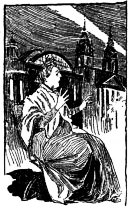
"The light shot across the sky."
At the next flash from the tower there was a shriek and a crowd began to gather about a man just across the hall. The cry came from a man who could receive the terrible grandeur but he did not have the strength of mind to sustain it.
He was gazing upon the incandescent globe-studded column, as in a trance, and again one of the electricians turned on the current and the shaft changed to living fire. The man seemed horrified by the unearthly beauty of the spectacle. It continued but a minute, when the current was turned off and the blinding light disappeared almost as suddenly as it had come.
A bystander whose attention happened to be directed toward him says that he stood gazing at the column for fully three minutes after the light had been turned off and that his countenance betrayed overwhelming bewilderment. Once or twice he raised a hand and drew it across his forehead. Then he was seen to press his temples with both palms, all the while gazing in an awe-stricken way at the great pillar. The attention of several visitors was attracted to the farmer, and one of them stepped to his side to inquire if anything was wrong with him. As the gentleman reached his side the latter threw his arms upward and, with a shriek that started the echoes, fell forward upon his face. Two or three guards rushed to the prostrate man's assistance, but before they reached his side he leaped to his feet and, screaming at the top of his voice, ran through the aisle toward the entrance facing the lagoon.
In a moment all was excitement, and the great crowd of visitors, becoming panic-stricken, ran in a dozen different directions or hid behind exhibits. The madman, pursued by a half-dozen guards, dashed down a side aisle and, leaping over boxes and machines, made a complete circuit of the General Electric company's exhibit and then paused again before the central column. Two guards seized him, but he threw them off as though they had been infants and again he started on a wild hurdle race through the building. He had not gone far when he tripped and fell, and in a moment three bluecoats were upon him.
Struggling and shrieking, the poor man was half led, half carried, to the north entrance of the building, where was waiting a patrol wagon. It required the combined strength of five guards to get the unfortunate man into the patrol wagon. Throughout the short drive to the patrol barn the prisoner fought like a wild animal and the officers had their hands full in keeping him aboard. When brought before the sergeant the prisoner became exceedingly quiet and spoke rationally while giving his name and address.
One of the guards then began to detail the offense of the prisoner. The recital had but just begun when the man became greatly excited and began screaming once more. The sergeant placed his hand in a kindly way upon his shoulder and gently forced him into a chair. The man grew quiet again and listened to the guard relate the story of the arrest without interruption. When the officer had finished the man arose and, walking up to the sergeant, said:
"Don't harm me, I didn't put all those bottles there. I'll tell you how it was. Somebody has stuck those bottles on that post and covered them up with a white cloth. When they raised the cloth the bottles turned to fire. I am not to blame. I don't know how those bottles came there. There are millions of them. They were all right at first, but the devils poured red fire into them. Don't hurt me. I had nothing to do with it."
The sergeant talked kindly to the man, and when he was quieted led him to the hospital, where a doctor attended to him. Here he entered into a long description of the pillar of "bottles," by which he evidently meant the incandescent globes. The doctor gave his patient a quieting potion, and in a short time he fell into a sleep. When he awoke from his sleep he was quiet, but his mind still dwelt on the pillar of "bottles," and he insisted on repeating his version of the affair to all the doctors. In the evening a carriage took the patient away, supposedly to the detention hospital.