Chapter XII
Reading edition
BEAUTY SHOW
Fanny was at the inn when noon came but the boys were nowhere to be seen. She saw great crowds of people massed a little way up the street but crowds were a common sight. She heard broken narrations of some exciting event that had transpired but there was nothing to cause her to think that her brother might be the central figure of all the excitement. Johnny rarely missed his appointments with her and she felt that something unusual had occurred or he would have met her at the designated place.
She decided to spend the afternoon at the Libby Glass Works and at the Beauty show. Once in the works, where glass is wrought into the most curious and costly designs, a few hours seems only too short for a good appreciation of the work done. The art, as illustrated there, is as fascinating as a romance. Three hundred people are employed there daily in showing what can be done with glass. Entrance is to be had to the blowing-room, in the center of which is the huge cruciform. In this there are placed the crucibles, as the working-holes are called. The heat in the furnace is 2,000 degrees Fahrenheit.
The batch from which glass is made is composed of sand, lead, saltpetre, potash and soda. It has to be cooked in the terrible heat for twenty-four hours before it is fit for use. In front of the working holes are the workmen. A long steel tube is thrust into the batch and a quantity of the mixture accumulated on the end. From the moment it is taken out of the crucible until the form is completed the operator never allows the hot glass to be still for a moment. It is always moving.
The second floor of the building is a lively place. It is here that the cutting is done. The process is most interesting and shows the highest skill of the glass-worker's art.
Opposite the cutting department is the glass spinning and weaving department. The spinning of glass into fine threads is done by means of a wheel nine feet in diameter which revolves twenty times a minute. A glass rod is exposed at one end to a blowpipe flame. When the glass is melted it is attached to the periphery of the wheel and the operator sits with watch in front of him. Every minute the position of the melting glass is shifted until the broad wheel is filled, when it is stopped and the glass is cut and taken off, made into the desired lengths and taken to the loom. The weaving is done by girls on hand looms. Two hundred threads of glass are woven alternately with one thread of silk. The thread is made up into napkins, neckties, lamp shades, bonnets and hats.
"SHE THOUGHT VERY DIFFERENTLY OF HIM NOW."
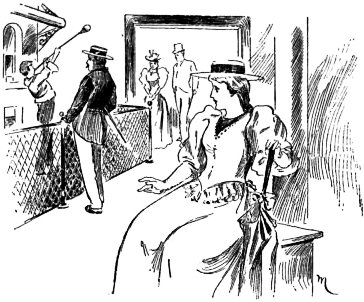
Fanny sat down on a bench to rest for a while when, chancing to glance to the far side of the exhibit she saw Mr. Warner, whom she had formerly known as Mr. Moses, intently watching the work in the looms. She thought very differently of him now. Louis had hotly defended him against everything the confidence man had said, and, of course, she now saw that the man who had spoken against Mr. Warner was of the most abandoned type of men. Somehow she felt that she owed him some palliation for the rudeness she had exercised. It would, perhaps, not be altogether according to the rules of etiquette; but if the opportunity offered she intended to say something in explanation. As he came on around her way she felt her pulses beat faster and her face flushing under some strange excitement. As he approached to where she sat, he saw her and stopped for a moment. When he came by she looked, up and he bowed and was about to pass on, but she arose from her seat and he stopped. He held in his hand some samples of woven goods, and he remarked that he was making a study of these fabrics to see if they were worth handling by his firm. The conversation led on so easily and naturally that she forgot that she had something she wanted to say in extenuation of past rudeness. She could not help observing how totally different was this man's bearing and conversation from the evil-minded man who had presumed upon her acquaintance before. There were no questions asked; no lead in conversation that caused her to speak in any way whatever of herself or her people. In a few minutes he had passed on, and she felt from instinct and reason that this man was a gentleman.
"THE LADIES WANTED TO SEE HER DRESS."
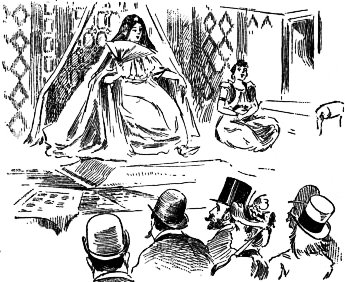
From this place she went over to the international dress exhibit, more commonly known as the "Beauty Show." Here were fifty young ladies chosen from as many different nationalities in order to exhibit the fashions of the world in the highest art of dress. At the front was Fatima, the queen of beauty. Her booth represented a room in the Sultan's harem. On either side, reclining on an ottoman, were her waiting maids, and at her feet her special servant. All the magnificence of oriental splendor surrounded her. A group of at least a hundred people were continually crowding the railing in front. They plied her with questions, and the ladies were much offended because she would not walk around so they could get a better view of her dress. She could answer questions in nearly any language but Turkish, and she finally admitted to some French gentlemen who were quizzing her that she came from Austria, her foot servant from the south of France, and her waiting maids from Paris.
That international beauty show is a wonderful and fearful affair. The beautiful representative of Ireland is dressed in green, and wears glasses.
"Arrah," said an Irishman to the proprietor, "raley now, is it in grane all the Oirish girruls do be drissed? By the bones av St. Patrig, 'tis the first toime Oi iver saw wan in glasses."
"The fact of the matter is that our Irish young lady is ill, and we have engaged this young lady to fill her place," said the proprietor, and he moved away only to hear the following conversation with the typical Greek lady from the Ionian isles:
"Do you speak English?" from a visitor. The lady shook her head.
"Do you speak French?" This In French by the same. Another shake of the classic head.
"Do you speak Greek?" This actually in Greek, but it only brought another shake.
"Sprechen sie Deitsch?" cried the visitor, with some impatience.
"Oh, ja! ja!" exclaimed the Greek young lady, eagerly, and a general laugh went around the little group which had listened to the conversation.
"Say, Bess," said a young fellow, nudging his girl and pointing to the Queen of Beauty, "ain't she a corker?"
"Naw," replied Bess. "I don't see anything pretty about her. She's all drug store. Anybody can see that."
"How d'ye like that, Mariar?" remarked an old Hoosier, stroking his yellow whiskers and squinting at his better half, a hawk-faced woman of determined countenance. "I tell yer what. Mariar, with all your good qualities yer never could hold a candle to that 'ere girl, could yer, now? Honest?"
"Benjamin! Come right along out o' here. Yer head's bein' turned by these brazen-faced females. Why, yer'll be cavorting around here like a young colt in a minnit or two. The idee o' comparin' me with that painted young woman—me, your loving wife—come along now," and Benjamin went.
"THERE WAS A PERT YOUNG MISS WALKING THE FLOOR."
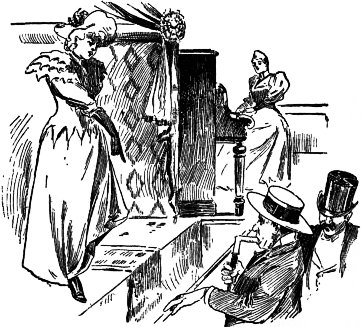
At the United States booth there was a pert Miss walking the floor, monarch of all she surveyed, a typical Uncle Sam's daughter. It was a sorry mistake when a dude presumed too much on her patience or a smart young man made too free with his remarks. She was always ready for them, to the delight of the patriotic young Americans about.
Here Fanny found five young girls studying the United States beauty with more than ordinary interest. Each of the girls wore a badge, on which was printed C. C. of C. C., and just above these letters were five more, M. K. S. L. N. A note book containing a pencil was attached by a neat little chain with the badge. There was scarcely a minute that one or the other of them was not writing something in her book.
Dressed exactly alike and being so intent on their work, they were evidently not ordinary sight-seers. Finally some remark was made between Fanny and one of the girls and Fanny showed her own note and sketch book and asked how they were keeping theirs. It soon appeared that these five girls were in a contest of more than ordinary interest. An enterprising newspaper of a Southern Illinois town had sent these five girls to see the Fair. They were to be supplied with all needful money, to be independent of all escorts, to take notes and write up their adventures and their version of the scenes of the great exposition entirely unknown to one another, and the paper would publish their reports on their return. Competent judges were to decide on the merits of their work and a handsome reward would be given to the successful writer. In an adjoining town another editor had sent out five boys on the same errand. The writers must all be between twelve and fifteen. The one out of the ten who did the best work was to receive a splendid souvenir medal. They were given ten days of sight-seeing and their whole souls were in the work.
"But what can be the meaning of these letters C. C. of C. C."
"At home they say these letters mean Crazy Cranks of Cumberland County but the fact is they have a meaning which is a secret that shall die with us. We are sworn with each other never to reveal it and to prove that girls can keep secrets. Of course the letters form our club name, and it has the word Columbian in it, but that is all we are ever to tell. We have a constitution and by-laws and regular meetings for mutual protection and advice in our trials and troubles." This was all quite interesting as a proof of what the girls in the latter part of the 19th century could do. Fanny and these girls at once became fast friends, for she found that they did not live a score of miles from her home, and that there were a number of people and home places that they all knew.
"But what can these letters "M. K. S. L. N." here at the top of the badge mean?"
"Oh, that is no secret. They are the initials of our names—Mary, Kate, Stella, Leila and Nannie."
They said they were not the only ones on a like errand, for they had met a little girl all the way from Boston, and only fourteen years old, who had been sent on the same errand by her class in the high school, and they had heard of girls from the south and west who were coming for the same purpose.
"We can't lecture," said Mary, "but we are going to help the Women's Congress prove that girls have just as much brains and courage as boys."
It was now nearly six o'clock, and Fanny was so interested in the five girls that she persuaded them to go home with her to enjoy the evening together. It promised a pleasant diversion, for the five girls had been hard at work several days and had not met a single acquaintance or congenial friend.
When Fanny arrived at her hotel that evening with the five girls, it was to discover Uncle and Aunt in consternation over an extraordinary story told by Johnny, who had arrived home an hour or two before. According to his story, he and Louis had tried to see into the Dahomey village. He did not know that it was wrong. He missed his balance and fell over the fence. He was scared and stunned by his fall. After a while he heard Louis yelling as if in great pain. Then two policemen came in and protected Johnny till he got safely away. When they reached the outside of the crowd which was all the time yelling at them, the policeman told him to git if he didn't want to get mobbed. He ran as hard as he could run in order to escape. Then he remembered Louis was caught, for he had heard him calling for help. Johnny came back around the buildings, but, alas! the bloodthirsty mob had done its work and Louis was no more. Johnny, now safely at home, lay moaning on his bed and would not be comforted. Fanny remembered having seen the great crowd over by the Dahomey village, but she had not dreamed of such a terrible scene taking place. Altogether it seemed incredible.
"Extry papurs, all about de cannibal feast!"
A thought suddenly struck Fanny that if there had been such a horrible tragedy as Johnny had told of, the papers would tell all about it. She ran down to the street and came back with a copy. She looked rapidly over the paper, but she saw nothing about a lynching at the Fair grounds. Then the front page leader, with its half a column of head-lines caught her eye:
"EXTRA, SEVEN O'CLOCK"
"The Mystery of the Dahomey Village deepens as the Investigation Progresses"
"The French proprietor avers that there was no attempt at Cannibalism, but he cannot make a coherent statement of the case"
"The supposedly bloodthirsty Dahomey men and amazons, said to be the most peaceful and mild in Africa. The natives contradict themselves and tell a dozen different stories. The Exposition management greatly alarmed, and the investigation being pushed with vigor. Horrifying disclosures supposed soon to be reached"
She read it over, then she read it aloud to sorrowing Uncle Jeremiah and Aunt Sarah. The truth of the great unintended hoax and misunderstanding began to dawn upon them. Then she explained the situation, and Johnny was brought out to hear it fully discussed. It was now clear to all of them, but what should they do was the next question. They could not think of the newspaper notoriety that the avowal of the truth would give them. Anyway, it had gone too far for them to interfere. Surely it was wisest and best for them to say nothing. It was so decided. As ludicrous as it was, it had become too grave a matter for amusement.
"Of course you will help us keep this secret, you girls?"
Not a word was returned but Mary picked up her chair and sat down in front of the four girls.
"The noble and progressive association, C. C. of C. C. will now come to order."
Instantly each girl sat prim and upright in her seat.
"Is there any question before this deliberative body of girls?"
Nannie arose and said, "Madam President, I believe it is proposed that we add another secret to our list."
Leila had her note book out and was taking down the minutes of the meeting.
"Believing that this should be done," Nannie continued, "I move that what we have heard and now know concerning this newspaper sensation we forever keep secret."
Stella seconded the motion.
Here Kate got the floor and said she did not think it advisable to add another secret to their list for she now had so many that it was making her life a burden in trying to remember them every time she had occasion to open her mouth. Besides the case would certainly be a scoop for them against the boys and would make them famous and cause the "Weekly Express" to be circulated all over the globe if it published the first true version of the case.
"THE NOBLE AND PROGRESSIVE ASSOCIATION, C. C. OF C. C."
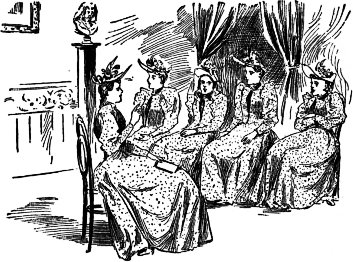
There was a sharp discussion for a few minutes, in which parliamentary usage was dethroned and confusion seemed to rule but they were young women and therefore had not lost a word.
The vote was taken and there was but one voice in the negative. There was a motion to make it unanimous and it was unanimous. Thus the wish of their hostess prevailed and another great secret was forever closed In their hearts from the common herds of mankind.