Chapter XVI
Reading edition
TO BUY A DOG
Jackson Park was a paradise of peace and rest compared with the nerve destroying difficulties of sight-seeing in the city. Uncle had experienced all the adventures he wanted, and his great desire now was to escape all further mishaps until he could get back safe among his Jerseys on the farm.
Tired from much walking among the scenes of the Exhibition, the family sat down upon one of the rustic seats in Wooded Island. It was a most picturesque place, a most inspiring spot from which to contemplate the great sweep of history that had culminated on those grounds.
"The longer I stay about this Fair," said Uncle, "and the more I see, the more I wish I knew. I can see folks discussing things with such great delight when I can't understand anything but the ifs and ands and buts. I heard a man say to-day that Columbus never discovered America, that he was a pirate. He said that all these doings should have been for a Viking or some such name. I knew it wasn't so, for so many people couldn't be fooled. How may that all be, Fanny?"
"There are a great many theories and stories set afloat about the discovery of America by people who desire more to show off their ability to construct plausible heresies against accepted things than to give real historic truth. But there is much that at least seems to be evidence of the Norsemen having been in America 500 years before Columbus touched the outlying islands of the West Indies. The Sagas of Leif the Lucky and Eric the Red told some marvelous stories of discoveries to the southwest of Iceland. Some of these stories seem to be verified in many ways, by digging up the logs of the Norse huts, by the written characters on Dighton rock, by the old tower at Newport, by the Benheim map of 1492, and a number of other important things.
"Then there has been found what seems to be beyond doubt a figure of Buddha in Yucatan, and also a Buddhist monument in Central America. Therefore a number of people have been trying to prove that Hwul Shan of China, discovered America ages ago. There are likewise well established the claims of the Phenicians and Greeks and even the Welsh and the Irish. But all of these were fruitless till Columbus in his high aspirations to become a great prince over unknown countries and to spread the Christian religion of his day, opened the way for the course of Western empire."
"But Fanny," said Uncle. "I heard the man say that Columbus didn't know anything and had no chance to learn."
"Yes, Father, this glorious year has taught to the students all over this country the beginning history of our great republic even as this Fair is teaching the progress of the world. Though Columbus was the greatest man of his age, yet we know only that he was the son of a wool comber and that he attended the school at Pavia, where he showed a marvellous aptitude for astronomy and cosmography. He became a sailor on the Mediterranean, some say a pirate, but the ships of one nation then preyed on the ships of another and considered it legitimate because there was then no International law. He married the daughter of an Italian named Palestrello, who had been a celebrated Portuguese sailor. With her he received many valuable charts, journals and memoranda. He soon moved to Lisbon, which was then the center of everything speculative and adventurous in geographical discovery. Columbus made a living here by making maps. Here he studied out his theory that he could reach Asia by going west, and he made several voyages to the Azores and Canary islands, which were then the limit of sea navigation. Then began his travels for help to carry out his wonderful plans. He took with him his motherless boy, Diego. From place to place he went with a heroism of patience never surpassed. The story of the rebuffs and privations through which he passed will be the wonder and praise of men forever. Weary and footsore and hungry, he stopped one day before the Franciscan Convent La Rabida, in Andalusia, to beg some bread and water for his child. Then came the mysterious turning of the scales in the forces of human greatness. The Superior of the convent happened to pass by, and, struck by the appearance of the poor traveler, began to talk to him. The Superior at once saw that no ordinary man was before him. Grander views were never presented and greater plans of conquest were never known. Christianity was to invade Asia on its eastern shores and meet the irresistible forces from the West. Columbus believed himself divinely inspired for this and therefore demanded that he be made high-admiral, governor-general and viceroy over all the land he reached and that for his revenue there should be given one-tenth of the entire produce of the countries. Such a far reaching demand as this could not have been acceded to only by a doubting sovereign, and he would probably have been beheaded with his puny crew of one hundred and twenty men if he had reached Asia and attempted to carry out such a wholesale scheme of subjugation.
"The months of this voyage were scarcely less full of treason, burdens, and peril than the years that had been given to make the voyage possible. A pension was promised to the man who first sighted land but Columbus saw a light rising and falling on the evening of Oct. 11, and on that account claimed and received the pension. It is said that the sailor who really saw land first foreswore his country and fled to Africa because of having lost the pension and the honor of being the first to see land. This is told by the enemies of Columbus to prove a sordid and avaricious nature. It is also told that he took such exasperating and outrageous measures to uphold his visionary schemes of conquest and government as high-admiral, governor-general and viceroy, that it became more than his home government could endure.
"His last voyage was disastrous, but whether from his own desire for gold hunting, or because from the demands of his crew, it can not be told. A man was sent to supersede him and chains were placed upon the man who had worn the robe of royalty. His last years before the public were even more bitter than his first. Until his death he seemed to spend all his time in trying to recover from the king his lost prestige, titles and possessions, but they never came. He besought Ferdinand pitifully to bestow them as a perpetual heritage upon his son, even if not to him. In a letter to his sovereigns, he said: 'Such is my fate that twenty years of service, through which I passed with so much toil and danger, have profited me nothing; and at this day I do not possess a roof in Spain that I can call my own. If I wish to eat or sleep, I have no where to go but to the inn or the tavern, and I seldom have wherewith to pay the bill. I have not a hair upon my head that is not grey; my body is infirm, and all that was left me, as well as to my brothers, has been taken away and sold, even to the frock that I wore, to my great dishonor. I implore your highness to forgive my complaints. I am indeed in as ruined a condition as I have related. Hitherto I have wept for others: may Heaven now have mercy upon me, and may the earth weep for me!'
"He died in bitterest poverty at Valladolid at about the age of seventy years. He was buried at Valladolid for a short while to satisfy the Franciscans, and then removed to Seville by request of his relatives. It was said that Columbus wished to be buried in San Domingo, and Charles V. gave authority for this to be done to the grandson of Columbus, and the family of Colon was to occupy the chapel of the cathedral. But there is no record whatever of the events of his burial at San Domingo. This is accounted for only on the theory that Drake, the English pirate, destroyed them when he sacked San Domingo.
"In 1795 Spain ceded San Domingo to France and it seemed to the Spanish people to be a national disgrace for the bones of Columbus to remain on foreign soil. There were no explicit directions as to the exact spot where his bones were and it was not known then that five of the family were buried together there. What was supposed to be his ashes were taken to Havana but in 1877 while making some repairs in the vaults another tomb was discovered in which was a strip of lead from a box which proved that the place contained the ashes of the grandson of Columbus. Then a further search was made; only a few inches from the vault first opened another vault was found and in it a lead box containing pieces of bone and human dust and on the lid was written
"D. de la A. per Ate"
which is supposed to mean "Discoverer of America, First Admiral." A silver plate inside had inscribed on it the names and titles of Columbus. This much decomposed leaden case was placed, with its contents, in another case of satin wood and glass, and all deposited in a vault so that the contents could be seen through the glass. Spain could not think of giving up the honor of having the bones of Columbus on her own soil, and the Royal Academy of Madrid made an exhaustive study of the subject and at last published a book in which they closed the argument with the following words: "The remains of Christoval Colon are in the cathedral of Habana, in the shadow of the glorious banner of Castile. It is most fit that over his sepulchre waves the same flag that sailed with him from Palos in the Santa Maria.""
After reviewing this history, which her interest in the great Fair, and the great events it commemorated, had caused her to learn, and after consulting her note book to be sure of her correctness, there was a general discussion among them, which showed that sight-seeing was not all they were doing at the Fair.
"Some bodies for the heads and feet."
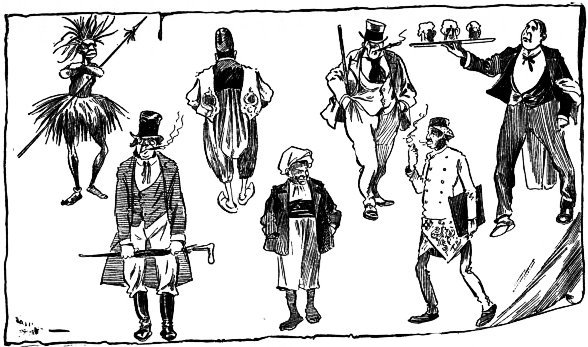
It was now past noon. Aunt decided to go home; Fanny would walk up and down the "Plaisance," and with her sketch book see what she could do toward putting bodies between some of those heads and feet she had drawn. Uncle and Johnny decided to go up to the business portion of the city to spend the rest of the day. It was a pleasant afternoon, and when they reached the viaduct from the train a great mass of people were passing and repassing. The great Auditorium building loomed up before them, with the Art Gallery on their right and the Columbus statue on their left. Under them trains were gliding by like long serpents, and out in the lake fleet steamers and sail-boats loaded with people were moving about like white spots on the blue waters. Uncle and Johnny passed along the sidewalk in front of the hotel when something at the corner caught their attention, and they came up for a moment to look at it. Two or three men also turned, stopping by him when he stopped. Then a few more came up, and a ring of men began to form. Uncle and Johnny now noticed that they were surrounded by people, and they attempted to move out, but in vain. In a short time the crowd had become so large that the sidewalk was blocked, and none except those who were close to the center knew what the original attraction was. The people coming over the viaduct and from far down the street noticed the crowd too, and bent their steps also in its direction. Some, fearful that they would miss something, began to run. The contagion for speed spread, and soon the whole mass were speeding up the boulevard with open mouths and wide-staring eyes. Each was asking the other as he ran, "What is it?"
As they came in contact with the central surging crowd where each man and woman was trying to see over the heads of those in front, despite the fact that the object, whatever it was, was on the ground, the question was repeated. But no one seemed to know what had happened. People in the center of the crush began to demand room and air. In vain they struggled to get out. The people still coming over the viaduct would start into a run as soon as they were on the street, and thus continually adding pressure on the outside made the positions of those inside almost unbearable. The crowd was now a pushing, clamoring one, extending some distance up and down the sidewalk and out into the street. The apparently insolvable mystery as to the nature of the accident or cause of the excitement only made the crowd more persistent and harder to manage. There were some who shouted, "give the poor fellow more air." "It's a shame to crowd around him like that." Then they would push harder than ever to see what it was.
Two men pushing each other got into an altercation. One struck the other, almost knocking him down. The crowd quickly took hold of the injured man and shoved him out into the "outer darkness," as if he had been a criminal, while the other was let alone. Some shouted for a doctor, others for the patrol and ambulance and the police. At last two officers came. After ringing up the patrol they forced their way through the crowd, which quickly fell in behind them and pressed on again with the renewed hope of seeing something. The presence of the officers only added to the general excitement, and people who had been
laggards or had left in disgust came back at a double quick.
When the police got to the wall of the building they found a man who had two Newfoundland pups tied to a string. The patrol wagon was sent back empty, and the crowd, which had been sold instead of the pups, dispersed.
When Uncle got out he took his bandana out of his hat and mopped his forehead, as if he had just finished tossing up a load of hay to Johnny on a hot day in the hayfield.
"ONLY A COUPLE OF NEWFOUNDLAND PUPPIES."
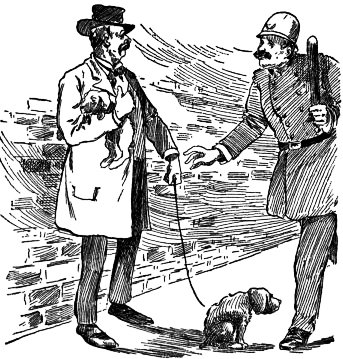
"Consarn them critters!" he said, "I was thinkin' of buyin' one of them Newfoundland purps for Fanny, but the crowd was so anxious to see the trade that I've got entirely out o' the notion. I never see such curiosity people in all my life. The other day I stopped at a winder, and before I got half through seeing there were about fifteen people standin' around and lookin' over my shoulder. I guess I can't see anything any more without tollin' so many folks on that I'm liable to get crushed. If country folks was half as curious 'bout things as these city folks, they might be laffed at with some sense."