Chapter X
Reading edition
PLAISANCE SOCIETY
When Monday morning came the family were promptly at the 60th street gate at nine o'clock. Johnny espied Louis with his eye over a knot hole that seemed designed by providence to let the hungry outsiders have a morsel of the Midway Plaisance scenery. Inside of the grounds Johnny determinedly led the way at once to the great Ferris go-round. They stood before it measuring their chances of living through such a revolution. It did not take much to persuade Fanny to accompany the venturesome boys; Uncle positively refused to discuss such a piece of folly, but Aunt decided at last that if Fanny went she must go also.
Like a forbidden specter the skeleton of the Ferris Wheel stands out gaunt and fleshless. All around is full of light and gayety.
A devout Moslem may be pardoned if, as he passes, he touches his forehead with three fingers of his right hand and murmurs: "Allah il Allah!" Some such exorcism seems to be needed to ward off the evil spirits that one would think must cluster around the ponderous structure, perching, perhaps, like the broomstick riders of Salem, on its spare metal ribs.
They entered the car of the great wheel, and when the signal to start was given they found that another old lady with her dudish son were to be their companions in the aerial flight.
The earth was dropping away. Higher and higher they went. Johnny was holding with a death-like grip on to the car. Fanny's whole life was passing before her like a procession of spectres. In a few minutes they had gone more than one hundred and fifty feet, and the sky seemed to be falling upon them.
"Stop her!" shouted the dude, accompanying his words with a frantic waving of his hands. Higher yet they ascended and his face assumed the look depicted in the features of Dante's characters when about to enter the infernal regions.
"HIS PLANS IN LIFE WERE INTERFERED WITH."
"Now, if the good Lord ever permits me to get back to the earth safely," said the old woman, "I promise never to leave it again till I am called to die."
They had reached the top and passed the crisis of going up. Now they began to fall. The sky was leaving them, and the earth was coming after them. They had no time to think. The coming down was worse than the going up. When they stepped out on the earth at the bottom of their descent it was with a sensation of thankfulness never experienced before.
The wheel is 275 feet high, and requires over 500 horse power to turn it. The axle is the largest piece of steel ever forged, and it was a great triumph of engineering skill to put it in place 150 feet from the ground.
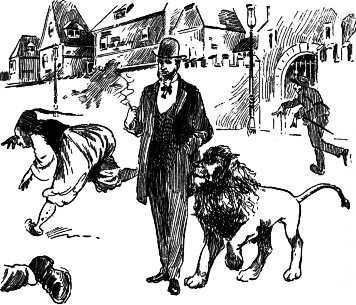
Hagenbeck's animal show was naturally the next attraction. Some distance ahead of them there was quite a commotion. Johnny and his companion were, as usual, ahead. In another minute Johnny came running back to Fanny and caught her by the hand. Without a word he started forward with her at a rapid pace. Quite a crowd was following some strange object, and Johnny hurried Fanny around to the front, where she saw Mr. Hagenbeck coming leisurely toward them with a lion walking by his side. This was the object which was attracting such a large crowd of people, and it indeed took some courage to stand there as he came by. So completely did they all acknowledge the superiority of the animal that there was no jostling about him. The Columbian guards did not have to form a line—in fact, even they gave way to the distinguished walker who held his head high in the air and enjoyed the bright sunshine without deigning to look at the crowd of different races around him. He was a native of India, and was born to be a king, but his plans in life were interfered with, and the forest in which he was to have ruled was invaded and he was captured. For some time he had not been feeling well, and the proprietor determined to let the captive see the sunshine. So they started out together, the lion walking along as quietly as a spaniel. When the six lions in the cage saw their comrade out for a stroll they gave a chorus of roars which made the windows rattle. It was answered from the roadway, and six guards who stood by thought discretion the better part of valor, and started on a run for the viaduct. Mr. Hagenbeck called them back and told them it was all right, but they still kept a safe distance. The lion seemed to enjoy the outing, yet when his trainer started to come back the monarch of the jungle followed him.
The crowd parted as the pair came toward it with more haste than grace, and the lion licked his companion's hand and went back to his cage. Mr. Hagenbeck explained that the lion is one of the largest in the world, and is not yet full grown. It is perfectly gentle, and at his home in Hamburg it is not kept in a cage, but plays in the yard with his children like a cat.
In front of Hagenbeck's building there were assembled a motley crowd of people gazing into a small room over the entrance way. There were a number of lions jumping about at the crack of the master's whip and giving the people a sample show of what could be seen inside. It caught the crowd, for there was a rush to the ticket office when the keeper disappeared from among the lions.
In the center of the building was a circular cage that looked like an old fashioned wire rat trap greatly enlarged. Into this cage the animals were introduced to go through with their performance.
"Well for that bear to walk on that globe and roll it along beats anything I ever seed," said Uncle. "He's got more agility in him than I ever had even at my best. Johnny, you couldn't walk a log across the creek as well as that bear walks that pole, and just look at him walking backwards. If you will notice, Johnny, you will see that the trainer gives all that acts bad a lump of sugar and the ones that act good don't get nothing. That's the way of lots of things, but if you will notice it the good ones will live the longest."
Aunt admired the dogs very much and observed that they didn't have to be told what to do as the others did and they were more willing and more grateful for attention. It was really pathetic and comical to see how they seemed to appreciate applause.
The dwarf elephant, thirty-five inches high, was brought into the arena in an ordinary trunk. It complacently ate some sugar and returned to its quarters.
When the show was over they walked up the street toward the Turkish village. Here a number of people were gathering around a Turkish fakir who was at the side of the street loudly proclaiming the merits of his wares and shouting out some tirade that his employer had taught him as a means of attracting a crowd. Johnny had seen the fellow before and he drew his friends up close to him so they could hear his peculiar harangue.
"By the beard of the prophet, my heart swells to spill the souls of those christian dogs. I am the mighty man of the desert and they shall repent or die."
"He, he, he," yelled Louis, "that's the feller what the kids told me yanked the mummy of Rameses from the holy temple and knocks out all the Chinamen and Arabs along the Plaisance. Look at him howl."
"Oh, Jeremiah, let's get away quick. I'm 'fraid he's dangerous," said Aunt Sarah.
"No he ain't," said Louis. "Jest watch me," and he walked up and tossed a copper at the orator's head and Abdul, the mighty man of the desert, caught it with a grin and in broken English said "tank ye."
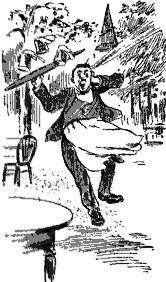
"Disturb me not, O reckless heathens," and he flipped a pebble with his fingers at a passing German who had just come out of the mediaeval castle with a tray of beer mugs on his head. The stone struck him on the ear. He set his tray down on a table and came over to the warlike Arab.
"Wot ver you trow dot stein."
"Move on I contend only with the strong and mighty."
"Wot ver you trow dot stein," and the little waiter edged up close.
"IT STRUCK HIM ON THE EAR.
"O mamma, I know the poor waiter will be killed, let's run away quick," said Fanny.
"O yer don't know nothin'," said Johnny, disgusted. "The Dutchman kin lick him in a minnit."
"She sketched their heads——"
"Wut ver you trow dot stein. You tink I am a house side. Donnervetter! I gif you some brains alretty;" and before Abdul, son of Cairo, could think, the little German tripped him to the ground, and as he fell caught him by the hair and dragged him into the boundary lines of the Turkish village, slammed him on the ground, and in a few minutes was back among the beer tables of the castle with his tray, calling "peer, peer, shents! ah trei peer, two cigar, kevarter tollar!"
The day had been a very fatiguing one, and Uncle and Aunt decided to spend the next day quietly at home in the hotel. Johnny and Louis had stayed manfully by the old folks all day, and their promised adventures had not yet occurred. The next day they were to be the guardians of Fanny, and they were quite proud of the duty.
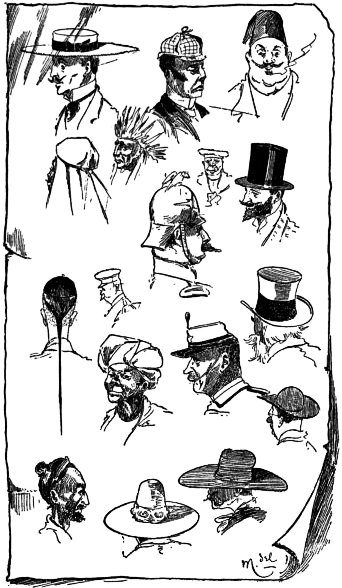
Fanny's note book and sketch book were now pretty well filled. Midway Plaisance heads and feet offered the most tempting work for her pencil. It is tempting enough for anyone to ask: "Where did you get that hat?" or "Where did you hit that shoe?" Evidently not in Chicago. Nothing of their kind ever graced a western city in such versatile varieties until the bands began to play and the world's cake-walk moved down the Plaisance.
In former years, when they had band concerts and Sunday school picnics at Jackson Park the visitor saw about four kinds of masculine headwear. One was the gray helmet of the park policeman resting under the tree. Another was the tall and shining silk hat of the elderly parent. In addition to these were some straw hats with rims not so wide as those of 1893, and derbys which were a trifle higher in the crown than the new ones. In the general description at the park the old styles of headwear have been crowded to the background by foreign novelties. The dicer, the fez, the turban, the hood, the helmet and the sun-shade are becoming very common. Only the stranger who comes into the gates is startled by the sight of a gaunt black man wrapped in a sheet and wearing coiled around his head enough clothing to make a good wash. But of all the incomprehensible varieties of headwear about the grounds from foreign lands, it remained for our own American Indian to outdo them all. When the great No Neck, of the Sioux nation, walks through the grounds with his war bonnet of eagle feathers trailing on the ground, the East Indians concede their defeat. No Neck's bonnet is worth about $400.
The footwear is worse in variety, if such a thing is possible. Perhaps, after all, it is a matter of education rather than appearance or convenience. The most elaborate is the high-topped boots of the German cavalryman, and the least the Dahomey Amazon, who sometimes has a red string tied around her great toe. They come from a torrid country, and have been freezing nearly every day, but scorn the apparel of the weak white man. The Amazons refuse to wear shoes. When it is too chilly for them to gallop around inside the bark fence they crawl into their tents, roll themselves up in the black blankets and criticise the policy of the Exposition.
On a moist day, when a Chinaman walks down the Plaisance he leaves a trail of oval-shaped tracks. It would take a keen judge of human nature to decide by looking at the tracks whether he has left home or was going back.
"——And then their feet."
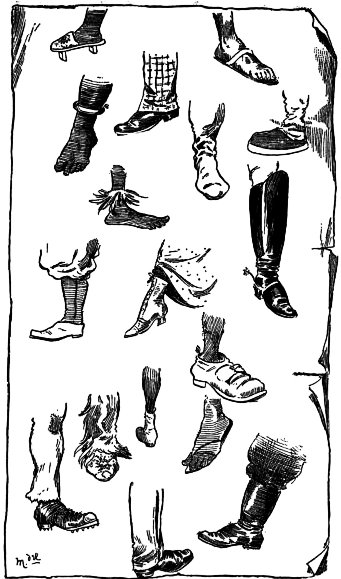
The Soudanese slipper is the most shiftless thing that a man ever put on his foot. It is simply a leather sole and toe. These represent the triumph of laziness. The Soudan citizen simply walks into his slipper in the morning and then in the evening he backs out. Every time he takes a step he lifts his heel away from the sole and it seems morally certain that he will lose the slipper, but in some way he manages to hold it. It is said this trick is accomplished by elevating the big toe at each step, thus preventing any slip. Any uncultured American who started for a promenade, wearing such things, would be in his stocking feet before he proceeded ten steps, but the men in the Cairo street tramp around all day and apparently do not realize that they are running any risk.
That evening at home Fanny gave a review of her note book, wherein she had recorded her observations on the politeness of the different nations as she had witnessed them. She thought the Javanese were the politest people of all. They always lay their hands upon their hearts and say, "I am honored," when spoken to. When they failed in their ability to answer a question, they just smile to show their good will. The Fort Rupert Indians politely tell their visitor to go when they have told what is asked for. There is of course more kinds of etiquette in the Plaisance than in any other spot of its size on earth. If the visitor desired to be just right it would require an etiquette reference book in at least sixteen languages.
Among the Turks there are strange habits. In greeting a stranger they bow very low and remain perfectly silent until spoken to. They will then shake hands in a genuine English fashion. One Turk calling on another will never sit down until the host arrives, even if he has to wait an hour. When the host comes in the two sit down after having exchanged greetings and not another word is spoken until coffee is served. The Syrians, on the other hand, will not turn their faces to a host before being spoken to. It is the proper thing when visiting one of them to take a seat with the back to the door and wait until the host enters and make no move until spoken to, when the visitor is expected to rise and bow.
To fully understand all an Egyptian says and does is a harder task than deciphering the hieroglyphics on an obelisk. The language of the Egyptian gentleman is the most fulsome possible. If he should be in need of a little temporary loan he will pound the man (whom he hopes to confidence successfully) on the back until he can hardly breathe. Experts in Egyptian etiquette can tell by the pounding process what is coming, and when the ceremony reaches the piledriver degree it is the proper thing to say: "What can I do for you?"
On hearing this the Egyptian will talk something like this: "Do for me? Why, my dear and most honored sir, your humble dog of a servant would not presume to ask a favor of one so great as you. I thought of calling on you yesterday, but it rained, and I feared that you would not be in a good humor and might refuse me, but then I want nothing. Who am I that a humble follower of Mohammed should dare to ask of you, my great lord and master, the very slightest favor? And yet if it had not rained yesterday I should have been fully inclined to ask you for temporary aid, but to-day I would not think of causing your highness any trouble. Why should I, who am so lowly, ask one for $5 for a few days. It would be an insult to you; one you could never forget. What, you insist on it? I am to take this, am I? Now really, as I was saying that one so low—but if you positively insist, if you are sure you will be deeply and terribly insulted if I do not take it—but your dog of a servant——"
That settles it. Having obtained the money he marches out without a thank you or goodbye.
The Dahomey people are the strangest of all. The first greeting of one amazon to the other is to slap her face. The visitor always slaps the hostess first, and if the visit is welcome the visitor gets a cuff on each cheek, and if it is not convenient to receive the visitor no slap is given in return.
But the palm is left to the American for a whole-souled disregard of the feelings of others. The show was brought here for the special benefit of the visitor; he has paid his money, and he has the right to do as he pleases.
If the sedan chair bearers happen to pass with some fat man for a passenger, the whole street is in an uproar of English comment meant to be humorous. Then the ordinary American visitor seems to think it his prerogative to point at the foreign contingent and say things aloud about them that would secure physical retaliation if the object of the remark were a citizen of the United States instead of a guest of the nation.