Chapter XIX
Reading edition
THE LOST FOUND
They took a car, and in half an hour were at the doors of the Clarendon Company. It was past business hours and the doors were locked. Fanny was greatly distressed as to what she should do; but there was no time to lose. Some young men were standing near eyeing her with the usual sensual greediness of their kind. Her mission was too urgent for her to notice their insinuating remarks.
"Can any of you tell me where or how I may find the gentleman named on this card?"
Her demeanor, so unaffected and true, brought all their latent manhood out, and each one was anxious for the honor of helping her.
Some one standing in the rear made an unbecoming remark, and instantly the eyes of those about her turned on him so meaningly that he slunk away. One of them took her into a restaurant near by and made known to the proprietor what she wanted. He said Mr. Warner lived with the head of the firm, a Mr. Sterling. The street and number of the residence was given to a cabman, and soon they were driving rapidly away.
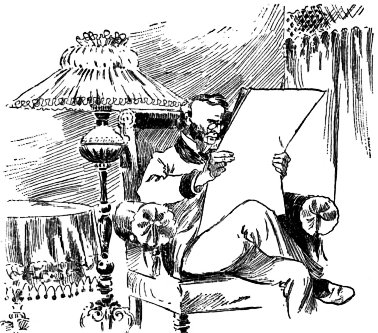
Mr. Sterling was sitting alone in his library reading the evening papers, when he heard a determined ring at the door. His door was open into the hall, and he went himself at once to answer the call.
It was growing quite dark, and he could distinguish only that there were two young people standing before him.
"Is this where Mr. Sterling lives?" said one, in a very pleasing tone of voice.
"It is."
"HE HEARD A DETERMINED RING AT THE DOOR."
"We are very sorry to disturb you, but we are in some trouble, and a gentleman by the name of Warner told us if, for any reason, we needed any assistance while in the city, to call on him. We went to the store, but it was closed, and then we were directed to come to you in the hope that through you we could find Mr. Warner."
John and Fanny saw a kindly appearing business man before them, and they spoke with the utmost confidence in his good-will.
"So, so! that is good. I have heard him speak several times recently of a young lady he met on the train, and somewhere else once or twice since. Are you the young lady I have been teasing him about? Now, that is good. Of course you can see him. He lives with me and is up-stairs now. May I ask what is the nature of your trouble?"
Johnny could hold his tongue no longer.
"Why, sir, they've tuck Grandpa up and got him in jail 'cause I stopped some crooks a gettin' his money."
"I don't see, my boy, just how that could be," and the gentleman seemed somewhat suspicious of their grandfather.
"I don't, nuther," blurted Johnny.
"Come in. I will send for Mr. Warner and see what he can do for you."
They followed him into the room, and he motioned them to take seats. Then he went out and sent some one up-stairs for Mr. Warner.
"Fanny, my little girl—my lost children!"
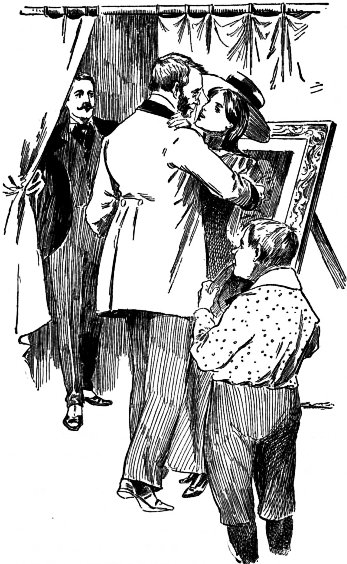
The room was richly furnished, but had an air of negligence about it that betokened the want of an interested woman's taste and care. They could hear voices now and then coming from some distant part of the house, but they sounded more like the hilarious gaiety of servants than of persons having such a cultured place for a home. From the tapestries on the walls to the piano and the great case full of books, everything was arranged for the convenience of the one rather than for the taste of the many. It was the most pleasing home, where money was lavishly spent, that she had ever been in, and perhaps she is not to be blamed that for a moment she was carried away by her surroundings, and the longing came over her to be so happily situated as this. Seeing a life-size painting of a woman placed on a high frame near a desk, she went over to look at it. There was something so lifelike and natural, and even familiar, about the picture that she still further forgot how she came to be there. She did not hear Mr. Sterling as he re-entered the room, but he came up to her, and as she stepped aside the light fell full upon her face almost on a level with the picture in the frame. A startled expression came over the face of Mr. Sterling, which deepened into an amazement. His face grew white, and he looked at her and then at the picture, and then from the picture to her.
The light of some quick intuition spread over her face, and she thrust her hand into her cape pocket and drew out a small gold locket, which she opened and looked at intently, and then from the face of the man to the face of the woman. Mr. Sterling saw the locket.
"What are you looking at, child?" he almost shrieked.
"My mother and father," she said.
He caught the locket out of her hand.
"There, there," he cried, pointing to the painting; "there is the same picture, it is the picture of the only one I ever loved, the one now in heaven, and you are her living image. In God's name, tell me, child, what is your name."
"My name is Fanny," she said, "Fanny Jones; sometimes they call me 'Fanny Sterling.' Mary Sterling was my——"
She never finished the sentence. With a cry of joy he caught her in his arms, sobbing and laughing; "My child, my child, my own little girl; found, found at last!"
Johnny at this amazing outburst had come up as if to protect his sister, and as Mr. Sterling saw him he cried, "And is this your brother, the baby I left never to see again till now?"
Mr. Sterling sat down and drew Johnny up to him. "A rough, hearty, honest farmer boy," he said; "I can not realize that after an endless search, you have been sent to me in such a strange manner."
Mr. Sterling overcome with his emotion, buried his face in his hands, and Fanny kneeling by his side, looked wistfully at him, not knowing what to think or do. Mr. Warner, in answer to the call, had come to the door and witnessed the whole scene. He could not understand it, and his astonishment rendered him speechless. At last without moving from his place at the door, he said: "What can this mean, may I ask? It is a mystery to me."
"My children," was all Mr. Sterling could say.
Her mission there suddenly came back to Fanny. She sprang to her feet and cried: "Oh! Mr. Warner, my grandpa is in trouble. You told us to call on you if we needed assistance in anything. He is in the police station as a result of our acquaintance with that man on the train. I came for you to go with us and see what you could do to help us out."
Everything was soon explained to them all; the cab that brought John and Fanny there was dismissed, and Mr. Sterling's carriage was soon speeding them all to the fastest train for the Fair grounds. At the police station half an hour later there was sorrow turned to joy, and a meeting that was too happy to be told. Uncle was released on bail to appear the next afternoon to answer to the charges, and there was a reunion at the hotel in another hour, when every past ill was forever buried in the pleasure of the present and the promise of the future. The next morning Mr. Sterling's house was made their abiding place, and Fanny became queen of his home.
That afternoon Uncle was in the police court awaiting his accusers. The judge called the case, but the witnesses were not there. Their names were called, but no one answered. Just then two boys came rushing into the room.
"Hold up, yer honnur," said one, "de persecution will soon arrive. I've been after 'em, an' I got 'em. I see 'em doin' de robbin', and' I found a policeman whut had sense enuf to take 'em in. See!"
"LOUIS CAME IN DANCING WITH EXCITEMENT BEFORE THE BURLY POLICEMAN WITH HIS TWO WARDS."
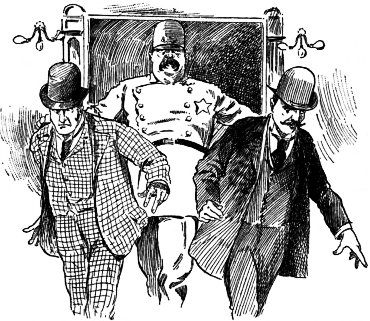
The irrepressible Louis had hardly ceased speaking when a burly policeman entered with the two confidence men who had attempted so perseveringly to get Uncle's money. Behind them came the man they had just been trying to rob. Johnny and Louis had seen them talking to a countryman, and, divining what was intended, followed them as they tolled him away to a place where they could accomplish the robbery. They found a policeman on the way, who took in the situation and assisted the boys to catch the fellows in the act.
Uncle's case was dismissed, and Louis succeeded in seeing the crooks given a chance to learn an honest trade at Joliet.
Sight-seeing as a business now gave over to a new order of things. The change was almost beyond what a dream could be. Before the C. C. of C. C. returned home there was a social gathering at Fanny's new home. Johnny had one young friend present and Fanny had five. Mr. Warner had often noticed that Louis was a very reliable boy, and Mr. Sterling gave him a good position in his store. Uncle and Aunt could not part with their children, and Johnny was so thoroughly a farmer that there could be no thought of him doing anything else; therefore, it was decided that Uncle's Jerseys should be removed to Mr. Sterling's farm, half an hour's ride from the city, and that Johnny should have charge of them there. Soon after, Uncle and Aunt sold their farm and henceforth lived as they pleased with Johnny and the Jerseys, or with Fanny in her happy city home. Mr. Warner is trying to win the approval of Fanny to some of his plans of happy life, and John and Louis believe they are more than kindly remembered by two of those bright girls known as the C. C. of C. C.
Here we may leave Uncle Jeremiah and family to the good of domestic contentment and to the well-earned peace of having lived life well. If the Exposition has awakened the sentiments of patriotism and reverence in the minds of all its visitors, and has broadened their views concerning mankind, and made more charitable their hearts toward the rest of the world, as it has done with this one true rural family, then it has been a mighty success, though millions of dollars were lost in its construction.
This need be none the less true to all, though no two people have seen the same World's Columbian Exposition. In all the vast throngs that have walked its streets and crowded its palaces for half a year there can be no two individuals who have the same story to tell, or who have the same thought to pay out to the world from that mint of human intelligence.
There is so much within the great "White City" that single pieces are lost like flowers in a landscape or like ferns on a mountain side. But its beauties inspire every soul; its refinements chasten every heart; its achievements exalt every mind, and its lessons give strength to every life.
THE END
