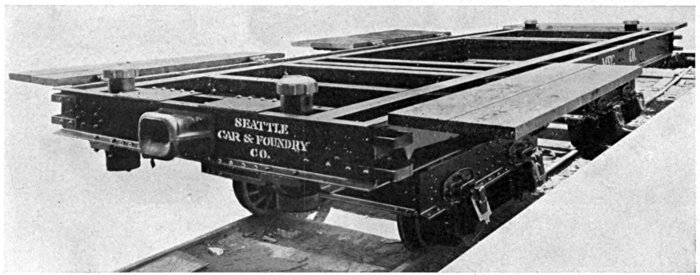
Yosemite Grade Destroyer Yosemite Valley Railway Standard Logging Car (60,000 POUNDS CAPACITY) Equipped with Hercules Bunks and Knight Chocks
Reading edition
This car was specially designed for the Yosemite Valley Lumber Co. to operate on an incline 8,000 feet long, with a maximum grade of 78%, the rise in feet from the foot of the incline to the top being 3,100 feet, the incline being in a vertical plane, but following the general slope of the mountain side and changing from one slope to another. The cars are let down the incline by means of 1½ in. wire rope, attached to a donkey engine.
This car was designed to meet these conditions, and is provided with a steel backbone, reinforced at the ends forward of bolsters to provide for the extreme angle of cable pull from a horizontal line and at the down hill end to support the bulkhead, which is provided to keep the logs from shifting. The vertical bulkhead posts are riveted to the steel backbone. At the cable end a special combination buffer and cable casting of cast steel is secured to the backbone by means of gusset plates, and is also riveted to end sill.
The backbone is built up of steel plates and angles in the form of a box girder, of the fish belly type. Cross bearers are located intermediate of the bolsters, and are sufficiently strong to carry the loads from the side sills to the center construction. Experience has proved that for logging cars, steel is unsuited for use in side sills, as continual shocks, resulting from discharging the load, cause their failure. For this reason red fir side sills were introduced in this car, making the underframe a composite construction of steel and timber. The side sills being supported at four points, viz.: at bolsters and cross bearers, no trouble has been experienced from failure of these sills. In case of failure, they are readily replaced, and the work can readily be done at any camp.
The bulkhead is constructed with a steel frame, with planking for the bulkhead proper, so that in case blocking is necessary to fill out between the log and the Bulkhead, this blocking can be nailed to the bulkhead to secure it in place, the object being to provide against the possibility of the log starting to shift.
The cable casting is made with a machine-fit pin to engage the shackle on the cable and place the pin in positive shear.
The cars were equipped with four Hercules Bunks, to provide for short or long logs.
The trucks are of the Diamond Arch Bar type, with cast steel bolsters. The bolsters are of special design, with hemispherical center bearing, to take care of the rock of the trucks in passing over the sharp, vertical curves.
Axles with 4¼×8 in. journals, and 33 in. chilled cast iron wheels are used.
Cars are equipped with Westinghouse automatic air brakes and inside hung metal brake beams.
The draft rig is of the twin spring type, with automatic couplers.
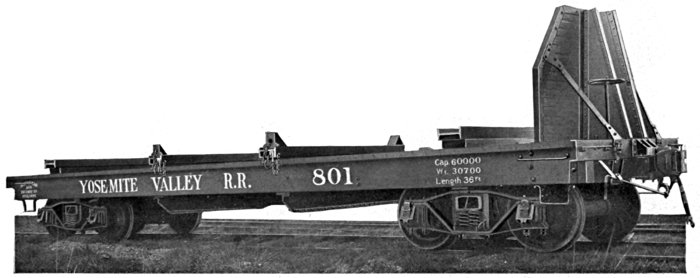
General View of our Yosemite Grade Destroyer
Details Yosemite Flat Car
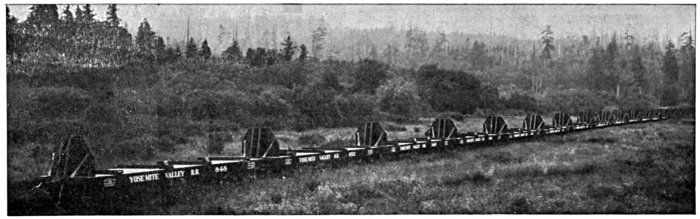
Train of Flat Cars in operation by the Yosemite Lumber Co. at Merced, Cal.
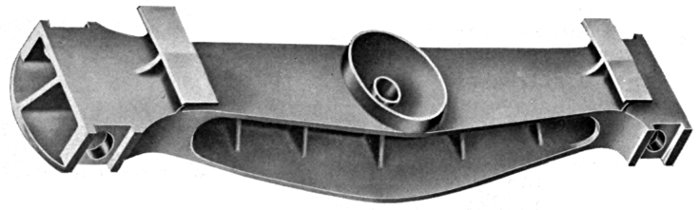
Cast Steel Bolster, showing Special Cup Shaped Center Plate Construction, giving full effective bearing
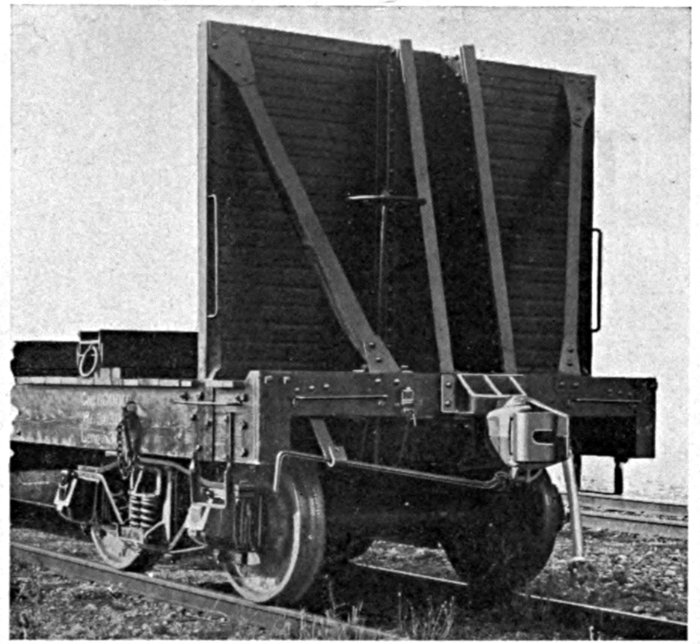
Bulkhead to Prevent Logs Shifting
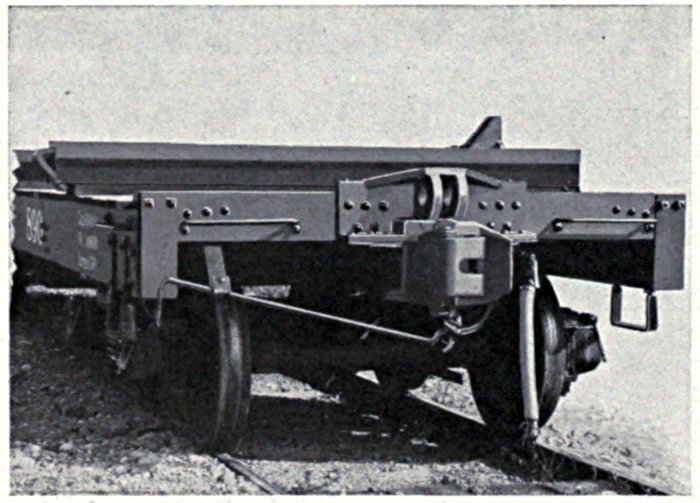
End of Car, showing Special Cast Steel Plate for attaching Hoisting Cable
CODE "Skidder" Number 150
Lidgerwood Skidder Car
60,000 Pounds Capacity