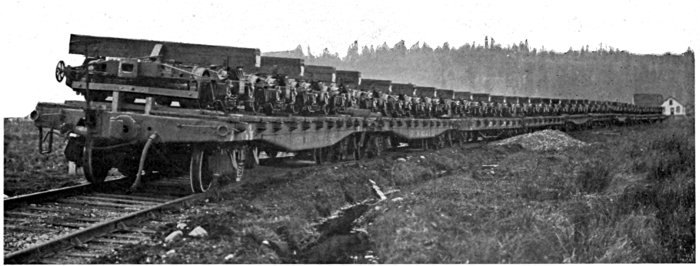
Air-Equipped Connected Truck (CAPACITY 80,000 POUNDS, ALLOWABLE OVERLOAD 10%)
Reading edition
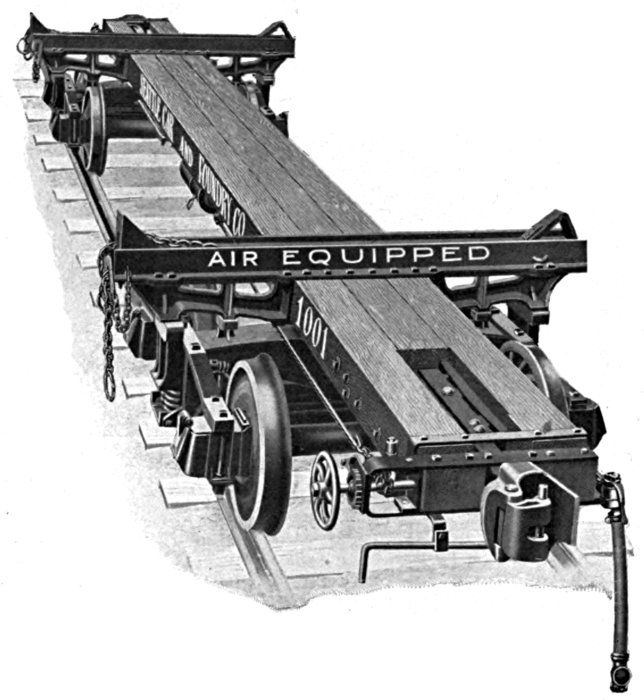
A detailed description of this truck will be found on the following page
This design is protected by U. S. patents

CODE "Connected"
Part of a train of connected trucks operated by Smith-Powers Lumber Co. of Marshfield, Ore.
Details of Air-Equipped Connected Truck (CAPACITY 80,000 POUNDS, ALLOWABLE OVERLOAD 10%)
This car was designed with the object of providing heavy capacity Trucks with Air-Brakes, and at the same time reducing the dead weight and maintenance to a minimum. This has become a recognized Standard Logging Car, and as the design permits of considerable latitude in length of car and centers of bunks, we do not hesitate to recommend it to anyone who requires either Flat Cars or Trucks for strictly logging purposes. The convenience of operation as compared with other types of equipment is apparent. From an economic standpoint the comparison is even greater. Some of the advantages are given below in detail:
1st. SIMPLICITY. Few parts to get out of repair, consequently car is always in commission.
2nd. REDUCED COST. First cost is 18% less than Flat Car of same capacity and equipment.
3rd. SMALL COST OF MAINTENANCE. More than 50% less than Flat Car.
4th. SAFETY OF OPERATION. Greatly increased over detached Trucks on account of Air Equipment and rigidity of connection, and over Flat Car in loading and unloading on account of skeleton construction.
5th. REFUSE NOT CARRIED TO DUMP. No deck to accumulate rubbish, adding to dead weight of car, and carrying it to the dump where it is discharged, often necessitating dredging to secure necessary depth of water.
6th. REDUCED DEAD HAUL. Which is 30% less than Flat Car of same capacity and equipment. This is important where heavy grades are encountered.
7th. OPEN DESIGN. Facilitates operation of both loading and unloading, lessening the time required and reducing the danger. At the same time, ample protection is provided for Brake Rigging, eliminating danger of being fouled by falling logs.
8th. INCREASED BUFFING CAPACITY. Connecting timbers forming backbone of 300 sq. in. cross section, which offers great resistance to buffing shocks.
Length over timber, 40 feet, can be furnished up to 56 feet. Length over all, 42 feet. Width over connecting timbers, 30 inches. Height to center of Coupler, 2 feet, 10 inches. Height to top of Bunk, 48 inches. Width of Bunk, optional, 9 feet or 10 feet. Bunk centers in illustration, 24 feet, but is optional with purchaser. M. C. B. Automatic Couplers. Westinghouse Air Brakes. Inside Hung Metal Brake Beams. Standard Diamond Arch Bar Truck Frame. Metal Truck Bolster. Seattle Car Manufacturing Co.'s Patent Cast Steel Body Bolster in combination with Patent Cast Steel Bunks, riveted together, making solid section. Thirty-three inch Cast Iron Wheels, chilled tread, double plate. Steel Axles, 4½ × 8 inch Journals. Malleable Iron and Steel Castings used throughout. Draft Gear optional. (Twin Spring or tandem.) Bunks Cast Steel, Hercules Patent, equipped with Knight Patent Chock, the McLafferty Stake, or the Skookum Bunk. Weight, approximately 19,000 pounds. This Car is protected by U. S. Patents.
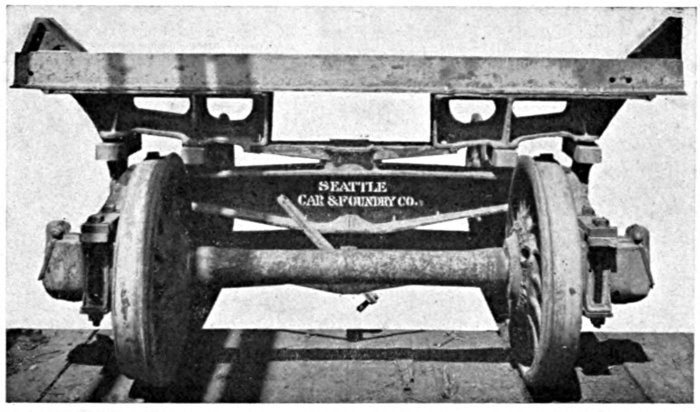
Owing to the original construction of Bunk and Bolster no part of the load is carried on the timber sills
Protected by U. S. Patents
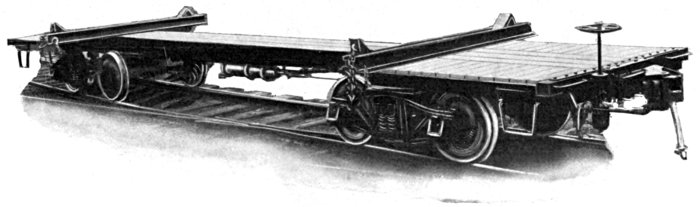
Air-Equipped Connected Truck
The Most Practical Skeleton Logging Car on the Market. Equipped With U. S. Safety Appliances to Meet Interstate Commerce Commission Requirements.
This car has done more to make the name of the Seattle Car & Foundry Co. well known among the logging fraternity than any other single one of our products. We instituted their use on the Pacific Coast. They were designed to avoid many of the obvious disadvantages of flat cars and to add the element of safety to trucks without materially increasing cost.
The letter which follows, pictures better than we could, the reception and experience of the trade, from the view point of the actual operator.
NORTHWEST LUMBER COMPANY Kerriston Mill Superintendent's Office
Kerriston, Wash., July 19, 1913
Mr. F. W. Chriswell, Chief Engineer, Seattle Car & Foundry Co., Seattle, Washington Dear Sir:
Mr. Horton our Secretary has requested me to write you of our experience with the connected logging trucks which we have been using for the last three or four years.
In a general way I might classify this under two heads, construction and operation. Regards to construction of these cars will say, while they are seemingly light, we have found them very strong, and more serviceable in our logging than flat cars which we had previously used and are still using. The air equipment as arranged in these cars is very well protected, and we have experienced practically no trouble whatsoever from breakage. Due to the construction of these cars with their three sills as the only woodwork, we have found the cost of maintenance very little, perhaps due to a certain extent to the accessibility of the parts, which permit of a thorough inspection by simply walking past the car. In operating, we have found these cars exceptionally adapted to the hauling of logs, and during our four years experience do not recall an instance where the load has been spilled due to any fault of the bunk or blocks. Our cars, of which we have twenty-four in operation, are built on twenty-four foot truck centers with nine and ten foot bunks, and during the last year and a half we have lost but one log except through derailment. We find that these cars seemingly ride easier than the seven flat cars which we have in service, permit of a larger load and carry their loads to better advantage. These cars are easily loaded, and it is not uncommon that we haul nine and ten thousand feet to the car. Our loads will average between seven and eight thousand feet per car. All of the trainmen who have worked on these cars, and the loaders in the woods like them very much. The fact that they are easy to load leads the loaders to put on a good load on them and in a careful manner, and in an all around way will consider them very much superior to the flat cars we are using, being seven in number of the standard logging type.
Any further information which I may be able to give you and which you may desire, will be furnished with pleasure upon request.
Very truly yours,
GEO. N. PECK,
General Superintendent
This Letter is Typical of Dozens We Have Received
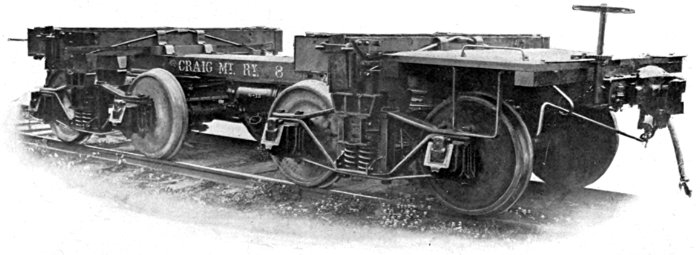
Old Style Standard Skeleton Car with Timber Bunk and Automatic Trip Pockets to Provide for the Use of High Stakes. Equipped With Air.
List of Parts—Standard Car Equipment
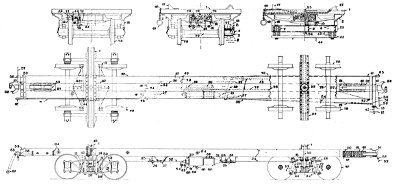
CASTINGS—
Give pattern number where possible in addition to list number.
1 BUNK
2 BUNK BRACKETS
3 JOURNAL BOX
4 JOURNAL BOX COVER
5 JOURNAL BOX WEDGE
6 COLUMNS
7 COLUMN GUIDES
8 JOURNAL BEARING
9 BOLSTER FILLER
10 CHAFING IRON
11 BRAKE SHOES
12 BRAKE WHEEL
13 RATCHET
14 PAWL
15 TOP CENTER PLATE
16 BOTTOM CENTER PLATE
17 CHOCK BLOCK
18 SIDE BEARINGS
FORGINGS—
19 TOP ARCH BAR
20 BOTTOM ARCH BAR
21 TIE BAR
22 TRUCK BOLSTER
23 SPRING PLANK
24 INTERMEDIATE LEVER
25 CYLINDER LEVER
26 LIVE LEVER
27 DEAD LEVER
28 DEAD LEVER STOP
29 DEAD LEVER STOP BRACKET
30 INTERMEDIATE LEVER FULCRUM
31 PUSH ROD
32 CENTER CONNECTION
33 TOP CONNECTION
34 BOTTOM CONNECTION
35 HAND CONNECTION
36 CONNECTION PINS
37 LEVER CARRIERS
38 CYLINDER BRACKETS
39 RESERVOIR BRACKETS
40 RELEASE VALVE HANDLE
41 PIPE CLIPS
42 BRAKE STAFF
43 BRAKE HANGER
44 SAFETY HANGER
45 GRAB HOOK AND CHAIN
46 FOLLOWERS
47 KNIGHT CHOCK BLOCK
48 CHAIN FOR CAST CHOCK BLOCK
49 CHAIN FOR "KNIGHT" CHOCK
50 TAIL STRAP
51 CARRY IRON AND BRAKE STEP
52 CARRY IRON
53 STRIKING PLATE
54 HAND CONNECTION BRACKET
55 CENTER PIN
56 CENTER PIN KEY
57 UNCOUPLING LEVER
58 UNCOUPLING LEVER BRACKET
59 BRAKE SHOE KEY
AIR EQUIPMENT—
60 AIR CYLINDER
61 AIR RESERVOIR
62 UNION
63 STRAINER
64 CUT-OUT COCK
65 ANGLE COCK
66 HOSE COUPLING
67 RETAINER VALVE
68 RELEASE VALVE
69 TRIPLE VALVE
70 TRAIN PIPE "B" END
71 TRAIN PIPE "A" END
72 NIPPLE
73 RETAINER PIPE
74 CROSS-OVER PIPE
LUMBER—
75 CENTER SILL
76 FILLER
77 DUST GUARDS
SPECIALTIES—
78 WHEELS
79 AXLES
80 TRUCK SPRINGS
81 DRAFT SPRINGS
82 COUPLER
83 "HUNTOON" BRAKE BEAMS
84 WASHERS
85 BRAKE ROD JAWS
86 PUSH ROD JAWS
87 DRAFT LUG