Rule for Measuring the Radius of a Sharp Curve
Reading edition
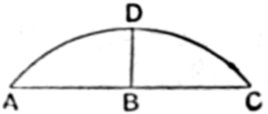
Stretch a string, say 20 feet long, or longer if the curve is not a sharp one, across the curve corresponding to the line from A to C in the diagram. Then measure from B, the center of the line A C, and at right angles with it, to the rail at D.
Multiply the distance A to B, or one-half the length of the string in inches, by itself; measure the distance D to B in inches, and multiply it by itself. Add these two products and divide the sum by twice the distance from B to D, measured exactly in inches and fractional parts of inches. This will give the radius of the curve in inches.
It may be more convenient to use a straight edge instead of a string. Care must be taken to have the ends of the string or straight edge touch the same part of the rail as is taken in measuring the distance from the center. If the string touches the bottom of the rail flange at each end, and the center measurement is made to the rail head, the result will not be correct.
In practice it will be found best to make trials on different parts of the curve to allow for irregularities. It is best not to measure across from one end of the curved track to the other even when the curve is so located that this is possible, since if any portion of the straight track at either end of the curve is included the result will be incorrect. This rule does not apply to curves of over one-half circle if the line is drawn connecting the two ends of the curve. It is a good plan to make the measurement on the inside of the outer rail of the curve, as this is often more convenient. In this case one-half of the width of gauge should be deducted from the radius when calculated, as the radius of the curve should be measured to the center of the track.
Example—Let A C be a 20-foot string; half the distance, or A B, is then 10 feet, or 120 inches. Suppose B D is found on measurement to be 3 inches. Then 120 multiplied by 120 is 14,400, and 3 multiplied by 3 is 9; 14,400 added to 9 is 14,409, which, divided by twice 3, or 6, equals 2,401½ inches, or 200 feet 1½ inches, which is the radius of the curve.
A B2 plus B D2
The formula is thus stated: == R.
2 B D
1202 plus 32
Or applied to the above example, == 2,401½ in. == 200 feet 1½ inches.
2 times 3
MATERIAL FOR ONE MILE OF TRACK
RAILS
Weight per Yard Tons per Mile
8 lbs. 12 4-7
10 " 15 5-7
12 " 18 6-7
16 " 25 1-7
20 " 31 3-7
25 " 39 2-7
30 " 47 1-7
35 " 55
40 " 62 6-7
45 " 70 5-7
50 " 78 4-7
52 " 81 5-7
56 " 88
60 " 94 2-7
63 " 99
65 " 102 1-7
70 " 110
75 " 117 6-7
Number complete joints per mile 90 per cent, 30 ft. and 10 per cent, short length rails, 358.
SPIKES
Size Under Head Average per Keg For Rail Weighing Kegs per Mile
6 × 9-16 320 75 to 100 lbs. 32
5½ × 9-16 375 52 to 75 " 30
5 × 9-16 400 45 to 60 " 26
5 × 1-2 450 35 to 45 " 23½
4½ × 1-2 530 25 to 40 " 20
4½ × 7-16 680 25 to 40 " 15½
4 × 1-2 600 20 to 35 " 17 2-3
4 × 7-16 720 20 to 35 " 14¾
4 × 3-8 1000 16 to 30 " 10½
3½ × 1-2 800 16 to 25 " 11
3½ × 7-16 900 16 to 25 " 12
3½ × 3-8 1190 12 to 20 " 9
3 × 3-8 1240 12 to 20 " 8½
2½ × 3-8 1342 8 to 16 " 7⅛