"Rainier" Logging Truck
Reading edition
We are the first builders of Logging Equipment to depart from the practice of the last twenty years and produce a Logging Truck designed along practical and economic lines. Modern railroading has developed the "Cast Steel" Engine Frame, Tender Frame and Passenger Truck Frame. Wherever safety is required together with lightness and durability, Cast Steel has been introduced.
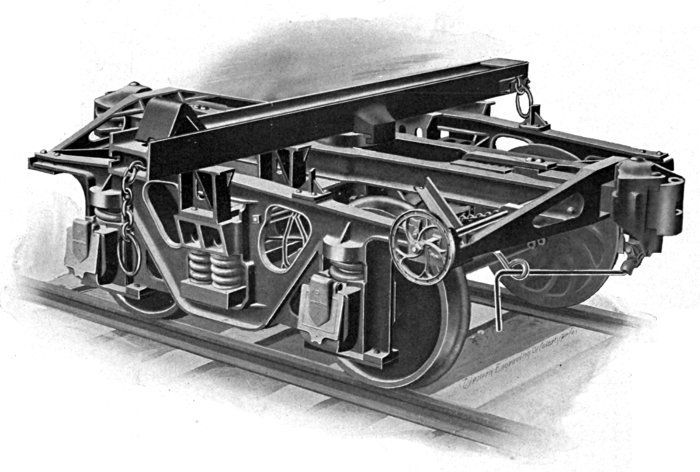
Following this modern plan we have constructed the "Rainier" All Cast Steel Truck of eight pieces where ordinarily several hundred are used.
Each Side Frame is in one piece taking the place of Top Arch Bar, Inverted Arch Bar, Tie Bar, Heel Brace, Truck Columns, and the many Bolts used to hold these parts together.
Each End Frame is in one piece taking the place of Top End Bar, Bottom End Bar, Striking Plate, Carry Iron, Corner Gussets, Brake Staff Brackets, and the numerous Bolts necessary to tie these parts together.
The Draft Beams are each in one piece, taking the place of Draft Timber, Draft Lugs, and the Bolts required to anchor them.
The use of Cast Steel permits of the most economic distribution of the metal, and the "Rainier" Truck is an example of what can be accomplished.
The Bolster and Bunk are similar to those used in the Hercules Trucks.
Springs are located under the Bolster to absorb shocks which would otherwise be transferred directly to the Truck Frame. The Springs over the Journal Boxes provide additional protection from shocks and also permit the wheels to hold the rails on an uneven track or at low joints.
Brake Beams are hung between the wheels and kept high enough to protect them in case of derailment.
The equipment includes Automatic Couplers to Couple with Standard Equipment, 33 inches above rail, and 33 inch Chilled Cast Iron Wheels fitted on Steel Axles with 5 × 9 inch Journals.
Journal Boxes are Malleable Iron. No Cast Iron is used with the exception of Brake Shoes.
The Center Bearing of the Bunk and Bolster is so constructed that the Bunk cannot turn over under load when train is started or stopped suddenly, as the Bunk cannot be removed from the Truck until it is turned parallel to the Draft Beams. The "Rainier" Truck stands for safety first.
CODE "Rainier" Number 340
All-Steel Improved "Rainier" Truck
Capacity 100,000 lbs.
Designed and built exclusively by
The Seattle Car & Foundry Company