Front matter (continued 9)
Reading edition
The same instinct in the full-grown man, draws a mob of ragged blouses after a Rochefort, in the streets of Paris, and builds barricades from which they fire upon the hireling soldiery of a Bonaparte.
CHAPTER XXVII.
THE BRITISH MUSEUM AND NATIONAL GALLERY.
N Great Russell street, Bloomsbury square, is the British Museum, one of the chief glories of the English metropolis, and an institution of which every Londoner is deservedly proud. There is, perhaps, no finer collection of curiosities and antiquities, and the nation has been for a century gathering the tributes of Science, Art, and Antiquity together in this vast building, which covers, with grounds and outbuildings, an area of seven acres.

The first purchase for the collection was made in 1750, when Sir Hans Sloane, a great collector and scientific man, died, leaving a will, in which he suggested that his collection which cost him £50,000 should be bought by Parliament for £20,000. This offer was accepted, and an act was passed purchasing Sir Hans Sloane's "library of books, drawings, manuscripts, prints, medals, seals, cameos, and intaglios, precious stones, agates, jaspers, vessels of agate, crystals, mathematical instruments, pictures, &c." Thus was laid the first foundation of the now world famous British Museum. By the same act a purchase was made of the Harleian Library of about 7,000 rare volumes of rolls, charters, and manuscripts, to which were added the Cottonian Library, and the library of Major Arthur Edwards. A lottery was devised, from which £100,000 was realized, and the collections were paid for from this fund, as well as the sum of £10,250 which was paid to Lord Halifax for Montague House, in which the museum was then located, and on which site the present building has been erected. The additional sum of £12,873 was paid for the repairs of Montague House, and a fund was also set apart for its taxes, salaries of officers, and Trustees, who were chosen from the best and noblest in the land, and in 1759 the Museum was opened to the public.
THE READING ROOM AND ITS OCCUPANTS.
The present lofty and imposing building was thirty years in construction, although the Museum was all that time open to the public, the building being erected piecemeal. The main buildings form a quadrangle with spacious and lofty galleries and courts. The entrances to the buildings are by magnificent staircases of stone, and the portico is adorned with giant figures and groups of sculpture.
Even in the old Egyptian days, no greater masses of stone were ever used than those which have been placed in the grand flight of steps of the main facade. There are twelve stone steps, 120 feet in width, terminating with pedestals, on which are the groups of sculpture. There are 800 huge stones in the edifice, weighing from five to nine tons each.
In the pediment, on the main front, are typified in storied stone, Man, Religion, Paganism, Music, the Drama, Poetry, the Patriarchs, Civilization, Science, Mathematics, and other allegorical figures. The entire buildings have cost upward of £1,000,000. The principal doorway is really majestic, being twenty-four feet high and ten feet wide.
The Reading-Room of the Library contains 1,250,000 cubic feet of space, the dome being 140 feet in diameter and 106 feet high. In this vast room an echo is heard like the sound of a trumpet, and on its shelves, and in contiguous alcoves, are 800,000 volumes of books upon every known subject and in every known language. This room cost £150,000. 4,200 tons of iron were used in the construction of the dome alone. There is accommodation for 300 readers, each person having a desk and table in a space of four feet three inches.
There is a great silence in this vast room where every one seems bent on study. The very doorkeepers who take your hat and umbrella, have a studious look. Every visitor presents his ticket of admission, and is registered for the benefit of the statistics of the Kingdom. Scores of men who have a taste for literature and reading, and no money to buy books, come here, and, during lunch-hours, those who are anxious to study, and do not wish to leave their seats, may be seen taking from under their tables light luncheons, kidney-pies, and sandwiches, of which they partake with that peculiar shamefacedness which is always observable in people who eat in public places.
There is a member of Parliament in his natty suit, and with a heavy watch-chain, who has gotten him down an old rusty tome, from which he is cramming with great earnestness for the next debate. Last night he had never heard of the subject of which he is reading, and just now he is full of it, and so puzzled with the wealth of the material before him that he does not know at which end to begin.
There is an old gentleman, in threadbare clothes, and worn cuffs, who has a very mild and placid face, and blue bulbous eyes. The table before him is strewn with old, worn volumes, bound with parchment and sheep-skin covers, and every time he turns a leaf a cloud of powdered dust ascends to his nostrils, and he is nearly suffocated. It is easy to see from this man's soft and fixed look that he is a monomaniac upon some subject, and that he is now settled for the day. Ah! what a sigh of relief from the old codger. He has, after great trouble, secured in his mind the point in dispute, and now he is at work rapidly scratching away at his notes. Looking over his shoulder I can see that the old fellow has a number of works on the subject of Heraldry before him, and he is, of course, tracing some mystic pedigree to the Flood, or further back, perhaps for the satisfaction of a butcher or tailor who may be in want of an escutcheon and a bar sinister in his shield.
In 1827, Sir Joseph Banks presented his botanical collection, and 66,000 valuable volumes. In 1837, the Prints and Drawings, the Geology and Zoology departments were formed, and in 1857, the Department of Mineralogy. The Museum is divided into departments of Printed Books, Manuscripts, Antiquities, Art, Botany, Prints, and Drawings, Zoology, Paleontology, Mineralogy, and Sculpture, each under the charge of an "Under-Librarian."
THE MAGNIFICENT LIBRARIES.
There are five Zoological galleries or saloons, embracing everything in the schedule of serpents, monkeys, lizards, tortoises, crocodiles, toads, antelopes, rhinoceri, elephants, and hippopotami, giraffes, buffaloes, oxen, lions, tigers, bears, otters, kangaroos, apes, squirrels, whales, sharks, porpoises, and all kinds of fish and mollusca.
There is also a gallery of Fossils, Zoological and Geological, and a Gallery of Minerals. In these galleries are eight saloons. Then follow the Departments of Botany, and the Department of Antiquities, containing vases, terra cottas, bronzes, coins, and medals. There are also three saloons of Anglo-Roman Antiquities, of Roman Iconography, three Greco-Roman saloons, the Greco-Roman Basement Room, the Lyceum Gallery, and the Elgin Rooms, in which are the splendid marbles collected by Lord Elgin at Athens, and which were bought for £35,000 by Parliament.
There are also the Hellenic Galleries of Marbles, the second Elgin Room, the Assyrian Galleries, 300 feet in length, and thirty other galleries, and innumerable saloons crowded with the most wonderful and valuable objects of art and science.
There is a Newspaper Saloon with the finest collection of newspapers in England. The catalogues of the libraries and collections of the Museum alone amount to 620 volumes. The collections are valued at £15,000,000. By act of Parliament, a copy of every book, pamphlet, sheet of letter-press, sheet of music, chart, plan or map, issued in Queen Victoria's dominions must be delivered to the British Museum. There are three libraries in the Museum: the King's Library, presented by George IV, consisting of 80,000 volumes; the Greenville Library, 21,000 volumes; and the General Library of 730,000 volumes, and which is inferior only to those of Munich and Paris.
Magna Charta, if not the original, a copy made when King John's seal was affixed to it, was acquired by the British Museum with the Cottonian Library. It was nearly destroyed in the fire of Westminster in 1731; the parchment is much shriveled and mutilated, and the seal is reduced to an almost shapeless mass of wax. The MS. was carefully lined and mounted; and in 1733 an excellent fac-simile of it was published by John Pine, surrounded by inaccurate representations of the armorial ensigns of the twenty-five barons appointed as securities for the due performance of Magna Charta.
An impression of this fac-simile, printed on vellum, with the arms carved and gilded, is placed opposite the Cottonian original of the Great Charter, which is now secured under glass. It is about two feet square, is written in Latin, and is quite illegible. It is traditionally stated to have been bought for four-pence, by Sir Robert Cotton, of a tailor, who was about to cut up the parchment into measures! But this anecdote, if true, may refer to another copy of the Charter preserved at the British Museum, in a portfolio of royal and ecclesiastical instruments, marked Augustus II, art. 106; and the original Charter is believed to have been presented to Sir Robert Cotton by Sir Edward Dering, Lieut.-Governor of Dover Castle; and to be that referred to in a letter dated May 10, 1630, extant in the Museum Library, in the volume of Correspondence, Julius C. III. fol. 191.
In the Museum, also, is the original Bull, in Latin, of Pope Innocent III, receiving the kingdoms of England and Ireland under his protection, and granting them in fee to King John and his successors, dated 1214, and reciting King John's charter of fealty to the Church of Rome, dated 1213. Also, the original Bull, in Latin, of Pope Leo X, conferring the title of Defender of the Faith upon Henry VIII.
ADMISSION TO THE MUSEUM.
The Reading Room is open every day, except on Sundays, on Ash Wednesdays, Good Fridays, Christmas-day, and on any Fast or Thanksgiving days ordered by authority; except also between the 1st and 7th of May, the 1st and 7th of September, and the 1st and 7th of January, inclusive. The hours are from 9 till 7 during May, June, July, and August (except on Saturdays, at 5), and from 9 till 4 during the rest of the year. To obtain admission, persons are to send their applications in writing, specifying their Christian and surnames, rank or profession, and places of abode, to the principal Librarian; or, in his absence, to the Secretary; or, in his absence, to the senior Under-Librarian; who will either immediately admit such persons, or lay their applications before the next meeting of the Trustees.
Every person applying is to produce a recommendation satisfactory to a Trustee or an officer of the establishment. Applications defective in this respect will not be attended to. Permission will in general be granted for six months, and at the expiration of this term fresh application is to be made for a renewal. The tickets given to readers are not transferable, and no person can be admitted without a ticket. Persons under eighteen years of age are not admissible.
The Reader having ascertained from the Catalogue the book he requires, transcribes literally into a printed form the press-mark, title of the work wanted, size, place, and date, and signs the same. Readers, before leaving the room, are to return the books or MSS. they have received to an attendant, and are to obtain the corresponding ticket, the reader being responsible for such books or MSS. so long as the ticket remains uncanceled. Readers are allowed to make one or more extracts from any printed book or MS.; but no whole or greater part of a MS. is to be transcribed without a particular permission from the Trustees. The transcribers are not to lay the papers on which they write on any part of the book or MS. they are using, nor are any tracings allowed without special leave of the Trustees. No person is, on any pretence whatever, to write on any part of a printed book or MS. belonging to the Museum.
The persons whose recommendations are accepted are Peers of the Realm, Members of Parliament, Judges, Queen's Counsel, Masters in Chancery or any of the great law-officers of the Crown, any one of the forty-eight Trustees of the British Museum, the Lord Mayor and Aldermen of London, rectors of parishes in the metropolis, principals or heads of colleges, eminent physicians and surgeons, and Royal Academicians, or any gentleman in superior position to an ordinary clerk in any of the public offices.
Some idea of the magnitude of this great Museum may be formed when I state that the clerical and literary force connected with the institution is larger than that of any similar foundation in Europe but one—the Imperial Library at Paris.
There is first a Principal Librarian, a Secretary, fifteen keepers of departments, beside a little army of attendants, messengers, bookbinders, watchmen, and doorkeepers, numbering over one hundred persons. Beside there are fifty or sixty persons of literary eminence and celebrity connected with the Museum, and employed to perfect the collection, to collate and arrange the books and to classify subjects. In this way alone the expenses of the establishment amount to £40,000 yearly.
The average number of visitors to the Museum yearly is over one million, and the galleries are entirely free to the public.
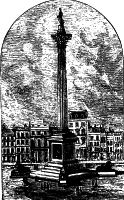
NELSON'S MONUMENT.
Next to the British Museum, the most frequented place in London is the National Gallery of Art, in Trafalgar Square, facing Nelson's Monument. This lofty monument fills the eye of the spectator as it takes in the range of one of the finest squares in Europe. The column is a circular one, 145 feet high, and the figure of the great naval hero, Nelson, on the top, is 17 feet high. The monument was built in 1840-43, and is placed on an elevated pedestal of granite. The Emperor Nicholas of Russia gave £500 toward the erection of the monument, and the rest was raised by public subscription. The two immense lions of bronze who lie couchant at the base of the monument, were modeled in iron from visits made by Sir Edwin Landseer to the live lions at the Zoological Gardens.
THE NATIONAL GALLERY.
There are also statues of Sir Henry Havelock and of Sir Charles Napier, on each side of the inclosure which fronts the Nelson column, twelve feet high and of bronze, and just below in an angle of the square is a bronze statue of George IV, which cost £10,000. These three statues, which are all equestrian, were paid for by public subscription.
On one side of the square is the church of St. Martin, an imposing looking building, built by Wren, and on the lofty steps of this church the crossing sweepers and bootblacks of the Metropolis have their daily rendezvous, and here divide their earnings with each other.
The National Gallery is, therefore, in a most commanding site, and from its broad steps a very fine view can be obtained of the Strand, Charing Cross, Parliament Street, and the Houses of Parliament.
The edifice was finished in 1838, and is 461 feet in length, and its greatest width across the saloons of painting is 56 feet. The stones were taken to construct it entirely from the King's Stables or Mews, and the building has a peculiarly sombre and solid effect. In it are a range of spacious galleries, whose walls are covered with the greatest works of the old masters and modern painters. It is the chief collection of paintings in the British Islands, and the number of subjects amount to 1,600. The number of pictures in the National Gallery, as compared with the number in the Continental galleries, is as follows: National Gallery, 1,600; Dresden Gallery, 2,000; Madrid, 1,833; Louvre, 2,500; Vienna, 1,500; The Vatican, 37; the Capitol, Rome, 250; Bologna, 280; Milan, 503; Turin, 563; Venice, 688; Naples, 700; Frankfort, 380; Berlin, 1,350; Munich, 1,300; Florence, 1,200; Pitti Palace, 500; Amsterdam, 386; Hague, 304; Brussels, 400; and Versailles, 4,000.
The pictures in the National Gallery are divided into the British and Foreign Schools. Of the British School there are 795 paintings of various artists, and of various degrees of merit, in which the names of every English painter of consequence is included by his works.
The chief collection in this division is that of Turner, the great colorist, and here are exhibited in a saloon by themselves the finest specimens of that great painter's works, in all numbering over one hundred subjects, which, together with a large collection of drawings and water colors, he bequeathed to the English people.
The Foreign School is sub-divided into the Italian, Spanish, Flemish, and French Schools, and these schools embrace 797 fine pictures, in which the old masters chiefly predominate. Three of Corregio's pictures in this gallery cost £15,000, and the latest acquisition is a Michael Angelo valued at £30,000.
The Gallery is open to the public on Mondays, Tuesdays, Wednesdays, and Saturdays; and on Thursdays and Fridays to students only. It is open from Ten to Five from October until April 30, inclusive; and from Ten to Six from April until the middle of September. It is wholly closed during the month of October.
Daily this free gallery of art is thrown open to the working people who enjoy the paintings, excepting on the days specified. There is no charge whatever excepting for catalogues of the British and Foreign Schools, which cost a shilling each.
The question of opening the Galleries on Sunday has been much agitated of late, but I question if the British public, particularly the working or artisan class, care much for paintings. The lower classes of Englishmen are not, as a rule, very esthetical in their views or ideas, and I think the British masses are best calculated to shine at a cattle-show. There is nothing in this world so capable of striking an average Englishman's fancy as a huge ox or a mountain of moving beef.
Corregio's master pieces, Turner's flaming colors, or Claude's landscapes do not move him at all; but take him to a cattle-show, and behold he is all life and animation, and give him a pot of beer in his red fist, and he becomes positively witty, and capable of conversation.
WANT OF TASTE AMONG THE ENGLISH.
One thing struck me as I wandered hour after hour through these galleries, and that was the total lack of education in the commonest rudiments of art, and the complete ignorance manifested in the remarks of the boors who gave the greatest works of their countrymen but a passing glance, and walked on in stupid stolidity. At Versailles or Florence, there was life, enthusiasm, and criticism of a very fair kind noticeable in the remarks of delight or disapproval which came from groups around a famous painting or a daub, but at the National Gallery the cattle-show and the pot of beer was still uppermost in all the looks and phrases of the spectators who used the place as a show room to pass an hour away.

CHAPTER XXVIII.
NAKED AND NEEDY.
NE hundred and thirty years ago, infanticide and desertion of children, were twin crimes, very prevalent among English women of the humbler and lower classes. The dull, twaddling, gossip-monging newspapers of that day were often the vehicle through which the public ascertained that infants were found in dust-bins and dark alleys, and on dung-hills, there exposed by their miserable and heartless mothers to starvation and storm. Twenty or thirty children per week were exposed, in London, after this fashion, and the evil grew to such an extent that it served to awaken the benevolence of God-fearing men and women, and among those was one Capt. Coram, a seafaring man who, by his long and repeated voyages and wanderings over many lands and in many strange waters, had accumulated a large sum of money.

I fancy I can see that brave old fellow now in his closely buttoned-up tunic, his three-cornered mariner's hat set askew, his eyes beaming with kindness and compassion, picking his steps through the worst holes and quarters of Old London, the London of Queen Anne and of Bolingbroke, of conspiracies, of Hanoverian Successions, of Highwaymen and Newgate, and of all the faded memories of that olden time which enthrall sense and memory, when we try to recall that which we can only see as Macaulay saw it by the light of old newspaper scraps, chronicles, and by the memoirs and diaries, of the then insignificant but to-day useful people, like Evelyn and Pepys.
THE FATHER OF THE FOUNDLING.
Who will not bless that noble old sailor, as I did, the May evening I stood in the principal dormitory of the Foundling Hospital, in which were comfortably housed over fifty of the devoted lambs, sleeping with warm clothes covering their little bodies, and their infantile chirpings seeming like a chorus of angels, whose visits are alas—few but far between.
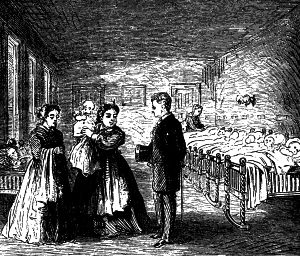
NURSERY IN THE FOUNDLING HOSPITAL.
There was the row of cots, and the kind-hearted women attending to their wants, and when I gave one of them an orange, the little twelve-pounder seemed as glad as if it had descended from the loins of a Tudor or a Stuart, instead of being, as it was, both fatherless and motherless.
I can see him who was to be father of the first Foundling Hospital in England, losing his way purposely, night after night, among those dark and badly lighted and unpaved streets and lanes that fringed the Thames River in those days, and from which issued nightly shouts of murder and rapine, and the boisterous but less deadly revelry of bacchanalian seafaring men, in trunk hose and canvas tunics. I can see the link boys with their smoky torches passing to and fro as in a fevered dream and the bearers of sedan chairs,—the porters shouting at the brave-hearted grim seaman, who turns his kindly old eyes aside from the flashing glance of beauty shot at him in dumb wonder by the damsel on her way to Vauxhall, Ranelagh, or a Rout, and Captain Coram the meanwhile chatting and bestowing pennies upon the beggar's offspring or forsaken child. His heart was large as the seas which he had sailed over, and his happiest moment was when he had rescued from the gutters and death some poor foundling who had been thrown on the world to make its way.
He had first embarked in the Newfoundland trade, and after some time spent in ploughing the waters between England and the Colonies, he set up at Taunton, Massachusetts, as a shipwright, where he prospered apace. Then we find him, after some years, in Boston, where, by his enterprise, the manufacture of tar was established in the then infant Colonies. Home to Old England again after thirty years of wandering, and on landing at Cuxhaven the brave old man was set upon by thieves and ruffians and plundered of all his earnings. Then the Government, in 1732, appoints him as a trustee for the settlement of Georgia, and subsequently he is engaged in the colonization of Nova Scotia. Finally he came home to project and carry out the idea of his life, which was the establishment of a Foundling Hospital in London.
Never was there a more indefatigable or tireless philanthropist than this bluff old sailor. Insult, contumely, and humiliation he cheerfully underwent to carry out his cherished plan.
One cold, stinging, December day, in the year 1737, Thomas Coram,—who had been advised that the Princess Amelia was a charitable and well disposed lady, and would be, perhaps, favorable to an application for the scheme he had in view—started for St. James' Palace, the then residence of royalty—with his three-cornered hat well planted upon his head, and his coat buttoned up, and offered a petition for the formation of a foundling hospital through Lady Isabella Finch, the lady of the Bed Chamber in waiting, who turned upon Coram when he presented her the paper, like a vixen, and bade him begone with cutting words and sneers. The poor old fellow, with rage in his heart, strode from the doors of royalty and never troubled the Princess Amelia again.
ADMISSION OF CHILDREN—HOW OBTAINED.
Finally, George II became interested so far as to give a charter on the application of John, Duke of Bedford, the Master of the Rolls, the Chief Justice, the Chief Baron, the Speaker of the Commons, and the Solicitor and Attorney's General. Hogarth, who also became deeply interested in the charity, and ever afterward continued its benefactor, painted a shield for the Hospital, and on the 26th of October, 1740, the old house in Hatton Garden was thrown open to nameless and homeless children.
The charter was signed by twenty-one ladies, of birth and distinction, and stated that "no expedient has been found out for preventing the frequent murders of poor infants at their birth, or of suppressing the custom of exposing them to perish in the streets, or putting them out to nurses, who, undertaking to bring them up for small sums, suffered them to starve, or, if permitted to live, either turned them out to beg or steal, or hired them out to persons by whom they were trained up in that way of living, and sometimes blinded or maimed, in order to move pity, and thereby become fitter instruments of gain to their employers. In order to redress this shameful grievance, the memorialists express their willingness to erect and support a hospital for all helpless children as may be brought to it, 'in order that they may be made good servants, or, when qualified, be disposed of to the sea or land service of His Majesty the King.'"
The children who are maintained by this charity are admitted on application of their mothers only, whose application to the governors must take place within twelve months of the birth of the child.
The petition is read to the governors assembled in committee; and the petitioner is called in and examined as to her allegations; and then the steward of the hospital (with the petitioner's permission) is instructed to make secret inquiries as to the truth of the case. If the admission be ordered, it takes place on the Saturday fortnight after the order (a small weekly allowance being made in the interim, if necessary, to the mother), when the child is examined by the apothecary, and if found perfect in eyes, limbs, and health, is received into the Institution. Its mother is presented with a certificate of its reception—with a certain letter on the margin, by which her infant pledge may be subsequently identified if necessary; but in all probability she never sees the child again.
It has a particular number assigned to it, which is sewn to its clothes, and becomes a property and chattel of the hospital. It is at once sent to the matron's room, and delivered to a wet-nurse previously engaged; and on the following day, being Sunday, it is baptised in the chapel of the institution—some common name, such as Smith or Jones, being given to it out of a list approved by the committee. On the same night, or following day, it is sent with its nurse into the country, who carries it to her own residence—she being generally the wife of some agricultural laborer—and reared there, under the occasional supervision of inspectors, for five years, when it returns to town for its education at the hospital. The number attached to its clothes remains so attached thoughout that time. At fourteen, the boys, at fifteen, the girls, are apprenticed, but still looked after by inspectors from the hospital until they are twenty-one years of age, when they are supposed to be able to take care of themselves. Deserving adults, however, are not lost sight of by the governors, and in case of incurable infirmities preventing apprenticeship, the Hospital does not desert its children to the end.
That the child be illegitimate is of course the most essential regulation, but an exception is made if the father be a soldier or sailor killed in the service of his country. Immediately after the battle of Waterloo, it was enacted that fifteen children of each sex should be forthwith admitted, the offspring of those who fell in that action; but to the honor of the soldiers' wives, it is recorded that only two mothers gave way to the temptation, and accepted the offer. No legitimate child has been admitted into the hospital for the last ten years.
A RUSH OF BABIES.
The other conditions of admission are: that the petitioner shall not have applied for parish relief; that she shall have borne a good character previous to her misfortune; and that the father shall have bonâ fide deserted his offspring, and be not forthcoming. The child acquires stronger claims for admission, if, First: the petitioner has no relations able to maintain the child; Second: if her shame is known to few persons (the express wish of the founder being that she might, if possible, recover her lost position); and, Thirdly: that in the event of the child's being received, the petitioner has a prospect of obtaining an honest livelihood.
The manner of admission was originally based upon that pursued "in France, Holland, and other Christian countries," as the wording of the quaint old charter went. The applicant came in at the outward door, rung the bell at the inward door, and presented her child; no questions whatever were asked of her, nor did "any servant of the hospital presume to endeavor to discover who such person was, on pain of being dismissed." When the narrow limit of accommodation was reached, the notice, "The house is full," was affixed over the door.
In October, 1745, the western wing of the present building was opened; but so many more children were brought than the place could hold, that there were frequently a hundred women with children at the door, when only twenty could be admitted. The ballot was then resorted to: all the women were admitted into the court-room, and drew balls out of a bag; but it was still stipulated that if any desired to be concealed, the bag might be carried to them, or the matron was empowered to draw for them.
In 1754, the hospital authorities had six hundred children to support, the cost of which exceeded their income fourfold. They therefore appealed to Parliament, who voted them ten thousand pounds on the condition that all applicants under twelve months old should be received. This wholesale scheme of charity, which was largely assisted by more public grants, only lasted for four years. On the very first general reception-day, 117 infants were taken in, and 1,800 before the half-year was out; while in the ensuing year 3,727 were admitted. The consequences are described to be lamentable. Immorality was greatly encouraged by the unlimited facility for thus disposing of its fruits, and the children themselves—though "the Foundling" had then branch establishments in many country places—could not be supported in such vast numbers.
Of the 15,000 children received in those four years, no less than 10,000 perished in their infancy. Parish officers, with local cunning, sent to the Foundling the legitimate children of paupers, in order to relieve their constituents; parents brought their own children, when dying, in order that the hospital should pay for their interment; and surgeons were even employed by parents to convey their children to this Alma Mater, at so so much per head, like pigs, or other cattle.
Parliament withdrew its grant from this formidable charity in 1759, although it humanely provided for the maintenance of all whom its too lavish charity had already admitted, and the branch country hospitals were discontinued. There were at that time 6,000 children in the institution under five years of age, and it was not until 1769, that by apprenticing all who were fit to be placed out, their number was reduced below 1,000. At the present time the yearly admissions average 32, and the total number maintained by the Hospital is 430.
As years sped by the spirit of the institution changed with its succeeding governors, and children were received without any inquiry, with whom a hundred pounds were paid down.
The Court Room of the Foundling Hospital has probably witnessed as painful scenes as any chamber in Great Britain, and though mothers may abandon their illicit offspring to the tender mercies of a public company, they cannot do it without great pain, and many an after pang of agony.
AN AGED FOUNDLING.
These scenes are renewed again when the children at five years of age are brought up to London from the places they have been farmed out like young goats, and they are then separated from their foster mothers. Even the foster fathers are sometimes greatly affected by the parting, while the grief of their wives is most excessive; and the children themselves so pine after their supposed parents that they are humored by holidays and treats, for a day or two after their arrival, in order to mitigate the change.
Though infants received into the hospital are never again seen by their parents, save in peculiar cases, a kind of intercourse with them is still permitted. Mothers are allowed to come every Monday and ask after their children's health, but are allowed no further information. On an average about eight women a week avail themselves of this privilege, and there are some who come regularly every fortnight.
I was present in one of the rooms of the Foundling Hospital while a stout red faced matron was engaged in washing one of these dear little babes of misfortune, and it was indeed an affecting spectacle, to hear the little motherless waif cry and watch its infantile kickings and splurgings in the wash tub.
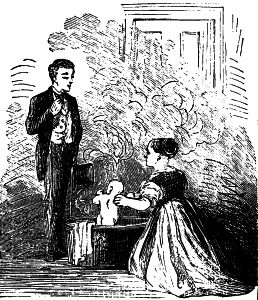
WASHING THE WAIF.
Even when application is made by mothers for the return of their child, it is frequently refused; when it is apprenticed, and no intercourse is permitted between them, unless master and mistress, as well as parent and child, approve of it; nor when it has attained maturity, unless the child as well as the mother demand it.
Thus a woman, who was married from the hospital, and had borne seven children, once requested to know her parents, on the ground that "there was money belonging to her," and her application was refused. But in November of the same year the name of a certain Foundling was revealed upon the application of a solicitor, and his setting forth that money had been invested for its use by the dead mother; the governors granting this request upon the ground that the mother herself had disclosed the secret, which they were otherwise bound to keep inviolable. Again, in 1833, a Foundling, seventy-six years of age, was permitted, for certain good reasons, to become acquainted with his own name, though, as one may imagine, not with his parent. It is a wise child in the Foundling who even knows its own mother.
Sometimes notes are found attached to the infant's garments, beseeching the nurse to tell the mother her name and residence, that the latter may visit her child during its stay in the country; and they have been even known to follow the van on foot which conveys their little one to its new home. They will also attend the baptism in the chapel, in the hope of hearing the name conferred upon the infant; for, if they succeed in identifying the child during its stay at nurse, they can always preserve the identification during its subsequent abode in the hospital, since the children appear in chapel twice on Sunday, and dine in public on that day, which gives opportunities of seeing them from time to time, and preserving the recollection of their features.
In these attempts at discovery, mistakes, however, are often committed, and attention lavished on the wrong child; instances have even occurred of mothers coming in mourning attire to the hospital to return thanks for the kindness bestowed upon their deceased offspring, only to be informed that they are alive and well.
It is stated that children who are discovered by the mother are spoiled by indulgence—and I can imagine that efforts to make up for the past would be lavish enough in such cases—and rarely turn out well.
HOW THEY DINE.
One exception to the rule of non-intercourse is related, where a medical attendant certified that the sanity of one unhappy woman might be affected unless she was allowed to see her child.
Twice or thrice in the year the boys are permitted to take an excursion to Primrose Hill; but at other times (except when sent on errands), and the girls at all times—are kept within the hospital walls. This confinement so affects their growth, that few of either sex attain to the average height of men and women.
It is a curious old place, this hospital for Foundlings, and full of memories. Here are some of Hogarth's best efforts as a portrait painter, and it was for this hospital that Handel wrote his glorious oratorio of the "Messiah." The organ, so magnificent in tone, which is placed in the chapel, was also the gift of Handel.
The high old-fashioned reading desk, from whence the chaplain expounds the scriptures; the side galleries in the style of George I, and the pillars that seem to tell of the days of Addison and Sterne and Swift, and all the rest of that galaxy who made the Augustan age of England—the rows of high backed benches such as are to be met with in all the London churches, built after the architectural period of Wren and Inigo Jones—combined with the low full toned voices of the boys and girls, as they raise the Anthem, seem to make the place a haven of rest and an abode of happiness for the poor world outcasts.
Then there is the girls' dining-room, hung with some fine paintings and works of art. The girls enter and take their stand, each in her proper place, against the long row of tables that extends from end to end of the room, the crowds forming a lane on either side.
A moment's pause, and a sweet voice is heard saying grace: the utterer being that modest looking girl at the centre of the table, who from her superior height and appearance seems chosen as one of the oldest among her companions. Scarcely has she finished before another girl, at the end of the table, dispenses with the ease and rapidity of habit, from the large dishes of baked meat and vegetables before her, the dinners of the expectant children, plate following plate with marvelous rapidity, till all are satisfied.
This room occupies a great portion of one side of the edifice.
In the boys' room the evolutions of the lads preparatory to taking dinner are most interesting. The change at once, and without blunder, hesitation, or want of concert, from a two deep to a three deep line, then they beat time, march, turn and turn again, until the welcome word is given for the final march to the dinner table. Thousands of the citizens of London visit this hospital yearly, and ladies are particularly interested in all that pertains to its welfare.
It has been enriched by innumerable bequests, and has a revenue of over £120,000 a year from rents, stock, and other sources.
The charities of London are incalculable in their extent, and it is my belief that no other city in the world—excepting Paris—possesses so many and such various institutions where the sick, naked, and needy are taken in and cared for. And yet with all this benevolence, there is a pharisaical spirit of ostentation at the bottom of every pound that is given, and the pupils of the beneficed schools, the inmates of the almshouses, the patients in the various hospitals, and the vagrants and lost ones in reformatories, refuges, and model lodging houses are drilled, uniformed, preached at, exhibited to the public, and ventilated in the newspapers, while the donations of those who have established the charities are be-puffed and be-lauded until the stranger is astonished at the mountains of cant which smother the work of so many generously benevolent people.
However, there is a vast amount of charity in London, and incalculable good is done those who are in need of it.
I can only give the aggregate of all these charities, hospitals and almshouses, as I have not space for details.
INCOME OF CHARITABLE INSTITUTIONS.
The incomes and receipts of the various Metropolitan Charitable Institutions amount to about twelve millions of dollars annually, much of which is contributed voluntarily, and this vast sum does not include contributions to police courts for the use of prisoners, amounting to £50,000 a year, or the erection and endowment of schools, and other similar gifts by individuals, deeds which are impossible to classify, from their isolation. Besides the regular incomes, as below, the proceeds of former legacies amounts to £841,373, or nearly six million dollars of United States money.
This large amount of nearly eighteen millions of dollars, double the entire sum realized from poor rates obtained in London, is divided among 640 institutions, of which 144 have been founded during the last ten years, 279 during the first half of the century, 114 during the Eighteenth Century, and 103 before that period.
The classification—generally speaking—and aggregate incomes are as follows:
INSTITUTIONS. ANNUAL INCOME.
14 General Hospitals, £174,858
66 Hospitals and Institutions for Special Medical purposes, 155,025
39 Dispensaries, 23,877
12 Institutions for the Preservation of Life, Health, and Morals, 46,230
1 Foundling Hospital, 20,200
22 Hospitals, Penitentiaries, and 16 Reformatories—total, 93,981
29 Relief Institutions, 64,720
21 Homes, for both sexes, and all ages, 18,200
9 Benevolent Pension Funds, 26,000
20 Poor Clergymen's Benefit Funds, 49,508
72 Professional and Trade Benevolent Funds, 125,051
24 City Company and Parochial Trust Funds, 40,820
4 Special National Funds, 53,000
124 Colleges, Almshouses, and Asylums, for the Aged, 103,063
1 Cripple's Charity, 7,215
16 Deaf and Dumb Institutions, 43,521
35 General Educational Funds, 112,600
16 Asylums, educating 2,400 orphans, 80,634
24 Educational Asylums for 3,700 children, 120,000
60 Home Missionary Societies, 413,171
30 Foreign Missionary Societies, 642,217
19 Jewish Charities, Hospitals, Schools, Almshouses, and Refuges, 163,000
3 Grammar Schools, on original Foundations, 862,000
2 Educational Establishments,8 parochial schools, libraries, lectures, and miscellaneous societies, of a charitable or benevolent character, 732,000
Some of these hospitals are not equaled by any in the world excepting those of Paris, and have splendid beds and the best of medical Staffs.
Guy's Hospital is called after a London Alderman and Member of Parliament, who made a fortune, in Oliver Cromwell's time, selling Bibles, buying sailors' pawn-tickets, and in the South Sea Speculation Bubble. It has 22 wards and 600 beds, and averages, yearly, 6,000 in-door and 55,000 out-door beds, with 24 professors and 250 students. The legacies left to this hospital amount to £500,000, and its annual income is over £30,000. Kings' College Hospital has 180 beds, and about 2,000 in-door and 40,000 out-door patients, annually. Its income is about £5,000 a year. The London Hospital has 500 beds.
Bartholomew's Hospital, founded by a Catholic monk, in the hoary past, is the oldest and largest hospital in London, as its students are the wildest and most reckless in the metropolis. The number of in-door patients is 7,000; out-door, 100,000, annually, and the yearly income is £32,000. There are 700 beds, 36 professors, and 500 students.
The St. Thomas' Hospitals, now in process of construction at the Surrey Side of the Thames, in Lambeth, opposite the Houses of Parliament, will combine a number of hospitals for Special Diseases, and will accommodate about 2,000 patients, with as many beds, and will have an income of £50,000 a year, or more.
It is impossible to think of any disease, complaint, deformity, or injury to any member or organ of the body, which has not its special hospital or institution for relief or cure, in the English metropolis. There are homes for distressed widows, for Asiatics, Africans, and South Sea Islanders, a Benevolent Society of Female Musicians, one for the Prevention of Cruelty to Animals, a Life-Boat Society, Homes for Teaching the Blind to read, for Governesses, a Shoe-Black Society, and, in fact, all classes of indigent and impoverished persons are provided for.
INTERESTING SIGHT.
The Sick Children's Hospital is one of the best and most needed institutions in London. This hospital was opened eighteen years ago, and has among its patrons the excessively pious Prince of Wales, and the lady whom he admired so much—the wife of Sir Charles Mordaunt, as also the highest ecclesiastical authority in England, the Archbishop of Canterbury. This Hospital for Sick Children is situated at No. 49 Great Ormond street, Bloomsbury, in an old-fashioned house built in the time of Queen Anne. The annual income of this hospital is about £25,000 a year, with 100 beds, including about a dozen at Highgate and Margate, the latter for those children who require sea air. It has about 600 in-door and 12,000 out-door patients, annually.
A sick child among the rich has, at least, solace in its sickness, besides every chance for its recovery that money can supply. A sick child among the poor may have attendance or not, as the case may be, but its father and its mother in London have but little time to bestow upon its sufferings. It is, perhaps, uncared for and all but abandoned to battle with disease without help. It is for the children of the needy poor that this hospital is established and is carried on.
No child suffering from small pox is admitted into the house, nor are any cases of rickets, hip joint or scrofulous disease of the spine or joint. They are refused for three reasons: because they are quite incurable, because they require nothing but rest for many months, and because good diet and fresh air, continued for months or years, are essential to improvement.
Glad children's laughter may be heard within those old walls, and pretty little voices murmuring to each other, as the tiny sick people chatter to their next bedside friends and neighbors. Sometimes a little tired one, wearied from weakness, lies still watching the blue scroll on the ceiling, or trying to make out what all the pink-cheeked and powdered ladies are doing upon the frescoes of the old-fashioned walls.
Each child has its cot to itself, and besides those in the house myriads of children are brought each year, by their mothers, to be seen by the doctors and nurses. In the room where mothers bring their children is a box, affixed to the wall, with a printed solicitation for pence, and fifty pounds a year is collected in this way, which is devoted to sending children to the watering places who are getting convalescent and need sea air.
The Queen, and other members of her family, are accustomed to send yearly donations of toys and jimcracks for the amusement of the children; and proud ladies may be seen daily moving among the sick beds with all kinds of gifts and childish luxuries, and who shall say that the faces of these beautiful girls, and the toys they bring, do not help most signally to establish convalescence, for what sick child ever suffered without appreciating a kindly smile, a wooden horse, a cart, a Punch, or a Noah's ark.
CHAPTER XXIX.
MARKETS AND FOOD.
HE aggregate of time, labor, and expenditure, necessary to provide three millions and a half of inhabitants with food, in a city like London, is something beyond comprehension. In getting at the food statistics of this great City, I found more trouble than in procuring material and detail for any other portion of this book. And yet there cannot be anything of more interest to the public than to know how, when, and from where, a great city derives the food which subsists its citizens.

The London markets are well built, well ventilated, well situated, and well regulated. The markets of London are a credit to the city and people. The markets of New York are a scandal and a shame to that great city.
Some idea may be formed of the amount of food needed to subsist London from the figures which I will give.
The Metropolitan Cattle Market, in Caledonian Road, Islington, is the largest market in London, covering fifteen acres, and having three acres of slaughter houses. This market cost one million four hundred and sixty thousand pounds, and cannot be surpassed by any other market in the world. The yearly receipts at this market was as follows: 360,000 beef cattle, 36,000 calves, 1,900,000 sheep, and 37,650 pigs. Besides this vast amount of meat there was nearly as much more received at the Newgate, Leadenhall, and Whitechapel meat markets.
The other articles of food, brought to the London markets, are estimated by those who profess to have nearly accurate information, as follows: Seven million head of game and poultry, six hundred and fifty million pounds of fish, two hundred and fifty million barrels of oysters, and two hundred and fifty million cubic feet of eggs. This last item rather staggered me, but the other estimated quantities are, I am assured, rather below than above the aggregate annual consumption.
The inspections of the London markets are made very rigidly, and I do not wonder at the necessity for a strict watchfulness, when I find that, in 1868, 160,340 pounds of meat, and 1,963 head of game and poultry, were seized by the officers as being unfit for human food. This amount consisted in part of 1,200 sheep, 186 pigs, 73 calves, 1,100 quarters of beef, 762 joints of meat, 462 tame fowls, 121 wild fowl, 300 geese, 290 ducks, 316 pigeons, 15 lambs, and only thirty pounds of sausages. There were also 239 rabbits, 111 hares, 75 haunches and quarters of venison, 84 partridges, and four pounds of pickled pork. It will be seen that there was a very great deal of beef and mutton to a very little pickled pork and sausage. All of the game, and most of the poultry seized, was putrid, and of the meat 108,000 pounds were diseased, while 21,000 pounds were stinking; 36,240 pounds of meat being taken from animals that had died of natural causes. As soon as the meat is seized it is sprinkled with creosote of coal tar, which checks putrefaction, and at the same time prevents it from being used as food, after which it is sent to the bone-boilers and destroyed.
Besides the enormous amount of food received at the markets already enumerated, there was also received at the Borough Market, Southwark, Smithfield New Market, Newport Market, Cumberland, Portman, Clare, and the Potato Markets, by railway, in the same year, 17,000 tons of meat of all kinds, 100,000 tons of potatoes, 14,000 tons of fish, 15,000 tons of vegetables, and 60,000 tons of grain, wherewith to feed the Londoners.
THE SMITHFIELD POLICE STATION.
Before daybreak is the best time to see the Markets of London in all their bustle and brisk traffic, and one summer morning I accordingly took a cab from the Langham Hotel and told the sleepy driver to take me to the New Smithfield Market, which is convenient to Newgate Prison. We dashed madly in the gray of the morning (it was not yet more than four o'clock) through Regent street, up Oxford street, over the Holborn Viaduct, and so on to the Smithfield Police Station, which is situated at a few rods distant from the place where the Cock Lane Ghost was first discovered.
I had been directed by Inspector Bailey, of the Old Jewry office, to call at this police station, and he informed me that I should find a special policeman there at my disposal to show me the markets, and procure me any information I might desire in regard to them.
The Smithfield Police Station is like most London police stations, a very quiet and not pretentious edifice, just in the shadow of Smithfield New Market.
There was a little desk and a little railing, behind which sat a little man in a blue uniform of pilot cloth, and behind the little man were hung upon the plainly whitewashed walls a collection of handcuffs, pistols, and knives, all of which were deodands to the law. There were also placards, offering rewards for all kinds of offenders, thieves, forgers, murderers, and embezzlers, and giving detailed descriptions of their persons and clothing when last seen. These placards covered the walls, but did not add much to the appearance of the apartment. On producing my letter of introduction from Inspector Bailey to the Sergeant in command—who treated me with much civility, a bell was rung by the latter, and a policeman in uniform appeared, my old friend Ralfe, whom the Sergeant addressed as follows:
"Ralfe, you are to take this gentleman all through Smithfield Market, and show him the sights, and then you can transfer him to some one else to have him taken through Billingsgate Market, and after that he may take a look at Covent Garden Market, if he so desires. Show him everything that you can, then report to me back again."
"Yesir," said Mr. Ralfe, touching his hat, although he was not in uniform, and in another instant we were in the London streets, which were very drear and damp, the gas lamps yet burning with a feeble light, and the daybreak as yet not having revealed itself.
The way was murky and dark, and the vicinity of the market was sufficiently indicated by the peculiar raw, fresh smell, with which newly killed meat greets the nasal organs.
Smithfield Market is built on a large, open square, and being on high ground commands a good view of the City of London proper. The site of the New Market which was opened a year ago, was formerly covered by the Cattle Market, which is now removed to Islington, in the suburbs. The building is of mixed stone and brick, and the cost was about half a million pounds. The ground on which it is built is also nearly as valuable as the building. The market is about four hundred feet in length and a hundred and fifty in width. The roof is of iron, and a vast avenue, high, broad, and spacious in every way, runs through the entire building.
THE HOT COFFEE GIRL.
When I reached the market with my friend, the policeman, the gas was still burning, and the long rows of stalls situated on the wide avenues of the market, were covered with beef and mutton, the stalls averaging thirty to forty feet in height. There was a confused hum of many voices, and coarse rough looking fellows in smalls and canvas smocks, with broad, scoop-shaped hats, rushed hither and thither with immense loins and quarters of beef on their brawny shoulders. Over each stall, and inside of the market beneath the roof, the proprietor or lessee of the stall has a small wooden edifice, with doors and windows and places to sleep for two or three persons. At each corner of the market is a lofty tower, a hundred feet high, and in these towers are board-rooms and dining-rooms, and reading rooms for select parties, and at the base or bottom floor of each tower is a bar where liquors and hot coffee, bread, butter, and tea, and other refreshments are sold during the early hours of the morning, to those who need sustainment. Two or three pretty girls were behind each of these stalls, and were serving with great dilligence and taste, the knots of butchers' helpers, cartmen, butchers' boys, and market officials who stood in their vicinity.
There are at least half a dozen meat inspectors in each market, and these men are paid one hundred pounds a year to examine and decide as to the wholesomeness of each and every pound or carcass of meat brought into the markets.
To one of these I spoke and asked him if he had much trouble with the butchers in regard to putrid meat.
"Trouble—Lord bless you sir, we have no trouble here to speak on. Ye see, sir, the class of butchers as sells meat here in Smithfield Market allers sells on commission. All this meat that you see a hanging on these ere hooks doesn't belong to the butchers. It is sent to them to sell on commission by the Railway Companies, and they do not own the stalls themselves either. They pays one pound ten shilling and sixpence a week for five square feet of ground—that's about the rate they pays, and the City owns the markit. Lord bless you, Sir," said the loquacious inspector, who was dressed like a butcher, having an apron, and stood leaning against a large quarter of beef. "I don't know where all the blessed meat comes from, but I knows that the pigs come from Hireland, and a goodish bit of the beef from Devonshire. It comes to the city by the Underground Railway, and you can see the place down stairs where all the meat comes in the mornin'."
At the breakfast stalls I noticed that nearly every one called for "two pennorth of bread and butter," and drank with it a bowl of hot tea or a smoking cup of coffee. The girls who served the coffee were chatty and lively, and desired information of me in regard to America. One of them, a little black brunette, queried:
"They say, sir, as how that a young leedy in Hamerica can get married on nothink—if she's good looking and can cook. Is it so, sir?"
I had no means of satisfying her as to that question, and I left her as she was preparing a sandwich for a hungry clodhopper, whose eyes were bulbous with hunger and expectation, and went below to the basement story, which opens by arches on the depot of the Underground Railway, and I found the entire earthen floor cut up by rails and platforms, on to which the meat from incoming trains is shunted and delivered. All meat delivered at Smithfield is of course dead, and no slaughtering is carried on in this market. Millions of pounds worth of meat finds its way here day after day, and thousands of men—porters and helpers and butchers' assistants—find employment here, their wages ranging from ten to thirty-five shillings a week.
Each helper is paid so much for every carcass which he carries into the market on his shoulders, and broad shoulders they have to be to carry these huge quarters of beef from the wagons which are drawn up in dense masses in and around the open spaces outside of the market walls. When this market was opened by the Mayor of London and other city dignitaries, sixteen hundred officials, connected with the market and the municipal government, dined in the central avenue, and two hundred barrels of ale were drank. This is a sample of a municipal British feast.
Outside of the building are little houses or market lodges, built of stone, in which are weighing machines, where men are constantly in attendance as weighers of beef and mutton. For this service they are paid one hundred and twenty pounds a year. The weighing machine in the little house connects under the middle of the street, where a platform is constructed, level with the surface of the pavement, and when a cart-load of beef is to be weighed, horse, cart, and beef are weighed together, and the total is placed on a slate, and when the helpers have carried all the meat into the stalls in the market to be sold wholesale, (for it is not a retail market,) the horse and cart are again weighed, and then their united weight having been deducted from the gross weight, the actual weight of the meat is thus ascertained by this simple and easy process. I think that the Smithfield Market is the finest I ever saw, and its ventilation and perfect system cannot be surpassed anywhere.
THE VEGETABLE MARKET.
From Smithfield Market I went to Covent Garden Market, which is a couple of miles distant, in Russell street, forming quite a spacious area. This is the great vegetable and flower market of London. There is a market held every morning in summer, but in winter, markets are held only on Tuesday, Thursday, and Saturday mornings. The market is owned by the Duke of Bedford, and was built at a cost of £30,000 by a former Duke of that family, forty years ago.
It has a colonade running around the entire building on the exterior, under which are shops having apartments in the upper stories. Joined to the back of these is another row of shops facing the inner courts, and through the centre runs a passage with shops on either side, in which are exposed for sale herbs and flowers, and the most magnificent bouquets can be procured here on a fine morning in summer. Scarce and delicate plants and flowers are here found in abundance, and around these stands I noticed numbers of male servants and pages in the liveries of some of the best known families among the London aristocracy, barganing for bouquets for their mistresses' tables. The noise and hub-bub around the open spaces in this market was perfectly deafening. It was now about four o'clock in the morning, and all the open areas were thronged with market-men and women and boys, carrying baskets and flowers in their arms, to and fro, chaffing each other or cursing and swearing with great good will.
Immense vans and market-carts loaded down with cabbages, onions, peas, cauliflowers, turnips, beans, parsley, greens, cucumbers, lettuce, apples, pears, parsnips, and other vegetables and fruits, are moving to and fro, some of them blocked in with the increasing traffic, the drivers, great big hulking fellows, mopping their perspiring foreheads and shouting at each other, as is usual among all cartmen. Women are hurrying hither and thither, making bargains and chaffering about the prices of vegetables, and meanwhile, it is almost impossible to hear or understand anything that is said. The police who are scattered here and there with their tall helmets, goodnaturedly push and shove those who block the passage ways, and frown sternly at the impudent young rascals who excite crowds and gather small knots of boys against the breakfast stalls outside the market.
Here and there around these coffee stalls, which are generally kept by old men or dilapidated and ancient women, you will see a couple of drunken or half sober roysterers, who have been on the tramp all night, and have at this early hour of the morning reached Covent Garden to get a cup of hot coffee in the market, which will clear the fumes of the liquor away, before they stagger home to a fond and anxious wife or an unrelenting landlady.
Wagons and carts have been arriving from a very early hour, and five o'clock seems to be the busiest time in Covent Garden. The houses of refreshment around the market are open at half past one in summer, and little tables are placed against the wooden pillars of the market by the tea and coffee venders, from which porters and carters make hearty breakfasts. There is no need to resort to exciting liquors, as the coffee is good and hot, and a baked potato, fresh and smoking from the oven, costs only one penny.
Every few minutes, through all the roaring and shouting, singing, talking, whistling, and laughing, I could hear the clear voice of the Baked Potato man, vending his smoking tubers and shouting:
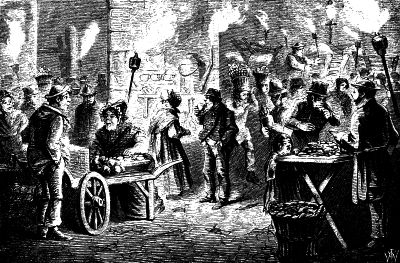
BREAKFAST STALL, COVENT GARDEN MARKET.
THE POTATO MAN GETS ANGRY.
"Tates hot!—all 'ot, 'ot! Taters all 'ot." His can with its steam pipe, from which issues forth a fragrant odor on the morning air, is already surrounded by young street boys, who will run an errand for a penny, hold your horse, catch a flying hat, steal a cabbage or a pocket full of potatoes from the stalls with equal impartiality and energy. These markets are the worst places in London for young lads, as there is always some excuse for their presence in the vicinity, under pretence of earning a penny or picking up the refuse and odds and ends of a vegetable market. Observe this young rascal now, who is surveying the Baked Potato man with an assumption of scorn combined with a profound look of wisdom in his features. His hands are in his pockets, his trousers are ragged to the knees, and his linen is nowhere visible—a miserable London street boy—and yet you would imagine, to look at him as he steps up to negotiate for a potato, that he was the agent of the Rothschilds about to make arrangements for a loan. His age does not exceed fifteen years, and he has been sleeping in the purlieus of the market all night, as his ragged and soiled coat testify, and his hair is full of slimy straws which he has accumulated while reclining his head on a market gardener's basket. The Baked Potato man eyes him with distrust and timidity, for he is well aware that there is no profit to be made from him, and that he is about to "chaff" him. The young rascals who stand around are all wide awake, and await the contest with solicitude in their countenances.
"Taters all 'ot—taters all 'ot—'ot—'ot," cries the Potato Man.
"Well, guv'nor, I see you're a keepin the steam up as usual. Vot's the werry lowest figger you names for the werry best taters, takin a lot—takin a quantity? I feels like patronizin you, I does."
"Penny a-piece, all 'ot—'ot."
"A penny a-piece for baked taters, and the Funds agoin down like winkin! Vy, I 'ad a pine apple myself out of a Garden this mornin for two-pence. Trade's unkimmon bad, guv'nor."
"Penny apiece—all 'ot—all 'ot—I say, keep your dirty fingers away from the can. You doesn't buy anythink, I know."
"I doesn't buy hanythink, eh? There's a hopposition can, too, started by a gentleman of my acquaintance"—here the young scamp put his thumbs in his waistcoat armholes and inflated himself after the supposed aristocratic fashion—"in the 'Aymarket. He calls the can the 'Gladstone,' and it's a werry spicy concern, I tell ye. Don't he give prime taters neither? They're real nobby ones, and plenty o' butter, and pepper, and salt. Oh! not at all! And its so werry respectable for a cove comin from the Hopera to stop and have a bit of supper on his road home. My heye, and haint the pro-pre-i-e-tor a makin of his fortin neither? Of course not! Oh, no. But there 'ill be fun when he returns to his willa with a postchay in Belgrawey in a few years."
By this time the Baked Potato man is pretty mad, between the pertinacity of his young tormentor and the highly colored picture of his rival's prosperity, as depicted by the boy, and he tells him in an angry way to "move hon, hif 'e doesn't want 'is preshis neck stretched."
"Wot, wiolence to one of her Majesty's subjecks, and hin the hopen day, too? Move hon, hey? Oh, werry likely. I'm a standin 'ere on my Sovrin's kerbstone—a Briton's 'Ouse is 'is castle, and when an Englishman hexpresses his hopinion hon the subjeck of baked taters he's to move hon, is he? Consekevently I'll stay here."
The "Baked Tater" man is now almost foaming at the mouth with rage, which is not lessened by the cheers of the spectators, who are, of course, on the side of the young orator.
He is about to lay down his can and pitch into his tormentor, when all at once that young gentleman assumes a pacific attitude, after displaying so much public spirit, and says:
"I don't want money nor credit, so look sharp ole feller and pick me a stunner from the Can."
At this moment the Potato Man's countenance relaxes, as the boy produces a penny-piece, and while he extracts a mealy potato from his can, the boy proceeds to amuse his audience further by going through a series of sleight of hand tricks, such as shaking the coin out of his cap after having swallowed it, or thrusting it into his eye and bringing it out of his ear, assuring the spectators the while that he had spent £20,000 in learning these tricks, and now, when the potato is handed to him, smoking hot, he expresses his indignation at the fact that the butter is "shaved too thin," and demands that what he loses in butter shall be made up to him by an extra shake of the pepper-box. At last he goes off to eat the potato, as the gray dawn breaks, and the man at the Can says:
"Oh, my eye—he is a precious leary cove for such a young von."
This market, as well as all the other London markets, is haunted with beggars who appeal to the charity of strangers with great effect.
FRUIT AND VEGETABLES.
One of these sat up behind a pile of empty baskets, and I saw that his trousers had rotted away at the bottom from long use and dirt. His face was that of a prematurely aged young man, and his torn shirt and worn features bespoke real misery. He was deaf and dumb it seemed, and the manner in which he solicited alms was by pointing to the following sentence, written on the flag-stone before him with a piece of chalk:
I am Starving. Help me.
A rental of about £26,000 a year is derived from Covent Garden Market by its proprietor, the Duke of Bedford, and the shops and stalls rent at from two to four hundred pounds a year. In the immediate neighborhood is Covent Garden Theatre, and all the little old rookeries of chop houses in this quarter have the smell of the greenroom and the rehearsal lingering about them. Here was, formerly, the garden of the Convent of Westminster.
Before the construction of the present market this was one of the most dangerous places in London with its tumble-down and crazy old structures, where abounded people of both sexes herded together like pigs. The Convent has become a play-house, and the monks and nuns have been transposed into actors and actresses. Where the salad was cut for the Lady Abbess in past times, drunkards now brawl and attack each other, and the flowers that would have been in the olden time plucked to adorn the statues of the Virgin or St. Peter, are now chosen to grace the marble mantel of some proud dame of Belgravia, or some gaudy and painted courtezan of Pimlico. The foreign fruit trade of Covent Garden is very extensive in pine apples, melons, cherries, apples, and plums. Pine apples were first cried in the London streets at "a penny a slice," twenty-five years ago. To supply this market with vegetables alone, 25,000 acres are required to be cultivated, and about 10,000 acres of trees are necessary to supply its annual demand for fruit. The trade in water-cresses is immense and they are chiefly hawked about the markets by little girls, although, of course, every stall has its own stock of cresses. They supply the same want as a relish for the Londoners' table that the small red radishes do to an American's appetite.
A man, curious in such things, has estimated as follows the yearly sales of this appetizing little green relish:
Covent Garden Market, 2,000,000 bunches, Farringdon Market, 15,000,000 bunches, Borough Market, (Southwark), 1,000,000 bunches, Spitalfield's Market, 500,000 bunches, Portman Market, 260,000 bunches, and Oxford Market, 200,000 bunches. It will be seen that Cockneys relish greens very much.
A little of everything can be procured at Covent Garden. Here are peddlers of account books, lead pencils, watch chains, dog-collars, whips, chains, curry-combs, pastry, money-bags, tissue-paper for the tops of strawberry-pottles, and horse-chestnut leaves for garnishing fruit-stalls; coffee-stalls, and stalls of pea-soup and pickled eels; basket-makers; women making up nosegays; and girls splitting huge bundles of water-cresses into little bunches.
Here are fruits and vegetables from all parts of the world; peas, and asparagus, and new potatoes, from the south of France, Belgium, Holland, Portugal, and the Bermudas, are brought in steam-vessels. Besides Deptford onions, Battersea cabbages, Mortlake asparagus, Chelsea celery, and Charlton peas, immense quantities are brought by railway from Cornwall and Devonshire, the Isle of Man, Guernsey and Jersey, the Kentish and Essex banks of the Thames, the banks of the Humber, the Mersey, the Orwell, the Trent, and the Ouse.
The Scilly Isles send early articles by steamer to Southampton, and thence to Covent Garden by railway. Strawberries are sent from gardens about Bath. The money paid annually for fruits and vegetables sold in this market is estimated at three millions sterling: for 6 or 700,000 pottles of strawberries; 40,000,000 cabbages; 2,000,000 cauliflowers; 300,000 bushels of peas; 750,000 lettuces; and 500,000 bushels of onions. In Centre-row, hot-house grapes are sold at 25s. per pound, British Queen and Black Prince strawberries at 1s. per ounce, slender French beans at 3s. per hundred, peas at a guinea a quart, and new potatoes at 4s. 6d. per pound; a moss-rose for half-a-crown, and bouquets of flowers from one shilling to two guineas each.
Green peas have been sold here at Christmas when they are deemed a luxury, for three pounds a quart, and asparagus has brought, in the same season, a pound, and rhubarb, a pound and five shillings a bunch.
The cries of the children peddling violets are sometimes almost heartrending, as these little waifs are very often fasting for a whole day before they can realize a few pennies to buy their food, to say nothing of food for those who have sent them to peddle the violets.
There is an Artesian well under Covent Garden Market, 280 feet deep, which supplies 1,600 gallons an hour, sufficient for the needs of the market people, most of which is consumed in watering flowers and vegetables, or in giving horses to drink. There are elegant conservatories over the colonnades of the market fifteen feet broad and fifteen feet high, for the preservation of the more costly and delicate plants and flowers. From this market nearly all the button-hole flowers which are vended at from a penny to four-pence a piece are obtained for the use of the London "swells."
THE JEWS' ORANGE MARKET.
One of the most curious places in London is the Orange and Nut Market, in Houndsditch. This market is chiefly in the hands of the lowest kind of Jews, men in greasy garments, and having frightfully hooked noses. The Costermongers come here for oranges, nuts, and lemons, to sell or hawk them around the suburbs or slums of London. The market is called Dukes'-Place Market. There is a big, massive, Synagogue, a lot of ancient-looking houses, the oranges themselves have a cob-webbed appearance, and the people are all dingy here. The nuts are for sale in sacks, and the baskets have a dilapidated look. The Jews, in all countries, are an industrious and economical people, and in London, as elsewhere, they monopolize the most profitable and least laborious occupations. They are represented by lawyers, members of Parliament, great bankers, like Rothschild, merchants, like Solomons, and men of liberal taste, like Sir Francis Goldsmid. The number of Jews in London is estimated at 48,000.
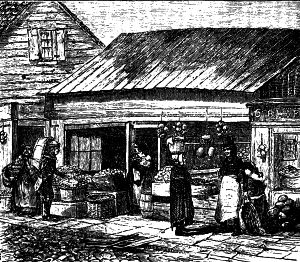
THE ORANGE MARKET.
Each dwelling around this Orange Market seems as if it had been partially consumed by fire, for not one of the shops have a window, and they are comparatively empty, save where a crate of oranges, or a bag of nuts, are exposed for sale. A few sickly fowls, looking as if they were dyspeptic, wander here picking up crumbs among the orange baskets and nut sacks, and dirty, ragged little Jewish children, play around with great equanimity among the rubbish. The disputes among the loud-voiced Costermongers who come here with their little wagons and jackasses, to draw their fruit, and the Jews who have all glib-toned, smooth voices,—at some times, when the oranges are changing hands from sellers to buyers—are very amusing.
There I saw slatternly-looking girls sorting the good from the bad fruit, and one big, tall Jewish wench, was engaged over a barrel of common black grapes, plunging her dirty arms down in the barrel and pulling up the decayed fruit which she gave to a little child who stood by her, and ate of them greedily from her hand. Some of these Jewish fruit-traders take in as much as £200 in a day's sale of oranges, from Costermongers. Most of these oranges are sent to the Jews on commission. Years ago the Jew boys had a monopoly of the orange peddling trade, but now the monopoly is in the hands of Irish boys, who are more eloquent, more aggressive, and more popular, than the Jews, and consequently sell they more fruit.
FARRINGDON MARKET.
Farringdon Market, near the Strand, on the sloping surface of the hill, upon which the Holborn and Fleet street stand, is one of the principal markets in London, though it covers but an acre and a half. The ground and buildings cost about £200,000. The market building is 480 feet long at the centre, 41 feet high, and 48 feet broad, and has a court-yard in the centre of which the wagons, and baskets, and market lumber, are placed. The court, or, as it is called, the quadrangle, is generally filled with vegetables and fruit.
CHAPTER XXX.
SECRETS OF A RIVER.
T had been a stormy night in the London streets. In the Strand the shopkeepers' assistants were hurriedly fastening the shutters upon the windows of their masters' shops, eager to escape the hurricane of rain which swept over the London housetops, and tore through the lanes of brick and mortar like an enraged fiend. Thirsty souls who were draining huge mugs of malt liquor in the many publics along Thames street, looked out with scared faces on the river which was beating its sides angrily against the shipping and lesser craft.

The waters of the Thames ran high and wild, and down in the Pool and by Limehouse Reach, huge ships bearing the colors of many nations at their peaks, swung and rocked in the seething tides, while black night and the angry shades of the coming storm gathered around their twinkling red and blue signal lamps, which lazily danced from their yards over the surface of the river, leaving faint streaks of light that were ever and anon swallowed by the angry waters. Boatmen were anxiously securing wherries and fastening them under bridges and by water-stairs, and all the while the clouds above lowered, and the sweeping gusts of rain stung the faces of those who were unfortunate enough to be in the streets without shelter. Shutters slapped and banged in and out, and chimney pots were whirled about by the fierce and howling winds.
I had been on a tour of inspection, with a friend and a police sergeant, through London during the night, and had left the Alhambra at midnight for Evan's Supper Rooms, in Covent Garden, where we passed an hour listening to the music of the glee and madrigal boys, and on leaving Evan's at one o'clock in the morning, my friend had parted with me to go to bed, and I left him at the corner of Wellington street and the Strand, he going westward to his residence in Westminster, while the police Sergeant and myself called a cab, as I had a desire to see London in the small hours, and Sergeant Scott had insinuated that a stormy night was the best for seeing strange sights. He little thought at the time how truly he spoke.
After some discussion between this veteran of the Old Jewry office and myself, it was decided that we should visit some of the thieves' haunts in the Borough of Southwark, as it was about the hour when these night birds came home to roost, and of a consequence the best time to see their places of residence.
The first place chosen for a visit was a den in the New Kent Road, and to get there it was necessary for us to cross Waterloo Bridge.
THE STRANGER AT WATERLOO BRIDGE.
To cross some of the bridges in London it is necessary to pay a trifling toll, which goes toward the repairs of the bridge. The charge for each pedestrian on Westminster and Waterloo Bridges is half a penny each—for a horse one penny. As the cab dashed up to the turnstile at Waterloo Bridge, the toll keeper came out to take his dues, a gruff looking fellow wrapped up in a big hairy coat. He took the two pence grumblingly, and just at that moment I noticed a woman coming up to the toll-house in a gaudy looking silk dress, and having a soiled velvet wrapper about her shivering shoulders. The light from the toll-house shone on her face, which was very pale, the eyes burning with a strange light, and the garments which hung to her figure were dripping with the rain.
"Please let me pass," said she to the gruff toll keeper, with an imploring glance, "I have not a penny in the world—please let me cross the bridge?"
"Please let yer cross the bridge—yer 'aint got a penny? Well wot d'ye want ter cross the bridge for then? If yer 'aint got a h'apenny I thinks yer as well on the one side of the bridge as the other? Well go on with ye, I don't mind a h'apenny, and go to bed as soon as ye can," the toll keeper shouted through the storm after the wretched woman as she dashed through the turnstile on the bridge, and was lost in the storm and darkness of the night.
As she fled into the night, my companion caught sight of her face, and a hasty exclamation escaped his lips.
"My God, that's Mag S——, that we saw to-night at the Alhambra! D'ye remember that pale faced girl who asked you to give her some liquor in the Canteen?"
"The woman who seemed out of her senses or crazed, and who danced and swore?" I asked.
"Yes sir, the same—well that's her, and what she can be doing here on this bridge at this time I don't know. She used to be a highflyer once, did Mag, but her fancy man has left her, and I'm afraid she's dead broke now, at times. My eye, wot a temper she has to be sure, when she blazes hup."
By this time we had reached the end of the bridge at the Southwark side, and the cab dashed madly by a female figure cowering in an alcove of the structure, the cabby swearing an oath as the horse shied at it going by.
As the night advanced, it blew harder and harder, and the storm raged with great violence. The waters under the bridge rebounded against the base of the stone arches, but the rain had ceased. We were now on our route back to the city, having inspected the dens of thievery to my great satisfaction. While going and coming, until we reached the bridge again, the mind of my companion, Sergeant Scott, seemed ill at ease in regard to the woman whom we had met upon the bridge before we had crossed. He was anxious and uneasy, and talked of the meeting incessantly, to my surprise.
"Some'ow or anuther I don't like meeting that gal on the bridge, Sir," said he. "She looked a little desperate, and when they looks that way I don't like to see 'em near water. Its touch and go with 'em then."
"Do you fear that the girl will attempt to commit suicide?" said I to him.
"I do, Sir. You see there's twelve hundred suicides in London every year, and half of 'em or more drowns themselves. The gals are more fonder of the water than the men. A man will blow his brains out or take pison, but a gal allers takes to the water. Why, bless you, Sir, we have as many as a hundred and twenty suicides hoff this here Waterloo Bridge every year. And this is their favorite bridge, this Waterloo Bridge. When they haven't got a penny in the world, and no friends, then they leap hoff the battelmints."
By this time we had reached the toll gate again, and the cab horse was walking slowly over the stone floor of the bridge, making echoes with his feet. The bridge was quite dark, yet I could see the buildings and spires on the London side piercing the skies, and the railway depot at Charing Cross Bridge, the towers of the Parliament Houses, and the square roofs of the St. Thomas' Hospitals rising vaguely and in shadows above the river.
There are stone alcoves on all the London bridges, which bulge out in a semi-circular form over the water on either side, and they will each accommodate a dozen persons, should such a number wish to sit down and look at the river. There are eight of these alcoves on Waterloo Bridge, and a raised sidewalk runs along on each side of the road, of solid and smooth flagging. The middle of the bridge is taken up by a causeway fifty or sixty feet wide, and this causeway is paved with a sort of Russ, or rather large Belgian pavement.
The cabby had stopped his horse to give me an opportunity to take a look at the river.
THREE O'CLOCK.
One boom—two booms—three booms! The bell in the Clock Tower at Westminster rolled out over the river. Three o'clock of a stormy morning, and all London asleep. It was a grand and impressive sight, the dark river, with bridge after bridge girdling it, and nothing to be heard but the champing of the horse in the awful stillness of that lone hour. Hark! There are voices on the bridge, voices passionate and imploring, that seem to shudder over the water and to creep through the arches of the bridge.
"Let us get out of the cab and see what it is, Sir, if you please. There's some cadgers a bunking in this vicinity, I imagines," said the police officer.
We walked along the bridge for a hundred feet or so, but could see nothing, although we heard the voices still.
"There's something wrong a-goin' on, but I don't know wot it is," said he again.
We advanced still further, and could see a woman's figure half hidden by the alcove which was across on the other side of the bridge from us. The woman was in earnest conversation with a man, who spoke in a clear, manly voice to her.
"This is the woman that begged the toll-gate man to let her cross to-night cos she hadn't a tanner," said the officer to me. "Let's watch 'em," said he; and feeling that it was an adventure of some sort, I silently acquiesced. We concealed ourselves in an alcove or embrasure.
"Keep quiet, now, and we'll see something, sure," said the Sergeant.
And we kept very quiet for a few minutes. The man was talking earnestly with the woman, who seemed half crazy with drink or excitement, we could not tell which, as we could only hear snatches of the conversation now and then.
It was the man's voice which we now heard.
"Come home, for God's sake, Margaret, and all will be well. You will be forgiven, and nothing will ever be cast up to you. I'll pledge you my word to that. Your mother is in the city, and your father is dead. She has come up from Glastonbury to see you, and I've spent eight nights walking for you, and hoping to get a sight of a face that was once dearer to me than life, and is now even still dear to me, if it only was to see you reformed, poor, unfortunate girl. Come home, for God's sake. Make the attempt, and it will be all well once more."
WEARY OF LIFE.
The girl was sobbing now very hard. The man seemed to implore her by all that had ever been sacred or dear to the lost girl, and she was evidently moved by his tone and earnestness, and the recollections that he had called forth.
"He's doin' of his best, and we can't do any think more—hany of us," said the Sergeant, who seemed a little touched.
"You talk to me of my mother, Harry? Why, I have not heard that name in three years. I thought I'd never hear it again. I have thought of her, too. But it's too late, Harry. The girl that my mother expects to see is the bright little Maggie, the school-girl who never had a hard word or an unkind look from her. I had an innocent face then, and was not afraid to meet her kind old eyes. But now, to meet her in this garb"—and she shook her flaunting silks—"I dare not—I dare not. Harry, I tell you it is too late. Too late. Too late."
"It's never too late, poor girl," said the stranger, "come home at once, or if you'll wait here a moment I'll go and call a cab and take you home to your mother at once. Wait here a moment and I will get a cab. Wait a moment, Maggie, only a moment:" and the stranger ran across the bridge, up King William street, and in the direction of the Bank, where he expected to find a cab.
The lost girl was left alone. Alone with night and solitude. Alone with naught but her past life, which arose from the waters like a shadow to keep her company. Alone and miserable, with the cruel sky darkling above her as if to shut out all hope, while the river yawned and gaped beneath, seeking an offering. God unheeded, her bosom cold as a stone; no prayer to conquer her anguish; with memories of promises broken and tender words unsaid; the passionate love of a fond mother given in vain; and at last an atonement is to be made. The old, old story—betrayal, dishonor, and the grave.
We crept nearer by some unknown impulse, to where she stood, and could hear her talking to herself, though we could not see her features, or anything definite, but a weird figure looming up like a shadow against the balustrade of the bridge. Her voice, which had fallen to a murmur almost, was like some forgotten music, the strains of which are heard in a dream. Who was this lone, wretched girl, and why came she here at this hour?
"My God, why should I go back to shame my poor old mother? I never will. I cannot do it. The sight of her would blast me. And Charley, for whom I lost all, where is he? In India, and no one here to-night, and I alone with my black thoughts on this spot. Why am I here? What do I live for? My life has been wretched enough. Why prolong it any longer? I will settle the matter now and forever. Good-by, Mother," said the wretched girl, looking up at the sky, and before she could be stopped in her fearful purpose, she had mounted the parapet by the embrasure, and leaped with a shriek into the devouring river beneath.
"By Heavens," said the Sergeant, darting forward and making an effort to catch at her clothes as her figure disappeared, "she has made a hole in the water with herself." At this moment a patrolman, hearing the girl scream and the shouts of the policeman, appeared upon the parapet. All three of us dashed down the stairs of the old bridge, and it was the work of a moment only to get a boat out, which, fortunately, had the oars inside. In a minute we were all out on the river, and the tide running very fast in the direction of the Pool—after pulling towards the middle arch the Sergeant cried out:
"Steady your rudder, there; what's that bobbing up and down on the water? That's a woman's head, sure; she's got hoops, too; that's lucky. Pull away, for your lives!"
In a few moments we were alongside of the dark, floating object, and the patrolman, drawing his lantern out, threw its reflection over the waters, while the head of the boat was kept well up to the dismal object.
The policeman leaned over the gunwale of the skiff and caught at the dress, and dragged in what he supposed to be a woman's body, but was only a bundle of rags and straw, the refuse of some lodging-house bed.
This was a severe disappointment to all in the boat, and we looked at each other without speaking, for a minute. The Sergeant had a scared look, and said aloud:
SADLY IMPORTUNATE.
"I'm afraid poor Mag's gone. She must have struck the bottom of the arches when she went down, and if she did, all's over and settled. The tide's running fast, too, and we will have hard work to find her."
For half an hour the most diligent search was made for her body, but no traces could be found of it but a bonnet and shawl, which were caught in some floating wood below the bridge.
We left the bridge, and the cab was driven home slowly, after the nearest police station had been notified of the poor girl's death or disappearance. The Sergeant of the Police District said that he would have another search in the morning, and I remained at the station to accompany the police in their visit.
A little after daybreak we were on Waterloo bridge again, and even at that hour a small assemblage had gathered around some object at the Southwark end of the bridge, where we could see the tall helmets of two policemen in the midst of the crowd of carters and market gardeners, who were en route to Covent Garden Market, and had stopped to look upon the body of a woman who had been fished up from the river.
Yes, there lay the body of the girl whose toll to eternity had been paid by her own rash act—stretched out on the cold stones, her garments dripping, her fingers clinched, and her eyes stark wide open. A young woman she was, but oh, how worn! The face was pinched, and the long, silken lashes sunk into the eyebrows.
The day was breaking in the East, but the policemen held their lanterns, which they had not yet extinguished, over the poor, pale features, and the grimy garments, revealing the long, matted, and tangled hair, and the stark, cold body, which had once held an Immortal Soul, but was now all that remained of the gay, merry-hearted, lost girl, who had fully reaped the harvest of vice—the Wages of Sin—called by the Evangelist, Death.
Last year, the number of suicides in London amounted to 1,160, and of this number 415 committed self-destruction by drowning. The Thames Watermen fish many a ghastly body from the River, and for each carcass—the result of their terrible trolling, they receive three pounds from the City authorities.