Front matter (continued 13)
Reading edition
This man was forty years of age, and the young girl, not more than fifteen years old, was his mistress, as I afterward learned.
The policeman signified to the proprietor, "Damnable Jack," that he wanted to get a bed where we might sleep together for the night.
"I hardly got a bed left but one and ye's are welcome to it, and for that matter it will hold five men and women, if I wanted to put 'em in it. Come here Phil, and give these gents a bed—they wants to taste the blessed sweets of lodgin house life. Give them their fill of it. Put them in the 'Lord Chancellor's' bed. Its the best in the house."
Let it be understood, that all the beds in the apartment were placed upon the bare floor, and that the mattresses were filled with dirty straw, which bulged out of their sides, or rags, and gave the room a close, fetid odor. For covering, there were dirty canvass quilts, made of the same stuff from which sails or potato sacks are fashioned. There were no sheets whatever, and the pillows and bolsters were stuffed as were the mattresses with rags or straw.
Near the fireplace was a bare space of smoothly laid brick, without any pretence of bedding at all, which was chalked out in a number of compartments, and each of these compartments was chalked out for a human being to sleep upon. By reposing on the bare, cold floor, the lodger saved a penny and got his bed for three-pence instead of four-pence.
Among the sixty persons present, there were at least twenty-five women, composed of female tramps, vagrants, prostitutes, coster-girls, and peddlers of different kinds of commodities, which they had to leave in an adjoining room that was locked up by the Deputy Lodging Master until the time of leaving their beds early in the morning, when the merchandise was delivered to its owners.
It was by the advice of an Inspector of Police that I made this essay to sleep in a cheap lodging house. He informed me that it was the only method of obtaining a clear knowledge of the habits and practices of the lodgers.
The "Lord Chancellor's" bed, as Damnable Jack called it, facetiously, was the best, from its appearance, in the room, and was at the farthest corner. It was generally used by the Deputy Lodging Master, and had a little chintz screen around it, and the bed itself, which had comparatively clean sheets and bed-furniture, was elevated a few feet from the floor on a sort of trestle work.
The charge for this bed was a shilling to each of us, and the policeman and myself laid down upon it in our clothes, the policeman having a revolver in his side pocket, upon which he kept his right hand during the night, whether he slept or had his eyes open.
I could not sleep in the terrible hole for several hours, and, in fact, did not think of doing so, as I was eager to watch the proceedings of the Scum of London, of which the lodgers were composed.
Many of the young girls had not retired when we came in, and a few of them now began to divest themselves of their clothing, without shame or compunction on their part, or surprise on the part of their fellow lodgers, excepting that now and then some low-bred ruffian would pour forth a torrent of obscenity when some of the female lodgers exposed portions of their filthy bodies.
The place was swarming with vermin, bed-bugs, roaches, and body parasites, in countless numbers, and this was one reason why many of the female lodgers stripped themselves to lie down, for some of the beds were so thickly packed that it was impossible for the Deputy Lodging Master to pass through the room without treading upon an exposed hand or foot, and in such a case, blasphemous and vile execrations were heaped upon his devoted head by the lodgers. This he bore with the greatest indifference as if he had never heard a word of it. The lodgers hoped by stripping naked to avoid having any of the vermin cling to their clothing—a wise precaution, as I found.
THE SCUM OF LONDON.
Men, women, and children, without regard to age, sex, condition, or kindred, slept together in this room, and as the night advanced the stench from their hot, loathsome bodies, rose like a hellish incense and nearly smothered me with its fumes. There the breath of each lodger was worse than the odor of a charnel house, so that I deemed it a wonder as I sat up in bed looking through a rent in the chintz curtain which enclosed our bed, a lamp burning faintly on a table the while, that sixty of God's creatures could sleep this way night after night, summer and winter, and yet be able to eat, drink, sleep, marry, beget children, and still thrive like deadly nightshade, to poison London and its neighborhood with their reeking effluvia.
About three o'clock in the morning I heard a hammering, squashing sound, and looking from under the chintz curtain, I was first astonished and then disgusted to see a wan-looking, cadaverous personage, from whom the most frightful snoring had proceeded during the early part of the night, hammering with the heel of his shoe at some dark moving objects, which he, every moment, scraped from his bed and placing them on the floor smashed at them in a raging and furious way with his shoe heel, taking care the while to keep up a steady stream of curses from his lips. He saw me looking at him and said:
"Well, neighbor, wot d'ye think of this. I pays four-pence for my bed, and here I am a-fighting to keep off the blessed bugs, for my life. I got myself gloriously drunk last night, to sleep, so that the wipers might not wake me up, but all the gin in Lunnon couldn't make a man sleep while the wermin are in the bed-clothes. I have took out and killed a bushel, more or less, of 'em, in the last half hour, but there's plenty more of 'em, Lord bless you."
This was the keystone of the edifice of my disgust. Too much of a good thing is said to be of no practical benefit to any one, and there was such a richness of bed-bugs and body parasites to be found in "Damnable Jack's" lodging house, that I thought I would not farther trouble his hospitality, and touching the guardian of the place upon the shoulder, who started up in a frightened way as if he were attacked, I left Mr. Scragg's lodgings, and took a walk in the cool morning air as far as Westminster Bridge, where I sat until daybreak, looking at the Parliament House, and the silent river with its numerous craft.
Before I left the accursed place, the policeman pointed to a pail of foul water standing in a corner, that had been fresh over night, and which had now had a thick scum on its top produced by so many poisonous lungs.
It is needless to say that I took a good warm bath early that morning, more than satisfied with my experience of the previous night.
Of this class of lodging houses, there are, in London, I believe, about seventy-five, capable of accommodating any number of lodgers that the proprietors may see fit to stow away in their dens.
Some idea may be formed of the manner in which the poorer classes of the London artisans are herded together from the fact that in the Inner Ward of St. George's Parish the number of families apportioned to the dwellings are so largely in excess of the room which they ought to occupy that all kinds of frightful distempers are common in these hell-dens. I give a table to show how human beings are crowded in this district:
Dwellings. No. of Families. Beds. No. of Families.
Single room to each family, 929 | One bed to each family, 623
Two rooms to ditto, 408 | Two " " 638
Three " " 94 | Three " " 154
Four " " 17 | Four " " 21
Five " " 8 | Five " " 8
Six " " 4 | Six " " 3
Seven " " 1 | Seven " " 1
Eight " " 1 | Dwellings without a bed, 7
Not ascertained, 3 | Not ascertained, 10
—— ——
1,465 | 1,465
TEN IN A BED.
Among the most munificent philanthropists who have built model lodging houses, for the poor and needy, I may enumerate Miss Burdett Coutts, and George Peabody. The former has expended nearly £500,000 in erecting model lodging houses for the poor, and the amount which was donated for the same purpose by Mr. Peabody exceeded a million and a half of dollars.
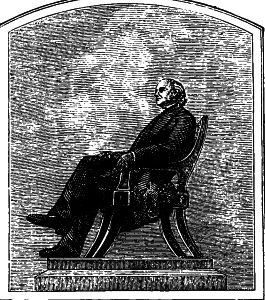
STATUE OF GEORGE PEABODY.
In speaking of Mr. Peabody, I must not omit to state the fact that the Londoners, to show their appreciation of his philanthropy, have erected to him a magnificent bronze statue at the rear of the Royal Exchange in their city, which was publicly uncovered by the Prince of Wales during the life-time of the late philanthropist.
CHAPTER XLV.
A TRAMP IN THE BY-WAYS.
REAT as London may believe itself to be in works of benevolence and philanthropy, there are spots in that mighty city which no one should visit without an officer of the law in his company, to warn him from the pitfalls and dangers which will beset his pathway.
One evening, feeling rather dispirited and uncomfortable, while sitting in the coffee-room of the Langham Hotel, a thought struck me that I might find amusement or novelty in some way by taking a tour through the city, and accordingly I called a cabman from the stand, in Upper Regent street, and, determining to make an effort to dissipate the blues, I jumped into the "hansom" and told the driver, an old weather-beaten looking fellow, with a buttoned-up coat and dirty neck-cloth, and wearing a black silk hat, which had once been quite respectable, but was now utterly wrecked—to "drive me anywhere in London—I don't care where as long as I can see something to interest me."
The driver, a well known character, who bore the title of "Old Smudge" among his brethren on the cab stand, and who was always in trouble with the police, replied:
"Where shall I take you, Sir? Would you like to take a look at the river? Or, mayhap you might wish to see a dog fight, or a ratting match—the Americans are partial to ratting matches—I know some on 'em are!"
"Take me anywhere," said I from the recesses of the cab in which I had ensconsced myself.
THE LONDON CABBIES.
These London Cabbies are, as a general thing, the most provoking and abusive fellows in the world, but their usefulness cannot be denied by any person who has experienced the delight of having a cab to hail when attacked suddenly by the often recurring rain storms, which serve to keep the atmosphere of Great Britain's capital in a state of perpetual moisture. There are two kinds of Cabs—the "hansom," a two wheeled vehicle, which falls back on its wheels, and is drawn by a single horse, the cabman sitting over your head with the reins elevated in his hands, and stretching through a metal ring in the roof to the collar of the horse. Then there are folding doors which can be closed to keep mud and dust from entering the cab, and a movable window fastened to the interior of the roof that can be hoisted or let down at will, and is most serviceable in case of rain or other inclement weather.
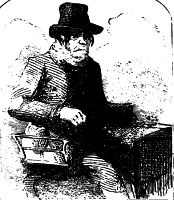
"OLD SMUDGE"—THE CABBY.
Then there is the "four wheeler," as it is called, a cab which is also drawn by one horse, but is built something after the fashion of the American coupe or brougham. This vehicle has four wheels, and is more comfortable and roomy than the "Hansom." The rates for transportation are higher, however, and the four-wheelers are used by a better class of people. There are six thousand one-horse cabs registered in London, of which number 2,352 are "six day" cabs, whose proprietors do not allow of their use on Sundays; and of "seven day" cabs, which are constantly traversing the streets, there are as many as 3,366. These cabs are all licensed, and their owners pay, annually, into the Municipal Treasury as large a sum as £10,000. The legal rate of fare in a "hansom," is sixpence a mile, and for a "four-wheeler," one shilling per mile, but the cabbies charge strangers any fare they can get.
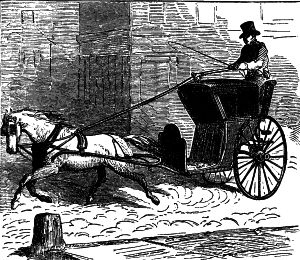
"A HANSOM CAB."
"Leave me alone, Sir, and I'll show you some of the sights of Lunnon town," said "Old Smudge," in a hoarse voice from the top of the cab in reply to my anxious enquiry as to where we were traveling. We were then some distance from the West End of the City, and from the noises which every few minutes attracted our attention, I fancied that the cab was being driven in the direction of the Thames. I saw, dimly, the masts of the shipping and the Docks, with their adamantine fronts frowning down upon me.
The cab was stopped suddenly, and the horse was brought up on its hind legs by a jerk of the reins from "Old Smudge," who was already in conversation at the door of a beer shop, which was illuminated, and had a large number of rough-mannered customers standing around its entrance. They were a sufficiently hard looking set to make a stranger think of his safety.
"This is 'Jack Barley's "Convivial Pup,"' Sir," said the cabman to me as I climbed out of the "hansom." "This is the finest rat-pit in Lunnon, Sir."
A SOIREE AT A RAT PIT.
I had often heard of Mr. Barley before, and now I saw him face to face, a most villainous and repulsive looking beast with a scarcely healed cicatrice in his jaw, and a couple of bleary holes under his black brows, miscalled eyes. Mr. Barley was famous in his way, and enjoyed distinction among a certain class. None could tell the breed of a dog, the age of a spaniel, the pluck of a terrier, or the gouging and milling abilities of a middle weight bruiser, with Professor Barley. In such matters his judgment was final and conclusive along the Thames bank for some distance.
The proprietor escorted us through a small bar, which was ornamented with the usual sporting emblems found in low London tap rooms, and after descending a stone stairs, I found myself in a room beneath the ground floor, with small circular benches ranged in a cramped fashion to the ceiling. On these seats about one hundred men, of all grades in the sporting class, were seated. There were a few "gentlemen," God save the mark, a brace of attorney's clerks, an officer of some line regiment, and the rest of the audience were of a miscellaneous character.
There was a rat pit below the benches, a square enclosure with a board fence about four feet high, enclosing it, the boards being whitewashed, and the flooring of the pit having sawdust scattered over it.
The only light in this dreary and subterraneous den came from six greasy, unvarnished tin lanterns, in which half a dozen of cheap tallow candles were fixed, and these flickered and sputtered with great malevolence on the rascally faces of the men who swarmed around the pit.
I heard a squealing noise, and I saw a lad bring in a long and huge flat wire cage, which was swarming with gray, black, and brown rats. Way was made for the youth to enter the pit with his cage of live rodents. Jumping in he opened the cage, and thrusting his forearm fearlessly through the door he drew forth, one by one, over fifty large and ferocious rats and threw them in a heap in the pit. These animals ran about in a confused way for a few minutes, and looked with an almost human and beseeching look into the murderous faces which were gathered around the pit. Then another cage was handed to the young man, and the same ceremony was performed again until there were one hundred and five rats in the centre of the pit.
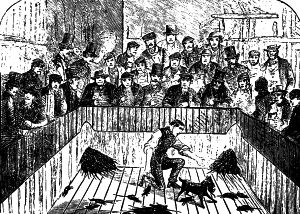
"ONE HUNDRED RATS IN NINE MINUTES."
There was to be a match for fifty pounds, the proprietor of the pit having matched his dog "Skid," a wiry and ferret-eyed little terrier, to kill one hundred rats in nine minutes. Bets were now made against and for the dog, that he would or would not kill the rats in the time named, and the excitement ran high as the little venomous dog was placed in the pit carefully by his master amid considerable applause from the roughs.
"SKID'S" BATTLE WITH THE RATS.
It was simply disgusting to witness that dreadful little terrier run at each rat, shake him for a second or two in the air and then drop him quite dead on the floor of the pit, while the roughs encouraged him to his work with shouts when the rat was destroyed quickly, but occasionally when a big and ferocious rat was attacked and showed fight in return, and when the terrier seemed to hang back for a moment, a perfect storm of curses and obscene epithets were rained on the unfortunate canine. Before five minutes had elapsed the whitewashed board sides and flooring of the Rat Pit were daubed with splashes of blood, and the little terrier was foaming at the lips, and his glossy hide was flecked with dark smudgy stains. When eight minutes and forty seconds had elapsed, "Skid" snapped the neck of the last rat, and now there was nothing left in the pit but a large pool of blood on which sawdust was quickly heaped, and a bleeding mass of heaving and dying rats.
Great cheering rewarded the efforts of "Skid," who was taken up tenderly, almost lovingly by his master; and now being very sick at the stomach from the disgusting sight I left the place and took the cab, cogitating the while on what I had seen.
Disgusting as the sight of the rat butchery had proved, I afterwards learned that some two hundred men earn a living in London, and its suburbs, in catching rats alive for the use of the rat-pits. Of this number a great many, however, are paid extra by persons who wish to drive the vermin from their dwellings, and have no means of doing so but by calling in professional rat-catchers.
Some fifteen or twenty of these professional rat-catchers pursue their dangerous calling in the London sewers, preferring to catch those found in drains to the house rats, who are not as ferocious as the former. Beside, the sewer rat will fight a terrier longer and more savagely than a house rat, and as this affords good sport, the sewer rat is at a premium in the market.
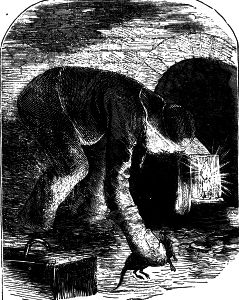
THE RAT CATCHER.
These rat-catchers traverse the sewers by night, and carry lanterns and a long wire basket with lids and a handle of the same material. They use ointment which they rub on their hands and with this same composition they cover their arms, which is very distasteful to the rats, who will not bite at any human flesh that is anointed with this preparation. These men wear large slouch hats, and pursue their calling in all seasons, to make a living. Often they have terrible battles with the enraged colonies of rats, and not a few of the rat-catchers have been over-powered in the sewers when attacked, and their bones whiten many of the brick beds and slimy crevices of these dark and dismal underground passages.
"PADDY'S GOOSE," RATCLIFFE HIGHWAY.
The cab driver now desired to know if I would like to visit "Paddy's Goose," a den in "Ratcliffe Highway," one of the worst of the bad districts of London. This place is frequented by sailors of all nations, who visit the spot to dance with the abandoned women, that are hired by the proprietors of these resorts to entice the foolish seafaring men just discharged from their vessels, with more money than they are able to take care of.
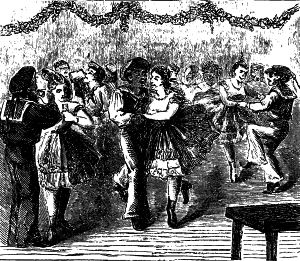
"PADDY'S GOOSE."
"Paddy's Goose," or the "White Swan," as it is called by its owner, is perhaps the most frightful hell-hole in London. The very sublimity of vice and degradation is here attained, and the noisy scraping of wheezy fiddles, and the brawls of intoxicated sailors are the only sounds heard within its walls. It is an ordinary dance house, with a bar and glasses, and a dirty floor on which scores of women of all countries and shades of color may be found dancing with Danes, Americans, Swedes, Spaniards, Russians, Negroes, Chinese, Malays, Italians, and Portuguese, in one wild hell-medley of abomination.
The proprietor of this den is undoubtedly the most desperate villain I ever saw outside of a prison gate, a man whose face is scarred and corrugated by the foot-prints of the Devil, whose servant he has been for many years, and yet I was informed that this scoundrel was tolerated, nay, encouraged by the government, from the fact that he had great influence among English seamen. This man during the Crimean War hired steamers, with bands of music, and served the Admiralty as a "crimp" for enlisting sailors, or rather for trapping them by drugging them first and then "burking" them off to the men-of-war, which needed fresh complements of seamen.
I did not stay long in this Devil's-Tavern, and I am sure my readers will excuse me from going into particular mention of the beastliness and orgies I saw there.
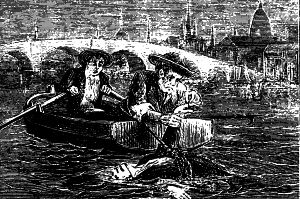
"WAITING FOR THE TIDE."
Dismissing "Old Smudge" with a fee that seemed to meet his approbation, I turned my steps in the direction of the river, not doubting for a moment but that I should find further food for reflection. I came upon the Thames suddenly as a vision, and saw it stretching out in all its dark and terrible beauty, just above Shadwell. I had taken my seat on an old dismasted hulk that lay some distance off in the river, and which I had reached with considerable difficulty by clambering from bowsprit to bowsprit among the silent shipping, on whose masts and canvas God's silent stars shone brightly down.
WAITING FOR THE TIDE.
I had not been sitting long there when a clumsy-looking and broad-bottomed boat passed me, directly below the hulk, one man pulling in the boat while another leaned over and seemed to support something, dark and bulky in shape, from the stern of the wherry.
A chill came over me, and in a faint voice I asked the man what he had in the skiff?
"Oh, yer honor, we were Waiting for the Tide below Bridge. We goes out every night, me and Tim, to look for bodies—we gets twenty shillings a-piece for them, and all we can find, and Tim's got a dead 'un now, and 'praps he's got a good haul, for there's a sparkling ring on Its finger,—mayhap yer honor would like to buy it."
Trailing slowly in the water was a lifeless corpse, and the boatman was tearing a bright object from its stiff forefinger.
Hastily I rose and turned my face away from the River which had given up its dead in this startling manner.
I went home thoroughly cured of the blues, and saw no more "sights" that night.
CHAPTER XLVI.
ENGLISH LITERATURE AND JOURNALISM.
NGLISH literature is one of the mainstays of our present civilization. Wherever the English language is spoken or understood, or wherever English thought predominates, English books are read, and the names of English authors are held in reverence. And second only to the power of English books is the power of the English press, which immediately after French journalism, represents the most trained culture and best talent employed in the Fourth Estate of our times.
London ranks, as I have said, in the second place, as far as her journalism is concerned. London journalists have not yet attained that high influence, both social and political, in the State, which is freely yielded to young and middle-aged men whose services are known to be of value on the Parisian journals of ability and circulation.
But the men who think for England, and who write its books, do not need to fear comparison with the same class in any other land in breadth of thought or influence on the masses of mankind. I shall make but a brief mention of a few of England's worthies in the paths of literature, and shall only speak of those who are best known by their works in America.
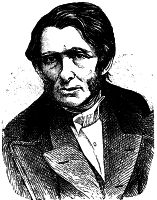
JOHN RUSKIN—ART CRITIC.
Twenty-eight years ago, articles of wonderful force, beauty, and breadth of tone, began to appear from some unknown pen, in the literary journals of London. These articles attracted notice from the best minds as they advocated a new and startling theory in art—the theory of Pre-Raphaelitism, as it has since been called. The author of these articles was John Ruskin—since become so famous—then in his twenty-fourth year. Ruskin was the son of a wealthy London merchant, and, unlike most men of genius he has never known any of the bitter struggles of poverty. From his boyhood he has been accustomed to elegance and plenty, the society of refined men and women, and his mind has been enlarged by almost incessant and instructive travel. He was very fond of the true and beautiful in Nature, and it is recorded of him, that when a child he had one favorite spot—Friar's Crag, in Derwentwater, which overhung a lake,—and here he was brought daily by his fond nurse, who secretly gratified the child's taste for the picturesque by allowing him to hang over the brow of the cliff, and when permitted to do so he would gaze for hours with intense joy and mingled awe into the depths of the dark waters below, hanging on by the grassy roots which bloomed on the surface of the cliff. He had always a feeling of awe and heart hunger in the presence of mountains, and, at fifteen years of age, he had ascended the summits of the most elevated hills in England. A landscape delighted him, while belle lettres and mathematics only wearied his retrospective soul. At twenty, his reflective and practical powers had increased by the incessant traveling which he undertook, having visited every European city of note, but in all these travels Venice always remained dear to his heart. At Oxford he was a gentleman-commoner of Christ Church, where he carried off the Newdigate prize for a poem called "Salsette and Elephanta," a fragment now forgotten, and was graduated double fourth class in 1842. Among his teachers in landscape painting, which he loved with all his great heart, he had such men as Copely Fielding, Harding and Prout. His great admiration was for Turner, however, and this love led him to the field of art criticism, in defence of that eminent painter.
RUSKIN'S LOVE OF THE BEAUTIFUL.
In 1843, the first volume of Ruskin's "Modern Painters" appeared, and created the greatest sensation. No art critic had yet appeared with such a wealth of language, and such an affluence of imaginative ideas combined with the most striking powers of observation, and an earnestness bordering on enthusiasm. Never thinking beforehand of the subject, his philosophy and criticism consists mostly of brilliant invective, and he is continually involving himself by his inconsistencies, yet, so great was his power, a new school in art was founded by him, with such disciples as Millais, Holman Hunt, and others, equally well known.
He is sometimes diffuse and discursive, and is far behind Henri Taine for perspicuity of style, though far more solid, concentrated, and vigorous, in his blows. The first volumes of Ruskin's "Lamps of Architecture" made their appearance in 1849, and were followed by the first volume of "The Stones of Venice," in 1851, the illustrations in the latter provoking much hostility, but displaying to great advantage his artistic powers. Ruskin has lectured and written on Manufactures, Gothic Architecture, and Painting, and he has said to have realized, by his works the sum of £95,000. He has a careworn face, sloped shoulders, and wavy silken hair. His habits are simple, and it is said that he is Brahminical in his tastes, never touching butcher's meat. His large private fortune enables him to extend his benevolence to struggling students, and others who are in need of assistance. Ruskin has taken up the cause of the workingmen of England with great zeal, and is now in his forty-ninth year.
FROUDE, THE HISTORIAN.
Since the death of Macaulay, England has had no successor to that eminent and great man in the field of history, until of late years James Anthony Froude has risen like a meteor to irradiate the dark places and bloody scenes of English history. The author of the "History of England from the Fall of Wolsey," may well claim a niche among the loftiest names who have searched the archives of empire and statecraft. James Anthony Froude comes of a High Church clerical family, and was born at Dartington, Devonshire, April 23, 1818. His father, the late Venerable R.H. Froude, was Archdeacon of Totnes, and young Froude went to Westminster School, the most aristocratic of its kind in England, and afterwards was graduated with high classical honors at Oriel College, Oxford, obtaining the Chancellor's prize for an essay on "Political Economy," and was elected Fellow of Exeter College in 1842.
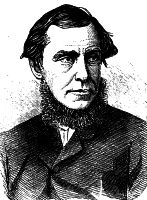
JAMES ANTHONY FROUDE.
For some time he was connected with the High Church party led by the Rev. J.H. Newman, and so much was he imbued by its doctrines, that he wrote the "Lives of the English Saints," and took deacon's orders in 1844. He has also written "The Shadows of the Clouds," 1847, and "The Nemesis of Faith," in 1849, both of which works had to undergo the severest condemnation of the University authorities, for the Puseyite opinions broached in their pages.
In 1850, Froude laid the foundation-stone of his fame by a series of articles, chiefly on English History, which were contributed to the Westminster Review and Frazer's Magazine, and in 1856 he published the two first volumes of his "History of England." This is his greatest work, in ten volumes, and for clearness of thought, powerful intensity, and acute understanding of those stormy periods of Henry VIII, Elizabeth and Mary, there are few passages in written history to equal Froude's descriptions of the age, and his grand delineations of character. He is, however, prejudicial in many things, and his view of the characters of Mary, Queen of Scots and Queen Elizabeth, is altogether different from the view which all modern historians have taken of these two women.
In 1867, a work entitled "Short Studies on Great Subjects," was published by Mr. Froude, and the historical sketches in this volume are of the most masterly kind in English literature. Mr. Froude is now Editor of Frazer's Magazine, whose pages his powerful genius illuminated some twenty years ago. This magazine had formerly for its contributors some of the finest scholars and best thinkers in Britain. Frazer's Magazine is issued by Longmans, Green & Co., Paternoster Row, one of the great publishing houses, and whose business is only rivaled by that of John Murray, McMillan, Sampson, Low & Son, and Smith & Elder, among London booksellers.
Among the contributors to Frazer are Max Muller, F.W. Newman, E. Lynn Linton, Jean Ingelow, Shirley Brooks, R. A. Proctor, Moncure D. Conway, a Massachusetts man, and a personal and intimate friend of Carlyle,—I believe he is to write the biography of that dogmatic old thinker, who has failed to prevent the earth from revolving on its axis, when he is gathered to his fathers, in the little churchyard in Dumfriesshire. William Howard Russell, James Spedding, Frederick Denison Maurice, a liberal clergyman and a professor in London University, and others whom I do not recollect, are contributors to Frazer. This magazine contains 134 double-column pages of large print, on fine white paper, and is sold for two shillings and sixpence. The same matter and workmanship could not be sold in America for less than one dollar and twenty-five cents, I am informed. Miss Ingelow, one of its contributors, is by no means a Miss in her teens, being now in her forty-first year, but it is tolerably certain that such delightful verse as hers could not have been written by one who had not endured sorrow and trial. The several editions of her poems have realized for Miss Ingelow the comfortable sum of £8,500, and I was told by a leading London bookseller, that Mr. Froude, whose last article was on "Salmon Fishing in Ireland," sold the copyright on four of his books for £39,000. Miss Ingelow is a Suffolk girl, and rumor says has never married because of a blighted affection in early life.
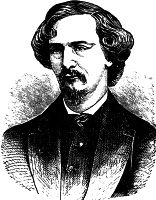
ALGERNON CHARLES SWINBURNE—POET.
A worthy successor to Lord Byron, in my opinion, is Algernon Charles Swinburne, the most passionate English poet who has lived for one hundred years. Swinburne is in his twenty-eighth year, and at that early age he has attained for himself a position among the poets of his native land, surpassed by none. For wealth of language, beauteous and fervent passion, and gorgeousness of imagery, Keats alone is his peer. Swinburne is an earnest republican, and sympathizes with revolution in every land. He is a great admirer of Italy. For a poem of one page in an English magazine he received two hundred and fifty pounds, a larger price than was ever paid before in England for a poetical fragment.
SWINBURNE'S BOYISH DAYS.
Swinburne, though a republican in sentiment, belongs to one of the oldest Roman Catholic families of Northumberland, and comes from ancestors who have followed the Percy in plate armor against the fierce barons of the House of Douglas. I am sorry to say, however, that the poet does not look like a man who would wear a steel jerkin and hang a battle-axe at his saddle bow. He has long curling hair, a pair of weird fascinating eyes, a loose and slender frame, and a face which does not impress one favorably at first. Take him altogether he seems like a man who might like to recline on a bed of roses, with an Amphora of Falernian by his couch, and half a dozen Syrian damsels to wait on him and hand him flowing bumpers of golden wine.
His boyish days were spent at Eton, and here he was noticed only for his utter dislike to athletic sports, including the darling amusement of every Etonian—I mean the cricket field. He was finished at Oxford, but did not receive his degree from Alma Mater. From the University he went to Florence, and there he contracted a warm friendship for that great gothic and rough-angled character, Walter Savage Landor, which was ardently reciprocated by the latter. Returning to England in 1861 he published the "Queen Mother," and "Rosamond," neither of which attracted much attention. His first great and decided success was in that classic poem "Atalanta in Calydon," published in 1864, when Swinburne had attained his twenty-first year. This poem took the cultivated minds of England by storm, and was followed by "Chastelard," "Poems and Ballads," "Laus Veneris," and a biography of "William Blake," the painter, in quick succession. Since then his copy-rights have amounted to £27,000, so rapid has been the sale of his books. This moneyed success does not, however, prevent the poet from being afflicted with a very penurious spirit, and it is said that he is in the habit of giving waiters and servants sixpences for the pleasure of taking the gifts back.
JOHN STUART MILL.
The greatest publicist in England, at this juncture, and the man whose views demand most attention from press and people, after Carlyle, is John Stuart Mill, the eminent writer on Political Economy, who was formerly a clerk in the India House, like Charles Lamb, as his father had been before him. Mr. Mill is now sixty-six years of age, and has lately taken up the cudgel for the Woman's Suffrage party, in England, along with Miss Harriet Martineau, after having exhausted Utilitarianism, Political Economy, Parliamentary Reform, Logical Systems, Auguste Comte, Positivism, Philosophy, and other light and airy subjects. Yet all his great powers of thought did not prevent him from being badly beaten by a Mr. Smith, a news agent, for the representation of the Borough of Westminster, in the late parliamentary elections. Mr. Mill has a grand broad forehead, a pair of deep steadfast eyes, a firm mouth, and is of studious habits. Like all students his oratory in Parliament, when first elected, was more ornate and logical than impressive or forcible. His English is vigorous and sterling, and it must be said of this venerable old man, that his whole life has been devoted to an idea.
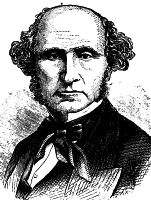
JOHN STUART MILL—POLITICAL ECONOMIST.
The very opposite of John Stuart Mill is Benjamin F. Disraeli, who was born in Bradenham, Buckinghamshire, Dec. 21, 1805. It is more than positive that Mr. Disraeli has never sacrificed any thing for an idea. Mr. Isaac Disraeli, his father, was a Christian, and an author, who had written the "Curiosities of Literature," and the "Amenities of Literature," the latter being a book in which the misfortunes and failings of authors occupy a large space. The grandfather of the great politician was a Jew of the Jews, I believe, and he who is now leader of the Conservative party in the House of Commons, and who was Lord Chancellor of England, has ever had a deep feeling for and faith in Judaism, although he has been for many years the Champion of the Anglican Church. At twenty years of age, Disraeli, who was then as fond of velvet shooting jackets and jewelry as he is now in his old age, or as Dickens was in his prime, began to write novels, and from 1825 to 1881 he had written "Vivian Grey," "The Young Duke," "Henrietta Temple," "Contarini Fleming," "Venetia," "Alroy," and "Coningsby."
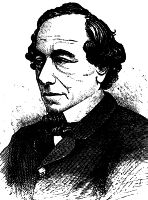
BENJAMIN DISRAELI—POLITICIAN.
In 1837, he entered Parliament, and made a miserable failure as a speaker and was laughed down, but he was not of the stuff to be frightened. Since then he has filled the greatest offices of trust that it is possible for a commoner to fill in England, and at times a radical revolutionist, and then again a most staunch monarchist, he has had greatness of soul enough to refuse a title offered him by the Queen, when he retired from the Cabinet in which he was Prime Minister. The honor tendered him was politely refused with many thanks, but he accepted the title of Viscountess Beaconsfield for his noble and devoted wife, who enriched and has sustained him in all his severest struggles.
It is told of this brave lady, that while accompanying her husband in a carriage to the House one night, Disraeli became lost in thought about a great speech which he was going to make, and the carriage door having closed on one of her fingers, she never uttered a sound of pain until the equippage drove into the Palace yard at Westminster, when the footman jumped down, and she fainted in her husband's arms. One hundred and fifty thousand copies of Disraeli's "Lothair" have been sold, and it is more than probable that the sale will not stop short of 250,000 copies. The bitterest article in review of this book was written in Blackwood's Magazine, by Lawrence Oliphant, author of the "Piccadilly Papers by a Peripatetic," in London Society. Mr. Oliphant deserted fashionable London society to found a Communistic association on the shores of Lake Erie, and having accumulated a secretion of gall and wormwood there he went back to England and poured it out on the head of Disraeli.
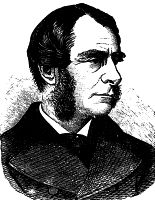
CHARLES KINGSLEY—NOVELIST.
CHARLES KINGSLEY.
The Rev. Charles Kingsley, formerly rector of Eversley and Chaplain in Ordinary to the Queen, and now Dean of Rochester, is the defender of Muscular Christianity in English literature. He is the son of a clergyman, and is descended from the ancient Saxon family of the Kingsleys, of Kingsley, in the Forest of Delamere. He was educated at Kings College, London, and Magdalen College, Cambridge, and is nearly fifty years of age. From his advocacy of the cause of the workingmen he has been called the "Chartist Parson." His chief works are, "Hypatia, or New Foes with Old Faces," "Alexandria and Her Schools," "Westward, Ho," "Two Years ago," and "Hereward, Last of the Saxons." He delivered the "Roman and Teuton Lectures" while professor of Modern History at Cambridge University. He has also written a series of children's books on historical subjects, which are very popular in England. His brother, Henry Kingsley, a novelist of considerable reputation, is eleven years younger, and is a contributor to the Gentleman's Magazine, the oldest periodical of its kind in England, which is sold for one shilling.
Anthony Trollope, the most voluminous English novelist now living, was born in 1815, and comes of a literary family, his mother having made a certain sort of fame by her book of American travels which did not redound to her credit. Many years after the issue of Mrs. Trollope's book, her son visited America and sought to redeem the unfavorable impression made by his parent's villification of our people, in his "North America," published in 1861. Anthony Trollope was educated at Winchester and Harrow, and at thirty-two years of age wrote his first novel, "The McDermotts of Ballycloran," a picture of Irish middle class life. Since then he has furnished to the publishers of his works enough material to fill a small library. Many of his genial novels appeared in the Cornhill Magazine, which was edited by Thackeray at one time, and subsequently by Frederick Greenwood, who was, during the former's management, a proof reader on the Cornhill, and is now the editor of the Pall Mall Gazette, the establishment of which journal was the realization of the dream of Thackeray's life.
James Greenwood, the "Amateur Casual," a brother of Frederick Greenwood, has written a number of books of adventure of the most stirring kind, and was attached to the London Morning Star, a penny morning paper, which advocated the cause of the North during the Civil War, and local sketches every alternate day were furnished by him to its columns, for which he received sixteen guineas a week.
Mr. John Morley, whom I have to thank for much courtesy, was editor of the Star during my sojourn in London. He is now editor of the Fortnightly Review, with which he was formerly connected. The Star suspended publication about six months ago. I believe John Bright held a stockholding interest in the Star previous to its suspension, and had, on some occasions, directed its editorial opinions.
THE MAGAZINES.
Mr. Trollope has an eminently literary look, and wears huge large shaggy whiskers, and a pair of spectacles. His pictures of Irish middle class society and English clerical characters, are the best and truest ever drawn by an British novelist, his Irish characters being infinitely superior to those of Charles Lever, whose heroes swagger and strut in a most atrocious manner. Anthony Trollope has a brother, Thomas Adolphus Trollope, who is also a literary man of considerable note, and is five years the junior of Anthony. Adolphus Trollope resides chiefly in Florence, and has written several works of fiction connected with the very romantic history of that city. The younger Trollope has been twice married. His first wife was an authoress, named Miss Garrow, who died in 1865, and eight months after her decease he was again married to a Miss Ternan, who is now living. That was what an unprejudiced mind might call quick work for a novelist. Anthony Trollope is the editor, and also, I believe, the proprietor of St. Paul's Magazine, which is sold for one shilling a number.
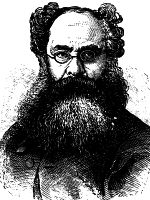
ANTHONY TROLLOPE—NOVELIST.
The circulation of the numerous London magazines and periodicals is only to be computed by millions. Of course the cheap magazines have the largest circulation, and the cheapest are not by any means the worst edited. The Temple Bar magazine, which was established by George Augustus Sala, a well known correspondent of the Morning Telegraph, sells for a shilling, and has among its contributors Mrs. Edwards, Florence Maryatt, Miss Harriet Martineau, who is also a contributor to the Daily News, H. Sutherland Edwards, John Holingshead, who was formerly the dramatic critic of the Daily News, and is now manager of a London Theatre. The Brittania Magazine is well edited and has original stories and sketches, and sells for sixpence. Bow Bells Magazine is a good local periodical, selling for eightpence, and Belgravia, edited by Miss Braddon, sells for one shilling, as does the St. James, which is well known for its clever Parliamentary sketches. Cyrus Redding, the famous octogenarian writer on wine culture, was for many years a constant contributor to Colburn's Monthly, in which many of William Harrison Ainsworth's sensation serial stories have appeared. Louisa Stuart Costello and her brother Dudley Costello, and Mrs. Ward, for many years contributed to the pages of Colburn's Monthly. Blackwood's Magazine is too well known to need any enumeration of its famous writers. Blackwood's sells at two-and-sixpence the number.
McMillan's Magazine is issued at one shilling a number by the publishing house of McMillan & Co., Bedford street, Covent Garden, having 78 double column pages of matter. Among its contributors are Frederick W.H. Myers, Edward Nolan, S. Greg, Thomas A. Lindsay, Dr. Boyce, Edward A. Freeman, Charles Kingsley, Jean Ingelow, Menella Bute Smedley, Mrs. Brotherton, F. Napier Broome, Thomas Hughes, Godfrey Turner, T.W. Robinson, and F.W. Newman. Cornhill is published by Smith, Elder & Co. All the Year Round is edited by Chas. Dickens, Jr., who is rated very high as a sketch writer, and is also well known as a rowing and yachting man. The London Society Magazine is published at 217 Piccadilly, and the most aristocratic of all the London magazines, being beautifully illustrated, and having excellent social, club, and fashionable sketches. The London Society is sold for a shilling, and has a number of lady artists who make drawings for its pages. Watson, W. Brunton, Lionel Henley, Adelaide Claxton, H. Tuck, A. Thompson, and F. Walker, are among the best known artists on this magazine. Walter Thornbury, author of "Haunted London," Lawrence Oliphant, Edmund Yates, and Lascelles Wraxall, are contributors to the London Society. The "Graphic," the finest illustrated weekly ever published in London, is edited by Arthur Lockyer, who has succeeded its former editor—H. Sutherland Edwards. The circulation of the different magazines is computed as follows:
Cornhill, 36,000; McMillan, 28,000; Blackwood, 39,000; London Society, 24,000; Frazer, 17,000; Colburn's Monthly, 7,500; Temple Bar, 19,000; St. Paul's, 16,000; Gentleman's Magazine, 25,000; Britannia Magazine, 26,000; St. James', 15,000, and Belgravia, 16,000.
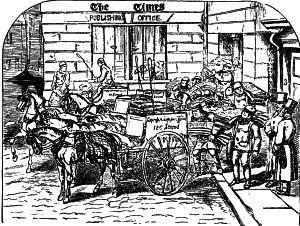
DELIVERING THE "TIMES."
The circulation of the principal critical Weeklies is: Saturday Review, sixpence, 38,000; Spectator, sixpence, 22,000; Athenæum, sixpence, 29,600; Examiner and London Review, 13,000. The Saturday Review has forty pages of double-column matter, large print, twelve of which are devoted to advertisements, the remaining pages being taken up with editorials, book reviews, notices of the drama and fine arts. The Athenæum has twenty-two quarto pages of three columns each, ten of which are taken up by advertisements, and the remainder by book reviews, and dramatic, fine art, and scientific notes. The editor of this journal is Sir Charles Wentworth Dilke, M.P., who wrote an excellent book of travel, entitled "Greater Britain." Ruskin and Huxley have been contributors to the Athenæum. The Spectator has twenty-eight pages folio, and is chiefly noticeable for its valuable historical studies, and its short and spicy paragraphs on the first four pages of the paper. Any of these weeklies will be sent abroad for the additional cost of a penny stamp.
THE LONDON TIMES.
The first number of the London Times was printed January 1, 1788, by John Walter, and the first newspaper printed by steam in Europe was the Times of November 29, 1814. Applegarth and Cowper's four cylindered presses, printing five to eight thousand sheets an hour, were in use by the Times for many years. These were succeeded by Hoe's press with Whithworth's improvement, and now the Bullock press modified, which prints on an endless sheet, is used by the Times. The circulation of this, the leading journal of Europe, varies from 57,000 to 65,000 copies a day, and the owner is Mr. Walter, the son of its founder. John Thaddeus Delane, the son of William F.A. Delane, the former financial manager, who has been succeeded by Mowbray Morris, is the editor of the Times. He is an Oxford man, and was admitted to the bar in 1847. Since 1839 he has been connected with the Times, to whose editorship he succeeded in 1841, on the decease of its then famous editor, Mr. Thomas Barnes. The value of the Times newspaper property has been estimated at three million pounds, or fifteen million dollars. As Thackeray said, its ambassadors are everywhere; one may be seen pricing potatoes at Covent Garden, while another is committing to paper the Cabinet intrigues at Berlin. Among its most celebrated writers have been Barnes, Sterling, Horace Twiss, William Howard Russell, Thackeray, Thomas Noon Talfourd, Baron Alderson, Louis J. Jennings, the American correspondent, now editor of the New York Times, and others. Southey was offered the editorial management at a salary of £2,000 a year, and the same offer was made to Thomas Moore, the poet, but both declined acceptance. The Times, with supplement, has seventy-two columns of matter, on sixteen pages, and 2,250 advertisements have been inserted in one day's issue, seven tons of paper, with a surface of thirty acres, and seven tons of type, being used.
CIRCULATION OF JOURNALS.
The circulation and prices of the leading London journals, are as follows: Times, 65,000, four pence; Daily News, 48,000, one penny; Daily Telegraph, 175,000, one penny; Morning and Evening Standard, 80,000, one penny; Morning Advertiser (rumseller's organ), 35,000, one penny; Pall Mall Gazette (evening), 30,000, one penny; Echo (evening), 75,000, one penny; Globe (evening), 8,000, one penny; Punch (weekly), 55,000, six pence; Illustrated London News, 60,000, four pence; Graphic, 80,000, six pence; Bell's Life (sporting), Wednesday and Saturday, 66,000, one penny; The Field (sporting, weekly), 18,000, six pence; Lloyd's Weekly Newspaper (Sunday), 140,000, one penny; Weekly Times (Sunday)—owned by London Journal, which has a circulation of 200,000—110,000, one penny; Cassell's Weekly Magazine, 90,000, Weekly Dispatch (Sunday), 215,000, two pence; Reynold's Newspaper (Sunday), 280,000, one penny; Jewish Record (weekly), one penny, 7,500; Tablet (Catholic weekly), four pence, 36,000.
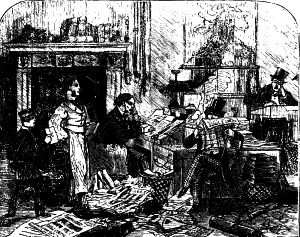
SUB-EDITOR'S ROOM, "TELEGRAPH" OFFICE.
The Morning Telegraph is the most popular daily newspaper in the world. During periods of great excitement its circulation increases to over 200,000 copies a day, and it takes four ten-cylinder, and four six-cylinder Hoe's presses, to strike off its daily editions. The correspondent of the Telegraph at Paris, Mr. Whitehurst, is hand and glove with Napoleon, and his salary amounts to £10,000, with a horse and brougham thrown in. The editor of the Telegraph is Thornton Hunt, son of Leigh Hunt, who was for twenty years on the staff of the Spectator. The sub-editor of the Telegraph, for they have no managing editors in England, is Mr. Ralph Harrison, to whom I am much indebted for courtesies received. The owner of the Telegraph is a Hebrew gentleman named Levy. The Daily News is owned by the Liberation Society, a Dissenters' association, and is edited I believe, by Mr. Edward Dicey, formerly a special correspondent of the Telegraph, who went to Suez for that journal. Tom Hood, son of the poet, was editor of the Tomahawk formerly, and lately of the Latest News, a penny Saturday paper, and Arthur A. Becket has edited Fun. James Grant is now editor of the Morning Advertiser, at a salary of fifty pounds a week, and Blanchard Jerrold receives £800 a year for editing Lloyds' Weekly. The salaries of editors on the London press vary from fifteen to fifty pounds a week, according to the ability displayed, and the circumstances of the journal on which they are employed.
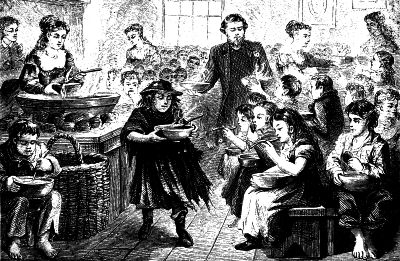
HALF PENNY SOUP HOUSE.
CHAPTER XLVII.
THE POOR OF LONDON.
EYOND comparison London exceeds all other cities of Europe for the number of its poor, and the misery and suffering of those who individually make up the gross totals in work-houses, back slums, and miasmatic tenements.
One of the most interesting—if not the most curious and cheerful scenes in the metropolis—may be witnessed any day by a visit to the East London "Half-Penny Soup House," an institution established by good and merciful people, whereby the poor little castaways and waifs of the city are provided with a dish of soup, a piece of meat, and a small loaf of bread, once in each twenty-four hours.
The children are gathered from the promiscuous juvenile assemblages that may be, at any time, found in the London streets, and are taken to the Soup House where large and steaming dishes of soup are given them, by charitable ladies, after which they are dismissed until the next twenty-four hours have elapsed, when again they assemble to partake of the same plentiful and grateful food. This nourishment costs but a half-penny per head, all the attendance and time being given gratuitously by the good ladies who seek the little ones for their own merciful purpose.
The struggles of the London poor to keep soul and body together, are very wonderful to understand or relate. Out of every five poor families in London—it is known that at least three are compelled, between Easter and Christmas, to denude their households of all the most necessary articles of clothing and furniture, to take them to the pawnbroker's shops in order that bread and meat may be procured for their little ones. And what terrible scenes are witnessed in these pawnbroker's shops, on Saturday nights when the goods are reclaimed by dint of economy and hard scraping? None but God, the police, and the pawnbroker, ever see such struggles.
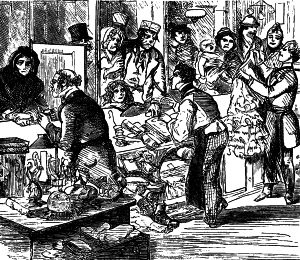
A PAWNBROKER'S SHOP.
One day I paid a visit to the Workhouse of St. Martin's, in the Fields, which is not far distant from Trafalgar square. This workhouse looks like a vast prison, stern, gloomy, and frowning, in the very busiest quarter of the city. Opposite to its entrance was the barracks of some regiment of infantry, and round the doors, were talking and smoking, half-a-dozen of long-legged and slim-waisted private soldiers, in red shell jackets, whose chief occupation seemed to be that of switching their manly calves with slender rods which they jauntily carried in their hands.
THE MASTER OF THE WORKHOUSE.
The workhouse door was shown to me by a squad of small boys who were at play in the adjoining gutters, clad in a pauper's uniform of blue, and on whose heads were dirty but comfortable caps of plaid pilot cloth.
"Yes, master, there is the Workus, over yander. Will ye give us a penny? We are all Workus," said they in chorus.
I entered the low entrance and stood in a small vestibule, where stood a shelf, or stand, upon which was placed an open blank or visitors' book, in which each caller was to inscribe his name and residence, together with his object for visiting the workhouse. On the opposite page were blank spaces, on which an attendant entered the hours when a visitor called and when he left the institution.
A miserable, worm-eaten looking old man, devoid of teeth, and shambling in his gait, a perfect wreck, shuffled up to me with a deprecating look in his eye, as if he were asking pardon for being alive. Heavens! how the iron of poverty, and the bitterness of dependence, must have eaten away that poor wretch's soul before such enduring lines of degradation could have been impressed on his features.
This old pauper was detailed to wait upon the visitors, and to see that their names were inscribed, with the warning that he should not attempt to ask for or receive any gratuity.
He faintly said in a childish voice:
"What can I do for you, Sir? Do you wish to see the Workus? Ah, yes, of course, a goodish bit of people comes to see the poor paupers, now and then, but we are never allowed to take anything, Sir. No never, never. Poor paupers, poor paupers," and so he mumbled away until the Master of the workhouse was announced by his footsteps that came in echoes as I sat in the little, poverty-stricken ante-room.
To the Master, who is the supreme authority in the workhouse, under the direction of the Board of Guardians of the parish, I explained my motives for visiting the paupers' residence, and he welcomed me with much politeness, offering me every facility to inspect the place. He was a medium sized man, of middle age, plainly dressed, and after having issued orders to several of the inmates of the establishment he prepared to accompany me through the premises. Here and there, in the walks and corridors, and courts of the workhouse, we met with an occasional pauper, the males in a grey, rough, shoddy uniform, and the women in check or plaid gowns, of a coarse cotton material, and wearing caps of a faded whiteness upon their heads.
They all had a vacant, listless look, and seemed lost in astonishment to see a stranger with the Master, to whom they made the most servile of salutations.
I had seen, in my travels on the English railways, when I sought the not very wholesome refuge of the third class carriages to study character—just such poor, faded-looking people, among the families journeying wearily to their various destinations, as these poor old relics, who were now clustering around the workhouse tea tables. Oh, God! how lonely they looked, and distant from all human kind. The same wan, woe-begone faces, but more quiet and reserved than those I saw in the close railway cars devoted to poor people.
Smoking is a common thing in these crowded and close carriages, and delicate women, and puny, weak children, are forced to travel for hundreds of miles in these cattle boxes—I cannot call them aught else—until they are sometimes known to vomit from the bad air and worse stenches.
Making inquiries of this gentleman as I went through the buildings, I may as well give his explanations of workhouse life, and of the condition of the poor and destitute of London. I freely admitted to him that I had heard very strange stories in regard to the treatment, food, and medical attendance of the paupers in the Unions, and that I would be obliged to him if he could clear up my reasonable doubts on many points.
SUGAR AND TEA.
In answer to one of these doubts the Master took me into a large, long and clean-looking room, in which were about forty female paupers. These women were engaged in getting supper for themselves, and were all above middle age, and haggard-looking.
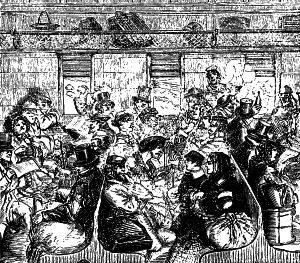
A THIRD CLASS RAILWAY CARRIAGE.
"Now, Sir," said he to me, "you, of course, can see something of which you speak, for yourself. Here is one of the busy wards of the Union. Each of these old women is allowed an ounce of dry tea per day, and enough sugar to moderately sweeten four cups of tea, which they make in their own tea-caddies, or, sometimes they mess together—three or four in a mess—and those who do not care for sugar will trade their surplus sugar for the surplus dry tea with some other paupers."
All the women arose from their low seats or benches, some of them being clustered around a grate in which were a moderate stock of burning coals, and bowed to the Master, who waved his hand and told them to sit down again, which they did with courtesies and many feeble expressions of thanks.
"That old woman over there in the corner," said the Master, pointing to a female of sixty years of age, who sat alone rubbing her bare arms, and chatting to herself senselessly, "has lost her wits. She is here forty-five years, and will die here in all probability. We have about 400 in-door paupers in this workhouse, and perhaps twice as many out-door poor, whom the parochial authorities assist as well as they can. Every pauper whom we support in this house costs the rate-payers of this parish about seventeen pounds six and ten-pence per head, which does not include charge for rent, taking the interest of the value of the property. For the children we have a school, and they get the rudiments and that's all. It is an idea with some, and I am afraid, with many poor people, "once a pauper always a pauper." The children who are born in this place, would never become independent of the parish if it were not that as soon as they grow up we send them to schools of an industrial kind outside of London, where they learn a trade, or are taught some occupation, such as gardening, blacksmithing, carpentering, or, in fact, anything that will enable them to make a living. The feeding and schooling of the children, with the nursing, &c., costs more per head for them, strange to say, than it does for a grown person's subsistence and clothing in London.
WORKHOUSE RATIONS.
"In this parish alone we have to take care of 478 children, and in some of the London parishes in Bethnal Green, and Hackney, or Stepney, they sometimes have to provide for from 1,500 to 2,000 children, of both sexes. Of course, in the very large parishes they cannot afford to educate the children, but have to content themselves with feeding and clothing as many as they can inside the workhouse, while the majority receive, with their parents, out-door relief, but the large and heavy parishes could not afford to have such fine schools as we have in the suburbs, with grounds attached, and sometimes goodish pieces of land, where farming and gardening can be taught the children. It costs the rate-payers of this parish twenty pounds a year to support and educate the parish children, and, along with all the rest of the taxes, it is no wonder that the people are grumbling and asking why we do not send the beggars to America or Australia."
"And why do you not?" said I to him, "if the sustenance of a pauper, together with his clothing, costs the parish £21 annually."
"Because, the people of London have an idea somehow or other, that the Americans will not receive paupers, and then again, if £21 was given to a pauper to go to America, they would raise a row in Parliament that too much money was going out of the country. Why," said he, "down at Birkenhead, near Liverpool, schools were built for paupers at a cost of £15,000, with bath-rooms and fine dining-rooms, and the people there raised an awful row because the cost to the rate-payers came to ten shillings per head per annum to every inhabitant in the place. They didn't want to give them bath-rooms or fine dining-rooms. They turned a man away there who was frozen, and he had to lose all of his toes on account of their neglect. In some of the work-houses, in the North of England, they are beginning to let the children out to board by the week, with farmers and families who can afford to take them, the parish authorities allowing, for each child, three shillings per week for board, with an outfit on leaving the workhouse, and six shillings and sixpence a quarter for mending and repairing their clothes, an offer which has been very cheerfully accepted by many families who are in decent circumstances."
"A 'Casual,'" said the Master, "is a pauper who is house-less and destitute in a different parish from which he has lived. When he finds himself in a strange place, as in London, he has to apply at the Police Station for a ticket, which is given him as a reference to ask for one night's lodging at the workhouse in the district. The ticket is shown to the Master, who receives him, and I will send him down here, but before he is sent down he gets a loaf of bread, weighing a pound and a quarter. He must apply to the House for lodgings before ten o'clock at night, or we will not let him in. Then he takes the loaf of bread and eats half of it for his supper, and the other half he saves for his breakfast. We give him, with the remaining half loaf of bread in the morning, a half pint of coffee or tea. But before he goes he has got to earn the breakfast which we give him, and is compelled to pick oakum from six o'clock in the morning until nine, when he leaves the House."
Before I left the workhouse the Master allowed me to inspect the beef, bread, butter, and beer, which are served out daily to the paupers. Each grown man and woman receives a twelve ounce loaf of bread, a pint of the best beer, an ounce of butter, daily, and five days in the week they receive six ounces of fresh meat, the other days being especially devoted to beans, and a liquid compound known to seafaring men as "skillagelee."
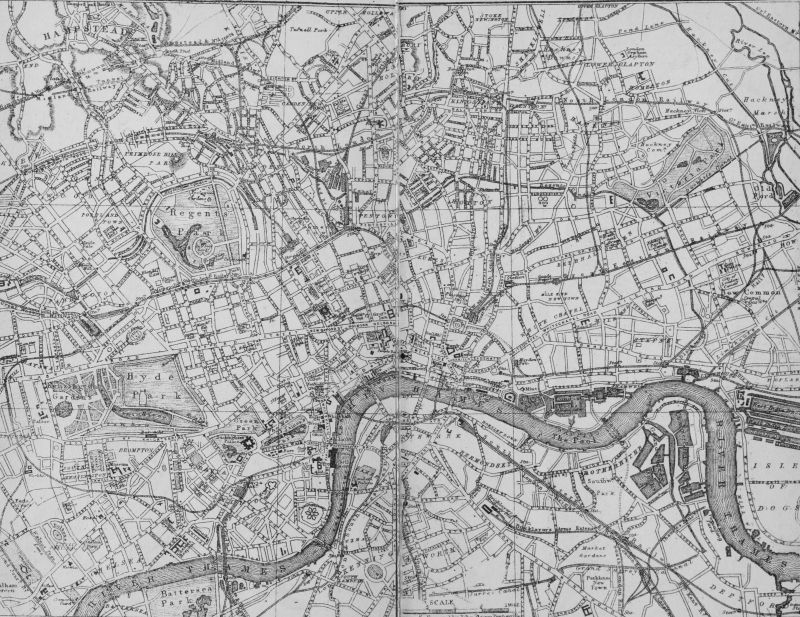
MAP of the CITY of LONDON.
BELKNAP & BLISS,
OF
HARTFORD, CONN.,
Are engaged in the Publication of
VALUABLE STANDARD WORKS,
SOLD ONLY BY SUBSCRIPTION.
Old Agents, and all others who want the Best and most Popular Books, and the Best Paying Agencies, will please send for their Circulars, which are sent free, and give full particulars.
THE EXPOSÉ:
OR,
MORMONS AND MORMONISM.
Giving its Rise, Progress, and Present Condition, with the Narration of
Mrs. MARY ETTIE V. SMITH,
a Sister of one of the High Priests—of her residence and experience for Fifteen Years among them, with a full, graphic, and authentic account of their Social Condition, their Religious Doctrines, and Political Government. It is a full and truthful disclosure of the Rites, Ceremonies, and Mysteries of Polygamy, with facts and statements truly startling; and also contains the speech recently delivered before the Elders in Utah, by Vice-President Colfax, and the reply of John Taylor.
It is an Illustrated 12mo Volume, and sold only by subscription at the following prices:
Bound in Fine Cloth, $2.00 " " Leather, Library Style, 2.50 " " extra Half Morocco, 3.00
Agents Wanted. Apply to
BELKNAP & BLISS, HARTFORD, CONN.
PICTORIAL
History of the United States.
IN
ONE ROYAL OCTAVO VOLUME OF ABOUT EIGHT HUNDRED PAGES,
AND CONTAINING
Four Hundred Engravings on Wood, besides Twelve Full Page Steel Engravings.
By BENSON J. LOSSING.
In this single volume may be found a record of every important event, from the discovery of the country to the present time, including short biographical sketches of all the distinguished men who have figured in its history. Every family should possess it. Prices as follows:
In Embossed Cloth, $5.00 In Leather, Library Style, 5.50 In Half Turkey Morocco, 6.00
LIVES OF CELEBRATED AMERICANS.
COMPRISING
Biographies of Three Hundred and Forty Eminent Persons
AND
ILLUSTRATED WITH OVER ONE HUNDRED FINE PORTRAITS.
By BENSON J. LOSSING.
Sold only by subscription, at the following prices:
In Cloth Binding, $2.50 In Leather, Library Style, 3.00
AGENTS WANTED. Apply to
BELKNAP & BLISS, HARTFORD, CONN.
LOSSING'S PICTORIAL HISTORY
OF
THE GREAT CIVIL WAR.
Three Imperial Octavo Volumes,
OF OVER 600 PAGES EACH, EMBELLISHED BY
MORE THAN 1,200 ENGRAVINGS ON WOOD, and 100 PORTRAITS OF UNION GENERALS, ENGRAVED ON STEEL.
By BENSON J. LOSSING,
Author of "Field Book of the Revolution," "Eminent Americans," "History of the United States," etc.
The work is very valuable, being a full and perfect pen and pencil picture of the Great Rebellion, and illustrates everything capable of delineation by the pencil and graver.
Sold only by subscription, at the following prices:
Embossed Cloth, per Vol., $5.00 Leather, Library Style, " 6.00 Arabesque Morocco, " 6.00 Half Calf, " 7.50
Agents Wanted. Apply to
BELKNAP & BLISS, Hartford, Conn.
DICTIONARY
OF THE
U.S. Congress and General Government,
Compiled as a Book of Reference for the American People.
By CHARLES LANMAN.
This volume contains about Five Thousand Biographies, as well as a large amount of official information connected with the General Government not to be found in any other publication. As a book of Reference it is invaluable. Sold only by subscription at the following prices:
In Cloth Binding, $4.00 In Library Sheep, 4.50 In Half Turkey Morocco, 5.00
Agents Wanted. Apply to
BELKNAP & BLISS, Hartford, Conn.