Front matter (continued 2)
Reading edition
"Well," he said, in a very gruff voice, "is hit bizness or pleasure? Vich? Kase, hif hits bizness you must 'elp yourself."
"PURTY BILL."
"Oh, pleasure by all means, Purty Bill," said the sergeant, "myself and friend here, who is a son of Henry Clay, as was President of the United States of America, just wants to see how the fun is goin' on to-night, and as I knew you kept a fust-class place, Bill, I thought I would bring him around to see you. He has called on the Queen, Mr. Bright, Mr. Gladstone, the Hemperor of the French, and he expressed a great desire to see 'Purty Bill;' so here we are."
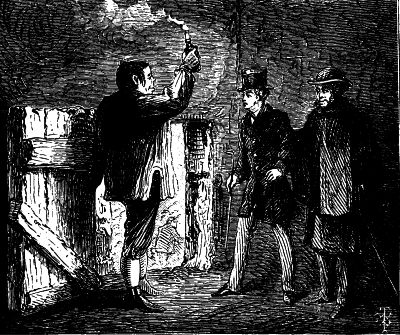
PURTY BILL SHOWING US IN.
The hideous vagabond seemed touched by this piece of insidious flattery, and said in a modified tone:
"Oh, well, that's fair enough. I don't hask hanything better. But ye see I thought you might ha' wanted some of my lodgers, and so many of them have been done for lately that they are getting suspicious of my honesty, and I have to be careful. Come this way," and he held the half-penny candle over his head, which gave me a chance to observe him. The man was about six feet two inches in height, and much in form of shoulders like an ox, with loins like a prize-fighter. The face was pitted terribly with small-pox, his entire face was seared, and even the corners of his eyebrows seemed eaten away by the awful disease. Hence his name of "Purty Bill." His eyes were of a greenish blue, and his attire was that of a costermonger; a smock of canvass, and knee breeches and huge shoes, whose heavy nails made rapid incisions in the clay floor of the long, dark passage through which we had to pass until we came to still another door. This door was not a door; in fact it was only a few planks strongly nailed together, and was not more than four feet high, so that we were all compelled, as "Purty Bill" lifted the latch, to put our feet in first, and making half circles of our bodies, we entered, and after descending three or four flagged steps we were at last in the cellar and establishment proper over which "Purty Bill" claimed a proprietary interest.
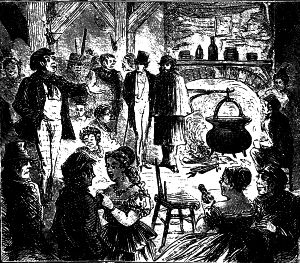
It was one of the strangest sights I ever saw—the interior of this Wild Beast's Den. It was a huge cellar formerly used as a brewery, of perhaps a hundred by seventy-five feet in dimension.
The ceiling, or, rather, the rough, unplaned beams which supported the roof above us, gave an appearance of great strength to the place. There was a large fireplace in the center of the cellar, around which fifty or sixty persons sat, of all ages and of both sexes. The floor was of damp clay, smooth and trodden by the feet of countless thieves, vagabonds, and prostitutes. The corners of the cellar were buried in darkness, while the center of the cavern, near the fireplace, was bright with the flames of a fire of logs, which threw a flickering light on the wooden beams, the broken chairs and stools, the pewter pots in the hands of the lodgers, and on many faces stained with dirt and ploughed up with crime and misery. There were thirty or forty berths roughly constructed as they are in the emigrant steerage of a Liverpool packet, and a heap of dirty straw in each indicated that they were used as beds by the occupants of the apartments. There was a large black pot hanging from a big hook, which depended from the brick chimney, and from this pot came a steaming odor of soup, or stew of some kind. The majority of the lodgers were sitting on the bare ground, which was dry and hardened near the fire, while at a distance from its flame the ground was rather damp and the lodgers sat on broken stools or on ragged pieces of matting, broken pieces of willow ware, logs of wood, bundles of rags, or any other article, or articles, that were convertible into seats for the time being.
"WONT YOU TAKE SOMETHING?"
The room was lighted by four or five candles, which were stuck in glass bottles, the bottles being fastened to the joists which supported the berths in which the lodgers slept. The people nearest the fire had fragments of food in their hands and were evidently preparing for a grand midnight feast. Some of them were peeling potatoes, and one old fellow with rheumy eyes had a piece of bacon of five or six pounds weight between his crossed knees on a board, which he was cutting into small square lumps, and as he hacked a piece off he threw it at random into the large pot. A young girl was engaged in carving a huge cabbage-head, and her assistant was scraping carrots and parsnips. Every one seemed interested about the pot, and every one seemed to have some contribution for the feast, which I found was a co-operative one.
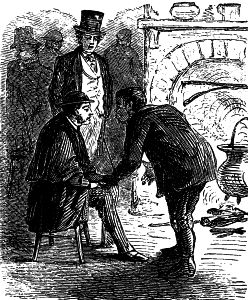
"WONT YOU TAKE SOMETHING?"
"Purty Bill" bustled about and found two broken stools for myself and conductor, and placed them near the fire, saying in a hospitable way:
"Gent's, this ere night is werry wet, and you might as well dry yourselves. Sit up nearer the fire. Won't ye take somethink?" and he put his huge paws on the detectives knee in a friendly way. "This is agoin to be a topper of a meal to-night, and all of us will welcome ye gents to our 'umble board. So make yerselves at 'ome, and peck a bit when it's biled."
"Wot's the idea of getting up this cram at this time of the morning, Bill? It's near two o'clock. Won't it interfere with yer lodgers' precious digestion?"
"Hinterfere with it? Wot, vith one of my lodgers? Rayther! No. Vy there's Kicking Billy as heats six blessed meals a day, and then he's all the time a lookin' for sangwiches and pigs trotters a-tween meals. Urt their digestion hindeed? Vy they 'av got stomax like them ere hanimals wot performs at Hastleys. You knows Slap-Up Peter. You used to be a stone swallower in the purfession," and the proprietor touched a man who was squatted on his haunches, smoking a dirty stump of clay pipe, with his foot. Slap-Up Peter drew the pipe out of his mouth, shook the ashes from it, dusted the venerable relic with a greasy red handkerchief, carefully placed it in his breeches pocket, and said:
"Vy don't ye keep yer big feet to yerself? Wot hanimals do you mean? Do you mean cammomiles?"
"Yes, them hanimals vith the 'umps on their hugly backs. You see, sir, Slap-Up Peter has had a good eddycation in his time, and he knows the names of the hanimals, 'cos he used to travel with the circus afore he went on the tramp to swallow stones and snakes."
"Peter," said the detective, "you must 'ave quite an 'istry. Could you tell us somethink about your past life, my boy?"
Slap-Up Peter had a melancholy face. The skin was tanned, the eyes large, black, and bulging, and the nose like a hawk's. His clothes were worn and greasy; his face was gaunt, and when he moved his body the bones seemed to creak and grate as if they had been joined together by metallic hinges. There was something mournful about the man—some queer story attached to him, I felt.
PETER AND JUDY.
"Tell ye me 'istry, is it? Vell, I don't mind if I do; but them as hears my story mout give me somethink to drink first, for I ham werry dry. I lost my woice speaking on the Histablished Church bill tother night in Parlymint, and I've been 'oarse hever since."
"Well, take a drop, Peter," said Kicking Billy, a one-eyed and one-legged, and rascally looking fellow, who sat with his crutches between his knees, toasting his shin at the fire, and he handed a bottle to Slap-Up Peter, who took it without saying a word, and lifting it to his mouth, took a deep, deep draught without winking.
"Look at that fellow that they call Kicking Billy—the one-legged fellow, I mean," said the detective to me. "He's a returned burglar, that fellow, and has served fourteen years. This place is full of thieves. They are nearly all thieves, and this is a thieves feast," he whispered in my ear.
"My name is Peter Wilson, and I've been in the show business for sixteen years, come Christmas, man and boy. I'm thirty-eight years of age now, and they called me Slap-Up Peter when I fust began jumpin', as a hacrobat in the penny gaffs. Cos wy, I had a way of turnin' myself over a chair and coming back-handed on a somerset that used to take well, but now so many does it that the haudience don't mind it a bit. I jumped for four years, and wos counted pretty good in my line until I dislocated my wrist a doin' of the Pyramids of Hegypt, and then I vos laid hup and couldn't jump for six months and hover; so I thought I'd leave the bus'ness and happear in another character. I got married to—"
"More fool you," said Kicking Billy, sententiously, taking a drink.
"Well, hit didn't cost you nothing, no more than it did for the government to support you in Botany Bay for fourteen years. So you needn't hinterrupt me again."
"Go hon, Peter, and never mind him, its only 'is chaff."
"Well, as I wos saying," continued Slap-Up Peter, "I got married, and maybe it was rayther foolish, for when we were spliced, Judy and I—she wos an Irish gal and a good worker—we went into our cash account and found that we had only one pun six shillings and height pence, not a blessed brown more. I said to Judy—she wor a good gal—
"Judy, we can't keep 'ause on twenty-six shillings capital, that's shure. That's all our fortune in silver and gold, and it won't last long. So wot will we do?"
"'Well, Peter,' said she, 'I didn't marry you for the dirty money; I married you cos' you were sich a good jumper and hacrobat, and I'll stick to you now when you can't jump any more;' for you see, Billy, my wrist was two years afore it got well."
"'Let us pad the hoof together,' said Judy, 'and we'll do the best we can. Let us two work the southern counties and we'll get long French or Hitalyan names, and we'll pick up a shillin here and there.' Cos you see," said Peter, "Judy had been born and bred in Shoreditch, and she knew all the wandering play-actors and showmen, and she wor hup to all their affs. So I next came out as 'Signor Hokenfokos, the fiery salamander of Naples, and my wife, the Baroness Padila, who had to leave her country on account of the wiolent love vich the king's son would persist in making hup to her, and she had to leave all her property, to the amount of six millions, behind her.' This was a good lay and we made from three to eight shillings a day down in Devonshire and Cornwall, wherever we could get a crowd together. I used to swaller hot iron bars, pokers, and red hot coals, and my wife used to play the hurdy-gurdy while I was swallerin' the hot coals. I improved at this werry much in two years, and then, after I had vorked the hot coals out, Judy said to me one day:
"'Peter, why don't you try and swaller snakes and swords? They are better than coals, and not so dangerous.'"
SNAKE SWALLOWING.
"'Yes, but I don't know how,' I said, 'and I don't like snakes at all, they are so precious slimy.' You see sir, even then I didn' know what it was to get used to a thing. Well, I commenced to swallow knives at first, and I had to oil them—that's the trick you see—with sweet oil as good as I could find at eighteen pence a pint, and I had to rub this on with a piece of shammy cloth. This oil lets the knife down easily, and when I wos well drilled there wos no danger at all—only I had to be sober. My swallow was hawful bad with the hirritation for two months, but I got over that; for when I felt my throat sore I took sugar and lemon juice, and gorgled my throat and that took the soreness away."
"Tell us about the snakes, Peter," said Purty Bill. "That's a good story, sir," to the author.
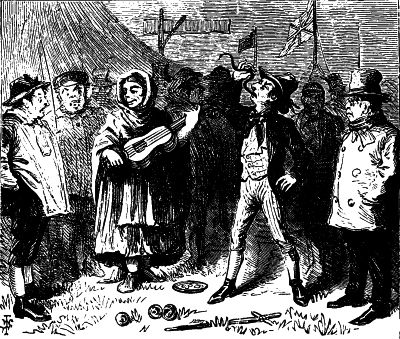
SNAKE SWALLOWING STORY.
"Ah! that was the most unlikely thing I hever took to. It went aginst my stomach hawful to swaller the snakes at first, and I don't believe I'd ever have done it if it hadn't been for Judy, who said to me, when I kicked agin it,—
"'Wot difference does it make, Peter, whether you swallow red hot coals or snakes? The snakes has their stings all taken out, and its nothing more than swallowin' a sausage or pork saveloy.'"
"Well, I went at it with a very bad 'art, and my old woman used to play 'Boney's March Across the Halps,' and the 'Death of Nelson,' whenever I swallowed a snake. You see I generally took a snake about fourteen or fifteen inches, or maybe a foot and a half long. The sting is out, you know, and I takes the head and puts the snake in, and if he doesn't go down why I pinches his tail, and then he rolls down the throat. It made me sea-sick at first, and the people in Sussex thought I was the devil out and out, and a good many hexamined my feet, which were in tights, to see if I had cloven feet. A goodish lot of people thinks that the snake goes entirely down the throat, but it stands to reason that the snake is more frightened than the man, and he does not go down, and hif he did he would be glad to come up, I can tell you."
"Don't you put somethink in your throat," said a boy of fourteen, who was known among the confraternity as 'Teddy the Kinchin;' "I mean, to make the snake sick if he'd go too far."
SLAP-UP-PETER'S SONG.
"No, that's no use at all; you see he doesn't go hall the way down. He is afraid, is the snake, and if you cough he'll come up and draw himself up and coil in a bunch in your mouth. But the duffers who pay their money think that the snake is in your stomach. It stands to reason that he'd get sick. It makes a man retch, and the first snake I swallowed I threw up and had awful vomits, but the next one I rather relished it, and it did me a sight o' good, like an oyster does after ye 'ave been drinkin at night and take's tuppence worth of natives in the morning. Well, when I began snake-swallowing it was rather new, and I had it all my own way for a long time, but finally, lots of men began to swallow snakes, and coal swallowing was not as good as it used to be; so I took to ballad singing, Judy and I. By this time we had sixty pounds saved, and we were doing well, but I made the acquaintance of a lot of Doncaster men, who knew I had the money, and before I could say 'Jack Robinson,' the money was all gone. Judy was in her confinement then, and she took on so bad about it that she died in child-bed, and the kid as well, and I've been on the tramp ever since, and now I do an odd turn at anything that turns up, but mostly I sing ballads, and make sometimes a shilling a day, and sometimes eightpence and ninepence a day. Times have changed for me. Worse luck."
Here the snake-swallower's story ended.
"Slap-Up Peter, will you give us a song? and I'll give you a drink, me oul wiper," said the crippled Kicking Billy to the snake-swallower.
"Well, Billy, I don't mind if I do," said Slap-Up Peter, draining the tin skillet to the last greasy drop.
The thieves, loafers, and women gathered around the fire in a half circle, and Purty Bill heaped logs very liberally, while Slap-Up Peter chanted in a hoarse voice the song, an extract of which I give below, as near as I remember it with my recollections of the scene, the choking smoke, the blazing fire, and the band of outcasts and outlaws in the den in Whitechapel:
'Twas down in Whitechapel that once I used to dwell, And of all the coves that knocked about, I was the greatest swell, My highlows were the cheese, with breeches to the knees, Oh, my toggery was quite correct—my coat was Irish frieze, My togs from Bond street came, it's a nobby slap-up street, In a fashionable locality—the swells the girls there meet; Nicol's my man for shirts, with his I cut a shine, His shop's in far famed Regent street, he's a pal-o'-mine. Rum too-rul-um, Happy-go-Bill, Inyuns and greens who'll buy, Rum too-rul-um, Happy-go-Bill, Inyuns and greens who'll buy.
"That's a fine melojous voice of yours," said Purty Bill to the singer.
"He's used to it," said one of the women.
Here's Spuds at Thrums a pound, they're prime 'uns as I've found, Oh, I've Reds and Dukes and Flukes and Blues, I sells in going my round. My greens are superfine, full blown and hearty are mine, Oh, come make a deal with me, my dear; don't wait, you'll find 'em prime. My inyuns now are new, you'll find what I says is true, In fact, the Queen, since these she's seen has cartloads just a few; My carrots are long and red, you'll find they're well bred, My vegetables are the cheese, bunch for you—penny-a-head. Rum too-rul-um, &c.
"Now give us the last werse with all the 'armony," said Teddy the Kinchin, in a piping voice.
"I vill, vith moosh plesh-yar, as the Frenchman said," returned Slap-Up Peter.
Jerry, my moke's a bird, of him perhaps you've heard, He knows his way about, he does, to match him's quite absurd; Just see him cock his eye when grub time's getting nigh, He likes his feed, he does indeed, he lives on cabbage-pie. Now any girl that's kind, and a husband wants to find, I'm ready made and so's my trade, that's if I'm to her mind; So down to Whitechapel we'll trudge again to dwell, And of all the coves that knock about I'll be the greatest swell. Rum too-rul-um, &c.
"That's wot I call a topper of a song. It's so werry sentimental that it makes a gal peep. The lines are werry touchin'," said a young gal of sixteen or seventeen years of age, who was not badly dressed nor bad-looking, and who went by the name of "Bilking Bet." She was a favorite, and several of them called upon her to sing. She had just the same mock modesty, this young woman with the brassy face, as if she had been a fashionable lady at the West End, with a jointure and a coach and six.
"Wot's that young gal's name, Bill," said the detective to the boss of the thieves.
He did not seem inclined to tell at first, but said sullenly, "you don't want her do you? No? Well then that's 'Bilking Bet,' she used to be a 'coster gal but now she's on the cross."
"Oho!" said Serjeant Moss, "that's the gal as was hup before Mr. Knox at Marlboro street the other morning for snatching a lady's purse in a push."
"Yes," said Purty Bill, "but there was no proof aginst the gal. She was brought out has hinnocent as the new-born baby. She wor."
THE COSTER GAL.
"Of course, Bill, you had that done and cooked. One of those nice little halybi's as you halways 'ave ready just to suit your customers. 'Bilking Bet' was down in Wales a waitin upon her poor sick mother, who was down with the scarlet fever, and not expected to live. My Heye? Eh, Bill, one of your old tricks? But, I say, Bill, don't you get ketched, cos its over the water to Charly with ye hif I ketch ye."
This conversation was carried on in the corner of the room, from which we could see that the group around the fire were preparing to hear a song from "Bilking Bet," who cleared her throat twice with a pull at a gin bottle—no glasses here to annoy a person—and began, in a mellow and not unpleasing voice, the following slang song which is common among the London costermongers, but is seldom heard among the thieves. The song, no doubt, she owed to her early costermonger associations, before she became a pickpocket. She was now one of the most expert in London, and was the kept mistress of a well known burglar, who had, two days before I saw her, broken open a tea shop in the Old Bailey, near Ludgate Hill.
The song was as follows:
"THE COSTER' GAL."
Some chaps they talk of damsels fine, Being angels bright and fair, But they should only see my girl, She is beyond compare, She is the finest girl that's out, Her name is Dinah Denny, When you are out you'll hear her shout "New Walnuts, twelve a penny!" Chorus.—S'help me never none so clever, As my Dinah Denny, Can shout about, all round about "New Walnuts, twelve a penny." Her voice is like a dove, And bright is her black eye, I think she does me truly love, She looks at me so sly. She sports the smartest side spring boots, Eclipse her cannot many, And shows feet small, while she does call "New Walnuts, twelve a penny." Chorus, &c. Rich noblemen may dress their wives In silk or satin dress, But Dinah I like quite as well In her Manchester print, "Express," We're going to be wed, and then If offspring we have many, We'll be nuts on, and christen them "New Walnuts, twelve a penny." Chorus, &c.
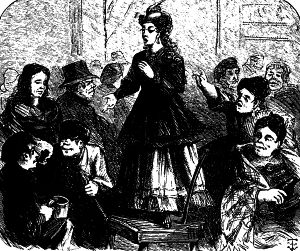
"BILKING BET TAKES THE CHAIR."
"Now I think that's werry neat and happropriate to the hoccasion," said a cockney lodger who had successfully begged two-pence from the detective to pay for his lodging, which he handed over to "Purty Bill" as soon as he got the pennies.
"I moves we put Bilking Bet in the cheer? Wot dye say, gentlemen and ladies hall, to the proposition?"
"Hall right. Bet take the cheer and give us some of yer 'Ouse of Commons."
"Bilking Bet" was escorted to the middle of the group, placed standing on a three-legged stool without any visible back, and assuming as stately an air as she was capable of, the young girl, with the most perfect sang froid, began:
"Me lords and gentlemen, and likewise the ladies. Me noble pickpockets, gonoffs, blokes, and pinchers. I am with you this hevening, for what purpose, I hask? FOR WOT PURPOSE I HASK? Why, to be present at the feast which takes place hannerally among the members of our noble purfession—shall I say dignified purfession? No; I won't."
"But ye have said it, Bet," said Kicking Billy.
"Hear! hear! Shut up, will ye, and let the gal tork," said Slap-Up Peter.
"Well," said Bet, broken down in her attempt at a speech, "I move that we have a song from 'Teddy the Kinchin.' Will he hoblige?"
"He will! he will!" said a dozen voices.
"TEDDY THE KINCHIN'S SONG."
"I am sorry, me blokes, that my woice is so werry much out of tune in singing at Her Majesty's Hopera in the Haymarket, but howsumbever, as I have given hup my hengagement at that 'ouse, I'll fake you a few werses to show wot I wonce wos when I wos in woice," said this cheerful young blackguard and thief, who had a pair of eyes like a ferret, and could not have been more than seventeen years of age, as he stood there dressed in the height of his idea of the fashion, with a flashy velvet coat and satin scarf, showing a huge pin. He sang, after clearing his throat with a long drink of gin, as follows:
"TEDDY THE KINCHIN'S SONG."
I am a curious comical cove Everybody does own O, Hey ricketty Barlow, Cock-a-doodle-do! I was born one day when father was out, And mother she wasn't at home O, Hey ricketty Barlow, &c. I went to school and played the fool, At learning was a shy man. Hey ricketty Barlow, &c. The boys they used to hollo out, "There goes a Simple Simon!" Hey ricketty Barlow, &c. Oh lor! oh my! I'm a Simple Simon, Oh lor! oh my! cock-a-doodle-do! Where ere I go the folks they know, And call me "Simple Simon;" Hey ricketty Barlow, &c.
"Haltogether, please," said the Kinchin.
"TEDDY THE KINCHIN'S SONG."
I used to "kick" the cobbler out, And rip up people's pockets, Hey ricketty Barlow, &c. And I was very fond of throwing stones And lumps of mud at coppers, Hey ricketty Barlow, &c. But now I'm going to settle down, Won't I cut a shine O, Hey ricketty Barlow, &c. I'll marry a gal with lots of Tin, And won't I spend her rhino, Hey ricketty Barlow, &c. Oh lor! oh my! &c.
"Now, once more, and a good haltogether please," and the young pickpocket sat down amid thunders of applause from every one in the cellar belonging to the band of thieves.
TEDDY THE KINCHIN.
The thieves stew was now declared ready for consumption by the chef de cuisine, and as I at least felt no appetite for such a rich dish, we left this underground den of infamy just as a few faint streaks of the coming dawn began to gild the spire of St. Boldolph's ancient church.
"That Purty Bill is one of the greatest scoundrels in London. He is a fence, and we've got him once or twice, but he minds himself now, and we are after his tricks every day. His cellar used to be a brewery, that's why he's got so much room underground, and his game is to let out lodgings, at two pence a night, for a blind, and then they can stay all day at this place until twelve o'clock at night, and if they cannot pay sure for the next night's lodging in advance, unless they are in very good circumstances, he clubs them out, and they have got to pad the hoof until daybreak, and sleep where they can. Good night." And we parted for that twenty-four hours.
CHAPTER VI.
DEBATING CLUBS AND COGERS'S HALL.
SHOE lane hath a very unromantic sound for a locality. It does not smell of the aristocracy. It hath not even a slight favor of the Landed Gentry, and no one could possibly take the trouble to find armorial bearings or hatchments for Shoe lane. Yet is Shoe lane a most eloquent place, and there is a little old public house there deemed second only in point of fame by the admirers of forensic eloquence who frequent it, to the House of Commons.
The way was long and dreary that Saturday night that I strolled from Long Acre, whose carriage-shops and leather manufacturers' stalls were all closed for the day; and the sultry London fog came down, blinding the pedestrians, as I turned from Lincoln's-Inn-fields into the better-lighted High Holborn, with the glare from its brassy gin-shops and dirty-looking old houses, that seemed all of them as if a good scouring would have done them an incalculable service in the way of a fresher appearance. I thought that Shoe lane was in a very suspicious neighborhood.
Turning to the left through Farringdon Market, a huge square seemingly devoted to the worship of highly odorous vegetables, I came into the narrow Shoe lane, which runs down at its bottom to Fleet street, just below where the gray stone arch of Temple bar bisects the Strand and Fleet street. There is nothing particularly noticeable about this part of Shoe lane.
SHOE LANE.
There is a ham and beef shop, with its layers of cold meat-pies piled on top of each other in the windows; and across the way there is the inevitable gin-shop, with its polished brass fender outside to keep off the boys who have no money to spend in gin, and there are the enticing signs all over the gin-shop telling of the merits of the brown-stout there vended, and the Burton ale and somebody's "entire" malt liquors which the proprietor assures the public are only genuine at his shop.
The lane is narrow here and not more than three or four men could pass abreast, although there are sidewalks to the lane, or rather apologies for sidewalks. This narrow lane is one of the few remaining relics of old London. Below, at the foot of Shoe lane, runs Fleet street—one of the busiest marts in the world, which is ever jammed and blocked with drays, cabs, and vehicles of all descriptions crowding to and fro, in sight of the mighty dome of St. Paul's; and under the pavement of that street, so famous for its publications and shops, the old River Fleet once ran in a dirty, hideous current, until it emptied its garnered filth into the Thames.
Here, opposite Shoe lane, one of the curious old conduits that formerly supplied old London with water might have been seen about the time of the wars of the Roses, when the English nobles were hard at work cutting each other's throats and making and unmaking kings for the want of something better to do. The cistern erected at the point where Shoe lane intersects Fleet street, was counted one of the handsomest in London. Stow—that quaint, old, musty chronicler—says:
"Upon it was a fair tower of stone, garnished with the image of St. Christopher on the top, and angels lower down, round about, with sweetly sounding bells before them, whereupon, by an engine placed in the tower, they, divers hours of the day and night, with hammers chimed such a hymn as was appointed." Frolicsome Anne Boleyn, the first day that she was queened, rode through Shoe lane on her way to the sacred Abbey of Westminster to receive the gilded toy upon her fair forehead, and pageantry and pomp met her at every step of her palfrey, in Cornhill, Cheapside, Fleet street, and Shoe lane.
In those days the streets and lanes of London were narrow and difficult, and the unfortunate queen that was to be might have touched the over-hanging eaves and gables of the houses in her progress through the city without leaving her saddle. The conduit in Shoe lane was grandly gilded over to do her honor, and ran wine for the whole day. At the base of the conduit a starvling poet sat reciting verses in her honor as she and her newly made ruffian of a husband passed, and no doubt this mediæval Mormon was highly pleased with the conceit. There were towers and turrets erected to do her honor in Shoe lane, and in one of these towers, according to the chronicler, "was such several solemn instruments that seemed to be an heavenly noise, and was much regarded and praised; and, besides this, the conduit ran wine, claret and white, all the afternoon; so she, with all her company, rode forth to Temple Bar, which was newly painted and repaired, where stood also divers singing men and children, till she came to Westminster Hall, which was richly hanged with cloths of Arras."
While Prince Hal was splitting the skulls of fractious Frenchmen at Agincourt and fording the passage of the Somme, Sir Robert Ferras de Chastley held eight cottages in Shoe lane from his king. Here and there was a garden peeping forth in its floral verdure; and here was also the town residence of the Bishops of Bangor, powerful and pious prelates in their day, God wot and odds bodkins; and as early as 1378 they held the tenure by virtue of the patent of the forty-eighth of Edward the Third, which says in most barbarous Latin: "Unum messuag; unam placeam terræ, unam gardinum cum aliis ædificis in Shoe Lane, London."
Times have changed since then in Shoe lane. A bishop of Bangor now, with his train of lances, his men-at-arms, mitre, cross-bearer, and torches, would be a sight indeed in Shoe lane. How that bright-eyed bar-maid at the door of the Blue Pig would stare at his lordship! How the greasy boy in the ham and beef shop would shout at the cope and silks and velvet housings—taking them, perhaps, in an innocent way, for a part of the Lord Mayor's show! And as for the conduit running Claret and Malmsley, the beer-swilling cockneys would not thank headless Anne Boleyn for such washy foreign stuff. Their fancy could only be fed by gin. A man-at-arms would be compelled now-a-days to wash his throat with Bass's bitter beer or brown stout, instead of sack, hippocras, or mead.
SOCIETY OF COGERS.
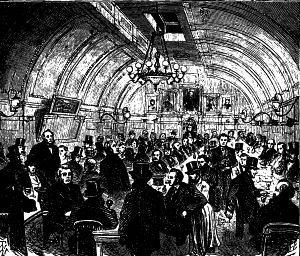
At last we are in the neighborhood of "Cogers Hall"—the hall of the Ancient and Honorable Society of Cogers. There is a gin-shop at the front, with its low doorway and flaring signs. The windows are well lit, and by the side of the bar is a long, narrow passage conducting the visitor for twenty or thirty feet to a back room, about forty feet long and twenty-five feet wide.
Off the passage are a number of small waiting-rooms, noisy and smoky, with the voices and vile pipes of the occupants. Four rows of tables run along the room, in which are present fifty or sixty persons all of the male sex. They are all decently dressed, for, although the admission is free, yet is the visitor to the Cogers Hall expected to drink or eat something, and the place, with its tariff of prices, though moderate enough to an American, would not suit a costermonger or laborer.
The roof is arched and paneled, done in a feeble imitation of the style of Sir Christopher Wren, who is popularly supposed to have built everything in London after the great fire of 1666. A handsome chandelier depends from an opening in the roof, and is ornamented with a number of glass globes, which serve to light the apartment and dissipate the thick clouds of smoke that constantly arise in the room.
There is a large, gaudy sign in the hall, on which are printed these cabalistic words: "Hot joints are served in this room from one until five." At the farther end of the room, opposite the entrance, is a paneling hollowed back in the wall, the entire room being paneled; and this paneling is shaped like a door, and is gilded. A step from the floor, in the paneling, is placed a chair of honor, which is occupied by the Most Worthy Grand, as he is styled; or, in fact, the chairman of the meeting. Those who are familiar with him go so far in their irreverence as to call this awful personage "Me Grand," and whispers have been heard that his name in reality is Tompkins or Noakes.
Directly opposite this dignitary, at the other end of the room, is a place in the paneling and a chair like to that which I have already described, and this is occupied by a tall, lean man, with side whiskers of a grayish pattern, who has the title of Vice Grand.
But the Vice, or Worthy Wice, is of greatly inferior dignity to the Most Worthy Grand. He is, so to speak, an empty ornament of the feast, and his duties are simple, and confined to calling out in unison with the assemblage, "Hear, hear," or "Good." "You are Right," when the Worthy Grand, in his oracular sentences, is most happy. At other times, in a loud voice he will call the attention of the waiters, who heartily detest him for his interference, to the fact that some customer has drained his beer, or gin and hot water, and needs, therefore, to be served afresh.
Still this man is human, and will listen, when off his seat of duty, to any scandal against the Most Worthy Grand with secret pleasure. In fact, the Worthy Wice, inspired by a generous four-pence worth of gin and hot water, told me aside, in conversation, that the Worthy Grand was unfit for his high position. "He his han hass, sir. He his too Hold. And he 'as no woice watsomever, sir. Bah! that, sir, for Tompkins"—and the Worthy Wice snapped his fingers in an insane manner at the air in which his potent imagination had conjured up the semblance of the Worthy Grand. Sitting down at a table I followed the custom of the place and called for something. On each table were placed a couple of long-shanked clay pipes, and a thin-necked, big-paunched, red-clay jar, which a man sitting near explained to my satisfaction.
"You see," said he in a rather mysterious voice, "we 'aven't much ice to speak of in England; leastways, it is too dear, and this 'ere red clay 'as a peculiar wirtue—it keeps the water as cold as if it was in the waults of Bow Church."
This man was decently dressed, and was, I believe, a drover by profession. He was very fleshy and very red in the face.
AT THE TABLES.
Tissues of fat lay around his eyebrows in layers, and his double chin was dewlapped like one of his own beeves. He had a heavy red hand, and was, as I found out, a true Briton in every sense. I asked him why the place was called Cogers Hall. To this conundrum he confessed himself unable to answer, but after scratching his head the "Beefy One," as I shall call him, made a sign for a waiter to come to the table. "I say," said the Beefy One, "why do you call this place Cogers 'All?" The waiter could not satisfy him, but said that he would call the Master. Well, the Master came, a thin-faced, side-whiskered Englishman, with watery blue eyes and trembling lip. The counterfeit presentment of the Master hung over the Worthy Grand's chair of state, done in oil, and it seemed as if the artist had endeavored, in accordance with the spirit of the Cogers Hall, to give the face an oratorical, Gladstonian expression, and the cloak was folded around the shoulders of the Master as the toga is folded around the shoulders of Tully, in classic pictures. Besides the picture of the Master, several other pictures of Past Worthy Grands were hung as tokens of their former forensic abilities. The Master, in answer to the question why the place was called Cogers Hall, said:
"Well, you see, we calls it Cogers Hall from the Latin ko-gee-TO—to cogitate, to think. Oh, yes, sir, we have been a long time established, sir; since 1756, sir; a matter of a hundred years or so, sir. You are han Hamerican, sir. Oh, yes, sir, we've 'ad George Francis Train 'ere, sir, for many a night, sir; and 'e spoke in that chair, sir; and when he was arrested, sir, in Ireland, the Home Secretary as wos, sir, wrote to me to question me if he had spoken treason, sir, or spoke agin the Queen, sir. Cos ye see, sir, the principle of an Englishman, sir, is to allow every man liberty to say wot he likes, sir, so long as he does not speak agin the Queen or speaks treason. That's an Englishman's principle, sir."
And George Francis Train had spoken in this very room! I could fancy the feelings of poor Artemus Ward when he stood at the tomb of Shakespeare at Stratford. These wooden chairs and benches were hallowed in my eyes henceforward. Men had sat upon those chairs who had listened to the fervid eloquence of a Train, and perhaps some of these very men had survived. Civis Americanus sum.
As the night came on apace, the smoky, old-fashioned, paneled room began to fill up, and before long nothing could be seen but rows of men lining the small tables, puffing vigorously from the long clay pipes, and at intervals taking deep draughts from the large, brightly burnished metal pots, holding a pint each, or perhaps sipping fourpenny glasses of hot gin and water. Along with the little jar of hot water which the waiter brought on demand, were little saucers of sugar—these little saucers never containing, by any chance, more than three lumps of sugar, and each of these lumps being equalized in size with a mathematical nicety. Some of the visitors, more hungry than others, satisfied their longings with "Welsh Rabbits," at sixpence apiece; or, when the rabbits had, in addition, two eggs cooked with them, the Welsh rabbit was called a "Golden Buck," and the waiter, in his greasy tail coat, raised his demand to eightpence.
In a few minutes the Worthy Vice, a gray-bearded man with a meek face and in shabby-genteel clothes, took his seat, and all the chairs in the apartment were turned around by those who occupied them in order that they might hear and see better. The Worthy Vice, who is sometimes entered on the bills of the performance as a "Patriot" when he has to take part in a discussion, read the minutes of the last meeting of the Ancient and Honorable Society of Cogers, which were listened to quietly, and then the attention of the audience was turned to the Most Worthy Grand, who occupied the chair at the other end of the apartment. This most noble Briton, in a quavering voice, having adjusted his vest—which had a tendency to leave exposed the lower part of the shirt-bosom at his stomach where his trousers bisected—opened the proceedings with much solemnity, imitating by hems and haws, as well as he could, the manners of the dullest and most common-place orators of the House of Commons. His business as a specialty was to review the events of the week.
NEWS OF THE WEEK.
"I don't think, gentlemen," said he, "that my task will be a very long one this hevening in reviewing the hevents of the week. There, aw, 'asn't been much a-doing in furrin parts, ah, this week. There 'as been 'a row in Turkee again, and in, ah, fact we might say there is halways a row in Turkee, more or less. There's a man in Hegipt whom we call the Viceroy of that, ah, country, and when he, ah, wos here we gave 'im fireworks and sich, and made a blessed time about him, as we might say vulgarly, so to speak. Now, he has been a invitin' of all the sovrins of Europe on his own hook to see him and his ryal family open the Sooz Canal. Well, he has been, ah, spendin' sich a lot of money that the Sultan comes out in a long letter and calls him a Cadivar, which is a word that I can't understand, being neither Latin nor yet Greek.
"Blessed hif I knowed that ye iver understood Greek or Lating, ither, Jimmy," said an old man who sat observant of the reviewer in a corner, drinking beer from a pewter pot.
"I thank ye all the same, Mr. Wilkins, but I don't like to be interrupted when I'm speaking," answered the Most Worthy Grand.
"You're right, Me Grand. Horder! horder!" shouted several indignant voices.
"I wos goin' to say," continued the Grand, after taking a deep draught of the porter which foamed in the pewter pot on the table before him—"I wos goin' to say that the state of our neighbor, Fronse, just hover the water, is now a spektikle for mankind. There's a great hadoo about the Hemperor's 'elth; and I must say as how he is in a bad way by all accounts. Nobody knows wot his disease is. It may be liver; it may be kidneys. I might take the liberty of sayin', as a rule, kidneys is bad. No one knows wot would be the consequences if the Hemperor was to step out, wulgularly speakin'. It would p'r'aps be the cause of a general war in Europe. Hengland doesn't want any more wars. We 'ave 'ad enough of them. They does no good for the workin' man. ('Hear! hear!') We pays the piper when the dancin' is done; but we never dances ourselves."
"True as the gospel, Jimmy," from a beer drinker.
"Now, there's another question which we all 'ave heard of a good deal, and that's the Halabama claims. They are in a precious muddle, to be sure. They may be right and they may be wrong. But I must say that I don't see where the money is to come from to pay them."
"We'll never pay them. We aint got the "dibs;" leastways, I won't pay any of it," says an irreverent young man whose face was quite flushed with strong drink.
"Well, as far as that goes, if they are to be paid, we know it will come from the pockets of just such people as ourselves in the way of taxes. Its taxes halways."
"I differ from the gentleman who preceded me altogether. Prussia must 'ave the left bank of the Rhine, and I'll put sixteen bullets in the Pope's heart. I tell ye, gentlemen, the Ekumenikal Council will be the downfall of the Romish religion. I'll put sixteen bullets in the Pope's heart," cried out a tall, thin-faced man in a half-clerical suit of black, who got on his feet, and while in the act of energetically expressing his feeling, by a wave of his right hand carried away a glass globe shading the gaslight above his head. The man was very drunk apparently, but by his language seemed to be a person of education. The "Beefy One," who sat by my side, and who had reached his third bottle of beer, whispered to me:
"I say, yon is a fine fellow when he's sober, and can talk poetry by the yard, but he is very drunk, and when he's fuddled he will talk a man blind about the Pope. Will you have some beer? Do take a pot."
It was with some trouble that the fiery Scotch orator was induced to sit down and defer his assault upon the Pope until a more fitting occasion.
At this moment the Beefy One pointed out to me a tall, martial-looking person in black clothes, who seemed to be very restive and looked as if he wanted to speak. He was of large frame, about sixty years of age, and was apparently a man of considerable stamina and backbone. His white whiskers and neat dress gave him the look of a justice of the peace who had dropped in to take a look at the assemblage from curiosity, and to see that the public morals and the constitution were properly taken care of.
COGERS HALL.
While the Worthy Grand was making a series of remarks on the health of the Emperor Napoleon and the menacing attitude of Prussia towards France in a gentle, slipshod way, the stranger looked up at times from the four-penn'orth of gin which he ordered when he came in to give an incredulous, doubting smile to a few of the coterie who sat around him and were evident admirers of his. The Beefy One whispered to me—
"That ole gentlemun is the finest orator as ever was. I tell ye, sir, he can talk when he's agoing. There's no end to his beautiful sentiments, I do say it, although he's a Hirishman. Oh, 'e is a great horator is the Ole One."
LIBERALS AND CONSERVATIVES.
After the review of the week's public events by the Worthy Grand, debate was in order on the topics reviewed by him. I found that the debaters who jumped to their feet one after the other in a manner worthy of the most dignified legislative assemblage, were divided into two parties, liberals and conservatives. The Liberals were the most logical, strange to say; the Tories were most dogmatic and violent. The Liberals—one of them at least—wished to do away with all monarchies and established churches; while the Conservatives, principally belonging to the shopkeeping element, in the audience, were strenuously opposed to the eight-hour law and to the trades-unions. One liberal orator would liked to have seen, as he expressed it, all the kings, barons, prime ministers, and other like despots, placed in one old rotten hulk of a vessel, and then the vessel was to be scuttled on the Goodwin Sands. "And who," said the eloquent orator, "would not say that it would not be a benefit to the human race? Who would not exclaim with me," and here he looked around on his eager audience in a threatening manner, "the more of sich cattle in the rotten old hulk the better?" There was a general grunt of acquiescence from the advanced Liberals at this possibility and a deprecatory shake of the head from one Conservative with a great clay pipe.
Finally, the Irish orator got a chance, and then it was wonderful to see how, in a sarcastic tone, he humbugged his hearers for half an hour by allusions to the good time coming, when every man should have a vote, and every Irish tenant should give up the graceful and sportsmanlike habit of potting from behind the Tipperary hedges all landlords who were in the way of a freehold system. The orator waxed wroth and became pathetic at times as he reviewed the past glories of the Isle of Saints and her present degraded position among nations. Yet in that he was skilful enough, in speaking of the Fenians, to deprecate their acts mildly, but, at the same time, he told his English audience, in the most forcible tones, of the abuses and tyranny that had led to the organization of Fenianism.
"Oh, I say, O'Brien, you are a humbugging of hus with that here gammon habout '98, ye know."
"I give yes me word, me Worthy Grand and gentlemen, that I do not advocate Fenianism at all, at all; but when yes dhrive min to madness by oppression, by acts of oppression such as the world has never seen, can yes blame the wu-r-rum if it turns on yes and bites."
THE SCOTCH PRESBYTERIAN.
No one could reply to this with the exception of the Scotch Presbyterian, who, again rising from his seat, denounced the Pope and Dr. Cumming as accomplices, and declared that at the first opportunity he would cheerfully encounter martyrdom to be able to "put sixteen bullets into the Pope's carcass," as he politely and charitably expressed himself. "I didn't care about your Ekumenikul Council," said he; "it will be the downfall of popishness and prelacy, and those who may go there are welcome; but as for me I would be burned to have him under my pistol."
"Oh, Mac, yer not so bad as yer purtend in yer talk. I'll engage, if his Holiness would give ye the chance, ye'd only be too glad to kiss his toe."
This raised a laugh at the Scotchman's expense, but he violently disclaimed for himself, as a true disciple of John Knox, any intention of submitting to such a degrading act of spiritual submission. The debate continued as the night waned, and at eleven o'clock, when I left the hall of discussion in Shoe lane, the subjects of vaccination, land laws, and coinage were yet to be touched upon by the speakers.
I have given but a glance at this place, which is the oldest established of its kind among a number of discussion halls and forums, whose sign-boards meet the stranger's eye in different parts of the city where most thickly populated. There is invariably a pot-house attached to these debating places, or rather the debating halls are attached to the pot-houses.
The better class of artisans and shopkeepers in a small way are principally the frequenters of the discussion halls. Mechanics with a gift of the gab, and who have five or six shillings a week to spend out of twenty-five or thirty, are to be found here in large numbers. The Most Worthy Grand and the Vice Grand are paid a fixed salary for their stated eloquence, and it is principally their duty to read all the cheap weeklies and dailies, not forgetting the Times, which is very often quoted by them as a sort of a clincher in the argument brought up. A place like this will take in five pounds of a night, and the wages paid to the bar-maids is about sixteen shillings a week. There were two here, and four waiters, who receive sixteen pounds a year and their "grub," as they call it. A small paper of rough-cut tobacco is furnished to each customer for a penny, and the consumption of this narcotic and Welsh Rabbits is encouraged, as they are quite certain to make the customers dry, and this dryness, as a matter of course, leads to the imbibition of plenteous beer and gin and water. These shops are licensed to sell spirits under the new Beer act, and they are compelled to shut off the debate at midnight. As a general thing the most advanced liberalism prevails in these places, and religious sentiments are below par with the audience. Very often it is possible to hear a well educated or scientific man debating in these halls, but, on closer survey, his accent will betray him to be some impoverished French or German physician, or reduced savan, who has no occupation in the hours of the evening, and can, therefore, afford to dispense wisdom to the thick-headed audience, gratis.
About a week after my visit to Cogers Hall I went, accompanied by Mr. Marsh, a member of the Daily Morning Telegraph's staff, and another gentleman connected with the editorial management of the Pall Mall Gazette, to take a look at another debating hall which is situated at No. 16 Fleet street. This place is quite famous in London for the virulence of its debates and the high flavor of its gin. Its Brown Stout is also above reproach.
As usual in all such places there is a public bar here, and this is located at the entrance, and is attended by the inevitable bar-maid, smiling and bedizined in all the glory of a two guinea silk dress, bought perhaps in Regent street or the Oxford Circus.
"WHERE ARE WE NOW."
The room here was not so large a one as that at Cogers Hall in which the orators were in the habit of haranguing their auditors. There were a dozen small tables, around which chairs were placed in a most picturesque confusion. Small white placards printed in blue ink were posted on the walls with the following announcement:
TEMPLE DISCUSSION FORUM. ADMISSION FREE. STRANGERS ARE PARTICULARLY INVITED TO TAKE PART IN THE DISCUSSION AND TO INTRODUCE SUBJECTS FOR DEBATE. THE QUESTION THIS WEDNESDAY EVENING WILL BE "THE POPE'S MODEL LETTER," WHERE ARE WE NOW? TO BE OPENED BY "A PROTESTANT." CHAIR TO BE TAKEN AT NINE O'CLOCK. SUPPER FROM EIGHT TILL TWELVE. BEDS. PRIVATE SITTING-ROOMS.
There was a venerable looking old fellow in the chair when we entered the Discussion Forum, who lifted a pair of gold rimmed spectacles from his nose to take a look at us. This was the chairman of the meeting, and shortly after we sat down he cried out to a tall person with a short grey raglan coat who was speaking and perspiring at the same time.
"Mister Chowley I will and cannot allow you, sir, to trample on the religious feelings of any man present in this harmonious meeting. We are all brothers here, sir, and the individual who disturbs our peace and quietness, should be to us all as the 'Eathen and the publican, sir." (Hear, hear.)
The tall man with the raglan, who did not like to be suppressed so easily, had taken his seat for a moment much against his will, but now he arose slowly and scornfully looking around him, spoke, with one hand leaning on a chair behind him, and another hand in his breast, as follows:
"Gentlemen, this his an age of science if it is an age of hanythink. Wot does my honorable and noble Roman Catholic friend wish to advance has an argument. Does he mean to tell ME, with my heyes hopen in this here blessed Nineteenth Century, which we are all so proud of, and whose blessed light is the moving cause of so much mental brilliancy—does he mean to tell me for a moment that the miracle of the transposition of water into wine at the wedding of Cana wos han hactual fact. Why gents it his altogether impossible—and no reasonable man in this Nineteenth century can for a moment believe it possible. Wot would Galileo, Kepler, Faraday or sich bright lights of the Nineteenth century say to sich stories? Why gents, there is a chemical change which would have to take place before such a translation, and this chemical transformation could not take place without the assistance of other substances. (Hear, hear.) And gents, as far as the infallibility of the Pope is concerned, why I have only to say in the words of the poet, hand I mention no names, that a piece of fat pork might stick in his gullet as soon as it would stick in mine, and that's all I think of infallibility and fat pork, with the blessed light of the nineteenth century before me." (Hear, hear.)
Mr. Chowley here sat down, thoroughly satisfied with himself and auditory, who applauded him to the echo. Then a member of the Roman Catholic persuasion answered him in a long and splendid oration, which seemed to thoroughly convince every one present that the Catholic side was right, and the Protestant one a most diabolical doctrine. After each man had done his little speech, it was curious, nay amusing, to hear the adherents of either party comment upon the previous argument.
"Oh! I say," said a Presbyterian, "didn't he smash the old Pope neither."
"And wot a blessing he gave His Grace, Archbishop Manning, though?"
"Well," said an ardent Irishman, "I niver heard such a lambeastin as the heretics got to night."
"You might well say that, Pether, and didn't he scald Martin Luther with the holy wather, though," said an honest looking, hard working fellow who sat smoking a pipe.
FARCE AND TRAGEDY.
One thing struck me in all this wilderness of argument and polemic discussion. While the two principals nearly argued their jaws off in the heat of discussion, they failed miserably to convert any of the opposite party, who sat the debate out with a heroic stupidity, understanding with much difficulty about one-third of what was said, and perhaps caring very little for the matter in hand, but sticking to their prejudices to the last, with a partisan fidelity not to be convinced by all the harangues that will take place from that night until the Day of Judgment.
And yet I could not enter a place of this kind in all London, from Temple Bar to Hammersmith, without hearing this same everlasting religious warfare of controversy.
And to add to the joke, hardly one of five of these persons who attend such discussions, were ever in a church of either the Catholic or Protestant persuasion.
Such is life—part farce, part tragedy.
CHAPTER VII.
THE CLUBS AND CLUB HOUSES OF LONDON.
E cannot conceive of any greater contrast than that which exists between the wretchedness and squalor of the lodging houses, and the splendor and refined elegance, combined with comfort of the Club houses of London, which are chiefly situated in Pall Mall, St. James street, and the neighborhood of lower Regent street.
Club life has attained its greatest perfection in London. No city upon the Continent can compare with it for the number of its club houses, the splendor of their architecture, their luxurious furniture, and the standing in society of their members.
INTERESTING STATISTICS.
There are, I believe, upward of fifty clubs in London, in which all the professions, and all the stations of life find representation, with a roll of perhaps 45,000 members. The following are the principal clubs with the cost of ground and construction: Army and Navy Club, George's street, St. James' square, 1,450 members, £100,000; the Conservative Club, St. James' street, 1,500 members, £81,000; Garrick Club, King street, Convent Garden, 500 members, £25,000; Junior United Service Club, corner of Charles and Regent streets, 1,500 members, £75,000; Oxford and Cambridge Club, Pall Mall, 1,200 members, £100,000; Reform Club, 1,400 members, £120,000; University Club, Pall Mall East, 500 members, £20,000; Wyndham Club, St. James' square, 600 members, £30,000; Westminster Club, Albemarle street, 560 members, £15,000; Athenæum, Pall Mall, 1,200 members, £60,000; Carlton, Pall Mall, 800 members, £100,000; Guards Club, Pall Mall, 500 members, £40,000; Oriental, Hanover square, 800 members, £30,000; Traveler's, Pall Mall, 700 members, £30,000; Union, Cockspur street, 1,000 members, £25,000; United Service Club, Pall Mall, 1,500 members, £70,000; White's Club, St. James' street, 550 members, £20,000; Boodles, St. James' street, 500 members, £15,000; Cavendish Club, 307 Regent street, 500 members, £15,000; and Civil Service Club, 86 St. James' street, 1,000 members, £45,000.
Besides the before-mentioned clubs there are the following, which rank nearly but not quite as high among Club men:
MEMBERS. COST.
Albert Club, 15 George street, Hanover square, 500 £10,000
Alpine Club, Trafalgar square, 600 18,000
Arlington Club, 4 Arlington street, 400 16,000
Arts Club, 17 Hanover square, 500 16,000
Arundel Club, 12 Salisbury street, Strand, 600 52,000
City of London Club, 19 old Broad street, (merchants,) 1,000 50,000
Gresham Club, City, (bankers, &c.,) 1,000 60,000
Junior Athenæum Club, 29 King street, St. James, 800 30,000
Junior Carlton Club, 14 Regent street, 800 40,000
New Carlton Club, Albemarle street, 800 25,000
New University Club, 57 St. James' street, 600 29,000
Portland Club, Stratford Place, Oxford street, 400 18,000
Smithfield Club, Half-Moon street, Piccadilly, 300 12,000
St. James' Club, 54 St. James' street, 500 23,000
Whitehall Club, Parliament street, 500 9,000
Whittington Club, 37 Arundel street, 1,600 40,000
Clarendon Club, 86 St. James' street, 900 36,000
Junior Reform Club, Albemarle street, 800 40,000
Brooks' Club, 60 St. James' street, 575 20,000
Arthur's Club,69 St. James' Strett, 600 18,000
Law Society, Chancery Lane, 1,000 68,000
National, Whitehall-Gardens, 400 17,000
Prince's Racket and Tennis Club, Hans Place, Chelsea, 300 11,000
United University, corner Suffolk street and Pall Mall, 500 33,000
Beefsteak Society, Lyceum Theatre, 250 5,000
Club Chambers, Regent street, 400 31,000
" " St. James' square, 300 17,000
Ambassador's, 106 Piccadilly, 200 16,000
Erectheum, St. James's square, 300 20,000
In these several clubs each member is elected by ballot, and pays an entrance on admission, and afterward an annual subscription, which varies like entrance fees in different clubs.
Thus, in the Athenæum, the entrance fee is £26.5s., annual subscription, £6.6s. Arthur's, entrance £21, subscription, £10 10s. Brooks, entrance, £9 9s., subscription, £11 11s. Carlton, entrance, £15 15s., annual subscription, £10 10s. Conservative Club, £28 7s., subscription, £8 8s. Garrick Club, entrance, £21, subscription, £6 6s. Junior United Service, entrance, £30, subscription £6. Oxford and Cambridge Club, entrance, £21 5s., subscription, £6 6s. Reform Club, entrance, £21 5s., subscription, £10 10s. Travelers' Club, entrance, £31 10s. Union, entrance, £38 10s., subscription, £6 6s. United Service Club, entrance, £36, subscription, £6. Whittington, entrance, £10 10s., subscription, ladies £1, gentlemen, £2 2s. Wyndham, entrance, £27 6s., subscription, £8.
When clubs were first started they were regarded with much hostility as being most antagonistic to domestic life, and the ladies displayed an intense spirit against them. The clubs, however, survived and flourished under their enmity, and it was found that they discouraged coarse drunkenness, the prevalent vice of Englishmen; encouraged social intercourse—of which ladies partook of elsewhere; refined the manners of the members, constituted courts of honor, and tended most materially to the manufacture of gentlemen.
The London clubs are private hotels on a vast and magnificent scale. They have billiard rooms, coffee rooms, nine-pin rooms, splendid libraries, saloons, and furniture, and plate of the costliest and rarest description.
LUXURIOUS DINNER—LADIES EXCLUDED.
All the refreshment which a member has, whether breakfast, dinner, supper, or wine, are furnished to him at the market cost price, all other expenses being defrayed from the annual subscriptions. For a few pounds a year, advantages are to be had, which no incomes but the most ample could procure. The Athenæum, which consists of twelve hundred members, can be taken as a good example of the rest. Among the members can be reckoned a large proportion of the most eminent persons in England—civil, military, and ecclesiastical, peers, spiritual and temporal, commoners, men of the learned professions, those connected with the sciences and arts, and commerce, as well as the distinguished who do not belong to any particular class, and who have nothing to do but live on their means, bore their tailors, and admire their family genealogy, and their own figures. These men are to be met with day after day at the clubs, living with more freedom and nonchalance than they could at their own houses. For six or eight guineas a year every member has the command of an excellent library, with maps, the daily London papers, English and foreign periodicals, and every material for writing, with a flock of gorgeous flunkies, in powder and epaulettes, to attend at the nod of a member, and a host of youthful pages in buttons and broadcloths. The club is a sort of a palace with the comfort of a private dwelling, and every member is a master without having the trouble of a master. He can have whatever meat or refreshment he desires served up at all hours, with luxury and dispatch. There is a fixed place for everything, and it is not customary to remain long at table. You can dine alone, or you can invite a dozen persons to dine with you, females being excluded. From an account kept at the Athenæum for one year, it appears that 17,323 dinners cost on an average 2s. 9¾d. each, and the average quantity of wine drank by each person at these dinners was a small fraction more than a pint for each. The bath accommodations are the finest that can be imagined.
The kitchen of the London clubs cannot be equaled in the world, and the chief cooks who have charge of the kitchens, have each an European fame. Alexis Soyer, the greatest cook since Ude or Vatel, had, for a long time, the charge of the kitchen of the Reform Club, and the kitchen of this club, of which John Bright, and all the leaders of the English liberals are members, is the finest in London.
A description of this kitchen will in a measure answer for that of any other London club, and I will give it here for the information of those who are curious in such matters.
The kitchen, properly so called, is an apartment of moderate size, surrounded on all four sides by smaller rooms, which form the pastry, the poultry, the butchery, the scullery, and other subordinate offices. There are doorways but no doors, between the different rooms, all of which are formed in such a manner that the chief cook, from one particular spot, can command a view of the whole. In the centre of the kitchen is a table and a hot closet, where various knicknacks are prepared and kept to a desired heat, the closet being brought to any required temperature by admitting steam beneath it. Around the hot closet is a bench or table, fitted with drawers and other conveniences for culinary operations. A passage going around the four sides of this table separates it from the various cooking apparatus, which involve all that modern ingenuity has brought to bear on the cuisine.
In the first place there are two enormous fireplaces for roasting, each of which would, in sober truth, roast a whole sheep. The screens placed before these fires are so arranged as to reflect back almost the entire heat which falls upon them, and effectually shields the kitchen from the intense heat which would be otherwise thrown out. Then again, these screens are so provided with shelves and recesses as to bring into profitable use the radiant heat which would be otherwise wasted.
MODEL KITCHEN.
Along two sides of the room are ranges of charcoal fires for broiling and stewing, and other apparatus for other varieties of cooking. These are at a height of about three feet from the ground. The broiling fires are a kind of open pot or pan, throwing upward a fierce but blazeless heat; behind them is a framework by which gridirons may be fixed at any height above the fire, according to the intensity of the heat. Other fires open only at the top, are adapted for various kinds of pans and vessels; and in some cases a polished tin-reflector is so placed as to reflect back to the viands the heat. Under and behind and over and around, are pipes, tanks, and cisterns, in abundance, containing water to be heated, or to be used more directly in the processes of cooking.
A boiler adjacent to the kitchen is expressly appropriated to the supply of steam for "steaming," for heating the hot closets, the hot iron plates and other apparatus. In another small room the meat is kept, chopped, cut, and otherwise prepared for the kitchen. There are also in the pastry room all the necessary appliances for preparing the lightest and most luscious triumphs of the art. In another room there are drawers in the bottoms of which blocks of ice are laid, and above these are placed articles of undressed food, which must necessarily be kept cool.
There is a cheerful air, an air of magnificence about these superb kitchens, which would charm a good housewife. Here all the genius that can be brought to bear upon cookery is concentrated, and the head cook would not deign to notice any person of less rank than a baronet, while in superintendence. Although there are twelve hundred members or over, yet he is not responsible to any individual one, and the only authority in the club to which he has to bow is the eight or ten members of the House Committee, whose decrees even to this great being are arbitrary.
The pots and pans are of an exceeding brightness, and the entire system is perfect. In one corner of the kitchen is a little stall or counting-house, at a desk in which sits the "Clerk of the Kitchen." Every day the chief cook provides, besides ordinary provisions which are certain to be required, a selected list which he inserts in his bill of fare—a list which is left to his judgment and skill.
Say three or four gentlemen, members of the club, determine to dine there at a given hour, they select from the bill of fare, or make a separate "order" if preferred, or leave the dinner altogether to the intellect of the chef, who is sure to be flattered by this dependence on his judgment. A little slip of paper on which is written the names of the dishes and the hour of dining, is hung on a hook in the kitchen on a black board, where there are a number of hooks devoted to different hours of the day or evening. The cooks proceed with their avocations, and by the time the dinner is ready the clerk of the kitchen has calculated and entered the exact value of every article composing it, which entry is made out in the form of a bill—the cost price being that by which the charge is regulated—nothing is ever charged for the cooking. Immediately at the elbow of the clerk are bells and speaking tubes, by which he can communicate with the servants in the other parts of the building.
Meanwhile a steam engine is "serving up" the dinner. In one corner of the kitchen is a recess, on opening a door in which we see a small platform, square-shaped, calculated to hold an ordinary sized tray. This platform is connected with the shaft of a steam engine by bands and wheels, so as to be elevated through a kind of vertical trunk leading to the upper part of the building; and here are the white-aproned servants or waiters ready to take out the hot and luscious smelling viands from the platform, to the member or members of the club who are anxiously awaiting dinner.
Architecturally speaking the club houses are the finest buildings in London, and in the west end of the town, and in the vicinity of the parks they do much to beautify the city; these massive, richly decorated, and pillared palaces of exclusiveness.
The "Heavy Swell" Club of all London is the "Guards" in Pall Mall. There are three or four regiments of the Queen's Household Brigade stationed always in London to guard the sacred person of the Queen, and it is from the officers of these crack regiments that the members of the club are balloted for. These fellows are supposed to bathe in champagne, and dine off rose water; they are afraid to carry an umbrella thicker than a walking stick, they hate "low people," and devote their existence to killing time, yet are withal sensitive, honorable in many things, (except paying their grocers, wine and haberdashing bills,) and will fight as becomes the descendants of the men who dyed the sands at Hastings with their blood, to bequeath a rich and fruitful kingdom to those who now inherit it.
THE CONSERVATIVE AND GARRICK CLUBS.
The Conservative Club is frequented by those athletic and slow going squires and gentlemen who are always ready to applaud Mr. Disraeli in the House of Commons, and are willing to serve as special constables on days when the English democracy become restive and open their eyes to the fact of their being plundered and robbed every day of their lives. It was from the Conservative Club that Mr. Granville Murray was expelled by the secret influence of the moral Prince of Wales, simply because following his duty as a journalist he had told the hereditary regulators of England that they were out of place in the nineteenth century.
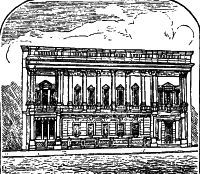
CONSERVATIVE CLUB HOUSE.
The Garrick Club is, as its name indicates, made up of artists, dramatists, actors, newspaper writers, and authors. It numbers among its members Charles Reade, Tom Taylor, Charles Dickens, Bulwer, Wilkie Collins, Anthony Trollope, Andrew Halliday, George Augustus Sala, Mr. Delane of the Times, H. Sutherland Edwards, William Howard Russell, Edward Dicey, Thornton Hunt, Editor of the Telegraph, John Ruskin, and I believe Thomas Carlyle's name was proposed as an honorary member; Charles Kean, Thackeray, Charles Matthews, Sr., who founded the club, W.H. Ainsworth, the novelist, the Blanchards, the Mayhews, Samuel Lover, Charles Lever, John Oxenford, Louis Blanc, Walter Thornbury, Lascelles Wraxall, Edmund Yates, John Hollingshead, formerly critic of the Daily News, James Greenwood, Frederick Greenwood, Brough, Dudley Costello, Lord William Lennox, Thomas Miller, Cyrus Redding, and other well known literary men belong to or have at some period or another been members of this club. American authors, artists, and actors, are always welcomed here, and among the habitues of the Garrick may be found Lester Wallack, H.E. Bateman, and others. The Garrick is noted for its famous gin punch which is a specialty here, and for which the following ingredients are necessary to composition; pour half a pint of gin on the outer peel of a lemon, then a little lemon juice, a glass of maraschino, a pint and a quarter of water, and two bottles of iced soda water. This is a most fragrant punch and not very intoxicating. The collection of pictures at the Garrick is very fine, and embraces nearly all the people, both male and female, who have made themselves famous in English histrionic art, among whom may be noticed Elliston, Macklin, Peg Woffington, Nell Gwynne, Colley Cibber, Mrs. Bracegirdle, Garrick as Richard III, John Phillip and Charles Kemble, Charles Mathews, Mrs. Siddons, Macready, Miss Inchbald, Edmund Kean, Kitty Clive, Mrs. Billington, and various others. Some of these portraits have been painted by the first of English artists. This gallery is only rivalled by that in Evan's Supper House in Convent Garden, where there is a fine and similar collection.
The Reform Club has among its members John Bright, W. E. Gladstone, Lord Hatherley, the present Lord Chancellor of England, the Duke of Argyll, W.E. Forster, Lord Dufferin, and other well known liberal nobles. About a year ago John Bright and W.E. Forster, his able aide-camp, resigned from the membership of the Reform Club, owing to the fact that a correspondent of an American journal, proposed by them, had had been black-balled in the Reform Club. This correspondent was Geo. W. Smalley of the New York Tribune. I believe that the club reconsidered their decision and admitted Mr. Smalley, and Mr. Bright and Mr. Forster are now members of the club. Sir Charles Wentworth Dilke, editor of the Athenæum, is a member of the Reform Club.
CARLTON CLUB.
The Carlton Club ranks high among the Tory or anti-liberal clubs of London, has a very rich proprietary and a magnificent edifice in Pall Mall. The Right Hon. Spencer Horatio Walpole, one of the members for Cambridge University, and Alexander Beresford Hope, one of the proprietors of the Saturday Review, who was a member of Parliament during the American Civil War, and a bitter foe of the North, are both members of the Carlton Club, as is also Lord John Manners, a prominent Conservative noble, and fifth son of the Duke of Rutland. John Laird, M.P. for Liverpool, the builder of the Alabama, is also a member of the Carlton Club.
Lord Cole, a son of the Earl of Enskillen, and a chief accomplice with the Prince of Wales in the Lady Mordaunt scandal, is a member of the Carlton.
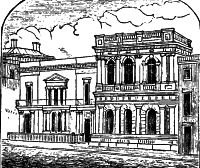
CARLTON CLUB HOUSE.
Gregory, the member for Galway, also a sympathizer with the Slaveholder's Rebellion, belongs to the Carlton. To be brief, this Carlton Club, essentially aristocratic and inimical to democracy all over the world, contributed more individual moneyed and social influence and support to Jeff. Davis than all the London Clubs put together.
I might state here that Bass, the great East India Pale Ale man, is a member of the Reform Club, while Sir Arthur Guiness, the Dublin Brown Stout man, Bass's great rival, is a member of the National Club, which is pseudo liberal. Jonathan Pim, the rich Irish Quaker, a member for Dublin City like Guiness, does not belong to any London club and keeps away from the flesh pots of Egypt. John Francis Maguire, M.P. for Cork, is a member of the Stafford Club, which numbers some of the Catholic families in its roll of membership. Sir Patrick O'Brien, an amusing Irishman who frequents the Cremorne a good deal, belongs to the Reform Club. The present Earl of Derby, late Lord Stanley, who was expected to lead the liberals in the House of Lords, but does not give much promise of doing so while he is an active member of the Carlton Club.
The Right Hon. George Goschen, a Jewish merchant, who is President of the Poor Law Board, yet quite a young man and promising, has his name inscribed on the lists of the Reform and Athenæum Clubs, and Robert Lowe, the witty, sarcastic, and clear-headed Chancellor of Exchequer, are lights in the Reform Club. Edward Sullivan, the Irish Attorney General, may be seen at the Reform, and George Henry Moore, a countryman of his, and an apologist for the Fenians, is a habitue of Brook's Club in St. James street. Sir John Evelyn Dennison, the Speaker of the House of Commons, while in town during the session, when dinner time comes, always doffs his gown and wig and toddles around to the Reform Club for a chop or steak, and a glass of wine. Vernon Harcourt, who signs himself in the Times "Historicus," represents Oxford Borough in the House of Commons, and is a member of the Oxford and Cambridge University Club. A good story is told of "Historicus." Three heavy swells of the Guards were dining at the Star and Garter at Richmond, and all three made a wager that they each could boast of the biggest bore in London as an acquaintance. The discussion wore high, and they agreed to test it by bringing each his bore to dine on a set day, and at a set hour, at the "Star and Garter." When the day came two close carriages were drawn up to the "Star and Garter," and out of each leaped one of the gentlemen who had made the wager. They were both disappointed in their bores, and came without them as they had previous engagements. A third carriage drove up, and out of it leaped the third Swell who had made the wager, with a tall gentleman in a cloak. As soon as the stranger uncovered and presented the smiling countenance of "Historicus," the two swells cried out in astonishment,
"By J-a-a-v ye knaw, that's not f-eh-ah—he's got our bo-a-h!"
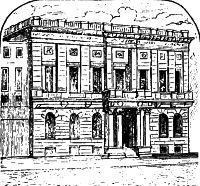
OXFORD AND CAMBRIDGE CLUB HOUSE.
Whalley, the religious madman, belongs to the Reform Club, and so does the Right Hon. Hugh Childers, First Lord of the Admiralty.
Kinglake, the historian, who bribed his way into the House of Commons, and afterwards testified to it without shame, is a member of Brooks, the Travelers, the Athenæum, and the Oxford and Cambridge Clubs.
Sir Robert Peel, the member for Farnsworth, is to be found at Brook's and Boodle's. Sir Henry Lytton Bulwer, formerly ambassador at Washington, at the Reform Club. Layard, the Nineveh discoverer and now English ambassador at Madrid, belongs to the Athenæum Club. The O'Donoughue at the Stafford and Reform Clubs, while young Mr. Gladstone, son to the Premier, modestly drinks his wine at the New University Club. Lord Carrington, a boon companion of the Prince of Wales, is a member of the Guards Club, and Sir Francis Crossley, the great Yorkshire manufacturer, may be seen nightly during the session passing his hours in the Reform and Brook's Clubs.
Queer and strange reminiscences cling to the London Clubs like barnacles to a packet ship. At the Alfred Club, George Canning, one of the greatest men ever known in England, used to take a steak and onions alongside of Lord Byron, who was always partial to Madeira negus.
Louis Napoleon, in his cheerless and hard up days, ate his eighteenpenny dinner at the Army and Navy Club in silence, while aristocratic Englishmen sat around chaffing and joking and taking no part in the sorrows of the exiled nephew of his Uncle. Since then dynasties have changed, and now a magnificent piece of Gobelin tapestry work, the "Sacrifice of Diana," worthy to be the gift of a sovereign, hangs in the club house of which he was once a member. The Emperor presented it to the Club.
The stock of wine in the cellars of the Athenæum is worth about $30,000, and is never allowed to run down or deteriorate, and its yearly revenue amounts to about $50,000.
BEEFSTEAK CLUB.
The Beefsteak Club is a coterie of choice spirits who meet over the Lyceum Theatre to eat beefsteaks and drink tobys of ale, each member bringing his own beefsteak and furnishing his own jokes. Several noblemen belong to it, and the President wears as his emblem of office, a golden gridiron. Peg Woffington was at one time a member of this club.
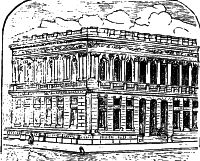
UNITED SERVICE CLUB.
The Duke of Wellington was in the habit of dining at the United Service Club, in Pall Mall, off the roast joint of beef or mutton, and one day he was charged 1s. 3d. for his plate of meat instead of 1s., the proper charge. He declared he would not pay the extra three-pence, and denounced the swindle until the three-pence was deducted, when the old soldier became satisfied and said that he would have paid the extra charge, but that he did not wish to establish an unjust precedent whereby others might suffer.
Just one hundred years ago a man dropped down at the door of White's Club, which is still flourishing in St. James' St., and the crowd of loungers in the bow windows immediately began to lay wagers whether the man was dead or not. A charitable person suggested that he be bled, but those who had wagered refused to allow it, saying that it would affect the fairness of the bet. In 1814, a banquet was given to the allied sovereigns at White's, which cost over $50,000 of American money, and the next year after a banquet was given to the Duke of Wellington which cost £2,480 10s. 9d. George IV, and Chesterfield, the master of politeness, were members of White's Club.
During the hard winter of 1844, the aristocratic clubs of London contributed to the starving poor of the metropolis, 3,104 pounds of broken bread, 4,556 pounds of broken meat, 1,147 pints of tea-leaves, and 1,158 pints of coffee-grounds. Otherwise these leavings might have been given to swine to fatten them.
DEMOCRATIC CLUB.—LADIES ADMITTED.
Gambling was carried on to a very high pitch at one time in the London clubs, but many have mended within twenty years. Crockford's Club House, No. 50 St. James' street, was known all over the world, and kings, princes, ambassadors, and statesmen, were inscribed upon its rolls as members. It no longer exists, however.
Crockford started in life as a fishmonger, in the old bulk-shop next door to Temple Bar Without, which he quitted for "play" in St. James'. He began by taking Watier's old club-house, where he set up a hazard-bank, and won a great deal of money; he then separated from his partner, who had a bad year, and failed. Crockford now removed to St. James' street, had a good year, and built the magnificent club house which bore his name; the decorations alone are said to have cost him £94,000. The election of the club members was vested in a committee; the house appointments were superb, and Ude was engaged as maître d'hôtel. "Crockford's" now became the high fashion. Card-tables were regularly placed, and whist was played occasionally; but the aim, end, and final cause of the whole was the hazard-bank, at which the proprietor took his nightly stand, prepared for all comers. His speculation was eminently successful. During several years, everything that anybody had to lose and cared to risk was swallowed up; and Crockford became a millionaire. He retired in 1840, "much as an Indian chief retires from a hunting-country when there is not game enough left for his tribe;" and the Club then tottered to its fall. After Crockford's death, the lease of the club-house (thirty-two years, rent £1,400) was sold for £2,900.
The Whittington Club is the only democratic club in London. It was started twenty-four years ago by Douglas Jerrold, who became its first president. It combines a literary society, with a club house, upon an economical scale, and contains dining and coffee rooms, library and reading rooms, smoking and chess rooms, and a large hall for balls, concerts, and soirees. Lectures are given here, and classes are held for the higher branches of education, fencing, dancing, etc. Ladies have all the privileges of gentlemen or members in the restaurant, and in balloting, while their dues and subscriptions is half that of the male members. This is the largest club in London, and combines all classes, having a roll of 1,700 members, all of whom are to be considered active. The Whittington Club is the only one in London where a person may be proposed without having a crest, or without belonging to a "good family," which means to loaf or idle a life away, and live upon the bread which is furnished by the blood and sweat of what these dandy Club men call the "lowah closses."
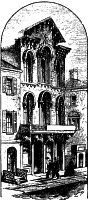
CHAPTER VIII.
THE ABBEY-CHURCH OF WESTMINSTER.
HIS is the Pantheon of England's Greatest Dead. As I stand here under the groined roof of this vast and glorious Nave, with the sunbeams streaming in through rose windows, and falling softly on sculptured figures and tombs of Kings and Queens long mouldering in the dust, their bodies recumbent in monumental brass, their hands clasped as in prayer, with heroes, and poets, and statesmen, law-givers, and royal murderers, lying silently around me on either hand, and under my feet beneath the worn and antique stones which form the pavement, I realize that I am in the Valhalla of the Anglo-Norman Race, a race that has been prolific of strong wills, great minds, and heroic deeds.
This is the most sacred spot in all Great Britain, this spot enclosed by the four walls of Westminster Abbey. It does not seem an edifice raised by human hands, rather would it appear, as I look to the roof, supported by most marvelous pillars, resembling an interlaced avenue of royal forest trees, that it had been constructed by beings of another world.
It was a grand faith that inspired Westminster Abbey, a faith that believed in sacrificing all earthly aspirations for the honor and glory of God.
Thus musing I am interrupted by a tap on the shoulder, as I stand leaning against a pillar in the gloom of the vast pile.
"Would you like to see the Habbey, sir?—its sixpence to see the Chapels—there's nine on 'em: the Hambulatory, the Nave, Transept, Choir, Chapels, and Cloisters, are free—beautiful sights—only sixpence, sir."
I turned, and saw a man in a black fustian gown, bareheaded, with a tall thin stick in his right hand; he was old, and seemed to need its frail support. This was a prebendary's "Verger," a sort of a porter or Abbey guide, whose main object was to collect as many sixpences as possible, but ostensibly he was a cicerone of the monuments and architectural beauties of the Cathedral Church of St. Peter's, Westminster.
Numbers of visitors were straying in and out of the Abbey, looking at the monuments, criticising the works of art, the mural tablets, or gossiping over the ashes of dead Kings, as if they were in a concert room, while here and there might be seen some scholar or learned man delving for facts, and poring over the musty Latin of the crumbling tombs.
In Westminster Abbey rival statesmen rest in peace, the tongue of the orator is mute, side by side rest the Crowned head and the Chancellor with his great seal, the Archbishop and the Play-actor, the philanthropist and the seaman, who died by his guns on the deck of the vessel of war, the divine and the physician, the Princess and the Soubrette, all mingle common dust together.
In Westminster Abbey, the powerful, spiritual, Roman Catholic prelate has celebrated High Mass with more than Eastern magnificence, the Introit has issued forth from his lips, and the acolytes have answered his "Dominus Vobiscum" with their "Amen;" and here the stern Puritan has knelt in his less formal prayer.
Here the dread sentence of excommunication has been launched forth in all its terrors from the lips of Papal legates, enthroned, and in Abbot John Estney's room Caxton printed the first English Bible.
Here the magnificence and pomps of the coronation of a King have been followed by the solemn and beautiful burial service for the dead, and the pealing organ, and the swelling choir, reverberating through the lofty grey-grown aisles, have chained men's minds to the power of Almighty God.
DIMENSIONS OF THE ABBEY.
Westminster Abbey is the finest and noblest specimen of Gothic architecture in all England.
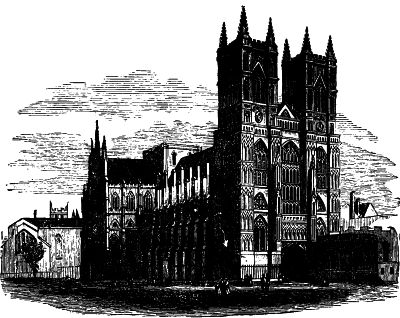
WESTMINSTER ABBEY.
Its dimensions are:
FEET.
Exterior.— Length from east to west, including walls, but exclusive of Henry VII's Chapel, 416
Height of the West Tower to top of pinnacles, 225
Interior.— Length within the walls to the piers of Henry VII's Chapel, 383
Breadth at the Transept, 203
Nave.— Length, 166
Breadth, 38
Height, 102
Breadth of each Aisle, 17
Extreme breadth of nave and its aisles, 72
Choir.— Length, 156
Breadth, 31
Height, 102
THE DIMENSIONS OF HENRY VII'S CHAPEL ARE—
Exterior.— Length from east to west, including the walls, 115
Breadth, including the walls, 80
Height of the Octagonal Towers, 71
Height to the apex of the roof, 86
Height to the top of Western Turrets, 102
Nave.— Length, 104
Breadth, 36
Height, 61
Breadth of each Aisle, 17
In a fine vault, under Henry VII's Chapel, is the burying-place of the Royal family, erected by George II, but not now used.
The cost of Henry VII's Chapel was originally about £200,000 of the present money, but since then £50,000 in addition have been expended in repairs. The roof is the most beautiful piece of work of its kind in the world, and is not excelled by any Saracenic or Moorish ornamentation known.
No living being has ever computed the cost of the Abbey itself, but the sum, altogether, since the foundations were built, must be very great.
The "Lord Abbot of Westminster" was one of the most powerful barons in England, and sat in Parliament as a great spiritual peer.
The Abbey Church, formerly arose a magnificent apex to a Royal palace, surrounded on all sides by its greater and lesser sanctuaries, (where no criminal could be arrested,) and its almonries, where a profusion of food was daily delivered to the poor, and raiment to the naked. It had its bell-towers, the principal one being 72 feet 6 inches square, with walls 20 feet thick; chapel, gate towers, boundary walls, and a train of other buildings, of which we can at the present day scarcely form an idea.
A WEALTHY SOCIETY.
In addition to all the land around it, extending from the Thames to Oxford Street, and from Vauxhall bridge to the Church of St. Mary-le-Strand, in a demesne of three square miles, on what is now the most valuable part of London, the Abbey of St. Peter's, Westminster, possessed besides, ninety-seven towns and villages, seventeen hamlets, and two hundred and sixteen manors. Its officers fed hundreds of persons daily, and one of its priests, who was not an Abbot, entertained at his Pavillion at Tothill, a King and Queen of England, with so large a retinue that seven hundred dishes did not suffice for the first table, and the Abbey butler, in the reign of Edward III, rebuilt, at his own expense, the stately gate-house which gave entrance to Tothill Street, and a portion of the wall remains to this day.
During the long ages, while men of noble Norman birth monopolized nearly every office of emolument and trust in the kingdom, nearly all the Lord Abbots of Westminster were of Norman birth or extraction. To be chosen Lord Abbot of Westminster, it was necessary for the Monks, headed by the prior, to select the Abbot "per Viam Compromissi," that is, the Monks met in a body and selected a chosen few, who, in their turn, selected the Lord Abbot. Then there was the method "per Viam Spiritus Sancti," which means by the special influence of the Holy Ghost, or all the Monks of the Abbey concurring unanimously in the election. After that the assent of the King had to be got, and the assent of the Lord Bishop of the Diocese, and even then all was not secure, for the newly elected Abbot was often forced to make the long and tedious journey to Rome and get the investiture of the Abbey from the Pontiff, in person, and sometimes this cost money, and trouble, that a person would hardly credit in these days. Abbot Richard de Kedyington, who had been prior of Sudbury, a cell subject to Westminster Abbey, on his election made the journey to Avignon, where the Pope was, for confirmation, and was three years there before he obtained investiture, and then it cost him eight thousand florins,—a large sum of money in those days—to obtain it. In 1321, when 5,500 florins had been paid, Pope John XXII remitted the remaining 2,500 florins of the debt.