Front matter (continued 10)
Reading edition
CHAPTER XXXI.
INTO THE JAWS OF DEATH.
ERY singular is the appearance of Leicester square, where are the resorts and lodgings of the foreign colonists of London. It is the dirtiest and darkest square in the city, with the exception of some of the fields in the outer suburbs. On every side you may behold traces of the foreign element which centres here. The people whom you meet in Leicester square, if you ask them a question, will be sure to answer you in a strange tongue, or else in a strange gibberish of English or Continental patois. There is an acre or two of sickly grass in the middle of the square which is guarded from the footsteps of pedestrians by a rickety and worn iron railing. In the middle of this patch of scanty grass is an equestrian statue of one of the Georges on an iron horse, the nose of which has been broken or has rotted off, and its appearance is in keeping with the buildings that tower all round it. The streets leading to and from the square are filled with foreign restaurants, and they are narrow and from them all issue forth smells such as the olfactories of a traveler encounter in the back slums of Paris or Vienna.

The buildings are shabby, the windows are shabby, and the people sitting at the tables, whom you may see through the dusty windows, rattling dominoes and playing cards at little tables, are shabby. Were it not for the statue in the middle of the square, it might be taken for the Gross Platz of a Continental town. Houses with strange names rise on every side, having signs in their windows of "Restaurant a la Carte," "Table d'hote a cinq heures," and are passed in quick succession, and the linen-drapers and other shopkeepers in the neighborhood take especial pains to inform all the passers-by that their employees can speak German, French, and Italian, and occasionally Spanish or Portuguese.
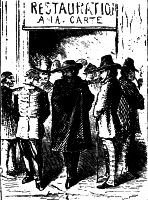
FOREIGN CAFE IN COVENTRY STREET.
The loungers in the square give visible and olfactory demonstration that they are not Cockneys; their tanned skins, long moustachios, military coats, and brigand-like hats, their polite and impressive bows,—all show the Frenchman, the Spaniard, the Polish exile, the Italian revolutionist, and the Greek wine merchant. The mingled fumes of tobacco and garlic, the peddlers who make desperate attempts to sell you copies of the Internationale, Patrie, Journal Pour Rire, and Diritto, all give ample evidence that you are in a strange quarter of London. The lodging-houses here are on the Parisian plan, and are let at five to ten shillings a week to mysterious men, who rise late, and are away all day in the cafés or gaming-houses to come home singing operatic airs at a late hour of the morning. Polish exiles, Italian supernumeraries of the opera, French figurantes of the inferior grades, German musicians, teachers and translators of languages, touters for gambling-dens—all congregate here. This is their Arcadia—their place of meeting, eating, drinking and sleeping—and for a hundred years past it has been frequented by such parasites.
LEICESTER SQUARE.
Here in this very square in one of the houses which form the "Hotel Sabloniere," lived Peter the Great and his boon companion, the Marquis of Carmaerthen; and in this square they have reeled home night after night; the master of all the Russias half-crazy with his potations of strong brandy and red pepper, of which he was passionately fond. Up yonder stairs passed Sarah, Duchess of Marlborough, in her powder, hoops, and patches, her train glistening under the glaring lights of the link boys who preceded her sedan chair, to the wedding of John Spencer, first Earl Spencer, and Miss Poyntz—bearing a case of jewels valued at £100,000, and a pair of shoe buckles valued at £30,000, for presentation to the beautiful bride.
The old-fashioned house opposite was the abode of Sir Joshua Reynolds, and the one at the corner of Sydney's Alley was the residence of William Hogarth, the bitterest and yet the truest caricaturist of his day. Here nightly came Samuel Johnson with his huge bulk and big walking-stick, to dogmatize with Reynolds, and with him came his toady, Boswell; and here came Goldsmith to read his "Deserted Village" to his coterie of choice spirits—and here Frederick, the "Good Prince of Wales," as he has been called to distinguish him from all the rest of his title, came to die of a bad cold which he caught walking in Kew Gardens in 1751; and here resided John Hunter, in the house now occupied by a humbug keeping a Turkish bath. It is a place of strange, quaint memories of good and brave, base and ignoble men and women in the past; it is now the Alcedama of licensed vice, the festering spot of all London.
It is now a place where wantons expose their shame; where social rottenness, winked at by the authorities, eats at the heart of a people who publish and read books condemning the depravity of Paris; who, in a pharisaical way, talk of the Mabille and the Quartier Breda, and yet in this very square is the "Royal Alhambra Palace," as it is called in the huge colored posters; and in the daily advertisements in all of the morning and evening papers of the metropolis, you may read such notices as these:
"The Alhambra—This evening at 8 o'clock, 'Pierrot,' the grand ballet, by Mr. Harry Boleno and troupe.
"The Alhambra—At 9 o'clock, the Christy Minstrels, by Riviere.
"The Alhambra—At 10 o'clock, the magnificent spectacular ballet, 'The Spirit of the Deep;' 10:15, Pitteri, the graceful and world-renowned danseuse, in a new grand pas seul; 10:30, 'The Home of the Naiads;' 11:15, grand Spanish ballet, 'Pepita.' 'God Save the Queen' at 11:45. Prices: Promenade, 1s.; stall and balcony, 2s.; gallery, 6d.; reserved seats, 4s.; new tier of private boxes, 2 guineas, 31s. 6d., and 21s. Closes at 12."
It was a rainy, unpleasant night—such a night as is often met with in London—when I first paid a visit to the Alhambra. The streets were deserted, and few persons were out of their houses, and those who were out took to cover in the cabs, which went madly dashing by, or in the busses, with their advertising signs, that were visible as they passed a lamp—the horses steaming and sweating, and the passengers inside grumbling and cursing their luck because of the bad air within and worse weather without.
THE ROYAL ALHAMBRA PALACE.
Nothing in the streets looked pleasant or cheerful, excepting the windows of the gin-shops with their bright brass and metal pumps, and the gaudy placards giving a list of the beverages for sale in the "publics," where men and women of the humbler class were consuming large quantities of beer and spirits. Passing through the Haymarket, I went down Coventry street, and in a few minutes stood before the gorgeous, gilded façade of the Alhambra. The building is about five stories high, painted of a cream-color, with minarets and gilt vanes and turrets in imitation of the manner of Owen Jones. The attempt to copy the Moresco style is rather absurd in the midst of common-place London. Indeed, it would be hard to find a Court of Lions in the building, and those who look for that most beautiful feature of the real Alhambra will go away disappointed. There is, however, a Court of Female Tigresses in the gallery up stairs which will compensate the curious for the absence of the Court of Lions. Though the streets were deserted, a large number of cabs stood at the front of the building and crowds of people were getting in and getting out of them.
The moon peeped just then from a bank of cloud, its rays breaking over the disfigured statue in the square, and threw a faint dead glare on the flaunting women who filled the passage leading to the Alhambra; the helmeted policemen; the porters in their black caps trimmed with red bands; the noisy, swearing cabmen disputing about their fares; the horses champing and biting, and the beggar boys and match-women who solicited languid swells to purchase their wares. It is the custom to give a penny to the men or boys who eagerly rush to open the door of your cab, and should you neglect them, they will follow until by wearying you they have achieved their object. There was a little hole in the wall, and a counter or desk, behind which was a sharp-looking young man, whose face seemed hard and cynical under the glare of the gas-jet over his head. Handing this man a shilling, I received a huge circular piece of tin, with a hole and letters punched in its surface. This was the ticket of admission, which I surrendered at the door to a big man in a red uniform, who looked like a Life Guardsman, his breast being all covered with service medals, but for what service I could not tell, or where performed.
Passing a wooden barrier, I caught a glimpse of lights, a stage, and legs of ballet-girls—a noise of many voices came by my ears, a number of young ladies smoking cigarettes opened a way for me to pass, and I stood inside of the Alhambra. I found myself in the promenade, which encircled the ground floor of the house, leaving a large space which was railed in for the wives and families of decent people who wanted to hear the music and see the dancing and pantomime. To walk in and around the promenade costs one shilling. To go inside of the railing in the space—which corresponds with the parquette at Niblo's, only that the whole floor is level and there is no descent here—will cost another shilling.
I saw a bar and a bar-maid before I got actually into the place from whence the stage could be seen; there was a bar and three bar-maids half-way down the promenade, and there was a bar and two bar-maids down before me in the alcove leading to the Canteen, with a corresponding number of bars and bar-maids in the same positions on the other side of the house.
All these bars had splendid bottles, with various fluids in them, arranged with an eye to effect, making it look like a vast apothecary's window, and there were bright brass beer-pumps all in a row, and pewter and silver and metal pots and tankards, and oval glass frames with pies, sandwiches, and all kinds of lunches to satisfy the thirst and appetites of the audience. The promenade was choked with men and women, walking past each other, looking at the stage, drinking at the bars, chaffing each other in a rough way, and laughing loudly. Although the night was stormy without, the revelry was high within.
Perhaps in this audience of three thousand people, who filled the ground floor and galleries, standing and sitting, and eating and drinking, there might have been fifteen hundred women, all well, and many of them fashionably, dressed and gloved. A sergeant of police with me said:
"If there are 1,500 women here to-night, as I believe there are, you may be sure that there are 1,200 women of the town among that number, Sir."
Twelve hundred unfortunate women in one place of amusement—and half a dozen other places like this, but of an inferior class, are open this rainy, unpleasant night, with a like complement of wretched females recklessly passing the hours that intervene before the dens close at midnight. The crash of sixty pieces of fine music falls on the ear, the glare, the gas, the tinsel on the stage, the well-dressed, fine-faced women around cannot shut out my thoughts of the "Legion of the Lost" who are so merry, so thoughtless, so careless of the morrow—deep in the fallacies of sin and despair.
THE SOCIAL EVIL.
The men who are conversing with these women seem to be of a good class, and spend a good deal of money in refreshments and liquor upon their fair, frail acquaintances. These last are not allowed to go inside of the railing on the ground floor alone, but they do not care for that privilege, as there is plenty to drink outside and more of the company of the male gender. Whenever a woman on the stage capers more vigorously, or flings her leg higher than the others, the applause is loud, long, and continued, and pewter and metal pots are dented in the surfaces of the tables that are ranged before each red-cushioned seat.
The comic singers are the favorites of the audience, however, and are always encored with vociferous enthusiasm. These singers get in a place like the Alhambra as much as ten pounds a week, as the proprietors know well the value of their services. The pantomimes are of the very best kind I ever saw; the dancing is, of its kind, good; the orchestra excellent and full in numbers, the acrobatic performances very fine, and the picture at the close of the pantomime is really superb. Yet with all these excellences combined, if the Alhambra and every Music-Hall-Hell like it in London were suddenly scorched up by a fire from Heaven, it would be the most incomparable benefit ever bestowed upon the English metropolis, and a saving grace to thousands of young English men and women—both in body and soul.
And the reason for this is that women are allowed admission at the door on payment of the price, without the escort of a man. Consequently it is, with the exception of the Argyle, and Holborn Casino, the greatest place of infamy in all London. It is convenient, in a central location, and were women not admitted alone the business of the place would break up. The men under twenty-five years of age, who comprise the largest part of the male audience, would not come were these Formosas debarred from admission. The performance—a first-class one—is not heeded. The chief attraction is the women.
And are these women calculated, by their manner, dress or appearance, to shock or warn people by their degradation? On the contrary they are cheerful, pleasant-looking girls, of quite fair breeding, and of a far better taste in their dress than the honest wives and sweethearts of the mechanics and shopkeepers, who sit in the place of virtue, within the painted railing. These women are satisfied with their lot, and do not repine so long as they have male acquaintances or "friends," as they call them, to give them champagne, moselle, and late suppers of game and native oysters in the Café de l'Europe, or at Barnes's in the Haymarket. Despite the arguments of those who have sought to eradicate the evil, these women, to any great number, never forsake their calling for the life of an honest working-woman. They laugh at such an idea, and will tell you that they could not do without wine, rich food, and costly dresses, even at the fearful price they have given to obtain them.
Besides, there is no field open to them, and suspicion follows every effort for reformation made by the few who have left the life of prostitution to go to hard work or service. They look down upon shop-girls and bar-maids with contempt, and many of them keep servants from the gains of their infamy. Whenever one of these girls happens to notice a stranger who does not seem to know the place, she will not hesitate to walk up to him, take his arm, and ask him: "Come, won't you give me my liquor?"
Many of these women have had no education whatever; still they manage to conceal the fact as much as possible, while others will tell you that they came originally from the workhouse, where they were sent as children, and being thrown on the streets when grown up, had no means of making a living but that which they were compelled to adopt. I spoke to one lady-like girl who seemed to be rather abstracted, and asked her if she were not tired of her present life, and anxious to leave it.
"Tired of my life? You may believe it that I am; but what of that. No one would take me by the hand after leaving this life. I am not such a fool as to jump from the frying pan into the fire. I get tight about twice a week, and then I come here and talk and drink more, and that serves to pass away the time. My friend is in Paris, and he sends me money when I want it. My mother is dead and my father is in America. I don't know where, and I don't care much, for he never bothered himself about me. Are you going to treat?"
I saw this girl walk up to the bar ten minutes after, pushing her way through the crowd, and saw her toss off nearly half a pint of raw gin, or "gin neat," as it is called here, without winking. Such is life. The detective told me that the girl had been one of the flashiest and best-dressed women who visited the Alhambra until a few months before, when she began drinking, and rapidly descended, when she had to pawn all her jewelry.
"WOTTEN WOW."
The songs sung in the Alhambra are not quite as low as those heard in some of the music-halls, and chiefly derive their short popularity from the fact that there is a comic vein in each one. Sentimental songs are not so popular, and do not receive so many encores as the comic ones. A man came on the stage, dressed in the exaggerated costume of a Pall Mall lounger, who sang a song, of which the following is a verse, with a very affected voice and lisp, keeping his body bent in a painful position the while:
THE BEAU OF WOTTEN WOW.
Now evewy sumwah's day I always pass my time away; Arm in arm with fwiends I go, And stwoll awound sweet Wotten Wow; For that's the place, none can deny, To see blooming faces and laughing eye; And if your hawts with love would glow, Why, patwonize sweet Wotten Wow.
Chorus:
So come young gents and dont be slow, But stylish dwess and each day go, And view the beauties to and fwo, Who dwive and wide wound Wotten Wow.
The chief merit in the singing of this song to the audience—was the affected lisp and farcical airs of the singer, who did his best to imitate the swells who lean over the railings in Rotten Row, when that fashionable drive is crowded with equestrians and foot passengers in the regular London season. The mob liked the satire on the aristocrats and relished all the local hits of the speech and the dress of the ideal do-nothing. Something of a more grotesque nature, and more broadly funny, which was cheered to the echo, was a nonsensical song called the "Royal Beast Show," that seemed to please the men and women in the audience. This song was sung by a man in a blood-red scarf, a pea-green body coat, and green glass goggles. The costume was indicative of nothing under heaven or earth that I ever saw before, but the song was exactly suited to the comprehension of the people, as their shouts of laughter testified:
THE ROYAL BEAST SHOW.
Come, stand aside, good people all, and hear vot I've got to say, But let the little dears come hup, wot's going for to pay. At all the coorts in Europe, we are reckoned quite the go: Then pay yer sixpences, and see the Royal Wild Beast Show.
Chorus.
The cammomiles, the crockodiles, and all that you could wish; The mice and rats, and tabby cats, and other kinds of fish; A dozen sphinxes hupside down and standing hin a row; Hits only sixpence heach to see the Royal Wild Beast Show.
The first one is the Kangaroo, you ought to see him jump; The next one is the Ippopotymus, you ought to see 'is hump; The third one is the Halligator, and he's such a one to crow, He wakes hus hevery morning in the Royal Wild Beast Show. The Donkey in the corner, with the Tiger hon 'is harm, Comes from Hass-iriya, vere once his father kept a farm; That Billy-Goat that's dressed in Pink and valking rayther slow, He's wery Horn-imental in a Royal Wild Beast show. The cammomiles, &c.
After these choice ballads had been sung, there was a ballet in which about fifty young ladies capered and pranced in a Bower of Angels, with a lot of dolphins, just like dolphins and angels in their mutual festivities in the other world: and then the detective who accompanied me, said:
"Would you like to see the Canteen? That's a werry 'igh old game is the Canteen; sort of priveet like."
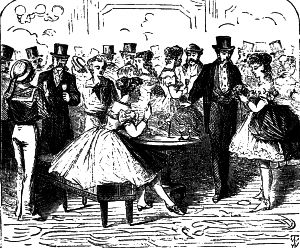
CANTEEN OF THE ALHAMBRA.
IN THE CANTEEN.
The Canteen of the Alhambra is situated on the lower floor of the building, under the stage, and has a dark entrance through a door which is supported on swinging hinges. The descent is by a spiral flight of stone steps, and on going through this door, the stranger receives the idea that he is going behind the scenes, which is a great mistake. The proprietors have made the entrance as dark and mysterious as possible, in order to throw a kind of greenroom air about it, which captivates simple people, and induces them to spend more money than they would otherwise. It is, in fact (this Canteen), nothing more than a subterranean bar-room, where men treat to Champagne wine and Moselle cup, the ballet-girls who come down, wrapped in travelling-cloaks; and after each ballet is concluded, flirt, drink, and make eligible acquaintances. The bar is in the form of a half circle, and two very largely framed women were behind it this night, serving the customers, who sit around on wooden benches. The ceiling is supported by rude posts, and everything is as uncouth as possible; and this gives it an additional charm to countrymen. They feel that they are doing something sinful, something indiscreet, which they would not like to have their wives or relations hear of, and, with the natural perversity of human nature, it is enjoyable to a corresponding degree. The waiters who bring the drinks and cigars from the bar, wear black dress-coats and red plush waist coats.
When I descended to the Canteen, the ballet was still on above us, and I could hear the tramping of the feet of the dancers as they bounded to and fro on the stage boards over my head. There were no ballet girls in the Canteen, but in a few minutes the strains of the dance music died away and down came the coryphees, trooping by twos and threes, their faces painted and chalked, and their white slippers and tights peeping out from the bottoms of the gray waterproof cloaks which they wore. They took their seats in the room on the wooden benches, and it was not long until each ballet girl found her male affinity, and of course the male affinity treated her to whatever the dear creature called for—however expensive. In such a moment, when these angels in tissue condescend to talk to mortals, who could think of expense.
There were a number of soldiers in the room, wearing the uniforms of different regiments, chiefly of the Household troops, with here and there a line private in buff and blue; a rifleman in dark green, or an artilleryman, with his gorgeous red facings and trimmings. But the angels of the ballet never wasted their time on such low people as common soldiers. Their game was much higher, and if they could not get a drink from an officer holding her Majesty's commission, they were content with stray Americans, who have a reputation for reckless liberality. In fact, Americans rank above par in the Canteen market, and are received with due honor.
THE OLD SINNER.
I saw one old gentleman, fully six feet high, with a venerable face and white whiskers, evidently of a respectable position in society, with his arm around the chalked neck of a girl of fifteen, whose light brown curls fell in masses over her shoulders, and, while he talked with her, he supplied her quickly-emptied glass with a sparkling wine. The detective said, in explanation of the scene, to me:
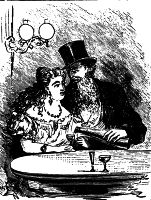
THE OLD SINNER.
"You see, sir, these gals as is down here in the Canteen only gets ten to sixteen shillin' a week for their night's work, and that isn't much. They is only the figurantys, and can't dance a bit; but they gets a bad fashion from the swells who go behind the scenes a drinkin' champagne and sich like, and that fashion leads them to wuss nor hannything that you'll see 'ere. They comes down here and drinks between the balley, and then goes hup on to the stage and dances again, and comes down hagain after the next balley, and by the time the Alhambra closes they are so blessed tight that they are ready for hanythink. I means, of course, the gals as is innocent yet; but the old hands are werry knowin' cards, so they is, bless you."
"That little gal as is just now a takin' that gentleman's address is a werry downy gal, she is. They calls her the 'Daisy,' because she has a fondness for bokays, and she is hup to all sorts of games. She 'ad some kind of a heddykation, when she was a little gal, and I thinks she was a governess or sich like once, and went to the dogs through somebody's fault; and she writes a beautiful hand, she does, and her little game is to send letters to strangers who visit London for the first time and don't know what to do with their money, and full of affekshun and such gammon—and tells them, in the writin' as 'ow she seed better days and axes their parding for givin' so much trouble—and 'opes they won't think the wuss of her for such freedom or liberty; and then she gets a few pun from the spooney, and she goes on a habsolutely hawful drunk for a few days and doesn't come to the rehearsal—and when the money is all spent she writes more letters and 'umbugs some other spoon. Oh, she is werry deep, is the 'Daisy.'"
The "Tulip," the other young girl, according to the story of the policeman, was famous for her aptitude in swearing and drinking "Stout"; otherwise there was nothing of special interest in her character, and her face, though a pretty one, was strongly marked with lines of dissipation. By the time that I was ready to leave the Canteen, having seen all that was worth seeing in the den (for it is a den, and nothing else) which has been the cause of many a promising youth's ruin, it was nearly eleven o'clock.
THE SIX PENNY GALLERY.
We paid another shilling to go up in the "Gallery," where there is not the slightest disguise in the conduct of the females who throng the place. Back of the gallery, in the corridors, where the performance can be seen over the heads of the men who stand in front, are ranged a number of bars, and at each end of this place, which forms a kind of saloon, small tables with marble tops. At these tables a number of men and women sat and drank and laughed, and told each other anecdotes more pointed than polished in their application. The clamor and the smoke made the place unbearable, and the strains of music from the orchestra, playing Weber's "Last Waltz," filled the vast building with its circular galleries, that were heaped one upon another, to the ceiling. Up in the highest gallery of all, where the admittance is only sixpence, the riff-raff were collected. When a woman goes to the six-penny gallery in the Alhambra she is indeed lost beyond all hope of rescue.
I came down disgusted, and on going below stairs to the first tier I found there a kid glove, fan, and bouquet stand. It is the fashion for the young men of this pious city of London, who have more money than brains, when they visit the Alhambra, to buy kid gloves or fans for the unfortunates who throng the place. Quite a trade is done in this way, as some of the swells are not satisfied, when intoxicated, unless they can prevail upon their feminine friends to accept of a slight trifle of their esteem in the shape of a dozen pairs of fine kids in a gilt box. The man at the glove stand told me that business in the season—when people came home from the Continent—was very brisk, and he said that in one night he had sold as many as nineteen dozen kids to be presented to the Formosas of the place.
The detective said to me as we went down stairs: "Suppose we go to the Argyle, in the 'Aymarket, and then finish with the Casino and Barnes's; they'll be very lively just now, I warrant ye, and the fun grows furious near midnight." I assented to this proposal, and we took a cab and went to the Argyle Rooms. The cabby put his tongue in his cheek when I said "Argyle Rooms," and drove us there. I gave him eighteen pence, and he desired to know if I didn't want to borrow the price of admission, because I refused to give him half a crown for a ride of a thousand feet.
CHAPTER XXXII.
THE "ARGYLE," "BARNES'S," AND "CASINO."
T is a quarter past eleven o'clock and the Haymarket is full of people—men and women jostling each other, many of both sexes being intoxicated; and beggars solicit us at every crossing, doffing their greasy caps and thrusting their dirty paws under our noses in their persistency. The cafes are overflowing with Gauls from across the channel, and when the crowds become too thick to leave the sidewalks passable, the policemen, who are in great numbers here, have to interfere to quell rows every few minutes. They clear the streets in a mild, civil way, very different from the manner of the New York police in like contingencies.

A stranger cannot help being astonished at the vast, almost incalculable, number of unfortunate women who haunt the London streets in this quarter as the hour of midnight approaches. There must be a great rottenness in Denmark where such a state of things can exist, and exist without any surprise on the part of those who witness such scenes nightly. I paid a shilling to enter the Argyle Rooms, and received a tin check, which was given up at the door, as in the Alhambra. The Argyle has not such high architectural pretensions as the Alhambra, but the class of visitors are better in the sense of dress and position. I entered through a side door, and found myself in a carpeted room, handsomely and tastefully furnished and decorated.
THE "ARGYLE ROOMS."
The saloon is nearly as large as Irving Hall, in New York, but lit up in a splendid manner with handsome chandeliers, which depend from the lofty ceiling, the gas jets burning in a deep glow through the shining metal stalactites that ornament the chandeliers. A splendid band of fifty instruments is stationed in the gallery at the further end of the room, and the music is of the best kind. The leader is attired in full evening dress, as is also every fiddler in the band, and the wave of the chef's baton is as graceful as that of Julien, when he was in his prime. Women, dressed in costly silks and satins and velvets, the majority of them wearing rich jewels and gold ornaments, are lounging on the plush sofas in a free and easy way, conversing with men whose dress betoken that they are in respectable society. A number of these are in full evening dress, wearing their overcoats, and a few of them have come from the clubs, a few from dinner parties, and a greater number from the theatres or opera.
They are not ashamed to be seen here by their acquaintances—far from it; they think this is a nice and clever thing to do, and, as no virtuous woman ever enters this place, there is no danger of meeting those who own a sisterly or still dearer tie, and who might cause a blush to redden the cheeks of these charming young men. Across the lower end of the room an iron railing is stretched, and this keeps the vulgar herd from mingling with the elite of the abandoned women who frequent the Argyle. Three-fourths of the ground space is devoted to dancing, and inside this railing sets are formed at a signal from the band above.
The charge for admission below, where I stand with the detective surveying this strange scene, is but a shilling, while the entrance fee to the gallery is two shillings, and this admits, as I am told by a servant, to all the privileges of the place whatever they may be. Even in vice the "horrid spirit of caste" prevails. It is chiefly clerks and tradesmen who are dancing in the shilling place, and at the end of each dance, be it waltz or quadrille, the man who has danced is expected to refresh his partner with a copious draught of beer, or a glass of plain gin. These women all take their gin without water, and smoke cigarettes if some one will pay for them. Inside the railing it is different.
The bars here are furnished with great splendor, and the calls for champagne are incessant. The women call champagne "fizz," and ale "swill." All around the room cushioned seats or benches are placed so that those who have done dancing may rest themselves and drink. There are liquor counters in every corner of the room, and a good business is done, the bar-maids being kept actively employed all the time while the music is playing. Upstairs there is another gallery and a fine bar, and here the really fast women congregate, to look over the balconies, but never condescending to mix among the vulgar dancers, excepting when their reason is gone through intoxication. These women all carry expensive fans, and their trains are as long as the train of a Countess in a reception at St. James's. There is a handsomely fitted up alcove to the right of the bar, and this alcove is ornamented with panels, on which are painted such pictures as "Europa and the Bull," "Leda," "Bacchus and Silenus;" and here are a number of women and men with Venetian goblets foaming full of champagne before them. Standing at the entrance to the alcove, is a stout, florid-faced woman, vulgar in appearance, with incipient moustachios at the corners of her lips. She is covered with jewelry, and her fingers, fat, red, and unshapely, glitter with diamonds.
This is the famous "Kate Hamilton," who was at one time the reigning beauty of her class, and has now degenerated into a vile pander. She is surrounded by a cluster of girls, and they are all in an animated discussion with her. The detective introduces me to this famous, or rather infamous, Messalina, and her first question is, "Will you stand some 'Sham?'" The next is to make inquiry about a number of New York politicians and sporting men who have patronized her den, somewhere in the Haymarket, while doing the foreign tour. She is most business-like and brief, this fetid old wretch, and has a speaking acquaintance with every man in the saloon.
THE HAYMARKET BY NIGHT.
While we are standing looking at her and her friends, the room is darkened, the gas being almost extinguished, and a chemical, light-colored flame irradiates the room like a twilight at sea, and the entire female population rush below to join in the last, wild, mad shadow-dance of the night. Around and around they go in each other's arms, whirling in the dim, uncertain, graveyard light, these unclean things of the darkness, shouting and shrieking, totally lost to shame—their gestures wanton as the movements of an Egyptian Almee and mad as the capers of a dancing dervish. Then the hall is darkened, the band ceases playing, the waiters finish the remains of the uncorked champagne bottles, the women dash madly down the carpeted stairs and into the streets with their male companions, and are whirled away with the cabs, which wait in long rows before the entrance of the Argyle, to the purlieus of Pimlico and the sensual shades of St. John's Wood, at Brompton.
The night has closed, a full English moon floats silently in the heavens, white snowy powder hangs over our heads like a film of lace—the clock-tower at Westminster Palace booms out the hour of midnight over the dark surface of the Thames, and we escape from the bustle of that vile dancing hall with gladness.
"Now," said my conductor, "let's go down in the Haymarket to Barnes's, and look at that for a few minutes, and then we will go to the Casino, in the Holborn, for a finish, if you please, sir."
Down through Coventry street, past the cafés again, which are preparing to close, and now we are in the Haymarket, one of the worst quarters of London. This street is wide, beginning at Coventry street and running down for a distance of about 1,400 feet to the "bottom," ending at the line where Pall Mall begins. They always say the "bottom" or "top" of a street in London, never "east" or "west." If there be a place in London that is deserving of notice, it is the Haymarket. Hundreds of years ago, the washerwomen of the village of Charing, just below us, and now one of the great business centres of London, used to bring their dirty linen here to cleanse it, and then dry it on the green fields in the Haymarket.
The green fields of the Haymarket have long ago been covered over with theatres, opera-houses and palatial shops, and now not all the washerwomen in England could cleanse the immoral sewage that streams through the Haymarket night after night—through the snows of winter, the heated nights of July, and August, and the fragrance of May. Here, at this chemist's door, formerly a tennis court, Charles II., his brother, the Duke of York, Sedley, Rochester, and the rest of the wild, reckless lot, used to come to play their favorite game; and here sat Mistress Gwynne, Portsmouth, Mrs. Hyde, Louise de Queroailles, Frances Stewart, and other dissolute beauties of the merry monarch's court, applauding the feats of skill performed by their lovers. In the theatre formerly standing on the site of the present Haymarket Theatre, and opposite to Her Majesty's Opera House, with its long, drab colonnades and dark shops imbedded in the arcades, Foote and glorious Garrick woke the passions of all who were intellectual and noble in the Addisonian age of England.
Here was the public house kept by Broughton, the champion of England, who has been forever immortalized by Hogarth—just off Cockspur street; and here was his swinging sign-board, having a portrait of himself, battered and bruised, in a cocked hat and wig, with the legend on the sign-board—
"Hic Victor Cæstus artemque repono."
Think of a modern prize buffer attempting to quote from the classics. Cibber wrote a show-bill for Broughton once, which I reproduce, as a specimen of advertising skill:
"At The New Theatre
"In the Haymarket, on Wednesday. The 29th of This Instant April,
"The Beauty of the Science of Defence will be shown in a Trial of Skill between the following Masters, viz., Whereas, there was a battle fought on the 18th of March last, between Mr. Johnson, from Yorkshire, and Mr. Sherlock, from Ireland, in which engagement they came so near as to throw each other down. Since that rough battle the said Sherlock has challenged Johnson to fight him, strapt down to the stage, for twenty pounds; to which the said Johnson has agreed; and they are to meet at the time and place above mentioned, and fight in the following manner, viz., to have their left feet strapt down to the stage, within reach of each other's right leg; and the most bleeding wounds to decide the wager. N.B.—The undaunted young James, who is thought the bravest of his age in the manly art of boxing, fights himself the stout-hearted George Gray for ten pounds, who values himself for fighting at Tottenham Court. Attendance to be given at ten, and the Masters mount at twelve. Cudgel-playing and boxing to divert the gentlemen until the battle begins.
"N.B.—Frenchmen are requested to bring smelling bottles."
Think only of these wigged nobles and their clients, the boxers, in knee-breeches and wigs, going to a battle, and think of the Frenchmen who were compelled to bring smelling-bottles to keep their stomachs in order, and who will not say that even in prize-fighting the Nineteenth century has brought progress, as in every other scientific matter?
AT "BARNES'S."
We are now at Barnes's, a famous night house, or, rather, an infamous night house, in the Haymarket. When the dancing places and music-halls of the metropolis close, this door remains open to catch all stray night birds who can find no other resting place. The place is an ordinary drinking saloon, with a confectionery and pastry counter, and the attendants are five or six over-dressed young ladies, all of whom have their hair dyed of a light color, and are very free and chatty in their manner. These girls are well supplied with jewelry and lockets. Their salary is not large enough to furnish them with the trinkets, as they only get one pound five shillings a week; yet they manage to dress expensively, and Champagne is so common to their palates that they have become indifferent to it and it absolutely palls upon them. Yet there is a percentage on every bottle that is consumed here, and consequently they do their best to sell Moet & Chandon at ten shillings a bottle to the customers—and will even drink with them.
IN THE HAYMARKET.
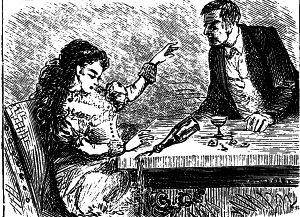
This is a great place for rump-steaks and native oysters—late at night, and a good business is done here in those articles of food. The oysters are small, black, and have a bitter, copperish taste. A New Yorker, used to Sounds and East Rivers, would leave them in disgust; but Englishmen, whose throats are parched with the liquors they get at the Argyle and in the Haymarket, prefer them to the most luscious Saddle Rocks. There is a large screen in the center of the room, the bar glitters with costly mirrors, and behind the screen are a number of small boxes partitioned off, and having red plush seats. In these are several noisy women, inflamed with liquor, eating and drinking and hallooing at their male companions. One girl, in a black silk dress, with her hair hanging down in disorder, is crying drunk at one of the tables, and has just spilled a bottle of wine over her handsome dress. She is cursing the waiter, who is also drunk, with much earnestness of purpose, and as soon as she sees the detective she halloos at him in a harsh voice:
THE "HOLBORN CASINO."
"I say, Bobby, you don't want me, do you?" I 'avent done nothink, although I wos wonst in Newgate for taking a swell's watch, which he guv to me for my wedding present, as was just four year ago, come Micklemas Goose. I wish I could throw meself in the Thames, but I 'aven't got the 'art—
"'Hoh, my 'art is in the 'Ighlands A follerin the vild roe. My 'art is in the 'Ighlands, Wheresomdever I—go—I go."
"Ah! that's a rum customer," said the policeman; "she's fly to heverythink. Now, hif that gal ain't watched this night, she is jest as likely to go to London Bridge and throw her blessed body hoff into the dirty water as not. They always goes to Lunnun Bridge when they want to make way with themselves—it's so lively like."
"Now," said the policeman, "I would hadvise you to make the finish at the 'Casino,' in the 'Olborn, afore you go to your hotel, sir, and then you may say you've seen the best of the bad places of Lunnun. The Casino is hopen till one o'clock to-night, I think, and we'll just be in time for the best dance."
We took a cab again, which dashed up Coventry street, through Cranbourne street, into Long acre, and up Drury Lane, past the old theatre of that name, and in a few minutes we descended in the wide, open space of the Holborn, before the entrance of the Casino, the fashionable dance-house of London. The street was lined with cabs, and policemen were thick in the vicinity of the entrance, ordering the men and women just coming out to pass on, and keep the street clear, a duty which gained for them a great deal of abuse from the intoxicated women, who did not want to pass on by any means. The entrance to this place is through a gaudy, gilded vestibule and down a descent of four or five steps to a spacious marble floor, which was covered with dancers. The whole interior was gilded, gold leaf and white predominating above all other colors.
The band, as at the other places of evil resort, was placed in the farthest end gallery, and was an excellent one. The leader wore white kids and the musicians white vests, and the crash of the instruments was almost deafening, filling the large space with a wild and not unpleasing harmony. Attendants in evening dress were on the floor, making up sets and soliciting the habitues of the place to dance with the female partners, which were easily found for them. A high balcony ran all round the hall, which is 100 feet by 75 in dimension, and in the corners of the saloon, up and down stairs, were cafés and refreshment bars, which were crowded with customers. The entrance to this place is only one shilling, and the class of visitors is of a superior kind to those who go to any other dance-house in London.
The saloon was really a magnificent one, rich and tasteful in its decoration, and the women were well and neatly dressed, and very quiet and well-behaved in their manner. Every woman wore nice gloves, high-heeled boots, and all of them had the lace frill or ruff now prevalent in London around their necks. They also wore charms and lockets and gold watches, and every one was attended by a cavalier. The men were smoking cigars and flirting, and a number of foreigners were present and danced incessantly, just as they would at the Mabille or any Continental garden. In fact, this is the only place in London, with the exception of Cremorne Gardens, that in any way approaches the mad gaiety of the Mabille.
Still, there is a certain English decorum observed here, and any girl who would get drunk or lift her skirts too high would be expelled instantly by the master of ceremonies, assisted by the policemen who are to be found scattered all over the place. Some of the girls will go up and ask for partners to dance with them, and then, if the latter wish to give them liquor,—well and good, but they will not solicit it, because these women affect the fashionable lady as much as their limited resources will allow.
GOOD NIGHT.
They are generally the mistresses of men of leisure, and when the season is at its height a great number of men about town may be seen here, as spectators, who come from the clubs or the Houses of Parliament, bored by the ennui of the reading rooms at one place, or the prosy speeches of members of the other. Some of the men dance with cigars in their mouths, and whirl around in such a wild manner as to cause collision with the other couples. Occasionally you will see two girls waltzing, and men who have sat too long at the dinner-table will, once in an evening, get up together and dance a "stag dance." But this is not encouraged by the master of ceremonies, as the dancing of a pair of male bipeds is not calculated to help the business of the place, and it is instantly suppressed, amid cheers and laughter.
The music strikes up for the last gallop, and there is a rush for partners; the balconies and alcoves and luxurious seats and marble tables are deserted, and in a moment everything is in a wild hurly-burly and a confusion and uproar; men and women galloping and bounding and yelling to the right, and to the left, and as the last crash of the big drum beats on the ear the passages and doorways are thronged with the dancers, every man crying for a cab to take himself and partner somewhere, perhaps they care not where—it is no matter; and now the place is in darkness, and the policemen having seen the last of the women leave the doorway, begin their patrol duty, which will last until day breaks and the stars fall from the London sky, telling them that they are relieved from their night's watch.
The detective shakes hand with and leaves me, he to go eastward to Temple Bar, and I to bed in a remote quarter of the great Babylon, whose noises and turmoil are now hushed into silence, excepting where a solitary street-walker, famishing from hunger, or a drunken pedestrian bars the way, and makes the night resound with insane shouts.
CHAPTER XXXIII.
ST. PAUL'S CATHEDRAL.
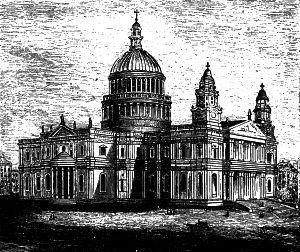
HE best expression of Protestant Ecclesiastical art in England, and perhaps in the world, is manifested in St. Paul's Cathedral, London. It is a stupendous temple rather than a church, and the religious effect is lost in the interior by the number of tombs erected to admirals, generals, colonels, and other military and naval heroes.

When Nelson ordered the decks of the Victory cleared for action at Trafalgar, he cried out to his lieutenant, Hardy:
"Now for a peerage or Westminster Abbey."
But Nelson lies in St. Paul's, and the tomb of England's greatest soldier—Wellington, is quite near his, under the same lofty nave. All the great Cathedrals and Abbies of England were built before the Reformation, and, consequently, St. Paul's is the best and truest proof of Protestant art in England.
WHEN ERECTED AND THE ARCHITECT.
The yearly revenues of this Cathedral are £23,422. This does not include the salaries of the Bishop of London, the Dean of St. Paul's, four Canons, a Precentor, a Chancellor, Treasurer, Archdeacon of London, Archdeacon of Middlesex, 29 Canons who do nothing but draw their salaries, a Divinity Lecturer, a Sub-Dean, 12 Minor Canons, among whom are a Succentor, Sacrist, Gospeller, Epistolar, Librarian, Almoner, and Warden, a Commissary, a Registrar and Chapter Clerk, a Deputy Registrar, a Receiver and Steward, six Vicars, a Choral, and an Organist; five Bishops' Chaplains, an Examining Chaplain, a Chancellor of the Diocese, a Secretary to the Bishop of London, and a Registrar to the Bishop of London at the Cathedral. Altogether about eighty ecclesiastics who receive salaries from the Cathedral, besides a swarm of vergers, choristers, and servants of all kinds the salaries of whom amount to at least £50,000 a year.
ST. PAUL'S CATHEDRAL.
Sir Christopher Wren was the architect of St. Paul's, and the first stone of the new Cathedral was laid on the site of the old St. Paul's (which had been destroyed by fire in 1666), in June 1671, and thirty-nine years afterward, the last stone was laid at the top of the lantern in 1710, by the son of Sir Christopher Wren, who had succeeded his father as the architect.
As St. Peter's at Rome is considered to be the chief temple of Catholic Christendom, so is St. Paul's entitled to hold the first place in Protestant Christendom. The whole expense of rebuilding St. Paul's was £736,752 2s. 3d. for the Cathedral, and £11,202 0s. 6d. for the stone wall and railings around the Cathedral. The architect received a beggarly £200 a year during its construction, for his services. The same architect afterwards designed fifty churches to take the place of those burnt down in the Great Fire, and they are all standing to-day, I believe.
The dimensions of St. Paul's as compared with St. Peter's at Rome, are as follows:
St. Paul's. St. Peter's.
Feet. Feet.
Length within 500 669
Breadth at entrance 100 226
Front without 180 395
Breadth at cross 223 442
Cupola clear 108 139
Cupola and lantern high 330 432
Church high 110 146
Pillars in front 40 91
Superficial area 84,025 227,069
The diameter of the gilt ball is 6 feet 2 inches; the weight 5,600 lbs., and will contain eight persons; the weight of the cross is 3,360 lbs.
The ground on which the present Cathedral stands has, from time immemorial, been sacred to Divine Worship. There was a Christian church here as early as the Second century, built, as it is supposed, by the Romans, which was destroyed during the persecutions of Diocletian, and again rebuilt, and in the Sixth century it was desecrated by the Pagan Saxons, who celebrated their Heathenish mysteries in the church.
It was afterwards richly endowed with lordships by Athelstan, Edgar, Ethelred, Canute, and Edward the Confessor. The Norman barons, when they came, made a raid on the property of the church as they did upon everything they saw in England, and the Saxon priests, half frightened to death by such violence, had their property returned them by Duke William, who gave it a charter on his coronation day, cursing all those who should molest the property of St. Paul's, and blessing those who should augment its revenues.
The enumeration of the jewels, and precious stones, and gold and silver ornaments presented to St. Paul's by its various pious benefactors, takes up twenty-eight pages of Dugdale's Monasticon.
The dimensions of Old St. Paul's in the year 1315 were:
Feet.
Length 690
Breadth 130
Height of nave 102
Length of nave 150
The height of the gilt ball on the top of the dome, (which was large enough to hold ten bushels of corn inside) from the ground, was 520 feet and it supported a cross, which made the entire height to the top of the cross, 534 feet. The area occupied by the edifice of Old St. Paul's was three and a half acres, one and one-half rood and 6 perches. The walls of the present Cathedral are 1,500 feet in circuit, and enclose five-eighths of an acre, or about one-fifth of the space of the old St. Paul's. In fine, the present Cathedral is in every way inferior to the old one, and in some places it is very tawdy in decoration, while the Old St. Paul's was in many respects a finer cathedral than St. Peter's, and twenty feet deeper.
DESTRUCTION OF OLD ST. PAUL'S.
In 1561 the steeple of Old St. Paul's was burnt down, a few years after Queen Elizabeth ascended the throne, and it was subsequently decided to rebuild the Cathedral, and Inigo Jones, a far superior architect to Wren, was chosen for the task. In 1633, Archbishop Laud laid the first stone of Inigo Jones's Cathedral, which was destroyed by fire in 1666. In 1643 the building was finished at an expense of £100,000. This Cathedral was architecturally and in every way superior to that built afterward by Wren, but was as much inferior to the old Cathedral of the Middle Ages, which Wren sought to improve upon.
It is believed that modern European Freemasonry was first founded among the workmen who were employed in rebuilding St. Paul's, from the fact of a number of the stone masons meeting together during the work in a social fashion, and from this casual association it is stated that the Lodge of Antiquity, of which Sir Christopher Wren was Master, originated, the occasion being the laying of the highest or lantern stone of the Cathedral in 1710—and it is stated that from this Lodge of Antiquity all the other Lodges of modern Europe have sprung.
The Cathedral contains monuments to Nelson, who is buried in a wooden coffin taken from the mainmast of the French Admiral's ship captured at the battle of the Nile the very same ship in which the boy Casabianca, the Admiral's son, "stood on the burning deck, whence all but him had fled." Nelson lies close to Wellington, and other illustrious men. His coffin is enclosed in a sarcophagus made by order of Cardinal Wolsey for Henry VIII.
Wellington is buried in the crypt of the Cathedral, in a sarcophagus made of Cornish porphyry, and near him is his old subordinate, the Irish Sir Thomas Picton, who commanded the Fighting Fifth Division at Waterloo. Queen Anne, who used to come to St. Paul's in great state and procession to thank God for the victories won for her by the Duke of Marlborough, and whom she afterwards betrayed—has a bronze statue erected in the pediment of the Cathedral.
Besides these worthies, the tombs of Collingwood, Nelson's friend, Wren, Rennie, the builder of London Bridge, and Mylne, of Waterloo Bridge, Dr. Samuel Johnson, who expected to be buried in Westminster Abbey, and was disappointed, like many others, Sir William Jones, Sir Astley Cooper, Sir Joshua Reynolds, Turner, the greatest colorist England has ever produced, Fuseli, Barry, Sir Thomas Lawrence, Opie, West and other famous painters, John, of Gaunt, Vandyke, Dr. Donne, Sir C. Hatton, Dean Colet, founder of St. Paul's School, and Sir Nicholas Bacon are buried in the crypt under St. Faith's—the parish church of St. Paul's—which is quite contiguous to the latter.
There are monuments to Bishop Heber, Lord Cornwallis, Nelson, Reynolds, Johnson, Sir John Moore, Elliott, who defended Gibraltar, Lord Howe, Rodney, Ponsonby, Admiral Dundas, and a large number beside of their country's defenders in the Cathedral.
PRICES OF ADMISSION.
To speak plainly the interior does not look like a church of God at all. It is simply a huge Pantheon, with monumental effigies, and slabs indicating the virtues, heroism, gallantry and acts in battle of innumerable soldiers and sailors who have fought for Britain in times gone by. The vast Rotunda and the gigantic Dome do not give the idea of a church, and the pillars and cornices have little in their aspect to make a spectator feel that he stands in the presence of the Almighty.
Yet the monuments and the vastness of the Cathedral are worthy of inspection, though the exterior of the Cathedral is far more imposing than the interior, owing to the fact that the real height of the walls of the body of the edifice is marked by a double row of pillars, which are ranged on top of each other, giving to the spectator an impression that the Cathedral walls to the roof, exclusive of the dome and cupola, are twice as high as they are in reality.
The following are the charges to see the different places in the Cathedral:—to the body of the church, 2d.; to the Whispering Gallery and the outside galleries around the dome, 6d.; to the Library, the Model Room, the Geometrical Staircase in the south turret, and the Great Bell, which weighs 12,000 pounds, 1s.; to the Ball at the top, 1s. 6d.; to the clock, 2d., and to the vaults 1s., in all 4s. 4d. from each visitor; which is nothing less than a downright robbery. This is playing Barnum with a vengeance.
It was the great bell of St. Paul's which a soldier on the ramparts at Windsor, twenty miles away, heard striking thirteen strokes one night, instead of twelve. He was tried for sleeping on his post, found guilty, and sentenced to death, and would have suffered had it not been for his stout heart, and his persistent assertion that he heard the bell strike thirteen instead of twelve strokes. It was proved that the bell did strike thirteen on the night in question, by the mistake of the ringer, and thus the soldier was exonerated.
It was for this same bell that Henry VIII. and a dissolute nobleman named Partridge, rattled the dice one night; and finally Henry lost the stake. Partridge having won, died in the same year in an unfortunate manner, just before he had made up his impious mind to have the bell melted down. This was looked upon as a judgment of God, for in those days judgments of God were of common occurrence.
The grandest sight ever seen under the dome of St. Paul's was the funeral of Nelson, which took place January 9, 1806. The body was brought through the streets from Whitehall Stairs, with the King, Lord Mayor, the Lords of the Admiralty, the Princes of the Blood, the nobles, prelates and civic companies following, through densely packed streets, which were almost impassable, for all England was there in heart, if not in body. The bands played the "Dead March in Saul" during the afternoon, and minute guns were fired from the Tower and along the wharves as the body passed. Hardy, Nelson's post-captain, and forty-eight sailors, who had seen the hero die, surrounded the corpse, and when the body was taken from the hearse into the vast Cathedral, a clear space was formed amid all that great sea of faces by the Highland soldiers of Abercromby, who had been with Nelson in Egypt and at Aboukir. Above was the immense dome, and from its dark and impenetrable depths depended a huge octagonal lantern, encircled by innumerable lamps.
Then came the words from the lips of the prelate who officiated:
"I am the Resurrection and the Life, and he who believeth in me though he were dead, yet shall he rise again," the mighty organ bursting forth—and out of all that vast multitude went forth a great, tremendous sob as the body was lowered into the grave enshrouded by the oak which came from the enemies' ship, and Nelson's flag, which he had borne at his masthead in victory so often was also about to be lowered, when suddenly the forty-eight sailors of his vessel, some of whom had carried his lifeless body from the deck to the cockpit—as if moved by one impulse, closed around the grave, rent the flag in pieces, each man securing a piece of the sacred emblem upon his person, as a testament of the greatest hero England ever saw, or ever will see again.
CHAPTER XXXIV.
GOING TO THE PLAY.
HERE can be no doubt but that London is a city much given to amusement, and I question if there can be found another city which spends more money and with a better grace, to support music and the drama.
It is very true that in a great degree the cheap amusement halls of London are of the very lowest kind to be found anywhere, but then the reader must understand that the greater number of theatre going and music-loving people never enter these haunts, which have won so much infamy among strangers. I refer, of course, to such places as the Argyle, the Alhambra, Cremorne, the Casino, and other resorts of the kind.
I think that the Londoners as compared with the Parisians, give a great deal more money for the amusements which they attend than the Parisians do for theirs.
Lately the French government has been compelled to build for the delectation of the Parisians, a splendid opera house, and besides the cost of this structure, which was two million of dollars, the government of France pays the following annual subventions or donations for opera alone: to the Italian Opera 120,000 francs, French Opera 900,000 francs and 250,000 francs to the Opera Comique, beside 200,000 francs annually to the Conservatoire, where music is taught.
In London, however, the support of such places is voluntary, and no state interference is dreamed of, save that of the Lord Chamberlain who is a sort of censor, and whose duty is chiefly to see that the ballet-girls do not abbreviate their skirts too much.
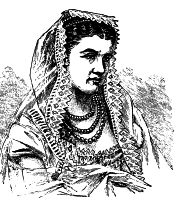
"BEAUTIFUL MISS NEILSON."
The most popular and lady-like actress in London is Miss Neilson, who performs at the Lyceum, the Princess's and Queen's Theatres. This young and charming actress is a favorite with all classes, owing to her perfect skill as an artiste, and her reputation is without reproach. She is known as "Beautiful Miss Neilson," and is of medium height, with dark, languishing eyes, in which the fire of genius burns, with a steady flame. Miss Kate Bateman, now Mrs. Dr. Crowe, is also a great favorite with the Londoners, and most deservedly so, for she has not her equal on the English stage in her distinctive line of characters. Who that ever saw the last act of "Leah," or the "Prison Scene" in "Mary Warner," will deny her terrible power as an actress. The English capital is divided into two camps as to the merits of the rival comedians—Lawrence, Toole and John Baldwin Buckstone. Alfred Wigan, and our own "Dundreary Sothern," stand high in the ranks of their profession, and no English comedian ever met with a more successful triumph in his own land than that earned by John S. Clarke at the Strand Theatre in 1869-70. French plays are very well received at the St. James Theatre—and I had the pleasure of listening to Schneider, in "Barbe Bleue" and "Orphee aux Enfer," who was supported by Dupuis, the celebrated tenor. Having visited many theatres in England, I can safely avow that I never saw an English comedy, or a play dealing with English characters and English homes, performed in better taste, or with more fidelity, than I have seen like plays produced at Wallack's Theatre, in New York City.
FULL DRESS REQUIRED.
Nearly all London theatres except the Queen's, in Long Acre, are dark and gloomy, and in the opera houses, the old style of erecting the private boxes or loges tier over tier and then hanging them with red velvet, gives a peculiarly heavy look to the interiors. Besides, prices for reserved seats are awfully high, and unless a man is the possessor of a pretty large private fortune, he cannot think of indulging in opera at all. As a proof of this I will here subjoin the prices at the Haymarket Opera House or "Her Majesty's," as it is called. The performances were Italian, German, and French, Grand Opera, and ballet:
Tariff of prices for private boxes: Pit boxes, 150 guineas for the season; grand tier, 200 guineas; one pair, 150 guineas; two pair, 100 guineas; orchestra stalls, 25 guineas; pit tickets, 10s. 6d.; amphitheatre stalls, 5s.; gallery, 2s. 6d. Opera on Tuesdays, Thursdays, and Saturdays, and special extra nights. No extra charge for booking places. Evening dress to boxes, stalls and pit. Gratuities to boxkeepers optional. Doors open at eight; performance commences at half-past eight.
These prices, it will be seen, are simply frightful. Then, unless you go in the gallery, you must be in full dress swallowtail and white choker, which is not relished by Americans, and particularly by those from the back-woods, who are not very familiar with evening dress coats. Of course the large sums are the subscriptions for a season of perhaps thirty nights.
At the Covent Garden Opera House, the tariff of prices is as follows:
Private boxes: Second tier, 2½ guineas; first tier, near the stage, 3 guineas; ditto, at the side, 4 guineas; ditto, in the centre, 5 guineas; grand tier, 6 guineas; pit tier, 5 guineas; pit stalls, 21s.; pit, 7 s.; amphitheatre, 2s. 6d.; amphitheatre stalls, front row, 10s. 6d.; second row 7s.; all other rows, 5s. No extra charge for booking places. Evening dress to all parts except the amphitheatre and amphitheatre stalls. No gratuities allowed to boxkeepers. Doors open at eight; performance commences at half-past eight.
In most of the theatres in London hideous old women or shabby looking men attend in the lobbies, and wait upon the people who have need for their services during the night, demanding a fee for every trifling errand, and in a first-class place of amusement, a boxkeeper would be insulted if offered less than a shilling for turning a key.
And then there are terrible young blackguards who insist upon the stranger's buying oranges, walnuts or apples from them, or else he must take their chaff as it is given.
But the biggest swindle of all is, that a man must pay two pence for the programme of the play, or three pence or four pence, as the case may be, and yet I have heard Englishmen tell me with audacity that they lived in a free country.
And now before I proceed to tell anything of the London theatres, I will give a table of the prices and the time of opening doors, with the location of each place of amusement for the benefit of those who may visit London:
ASTLEY'S AMPHITHEATRE.
The Adelphi, 411 Strand; admission, seven o'clock—6s., 5s., 3s., 2s., 1s. 6d., 1s., and 6d.; Astley's, Westminster Road, Lambeth; seven o'clock—5s., 3s., 2s., 1s. 6d., 1s., and 6d.; Britannia, Hoxton Old Town, will hold 3,400 persons; half-past six o'clock—2s., 1s., 6d., and 3d.; City of London, 36 Norton Folgate; seven o'clock—2s., 1s., and 6d.; Covent Garden, Bow street; eight o'clock—7s., 5s., 3s., 2s. 6d., 2s., and 1s. It was built in 1849, with Floral Hall adjoining. Its size, 240 feet by 123 feet, and 100 feet high, equals that of La Scala, the largest in Europe. Drury Lane, seven o'clock—7s., 5s., 2s., 1s., and 6d.; Grecian, City Road, seven o'clock—1s., 6d., and 3d.; Haymarket, seven o'clock—7s. 5s., 3s., 2s., and 1s.; Her Majesty's, corner of Haymarket, eight o'clock—7s., 5s., 3s., 2s. 6d., 2s., and 1s.; Holborn, High Holborn, nearly opposite Chancery Lane, seven o'clock—6s., 4s., 2s., 1s. 6d., 1s., and 6d.; Lyceum, Strand, seven o'clock—6s., 5s., 3s., 2s., and 1s.; Olympic, Wych street, Drury Lane, half-past seven o'clock—6s., 4s., 2s., 1s.; Marylebone, Portman Market, seven o'clock—3s., 2s., 1s., and 6d.; Pavilion, Whitechapel, half-past six o'clock—2s., 1s., and 6d.; Prince of Wales, Tottenham Court Road, seven o'clock—6s., 3s., 1s. 6d., 1s., and 6d.; Princess's, Oxford street, seven o'clock—6s., 5s., 4s., 2s., and 1s.; Queen's, Long Acre, formerly St. Martin's Hall, seven o'clock—6s., 5s., 4s., 2s. 6d., 2s., and 1s.; Royalty or Soho, Dean street, Oxford street, half-past seven o'clock—5s., 3s., 1s., and 6d.; Royal Amphitheatre, High Holborn, west of Red Lion street, seven o'clock—4s., 2s., 1s. 6d., and 1s.; Sadler's Wells, Clerkenwell, seven o'clock—3s., 2s., 1s., and 6d.; Standard, Shoreditch, half-past six o'clock—3s., 1s. 6d., 1s., 6d., and 3d., burnt down in 1866, is rebuilding; St. James's, King street, St. James's Square, half-past seven o'clock—4s., 3s., 2s., and 6d.; Strand, Strand, seven o'clock—5s., 3s., 1s. 6d., and 6.; Surrey, Blackfriar's Road, seven o'clock—3s., 2s., 1s. 6d., 1s., and 6d.; Victoria, New Cut, Lambeth, half-past six o'clock—1s. 6d., 1s., 6d., and 3d.
Drury Lane, which was built in 1812, will seat 1,700 persons, and its vestibule and saloons are as fine as any in Europe. Private boxes in the London theatres range in price for a single seat at from one guinea to four pounds, or from $5 to $20 a night. The Olympic seats 2,000; the Adelphi 1,500; Astley's Circus 4,000, and the gallery of the Victoria will seat 2,000, while the Pit of the Pavilion, a murderous hole in Whitechapel, seats 1,500 roughs.
Astley's is a sort of Hippodrome for spectacles, and is much loved by young London for the prancing of its horses and its grand shows. Astley's is at Lambeth, on the Surrey side of the Thames, and is in the heart of the democratic quarter of London. The present building is the fourth erected upon this site. The first was one of the nineteen theatres built by Philip Astley, and was opened in 1773, burnt in 1794; rebuilt 1795, burnt 1803; rebuilt 1804, burnt June 8, 1841, within two hours, the house being principally constructed from old ship-timber. It was rebuilt, and opened April 17, 1843, and has since been enlarged. There is only one other theatre in London for equestrianism; and the stud of trained horses numbers from fifty to sixty.
Philip Astley, originally a cavalry soldier, commenced horsemanship in 1763, in an open field at Lambeth. He built his first theatre partly with £60, the produce of an unowned diamond ring which he found on Westminster Bridge. Andrew Ducrow, subsequently proprietor of the Amphitheatre, was born at the Nag's Head, Borough, in 1793, when his father, Peter Ducrow, a native of Bruges, was "the Flemish Hercules" at Astley's. The fire in 1841 arose from ignited wadding, such as caused the destruction of the old Globe Theatre in 1613, and Covent Garden Theatre in 1808. Andrew Ducrow died January 26, 1842, of mental derangement and paralysis, produced by the above catastrophe.
Covent Garden theatre is the second one built on its site,—it being a strange fact that nearly all the theatres in London have been burnt down from time to time. It was here that the "O.P.," or "Old Prices," riots took place in 1804, and continued for seventy-seven nights, the management having made an attempt to raise the prices, but at last they had to back down before the popular storm. Incledon, Charles Kemble, Mrs. Glover, George Frederick Cooke, Miss O'Neill, Macready, Farren, Fanny Kemble, Adelaide Kemble and Edmund Kean have strutted their brief hours on its stage, but now the house is entirely devoted to opera.
Drury Lane Theatre, or "Old Drury," as it is sometimes known, and was at one time called the "Wilderness" by Mrs. Siddons, is situated in one of the lowest quarters of London, where vice, crime, poverty and drunkenness abound, but still it is frequented by the best classes of the play-going public. Here, one night in August, 1869, I saw "Formosa" played to a very full house, the excitement about the Harvard and Oxford race having culminated about this time. It was then under the direction of Mr. Dion Boucicault, who has made and lost two or three fortunes in the management of theatres. All the famous disciples of the histrionic art who live in English dramatic history, have appeared during the last two hundred years on the boards of Old Drury.
In 1799 sixteen persons were trodden to death in an alarm which took place at the Haymarket theatre.
There is a little theatre called the Adelphi, in the Strand, near Cecil street where I had rooms for some time, and this little dirty theatre, which has a vestibule like the entrance to a New York lager bier saloon, has been very much frequented by Her Majesty, Queen Victoria. This royal lady has some queer tastes, and among them is a fondness for broad farce or low comedy. She is also fond of the piano, which she learned from a Mrs. Anderson, and sometimes when she plays she likes to be accompanied by two or three of the most distinguished violinists that can be procured. The Queen used to sing, and in the old days, when the world was new to her and before she had been widowed, it was the custom at the nice little private parties which she gave, to have Prince Albert sing with her, while the Hon. Mrs. Grey, wife of her Secretary (and a lady who had a good deal of work in helping to compose the Queen's memoirs), performed on the piano.
In every place of amusement in London, be it high or low, there is a place set apart for the Queen's family, so that should she take a notion to visit the most out of the way place, she may be certain of being able to secure a secluded nook or loge where she will not be intruded upon.
A GIN PUBLIC IN THE NEW CUT.
In the vicinity of all the theatres of the lower grade in and about London, I found nests of cheap public houses or drinking bars, and toward nine or ten o'clock, while the performances are at the height of dramatic agony, these resorts are crowded, with persons of both sexes, who have slipped out of the amusement halls to get a pint of beer or "tuppence" worth of "gin neat." Gin "neat" is gin without water or sugar, and this drink is very popular among women of the lowest class in London.
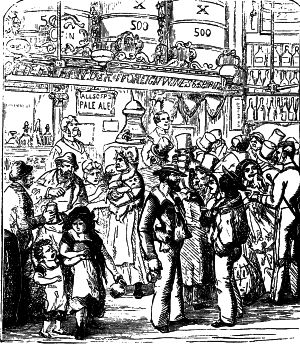
A GIN PUBLIC IN THE NEW CUT.
In Waterloo Road, close upon the Victoria theatre, I saw one of these "gin publics," the doors of which were choked with customers passing in and out from the adjoining theatre. There were negroes, Malays and Chinamen, with an overflowing majority of Cockneys, in the "public," all of whom were busily engaged in assuaging their thirst, or firing up their stomach furnaces. Not a little puzzled was I, to see women with small children in their arms, drinking alongside of sooty coal-bargemen—negroes, and young children, who had been driven by their miserable parents to beg coppers wherewith to procure them gin. It was a dreadful scene to witness, and the smiling fiend behind the bar was positively fat and enjoying the haggardness in some of his customers' faces.
I had been told that there was a theatre on the Surrey side of the river, in which, if I visited it, I might find all the unwashed elements of the London democracy at home, and one evening I found myself before its door, after a long journey.
IN THE GALLERY OF THE "VIC."
This was the "Royal Victoria Theatre," New Cut, Lambeth. The Bowery, in its palmiest and most glorious days, could not hold a candle to this histrionic temple. Its tragedies and dramas of the highway robber and George Barnewell apprentice school are not, perhaps, to be equaled in any theatre in the world. The Porte St. Martin, in Paris, is a mere training-school of horror compared with this, the most bloodthirsty of places of amusement. There were two entrances—one for the aristocracy of Lambeth, the other for the underfed plough-holders, or, rather, for the Costermongers. The aristocratic entrance had a dark, dirty box-office, illumined by a pair of gas-jets that could hardly find air to flutter in, so strong was the stench of men and filthy materialism.
Over the door of the box-office was a sign, "Pit, 6d.; gallery, 3d.; private stage boxes, 2s." The crowds pushed hard and fast to get an entrance. They came in swarms of fustian and corduroys, with unkempt hair, the bosoms of some of the costerwomen almost laid bare with the shoving and crushing; the lads and men wearing heavy hob-nailed shoes, such shoes as are never seen in America excepting on the feet of emigrants, who stream through the gates of Castle Garden from the waste of Atlantic waters—and these heavy hob-nailed shoes did wonders in hurrying the progress of the front ranks, by repeated applications to the calves and ankles of those who had the good or bad luck to stand nearest the door of the theatre.
After a severe struggle, in which some greasy corduroys are ripped and several caps lost, and a number of babies squeezed—who are in the arms of girls hardly old enough, one would think, to be their lawful mothers—we get clear of the mob, shouting, screaming, and whistling, and pass up the dirty, rickety stairs to the three-penny Gallery of the "Vic," as the theatre is called by the class who frequent it; and now a sight presents itself to the writer such as is seldom seen, and never in any city but London.
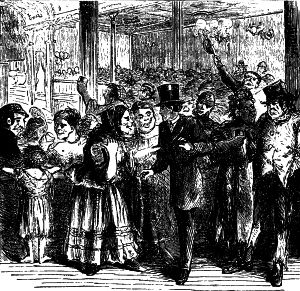
THE GALLERY OF THE "VIC."
I lost my hat on the stairs, and in the crush I discovered it in the hands of a mutinous boy, about a dozen steps below me, who threatened if I did not give him a sixpence "to kick the brains hout hof hit." I give the truly amusing boy sixpence and the hat is flung up to me much the worse for wear, while a young girl with a dowdy bonnet and a face swelled with gin asks me in chaff if I am fond of "periwinkles."
The gallery of the Victoria is one of the largest in the world, and will hold, on a modest computation, 2,200 people.
Five minutes after I found myself in the gallery; it was crowded and not a seat could be had, for these people gather at the theatre doors, and fill the surrounding streets and lanes for an hour before the place is advertised to be open.
As I have no seat and look rather out of place, several cheerful young ladies offer to let me sit in their laps, and facetious remarks are made on the different articles of apparel which I have on me. Being a very warm evening, nearly all of the males, men and boys, are in their shirt-sleeves, and it grieves one to think that many of these shirts are sadly in need of washing, and not a few want repairing. The boys and men are hardly seated when they fall into something like the Old Bowery tramp—only that here they all seem to be acquainted with the same slang song, and it is sung by them in a loud, full, and not unmelodious chorus, with a vehemence that shakes the old timbers of the house.
In the well-ordered pit of the Bowery theatre in other days, if I remember right, such truly scandalous conduct would have instantly been suppressed by the strong arm and heavy stinging cane of the brawny fellow who stood with his back to the stage, immediately behind the orchestra; his watchful eyes surveying every rugged face in the pit, and ready with his powerful arm to rain blows like a storm on the shoulders of the brawler.
THE CHORUS OF "IMMENSEKOFF."
I should like to see a man with a brawny arm and cane try the same thing on the audience in the gallery of the "Vic." I am sure he would be thrown over the rail into the lower part of the theatre, particularly if he were to interrupt a chorus. Many of the men and lads, who have their entire week's earnings in their pockets, are very drunk already, though it is only half-past seven o'clock of the Saturday night. The chorus which they are singing is that of a popular street and music-hall song, which every one is now humming in London. They sung it as follows:
"Ha! my dear frens, pray 'ow de doo, Hi 'opes I sees yer well, Peer'aps yer don't know 'oo I is; Well, then, I'm the Heastern swell. My chambers is in Shoreditch, And I fancy I'm a Toff; From top to toe I really think I looks—Immensekoff. Immensekoff—Immensekoff, Behold me a Shoreditch Toff— A toff, a toff, a Shoreditch Toff, Hand I thinks myself—Immensekoff."
"Come hup there, ye lazy fiddlers, and give us our thrip-pence worth," shouts an irate lad to the orchestra, who are scraping and rosining their instruments.
"Yes, give us moosic for our money, old bald head," shouts another young ruffian to the despised leader of the orchestra, who responds with a wave, and then we have "God Save the Queen," done after the style popular in the New Cut.
When this is over a red-headed fellow, with his arms bare and perspiring like the lower animal that he is, cries out loudly, "Now for the next varse, and give us a good chorious," and then they all commence again:
"Vith the fair sec', bless 'em, need I say— That hi am 'number Von;' Hits really quite a bore to me The way the gals do run— Not away from me—but hafter me. Hah—you may laugh and scoff, But I can tell yer—that the gals Think me—Immensekoff. Immensekoff—Immensekoff."
And so on for five mortal verses the whole mad swarm of dirty, ignorant wretches, keeping time with hands and feet until my head ached, and I went down the narrow stairs, while a number of polite young ladies inquired as I passed, "if I had been sea-sick." The descent to the lower part of the theatre was about forty-feet, down a dimly lighted stairs, and I found myself in the family circle, as it would be called in America, the seats being of planed planks without cushions, while the aisles were crowded with people, as above in the three-penny gallery.
THE "TERROR OF LONDON."
Here the admission was, I think, a shilling, and the audience was a little more select, yet not enough to cause remark from a stranger. The doorkeeper told me he could get me a seat in a private box on the stage for two shillings, and I followed him through another dirty, dark passage, my feet crushing the shells of walnuts and filberts, which here take the place of the old time peanuts.
I was solicited to buy sandwiches of a very ancient aspect by several men, and pigs' feet and sheep's trotters by a number of women, at a penny and "tuppence" apiece; and a boy with a large flat basket offered me a pint of periwinkles for "three ha'pence," "all fresh, sir;" and finally I got into the box on the stage, which gave me a very good view of the entire theatre and its sweltering audience. Pit, circle, and "three-penny" gallery were packed with human heads, tier upon tier, in a manner that seemed to defy description.
The walls were rough, and in some places but poorly papered, and in the corners of the upper gallery, flirtation, small-talk, and chaff went on so audibly that I could hear almost what was spoken, or rather cried out from the gallery, although I was at the other extremity of the building. Great anxiety was manifested to have the curtain hoisted by the unruly audience, and not a little shouting was done to make the fiddlers hurry up their overture.
The piece was called the "Terror of London," and it depicted the life of an apprentice who had departed from the ways of honesty to take up with bad companions in pot-houses, and was in four acts. The apprentice was of course the hero of the drama, and the author of the piece played the character of the abused apprentice. Whenever the apprentice kicked a policeman or threw one of his pursuers down a dark trap-door, there was great applause of his dexterity; but when the villain of the piece, a snaky-looking wretch, unworthy to breathe the "a-i-r-r-r of heving," slapped his hands after the commission of a fresh crime, he was received with derisive shouts and yells, which he, however, took as compliments to his histrionic skill.
The heroine of the piece was in love with the unfortunate and dissipated apprentice, and did nothing but clasp her hands and tear her hair at his "goings on." But at last she was roused to fury when the villain of the play followed the dishonest apprentice to his mother's grave to give him up to the police. The apprentice was discovered lying across a painted marble tombstone, and when the police entered, led on by the heavy villain, the heroine threw her body between him and his enemies, and drawing her form to its full height, she declaimed thus:
"The fust m-a-n who places his polyuted touch on the form of my nobil up-e-r-en-tis, though he were doubly armed with the king's authority, shall find his fate on the point of this pon-yard."
After this necessary outburst several more people were killed, and the whole concluded with the dying scene at Tyburn, the gallows, and the culprit, the bowl of ale, and the apprentice asking his friends if they would not prevent him from dying a disgraceful death. Here he makes an attempt to escape, and is pistoled admirably by the villain, who is convenient, and who is in turn pistoled by the apprentice's sweetheart, she being also ready at the proper moment for action. Then the curtain went down, and a stout girl, with fat legs and a green pair of tights, danced a hornpipe, which was loudly encored, the young lady being encouraged by such remarks as:
"Do you want some kidney pies?"
"Kick up, Miss Jenny."
"Don't mind the shoes; we pays for that."
"Tell the fiddlers to give it to yer 'otter—vy, yer not dancing at all!"
"DO YOU WANT SOME KIDNEY PIES?"
Every one in the theatre seemed to be on speaking terms with each and all of the performers, and, in some instances, the latter would answer the chaff back merrily, an incessant fire of replies and counter-replies being kept up that was amusing, if not edifying. While the dancing was going on an old woman made her entrance into the box where I was sitting, and asked if "I didn't want some porter or kidney pies." At the "Vic" it is the custom to eat during the performance, and drink porter or beer, which is brought by old women and boys between the acts, and sold at four-pence a bottle. Then the dancing girl retired gracefully amid great applause. She was succeeded by a comic singer, who sang, in a green coat and kerseys, a song, the burden of which was:
"Wait for the turn of the tide, boys, For Rome wasn't built in a day: Whatever through life may betide, boys, Why, wait for the turn of the tide."
This concluded the performance, and the curtain went down, and the lights in the dirty lamps being extinguished, the roughest audience of the roughest play-house in London wandered right and left, up and down the New Cut to their homes, or else they stopped to drink and drain in the pot-houses, or choke the thoroughfare to buy in the street market, which was now—eleven o'clock—at the height of commercial prosperity. Eleven o'clock tolled from St. Paul's as I repassed Waterloo Bridge back to the city, and the Thames swam and bubbled calmly against the stone piers of the massive bridge.
CHAPTER XXXV.
BILLINGSGATE FISH MARKET.
HEN a foot passenger crossing London Bridge looks down the river to the left, he cannot help noticing a little cluster of masts tapering upward from a series of small hulks and craft which lie quite near to each other, in the shadow of a long building of part brick and stone, the river side of which is open and crowded with people of both sexes from an early hour of the morning.
This is the famous Billingsgate Fish Market, which has given or originated a synonym for blackguardism and low abuse all the world over.
The market for many years consisted of a collection of wooden pent houses, rude sheds, and benches, and the business formerly commenced at three o'clock in the summer and at five in winter. In the latter season it was a strange scene, its large, flaming lamps of oil, showing a crowd of fish venders and fish buyers struggling amid a Babel din of vulgar tongues, which has rendered Billingsgate a by-word for abuse and foul-mouthed language. Addison has referred to the Billingsgate fish-wives and to their quarrels as "the debates which frequently arise among ladies of the British fishery."
PROFIT ON FISH.
The old style Billingsgate fish-woman wore a strong, stiff gown tucked up, with a large quilted petticoat; her hair, cap and bonnet flattened into a mass from carrying fish baskets upon her head; her coarse cracked voice, her bloated face and her large brawny limbs completing the picture of the old Billingsgate "fish fag."
This virago has disappeared and a new market building was erected in 1849. A stone river-wall was constructed where an old mud bank formerly existed and the surface was filled in and levelled to equalize the grade in Thames street on which the market has its frontage. Within, the ground was excavated and formed into a lower market, which has two subterranean openings on the river, for the sale of shell-fish, oysters, muscles, prawns, periwinkles, and whelks. These shell-fish are kept in large half puncheons bound with iron hoops. The market has a superficial area of 2,700 feet, but the drainage in the lower market is very bad as it is below the level of the river. The upper market is open to the public through two large arched apertures, 400 feet wide, and below it is bounded by eighteen dark arches which are used by the salesmen as depositories for their goods. These arches are entirely without ventilation and even the market itself, thronged as it is for twelve hours of the day, receives no air but that which comes in a chance way from the already vitiated atmosphere of the neighborhood. The market is covered on the side next to London Bridge by a roof of rough glass. The light iron columns which serve to support the roof, also serve to divide the market into a series of narrow gangways, and within these gangways the dealers take their stand to vend and auction the fish every morning, book and pencil in hand, and their aprons hanging from their chests to their knees. There is a clock tower on the building and a bell which is rung at five o'clock every morning to announce the opening of the market, and then is witnessed a general rush like the retreat of an army. The railways alone carry to this market annually, 15,000 tons of fish, besides the amount which is brought by water.
Five hundred years ago this market produced a rental of forty-six pounds per annum; to-day there is a firm which has a small stall whose profits on fish amount to £10,000 a year, and the good-will of one fish merchant in the market, I believe, was purchased last year for the large sum of £30,000. About the same time that the market rental was forty-six pounds a year, the best soles sold for three pence per dozen, the best turbot for six pence each, the best mackerel one penny each, the best pickled herrings one penny the score; fresh oysters two pennies a gallon, and the best eels two pennies per quarter of a hundred. William Wallace, the Scottish hero, was then a prisoner in the Tower, and Bannockburn had not been won by Bruce, and the ink on the Magna Charta was hardly dry.
In 1548, although the king of England was a Protestant, and the government a Protestant one, yet an act was passed which imposed a penalty on those who ate flesh on fish days. This was to protect the trade in the fisheries, however, and not to interfere with the private religious opinions of the people. The consumption of fish in the household of Thomas, Earl of Lancaster, in the year 1314, was 6,800 stock fish, consisting of ling, haberdine, &c., besides six barrels of sturgeon, the whole valued at £60 of the money of that period.