Front matter (continued 4)
Reading edition
There are several Registries in Doctors' Commons, under the jurisdiction of the Archbishop of Canterbury and the bishops. Some of the very old documents connected with them are deposited for security in St. Paul's Cathedral and Lambeth Palace. At the Bishop of London's Registry, and the Registry for the Commission of Surrey, wills are proved for the respective dioceses, and marriage licences are granted. At the Vicar-General's Office and the Faculty Office, marriage licences are granted for any part of England. The Faculty Office also grants Faculties to notaries public, and dispensations to the clergy; and formerly granted privilege to eat flesh on prohibited days. At the Vicar-General's Office, records are kept of the confirmation and consecration of bishops.
MARRIAGE LICENSES.
Marriage licences, when required by persons who profess the faith of the Established Church of England, are always procured in Doctors' Commons upon personal application to one of these old fogy Proctors, whom I saw running around the quaint quadrangle, like a hen on a hot griddle, with a roll of papers in his fleshy, fat hands. A residence of fifteen days is necessary to either bride or bridegroom, in the parish in which the marriage is to be solemnized, or not much longer than it takes a repeater to become a useful if not a legal voter in New York City. This little antique court of Doctors' Commons is in fine one of the pious swindles that the English people delight in perpetuating and groaning under, while the sinecurists make pots of money, and laugh and grow fat on the pious plunder. There are all kinds of little dodges in Doctors Commons, so that when a suitor enters here it is like a dip into chancery litigation; the victim being plucked before he leaves. Even to get married is very expensive in Doctors' Commons. The expense of an ordinary license is £2 12s. 6d.; but if either party is a minor, there is 10s. 6d. further charge; and if the party appearing swears that he has obtained the consent of the proper person having authority in law to give it, there is no necessity for either parents or minor to attend. A special license for marriage is issued after a fiat or consent has been obtained from the Archbishop, and is granted only to persons of rank, judges, and members of parliament, the Archbishop having a right to exercise his own discretion.
The expense of a Special License is usually twenty-eight guineas. This gives privilege to marry at any time or place, in private residence, or at any church or chapel situate in England; but the ceremony must be performed by a priest in holy orders, and of the Established Church. With the marriages of Dissenters, including Roman Catholics, Jews, and Quakers, the Commons has nothing to do, their licenses being obtainable of the Superintendent-Registrar. A Divorce when sought is carried through one of the courts in this profession (according to the diocese), and is conducted by a proctor; the evidence of witnesses is taken privately before an examiner of the court, and neither the husband, wife, nor any of the witnesses, need appear personally in court. A suit is seldom conducted at an expense less than £200.
Then there is the High Court of Admiralty, a "precious old swindle," as a seafaring man told me it had proved to him. He was a seaman before the mast, and to get a sum of eight pounds six and four-pence, he was compelled to pay eleven pounds of costs and fees. It comprises the "Instance Court," and the "Prize Court," where the famous Lord Stowell, in one year, adjudicated upon 2,206 cases connected with the high seas.
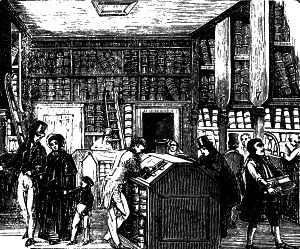
DOCTOR'S COMMONS.
The Instance Court has a criminal and civil jurisdiction; to the former belong piracy and other indictable offences on the high seas, which are now tried at the Old Bailey; to the latter, suits arising from ships running foul of each other, disputes about seamen's wages, bottomry, and salvage. The Prize Court applies to naval captures in war, proceeds of captured slave-vessels, &c. A silver oar is carried before the Judge as an emblem of his office. The business is very onerous, as in embargoes and the provisional detention of vessels, when incautious decision might involve the country in war; the right of search is another weighty question.
PAYING THE PIPER.
The practitioners in this court are advocates (D.D.C.L.) or counsel, and proctors or solicitors. The judge and advocates wear in court, if of Oxford, scarlet robes and hoods lined with taffety; and if of Cambridge, white minever and round black velvet caps. The proctors wear black robes and hoods lined with fur.
The College has a good library in civil law and history, bequeathed by an ancestor of Sir John Gibson, judge of the Prerogative Court; and every bishop at his consecration makes a present of books.
After a case has been worked slowly through one of these ecclesiastical courts, it is then transferred to another, and after bowling the cause about for years it is just possible that it will be lost for the suitor. Suits are brought in Doctors' Commons for the most ridiculous and trivial causes, and once a man gets into the Commons, he is made to pay the piper while the sleek, fat proctors, dance right merrily to the music paid for by their unhappy victims. A case in point I will mention. The cause had just been tried in the Archdeacon's Court, at Totness, and from thence an appeal had been sought in the Court at Exeter, thence it went to the Court of Arches, and from there to the Court of Delegates, and after all this fuss and expense, the question in discussion was to know which of two persons had the legal right to hang a hat on a certain peg! This is sober truth, and no exaggeration.
But the great perfection of legal scoundrelism was, in a case where a man, named Russell, whose wife's character had been impugned by a person named Bentham, at Yarmouth, was tried. This gentleman could find no remedy in Common Law for the defamation, so he must needs go to Doctors' Commons and the Ecclesiastical Courts. The Proctor's bill amounted to £700 after the case had gone through several courts, and finally each party had to pay his own costs after the case had been continued six or seven years; the special beauty of Ecclesiastical Courts being, that once a victim brings a suit, he is never allowed to withdraw it until it has gone the rounds of every court, thus giving fees to a score of persons, one-half of whom never hear of the case until they make up their minds to send in a bill for money. Finally, after seven years of this pious warfare, Mr. Russell, being a poor man, was ruined, and his wife's character was not half as good as when he began the suit.
The Prerogative Will Office is, however, the busiest and most interesting place in Doctor's Commons. Wills are always to be found here at half an hour's notice, and generally in a few minutes. They are kept in a fire-proof, strong room. The original wills begin with the year 1483, and the copies date from 1383. The latter are on parchment, strongly bound, with brass clasps. Here I saw the will of Shakespeare, on three folios of paper, each with his signature, and with the inter-lineation in his own handwriting: "I give unto my wife my brown, best bed, with the furniture." There is kept, also, the will of Milton, which was written when the poet was blind, and set aside by a decree of Sir Leoline Jenkins. And I saw alongside of Milton's will, the last testament of the soldier of democracy, Napoleon Bonaparte, made at St. Helena, April, 1821.
In one year 40,000 searches were made here for wills, and 7,000 extracts were made from testaments. There were, also, 5,000 commissions issued for the country. Some of the entries of wills made by the early Monks are beautiful specimens of illumination, the colors remaining fresh to this day.
Let us take a look into the Will Office, and give a glance to one of the most interesting phases of the drama of human life.
THE FORGOTTEN SAILOR.
People are passing rapidly in and out of the narrow court, their bustle alone disturbing the marked quiet of the neighborhood. At the end of the court, we ascend a few steps and open a door, when the scene exhibited in the sketch is before us. All seems hurry and confusion, the solicitors turning over the leaves of bulky volumes and folios at the desks, long practice having taught them to discover at a glance the object of their search; rapidly to and fro move those who are bringing the tomes and taking them back to the shelves where they belong, and as rapidly glide the pens of the numerous copyists who are transcribing or making extracts from wills, in all their little boxes, along both sides of the room.
But as we begin to look a little more closely into the densely packed occupants' faces, we see persons who are certainly not solicitors' clerks, nor officials of Doctor's Commons, but parties whose interests in a worldly point of view may be materially benefited or damaged by the investigations they are ordering to be made.
Even the weather-beaten sailor, whose rugged face one would take to be proof against any fortune, betrays a good deal of sensibility. He has just returned probably from some long voyage, and one can fancy him to have come to Doctor's Commons to see whether the relative, whom the newspapers have informed him is dead, has left him, as he expected, the means to settle down quietly in a little box at Deptford, Greenwich, or Camberwell, or some other sailor's paradise.
He steps up to the box on the right hand as directed, pays his shilling, and gets a ticket, with a direction to the calendar, in which he is to search for the name of his deceased relative. He must surely be spelling every name in that page he has turned over—ah, there it is at last; and now he hurries off, as directed to, with the calendar, to the person pointed out to him as the Clerk of Searches. A volume from one of the shelves is laid before him, the place is found, and there lies the object of his hopes and fears—the great hopeful or threatening will. Line by line his face begins to grow darker—a ghastly grin at last appears—he has not been forgotten—there is a ring perhaps, or five pounds to buy one, or some such trifle; he closes the book with a bang and a curse, and the sailor hurries back to his ship and to storm and danger on the deep, deprived of all the contentment that had so long made him satisfied with his hard lot.
But here is another picture. A lady dressed in a style of the most gorgeous splendor, whose business is of a more important kind than a mere search—she is probably an executrix of a will—and is just leaving the office, when she meets at the door another lady, to whom she makes a low courtesy, with an expression of decided malice on her showy countenance. The successful legatee can be seen in her face, while blank and startled disappointment appears in the other woman's features.
Such is Doctors' Commons—and Such is Life.
CHAPTER XII.
THE BOHEMIANS OF LONDON.
OING east through Oxford street, when you get near High Holborn, there is a narrow thoroughfare called Dean street. Turn down this and it will bring you to Carlisle street, a short and dark lane, a street only in name. This short street brings you to Soho Square, famous for its sauces and pickles all over the world from Calcutta to New York.

The neighborhood is a very quiet one, as by its peculiar exits and passages it is cut off from the busiest part of London on either side of it, and leaving the Holborn or Oxford street, with their crowded traffic, shops, busses, and cabs, in a moment you are in this quiet square, with its little dot of green, fresh grass; that seems a relief after the arid business waste which you have just left. Just opposite is Greek street, which leads to St. Martin's lane, where a nest of small dealers in milk, butter, eggs, and groceries herd together, and where the poor, mean chop-houses form a perfect rookery, from which comes the fumes of hot coffee, muffins, mutton chops, and kidneys all the long day. Little dirty, rosy-cheeked children play here in the gutters right merrily all the day through, and the noises of the peddlers' cries, and the joyous mirth of the children "glorious at their games," are the only sounds that break the remarkable stillness of the noonday hour.
When the gray in the sky begins to deepen, and the shades of night fall over and around this quiet square, then the scene changes, and life and bustle and noisy interchange of voices fill the solitary place, which the shabby gentility of the neighborhood cannot repress or keep down. Then the coffee-shops become vocal, the pot-houses are once more vivacious, and streams of thirsty and hungry men and women pour into these places, and come out refreshed with beer and replete with cheap but plenteous food. This neighborhood is savory with macaroni and oils, betokening the presence of the Italian element, who flock to Soho Square in great numbers when they arrive in London. There are "albergos" and wine-shops where you may obtain a quarter of a fowl for ninepence, and a bottle of Marsala, which is only a darker and stronger sherry under another name, and you can get olives and brandied cherries, at dessert, for a few pence. The women who attend in these places are fat, jolly-looking persons, with rounded forms, finely shaped faces, and magnificent black hair, done up in massive bands, and they sit many hours of the day knitting on low stools at the doors of these foreign-looking inns. The customers who frequent these places are wealthy organ-grinders, men who cast figures from potters' clay and plaster of Paris, musicians and porters in the Italian warehouses along the docks, medical students, Bohemians, and the riff raff in general. One of the clay figure men wanted to sell me a well executed full length figure of Thackeray, with his spectacled, kindly face, at 7s. 6d., for which I was asked a guinea in Drury Lane, the workmanship and material being fully as good in every essential.
In the heart of Soho Square is this little dark Carlisle street, and in the centre of Carlisle street is a small, dingy public-house, called the "Carlisle Arms," which is one of the resorts of the Bohemians of London.
COCKERELL'S LODGINGS.
This old place has been from time immemorial frequented by them, and here I was brought one cool September evening by the head clerk of one of the leading publishing houses of London. This clerk was still a young man, but he had the best knowledge of books and general literature that I have ever found in a man of his position. He knew at a glance how much a book would bring, who wrote it, when it was published, and how many copies were to be got, were they to be dug out of the mustiest book-stall in London. He had a familiar acquaintance with all the members of that strange tribe of litterateurs who contribute to the magazines and weekly and daily press of this the greatest newspaper city in the world. He knew who it was who wrote the last flash novel, how much he got for it, and whether he had drunk the proceeds or not. Every first and fourth class reporter in London, all the dramatic witlings and punsters, the great short-hand guns of the House of Commons, the book reviewers, and the dramatic and musical critics, were to him everyday acquaintances, and they all in turn paid him a cordial respect for his universal knowledge. I shall call him Cockerell, this marvel of booksellers' clerks.
At 8 o'clock I called at Cockerell's lodgings, which were in Rupert street, near Holborn. He lived quietly in a nice, cosy room, filled with rare and curious editions of the works of which he was most fond, and everything around the place, from the brass andirons to the quaint clock in the chimney place, betokened a steady-going, well-informed man. The "Newgate Calendar," "Cruikshank's Almanacs," for twenty years, finely illustrated, "The Slang Dictionary," "The Streets and Antiquities of London," "A History of Signboards," "Hansard's Debates," a folio "Shakespeare," "The Heads of the People," illustrated by Kenny Meadows, "Debrett's Peerage," "The Lords and Commons," several volumes of Balzac, a volume with the wills and autographs of the Doges of Venice, "Macaulay's Lays," some of "Sala's Sketches," a bound series of the Saturday Review, and some volumes of "Punch," were among his collection, besides a complete collection of the British plays, and a number of Gilray's sketches, framed, hung from the walls. "Show me a man's library, and I will tell you what he is," somebody has said, and I believe the above works, picked out of a large library, best explain the character of the head clerk who was to be my companion for the night's adventure. Putting on his collar, gloves, and an old slouch-hat, Cockerell and I reached the hall, where the maid-servant, looking suspiciously at the writer, inquired from her master what time he would be home.
"I don't know, Jenny, exactly," said he, "but it will be some time before the cocks crow."
Having arrived at the "Carlisle Arms," we walked in, passing the bar, and found our way through a low passage into a back room about twelve feet wide by fifteen in length. The ceiling was low, and there was no ornament to be seen with the exception of a steel engraving of the Duke of Wellington on horseback, surrounded by a mounted staff, and surveying through a field-glass the broken columns of the first Bonaparte from an elevation on the plain of Waterloo. There were but three persons in the room, which had a round oaken table in the centre, and a quadrangle of wooden benches,—when I entered. My well-informed friend was saluted with hearty greetings by all present, and was asked what he would have to drink. This is an anachronism in English customs, for the people of this tight little island generally allow a friend to pay for his own drink, as a custom which has long ago been endorsed by the best authorities. There is no such folly known here as may be seen in every American public house, where the free and independent electors stand at a bar each hour in every day, treating one and the other with a promiscuous and reckless generosity. But among Bohemians all over the world it is different. If they cannot pay for a drink, they will call for it and treat each other with a liberality which is, to say the least, a most praiseworthy trait.
A PINT OF COOPER.
I forgot to mention that there were two vases, with faded artificial flowers, on the rusty old chimney-piece, and these flowers seemed to the Bohemians like the waters of an oasis in the desert to a party of Bedouins. All else was a blighted, sandy waste of small talk, tobacco smoke, and weak gin and water. The principal spokesman of the party, who was quite bald-headed and had but two or three teeth, rang the bell behind the door, and presently the pot-boy appeared. In the lowest of London publics the pot-boy waits upon the customers, washes the pewter pots, and cleans the tables with a dish-cloth, for a stipend of ten shillings a week in British coin. The pot-boy had not more than made his appearance when in came the bar-maid, with natural light hair, one of the first bar-maids I had seen in London whose hair was not dyed.
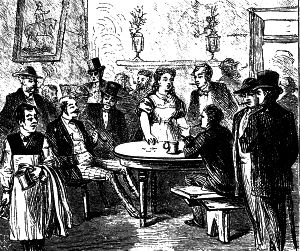
A BOHEMIAN CAROUSE.
The bar-maid surveyed the room and its occupants calmly, then asked for the orders. The pot-boy, feeling that he was only a subordinate, retired in disgust, with his dish-cloth on his left arm. One man called for "sherry weak," another for "gin and water," and a third for a "pint of cooper." The cooper was brought in a metal mug, with hoops girding it, and for this reason, I believe, the mug is called a "cooper." Pretty soon the room began to fill with stray Bohemians, who dropped in one by one and took their seats as if they feared no eviction.
In half an hour there were a dozen present, and the room was so crowded that two of them had to stand up. One or two were dandies, and wore heavy scarfs and pins, and talked French because, forsooth, they had been on the Continent. Some of them were artists on the half score of comic weeklies which are to be seen in the windows of every news-shop in London. Some were wood-engravers, some were painters in a small way, and there were correspondents of the Birmingham, Manchester, and Liverpool papers also present. All were in the literary or artistic line, and a few had been in the gallery of the House of Commons as reporters, doing short-hand work, and there was one really clever artist, who had illustrated books by some of the best authors in England. This man was a little scant of hair on the top of the forehead, and had a light moustache. He had been to many prize-fights, and had gloated over many a frightful murder, through his sketches in the weekly illustrated newspapers. He was a merry, good-natured fellow, with a genuine fund of pleasant anecdote and a liking for Burton ale.
There was another man very quiet in appearance, and wearing a gray mixed sack coat, with his bosom open in the style of Walt Whitman. He puzzled me when I first looked at him, but after a while I found that he was a German by birth, very recondite,—from Lower Prussia, domiciled in London for many years, who had written a work with the mystical title of "Entities of God." None of his intimates had ever even read this book; with the exception of one man, (a dear friend,) who was in his debt, and had honored his friendship so far as to read the preface, but could not get any farther for a different reason from that assigned by the Heidelberg student, who, after reading a work of John Stuart Mill, threw down the book in disgust, saying that "it was too clear;" yet he was respected in this mixed assemblage of topers and clever fellows, because he had written a book that no one could understand. Such is the force of intellect.
There were two Irishmen present who sat in a corner together, drank together, gave each other a light for the pipes which they smoked, and quarreled with a fraternal regard.
THE RADICAL AND CONSERVATIVE.
One was an old man with a grey moustache, an Orangeman, who had been in America in the old days when Virginia and South Carolina ruled the Senate of the republic, and since then he had been a correspondent by turns for some of the London newspapers abroad, and again a literary hack for the shabby sheets that are read in the obscure holes of the city. His friend was a much younger man, full blooded, and a thorough Irish Nationalist, although he disclaimed Fenianism. He was a reporter, and had an extensive knowledge of his professional associates on the London press. His name was Fitzgerald, and his venerable friend was known as Dawson. The German of the profound intellect was called Meyer, or Herr Meyer. The names of the French dandies I have forgotten; they were but poor specimens, and did not furnish any entertainment during the evening.
There were two reporters of the morning press at this feast of reason and flow of beer, but they did not contribute much amusement to the party, as they were discussing the respective rates of salaries on the Daily Bludgeon and the Morning Budget during the entire evening's conversation. The two Irishmen were perpetually at loggerheads about politics, "Fitz" being a Radical, Dawson a Conservative Churchman of the old school. Occasionally they gave each other the lie, and then I expected to see them striking out at each other; but in three minutes after they would vow eternal friendship, and shake each other's hand with great warmth. The name of the artist was Sullivan. Sullivan hailed the head clerk with great feeling, and as he sat down there was a drink all around.
"Well, old Cockerell," said the vivacious Fitz, "how is Slogger's book getting on with yeer people?"
"It 'ill soon be published. We have it on hand now, and expect to sell twenty thousand copies. The pictures will sell it alone, although, I must say, Slogger's text is very good for his subject. We are getting all the trade now. Every fellow that thinks he can scribble comes to us, and the big fish are also in our net. Murray must have been cut up pretty bad to find Gladstone leaving him and going to McMillan. It all comes of having a magazine. A publishing house that can command the columns of a well circulated magazine can print as many books as they like, and, what is better, they can sell them. Our house does the heavy flash business, and it pays well. Old 'Swoslam' is a keen blade, and is always on the lookout for a novelty. McMillan has sold, I'm told, four editions of their magazines having the Byron article. Well, old fellow, how are you (to Sullivan), and what are you doing?"
"I'm fhoine, me dharling, and me appetite is just as good as ever, but me powers of dhrinking are failing fast. As for what I'm doing, Miss Sthabber has got me to make pictures for her new novel, which she got a hundred and fifty pounds for in the 'Thames Mag.,' and now she is going to publish it in book form. It's a nice title she has for it, 'The Red Divil of the Yallow Mountin; or, the Ghost of the Place de Greve.' I sometimes think the woman is going crazy whin she sinds for me in the mornin' to talk to her about her new books down Brompton way, where she lives. I generally find her in bed with a decanther of brandy, a pot of coffee, and a square box of cigarettes by her bedside on a table. 'Soolivan,' said she, 'I want two Convent scenes in the sixth chapter; a rocky pass, with a skeleton standing in the middle of the gap, his grisly arms outstretched, for the ninth chapter; and in the fifteenth chapter you must give me a powerful tableoo where the chief butler is discovered in the room off the banquetting hall poisoning his misthresses's wine.
"'For the details I'll trust to your powerful Irish imagination; and now, Soolivan, you low blackguard, turn your back and help yourself to the brandy while I'm putting on me wrapper, as I don't wan't you to be making fancy pictures of 'Vanus going to the Bath,' or any such gammon as that, for pot-houses, with the great female London novelist—I believe that's what they call me, isn't it, Soolivan?—as an original.' Indade, I think that Miss Sthabber is more nor half mad, but I must say that she is the divil at plots and incidents, and she drinks excellent brandy."
THE SHORT-HAND REPORTER.
"Stabber is a clever woman," said Cockerell, the head clerk. "Whackem & Co., Paternoster Row, sold thirty-two thousand copies of her 'Blue-Eyed Demon' in three months, and she refused £950 for it from an Edinburgh house, so Whackem must have given her more. By the way, do any of your fellows know the name of this man who has written the last new novel 'Girded with Steel?' I fancy he must be one of your newspaper fellows, because he has a lot of stuff in it about 'leader writing,' 'my note-book,' 'two columns is more than earthquake should be allowed in a newspaper,' and there are, besides, the details of editorial life which an outsider could not know. Who is he?"
"Oh, he's a young reporter on the Omniverous Clam, but I could not give his name on a pint of honor," said Fitz. "He's a clever chap, though, and will make his way. He's only been two years in the professhion, and he's the best short-hand man on the Clam now, so maybe you know who I mean now."
"It's Billingsgate," said one.
"No, it's Gravelly," said another.
"Boys, ye are not right; it's Goby, and he's five hundred and fifty pounds the betther of it, which is a nice little lump for a reporther who gets five guineas a week, and has to work like a horse for that in the session," said Fitzgerald.
"Reporthers have harder work now then they had whin I first went in the Gallery," said old Dawson. "Me father, as yez know, boys, was a reporther before me; and I might say it runs in the family. Ah! thim were good times, boys, when the ould man did his short-hand wurruk. He knew all the great reporthers of the day; and fine fellows they were, too. There was William Radcliffe, the husband of the woman who wrote all the bloodthirsty novels. Radcliffe was a mimry reporther, and he'd go to the House and sit the debates out, and nivir take a note at all, at all. Then he'd go to the office and dictate two different articles at a time to the juniors who took it all down, and out it came, sphick-and-sphan, in the morning, without a flaw.
"Then there was another grate fellow, ould Billy Woodfall, who had a paper of his own called the Diary; and that was before the House allowed the reporthers to take notes during the debates. They used to call him "Mimory Woodfall," because he'd never forget anything that he had heard; and when strangers would come from the country to visit the House the first questions they would ask would be, 'Which is Woodfall?' 'Which is the Sphaker?' Me fawther told me many a story about him. He had a fashion of bringing hard-boiled eggs with him, which he carried in his hat, and whin he came to the House he'd take off his hat carefully, put it between his knees, take the eggs out, keeping his head well down for fear the Sargint-at-Arrums would see him eating, and then he'd brake the shells and eat the eggs with as great relish as if they were game pies. A reporther on an opposition paper wanted to play a joke on Billy one night, and when he laid his hat down he took the two hard-boiled eggs out and put two in the hat that had nivir been boiled at all, and when Billy wint to crack the shells the yoke sphattered all over his breeches, bedad, so it did. Billy nivir forgave the joke until the day of his death. Woodfall did all his own reporthin', and the Diary did well for a time, until the Morning Chronicle started in opposition, with Perry at the head of it. Perry hired a lot of reporthers to take notes of the debates and write them out, and by the time that Woodfall had his notes written out, the Chronicle was selling in every sthreet in London; and that was what took all the wind out of poor Billy's sails."
"Perry was a foine reporther himself, and when the House was thrying Admiral Palliser and Admiral Keppel for their loives, Perry'd send in eight or ten colyums every week of the debates, without any assistance; but, bedad, we wouldn't think much of that now. Woodfall used to say, in a joking way, that 'he had been fined by the House of Commons, confined by the House of Lords, fined and confined by the Coort of King's Binch, and indicted in the Ould Bailey,' for his offinces. Oh, them were foine times, bedad, whin you could go in and get yer nice chop and yer glass of sherry, or a sweet little sthake fresh from the rump, and maybe have the Juke of Wellington and George Canning sitting at the same table wid ye; and they'd be at the chops and sthakes too."
A SONG FROM THE SPEAKER.
"Dawson, me boy, tell us about Mark Supple and the Quaker, and take another jugfull of beer to wet yer whistle," said the artist, who had just withdrawn his nose from the pewter pot which he was now sadly contemplating in its mournful emptiness.
"Oh! is it Supple ye mane, Jimmy. I'll tell ye all about him, yer riverence, and I'll take a pint of sthout to strinthin' me nerves afore I begin. Ye see," said Dawson, after he had taken a long pull at the mug, "Mark was fondher of a joke than he was of his breakfast. He was a good reporther, too, and liked a little dhrop now and thin, like more of his counthrymin, God forgive thim. One night Mark was in the gallery reporthing for the Morning Chronicle, when Mr. Addington was the Sphaker. Mark was a big, raw-boned native of sweet Tipperary, and was fond of hearing a song at all times. He used to take a glass of wine or two in Bellamy's, and thin go up in the gallery and take out his note-book and whack away with the pot-hooks and colophons. Mark was a foine scholar and a janius. They say he'd dhress up a mimbir's speech, and put retterick and flowers and poethry into a dull six-mile oration, and it used to puzzle the mimbirs so that they would hardly know their own words again. Of course, they all liked Mark, and he sometimes took a good dale of freedom with thim.
"He had a mighthy quare style intirely with him, and an English mimbir who was fond of a joke, like Mark's self, said that Mark's style of reporthin' was 'a mixture of the hyperbolical, with a vane of Orientalism and a dash of the bog-throtter.' They are quick enough, God knows, to sneer about the poor bog-throtters. Well, this night was a quiet one in the House. A number of the mimbirs were asleep, some were nodding, some were at their dinners; and when Mark looked down from the gallery the Sphaker, Mr. Addington, had nothing to do, and there was a silence in the House so that you might have heard a pin dhrop. All at once Mark called out in a reckless loud voice:
"'A song from Mr. Sphaker.'
"You can imagine the horror of Mr. Addington as he stood up, his tall, thin figure stretched to its full linth, and his peevish eyes scanning the House from top to bottom. Every one roared out laughing, and William Pitt had the tears sthraming down his ould, withered cheeks. After a while the House recovered its gravity, or rather its stupidity, and the Sarjint-at-Arrums began his search for the man who had hallooed in the sacred place. He went up among the reporthers, who all knew the offindhir; but none of the boys would tell on Mark, who was well liked; and, bedad, the Sarjint-at-Arrums was bursting his skin with rage. Seeing that he could not get any information, he turned to Mark, who was looking as solemn as a toomstone, and asked him if he knew who had called for a song.
"Mark purtended that he was very busy with his pencils, and, nivir sayin' a wurd, pointed his finger to a fat Quaker who sat asleep, two or three seats off, with his hands clasped quietly over the pit of his stomach. The Quaker was seized in a minute, and given into the custody of the House, vainly declaring his innocence, and was kept in confinement two hours, until Mark, in a manly way, acknowledged his crime, and was put in the Quaker's place, to meditate on his foolishness. He was brought to the Bar of the House thin, and let off, whin he promised to do betther in the future, and nivir call upon the Sphaker for another song."
"Tell us about Supple and Wilberforce, Dawson," said Fitzgerald to the veteran.
"Oh, that wasn't Supple that played the thrick on Wilberforce: that was Pether Finnerty," said Dawson. "Pether was on the Chronicle; and one night, when the House was full of business, Pether sat drinking too long in Bellamy's and lost his turn. When he got into the House, he asked some of the boys, who had been sphakin'? One of them who had been present told Pether that Wilberforce had been sphakin' for an hour.
"'What did he say?' says Pether.
"'Take out yer book, and I'll give it to ye, me boy, in a jiffy,' says the other. Pether was so far gone that he would have made Wilberforce say anything, however ridiculous, and when the other reporther began as follows, he did not see the joke:
"'Potatoes make men healthy, vigorous, and active; but, what is still more in their favor, they make men tall'—
"Did he say that, the jewel?" said Pether, who was touched with this tribute to the esculent of his native isle.
THE BEAUTIFUL POTATO.
"I'll give you my word, he said it,—'and when I look around this house, and see before me such fine, vigorous specimens of Irish manhood, all reared on the potato, and think of my own stunted, weak figure and attenuated frame, I must always regret and lament that my parents did not foster me on that fragrant and genial vegetable, the beautiful potato.'"
"'Oh! murther!' said Pether; 'but Wilberforce is the fine fellow to use such poetical language;' and off he wint to the Chronicle office to write out his notes. And the next morning there it was—the thribute to the potato and all the rest of it—and all London was laughing at Wilberforce, and every one believed that he was drunk when he spoke the words. The next day Pether was brought before the bar of the House to stand his trial, and Wilberforce rose and said:
"'Mr. Speaker and Gentlemen: Were I capable of using such language as was attributed to me in a morning journal, in its reports of yesterday's debates, I would be unworthy of the attention which I now claim from this House and unfit to occupy a seat in this honorable body. Rather would I be worthy of a straight-jacket in a lunatic asylum, where I might learn better sense of the dignity of this House.' Pether was let off, like Mark Supple, and he was ever afterwards very careful in his reports. But the joke stuck to Wilberforce's coat for many a long day afther."
By this time the greater part of the Bohemians had left for their homes, and after a song and a few more stories from Fitz and Sullivan, the erratic band broke up, and the tap-room was deserted. Such was the scene—a singular one—which occurs in the old dingy Public House night after night among the wandering journalists and penny-a-liners of the London press and their associates of kindred professions. The old, haunted Public could tell many a ludicrous story of a like kind had it a tongue to speak—of the amusing, wandering, never-do-well Free Lances, of the Press, who find food and clothing, and a good deal to drink, by their ephemeral contributions to the journalistic and light literature of England's metropolis.
In addition to the "Carlisle Arms" there is another resort of the higher class of writers, authors, and artists, in the neighborhood of the theatres, and this place is known to those who frequent it as the "Albion." At the Albion, there is an excellent restaurant, and well-cooked viands, and wines of the best quality, may be obtained there at reasonable prices. Choice little dinners, illuminated by wit and humor, are given here by journalists to each other.
CHAPTER XIII.
TOWER, PALACE, AND PRISON.
HE sun has risen and set for a thousand years on its gray walls; the grime and verdure of a thousand years have cemented its hoary stones; nations have grown and decayed; dynasties have been founded and wrecked irretrievably; a New World has been discovered, and inventive genius has almost changed the face of the earth and yet the Tower of London, (cemented by the blood of beasts, as the fable has it,) which saw the beginning and progress of these changes, still endures, and will no doubt endure to the end of time.

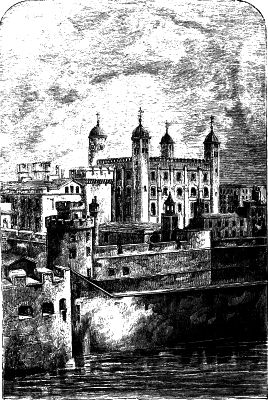
TOWER OF LONDON.
It seems a long, long time ago, that bleak Christmas day of the year 800, when the Pope of Rome placed the Iron Crown of Lombardy upon the annointed head of Charlemagne under the dome of St. Peter's, amid the huzzas of the multitude of Frankish warriors and barons who witnessed the sacred ceremony, and yet far back in that nearly barbarous age, the chroniclers tell us in their scholastic volumes of the monasteries, that a Tower existed in London and on the same spot where now the wardens patrol in their red tunics and explain historical conundrums to dull Cockneys.
And some of the chroniclers go farther back and profess to believe that the Tower is as old as the Roman occupation of Britain, and do not hesitate to say that Julius Cæsar, who has been accused of so many good and bad deeds, was the founder of the old forbidding pile of masonry.
Be that as it may, it is old enough to have earned a lasting infamy, only once deserved in history by another grim fortress,—its twin brother and accomplice in blood and oppression, the Bastile Of Paris. That foul excresence on the fair face of the Earth has been swept away by the stormy sea of a people's vengeance, while the Tower of London still remains as a lesson of tradition, to tell of the crimes that God has permitted kings and dwellers in high places to perpetrate against the people, who have suffered and died and made no sign.
The charge to see the Tower of London is only sixpence in these days, and for a sixpence a visitor may see everything; dungeon and trap door, axe and scaffold, crown jewels and prison bars, the cages and the dungeons and graves of those who suffered and died here during the long night of centuries,—and all this for a paltry sixpence.
Amid the tramp and thunder of a hundred battles it has stood unshaken; it is too strong for the destroying hand of man; and time, as if in reverence, has trod lightly as he has stepped over its massive walls.
I saw its towers; four of them, standing up against the sky, bellshaped and surmounted by weather vanes, one day from London Bridge, and having a curiosity to see a structure, which even more than Westminster Abbey is coeval with authentic history, I walked slowly to Tower Hill, passed along the firm drawbridge, paid a sixpence and entering under the spiked portcullis, I found myself in the Lion Tower which stands at the corner of the moat or Tower ditch facing the Thames.
DELIVERING THE KEYS.
The extent of the Tower within the walls is twelve acres and five roods. The exterior circuit of the ditch—now a garden, or rather an apology for a garden—surrounding it, is three thousand one hundred and fifty-six feet. On the river side is a broad and handsome wharf or graveled terrace, separated by the ditch from the fortress and mounted with sixty pieces of ordnance, which are fired on the royal birthdays, or in celebration of any remarkable event. From the wharf into the Tower is an entrance by a drawbridge. Near it is a cut or short canal connecting the river with the ditch, having a water entrance called the "Traitor's Gate,"—State Prisoners having been formerly conveyed by this passage to Westminster, where the two Houses of Parliament now sit, for trial. Over the Traitor's Gate is a building containing the waterworks which supply the interior with water.
Within the walls of the fortress are several streets. The principal buildings which it contains are the White or principal Tower, the ancient Chapel of St. Peter-ad-Vincula, the Ordnance-Office, the Record Office, the Jewel's House, the Stone Armory, the Grand Storehouse, and the Small Armory, besides the house belonging to the Constable of the Tower and other officers, the barracks of the garrison, and the sutler's shops, commonly used by the soldiers. It is generally a regiment of the line which serves as a garrison for the tower.
The principal entrance to the Tower is to the west. It consists of two gates on the outside of the ditch, a stone bridge built over the ditch, and a gate at the end of the bridge.
These gates are opened every morning with a strange, and for the Nineteenth century, a very fantastical ceremony.
The Yeoman-Porter with a sergeant and six men march to the Governor's house for the keys.
Having received them, he proceeds to the innermost gate, and passing that, it is again shut. He then opens the three outermost gates at each of which the guards rest their firelocks while the keys pass and repass. The gravity with which the guards perform this ceremony, and the nice precision with which they manoeuvre, is calculated to make everybody but an Englishman laugh.
On the return of the Yeoman-Porter to the innermost gate, he calls to the warden on duty to take the Queen's keys, when they open the gates, and the keys are placed in the warden's hall.
At night the same formality is used in shutting the gates; and as the Yeoman-Porter and the guard, return with the keys to the Governor's house the main guard which, with its officers, is under arms, challenges him saying:
"Who comes there?"
He answers:
"The Keys."
The challenger replies:
"Pass Keys."
The guards by order rest their firelocks and the Yeoman-Porter says:
"God save the Queen."
The soldiers then answer back:
"Amen."
The bearer of the keys then proceeds to the Governor's house and there leaves them.
After they are deposited with the Governor no person can enter or leave the Tower without the watchword for the night. If any person obtains permission to pass, the Yeoman-Porter attends him and the same ceremony is repeated.
The Tower is governed by its constable, called the Constable of the Tower, and the Chief Nobleman or principal person next to the blood royal, not including the Archbishop of Canterbury, is chosen to hold this office by the Queen. At coronations and other state ceremonies this officer has the custody of and is responsible for the regalia. Under him is a lieutenant, deputy-lieutenant, commonly called governor, a fort-major, gentleman porter, yeoman porter, gentleman gaoler, four quarter-gunners, and forty warders. The warder's uniform is the same as that of the Queen's Guards, or Beef Eaters.
It is rarely that the Tower is used as a State Prison, in these days. When prisoners are detained here, by application to the Privy Council they are usually permitted to walk on the inner platform during part of the day, accompanied by a warder.
IN THE LION'S MOUTH.
The fire which took place toward the winter of 1841 destroyed a great portion of the grand armory, and materially altered the features of the Tower. The armory, said to have been the largest in Europe, was three hundred and forty-five feet in length, and was formerly used as a storehouse for the artillery train, until the stores were removed to Woolwich. A very large number of chests with arms ready for any emergency were in a part of the room which had been partitioned off; and in the other part a variety of arms were arranged in elegant and fanciful devices.
A fearful destruction of property, at once curious and valuable, took place in this department; but one beautiful piece of workmanship being preserved.
This was the famous brass gun taken from Malta by the French in 1798, and sent with eight banners which hung over the gun, to the French Directory by General Bonaparte, in La Sensible, from which vessel it was captured by the English man-of-war, Seahorse.
In the Lion Tower, at the entrance, were kept the wild beasts in the olden times, for the amusement of such monarchs as James I, who was too cowardly to look upon any strife but that of chained or caged animals. Here were kept lions, tigers, bears and bulls, wild boars, dogs and fighting cocks. About one hundred and fifty years ago a young girl who was employed as servant by one of the keepers, being of a rather bold and courageous temper, she took pleasure now and then in feeding the lions, and with great imprudence one day ventured to be a little more familiar than usual with the king of beasts, relying upon his gratitude because she was in the habit of feeding the animals. This time she went too close to the cage of the lion, who caught hold of her arm and tore it from the shoulder like a shred of rotten cloth, and before any one could come to her assistance, he gave her a terrible gripe and killed her instantly.
Another individual who had charge of the lions and fed them had a very narrow escape from their claws, and he has related his story as follows:
"'Twas our custom," he says, "when we cleansed the lion's den to drive them down over night into a lower place in order to rise early in the morning and refresh their day apartments by cleaning them out; and having through a mistake, and not forgetfulness, left one of the trap doors unbolted which I thought I had carefully secured, I came down in the morning before daylight, with my candle and lantern fastened before me to my button, with my implements in my hands to despatch my business, as was usual, and going carelessly into one of the dens, a lion had returned through the trap door, and lay couchant in the corner of the den, with his head toward me. The sudden surprise of this terrible sight brought me under such dreadful apprehension of the danger I was in, that I stood fixed like a statue, without the power of motion, with my eyes steadfast upon the lion and his likewise fixed upon mine.
"I expected nothing but to be torn to pieces every moment, and was fearful to attempt one step back, lest my endeavor to shun him might have made him the more eager to hasten my destruction. At last he roused himself, as though to have a breakfast off me; yet, by the assistance of Providence, I had the presence of mind to keep steady in my posture, for the reasons before mentioned.
"He moved toward me, but without expressing in his countenance either greediness or anger; but, on the contrary, wagged his tail, signifying nothing but friendship in his fawning behavior; and after he had stared me a little in the face, he raises himself up on his two hindmost feet, and laying his two fore paws upon my shoulders, without hurting me, fell to licking my face, as a further instance of his gratitude for my feeding him, as I afterwards conjectured; though then I expected every moment that he would have stripped my skin, as a poulterer does a rabbit, and have cracked my head between his teeth, as a monkey does a walnut.
"His tongue was so very rough, that with the few favorite kisses he gave me, it made my cheeks almost as rough as a pork griskin, which I was very glad to take in good part without a bit of grumbling, and when he had thus saluted me and given me his sort of welcome to his den, he returned to his place and laid him down, doing me no further damage; which unexpected deliverance occasioned me to take courage, that I shrunk back by degrees till I recovered the trap door, through which I jumped and pulled it after me, thus happily through an especial Providence, I escaped the fury of so dangerous a creature."
THE BISHOP OF DURHAM A PRISONER.
The Tower was for many hundreds of years an object of suspicion to the good citizens of London, who deemed the massive fortress a standing threat against their rights and privileges. Whenever a monarch wished to wrest concessions from the Londoners, to wring a large sum of money from their fears, or commit some other act of despotism, it was customary, just previous to the attempt against the people, to strengthen the Tower in its weakest part, and a ditch, or a wall, or a bastion was constructed, to enable the Governor or Constable of the Tower to hold the fortress for his Lord the King, in case the citizens should resist the attempt on their purses or their liberties.
How little the gaping Cockneys and bulbous-eyed rustics, who stroll around through the different apartments of this mighty castle, know or even dream of the great deeds, terrible crimes, and high resolves of those who have inhabited this Tower of London during a thousand years of its most eventful and troubled history.
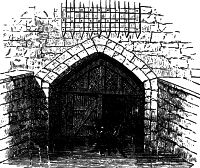
TRAITOR'S GATE.
One dark night during the first years of the reign of Henry I, before the Traitor's Gate had attained such a terrible fame as it afterward obtained from the number of the victims who have passed under its grimy arch, never to pass out except to the block on Tower Hill, a shallop with two men whose arms lie between their feet at the bottom of the boat, and a third whose arms are bound, stops at the wall where the Water Gate is now shown, and in reply to the summons of one of the armed men, the portcullis is hoisted, and Ralph Flambard, the fighting, choleric, and rebellious Bishop of Durham, passes under the arch a prisoner to the King, and the massive iron gates, rusty even then, are shut firmly ere the sound of the boat's oars have been heard by the wardens in the Inner Tower.
In a few days he makes a number of friends among the officials of the Tower by his merry temperament, and as state prisoners were always allowed to furnish their own tables in the fortress, the jolly bishop has many a heavy carouse. Tun after tun of hippocras, canary, and sack is conveyed to him, and he dispenses those medieval beverages to the knights and men-at-arms—pages and guards, with no stinted measure. One evening the Bishop receives a long and strong coil of rope in a puncheon of Malmsley, and that very night, after he had drank all the knights, men-at-arms and wardens under the oaken tables, the jolly bishop flies to the ramparts, lowers himself down into the ditch, and like the plucky prelate that he was, escapes from Henry's wrath.
One fine summer day when Henry III is King of England, Cardinal Pandulph, the Legate of the Pope, presents himself and a long train of attendants, with sumpter and service mules, at the land postern of the Tower, and after a loud flourish of trumpets to announce his arrival, the Cardinal is admitted to the presence of the King; and throws a bag of Rose nobles on the table before the young monarch, for in those days the Majesty of Britain did not scorn to borrow 200 marks of Cardinal Pandulph, and one hundred marks of Henry, Abbot of St. Albans. The money market was very tight in those days, and Kings often held dealings with pawn-brokers, for we find Henry VIII pledging or melting down nearly all the crown regalia to satisfy his creditors.
COUNCIL CHAMBER OF THE TOWER.
There is an apartment of very large and fine proportions in the third story of the White or Main Tower, supported by two rows of beams. The timber ceiling is flat, and the walls are pierced with windows on one side and heavy arches appear on the other side; the whole structure being of the rudest construction, yet grand looking withal; and this is the great Council Chamber of the Tower, in which some of the most startling and memorable scenes in English history have occurred.
It is Monday, September 29, 1399. The day, which was overcast in the early morning, has turned out fair and bright, and the Council Chamber and all the approaches to it are crowded with the highest nobles, temporal and spiritual, in the land; steel clad knights, mitred abbots, proud bishops, grave judges in cap and ermine, peers and lackeys, stand on the stairs and in the ante-rooms, to catch a word or get a look at the coming grand historical farce which is to end at last in a terrible tragedy.
It is the Feast of St. Michael the Archangel, and as the sun streams through the stained glass of the oriel windows, and the shouts of the London prentices at their games of ball, are wafted to the warder on the battlements, who carries his partisan to and fro; a deputation from each house of Parliament, headed by the Archbishop of Canterbury, Percy, Earl of Northumberland, and other great Nobles, enters the Council Chamber to hold a conference with the reigning Monarch Richard II, now about to resign his Crown to the Protector Bolingbroke, who afterward as Henry IV, will encounter more vicissitudes and suffering than the monarch he is about so cruelly to depose.
The nobles seat themselves, the Protector enthrones himself, and a ghastly figure, that of Richard II, stalks moodily into the Chamber, clad in kingly robes, his sceptre in his hand, the Crown upon his head, and there is silence for a moment among all present. Then Richard says in a broken voice, but distinctly, "I have been King of England, Duke of Aquitaine, and Lord of Ireland about twenty-one years, which Seigneury, Royalty, Sceptre, Crown and Heritage, I now clearly resign here to my cousin, Henry of Lancaster, and I desire him here, in this open presence, in entering of the same possession, to take the sceptre;" "and so," says Froissart, "he delivered it to the Duke, who took it," and kept it, also, he might have added.
Before a year had elapsed the unfortunate monarch was put to death in Pontefract Castle by order of his successor, Henry IV.
On a May day, in 1471, the streets of London resound with music, and the populace are all in holiday attire to welcome Edward IV, who returns victorious from the battle of Barnet, where he has slain, in cold blood, Prince Edward, son to Henry VI, who is a prisoner in the Tower. Next day Henry dies in a suspicious manner, and Edward has leisure for a little while to found the Order of the Garter.
Edward dies, and he is not cold in his tomb before Richard III ascends, or rather usurps the throne.
Edward has left two boys, the eldest of whom is lawful heir to the Crown, by Elizabeth Wydville, his wife.
One dark night, the wind soughs in the trees and moans around the battlements of the fortress, as two men, Miles Forest and John Dighton, hired assassins, enter the sleeping chamber of the two young princes. They steal to the bed, and having covered the mouths of the lads with the bed-clothes and pillows, they throw their heavy bodies across the couch. There are some faint, stifled moans, for a few minutes, and then all is still but the mournful music of the storm without, for the murderers have done their work but too well.
Sir James Tyrrell, who has been in waiting outside to see that the bloody deed is accomplished, walks in, looks at the distorted features of the children, gives an order in a whisper, and the still warm bodies are carried out, and down a dark stone staircase, and are buried there beneath a heap of stones to moulder till the Resurrection.
Here comes William Wallace, patriot and hero, to the Traitor's Gate, in the year 1305, and after languishing in prison for months he is tied to horses' tails and dragged forth, through Cheapside, and thence to Smithfield, to die the death of a dog, his mutilated body being torn to pieces in the presence of a noisy and hostile rabble.
From this place, Sir John Oldcastle, Lord Cobham, is also dragged forth to St. Giles, in the Fields, and having been hung up over a slow fire by a chain from the middle of his body for two hours he is slowly roasted to death. He was a follower of Wickliffe.
The Duke of Clarence, brother of Edward IV, is hurried to his death in the Tower by Richard III, who orders him to be drowned in a huge hogshead of sweet wine! A mode of death chosen, it is said, by the victim himself in preference to any other.
The good and pious Sir Thomas Fisher, Bishop of Rochester, eighty years of age, is imprisoned here, and is left to starve and rot in a dungeon of this place of infamy. His misery is such that the man of God has to write Secretary Cromwell, minister of Henry VIII: "Furthermore I beseech you to be good, Master, in my necessity, for I have neither shirt, nor yet other clothes, that are necessary for me to wear, but that be ragged and rent too shamefully. Notwithstanding, I might easily suffer that if they would keep my body warm. But God knoweth, also, how slender my diet is at many times. And now, in mine old age, my stomach may rot away but with a few kinds of meat, which if I want, I decay forthwith."
When this God-fearing man was taken out to be beheaded, his bones showed through his skin, and women wept and fell fainting at the cruel sight.
In the Beauchamp Tower, at the very bottom or foundation, is a subterraneous cell known as the "Rats' Dungeon," a hideous hell-hole, below low-water mark, and dark as the despair of the human souls who were confined there in the days when men were fond of cutting each others' throats for conscience sake. At high water, thousands of rats sought shelter in this dungeon until the floods subsided. Woe be to the poor wretches there confined when the rats swarmed in, screaming like human beings in agony.
In this den, prisoners were starved when the rack had failed to wring a confession from them. Here all their shrieks and struggles were drowned deep in this infernal hole with only the eye of the Almighty to look upon the maddening horrors which the wretched prisoners had to endure before Death came to relieve them.
One night with the rats was enough,—at break of day only a heap of gnawed bones remained to tell the tale.
IMPRISONMENT OF ANNE BOLEYN.
In one of the upper stories of the Tower there is an apartment with one grated window and a rough oaken planked floor, where Anne Boleyn was confined when her royal paramour had determined to send her neck to the axe. The unhappy woman, as she passed through the Traitor's Gate, read her fate in its dread aspect, and as she passed beneath its arch she rose in the barge, fell on her knees and prayed God to have mercy on her, and defend her from her Royal lover's rage. When she was shown her apartment, its naked and forbidding aspect terrified her sore, and she cried out in a maniacal frenzy, "It's too good for me, Jesu have mercy upon me." Then she knelt down weeping and laughing like a mad woman. When her head lay on the block the executioner was afraid to strike off her head, as she refused to have her eyes bandaged, and at last he had to take off his shoes, and cause another person to approach her while he came from behind and clumsily hacked off her head.
When the Marchioness of Salisbury, an aged and venerable lady, was led to execution, she stoutly declared she was not a traitor, and refused to lay her head on the block, and the headsman was compelled to follow her all around the scaffold, striking at her as if she was a bullock, until finally her gray head was hacked off.
The Princess Elizabeth, afterwards Queen of that name, having been suspected of complicity in the hasty insurrection of Sir Thomas Wyatt, she was committed to the Tower by order of her sister, Queen Mary.
As she passed under the Traitor's Gate, through which her mother, Anne Boleyn, and Wyatt (who had fought for her) had preceded her, the proud heart of Elizabeth failed her and she burst into tears. At first she refused to get out of the boat, but seeing that force would be used, she cried out to the rowers—
"Here landeth as true a subject, being a prisoner, as ever landed at these stairs; and before Thee, oh God, I speak it, having no other friend than Thee."
Proceeding up the stairs she seated herself, and being pressed by the Lieutenant of the Tower, Sir Thomas Brydges, to rise, she answered:
"Better sit here than on a worse place: for God knoweth and not I, whither you will bring me."
She lived to be Queen of England, and the mercy which was shown to her she refused to many a poor wretch, whose bones Elizabeth allowed to be gnawed clean and bare in the "Rat's Dungeon."
One more scene of horror.
LADY JANE GREY ON THE SCAFFOLD.
As Lady Jane Gray passed out of the Tower by the postern gate to Tower Hill, she beheld the headless corpse of her husband (who had just been decapitated) carried out on a cart to be buried in the Tower chapel of St. Peter-ad-Vincula.
"All, Guilford, Guilford," said she, "the ante-past is not so bitter that thou hast tasted, and which I soon shall taste, as to make my flesh tremble; it is nothing compared to the feast of which we shall this day partake in Heaven."
Then she passed on to the scaffold.
When on the scaffold she turned to the crowd and said:
"And now good people all, while I am yet alive, I pray of you to assist me with your prayers."
Then she knelt, and turning to Father Feckenham, the Queen's chaplain, asked him:
"Shall I say this psalm?"
And Father Feckenham, who was afterwards Lord Abbot of Westminster, answered:
"Yea."
Then she said the psalm Miserere Mei Deus and stood up and gave her book, gloves, and handkerchief to her two attendant ladies; and she commenced to untie her gown.
The executioner said:
"Shall I assist you to disrobe, Lady Jane?"
She answered him quickly:
"Nay, leave me in peace," and her two ladies advanced and disrobed her.
The headsman then desired her to stand on the straw, after her ladies had tied a kerchief about her eyes, and as she complied with his request, she asked him:
"Will you dispatch me quickly? Will you take it off before I lay me down?"
"No, Madam," said he to the last question.
Then Lady Jane felt for the block, her eyes being bandaged, and groping, she said:
"Where is it? Where is it?"
Laying her head on the block, she said slowly:
"Lord, into thy hands I commend my spirit," and at that instant, her neck being bared, there was a glitter of steel, a dull thud, and her head rolled in the sawdust.
The Jewels and Royal Regalia are kept in a glass case, well guarded by a warden, who is never allowed to leave the apartment for an instant, unless when relieved. There is a charge of sixpence extra to see the Jewel House, and a constant stream of visitors may be found in this part of the Tower, the ladies particularly taking a great interest in the splendor of the royal treasures.
St. Edward's Crown, first worn by Charles II, has since his time been worn by all the monarchs who have ascended the throne of Great Britain. This is the identical crown stolen by the daring Col. Blood, and the one which was placed on the head of Queen Victoria when she was crowned in Westminster Abbey, nearly two hundred years after it was stolen. It is a very magnificent one, surmounted with a cross of diamonds. The new crown, made purposely for her Majesty, is also here, and is made of purple velvet, hooped with silver, and richly adorned with diamonds. The ruby in it is said to have been worn by Edward, the Black Prince, five hundred years ago, and the sapphire in it is considered to be of great value; the crown altogether is estimated to be worth £100,000. King Edward's Crown is supposed to be worth at least £200,000.
THE CROWN JEWELS.
The Prince of Wales' Crown is formed of pure gold, without many jewels, while that of the Queen's Consort, formerly worn by Prince Albert, is enriched with pearls, diamonds and other precious stones, and is worth about £80,000.
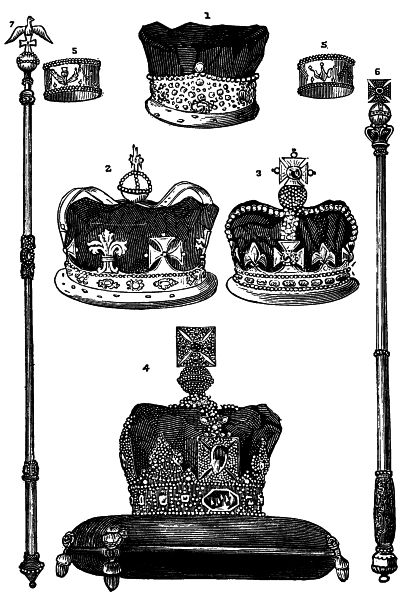
1. Queen's Diadem. 2. Prince of Wales' Crown. 3. Old Imperial Crown. 4. Queen's Crown. 5. Queen's Coronation Bracelets. 6. Temporal Sceptre. 7. Spiritual Sceptre.
The Queen's Diadem, valued at £75,000, was made for Maria d'Este, the unfortunate Queen of James II, who stood cowering in the rain and sleet, under the walls of Lambeth Church, that awful night when her husband abdicated, and William, Prince of Orange, landed at Torbay. Before James crossed the river at Westminster, to join his wife in their flight from England, he threw the Great Seal of Britain into the Thames.
St. Edward's Staff, a part of the regalia, is four feet seven inches long, bearing at the top an Orb and Cross, the orb containing, it is said, a portion of the Cross on which our Saviour died.
The Staff is made of beaten gold, to the bottom of which is fixed a steel spike, no doubt intended for defence, as a strong arm would be able to drive it through any assailant. Nothing is known authentically of the history of this Staff, but it is supposed to date back as far as the time of the Crusades, on account of the portion of the cross which it is said to contain.
The Royal Sceptre is of gold, ornamented with precious stones; also with the rose, shamrock, and thistle, emblematical of England, Scotland, and Ireland, all in gold; the cross is richly jewelled, and contains a large diamond in the centre; the length of the Sceptre is two feet nine inches, and it is valued at £40,000.
The other jewelled articles of the regalia are valued at £300,000, and are as follows:
The Rod of Equity is three feet seven inches in length, and is made of gold set with diamonds. The Orb at the top is encircled with rose diamonds, and in the cross, which surmounts it, stands the figure of a dove with wings expanded. This is sometimes called the Sceptre with the Dove. Another sceptre called the Queen's Sceptre with the Cross, though much smaller, is very beautiful in design, and thickly set with precious stones.
IVORY SCEPTRE AND SWORDS OF JUSTICE.
The Ivory Sceptre was made for Maria d' Este, and another sceptre, found behind the wainscotting in the apartment in which the regalia was kept, is said to have been made for the Queen of William III.
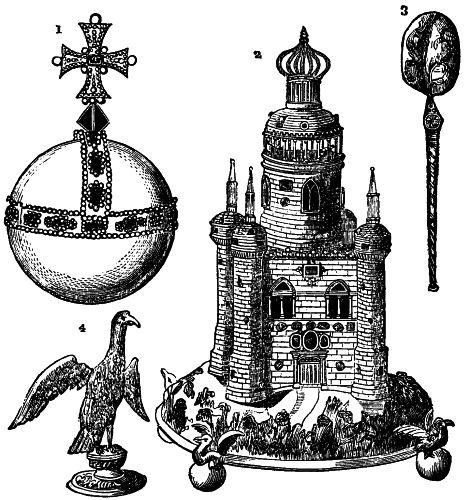
1. Imperial Orb. 2. Golden Salt Cellar of State. 3. Anointing Spoon. 4. Ampulla.
There are also two other Orbs, well worthy of observation, as are also the Swords of Justice, the Ecclesiastical and Temporal; and the Sword of Mercy or the Curtana, as it is called. This is pointless, as so is its title, which could have no point when the sword was wielded by an English monarch.
Then there is the Ampulla, to hold the Holy Oil for anointing the foreheads and palms of the hands and necks of sovereigns. It is said that Queen Victoria dispensed with the anointing of her royal neck, fearing that it might soil a very costly lace chemisette which she wore at her coronation. The Ampulla is made in the shape of an eagle, and the base holds the oil. Besides the jewels already mentioned, there are several others, among which are the Armillae, or Coronation Bracelets, made of gold and rimmed with pearls; the Coronation Spoon, for pouring out the oil, which is very ancient; and the Golden Salt Cellar, shaped like a castle, with Norman turrets, windows and doors. Then there are other salt cellars, a baptismal font, where the royal children are baptised, a silver wine fountain, and many other valuables which I have not room or desire to enumerate. Altogether, the crowns, diadems, sceptres and other articles of the regalia, are worth about seven millions of dollars, and they are of no use whatever, excepting for show.
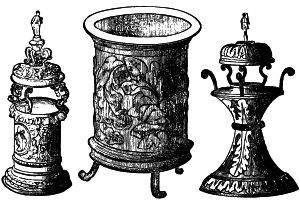
STATE SALT CELLARS.
It must be remembered that hundreds of people die annually of starvation in London, while these jewels, valued at seven millions of dollars, are growing rusty, and every shilling which bought these jewels was wrung from the blood, labor, and misery of the ancestors of the radical voters who compose the English Trade Unions, and follow the standard of John Bright. A just and honest Parliament would order the sale of these Crown jewels, and the sum realized might find many happy homes in the New World for those who now starve in the rookeries and lanes of London.
There is only one attempt to steal the English Crown Jewels, mentioned in history, and that was a most audacious one, and planned with a skill worthy of the man who made the attempt.
The robbery was committed by Col. Thomas Blood, in 1673.
He was a native of Ireland, born in 1628.
A DESPERATE ADVENTURE.
In his twentieth year he married the daughter of a gentleman of Lancashire; then returned to his native country, and having served there as a Lieutenant in the Parliamentary forces, received a grant of land instead of pay, and was, by Henry Cromwell, son to Oliver, made a Justice of the Peace. On the Restoration of Charles II, the Act of Settlement, which deprived Blood of his possessions, made him at once discontented and desperate. He first signalized himself by his conduct during an insurrection set on foot to surprise Dublin Castle and seize the Duke of Ormond, Lord Lieutenant of Ireland. This insurrection he joined and became its leader; but it was discovered on the very eve of execution, and was rendered futile.
Blood, who was neither afraid of man or devil, escaped the gallows, the fate of some of his associates, and concealing himself among the native Irish patriots in the mountains, and ultimately he escaped to Holland, where he was favorably received by Admiral de Ruyter, the Dutch Nelson.
Always ready for battle and spoil, we next find him engaged with the Covenanters in their rebellion in Scotland in 1666, when being once more on the side of the losing party, he saved his life only by stratagem.
Thenceforward Col. Blood appears only in the light of a mere adventurer, bold and capable enough to do anything his passions might instigate, and prepared to seize fortune where-ever he might find her, without the slightest scruple as to the means employed. The death of his friends in the Irish insurrection, seems to have left in Blood's mind a great thirst for personal vengeance on the Duke of Ormond, whom accordingly he seized on the night of December 6th, 1676, tied him on horseback to one of his associates, and but for the timely aid of the Duke's servant, would have hanged the astonished and paralyzed noble on Tyburn Tree, where he attempted to convey him. The plan failed, but so admirably had it been contrived that Blood remained totally unsuspected as its author, although a reward of one thousand pounds was offered by King Charles for the discovery of the attempted assassins.
He now opened to the same associates an equally daring but much more profitable scheme, had it been successful: to carry off the Crown Jewels. It was thus carried out—Blood one day came to see the Regalia, dressed as a parson, and accompanied by a woman whom he called his wife; the latter professing to be suddenly taken ill, was invited by the keeper's wife into the adjoining apartment. Thus an intimacy was formed which was so well improved by Blood, that he arranged a match between a nephew of his and the keeper's daughter, and a day was appointed for the young people to meet. At the appointed hour came the pretended parson, the pretended nephew, and two others, armed with rapier blades in their canes, daggers and pocket pistols—a nice wedding party indeed.
FAILURE TO GET A CROWN.
One of the number made some pretence for staying at the door as a watch, while the others passed into the Jewel house, the parson having expressed a desire that the Regalia should be shown to his friends, while they were waiting for the approach of Mrs. Edwards, the keeper's wife, and her daughter. No sooner was the door closed than a cloak was thrown over the old man and a gag was forced into his mouth; and thus secured they told him their object, telling him at the same time that he was safe if he kept quiet. The poor old man, however, faithful to the trust imposed in him, exerted himself to the utmost in spite of the blows they dealt him, till he was stabbed and became senseless. Blood now slipped the Crown under his cloak, another secreted the Orb, and a third, with great industry, was engaged in filing the Sceptre into two parts, when one of those coincidences, which a novelist would hardly dare to use, much less to invent, gave a new turn to the proceedings.
The keeper's son, who had been in Flanders, returned at this critical moment. At the door he was met by an accomplice, stationed there as a sentinel, who asked him with whom he would speak. Young Edwards replied, "I belong to the house," and hurried upstairs; and the sentinel, I suppose, not knowing how to prevent the catastrophe he must have feared otherwise than by a warning to his friends, gave the alarm.
A general flight ensued, amidst which the robbers heard the voice of the old keeper once more loudly shouting, "Treason! murder," which, being heard by the young lady, who was waiting anxiously to see her lover, she ran out into the open air, reiterating the same cry. The alarm became general and outstripped the conspirators.
A warder first attempted to stop them, but being very fat, at the charge of a pistol which was fired, he fell down without waiting to know if he was hurt, and so they passed his post. At the next door, Sill, a sentinel, not to be outdone in prudence, offered no opposition, and they passed the drawbridge.
At St. Katharine's Gate their horses were waiting for them; and as they ran along the Tower wharf they joined in the cry of "Stop the rogues," and so passed on unsuspected till Captain Beckman, a brother-in-law of young Edwards, overtook the party.
Blood fired a pistol but missed the Captain, and was immediately made prisoner.
The Crown was found under his cloak, which, prisoner as he was, he would not yield without a struggle.
"It was a gallant attempt, however unsuccessful," were the witty and ambitious fellow's first words; "it was for a Crown!"
Not the least extraordinary part of this affair was the subsequent treatment of Col. Blood. Whether it was that Blood had frightened Charles II, by his audacious threats of being revenged by his numerous associates, in case of his death on the scaffold, or else captivated him by his brilliant audacity and flattery combined, it is certain that Blood, instead of being punished as he should have been, was rewarded with place, power, and influence, at court. Instead of being sent to the gallows, he was taken into especial favor, and all applications through him to the King, for favors, were successful.
It is said that Blood had told the King that he had been engaged to kill his Majesty, from among the reeds by the Thames' side, above where Battersea Bridge now spans the river, but was deterred from the crime by the air of Majesty which shone in the King's countenance.
What more delicate flattery could be administered to a King than this?
Blood died peaceably in his bed in the year 1680.
It was not to be expected that the notorious favoritism of the King toward Blood should escape satirical comment, and the Earl of Rochester, a shameless scoundrel himself, wrote, on the attempt to steal the Crown:
"Blood, that wears treason in his face, Villian complete in parson's gown, How much he is at Court in grace For stealing Ormond and the Crown! Since loyalty does no man good Let's steal the King, and outdo Blood."
Edwards and his son were awarded £300 by a not over generous Parliament, but the delay in payment of the sum was such that Mr. Edwards was compelled to sell his claim for £120 to a Jew. In this case virtue had its own reward, but no other.
BIRTH-PLACE OF WILLIAM PENN.
On the neighboring Tower Hill, which is now covered by fine mansions, and where the shaft has just been sunk, giving admission to the Thames Subway under the River, in the old days of violence and blood, many a noble head was brought to be hewed off by the executioner's shining axe. Lady Raleigh lived here on Tower Hill after she had been forbidden to visit her husband in the Tower. William Penn was born in a little old house in a little old dusty court on Tower Hill, and it was here that he first imbibed his horror of bloodshed and capital punishment. At the "Bull," a public house on Tower Hill, on April 14, 1685, died Otway the poet, of starvation, and around the corner in a cutler's shop, which is numbered with the things that were, Felton bought a large jack-knife for ten-pence, with which he assassinated the magnificent Duke of Buckingham. At No. 48 Great Tower street, is situated the Tavern called the "Czar's Head," built on the site of an old pot-house, in which the Emperor Peter the Great, and some low companions, used to meet to drink fiery potations of brandy and smoke clay pipes.
In the very same spot, where the scaffold was formerly erected, and where the gouts of blood fell dripping from the severed necks of victims of the axe, marine stores are now sold, and sea-biscuits, pea-jackets, hour-glasses, and quadrants are offered for sale.
The scaffold was generally built on four strong posts with a platform, five feet high, and in the centre of the platform was placed the block. The victim was generally bound, unless by desire the binding was omitted.
For the gratification of those curious in such matters, it may be as well to give the bloody head roll of the most illustrious of the victims executed on Tower Hill, and the date of their decapitation.
June 22, 1535, Bishop Fisher; July 6, 1535, Sir Thomas Moore; July 28, 1540, Cromwell, Earl of Essex; May 27, 1541, Margaret Pole, Countess of Shrewsbury; Jan. 20, 1547, Earl of Surrey, the poet; March 20, 1549, Thomas Lord Seymour, of Sudeley, by order of his brother, the Protector Somerset, who was beheaded Jan. 22, 1552; Feb. 12, 1553-4, Lord Guildford Dudley; April 11, 1554, Sir Thomas Wyatt; May 12, 1641, Earl of Strafford; Jan. 10, 1644-5, Archbishop Laud; Dec. 29, 1680, William Viscount Stafford, "insisting on his innocence to the very last;" Dec. 7, 1683, Algernon Sydney; July 15, 1685, the Duke of Monmouth; Feb. 24, 1716, Earl of Derwentwater and Lord Kenmuir; Aug. 18, 1746, Lords Kilmarnock and Balmerino; Dec. 8, 1746, Mr. Radcliffe, who had been, with his brother, Lord Derwentwater, convicted of treason in the Rebellion of 1715, when Derwentwater was executed; but Radcliffe escaped, and was identified by the barber who, thirty-one years before, had shaved him in the Tower. Mr. Chamberlain Clark, who died in 1831, aged 92, well remembered (his father then residing in the Minories) seeing the glittering of the executioner's axe in the sun as it fell upon Mr. Radcliffe's neck. April 9, 1747, Simon Lord Lovat, the last beheading in England, and the last execution upon Tower Hill, when a scaffolding, built near Barking-alley, fell with nearly 1,000 persons on it, and twelve were killed.
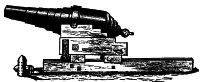
CHAPTER XIV.
THE CADGERS OF LONDON BRIDGE.
FTER leaving the Old Jewry Lane and passing up Cheapside, we came into the Poultry just as the rain had ceased, and as great rifts in the masses of fog were breaking through the opaque atmosphere. The Poultry is a short street which runs up to the Mansion House, and during the noon of the day is nearly impassable from the amount of traffic done there. Now the shops were all closed, and the bell of St. Paul's rang out for midnight, the echoes stealing over the city and the river in a ghostly way that thrilled through the hearts of the pedestrians who were darkness-bound in the streets. We passed through the Poultry into King William street, and on past Cannon street, with its warehouses and retail stores, by East Cheap, until we could see London Bridge, in all its vastness, looming up like a sleeping giant, the dark arches girding the river in seemingly everlasting bands.

The detective said: "Let's go down the stairs of the bridge and see some of the characters that find board and lodging down the steps. They're a hawful set, some on 'em."
The Thames lay at our feet, spread out like a map. The sky was clearing, and the river was very quiet. Now and then the sullen waters, driven in an eddy against the huge piers, could be heard plashing in a secret, stealthy manner, and anon they would recede and come back again, plash! plash! plash! All about us was so still; not a sound to be heard as we leaned over one of the alcoves in the bridge. Below us, to the left, the Catharine Docks, full of shipping; the London Docks, full of shipping; Shadwell lined with lighter craft—all so still, and the million of masts looking ghostly in the holy light of the midnight. Over on the right, Bermondsey-way, more shipping—countless spars pointing up to the midnight skies; the Pool choked with shipping—coal barges, eel-boats, East India vessels, brigs and schooners, barks and black-hulled packets, lying high in the water; flat-bottomed barges for carrying sand and for dredging; the gray coping stones of the Tower hanging over the water, and the stillness of death on noisy Rotherhithe, and a pall over the immense West India docks.
This great river, this river of all the nations of the world, with their tributes laid at her docks and their gifts on her broad bosom—how quiet it is just now. A matchless stream for its congregated wealth. Miles of warehouses, miles of stone docks, miles of shipping, and thousands of seamen. And yet a dirty and turbid and ungrateful river at times, when it overflows the fish-stalls, when it overflows the high street in Wapping and drowns myriads of rats in Upper and Lower Thames street.
VAGRANCY AND PAUPERISM.
We went down the "London Stairs." Every bridge that spans the Thames has four stairs or flights of stone-steps running down to the water's edge. These stone stairs are generally twenty or twenty-five feet wide, and they run down, for a hundred broad, massive and capacious steps, to where the tide comes in. There are turns in the stairs, and stone platforms—where the magnificent stone embankment has not been completed, as it is at Westminster Bridge down the river—under whose vast arches hundreds of human beings find shelter from the inclemency of the weather. I may say here that there is not such a city in the world as London for vagrancy and vagabondism of the worst kind despite the fact that there are 7,000 police in the metropolitan district; and besides this force for prevention, the work-houses in the West District, composing Kensington, Fulham, Paddington, Chelsea, St. George's, Hanover Square, St. Margaret, and St. John, and Westminster, furnish in and out door relief to 18,000 persons. Marylebone, Hampstead, St. Pancras, Islington, and Hackney, in the North District, provide for 24,820 persons. St. Giles, St. George, Bloomsbury, the Strand, Holborn, and City of London, in the Central District, provide for 19,127 persons. Shoreditch, Bethnal Green, Whitechapel, St. George in the East, Stepney, Mile End Town, and Poplar, provide for 28,713 persons, in the East District. In the Southern District, St. Saviour, Southwark, Rotherhithe, and Bermondsey; in St. Olave's, Lambeth, Wandsworth, and Clapham, Camberwell, Greenwich, Woolwich, and Lewisham, there is provision for 38,487 persons. Here we have a total of 128,880 men, women, and children, occupants of the union work-houses of the metropolis of London, with a population of less than three and a half millions. Besides this number, there are thousands of casuals who receive lodgings in the work-houses; and outside this fearful aggregate there are roaming in and about London at least 15,000 vagrants—or, as they would be called in America, "bummers"—who do not frequent the work-houses from various reasons, and consequently have to "bunk out," as we would call it in New York.
At the bottom of some of the bridges there are heaps of rubbish and old rotting planking, some of which rubbish is carried off when the tide leaves the stones of the bridges. Then there are old boat-houses, and rows of long, stout-built boats for hire; but at night there are no persons to watch these boats, and they are used as berths to sleep in by the vagrant vagabonds who haunt the recesses of the bridges. When the tide recedes in the Thames, it generally leaves a space of twenty to two hundred feet of the inshore bottom of the river bare on the Surrey side, and this is generally a soft, drab-looking mud, with a treacherous look, where man or beast might be swallowed up without any warning. When the detective and I went down into the dark recesses of London Bridge, that night, the river was at the flood, and the rubbish was being carried away by the incoming tide. This was on the Surrey side of the river. There were about a dozen persons beneath the first archway, making, in fact, a perfect gypsy encampment. Eight of these persons were of the male sex, and beside these there were two old haggard-looking women and a grown girl of twenty years or thereabouts, and a child of ten years, in all the glory of rags and destitution. The oldest man in the party might have been fifty years of age, and the others were younger, one of them being a stout, able-bodied young fellow of eighteen or nineteen. Some of the party were asleep, and were snoring most comfortably, as the rain did not penetrate to their place of sleeping; but every few minutes a gust of wind came howling down the river and burst through the arches with a mad fury, making the sleepers turn uneasily on the stone steps.
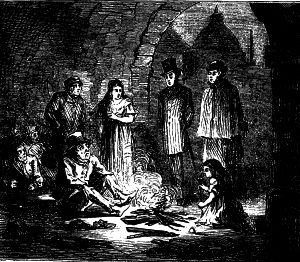
THE CADGER'S MEAL.
The old fellow, who seemed to be a confirmed vagrant, from his slouchy look and greasy, unpatched clothes, had built a small fire of the refuse which abounded in the arches, and he was drying pieces of driftwood that had floated from the scaffolding on the new Blackfriar's Bridge down the river. He was warming his hands and slapping them, and the little girl of ten years was stooped over the fire, toasting an enormous potato on the end of a splinter of wood.
THE LOST GIRL.
"What are you herding here for, Prindle," said the detective to the old fellow, who looked up in a morose way and muttered something under his teeth which sounded like "D—n the bobbies."
"I'm a trying to get somethink to heat. Vy vill yer foller a cove everywheres as wants to get a mouthful to heat. I haint done nothink as should bring you here arter me. I'm not hon the pad now hany more."
"I don't want yer pertikler, I don't; but stop yer jaw and keep a civil tongue in yer head, will ye," said the sergeant. "Whose gal is that ere a toasting the taty with the skiver?"
"I'm blessed hif I knows whose gal it his. Ye don't suppose that I'm the man as makes the Post-hoffice Di-rek-te-ree. She haint mine, I know, cos I'm not a fool, nor never vos, to have any children. I must say she is werry 'andy at the taties when a feller wants to get some winks. But, I say, you got nothink aginst me from the Beak, 'ave you?"
"No, I have nothing against you just at this partickler moment, but I dunno how soon I'll have," said the sergeant. "But I have brought a gentleman here who wants to get some information about this 'ere precious family of yours, and how you contrive to live, and I want you to answer him civilly, or I may find something against you that would hurt your tender feelings, you know."
"He wants some hinformation habout me and my family, does he? That's a precious lark, that is. Why doesn't he stay in his bleeding bed and cover his nose hup in the sheets. I never asked 'im about his familee, as I knows on. Wot a werry pecoolier taste he has, to be sure. Maybe he's one of them rummaging Paper chaps as is halways a torkin about the rights and dooties of the vorkin' classes, and is a-ruinin' of the country's blessed prosperity?"
"Father, answer the man civilly, will ye. Yer halways a-making trouble for yourself by yer bad tongue, and it does other people harm as well as yourself. Tell him wot you have got to tell, and he'll go away."
This was said by the young girl, who now came forward and stood looking at the old man eagerly. She was robed in an old calico gown, rather tattered at the bottom, and quite besmirched with the washings of the Thames mud which had clung to the stone stairs of the bridge. The girl was well formed and tall, and her dress hung from a good figure. Her eyes were black and glittering, and her bold, coarse, handsome face was seared with the traces of evil passions, hardship, and reckless despair. The girl's face told her story before she had spoken. Childhood and girlhood reeking with the foulness of the gutters, and then the matured woman a castaway in the deadly miasma of the London slums.