Front matter (continued 8)
Reading edition
"Trick-hat-the-loop, ring the nail, and ye gets three h'apens. Ring the nail and ye gets three h'apens. And 'ow much does ye hinvest. Vy honly ha'apenny. A man von two hundred pun hof me last veek, and there 'e his just now agoin to bet hit all on the Hoxford crew, and ef ye don't believe me just hax 'im 'isself," said a seedy looking wretch, with a handful of small iron rings in his hand, directing his index finger to some indistinct personage in the crowd, whom no one present could recognize.
The number of apple, pear, goosberry, plum, pie, and ice-cream stands that line the path are almost incalculable to think of. Pies square, round, and triangular of shape, in all the varied stages of decay, are for sale at a penny a piece. Tarts, cheese cakes, mutton pot-pies, ham pies, suet puddings, whelks, a sort of odorous shell-fish, at half-penny apiece, green gages, and "sandviches" are shouted on every side of us.
There are all kinds of games in progress. There is the ancient and honorable game of "cockshie," and "cocoa-nut." The latter is curious. Three cocoa-nuts, hollowed out, are placed on the top of as many sticks, which are stuck upright in the ground, and the game, costing a penny, is to knock off those cocoa-nuts at three strokes, when you can claim three pence—providing, of course, that you knock off all three cocoa-nuts; which, of course, can only be done by the princely proprietor himself after hard training.
There is one noisy fellow on a little hillock, pockmarked and ferret-eyed, in a greasy woolen duster, who has drawn a large crowd around him by his peculiar and quack-like oratory. This fellow is a gem, in his way, of purest ray serene. He is a merchant of penny scarf and finger rings.
"Now," says he, elevating a scarf ring on one finger and a wedding ring on another, in sight of the wondering crowd, "hif hi was to tell you good people that these beuty-fool rings wor pure goold, vot vould you say? Vy, you vould say, in the most hexitibel and hunmistakabel langvidge has could come from your blessed traps, 'ee his a harrant himposter.
"Could hi blame yer for hexpressing yer feelinks in sich langvidge? No. Hi vould say to my disturbed conscience, has was at that very moment a tearing my hinsides to pieces, 'you, Villiam Bowsley, have forsaken the good karraktir has was 'anded down to yer by hancestors who 'ad their hown hestates, 'osses, and kerridges; Villiam Bowsley, you 'ave been han harrant himpostor, and deserves to be 'ung.' Vell, does I tell ye that these ere rings is goold? No; on the contreery, I says they are brass. Vell, may be ye don't care so much for brass harticles. Ham hi a friend of brass? No, agin. But I ham a friend of Hart. I asks ye to look at this ere image of Mr. Gladstun, as is now hour blessed Pri-meer. Wos hever anything so beau-ty-fool? Look at the insinivatin smile on 'is sveet feetyures. Ven I last dined vith Mr. Gladstun—ye needn't laff, cos ye knows, perhaps, the story in the Good Book of the bad children 'oo chaffed the old Profits and wus heat hup by bares—ven I last dined vith Gladstun, hour blessed Pri-meer, he says, 'Bill'—he calls me 'Bill' ven 'ee his friendly—'Bill, them pictures on them ere kam-e-o-s as you sells is my likeness just like twins. Cos, vy,' said he, 'my maiden haunt reckignized them, and fainted avay ven she seed vun.'"
Passing along a few feet I am attracted by the noise of a loud, rough voice, that is shouting over the thickly packed heads of another crowd:
"Step hup gentlemen and take a look hat the noble hart of Self-Defence has his practised in the Royal Tent. This vay gentlemen, honly tuppens. Brisket Bill and the 'Ackney Vick Cove is a goin' to set-too. Step hup."
THE BOXING TENT.
There is a large tent back from the path covered all over with representations of half-naked boxers in the act of defending themselves, or mauling or beating each other to pieces, and the master pugilist stands on a high bench to attract the crowd, while at the same time he can look inside of the tent and direct the ceremonies by calling time and announcing the names of the combatants. Two wretched, miserable looking women, their features furrowed with want, their eyes bleared with gin, and their general appearance indicative of hard luck, cruel treatment and filth, hold each a sheet of the tent in their hands, and one of them puts out her hand to take the two pence which is the price of admission.
I pass in to the tent and find twenty or thirty hard-looking cases circling around "Brisket Bill" and the "Hackney Wick Cove," who are stripped to their waists, their features inflamed with passion, their hair cropped short, and boxing gloves on their hands. There are half a dozen burly, big soldiers in the tent belonging to different arms of the Queen's service, and two of them wear the red shell jackets and army fatigue caps of the Life Guards. Brisket Bill is a low-sized, compact, thick witted brute in corduroys and heavy hob-nailed shoes, who has been probably "starring" in the provinces, and the Hackney Cove is a tall, well-made, fresh-faced-looking young fellow, who is quite lively on his feet, and seems to rather like the punishment which Brisket gives him every now and then in the chest and face.
A ruffianly-faced scoundrel offers me a ticket to go to his boxing benefit on the next Monday night, which is declined, and at the next moment the Hackney Cove knocks Brisket Bill, with a tremendous blow, kicking at my feet, while cheers greet the feat from the Life Guards, roughs, thieves, and clodhoppers in the tent, and the Master Pugilist cries from the top of the tent outside:
"Vind hup, Brisket; 'it 'im 'ard and be done vith your larking. Give these gentlemen the vorth of their tupence. Vind hup, I say, and stop 'im."
Going down the towing path I found the crowd increasing every moment, and all streaming from the direction of London. A great number of soldiers were present all in bright uniform, without side-arms, and all carrying jaunty canes—lancers, foot guards, riflemen, artillery drivers, men of the siege train, heavy cavalry, dragoons, and light-infantry men. The majority of these warriors bold were accompanied by their sweethearts, pretty, clear-skinned English girls in their best bibs and tuckers, and of course they all wore the Oxford blue on their persons. Hundreds of small dirty-faced and ragged boys swarmed in and out of the numerous tents, and many grown men were endeavoring by bawling loudly, to dispose of badges and rosettes. Some of them had pieces of wide dark blue ribbon with the words cribbed from the famous ballad of Tommy Dodd a little altered, inscribed in gilt type on them:
"Now boys, let's all go in; Oxford—Oxford sure to win, Tommy Dodd."
Others sold small rosettes with the words "Oxford Laurels" engraved, and Harvard badges made of red, white, and blue lutestring, bearing the arms of the United States, the eagle rampant, and screaming fiercely, while one costermonger's cart had elevated on canvas in bold letters, the words of Nelson at Trafalgar, forever classic in the English tongue:
"ENGLAND EXPECTS THIS DAY THAT EVERY MAN SHALL DO HIS DUTY."
Almost every person who passed this costermonger cart cheered or approved of the legend in some way, while as a counter irritant a party of Americans who had hired a whole house, had the Star Spangled Banner displayed with the following couplet underneath, in glaring type, and which attracted very considerable attention:
"Then conquer we must, when our cause it is just, And this be our motto: In God be our trust!"
THE DEAR OLD FLAG.
I saw numbers of Americans, during the great excitement of that memorable day, pass and repass the sacred symbol of their country just for the sake of lifting their hats to the dear old flag. Blood is thicker than water—even if it was only a boat race. One young fellow who had been for four years studying his profession at Halle, in Germany, and had not seen the Gridiron during that time, doffed his hat twice and was cheered from the balcony in return; and when he came to me and spoke, his eyelashes were humid, and, when I asked him what was the matter, he answered in a polyglot of Deutsch and English:
"Ach Gott! I've been having a blamed good cry at the sight of the Stars and Stripes."
And thus the day passed, and the sun declined in force and fell in strips of silver and gold and purple on Putney church and steeple, and on all that mad, roaring, shouting, gambling, eating, and drinking multitude, that lined both banks of the river from Putney to Mortlake—a million human beings in all—to witness ten lads struggle for less than half an hour in two frail boats.
CHAPTER XXIV.
STRUGGLE AND VICTORY.
S I passed down the towing path toward the stone house where the Harvard crew were resting, I saw the blue blades of four slender oars elevated above the crowd, and passing through the closely wedged ranks. The men who carried them, the Oxford Four, appeared on the river's bank—four fine looking young fellows, with the coxswain, a mere lad, in their rowing suits. They were going to take a paddle preparatory to the race, for half a mile up the Thames toward the Duke of Devonshire's. They looked well, and were loudly cheered as they got into their boat. They paddled up the river.
As I passed the gate of the stone house I saw the Chevalier Wykoff and George Wilkes standing together and spoke to them both. Just at this moment the face of Loring, the stroke of the Harvard crew, appeared looking out toward the river, which was packed with boats full of people. There was something in the man's face that I did not like. I had not seen him for a few days previous. He had a huge boil under his right chin in his neck, with a white crust on the top of it; his eyes seemed wild, his manner anxious and hurried, and altogether he seemed very unsteady. I shook hands with him and asked him how he felt.
ON BOARD THE PRESS BOAT.
He said slowly, "Pretty well," and after we talked a few minutes he went in to prepare for the struggle. I stepped back to the towing path and spoke to Mr. Wilkes, who asked of me "Who is that? Is not that Mr. Loring, the Stroke of Harvard?" I answered in the affirmative. Mr. Wilkes then asked me, "What did he say? Does he feel well?" I answered, "He says he feels pretty well?" Wilkes burst out, "Pretty well! He doesn't look like it. That man's sick." and in an instant he dashed into the crowd to find some one and I lost him for the time being.
I walked down to the "Star and Garter" inn slowly, thinking of the last look I had at Loring, and I felt astonished that he should be ready to pull a race in his condition. The man was evidently in a state of exhaustion; he looked overworked, overstrained, and out of condition for a four mile and three furlong race—he who had, when at his best, only been used to pull a three mile race, turning at a stake of a mile and a half distance.
Warned by the noise and rapid movements of the crowd that something was astir, I made my way by the Star and and Garter, out of whose windows men were handing porter bottles to their friends beneath, and, walking to the river's bank, I hailed a boat with two Thames watermen in it, who pulled me through the line of Police boats to the Press boat Sunflower, which had her steam up and was getting ready.
Getting on the deck I took a look around me. Above and at our back was the old Putney Bridge, thick with human beings of both sexes. Beneath were countless steamboats and small craft, wedged together in a dense mass, covering the river behind the bridge for acres, and at our stern a huge iron chain of Vulcanic links stretched from the Star and Garter to a point off Fulham on the Middlesex shore. The chain in the middle of the river was under water, but near both shores it was visible to all the passengers on the steamboats behind Putney Bridge, but also impassable to them, however they might rage, fume, and curse at their ill-luck and guineas thrown away.
By the side of the Press boat, the Umpire's boat—a craft similar in build and appearance—was anchored, many of the passengers wearing the rival colors; the Americans drinking brandy and soda to refresh themselves, and the Englishmen giving odds on Oxford with great good will and humor.
The picture on the river was a most striking one, and worthy of a master's brush, with its vivid color, the striking dresses of the crowds, the flags and bunting from housetops and steam funnels; the green-leaved trees, their branches covered with human fruit, and the hot August sun, just losing its intensity, as a cool breeze came down from the direction of Mortlake to ruffle the surface of the river, its eddies and wavelets sparkling and dancing like diamonds of price.
It was now within a few minutes of five o'clock. There was a sudden hum above on the river, at a place called the Crab Tree, as the Oxford crew got into their boat, and the hum became distinct and swelled into a pronounced noise, and the noise became a great solid, full cheer from a hundred thousand throats, as the bright blue blades of the Oxford Four were dipped in the water, and they came paddling down the stream in their narrow shell to take position by the Umpire's boat near the bridge. They paddled easily, and took position with a quiet look in their fair English faces that impressed every American favorably.
Then there was another hum as before, when the Harvard crew came down from the boat-house of the London Rowing Club, and a tremendous cheer as their boat came up to the Middlesex shore—in among the seedy long grass.
And now let us look for a moment at the two crews as they sit there passively awaiting the order to "go." The Harvard boat is long, narrow, and the frail cedar wood timbers that compose it are polished like a steel mirror. Its nose and bow are sharp as a lancet, and amidships it is but a few inches out of the water. So frail, and yet to carry the good or bad fortune of a mighty nation's hope.
LORING'S CONDITION.
The Harvard crew wore white flannel shirts, the sleeves cut away at the shoulders, with white drawers shortened above the ankles, and white fillets bound around their temples to save their heads from the sun's rays. To a spectator they looked magnificent—all of them bronzed as they sat well forward in the boat, their skins like a new guinea. Burnham, the coxswain, had his back to the steamer and faced the stroke, Mr. Loring. Burnham looked stout, massive, and in good condition. His broad back, rather too broad for a coxswain, gave an idea of endurance and "staying" more useful in a stroke than a "cox." His face was tanned, and his quick, restless eyes scanned the broad Thames with a short, momentary glance, and then they rested on Simmons, the hope of the American boat.
Burnham wore a Vandyke tuft at his chin, and a stiff, bristling mustache of sandy hue. He looked old enough to be father to the Oxford coxswain. Loring sat with both hands grasping the stroke-oar on the right side of the boat. His face was turned also, and his dark eyes had something nervous and flitting in them that I did not like. His body was as lean as a greyhound's—in fact, he was too lean for a long race. But the muscles and sinews stood out in bold relief, and the cords of flesh between the shoulder-blades were hard, and, Loring being slightly round in the shoulders, it gave him a look of great strength, more fictitious than real.
He wore a mustache and goatee—not quite so artistic in shape as Burnham's—and the hair was cropped close to his ears. His face, however, did not satisfy the Americans, who watched him closely. There was something that was indefinite, something unstrung, in the lines that should have been set and hardened like steel bars. He had a feverish look as he sat forward, with his long, massive arms, grasping the oars.
Simmons, the pride of the crew, sat behind Loring, his perfect physical form astounding the Englishmen by its massive and beautiful outline. The face was gravely handsome, the chin round yet firm, the shoulders grand in their proportions, and the loins like the waist of an oak trunk. His naked arms were marble for their shape and purity of skin, and the neck, proudly resting upon his shoulders, could not have disgraced the Sun God.
Take him altogether, I never saw such a perfect specimen of manhood and physical beauty as he looked that day in the Harvard boat. And yet his eyes, usually intense and piercing, and bluish gray, which always looked a man in the face, were to-day yellowish and overcast. That lion heart, which could hardly think of defeat, was torn in a struggle to maintain composure. He and Loring for four days had been gradually weakening almost to the point of exhaustion, and these two men, upon whom the race principally depended, were perfectly aware that their form was not good, and they were well aware, also, that without their strength and health the race was lost before it began.
Simmonds towered above all his companions, and he held the wrist of his oar calmly as he could, while behind him sat Lyman, a grave, austere looking young gentleman, with a well cut face, mouth, and chin, dark hair, a resolute look, and a well shaped body; of modest, but athletic look and determination.
Lyman seemed in very good shape, though a little anxious—as was no more than natural—about Loring and Simmonds, while the most insouciant, daring looking man in the boat to-day, is that haughty, imperious looking fellow who sits in the bow, Joseph Story Fay, a man of proud will, self confidence, and great endurance. He sits seeming a careless observer of the preparatory and technical part of the programme, but those keen, watchful eyes, that seem to stab like a knife, are bent with no little solicitude on the Oxford boat, which is almost stationary a few yards distant.
The Harvard crew had a manly, bold look, taking them in a mass, and a sombre, matured appearance, their bodies and faces stained deep yellow, like a crew of Indians, and they also sat, if I may use the word, taller in their boat than the Oxford crew did in theirs.
CONDITION OF THE MEN.
The Oxford crew were boyish, fresh-faced fellows, compared with them, their light skins and hair making them look more juvenile in appearance, and beside, they had not such an ascetic look as the Harvards, who had lived more like monks than athletes, without any amusement or even beer—for weeks training themselves to death, and working body and mind too much. The Harvard crew seemed anxious and careworn, when their faces were studied, and they were certainly not in good training condition for the race.
Loring had worked like a horse, pulling long distances in broiling suns; and the crew when together had a bad fashion of rowing the whole course, while the Oxford men contented themselves with a pull of a couple of miles at a time, being careful not to overdo the business. Then, on Sunday the Oxford men always went down to the sea-shore at Brighton, and drank beer moderately and ate fruit in a jolly sort of a way, and plenty of roast meats, while the Harvard men lived to some extent on farinaceous food and porridge and figs and mutton, a favorite dish of theirs when roasted—and to be brief, they were too anxious to win, and the consequence came in the shape of a fidgetty, nervous, and overtrained condition.
Besides, the stroke of the Harvard crew was too labored and fiery and energetic to last, for the amount of powder belonging to them. The arms were with them the great impelling power, and the recover was too high up in the chest, while the Oxford men recovered a little above the pit of the stomach, which is less wearisome and distressing. In catching the oar forward they expended too much force, and spent a great deal of strength in dropping it, while their strength would have been better used in holding the water just before the recovery.
The coxswain, too, was naturally uncertain of his Stroke and Simmonds, both men being in poor condition; and Loring told him before the race, in case that he flagged to sprinkle his face and that of Simmonds, with water. This alone was enough to make Burnham rather shaky, and not a little doubtful of his crew. A few lengths lost by wild steering or nervousness, and it would be of course impossible to win in the case of two crews so very closely matched otherwise. I say all this advisedly, and I am sure the conclusion will bear out my premises. In addition, they had tried half a dozen boats while in training, and displaced two of their crew. Whether it was wise to make this change or not, I have no means of knowing, and cannot say.
The Oxford crew having paddled their boat a little nearer the Press steamer, I now had a good look at them. They all had a fresh, fair, English look, and were not, as far as I could see, at all fagged before going into the race. Darbishire, the Stroke, was the first man who caught my eye. He did not look at all burly in frame, and his figure was lower in the thwarts of the boat by a head, than that of the gigantic-framed Cornwall Celt, Mr. Tinne.
Darbishire had a merry blue eye and a turn-up nose, indicating good humor. His body was well set, his shoulders compact, and his hair, though short, had a proclivity to curl and kink. He had a broad forehead, a mouth a little turned down at the corners and arching, and his chin was moderately firm.
Yarborough was far more determined in his look, and sported a pair of thin, mutton-chop whiskers. He was the darkest-skinned and darkest-eyed man in the Oxford boat, besides being a fine oarsman and a victor of many college matches. His nose was of the snub order, and the chin dimpled, the forehead being broad and white, and the hair, like Darbishire's, inclined to curl. He was what would be a "big small" man, and was as compact and tough as a hickory nut.
Tinne was, however, the giant of the crew. I never saw a more glorious looking fellow than this clear-skinned, handsome Cornwall lad, with his splendid clearly cut profile, frank, merry face, laughing eyes, and thoroughbred look.
It was worth a day's walk to see Tinne pull. He was a man a good deal after the style of our own Simmonds, but not so gravely reserved. He was not as tall as Simmonds, but a great deal heavier, and looked as if he could pull a man-of-war's gig in a race, with those grand shoulders and hips broad as a barrel of beer. Yet, with all his great physique, his gait was as light as a girl's, and the feather of his oar when taken from the water was artistic in itself.
HALL, THE COXSWAIN.
This huge fellow, weighing 192 pounds on the day of the race, was formidable enough to intimidate the boldest betting American of us all. Tinne, like his friend Willan, the bow oar, had been president of the Oxford University Boat Club, and had never known defeat. Willan, the Bow, looked as if the matter was mere play, while he amused himself with the oar and watched Walter Brown, who held the nose of the Harvard boat from a launch, with a keen alert look. His white Guernsey shirt was open at the neck, and it showed a wonderfully muscular but white throat. His shoulders were broad across, and his fingers grasped the oar as if they were riveted with steel nails to the frail shaft.
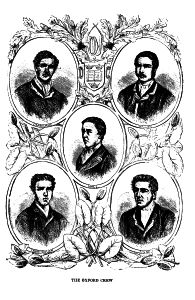
THE OXFORD CREW.
The most innocent looking boy I ever saw in a boat was Hall, a slight, frail, girlish looking lad, and coxswain of the Oxford crew. Weighing one hundred pounds on the day of the race, and being about seventeen years of age, he was the last person that a man would choose for a coxswain, who knew nothing of the mysteries and science of the art of rowing as practiced in England. His skin was light and almost transparent, the blue veins in his face being very prominent. His hair was very light, and his eyes blue as the sky. A handsomer lad could not be found, but he seemed delicate enough to be blown away with a breath. The face was weak, and the mouth of a curious shape, the corners being drawn down, and giving him a soft, credulous look.
Looking at him there in his dark-blue jacket of thin flannel—all the rest of the crew were in white shirts cut away at the elbows, and white drawers shortened at the ankles—he looked so innocent and lady-like, that it needed but a crinoline and silk skirt to transform him into a pretty English girl of the period.
And yet that delicate boy had a great trust, and "Little Corpus," as he was called from his college at Oxford, well deserved it all, for his knowledge of the river was unrivaled, and his steering was simply perfection. Nothing could be finer. A New York betting-man, who lost heavily, declared that he was a "young weasel" for sagacity and cool nerve.
By the time I had taken a good look at both crews, the arrangements had all been made, and the two boats had been brought by their coxswains up to a line stretched across the river, and the crews now lay in their boats, with bodies bent forward, their faces set, their oars grasped with energy, the coxswains with the ropes in both hands, and the stroke of each boat having his oar blade poised a few feet above the water.
Walter Brown held the nose of the Harvard boat, and John Phelps, a rugged looking Thames waterman, had his grip fastened on the Oxford boat, waiting for the word to go. Loring's eyes are blazing with unwonted fire; Darbishire seems confident and easy, with his ears dilated like a pointer, and a death-like silence reigns all over that swarming river—just now the noise was deafening; the Americans have ceased to drink any more brandy and soda; Tom Hughes looks up the river to see if all is clear; Mr. Lord, of the Thames Conservancy, reports all clear—and the bulky figure of Blakey, the starter of the race, is seen to ascend the paddle-box of the Lotus steamer, and his voice rings over the water, and is heard with a thrill, for the decisive moment has come at last.
"I shall ask," says Blakey, "are you Ready—are you Ready, and if you do not stop me I shall give the word Go, after which God speed you both."
"Are you ready?"
"No!" shouts Darbishire.
"Are you ready?"
"No!" again, distinct and clear, from Darbishire.
"Are you Ready?" No answer this time from either crew.
"GO!"
A hundred thousand throats, as if made of cast-iron, bellow forth: a hundred thousand eyes are dazzled for a moment as the diamond drops fall from the upraised blue blades of Oxford and the white blades of Harvard. Walter Brown executes a war dance in an instant after he has sent the Harvard shell a full length on its way. The 'Rah, 'Rah, 'Rah, of Harvard pierces the air; the masses on the banks of the river begin to show incipient symptoms of madness. Both boats are off, Harvard pulling like demons, and Oxford has just got into her careless, easy swing, pumping away like machines. The two steamers start on a helter-skelter race, and the greatest boat race the world ever saw has just begun for better or for worse.
HARVARD'S LIGHTNING STROKE.
No man that day who witnessed the start of the two boats—the terrific spring of the Harvard crew, and the cool, rythmical measure of the Oxford stroke—can ever forget that moment of moments, unless, indeed, his blood be thinner than water and his pulse of ice. The Harvard crew caught the water first, and were well on their way before the crowds were recovered from the shock. Loring swept away like a tiger after his prey, and Burnham—who had won the toss for choice of position, steered in on the Middlesex shore, the Oxford crew having won a blank, and having to keep in, consequently, on the Surrey side—showing very good judgment at first, and keeping his boat well under way. It was but a minute, and Harvard was a full length clear in the water of the Oxford boat, Loring pulling forty-two strokes a minute, and Simmond's elbows going backward and forward like a steam engine.
The Oxford crew, after a pause, recovered from their slight surprise, and fell into stroke as if a piece of mechanism were propelling their narrow shell. Darbishire is now rowing beautifully, and has settled down to hard work, while Tinne's great shoulders, bob up and down with superhuman energy, his glorious chest expanded to its full power, and he pulls with the magnificence of incarnate force, while "Little Corpus," the coxswain, is as quiet as a mouse, watching every stroke of the Harvard crew, as he sets in the stern sheets of the Oxford shell.
Oxford has started with thirty-eight strokes, and now, when Mr. Darbishire sees Loring putting on the steam at forty-four, he quickens his stroke to thirty-nine, and Hall gets the boat headed a little toward the Middlesex shore.
The Star and Garter is fast disappearing from the stern of the Press boat, and the Umpire's boat follows closely, neck and neck almost. The crowds at a place called the "Creek," where a little stream runs tributary to the Thames, are shouting "Oxford" all their might and main. Fay, in the bow of the Harvard boat, seems to hear the taunt, and begins to show evidence of his strength, by pulling the bow-side around slightly, which compels Burnham to put his rudder down and keep off from the Oxford boat.
At Simmond's boat-house the jam is tremendous, and the crowd cheers Harvard as she sweeps by a length ahead; and Oxford going a few feet wild at this point, the Harvard men on the two steamers shout themselves hoarse, and one man with a Magenta-ribbon takes off a new hat, carefully inspects it for a moment, and then in a delirium of frenzy kicks the crown of it in, and presents it skyward as a peace offering.
The people on the Surrey towing-path seem all mad, Oxford is not showing speed enough for them, and the stands and shows and booths are deserted as if they had never been in existence, the crowds pressing forward to the bank of the river wildly. Passing the "Willows," a pleasant little grove of trees, with a quaint stone house nestled in their bosom, a loud cheer is given as the Oxonians spurt a little, while at the same time the water falls, or rather dashes from Loring's oar with increased vehemence, for Harvard is now pulling at the tremendous pace of 45 strokes a minute, a thing unheard of before in an English boat race.
At "Craven Cottage" Oxford gains slightly, but the fact is hardly noticed by the Harvard men, who can see but one thing, and that is the Harvard boat, now ahead by a length and a half. I never imagined that Loring could do the work he is now doing, which is superhuman, and therefore cannot last. At the "Soap Works," a crazy old place, Darbishire seems to be creeping up, and his stroke is most assuredly telling on the Harvard energy and fire. Oxford is now pulling 40, and the cheers are deafening from the shore, while cries and exclamations and yells of encouragement come from the countless wherries, stationary barges, and craft of all kinds that line the Surrey side.
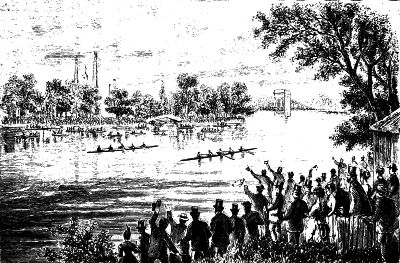
THE UNIVERSITY RACE.
"Well pulled, Willan. Nobly done for Exeter," shouts an excited Oxford University man from a small boat. "You are sure to win."
"Oh, go it Harvard; go it Harvard. 'Rah—'Rah—'Rah—'Rah. Hit her up, Loring."
"Keep your steam on, Burnham. Don't get frightened."
"What's the matter with Harvard, now," says a Harvard man to a dignified English gentleman on the Press boat.
"Wonderful stroke, sir; 'fraid it can't last. Great power, sir, in the Oxford crew," says the old gentleman rather curtly.
"Well done, Simmonds, you are the man for my money," cries a Western man who has a bottle of soda water in his hand, and has been betting heavily all the way down the river on the boat.
BURNHAM'S BAD STEERING.
Opposite the "Doves," Harvard goes away splendidly from Oxford; but now the Harvard men on the steamboats begin to notice something queer in the steering of Burnham. Briefly, he is steering wide of his race, and very badly, and his nerve seems to be going, for the boat looks quite unsteady and veers in the water more than she ought to. Now we are rounding a bend in the river, and the great, single span of Hammersmith Bridge looms up before us. Every coigne of vantage on this immense pile, from one side of the river to the other, is covered with vehicles, broughams, carriages, 'busses, and at least thirty thousand people are clustered and hanging on to the structure in a most astonishing manner. It was a mad sight, that bridge, with the great swaying masses, pushing, shouting, and fighting to get a look at the boats.
Cries of "Hoxford," "Hoxford," come down from above our heads as we near the bridge, and the excitement is perfectly terrific. We have already passed a quarter of a million of people, to estimate them in the rough, and still they line the banks above us in impenetrable masses. The waving of handkerchiefs and shouting is enough to make a man lose his senses, if the race did not claim so much attention from the spectators.
Harvard prepares to shoot under the bridge, being still a length and a half ahead, but Loring is not doing his work so stoutly now, although the Harvard boat glides through the water at 46 strokes a minute. The pace is too hard and it will not and cannot last five minutes longer.
Oxford steers out from the Surrey bank to shoot the bridge, and "Little Corpus" makes a circuit to avoid an eddy where the tide is bad, while Burnham is mad enough to go away from the race by giving room to Darbishire's boat, whose coxswain never loses an inch by weak or ill-judged steering, Burnham going out of his way too much to accommodate Oxford, instead of keeping on and taking Oxford's water in a direct line. It was at this place that Harvard lost the race, wholly by Burnham's bad steering and Loring's nervousness.
"Oh, my God! what are you doing Burnham, why do you steer so?" shouts an excited Yale man in the Press boat thinking vainly that Burnham will hear him; but Harvard is too far on our bow to hear the warning voice, and here she loses a full half length. The excitement is now beyond description. From all the vast stagings that are erected on the Surrey side, decorated with English bunting and covered with thousands of people, comes a glad swell of triumph, borne on the breeze, and striking despair to every American heart.
Now, at this moment, after shooting Hammersmith bridge, Loring's oar seems to hang loosely from the gunwale of the boat, and his head is bent forward as if he were about to faint. In an instant the coxswain, Burnham, dashes water into his face and chest, and repeats the ablution five or six times, throwing the water also on Simmonds, who is weakened from the pace he has been pulling.
The Harvard stroke now goes down to 42, to 41, and to 40; for Loring is knocked up, and the pulling is being done by Fay, on the bow side, in despair. Elliott, the boat-builder, standing on the paddle-box of the Lotus, is black in the face from shouting, "Harvard! Harvard!" "Pull up Harvard!"
OXFORD'S VENGEANCE STROKE.
There goes that same steady, wonderful, glorious stroke of Oxford, like the knell of doom, not to be stopped until victory perches on her gallant crew. At Chiswick Island Loring spurted and made a despairing effort; but the man is sick and gone for the race, and it is no use hallooing now, for Oxford forges past the Harvard boat with a will and power that calls forth a shout from the assembled multitude, which rings in the ears of Loring's crew like a sentence of death.
Still the gallant fellows struggle on, inspired by an agony which none may describe in such a race, and they never falter for an instant, but pull as if they were determined to win. During the first mile and a half of the race, Burnham received the back wash of the Oxford boat, by keeping all the time in a line behind Darbishire's crew with a seeming blunder that actually called tears of rage to the eyes of Americans on the steamboats. Getting along by Chiswick Church, which was crowded with people, the Oxford crew pulling 40, their boat was a length ahead of the Harvard bow oar, and Hall, the coxswain, took care that no ground should be lost by his steering. Then Darbishire spoke the word to his crew, and throwing all the powder they could into their backs, they gave Harvard only the alternative of pulling to Barnes's Bridge for an honorable defeat.
Never for a moment did Oxford flag, but kept the stroke as if grim death was at their heels, yet all the time throughout the race they seemed easy in their style, and regular as the pendulum of an eight-day clock.
The want of time and catch in the Harvard stroke was very noticeable at Barnes's Bridge, and here the same immense crowds were gathered as at the bridge at Hammersmith, and now the Oxford boat being positively a length and a half ahead, and no mistake, the cries and shouts were most appalling. Past the green fields in the Duke of Devonshire's meadows a large crowd was gathered, who hailed the appearance of the Oxford crew with great and significant pleasure.
The race was now lost, virtually. Harvard was out of time—knocked up—and the men in her boat were laboring like oxen in chains. The morale of the Harvard crew was gone a mile below Barnes's Bridge, when Loring's oar hung loose for the first time, and nothing human could now give old Massachusetts a victory. It was a gallant struggle, too, and nobly waged. Passing the "White Cottage" and the "White Hart" in the race for the Ship Tavern at Mortlake, the Harvard crew, in the last quarter of a mile, put on a desperate spurt and rowing for a minute and a half at 44 strokes, they gained ground on Oxford, whose crew seemed as fresh as when they began.
BEATEN BY EIGHT SECONDS.
Now is the last desperate struggle. Pull, Harvard; you cannot hope to win. Pull, Harvard, and pluck the sting from defeat! Both crews go at it for a minute, and Loring's last spark of fire is given to drive his boat through the water. There is a shout from the Ship Tavern, where the American flag is displayed. Oxford comes by with that terrible vengeance stroke, the terror of many a gallant Cantab oarsman. There is a shout which splits the clouds almost, a report of a gun, and Oxford has struck the tow line, a boat and a half's length ahead, (not three lengths ahead as was reported,) the race is lost and won, by about 65 feet, and the most gallant display ever seen on the Thames is over, and the dark blue swarms go home triumphant at heart. Bridges, river bank, and church steeple are deserted, as the Oxford crew paddle their boat along side of the Harvard crew, and, raising their hands in air, give the defeated oarsmen a hearty English cheer and shake hands with them, and the Harvard boys cheer back, and Charles Reade, who stands on the deck of the steamer Lotus, lifts his straw hat in respect to Loring, who smiles back sadly at him, and all is over. The children's children of those two crews will yet tell of that day's struggle, which for one hour served to call back the Homeric days of Greece.
The distance pulled by the Harvard and Oxford crews was four miles and three furlongs, without any turning at a stake boat. The day was a very warm one, the thermometer being at 87° Fahrenheit—in the shade.
The names and weight of the crews were as follows:
OXFORD UNIVERSITY. HARVARD UNIVERSITY.
1. Darbishire, (stroke) 160 lbs. 1. Loring, (stroke) 154 lbs.
2. Yarborough, 170 " 2. Simmonds, 170 "
3. Tinne, 192 " 3. Lyman, 155 "
4. Willan, (bow) 166 " 4. Fay, (bow) 155 "
Hall, coxswain, 100 " Burnham, coxswain, 112 "
——— ———
788 746
The time occupied by both crews in pulling the race was as follows:
Oxford, 22 minutes 20 seconds.
Harvard, 22 " 26 "
Both crews did their best, but the Oxford style of rowing, and their form, was superior to that of Harvard. Rowing with a coxswain will one day supersede the Harvard bow-steering. The Harvard crew received perfect fair-play and courtesy, and all the stories to the contrary which have been circulated are untrue.
CHAPTER XXV.
THE CURIOSITIES OF LONDON.
MOST venerable relic—none more so in London—is the Domesday Book, which I was allowed to inspect one day while sauntering through the Chapter House of Westminster Abbey. This hoary volume is called the "Domesday Book," or, "Register of the Lands of England," and was made in the year 1086, almost in the morning of English history.
There are two volumes of the "Domesday Book," one being a folio and the other a quarto. A fee of a shilling is charged strangers, to inspect the musty old tomes, with their illuminated characters, which detail the various "messuages," "folkmotes," "carucates," and "hydes," of land, which were divided among Norman William's mail clad barons, by right of conquest, nearly a thousand years ago.
These volumes are the oldest in England, although I have been informed that there are, in the Bodleian Library, at Oxford, two books, in Greek characters, which were saved from the destruction of the Alexandrian Library in the Ninth Century.
THE DREADNOUGHT.
One of the Domesday volumes is a very large folio, the other is a quarto. The quarto is written on 382 double pages of vellum, in one and the same hand, in small but plain characters, each page having double columns. Some of the capital letters and principal pages are touched with black ink, and others are crossed with lines of red ink. The second volume, in folio, is written in 450 pages of vellum, but in single columns, occupying each page, and in a large, fair character. At the end of the second volume is the following memorial, in capital letters, of the time of its completion:
"Anno Millesimo Octogesimo Sexto ab Incarnatione Domini, vigesimo vero regni Willielmi, facta est ista Descriptio, non solum per hos tres Comitatus, sed etiam per alios."
These books, until the year 1696, or for over six hundred years, were carried innumerable times from place to place, through England, under strong guards, within the jurisdiction of the various Lord Chancellors, and Courts, to settle disputes and verify local records and documents, in regard to the transmission of real estate, for every acre of land owned to-day in England is held by the original tenure, given in Domesday Book.
Since 1696 the book has been kept with the King's Seal, at Westminster, in the Exchequer, under three locks and keys in the charge of the Auditor, the Chamberlain, and Deputy Chamberlains of the Exchequer. It is kept in a vaulted porch never warmed by fire. For eight hundred years it has never felt or seen a fire, and yet the pages are bright, sound, and perfect as ever. In making searches, or transcripts from the volume, the text must not be touched, and this has always been the rule from forgotten days. All the cities, towns, and villages of England are recorded in this book, with their value, location, and boundaries, their castles, fortresses, marches, and the religious houses of the Kingdom, as they stood twenty years after Duke William, of Normandy, reined in his war horse from the slaughter of Hastings' dread field.
The Hospital Ship "Dreadnought," (soon to be broken up and sold,) which lies moored off Greenwich, in the dirty Thames, is another of the curious sights of London. An hospital for the sick and diseased seamen of all nations arriving in the port of London, was established on board of the "Grampus," a 50 gun frigate, in 1821, but the "Grampus" did not prove large enough for the purpose, and the next vessel chosen was the 104 gun three-decker "Dreadnought," which was fitted up in 1831, as an Hospital Ship. This old hulk has glorious memories for all Englishmen, who, as they look at her rotting timbers, can imagine that they see her coming out of the smoke of Trafalgar fight, after capturing the Spanish three-decker, "San Juan," which had, two hours before, beaten off the English frigates, "Bellerophon" and "Defiance."
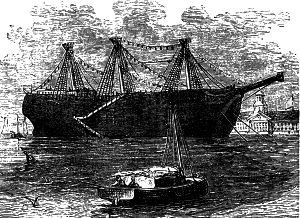
HOSPITAL SHIP, DREADNOUGHT.
The establishment on board of the "Dreadnought" consists of a Superintendent, two Surgeons, an Apothecary, Visiting Physicians, and a Chaplain. The ship is moored contiguous to the bulk of the shipping in the docks, and in the river, and is the only place in London for the reception of sick seamen arriving from abroad, or to whom accidents may happen between the mouth of the river and London Bridge. Sick seamen of every nation, on presenting themselves alongside, are immediately and kindly received without any recommendatory letters, and ship-wrecked sailors, and vagrant seamen, are admitted, if deserving. In 1869, 2,463 patients were received on board, and 1,836 seamen were attended to as out patients.
A GAUDY SHOW.
The Emperor of Russia subscribes annually £150, the Queen of Spain £100, the King of Italy £100, the Emperor of France £200, the Sultan of Turkey £100, the King of Denmark £50, and the King of Prussia £100. I heard nothing of a contribution from the American Government, but it is probable that the American Consul may, in some way, provide for the destitute seamen of his country.
The patients are ranged upon the lower decks, the portholes affording a sort of ventilation, such as it is—the breeze coming in from the putrid Thames' river, and in the cabin are all the implements of surgery, so that a leg or arm can be whipped off at a moment's notice, or an abscess, or ulcer, may be punctured equally quick.
Visitors can inspect the "Dreadnought" on any day of the week, excepting Sunday—between the hours of eleven and three.
The number of seamen cared for in this floating hospital, for the past thirty years, with their different places of nativity, is as follows:
Englishmen, 84,600; Scotchmen, 18,960; Irishmen, 17,325; Frenchmen, 3,911; Germans, 2,800; Russians, 2,230; Prussians, 1,840; Hollanders, 480; Danes, 1,600; Swedes, 2,117; Norwegians, 1,604; Italians, 1,208; Portuguese, 706; Spaniards, 801; East Indians, 2,014; West Indians, 3,212; British Americans, 1,582; United States, 3,316; South Americans, 712; Africans, 1,200; Turks, 174; Greeks, 295; New Zealanders, 98; Australians, 307; South Sea Islanders, 80; Chinese, 347; born at sea, 206.
Generally there are about two hundred patients in the floating Hospital at a time, and it is kept pretty full, from the fact that a poor sailor will perish afloat sooner than enter a land hospital, and seamen often travel from the most distant parts of England, Ireland, and Scotland, to be received in the Dreadnought.
One day, while standing on Cheapside looking at the busy thoroughfare, which much resembles Broadway, New York, in its main features, I saw a queerly-shaped, but magnificent vehicle dash by, embellished in gold and silver, and hung with crimson velvet.
I asked a bystander what it was, and he answered with proper British pride:
"Why, don't you know? That's the Queen's State Kerridge a-goin to the Tower to be repaired."
I afterward saw this vehicle in all its glory and detail, and for the benefit of Americans who may desire to get up a gorgeous equipage, I will do my best to describe it.
The carriage is composed of four Sea Tritons, who support the body by cables; the two placed on the front, as it were, bear the driver, (a most magnificent flunkey in powder and velvet,) and are sounding shells, and those on the back part carry the bundles of Lictors rods which are seen on Roman monuments and medals. The foot board on which the driver rests his noble feet, is a large scallop shell, supported by marine plants of different kinds. The pole resembles a bundle of lances, and the wheels are made in imitation of the war chariots which once rolled around classic arenas in the Games. The body of the coach is composed of eight palm trees, which, branching out at the top, sustain the roof, and at each angle are trophies of English battles by land and sea.
On the top of the roof are three little figures of fairies representing England, Ireland, and Scotland, supporting a golden crown, and holding the sceptre, the sword of state, and insignia of knighthood, and from their bodies fall festoons of laurel to the four corners of the roof.
On the right and left doors, and on the back and front pannels, are painted allegorical designs in splendid style, representing Britannia on a Throne, Religion, Wisdom, Justice, Valor, Fortitude, Commerce, Plenty, Victory, and all the other virtues and acquisitions which all Englishmen flatter themselves can only be found in "Britain ye knaw."
THE QUEEN'S STATE COACH.
Inside the State Coach it is simply magnificent. The body is lined with scarlet embossed velvet, superbly laced and embroidered with the Star, enameled by the Collar of the Order of the Garter, and surmounted by the crown with the George and Dragon pendant. St. George, St. Michael, and even St. Patrick, get a show here, although the latter has very little show from the Queen in his own country.
The hammer cloth is of scarlet velvet, with gold badges, ropes, and tassels. The length of the carriage and body is 24 feet, width 8 feet 3 inches, height 12 feet, length of pole 12 feet, weight four tons. So that the Queen, when she desires a state airing, is carted around for the amusement of her subjects, in a four-ton vehicle. The painting of the panels cost £800, or about $4,000 greenbacks. The eight horses which are employed to draw this magnificent carriage on state occasions, are valued at £2,000, and the expense for grooms, drivers, coachmen, and boys, of this equipage, which is not used more than once in five years, (and when not used being chiefly of service in showing off the manly proportions of John Brown,) is for every year over $25,000, or as much as the salary of the President of the United States. The Queen's coach is one hundred and eight years old, and is kept in the Royal Mews or Stables at Pimlico.
The bill which a loyal people had to pay when it was sent in for this coach, was as follows:
Coachmaker (including Wheelwright and Smith), £1637 15 0
Carver, 2500 0 0
Gilder, 935 14 0
Painter, 315 0 0
Laceman, 737 10 7
Chaser, 665 4 6
Harnessmaker, 385 15 0
Mercer, 202 5 10½
Beltmaker, 99 6 6
Milliner, 31 3 4
Saddler, 10 16 6
Woollendraper, 4 3 6
Covermaker, 3 9 6
— — ——
£7528 4 3½
There was an awful row about the size of the bill, which was at first £8,000, but after a great argument it was cut down to the amount paid, £7,528 4 3½. The maker refused to take off the three-half pence, and declared that he had been "skinned and robbed," but I imagine it was the poor miserable wretches who died of starvation and cold and exposure in the London streets that had the best right to complain.
The Lord Mayor's State Coach, which was built in 1757, is almost as magnificent as the Queen's, and is designed in fully as good or bad taste, I do not know which to call it.
To show how the people of England tolerate the most outrageous humbugs on the face of the earth, I will give some of the items in regard to the cost of the Lord Mayor's coach. When the coach was built, one hundred and thirteen years ago, each alderman in the city subscribed £60 towards its construction; then each alderman who was afterward sworn into office, was forced to contribute £60 on taking the oath. And each Lord Mayor also gave £100 on entering his office, to keep the coach in order. In 1768 the entire expense of keeping the coach fell on the Lord Mayor, who had to pay £300 during that year, and twenty years after its construction, the coach cost in 1787, £355 to keep it in order for that twelve months. During seven years of this present century, the cost for repairs was per annum—£115, and in 1812 it was newly lined and gilt for the benefit of the gaping London crowds, at an expense of £600, and a new seat cloth was furnished for £90; and again in 1821, this costly vehicle devoured the bread which ought to have been eaten by the starving poor, to the tune of £206 for another relining. In 1812 a carriage-making firm agreed to keep the coach in order for ten years at an expense to the city of £48 a year, which offer was accepted. The real amount of money swallowed up in this old lumbering vehicle is incalculable. Six horses are required to draw it, valued at £200 a piece, and the coach weighs 7,600 pounds. A Lord Mayor, when well fed and taken care of, weighs, I believe, about 312 pounds. The harnesses for each of the six horses weighs 106 pounds, or 636 pounds in all.
The State Coach belonging to the Speaker of the House of Commons, was built for Oliver Cromwell, and is drawn by two horses.
JONATHAN WILD'S SKELETON.
The two sheriffs of London have also State Coaches, burnished and blazoned with gold, and hung with silks and velvets, and although they only receive £1,000 for their year's services, the expense of state coaches, horses, liveries, and drivers, never falls below 2,500 guineas for their term. They are not allowed to serve if they swear themselves to be worth over £15,000, or $75,000.
The ceremony of installing a London sheriff I am afraid would make a New York Sheriff howl, and much profanity would result were the ancient ceremonies to become necessary at the City Hall of New York. I give the curious form of installation of a Sheriff of London.
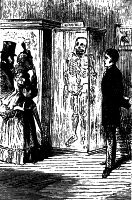
JONATHAN WILD'S SKELETON.
The sheriffs are chosen by the Livery Companies or Trade Associations of London, on the morning of the Feast of St. Michael, and are presented in the Court of Exchequer, accompanied by the Lord Mayor and all the Aldermen, when the Recorder of London introduces the two sheriffs, one for London proper, and the other for Middlesex County, and the Chief Judge in his red robes, signifies the Queen's assent, handing the sheriff's "roll"—a sheet of paper which has had the names of the sheriffs pricked in by the Queen's own hand, the writs and appliances are read and filed, and the sheriffs and senior under-sheriffs take the oaths; when the late sheriffs present their accounts. The crier of the court then makes proclamation for one who does homage for the sheriffs of London to "stand forth and do his duty;" when the senior alderman below the chair rises, the usher of the court hands him a bill-hook, and holds in both hands a small bundle of sticks, which the alderman cuts asunder, and then cuts another bundle with a hatchet. Similar proclamation is then made for the sheriff of Middlesex, when the alderman counts six horse-shoes lying upon the table, and sixty-one hob-nails handed in a tray; and the numbers are declared twice.
The sticks are thin peeled twigs tied in a bundle at each end with red tape; the horse-shoes are of large size, and very old; the hob-nails are supplied fresh every year. By the first ceremony the alderman does suit and service for the tenants of a manor in Shropshire, the chopping of sticks betokening the custom of the tenants supplying their lord with fuel. The counting of the horse-shoes and nails is another suit and service of the owners of a forge in St. Clement Danes, Strand, which formerly belonged to the city, but no longer exists. Sheriff Hoare, in his MS. journal of his shrievalty, 1740-41, says, "where the tenements and lands are situated no one knows, nor doth the city receive any rents or profits thereby."
In the Town Hall or Guildhall of London, some very strange relics are preserved, but none can be more strange than the yellow faded parchment shown me on which was written the humble petition of that notorious rascal and thief-taker, Jonathan Wild, who had first trained Jack Sheppard to thievery, after which he entrapped and hung him. Well, this very virtuous old gentleman had the audacity to send a petition to the Court of Aldermen in the year 1724, praying for the freedom of the City in view of the benefit he had conferred on it by the apprehension of so many thieves who had returned from transportation.
One day while paying a visit to a celebrated surgeon, whose residence is at Windsor, I was invited to look into his closets, in which were stored a number of curiosities. Suddenly a door in a recess of the chamber flew open, and out popped a skeleton on wires, with a ghastly, grinning jaw, and its ribs all open like the timbers of a wrecked ship.
"That's the skeleton of Jonathan Wild," said the surgeon, "It has been in our family for a hundred years, I believe."
CHAPTER XXVI.
STREET SIGHTS OF LONDON.
ERY strange sights are seen in London. No city that I have ever visited will compare with London for the number of its street peddlers, hawkers, booth proprietors, open-air performers, ballad singers, mountebanks, and other street itinerants.

From daybreak until dark, and long into the night, in the ramification of Streets and Lanes, Squares, Mews, and Ovals, the ear of the stranger is saluted with the harshest and most discordant sounds which emanate from the throats of a street-selling population of both sexes, large enough alone to make the population of a fifth-rate city.
The London Cockney who has heard the same grating sounds from the days of his earliest childhood, never stops in his walk to listen to the cries, but the stranger in London is compelled by the very want of melody or intelligibility in the hawker's cries to listen, yet it is useless for him to attempt to solve the meaning of their uncouth and barbarous gibberage.
For these seventy-five thousand men, women, and boys, as well as girls, many of a tender age—have their several dialects, and signals, and patois, which it would be madness to try to understand without a thorough schooling in the rudiments of their language and several occupations.
In another part of this work I have taken a glance at the London Costermongers and their habits and amusements, such as they are.
Beside this, the largest and most hard-working class of street hawkers, there are a hundred other branches of street merchandise, and all these different branches have their followers, who navigate every quarter of the metropolis, trying to pick up a shilling here and there from the sale of their commodities, as luck or energy may chance to send the shilling their way.
It is calculated that the gross receipts of the street peddlers of London amount to as much as £5,000,000 a year. This would make an average of £70 a year, or nearly $500 for each person engaged in street peddling. Of course in this aggregate I must include all those who keep stands or booths of a greater or lesser magnitude.
Some of these poor wretches may earn in good weeks about fifteen to twenty shillings, while at other seasons when green stuff is scarce, it is rarely that they exceed more than eight shillings on an average for the same amount of labor and hawking.
Ten shillings, however, is a fair week's earning if that amount be realized during the current year. It may be calculated that the profits will average as high as £1,500,000 where the gross receipts for sales are as high as £5,000,000.
A bitter hostility exists between the tradesmen who occupy shops and pay what they consider to be exorbitant rents, and the street sellers. No sooner has a street seller made a round of custom for himself and advertised his wares sufficiently, than the blue-coated policeman is sure to appear, armed with the authority which cannot be disobeyed, and he is compelled to move his stand or barrow.
The hawker or peddler is forced to pay four or five pounds a year for a license to sell in this precarious way, and yet in London he has no legal right to occupy a stand or booth. He has always to move on, like the boy Joe in Bleak House.
It is more than wonderful to think of the shifts made by the poor classes of London to make a living.
SECOND-HAND BOOTS AND SHOES.
The rich man passes by objects in the crowded streets every day with scorn or loathing, which serve to yield a sustenance to the indigent population, and even the offal of the streets will bring a price when offered for sale. The work of the class who gather this material is generally done before daybreak, and in some cases their earnings are considerable.
The second-hand metal and tool sellers are to be found chiefly as proprietors of booths or barrows in the vicinity of Petticoat and Rosemary Lanes. The street trade of the city is, to a great extent, done by those who have barrows, and as it is convenient for them to move their barrows from place to place, the costermongers are found all over the metropolis.
I made it my business to go almost incessantly among those street hawkers, and I got from them a vast amount of useful information, and a great many statistics.
Some of them tell curious stories, and have considerable wit of a coarse kind, but to the wandering American they are, with few exceptions, very civil, and will relate their checkered life-histories with great eagerness.
There are hundreds of old boot and shoe shops and stands, where a great business is carried on in the mending, patching, and vending of old shoes and boots.
In one branch of the street trade alone, it will be interesting to give some statistics which may be deemed reliable, as having been collected by Mr. Henry Mayhew. There are shops and stands included in this trade alone—
In Drury Lane and streets adjacent, 50 shops.
Seven Dials, " " 100 "
Monmouth Street, " " 40 "
Hanway Court, Oxford Street, 4 "
Lisson-grove, " " 100 "
Paddington, " " 30 "
Petticoat Lane, " " 200 "
Somerstown, 50 "
Field Lane, Saffron Hill, 40 "
Clerkenwell, 50 "
Bethnal Green, Spitalfields, 100 "
Rosemary Lane and vicinity, 30 "
——
744 shops.
About two thousand five hundred men are employed mending and patching shoes. Then there are hundreds of poor men and women who gain subsistence, but barely subsistence, by collecting the old material of all articles that are made of leather, and selling it to those who keep shops or stands.
I visited the lodgings of a man, in Cutler street, who paid his landlord a weekly rent of 1s. 8d. for the use of one bare room, which had no furniture with the exception of a three-legged chair upon which he sat—and a heap of straw and dirty rags, which served him as a bed. On the bare mantel-piece was a broken loaf of brown-bread, and a cooked kidney, with a broken mustard-pot.
The man was named Ferguson, and had only one eye, the other having been obliterated by the small pox. He was a cheerful old fellow, this peddler of second-hand boots and shoes, and seemed to take the world as it came without thought of the morrow. I told him that I was in search of information, and statistics in regard to the working people of London, and he offered me very politely his only stool. I declined the courtesy and sat on the heap of rags while he told his story.
"Ye need not be afeered of the bugs, yer honor, in the bed. The place is not warm enough for them to stay here.
"Stistiks ye want is it? Well, I don't know how I can give ye stistiks, but I can tell you my own story.
"I began life a shoemaker's apprentice, in Edinburgh, although I am by birth an Englishman. My master's name was Mac Donald, and when he drank whiskey his temper generally ruz, and the divil couldn't stand him or get the better of him. So I listed for a soldier and went to furrin parts, and after I sarved my time I came back a good deal wiser but not a penny richer of it all.
THE DOG FANCIER.
"I had my ups and downs when I came back, but I didn't marry, as it was too bad to bring another person into poverty besides myself. I've smoked a pipe when I was troubled in mind and could not get a bite to eat, or a drop of gin to drink, but how would it be if I had a young daughter? What good would it do to smoke if she wos hungry and I had nothing to eat for her. I used to sell cherries and strawberries, and then I gave that up and went into the old shoe trade. It paid better, but sometimes I hadn't a penny-piece for two days at a time, and I would have to sell my stock to get my grub.
"The regular sort of men's shoes are not a werry good sale. I gets from ten-pence to five shillings a pair, but the high priced ones is always soled or heeled and covered with mud. I gets from one shilling to two-and-sixpence for cloth in the shoes, when they are in decent trim. Blucher's brings two shillings and upwards, and Wellington's about the same. I have sold children's shoes as low as three-pence and as high as one and sixpence. I carry a wooden seat with me so that a man who wants to buy from me can sit down and try on a pair anywhere. People who havn't got any money to throw away generally likes to get their second-hand boots or shoes as big as you have them, cos wy, when they take them in the rain if they are a tight fit they can't put them on."
On an average the one-eyed boot and shoe seller informed me that he made about four to seven shillings a week, and he called it a very good week when he managed to make ten shillings profit.
Dog-sellers, of whom there are about two hundred in London, always choose the most public places for their stations.
Down in Parliament street, opposite the Horse Guards, in Trafalgar square, at the base of Nelson's Monument, in Upper Regent street by the Coliseum, on the steps of the Bank and the Royal Exchange, on Waterloo Bridge and along the Thames Embankment, and in fact wherever a large open space may be found, or a well known public building located, the dog-fancier may be noticed with a poodle between his legs, a black and tan under one arm and a spaniel under the other, and by his side, it is more than probable that a basket will be placed full of live, kicking, and sagacious pups, of different colors and of as many breeds.
These dog-sellers are the keenest street traders to be found in London, and dramatists and playwrights are never weary of making sketches and amusing characters of dog fanciers.
Some years ago, two rascals, bearing the names of "Ginger" and "Carrots," made themselves famous for the number of dogs stolen by them. At last it was impossible for any canine to escape these fellows, and so industrious did they become in the pursuit of them that they were arrested by the police and sent to the House of Correction for six months, which is the penalty for stealing one dog, yet "Ginger" and "Carrots" had, in their career, stolen thousands of unsuspecting yelpers from their owners.
In one year 60 dogs were reported lost, 606 stolen, 38 persons were charged with dog stealing, 18 of whom were convicted, and 20 discharged.
It is a fact worth noting, that, excepting in rare cases, the dog stealers do not affiliate with or frequent the company of house-breakers, or thieves of any other class. Dog stealing among professionals is looked upon as a noble science, and deserving of long and arduous practice.
On wet days, when pedestrians may be forced by the suddenness of the rain gusts to seek refuge in some arcade or colonade, like those in Piccadilly or the Regents' Quadrant, it is then that the dog fancier suddenly emerges from his hibernation, and knowing that he will have the attention of a group of people who are without occupation while in shelter, he may be certain to dispose of his dogs to advantage. It is upon old and timid ladies that these dog venders are sure to practice their tricks.
Let an old maid but look longingly at some hairy poodle or woolly King Charles,—then woe be to her if she attempt to escape without buying.
"Wot," said one heartless villain of a dog fancier to a spinster wearing gold spectacles, who was trying to make her escape from his alarming language, as he stood in the Strand with a pet poodle in his arms, "does ye keep me 'ere a torkin for three blessed hours and then ye goes hoff without buying this beutifool dorg as is dirt cheap at twenty pounds and I hoffers it to ye for five sovs. I say, do take it with ye and make a muff of hit, the precious dear. All ye have to do is to get its legs and tail cut off, and get its insides scooped out, and ye'll have a splendid muff. Wot, ye won't buy, hey? Pir-leece, Pir-leece," and the fellow began to scream for the police as if the poor frightened old maid had intended to rob him.
WHO KEEP BIRDS.
Bird-Sellers frequent the New Cut, Lambeth, Bermondsey, Whitechapel, Billingsgate, and Smithfield, as well as the different streets of Southwark and Blackfriars.
There are hundreds of these bird-sellers to be found hawking their birds all over the city. They are shrewd, speculative men, and can tell a bird's age and power of singing almost at a glance.
The smallest cage costs sixpence, and a thrush and cage of a common kind is valued at 2s. 6d. A canary that sings well may fetch about 3s. The hens or female birds do not have a large sale, and the trade in pigeons is decreasing, owing to the emigration of many of the Spitalfield weavers, who had a great love for pigeons and were the principal breeders of that bird in England.
The poorer the family, the more likely that a bird will be found in the house; and stable boys, laborers, and the humbler class of artisans, are in the habit of keeping birds in their dwellings.
It is also curious to notice the love formed by women who lead an abandoned life, for all kinds of birds, chiefly, however, for those that will sing. I noticed, in making a tour of inspection with the police among the Slums of the Haymarket, that nearly every woman of foreign extraction and of dissolute life had a linnet, canary, or blackbird, in her room. Frenchwomen of this class are very fond of canaries. Poor, lonely, forsaken wretches, it is the instinct of deprived maternity which demands that they should have something to love and make a pet of.
Sailors, who have returned from long voyages, will stop in the street when they see a bird-seller's stand, look at it for a moment with open mouth, and taking out a handful of silver, will give the bird-fancier any price he chooses to ask for a sweet singing bird. The bird will serve as a gift to some female relative, a wife, or as, in many cases, some woman of the town will receive the cage and its occupant as a gift from the drunken Jack-Tar.
About five thousand parrots are imported and sold annually in London. They are chiefly brought from Africa, and a fine parrot will bring as high as a pound. Quite a number of these birds die on the homeward voyage, and this makes the price of parrots very high. Birds' nests are also sold in the streets by Italian and Savoyard boys in great numbers.
Squirrels, rabbits, and gold and silver fish may be also found for sale in the streets, the latter being bought to keep in glass globes as ornaments.
At every railroad station, in and outside of London, a person can be weighed for a penny. A man named Read has at least one hundred weighing chairs, which he rents out to men and boys at a certain rate of the gross receipts. On the different bridges cripples and retired soldiers may be found with brass instruments for testing the lungs and power of a man's arms, and also machines are to be found in front of well-known public houses, and in the parks and squares, for measuring the height of pedestrians.
There was one old fellow with whom I became acquainted, who kept a measuring and a weighing machine.
His station was on the Middlesex side of the Waterloo Bridge. He told me that he had been a pot-boy in a cheap eating house for five years, and then was a helper in a gentleman's stable for six years. One of his arms was rendered useless from an attack of paralysis, and finding that he could not any longer work as a helper, he borrowed enough money to purchase the weighing and measuring machines.
Having some curiosity to know the average weight and height of his many customers, I made a bargain with him, as he could read and write, to keep a record of his experience for three days of the physique of those who patronized his machines.
His patrons were chiefly laboring men on the new Thames Embankment, boatmen plying on the river, clerks going and coming to their business over Waterloo Bridge, and soldiers.
COKE SELLERS.
His largest income was on Saturday nights, when the laboring people were flush of copper pennies, and as nearly every third man was sure to be drunk going over the bridge on Saturday night, he was certain to reap a good harvest from their generous pockets.
In three days he had weighed one hundred and thirty-two persons of the male sex, and eight women. The average weight of each person I found was, including the women, one hundred and fifty-five pounds. The number of persons measured for their height was sixty-four, and the average tallness of each person, among which number was only one female, was five feet eight inches. The soldiers were of course the tallest. These figures speak well for the London Cockneys. One of the women, a cook, measured six feet, and weighed one hundred and ninety-eight lbs. I gave the venerable statistician a shilling and bade him good-bye, but not before I had received his blessing in fervent tones.
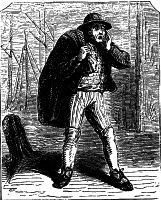
COKE PEDDLER.
The consumption of coke purchased from the various gas houses of the city by peddlers and hawkers is enormous.
There are about two thousand persons concerned in this street trade, one hundred of whom are women, and the aggregate includes boys. The various gas companies realize a yearly sum equal to six million of dollars from the sale of the coke. The peddlers distribute the coke to their customers in large vans, wheelbarrows, donkey carts, hand carts, and some of these strong limbed, broad chested fellows, carry the coke from door to door in large sacks. A few of the women own routes, and hire boys or men to sell the coke, giving them eight to twelve shillings a week, according to their merits and enterprise as hawkers. Coke is bought by these hawkers at the gas houses at from three to four pence per bushel, and is sold by them again at eight pence per bushel.
In giving the rates which I will have occasion to quote from time to time in this work, I shall generally give the prices in British money.
Salt is also vended in carts and wheelbarrows like coke, and some of the peddlers of that much desired article for seasoning and preserving food, sell in one day as much as five hundred pounds. The wholesale price to the hawkers is about 2s. 6d. per hundred pounds, and it is sold by them to the poor people in thickly populated districts, at a penny a pound, or sometimes cheaper.
Sand is sold in large quantities to the keepers of publics and small shops, and to those keeping stalls in the old markets, at twenty shillings a load, and the sand peddlers pay a license of two pounds per annum. In fact all the London peddlers pay a tax or license of some kind or another.
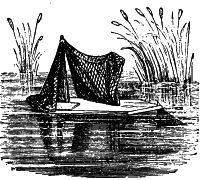
One of the strangest sights in London is the "Bum Boat" of a "Purl," or warm beer seller, who may be found now and then of a dark foggy day plying his vocation on the Thames.
Formerly there were hundreds of these beer peddlers upon the river, but I believe that there are but a few, perhaps not more than five or six, who still follow this occupation.
One day while pulling around the shipping below London bridge in a small boat, I came across one of the "Bum Boat" men, who might, I believe, be taken as a very fair specimen of his class, or calling, once numerous, but now only a scattered remnant of their former numbers.
STOCK IN TRADE.
This fellow, a sun-browned-looking man of thirty years of age or thereabout, was impelling a craft, a strongly constructed, broad bottomed barge or yawl, in and out among the smoky looking coal barges, fish and oyster craft and coasting steamers. He wore a dark blue guernsey shirt and a yellow oil-skin jacket, with heavy water boots which encased his large legs from the knees downward. An immense "Sou'-wester" shaded his broad face, and he was trying to drive the fog away by smoking a dreadful black clay pipe.
At the stern of the boat was a rough canvas awning, and under this the "Purl" man told me that he slept for weeks and months, while his boat lay at anchorage in some of the nooks of the busy river.
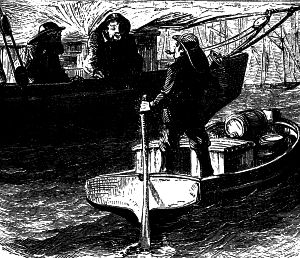
BUM BOAT MAN.
He seldom or ever went ashore, excepting when necessity compelled him to debark for the purpose of laying in beer and other stock for his customers.
In the bottom of the boat were heaps of fresh onions, a bag of potatoes, a couple of bushels of Swedish turnips, parsnips, carrots, some packages of tea and coffee in small square brown parcels, tied with white string, a tin box full of mutton chops and beef steaks, cut ready for sale, and other articles of food that would be most relished by seafaring men on their return from a voyage.
There were also in the boat a small patent sheet-iron furnace, two little casks of beer, each containing about four gallons of that beverage, a can with a gallon of gin of the cheap and fiery brand, and two tin pannikins in which he warmed the beer, or "Purl," as it is called, upon the small sheet-iron stove. This he sold hot to the sailors, oystermen, and coal bargees, at four pence a pint. It was most wonderful to see the dexterous manner in which this Bum Boat man passed in and out between the numerous craft, paddling and ringing a hand bell the while, without any collision or trouble, and then to hear through the fog, the answering cries from the sailors who recognized his welcome bell:
"Boat ahoy!"
"Bell ah-o-o-y!"
"P-i-n-t o' P-u-r-l a-h-o-o-y!"
Then for an instant the bell would cease, and the dark shapes of the "Bum Boat" and its proprietor would be seen, as the latter stood up to reach a noggin of gin to a bargee, or a pewter pint of foaming hot "Purl" to some thirsty soul of a tar just arrived from Greenwich, Glasgow, or Cork.
The "Bum Boat" man is one of the most picturesque sights of that most picturesque of cities, London. The few who still ply their avocation on the river, are in pretty comfortable circumstances, and their lives are as happy as can be imagined, much more so, I have no doubt, than they were when there were hundreds of them paddling about the river and impoverishing themselves by a ruinous competition.
HOW DICK GETS HIS PORRIDGE.
I have often noticed miserable, wan, and half naked looking little children, in and around the Regent's Circus, and in the neighborhood of the Cafés and Pall Mall, with small bags made from the material used in potato sacks, collecting cigar ends and crusts of bread from ash heaps and dust bins. Wondering what use could be made of these disgusting fragments, I one day accosted a lad of twelve years or thereabouts, who was busily engaged in searching a dust bin near Simpson's Tavern in the Strand, which is a resort for fashionable diners out.
I said to him, after giving him a penny, which will always unclose the lips of the sauciest London street boy:
"Child, why do you collect these fragments of crusts and cigar ends?"
"Mister," said the half frightened child, who took me at the first glance for a detective in plain clothes—and by the way, it seems as if every poorly clad and hungry man and woman in London were suspicious of the police, for the reason that they are poorly clad, and for that reason alone—
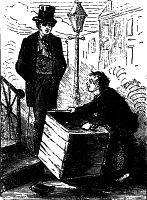
"I GETS IT FOR CIGAR STUMPS."
"Mister," said the hungry child, whose face was prematurely aged, "I aint doing nothink; I was only grabbing the crusts for porridge."
"For porridge,—how do you make the porridge, my lad?"
"My mother—she is down in Milbank street, and has got the small pox, but before she was sick she used to bile the crusts in hot water and put a pennorth o' oat meal in the pot. She borrowed the pot from Mrs. Clarke, she did."
"Who makes the porridge now, boy," said I to him.
"A gal—me big sister Mag—she makes ladies' shoes for a shop, and wacks me when she's mad and I aint got no money for gin. I likes porridge, and Mag she makes it so preshis 'ot. My name's Dick."
"Well, Dick, how do you get the 'pennorth' of oat meal for the porridge?"
"I gets it for cigar stumps. I finds a lot on 'em and sells 'em, and I gets ten browns for a pound on 'em. The tibbaccy man buys 'em, but he wont buy the short ones, cause he says they are all wet and the tibbaccy is all gone from them. I makes tuppence a day sometimes."
There are, I am told, fifty or sixty persons, men and boys, some of whom are Irish, engaged in this branch of the Street Finders' vocation.
It would be tedious to give an account of all the different branches of street selling and buying in London. Their number is legion, and it would be the work of weeks to merely recapitulate all the strange ways and means whereby wretchedness exists in the heart of surrounding splendor, and what would seem to be, but is not—an all-pervading charity.
But I cannot close this chapter without glancing at the street performers—street "Peep" Shows, Reciters, Showmen, Strong Men, Dancing boys and men, Tom Tom players, Street Clowns and Acrobats, Bagpipe players, Negro Serenaders, Street Bands, Punch and Judy shows, and other street folk, who are almost if not as numerous as the hawkers and collectors.
There is to be seen on Saturday nights, in the vicinity of Farringdon and the old London markets, now and then a stray Peep Show man, who frequents the most crowded districts, where the poorer people have money to spend. These Peep Shows are conveyed through the streets on a low four wheeled wagon, sometimes by the performer or proprietor in person, at other times by a donkey. Donkeys cost from two to five pounds in London, according to their breed and tractability.
On the wagon a square box is generally placed, having a large glass front, which is covered with green baize or a dirty velvet curtain.
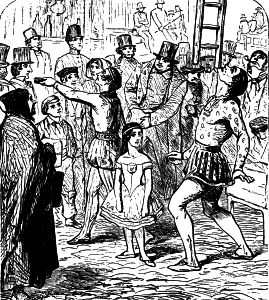
STREET ACROBATS.
This screen conceals the automaton figures that are set in motion by the man in charge. Sometimes there is a hurdy gurdy, or hand organ, attached, and while the exhibitor turns a crank to allow the spectators to look at the revolving pictures of the "Capture of the Malakoff," the "Death of Nelson," "Napoleon at Waterloo," or some other historic picture, the hurdy gurdy will play "Old Dog Tray," "The Lancashire Lass," or some other popular ditty. Representations of the most horrible murders, or executions of well known criminals, are much relished by the London mobs, and are well patronized. One of these men told me that he was accustomed to take three and four shillings on Saturday nights in Farringdon market or the New Cut, while during the week he might not make four shillings altogether.
STREET ACROBATS.
Street acrobats, or posturers, are often met with in London. They are to be found usually in streets which have one end closed, or near the river. Thus the traffic is not impeded, owing to the absence of vehicles; and a street like those which run off the Strand toward the river will be quiet as the grave all day long until near the dusk, when all at once, as if by magic, a curious crowd of men, women, and children will collect around a man and boy or boys, who will in the most business like fashion proceed to divest themselves of their outward clothing, which of course is of a rather shabby kind, and in a few moments they will appear in all the glory of flesh-colored tights, just as they may be seen standing in the sawdust of a circus arena. Their foreheads are glorious with silver tinsel or silk ribbon fillets, their loins girt with strips of velvet, and their whole rig of a theatrical character. Some of the children are really handsome, and most exquisitely shaped, the results of athletic exercise and free fresh air. But the men, poor devils, have all of them a haggard, worn, fretful look, with hollowed cheek and straggling gray hair.
Having placed a piece of carpet, rather threadbare in appearance, in the middle of the street, after selecting the cleanest spot for it, these fellows (who are soon in the centre of a ring of people, from whom coppers are collected while the acrobats are bounding in air), go to work, and for half an hour will amaze, delight, edify, and instruct the grown children, larking street boys, and nursery maids of the neighborhood, and having collected perhaps ten pence or a shilling, they will gather up the carpet, don their sober, shabby garments, and find another quarter to do their trapeze, pyramid, and dancing feats.
Nearly all these street acrobats are bruised, or are in some way injured, and many die young from falls.
Occasionally they will disappear from the crowded London streets, in search of a scanty existence in some miserable provincial barn of a theatre or music hall, and years may perhaps elapse before their pinched cheeks and hungry eyes will again be encountered in the shabby chop houses and dark, lanes of London. Six shillings a week is as much as these poor wanderers, soiled by the glare of tallow candles in crazy barns and sheds, can expect to make in the provincial towns and villages. Therefore London, with all its misery, is very dear to them, for with much less toil and labor they can realize twelve to fifteen shillings per week in the Capital.
PUNCH AND JUDY SHOW.
But the great and lasting attraction among the multifarious street scenes of London, is the Punch and Judy show, the delight of joyous children, of the rich and poor, whether in Belgravia or St. Giles. And indeed, Punch and Judy shows reap more profit in a poor and squalid district than they will in the aristocratic quarters.
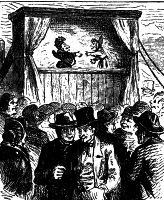
PUNCH AND JUDY.
It is rarely that the police will disturb these street shows, unless that householders should prefer a complaint that they were annoyed, and then of course they are driven away. I have myself looked and listened for many an hour to these absurdly humorous shows, to Punch and Judy, the Dog, the Clown, and some negro characters selected for the exhibition. Usually there is a man, his wife, and a boy to collect the pennies thrown from windows or given by the crowd which assembles to witness the performance.
The man plays the pipes, fastened at his breast, and the drum with his elbow; and the woman keeps the figures in motion on the miniature stage, the back of which is hidden by a green curtain or tent, placed in the cart. Behind this screen the woman conceals herself and talks for the little automaton figures. There is a set dialogue in which the figures are supposed to converse, and as it is seldom changed, I give the following portion of a comedy of conversation, as that chiefly used for many years by the London Punch and Judy shows:
Enter Judy.
Punch. What a sweet creature! what a handsome nose and chin! (He pats Judy on the face lovingly.)
Judy. Keep quiet, do! (Slapping him wickedly.)
Punch. Don't be cross, my ducky, but give me a kiss.
Judy. Oh, to be sure, my love. (They embrace and kiss.)
Punch. Bless your sweet lips. (Hugging her.) These are melting moments. I'm very fond of my wife, I must have a dance.
Judy. Agreed. (Dancing.)
Punch. Get out of the way, you don't dance well enough for me. (Hits her on the nose.) Go and fetch the baby, and mind and take care of it and not hurt it. (Judy goes off.)
Judy. (Coming back with the baby.)
Take care of the baby while I go and cook the dumplings.
Punch. (Striking Judy with his hand.) Get out of the way! I'll take care of the baby (and Judy goes out).
Punch. (Sits down and sings to the baby.)
"Hush a-bye baby on the tree top, When the wind blows the cradle will rock; When the bough breaks the cradle will fall, Down comes the baby, cradle and all."
(The baby cries and Punch throws it up and down violently.)
Punch. What a cross child! I can't abear cross children. (Shakes the baby and pretends that he is about to kill it, and finally throws it out of the window.)
Enter Judy.
Judy. Where is the baby?
PUNCH IS EXECUTED.
Punch. (In a lemoncholy tone.) I have had a misfortune; the child was so terrible cross I throwed it out of the window, I did. (Lamentation of Judy for her dear child. She goes into asterisks, and then excites and fetches a cudgel, and commences beating Punch over the head.)
Punch. Don't be cross, my dear, I didn't go to do it.
Judy. I'll pay yer for a throwin' the child out of the winder. (She keeps a beatin him on the blessed head with the stick, but Punch snatches the stick away, and commences a smashin of her blessed head.)
Judy. (Screaming like hanythink.) I'll go to the Constable and have you locked up.
Punch. Go to the devil. I don't care where you go. Get out of the way. (Judy goes hoff, and Punch sings, "Par Excellence," or, "Ten Little Indians." N.B. All before is sentimental, but this here's comic. Punch goes through his roo-too-to-rooey, and in comes the Beadle hall in red.)
Then the "Clown" and "Jim Crow," the "Doctor," "Jack Ketch," the hangman, with various characters, follow each other in quick succession and enact their absurdities to the intense delight of the "juveniles," as the showman, in his printed book of the play calls the children. Punch is tried and convicted of murder, and being sentenced to death, is finally hung by Jack Ketch, at Newgate, as a punishment for his crimes, and is then placed in a coffin and given to be dissected.
All through these performances I have frequently noticed that the child spectators sympathized with Punch,—who is certainly a most notorious criminal if we are to judge by his actions on the stage of the Punch and Judy show,—and they always applauded when the Beadle got the worst of the fight.
It is a strange instinct, that which rises and glows in the breast of a child,—this resistance to the spirit or personification of authority.