Front matter (continued 11)
Reading edition
It is four o'clock of a summer morning at Billingsgate market and all London is as yet solitary, and the streets are unpeopled by traffic or pedestrians. The sight from London Bridge is magnificent on such a morning. In the words of the poet who looked upon this same scene:
"This city now doth like a garment wear The beauty of the morning; silent, bare, Ships, towers, domes, theatres, and temples lie, Open unto the fields and to the sky All bright and glittering in the smokeless air. Never did sun more beautifully steep In his first splendor valley, rock, or hill; Ne'er saw I, never felt, a calm so deep! The river glideth at its own sweet will; Dear God! The very houses seem asleep, And all that mighty heart is still."
Riot, profligacy, want and misery have retired, and labor has scarcely risen. As we approach Billingsgate, the profound silence of the dawn is now and then broken by the wheels of the fishmonger's light cart, which is proceeding to the market.
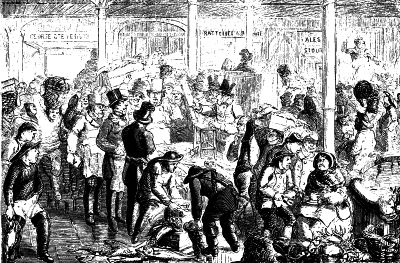
AN AUCTION AT BILLINGSGATE FISH MARKET.
The whole area of the market, brilliantly lighted with streaming flames of gas, comes into view. One might fancy that the stalls were dressed for a feast. The tables of the salesmen, which are arranged from one side of the covered area to the other, afford ample space for clustering throngs of buyers around each. The stalls appear to form one table, but the portion assigned to each is nine feet by six. Each salesman sits with his back to another, and between them is a wooden shelf, so that they are apparently enclosed in a recess, but by this arrangement they escape having their pockets picked, a common occurrence where there is a large crowd. There are about 200 fish salesmen in London and half of that number have stalls in this market for which a pretty good rent is paid.
Proceeding to the bottom of the market, we perceive the masts of the fishing boats rising out of the fog which envelopes the river. The boats lie considerably below the level of the market, and the descent is by several ladders to a floating wharf, which rises and falls with the tide, and is therefore always on the same level with the boats. About fifty of these craft are moored alongside of each other.
THE OYSTER BOATS.
The oyster boats are crowded together by themselves. The buyer goes on board the oyster boat, as oysters are not sold in the ordinary, morning market. The fishermen and porters are busily engaged in arranging their cargoes for quick delivery as soon as the market begins. Two or three minutes before five the salesmen take their seats in the enclosed recesses, watching each other eagerly. The porters with their dirty canvass aprons and their huge scooped hats stand ready with their baskets on their heads, but not one of them is allowed, however, to have the advantage of his fellows by an unfair start, or to overstep a line marked out by the clerk of the market. The instant the clock strikes the melee commences and then woe to the bystander who blocks up the way—he is knocked down and trampled on, and fish of all sizes are spilled over his prostrate body, while his eyes, hands, limbs and other members, are blessed with great fervor by the porters.
Each porter now rushes at his utmost speed to the respective salesman to whom his basket is consigned. The largest codfish are brought in baskets which contain four; those somewhat smaller are brought in boxes; and smaller sizes in dozens, and still larger numbers, but always in baskets. All fish are sold by the "tail," or by number excepting salmon, which are sold by weight, and oysters and shell-fish by measure. The baskets are instantly emptied on the tables, and the porters hasten for a fresh supply. It is the fisherman's interest to bring his whole cargo into the market as soon as possible, for if the quantity brought to market be large, prices will fall the more quickly, and if they are high, buyers purchase less freely, and he may miss the sale. As, for example, a boat load of mackerel from Brighton sold at Billingsgate for forty guineas per hundred, or seven shillings each, an extraordinary price—while the next boat load produced but thirteen guineas per hundred.
The majority of the fishing vessels are sloops and schooners under fifty tons each, and of this number the greater part belong to ports on the coast as follows:
Yarmouth 630
Faversham 416
Brighton 60
Dartmouth 357
Southampton 193
Maldon 218
Rochester 363
Colchester 318
Dover 180
Rye 80
Ramsgate 170
Salmon is conveyed by rail in large boxes, covered with pounded ice, which preserves them fresh for six days, and sometimes in the summer months as many as 3,000 boxes of salmon are received at Billingsgate in a day. The salmon are sent to agents to be sold on commission at a profit of five to ten per cent., the agent taking the risk of bad debts, and the price varies from fivepence to a shilling a pound, according to the supply in market.
BREAKFAST AT BILLINGSGATE.
The best time to see Billingsgate is of a Friday morning between six and seven o'clock. The regular fish merchants come first and are served first, and then their places are taken by the Costermongers, or street pedlars, who buy the refuse, or what is left. Lower Thames street, above and below London Bridge, is sure to be crammed full of fish carts and fish porters running hither and thither with baskets of fish upon their shoulders, and it is noticeable that the lower part of every building is open and the spaces filled with fish of all kinds, chiefly smoked and preserved fish, which are exposed in large baskets and boxes for sale. The proprietors of these places, some of whom do business in salted and smoked fish with every part of the civilized globe, stand at the doors of their wholesale shops with large aprons upon them, although their bank accounts may amount to scores of thousands of pounds.
Up Fish street as far as the monument are long lines of carts waiting for fish, drawn by asses and horses, and around the monument may be seen a perfect circle of carts guarded by ragged boys, some of whom contract to take care of a dozen carts at a time for a penny a cart, while the Costers are purchasing the fish.
Formerly the consumption of spirits here among the buyers of fish was very great, but now at a very early hour in the morning a hot cup of coffee with a slice of bread and butter can be procured at any of the numerous coffee stalls for twopence-halfpenny.
The men and women are shouting and hallooing at each other as if they were mad. Old gentlemen who have a good appetite and come here to make a market for their families, are very often seen to enter the tavern called the "Three Tuns," which is in the market enclosure, and at which a fish dinner or fish breakfast of three dishes can be procured for eighteen pence. It is very puzzling at first to understand the cries, which come hard and fast from the mouths of salesmen and hucksters, costers and pedlars of newspapers, frequenters of coffee stands, and other trades people.
"Now, you mussel buyers," shouts one, "come along—come along—now's your time for fine, fat, greasy, mussels."
"All alive! al-ive oh—alive oh! Han-some cod! best in the market. All alive oh!"
"Y-e-o—y-e-o! Y-e-o—here's your fine Yarmouth Bloaters! Who's the buyer?"
"Here you are, guv'-ner; splendid whiting! some of the right sort."
"M-o-rning T-e-l-e-graph, one penny. Standard and Times."
"Turbot! all alive—turbot."
"Glass o' nice peppermint! this cold morning—ha'penny a glass!"
"Here you are at yer hown price! Fine soles, Oh!"
"W-oy, w-o-y! Now's your time—preguzzling sprouts—all large and no small 'uns."
"H-u-l-l-o, h-u-l-l-o, here, I say—bewteeful lobsters—good and cheap—fine cock crabs, all alive, hoh."
"Never mind 'im, guvner; he'll cheat yer; look at this 'ere turbot—have that lot for a pound—come and see—now don't go away, guvner—the're preshis cheap, and filling at the price."
"Had-had-had-had-haddick—all fresh and good."
"Here, this way—this way for splendid Skate—Skate O—Skate O."
"Currant and meat puddin's, a penny each and werry 'ot." "Here's food for the belly and clothes for the back, but I sell food for the mind" (shouts the newspaper vender). "Here's smelt O!" "Here ye are, fine Finney haddick!" "Hot soup! nice pea soup! a-all hot! hot! Ahoy! ahoy here! live plaice! all alive O! Now or never! whelk! whelk! whelk! whelk! Who'll buy brill O! brill O! Capes! waterproof capes! sure to keep the wet out! a shilling a piece! Eels O! eels O! Alive! alive O!" "Fine flounders, a shilling a lot! Who'll buy this prime lot of flounders? Shrimps! shrimps! fine shrimps! Wink! wink! wink! Hi! hi-i! here you are, just eight eels left, only eight! O ho! O ho! this way—this way—this way! Fish alive! alive! alive O!"
THE CAPITAL INVESTED.
"Fresh do you call these?" says one who finds the price of a lot of sprats too high for him. "Look a-how they rolls hup the vites of their heyes, as hif they vanted a little rain. I should say they hadn't a blessed smell of water for a week past."
"Think I've been a robbin' of somebody?" says another. "Vy, bless you, all the whole bilin' of my customers hasn't got so much among 'em as would buy the lot—no, not if they sold their veskits."
As many as two thousand persons breakfast at the coffee houses in the neighborhood of Billingsgate every morning, all of whom are engaged in the fish business.
The following estimate has been made of the gross amount of fish of different kinds, sold at Billingsgate market in the course of the year:
Salmon 750,000
Live Codfish 600,000
Haddock 3,000,000
Flounders 420,000
Eels 12,000,000
Yarmouth Bloater 200,000,000
Red Herrings 75,000,000
Sprats 1,200,000,000
Crabs 1,000,000
Oysters 500,000,000
Periwinkles 400,000,000
Whiting 60,000,000
Mackerel 30,000,000
Shrimps 600,000,000
Soles 120,000,000
Lobsters 2,500,000
The capital embarked in this trade is something enormous to think of. Salmon when scarce, have sold for twenty shillings a pound. The market is the property of the Municipality of London associated with the Company of Fishmongers, one of the most powerful and wealthy corporate societies in London. Fifty per cent. of the gross amount of fish received at Billingsgate market is purchased by the Costermongers and sold from carts in the streets, at a small profit to the pedlars.
CHAPTER XXXVI.
THE INNS OF COURT.
HEREe are four Inns of Court in London and thirteen Inns of Chancery. The Inns of Court are the Middle Temple, Inner Temple, Lincoln's Inn, and Gray's Inn. The Inns of Chancery are Barnard's Inn, Holborn; Clement's Inn, Strand; Clifford's Inn, Fleet street; Furnival's Inn, between Brook street and Leather lane; Lyon's Inn, Strand; New Inn, Wych street; Sergeant's Inn, Chancery lane; Staple Inn, Holborn; Sergeant's Inn, Fleet street; Symond's Inn, Chancery Inn, and Thavie's Inn, 56 and 57 Holborn Hill.

These Inns of Court and Chancery are large boarding-houses or hotels; and in the middle ages, they were called "inns" or "hostels," where students in law and Chancery were taught the legal science and ate their meals while living as students at a common table as in college. This is called "dining in hall," and certain rules and regulations are prescribed so that the aspiring student may not expect to have the license of the American boarding-house, being in fact in a state of pupilage as was intended by the founders of the splendid (for I cannot use any other term) Inns of Court.
In the old days of the York and Lancaster factions, the Sergeants and "apprentices at law," as the students were called, each had their pillars in Old St. Paul's, and at the foot of the pillar the student, half kneeling, heard his client's case and jotted down the points on his tablet.
GRAY'S INN GARDENS.
The four Inns of Court were frequented by sons of wealthy commoners and the nobility, while the Inns of Chancery had for pupils and boarders, the sons of merchants and tradesmen, who had not the means of paying the expenses of the Inns of Court which amounted to twenty marks, annually, a large sum in those days.
About 8,000 students attend the Inns of Court and Chancery in London, and it is a very strange sight to see the dark chambers in some of these ancient Inns with their old fashioned, mediæval architecture, parapets, gate-ways, unillumined windows, courts, and passages, amidst one of the very busiest spots in London.
Go inside of one of these courts and you shall no longer hear the sullen roar of the city, or the clatter of the omnibusses, nor the incessant and deafening din of hawkers and street pedlars. A monastic silence reigns, and in the grass-grown square of Lincoln's Inn, all is silent as the grave, and in the dim passages of Clifford's and Clement's Inns, it is very difficult to believe that the densely-packed Strand and thronged Fleet street are so near.
During Elizabeth's reign, alms were distributed twice a week at the gate of Gray's Inn, and James I. signified that none but gentlemen of descent and blood should be admitted to matriculate. The "Reader," a lazy official of Gray's had a liberal allowance of wine and venison for which sixpence and eightpence were paid per mess, and eggs and green sauce were breakfast dishes on Lenten day. Beer was then only six shillings a barrel. Caps were worn at supper by order, and hats and boots and spurs, and standing with the back to the fire in the hall were forbidden the students under penalty. Dice and cards were only allowed at Christmas. Two students slept in a bed and Coke and Littleton are said to have been at one time bed-fellows.
Gray's Inn Gardens was one of the most pleasant places in London in the old days long agone, and during the reign of Charles I., it was frequented as a place of assignation. The principal entrance to Gray's Inn is from Holborn by a gateway, a fine specimen of brick-work of 1542. The hall of Lincoln's Inn has an open oak roof, divided into seven bays by gothic arched ribs, the spandrils and pendants richly carved; in the centre is an open louvre, which is pinnacled externally. The interior is richly wainscoted, decorated with Tuscan columns, and the windows are of stained glass, gorgeously emblazoned. The library 80 feet long, 40 feet wide, and 44 feet high has an open oak roof, with separate apartments for study, and iron balconies running around the book-cases. There are in this apartment five stained glass windows, and a collection of valuable law books and MSS. to the number of 25,000.
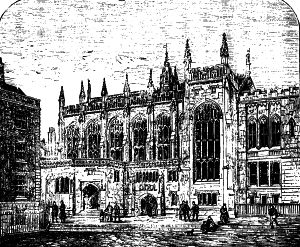
LINCOLN'S INN.
On either side of the dais of the dining hall beneath the lofty oriel window in Lincoln's Inn, is a sideboard for the upper or "benchers" table who are the high authorities of the place; the other tables are arranged in graduation, two crosswise and five along the hall for the barristers and students who dine here every day during term; the average number is 200; and of those who dine on one day or another during the term "keeping commons," there are about 500 students.
LINCOLN'S INN.
The new hall of Lincoln's Inn, just completed and equal to anything in England, is situated on the site of the old hall, between Middle Temple Cloister and Crown Office-row. It is of the Perpendicular Gothic style, faced externally with Portland stone and internally with Bath. The building projects towards the gardens 14 feet more than the old hall, which measured 70 feet by 29 feet; the new hall being 93 feet by 41 feet. Its floor above the pavement-level, and the basement is occupied by the various offices required for the officials. In rebuilding their hall, the "Benchers" have availed themselves of the opportunity to extend and improve the domestic offices; to provide commodious robing-rooms, and lavatories for the use of members and of students and to obtain better clerks' offices.
New offices have also been built for the treasurer, and the Parliament Chamber has been increased in size. The interior of the hall is panelled, to the height of nine feet, with a very handsome wainscot dado; the panels with cinquefoil cusp heads, surmounted by an embattled cornice—a magnificent specimen of joiner's work. The Parliament Chamber, attached to the hall eastward, has been considerably altered and improved—this is what may be called the drawing-room attached to the hall, where the "Benchers" retire for dessert. The kitchen is attached at the west end, and fitted up with the latest modern appliances. The hall is to be heated with hot water and lighted with sun-burners, and very handsome ornamental gas-brackets have also been introduced on the side walls.
Lincoln's Inn occupied the site of the Convent of Blackfriars, which was built by Lacy, Earl of Lincoln. Among the famous students of the Middle Temple, were Edmund Burke, Bulstrode Whitelocke, Wycherley and Congreve, Sir William Blackstone, Lord Chancellors Eldon and Stowell, Richard Brinsley Sheridan, and Oliver Goldsmith.
The number of students in the reign of Henry VI. were: Four Inns of Court, each 200—800; ten Inns of Chancery, each 100—1000; total 1800. To-day there are in the four Inns of Court alone, 4500 students.
In Gray's Inn lived Dr. Rawlinson, "Tom Folio" of the "Tatler," who stuffed four chambers so full of books that he was compelled to sleep in the passage.
How to become a lawyer is the only science studied in the Inns of Court, and the manner of doing it is as I shall describe. The four Inns of Court, viz.: the Middle and Inner Temples, Lincoln's Inn, and Gray's Inn, have exclusively the power of conferring the degree of Barrister-at-Law, requsite for practising as an advocate or counsel in the superior courts. Lincoln's Inn is generally preferred by students who contemplate the Equity Bar; it being the locality of Equity Counsel and Conveyancers, and of Equity Courts or Courts of Chancery. If the student design to practise the common law, either immediately as an advocate at Westminster, the assizes, and sessions, or as a special pleader (a learned person who, having kept his terms, is allowed to draw legal forms and pleadings, though not actually at the bar), his choice lies usually between the Inner Temple, the Middle Temple, and Gray's Inn, though he may adopt Lincoln's Inn. The Inner Temple, from its formerly insisting on a classical examination before admission, became more exclusive than the Middle Temple or Gray's Inn. Gray's Inn is numerously attended by Irish students, and has produced some of the greatest luminaries at the Irish Bar, including Daniel O'Connell.
To procure admission to either of these Inns, the student must obtain the certificate of two barristers, coupled in the Middle Temple with that of a Bencher, to the effect that the applicant is a fit person to be received into the Inn, for the purpose of being called to the Bar. Once admitted, the student has the use of the library, and is entitled to a seat in the church or chapel of the Inn, and to have his name set down for chambers.
"DINNER IN HALL"
He is then required to keep "commons," by dining in the hall for twelve terms (four terms occur each year), on commencing which, he must deposit with the treasurer £100, to be retained with interest until he is "called"; but members of the Universities are exempt from this deposit. The student must also sign a bond with sureties for the payment of his commons and term-fees. In all the Inns no person can be called unless he is above twenty-one years of age and of three years' standing as a student. The "call" is made by the Benchers in council; after which the student becomes a barrister, and takes the usual oath at Westminster. In certain Inns, however, the student must, before his call, attend certain lectures, which are a revival of the old readings, without their festivities.
To witness one of the "Hall Dinners" is enough to bring back the days of chivalry to one's mind. There is the lofty, grand Gothic roof, the long tables, the grace before meat, which is offered by the "Reader," the magnificent windows of stained glass, which project a thousand varied hues on the faces of the students, and the grave features of the Benchers who sit aloft on the dais.
At five or half-past five o'clock, the barristers, students and other members, in their gowns, having assembled in the hall, the Benchers enter in procession to the dais; the steward strikes the table three times, grace is said by the treasurer or senior Bencher present, and the dinner commences; the Benchers observe somewhat more style at their table than the other members do at theirs; the general repast is a tureen of soup, a joint of meat, a tart, and cheese, to each mess consisting of four persons; each mess is also allowed a bottle of port-wine. The dinner over, the Benchers, after grace, retire to their own apartments. At the Inner Temple, on May 29, a gold cup of "sack" is handed to each member, who drinks to the happy restoration of Charles II. At Gray's Inn a similar custom prevails, but the toast is the memory of Queen Elizabeth. The Inner Temple Hall waiters are called "panniers," from "pan-arii" who attended the Knights Templars. At both Temples the form of the dinner resembles the repasts of the military monks; the Benchers on the dais representing the "knights;" the barristers the "freres," or brethren; and the students, the "novices." The Middle Temple still bears the arms of the Knights Templars, viz., the figure of the Holy Lamb.
The entrance expenses at the Inner Temple (the average of the costs at other Inns), are £40 11s. 5d., of which £25 1s. 3d. is for the stamp; on call, £82 12s., of which £52 2s. 6d. is for the stamp; total, £123 3s. The commons bill is about £12 annually.
Of Clement's Inn in the Strand which is just the same Clement's Inn as it was when Shakspeare lived, that poet speaks as follows in the second part of Henry IV.:
Shallow. I was once of Clement's Inn, where, I think, they will talk of mad Shallow yet.
Silence. You were called lusty Shallow, then, cousin.
Shallow. By the mass, I was called any thing; and I would have done any thing indeed, and roundly too. There was I, and little John Doit of Staffordshire, and Black George Barnes of Staffordshire, and Francis Pickbone, and Will Squele, a Cotswold man; you had not four such swinge-bucklers in all the Inns of Court again.
Then Shallow tells of Sir John Falstaff breaking "Skogan's head at the court-gate when he was a crack not thus high; and the very same day did I fight with one Sampson Stockfish, a fruiterer, behind Gray's Inn."
Shallow. Oh, Sir John, do you remember since we lay all night in the Windmill in St. George's Fields?
Falstaff. We have heard the chimes at midnight, Master Shallow.
Shallow. I remember at Mile-End Green (when I lay at Clement's Inn), I was then Sir Dagonet in Arthur's Show.
Then Falstaff says of Shallow: "I do remember him at Clement's Inn, like a man made after supper of a cheese-paring."
Before a student can enter an Inn of Court and eat his first dinner, he must deposit £100 as security that he will pay for the rest of his dinners. No student is allowed to keep a "term" unless he has been three days in "hall" when grace is said at dinner.
IRISH STUDENTS.
No person in trade or in deacon's orders, or one who has been a conveyancer's clerk, can be admitted at all, so strict are the rules. No gentleman can be called to the bar by any of these Inns which are corporate and chartered bodies, before having been a member or student of his Inn for five years, unless that he is a Bachelor of Laws, or a Master of Arts of the Universities of Oxford, Dublin, or Cambridge, when three years is the period required. No one can be called to the bar until his name and description have been put up on the screen in the hall of the Inn to which he belongs for a fortnight previous to his call, and communicated to all the other societies.
Irish students must keep eight terms in one of the English Inns, as well as nine in the King's Inns, Dublin, before they can be called to the Irish bar.
Irish students may keep terms in London and Dublin alternately, or in any other order they may think proper. Gray's Inn is the favorite Inn of Irish students, for the reason that discipline is not so strict as in the Inner or Middle Temple, or Lincoln's Inn, and, besides, no charge is made for "absent commons," or being away from the dinners, while in the other Inns the student is charged for his meals in any case.
CHAPTER XXXVII.
THE BANK OF ENGLAND AND THE MINT.
HE Bank of England is the greatest moneyed institution in the world. It is situated in the very heart of the City of London, opposite the Royal Exchange and the Mansion House, and is composed of an insulated mass of stone buildings and courts covering four acres of ground, bounded by Princes's street, west; Lothbury, north; Bartholomew Lane, east; and Threadneedle street, south. Its exterior measurements are 365 feet south, 410 feet north, 245 feet east, and 440 feet west.
Within this area are nine open courts, a magnificent Rotunda, numerous public offices, court and committee rooms, an armory, engraving and printing offices, a library, apartments for officers' servants, beadles, detectives, porters, and messengers.
During the No-Popery riots of 1780, the Bank was attacked by the mob, when Wilkes rushed out of the building and seized some of the ringleaders. The Bank was defended by the regulars, the City Volunteers, and the Clerks of the establishment, who melted their leaden inkstands into bullets. For ninety years since that terrible night, the bank has been guarded by a company of foot soldiers, detailed in regular rotation from the Horse Guards, under command of one officer, for whom a sumptuous table is set every night, with the privilege of inviting two friends, while servants are provided for him.
THE BANK ESTABLISHED.
In the political tumult of November, 1830, provisions were made at the Bank for a state of siege, and when the Chartists made their great demonstrations in 1848, the roof of the Bank was fortified by a company of sappers and miners, cannon were planted, and a strong garrison held every court and passage in the interior.
The number of clerks and porters and other employees who are retained by the Bank, is one thousand or more, and their salaries amount to half a million of pounds, or two and a half millions of dollars annually.
In 1808 an arrangement was made by the English Government with the Bank, by which the latter undertook the management of the English national Debt, at a rate of £340 for each million of the debt up to 600 millions of pounds, and £300 for every additional million.
The Bank of England was established (1694) chiefly by Mr. William Paterson, the projector of the Scotch Colony of Darien, who commenced by founding a National Bank, 1691. To carry on the war with France (1694) Government required a loan of £1,200,000, and imposed new taxes, expected to yield a million and a half. The subscribers to the loan were incorporated under the title of the Governor and Company of the Bank of England, and empowered to buy land, to deal in gold and silver, and in bills of exchange. The interest on the loan was 8 per cent., besides which Government agreed to pay £4,000 a year for the cost of management, or £100,000 in all.
In the vicinity of the Bank of England there is a dense traffic, and it is necessary that suitable provender should be found for the large number of bankers and bankers' clerks, who, living in cosy little villas at Brompton, Paddington, and Maida Hill, and are compelled to eat their warm lunches in the city during business hours.
The Poultry, Bucklersbury, King William, Prince and Leadenhall streets, are lined with these comfortable, pleasant looking eating-houses and dining-rooms, where the moneyed men and their smart looking clerks sit back in easy little boxes, with turtle soup, salad, and juicy rump steaks before them, and long necked wine bottles in ice coolers between their feet, chatting about stocks and Change and Turkish Loans.
In the parlor lobby of the Bank is a portrait of Mr. David Race, who was in the service of the institution over fifty years, during which time he amassed a fortune of £200,000.
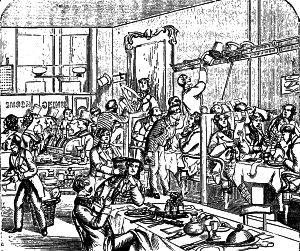
BANKERS' EATING HOUSE.
The Bullion Office, on the western side of the Bank, consists of a public chamber and two vaults—one for the open deposit of bullion free of charge, unless weighed, the other for the private stock of the Bank.
Here are employed a Principal, Deputy Principal, Clerk, Assistant Clerk, and porters.
The gold is kept in solid bars, each bar weighing 16 pounds and valued at £800, or $4,000, and the silver in pigs and bars, while the dollars are kept in bags.
The value of the gold in the vaults of the Bank in 1869 was about twenty millions of pounds, or one hundred millions of dollars.
One day I received an order which was sent me by a friend, giving me full authority to visit the Bank of England. I had not a little curiosity to satisfy, and accordingly I arrived at the Bank as early as eleven o'clock in the day.
LEDGERS AND MONEY-BAGS.
Passing through the central entrance, which is opposite the Mansion House, I found myself in a spacious court well flagged, and here were two boxes in which sat a brace of Old Jewry detectives, who are on duty in this spot from one end of the year to the other. These men receive gratuities from the Bank beside their regular pay. There were also in the yard two big fat beadles in red coats and leggings, their garments being covered with tinsel. These fat, logy looking fellows are the footmen of the Bank, who are employed to watch for suspicious strangers and to guide any visitors who may come.
While an attendant was reading the order which I handed him, I could hear the musical jingle of sovereigns and silver coins, being rattled up and down in the interior of the building.
I was taken by the guide into a large vaulted room with a cupola, in which were a perfect army of clerks, some young and brisk, others old, gray, and ponderous, ranged in long rows behind the desks, making up accounts, weighing gold and paying it over the counters, or writing in huge ledgers.
Outside the circular railings, which run all around this very large room, were stationed a vast crowd of depositors, men and women, or persons drawing money in gold or silver. Continually from the throats of the clerks arose the words:
"How will you have it. Gold or silver? Sovereigns or halves?"
Here is a lady who has traveled very far, perhaps, for her dividends. She has taken a seat and a number of curious eyes are gazing at her as she slowly takes a wing of a chicken and a piece of snowy white bread from a napkin and commences to eat, in the midst of all this wealth and confusion of the richest city in the world.
The number of ledgers and account books behind these bars are enough to frighten one. When the day's business is done all these huge books are stowed away by the porters in the fire-proof room under ground, and brought up again in the morning, for they are fully as valuable as the large sums inscribed on their leaves.
Machinery has been perfected so that these bulky account books may be hoisted and lowered every day.
Look at that young man with his banking case chained under his arm; the rolls of checks and notes he holds in his hands will probably amount to thousands of pounds; he catches the eyes of one of the clerks, calls out the amount, hands the bulky bundle over the brass mounted railing and quits the room, leaving the sum to be counted over at leisure.
See how carelessly the cashier handles that heavy bag of gold; he has no time to count it, but throws it into the scale as a coal heaver would a sack of coals—so long as it is right weight, that's all he cares about; he then shoots it into his large drawer and throws the bag aside as if he did not mind whether a sovereign stuck in the bag or not.
He counts sovereigns by twos and threes at a time; you feel confident that he must have given you either too many or too few, he appears so negligent; you count them, and there they are quite correct, and no mistake whatever.
The guide says to me: "Sometimes, Sir, the clerks are kept in the Bank for hours when there's a sixpence wrong in the balance, and they have to go over and over the books until they make the sixpence right. It's awful work, to have to go over them long columns of figures and no chance of getting away until everything is correct."
"Was there ever any great forgery committed on the Bank?" I asked the guide, who seemed to be a very intelligent man, having been in the Bank forty years.
"Ah, yes Sir, there was two great ones. In old times a great many men were hanged for forging Bank of England notes. In one year, I think it was 1820, there was over a hundred persons convicted of forgery, and nearly nine hundred were convicted for having forged notes in their pockets. Why, Sir, when I was a boy I remember as many as twenty-four hanged in one year for forgery on the Bank. I think the year was 1818. In 1803 there was a great forgery, committed by Mr. Astlett, who was one of the chief cashiers of the Bank. The amount was so large it frightened every body. Astlett done his work so well, by re-issuing Exchequer bills, that he defrauded the Bank out of £320,000 before they knew it. You may imagine what a row there was when it was found out. The old Governor nearly went mad."
"Was any other great forgery ever attempted?" said I, curious to hear those details of forgotten crime.
"Oh yes Sir," said the old man, "the biggest forgery of all was Fauntleroy's, in 1816, that was a great deal bigger than Astlett's, for it was for £360,000, and the way of it was this: You see Mr. Fauntleroy was the head partner of a bank in Berners street that had dealing with the Bank of England, and the bank that he belonged to was in a bad state, so what does Fauntleroy do to keep up its credit, but he goes to work quite cooly and forges powers of attorney of a lot of nobs and he sells out their funds, and all the time he was a-working in the dark this way, he wos a payin' of the divydends to them. Then the crash came at last, and before he was caught, when the police broke into his house, they found a note and on the note was written:—
"The Bank first began to refuse to discount our acceptances, and to destroy the credit of our house; and by G—d the Bank shall smart for it."
"So, that's the way he did it, but he was hanged for it, and I saw him swing. I never saw so many people in my life as was at that hanging. All London was there, Sir, and when he got off the cart you would have thought he was going to a party, he was so blessed cool."
THE GREAT PANIC OF 1825.
There was a "Great Panic" in the Bank of England in December, 1825, caused by the redemption of interest on £215,000,000 of stock held by the public. The Bank of England was acting as banker for the Nation, and offered to advance money to holders of stock to pay off their principal investment. This was an era of mad speculation, and no less than £372,000,000 was invested in all kinds of bogus stock projects. In some of these schemes shares of £100 on which only £5 had been paid, rose to a premium of £40, yielding a profit of eight times the amount of money paid. Everything went merry as a marriage bell for a time, and large sums had been withdrawn from the Bank of England, reducing the gold in its vaults from £8,750,000, in October, 1824, to £3,624,320 in February, 1825.
The panic began on the 5th of December, 1825, when a London bank failed, at which the agency of above forty country banks was transacted, and such a re-action was the necessary result of the previous madness of speculation. Lombard street, and the vicinity of the Bank, were filled with excited men and women, who were waiting eagerly to withdraw their investments. Next day, a number of other banks failed. The rush on the Bank of England was terrific, but the clerks kept paying away gold in bags of twenty-five sovereigns each. From nine until five, each day, twenty-five clerks were engaged, counting out gold, and as it would take that number of clerks to count out £50,000 in sovereigns, if counted by hand, a plan was made by which the tellers counted 25 sovereigns into one scale and 25 into another, and if the scales balanced, they continued until there were 200 sovereigns in each scale. In this way £1,000 were paid out in a few minutes, the weight of one thousand sovereigns being 21 pounds, while 512 bank notes only weigh one pound. In this way £307,000, in gold, was paid out in nine hours to the clamorous people.
THE PANIC CEASES.
Instead of contracting their issues the Directors of the Bank boldly extended them. In one day they discounted 4,200 bills. December 8th, the discounts at the Bank amounted to £7,500,000; on the 15th, they were £11,500,000, and on the 29th, £15,000,000. December 3d, the circulation of the Bank was £17,500,000, and the day before Christmas, December 24th, it was £25,500,000, or, $127,500,000. Any kind of paper that was not absolutely worthless, was discounted. Tremendous advances on deposits of bills of exchange were made by the Bank, stock was entered as security, and exchequer bills were purchased. The gallant old institution weathered the storm, and, on the 26th of December, gold began to come in slowly. During the latter part of the panic week a forgotten box of one-pound notes, containing £700,000, was discovered, and these were immediately issued, and the Directors acknowledged that the forgotten box saved the commercial credit of the Bank and of England. There was only £601,000 in bullion and £426,000 in coin when the rush stopped. In February, 1797, when the Bank suspended cash payments, there was £1,086,170 in coin and bullion remaining in the vaults.
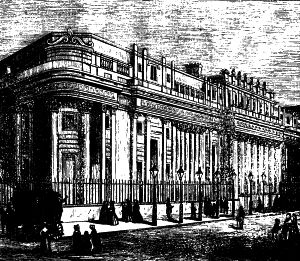
THE BANK OF ENGLAND.
I saw, in a glass case, a bank note for one million of pounds (canceled,) which had passed between the Bank and the government in some transaction or another. Think of it, a piece of paper five by two and a half inches in size, which was good on its face any place in the world for Five Millions of Dollars. I saw also here, several other bank bills for large amounts, such as ten, fifty, one hundred, and two hundred and fifty thousand pounds each. These were the most valuable strips of printed paper I ever saw.
It must be recollected, that inside of the walls of the Bank of England, which covers four acres, as I have observed, everything is made, excepting the paper of which the bank notes are manufactured. The gold, of course, is coined in the Mint on Tower Hill, but everything else is done inside of the Bank walls, including paper staining, engraving, making the steel plates from which the notes are transferred, and other useful arts. Printer's ink is also made, the ink having to be of a peculiar shade so as to prevent counterfeiting. Then there are book binderies, where the ledgers and accounts are bound, and a number of other rooms devoted to various purposes.
It is a noticeable fact, that every Bank official whom we meet on our journey through all these lofty apartments, halls and saloons, wears full evening dress though it is not yet noonday. Swallow-tail coats, white neck-cloths, and white vests, of the most spotless hues, seem to be the Bank uniform.
And what pleasant surprises there are in this institution. Now the guide leading, and I following, we emerge into an open court-yard, of very good size, which has lawns, shrubberies, and dainty little grass plots, with the most cheering flower-beds, the colors of which are very refreshing to the eye. Here are well-shaded and sanded paths, and lofty, leafy trees, and all these rural delights are concentrated in a space of one and a half acres, the dimensions of the grounds walled in by the Bank. Here, in the heart of mighty London, is a green oasis, like a diamond set in a pig's nose.
These detached buildings, with white steps leading to their doors, and neatly-ornamented porticoes, are the residences of the Governor and Directors, and here they hold receptions, and levees, and the questions and inquiries of angry stockholders are heard and answered at quarterly meetings. The guide asks me if "I would like to see the workshops of the Bank." I agree at once to his proposition, and on ascending a flight of narrow stone steps, we find ourselves in a large room which is used by the Bank mechanics to prepare the steel plates upon which the Bank notes are engraved.
A very powerful steam engine, which is used for other mechanical and artistic purposes in the Bank, is the motive power by which the work is done in this room. I can hear the sharp steel wedge scraping and polishing the already bright sheets of steel, and the noise is a most disagreeable one. All the workman has to do, however, is simply to place the plate and spindle in the exact spot, when the machine, like a stroke of vengeance seizes it, and in a second it is bright as silver.
MAKING INK FOR BANK NOTES.
Now we are in the room in which the printer's ink is manufactured with which the Bank notes are printed. The ink has to be of a very peculiar black shade, as counterfeiting would be easy were the materials used to be the same as in other inks.
Masses of black matter are being ground into a fine powder by rollers, I think that the guide told me it was nutgalls; large lumps are placed beneath the rollers, the cylinder revolves, and the powder is crushed to a fine paste.
The guide says, "If there's a bit of sand left in the paste, why then the grinding hasn't been done right." The rollers are of strong steel, and the smallest substance would be ground under them. A grain of sand will cause the two rollers as they meet to recede from each other, so sensitive are they to the finest hard substance.
Now we are out in a court again and we can see the engine room, and the huge coal fires burning, and the big boiler sweltering and steaming away at a great rate. The man who attends the engine is in his shirt-sleeves, and a little blackened, and I believe that, not excepting the Beadle, this was the only man whom I saw inside of the Bank who was not in full dress.
Here is a large room where the Bank-paper is cut to the proper size for notes, and a thousand pound note is exactly the same size as one for five pounds, which is the smallest denomination issued by the Bank.
Then there is the room for the compositors and binders, and in the latter apartment, all the account books which the vast business of the Bank make necessary, are paged, lined, and bound. Of ledgers alone, one thousand are used yearly, in this fountain head of finance, and check books innumerable are also printed and bound here.
Now I am again in the court-yard, which is paved very neatly—but no, I have not been here before. This fact I recognize as I look around me. This another court-yard.
"This is the Library, Sir," said the guide.
I began to think that the Bank officials were indeed a very literary set of people, who could find time in business hours to read books, but I was presently made aware of my mistake.
The guide knocks quietly at a small iron door, which revolves on its hinges with a noise, and a man in that same inevitable dress-coat, cravat, and neck-tie, opens the door, and I gain an entrance to a place which looks to me very like the casemate of a Monitor, or a sally-port in a stone fortress. Iron doors, iron hinges, and iron windows, shaped in a circular form, and embayed in the wall, are the most significant signs around me.
Although it is broad daylight outside, there is utter darkness within, but for the single gas jet which burns as if suffering from some defect in the pipe.
I feel that some mystery is to be explained, or some strange sight shown me—or else why this change from sunlight to this cribbed and dungeon-like casemate.
It would be impossible to break into this room; and to get out of it, if the doors were locked, would be equally difficult, I imagine.
Now the gentleman who has opened the door goes behind an iron railing, and says:
"This is the Library of the Bank, Sir, and these are the volumes that compose the Library," he says to the writer, at the same time taking a large package of notes from a shelf—on which there are many hundred packages of like description—"we keep here the canceled notes which are called in, and therefore they can never be used again. We keep these old notes for twenty-five years, in case a forgery has been committed, and when it becomes necessary to produce the notes for evidence—why, here they are—we have notes here for millions of pounds," said he, turning over bundle after bundle of ragged looking papers, that had once been of incalculable value.
These notes, after a certain time, are reduced to pulp, and again are made into paper, from which in turn fresh bank notes are made, so that these old rags have the property which Ponce de Leon's fountain gave, of renewing their youth.
Into another room now, where the notes are printed from the plates, and to insure honesty in the printer—the machine registers the number of each note printed—the registering being done in a distant part of the establishment.
IN THE VAULTS.
And now we are in the Vaults, where the precious metals are kept, and where I saw and handled riches such as would have bewildered Pizzaro, or Cortez, even in their wildest imaginings.
Here are the Bullion Vaults, in which are kept bars of gold and silver. The gold bars weigh sixteen pounds each, while the silver bar varies.
The Bank pays for gold seventy-eight shillings an ounce, while silver is generally valued at about five shillings and two pence an ounce.
It is enough to dazzle the eyes of a miser, or render him blind, to look at the show of gold bars piled up behind the railings, in those large glass presses. Thousands of them! And they are piled up just as I have often seen the stacks of solder in a plumber or gas-fitter's shop in America, without any seeming care as to how they are laid.
Here a couple of men entered with kegs, and one of them, stepping up to me, asks:
"Would you like to handle a large sum of money, Sir?"
"I don't care if I do," I said; and the very polite gentleman went to a safe in the corner and opening one of the numerous black doors of iron which ornament every portion of the room, he brought forth four medium sized packages, and laid them on the counter before me, saying:
"Please to hold open your hand. Now, Sir, there are four packages of Bank of England notes, all ready for delivery, and in each package is one million of pounds."
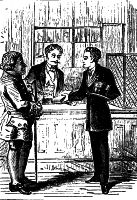
"I BEGAN TO PERSPIRE."
I began to perspire and lose my sight and hearing. "Can there be," I said, "so much money in the world?" and then I heard him say again:
"Please to examine the packages—one—two—three—four—millions."
I cried out, "stop, stop—give me breath—do you mean to say," said I, "that there are four million of pounds in these four packages—twenty million of dollars?"
"That is what I mean," said the polite official, and he smiled slightly at the excitement which he saw in my features.
At that moment I did not envy C. Vanderbilt, and I despised Jim Fisk.
Dim thoughts of murder flashed across my brain—and yet, no—I banished it from my mind. Twenty million of dollars! But then, the Tower! Ha-ha—away, fell design.
In one week the issue of bank notes amount to twenty-five million of pounds, or one hundred and twenty-five million of dollars. During the last twelve months the Bank has purchased three million and a half pounds' worth of gold bars, and one million eight hundred pounds' worth of silver bars. During the same period it sold six million pounds' worth of gold bars, and a quarter of a million pounds' worth of silver' bars.
MAKING SOVEREIGNS.
In the Weighing Office, established in 1842, to detect light gold, is the ingenious machine invented by Mr. W. Cotton, then Deputy-Governor of the Bank. About 80 or 100 light and heavy sovereigns are placed indiscriminately in a round tube; as they descend on the machinery beneath, those which are light receive a slight touch, which moves them into their proper receptacle, and those which are of legitimate weight pass into their appointed place. The light coins are then defaced by a machine, 200 in a minute; and by the weighing-machinery 35,000 may be weighed in one day. There are six of these machines, which from 1844 to 1849 weighed upwards of 48,000,000 pieces without any inaccuracy. The average amount of gold tendered in one year is nine millions, of which more than a quarter is light. The silver is put up into bags, each of one hundred pounds value, and the gold into bags of a thousand; and then these bagsful of bullion are sent through a strongly guarded door, or rather window, into the Treasury, a dark, gloomy apartment, fitted up with iron presses, supplied with huge locks and bolts.
And now I was to behold the process. After leaving the Treasury vaults, where I was shown the Bank notes, I was taken to a very large room on an upper floor, in which was a small and elegant steam engine, with other intricate machines, for weighing and defacing, or marking coins.
There was a large table with a number of coin shovels, and its entire surface was covered with sovereigns, heaped a foot high, the table having a raised rim all around it.
They were weighing these sovereigns—these officials with the finely starched shirts and white neck-ties; and this was the manner of it:
There were two open square boxes, which had connections with a number of wheels and revolving cylinders, and from each of these boxes projected the mouth of a scoop or highly polished funnel. A roll of sovereigns passed into this box, sliding slowly down through the mouth, and thence into a larger box below on the floor.
The attendants fill the tubes, and at the lower end of the scoop the work is done. Whenever a sovereign of light weight touches this spot in the lower part of the tube, a small brass plate jumps out and pushes the light sovereign into the left-hand aperture, while the full-weight pieces drop without hindrance into the right-hand box. The small brass plate does the business very quietly.
The light sovereigns are then gathered, placed in a bag, and sent back to the Mint to be re-coined. The man who was working the machine pulled a crank and a number, perhaps a thousand, of these marked sovereigns fell into the box. I took some of them in my hand, and found them almost totally defaced, and a number had been slit in two halves by the process, but no gold dust is lost the operation is performed so cleanly.
On the very same spot where once stood the Monastery of the Cistercian Monks, or Gray Friars, the Royal Mint of England is now located, and here all the money in use in England is coined by the "Company of Moneyers," as they are called. The building is situated on Tower Hill, the Mint having for a thousand years been carried on in the Tower itself.
For many hundreds of years the coinage of England had been debased by succeeding money-makers, who were entrusted by the Kings with the coinage, and in the reign of King Edward I, 280 Jews, of both sexes, were charged by this monarch with having debased the silver and gold coins, and were hung in London for the offence. King John, in 1212, ordered all the prisoners in his custody, among whom were some ecclesiastics, to be brought before him for instant judgment, at the same time summoning Cardinal Pandulph, the Papal Legate, to appear also to witness the judgment. Pandulph appeared, and King John thinking to frighten that haughty prelate who had often humbled him, ordered a priest among the prisoners, who had counterfeited money, to be hanged.
Pandulph stepped forward and said:
"Lord King, who so dares lay finger on yon clerk, though he were of royal blood, him shall I excommunicate, and he shall be anathema of Holy Church."
Pandulph, who was indeed a very energetic person, left the apartment to get a candle, so that he might curse John in due form, and the King having been thoroughly frightened, delivered the priest to Pandulph to have that prelate do justice on him, but the legate immediately liberated the offender.
During the reign of the Saxon Edgar, the penny had become scarcely equal to a half-penny in weight, and St. Dunstan, who was a bishop and confessor to the King, became so outraged at the debasement of the coinage, that on Whit-Sunday he refused to celebrate the mass before the King until justice had been done on three officials, or as they were called "moneyers." They were at once taken out of the Church and had their right hands struck off by order of the King.
In those days even the gold coins were of square, longitudinal, and all sorts of irregular and uncouth shapes.
One of the prophecies of the Sage Merlin was to the effect that when the money of England should become round, the Prince of Wales would be crowned in London. Edward I, having ascertained that such a prophecy was believed among the Welsh people, caused the head of their last native Prince, Llewellyn, to be cut off and sent to the Tower in London, where it was crowned with willows in mockery of the prophecy, and since then no native Welshman has held the title of Prince of Wales, with England's consent.
HENRY VIII A COUNTERFEITER.
Henry VIII, among his many acts of scoundrelism, was guilty of debasing the coinage of his kingdom, and when his illegitimate daughter, Queen Elizabeth, called in £638,000 of silver and gold money for the purpose of re-coining it, she ascertained on going to the Mint in person, (where she coined with her own hands several pieces of money) that these monies, whose current value on the face had been £638,000, were then only worth in reality £244,000.
On the day that George the Third's first son and successor was born—afterwards George IV—the captured treasure of the Spanish vessel "Hermione," amounting to sixty-five tons of silver and one bag full of gold, was carried in triumphant procession through the streets of London—amid the acclamation of the citizens—borne by twenty wagons. The value of the treasure was one million of pounds. This money was taken to the Mint to be coined.
In 1804 the English Government having determined to declare war against Spain, some private parties under the leadership of a Captain Moore, fitted out four ships to intercept some Spanish vessels on their way home from the Indies with treasure, and this infamous act of piracy was performed before the capturers of the Spanish galleons had heard of the impending declaration of war, and in fact before war was declared.
Some hundreds of persons were blown up in the Spanish Admiral's vessel, and one rich Spanish merchant who was returning on one of the vessels with his wife and daughters—having accumulated a great fortune—lost their lives by this act of treachery.
In 1804 the ransom payable to the British Government from the Chinese Nation, amounting to sixty-five tons of silver, or two millions of Chinese dollars, the price which China had to pay for not taking her opium quietly, was brought home and transferred to the Mint to be coined.
The money paid by France to Charles II of England for the town of Dunkirk, an immense treasure, was spent by that monarch in the worst kind of debauchery, and the face of Britannia which remains to this day upon English coins, is the likeness of Miss Frances Stewart, afterward Duchess of Richmond, and at one time a mistress of this dissolute King.
Guineas, which are valued at twenty-one shillings, while the sovereign is valued at a pound or twenty shillings, were first coined from the gold brought by the African Company from Guinea, and the coins had an elephant stamped on them.
In the same reign were struck the five guinea, the two guinea piece and the half guinea pieces. The coinage of this monarch's reign, who was only fitted to be the keeper of a bagnio, was so much depreciated, that in the reign of William and Mary, when 572 bags of silver coin were called in of Charles II's reign, it was found to weigh only 9,480 pounds, although the proper weight should have been 18,450 pounds.
The gold quarter guinea was coined by George I, and this coin is remarkable for bearing for the first time the letters "F.D." (Fidei Defensor,) or "Defender of the Faith." George III, an old blockhead as the First George was an old blackguard, coined seven shilling pieces, but these have been withdrawn, as have also the guineas and half guineas, which are now replaced by the sovereign, half sovereign, and crown, which latter coin is valued at five shillings.
When the bad money of Henry VIII was called in, the workmen in the Mint declared that it contained arsenic, and many of them "became sick to death with the savor." For this sickness some venerable idiot ordered them to drink from dead men's skulls, and a warrant was actually obtained whereby the heads of several Catholic priests, which then decorated London Bridge, were taken down and drinking cups were made from them for the workmen.
The present building in use by the Company of Moneyers for a Mint, was erected in 1811 on Tower Hill, and cost with the construction of machinery two hundred and fifty thousand pounds. If one hundred thousand pounds worth of gold bars are sent into the Mint one morning, on the next they will be ready for delivery in sovereigns.
HOW TO MAKE MONEY.
The gold is melted in pots made of black lead, which will not break in annealing, and then the alloy of copper is added (to gold one part in twelve; to silver eighteen pennyweights to a pound), and the mixed metal cast into small bars. The bars then in a heated state are first passed through the rollers, which are of tremendous power, these reducing them to one fourth of their former thickness and increasing them proportionally in length. Then the sheets of metal are passed through the cold rollers, which laminates them to the required thickness of coin.
Now comes the work of the cutting-out machines. There are fifteen of these elegant engines in the same basement, set apart for them.
The bars having been cut into the required strips and thickness, the protecting rim is next raised in the "Marking Room," and after blanching and annealing, they are ready for coining.
There are twelve presses for this purpose, each of which makes a hundred strokes a minute, and at each stroke, above and below, a blank is made into a perfect coin, stamped on both sides and milled at the edge, each press coining about ten thousand pieces of money in one hour. One little boy is alone needed to feed a press with blanks.
The coin is tested before the Lord Chancellor or Chancellor of the Exchequer and a jury of twelve goldsmiths, who are sworn to give a fair judgment, once a year—this being a trial between the Company of Coiners and the Government who own the coin. In a late trial of two hundred pounds weight of gold coin, the bulk weighed just one pennyweight and fifteen grains less than was correct—which is pretty good workmanship.
In a period of eighteen years the amount of money coined by the Company was as follows:
Gold, £55,000,000
Silver, 12,000,000
Copper, 250,000
—————
Total, £67,250,000
Profit to the Company for coinage of above amount £214,000.
Amount charged for coining £67,250,000—by the Company of Moneyers—£421,000.
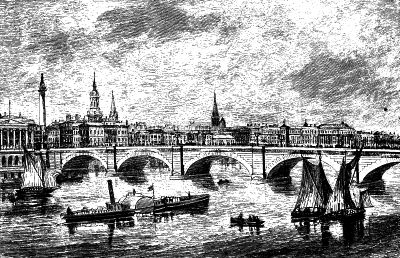
LONDON BRIDGE.
CHAPTER XXXVIII.
THE BRIDGES OF LONDON.
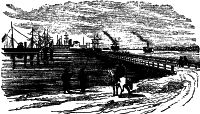
ONDON may well be proud of her bridges. Fifteen of the finest structures of their kind in the world span with mighty and enduring arches, the surface of the Thames; in a distance of seven miles on the river from London Bridge, to the Suspension Bridge, at Hammersmith. Paris alone can rival London in her super-aqueous structures, but in massiveness and grandeur there is no bridge covering the Seine, and having such a magnificent roadway and arches as Waterloo Bridge.
Of all the bridges which span the Thames, none have a history like that of London Bridge; although the present structure dates only from 1825. The history of old London Bridge is that of London itself, for the bridge was coeval with the overthrow of the Saxon dynasty, and the death of Richard C[oe]ur de Lion.
The first bridge erected on the site of the present London Bridge, was a wooden one by Ethelred III., in 994, and the tolls were paid by boats bringing fish to "Bylingsgate," which was then a water-gate of the city. The next bridge here was constructed by the pious brothers of St. Mary, Southwark, which house was originally a convent, established by a young girl named Mary, daughter to a ferryman, who plied at this point, and from the profits of the ferry the bridge was constructed. This bridge was almost totally destroyed by the Norwegian King Olave in 1008, and was rebuilt by Canute in 1016, swept away by a flood 1091, rebuilt 1097, burnt 1136, and a new one was erected of elm timber in 1163 by Peter, a priest and chaplain of St. Mary's, Colechurch, in the Poultry.
This bridge did not satisfy the pious architect, however, and he began with great zeal to build a stone one, the first in England, a little to the westward of the timber bridge in 1176, when Henry II. gave toward the construction the proceeds of a tax on wool, from which originated the saying, "London Bridge was built on woolpacks," a phrase that has often been taken in its literal meaning. Priest Peter died in 1205 and the bridge was finished in 1209.
This bridge consisted of a stone platform 926 feet long, and 40 feet wide, standing about 60 feet above the level of the water, and comprehended a draw bridge and nineteen pointed arches, with massive piers raised upon strong oak and elm piles covered by thick planks bolted together, so that after all, the famous stone bridge had a wooden platform. There was a gate-house, with turrets and battlements at either end, and toward the centre, on the east side, was built a beautiful gothic chapel of stone to the memory of St. Thomas (à Becket), of Canterbury. In a crypt of the chapel was placed a stone tomb over the body of Priest Peter, the founder of the bridge. This bridge, in the time of Elizabeth, is described as having "sumptuous buildings, and stately and beautiful houses on either side," making one continuous street from end to end and having an archway under the houses and dwellings through which vehicles, sedan-chairs, and pedestrians passed. The river could be seen at intervals in the gaps of masonry, and, in fact, this bridge was as much of a thoroughfare and causeway besides, having all the characteristics of a street on solid ground, as any open space in London. Some of the buildings had shops and beer-houses in the lower stories.
The chronicles of this stone bridge during six centuries, form, perhaps, the most interesting episodes in the history of London. The scenes of fire, siege, insurrection, and popular vengeance, of national rejoicing, and of the pageant victories of man and of death, of fame or funeral, which have transpired on and about the bridge, it were vain for me to attempt to describe. In 1212, four years after the completion of the structure, a terrific conflagration took place on the bridge, and 3000 persons perished in the flames, both ends being on fire at the same time. De Montfort repulsed Henry III., on this bridge, and the populace attacked and stoned his Queen in her barge as she prepared to shoot the bridge. Wat Tyler, the popular rebel entered London by this road to be struck down by Sir William Walworth in 1381. Richard II. was received here by the citizens in 1392. In 1415 Henry V., fresh from Agincourt, passed the bridge, and seven years after his corpse was carried over it to be buried at Westminster Abbey. In 1450 Jack Cade attempted to storm London Bridge, but he was defeated and his head placed on a pole over the gate-house. In 1477 the Bastard of Falconbridge attacked the bridge, and fired several houses. In 1554 Sir Thomas Wyatt crossed the bridge at the head of 2000 men, to dethrone Queen Mary, and lost his head for it. In 1632 more than one-third of the houses on the bridge were destroyed by fire, and in 1666 the whole labyrinth of dwellings, shops, and edifices, were swept away by the Great Fire; the entire street being rebuilt within twenty years after. The houses were entirely removed and parapets and balustrades were erected on each side in 1732, and one hundred years after, in 1832, the venerable structure was demolished to make way for the new London Bridge now standing. Holbein, the painter, lived on the bridge, book publishers occupied shops on it, and the London tradesmen believed it to be one of the Seven Wonders of the world. Hogarth lodged here, and Swift and Pope visited Tucker, a bookseller who had a shop on the bridge.
GRINNING SKULLS.
The most terrible reminiscence of the bridge is connected with the fact that its gate-houses at either end were garnished for many hundreds of years by the heads of many great and good men as well as of bad and depraved villains, whose skulls were exposed on spikes to dry and bleach in the sun.
The heads of Sir William Wallace, 1305; Simon Frisel, 1306; four traitor knights, 1397; Lord Bardolf, 1308; Bolingbroke, 1440; Jack Cade and his rebels, 1451; the Cornish traitors of 1497, and of Fisher, Bishop of Rochester (displaced in fourteen days after by that of Sir Thomas More, 1335), have adorned this ghostly bridge. From 1578 to 1605, it was a common sight to see the heads of Roman Catholic priests exposed on this bridge, their offence being that they sought to preach their doctrines in London. Finally, in the reign of Charles II., this display of bare, grinning skulls was transferred to Temple Bar.
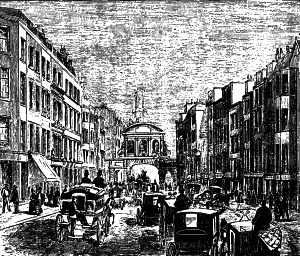
TEMPLE BAR, FLEET STREET.
Temple Bar, as it is called, is a large, gray archway, which spans Fleet street in its busiest traffic and jam. The archway was formerly the limit of the City of London, and when a sovereign came westward from Westminster, or eastward from the Tower, to make a formal entry, the Lord Mayor and the City Councils, in robes of state, were present under its historic archway to offer the keys and admit the Sovereign. The rusty gates were then rolled back, and on such occasions the pageants were very fine.
For over a hundred years the London traders and shopkeepers, and the students of the Temple, were regaled with the daily and ghastly sight of a row of grinning and socketless skulls, which were ranged in lines on cruel spikes above the architrave of Temple Bar. There is an empty room in the upper story which has a terrible history, for here heads were boiled in pitch before being exposed.
In 1737, Eustace Budgell, a cousin of Addison and a contributor to the Spectator, when reduced to poverty, took a boat at Somerset Stairs, and ordering the waterman to row down the river, threw himself into the flood as the boat shot London Bridge. He had filled his pockets with stones, and he left behind him a slip of paper on which was written, "What Cato did and Addison approved cannot be wrong." This was a great puff for Addison's tragedy. Edward Osborne, an apprentice of Sir William Hewet, afterwards Lord Mayor, jumped from the window of one of the bridge houses, in 1536, to save his master's daughter, an infant, and years afterwards he was rewarded with her hand in marriage, and became Lord Mayor himself. The grandson of the apprentice became Duke of Leeds and the founder of the present ducal house of that name. No bridge ever constructed had such a history as that of Old London Bridge.
THE TRAFFIC ON LONDON BRIDGES.
The flow of traffic on some of the principal bridges by actual computation during twelve hours, from 6 a.m. to 6 p.m., was: Pedestrians, London Bridge, 96,080; Southwark Bridge, 2,500; Blackfriars Bridge, 48,095; Waterloo Bridge, 12,000; Westminster Bridge, 38,015. Equestrian traffic: London Bridge, 211; Southwark Bridge, 93; Blackfriars, 91; Waterloo, 38; Westminster Bridge, 311. Vehicular traffic: London Bridge, 26,800; Southwark Bridge, 516; Blackfriars Bridge, 6,384; Waterloo Bridge, 2,603; Westminster Bridge, 7,300. From these figures it will be seen that the traffic on London Bridge which leads from the heart of the business portion of the city, and is toll free, exceeded that on all of the others put together. Some of the bridges are owned by companies and a toll of half a penny per passenger is taken for revenue by them.
London Bridge was designed by Sir John Rennie and built by his son. The first pile was driven March 15th, 1824, government contributing £200,000 toward the undertaking. Altogether the bridge cost £2,000,000 before it was finished. It is built on coffer-dams, and the bridge has five semi-elliptical arches. The centre arch has a span of 152 feet, and a rise above high water mark of 24 feet 6 inches; the two arches next the centre are 140 feet span, and the two abutment arches have 130 feet of span. There is a parapet four feet high and the length between the abutments is 782 feet, while the width between the parapets is 53 feet. The bridge was nearly eight years in construction, and 120,000 tons of stone were used in its erection.
Southwark Bridge is constructed of iron with three colossal arches, and was built by Rennie. The middle arch has a span of 240 feet and a rise of 24 feet. Its height above low-water mark to the roadway is 55 feet. The cost was £800,000 and the bridge was opened in 1819. Its length is 700 feet, and the roadway is 42 feet wide.
The new Blackfriars Bridge is 1,000 feet long, 42 feet wide, and the cost will be £300,000.
Waterloo Bridge is the finest in the world. Its dimensions are: Length between abutments 2,456 feet, water-way, 1,326 feet. The carriage-way is 28 feet wide with a pathway on each side of seven feet. There are nine arches, each of which are 120 feet in span with a rise of 35 feet. Waterloo Bridge has a level grade from one end to the other. Canova, the sculptor, said of this bridge, "It was alone worth a journey from Rome to London to see it." The cost was £1,000,000.
WATERLOO BRIDGE.
As a set-off to what Macaulay has prophesied in regard to London Bridge and the future New Zealander, Baron Charles Dupin, the great French publicist, speaks of Waterloo Bridge as follows:
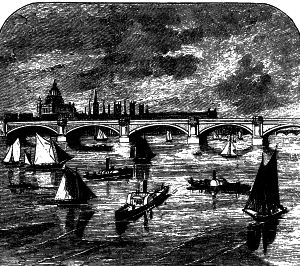
THE NEW BLACKFRIARS BRIDGE.
"If from the incalculable effect of the revolutions which empires undergo, the nations of a future age should demand one day what was formerly the New Sidon, and what has become of the Tyre of the West, which covered with her vessels every sea?—most of the edifices devoured by a destructive climate will no longer exist to answer the curiosity of man by the voice of monuments; But Waterloo Bridge, built in the centre of the commercial world, will exist to tell the most remote generations—'here was a rich, industrious, and powerful city.' The traveller, on beholding this superb monument, will suppose that some great prince wished, by many years of labor, to consecrate forever the glory of his life by this imposing structure. But if tradition instruct the traveller that six years sufficed for the undertaking and finishing the work—if he learns that an association of a number of private individuals was rich enough to defray the expense of this colossal monument, worthy of Sesostris and the Cæsars—he will admire still more the nation in which similar undertakings could be the fruit of the efforts of a few obscure individuals, lost in the crowd of industrious citizens."
Charing Cross is the next bridge on the Thames, being built of iron and used by a railway company. It was built by Brunel, and is a graceful structure, but does not permit of pedestrian traffic.
Westminster Bridge is nearly level in its grade, and has seven arches. It is 1,220 feet long. The cost was £400,000.
Lambeth Bridge is of iron with three arches, each of 280 feet span, and the width is 54 feet. Cost, £100,000.
Vauxhall Bridge is of iron with nine arches of equal span—each 78 feet wide. The breadth of the roadway is 36 feet, and the total length of the bridge is 840 feet.
Pimlico Railway Bridge is built of iron, with four openings or spans of 175 feet each. The bridge is 900 feet in length, and has a width of 24 feet.
Chelsea Chain Suspension Bridge is 922 feet long and 45 feet wide. Cost, £75,000.
Hammersmith Suspension Bridge is 841 feet long and 32 feet wide. Cost, £180,000.
Scott, the American diver, lost his life while performing acrobatic feats on Waterloo Bridge. The season he chose for diving from a height of twenty feet above the parapet of the highest London bridge was during an intense frost, when the river was full of ice, and the enormous masses floating with the tide scarcely appeared to leave a space for his reckless plunge into the river or his rise therefrom. He watched his moment, and the feat was performed over and over again with perfect safety. But he had been told that the Londoners wanted novelty. It was not enough that he should do day after day what no man had ever ventured to do before.
DEADLY ACROBATICS.
To leap off the parapets of the Southwark and Waterloo bridges into the half-frozen river had become a common thing; and so the poor fellow must have a scaffold put up, and he must suspend himself from its cross bars by his arm, his leg and his neck, in succession. Twice was the last experiment repeated; but on the third attempt the body hung motionless. The applause and laughter that death could be so counterfeited was tumultuous; but a cry of terror went forth that the man was dead. He perished for catering to a morbid public appetite. Every one who saw this voluntary hanging went away degraded and disgusted at the terrible result of the show.
CHAPTER XXXIX.
AT WINDSOR CASTLE.
ROM Windsor Castle the view is one of the finest in England. A vast panorama extending as far as the eye can reach. All flat—the faint, bare, blue horizontal line, scarcely discernible from the clouds, so distant is it, as straight as the boundary of a calm sea—and yet how infinitely varied! What would such an expanse of land be in any other country but England, which is, in itself, a huge landscape garden?
A lovely river, to which the hackneyed illustration of "a stream of molten gold" might well be applied, from the silent roll of its glittering waters, as if impeded by their own rich weight, now flashing like a strip of the sun's self, through broad meadows, whose green is scarcely less dazzling—now lost in shady nooks of wondrous and refreshing coolness.
Trees of various species and growth, singly, in clumps, and in rows, are everywhere. Little bright-looking villages, with their white spires, or grey towers, are dotted all over the scene. Beyond where I stand, on the ramparts of the Castle, I can see the Gothic turrets and spires of Eton College, founded by Henry of Lancaster, flanked by oak and birch trees, and above us, on this delightful day in autumn, the banner of St. George is floating right saucily, denoting that this Martial Keep is a royal fortress and a hereditary residence of the Sovereigns of England.
THE DEMON HUNTSMAN.
Everything seems in perfect harmony around us, as the sun falls in slanting and roseate beams on grass, tree, flower, castle, and river. There are not many hours, in one's life, such as I enjoyed that pleasant evening in September. The gentle hum of human life reaching me from the distance, is no more injurious to the effect than the rustling of the trees, or the chirping of the birds. The quiet bustle down at the stone bridge, the shouts of the bargemen—heard several seconds after their utterance,—the plashing of the oars of stray boats, the cricketers over there in their play-ground, where reposes some of the dust of Arthur's blood; all these have a charm for the drowsy senses.
The sleepy-looking chimneys of the old, royal town, immediately beneath me, fill up their place in the picture famously; even steam—that most implacable enemy of romance—appears on the scene without injuring it. The little toy-house-looking railway station, which I can see from where I stand, on the battlements, is a harmless, nay a pleasing object; and to watch the lilliputian train that has just left it, disappearing fussily among the old trees, is a perfect delight.
Windsor Castle has been the abode of royalty from the time of the Saxon Kings. It was while King John lived at Windsor, that the barons obtained from him Magna Charta. Cromwell has held his republican courts in Windsor, and Charles I lies buried in its Chapel Royal.
James, the Royal poet and King of Scotland, has visited here, and David, another Scottish monarch, was a prisoner in its gloomy towers. Here was instituted the Order of the Garter by Edward, who was "every inch a King," and some of the most splendid pageantries and courtly ceremonies of history have been enacted within the walls of Windsor Castle. In its vast forests, Herne, the Diabolical Hunter, has chased the Phantom Deer to the tally-ho of unearthly horns. This forest, or, as it was called, "Windsor Great Forest," was of enormous extent, and comprehended a circumference of one hundred and twenty miles. In the time of James I, this great area had been reduced to seventy-seven and a half miles. There were then three thousand head of deer, and fifteen walks, in the forest, each about three miles long. The next reduction of its size left the Forest only fifty-six miles in circumference, and in 1814 an act of Parliament was passed to enclose its boundaries. Since then villages, and detached buildings, and private residences, have encroached upon this once magnificent demesne, until but 6,000 acres of wood and dell have been left of all the great medieval acreage.
Edward, the Confessor, held a court here, and assigned the Manor of Windsor to the Abbot and Monks of Westminster. William de Wykeham, the great philanthropist and scholar, who founded Winchester School and the New College at Oxford, was appointed Clerk of the Works at Windsor to superintend the reconstruction of the Castle, in 1356, and his fee from Edward III for the service was one shilling a day while he remained in the town, and two shillings a day when he went elsewhere upon business.
The Castle is divided into a great number of apartments, many of which are memorable for their historical recollections, and among them are St. George's Chapel, Beaufort Chapel, the Round Tower, the North Terrace, the Audience Chamber, the Vandyck Gallery, the Queen's Drawing Room, the State Ante-Room, the Grand Vestibule, the Waterloo Chamber, the Grand Ball Room, St. George's Hall, the Guard Chamber, the Queen's Presence Chamber, the King's Closet, the Queen's Private Closet, the King's Drawing Room, the Throne Room, the State Apartments, and the Private Apartments. The Home Park attached to the Castle is a private garden in which the Queen walks or rides while residing at Windsor. The Queen seldom rides on horseback of late years, as she has become so fat and pursy that she is in constant dread that she will have to take any such exercise as walking in the open air, or even promenading upon the Grand Terrace of Windsor.
In St. George's Chapel, a beautiful little edifice, are hung the banners of the Knights of the Order of the Garter, and under each banner is the carved stall, made of wood, on which each Knight of the Chapter sits, at the installation of a new member, or when any grand ceremony may make their presence necessary. In the groined roof above the banners, are worked the arms of Edward the Black Prince, Henry VI, Edward IV, Henry VII, and the succeeding English Sovereigns. The helmets, swords, and mantles of the Knights, together with the brass plates, recording their titles, are also to be seen here. In this Chapel is buried the crumbled dust of poor Jane Seymour, one of Henry VIII's unfortunate wives and the mother of Edward VI, who reformed the Prayer Book and Liturgy of the Church of England. The body of Charles I also lies here, but he was more fortunate than Jane Seymour, whose memory is almost forgotten.
In the Beaufort Chapel is the family tomb of that perverse old idiot of a king, George III, in which repose the ashes of his children and Queen; the Duke of Kent, father of Queen Victoria, Princess Charlotte, William IV, uncle to Queen Victoria, the royal blackguard and scoundrel George IV, the Princess Augusta, who was believed to have been insane, and Queen Adelaide.
It is in the Beaufort Chapel that the Poor or Military Knights of St. George's College, assemble to pray and beseech the Almighty for the health and welfare of the Queen of England, and for the Most Noble Companions of the Order of the Garter, to whom the Poor Knights cling as a species of indigent parasites. The Order of Poor Knights was established by act of Parliament of Edward IV, in the name of the "Poor Knights of St. George's College," and was to consist of a Dean, 12 Secular Canons, 13 Priests, 4 Clerks, 6 Choristers, and 24 "Alms Knights."
PRAYING FOR CHEESE AND BEER.
At divine service in the Beaufort Chapel, these old, broken-down looking men may be seen, on every festival, and on all occasions when services are held, praying for the reigning Sovereign of England. For this service they receive bread, cheese, beer, and meat, ten times a week. I saw these worn, meek-looking men, who seemed to glide rather than walk during service, but it seemed to me that very little prayers were uttered by them for the Sovereign, as they all had a vacant, absent look, with the exception of one or two who had the regular fixed John Bull stare, and were evidently awaiting the hour when bread, cheese, and beer, were to be announced.
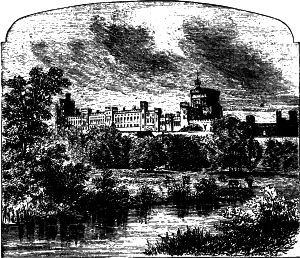
WINDSOR CASTLE.
In the Round Tower, which is 295 feet high, there were confined nearly all the State prisoners whom despotism found it necessary to secure in its dungeons, from Edward III to Charles II, and in the "Audience Chamber," which is hung with Gobelin Tapestry, representing the story of Queen Esther, are paintings of Mary, Queen of Scots, and William, Prince of Orange. This is an "Audience Chamber" only in name, for the Queen very seldom holds levees in this big, desolate-looking room.
The "Waterloo Chamber" is 47 feet in length and 45 in height, and has a gallery of magnificent portraits, by Lawrence, all of whom were, in some fashion, connected either in the closets of diplomacy, or the fields of strife, with the downfall of Napoleon; hence the name of "Waterloo Gallery." Here are life-size portraits of Wellington, Lord Castlereagh, Humboldt, Alexander I, Count Nesselrode, Capo d'Istria, Prince Schwartzenburg, Archduke Charles, Blucher, Platoff, the Marquis of Anglesea, Francis II, of Austria, Pope Pius VII, and others equally famous.
In the Grand Chamber is a piece of ordnance, taken from Tippo Saib, at Seringapatam, a table made from the wreck of the Royal George, and an elaborately worked shield of silver, inlaid with gold, made by Benvenuto Cellini, which was presented by Francis I, of France, to Henry VIII, of England, at the Field of the Cloth of Gold.
The Throne Room has a fine ceiling, ornamented with the different emblems of the Order of the Garter. Here the Queen sits enthroned on occasions of State, and receives her guests habited in a scarlet velvet mantle, trimmed with miniver. On one occasion, when her Majesty took her seat here, her costume, including the jewels and Crown, was valued at £150,000, a vast sum to be thrown away on such heartless vanities, when it is recollected that myriads of people were dying of want and starvation in her Kingdom at the time.
The Throne is a very fine piece of work, and is covered with heavy hangings of red velvet, and is ornamented with the rose, shamrock and thistle.
IN THE QUEEN'S CHAMBER.
By special permission I had the pleasure of beholding the Queen's bed-room, or Private Closet. This is a favor seldom shown to any but foreign noblemen, or Embassadors, but by diligent efforts I had succeeded in getting permission to look at this sacred place.
On the day that I visited Windsor Castle, it luckily happened that very few visitors had called, and as I had a note from a most high personage, with permission to see the private apartments of Her Majesty, I was glad that there was not a crowd to witness the result of my mission. As a point of honor, I find it impossible to mention the name of the great personage who gave me permission to visit the Queen's Chamber, as I fear it might give him trouble, and perhaps deprive him of his lofty position.
Even the attendant, to whom I showed the note, was afraid to allow me to enter the apartments, as the Queen had only left them early that same morning to take a drive, and was expected back during the evening. It was now two o'clock in the afternoon, and I began to fear that I would not see the private saloons of her Majesty.
The attendant said, in answer to my request:
"I tell you, Sir, I'll lose my place and perkisites if I show the hapartments to you. I dare not do it."
"But," said I, "there is an order from Lord ——, will not that be sufficient?"
"Yes," said he, "his Lordship is a great friend of the Queen, but I'm afraid this order is a mistake, and only refers to the public apartments, which I have no hobjection, Sir, to your seeing."
I began to think I would fail if I did not find a weak spot in the gorgeous flunkey.
Suddenly a thought struck me. I asked myself "who has been the most popular and best loved American in England?"
Echo answered, "George Peabody."
And "why," the inward monitor asked.
Echo answered again, "because he gave so much money away," for I was positive that the English (servants at least) did not care for any of his less showy virtues, in comparison with that of bestowing millions from his private purse! Why, the Queen herself give him her portrait. Did she not?
The flunkey seemed to read my soul the while that I communed with myself.
I felt that I must throw myself in the breach. Suddenly I slipped a bright new sovereign into the man's hand. His fingers closed on the shining gold coin like the teeth of a vise and his eyes glistened. I knew then from his look that I would have to pistol the flunkey on the spot before I could get back my sovereign. We were going toward the private apartments of her Britannic Majesty, who is also Defender of the Faith.
A long corridor lay before us, and the flunkey stopped and said to me:
THE SECRETS OF ROYALTY.
"I'll try it, Sir. You are indeed very generous, and I honor you for it, but I don't know whether we can pass the Yeoman of the Guard. They are always about here guarding Her Majesty's private apartments. This is the Queen's Closet."
He pointed to a lofty doorway, and I saw a big, bloated Britisher, walking up and down with something on his shoulder that looked like a meat-axe fastened upon a clothes-pole. He had a red tunic, and wore a round flat hat, and his legs which were very noble and imposing, were clad in red hose.
The flunkey, who was also in tights, went up to him and spoke, and I assumed a business-like air. He was telling the red-faced Beef-Eater, as I afterwards ascertained, that I came to make some repairs in the closet, but the Beef-Eater did not seem willing to admit any one; but by some moral suasion he obviated his scruples, and I was allowed to enter. I think he divided the sovereign with him.
The flunkey beckoned to me, and I approached. The Beef-Eater—noble fellow—looked the other way, as I entered the imposing apartment.
The flunkey stood in silent awe, as I looked around on the splendors of the lofty room.
A magnificent bed stood in a corner of the apartment, hung with red velvet and yellow silk. The arms of Great Britain were emblazoned on the heavy red velvet, and the Lions and Unicorns, disported playfully all over the room in their usual attitudes. There were large oil paintings of George IV, King William IV, the Duke of Kent, father of Queen Victoria, the Prince of Wales as a Colonel of the British army, and the Princess Louise, a marriageable daughter of Queen Victoria.
The bed was large and would have held three persons of the size of Queen Victoria. Elegant lounges were arranged around the lofty apartment, covered with damask satin. A faint and delicious odor filled the room, and I seemed to sink in the soft and luxuriant carpets. Mystery, silence, and enchantment prevailed, and I trembled to think that I stood in the presence of Royalty unbidden, and without the permission of the Queen.
There was a sideboard of most intricate carving at one end of the room, with some green Venetian glasses on one of its shelves, but I saw no decanters. The room was filled with a glory and power, reflected in the possessor of three Kingdoms. From without, through the deeply embayed windows, also hung with satin of the color of a morning sky, I could hear the tramp of the sentinels on the battlements, and the hoarse cry of the warders, going their rounds, demanding the counter-sign of strangers.
The charmed silence was broken by the voice of the flunkey in answer to my enquiry as to how the aromatic odors of the chamber were procured.
"Her Majesty is werry fond of perfumes, Sir," said he. "The carpets has Cologne shook on them every morning, and if you will come here to the bed, you will also get the smell of Patshooly."
I walked to the bed and I found that there was an odor of cologne, otter of roses, and musk, proceeding from the counterpane, which was bordered with purple velvet and gold lace, and had the royal arms embroidered in the centre. The pillow slips had trimmings of Valenciennes lace, half a yard wide, hanging from their open ends. The counterpane was of quilted blue and pink satin, and inside of the velvet canopy that covered the bed, was a lining of blue and white satin, from which hung down heavy folds of Mechlin lace.
A little table of ivory, inlaid with gold and lapis lazuli, stood a few feet from the bed, supported by a tripod elegantly worked in solid silver.
The flunkey explained to me the use of this table. "Sometimes Her Majesty takes her breakfast in bed," said he, "when she is indisposed. Her Majesty is werry fond of coffee, and often takes two cups of a morning when she is stopping at Windsor. She is fond of veal cutlets, well done, and sweet breads, for breakfast. Yes, Sir, I have heard that Her Majesty, God bless her, when she had a good appetite, before Prince Albert died, would eat a pound of veal at breakfast. The lady in waiting places her coffee on that small table, and after handing Her Majesty her breakfast in bed, she stands off at a respectful distance, and waits until she is called again to offer Her Majesty a favorite dish. The Duchess of Athole, who is a relation of Lady Mordaunt, is greatly liked by Her Majesty, and when she waits on the Queen, Her Majesty allows her to sit down, but all the other ladies in waiting, excepting Lady Dianna Beauclerk, has to stand up. Sometimes, when the Prince of Wales comes here, God bless him, he is awfully screwed (drunk), and then the Queen makes a preshis row, and she wont speak to him for a week after.