Front matter (continued 7)
Reading edition
LORD STANLEY AND THE O'DONOGHUE.
The medium sized gentleman with the thoroughly English face, wavy hair, and plain and unostentatious attire, who passes behind the Speaker's Chair for a moment, and then whispers to that awful dignitary, is the Duke of Richmond, the leader of the Conservative party in the House of Lords. The Duke is quite popular in England, and has a magnificent park and castle at Goodwood, where a race takes place every year, for a prize called the "Goodwood Cup." Under the administration of Mr. Disraeli the Duke held the position now occupied by John Bright, who is President of the Board of Trade.
There was for some time a warm rivalry between the Duke of Richmond, Lord Cairns, and the Marquis of Salisbury, as to which of the three should lead in the House of Lords, and at one time, I believe after the death of the lion-like Earl of Derby, Lord Cairns, who used to be an Irish lawyer before he was ennobled, had the best chance from his great ability, but the high position and family of the Duke carried the day.
That plain looking man who with a slight inclination to the Speaker and doffing his hat, passes out to the Division Lobby, is Lord Stanley—now Earl Derby, since the death of his father. Lord Stanley, who is now in the House of Lords, was one of the ablest members of the House of Commons, a forcible debater, a logical reasoner, and a thorough gentleman in all respects. Lord Stanley entered political life very early, and has filled various offices of trust, being successively—Under Secretary of Foreign affairs in 1852; Secretary for the Colonies in 1858; Secretary of State for India in 1858-9, and Secretary of State for Foreign Affairs in 1866-8.
The tall, dark-haired and handsome looking member who has followed Viscount Bury in debate, and who speaks so fluently without notes, and whose language and gestures are not without a certain grace and elegance, is The O'Donoghue member from Tralee, who was going to marry an Earl's daughter in order to pay his debts—but didn't. The O'Donoghue challenged Sir Robert Peel to fight a duel a few years ago, having been offended by some unparliamentary language of Peel's in the House, but the latter backed out of the row in a very undignified manner.
Lord Stanley having forgot something, comes back to find it, and searches the bench behind the spot where The O'Donoghue is speaking from, which rather confuses the Irish orator a little—but Lord Stanley apologises at once. By the way, Earl Derby is said to be engaged to the Marchioness of Salisbury, whose husband died a year ago. This will be a late marriage for both parties, the intended bride being forty-six years of age with five children, the youngest of whom is a daughter twenty-two years of age, while Earl Derby is forty-four years of age, and very common-place and prosaic in his domestic habits. The Marchioness is, I believe, a daughter of Earl De La Warr.
Three men now enter the House and take seats—two in the galleries, who are soon joined by a third. This last man is the richest noble in England. He is an old man on the brink of the grave, and yet he could buy up a dozen of the members of Parliament who are fuming and fidgeting below in the freshness of good health. It is the Marquis of Westminster, who owns half of the borough from which he takes his title, and his income I have been told is something like four hundred thousand pounds a year. The Marquis is very charitable, and has spent over £100,000 in erecting model tenements for poor people in London. Beside the title of Marquis, he also bears that of Sir Richard Grosvenor, which is supposed to be derived from the French of Gros Veneur—"Great Huntsman,"—some of the ancestors of the family having acted in that capacity to the Norman Dukes at a remote period.
The other gentlemen are Earl Spencer, the Lord Lieutenant of Ireland, a big man with a big head, a big whisker and a big look in the face, wearing a big tweed coat; and the Hon. Robert Wellesley Grosvenor, one of the members for Westminster, a Captain in the 1st Life Guards, and belonging to the family of the old Marquis of Westminster. He has for his colleague who now takes his seat, William Henry Smith, the other member for Westminster, who owns the largest news agency in the world, at No. 186 Strand.
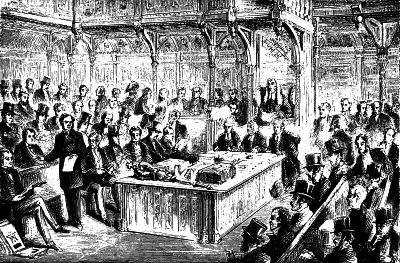
GLADSTONE SPEAKING IN THE HOUSE OF COMMONS.
And now the Premier is on his legs at last. I had heard of Gladstone so often that I was curious to hear his voice and look upon his face. Imagine a tall man, six feet in his stockings, with a massive head, a good strong body, sparse side whiskers just whitening with years, a pair of dark eyes, deep as an abyss, with the thoughts and struggles of a mighty spirit welling up—firm lips and cavernous eyebrows, a massive and persistent under jaw, the lines of the face strongly marked and indicating by their rigidness the conflict that has been going on inwardly for years, and dress that figure up in deep black upper garments and mixed trousers, and you have something like the Premier of Great Britain as I saw him in his seat on the end of the Treasury benches in Parliament. One leg is thrown over another in a negligent and thoughtful attitude, the head being bowed forward on the breast, while every few minutes he raises his eyes with a wonderful mystery glittering in them, to the face of the member who has the floor, as if he were taking the mental measurement of the speaker. The face represents a fierce enthusiasm which can kindle into great deeds, or express with a glance great thoughts.
MR. GLADSTONE'S EARLY LIFE.
This wonderful man started in life as a High Churchman and Tory, believing that all bishops should know Greek and acknowledge the Apostolic Succession, and now he is an advanced Liberal, but opposes woman's suffrage as a dangerous measure. In religion Gladstone sticks to his Oxford teachings, and this is best proved by his Episcopal appointments, nearly all of whom are High Churchmen.
How grandly the sentences roll from the lips of the scholarly Premier, as he stands up to reply to some attack on the administration. Every sentence is rounded, full, concise, and flowing, and every phrase seems chosen with elegance. He is a marvelously brilliant speaker, but it is better to hear him than to read his speeches, which though perfect literary compositions, are yet, in type, brilliant and dry abstractions, while the contrary may be said of Bright's speeches, whose productions sound better in a report than they do when they are delivered.
And now he has done, and sits down, slamming his hat on his head, and reclining back, with his eyes glued on his shirt bosom; and from the Opposition benches at the other side of the House, a tall, massive figure, which is radiant with jewelry and surmounted by a poll of black curly hair, rises to answer Mr. Gladstone. The face is corrugated, the nose like an eagle's beak—curved—like those on Roman coins, or just such a nose as Titus encountered by the thousand, under piercing, almond-shaped black eyes, in the Court of the Holy of Holies, when the Chosen People fell in heaps behind their shields, only glad to die for Jerusalem.
Yes, here is one of that same wonderful, plucky race, which has survived hundreds of years' of war, pestilence, famine, persecution, and contumely, and now finds its best representative in Benjamin Disraeli, the author of "Tancred," "Coningsby," "Henrietta Temple," and "Lothair," that book of books. This is the same Jew whom O'Connell thundered at thirty years ago, and whom he denounced as the lineal descendant of the impenitent thief who died upon the Cross. Thirty-three years ago this man entered Parliament and made his maiden speech, or attempted to make it,—as a member from Maidstone. The crowded House laughed at him that night,—men who were used to Canning, and Henry Brougham; to that consummate orator, Daniel O'Connell, and to the brilliant fireworks of Richard Lalor Sheil,—laughed at the young member with the Jewish beak and profile, and he sat down discomfited, but not beaten, crying out to the House, which was indulging in cock-crowing and geese-cackling at his expense, "You will not hear me now, but you shall hear me yet."
He is an older man now, and success in everything he has attempted, such as has never been given to any living man but Louis Napoleon, has rewarded his efforts. Hear how he dashes into Gladstone's eloquent sentences with his biting, withering words of sarcasm,—how he overthrows the airy edifice which the Liberals were just now contemplating,—listen to the fiery words of this master of wit and trenchant, cutting invective—invective that spares no feeling or cherished opinion, but bares the breast of the Minister like the surgeon's hand to plunge still deeper the scalpel in the roots of the wound.
Now he has done, and he sits down, and members crowd around him and congratulate him, but he receives their incense with a wearied, indifferent air, that seems to say, "I have been Premier myself, and I think it to be a small place for a man of ability."
DANIEL O'CONNELL.
And so the night passes on in the House, member after member getting upon his honorable legs, and the small hours come on apace, and the small talk continues, and the Speaker comes in and goes out, yet still the House remains in Committee—a very wearisome night it is, and hot and close in the galleries, and many sleep the sleep of exhaustion in the legislative arena—while off in green fields and on grassy meads, by lakes and rivers, the dew falls heavily, and the English Moon shines with a soft light all over the broad land.
It is amusing to see the Speaker of the House settle a point of order when members become obstreperous, with his little cocked hat in his hand, or to see him reprimand a member who crosses the horizon of a member who is addressing the House. This last offence is considered a great breach of etiquette, and the Speaker always instructs the offender that he should have made a tour around the House to avoid giving offence to the orator. Sometimes a tired member will notice that there is not a sufficient number of members in the House to transact business, and if he wishes to escape a threatened monstrous debate, he must notify the Speaker that there is not a quorum present. Perhaps the Speaker may desire to rush some business through, and he will therefore have to be notified several times before he will take warning to count the members, which he does at last with slow reluctance.
It has been the privilege of any member (from time immemorial,) to inform the Speaker that there are strangers in the gallery, meaning ladies, reporters, or any one who is not a member of Parliament. When so notified, the Speaker, by this musty old rule, is compelled to order the strangers to leave the House. Thirty years ago Daniel O'Connell quarreled with the London Times, and that paper in revenge would not print his speeches. O'Connell determined to be even with the journal, and whenever he saw a Times' reporter in the gallery, he would cry out, "Mr. Speaker, I beg to call your attention to the fact that there are strangers in the gallery." Then the Speaker would order the galleries cleared, and the Times' reporters had to take their note books and march off disgusted. It was not long before the Times gave in and stopped the fight, and O'Connell's speeches were reported with fidelity. This has always been regarded as a joke of O'Connell's, but I see that lately a Scotch member named Craufurd, who represents the town of Ayr, and is also editor of the Legal Examiner, has been putting O'Connell's joke in practice.
Miss Florence Nightingale, Miss Lydia Beckett, and Miss Harriett Martineau, as well as many other well known ladies, have been for some time working with great zeal for the repeal of the act which licenses prostitution in garrison towns. Many members of the House are opposed to the repeal of the act, and consequently when the question of repealing it came up in the House, and just as the debate had opened, the member for Ayr, Mr. Craufurd, rose and said, "Mr. Speaker, I beg to call your attention to the fact that there are strangers in the gallery," pointing to the gallery where a few ladies had placed themselves, for the purpose of hearing a question of so much moment to their sex, discussed. The Speaker and many members urged Mr. Craufurd not to look that way, and to permit the obnoxious persons to stay where they were; but with Scotch obstinacy he insisted, and Mr. Bouverie upheld him in it, saying, "I believe it is an undoubted rule of the House, sir, that if an honorable member does notice the presence of strangers, the galleries are cleared." Accordingly they were cleared; the reporters, as well as the ladies, were put out, and then the debate went on for several hours. At the close of this, the Prime minister, Mr. Gladstone, got up and lectured Mr. Craufurd for his ill-timed modesty, telling him that the feeling of the whole House was against him. The debate was therefore adjourned, by a strong vote of 229 to 88, to come up again in the presence of reporters, and most likely, of such strangers of either sex as may choose to come in.
DUCAL HOUSES.
The House of Lords is the Upper House of Parliament; in England all bills that are born in the Commons have to be confirmed by the Lords and signed by the Queen, before they become part of the statutory law of the land. There are about four hundred of these legislators in the House of Peers, for it must be understood that every nobleman does not sit by right in the House of Lords. In many families the privilege is hereditary, and generation after generation a family is represented by the oldest son, who, on the death of his father, takes the seat made vacant in the Lords. The highest rank of nobility in England is that of Duke. There are eighteen nobles who enjoy the Ducal dignity in England, two in Ireland, and six in Scotland. They are as follows:
English Dukes.—Norfolk, Somerset, Richmond and Lennox, Grafton, Beaufort, St. Albans, Leeds, Bedford, Devonshire, Marlborough, Rutland, Manchester, Newcastle, Northumberland, Wellington, Buckingham and Chandos, Sutherland, and Cleveland.
Irish Dukes.—Leinster, Abercorn.
Scotch Dukes.—Hamilton and Brandon, Buccleuch, Argyll, Athole, Montrose, and Roxburghe.
There is only one Duchess in her own right—the Duchess of Inverness, which is a Scotch title. On state occasions Dukes wear velvet robes and ducal caps of state, with strawberry leaves in gold.
A stranger addressing one of these Dukes, has to begin his letter as follows:
"My Lord Duke, may it please your Grace." And in state proceedings a Duke is styled "High, Puissant, and Noble Prince." There are Dukes and Dukes. Dukes of the royal blood are still higher in rank than the noble Dukes. The eldest son of the reigning monarch always bears the title of "Prince of Wales." The eldest daughter is called the "Princess Royal." This princess is married to the Crown Prince of Prussia. These two dignitaries, according to court etiquette, are served by the attendants, when at table, on bended knees with uncovered heads. Those admitted to kiss their hands must also kneel. In the House of Lords, when the Queen is present, the Prince of Wales, as heir apparent, sits on the right hand of Her Majesty, while Prince Albert always sat on her left hand. The younger sons of the Queen, when they are Peers, sit on the left hand of the throne, but after the father dies, they sit below the Wool Sack, (a huge fiery red bed-tick full of wool, on which the Lord Chancellor takes it easy when the Lords are in session,) on the bench assigned to the other Dukes.
The Prince of Wales, when on his throne, wears a robe of ermine, a cape of ermine, and a red velvet cap, with a gold tassel over a gold crown, ornamented with pearls. The younger sons and daughters have no diamonds, pearls, or crosses surmounting their diadems—unlike the Prince of Wales.
The three highest subjects after the Queen and the Royal Family in England, are: First, The Lord Archbishop of Canterbury. Second, The Lord High Chancellor of England. Third, The Lord Archbishop of York. The Archbishop of Canterbury, who is Primate of England, is styled in public documents, and he also writes himself, "The most Reverend Father in God, the Lord Archbishop of Canterbury, by Divine Providence." The Archbishop of York signs himself, "By Divine Permission," as do all the other Bishops. There are only two Ecclesiastical Provinces in England, those of York and Canterbury, and two Archbishops. In the House of Lords the Archbishops and Bishops, (excepting the Irish Bishops now disfranchised,) sit as Spiritual Peers, and the two Archbishops wear Ducal Coronets—the Bishops wearing fillets of gold on their heads, with pearls and jewels. The Bishop of Sodor and Man, and the junior Bishops have no seats in the House of Lords. A Bishop ranks next to a Viscount. The nobility of Great Britain own three-fifths of the landed property of the Kingdom, while starvation and want run riot in the land.
England is studded with parks, villas, castles, game preserves, rabbit warrens, trout streams and deer parks, all of which are held by right of primogeniture. No poor man can enter these beautiful ancestral domains, and the severest penal punishments are meted out to those poor wretches who dare to infringe on the game laws.
The English nobility are not cowardly or treacherous, but many of the younger members are very corrupt, extravagant, and reckless, and no doubt in time their order will pass away, for they are out of place in this century.
PRIVILEGES OF THE PEERS.
England has nineteen Dukes, seventeen Marquises, one hundred and three Earls, one Countess (widow of an Earl), nineteen Viscounts, one Viscountess, and one hundred and fifty-two Barons.
Ireland has two Dukes, twelve Marquises, sixty-four Earls, and sixty Barons, besides twelve Viscounts. When three Irish Peers die in succession without issue, one other Irish Peer is created to fill the gap.
Scotland has seven Dukes, four Marquises, forty-four Earls, five Viscounts, and twenty-five Barons. The wife of a Duke is entitled "Duchess," the wife of a Marquis "Marchioness," the wife of an Earl is a "Countess," the wife of a Viscount is called a "Viscountess," and the wife of a Baron enjoys the title of "Baroness." The better-half of a Baronet, which is a title bestowed upon fat aldermen and rich manufacturers—being a cheap order of knighthood, conferred by the Queen, is called "My Lady This," or "My Lady That," as the case may be.
The people of England are heartily tired of their nobility, and the success of American principles upon this continent has a tendency to cause the destruction of this social outrage upon the Nineteenth Century.
Peers, or members of the House of Lords, have many privileges which others of noble blood do not enjoy. A Peer can only be tried for High Treason or murder by his Peers, who compose the House of Lords, and the trial takes place in a session of that body specially convened for that purpose, after the fashion here described.
The Peers having taken their seats in full, flowing robes, the Lord Chancellor seats himself on the Woolsack in the middle of the House of Lords, the Garter-King-at-Arms, in his gorgeous surcoat and tabard, makes proclamation of the offences against the culprit Peer. The Lord High Steward puts the question to each peer in his seat, after the evidence has been heard;
"Is the prisoner at the Bar Guilty or Not Guilty?"
Then each Peer, rising, says, "Guilty," or, "Not Guilty upon my Honor," as the case may be. A Peer cannot be taken into custody unless for an indictable offence. This is also a parliamentary privilege of the members of the House of Commons, who cannot be arrested for debt while the House is in session, or while attending the proceedings, or going to or from Parliament. An old custom of England allows a Peer, going to or from Parliament, the privilege of killing one or two deer belonging to the Sovereign, after he has blown a horn. This is very seldom done now-a-days. A Peer cannot be bound over to keep the peace, excepting in the Court of Queen's Bench. Slander against a Peer is known in the courts as scan. mag. and is severely punishable.
A Peer cannot lose his title of nobility excepting by death, or when he has been attainted for High Treason. He is allowed to answer to a bill in Chancery upon his word, and is not required to take an oath. The Sovereign may degrade a Peer from his rank for wasting his estate, as in the case of George Neville, Duke of Bedford, who had led a dissolute life and had squandered all his fortune. He was deprived of his title, honors, and possessions, by Edward IV, the latter being forfeited to the Crown. If that precedent was followed in these times, a great number of scampish young nobles would lose their titles and the remnants of princely estates.
Lately, I believe, Parliament has ordered it so that a Peer may be proceeded against for debt, as in the case of the bankrupt Duke of Newcastle. Besides all these manifold privileges, which exist for the benefit of the nobility, the Diplomatic Service is chiefly for their support, and here, as in the Foreign Office, fat sinecures are available at all times, for the improvident and spendthrift nobles. Some idea of the rich prizes of the Diplomatic Service may be got from the following list of salaries of the different Ambassadors, Ministers, and Charges d'Affaires, at the principal countries with which Great Britain holds intercourse. The salaries I give are those of the Ministers alone, not including the salaries of attaches, and they are thus enumerated:
SALARIES OF AMBASSADORS.
France, £10,000; Turkey, £8,000; Russia, £7,800; Austria, £8,000; Prussia, £7,000; Spain, £5,000; United States, £5,000; Portugal, £4,000; Brazil, £4,000; Netherlands, £3,600; Belgium, £3,480; Italy, £5,000; Bavaria, £3,600; Denmark, £3,600; Sweden, £3,000; Greece, £3,500; Switzerland, £2,500; Wirtemberg, £2,000; Argentine Republic, £3,000; Central American Republics, £2,000; Chili, £2,000; Peru, £2,000; Columbia, £2,000; Venezuela, £2,000; Ecuador, £1,400; Coburg, £400; Dresden, £500; Darmstadt, £500; Rome, £800; Persia, £5,000; China, £6,000; and Japan, £4,000.
CHAPTER XX.
THE LONDON POLICE AND DETECTIVES.
BOUT ten o'clock in the evening, the rain, which had been gathering all day, came down in bucketfuls. The gutters ran like little rivers, and on Lothbury and the Poultry, and on all the buildings behind the Bank and over London Bridge there came down a hot steaming fog that almost blinded, as the rain poured against the faces of those who had to encounter the storm. The rain was hot, and the fog had a fetid, sticky odor, that seemed like the breath of a graveyard, or a festering corpse in an old vault on a hot July day.
Down below, on the river, all was quiet among the noisy Wapping boatmen, and the river below London Bridge looked gloomy and vast and dangerous as the entrance to the shades of the Inferno. Now and then, through the dense darkness and gloom which hung like a tissue over the river, came a whistle, eldritch-like, from the funnel of some Greenwich or Chelsea steamer, as she grated against the fishermen's barges, that lay like huge floating carcasses out on the bosom of the dark river; and anon came the hoarse, drunken shout of some intoxicated oyster or herring navigator, who lay in the shadow of Billingsgate Market, returned from some Flemish or Scotch port with a precious cargo of eels or sprats. London, or the City, seemed deserted and lonely. The portal of the Bank was as solemn as a churchyard.
THE OLD JEWRY.
The insurance offices in Bishopsgate and Broad streets, the money-changers' and money-brokers' haunts in Leadenhall street, and the merchants' desks in Cornhill and Gracechurch street, were forsaken. A footfall seemed like an echo of past years, and while the water ran in torrents in the gutters, and while misery haunted doorsteps and dark passages, seeking shelter with dripping rags to hide its shame, the stolid policemen walked their rounds and looked sharply through the thick fog as cabs dashed by, for the West End, and the noise of the horses' feet died away under the arch of Temple Bar.
Where the Poultry, Bucklersbury, and Cheapside, form a junction, just below the Mansion House, there is a little, narrow, and short street. This street is called the "Old Jewry," and it has its outlet in Coleman street and Moorgate street, which run in the direction of Finsbury square. Behind the Old Jewry is Basinghall street, the Aldermanbury, and Finsbury square. Then there are Milk street, Wood street, Botolph street, Pudding lane, Fish street, Mark lane, Lime street, and Love lane. In all these narrow causeways, dark passages, and crooked sinuosities of brick, stone, and mortar, untold and uncounted wealth is hidden away, safely behind bolts and bars.
These tall, lowering warehouses, with their treasures of spices and silks, ingots and bars of yellow metal, where guineas are shoveled about all day as if they were plentiful as cherry-pits—have a dismal effect this sloppy, stormy night. Then the Old Jewry has its memories, some sorrowful and sad enough. Its very name a synonym for persecution and torture, a relic of steel-clad days and roystering and merciless nights, when the tribes of Israel were the playthings of the Gentiles and unbelievers.
Here, in this narrow lane, stood the proudest synagogue in all England until the year of grace 1291, when the Jews were, by edict, expelled the kingdom; and here came the Brothers of the Sack, a mendicant order of friars, to take possession of the deserted temple, one sunny May afternoon, when the orchards were blooming, and the linnets were singing in Cheapside—now a mart of all the nations of mankind. And then, in the natural order of things, came Sir Robert Fitzwalter on another sunny afternoon, to dispossess the Brothers of the Sack; and this doughty knight, having the ear of the then King, turned the monks out, and they, invoking the displeasure of the Maker of all things upon Knight Fitzwalter, banner-bearer to the city and the Lord Mayor of London, left the convent and dispersed themselves severally and sorrowfully, all over the by-paths and sequestered roads and nooks of merry Old England.
The Old Jewry is about two hundred and fifty feet long. Short passages, that cannot be dignified by the title of lanes, jut off this narrow street. High buildings loom up to the sky above the heads of the passers-by, and the dome of mighty St. Paul's is hid away from the vision.
In this Old Jewry is a court-yard hidden away. There are jewelers' shops, silk-mercers' shops, and chop-houses of the better class on either side, and a man, in a blue cloth uniform of heavy fabric, walks up and down, day and night, with a pasteboard helmet on his head. His wrists are trimmed with bands of crimson and white flannel, and one row of gilt brass buttons bifurcate his blue, close-fitting coat, and meet to part no more at his throat and waist. The face of the man is homely, and his black eyes burn under his helmet of a hat, and in the glare of the street lamp. Not a soul stirring in the Old Jewry to-night but this silent patrolman, who looks up and down the lane, now to Cheapside, now over the roofs as if he would like to get a glimpse of St. Paul's, whose bell booms with an affrighting suddenness and energy on the air, through the beating rain and blinding fog.
"Is this the Central Detectives' Office?" I ask of the helmeted patrol.
"Yes, sir. This 'ere is the Central Hoffis of the City of Lunnun; the hother hoffis is down Scotland-yard way in Parliament street, hopposite the Hadmiralty and the 'Oss Gy-a-ads."
I find my way past the patrol, and around me I can see a court-yard fifty by a hundred feet in size, and at either side a gas-lamp burns dimly, and the wind whistles down from above, and the rain patters unceasingly.
RELICS OF CRIME.
It is like a play-ground or school-yard, but there is in it the quietness of a deserted church. Turning to the right, I ascend two steps and enter a hall, where another morose-looking patrolman demands my business.
"Who do you want to see, sir? Oh, Hinspector Bailey. Well, sir, he is werry busy just now; got a precious 'ard case to desect; but I'll take your card and I'll try wot I can do."
In a few minutes I am ushered into the presence of the chief detective officer of the chief city of England. He sits in a room secluded from the main rooms, and as I pass through a number of these chambers a squad of men, who are sitting on chairs and lounges, look up at me quietly for a second, and, not recognizing any one whom they "want," drop their eyes immediately. The room in which Inspector Bailey sits is not a large one, and there is no superfluity of furniture, but the walls are covered with placards offering rewards for the apprehension and conviction of criminals, murderers, forgers, and other runaways from justice. Some of these are so curious that I must give a few of them:
RING STOLEN—£1 REWARD.
A reward of £1 will be paid for information that shall lead to the discovery of a gold ring, the setting in which was originally arranged for a round stone, with about five small teeth or holders to fix the same; the original stone having been lost it was replaced by an oval or pear-shaped rose diamond, which was loose in the setting.
The said ring was stolen from a warehouse in the city, on the 14th inst.; and it is requested that any person hereafter offering it, for pledge or sale, may be detained until the police are informed.
Information to Inspector Bailey, City of London Police, Detective Office, 26 Old Jewry: or to the officers on duty at any of the city or metropolitan stations.
£1 10s. REWARD.
TO CAB-DRIVERS, ATTENDANTS, AND OTHERS.
INFORMATION WANTED.
On Saturday, the 17th of April, 1869, about 4.45 in the afternoon, a four-wheeled cab, took up at Messrs. Smith, Payne & Co.'s Bank, at the end of King William street, near the Mansion House, a gentleman, 48 years of age, 5 feet 8½ inches high, dark brown hair, fresh complexion, scanty whiskers, square build, and moderately stout; with a dark-brown portmanteau, which was put inside. He told the driver to take him to Finsbury square and he would tell him the number afterwards. £1 10s. reward will be paid on the required information (as to his destination) being given to Inspector Bailey, City of London Police, Detective Department, Old Jewry, E.C.
London, 8th May, 1869.
£200 Reward.
EMBEZZLEMENT.
Absconded, on Friday, the 5th inst., from the employment of the Great Central Gas Company, 28 Coleman street, London, Benjamin Higgs, late of Tide-End House, Teddington, Middlesex. Description.—About 35 years of age, 5 feet 9 or 10 inches high, black hair, mustache, whiskers, and beard, pale complexion, slender build, gentleman-like appearance. Generally dressed in black or dark clothes and brown overcoat. Had a large-sized dark green-colored leather bag and a small black bag.
The said Benjamin Higgs is charged on a warrant with embezzling a large sum of money belonging to the above company: and notice is hereby given, that a reward of £100 will be paid to any person who will give such information as shall lead to his apprehension; and a further reward of £100 on recovery of the monies embezzled. A photograph of Benjamin Higgs may be seen on application at the principal police stations.
Information to be given to Messrs. Davidson, Carr, and Bannister, Solicitors, 22 Basinghall street, E.C., or to Inspector Bailey, City of London Police, Detective Department, 26 Old Jewry, E.C.
London, 18th March, 1869.
"So you would like to see London under its most unfavorable aspects. You would like to scour it by day and night, Sir. Well, you have a big job on hand, let me tell you, Sir," said a cheery voice which came from behind a low desk. This was Inspector Bailey, a very English-looking gentleman, with a ruddy oval face, reddish whiskers,—thick and neatly trimmed, and wearing a dark-mixed suit of clothes. He had clear blue eyes, this cheery-voiced inspector, and did not in any way give the idea of a detective, he looked so jolly and well-fed, and there was such a humorous, good-natured, twinkle in his eyes.
MR. FUNNELL'S SECRET.
"Well," said he, "let us see what's best to do for you, sir. I'll give you the best men I have, and I can do no more. I suppose you want to see St. Giles? Well, St. Giles is not what it once was. You see they have been rooting up the worst holes, and the parish authorities are quite active, and three new streets have been opened, and a great change has come over the place. But there's a terrible lot of destitution and crime and misery in the City of London still, and you can see it all if you have the heart for it. Send up Sergeant Moss," said the Inspector to a messenger.
Sergeant Moss came up from below stairs, a dark-eyed, thick-whiskered, good-looking fellow of thirty-five years, dressed like a dissenting minister, and trying to look very meek. Butter would not have melted in Sergeant Moss's mouth. He wasn't "fly" to what was going on neither. Oh, no!
"Sergeant Moss, you will take this gentleman through Ratcliffe Highway and Wapping, and show him the sailors' dens and the thieves who haunt Lower Thames street. Give him the best chances you can, and look out for Bill Blokey. He's down that way to-night, more nor likely, and if you brought him in it would be no particular harm to him or you. We got the trunk that he broke open and left behind. That will be your detail. Send me Funnell up stairs."
Mr. Funnell came. Mr. Funnell had a very huge beard, which hung down on his chest like a door-mat, and a sharp eye for business. In fact, he was all business, this cheerful Mr. Funnell. He was a first-class detective in London. But he had hard feelings against New York. It was no place for Mr. Funnell. Mr. Funnell confided to me a secret which I will now give to my readers.
"I wos wonst over in New York. That's a good many years ago. That was a long time ago. Yes, a very long time ago, in Bob Bowyer's time, when Bob was the topper, as we say. He wos the 'Awkshaw of the period, wos Bob. I wos awfully innocent then, and Bob didn't take the right care of me, and I fell into the hands of the Philistines. I went down one day to Fulton Market; I think it's just opposite some ferry where you go across, just like Southwark, and you can get very big oysters there. Well, as I wos saying, I wos werry innocent, and as I wos walking along, thinking of a good many things, when one of these fellows I believe you call the gentry on your side 'heelers'—dropped a big fat pocket-book at my feet.
"Now, mind you, I did not see him drop it, and that's where I was taken in. That made the trouble for me. I had never seen anything of that kind done in England, and of course the 'heeler' naturally insisted that the pocket-book wos mine. I tried to argue with him that the pocket-book wos not mine, but the more I argued that way the more he persewered the other way. Well, I wos perswaded against my own ideas that, perhaps, I might have lost a pocket-book, and the fellow wos so blessed positive about it too. So I fell a wictim to the infernal scoundrel, and gave him some money for the pocket-book, and, of course, the money wos worth nothink, and Bob Bowyer could do nothing for me. Ah, New York is a precious bad place.—So it is."
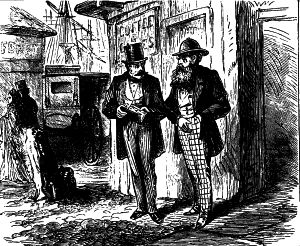
THE POCKET-BOOK GAME.
"Well, now, Mr. Funnell, as you have done relating your sad experiences, you will please do as I tell you. You will report to our American friend, or, rather, he will report to you early in the morning, and you will take him and show him Billingsgate Market before daybreak. You are the best man for Billingsgate, I think, and you had better attend to that detail."
"I will meet him there or at the Fish Hill monument, at 5 o'clock in the morning, if that will do, Sir."
"PIPING OFF."
"That will do very well," said the Inspector. "And now we want a man for Smithfield. Who is a good man for Smithfield? Let me see," and the Inspector tapped his forehead. "I think Ralfe will do for that. He knows the Smithfield Market best, and he will show you everything, with a knowledge of what he is doing. Let Ralfe come up, and Sergeant Scott and Webb. I want to speak to them."
Ralfe, or Dick Ralfe, as he was called, was a good-looking young Englishman, who had not been long on the force, and who was in capital health and spirits, having lately been detailed, for his quickness, to special duty from the patrol to the Old Jewry.
"Mr. Ralfe, you are good on Smithfield Market. Take this gentleman there at 4 o'clock to-morrow morning. Meet him at the Smithfield Police Station at 4 o'clock in the morning, and time your inspection so that you will be able to catch Funnell at the Fish Hill Monument at 5 o'clock in the morning, so as to have him see the fish come in at Billingsgate. And now, Sergeant Scott, you will show this gentleman the Minories, Petticoat Lane, Bevis Marks, Houndsditch, and the Jews' Quarters, but those you will have to take on another day, as you have already a hard day's work before you. You had better see the market on Sunday morning, one of the greatest sights in the world, sir, I assure you, and the Rag Fair is also a grand show of the kind, I also assure you; and now, Sergeant Webb, I will give our friend in your charge when he has got through with the rest of them, and you and he can work the City, I think. You will do the Bank and the Mansion House and Newgate; and, let me see,—Funnell can take him to the Sessions and the Old Bailey Courts; and he will have to go to Scotland-yard to do the Borough of Westminster, as that is not in our jurisdiction. And now, Sir, good morning, and don't carry a watch with you in the places where you are going, for some of the people are not very moral or very pious to get a look at. Good morning, Sir. Smithfield at 4 o'clock, Ralfe."
Sergeant Webb was a tall, well-built man, in the prime of life, with ruddy cheeks, and a look that resembled the expression usually worn by Mr. Seward before he lost all chances for the presidency. His face was smoothly shaved, and he looked as if he could assist with great dignity at a banquet.
Sergeant Scott was a man just above the middle height, with light brown whiskers, and an easy, good-natured manner, who had a memory well stored with anecdotes of "blokes," and "wires," and "dummies." He had, also, choice stories of distinguished people who had, during their lives, been known in the "faking" line, and could have pointed me out a number of pals who were celebrated in the "kinchin lay" for snatching "wipes" and "grabbing tanners" and "browns" from little children when they were sent to the shops for bread or milk.
At the back of the apartment in which the detectives were assembled to receive orders, stood a short, thick-set looking young man, with an amber moustache and goatee. His eyes were blue and his complexion very fair. He was dressed in a quiet manner, and nodded to each of the detectives as they passed out into the court of the Old Jewry. This was Jim Irving, the celebrated American detective, who had apprehended Clement Harwood, the great forger, just as he was about to land in New York, and he was now waiting the trial of the accused which was to take place at the Mansion House.
"Jim" was already quite familiar with the City of London, although he had been in it but a few days. He was, of course, rather astonished, at the quiet, old-fashioned way, that the English detectives had with them of waiting for a thief until he came and gave himself up. But he was very much charmed with a gorgeous seal-skin vest, for which he gave five guineas.
POLICE DIVISIONS.
Seventy-five years ago, London had not more than sixty-eight policemen or constables, and the present admirable system of Police is all owing to the clear head and sagacious mind of Sir Robert Peel, who first organized it about thirty-five years ago. The old local watch of the city consisted of the Bow street force of sixty-eight men, and the parish beadles, constables, headboroughs, street keepers, and watchmen, in the several wards of the City, and in many cases these so-called officers of the peace were rascals of the worst description, in league with thieves and prostitutes.
It is said that a Mr. George Vincent Dowling, (who was editor of "Bell's Life" at the time,) gave Sir Robert Peel the first idea of the present organization, which consists of a Board of three Police Commissioners, a chief Superintendent, 25 Sub-Superintendents, 136 Inspectors, 700 sergeants, and over 7,000 policemen. 4,000 men are on duty in the day-time and 3,000 in the night time. During the day they are never allowed to cease patrolling, being forbidden even to sit down. They wear dark-blue pilot woven short frock coats, buttoned up to the neck, trousers of the same material, with brass buttons on the coat and a pasteboard helmet covered with black rough felt.
The Police Districts are mapped out into divisions, the divisions into sub-divisions, the sub-divisions into sections, and the sections into beats, all being numbered and carefully defined. To every beat, certain policemen are detailed, specifically, and they are provided with little slips of pasteboard, on which are printed the routes they are to take. So thoroughly has this management been perfected, that every street, lane, road, alley, and court, within the Metropolitan District—that is, the whole of the metropolis—(excepting that part in a radius of three-quarters of a mile from St. Paul's, which is called the City of London Proper)—including the County of Middlesex, and all the parishes, 220 in number, in the Counties of Surrey, Kent, Essex, and Hertfordshire, which are not more than 15 miles from Charing Cross in any direction, comprising an area of about 700 square miles, and 90 miles in circumference, and with a population of 3,500,000,—is visited constantly, day and night, by some of the police. Within a circle of six miles from St. Paul's, the beats are traversed in periods of time varying from twenty to fifty minutes, and there are some points, such as the Bank, the Mint, the Cathedral of St. Paul, the Abbey of Westminster, the Houses of Parliament, Buckingham Palace, the Horse Guards, and the Inns of Court, which are never free from inspection for a single moment.
There are 130 police stations in the metropolis, and by a telegraph signal a Police Commissioner at White Hall, in Parliament street, which is contiguous to Scotland Yard,—the headquarters of the Metropolitan Detective force, who are separated in their duties from the Old Jewry or City of London Detective force,—can concentrate in an hour and a half as many as 6,000 men for instant duty. This vast force, each man receiving but three shillings to three and sixpence a day, is really under a wonderful control. Each officer has to walk twenty miles a day in his rounds beside attending the police courts, which is equal to five miles in addition. 98,000 persons were arrested in one year—1869, of which number 40,000 were discharged. The cost of the Metropolitan Police for one year was about £525,000, and the City Police, for the same term, £60,000—the City Police numbering 700, the Metropolitan force nearly 7,000.
The expenses of the Police Courts, for 1869, was £88,240, including the salary of one Magistrate at £1,500 a year, and thirty other Magistrates at £1,200 a year, each. Sixty pounds and six shillings were expended for rattles, swords, and clubs, in the same time. The City Corporation are allowed, by act of Parliament, to have their own Police and Commissioners in the heart of the metropolis, or City proper. There is, besides, a "Horse Patrol" for public occasions; eight hundred of which were on duty on the day of the Oxford and Harvard race; a "Thames River" Police, the "Westminster Constabulary," and a "Police Office Agency," for recovery of stolen goods. Before the establishment of the Thames Police, in 1797, the annual loss by robberies alone on the river, was £750,000 a year, the depredators having various, curious names, such as "River Pirates," "Light" and "Heavy Horsemen," "Mud-larks," "Capemen," and "Scuffle-hunters."
RIVER THIEVES.
They were frequently known to weigh a ship's anchor, hoist it with the cable into a boat, and when discovered, to hail the captain, tell him of his loss, and row away cheerily. They also would cut shipping and lighters adrift, run them ashore and then clean them out. Many of the "Light Horsemen" cleared as much as thirty pounds a night, and an apprentice to a "mock-waterman" often kept his saddle horse and country seat. During the first year of the Thames Police, the saving to the West India merchants alone amounted to £150,000, and 2,200 river thieves were convicted during that time, of misdemeanor.
In those days, the magnificent docks which are now the chief ornament of London, had not been built with their high walls to keep out the swarming thieves who haunted the shipping.
CHAPTER XXI.
HUNTING THE SEWERS.
IDDEN in the bosoms of the sewers of every Great City lies a world of romance. The secrets of thousands of human beings, with their hopes and aspirations, their defeats and disappointments, are garnered, in the relics of myriad households, whose rubbish is shot through drains, to be imbedded in the accumulated masses at the bottom of the soggy sewerage.
London has two thousand miles of bricked sewers, and the entire metropolis is honey-combed by these effluvious passages.
These sewers are, of course, choked with refuse and swarming with rats and other pestiferous vermin, by night and day, and are pervaded with noxious gases, which, when inhaled, cause almost instantaneous death. The rats grow as big as kittens in the sewers, and will face strong, healthy men, and give them combat—in legions. The rats feed on offal from the butchers' slaughter houses, which is poured into the sewers, and they also subsist on the grain which comes from the breweries, in different parts of the city.
Twenty years ago, the main sewers of London, having their outlets on the river side, were completely open, and it was lawful to enter them to search for valuables, but since then so many people have died of the gases, or have lost themselves in their noxious recesses, that a law was at last passed, by which persons entering the sewers to explore them, unless they were employed as workmen, became amenable to imprisonment, and at present the law is strictly enforced.
SEWER HUNTERS.
Formerly, when the spring tides in the Thames began, it was of common occurrence for the waters to dash into the sewers, sweeping everything in their way, and very often engulfing the workmen, or others engaged illegally in searching the sewers; and days after one of these tidal floods had occurred bodies of drowned and disfigured men would be vomited from the mouths of the sewers.
Now, however, this is changed, and hanging iron doors, with hinges, are affixed to the mouths of the sewers, and are so arranged that when the tides are low the iron doors are forced open by the rubbish and wet refuse which is emptied into the Thames, and when the tides rise the volume of water forces the doors back, and the river cannot enter the sewers.
There are two or three hundred men in London, who earn a living by working in the sewers. These men, though there is a law against the practice, search the sewers, night and day, for old iron, rope, metal, money, or whatever is of value to the finder. They are called "Toshers," or "Shore-men," and are, in some things, very like the "mud-larks," who frequent the river sides.
Some of these men are very fortunate at times, and succeed in obtaining good prizes from the black, stinking mud of the sewers. Gold watches, silver milk-jugs, breast-pins, bracelets, and gold rings, are obtained by them. These sewer hunters, however, do not trouble themselves to collect coal, wood, or chips, as is the case with the mud-larks. There are better prizes for them, and accordingly, they do not waste their time on such trifles.
The Sewer-Hunter, before penetrating a sewer, provides himself with a pair of canvas trousers, very thick and coarse, and a pair of old shoes, or high-topped boots—the higher the legs the better. The coat may be of any material, only it must be of heavy fabric, and there are large pockets in the sides, where articles may be crammed at will.
They carry a bag on their backs, these sewer-hunters, and in their hand a pole, seven or eight feet long, on one end of which is fastened a large iron hoe to rake up rubbish.
Whenever they think the ground is unsafe, or treacherous, they test it with the rake, and steady their steps with the staff.
Should a Sewer-Hunter find himself sinking in a quag-mire, he immediately throws out the long pole, armed with the hoe, and seizes the first object in the sewer, to hold himself up. In some places, had the searcher no pole, he would sink, and the more he tried to extricate his person, the deeper he would imbed his body.
Use is made of the pole to rake the mud for iron, copper, or bones, and occasionally the rake turns up the remains of a human being, who may have perished in those fetid cells. Great skill is necessary in the hunter, to know always when the tide leaves and comes, so as to enable him to find articles at certain points.
The brick work in many parts is rotten, especially in old sewers, and there is great risk in traversing the channels, as sometimes, when the sewers are being flooded from the dams erected at stated intervals, the passage is flooded to a height of three feet, very suddenly, and if the Sewer-Hunter be not notified the first intimation of his danger is given by a thundering, rushing sound, and before he can escape the waters are upon him, and he is enveloped by them or hurled down with tremendous force, and swept along for miles in darkness, and filth, and despair, cut off from all human aid, no ear to hear his shouts, and no hand stretched forth to save.
In some places where the arches are unsafe, he will not dare to touch any part of the roof of the sewers, or the sides, fearing that he may be buried beneath the ruins. The main sewers are generally five feet high from floor to ceiling, but the branch sewers are much lower, and it is necessary to crawl on hands and knees to proceed. In the main sewers, there are niches built in the brick walls of some depth, with a raised platform, and the hunters always step into one of those when the sewers are being flooded, to clean them.
AN UNLAWFUL BUSINESS.
Rats, unless in great numbers, will not attack a man if he passes them quietly, but if driven to a corner they will fly at the intruder's face and legs in hundreds. A bite from one of these rats will swell a man's face or arms to an enormous size. The men who are employed as "flushers" to clean the sewers wear leather boots, the legs of which come up to the hips, and of thick leather, and when the rats make an attack on these men, they always flash their lanterns, which are fastened to leather belts around their waists, and this frightens the vermin away, as they are not accustomed to light, and will flee from it if not molested. The big leather boots of the "flushers" cannot be bitten through by the rats.
The trenches or water-tanks for the cleansing of the sewers, are chiefly on the south side of the Thames, and as a proof of the great danger incurred by sewer-hunters from these floods of water suddenly let in on them, I am told that when a ladder was put down a sewer from the street some years ago, on which a hod-carrier was descending with a hod of brick, the rush of water from the sluice struck the ladder, and instantly, ladder, hod-carrier, and all, were swept away, and afterward the poor man was found at the mouth of the sewer, all battered, torn, bruised, and dead.
Whenever a Sewer-Hunter passes through a sewer under a street grating, he is compelled to close his lantern, else the reflection of the light through the grating would call the attention of the police, and he would be taken before a magistrate. Dogs are never taken through the sewers, for the same reason, as their barking would be noticed, although they would be an excellent defense against the rats.
Occasionally skeletons of unfortunate cats have been found in the sewers, their bones completely cleared of flesh, and nothing but a little fur remaining. I should pity the cat that strayed into a sewer, as they do occasionally from house-drains and cesspools.
As the Sewer-Hunters go along in the sewers, they often pick money from between the crevices of the brick-work, and now and then a handful of sovereigns have been taken from these crevices. Sometimes a small pick is needed to recover metals or money from the crevices where they are wedged.
One man told me that he found a small leather bag with two hundred sovereigns and some shillings in it, that had no doubt been washed out from a drain. He said that he had often found money, and that he was well satisfied with his luck in general. He had been for twenty years searching the sewers, and had amassed considerable property. He told me his story as follows:
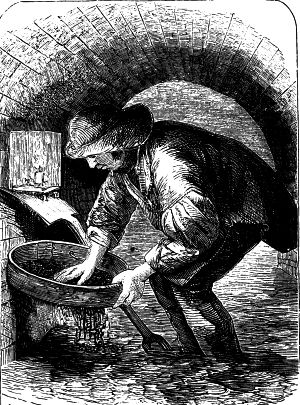
THE SEWER-HUNTER.
A RAT STORY.
"The first night, ye know, that I went into a sewer, I had a pal with me, as is dead now. Steve Williams was his name—God rest his soul. I felt afeered when I went in and got lost two or three times, but Steve allers found me agin by hollering at me. I got the greatest fright that night I ever got in my life. We were somewhere in a sewer in old Smithfield, and there must have been a distillery somewhere there, for when I turned out of the main sewer into a branch one, I saw by the light of the lantern a thick steam beyond me. I was a little ahead of Steve, who had just got a haul of two silver table-knives and a watch chain of goold, and he was looking at the haul he made when I saw the steam a fillin of the sewer. I went along, when I got near it my head begun to get dizzy, and I fell back on my shoulders into the sewer. I got drunk in the steam from the distillery,—that's what ailed me—and it was so sudden like, that I would have lost my life if Steve hadn't been there.
"Well, Steve saved my life agin the same night. We were pretty near the mouth of the sewer on the Thames, near Wapping, where we had a boat to take us off, for in those times the peelers never meddled with us like they does now.
"Well, there was one place very ticklish in the sewer, that Steve had cautioned me about, and this place was all broken and in holes, and it was chuck full of rats. When we came by I was foolish enough to turn the light of my lantern on the broken place in the sewer, and sure enough, there was a reglar colony o' rats in a room—keeping house,—about two thousand of them—with a hall-way and a room gnawed out of the bricks, as large as the room I live in at home. There they were, all stuck together, with their eyes a glarin at me like winkin, and they all in a heap as big as a horse and cart. I never seed such a sight in my life. Steve told me to come on, and I was going, for the rats never said a word all the time, but looked at me and squealed—but just as I was turning around after Steve my foot slipped and I fell, and the lantern dropped into a pool and went out.
"I must have frightened the rats, for there was an awful squealing and scampering—but they didn't all run away, for I found a hundred of them fastened on my hands, legs, face, and body, when I fell. You may be sure I hollowed and yelled, for I wasn't used to these vermin then, and the more I hollowed and beat them, the more they squealed and bit me.
"In a few minutes Steve came running back with his lantern, and seeing I was down and couldn't get up, he drove at them with his pole and killed half a dozen of them, and then they left me and jumped at him. Then we went at it for a couple of minutes, battling for our lives, and when we did beat them off we were bitten all over our bodies. I am sure if it warnt for Steve and his lantern that time, I should have been eaten up by the rats. You see, Sir, they thought when I stumbled and fell that I attacked them, for I found out since that they never begin first if they can help it."
CHAPTER XXII.
BACCHUS AND BEER.
T is an undeniable fact, that the English are the greatest beer-drinking people in the world. The assertion may be disputed in favor of the Germans (and their beverage, lager bier,) but who can compare the thin resinous beer of Munich and Vienna with the heavy bodied, soporific, and sinewy London pale ale, Edinburgh ale, or Guiness Brown Stout, that has ever drank the latter malt liquors.

To believe in his native beer is a necessary part of the Englishman's religion, and it is with the proverbial Briton a trite saying, when an exile at Chicago, New Orleans, New York, Madrid, Constantinople, St. Petersburg, or Calcutta,
"You cawnt get a glass of hale in this blessed country—you knaw. You hawvent got the 'ops you knaw, and ye cawnt make it ye knaw."
English literature and English poetry are full of beer and redolent of malt and hops, from Chaucer and Shakespeare down to the present day. Tom Jones, Roderick Random, the Spectator, the Tatler, the Guardian, Fielding, Hume, Smollett, Pope, Addison, Dryden, Goldsmith, and Samuel Johnson, never let slip a chance to prove the virtues and efficacy of beer, and 'Alf and 'Alf.
It was in a room in Barclay & Perkins' brewery in Southwark, then owned by Mr. Thrale, that Samuel Johnson, (who, if he was an obstinate, dogged, and overbearing old rascal,—yet was the father of modern English,) wrote the famous English Dictionary, and when Mr. Thrale died, Johnson being one of his executors, the property was sold to the Barclay & Perkins of that day for the sum of £135,000. The present brewery encloses fifteen acres of buildings and vats, and is the largest in the world but one.
The tribes that came from India and settled in Germany, to which Tacitus refers, were the first to introduce beer into Europe. The descendants of these long haired, fair skinned tribes, were long after, (in the sixteenth century,) the first to teach the English brewers the use of hops, for the people of England, of that day, made their beer after the manner of the ancient Egyptians, by the admixture of herbs, broom, and berries of the bay and ivy.
In 1585, there were twenty-six brewers in London and Westminster, who brewed in that year 648,960 barrels of beer, and, six years after, they exported 24,000 barrels of beer to the Low Countries and Dieppe. In 1643, the first excise duty was imposed on beer. In 1722, the brewers stored their beer to keep it mellow, for the first time, and sold it to all house-keepers to be retailed at three-pence a pot—holding over a pint. In 1869, 500,000 barrels of beer, valued at £1,800,000, were exported from London to foreign places, being one-fourth of the total amount that was exported during the same time from other ports in England.
British India took 201,000 barrels, Australia and New Zealand, 148,000 barrels, China, 35,000 barrels, Cape of Good Hope, 15,000, British West Indies, 30,000 barrels, Spain took 209 barrels, Brazil, 15,000 barrels, Russia, 6,000, and France 7,000 barrels.
Barclay and Perkins employ a capital of £2,000,000 annually in their trade, and 300 huge horses, brought from Flanders, at a cost of from £60 to £100 each. These horses consume 9,000 quarter hundreds of oats, beans, or other grain, 900 tons of clover, and 290 tons of straw for litter. The manure hops that are spent, and other refuse, are taken by a Railway Company. There are five partners in the house; the firm being worth £8,000,000, and the head brewer receives a salary of £2,000 a year.
CATS ON GUARD.
The water used for brewing purposes is that of the Thames, pumped by a steam engine, on the same ground where Shakespeare's Globe Theatre stood three hundred years ago. One hundred and fifty thousand gallons of beer can be brewed from this water, daily. There are two engines of 100 horse power each, which are nearly a hundred years old. The furnace shaft is 19 feet below the surface and 110 above it. The malt is carried from barges at the river-side, by porters, and deposited in enormous bins, each of the height and depth of a three-story house. Rats are fond of malt, but to keep them off a staff of sixty large cats are constantly employed on the premises, and all these cats are under the supervision of a big-headed or chief cat, with a long moustache and Angola blood.
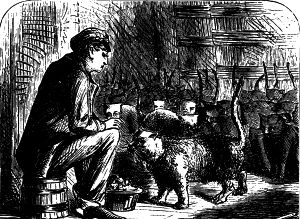
CATS RECEIVING RATIONS.
It is quite a sight to witness the anxious solicitude of this Chief Cat for the honor of the house of Barclay & Perkins, and for the discipline of his subordinate cats, the chief being a Thomas of the purest breed.
Thirty-six tons of coal per day are used here for brewing purposes, and the malt is stored in a huge room, with light windows, called the Great Brewhouse, built entirely of iron and brick. There is no continuous floor, but looking upwards, whenever the steaming vapor rises, there may be seen, at various heights, stages, platforms, and flights of stairs, all occupied by the Cyclopean piles of brewing vessels.
There are also huge buildings next to the brewhouse, with cooling floors, into which is pumped the "hot Wort," as it is called, or beer. The surface of the floor in one of these buildings is 10,000 feet square, and I saw men with gigantic wooden shoes swimming about in this beer, which looked like a vast lake. The beer is sometimes cooled by passing it through a refrigerator which has contact with a stream of cold spring water. The cold beer is then allowed to ferment in vast rooms or squares, as large as an ordinary block of houses,—which are made to hold 2,000 barrels. It is a strange sight to look at one of these lakes of beer, the yeast rising in masses like coral reefs in a southern sea,—upon the surface of the water, and these rock-like elevations yield, after the force of the yeast is spent, to the slightest wind, giving it the appearance of a vast ocean of beer in a storm. There is one huge vat for porter that will hold 5,000 gallons, which at selling price is worth £12,000. The Great Tun of Heidelberg holds but half of this quantity. One thousand quarter-hundreds of malt are brewed daily by Barclay & Perkins.
THE GREAT PORTER TUN.
The great rival house to that of Barclay & Perkins, is that of Hanbury, Buxton & Co., in Brick-Lane, Spitalfields, covering eight acres; in which 275,000 gallons of water are used daily, obtained from a well 530 feet deep;—600,000 barrels of beer are brewed here annually. There are 150 vats, the largest of which contains 3,000 barrels, or about 100,000 gallons of beer. There are eight brewing coppers, three of which are capable of containing 800 barrels each. 700 quarters of malt can be mashed at one time in six mash tubs;—10,000 tons of coal are used annually, and there are 200 huge horses, each horse consuming 42 pounds of food per day, or about 2,500,000 pounds per annum.
There is a library with 5,000 volumes, a billiard-room, reading-room, and savings-bank, on the premises, with a benefit Club for the workmen, each member paying sixpence a week, and receiving fourteen shillings a week in case of sickness; and on the death of his wife, £8, and in the event of his own death the family receives £18. Two companies of volunteers were raised from the 800 employees of the firm, and the men are allowed one holiday in a fortnight.
The brewery of Mr. Salt, at Burton-on-Trent, has been established for eighty years, and brews annually 25,000 barrels of that peculiarly strong and bitter ale.
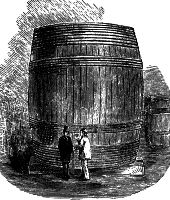
THE GREAT PORTER TUN.
In London it is calculated that about 6,500,000 barrels of ale, beer, and porter, are brewed annually, valued at about £20,000,000, and I think I am therefore correct in calling the English a beer-drinking people.
Everybody drinks beer in London. You can see laborers and dockmen sitting on benches outside of public houses, swilling what they call swipes, at two pence a pot. So if you drink at a Club you will see men as eminent as Mr. Bright, or Mr. Disraeli, calling for a "pint of Bass' East India Ale," or "a bottle of Stout." Even in work-houses beer is kept on tap, and were the paupers to be deprived of their beer, they would, I believe, rise and annihilate their masters. A quart bottle of good beer or porter can be got anywhere in London for sixpence, and of all the beverages that I have ever tasted, I never found anything to equal in fragrance a drink of good London "Brown Stout" on a warm summer day. A man may procure as much good beer as he can drink at a draught, for three pence, in London, at any public house or restaurant, and it is the common custom with the Cockneys to have it at every meal, and also between meals.
They have also a fashion in large parties among the working and middle classes, of ordering what is called a "Queen Ann," which is simply three pints of beer in a large, brightly burnished metal pot with a handle, and the man who calls for it having paid, takes a drink, then wipes the edge of the pot with the cuff of his coat-sleeve, to remove the foam from his lips,—then passes it to his wife, sweetheart or his eldest child, who each in turn drink and wipe the edge of the measure; then it is passed to the stranger, and all around the board, each person being careful to wipe the "pewter" in the same fashion. This custom seems rather strange and savage at the first sight to an American, but it is the custom of the country, and therefore cannot be quarreled with.
Benjamin Franklin, as we learn by his diary, was disgusted by the beer-swilling Londoners. When a journeyman printer in London before 1776, he says—"I drank only water; the other workmen, near fifty in number, were drinkers of beer. We had an alehouse boy who attended always in the house to supply workmen. My companion at the press drank every day, a pint before breakfast, a pint at breakfast with his bread and cheese, a pint between breakfast and dinner, a pint at dinner, a pint in the afternoon about six o'clock, and another pint when he had done his work. I thought it a detestable custom, but it was necessary, he supposed, to drink strong beer, that he might be strong himself. He had four or five shillings to pay out of his wages every week for the detestable liquor."
This is pretty strong testimony from Franklin, and I find that although he frequented alehouses in London, where all the men of wit and learning of the time were to be found, yet he never indulged in beer.
QUANTITY DRANK IN LONDON.
Any foreigner passing through a London street which is inhabited by working men and their families, or in the neighborhood of factories or other industrial establishments, if the period of the day be between twelve and one o'clock, or just after twelve, cannot fail to notice a sudden commotion and rush of men, women, and half naked children, with jugs, pewter measures, tin cans, and earthen vessels, to the neighboring tap-room or beer-house. All this large multitude are in quest of beer for the noonday meal.
At noon and night the pot boys of the innumerable beer-shops may be seen carrying out the quarts and pints daily received by those families who do not choose to lay in a stock or store of their own beer, or the mothers and children of the same families, to whom the half-penny given to the pot boy is a matter of consequence, may be seen journeying to the beer-conduits themselves, and the drinking goes on from morning until night, among truckmen, coal heavers, street pavers, mechanics in the "skittle grounds," medical students in the hospitals, law students in the Inns of Court, and "swells" in taverns.
From the gray of the morning until the hour of dark, you may see in the London streets those large drays, larger horses, huge draymen, and large casks of beer, ever present and never absent from the Londoner's eyes. Go down to the Strand, that street which borders the river, and you will see the same drays and Flemish horses emerging from the huge brewery gates, preparatory to carrying barrels of beer to tap-houses, and nine-gallon casks, the weekly allowance of a private London family, to dwelling-houses.
A competent authority has estimated that each and every inhabitant of London will drink, averaging young and old—80 gallons of beer in the year. The population is 3,500,000.
Therefore, Great is Beer, and Barclay and Perkins are its prophets.
CHAPTER XXIII.
HARVARD AGAINST OXFORD.
ELDOM—perhaps not twice in a hundred years, had such a night of excitement been known in London as that which ushered in the morning of the Twenty-Seventh of August, 1869, the ever-memorable day on which a million of half-crazy people were to witness the Great University Boat Race between Oxford and Harvard. This race, it was universally declared, would forever settle the mooted question of British pluck and American endurance, by twenty-five minutes hard pulling in two four-oared boats on the River Thames, between Putney and Mortlake.
The boasted phlegm of the English race had, as it were, disappeared before the touchstone of national rivalry, and prince, peer, peasant, and cabman alike felt that the honor of England was in the hands of Mr. Darbishire's Oxford crew.
For weeks before the race came off, the London shopkeepers, mercers, haberdashers, and drapers, had illuminated windows and doorways with neck-ties, scarfs, shoe-buckles, ribbons, silks, and hosiery, and with the greatest commercial impartiality, these articles that I have named, with a hundred others that I cannot recollect, had been made to assume the modest hues of the Oxford Dark Blue, and the blazing brilliancy of the Harvard Magenta. The merits of the men of both Universities had undergone the severest mental and conversational scrutiny in every part of the metropolis.
POLICE ARRANGEMENTS.
In a great city with a population of over three millions of Englishmen, it was but natural and just that Oxford should hold high ascendancy, and that Oxford favors should be worn almost exclusively, and that the superiority of Oxford rowing, should be with high and low a question of orthodoxy. Night settled down on the myriad roofs and church steeples of London, and ten young lads, down at the little village of Putney, with its narrow streets and old-fashioned church, braced themselves, before going to sleep, for the greatest athletic conflict that the Nineteenth century has known.
The sun broke over the London housetops on that eventful Friday morning, the Twenty-Seventh of August, with unusual brilliancy for an English sun. The weather had not been of the most promising kind for some days previous, and it was feared that the day might turn out a foggy or a rainy nuisance, and thus interfere with the pleasure which so many countless thousands had promised themselves in witnessing the race. London was astir at an early hour, and great crowds filled the streets in the direction of the railroad stations on the Surrey side of the river, and in the vicinity of the numerous steamboat wharves, for the purpose of securing an early transportation to the scene of the conflict.
At 9 o'clock the stations of the Northwestern, the Metropolitan, and the London and Northwestern Railways—at Waterloo, Vauxhall, Clapham Junction, Wadsworth, Putney, Ludgate Hill, London and Blackfriars Bridges, Euston, Chalk Farm, Hammersmith, Paddington, and Westminster—were swarming with masses of men, women, and children, vainly endeavoring, struggling, pushing, and trying to obtain precedence of each other, in order to get tickets to be carried to the boat race. The different railway companies of London, in order to accommodate the tremendous number of spectators, had suspended their regular traffic and agreed to run excursion trains all day steadily until an hour before the race.
The Thames Conservancy Board, which has the power to clear the river and prevent obstructions from delaying the race, had worked manfully, and by great exertions had succeeded in making every steamboat captain and owner on the river know that he would be compelled by force to remain above Putney Bridge, where the race was to begin, on penalty of £20 fine; and if rash enough to run the risk of fine, the police were to seize the offending steamer and quench her fires, and thus prevent further locomotion.
One steamboat speculator had been selling tickets at two guineas a head for the steamer Venus, and had declared openly that he would pay the fine of £20 and run the boat anyhow, despite the authorities of the river and the police who swarmed, in hundreds of small boats and tiny steam launches, all over the broad surface of the Thames.
When the steamer Venus came down to Putney Bridge, however, she was stopped very quickly, and her cheated passengers were forced to remain on board and witness the start, but the steamer was fastened at anchor and could no farther go. Passengers by this unlucky boat, who were unable to stand the broiling sun for four or five hours, debarked at Putney, and consoled themselves with mutton chops and bitter beer at the Star and Garter. Formerly, at the University races between Oxford and Cambridge, there was not only danger that the race itself would be interrupted, or perhaps lost, by the reckless rushing to and fro of the innumerable steamers that were sure to follow the progress of the boats towards Mortlake, but it was also very unsafe for passengers in small boats, wherries, or launches, to venture on the river, owing to the manner in which the steamers dashed to and fro at the bidding of the eager captains.
But the assertions in some of the American newspapers, that the Harvard crew would meet with foul-play from some scoundrel or other who might employ money to influence a master of one of those vessels, had aroused a determined energy among the members of the Thames Conservancy Board, and the result was a clear river, in one sense, from Putney to Mortlake, for the two crews.
When I say in one sense, I mean that the channel of the river was kept clear of steamboats and skiffs alike; but, while the steamers were not allowed inside of the chains stretched across at Putney and Mortlake, thousands of every description of small craft lined the river for a space of five miles on both sides, on the Surrey and Middlesex shores,—but out of the path where the race-boats were to make the essay for superiority.
THOMAS HUGHES, M.P.
But two steamboats were allowed to follow the crews, and one of these was the steamer Lotus, engaged to carry the referee, Mr. Thomas Hughes, M.P., author of "Tom Brown at Oxford," "School Days at Rugby," and other well-known and popular books—Besides the umpire for each crew, the judge of the race, Sir Aubrey Paul, and a number of ladies and gentlemen specially invited. Besides this boat there was also the steamboat Sunflower, chartered for the use of the press of London and for the benefit of American correspondents in London, by one of the editors of Bell's Life. These two boats were never more than fifty yards to the rear of the Oxford and Harvard shells during the progress of the race.
At half past 1 o'clock the press boat had been advertised to leave the Temple Pier for the scene of the race. Taking a cab at the head of Regent street, I had a good opportunity to observe the streets and shops and numerous vehicles. Of the six or seven thousand cabs which are to be found at the different stands all over London, hardly one this morning but is in some way decorated for the festival. These sharp-eyed, cunning-looking cabbies, in their careless attire, each with a brass medal depending from his breast, giving his number and license, have an eye to the main chance. Their long whips are tipped with short bows of blue ribbon in the greater number, while a few have magenta ties. Out of respect for the Yankees, they will charge them to-day a shilling a head more than they dare ask from an Englishman.
The great clumsy busses, that look more like advertising vans than vehicles for the purpose of carrying passengers, are splendid this day with decoration. They are made, as the sign above each tells you, to carry twelve inside and sixteen outside. The drivers of the busses have a more respectable look and are more profound in their wit than the cabbies. They have a solid British look that tells plainly of roast beef and careful usage. The cabbies are to the buss drivers a sort of gypsies, and are looked upon by them with suspicion. Every omnibus is crowded with passengers this cheerful, sunny day.
All London seems going to the race. Dry goods clerks, licensed victualers, "cads," grocers, public-house keepers, bar-boys, stable-boys, bar-maids, servant-maids, well-to-do tradesmen and their wives and children, apothecaries' assistants, golden-haired milliners nicely gloved, dressmakers' apprentices, pickpockets, peers of the United Kingdom, University men in cap and gown, Charter House boys with yellow stockings on their legs, and dark-blue frocks fastened at their waists with leather straps, wandering Americans displaying large diamonds and shocking bad hats, Westminster schoolboys on the foundation of Elizabeth, the Dean of St. Paul's in his shovel hat, city men, brokers and bankers, watermen from the Thames, professional oarsmen, Jew and Gentile;—they are all interested and will all see the race or a part of it.
I never saw anything like this great crowd before. It is believed that two hundred and fifty thousand people is the average number that are in the habit of witnessing a Cambridge and Oxford boat-race, but Cambridge has been beaten so often that the interest does not compare at one of these races with the tumultuous, all-pervading feeling that is borne in every man's bosom as he hurries along to-day. It is not so very certain that Harvard will be beaten, although it is rumored here and there that Loring, the stroke of the crew, is unwell, which rumor only tends to increase the odds on Oxford.
The Temple Pier is reached at last. We pass through an arched gateway at the bottom of a narrow street opening on the Thames. This spot is more historic even than Westminster Abbey. There before us is the Church of the Temple, seven hundred years old and black with time. All the ground around us belonged, in the old bygone days, to the Knights of the Order of the Temple. Now the place is the resort of attorneys and barristers, and in it legal people have chambers. Right in the shadows of the old Norman towers and battlements of the ancient church, Jack Cade's followers rose from a swinish, drunken sleep to turn their weapons against each other, hundreds falling in the conflict.
DARK BLUE AND MAGENTA.
Here in these chambers resided Chaucer, Gower, Spenser, Clarendon, Coke, Plowden, Selden, Beaumont, Congreve, Wycherley, Edmund Burke, Cowper, Samuel Johnson, Oliver Goldsmith, Pope, Eldon, Erskine, and others equally famous. Here they slept, joked, read, ate, and drank. Surely, if this ground be not hallowed, none other is. In company with a well-known American journalist, Mr. George Wilkes, I find my way to the Press boat, which is lying at the foot of the Temple Pier, off the Embankment. She is a long, double-ender, with a red streak on the upper part of her keel, and a black hull. Her steam funnel is made to be lowered at the base, working on hinges, when going under a bridge. Like all Thames boats to-day, there are two flags hoisted on her twin flag-staffs—the American and English. There is no awning, no upper-deck, to shade us from the August sun, which is now beginning to burn with an intensity peculiarly un-English.
There are, perhaps, about fifty persons on the boat, of whom two-thirds are English; the remainder Americans. They are not all newspaper men, though it was understood, before the tickets were sold, that none but newspaper men would be allowed on board.
The Englishmen wear blue scarfs and bows; the Americans sport the magenta all over their clothes. The sun falls on the broad, muddy river in slanting beams of kindling gold, making the old warehouses on both banks of the stream, with their yellow brick gables, to stand out in bold relief.
Above us is London Bridge, lowering in its immensity, and to the right is Billingsgate Market and Paul's wharf. Close upon our stern is Blackfriars Bridge, the Temple Gardens, Kings College—a massive, dirty gray structure, running along the river bank; Somerset House, the government building where all the clerical work of the administration is done, and where well-fed and well-paid clerks enjoy sinecures of the kind which the Barnacle family were so fond of. Before us is Waterloo Bridge, Cecil, Duke, Salisbury, Surrey, Buckingham, Villiers, and other streets called after the mansions once inhabited by the favorites of Charles, James, and William of Blessed Memory.
At a little before two o'clock the Sunflower steams off on her journey up the river. The course of the steamer is impeded at almost every foot by small craft of all descriptions, en route to Putney and the race.
We pass, on our way down, Waterloo Bridge, Charing Cross Bridge, with its huge railroad trains thundering over our heads, bound to Dover, with passengers for the Continent; Westminster Bridge and the Houses of Parliament, with their gilt vanes, towers, and battlements glistening in the sun; Lambeth Bridge and Lambeth Palace, the residence of the Primate of England, with its gardens and red brick towers; St. Thomas Hospitals, in process of construction; Millbank Penitentiary, a gloomy, six-sided fortress of crime; Vauxhall Bridge; Pimlico Pier, where we stop a moment; the Nine Elms Road, Chelsea Bridge, and Chelsea Hospital, where a number of frisky, one-legged and one-armed veterans are disporting themselves on its smooth, grassy lawn; the Botanic Garden on the right, and the green fields and trees and silvery lake of Battersea Park on the left; Albert Bridge, Cadogan Pier, Chelsea Pier, Battersea Bridge, and the Cremorne Gardens, with its kiosks, captive balloon, statues, shady walks, fountains, and flower beds; and now we are opposite Fulham and Brompton, where the splendid and extravagant Formosas of the metropolis enjoy their ill-gotten gains in pleasant villas and cozy little houses.
We are now getting away from the thickly populated districts of London, and the bridges that cross the river are fewer and farther between, and, being generally of wood, are more rickety.
During the entire passage we are continually stopped by small craft of all kinds. The river is alive with them.
ON THE TOWING PATH.
There are huge yawls, of broad bottom and clumsy construction, containing family parties, with their provender—bread, cheese, and beer, ham pies, and beef pies, kidneys and tongues—spread out in the bottom of the boats on white cloths or in open baskets; there are long shells with crews of eight and four, carrying coxswains; single sculls, double sculls, wherries, watermen's boats, small steam launches, lighters, watermen's barges, small sloops and schooners with dirty sails and unseemly rudders, pleasure yachts, and craft of such queer shape and rig as are never seen on our American rivers.
All are bent on pleasure, and in many of the boats they are singing the slang songs of the London streets; and now and then are warbled the cheering chants of the boatmen immortalized by Dibdin and Taylor, the water poets. A couple of miles more and we are in sight of Putney Bridge, which towers aloft, rickety, worn, and decayed, thousands crossing to and fro on its frail planks to get positions for the race.
And now the full grandeur of a sight such as is seldom or ever seen bursts upon every one on board the Press boat, and even the Londoners admit, in an easy way, that the Derby Day is eclipsed by the great number of people who line the banks of the river for miles on the Surrey and Middlesex shores.
To the left, above the old bridge, is the village of Putney, with its narrow streets and noisome lanes, its green fields, festering pools, eccentric-looking mansions and houses of an humbler kind, the steeples of St. John's and St. Mary's, with their quaint clock-towers; and to the left, on the Middlesex bank, are Fulham and the Bishop of London's palace, the long grass on the Bishop's lawn waving in the breeze, and upon whose surface were stretched pic-nickers eating and drinking.
The Star and Garter at Putney, a famous hostelry, where the crew of Harvard had lodged when they first came to England, was covered all over its surface toward the river with the flags of America and England. The old wooden balconies were crowded with ladies wearing favors in their bosoms; the passages and lanes leading to the towing-path on the river swarmed with foot passengers, all having one determination and one sole object. The "Bell Inn," a rival to the Star and Garter, was also glorious with colors, and all the house-owners for miles along the river had let their windows and seats on their roofs for various sums, varying from five shillings to five guineas per head.
One generous American "lady" had advertised in the Times that she would let seats in her windows to her countrymen at the modest price of two guineas per head, and she found that she had not half room enough for her compatriots. An innkeeper on the towing-path had let the front of his house for £40 to a speculator, who realized a profit of £25 on the venture. The Leander Boat-house, belonging to a well-known boating club, had a scaffolding erected fronting the river for the members and their ladies, which was covered with Union Jack bunting, the structure being the place where the Oxford crew had housed their race-boat.
Close to it was the boat-house of the London Rowing Club, an association of four hundred gentlemen, who had proved themselves warm and steady friends of the Harvard crew since their arrival here. The Harvard boat was housed here, and the staging and platform were decorated with American colors. A number of ladies, wearing red rosettes, were seated upon this balcony.
A few yards below was the modest stone house where the Harvard crew were sleeping two hours before the race. This place was enclosed by a stone wall, breast high, and shaded by green trees. Platforms were erected behind this wall, and on them I noticed seated the American Minister, Mr. Motley, the Hon. S.S. Cox, "Tom Hughes," Charles Reade, the novelist—a bluff-looking, hearty Englishman, in gray clothes—and a number of ladies, just before the race began.
A FRIGHTFUL JAM.
Back from this house ran the High street, and, I believe, the only street of Putney, and in this street was located the unpretending place of residence of the Oxford men. The towing-path on the Surrey side of the river runs along for miles away beyond Mortlake, and on the Middlesex bank there is also a path, and on both of these paths it is customary on a race day for thousands of harmless maniacs to run along, hats and coats in hand, vainly endeavoring to keep up with race-boats going at a speed greater than a mile every five minutes.
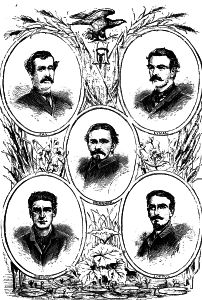
THE HARVARD CREW.
Of course, they soon lose sight of the boats after the start; yet they will still run, hallooing, cheering, and shouting like madmen. To furnish sport and amusement for the myriads of Cockneys who come by rail, steamboat, or on foot, from London and its environs, there are not wanting sharpers, players, peddlers, fighting-men, showmen, venders of all kinds of fruit, vegetables, meats, pies, drinks, ices, and all kinds of knick-knacks—things useful and useless; and these people and their wares combined make up a kind of a Bartholomew's fair on a grand scale.
The fair and its accessories covered the towing-path for three miles, and rendered the passage most difficult on this occasion for the many pedestrians. Dresses were torn, buttons pulled off, hats smashed, bonnets rumpled, hoops irretrievably wrecked, children trod on, women half suffocated and rendered faint and sick; yet, back from the river, for fifty or sixty feet, for a distance of three miles, the uproar and sale of questionable merchandise and doubtful provender never ceased for an instant.
It was a scene such as is displayed once in a man's life-time, to remain indelibly engraved on his mind ever after. One thousand policemen lined both banks of the river to keep order, but most of them were on the Surrey, or most thronged bank of the stream. A large number of those were mounted on huge black horses, and but for them many lives would have been lost on this most eventful day of days.
At the boat-houses, where the shells of the rival crews were concealed from the gaze of the crowds, outside, the jam was frightful, and very dangerous, as the police every few moments had to back their horses into the crowd to keep a passage-way clear, and on several occasions were compelled to charge the dense masses of men, women, and children.
Some time before the race came off, I made my way along the towing-path as well as I could through the swaying, surging crowds, for the purpose of taking a look at the amusements they were enjoying.
There was a large crowd around a man who stood before a circular table, the top of which revolved on a pivot. The surface was painted and divided into four triangles by colored lines. In each angle was painted the name of some famous horse, such as "Formosa," "Pretender," "Blue Gown," and "Lady Elizabeth." An indicator, like the hand of an eight-day clock, swung on a pivot in the centre of the circle.
A spectator being invited to place sixpence on the name of some favorite horse, the proprietor of the show gave the circular board a spin, and if the indicator stopped opposite the name of the horse where he had placed his money, he gained a shilling. The fellow who had this machine in operation was a hard-looking case, in a greasy cutaway velvet coat. His oratory was to the point and business-like.
"Down vith yer sixpence; and make yer bets, gentlemen. My hindicator is sure as the clock of St. Paul's and twice as waluable ha hacquisition. I don't care vether it is Formosy or Purtendir that yer bets yer bob hon. Yer take Hoxford or ye take 'Avard—
Hi gives 'er a spin Han lets yer vin;
vich is poetry, and if ye dosn't vin, I gits the tin; vich is po-e-try agin, and is halso a favrite hexpression of the Chanselur of the Hexcheckever ven he piles hon the blessed taxis has 'as made me sell hall my property to havoid a bust hup. Try yer luck agin; thank ye sir. Formosy, sir, sure to vin or lose."
Close by this amusing blackguard is the stand of the root-beer, ginger-beer, and bitter-beer seller, who is crying out from behind his little cart:
BOOTHS AND SHOWS.
"Valk hup and try this ere de-lee-shus bewerage, honly tuppence a bottle. If ye don't like it I gives ye yer money back, and no 'arm done. The Prinse of Vales alvays buys 'is beer hof me ven 'e isnt travelin, for the good of 'is 'ealth. Valk hup and don't be ashamed; the no-bil-e-tee and gen-te-ree hall patronizes me. Ginger-beer, ginger-beer, and may the best man win, as my vife says, ven she sees two pickpockets a fightin' for a shillin'."