Front matter (continued 3)
Reading edition
Abbot Richard de Crokesley, together with a number of other nobles, and Poitevins, who had incurred the enmity of a powerful party who were opposed to court favoritism, were poisoned by the steward of William, Earl of Clare, and Crokesley died July 1258, of the effects of the poison.
Phillip de Lewisham, who was elected to succeed Crokesley, was so gross and fat that he procured a dispensation, so that he would not have to go to Rome to be confirmed. An able deputation of monks went in his place, and when they returned with the Pope's confirmation, after having to pay 800 marks to certain Cardinals, who opposed it, they found that Abbot de Lewisham had died during their absence.
Gislebertus Crispinus, a monk, of the abbey of Bec, in Normandy, and belonging to one of the noblest families in that duchy, was chosen abbot in 1082. He was a very learned man, and held a great disputation at Mentz, in Germany, with a deeply versed Jew, on the "Faith of the Church against the Jews."
Gervase de Blois, an illegitimate son of King Stephen, was made abbot in 1141. This man was not fit to be a priest, being insolent, arbitrary, and unjust, and, instead of attending to his duties as head of the abbey, he was often in armor, depredating, or hunting, or hawking. He dissipated the manors, livings, tithes, vestments, and ornaments of the abbey, and was finally admonished to behave himself by Pope Innocent, but the abbot disregarded the admonition of the Pope and was then deposed by King Henry II, in 1159. He died in a year after.
The Lord Abbot Laurentius, his successor, was a wise, just, and prudent man, much trusted by King Henry II, and the Empress Maud. It was Abbot Laurentius who first obtained for himself and successors the privilege of wearing the mitre, ring, and gloves, until then the symbols of Episcopacy, and only allowed to the Bishops by the Pope. The wearing of these symbols gave the mitred abbots of Westminster, and other abbeys, the right to sit as peers in parliament, the same as bishops to whom the right belonged exclusively, before Abbot Laurentius obtained the grant.
REVENUES OF ABBEY IN 1540.
Simon Langham was one of the greatest abbots that ever wore the mitre in the abbey. He was made Lord Chancellor of England, and Archbishop of Canterbury, Bishop of Ely, and Lord Treasurer of the Kingdom by Edward III. It was this prelate who deprived John Wickliffe of the mastership of Canterbury Hall, Oxford, which was the first cause of Wickliffe's investigating the scriptures.
On the 16th of January, 1540, the Abbey of Westminster, which had been established for more than nine hundred years, having been founded by King Sebert, a Saxon monarch, and his wife Ethelgoda, in honor of St. Peter who was said to have appeared to the King in a dream, was dissolved by order of Henry VIII, and the abbey was surrendered to the King by Abbot Benson and twenty-four monks. The annual revenue, which included the gross receipts, amounted to £3,977, equal to twenty times the same amount of English money of to-day.
Westminster was made a bishopric, the abbey was advanced to the dignity of a Cathedral, with an establishment of a bishop, (Thomas Thirleby, dean of the King's Chapel,) a dean, twelve prebendaries, and inferior officers. Abbot Benson, who was always on the winning side, was made dean of the Abbey, five of the monks were chosen prebendaries, four other monks were made minor canons, and four more were elected to be King's students in the University. The other twelve monks who did not approve of the change were dismissed, with pensions of from ten pounds a year to five marks. A revenue of £586 a year, and the Abbot's house was allotted to the Bishop. Dean Benson died in an unhappy state from the repeated attempts made by the rapacious nobles and courtiers to deprive him of the lands of his deanery. He was buried in the abbey, but the inscription on his tomb was obliterated. The bishopric of Westminster lasted only ten years, and was then suppressed and reunited to that of London, to which it has since belonged. Numerous attempts were made by the partisans of the See of London to rob and deprive the abbey of its lands and revenues, and hence arose the saying of "robbing Peter to pay Paul," which is explained by the fact that the patron saint of the See of London was St. Paul, while St. Peter was the guardian of the Abbey of Westminster.
In 1556, Queen Mary being on the throne, the Church of Westminster again became an abbey by order of the Queen, and John Feckenham was made abbot of Westminster. He was held in general esteem for his learning, charity, and piety, and he was continually engaged in doing good offices for the Protestants who suffered by the laws of the realm for their faith. Three years after, Mary having died, the monastery was again suppressed by order of Queen Elizabeth, and the abbot and monks were again turned out of the abbey. In 1560 the abbey, by enactment, was made a collegiate church, which it remains to this day, and was endowed with the lands which had belonged to the abbot and monastery. Since that time Westminster Abbey has been governed by a dean and chapter, and has had thirty-three deans in regular succession of the Protestant faith.
The Abbey has the following large clerical staff for its government:
One Dean, eight Prebendaries, one of whom is a Lord, and another a Bishop; a sub-Dean, an Archdeacon, a Precentor, five minor Canons, eleven Lay Clerks, two Sacrists, a Dean's Verger, a Prebendary's Verger, a High Steward, who is a Duke, a Deputy High Steward, a Coroner, a High Bailiff, Searcher and Bailiff of the Sanctuary, a High Constable, a Head Master of Westminster School, Second Master, forty Queen's Scholars on the Foundation, a Steward of the Manorial Court, two Joint Receiver's General, a Chapter Clerk and Registrar, an Auditor, a Commissory and Official Principal, a Registrar of the Consistory Court, and a Deputy Registrar, an Organist and Master of the Choristers, twelve Almsmen, four Bell-ringers, two Organ-blowers, an Abbey Surveyor, a Clerk of the Works, a Beadle of the Sanctuary, and last of all a College Porter and four Probationary Choristers, in all a staff of eighty persons, a very slight reduction upon the old administration of the Abbots of Westminster. These different office holders, in all, receive salaries of about one hundred thousand pounds a year, and the cost of the school, and the repairs of the abbey, make the sundries amount to about twenty thousand pounds a year additional.
TOMB OF SHAKESPEARE.
In the general plunder of monasteries and church property, which distinguished the reign of Henry VIII, Westminster Abbey suffered severely, but it was still worse treated by the Puritans in the great civil war, the abbey being used as a barrack for the soldiers, by the Parliament, who wantonly destroyed many of the tombs and monuments that adorned the various chapels, the altars in the chapels dedicated to the different saints being thrown down, the images broken, and the richly stained windows shattered into fragments. The restoration of the edifice was intrusted to Sir Christopher Wren, who built St. Paul's, but he made a very botching piece of work in the additions which he gave to the towers at the west end.
The imitation of the Gothic style in Wren's additions are wretched and out of place in such an edifice as the Abbey. The front of the Abbey has no columns or pierced works of carving, to which the Gothic style owes so much of its lightness and elegance, and there is a mixture of ornamentation such as the broken scrolls, masques, and festoons over the grand entrance, which gives it a very heavy, flat appearance.
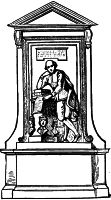
SHAKESPEARE'S TOMB.
The Abbey is very rich in monuments of all kinds, some of which are very fine works of art. All along the walls, in the transepts and aisles, in the Nave, in the chapels, in the flooring of the Abbey, and everywhere around me I saw tablets, tombs, inscriptions, and medallions.
Among the most noticeable are those of Ben Johnson, John Milton, Geoffrey Chaucer, the father of English poetry and first poet buried in the Abbey, A.D. 1400, Dryden, Thomas Campbell, William Shakespeare, Oliver Goldsmith, Joseph Addison, Handel the musician, Richard Brinsley Sheridan, Dr. Samuel Johnson, Sir William Davenant, and Robert Southey, in the "Poet's Corner," which is situated in the south transept. They are all richly ornamented with busts, effigies of the deceased, or allegorical designs in marble, or brass, or bronze.
The tomb of Shakespeare is of marble, with a full length figure of the great poet leaning on his left elbow, and has the following epitaph written by John Milton, who was best fitted to write it:
What needs my Shakespeare for his honored bones, The labor of an age in piled stones, Or that his hallow'd relics should be hid Under a star-y pointing pyramid! Dear son of Memory, great heir of fame, What need'st thou such weak witness of thy name, Thou in our wonder and astonishment Hast built thyself a live-long monument, For whilst to the shame of slow-endeavoring art Thy easy numbers flow, and that each heart Hath from the leaves of thy unvalued book Those Delphic lines with deep impression took; Then thou our fancy of itself bereaving Dost make us marble with too much conceiving; And so sepulchred, in such pomp dost lie, That kings for such a tomb would wish to die.
Milton's epitaph is as follows:
"Three great poets, in three distant ages born, Greece, Italy and England did adorn; The first in loftiness of thought surpass'd. The next in majesty—in both the last. The force of Nature could no farther go, To make the third, she joined the former two."—
John Gay, the author of the "Beggar's Opera," wrote his own epitaph, which is on his tomb;
"Life is a jest, and all things show it; I thought so once; but now I know it."
There is a sarcophagus to Major John Andre who was executed as a spy by order of George Washington. It has a representation of a flag of truce, and Britannia in tears.
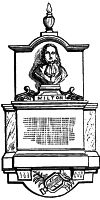
TOMB OF MILTON.
Mrs. Oldfield, the actress who coquetishly ordered that she should be buried in a fine Holland chemise, with a tucker, and a double ruffle of lace, and a pair of white kid gloves, has a monument with an inscription by Pope. Isaac Newton has also a very fine monument, and William Pitt's monument cost £6,000. Henry Grattan, Robert Peel, Charles James Fox, William Wilberforce, George Canning, and Lord Palmerston also have monuments.
THE LAST CATHOLIC FUNERAL.
Mary Queen of Scots, and the Queen who slew her, have magnificent monuments near each other, and similar in style. The funeral of Queen Mary, sister of Queen Elizabeth, was the last one which was celebrated in the Abbey with the ceremonial of the Roman Catholic Church. She died in 1558, and her body was brought from St. James Palace with great pomp to the Abbey, on a splendid chariot. It was met at the great entrance of the abbey by four bishops and Lord Abbott Feckenham in mitre, robes, and with crozier. The body lay all night under the hearse, with a guard of nobles and pages to watch it. On the fourteenth day of December it was interred in the vault, and a plain black tablet was erected to be placed over it by King James I, with the inscription:
ET MARIA SORORES IN SPES RESVRRECTIONIS.
James II, who sought to re-establish the Roman Catholic Faith in England, (like Queen Mary,) died at St. Germain En-Laye, in France, and has no tomb in the Abbey. His intestines were given to the Irish College, in Paris, the brains to the Scotch College, and the heart to the Convent of Chaillot.
Admiral Kempenfeldt, who was drowned on the man-of-war Royal George, which sunk with eight hundred men, all of whom were lost, off Spithead, in 1782, is also buried here, with the epitaph on his tomb, written by Cowper the poet:
"Toll, toll, for the brave— Brave Kempenfeldt is gone; His last sea-fight is fought; His work of glory done. His sword was in its sheath, His fingers held the pen, When Kempenfeldt went down, With twice four hundred men."—
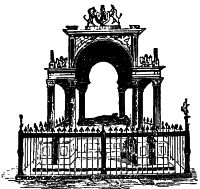
TOMB OF MARY, QUEEN OF SCOTS.
The Chapel of Edward the Confessor, who founded the Abbey, is full of dead Kings and Queens, so full that a poet has written of the commingled Royal dust that is here reposing:
"Think how many royal bones, Sleep within these heaps of stones. Here they lie, had realms and lands, Who now want strength to lift their hands. Where, from their pulpit sealed with dust, They preach, 'In greatness is no trust!' Here's an acre, sown indeed, With the richest, royalest seed, That the earth did e'er suck in, Since the first man died for sin."
INTERMENTS DURING THE MIDDLE AGES.
Here lies buried Edward the Confessor, before whose tomb was kept continually burning a silver lamp. On one side stood an image of the Virgin, in silver, adorned with two jewels of immense value, presented by Eleanor, Queen to Henry III; on the other side stood an image of the Virgin, carved in ivory, presented by Thomas a-Becket. Edward I offered the Scotch regalia and the antique stone on which the Kings of Scotland were crowned at Scone; this latter relic is still preserved. This shrine was composed of various colored stones, in Mosaic work; but it is so dilapidated that very little idea can be formed of its original beauty and grandeur.
Queen Editha, Queen Maud, Edward I, Henry III, Elizabeth Tudor, daughter of Henry VII, Queen Eleanor, Henry V, the victor of Agincourt, Queen Phillippa, Edward III—with his sword, seven feet long and weighing eighteen pounds, together with his enormous shield, hanging to his tomb,—Margaret of York, Richard II, and a host of others, are here buried. Their tombs are of magnificent workmanship, with full length figures lying recumbent and their hands clasped in prayer.
The Abbots and Priors of the abbey are buried in the walks of the Cloisters, and I stood on three of these mural slabs, and looked at the worn, full length effigies of the dead abbots, in full abbatical robes, ring on finger, mitre on head, and crozier in hand, their Latinized names almost worn away by the footsteps of the hundreds of thousands of men and women who had paced the Cloisters since they were interred, seven hundred years ago. And yet these tombs in Westminster Cloisters are but as yesterday, when compared with the Pyramids of Egypt, or a geological formation.
It was in Westminster Abbey that all the Kings and Queens of England have been crowned, and when a monarch had been crowned previously, as in the case of Henry III, whose coronation took place at Gloucester, it was thought proper to have the ceremony again performed at Westminster, in the presence of the nobles and the chief ecclesiastical dignitaries of the land; the Archbishop of Canterbury always officiating in the august ceremonial.
What wondrous scenes this proud old Abbey has witnessed! I can but enumerate a few of these however. One day in the middle of Lent, 1176, the King and his son came to London, while a Convocation of the Clergy was being held in Westminster Abbey. The Papal Legate was present, and the Archbishops of Canterbury and York were also present. Thomas a-Becket had been murdered by order of the reigning King Henry II. Becket had been Archbishop of Canterbury. In the Convocation the then Archbishop of Canterbury, as Primate of the Kingdom, sat on the right hand of the Papal Legate. The Archbishop of York seeing this, when he entered the Abbey, came in a rude manner and pushing between the Primate and the Legate, as if disdaining to sit on the left hand of anybody, thrust himself into the lap of the Primate in a swash-buckling manner. The Primate would not move, and no sooner had the insult been offered than the Bishops and Chaplains in the Abbey ran to the dais and pulled my Lord of York down and threw him to the ground, and began to beat him severely. The Archbishop of Canterbury then sought to save him, and when he, the Archbishop of York, got on his feet, he straightway went to the King whom he had advised to murder Thomas a-Becket, and made complaint of the outrage which had been offered him. The King laughed at him for his pains. As he left the Abbey the monks, and priests, and bishops, with a loud shout cried out at him, "Go, traitor, thou didst betray the holy man Thomas a-Becket; go get thee hence, thy hands yet stink of blood."
When the news reached the Archbishop of York (previously) that the Archbishop of Canterbury (Becket) had been assassinated on the steps of the Altar, he ascended his pulpit and announced the fact to his congregation as an act of Divine vengeance, saying that Becket had perished in his pride and guilt like Pharaoh.
In 1297, Edward I offered at the shrine of Edward the Confessor, the famous stone, crown, and sceptre of the Scottish Sovereigns, together with the Coronation Chair, now in the Abbey, on which all English monarchs have to sit to be crowned. This chair was taken from the Abbey of Scone, in Scotland, by Edward, having been brought to Scotland by King Fergus from Ireland, three centuries before the Christian Era. Before that period, it is said to have been used for many hundred years by the Irish Kings for a like purpose.
CORONATION OF WILLIAM THE CONQUEROR.
The Scots were very eager to get the stone back for the reason that a legend existed that whoever possessed the stone should rule Scotland. This old stone chair, or rather oaken chair with a stone seat,—twenty-six inches in length, sixteen inches and three quarters in breadth, and ten and a half inches in thickness—has seen many strange changes in dynasties, for every king since Edward I, has sat in it on his coronation day.
The ceremonies of coronation were very grand in the olden time and much of their splendor has passed away or has become obsolete.
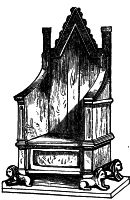
CORONATION CHAIR.
One of the grandest sights ever witnessed in the Abbey was when Aldred, Archbishop of York, crowned William the Conqueror, King of England. The mail clad bodies of Norman soldiery lined every part of old London to keep down the Saxons, while William, superbly mounted, and followed by a train of two hundred and sixty barons, lords and knights, entered the Abbey. When the multitude reached the high altar, Geoffrey, Bishop of Coutances, asked the Normans if they were willing to have the Duke crowned King of England, and the nobles, knights, and priests, among whom the English lordships and abbeys were already parceled out, cried aloud with one voice that they were. The Norman horsemen without the walls of the abbey hearing the shout, fancied that the Saxons within had attacked their countrymen, and immediately they set fire to the houses around the abbey, and in a few minutes the abbey was deserted of friend and foe alike with the exception of William and a few priests who stood firm, although the Duke trembled violently as the crown was placed upon his head. He declared that he would treat the English people as well as the best of their kings had done, vowing by the Splendor of God, his usual oath.
The coronation of Richard I, the Lion Heart as he was called, was attended with great pomp.
On the third of September, 1189, the Archbishops of Canterbury, Rouen, Treves in Germany, and Dublin, arrayed in silken copes, and preceded by a body of clergy bearing the cross, holy water, censers and tapers, met Richard at the door of his privy chamber in Westminster Palace, and proceeded with him to the Abbey. In the midst of a numerous body of bishops and ecclesiastics, marched four barons, each with a golden candlestick and taper, then in succession—Geoffrey de Lacey with the royal cap, John the Marshal with the royal spurs of gold, and William, Earl of Striguil and Pembroke, with the golden Rod and Dove. Then came David, brother to the King of Scotland, and present as Earl of Huntington, and Robert, Earl of Leicester, supporting John the King's brother, the three bearing upright swords in richly gilded scabbards.
Following them came six barons bearing a chequered table, upon which were the King's robes and regalia, and now was seen approaching the central object of this gorgeous picture—Richard himself, under a gorgeous canopy stretched by six lances, borne by as many nobles, having immediately before him the Earl of Albemarle with the crown, and a bishop on each side. The ground on which he walked was spread with rich cloths of Tyrian dye.
THE MASSACRE.
At the foot of the altar, Baldwin, Archbishop of Canterbury, administered the oath, by which Richard undertook to bear peace, honor, and reverence to God and Holy Church, to exercise right, justice, and law, and to abrogate all wicked laws and customs. He then put off all his garments from the middle upwards, like a modern prize fighter, except his shirt, which was open at the shoulders, and he was annointed on the head, breast, and arms, with oil, signifying glory, fortitude, and wisdom. He then covered his head with a fine linen cloth and set the cap thereon, placed the surcoat of velvet and dalmatica over his shoulders, and took the sword of the Kingdom from the Archbishop to subdue the enemies of the Catholic Church, and then put on the golden sandals and the royal mantle, which last was splendidly embroidered, and was led to the altar, where the Archbishop charged him on God's behalf, not to presume to take this dignity upon him unless he were resolved to keep inviolably the vows he had made; to which the king replied:
"By God, His grace, I will faithfully keep them all: Amen." The crown was then handed to the Archbishop, by Richard himself, in token that he held it only from God, when the Archbishop placed it on the King's head; he also gave the sceptre into his right hand, and the royal rod into his left.
At the close of this part of the ceremony Richard was led back to the throne, and High Mass being performed with grand pomp, Richard offered as was usual, a mark of pure gold to the altar.
While the coronation was going on inside massacre and arson reigned outside of the Abbey. Before the ceremony, Richard, by proclamation had forbidden all Jews to be present at Westminster, either within or without the Abbey, but some members of that persecuted race had rashly ventured within the walls, and a hue and cry being set up at what was deemed a sacrilege, the populace ejected a prominent Israelite and beat him with sticks and stones. In a few minutes a report spread that the King had ordered the destruction of the Jews, and the furious mob spread all over the city, burning the houses and destroying the lives of the miserable Jews. Men, women, and children of tender age were burned alive in their domiciles, where resistance was made to the mob, and the cries of the murdered children blended discordantly with the sounds of the shaums, and jongleurs, and the shouts of the rabble, who were celebrating the coronation. The riot became so formidable that at last Richard, who was at dinner in Westminster Hall, ordered the Chief Justiciary of the Kingdom, Ranulf de Glanville, to go and quell it, but this was more easy to order than to perform, and the King's officers were driven back to the Hall.
Through all that night and day the pillage, arson, and massacre continued, and the next day the King hanged three of the rabble as an atonement.
At the coronation of Henry IV, Sir John Dymoke, the Champion of England, rode into the Hall of Westminster Palace, where dinner was being served to the King, on horseback in complete armor, with a knight before him bearing his spear, and his sword and dagger by his side, and presented a label to the king on which had been written a challenge to any knight, squire, or gentleman, who dared declare that Henry was not rightful King of England. He then had a trumpet blown, and cried out that he was ready to fight in the quarrel. The label was then taken and cried by the heralds in six places in the town of Westminster, but no person seemed ready to fight although Richard II had been deposed by Henry IV and was then in a neighboring dungeon.
That most atrocious medieval fraud, Richard III, when about to be crowned King, walked barefoot from Westminster Hall to the Abbey, a distance of about six hundred feet, to let the crowds witness his resignation and humility.
When Edward VI, a boy of sixteen, was about to be crowned, he laid himself down upon the steps of the altar on his stomach while Cranmer, Lord Archbishop of Canterbury, opened his shirt and rubbing the oil between his shoulder blades, anointed him.
James I, who hated tobacco and witches, forbade the people to come to Westminster to witness his Coronation, as the plague was then raging, and James did not wish to catch the distemper.
OMEN OF ILL LUCK.
Charles I was crowned February 2, 1626, and his Queen, Henrietta, being a Catholic, was not a sharer in the Coronation, nor was she a spectator, and she would not accept the place fitted up for her in the Abbey, but stood at the window of the Palace gates to look at the crowd and procession, while her retinue of French ladies, nobles and servants, were dancing within. When Charles walked up to the altar to ascend the throne, Laud, who was Archbishop of Canterbury, and the Duke of Buckingham, Lord High Constable of England, offered him their hands on either side to ascend the throne, but the King smilingly refused their hands and said:
"I have as much need to help you, as you have to assist me."
Then Laud presented the King to the great crowd of Nobles and people, and said, in an audible voice, "My masters and friends, I am here come to present unto you your King: King Charles, to whom the crown of his ancestors and predecessors is now devolved by lineal right; and therefore I desire you by your general acclamation, to testify your consent and willingness thereunto."
Not a voice answered, and there was a stillness as of the grave through the vast spaces of the Abbey. It was a bad omen of a reign, which ended so disastrously, for the listening monarch.
At last the Earl-Marshal, Lord Arundel and Howard, said to the spectators present: "Good people, I pray thee, why call ye not right lustily, 'God save King Charles?'"
Thus admonished, they with one voice exclaimed, "God save Charles, our King." In the adjoining hall, Oliver Cromwell was inaugurated Lord Protector of England, with a quiet ceremonial, attended by ushers, life guards, State coaches, the Long Parliament, and several troops of horse.
When James II was crowned, the Royal bauble tottered on his head, and this was supposed to be a prophetic omen of ill luck.
When George III was made King, with great pomp and circumstance, there was present, unknown to the crowd, a young man who must have witnessed the placing of the Golden Circlet on the brow of this fat, Hanoverian Prince, with strange emotions. He could have said with truth, "My place should have been by that chair; my father should have been sitting in it," for it was the young Pretender, Charles Stuart; the last of his royal and unfortunate race.
At all the late Coronations, the magnificent pomp and ceremonial of the Middle Ages have been omitted, and the last time that these Ceremonies were carried out was at the Coronation of George IV, when the Celebration was a very fine one.
The wood-work of the Choir was removed and boxes erected, affording an uninterrupted view of the Nave and Chancel, showing the Peers and Peeresses in all their magnificence of robes, of satins and silks, and head-dresses of feathers and diamonds. To these were added the brilliantly illuminated surcoats of the Heralds and Kings-at-arms, while the King himself sat in the royal Chair of State, which is over two thousand years old, and there received homage from the great officers of State, and Peers of the Realm, the Crown on his head and Sceptre in his hand, the Garter and George around his neck, and the velvet robes enfolding his body, which was then scorbutic from disease and dissipation.
The challenge of the Champion of England was at this ceremony delivered for the last time. After the banquet was over, at which seventeen thousand pounds of meat, three thousand fowls, one thousand dozen of wine, ten thousand plates, and seventeen thousand knives and forks, were among the items, came the challenge to all who dared to dispute the right of George to the throne of England.
It was an imposing sight, as the Duke of Wellington, with his Ducal Coronet ornamented with strawberry leaves, on his head, and in his flowing Peer's robes walked down the hall, cheered by the officers of the Life Guards, who were present. He shortly afterwards returned, mounted, and accompanied by the Marquis of Anglesey, the one-legged cavalry officer of Waterloo, and Howard, Duke of Norfolk, the Hereditary Earl Marshal of England.
THE BANQUET AND CHALLENGE.
The three Nobles rode gracefully to the foot of the throne, paid their homage, and then backed their horses down the lofty hall. The hall doors of the Palace opened again, and outside, in the twilight, a man in complete armor of Milan proof, appeared on horseback, outlined against the shining sky. He then moved, passed into darkness, and under the massive arch, and suddenly Howard, Wellington, and Anglesey, stood in full view of the vast assemblage, with the palace doors closed behind them. This was the finest sight of the day, as the Herald read the challenge, a glove was thrown down by a gauntleted hand as a token of defiance, which was taken up instantly by Wellington, and then they all proceeded to the throne, trumpets blowing, people shouting, and flower-girls strewing the way with baskets of flowers.
The funerals of Lady Palmerston and George Peabody were the last that have taken place in Westminster Abbey, and at the funeral of the former a London reporter, in his eagerness to get an item, fell into the grave of Lady Palmerston and nearly frightened a young lady mourner out of her senses. Such is the story of this Mausoleum of Royalty and Heroism. Westminster Abbey is only equaled for the antiquity and grandeur of its mortal remains by the Abbey of St. Denis, in France, and those world-old cemeteries, the Pyramids of Egypt.
CHAPTER IX.
THE COSTERMONGERS AND RAG FAIR.
HERE is a wide, short street, or rather road, in the heart of London. The buildings are mean, the people who cluster against their doorways and in the alleys and courts that branch from this short, wide street, are wretched in appearance; their garments are patched and in piecemeal, and when untorn they are greasy and besmeared with filth.

In this street, crowded at night—on Saturday night it is almost impassable—children of a tender age may be seen begging for coppers and soliciting assistance from those of more mature years, but to the full as wretched as themselves. Vice is in every glance of their eyes. Crime has already made its graven lines in their young faces, and their language or dialect, (for it is not a language), is a combination of uncouth sounds, obscene imagery, and slang corruptions of the English tongue.
ARCHBISHOP OF CANTERBURY'S GARDENS.
This street, or road, is called the "New Cut," and is situated in Lambeth on the Surrey side of the Thames. It is reached from the City by Waterloo Bridge and the Waterloo road, and from the West End by Lambeth and Vauxhall bridges. Thousands are born, baptized, many beget children and die within the municipality of the Great Metropolis, and yet have never seen the New Cut—nay, have never even heard of it, or if they did, the word would have as much meaning to them as the plains of El Ghizeh, or the source of the Nile to a Bow Cockney. Yet there are thousands who are born here in this New Cut who live and die in it and make a living for themselves, after a fashion, who, if not content with, are certainly unaware of any method of changing or bettering their lot in this life.
Narrow, dark, and mean streets run contiguous to the New Cut, and branch from it in a winding, snaky way. A decently-dressed man is not safe in this street, and the only sound of civilization to cheer him, once lost in the mazes of these festering lanes and alleys, teeming with low pot-houses, tap-rooms, and wild-looking children, bold, bad-looking desperadoes of men, and reckless, obscene women, is the low, rumbling sound coming like the approaching thunder to his ears every few minutes as the loaded passenger trains dash to and fro on the Northwestern and Southeastern Railways.
The New Cut runs into the Lower Marsh and is flanked by Wootton, White Horse, Collingwood, Eaton, Marlboro streets, and the Broad Wall. To the west are Thomas, Isabella, and Granby streets, and from all this misery and destitution of a quarter where the inhabitants are packed like rabbits in a well-stocked warren, the road leads through the Upper Marsh down to the rare pleasaunce or garden of the palace of the Archbishop of Canterbury, one of the most sumptous ecclesiastical retreats in England. The Archbishop's gardens, although located in the heart of a populous city, cover as much ground, it is calculated, as gives sleeping and eating room to 11,000 human beings in the New Cut district.
It is true that the river rolls sluggishly five or six hundred yards below the New Cut, and those who are tired of dog's meat, rotten vegetables, and the offal of the street markets for their common food, and of sleeping eight in a room on straw which is not even clean, can at any time deliver their bodies from further pain and starvation, and their minds from a daily never-ending struggle as to how the dog's meat and decayed offal may be procured, by a quick plunge in the river, near by.
This quarter is the principal resort of the "costermongers" of London. The word "costermonger" has an equivalent which is better known as "peddler." All those who vend or hawk vegetables, fruit, carrion meat, game, fowl, ginger beer, nuts, or, in fact, any of the numerous articles or commodities of refuse merchandise found on the barrows and wagons of the London peddlers, are called by the London term "costermongers." The word is an old one used by Shakespeare, and therefore has, if none other, the merit of antiquity of the most genuine kind.
There are in London proper, embracing its suburbs, of both sexes—including men, women, and children—according to information which I had procured from the police and physicians, who have means of knowing, about 23,000 costermongers. These people are from daybreak until midnight in the open air, I might say, for their marketing is done as early as four or five o'clock in the morning; and then, after an hour or so spent in marketing, comes the cheap, scanty breakfast, consisting of a pound of bread, a "saveloy," which is a sort of a sausage, at a penny a piece, about four inches long and two inches in circumference, quite succulent to the costermonger's palate, or perhaps a piece of beef or bacon of the kind that is vended from barrows in the London streets at two pence a pound, the refuse of the butchers' shops and pieces unfit for a ready sale.
Among these refuse pieces are small portions of ham, shoulders, and pork, fragments of bacon, "snag" pieces, and mutton, and a very suspicious veal, which is often sold by these same hawkers in the suburbs to old maids for cats' meat. Sometimes the "coster" will take a pint of sloppy coffee, which he gets for three half-pence, with his brief breakfast; at other times he prefers a quartern of gin "neat," at two-pence; and again he will be satisfied with a mug of beer at two-pence. As early as 7 o'clock in the morning the hideous noises, which can only come from the throat of a costermonger, are heard in the London streets, awakening those who wish to sleep late, and, to make matters worse, no person, unless the costermonger himself, can by any application ever understand the exact words of their cries. They are only to be recognized by sound, and, therefore, it is always necessary to appear at a window or doorway in order to discover the precise article which the coster wishes you to buy.
SALE OF WATER CRESSES.
I visited the New Cut on a Saturday night, which is the great market night, when traffic is at its height in the neighborhood. The wide, short street, which runs into a half circle at its end, was filled with people. The noise was of that indefinite kind which is hardly to be described. Stands, barrows, and wagons, having ponies and asses attached, were placed along the gutters, with smoky lamps fed with a disagreeable smelling oil, from which a dusky flame was shed over the street, showing the faces of the venders as they gave tongue to many different cries.
"Whelks," a small shell-fish, like the American mussel, were heaped in thousands on the heads of barrels and tables, and ham sandwiches, at a penny apiece, and boiled potatoes, with sheeps' trotters, oysters, fried fish, oranges, apples, plums, and, in fact, every kind of fruit and vegetable were for sale. Little ragged boys and girls, their feet bare and dirty, ran hither and thither, importuning the passers-by to purchase their matches and water-cresses. Here water-cresses and radishes are sold together in bunches at a penny a handful. Some of these small children are up as early as five o'clock in the morning, to purchase the water-cresses at Farringdon market, and from that time until midnight, or until the theatres close, they are crying their water-cresses, which they carry with them through the London streets in a basket.
The whelks are sold at two a penny, and are accounted a delicacy by the poor of London, when properly seasoned with pepper, salt, and vinegar. They are very much relished in the pot-houses of the metropolis by hard drinkers when pickled in this fashion, and in any tap-room of a Saturday night it is not uncommon to find men or women peddling these shell-fish to those who have been drinking freely. The costermongers are universally great gamblers, and earning during the week from twelve to thirty shillings, as their luck may run with the purchasing community, yet it is not an uncommon occurrence for them to gamble away as much as fifty per cent. of their week's earnings in various games of chance.
These people have no religious belief whatever, and do not know anything even of the rudiments of religious instruction. To them God is some indefinite being whose attributes are unknown, and whose immutable laws are disregarded simply from utter ignorance. They never darken a church door, and tracts are received by them with the most supreme disgust.
A number of missionaries have labored among them in vain for any great result, chiefly dissenting clergymen, and, although they will listen to them patiently enough, yet they look upon them as the representatives of wealth and intelligence, and they cannot tell the difference between a Wesleyan minister who holds forth on a Sunday morning, with a big banner, calling upon them to repent, in the dark alleys of Bethnal Green and Whitechapel, and the richly beneficed divine of the Church of England who rolls by in a carriage, totally heedless of their condition, bodily or spiritual. All men who wear white neck-cloths are called parsons, and are disliked by the "costers." Besides, they have not learned to read, and tracts are useless to them, were they willing to study their contents.
The marriage relation is utterly ignored among them, and, if what the police told me be true, not ten per cent. of the costermongers who live with women and vend their goods in common are married. At fifteen years of age the young costermonger leaves father and mother to cleave to a girl of his own age, also the child of a costermonger, bred in the gutters of the metropolis, and, having purchased a barrow for ten shillings, and an ass for perhaps £2, the pair begin the world practically man and wife, but without ever dreaming of calling in the assistance of the minister to bind them together in the bonds of lawful wedlock.
HEATHENISM OF THE COSTERS.
A marriage certificate in a costermonger's den would, indeed, be a curious and unusual relic, as would also the marriage ring, which is looked upon in civilized society as the seal and confirmation of the wedding ceremony. They say that they cannot afford to pay a minister's fee, and as their code of morals is beneath mention they do not see the necessity of the expenditure. Their children grow up in the same way, bred, as their parents have been, to hawk and cry from dawn until darkness, and thus the costermongers increase, more savage in their usages than the American aborigines.
Mind, I am now speaking of the English costermongers, for, with the Irish costermongers, both male and female, who are still lower in the social scale as far as the goods of this world go, it is different. While the English coster cares not for the visits of the minister of the Protestant faith, the Catholic priest is ever welcome among his wretched and degraded flock in Whitechapel, in the New Cut, in St. Giles, or Lambeth, and he is beloved by them in their own rude, reckless way. The Irish costermonger believes most firmly in the sanctity of the marriage ceremony. With a few exceptions, their children, however wretched and miserable their lot may be in the future life, are born in wedlock, and the slur of illegitimacy cannot be thrown up at them. They will always have a few coppers to give their priests to help those more miserable than themselves, and, though these children but rarely receive the benefits of a common English schooling, they are more eager to learn and more ready to seek instruction than the children of their English neighbors.
I inquired of one of these costermongers, who had a fried-fish stand in the New Cut, and sold sprats all cooked and ready for eating, if he could read. He seemed rather an intelligent fellow, in his way, and had by no means the uncouth, ruffianly look that I noticed in many of the men's faces who were engaged in selling vegetables, fish, whelks, and periwinkles in the street. He had a little smoky lamp depending from a sort of gallows over his cart, and he spoke cheerfully:
"Well, I'm not much of a reader, like you gentlefolks be; but I picked up a little book schoolin' at the Ragged schools by night, when I had four puns saved, last winter. The letters wor a cruel bother to me at first, and I most guv it hup at the beginning, sort o' faint-hearted; but the teacher, as wos a Miss Spencer, she wos a good gal, and she says to me (about Christmas it wor), 'Jimmy, you'll never learn to read hif you don't persewere, and I know, Jimmy, you can persewere hif you want to.' Ye see, sir, I had just gived the blessed book a kick into a corner of the room, like mad; cos vy, the blessed letters wor so cranky and they wor all so mixed hup together that I lost my 'ead as it wor, and I couldn't make nothink hout of their shapes. But that gal, Miss Spencer, she wor a topper and no mistake. She guv me a kind of a smile, and bless me hif she didn't go to the corner of the room and she takes hup the book as I had flung down, with 'er pretty little fingers, and vith that she puts hit into my 'and, hand then I 'adn't the 'art to refuse the gal; and that wos the way as I larned to read; and now I reads Reynold's Weekly hevery Sunday mornin' to my maty, the boiled potato man, which is 'ere to speak for 'isself, sir."
The boiled potato man was advanced in years—a hardy, rugged-looking fellow, who seemed as if he would like to read like his "maty," but could not muster up courage to begin so late in life. I mentioned casually to him that a great Latin grammarian had, at an early stage of the world's history, made the attempt to learn Greek, being then seventy years of age. His characteristic reply made me see that my remark had struck him in the wrong place.
"Well," said he, "hif that blessed hold Latting, as ye calls 'im, had to 'awk biled pertaters from mornin' till night in the New Cut, and go 'ome to three kids vith, maybe, honly sevenpence for 'is day's vork, I'm blessed hif 'ee'd a-bother'd 'is precious hold soul a-learnin' Greek, or hany other lingo. I finds henuff to do vith the mealys, vithout a-troublin' myself habout the books as I see heverywhere I goes. N-i-c-e 'ot pertaties—hall smokin' 'ot—a-penny apiece!"
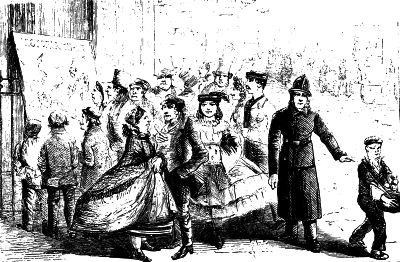
VICTORIA THEATRE—NEW CUT.
I bought a hot potato and a sprat, and left the two wondering if I had been "gaffing" or "larkin'" on 'em; and passing through the crowded street, past butchers standing at their doors in dirty aprons, sharpening their knives in a business like manner; past water-cress and match girls, who seemed to spring out of the gutters, so thick were they; past drunken, noisy women, staggering home to their miasmatic dens, with bunches of vegetables or chunks of meat in their arms, wrapped in coarse brown papers, dirty children following their footsteps, gaunt and shadowy-like; past reeking, greasy coffee-shops, the very sign-boards of which were redolent of eel pies, kidney stews, and all the abominations which are devoured in this neighborhood daily and nightly, by the poor people who are forced to eat this food, the refuse of the slaughter-houses of mighty, populous London, from that stern, blind necessity which knows no law, and I came upon a crowd of the working people—costermongers, peddlers, match-women, and young lads and girls—who find habitations in the dusky lanes and frightful courts of the neighborhood. I stood before a large, dark-looking building, which seemed like a prison, its frowning, dirty facade being no evidence that it was a place of amusement. But it was a place of amusement, or, rather, a place of torture. This was the "Royal Victoria Theatre," New Cut, Lambeth.
THE NEW CUT.
The Victoria Theatre, or the "Vick," as it is called by its patrons, is one of the most democratic places of amusement, if not the most democratic in London. In another place I will attempt to describe the strange sights which I saw inside of its walls, but at present I shall confine myself to giving my readers a view of the "Old Clothes" district, which is chiefly inhabited by the lower class of the London Jew peddlers or hawkers.
Dick Ralph was a patrolman bold, who did duty in the "H," or Smithfield Division of the City of London police, and was rewarded for his vigilance and attention to duty by being promoted to the office of "special," under probation, in the old Jewry squad of detectives.
Dick had lately married and was the proprietor of a fine chubby boy of fifteen months old, who resembled his father in every respect, having the same red flush in the cheeks, the same black eyes, which sparkled like diamonds, and the same little chubby nose. The family lived back of St. Paul's towering pile, in a little lane or court which ran around the old sheds that formed a part of the Old Market or Newgate shambles, and was the principal fresh meat mart before the New Smithfield Market had been built.
Ralph had been detailed by Inspector Bailey to visit Petticoat lane, Houndsditch, Bevis Marks, and the Minories with me, and we were to go together to the Sunday market in this district, which is almost entirely inhabited by Jews, although a greater part of the out-door trade and costermongering is done by Christian Cockneys.
I found Ralph living up a two-pair back, in one of the queerest, old-fashioned wooden houses in the Newgate shambles. Directly over my head was the dome of St. Paul's, with the morning fog clearing away from its peak, and the sun was gradually appearing to gild the tall cross on the apex, and the tower of St. Faith's, under St. Paul's. The stairs were ricketty and dark, and the wainscotting quite fanciful. A woman of twenty-five or six years of age, rather tidy in appearance, I saw holding the big chubby baby, the pride of the Ralph family. The family were at breakfast, and had been busy discussing fresh plaice and soles from Billingsgate. The baby was allowed to tumble all over the floor and bite its fingers.
"How are you this morning, sir," said patrolman Ralph; "it promises to be a pertickelerly fine Sunday does this, and a nice one for stroll to see the sights."
Ralph took down his hat and overcoat from a nail, and bidding his wife good-bye affectionately, we strolled out into the streets.
We took a walk up Newgate street to Cheapside, through the Poultry, through Cornhill, passing the Bank and Mansion House on our way, and finally opposite the Aldgate Church, with its curious old Sir Christopher Wren spire, we found ourselves standing against the railing which encloses a little green square of grass belting the church.
"Now, sir," said Dick Ralph, "we are just going into one of the worst places in London. There's a regular mob here all the time, and hits just as much as a man can do to pass the peddlers without having his 'at and coat taken hoff him by the Sheenies who are selling of hall sorts of things on the Sunday market. You can buy hanything from a gimlet here in Petticoat lane to a suit of clothes in Rag Fair."
PETTICOAT LANE.
Houndsditch is a wide street which runs down from the Aldgate High street to Bishopsgate street. At the other end is the street called the Minories, going in the direction of the Tower, which frowns upon the river. Here, also, is the district called "Petticoat lane," which embraces a number of short streets, courts, lanes, and filthy alleys, with such characteristic names as "Sandy's Row," "Frying Pan alley," "Little Love court," "Catharine Wheel alley," "Hebrew Place," "Fisher's alley," "Tripe yard," "Gravel lane," "Harper's alley," "Boar's Head yard," "Stoney lane," "Swan court," and "Borer's lane."
These are only a few of the choice thoroughfares in this locality, and all of them are dirty and swarming with a class who obtain their living in the streets. There are, it is calculated, living and doing business in Petticoat lane and its lesser tributaries of streets and alleys, about six thousand men, women, and children who profess the Jewish faith, and are in humble circumstances, who have to struggle and compete with the Irish of the poorer class in the street trades, though the Jews have a monopoly of the old clothes' trade.
Houndsditch is in every way superior to the other streets which surround it. It is wider, the shops are of a better order, and it is noticeable that very few of their doors are open on a Sunday morning. As the detective and I passed through the street I noticed such names as "Abrams & Son," "L. Benjamin," "Isaacs & Co.," "Moses & Son," "Hyams & Co.," and other like names over the doors of fruit shops, jeweller shops, mercer shops, clothiers, and in one or two instances, over the doors of small publics. It is, however, not a common thing to find a Jewish name over a liquor shop door in London.
"We are in the very nick of time to see the show," said Ralph to me—it was nearly nine o'clock of the Sunday morning, and we had gone down Houndsditch about three of our New York blocks.
"The market is from eight o'clock Sunday morning until about two in the hafternoon, and the business is as brisk as can be all that time," said Ralph.
The houses were all old, and all of them had a slouching, mean look, with funny gables, grimy windows in the upper stories, and queerly peaked and stunted roofs, overhung by tubular red chimneys, which stood up like rows of corn in a field when seen from a distance.
The people whom we met in the streets had an Eastern look, with peculiarly brilliant, almond-shaped eyes, and prominent noses. Some others had the Celtic features and spoke to each other with the unmistakable brogue. The policemen that we met, too, seemed to partake of the characteristics of the place, and I fancied that I could trace a resemblance in their faces to those by whom they were surrounded.
Crossing the street, we went through a court about a hundred feet wide, that seemed to lead into a covered shed, from which came a din and clamor of voices that was almost deafening.
There was a wooden building like a market covered over, to to which we ascended by a flight of three steps.
"This is the Rag Fair, sir; I suppose you heard on't before. It's a werry strange place, Rag Fair. But don't stop to look at anythink, or them as keeps the stands will tear you to pieces to make you buy."
A CONGRESS OF RAGS.
Although I took as much heed as possible of the injunction, it was impossible not to look. It was a very queer place in more senses than one. To get an idea of it take a section of Washington Market, New York, with its stalls and blocks, and buyers and sellers; and on the walls where the pork, mutton, and beef are hung to be inspected and sold, and, instead of the flesh of the cow, pig, and peaceful sheep, hang hundreds upon hundreds of pairs of trousers—trousers that have been worn by young men of fashion, trousers without a wrinkle or just newly scoured, trousers taken from the reeking hot limbs of navies and pot boys, trousers from lumbering men-of-war's men, from spruce young shop boys, trousers that have been worn by criminals executed at Newgate, by patients in fever hospitals; waistcoats that were the pride of fast young brokers in the city, waistcoats flashy enough to have been worn by the Marquis of Hastings at a race-course, or the Count D'Orsay at a literary assemblage; take thousands of spencers, highlows, fustian jackets, some greasy, some unsoiled, shooting-coats, short-coats, and cutaways; coats for the jockey and the dog-fighter, for the peer and the pugilist, pilot-jackets and sou-westers, drawers and stockings, the latter washed and hung up in all their appealing innocence, there being thousands of these garments that I have enumerated, and thousands of others that none but a master cutter could think of without a softening of the brain, take two hundred men, women, and children, mostly of the Jewish race, with here and there a burly Irishman sitting placidly smoking a pipe amid the infernal din; and shake all these ingredients up well, and you have a faint idea of what I saw in Rag Fair.
Take five thousand pair of shoes, boots, gaiters, bootees, brogans, watermen's boots, shoes of criminals, and suspicious-looking boots, taken from the feet of thieves, flashy-looking women's gaiters and cordovans purchased from prostitutes and wretched women in garrets, who had sold them to buy food or a drink of gin.
Take all these articles, scatter them around, hang them on nails and hooks depending from greasy stalls ascending to the old tumble down roof, and then the reader will have a dose offered to him such as I got when I fell on Rag Fair, Petticoat lane.
It was by far the strangest scene I had ever looked upon. London has nothing like it elsewhere, and New York, which is really destitute of any specially salient characteristic, could not in fifty years' time organize and bring together such a mass of old clothes, grease, patches, tatters, and remnants of decayed prosperity and splendor. In every old tattered trousers there was an unwritten epic; in every gaudily fashioned waistcoat there was a tale perhaps of sorrow and sadness and want, if any one could but point it out.
The patches and rents that were botched up and mended, showed the hasty repairs in the old coats that hung in platoons and files from the niches; the jagged sewing and frayed edges in each of these old garments, could they speak, would tell an astonishing tale, or furnish the groundwork of a plot for a popular drama.
The stalls were in rows, and the men and women and boys who did business there kept running about all the time I remained in the fair, shouting and screaming like possessed beings. Their great aim and object was to catch some unfortunate visitor by the lappel of his coat or snatch his elbow, his coat-tail, or any other available part of his clothing, hold on to him, shake an old waistcoat in his face, and if he didn't want a waistcoat, shake a dirty old pair of trousers in his face, talking all the time in an imploring, or may be a trembling tone, until the man would be compelled to break away by sheer force or call the police, who seemed to have enough to do in this place.
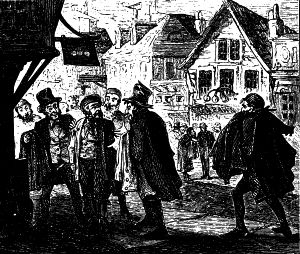
RAG FAIR.
I stopped for a moment to look at a stall where about a hundred pairs of boots and shoes were displayed in rows, the thick-soled heavy-looking brogans of the laborer ranged next to the nicely-fashioned gaiter of the elegant, with their well-turned toes and arching insteps, and the man, a sharp-featured Hebrew, who was proprietor, seized me and thrust a second-hand pair of boots in my face, saying at the same time:
MODUS OPERANDI OF SELLING.
"You wan'sh a nish pair o' bootsh? S'help, I shells you thish pair for two shillings, and they wash never made lesh than a guinea and a half! Don't you want to buy these sphlendid bootsh; s'help me, I only makes'h two pensh?"
I tried to get away, but he held to my arm and kept shaking the boots, while his sharp, black eyes glittered like sword points at the prospect of losing a sale. At last the detective, losing patience, jerked him away, and we passed on to the next slop stand.
This was kept by an old Irish woman. The Jew was all mercantile acerbity and sharpness. This old humbug of a female Celt was all treacle and honey.
"Ah, then, it's the foine gentleman that ye are. It's easy to see the good dhrop is in ye. May be it's a likin' ye'd be taking to this sphlindid waistcoat; that's all the fashion now, and it's well it 'id look on yer fine figger. And don't ye want nothing at all to wear? And shure ye wouldn't be afther goin' naked like an omaudhaun in the streets and havin' the people shoutin' after ye?"
"How much rent d'ye pay for this stall," said I to her, to get her off a topic by which she made her living.
"Is't the durty rint ye mane? Well, it's enouff for the ould hole. I pay sixpence a day in advance, and the devil resave the penny I've turned yet, this blessed mornin."
"Have you any one to support beside yourself?"
"Well, indade, I have two childher, and its small comfort they are to me. One of thim, the eldest, is down wud scarlet favir, and the docthor says it tin to one if she'll ever recover."
"You see sir," said the detective, "the people who rent stands from the men as own this place, they have to pay sixpence a day to 'old the stand. But those fellows as you see running around like lunatics, and a borin of every one, they pays two pence a day rents—cos why they 'ave no stands and honly walk habout with the clothes hon their harms."
"Yis, and I wish you'd sind them to the divil, the haythens—they niver give an honest woman a chance to make a penny be hook or be crook, wud thim runnin all over the fair."
"Halso, we never allows the 'awker as has no stands to stay in one place," said Dick Ralph, "cos hif we did, that would ruin the business of the people as pays rent for the stands. So we keeps them a movin' hon, and they doesn't like it, but we have got to do it, or else they would have rows hall the Sunday through with the nobs as keeps the stands. You see, the wery minute one of the 'awkers gets hopposite a stand, he collects a crowd and—now, there goes one now;" and he pointed to a fellow with a pair of trousers, who was bawling his goods out while a policeman had him by the neck shoving him along by main force.
"Oh, some of these lads are precious 'ard coves, I tell you, to manage. Some of them will fight and curse at you like as hif they wor made of brass. But we never talks long to them, 'cos hif we did Rag Fair would be too much for the force."
"How much a day do the hawkers make on an average?" I asked Ralph.
"Well, I can't tell, because they are sich werry 'ardened liars. I axed one the werry last Sunday as I wos 'ere. Says I, 'old Benjamin, how much do you take in on a day's work on a haverage?'"
"Oh! blesh your 'art," sez he, "some days I hash two pounds profit, and some days I makes a shillin' by 'ard vork."
"Now ye see," said Ralph, "I knew he was of gaffin me, for he was not worth two pounds, body and soul, and I don't suppose he never made more than half a crown in a day and do his best. Then Old Benjamin spends it hall in fish. The Jew peddlers here are wery fond of fish on Saturdays. They would go without a meal in three days to have a fresh mackerel on Sunday. And they are werry pertikler as to who kills the meat before they buys it."
Determining to make another attempt to see Petticoat Lane on a week day, I bade the polite policeman and the highly odorous quarter of the Old Clothes sellers, a very good day.
CHAPTER X.
FROM NEWGATE TO TYBURN.
ET us look at Newgate. This stern old pile of stones heaped upon stones, grey and grim, the burden of whose sighs afflict the weary skies above.
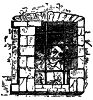
The strangest kind of a fascination hung over me as I looked at its Gate, cut in the deep wall like the entrance to a rocky cave. The spiked sill spoke of gibbets, the bars and locks and bolts of a felon gang, who dragged their blind life away, day following day, for them without hope, the outside world vacant, dumb and blank as the Ages, to their crime begotten souls, whose only music was the clank of fetters and the hoarse grating of iron hinges.
The building itself, covering half an acre, seemed sealed like a sepulchre. There was nothing to be gotten out of it, one way or the other. No one can have even looked at this terrible prison of Newgate without a shudder of despair for his kind.
Only on certain recurring Black Mondays did it yawn like a grave in the face of a great swearing mob, to put forth something into the open in the shadow of St. Sepulchre's, that was half dead; to take it back after an hour quite dead; and then it relapsed into its old, inscrutable dumbness.
Now Gate of Ivory, now Gate of Horn—now a porch above which might be inscribed the despairing legend of the Inferno, now a wicket at which the charitable might tap gently, fraught with messages of mercy to the fallen creatures within—the portal of Newgate could assume chameleon hues, not always hopeless.
Next to the spikes of Newgate, the visitor must always mark for lasting remembrance, the stones of Newgate doorsteps. They are not perhaps more than eighty years old, but they look more worn than the jambs of Temple bar—more decayed than the wheel windows of the Cloisters of Westminster Abbey. They are ancient through use, and not through time.
The Hall of the Lost Footsteps at Versailles is but an empty name, but the millions of footsteps that have worn Newgate stones, must make it an abiding reality. Here have united all the crooked roads. Here have fallen the last steps on the stones of the ford of the Black River. Beyond the steps has loomed the City of Dis.
How many footsteps! how many!
Lord George Gordon, after the riots and burnings of 1780, wrecked and crazy, totters feebly up Newgate steps to die in the prison which his murderous associates had attempted to burn. Desperate Thistlewood, fresh from the loft in Cato street, where his fellow conspirators were dragged—reeking from the murder of Smithers, whose ghost followed him to the gallows, is brought here heavily chained from the Tower Dungeon, in which the ministry with frantic fear had at first immured him.
He and his gang will leave Newgate no more save by the Debtor's Door, where the Man in the Mask—one of the few unsolved mysteries of the Nineteenth century—will do his horrible office upon them and hold up to the populace five severed heads, who at first shudder, but growing hardened by the dripping sight of blood, will cry as the clumsy butcher lets the last head fall—
"Hallo, butter-fingers!"
Down Newgate steps at dead of night, how many corpses of uncoffined wretches have been borne in sacks, to be dissected at Old Surgeon's Hall, over the narrow causeway which skirts the prison.
EXECUTION OF BARRETT.
The dread gaol keeps its secret better now. No grapnel hauls forth the dishonored carcass of the dead criminal for exposition at the Gemonian steps.
The place is doubly a Golgotha, and murder is buried on the spot where it has been slain.
Here died brave hearted Michael Barrett, the victim of the last public execution which will ever take place in Newgate, just three short years ago. How the huge metropolis seethed and boiled like a world-cauldron that day of days!
Condemned to die as a Fenian conspirator, he gave his life gallantly for his native land, and in his last hour frightened England more than a hundred living Barretts could have done.
I stood before Newgate with a member of the Old Jewry force who had seen the execution of Barrett. From the fact that the government, after that day, has prohibited any more public executions, his description of the scene will be worthy of recounting to my readers. The detective was a young man, and intelligent beyond his class. We were standing outside of the prison gate.
The lane or street of the Old Bailey, which begins at Ludgate Hill, one block below St. Paul's Cathedral, runs toward Newgate street, parallel with Giltspur street which it enters, and forms before ending a triangular space of about two acres square measurement. At the angle, formed by the Holborn Viaduct, which ends here, (Giltspur street and Newgate street,) is the old Church of St. Sepulchre. To the right and behind us, we could just trace the ornamented and beautiful facade of Christ Church Hospital. To our left and below us was the Sessions Court in the Old Bailey, a place in some respects like the Tombs Court and the Court of General Sessions in New York, were both courts to be combined. I am thus particular in order to show my readers where and how Michael Barrett, the last Newgate victim, died.
"Well, you see, Sir," said my Old Jewry friend to me, "the week as Barrett wos hung wos a busy week with us. Up all night sometimes and all day, searching the holes and corners and dark places of the city for Fenians. We got information that they wos going to blow up St. Pauls, one day—another day we hears that they had a plot to bust hup the Bank of Hingland—then they were to burn down the Tower and the 'Oss Guards, and then somebody told us that they meant to send Westminster Habbey and Buckingham Palace sky high—and this way and that way we wos worrited to death with hinformation. One night I was detailed to St. Paul's to watch the crypts or vaults under the Cathedral, where the Fenians intended to put a lot of gunpowder to blow it hup. I staid there all night with some more of the men detailed, and a precious cold job it wos, we hiding among the vaults snapping our fingers and shivering like geese in a pond, and not a Fenian within three miles of us. That wos a lark, and the newspapers laughed at us, and had comic picters of us standing in the cold, for their hedification."
"Another night we hexpected them to set fire to the 'Ouses of Parlyment, and a blessed shame it would have been to have destroyed sich a fine hedifice, and there I wos night after night, a-playing hide and seek among the galleries and Towers of the 'Ouse, watching for Fenians and hexpecting to get a stab in the back, and all the time I wos wishing as how I could get relief, so as to get a pot o' beer in the King's Arms in Parlyment street."
DYING FOR AN IDEA.
"Well, Sir, at last came the busting and blowing up of Clerkenwell Prison, and a nice row that made all through England—and while the fellows as did it walked off quite cooly—Barrett and a few more who wos suspected, and who wos as I believe really hinnocent—of the Clerkenwell affair—wos taken and tried right over here in the Sessions Court (pointing with his hand over the wall of the Old Bailey Court), and he stood up in the dock that day as he wos found guilty, and I must say he was as brave a man as I ever saw—and defied the big wigs and all on them, and said he was not afraid to die, and then he told them that if it was twenty lives he would give it for "dear Ireland,"—thems just the words he said, and although I don't like Fenians or Fenianism, I must say for him that he was no more afraid than I was, that is if you can judge from a man's face at such a hawful minute.
"The night afore his execution I was in his cell; I was let in by a friend of mine the turnkey, and I spoke to him kindly, cos you see I didn't feel exactly like as if he wos a man who had committed a common murder or robbed for a living, cos why, you see, a lawyer told me as how he was dying for an idea, like Russell or Hampden or some others of them Big Guns.
"I sez to him:
"How do you feel Mr. Barrett?"
"I feel well, thank you said he;" one of the turnkeys wos watching him, sitting up with him, and he had a light in his cell—he was ironed.
"They are putting up the scaffold," said he to me without a bit of fear.
"Yes, and I'm sorry for it," said I, "Mr. Barrett—is there anything I can do for you."
"Nothing," says he, standing up and turning down the book which he was reading, his chains clanking around his legs—"Nothing—but you see me the night before I die—tell those who employed you that Michael Barrett has made his peace with God—and is not afraid to die. Tell them," and he commenced reciting poetry like, with his eyes on the ceiling of his cell:
"Whither on the scaffold high Or in the battle's van; The fittest place for man to die Is where he dies for man."
"Them's the lines as near as I can remember, for I saw them in a book after, and that made me recollect them.
"During the night they were busy in putting up the scaffold, and three or four thousand special constables were sworn in by the magistrates, cos why, they were afraid that the Fenians would rescue Barrett, and I, as well as every other man, wos armed with a six-barrelled revolver. When the morning came there must have been a hundred thousand people in the streets and all around here. Hundreds staid up all night to get a chance for a good place to look at him, and there was more than three thousand women, and as many children in the crowd around the scaffold. The top of the scaffold, I mean the frame, was about twelve feet above the street, and the platform was about six feet high, so that hevery one was able to see him. Fifteen hundred police in uniform were drawn hup around Newgate, and to prevent the crowds from pushing or rescuing the prisoner, a barricade of trees was built at a distance of two hundred feet from the scaffold hevery way. Five hundred police in plain clothes were among the crowds armed with revolvers, and troops were stationed at all the barracks in the city so as to be ready for any attempt to save his life. The crowd Sir, was for all the world like a surging sea, and people were buying and selling of histers, and liquors, ginger beer, whelks, fruit and cigars, just the same as if they were at a fair, and men and boys were crying ballads and singing, and some of them were peddling Barrett's printed confession. Now you see, Sir, that was a humbug, becos Barrett never made no confession, but they sold just as well as if he had made one, at a penny a piece.
"Well, when St. Sepulchre's bell struck eight, which is always the signal, they brought him ought, and although the air was cold and some of us were shivering from standing up so long without anything to eat or drink, he never trembled at all, but looked at every man and woman of all that wos there with a smile, and a steady look.
"'He's a game un,' I heard many a man say, and our fellows who had such hard work watching the Fenians by night and by day, had no hard feelings agin the brave fellow then. The women around the scaffold waved their handkerchiefs to him, you see, Sir, the women, bless them, are always up to such blessed games, and there was some man in the crowd when the rope was put around his neck, who wore a fur coat, and seemed like an American, who cried out as loud as he could—
"Good heart—Michael Barrett—this day. All is not lost while one drop of Irish blood remains."
THE PESTIFEROUS PRISON.
"I saw the man, and I made a jump for him with two of my pals, but the crowd opened and let him pass through,—it seemed a purpose like, and just then I heard a roar and a great convulsive sob, and the crowd pushed this way and crushed that way, almost smothering me, and I nearly fainted from the awful squeezing I got, and I picked up a little girl from atween my feet, and when I looked up Barrett's body was a swinging to and fro from a rope, and all was over, and believe me, Sir, I was glad of it when it was over."
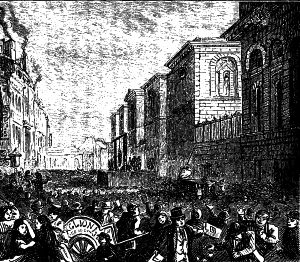
THE LAST EXECUTION AT NEWGATE.
It was high noon when I arrived at Newgate, and my visit was paid chiefly to that part of the prison devoted to the subsistence of the prisoners. I passed through the corridors and passages, and door after door, and hinge after hinge grated as I advanced with a companion. All around the prison are the high walls of the neighboring buildings, and attached to them are precipitous sheds with spikes to prevent the escape of prisoners who may succeed in getting as far as the yard. On top of the prison is a huge circular fan which revolves and gives ventilation to the interior of the jail. This improvement was the result of the labors of the great philanthropist John Howard.
In the old days Newgate was a hell upon earth. During the Eighteenth century prisoners endured the tortures of the damned here. Jail birds were shackled to the floor to prevent their escape, and mouldy bread and stinking water was given them to drink until their stomachs loathed the appearance of food. Their beds were of stinking straw, the rain from the heavens dripped through the roof upon them, the frost and cold eat into their bones; they festered in dirt, disease, and destitution, till their limbs broke out in horrible blains, and ulcers and all kinds of agues and dysenteries swept down upon them. Then in this terrible state, after rotting for months awaiting a trial, they came into the dock at the Old Bailey with the jail fevers upon them to slay with the pestiferous miasma which exhaled from their bodies, judge, jury, and pettifogging attorneys.
The prisoners were so crowded together in dark dungeons, that the air becoming corrupted by the stench, occasioned a disease called the "goal distemper," of which they died by dozens every day. Cartloads of dead bodies were carried out of the prison and thrown in a pit in the burying-ground of Christ's Church without ceremony. The effluvia in the year 1750 was so horrible that it made a pestilence in the whole district. Four judges who sat in the Session, a Lord Mayor, several aldermen, and other civic dignitaries were carried off by the distemper, together with a number of lawyers and jurors present at the trials of Newgate criminals.
GETTING WEAK IN THE BACK.
Then at last the prison was cleansed, and a system of ventilation introduced, which made some improvement in the condition of the prisoners. Still, Newgate was a disgrace to Christendom, and just one hundred years ago Parliament made a grant of £50,000 to construct a prison. Beckford, author of Vathek, and then Lord Mayor of London, laid the first stone. In 1780, Lord George Gordon, with his No-Popery rioters, burned down that part of the prison which had been constructed, and set at liberty three hundred of the prisoners confined there. £40,000 in addition had to be granted before the building was completed.
On an average there are between two and three hundred prisoners held in durance in Newgate, and twelve sessions are held during the year at the adjoining Old Bailey Court for their trial. This is called the Central Criminal Court, and it is here, in this very court, that Jack Sheppard, Dick Turpin, Claude Duval, Sixteen String Jack, Tom King, and all the other heroes of the yellow covered literature, were tried, condemned, taken in fetters to Newgate, and from thence to Tyburn Tree to hang by the neck until they were dead.
The Judges of the Old Bailey Court are the Lord Mayor, Aldermen, Recorder, and Common Sergeant of London, and the Judges of the Courts at Westminster Hall, who sit here by rotation to assist, by their superior legal knowledge, the inferior local magistrates.
The prison is divided into a male and female side, but beyond this there is little classification; the pickpocket, the swindler, the embezzler, the murderer, are all associated together; while the hardened offender and the one who is merely suspected of crime, but too often share the same cell, and feed at the same board.
There are separate cells, so that every one averse to society may dwell alone if he or she chooses, but in conversation with the turnkeys, I learned that the privilege was rarely claimed.
"Why, Lord bless your heart, Sir," said a turnkey to me, "there isn't one of the birds in this ere cage that wouldn't go down on his blessed knees and beg hoff if he was to be locked up alone for forty-eight hours. Ye see, sir, it sickens them, it does, to be alone and hear no one's voice but their own. There's a few of the high 'uns at first, when they come here, are werry hoffish and have a sort of a "how-dare-you-look-or-speak-to-me-air," but before three days they gets weak in the back and then they'll give a guinea a minute to look at a face if it only wor a monkey's dirty mug."
When prisoners become refractory, solitary confinement, for a few days, is the punishment, and it never fails to tame the most intractable. The beds of the prisoners are in tiers one above the other, like the berths on an emigrant ship, only that they are clean almost to painfulness. The beds consist of a hard mattress and coarse coverings, sufficient in all seasons to keep them comfortably warm. A plain deal table and bench constitute the only furniture of the place, and these, with the floor, are daily scrubbed into a state of scrupulous cleanliness by the inmates of the cells. There are paved court yards in which the prisoners may walk and breathe the small quantity of pure air that can circulate between those high and gloomy walls, surmounted by formidable spikes to impede the climber.
I went into the kitchen of Newgate and found it to be a commodious and well-fitted apartment, very like the kitchen of the Reform Club, only not so luxurious, from its want of French dishes, and I found here boilers, stoves, ranges, saucepans, kettles, and all that a chef could need for his cuisine. This was not the kitchen of the Old Newgate of which Ainsworth delights to tell, where the hangman used to seethe in a cauldron of molten pitch the heads and quarters of victims executed for treason, whose several members were afterwards affixed to the spikes of Temple Bar or London Bridge.
I saw the rations of each prisoner served out in tin panikins and platters, and the bread served was as white as any I ever ate. There were three large and beautiful potatoes allotted to each one, and three ounces of boiled beef, good and tender and free from bone, just of the same quality which I had seen served a few days before in the barracks of the Grenadier Guards down in Westminster. The meat might not have all the accessories and sauces which a Delmonico or a Blanchard could provide, but it was palatable and tender to the taste.
On "off" days they have soup and thick gruel for breakfast, and sixteen ounces of bread per day. They never get beer, butter, milk, cheese, cabbage, tea, coffee, or eggs.
HOTEL REGULATIONS.
So, after I had seen all this "bee bread," the hunks of meat duly weighed out, the potatoes and lumps of bread packed in their panniers and delivered out from door to door—the chief warder and I began to ascend a very Mont Blanc of iron staircases, and visited, one after the other, the cells of the wicked hive; in which, God knows, there was no honey making, but only wax, bitter as the book which the Apostle swallowed.
The original "comb," many stories high, had been built in one of the former yards of the gaol. The space between the different tiers of cells was quite sufficient for ventilation; but the architects had of necessity trusted more to height than to breadth, and this increased the hive-like appearance of the place. But when I came down again, the remembrance of what I had seen fresh upon me, all these iron staircases and galleries, all these shining locks, bars, numbers, plates, and "inspection holes," all these recrossing and crossing pillars, trusses, and girders, made me think that I had just left some great, bad exhibition of products of the devil's industry. One cell was, in all save its occupant, twin brother to its neighbor on either side; and so on, tier above tier, until the whole nest had been explored. I forgot to ask how many feet broad, by how many feet long, was each dungeon.
But here is one—the type of all the rest. It is as large say, as a cabinet particulier, to hold four, at Vachett's or the Moulin Rouge; but it is given up to the occupancy of one man. It is a hundred times cleaner than ever was cabinet in Paris restaurant; and here the lodger eats, reads, and sleeps. His bedding lies on a shelf on the right corner as you enter the cell. It is a pile of rugs, matting, mattress, or some other kind of bedding, packed and folded up with mathematical accuracy, with an assortment of straps and hooks disposed in corresponding order. These hooks will, by and bye, at eight o'clock, be inserted in rings in the whitewashed cell, when the prisoner will make his bed and sleep athwart his cell.
There are his gas-pipe, his basin, and mug; there is a little desk-formed table, which he can prop up with a wooden support, to eat his meals upon; there are his tin panikin and wooden spoon, his Bible, prayer-book, and hymn-book, his comb, his salt-cellar, with a neat cover of blue paper. Everything shines, glistens, sparkles, almost as bravely as the gew-gaws in Mr. Benson's shop outside. The floor is of shining asphalte. The covered ceiling is without a flaw. The walls are unsmirched. A neat copy of the regulations enforced in this "hotel"—the code of discipline framed by the Sheriffs—are hung up for the prisoner's guidance. He has a ventilator, by means of which he can regulate the temperature of his cell; and I noticed that the chief warder had to tell almost every prisoner that he was keeping his cell too warm.
Among the many afflicting scenes that have taken place in the vicinity of Newgate, was that of February 23, 1807, when two men, named Haggerty and Holloway, were hanged for the murder of Mr. Steele, on Hounslow Heath. The greatest interest had been excited by the trial of these two men, and an immense crowd assembled to witness their execution.
By five o'clock in the morning every avenue was blocked up; every window that communicated a view of the place was crammed, and wagons, arranged in rows, groaned under the weight of the eager multitude. The pressure of the assemblage was tremendous; and when the criminals had been turned off—when they had given their last death struggle—the mass of the people began to move. But there was no room for them to move in.
Immediately rose the shrieks of affrighted women in the crowd, which but increased the alarm, and made each individual struggle to get out of the multitude. Hundreds were trodden under foot, and the furious and frightened crowd passed over them.
At last the confusion ceased a little, and the ground became comparatively clear.
DRINKING FROM ST. GILES' BOWL.
Some who had been thrown down arose but with little damage, and went home, but forty-two were found insensible, of this number twenty-seven were quite dead, of whom three were women. Of the other fifteen many had their legs or arms broken, and some of them afterward died. Since that occurrence barriers have been erected and executions have taken place without loss of life. The system of hanging in chains has also been abolished, and Newgate may one day hope, like its brother of the Bastille, for the light of freedom to break in upon its hell-holes, and show to humanity how like devils are men clad with a little brief authority.
Eighty-three years ago, the last victim, taken from Newgate to Tyburn Tree, was hung there upon the gallows in chains. The name of the criminal was John Austin. Tyburn was anciently a manor and village some miles west of London, and on this fated spot, in 1330, Roger de Mortimer was hanged, drawn, disemboweled, and quartered, for high treason. The gallows was a triangle upon three legs. Long years ago, when Dan Chaucer wrote his lays, criminals were taken to Tyburn, and hung from a lofty elm tree, which overshadowed a brook or "burn," hence the term of "Tyburn Tree." The gallows, in after years, stood on a small eminence at the corner of the Edgeware Road, where a tool-house was subsequently erected.
Beneath this spot, where the gallows formerly stood, the bones of Bradshaw, Ireton, and others, who had voted for the death of Charles I, repose, their remains, having been taken from their graves, after the Restoration, and thrown here. Around the gibbet were erected open galleries, like those at a modern race-course, from whence many thousand people, of both sexes, were wont to feast their eyes on the dying struggles of the condemned. "Mamma Douglas," an old toothless woman, held the keys of these seats, and she was, facetiously, called the Tyburn "pew opener." Prices of seats to witness the sport, varied from one and sixpence to three shillings, and in one instance, a reprieve having arrived for the prisoner in time to save his life, the mob became enraged at their disappointment, and tore up the benches. The criminal was conveyed in a cart to Tyburn, the parson chanting prayer and hymn on the route, and in passing through the quarter of St. Giles, a bowl of ale was always offered to the condemned to drink, the procession of Sheriffs, Stavesmen, and Constables, halting on the way for the purpose. Among the famous criminals executed here were Perkin Warbeck, for plotting his escape from the Tower, 1534; the Holy Maid of Kent, and her associates, 1535; the last Prior of the Charter House, same year; Southwell, the poet, 1615; Mrs. Turner, hanged in a yellow starched ruff, for the poisoning of Sir Thomas Overbury, 1628; John Felton, assassin of Villiers, Duke of Buckingham, 1600; and in 1662 five persons who had signed the death warrant of Charles I; 1684, Sir Thomas Armstrong (Rye House Plot); 1705, John Smith, a burglar, having been hung for fifteen minutes, a reprieve arrived, and he was cut and bled, which saved his life. Jack Sheppard was hung in 1724; Jonathan Wild, the thief taker, in 1725, and Catharine Hayes was burnt alive here in 1726, for the murder of her husband, as the indignant mob would not suffer the hangman to strangle her, as was usual, before the fire was kindled. In 1760, Earl Ferrars, who had murdered his steward, rode from the Tower to Tyburn, in his open landau, drawn by six horses, and was hanged with a silken rope, the hangman and the mob fighting for the rope, while the latter tore the black cloth on the scaffold to pieces. Oliver Cromwell's body was taken up and here, long years after he had died, hung from the tree, while his head was set on a spike of Westminster Hall. The other famous hangings were as follows: 1767, Mrs. Browning, for murder; 1774, John Rann (Sixteen-Stringed Jack), highwayman; 1775, the two Perraus, for forgery; 1777, Rev. Dr. Dodd, forgery; 1779, Rev. James Hackman, assassination of Miss Reay: he was taken from Newgate in a mourning coach. 1783, Ryland, the engraver, for forgery. 1783, John Austin, the last person executed at Tyburn.
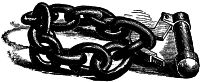
CHAPTER XI.
DOCTOR'S COMMONS.
NE of the queerest old rookeries in London is the little old edifice in Great Knight-Rider street, just back of St. Paul's Churchyard, with its nest of courts and its ancient quadrangle, where people go to get licenses to marry—or to have divorces granted them, or to examine or prove wills—or perhaps to have a suite entered for salvage or flotsam, or jetsam,—where David Copperfield paid a thousand pounds to receive his matriculation as a proctor. This curious old relic of Roman Catholic England, where the wills of the British nation are preserved, is known as Doctors' Commons.

It is a college of civil, canon, and maritime law, and here all cases that belong to these three divisions of English law, as also divorce suits, are entered, argued, and decided.
The lawyers who practice here are all well to do, snug, aristocratic old fellows, and enjoy good living and nothing to do as no other disciples of the legal profession can.
It is called Doctor's Commons because the doctors or students at law used to eat in common, or dine together in a hall in the old days when the Archbishop of Canterbury acknowledged the supremacy of the See of St. Peter.
In the Doctors' Commons are—the Court of Arches, named from having been formerly kept in Bow Church, Cheapside, originally built upon arches, and the Supreme Ecclesiastical Court of the Province of Canterbury—the other English Ecclesiastical Province being that of York; the Prerogative Court, where all contentions arising out of testamentary causes, are tried; the Consistory Court of the Bishop of London; and the High Court of Admiralty; all these courts hold their sittings in the college hall, the walls of which are covered with the richly-emblazoned coats of arms of all the doctors who have practiced here for two hundred years past.
The Court of Arches has a jurisdiction over thirteen parishes, or "peculiars," which form a "Deanery," exempt from the authority of the Bishop of London, and attached to the Province of the Archbishop of Canterbury, who is Primate of England. This court decides, as in the days of Wolsey, in all cases of usury, simony, heresy, sacrilege, blasphemy, apostacy from Christianity, adultery, fornication, bastardy, partial and entire divorce, and many exploded offenses, which in the Nineteenth century become farcical when tried in an ecclesiastical court. Fighting or brawling in church or vestry are also offenses under the jurisdiction of this absurd old court, but they are seldom or ever brought up in these days, as the newspapers are sure to seize upon such trials as subjects for derision and satire. Still the statutes are in existence and will probably never be repealed until the Established Church of England is abolished.