Front matter (continued 6)
Reading edition
"Believe me, yours ever sincerely, "Albert Edward."
IX.—He Had the Measles.
"Sunday.
THE PRINCE HAS THE MEASLES.
"My dear Lady Mordaunt,—I cannot tell you how distressed I am to hear from your letter that you have got the measles, and that I shall in consequence not have the pleasure of seeing you. I have had the measles myself a long time ago, and I know what a tiresome complaint it is. I trust you will take great care of yourself, and have a good doctor with you. Above all, I should not read at all, as it is very bad for the eyes, and I suppose you will be forced to lay up for a time. The weather is very favorable for your illness, and wishing you a very speedy recovery,
"Believe me, yours most sincerely, "Albert Edward."
X.—Anxious Again.
"Sunday.
"My dear Lady Mordaunt,—Many thanks for your kind letter. I am so glad to hear that you have made so good a recovery, and to be able soon to go to Hastings, which is sure to do you a great deal of good. I hope that perhaps on your return to London I may have the pleasure of seeing you.
"Believe me, yours very sincerely, "Albert Edward."
XI.—The "Great" Francis is to Arrive.
Sandringham, King's Lynn, Nov. 16.
"My dear Lady Mordaunt,—I must apologise for not having answered your last kind letter, but accept my best thanks for it now. Since the 10th I have been here at Sir William Knollys' house, as I am building a totally new one. I am here en garcon, and we have had very good shooting. The Duke of Cambridge, Lord Suffield, Lord Alfred Paget, Lord de Grey, Sir Frederick Johnstone, Chaplin, General Hall, Captain (Sam) Buckley, Major Grey, and myself, composed the party; and the great Francis arrived on Saturday, but he is by no means a distinguished shot. Sir Frederick Johnstone tells me he is going to stay with you to-morrow for the Warwick races, so he can give you the best account of us. This afternoon, after shooting, I return to London, and to-morrow night the Princess, our three eldest children, and myself, start for Paris, where we shall remain a week, and then go straight to Copenhagen, where we spend Christmas, and the beginning of January we start on a longer trip. We shall go to Venice, and then by sea to Alexandria, and up the Nile as far as we can get; and later to Constantinople, Athens, and home by Italy, and I don't expect we shall be back again before April. I fear, therefore, I shall not see you for a long time, but trust to find you, perhaps, in London on our return. If you should have time, it will be very kind to write me sometimes. Letters to Marlborough House, to be forwarded, will always reach me. I hope you will remain strong and well, and wishing you a very pleasant winter,
"I remain, yours most sincerely, "Albert Edward."
On the afternoon of the fifth day of the trial, the Prince of Wales, who had been driven by his royal mother to take the step, much against his will, appeared in court to testify, nominally at his own request, but really from a fear of public opinion. The presiding judge of the Divorce Court, Lord Penzance, when he heard that the Prince desired to testify in his own behalf, exerted himself in such an extreme fashion, as to call down the ridicule and scorn of the London press for his servile proceedings. Having been informed that the Prince was about to appear in court, this flunkey judge, who had been created a peer for something that he had done as a lawyer, was most eager, painfully eager, in fact, to accommodate his Royal Highness. The latter was treated by the judge with a respect which was a combination of profundity, enthusiasm, and excitement. One journal suggested to the learned judge, that while the Prince was in attendance on the trial, it was the duty of the magistrate to have a smoking room fitted up for the special use of the Prince, while another claimed that a billiard table should be provided for the amusement of the Prince between the intervals of the evidence, and asked Lord Penzance to be careful and open court daily at an hour to suit the convenience of the Heir Apparent, who is I believe, a late riser. It is a rule of British law, that the members of the Royal family cannot be called upon to testify in any case, unless of their own free will, and then they are not asked to swear to the evidence which they may give, as their simple affirmation is deemed to be sufficient. The Prince of Wales on this occasion, however, thought it necessary to be sworn, and he testified that he knew Sir Charles and Lady Mordaunt, and that Lady Mordaunt had been an acquaintance of his before his marriage to the Princess of Wales. He also testified that he was fond of riding in hansom cabs, and lastly, he swore that there never had been any improper familiarity or criminal act between himself and Lady Mordaunt. This statement, in open court, was a great relief to the Queen, who it is said, at once upon hearing of it sent for the Prince to come to Buckingham Palace, and on his arrival he was welcomed warmly by his mother.
SIR FREDERICK JOHNSTONE TESTIFIES.
The next witness examined was Sir Frederick Johnstone, who testified that he had gone to dine with Lady Mordaunt at the Alexandra Hotel, in obedience to a request which she made by letter, to that effect. The dinner was a tete-a-tete one, (no one being present but Sir Frederick and Lady Mordaunt) in a private room, and it lasted from four o'clock in the afternoon until twelve o'clock at night. Sir Frederick acknowledged that the dinner took place without the knowledge of Sir Charles Mordaunt, and that he never told the latter of the circumstance afterward, although a visitor at Walton Hall. This closed the case on evidence. A paper had been found in Lady Mordaunt's handwriting, with the memoranda "280 days from June 29—April 3d," referring, as it was supposed, to her first meeting with Viscount Cole. Sir Charles Mordaunt, in his affidavit, alleged the marriage on the 6th of December, 1866, at St. John's Episcopal Church, Perth; cohabitation at Walton Hall, and at 6 Belgrave-square; and adultery with Viscount Cole in May, June, and July, 1868, at Chesham-place, and in July, 1868, and January, 1869, at Walton Hall; and adultery with Sir Frederick Johnstone, in November and December, 1868, at Walton Hall, and in December, 1868, at the Alexandra Hotel, Knightsbridge; and adultery also with some person between the 15th of June, 1868, and the 28th of February, 1869.
The English aristocracy never have had such a blow dealt at their corrupt social system, as the developments of this suit impelled against them. "Reynolds' Newspaper," a London journal with a circulation of 280,000 copies weekly, spoke in thunder tones as follows, to its readers, the workingmen of London:
"THE PRINCE OF WALES IN THE DIVORCE COURT.
The great social scandal to which we have frequently alluded, has now become blazoned to the world through the instrumentality of the Divorce Court. Nothing was left undone that might hush it up, so that the Prince of Wales' name should not figure in so discreditable a business. Every effort was made to silence Sir Charles Mordaunt. A peerage was, we believe, offered him. Any place of emolument he asked for would willingly have been given him. All the honors and dignities the crown and government have it in their power to bestow would readily have been prostituted to insure his silence. Lord Penzance, at the last moment, earnestly strove to keep the name of the Prince from coming before the public. Sir Charles Mordaunt, however, was deaf to every persuasion, and, like a noble minded man and high spirited gentleman, scouted all attempts to shut his mouth; and, with contemptuous indifference to the entreaties of the judge, and disregarding the course adopted by his own counsel, at once told the whole story of his supposed dishonor, without blinking facts or concealing names. He told the court that he forbade his wife continuing her acquaintance with the Prince of Wales on account of his character. He intimated to the Prince that his visits should cease. He, however, alleges that, despite this intimation, they were surreptitiously continued; that letters of a compromising character were found; and that other circumstances occurred leading him to suppose that an improper intimacy existed between, the Prince and his wife. It should be borne in mind that when all this is said to have occurred the Prince of Wales was a married man himself, and the father of a family. The question, therefore, remains to be solved, is he an adulterer or not? Can he disprove the apparently damnatory allegations of Sir C. Mordaunt? Of course we do not wish to prejudge the case. We hope, for his own and for his wife's sake, that he can completely refute the heavy accusation laid to his charge, and that he will do so at the earliest opportunity. But we have no hesitation in declaring that if the Prince of Wales is an accomplice in bringing dishonor to the homestead of an English gentleman; if he has deliberately debauched the wife of an Englishman; if he has assisted in rendering an honorable man miserable for life; if unbridled sensuality and lust have led him to violate the laws of honor and of hospitality—then such a man, placed in the position he is, should not only be expelled from decent society, but is utterly unfit and unworthy to rule over this country or even sit in its legislature."
THE FASTEST MAN IN ENGLAND.
I don't see how any writer could make a stronger case against Royalty, (however hostile his spirit,) than this fearless exposition by the English journal of wide circulation, to which I have referred. The evidence of Sir Frederick Johnstone, which I have omitted, was too disgraceful to appear in this work, although the English papers printed every line of it. Well, the case went to the jury at last, after Lord Penzance had properly and carefully manipulated them, and a verdict was brought by them "that Lady Mordaunt being of unsound mind, was totally unfit to instruct her attorneys," and thus Sir Charles Mordaunt, having been dishonored and his domestic happiness destroyed by a conspiracy of titled persons, had to be satisfied with the verdict. In these days the plea of insanity is always a convenient one, and is very useful in a desperate case. Sir Charles was not daunted, however, and appealed his case, but met with defeat again, and thus the matter rests, and will rest. It is the intention of the injured husband to visit America, as he is an admirer of our institutions. I do not wish to offer any comment whatever on the state of society in which such corruption exists. The facts must speak for themselves.
The "fastest" young man in England is undoubtedly, William Alexander, Louis, Stephen, Douglas-Hamilton, Duke of Hamilton, Marquis of Hamilton, Marquis of Douglas, Earl of Angus, Earl of Arran, Earl of Lanark, Baron Hamilton, Aven, Polmont, Macanshire, Innerdale, Abernethey and Jedburgh Forest, and premier Duke and Peer in the Peerage of Scotland, Duke of Brandon (Suffolk), and Baron Dutton in the Peerage of Great Britain, Duke of Chatherault in France, Hereditary, Keeper of the Holyrood House, and Deputy Lieutenant of some county with an unpronounceable name in Scotland.
Possibly some of my readers, in going over this long line of titles, will recall the days of Bruce and Douglas, of "proud Angus," whom Marmion bearded in his hall, and of that Douglas who carried the heart of Bruce, like a Paladin, amid the lances of Spain; or perhaps the picture of Chevy Chase, and Douglas, and Percy, in armed fight, will be evoked with thoughts of the greatest historical House in Europe. Nobler descent, or more genuine historical honor, cannot be claimed by the holder of any lordly or royal title, than that which belongs to the present Duke of Hamilton, who is as yet only twenty-seven years of age. He is a first cousin of the Emperor of France by his mother, Stephanie, Duchess of Baden, a noble, beautiful, and good woman,—who married the old Duke of Hamilton; and one of his sisters is married to the Prince of Monaco, a sovereign in his own right. Two other sisters of the present Duke are nuns, having been educated in the Roman Catholic faith by their mother. The fourth sister is married to a private gentleman of large fortune.
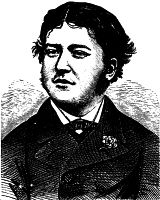
THE DUKE OF HAMILTON.
INSULTS THE EMPEROR.
The old Duke was in every sense a gentleman and a man of honor, but his two male descendants, the present Duke of Hamilton, and his brother, Lord Churchill Hamilton, are sad scapegraces—indeed I doubt if a rougher name would not be more appropriate. The young Duke, as soon as he came of age, fell heir to an income of £300,000 a year, and eight or nine country seats and residences. He had no sooner entered into possession of his estate, than he was surrounded by betting men, turf blackguards, spendthrifts, abandoned women, and dissolute noblemen of his own age. Every shilling of his gigantic fortune was squandered in three or four years, and his proud old name became a by-word of scorn and reproach when it was found that his debts amounted to £130,000. He had for his associates the Earl of Jersey, the Marquis of Waterford, the Prince of Wales, Lord Carington, the Duke of Newcastle, the Earl of Winchelsea, the Earl of Westmoreland, and other bankrupt and dissolute nobles. For a long time polite society tolerated the Duke of Hamilton, because of his family, birth, and fortune, but when he lost the latter, those who formerly laughed at his wild actions and peccadilloes, now began to frown upon him as an enfant perdu. He was sowing too much wild oats, and his friends began to desert him in disgust. A bad set of men who had control of the Duke, did not hesitate to drag his proud name and title through the gutters. At last his fellow noblemen, thoroughly ashamed of him, determined to give him a lesson. His name was put up for membership in the Jockey Club, and he was black-balled with great unanimity. The Duke of an almost royal family was treated in this ignominious way by the fathers of families, and brothers of girls of stainless birth, as a caution to him. The Duke being both bankrupt and disgraced, left England for the Continent, to avoid his thousand and one creditors, who cursed him bitterly when he departed. Passing through Paris, his cousin, the Emperor, invited him to dine at the Tuilleries. The Duke returned a curt verbal answer to his imperial relative, that he could not accept the invitation, "for he had neither clothes nor manners in which to appear at the Emperor's table." That same evening he appeared in a private box at the opera, dressed in a short double-breasted shooting jacket, in company with two or three of the turfites (broken down betting men, who hung on to him for what they could get), and afterwards presided at a supper of which the less that is said the better, concerning the "ladies," who composed one-half of the twenty-four persons who sat down to table.
After the Duke left England for the Continent, a sale of his effects was had. Hundreds of purchasers attended the sale out of curiosity, as they had attended the sale of "Skittle's" furniture, or as the Parisian dandies and lorettes attended the sale of the household gods of Marguerite Gautier, afterwards known as the "Dame aux Camelias." Every article belonging to the Duke realized a value of more than two or three hundred per cent. over its original value. Crowds of "snobs" and "cads" bought whips and pipes, riding jackets, cigar cases, canes, gloves, and boots, pictures of French dancers and German soubrettes, as well as articles of crockery, at the most extravagant prices, simply because they had once been in the possession of a real live Duke, although he was a scamp. One miserable little tea-broker gave twenty-five pounds for a worn, poorly bound copy of the "Kisses of Johannes Secundus," with the idea that he was getting something very immoral—but he was disappointed of course.
I saw him twice, this Duke of Hamilton, once in a low cabaret in Paris, which had for a name the strange and I thought very inappropriate title of the "Groves of the Evangelists."
It was in a little street, or rather lane, called the Rue Belle-Cuisse, which is in the Quartier Breda.
It was a low dingy little hole, this "Groves of the Evangelist," and the people present were chiefly infantry privates of some of the line regiments, who serve as a part of the garrison of Paris. They were a hard-drinking, ruffianly lot, and the women who sat on their laps were of all the obscene birds of night that I encountered in Paris, the very worst and most abandoned.
A little girl, with a bold face and wearing a slatternly, torn dress, with a brazen pair of steely blue eyes, acted as bar-girl in this place, and measured out to the customers, petit verres of fiery Nantes brandy.
Two men, young, and fashionably dressed, sat at a table, who appeared to be strangers in Paris, although they conversed fluently enough, in French, with each other.
One of these was a fair, girlish-faced, young gentleman, with hair which is always termed auburn by the poets, while, as a contradiction it is generally denominated, in police returns—"red hair." This was the Duke of Hamilton.
The second person at the table was a tall, athletic, and handsome-looking fellow, of twenty-four or five years of age, with a smooth face, daring, black eyes, and a massive head well set upon a pair of broad shoulders.
This individual was John De La Poer Beresford, Marquis of Waterford, Earl of Tyrone, Viscount Tyrone, and a Baron five times over in England and Ireland, a relation of the Archbishop of Armagh, Protestant Primate of Ireland, and having an income of about half a million dollars, annually, in his own right.
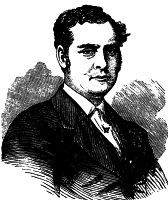
MARQUIS OF WATERFORD.
VILLAINY OF THE MARQUIS OF WATERFORD.
This young Marquis of Waterford, did a most dastardly thing when he seduced the wife of his bosom friend, the Hon. J.C.P. Vivian, M.P., a Junior Lord of the Treasury, who had placed the utmost confidence in the Marquis. He took Mrs. Vivian with him to Paris, and there lived with her in open adultery for some time until he became tired of his victim and then he ordered her with great coolness to return to her dishonored husband. To make the matter worse she was the mother of two lovely children. Her married sister, the Honorable Mrs. Somebody, went to Paris to attempt to reclaim her, held an interview with her, and begged of her to return to her husband. She blankly refused to do so, giving as her reason that she loved "John" too much,—"John," I need not say, being the Marquis of Waterford.
Mr. Vivian having commenced a suit for divorce, the utter villainy of the Marquis appeared when the letters of that nobleman to his quondam friend Vivian were read, in which the great trust reposed by Mr. Vivian in Waterford was most publicly made manifest.
This young nobleman is a grandson of the second Marquis of Waterford, who was distinguished as a companion to the Prince Regent, and as well for breaking off door-knockers and bell-handles—a complaint that was chronic with him, and that seems to run in the family.
The Marquis of Waterford is not quite so impoverished through his excesses as some of his friends, but I understand that his debts at one time amounted to £60,000.
My readers may recollect that, during the visit of the Prince of Wales to America, he had in the suite which accompanied him, a certain Duke of Newcastle, a young nobleman, who married, some years ago, a daughter of the great banker, Hope, who brought her husband an immense fortune. Beside these advantages there were few noblemen in England as highly connected, or as wealthy, as the Duke of Newcastle. Well, Miss Hope only served to stay the waning fortunes of this spendthrift for a short time, as he is now a bankrupt, and has to reside out of England to avoid the Sheriff's officers. While the execution was being levied in the magnificent mansion of the Duke, and before his wife could leave the premises, the Duke had gambled away thirteen thousand pounds, the last remnant of his once princely fortune. This hopeful Duke has always been very intimate with the Prince of Wales.
Another of the same reckless unprincipled set is the young Earl of Jersey, who was left an income of £50,000 a year, every shilling of which is gone. This young fool, who is endowed with the manners of a cabman, and who has a pot-house air in everything that he says or does, was deeply in debt at sixteen years of age, and before he left school he had borrowed £25,000 from the Jews, who now own him body and soul. His grand-mother, the Countess of Jersey, was, I believe, a mistress of George IV.
THE MARQUIS OF HASTINGS.
The Marquis of Hastings, who died about two years ago, was also one of this same set of spendthrift, young harum-scarum, unprincipled scions of the Bluest Blood of which England can boast. All his magnificent fortune went in horses, and women, and yachts, and at last, when he died, at the age of 26, he had squandered some three or four millions of dollars, and, I believe, the title created as far back as 1389, became in the direct line, extinct. The Marquis lost one day at the Derby race on Lady Elizabeth, a favorite horse of his, the enormous sum of $150,000 in gold. He married a beautiful and wealthy girl, and her fortune went in the general crash after his death. He owned a magnificent yacht, and was in the habit of cruising in the Mediterranean with a coterie of dissolute young aristocrats like himself, and on board of this yacht scenes took place that might have made the cheek of Sardanapalus to blush—that is, provided that that bloated Assyrian ever blushed.
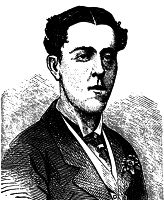
THE MARQUIS OF HASTINGS.
Prince Christian of Schleswig, a beggarly little German kinglet, who was allowed to marry the Princess Helena, a daughter of Queen Victoria, and a very good girl, is said to be rather wild in his ways, but his allowance, £10,000 a year from Parliament, has to satisfy him whether he likes it or not. But in 1869 Prince Christian and the Duchess of Mecklenburg-Strelitz had occasion to journey from Dover to Calais, and the little German had the impudence to send a bill of sixty eight pounds expenses to Parliament, despite the fact that he received his allowance regularly. Professor Fawcett, a liberal member of Parliament, who brought in bills to abolish religious distinctions in Dublin University, and in favor of woman suffrage, demanded the items of the bill, and failing to get them, moved that the Prince Christian's bill be struck out of the estimates. To show what is thought of such unbridled extravagance—the fare being only about two pounds from Dover to Calais—I give the satire and comments of the Queen's Messenger of August 5, 1869, upon the matter. This paper is a weekly organ, published in London.
"Happily there are always two ways of looking at a question, else the following bill, which was presented last week to Parliament, might have suggested puzzling reflections:
DUE FROM BRITISH TAXPAYER TO BRITISH GOVERNMENT:
For cost of presents made by Duke of Edinburgh during voyage to Cape and Australia, £3,374 14 0
For conveyance of Prince Christian and Duchess of Mecklenburg-Strelitz from Dover to Calais, 68 0 0
For royal present to Peter, king of Congo, as reward for act of Christian charity, 0 12 6
For luncheon to Prince William of Hesse, 13 0 0
For providing food for inhabitants of Cephalonia after the island had been injured by earthquake, 10 9 6
For rigging-out a pier at Antwerp for reception of Prince of Wales, 2 1 0
For robes, collars, and badges for certain persons who had received honor of knighthood, 1,000 0 0
For maintenance of Congo, pirate chief, at Ascension, 38 3 0
Cost of presents to King of Masaba, by Captain of H.M. ship Investigator, 2 0 4
———
£4,509 0 4
Thus it costs 13l. to give a luncheon to Prince William of Hesse, and only 10l. to relieve an island full of people who are dying of famine. It requires 2l. to lay down red cloth for the Prince of Wales to walk on, and only 12s. 6d. to reward King Peter for an act of Christian charity. These are facts worth knowing. The only thing we regret is that Government should have withheld information as to the precise nature of the gift with which King Peter was gratified. Did this mighty Empire present him with six pairs of cotton socks, or request him to accept a gingham umbrella second-hand? And the King of Masaba, who figures anonymously, what did he get for 2l. 0s. 4d.? Was it a pair of boots and some pocket-handkerchiefs, or a few pots of Scotch marmalade and a dozen pints of Bass? As to the other items of the bill, it is so obviously right that the country should be made to pay 68l. every time Prince Christian crosses the Channel, that we can only wonder anybody should ever have thought otherwise, and moved, as Mr. Fawcett did, that the sum be struck out of the estimates. We live in strange times, forsooth, when a prince cannot charge the cost of his railway-tickets on to the national purse without being made the subject of unmannered comments!"
LORD ARTHUR CLINTON.
And now having given as brief a resume as I possibly could of the salient characteristics of the "fast" young English aristocracy—having shown how extravagant, useless, dishonorable and unprincipled many of them are, I will close by mentioning that it is not long since the English journals were filled with the evidence on the trial of two young men who were arrested in London for dressing and appearing in public as females. They were frequently seen at the Opera, the race course, and in other public places, in company with Lord Arthur Clinton, a well-known young nobleman. Their apartments were searched, and waterfalls, chignons, puffs, and all the articles of the female toilet and female wearing apparel, were found in their possession. Brought before a magistrate, they manifested a strange and unmanly behavior, and bore without shame the details of the medical examination. Lord Clinton, in company with some other friends, had been paying their addresses to these hybrid creatures, and following in the footsteps of some of the disgusting court favorites, of which Juvenal and the Satirists of the Lower Empire speak, he was jealous of another young Lord, the cause being a rivalry for the affections of one of these hybrid things in a woman's clothes!
CHAPTER XVIII.
LORDS AND COMMONS.
HY, Sir, I do think the times 'ave changed a great deal, but I am afeered they will change wuss nor ever agin. They do say as how Gladstone has, wen he likes, a will of his own to overturn the Crown itself. And I know 'is son—'a past eight-and-twenty years the young one is. He is just a bit of a curate in yon church of St. Mary's, Lambith; and I can say for 'im as he is a hard-working man—it's no bed of ease, the parish—and 'is father, who is now more than the Queen herself, might have given young Gladstone the richest living in Ingland, and nobody to say boo to him for the favor. Yisar, I'm sixty past, last Miklemas, and man and boy I've lived in Lambeth; and now I'm broke down with the parlyatics—but I once was a good man on the river, and could pull a wherry or waterman's tub with the best on 'em."
The murky beams of an August sun were falling slantingly on the muddy waters beneath my feet as I leaned over the stone balustrades of Westminster Bridge, which connects the ancient borough of Westminster with the Surrey side of the River Thames. Far down the river, I could see craft of every description lying in the stone docks, the pride and boast of all Englishmen. Bridge after bridge loomed up in the sun's hazy beams. Waterloo, Charing Cross, Blackfriars, Vauxhall, and Lambeth Bridges, crowded with traffic and swarming with the wild, heedless, ever-bustling life of the greatest city of the modern world. Under the piers of this grand bridge, nearly a thousand feet long, swept coal barges, wherries bearing noisy cockney watermen, who halloed to each other from roast-beef stomachs and brown-stout lungs, and every minute the paddling, roaring steamboats, peculiar to the Thames,—each boat about sixty feet long, their clean black hulls set off to advantage by the narrow streaks of red paint that served as an ornament to their keels, dashed to and fro, in and out of the bridge, conveying homeward clerks, shop boys, barristers, solicitors, M. P.'s, business men from the city, physicians, and here and there a stray white neck-clothed curate of the Established Church, disgusted with the latest work of Parliament, while, within a few feet of him, scarcely conscious of the visible triumph that shone over his face, sat a Dissenting preacher reading Bright's last effort in the Commons on behalf of Disestablishment.
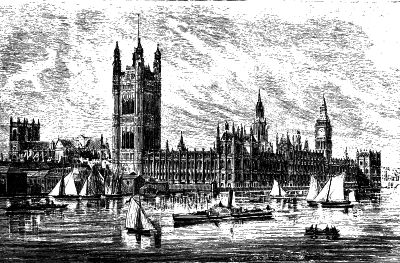
HOUSES OF PARLIAMENT.
On either side of the Thames, beginning at one end and ceasing at the other end of the Houses of Parliament, the magnificent embankment of hewn granite stone stretches, thirty or forty feet in width, for a mile each way, thousands of foot passengers traversing its massive blocks, each man and woman busy with his or her thoughts, or preoccupied with the passing vagaries of the hour.
VIEW FROM WESTMINSTER BRIDGE.
On my right is Westminster Palace and the Houses of Parliament, the finest modern gothic buildings in the world. The dozen towers and belfries of this truly glorious edifice, gilded over with brass, glisten with the refulgent hues of the dying sunset,—for nine hundred and forty feet on the river, these massive, brown buildings, (that, on the first view, bring up memories of some grand, old Gothic Cathedral,) stretch away with tower, buttress, and pinnacle, presenting a river facade which cannot be equaled by any other edifice for legislative purposes in the world.
Beyond, to the left, on the Surrey side, I can see Lambeth Palace, with its faded reddish-brown brick piled up to the clouds, where resides his Grace, the high and puissant spiritual prince, the Archbishop of Canterbury and Primate of England. The feverish broil and confusion of the great city are all round me, and are present in, and to an extent pervade, the air above me. The whistling and puffing of the locomotives may be heard night and day as they sweep to and fro, conveying passengers and freight to and from all parts of England and the Continent, over Charing Cross Bridge. The old man by my side on the bridge, with whom I have been conversing for half an hour, is an intelligent artisan of the conservative class, benumbed and enfeebled by illness, and his poor old watery, dazed utterances confess to his astonishment at the marvelous rapidity with which one of the great strongholds of every Englishman's belief,—the Established Church, has been over-turned by the now foremost man in Britain—William Ewart Gladstone. The old man has relations in America, somewhere,—he thinks, near Cincinnati, and he asks after their health and well-being with the most implicit trust that I should know all about them, believing that the Queen City is only a few miles distant by rail from New York. Yet the relatives of his youth and manhood have been absent over twenty years, and are possibly all dead and dust by this time.
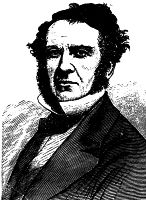
WILLIAM EWART GLADSTONE.
As I have a desire to pay a visit to the House of Commons, and be a witness of the proceedings of that dignified body of legislators, I bid the Old Man of Lambeth a very good day, which he acknowledges in his own fashion, and I stroll across the Bridge and down Bridges street toward the Commons. As I pass the huge and massive Clock Tower, said to be four hundred feet in height, and of most beautiful design, I am warned by what I see all around me, that I am in the close vicinity of that edifice which contains within its walls annually the chosen wisdom and supposed best talent of England. Directly before me is the magnificent fane of Westminster Abbey, holding within its thousand storied urns, the ashes of the bravest, most intellectual, and most renowned, as well as the most wretched and unfortunate of Britain's dead. I can see, as I cross the bridge, the back portion of the Chapel of Henry the Seventh, with its superb and intricate net-work of tower, cornice, buttress, groined and fillagree stone-work. Cabs, four-wheelers, and open carriages, with coachmen and footmen attired in gorgeous liveries, their wigs powdered and frizzed, are driving hither and thither, the occupants of some in full dress going to dinner, or to listen to the debates which are to take place to-night in the Lords or Commons.
"BOBBIES" AND "CABBIES."
These magnificent flunkies wear a contemptuous look of ennui on their faces, and they survey all foot-passengers with blase glances of indifferent serenity, which I find almost impossible to describe justly. The court-yard directly opposite St. Margaret's, of Westminster, is in a hollow below the grading of the approach to the bridge, and is surrounded by a very handsome gilded iron railing, which is in turn surmounted by a row of lamps which encircle the House of Commons at night like a belt of fire. Within this enclosure are continually stationed fifty or sixty hansom cabs for the convenience of the members who may need them in the intervals of debate, and on top of these cabs are to be found the cabbies who delight to bark and bite at the unsophisticated and verdant stranger.
There are half a dozen of policemen, or "bobbies," as the cockney, in his refined slang, chooses to term them, wearing dark blue uniforms with silver gilt buttons, and the letter and number of their division on their close coat collars. The thick cloth-board hats, of a helmeted shape, that these poor fellows are compelled to wear, even in hot weather, are heavy enough to excite the compassion of the most hard-hearted person, An inspector of hacks, always on duty in the Palace Yard, may be seen moving to and fro, giving instructions to the malicious cabbies, who are listening to his scoldings with the most provoking indifference, real or assumed, as the case may be.
Not being aware of the regulations, which do not permit a stranger or visitor to enter the House of Commons without being possessed of the written order of a member, I find myself notified at the splendidly arched gothic doorway that I cannot pass. Here is a difficulty I had not counted on. A friend from America, however, shows an order, which I afterwards discover only admitted one person. We pass in under the groined roof of one of the finest halls, architecturally considered, in Europe. In this hall, over six hundred years ago on a New Year's day, a monarch of the Plantagenet line fed six thousand poor people, and one may well believe the legend of old prosy Abbot Ingulph, of Croyland, as he looks around and above him at the grand dimensions of the stately hall. On either side as one enters are marble statues, life-size, of Hampden, Falkland, Walpole, Fox, Pitt, Burke, Grattan, and others,—the work of England's greatest sculptors, placed on pedestals of stone.
We are told by the policeman who attends at one of the inner doorways to seat ourselves on a stone bench in an alcove, and wait our turn as is the custom here. The Stranger's Gallery will not hold more than a hundred persons when crowded; and when a heavy debate is in progress, on a great public measure, the gallery is sure to be full. Five persons are admitted to the gallery at a time as soon as a gap is made in the benches by the departure of an equal number of spectators. Should a man leave his seat in the alcove for an instant he is certain to lose his turn, and he will be compelled to go to the bottom place and begin over again. As soon as there is room, the policeman makes a sign to those in waiting, and he marshals the five persons who have tickets, and they follow him through several passages and halls to the Lobby of the Commons—a large, square hall, beautifully decorated, and, turning to the left, they all ascend a winding stair to the ante-room, where the tickets are examined by an old, white-haired gentleman who sits in a chair in evening dress, and, if correct, the batch are admitted to the Stranger's Gallery, which is on the same floor, at the end of another dark passage.
BILL OF FARE.
Before I leave the Lobby of the Commons, let me describe it briefly together with the Lunch Counter of the house, which even the greatest public men find it necessary to visit occasionally. It is a large square hall of lofty proportions, almost every inch of the walls and ceiling being ornamented in relief with the insignia of the Kingdom of Great Britain and Ireland.
A score of the members are in the Lobby talking with one another, in an animated but not loud tone, or mayhap to some of their favored constituents who have admission. To the right is a counter running across an angle of the Lobby, at which ices, sandwiches, a glass of sherry, a glass of port, or a glass of brandy—all of a good quality, can be obtained by those of the members who do not wish to spoil a dinner by a hearty luncheon, or who do not wish to spend the time in going down stairs into a cosy suite of rooms, which I almost fancied were carved out of the beautiful oak paneling, and where a dinner nearly as good as may be found in England can be obtained at the prices and at the hours which I give in the Bill of Fare: One o'clock—Soups: Jardiniere, 1s.; Calf's Tail, 1s. Joints: Shoulder of Mutton, 2s.; Steak, stewed, 2s. Entrees: Hashed Venison, 3s.; Filet B[oe]uf au Vin, 2s.; Mutton Cutlets piquante, 2s.; Lamb Chop, 1s. 3d. Five o'clock to 6.30—Salmon, Is. 6d.; Sole, 1s.; White Bait, 1s.; Saddle of Mutton, 2s.; Cold Roast Beef, 1s. 3d.; Cold Boiled Beef, 1s. 3d.; Cold Lamb, 2s.; Cold Ham, 1s. 3d.; Lobster, 1s. 3d.; Ribs of Beef, 2s. At 7 o'clock, same prices. Puddings, 6d.; Tarts, 6d.; Wine Jelly, 6d.; French Beans, 6d.; Green Peas, 6d.; Salad, 6d.; Cheese, 4d. This is the bill of fare, for one day only, of the steward, Mr. Nicoll, who purveys for the Lords and Commons of England in both Houses.
I give the prices as a curiosity, showing on what nutriment heroes, statesmen, and orators are fed while attending St. Stephens, and how much they are taxed for their food. This may be trivial to some persons, but I contend the sum of human existence is made up of trifles, and in England, particularly, of such substantial trifles as I have given above. Wellington gained the battle of Waterloo because his troops were well fed, while the raw levies, and even the Old Guard of Napoleon, had been fighting for three days at Ligny and Quatre Bras, and had to lie the night before Waterloo in a wet morass, hungry and exhausted. The articles of food that I have named are to be procured here at a cheaper rate and of better quality than anywhere else in London, only that to enjoy the luxuries which I have enumerated at moderate prices, it is first necessary to gain admittance to the Houses of Parliament, which can only be done through a member's order. The chops and steaks here are truly magnificent, and on a scale of grandeur commensurate with the architectural pretensions of Westminster Palace.
Besides all this, away down below the bustle and eloquence of the Commons, in those dark, quaint oak passages enclosed by marvelous paneling, the visitor is certain to find one of the most beautiful bar-maids in London to wait upon him—and hand him cold sherry at sixpence a glass.
This comely damsel had some tickets to sell. Her uncle—I think it was her uncle—it was who had broken his leg. He belonged to the Noble Order of Foresters, and it was necessary that the public should be called upon to make up a purse to have the uncle's leg set. I had a benevolent American along with me who knew not what to do with his newly cashed sovereigns, and he listened with a compassionate ear to the tale of distress. The result was a small contribution of a half sovereign to the uncle.
MR. BRUCE AND HIS STEAKS.
The bar-maid said, in presence of two of her country friends—they came from Ilfracombe, down in the country: "I am so much obliged to you, sir. My uncle is very bad. Will you have soda and brandy, sir, or will you have a little bitter beer? The bitter beer is very good after a mutton-chop and potatoes. Mr. Bright always prefers a glass of sherry when he comes down here, but Mr. Disraeli takes brandy and soda. The Hirish members, they are so jolly, and they do carry on so, and they make such jokes with us girls. I likes Lord Stanley, the member for Lynn, least of them all. Somehow, you can't joke with him. He looks awfully sewere, and whenever he speaks it's just like a father for all the world. You know, sir, he's got the hold Darby blood hintoo 'im, and he is a great man."
"Who do you like best in the House of Commons, sissy?" said my frolicsome American friend to the joyous bar-maid.
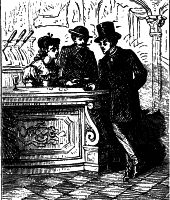
THE LEGISLATIVE BAR-MAID.
"Well, sir, I likes Mr. Bruce, the 'Ome Sekretary, the best of hall of them. He has sich a hinfluence. When he comes down here he always takes a steak, and he is hawful pertikler habout it as how it is to be cooked. He halways likes to have one side raw and the other side burnt. Oh, I have been so worrited about Mr. Bruce and 'is steaks—the waiters always comes to me and says, 'I say, wot kind of a man is this 'ere 'Ome Sekretary, he ought to get some silk binding on to his steaks, he is so werry pertikler.' But he always drops 'em a sixpence and that makes it hup."
The door of the members' entrance to the Commons is guarded by two persons in evening dress, who are dignified enough in presence and feature to sit in the Senate of the United States. At each side is a handsomely carved, oaken box, shaped like a sentry's hut in camp, and in the sides of these boxes are placed notches or racks where all messages and letters for the members are left in the charge of the doorkeepers, as no outsiders whatever are permitted to penetrate this entrance excepting the Lords or distinguished foreigners, and the latter only by invitation of the House itself.
There are also telegraph offices in the corners of the lobby, with stained glass windows, from whence telegrams can be sent without delay to the Mediterranean, to Paris, St. Petersburg, New York, Washington, San Francisco, Madrid, Pekin, or any place in the bounds of civilization. As I turn from the contemplation of these offices, and from the benches where a number of messengers and smart-looking and handsomely-uniformed pages are in readiness to rush to the clubs in Pall Mall, to the Opera, or to the private residences of the members of the House, in obedience to the beck or nod of the "whip" of the government, (Sir Henry Brand,) in case of a division, I see before me in the doorway a magnificently attired gentleman, in black silk stockings, buckled shoes, and powdered hair and ruffles, wearing a bright sword at his hip. He looks like a picture stepped out of a frame of the period which Thackeray loved to dwell upon—when George the Third was king.
This gentleman is none other than the Sergeant-At-Arms of the House of Commons, Lord Charles James Fox Russell, a scion of the great house of Bedford, of which Earl Russell is a member. How different he looks from the sergeant-at-arms of some of our State Legislatures, or even of the National Houses of Congress. Here is no promoted bar-keeper or reformed rowdy, but a gentleman bearing one of the proudest names in England, and befitting by position and character the elevated office which he holds. It is more than easy to believe that a slung-shot or revolver could not be pulled upon this gorgeous and venerated being while in the performance of his august duties. The most malicious derringer would be silent in his awful presence, and no slung-shot, however moulded, could ever impinge that hereditary forehead.
THE GREAT COMMONER.
A story is told of a man who once penetrated even to the floor of the House itself, and sat there on the benches, being taken for some new member by his colleagues who was yet to be sworn in. But before the morning broke, the House having sat all night, the horror of his position had so paralyzed him that his jetty hair had turned white. Stay, as I have no ticket I will throw myself upon the country and abide the issue. I sent in to the Hon. John Francis Maguire, M.P., my card, with the written desire that I should be admitted to the gallery, and then I awaited the issue, whether for the Tower or the House.
While I waited, strolling about the gallery, a gentleman came out of the door of the Commons, upon whom every eye was turned, and walked in an upright, John Bull fashion towards the refreshment counter. A whisper went round the lobby, "That is John Bright," and then I knew that for the first time I stood in the presence of England's greatest Commoner, the apostle of the Manchester school and Tribune of the people. I who had seen so many caricatures of the great orator in Punch, which has always depicted him as a fat, pursy, vulgar-looking person, sans breeding, sans ceremonie, failed at the first glance to identify the noble-looking old man in evening dress, with an irreproachable white neck-tie, and a decidedly polished exterior, who halted at the refreshment bar to slowly sip a strawberry ice after the heat of the debate.
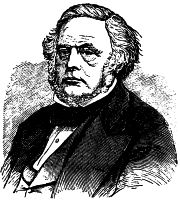
JOHN BRIGHT.
Every inch this was a man, as I looked at him, and a king among men, if the outward shell can serve at all to indicate what is concealed within. And he has a princely following too. For around him I can see a number of men whose names are known wherever the English language is spoken, and wherever English newspapers are printed and read,—eager to get a word or a look from him, plain John Bright, once the best hated man in England, and now, by sheer force of will and dogged pluck, enshrined forever in the admiration, if not the love, of his countrymen. I have as yet only been waiting a few minutes when I see approaching me a messenger of the House, who points the writer out to a stout, compact-looking man in evening dress, of advanced years, fair complexion, and with a keen look in his face which serves as a front to a large, solid head, well set on strong shoulders. This is the Hon. John Francis Maguire, M.P. for Cork, author of "Rome and its Rulers," "The Life of Father Matthew," "The Irish in America," and editor of the Cork Examiner, a man well known in Ireland and America, and one of the Irish leaders of the Liberal side in the House.
Mr. Maguire has taken the trouble to leave his seat in the House during debate to oblige the writer of this book, and I must here make my acknowledgment for the courtesy done. Mr. Maguire hands me a slip of paper which he has procured for me from the Right Honorable John Evelyn Denison, Bart., Speaker of the House, and this order entitles me to a reserved seat on the front bench of the Gallery. I now pass the dignitary in the black stockings and buckles, who smiles most graciously at me out of the respect to the Speaker's order, and, after traversing a narrow stair, emerge into the Speaker's Gallery, and find myself at last inside the English House of Commons, of which I have heard so much and so often.
It is now after dusk, and I can hear the silvery chime of "Big Ben" in the huge clock tower of St. Stephen's, as it peals the hour of eight through the corridors and galleries. There is just now a recess among the members for consultation, and but few are on the floor of the House, the majority being in the lobby button-holing each other, and the rest, with the exception of fifteen or twenty on the seats behind the Treasury Bench, are at dinner.
HALL OF THE COMMONS.
There are fifty or sixty persons in the Gallery, behind and above me, the place where I sit being reserved for those whose names have been inscribed on the list of the Speaker. The Commons' Galleries run lengthwise on either side of the House, for nearly a hundred feet, having an upper and lower bench, covered with green leather. The House is about forty-five feet wide, and one hundred feet long, and the ceiling is over forty feet from the ground floor, where the debates are held. It is impossible for me to convey an idea of the richness and splendor of this Hall of the Commons. Suffice to say that there is nothing to compare with it in America for architectural effect and compactness.
From above in the ceiling a flood of mellow light pours through sixty-four stained glass windows, and on either side of the House the windows are gorgeous in their designs of shields and coats of arms, indicating the living presence of the monarchy of Great Britain and Ireland. The numerous gas jets are concealed at the top of the glass panelling of the ceiling, throwing a brilliant but subdued light upon the Speaker as he sits in his high, over-hanging oak chair; on the members; on the spectators, and on the ladies who are assembled behind the glass screen at the back of and above the Speaker's chair. Beneath the Ladies' Gallery, and also behind the Speaker's chair, is the Reporters' Gallery, so arranged that each member, as he faces the Speaker, shall also face the numerous corps of reporters who are in attendance to note down whatever wheat may develop itself in the wilderness of chaff spoken in this House.
The lowest bench on the right hand of the Speaker is devoted to the Ministry, and on this side, immediately above, the supporters of the government congregate within hearing distance of the Premier, night after night, during the sessions. Whenever the Ministerial side is thin of speakers, Mr. Gladstone simply turns around, and a nod or look will bring upon his feet whatever member he thinks will best fill the gap. Underneath the Strangers' gallery is placed a special seat for the august Sergeant-at-Arms or his deputy, who is, if I mistake not, a baronet. The walls and ceiling all round are of stone of a peculiar color, which is neither brown, white, grey, nor yellow, but is a combination of all four; and I can best describe the tone of color by likening it to the hue of the bronchial troches or lozenges that are sold in the druggists' shops in America. Otherwise I might call it a brownish-grey, of which John Ruskin has examples enough and to spare in his "Stones of Venice."
It is certainly a very rich color, and admirably adapted to the damp and foggy atmosphere of London. Wherever the eye may choose to rest in the Houses of Parliament, it is sure to be confronted with the emblazoning of royal and princely cognizances. On both sides of the House are the Division lobbies, where the members go to be counted by the tellers, when a division is called for. That on the west side is for the "ayes," and on the opposite side is the lobby for the "noes." There are also libraries, residences for all the officers of the House, on a scale of the most princely magnificence, and more than a score of committee-rooms abutting off the longest corridors of any public building in the world, not excepting the Escurial in Spain. Everywhere you may see acres of polished oak above and around you.
CHAPTER XIX.
LORDS AND COMMONS.—CONTINUED.
IRECTLY in front of the gallery where I am sitting, is the Reporter's Gallery. There are fifteen boxes for their use to take notes in, each reporter sitting separately from his comrade, and writing characters for dear life. These boxes resemble private boxes in our New York Opera House, with the difference that they have no roofs above them, and are open to the public gaze. Behind these fifteen boxes are seats for twenty more reporters, to take the place of those in the boxes in turn. Each reporter takes short-hand notes for a space of ten to fifteen minutes time, and is then relieved by his colleague, waiting above him, who steps into his place as the other retires to the Reporter's Room, in the corridor, to write out his notes, and thence to take them to the newspaper office, or else, if he chooses, he may send them by the small boys waiting in the gallery, who are employed by the newspapers at a salary of from eight to twelve British shillings a week to act as messengers. Late at night, it is customary for the reporter who has notes of a very important speech—which he desires to get to the composing-rooms of his journal, to take a cab from the Palace Yard, where there are dozens of them always waiting, and thus dash off to be in time for the press. The Times keeps thirteen reporters constantly in the gallery during the session, and the Standard as many more, if I am not mistaken. These men are all expert short-hand reporters, and receive from five to eight guineas per week, according to their capability. There is also a man who remains late to get the gist of what is said and done in debate, and from his notes he makes up a clear and comprehensive summary for the morning edition. Then there is the "leader-writer," "the editor" proper, and a "special reporter," who receive cards of admission to that part of the house under the Reporter's Gallery, and consequently on the floor of the House behind the Speaker's chair. This is a high favor, and only granted most sparingly, and with discretion.
There are generally to be found about twenty reporters in the gallery, but this number is greatly increased on a "field night," when it is usual to find as many as thirty-five or forty journalists in the gallery. From what I have seen of these parliamentary reporters they seem to be very deliberate in their movements, and they do not allow anything to hurry them. They are nearly all, however, very pleasant gentlemen, and with few exceptions, men of experience and scholarly attainments, two-thirds of them being men who have taken honors at the universities, or at Harrow, Eton, or Rugby, and in not a few instances they have begun life by taking minor orders in the church, and having toyed with journalism for some time they were unable at last to resist its feverish fascination. Some few of them are in the Inns of Court—embryo barristers during the day, and at night they practise short-hand, earn a respectable living, and gain experience from England's chosen representatives up in their secluded nooks in the gallery of the House. It was not always that the press and its reporters had such privileges as they now possess in the House of Commons.
DR. JOHNSON TAKING NOTES.
Before the administration of Sir Robert Walpole, there were no satisfactory records of the debates in the House. The fierce contests between Walpole, Windham, Pulteney, and others had, indeed, for some time before 1740, attracted attention to the proceedings of the House, and they had been regularly reported in a confused long-hand sort of fashion every month in the Gentleman's and London Magazine, the former publication commencing the debates in January, 1731, the latter in April, 1732, but no attempt can be said to have been made to convey more than the substance of the speeches until that department of the Gentleman's Magazine was intrusted to gruff old Samuel Johnson, in November, 1740. This is the commencement of the era of parliamentary reporting in England. Short-hand, before that time is involved in chaos, and it is doubtful if Johnson knew anything more than the rudiments of the then crude system of stenography.
Indeed, Johnson appears to have given more of his own eloquence than of what had actually been uttered in Parliament; but still, what he did was, in all probability, only to substitute one kind of eloquence for another—a better for a worse; or, it might be, sometimes, a worse for a better—and therefore, on the whole, the speeches written by him, though less true to the letter than those given by his predecessors, may be received as a more living, and, as such, a truer representation of the real debates than had ever before been produced.
He would not take the trouble to or be guilty of the absurdity of expending his lofty rhetoric upon the version of a debate or speech which had not really attracted attention by that quality, but I suppose he reserved his strength for occasions on which those who had heard, or heard of, the original oration, would look for something more brilliant than usual. It was not, however, until after a long and severe struggle, with a desperate fight at the close, that the right of reporting the debates of Parliament was gained by the English press of that day. It is only about one hundred and thirty years ago, (in the old days of the Hanoverian and Pretender's troubles), since anything spoken in the House was allowed to be printed until after the session was dissolved. The House, in its wisdom, denounced any earlier publication of the eloquence of the honorable members as a daring act of illegality.
On the 13th of April, 1738, the House resolved "that it is an high indignity to, and a notorious breach of the privilege of this House, for any news matter or letters, or other papers, as minutes, or under any other denomination, or for any printer or publisher of any printed newspaper of any denomination to presume to insert in the said letters or papers, or to give therein any account of, the debates or other proceedings of this House, or any committee thereof, as well during the recess as the sitting of Parliament, and that this House will proceed with the utmost severity against such offenders." The House of Commons, it is needless to say, has progressed somewhat since that day.
The monthly magazines, notwithstanding the resolution of the House, still continued to print the debates, although for some time they took the necessary precaution of indicating the speakers by fictitious names, to which they furnished their readers with a key when the House became dissolved. But it was not until the year 1771, nearly a century ago, that the debates began to be given to the public day by day as they occurred, and then the attempt gave rise to a contest between the House and the newspapers, which occupied the House, to the exclusion of all other business, for three weeks, when a committee was appointed, whose report, when it was read two months after, suggested whether it might not be expedient to order that the offending parties should be taken into the custody of the Sergeant-at-Arms. Edmund Burke compared the decision, in his own brilliant manner, to the resolution of the bewildered convocation of mice,—that the cat, to prevent her doing future destruction, should have a bell hung to her neck, but forgot to say how the rash act was to be performed. Well, that is all past and gone now, and the only complaint made in these busy days by members of Parliament against the score of daily newspapers, published in London, is that they err in not printing enough of the speeches to satisfy each individual representative.
THE CLERK OF THE HOUSE.
I noticed that the majority of the parliamentary reporters in the Gallery were considerably advanced in age, many of them wearing gray hairs, and fully sixty per cent. of the whole number that I saw were above forty years of age. Some of these gentlemen, by careful saving and strict attention to their arduous professional duties, have amassed comfortable competencies, and some of them own, in the environs of the city, snug little houses, with snug little libraries, and in some of them, I can certainly say, are to be found pleasant tables and home-comforts rarely possessed by their brethren of the note-book and pencil in America. There are, to be sure, many improvident ones in London, as elsewhere, and here Bohemianism has a lower depth than it ever was known to have in America, for it is here that the really depraved and abandoned Bohemian confines himself exclusively to the consumption of gin—raw and simple gin. A low London Bohemian is a mere animal, and will beg a copper from you in the same breath that he professes his willingness to translate a Greek tragedy—to oblige the giver of the copper, or else he will favor you with an account of his days at Oxford or Trinity, when he was a "first honor" man or a B.A. But one thing I have not found as yet in London on the press, and that is an illiterate or badly taught man, such as can be met with by the score on the American press.
The House to-night is in a Committee of the Whole on the Scottish Education bill. The Ministerial benches are pretty well filled, while the Opposition benches, to the left of the Speaker's chair, are but thinly populated. Fronting the Speaker's chair of state is a table of polished mahogany, the surface of which is about ten feet wide by fifteen feet long. Directly before the chair of the Right Honorable Speaker are two low-seated chairs of less pretension, occupied by the Clerk of the House of Commons, Sir Denis Le Marchant, and his assistant, Sir Thomas Erskine May, K.C.B. The former is a smooth-faced man, having the inevitable wig upon his head, which gives him a much older appearance than his years would warrant. His shoulders are enveloped in an ample black silk gown, and a blank book of large dimensions is open before him upon whose leaves he is supposed to enter the minutes of the House. This person has a magnificent suite of apartments in a wing of the Parliament House, beside a very large salary, and is as comfortably housed as if he belonged to the royal blood of Britain. Sir Thomas Erskine May, K.C.B., seated upon his left, is a clean-shaved gentleman in evening dress, who also has apartments in the palace, and a good salary. He has nothing remarkable about his person or manner, with the exception of a very drawling voice and a hesitancy in announcing motions made by the members, or in calling a division when the House so wills it. He is the author of the continuation of Hallam's Constitutional History of England. Beside these high officials there are four "Principal Clerks," one of whom, like Sir Thomas May, enjoys the high dignity of a Knight Companion of the Bath, &c. Then there are twelve "Assistant Clerks" and twelve "Junior Clerks," with an "Accountant," an "Assistant Accountant," a "Private Secretary to the Chairman of Ways and Means;" a "Sergeant-at-Arms," who is a Lord; two "Deputy Sergeants;" a "Chaplain," no less a man than Canon Merivale, the accomplished Roman historian, who has the good sense to make his prayers at the commencement of the proceedings very short; a "Secretary to the Speaker;" a "Librarian," a poor cadet of the great overshadowing family of Howard; an "Assistant Librarian," with an Irish name; two "Examiners of Petitions for Private Bills," one of whom is Mr. R.D.F. Palgrave, of whom Americans have heard, and finally a "Taxing Officer," beside innumerable servants, of superfine bearing, correct evening dress, and consummate self-possession. I asked one of these ponderous servants, whom at first sight I took to be the "Juke of Linsther," as an Irish reporter pronounced it, if he was not awed by the dignity of the house.
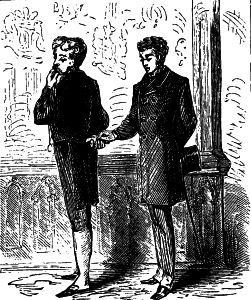
COULD YOU MAKE IT A TANNER?
"Aw," said he, in a gracious manner, "you er, I preeszhume, en Eemireken. This sawt of thing boaws me 'orrid; it does. I hev dun hit for heit yeers. I wish they wud adjoan, and I wud go to my CLUB."
THE SPEAKER AND HIS WIG.
Timidly I offered this gorgeous being four-pence, expecting to be rebuked in a dignified manner for my presumption by the personage who talked so fluently of "'is club." He never turned around, but, gazing steadily at the Speaker's chair, as if he was desirous of catching the Right Honorable Gentleman's eye, thrust his hand behind him, counted the pennies with his fingers, and said to the writer in a stage whisper:
"Would your 'onor pleese to make it a 'tanner'? We 'ave no perkisites in the Commons, pleese." Let me here state that a "tanner" is the slang term for sixpence, and a "bob" is a shilling among the London cockneys, servants, bar-boys, and wild children of the thousand streets and lanes of London.
When the House is in committee it is not the custom for the Speaker to be present. When the House is in open session, then the Speaker is arrayed in wig and gown, and he sits far back in the recesses of his chair, like some dried-up mummy, so closely is he swathed and covered. It is pretty hard work for a member to actually catch his eye, being so muffled up as to defy recognition by a casual observer. Yet it is a part and parcel of the British Constitution, that this Right Honorable John Evelyn Dennison should be smothered in this huge box and gown and wig on a warm August night like this. During committee proceedings the Speaker may walk out, doff his wig and gown, and dine as he has done to-night, and then come back, and finding the House still in committee, he will seat himself in his chair without his legal vesture. I have been in this House four nights, and this is the first time that I have seen the Speaker's legs—palpably. He lolls back without any of that reverence that I have heard so much of, as belonging to the Commons, and he has at last gone to sleep, like Mr. Greeley under Dr. Chapin's sermons. In the meantime, the bill, which has twenty-five clauses or sections, is being canvassed and considered by the members who stream in, now that the dinner hour has passed.
While the Speaker slumbers in a quiet way, the chief and assistant clerks of the House conduct the business, the assistant taking up the bill, and repeating as he reads each clause in detail: "It is moved," or "it is proposed that a substitute," or that the "word —— instead of ——," and so on, in soporific tones, for two long hours. A number of people in the gallery are gently dozing, and visibly many of the messengers are relapsing into a blissful repose.
The Speaker's table is covered with reports, large bound and gilt volumes, books of reference, pamphlets, newspapers, costly ink-horns, and other clerical paraphernalia of the state service. The huge gilded mace of the Speaker, which lies on the further end of the table below his chair, when the House is not in committee, is now pendant under the table on a rack, to show that it is not an open session for the introduction of new measures or for the making of set speeches.
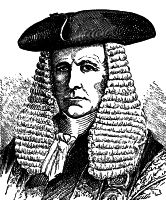
THE SPEAKER OF THE HOUSE.
Out of six hundred and seventy or eighty members of the House, there are not present to-night more than one hundred and fifty. Many of the remaining members are scattered all over the Continent in nooks and corners. A large number may be found on the Parisian boulevards; some are at Fontainebleau; some in the Pyrenees, swallowing chalybeate waters; many are yachting in the Mediterranean, or wasting their time with the peasant girls in Isles of the Greek Archipelago; not a few are off at the races at Goodwood or Brighton; some are at Rome, burning, fuming, and cursing the garlic and salads; dozens of them are at Constantinople, at St. Petersburg, or climbing the Alps out of a sheer love of danger and the reckless fondness of physical excitement inborn in the Englishman; and probably as many as could be numbered on the fingers of the hand are scattered over the American Continent in search of novelty. There are also a number of City members absent, in their out-of-town residences, compelled to forego forensic honors, at the command of wife and daughters who are packing and poking preparatory to a flight to the Rhine and Germany. The ministerial benches show a good front for the late season; first, because the government has a great deal of unfinished business on its hands, which must be transacted before Parliament is closed; and secondly, because the exertions of the government whip have been most arduous in hunting up Mr. Gladstone's supporters, and compelling them to remain in their seats, while there is work to be done by them.
DIGNITY OF THE HOUSE.
With a great number of Americans, that have not visited England, there is in some way or another an abiding impression that the House of Commons is the most stately and dignified legislative body in the world. To be disabused of this notion it is only necessary for an American to sit during a night session in the gallery of the House, with a proviso that he has been a visitor at some time or another to the Senate Chamber or the House of Representatives at Washington. When a member of this House rises to claim the attention of the Speaker, it is common to find half a dozen of his fellow members rising also with him for the same purpose. A member of the government gets on his honorable legs with his face turned toward the Speaker. If on the lower bench, he will walk a little forward to the table, and if he is accustomed to speak from notes, it is more than possible that he will lay one hand on the table and with the other turn the leaves of his manuscript. If he speaks extemporaneously, he will probably lean in a lounging position forward, his two hands resting on the Speaker's table.
Many of the members who are best known to the public have this fashion, and it is most unpleasant to hear them drawl forth sentence after sentence as if they were dragged from their honorable throats by sheer force. It has often been reported by English writers that American legislators have a bad fashion of elevating their legs and laying back in an irreverent attitude while listening to a debate. Also, that they expectorate freely. Well, I have seen the most distinguished statesman at present in England—I mean Mr. Gladstone—lounge and disperse his limbs, while within ten feet of the Speaker, in a fashion that would bring shouts of laughter from a crowded theatre, were the same thing done in a farce or low comedy.
Each member of the Commons, as he walks into the House, to-night, has his hat on his head. As he passes the Speaker's chair, he doffs it for an instant, but when he takes his seat the hat is replaced upon his head as before. As a general thing, a member who speaks without notes, addresses the Speaker, with his hat in one hand. They all seem to conclude whatever remarks they have to make with a jerk, and as soon as they sit down the hat is again replaced, or rather slapped on the head, with a vehement motion that seems impelled by some hidden mechanical power. Then they have a fashion of lounging in and out in a free-and-easy way during debate, that is highly suggestive of a bar-room in a frontier town.
There is rarely, or never—in the House of Commons—an exhibition of the nervous, impassioned speaking which may be heard all over America or in the Corps Legislatif. When there is a clear or telling speech made, (as far as the manner of delivery goes,)—mind, I do not speak of its effect practically—or if the eloquence is of a florid description, it will be surely spoken by one of the one hundred and five Irish members. Certainly, when Whalley or Newdegate get on their legs, to smash the Pope or to recount horrible but dramatic stories about the mysteries and child massacres of convents, there is no lack of vehemence and buncombe. But this style of oratory is confined to a few of the members who have hobbies to ride, and who cannot be driven from them even at the point of the bayonet.
AMBASSADOR LAYARD.
Physically speaking, a majority of the members are gallant-looking fellows, and they are all dressed simply, but with the taste always observed by a gentleman in the selection of articles of clothing. A small number of them wear white beaver hats, and their trowsers are cut widely at the bottom in the now prevailing fashion. With the exception of a few of the younger and more fashionable members, who frequent the race-courses, the Opera,—go to hear Schneider, lounge into the Cremorne after eleven o'clock at night, or frequent the society of such famous demi-reps as "Mabel Grey," "Baby Hamilton," "Baby Thornell," or other women who have beggared and ruined hundreds of those young men about town who have a disposition to be fast, there is a total absence of showy or loud colors in their apparel. A great many of the "fast" young men attend the session—occasionally—for the sake of common decency, or because their constituencies compel it, as in the case of a City borough the other day, where a member was rebuked by a public resolution of condemnation and asked to resign, for absence from his seat. Younger sons of noble lords look upon the House of Commons as a necessary evil, which must be "done," like an occasional visit to church, or to Richmond, or Greenwich, to eat fish.
As the members come in one by one and take their places on the benches, I find opportunities to observe and note their peculiarities and looks. That gentleman who comes in so slowly and so quietly, dressed in dark clothes, and having a head, whiskers, and general resemblance to our Longfellow, is the Right Honorable Austin H. Layard, Commissioner of Public Works, one of the Ministers, but not a member of the Cabinet, and lately appointed English Ambassador to Spain. You would take him for a literary man or a thinker, anywhere, by reason of his long, flowing, white hair and thoughtful look. Mr. Layard is the author of the celebrated book on Nineveh. He receives attention in the House always when he rises to speak of Eastern affairs. He was at one time an attache of the English embassy to the Porte, and was Under Secretary for Foreign Affairs in the administration of Earl Granville. Mr. Layard has the reputation of being rather hot tempered in debate, and at one time he earned the ill-will of the aristocratic faction in the House by his persevering liberalism, but at present he is popular enough, and no one can look at his bright dark-blue eye and general appearance, without feeling that he is in the presence of a man who possesses a considerate and calmly philosophical spirit, broken at times by a sudden flash of the scholar's enthusiasm.
That gentleman with the exquisitely carved face and very red hair, with a slight dimple in his chin, and clear, frank eyes, is the Secretary of State for War, the Right Honorable Edward Cardwell, M.P. for Oxford City, and an old follower of Sir Robert Peel. He has in his time held various offices of trust under different administrations, and in June, 1866, when the forces of Col. William R. Roberts, President of the Fenian Brotherhood, invaded the Canadas, Mr. Cardwell, as Secretary for the Colonies, had his hands full of a rather difficult business, which he managed as well as the very annoying circumstances—for a British Crown Minister—would permit. I like to hear Mr. Cardwell speak. He is always ready, yet deliberate, and with these qualities he possesses a happy and easy manner in argument. The most difficult job of Mr. Cardwell's life was the management of the Governor Eyre-Jamaica business, which at its crisis covered the English administration with shame and ignominy. Mr. Cardwell had, while at Oxford, a very good reputation, which he has not as yet contradicted by his course in Parliament, of which body he was returned as a member as early as 1842. Thackeray once ran against him and was defeated.
LORNE AND CHILDERS.
That really handsome young gentleman, who is said to have the best-shaped leg in the House, as well as the friendship of the most charming female members of the aristocracy, as he certainly is the owner of a most beautiful head of hair, of the hue of a new guinea, such as is seen in Carlo Dolce's Virgins—is the member for Argyllshire, the Marquis of Lorne, heir presumptive to George Douglas Campbell, eighth Duke of Argyll, the Liberal Secretary of State for India in the Gladstone Cabinet, a Privy Counsellor, and a Knight of the Thistle. The young marquis, at twenty-five, has the face and skin of a maiden of twenty, and I could not but observe that his trowsers were of a fashion superior to any other known trowsers in the House of Commons. I do not know whether the handsome Marquis inherits the Covenanting piety of the Argyll-Campbells, his ancestors; but he bears a wonderful resemblance to his father, the Duke, and among the frescoes in the corridors of the House there is one by Copely, entitled the "Sleep of Argyll," and I was astonished to notice the strong likeness of the young Marquis—who passed the fresco at the moment—to the face of his illustrious ancestor of two hundred years ago, as it was depicted by the artist—lying on a prison pallet. The Marquis of Lorne, while I was in the gallery, sat behind Mr. Gladstone, on an upper bench, as a Liberal, like his father who sits in the Lords. When the hereditary Campbell got up on his well-shaped legs to speak as a Scotch member on the Parochial Schools bill, he did it quietly, and in a clear, musical voice, that seemed to attract attention.
The Marquis of Lorne has a very ready delivery, though he is not as yet of great account in debate, and he is I believe, from all reports, a marvelously proper young man, compelled to exist upon about £25,000 a year, which amount will be largely augmented when the present Duke is committed to the family vaults.
That big, bulky six-footer, of great shoulders and massive limb, wearing tightly fitting clothes, his forehead overshadowed with dark, reddish-brown hair, and his whole manner indicative of pluck and a contest against life-long odds, is the Right Honorable H.C.E. Childers, member for Pontefract, and First Lord of the Admiralty, an office that in England somewhat resembles the position of Secretary of the Navy of the United States, having this difference only—that the First Lord, while in his place on the Treasury or Cabinet benches in the House of Commons, is compelled to reply to all attacks on the management of the Navy, and to defend the expenditure and estimates of that department. He is now giving facts from a pamphlet which he holds in one hand, while he rests his body on his other hand across the table in a negligent manner, as if he were more used to roughing it in the bush than supporting a minister by a recapitulation of dreary statistics in the House.
Mr. Childers was at one time, I believe, a fellow-member with Mr. Robert Lowe, of the Parliament of Victoria, after both of them had exiled themselves voluntarily to the antipodes. Mr. Childers only became a member of the House in 1860, and his rise to eminence was achieved with more than American rapidity, in a country where it is a cardinal principle that a man should not receive emolument, honor, or position, until he has grown the gray hair of sixty years.
Mr. Childers is the chairman and director also of at least threescore of corporations and foundations of charity of one kind or another, and is said to be very good in figures—a necessary gift in a Lord of the Admiralty. If his mind is half as big as his whiskers, he is certainly a genius. The hard work of defending the Gladstone administration in detail is usually given to Mr. Childers, to W.E. Foster, M.P. for Bradford, or to Mr. Bruce, the Home Secretary. In all Irish matters, Mr. Chichester Fortescue, the Chief Secretary for Ireland, is expected to stand by his leader, Mr. Gladstone, and he has been of great service to him in the Irish Land Bill legislative measures. Mr. Childers, like the young Marquis of Lorne, is a Trinity College, Cambridge, man, but not an Eton boy like the former.
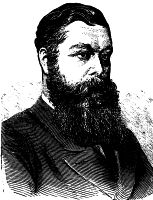
FIRST LORD OF THE ADMIRALTY.
The next noticeable person on the ministerial bench, and by all acknowledged to be one of the ablest men in Parliament, is the Right Honorable Robert Lowe, member for London University, an Oxford man, and son of a Church of England clergyman. London University, which Mr. Lowe represents, is the most liberal educational institution in England, and grants University degrees to students, irrespective of their religious belief. A short time ago the Queen opened the new London University buildings, which are, I believe, unequaled in the metropolis for beauty of design and commodious comfort. Mr. Lowe is now in his fiftieth year, and is a member of the Gladstone Cabinet, and Chancellor of the Exchequer—the office formerly held by his illustrious chief, and one of the greatest trust and responsibility in England.
THE SATIRICAL LOWE.
As an orator Lowe has few equals, and stands in the following order of precedence: Gladstone,—Bright,—Disraeli,—Lowe,—according to the best judges. By many he is said to be superior to Disraeli in satirical power, although not his equal in vehement philippic, and not a few consider him equal in logical force to Bright. Yet, with all his ability and power, he is one of the best-hated public men in all England, and this is said to be the result of his unfortunate proclivity for satire, and for a certain unpleasant gruffness, that, spite of his education and inward natural courtesy, will break out, and in a minute demolish the labor of a year of statesmanship. I might call Mr. Lowe a pure-blooded Albino, as he is first noticeable by his bushy white eyebrows, white hair of great length, and rather pinkish eye-lids.
He has a positive, firm chin, a clear eye, and, from the abutment of his nostril to the corner of his lower lip on either side deep ridges extend, giving him in that part of the face the look of a bon vivant. The eye is very steady, and looks at a stranger of doubtful appearance with a sneering way that seems to say: "I have to be polite; but if I choose to think you an idiot, it is my own business." The ears are large, and seem to be buttoned back, as if ready for a row on the slightest provocation. Mr. Lowe is quite near-sighted, and it is said that to this defect he owed his release from holy orders, having studied for the Church at University College, Oxford. He certainly would have made a very unpleasant sort of a clergyman for some of the lax and rather immoral public men who illuminate the House occasionally. He is a man of many edges, bristling all over with sharp and hard angles, and is in every way an aggressive person. Lord Palmerston, who was with every other member of the House—on the footing of a jolly good fellow, could never be brought to like Robert Lowe. Lowe never laughed at the veteran Premier's jokes.
Mr. Lowe owes his first important advancement from an ordinary station in life to the fact that when he returned to England from Sydney, he had the good fortune to contribute a smashing article to the Times, and since that time Mr. Lowe, it is understood, has been a regular outside contributor of that journal, with great good luck to back him. Mr. Lowe has also the reputation of being a very quick and facile "leader" writer upon the topics with which he is best acquainted.
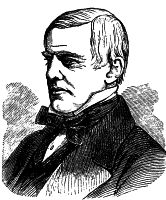
ROBERT E. LOWE.
Mr. Lowe once had his head well smashed by the roughs at an election row, and it is said that the memory of it has stuck to him ever since, like the caning of Charles Sumner by Preston Brooks, and, like that episode, it has served to keep old fires burning. In the memorable debates of 1866, upon the suffrage question, Mr. Lowe shone with his greatest force. With such rivals as Bright, Disraeli, Gladstone, Hardy, and Milner Gibson, it was no joke to keep on the top of the tide, but Lowe never faltered in his career. The more pitiless were his adversaries in argument, the more pitiless became Robert Lowe.
THE MARQUIS OF HARTINGTON.
The fancy, the vigor, the antithesis, the irony, wit, force, energetic subtlety, and strength of his speeches during that stormy session of 1866, are not likely to be forgotten soon, by friend or adversary, in the House of Commons. Lowe is, I believe, the only instance of a man who has at one and the same time a dimpled chin and a bad temper.
That mild-looking, dark-faced man, with neat attire and jeweled fingers, who comes in almost stealthily from behind the Speaker's chair, and takes his seat upon the Ministerial Bench, is Goschen, who represents London, and is a member of the Cabinet, President of the Poor Law Board, and son of a Leipsic bookseller of moderate circumstances.
Mr. Goschen is evidently of Jewish origin, and his rise to power has been speedy. He is still a young man—of polished manners, and more than any other member in Parliament represents the moneyed interests of the great city for which he sits. He is a Rugby and Oriel College man, and was at one time Vice-President of the Board of Trade, and afterwards Chancellor of the Duchy of Lancaster. Yet he is scarcely developing the statesmanlike power which was predicted for him by his friends who had watched his career as a Director in the Bank of England, and as the author of essays and treatises on some topics of political economy.
The middle-sized gentleman, inclined to baldness, wearing a brown coat and a mixed trousers, with straps at the bottom of the latter, and who has a slight fringe of whiskers and a round bright eye, is no less a personage than the Marquis of Hartington, Postmaster-General, a member of the Cabinet, heir presumptive to the Dukedom of Devonshire, the Earldom of Burlington, Baron Cavendish in Derbyshire and Baron Cavendish in York, chiefly celebrated for his advocacy of the Confederacy in Parliament, and a man of not exceedingly great calibre as a debater or thinker; but from the possessions which he will one day inherit in this broad and merry England, a man of most decided influence and power. He has for his family motto, "Secure in Caution," and generally sticks to it in the House.
In his young days, it is hinted that the Marquis of Hartington was in the habit of going home very late with his night key in his coat-tail pocket, and at one time it is said that the notorious "Skittles," (since dead,) had emblazoned on her handsome brougham—presented her by the Marquis—the crest of the now steady and religiously inclined Postmaster-General of Great Britain. He is just now conversing with a tall, black-whiskered man, of sharp features and equally sharp accent, in drab clothing. This is George Armistead, M.P. for Dundee, formerly a Russia merchant, and said to be a good man on committees.
A medium-sized, dark-faced, and portly person in black clothes walks in slowly by the Speaker and seats himself, with his hat bent forward over his eyes, and having a book, whose leaves he is cutting, in his hand. This is Alexander James Beresford-Hope, one of the two M.P.'s for Cambridge University—the other being the Right Hon. Spencer Horatio Walpole, whose mother was Countess of Egmont.
Mr. Beresford-Hope is part proprietor of that well known weekly and satirical journal, the Saturday Review, and is or has been a writer for the same sheet. During the Civil War in America, Mr. Beresford-Hope spoke early and often in support of the Confederacy while in Parliament, and also wrote a book favoring Jefferson Davis and his cause. In this course he had no more ardent colleague than the gentleman who now approaches him with his head moving from right to left, in a nervous fashion—I mean William Henry Gregory, member for Galway.
PEERS IN THE GALLERY.
Mr. Hope is no doubt a good liver, and is a member of the Carlton, Athenæum, University, Oxford and Cambridge, and New University Clubs, where, possibly, he has a great opportunity to study cookery as a fine art. His fellow member from Cambridge, who stands toying with his watch chain and drumming on the floor, bears the imposing name of Spencer Walpole, and has no decided individuality in the House. Both Hope and Walpole are Conservatives, and are sadly shocked at the continued majorities of Mr. Gladstone.
The man just now speaking from notes is Lieutenant-Colonel Sir Robert Anstruther, of the Grenadier Guards, member for Fifeshire, a Harrow man, and an earnest liberal of the Scotch stamp.
The little old man in evening dress, pale face, and having a circle of white beard around his throat, who is playing with his fingers nervously, is The O'Conor Don, member for Roscommon, who is looked up to by all the Irish members.
The slender young gentleman, not yet in his twenty-fifth year, and very fashionably dressed, leaning up against the back of the Speaker's chair in conversation, is Henry George, Earl Percy, son of the Duke of Northumberland, who married the eldest daughter of the Duke of Argyll, and will one day be the proprietor of the second proudest title in England as well as of half a dozen castles, a score of manors, and three or four baronies. This young man was sent to the House of Commons by his father, the Duke of Northumberland, as a Conservative, but it is rarely that he takes the trouble to open his lips in debate. He has a very great reputation for driving tandem, and is known to be a judge of boquets and claret—young as he is as a legislator in the House of Commons—but he bears a good reputation, and has not done anything to dishonor the proud name of Percy as yet.
That young gentleman with the pointed yellow moustache and goatee of the Vandyke type, is Sir David Wedderburn, of an old Scotch family, and quite an active working young member of the opposition when led by Disraeli. Very often the peers of the Upper House may be found in the Commons, from motives of curiosity or to get intelligence of the birth of new bills before they are sent to the Upper House. They have a gallery of their own, these peers, and hardly ever trouble the floor of the House.
Occasionally a prelate of the English Established Church may be found in the Peers' Gallery of the House of Commons, listening to the debates, and to-night there are two bishops in the gallery, one of whom is Dr. Fraser, Bishop of Manchester, who is said to be the most practical minded prelate in England. Dr. Fraser has a well outlined face and a very compact head, with a clear, firm eye. He is big with a scheme for the education of the working classes, and looks to be deeply interested in the debate. His companion is the Bishop of Peterborough, who is acknowledged to be the ablest speaker and clearest thinker in the English Episcopate. Viscount Bury is now on his legs. The Viscount is of all the speakers I have heard, the very dullest. He reads from notes which he takes page for page from his hat, and I am certain that I never listened to such a dreadful monotone as his voice. The Viscount dresses plainly, and yet he has a Dundreary look, the light side whiskers which he wears giving him an affected appearance. The Viscountess Bury is a daughter of Sir Allan McNab, and in her younger days was a celebrated beauty, and was a toast in fashionable society.
That young gentleman with the slight, downy moustache and gloriously handsome face, leaning over the side of the Peers' Gallery, is the Marquis of Huntley, a member of the House of Lords, and is the first Marquis in rank of the Scottish peerage. He is only twenty-three years of age, and was married a short time since in Westminster Abbey, the Prince of Wales acting as his best man, and all the notabilities of the court attending. The old, soldierly-looking man who is conversing with him and having a white rose in his button-hole, whose hair is cropped quite close, is the Earl of Fingall, who was formerly an officer in the 8th Hussars, and a hero of the Crimean war.