Front matter (continued 5)
Reading edition
"There, aint that a precious daughter for a loving father like me. Oh, she's a comfort to me in me hold hage, so she is. And she talks of wirtue and gets on the 'igh 'orse with her poor old father sometimes, and makes him veep. Oh, vot an ungrateful family I've got, to be sure. She's no better than she ought to be, anyhow."
"Oh, stop that bloody talk, old man," said the stout, able-bodied young fellow, who seemed to be a person of influence in the out-door establishment. "W'ats the use of throwin' sich things in the gal's face. Molly's a gal jest like any one else's gal when she can't get anything to eat. I don't blame her a bit."
THE YOUNG CADGER'S STORY.
"If I am bad, Jem," burst out the girl, raging with passion, and her eyes filled with tears, "who made me so? Who kept chiming into my ears that I had a pretty face and that I ought to sell it? Who, I say? Who was it," continued the girl, clenching her hands, and her face blazing with excitement, "that struck me last Christmas night, come two years, and pitched me out of the hole that we lived in on Saffron Hill? And then I had to seek a livin' in the streets, and when I was hungry I took money and sold myself to perdition; and then I had a father who used to steal it from me when I'd come home to sleep, and he'd take the few shillings that I earned by my shame, to go and drink it, and none of ye were ashamed to live on the money that lost my poor soul. Not one of ye." Here the girl, utterly exhausted, sat down on the stones and wept as if her heart was going to break, while the ragged child, who had by this time succeeded in burning her fingers a number of times, looked on in wonder at the sudden turmoil of vagabondism. The son, a powerfully built fellow, looked up and said:
"Molly, I wish your devilish trap ud shut. Wot good does this do any of ye, I'd like to know. Here I've been hon the aggrawatin' tramp for two weeks, and I hexpected to see yes all comfortable like, when I kum home, in Saffron Hill, down St. Giles way, and here I finds yes hall a-living hunder London Bridge by night, and a-beggin, or doin' wuss, in the day time. Hits enuff to make a saint swear at his blessed liver."
"Wuss luck, Jem; wuss luck, Jem; I halways knew as how it would come to this, a-sooner or a-later," said an old crone in the corner of the archway, who was smoking a pipe and whom I believed to be fast asleep.
"Well, sir, if ye'v got no hobjection," said the stout young man, "I'll tell you our story. It isn't much of a story to tell, after all. The old man there went to be a navvy and got two shillings a day until he took to drink; when he had work on the Great Western. They used to swindle him in the Tommy shops. Them's the shops, you see, where a contractor who 'as the job to bulk it, keeps the groceries and grub for the navvies. They skin the navvies so terribly, do these Tommy shops, and when his week is up, a man has nothing left out of his vages, cos', you see, they halways manages to run up the bill as high as the week's vages. Oh! they are precious scoundrels!"
"Don't call them scoundrels, Jem. Hit's too good a name for them haltogether," said the old man, who was beginning to doze.
"Will you shut up?" savagely said the hopeful son; and then he continued, when he had taken a whiff at the pipe: "Well, by and by the old man got to drinking so much beer that the whole of the wages was drawn for lush, and he had nothing to eat during the week excepting what the other men gave him for charity."
"Hevery word of that's a lie, Jem. Wot a precious talent you have, to be sure, for habusin of your poor old fayther."
"Will you shut up, d—n you?" said the dutiful son, who was fast losing his temper at being interrupted so often by his fond parent. "I wos away at sea down on a Cardiff coaster, when the old man came home, and the gal, there, Molly, was a lace-maker, and wos making eight shillings a week, and the old woman used to make penny baskets to carry fish home from the markets, and she got, I suppose, as much as—how much did you make on them ere baskets, mother?"
"Two and sevenpence ha'penny a week, Jem, and some of the stuff wos rotten has an egg, Jem, and I halways had bad hies, Jem—you know I had—a-crying for you when you wos a blessed baby."
"There, stop that bell-clapper of yours, will ye? Yez are all crazy, I think. Well, the short and the long of it wos, that the old man came home and began to drink everything that he could put his hands on, and Molly lost her place because the old un would come haround her place of business, in Tottenham Court road, and her hemployer as was said as 'ow he's blessed if he'd stand hit hany longer, 'aving such a drunken old bloke a-comin around his shop; and then the gal took to the street, and she got two months in the Bridewell for wagrancy, and when she came hout she was wuss nor ever, and then the family got put hout cos' they could not pay the rent in Saffron Hill, four bob and a tanner a week; and it all comes of that hold man a-drinking like a swine that we are here to-night hunder London Bridge."
"How can you tell sich voppers, Jem, about yer poor old fayther? Ven you was about two hinches 'igh I used to dandle ye hon me knee, and now look at yer hingratitude to the hauthor of your beink."
TWENTY-FIVE HUNDRED CADGERS.
"Guv us a taty, Jenny," said the son to the little girl, who was now engaged in pulling three or four from the dying embers of the fire; and he snatched one and tore a piece out of it eagerly, hot ashes and all. Just then a low steamer went past, with her red signal light shining like a huge glow-worm out upon the surface of the dark river, and as she went under the bridge her whistle shrieked out on the night air like a demon, and at the same moment the bell of St. Saviour's in Southwark, on the Surrey side of the river, tolled in a brazen tone the hour of one o'clock, and Sergeant Scott suggested to me that we might as well go about our business and leave the Cadgers to themselves. "Cadger" is a Cockney term for people who will not work and have no habitation, but go from one place to another, roaming loosely, picking up anything they can get, honestly if they can get it that way, and if not they will not hesitate to steal for a living, or beg when they find people charitable enough and willing to commiserate their supposed sufferings.
There are about 2,500 of this class in and around London, continually changing their places of residence, and to this class the hopeful family under London Bridge belonged.

CHAPTER XV.
THE LUNGS OF LONDON.
HE Lungs of London, through which her large masses of population find respiration and ventilation, are her parks, gardens, and pleasure grounds.
The city is admirably provided with these oases, which occur frequently in the great desert of brick and mortar.
Nothing can be more grateful to the eye of the stranger sojourning in the English metropolis, than the frequent views which he encounters of smooth bits of lawn, upon which large numbers of sheep browse peacefully; acres of flower beds, in the care of the most celebrated florists; sheets of water in which nude bathers are disporting with perfect freedom; or long and wide expanses of green trees and shrubbery, enclosed by high iron railings, but free to all the citizens to enjoy and to hold forever.
REGENT'S AND HYDE PARKS.
Beside the parks and gardens, London has an infinity of squares, commons, and crescents, which are surrounded by private residences and inclosed by railings and walls—such as Trafalgar Square (public), Bedford, Cavendish, St. George's, Grosvenor, Leicester, Soho, Belgrave, Euston, Finsbury, Fitzroy, Portman, Russell, Wellclose, Hanover, Brunswick, Eaton, Berkeley, Golden, Mecklenburg, Red Lion, Tavistock, and a great number of other squares which I do not now call to mind. The majority of these places have plots of grass and trees, with fountains and flower-beds, varying in size from a quarter of an acre to three acres in extent. Then again others have not a blade of grass or a single shrub to dignify their lonely aridness, and the hum of cartwheels and the noise of brawling men and women, are heard all day and into the night ascending from them. Half a dozen of them, like Belgrave, Grosvenor, and Berkeley Squares, are hemmed in on all sides by the gloomy and palatial dwellings of the governing class of England, who seek to absorb even a stray blade of grass, or the leaves of a scantily clothed tree, sooner than allow the poor and degraded to enjoy them.
And so we have green spots, like Golden and Soho, and Wellclose Squares, exhibiting the various gradations from squalid poverty to shabby gentility; and in Belgrave and Grosvenor Squares we have all the indications of refinement, wealth, perfumery, silks, and satins, combined with a resolve which says to Golden and Wellclose Squares,
"You are of a different nature from us. We belong to a class which knows you not, and with whom you can never mingle—never. You are polluted and degraded. We are the salt of the earth. We lock the iron gates of our private squares, and you must not enter them; and yet we have parks and preserves, and Swiss Chalets, and villas at Mentone and Rome, and spas at Hombourg and Baden."
And accordingly and most dutifully misery shrinks by high iron walls in the heart of London, or at most will only peer furtively through the iron grating of Grosvenor and Belgrave Squares.
But the public parks belong to the people, and by the people they are enjoyed most thoroughly. Children, old and young, gray-beard and adolescent, all flock to these parks; and Regent's Park or Hyde Park, on a summer Sunday afternoon is a splendid sight, and a similar one cannot be obtained anywhere else but in Paris pleasure grounds, on a Sunday, and it was Paris that first taught London to respire through these public lungs of hers.
The dimensions of the public parks and gardens of London are as follows:
Battersea Park, 200 acres.
Kensington Gardens, 380 "
Finsbury Park (in progress), 300 "
Green Park, 71 "
Regent's Park, 450 "
Victoria Park, 290 "
Primrose Hill Park (Cricket Grounds), 50 "
St. James Park, 83 "
Hyde Park, 395 "
Southwark Park (not completed), 120 "
Kensington Oval, (for Cricket Ground), 12 "
Cremorne Garden, 10 "
Botanic Garden, Chelsea, 12 "
Royal Botanic Garden (Regent's Park), 20 "
Horticultural Gardens (Cheswick), 35 "
Kew Gardens, 60 "
Buckingham Palace Gardens, 40 "
Temple Gardens, 7 "
Zoological Gardens, 18 "
Greenwich Park, 200 "
Richmond Park, 2,253 "
——
5,006 "
Here are five thousand acres of parks, pleasure grounds, gardens, and cricket fields, all in fine order, and under careful and economical supervision. Surely London is well provided for in the way of open air amusement. Besides, bands play in the different parks and squares almost daily. In St. James Park, Regent's Park, and Hyde Park, bands play every afternoon in inclosures set apart for that purpose. Some of these bands are formed of old musicians and veterans who have served in the Crimean and Indian wars. There is a body of men distributed over London, who wear a uniform of semi-military fashion, and are called the "Corps of Commissionaires," who can be sent on errands, with or for packages or letters, and from this body two full bands have been formed, who earn a decent subsistence by playing in St. James Park and Regent's Park, every pleasant afternoon during summer.
WHAT THE PARKS CONTAIN.
In the inclosures, where these bands furnish music, chairs are arranged, and all persons who enter and take seats are expected to contribute two-pence toward the musicians for the pleasure of hearing the music.
BATHING IN HYDE PARK.
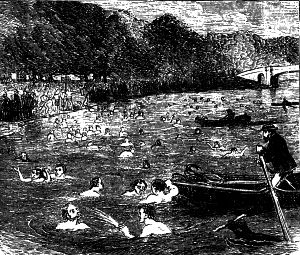
There are also sheets of water in Regent's Park, Victoria Park, Battersea Park, St. James' Park, and Kensington Gardens. The sheet of water, or stream, in Hyde Park, is known as the "Serpentine River," from its sinuous course. This is quite a large sheet of water, and is much frequented for free bathing, on warm days in the heated term. Here, thousands of people may be seen on a sultry afternoon, plunging to and fro in the cool waters, and in case of any accident—for the water is deep—the boats, ropes and drags of the Royal Humane Society's Life Saving Apparatus, are always ready for immediate use, and numbers of people are rescued and taken from the Serpentine, and resuscitated.
When the winter months come, and the Serpentine becomes frozen over, the Londoners congregate there in great numbers to skate, or play at golf or curling.
There is a large lake in the Regent's Park ornamented with small, well-wooded islands, and in Kensington Gardens there is one of the finest museums of art, science, and curiosities, in the world. There are rocky dells, and grounds for sham fights, in Hyde Park, there are the rarest exotics in the Palm House at Kew, and every known species of bird, beast, reptile, and fowl, may be found in the Zoological Gardens, which comprises eighteen acres of space in the Regent's Park.
In Richmond Park, which is ten miles distant from the London Post Office Centre, there are two thousand three hundred acres of hill, dale, plain, and forest, and here are to be found deer-parks, rabbit warrens, romantic foot-paths, ancient oaks, horse-chestnuts, and thorny ridges, with a variety of sequestered spots for pic-nics and pleasure parties. This noble park can be reached by a sail of fifteen miles on the River Thames, which is skirted by Richmond Park for some distance.
There is a grand Observatory for scientific purposes in Greenwich Park, which is noted all the world over for its correct calculations, and all the watches and clocks in Great Britain are set by Greenwich time.
THE WORLD'S FAIR.
Bushy Park, at Hampton Court, where there is a splendid gallery of ancient and foreign paintings and sculpture, the property of the nation, and free to the people, was formerly the residence of Cardinal Wolsey. This royal palace and park is to London what St. Cloud is to Paris. The palace stands on the banks of the Thames, and when completed, in 1526, for the great Cardinal, it contained 282 apartments, and as many beds. The Great Hall is inferior to none in England, and is ornamented with stained-glass windows, stags' heads, spears, flags, trophies, figures of men-at-arms, and other medieval ornaments, and the walls are hung with tapestry, depicting the story of the Patriarch Abraham's life. The largest grape-vine in the world grows in the park, and extends over a space of 3,000 feet. This vine was planted one hundred years ago, and produces, every year, about 2,000 bunches of black, sweet grapes, which are reserved for the Queen's private table. An attendent, showing the royal vine to me, informed the writer that it was high treason to steal the grapes, and I have no doubt that he believed what he said. The Queen has, also, a bed-room here, which she wisely refrains from sleeping in, as, I have no doubt, she would catch influenza from the draughts.
But the great curiosity of Hampton Court Park, is the "Maze," an intricate complication of pathways, that wind in and out, and which have served as a standing conundrum and riddle from time immemorial, for the amusement of the Cockneys. Any one who enters this maze without a guide cannot leave it again, so intricate and puzzling are the foot-paths, which are overshadowed, embowered, and interlaced with young trees and umbrageous shrubbery. By fastidious Londoners this maze is called the "Labyrinth."

THE LABYRINTH.
One of the most popular places of rural resort in the vicinity of London, is the Crystal Palace at Sydenham, a suburb of the metropolis, and about ten miles from the city.
It is no exaggeration to say, that next to St. Peter's, at Rome, this is the most wonderful structure in the world, and equals in point of magnificence, some of the creations of the Arabian Nights.
When the great World's Fair of 1851 ended, there was a general desire among all Englishmen, that this magnificent structure, which had held the great cosmopolitan show, should not be destroyed. A committee of some nine gentlemen was formed, by whose direction it was taken to pieces for the purpose of reconstruction. This committee had purchased the building, and a company was chartered with a capital of £500,000, in shares of £5, and so confident were the Londoners of the success of the new scheme, that the shares were quickly taken up and the operation of removing the vast building to Sydenham, its present site, was commenced.
THE CRYSTAL PALACE.
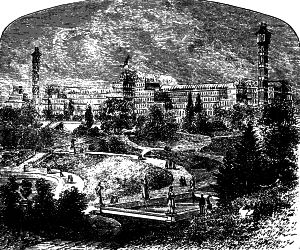
The new structure was begun, and the first column raised, on the 5th of August, 1852; and, immediately after, several gentlemen were despatched to the principal cities on the Continent for the purpose of bringing to England casts of the finest pieces of sculpture in existence, and other specimens of the fine arts. The splendid Park, Winter Garden, and Conservatories were committed to the management of the late Sir Joseph Paxton, who invented the architectural part of the Palace of 1851. The arrangements of the various other departments were assigned to men of eminence and skill, in whose hands the structure grew, until it quickly attained its present splendor, and the New Crystal Palace was at length opened to the public on the 10th of June, 1854. Some idea of the magnitude and extent of the operations carried on in the fitting up of this enormous house of glass may be gathered from the fact, that at one time there were no fewer than 6,400 men employed in carrying out the designs of the directors. The edifice is completely transparent, being composed entirely, roof and walls, of clear glass, supported by an iron framework; and it is said that these materials are more durable than either marble or granite, and, if properly cared for, will utterly defy the ravages of time. The extreme length of the Palace, including the wings, is 2,756 feet; which, with the colonnade leading from the railway-station to the wings, gives a total length of 3,476 feet, or nearly three-quarters of a mile. The width of the great central transept is 120 feet; and its height, from the garden front to the top of the louvre, is 208 feet, or six feet higher than the Monument on Fish Hill. It consists of a basement floor, above which rise a magnificent central nave, two side-aisles, two main galleries, three transepts, and two wings. In order to avoid sameness and monotony in such an immense surface of glass, pairs of columns and girders are advanced eight feet into the nave at every seventy-two feet. An arched roof covers the nave, and the centre transept towers into the air in fairy-like lightness and brilliancy. There are also recesses twenty-four feet deep in the garden fronts of all the transepts, which throw fine shadows, and relieve the continuous surface of the plain glass walls; and the whole building is otherwise agreeably broken into parts by the low square towers at the junction of the nave and transepts, the open galleries toward the garden front, and the long wings on either side. The building is heated to the genial temperature of Madeira, by an elaborate system of hot-water pipes, and the supply of water is drawn from an Artesian well. The Tropical Department, once a great feature of the Palace, has ceased to exist; having been destroyed by fire about three years ago.
THE CRYSTAL PALACE.
There are large and beautiful pleasure grounds all around the Crystal Palace, and all the great national fetes, concerts, and open air demonstrations, take place here. Patti, Nillson, and Sims Reeves, sing here in benefits for charitable associations, and for a shilling, a person may listen to ballads on Saturday afternoons, at these concerts, sung by the greatest living English tenor. Then there are acres of restaurants and dining saloons inside and outside of the Crystal Palace, and apparatus and cooking utensils are on the premises, whereby ten thousand people may find dinner, all at one time, and sit down to tables in five minutes after dinner has been ordered. During the long summer evenings, promenade concerts are held at the Crystal Palace, and fireworks are let off in the presence of great crowds, who enjoy the sports and junketings much as a New York crowd may do on a Fourth of July night, in the City Hall, or Madison Park.
The contents of the Palace itself are calculated to puzzle the brains of a philosopher. Everything wonderful, curious, precious, or difficult to find at any other place, may be found at the Crystal Palace.
Specimens of architecture, sculpture of all ages, tombs, temples, busts, statues, capitals, hieroglyphs, from Greece, Rome, Egypt, and Italy, portions and entire courts from the glorious Alhambra, gigantic relics and ruins from the Palaces of Babylon, Susa, and Nineveh; fragments of the Christian temples of Italy, the castles and churches of Germany, the Chateaux of Belgium and France, and the Cathedrals and Mansions of England, from the earliest ages to the present time, all of which are arranged in "courts" in the most systematic order.
Beside these there are many Industrial "Courts" containing the most wonderful and useful inventions of the genius and scholar. Then there are gigantic models of the tremendous animals who existed before the flood, with models of huge and hideous reptiles, and saurians, who did their level best in the same period.
Some sunny Saturdays as many as fifty thousand people pay visits to the Crystal Palace, and to see and enjoy all these wonders, the charge is only one shilling, including concerts, music, fireworks, and flirtations.
The last time I was there it was on the occasion of the Royal Dramatic Fete, for the benefit of the profession, and fully a hundred thousand persons were present, including the Prince and Princess of Wales, and many of the nobility.
COST OF GROUNDS AND BUILDING.
The entire cost of grounds and building, with works of art and curiosities, was seven million dollars. There were 15,000,000 of bricks, 6,000 tons of iron, 20,000 loads of timber, 300,000 superficial feet of glass, 1,200 iron columns, one mile and a half of clerstory windows, and other materials in proportion, used in the construction of the edifice, and the space of ground enclosed under the transparent roof is twenty-five acres, being one-fifth greater than the area of the base of the Great Pyramid.
CHAPTER XVI.
THE RAKES OF THE ROYAL FAMILY.
NGLAND has been singularly unfortunate in her Royal Families.

York and Lancaster, Plantagenet and Tudor, Stuarts or Hanoverians, they have been, with here and there an odd exception, a very bad lot, morally speaking.
It is a curious history of crime and bloodshed, of dishonor, perjury, and harlotry, this history of the Monarchs of England, since the days of William the Norman, who had three illegitimate children, and massacred thousands of his Saxon subjects every year, down to the days of George IV, the most gentlemanly blackguard of his time and of Europe.
VAGABONDS IN KINGLY ROBES.
Roll back the hoary gates of the past, and look at Richard Crookback, who reveled in blood, and died in Bosworth Ditch, a death only a little better than that of Edward IV, whose children Richard basely murdered, and we find succeeding him a scoundrel like the Eighth Henry, a brutal fiend, with his six successive wives, all of whom perished miserably, but the first and last wives, Catharine of Arragon and Catharine Parr; and then we find his two children—Mary, an honest fanatic, burning human beings for the honor of God; and next comes Elizabeth, who has been facetiously styled the Virgin Queen—with her paramours and favorites. Follow this hideous old spinster to the yawning verge of the tomb, and she is still to be seen with her parchment visage and grey hairs, seeking new lovers, or butchering the unfortunate Queen of Scots, until at last the dread moment of all approaches, when she tells her horrified chaplain that she will give millions of money for a moment of time. Then we have a pusillanimous monarch, James I, who spends his best years discovering witches and writing fantastical and forgotten treatises against tobacco, or permitting a man like Bacon—whose life was worth that of a thousand Kings, to be degraded and made miserable, till at last his great, far seeing eyes are closed in a final sleep—his heart having broken to pieces in the meridian of his genius.
Then comes Charles I, a good man in his mild way, a patron of the arts, a good husband and father, but withal he is doomed to the block.
Vainly he endeavors, in battle and statecraft, to stem the onward march of the people who are determined to hurl all obstacles from their path which stand in the way of their new ideas.
And now comes up the Brewer, Oliver Cromwell, one of Carlyle's heroes, (and by the way, all of Carlyle's heroes are dripping with blood,) a most accomplished and unrelenting butcher, one who thanks God for his "precious mercies" when a thousand men, women, and children are driven over a bridge into a deep river beneath, impelled by the pikes of his ruffianly soldiery. Then he dies, and Charles II, a dissolute royal scamp succeeds, and he of course has to dig up the crumbling skeleton of Cromwell to hang it on Tyburn tree, that all men may see what manner of divinity it is that should hedge around a King.
Think of this royal vagabond, who has for his mistress a Stewart, a Duchess of Cleveland, a Louise de Queroailles, who also becomes a Duchess of Portsmouth, and last but not least, poor simple, soft hearted Mistress Nelly Gwynne, who left to the nation Greenwich Hospital to atone for her lost soul.
It might be expected that in these days of the daily newspapers and telegraph wires, of railroads, female suffrage and personal journalism, that royalty, and notably, English royalty, would improve, from a slight sense of decency and a proper regard for public opinion, if for no other cause. Let us see.
Ten years ago I vainly endeavored to penetrate the dense masses who lined Broadway, New York, and filled the air with their shouts, as an open barouche, containing the then Mayor of the chief city of America, sitting on the back seat, and a fair faced youth with flabby skin and retreating chin, clad in a scarlet uniform and having an Order of the Garter pendant from his breast, passed up the thronged thoroughfare between two lines of citizen soldiery, whose bayonets, bright as silver, reflected back the many hues of the excited and surging masses.
Five hundred thousand people of both sexes had turned out in holiday attire, that ever memorable day, to do honor to a foreign prince, whose government, since that thoughtless hour, sought during the terrible confusion of a civil war, by every means in its power, by money, influence, by Alabama pirates, by unceasing and bitterly hostile journalistic attacks, by speeches in and out of Parliament—through the pulpit and the rostrum, to destroy the Republic of the West. In fact that government moved Heaven and Earth to annihilate and obliterate the liberty, union, and might of the American people.
Such a reception had not been given, twenty-five years before, to the gallant, noble-minded, and chivalric Lafayette, the companion of George Washington, one of the finest characters in all history, or the unwritten records of mankind.
This fair-faced, flabby-skinned youth, in the lobster colored and laced coat, who stood up in the open carriage, (hired from the New York Corporation hack-driver-in-chief, and charged for in the bill afterward rendered, at five times the real price,) was no less a personage than Albert Edward, Prince of Wales, Duke of Cornwall, Fellow of Trinity House, Colonel of a Regiment of Foot, a General in the British Army, (like Captain Jinks,) Baron Renfrew, Duke of Rothesay, Earl of Dublin, and eldest son of Queen Victoria that is, and in the future to be King of England and Defender of the Faith, by the Grace of God and the permission of the Radical English Trades Unions.
A CHANGE FOR THE WORSE.
He was not a very bad looking lad of nineteen or twenty, that sunny afternoon, as he bowed repeatedly and raised his Generals' chapeau, with its plume of feathers, and doffed it to the radiant republican female faces, and curtesied like a backward school boy, in acknowledgement of the wild shouts which pealed upward in the clear atmosphere, although no spectator there could have accused him of having an intellectual or cultured face. How well we can all now remember, to our shame, the manner in which he was petted, and caressed, and toadied, and dined, and wined, until in the estimation of his toadies he had almost attained the stature of a God, this boy with the retreating chin and imbecile face—this hope and pride of the Guelph family.
Still with all the marked and inherent imbecility of a descendant of George III in his features, the young scion of royalty had not, at that time when I first saw him, developed the seeds of immorality, want of honor, meanness, and utter sottishness which have since made his name infamous among his subjects, and despised by the princes of Europe.
The young lad for whom America could not do too much honor in feteing and feasting, has since surrounded himself with pimps, panders, parasites, and blackguards, of the lowest kind.
His name is a bye word of scorn in the British metropolis, and for a lady of rank or position to be seen three times in his neighborhood, is certain dishonor to her and her relatives.
It was nearly ten years after that bright sunny day, in Broadway, with its shouting multitudes and noisy cheers, before I again saw His Royal Highness Albert-Edward Prince of Wales.
One night, in going through High Holborn, and being without any settled purpose as to where and how I should spend the evening, I accidentally noticed the blazing gas lamps of the "Casino," a well-known dancing hall, frequented by the loose livers and aristocratic idlers of the English Capital.
After a moment's hesitation I entered and found the place—as is usual on summer evenings at all the London dancing halls—pretty well crowded.
Scores of couples, of both sexes, were whirling frantically in the Old-World Teutonic waltz, and in the flushed faces and excited gestures of the gyrating dancers I could notice a total forgetfulness of modesty and decorum.
From the alcoves came the sounds of the clinking of wine-glasses, the rattle of Moselle bottles, the pop, pop, of champagne corks, and songs, choruses, and loud shouts of laughter, together with a Babel-jabber of many confused tongues.
My attention was attracted while listening to the music from the fine band, to a group that occupied a position which partially screened them from the glances of the larger portion of the audience and dancers, sitting and standing back as they did in an alcove.
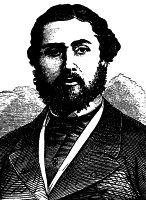
PRINCE OF WALES.
There were a dozen persons, perhaps, in the party, of both sexes, five or six men fashionably attired, and as many women, in all the grandeur and magnificence of harlotry—open and defiant—but well-bred harlotry.
There were two central figures conversing in this group, and I could see that they were listened to with attention while speaking, one of them, particularly, a slightly bald-headed man, having secured the ears of his audience.
The other central figure was a woman, beautiful, but of that beauty which is leprous to the sight, and fatal to those who encounter it as the shade of the Upas Tree.
"Who is that man?" said I to an usher, nodding in the direction of the bald-headed person.
"That man" said the flunkey, "why, that's not a man, that's His Royal 'Ighness the Prince of Wales,—and long may he reign over us."
And this worn, blase, sottish and almost brutally stupid-looking person in the Scotch tweed suit, with drooping eye-lids and sore eyes,—as if he seldom went to bed, and then did not stay long in it, looking to be forty-five years of age; prematurely bald, and without a particle of that apparent divinity which, it is said, doth hedge a monarch, was the self-same young lad of twenty, whom I had seen environed by bayonets in Broadway, ten years before.
THE PRINCE AND HIS FRIENDS.
But how changed he was! Long nights of dissipation and debauchery had seamed the once youthful and unwrinkled features, and the under part of the face hung in heavy, adipose folds, like the dewlaps of a bullock. His figure was stout and without grace, and to me he seemed like a beer-drinking bagman or commercial peddler, half John Bull, half Hanoverian. The tweed suit, a material which he affects very much, was not at all calculated to set off or adorn his figure, and the great grandson of George III looked very undignified indeed as he leaned over the painted harlot resplendent in silks, and glistening with jewels, who is known to all wild London scapegraces, and young men about town, by the name of Mabel Gray, a name assumed for a purpose—to hide her identity with the gutters from which she has sprung.
The Prince of Wales, despite all the counsels and admonitions of the Queen (of whom whatever may be said, the merit cannot be denied her of being a good mother), has, I regret to say, the reputation of being a very sorry scamp.
His intimates are, generally, the worst and most abandoned roues of the Clubs, the lowest turf blackguards and swindlers, and when he chooses a companion who is not a swindler or a blackguard, a debauchee, or a decoy, he is sure to be a fool.
The young man standing by the side of the Prince of Wales when I entered the dancing hall, was Charles, Lord Carington, whose mother was of the great family of d'Eresby, the head of which is Lord Willoughby d'Eresby, Lord High Chamberlain of England, to whom is entrusted the duty of looking after the morals of the English people and the sanctity of the British drama. It is he who gives passes to the House of Lords on Saturdays, on slips of blue paper which the unwashed are very eager to obtain; and it is also the duty of the Lord High Chamberlain to watch every new burlesque when produced, in order that the skirts of the ballet girls and blondes may be of the proper length, and not too short for the proprieties.
Lord Carington's grandfather was a rich man named Smith, who was ennobled for some reason or another, and his large fortune and title has descended to the present possessor, who is known to be one of the wildest and most rakehelly young noblemen in London. He is a lieutenant in the Guards of the Queen's Household Brigade, and one of the boon companions of the Prince of Wales. The latter is constantly to be found in company with this "Charley Carington," as he is called, who was the perpetrator of a most cowardly outrage upon the person of Mr. Grenville Murray, an aged gentleman who was supposed to be proprietor and editor of the "Queen's Messenger," a satirical weekly journal, in which Mr. Murray was said to have written several scathing articles upon the "Hereditary Legislators" of England. In one of these articles a sketch was given of Lord Carington, under the title of "Bob Coachington, Lord Jarvey," in which the practice of driving a mail coach and four horses to and fro between London and its environs and taking up passengers for money, a favorite pastime of Lord Carington, was referred to in no very flattering terms. For this supposed affront, without any positive proof to warrant the outrage, the gallant Lord Carington, aged 25 years, set upon Mr. Murray, as he was coming out of the Conservative Club, of which he was a member, and beat him badly. Mr. Murray is about 60 years of age, and was of course not able to defend himself, and when he sought justice in the usual way at the Marlborough Street Police Station, of the magistrate, Mr. Knox, he found the Prince of Wales and a number of titled ruffians sitting on the bench along side of the dispenser of justice!
TWO IMBECILES.
Of course Mr. Murray received no justice in that Court, and not only was he refused satisfaction, but in addition an attack was made upon the person of his counsel, when a libel suit had been preferred against the "Queen's Messenger," by the aristocratic friends of Lord Carington and the Prince of Wales, who did this to intimidate him from writing farther in his journal of the scandalous conduct of the Queen's relations and the rottenness of the higher nobility.
In addition to this Mr. Murray was expelled from the Conservative Club by a ballot of one hundred and ninety votes, only ten members of the Club having the personal courage to withstand the influence and threats brought to bear against them by the Prince of Wales, Lord Carington, and their minor satellites.
Lord Carington is fond of driving his coach and four and taking up passengers in the outskirts of London, charging them a nominal fare. While sitting on the box or seat of the coach he usually holds to his lips a huge horn, which he toots like a raving maniac, much to his own satisfaction and the edification of the floating community, who with the fondness of all Englishmen for a live Lord, smile benignantly if not affectionately upon this imbecile young nobleman.
In the words of the song, the "Prince of Wales goes everywhere to see the sights of town" with Carington, and at the Dramatic fete at the Crystal Palace in 1869, while his beautiful, good, and neglected wife sat on a dais and received the donations for the Dramatic College, the Prince manifested in public his intimacy with Carington by laughing and conversing with him, arm-in-arm, much to the horror of all the pious old dowagers who were present and had heard wild stories of Lord Carington.
Mabel Grey, who has ruined scores of young aristocrats and brought them to beggary, is the reputed mistress of Lord Carington, and has made several visits with him to Paris, Baden, and other places on the Continent. It is said that he has already squandered twenty thousand pounds upon this well-bred harlot, and it is the current talk in London that the Prince of Wales has also been on terms of an improper intimacy with Mabel Grey. At all events he is not ashamed to be seen speaking to her in Casinos or addressing her in public places, and the dear Prince has on several occasions been seen drinking champagne with her in the music halls and dancing rooms of the English capital. This is a very bad business for a bald-headed father of five children.
PRINCE AND CABMAN.
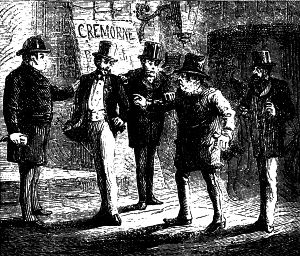
The Prince of Wales, with all his immense riches, is mean and very penurious in money matters. He will argue for fifteen minutes with a cabman in the street about an over-charge of a sixpence, and has been known to get into an altercation with ticket sellers in the box offices of places of amusement for the sake of a shilling or half a crown, in a most undignified way. One night when getting out of a cab at Cremorne the driver attempted to charge the Prince four shillings for a ride when he should have charged him but two-and-sixpence. The Prince, who was a little intoxicated, refused to pay the over-charge. The London cabbies are the most impudent, brassy set of fellows I ever saw, and this cabman was more than usually pugnacious. The Prince attempted to go into the Garden, and had presented his ticket, when the cabman with a yell clutched his coat, and tore away the skirt in the struggle to get more fare. The Prince was recognized by some of the attendants of the place, and the horrified cabman was handed over to the police for assault on the blood royal. Fearing the ridicule of the London press, the Prince told the policeman to release poor Cabby, who was only too happy to escape transportation for life.
INFAMY OF THE PRINCE.
For the past seven years the Prince of Wales has been a prominent actor in almost every scene of aristocratic dissipation and debauchery which has been enacted in the English metropolis. He is well known in the coulisses of the Opera, and has openly maintained scandalous relations with ballet dancers and chorus singers. Even the shame of the thing would not restrain him from loudly and familiarly applauding and clapping his hands, whenever any of these female favorites of his came on the stage, while the strains of Beethoven or Rossini could not elicit from him as much as a smile of gratified approbation. The taste of the Prince for music may be imagined from the fact that "Champagne Charley," and "Not for Joseph," are his two most cherished melodies.
His relations with Mademoiselle Helena Schneider, the opera bouffe singer, were most notorious, and he has been known to leave the bed side of his wife in her illness to hasten to Paris at the summons of this notorious woman of Darkness, and Sin, and Shame.
Among his special female favorites, are many of the better known soubrettes of the London and Parisian theatres, and notably he was an admirer of Finette, the famous Can-can danseuse of the Alhambra.
He is flippant, shallow, and heartless, and the record of his life thus far has caused many a scalding tear to fall from the eyes of his royal mother.
The London Lancet, the highest medical authority in England, found it necessary, some eighteen months ago, to deny the charge that was made openly against the Prince, which if true, would stamp him with infamy. The Princess of Wales, who is a good and noble lady in every sense—and a long suffering one in some respects—during the summer of 1869, visited the baths of Wildbad, in Germany, for the benefit of her health, which had been sadly impaired. I dare not in these pages insult my readers by giving the cause of her ill-health, which is more than whispered about in English society.
The Prince has, I believe, five handsome children—their good looks coming to them from their vigorous Norse mother, but it will not be from any precaution taken by their father, if they do not hereafter suffer from the results of his early indiscretions and follies, in the Haymarket and the purlieus of Paris.
In a good many respects the Prince of Wales resembles another Prince of Wales—one who succeeded his father as King. I mean George IV. Like him, Albert Edward is already a broken debauchee, and like George IV Albert Edward has a vicious way of making his wife suffer through his follies and disgraceful behaviour. Unless the Prince is predestined to experience a sudden and speedy conversion, it is more than probable that the next King of England will excel and put to shame the open acts of profligacy which made George IV so notorious.
One thing could be said for George IV which cannot be said for the Prince of Wales. The former was a gentleman in manner if not one at heart—but this Prince, while being thoroughly heartless and "stingy," has the breeding of a waiter in a lager beer saloon. He is heavy, slow, unready, hesitating, and flabby, without a spark of culture or a trace of the refinement which belongs to his station.
PRINCE AND BREWER AS FIREMEN.
His Royal Highness has a great passion for running with the "masheen," as a New York rowdy would term it, and Captain Shaw, of the London Fire Brigade, is greatly admired by the Prince for his gallant management of that very efficient Corps. The latter has often taken a ride on a fire engine through the London streets. The Prince, while on a visit to Brighton some years ago, made the acquaintance of a rich young London brewer, who had more money than brains. This was just the sort of a man to suit the Prince, being very fond of rich young men, who in many cases are only too happy to have the honor of paying the bills contracted by his Royal Highness. This eminent young brewer had, with the Prince, a similar taste for fire engines, and it was suggested by the future King of England that the brewer, who had a fund of good nature, should send to London for a fire engine, at his own expense, and have it transported to Brighton, where in course of time the Prince hoped it might afford them much amusement. The brewer of course complied with the Prince's request, and before long one of those grotesque looking fire machines, that are every now and then to be seen darting through the London streets, made its appearance at Brighton. Night after night the Prince and the brewer made the quiet villas and the Parade of Brighton resound with their shrieks and howls, as they drove at headlong speed through the watering place, the two maniacs sitting astride of the apparatus which was drawn by two horses; and finally the thing became such a nuisance to the residents of Brighton, and so many complaints reached the Queen's ears of the Prince's riotous conduct, that at last he was sent for and severely reprimanded by her Majesty, and for a few days he kept on his good behavior, to relapse again like a fever patient.
It is useless to conjecture as to the probability of the Prince succeeding to the throne, but if ever he does, he will no doubt revive the days of Charles II and his dissolute court. His beautiful and virtuous wife will perhaps fall into the place which Catharine, of Braganza, was compelled to accept as the consort of that rakehelly monarch, and Albert Edward will, no doubt, find in Lord Carington material for a successor to Sir Charles Sedley, and in the Duke of Hamilton a scamp, worthy of the reputation borne by the Earl of Rochester.
It is a mistake to think, moreover, that the Prince of Wales is alone among his family, in his vicious course, or that he has not numerous imitators among the nobles bearing some of the proudest names in England. Although he is yet but a young man of thirty years of age, he has those around him who ape his immorality and copy his disregard for the usages of society.
Still, the Prince cannot be blamed for the follies of his relations. The Duke of Cambridge, cousin to the Queen, and old enough to be the father of the Prince, has as bad if not a worse reputation, than the Prince of Wales.
George Frederick William Charles, Duke of Cambridge, Earl of Tipperary, and Baron of Culloden, is a first cousin of Queen Victoria, a Field Marshal and Commander-in-Chief of the English Army.
This Prince is about fifty years of age, and lives in an unlawful way with a Miss Fairbrother, by whom he has had several children, I believe. It might be expected, of a prince so closely related to the Queen, and occupying such a high position as chief of the British Army, that he would set a good example to the younger branches of the royal family. On the contrary, the Duke is well known, everywhere, as a royal rake, and his shameless amours are beyond number. The old prince is slightly bald from his course of early piety, and suffers so dreadfully from the gout, the result of early dissipation, that he is nothing but a wreck, being compelled annually to pay a visit to the mineral baths of Germany, and American travelers upon the continent at Baden, Ems, and Hombourg, will occasionally encounter an old, broken, and bloated personage, limping on a stick, who will quarrel with a waiter, in Hanoverian Deutsch, for the sake of a kreutzer, and when once excited it is very difficult to calm his rage, which, sometimes, degenerates into a helpless imbecility. This is the Duke of Cambridge.
A MAD KING.
From his illicit connection with the lady to whom I have referred, the mock-title of "Duke of Fairbrother," has been given to this illustrious Commander-in-Chief of the Army. Fancy such a Duke of Cambridge holding the baton of Wellington, and leading such soldiers as Havelock, Outram, Colin Campbell, and Napier of Magdala. And this very same imbecile Duke has had command of the English Army, and notably at the Alma, in the Crimean campaign, his conduct was such as to make the spectators doubt whether he was a madman or a coward. In the heat of the fight, the Duke lost all management of him self, and began to make strange noises, and to act in a strange manner, until he was carried from the field, kicking and biting in a maniacal fashion.
For the taint is in the blood of the English Royal Family, and may never be eradicated. The Duke of Cambridge is a lineal descendant of George III, who, by his inherent madness, lost half of the British Empire, and who was in the habit of answering reasonable questions, with such replies as,—
"What, what, who, who, where, where, why, why—BLIM!" Should the Prince of Wales hereafter behave himself in an unseemly fashion, his tainted blood may, to a certain extent, be blamed for the outbreak.
CHAPTER XVII.
FAST YOUNG ENGLAND.
HY Londoners should presume to sneer at the morality of the volatile Parisians, has always been a sore puzzle to me. During the past fifteen years, sharp observers of society in the English Capital have been appalled by the visible and marked progress of moral and social deterioration among the people who affect to give tone, and breeding, and refinement, to all that they do or say, as leaders of society.
Polite London Society has always plumed itself upon being superior, in a moral sense, to the corresponding class in the French Capital, but it must strike those who have held such views, that there is no basis for the belief any longer, when the notorious fact is offered to them, that two of the highest personages in England are men who lead lives of immorality—I refer to the Prince of Wales and the Duke of Cambridge. I have however said enough of those two loose gentlemen, and I shall proceed to consider the subject in its larger bearings.
I boldly assert, that English Society, of the highest class, is to-day as rotten in every sense, as were the French nobility, with their mistresses and their "little establishments," before the whirlwind of the Revolution of 1793 swept away all that was of hideous corruption and infamy, never to rise again.
The proudest names among the English nobility are those which have some moral or dishonorable taint affixed to their titles, by their conduct in life.
MISS HARRIET MONCRIEFFE.
Many of my readers must recollect the termination of the famous Mordaunt case, in which the Prince of Wales was implicated, and it will also be remembered that the few facts which were developed on the trial, despite the attempt of Lord Penzance, (acting under pressure of the Throne,) to hush them up, had the effect of shaking England to the centre, socially speaking.
Miss Harriet Sarah Moncrieffe, now Lady Mordaunt, is a daughter of Sir Thomas Moncrieffe, a baronet of one of the oldest families in Scotland. The family seat is at Earn, in Perthshire, and the mansion and grounds are among the finest in North Britain. The family was a large one, four sons and six daughters being born to Sir Thomas and his wife, who was a daughter of the Earl of Kinnoul. Lady Harriet's eldest sister is married to the Duke of Athole, one of the richest and most powerful of the Scotch nobles. Then she has a sister married to the Earl of Dudley, and another to a Mr. Forbes, of a wealthy Scotch family, into which, if I be not mistaken, Lady Douglas-Hamilton, a sister of the Duke of Hamilton, is married. One of the sisters—the Duchess of Athole, has for her mother-in-law the Dowager-Duchess of Athole—who is a tried and trusted friend of Queen Victoria, being, as I believe, a Lady-in-waiting, or a Lady-of-the-bed-chamber to the Queen, or something of that sort. Altogether the family and its connections are among the very thickest cream of English aristocratic society.
In December, 1866, Lady Harriet Sarah Moncrieffe, then eighteen years of age, and surpassingly beautiful in person, and most graceful in manner, was married to Sir Charles Mordaunt, of Walton Hall, Warwickshire, who was then twenty-nine years of age, and a very wealthy bachelor, possessing one of the finest country seats, with mansion and grounds, in all England. The main buildings alone were erected at an expense of over $350,000 of American money, and to this most delightful and picturesque spot the young bride was taken to spend the honeymoon. Everything that the heart of a fashionably bred woman could desire was hers, she had troops of servants, a fine old baronial mansion, a large stable full of horses, a yacht, a gallery of paintings, a villa on the Continent, equippages, diamonds, ladies'-maids, and a town house in London. And beside her lightest word was law to her loving husband. She had been presented to the Queen, and in her life-pathway sunshine fell and gladdened her young spirit. But there was a canker in the bud—a skeleton in the closet—as there always is. Lady Mordaunt had loved below her station before she married Sir Charles, and had sought to marry the object of her affection, but her mother, who was a very worldly minded woman, was determined that she should marry the rich Sir Charles Mordaunt, who had houses and lands, while "poor Robin Adair" had to go about his business.
Of course the natural consequences had to come. Sir Charles had a yacht, and now and then went on cruises to Norway and up the Baltic, and ran his craft from Erith to the Nore, and on many a sunny day the snowy jib-sail of his boat was seen from afar by those nautical minded people who frequent the breakwater at Cherbourg. When he was at home he was either hunting with the Warwickshire hounds, or looking for plover and grouse on Scotch moors. Any other spare time he had was taken up in his parliamentary duties, for he had the ineffable honor of signing "M.P." after his name.
And the young, gay, beautiful, and high spirited Lady Mordaunt—how was it with her? Being left very much alone, she developed herself. She delighted in balls, the Italian—yes, and the Bouffe Opera, she liked Croquet parties, garden parties, Crystal Palace concerts, and flirtations, and one evening, in company with Captain Farquhar, an officer of the Guards, she visited the "Alhambra," a celebrated dancing hall, which is supported by the London demi-monde.
IN BAD COMPANY.
She was young, thoughtless, and very beautiful, and to be brief, she fell among wolves, as many a woman has before. She had for escort to different places, the Prince of Wales, Sir Frederick Johnstone, Viscount Cole (eldest son of the Earl of Enniskillen), Lord Newport, Captain Farquhar, the Marquis of Blandford, and among her acquaintances were the Duke of Hamilton, the Earl of Jersey, the Marquis of Waterford, and other young gentlemen, whose company or friendship alone would be enough to destroy the character of the most spotless married woman. And by the by, all these fast young noblemen are friends and boon companions of the Prince of Wales. Lady Mordaunt also knew Lord Carington, although his name did not appear in the trial for divorce.
All of these titled gentlemen whom I have mentioned, are of that class which is denominated "fast young men"—in England. They are all of good families, and are of the salt of the earth, being hereditary legislators for the English people. They gamble, own fast horses, make tremendous bets, keep mistresses, and yachts, and among this set to dishonor a young and unsuspecting married woman, and cover with disgrace an old family name, is indeed an achievement of which they feel very proud, a woman's weakness and folly being a subject for joking in their clubs, and affording much amusement to the young blackguards at covert side and in many a yacht cruise in the Mediteranean and the Baltic Seas.
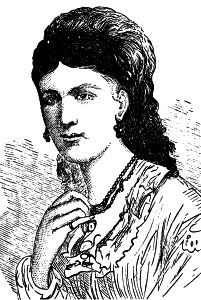
LADY MORDAUNT.
Lady Mordaunt had fallen among a pack of masculine wolves. Her two sisters, the Duchess of Athole and the Countess of Dudley, vainly endeavored to save their foolish sister, and her mother, Lady Louisa Moncrieffe, and her young sister, who was engaged privately to Viscount Cole—(Miss Frances Moncrieffe), and Miss Blanche Moncrieffe, used all their powers of persuasion, but Lady Mordaunt had met already with the fate of all those who frequent bad company. She was corrupted, and her only desire was now to become deserving of the title of "fast." Lady Mordaunt soon became the leader of the "fast" feminine set in London. No lady could drive such "fast" ponies as she. None could equal her for "fast" or "slangy" talk. Her highly colored attire was voted the "fastest" in London. Her male companions who were in her company and who escorted her, were all "fast," particularly the Prince of Wales, who enjoys the proud distinction of being "fast." Lady Mordaunt never accompanied her husband anywhere—he being very often absent, and besides, he was not "fast."
And Lady Mordaunt is not alone among her aristocratic sisters of London. She has a number of imitators, who talk "fast," ride "fast" horses, frequent the company of "fast" men, and visit with these last, "fast" places of amusement. This "fast" woman has now become typical in England. She dyes her hair, she paints her face, she wears flaunting and unbecoming costumes after the style of the loose living blondes who appear in burlesque; in short, she apes the manners and the attire of that hapless class of women of whom she once spoke, when she spoke of them at all—with a shuddering thrill of mingled horror and pity. A famous female English novelist—whose heroines, by the way, are all of the light-hair-dye and "fast" type—speaking of these "fast" society-women, pertinently asks:—
SLANG WOMEN AND "MRS. JOHNSON."
"Who taught the girls of England this hateful slang? who showed them—nay, obtruded upon and paraded before them these odious women? who, indeed, but the men, who recoil from their own work of their own hands, and cry out upon the consequences of their own conduct? It was not till the young Englishman learned to ridicule everything virtuous as "spoony," and everything domestic as "slow," that the women took pains to master the slang of the race-course, and to model their dress upon the costumes of the women whom they saw from their carriage windows dimly athwart the mists of midnight flitting across the Haymarket, as they were driven away from the Opera-house. Be sure society decayed, like the tree to which poor Swift pointed with sad prophetic certainty, "first at top." It was not till the moral deterioration of the modern young man had become a fact but too obvious, that any fatal change was perceived in the modern young woman; it was not until a contemptuous and disrespectful demeanor to parents, newly denominated governors, relieving-officers, paters, maters, maternals; a scornful avoidance of sisters as muffs and dowdies; an utter irreverence for age, and a disdainful treatment of all woman kind,—had become distinguishing characteristics of young Mr. Bull, that poor, giddy, mistaken Miss Bull, too anxious to please the young cub, whose moral being and real interests had best been served by a judicious course of cat-o'-nine-tails, began to dye her pretty hair and paint her fresh young cheeks; it was not till the British lords flocked to the sale of a bankrupt courtesan's effects, and gave unheard-of sums for the tawdry crockery-ware of a courtesan's bedchamber, that British ladies began to slide downwards upon that fatal incline which their masters had smoothed for them."
"In the early days of the music-halls, before the nameless Captain had begun to cultivate his too famous whiskers, or the insatiable thirst of the convivial Charley had become a fact so painfully notorious,—when the prudent Joseph was yet unknown, and the Strand not yet renowned as the dweling-place of Nancy,—there was sung a song called "Mrs. Johnson," in which the singer, in a tipsy solemnity, bewailed the fact that the tastes and manners of his amiable wife were but too identical with his own. "And so does Mrs. Johnson,"—that was the ever recurring refrain. "I drink, I smoke, I swear, I stop out to unholy hours of the night," sings this Mr. Johnson of the music-halls, "and so, unhappily, does Mrs. Johnson. I am altogether a fast and disreputable individual, and I consider it very delightful to be fast and disreputable; but—and here, I confess, the shoe pinches—so does Mrs. Johnson. This midnight rioting, this hunting up of dancing-gardens and quaffing of perennial champagne, is my very ideal of man's existence; but I recoil aghast with horror before the idea of the same predilections in Mrs. Johnson." It is only a vulgar music-hall ditty; but I think there is a moral hanging to it, which our modern Juvenals would do well to consider."
"It is the story of Adam and Eve over again—"the woman tempted me, and I did eat." The historian of the future, studying the social aspects of this century from a file of Saturday Reviews, would have fair ground for believing it was because of modest women that outraged Englishmen fled to the denizens of St. John's-wood; that it was the slang and fastness of our girls that drove our men to the race-course and the betting-ring; the women tempted them. What cowards and hypocrites men must be, when they can turn upon and assail the helpless woman who has meekly and dutifully copied the model they have set up before her eyes, and at whose shrine she has seen them prostrate and worshipping!"
"The modern young man, with a selfishness as short-sighted as—selfishness, which is always short-sighted, has desired all the delights of life. He likes the society of the venal Cynthia of the minute, as his forefathers have done before him, but it has seemed too him too much trouble to disguise that liking, in deference to the feelings of purer Cynthias, as his forefathers did before him. When Junius wished to brand the Duke of Grafton with ineffable shame, he charged him with having flaunted Miss Parsons before the offended eyes of royalty; now-a-days such a reproach would seem the emptiest oratorical truism. The royalty of virtuous womanhood is offended every day by a procession of Miss Parsonses. Everywhere Miss Parsons is followed and worshipped. At covert-side, on parade of Brighton, or in lamplit gardens of Scarborough, in opera-house and on race-course, abroad or at home—the Parsonian worship is still going on. Miss Parsons has her matins and her vespers, her choral services at five o'clock, her gatherings at all hours and all places. The bells are always pealing that call the faithful of the Parsonian creed. And woman's poor little stock of logic only enables her to frame one fatal syllogism:
Miss Parsons is admired;
Miss Parsons is beloved;
Therefore to be like Miss Parsons is to be admirable and loveable."
When the season ended it was customary for Sir Charles Mordaunt to rejoin his wife at Walton Hall, and it might have been believed that after the gaieties of the winter revels, the mistress of the mansion would seek a little rest and the quiet of the country. But no. The country seat was always full of "fast" ladies and "fast" gentlemen. Sporting men and people of loose characters, whom no sensible man would admit to the presence of his wife, became the intimates of Lady Mordaunt. In fine, the Coles, Farquhars, Johnstones, Waterfords, Hamiltons, and the like, were "doing Lady Mordaunt's business for her," as I heard a London barrister express it. People began to talk about her, and she lost the respect of her friends, who dropped off one by one. Her poor old father, Sir Thomas Moncrieffe, while sitting in White's Club (the only club of which the Prince of Wales is an active member), hears his daughter's name mentioned in a very odious manner, and that of the Prince of Wales occurs in the connection. The "Pwince," says one of these small wits, "is very devoted—ah—Lady Mowdaant—I heah," and so the scandal flies. Sir Thomas is enraged, threatens the puppy, and tells Sir Charles of the thunder in the air. Poor old man! It is openly stated in the club that Viscount Cole and Sir Frederick Johnstone,—the former twenty-two, and the latter thirty-two years of age, are constant visitors to her boudoir,—as often as three times in a day—so says Madame Scandal. Sir Frederick Johnstone is known to be the greatest libertine in England. He is rich, of a good family, and yet no woman will marry him, for it is whispered in society,—even among ladies—that he has become so enervated and palsied from his long course of debauchery, as to be unfit for the marriage bed—and Lord Cole is a fit rival to Lord Carington for wildness and blackguardism. I saw this same Sir Frederick Johnstone slapped in the face a dozen times at the Cremorne Gardens one night, by a fashionably attired Cyprian who had been his mistress, and who had been deserted by him, but not a blush warmed his cheek under the stinging slaps of her hand. Luxury and debauchery had emasculated him. He was no longer a man—he was a frame covered over by a handsome evening dress.
A GIDDY WOMAN.
During all this time, while Lady Mordaunt was sowing the wind to eventually reap the whirlwind, her husband was ignorant of these most damnatory facts against her reputation,—which afterward became known to him. At last the scandal was bruited about so much that Sir Charles Mordaunt found it necessary to enter proceedings in the Divorce Court, at Westminster, for a separation from his wife. All England was, socially, turned upside down with amazement, when it was ascertained that the Prince of Wales was implicated. The Queen sent for Sir Charles, and begged of him to withdraw from the case, in order to secure her son's reputation from the contempt which was sure to fall upon his Royal Highness when the developments were made public. The entreaties of the Queen did not avail, however, with Sir Charles, who, with a dogged English pluck, was resolved to have justice. Then an attempt was made to bribe him, and a peerage was offered him to keep him quiet, but this did not serve, as Sir Charles refused to compromise with dishonor and shame.
Lady Mordaunt's husband had ordered her not to receive the Prince of Wales at his house while he was absent, or at any other time, but the unfortunate woman had disobeyed him. She also refused to accompany Sir Charles on a fishing excursion to Norway, as she preferred to stay at home and associate with disreputable characters. He also ordered her not to receive Viscount Cole, or Sir Frederick Johnstone, but, as in the other case, the husband was disobeyed, and his house was used by them against his will during his absence. On the 27th of February, 1868, Lady Mordaunt was prematurely confined of a child which was afflicted in the eyes with a hideous disease. The first question asked by Lady Mordaunt immediately after her confinement, was of the nurse. She asked, "Is the child diseased?" The nurse answered, "My Lady, you mean deformed;" and Lady Mordaunt answered, "No, you know what I mean." This question was repeated five or six times, and, during the night, she said to her sister, Mrs. Forbes, "If you do not let me talk I will go mad," meaning thereby that she desired to make a confession. The nurse asked if she should fetch Sir Charles to her, and she said "no," but added, "This child is not Sir Charles's at all—but Lord Cole's." She then stated that she had behaved improperly with Lord Cole in June, 1867, at her husband's house. This was testified to by the nurse, and the occurrence took place at Walton Hall. She was afraid that the baby would be blind—the disease being an incurable one.
The suit for divorce was opened in the Westminster Divorce Court February 16th, 1869, and some of the most eminent and aristocratic personages in England attended. The Prince of Wales was ashamed to be present until sent for, but as he was very anxious about the result he sent his private Secretary, Sir W. Knollys, to watch the case. That gentleman was present every day, and manifested great interest in the testimony, which was very filthy, but not so filthy but that the Pall Mall Gazette and London Times, with other leading journals, should print every line of it, day by day, as it transpired in the Court. The trial continued seven days, Lord Penzance presiding, and it created as great an interest in London as the McFarland and Richardson case did in New York. No ladies were admitted to the Court, but two thousand, the majority of whom were of the cultivated and respectable class, sought admission during the first three days of the trial. All the relatives, of both parties, who could attend were present. The Dowager-Lady Mordaunt, mother of Sir Charles, testified strongly against her daughter-in-law, whom she accused of shamming insanity to hide her crime and dishonor. The plea of insanity was the defence set up by Sir Thomas Moncrieffe, father of Lady Mordaunt. The testimony was very contradictory. Some of the physicians swore that Lady Mordaunt was perfectly sane, but that she feigned insanity to screen herself, while others testified that she was not in a sound condition of mind.
A TREACHEROUS WIFE.
But the evidence was very clear against Lady Mordaunt despite of all endeavors to save her, or rather to save the Prince of Wales, through the unfortunate lady. Testimony was adduced, that, one evening in November, 1868, Lady Mordaunt absented herself from Walton Hall and went to London in company with Captain Farquhar, one of her "fast" young male friends, and that while there she stopped a whole night with him at the Palace Hotel. To blind her husband she wrote the following note to him:
Palace Hotel, Buckingham Gate, Nov. 8.
My Darling Charlie—One line to say I shall not be able to reach home by twelve o'clock train, but will come by the one which reaches at 3.50. Send carriage to meet me. I felt horribly dull by myself all yesterday evening. I have not had much time as yet to-day. I have seen Priestly and will tell you all about it when I come home.
Your affectionate wife, HARRIET MORDAUNT.
Frederick Johnson, a footman of Lady Mordaunt, testified as follows:
Frederick Johnson testified:—I was formerly footman to Sir C. Mordaunt. While Captain Farquhar was staying at Walton, in the autumn of 1867, I took a note, I believe, from Mrs. Cadogan, into Lady Mordaunt's sitting-room. The captain was there. They had carving tools before them. The rest of the party were out shooting. I did not knock before entering. Lady Mordaunt told me I ought not to come in without knocking. She had not told me so before. I went with Lady Mordaunt, in the spring of 1868, to the Alhambra. Captain Farquhar was there. Lady Kinnoul (with whom Lady Mordaunt was staying) went, too, in her own carriage, and Lady Mordaunt in a hired one. Lady Mordaunt left about twelve. The Captain rode part of the way home with her. I have posted three or four letters from Lady Mordaunt to him, and have also delivered a letter to him. The Prince of Wales called once in 1867; I did not see him at the house again. He also called on Lady Mordaunt while she was staying with Lady Kinnoul. I have taken letters from her Ladyship addressed to the Prince; some I took to Marlborough House, and others I posted.
Cross-examined.—Letters were given me by her Ladyship, her maid, and the butler. I posted a great many. The Prince called at Lady Kinnoul's to see Lady Mordaunt just after she had got better. She had been confined to her room.
Re-examined.—I took two or three letters to Marlborough House; two I am positive, and I think I posted three to the Prince of Wales within three days.
The strongest testimony against Lady Mordaunt was given by Miss Jessie Clark, lady's maid to the wretched woman. It was full and comprehensive, and I give it here from the official report, cooked up by the Prince of Wales' friends, with extenuating notes, which I omit.
THE PRINCE OF WALES CALLS OFTEN.
Jessie Clarke was then called, and deposed,—I was lady's-maid to Lady Mordaunt from her marriage till she left Walton. In the autumn of 1867 Captain Farquhar came on a visit, and stayed about a week. He and Lady Mordaunt were very much together.
In November, 1867, Lady Mordaunt went up to London, and I accompanied her. We stayed at the Palace Hotel, Buckingham Gate, and remained two nights. We arrived at the hotel about 5 p.m., and about half-past ten I saw Captain Farquhar on the landing outside the sitting-room with Lady Mordaunt. The bed-room was a short distance off. I did not see him come or leave. Her ladyship went to bed about a quarter to eleven, and I called her the next morning at half-past eight. I had arranged the bed-room for her. In the morning I noticed that the books had been moved, though her ladyship never used to move anything that I arranged. The next day she was out the greater part of the day, and went out again about six. She had not returned about ten, when I went to bed, and she told me not to sit up, as she would not want me.
After returning to Walton she was taken suddenly ill in the night, and was confined to her room for a week. She then got into her sitting-room. In arranging her toilet-table I found a letter, not in an envelope, under a pincushion. I read it. [Notice to produce the letter was here proved, Dr. Deane stating that he knew nothing of it.] I replaced it, and a few days afterwards showed it to the butler, then putting it back again. I afterwards saw her ladyship take it and put it into the fire. It was dated from "The Tower, Saturday," and said, "Darling, I arrived here this morning about a quarter to nine, very tired and sleepy, as you may suppose." It added that he had seen his name inserted in the Post as Farmer instead of Farquhar, and said, "So it's all right, darling, as I was afraid Charles would be suspicious if he saw my name in the arrivals at the hotel with yours." The letter was signed "Yours, Arthur." I found it the day after she left the bed-room. She seemed surprised when she found it, and said she did not think there were any letters about, and then burnt it.
In September, 1868, I had occasion one evening to go into her ladyship's bed-room, and Captain Farquhar came in. Her ladyship was not there, and the Captain did not know I was there. He walked to the table, took some flowers up, and left. During the season in 1867 and 1868, Sir Charles and Lady Mordaunt were in town. Sir Charles usually went out in the afternoon to his Parliamentary duties. The Prince of Wales called two or three times in 1867 at that time of the day, and in 1868 more frequently. In 1868 he usually came about four in the afternoon, and stayed from one to one and a half or two hours. Her ladyship was always at home and saw him. No one was in the drawing-room at the time. The Prince did not come in his private carriage. I do not remember that Sir Charles was ever at home when the Prince called in 1868.
Lord Penzance.—Sir Charles himself has told us that he was at home on one occasion, three weeks before he left for Norway.
Examination continued.—The Prince came about once a week. In March, 1868, I attended Lady Mordaunt while on a visit to Lady Kinnoul, in Belgrave-square, Sir Charles being then at Walton. The Prince came there one Sunday, for I met him leaving as I was coming in. Lady Mordaunt showed me a letter from the Prince before she was married, and I have delivered letters to her in the same hand writing; six or seven times, perhaps, in 1868. I also received two or three letters from her addressed to the Prince, which I gave the footman (Johnson) to post. During the summer of 1868, Lord Cole used to call twice or thrice a week in the afternoon, more frequently when Sir Charles was out. Lady Mordaunt was then at home. She told me we were to go home in a week after Sir Charles went to Norway [15th of June], but we did not go till the 7th of July. During that interval Lord Cole used to call, and on the 27th of June he dined there with another gentleman and lady, whom I do not know. They had not left at half-past twelve, when I went to bed. Her ladyship invariably told me not to sit up for her after twelve. We went to Paddington to take the train, Lord Cole met her there, and took the tickets, giving me mine, and handing Lady Mordaunt into a first-class empty compartment. He stood by the door till the train was starting, and then got in. He left at Reading, the first stopping station. The other servants came down on the 10th, and Lord Cole also; he remained till the 14th, and the next day Sir Charles returned.
In December, 1868, I was staying with Lady Mordaunt at the Alexandra Hotel, Knightsbridge. The Duke and Duchess of Athole stayed there with her. The day after they left Sir F. Johnstone came, and left her ladyship's sitting-room about midnight. I was at Walton during her confinement, and until she left. After the nurse left, on the 27th of March, I attended on her. The note produced I found soon after the 10th of April in one of her ladyship's pockets in a dress which she had recently worn. [This was the letter read yesterday addressed to the nurse, and bidding her say nothing more about the nonsense the writer had uttered.] About the 25th of April I noticed in the paper the death of the Countess of Bradford. I showed it to Lady Mordaunt, who said, "Poor thing, I'm so sorry," and said she would have to go into mourning. I provided temporary mourning, and her ladyship directed me to get two mourning dresses, as she would not be going about much. She also selected mourning jewelry. On the 6th of May I saw her before the physicians came. She was conversing with Mrs. Forbes, who asked for some brandy and soda water, and while she was drinking it Lady Mordaunt laughed, and said, "Helen, if you drink all that I'm sure you'll be tipsy." The same evening Mrs. Cadogan called, and I took a photograph in. They were talking very comfortably. On the 12th of May, while dressing her ladyship, she remarked on the dress Lady Kinnoul wore, and said, "What a larky old thing she is." I told her Mrs. Forbes admired a certain dress of hers, and she replied that she wore it a long time at Yowle [Mrs. Forbes' residence]. Her ladyship looked at the newspapers until the time of her leaving, the 15th of May. Down to that day I constantly attended on her. I have never seen her since. I never saw anything indicative of unsound mind. She was perfectly rational and sensible, and appeared to understand everything.
Henry Bird, an old servant of the family, and butler, testified in a candid, frank way, to what he knew, as follows:
FARQUHAR AND JOHNSTONE.
Henry Bird.—I am butler to Sir C. Mordaunt, and have been in the service of the family thirty years. Lord Cole, Captain Farquhar, and Sir F. Johnstone visited Walton Hall. In the autumn of 1867 I accompanied Sir Charles and Lady Mordaunt to Scotland. Captain Farquhar was staying at the same place, and I noticed that he and her ladyship were often together. Lady Mordaunt was more frequently with him than with other people. A few days after we returned to Walton he came to visit. He was often in her sitting room, generally alone with her. Sir Charles was frequently out shooting at the time. Jessie Clarke made a communication to me, and showed me a letter. That was about ten days after Lady Mordaunt's return to London. It was in Captain Farquhar's writing. I read it and returned it to Clarke. It was dated at the Tower, and said, "Darling, I got home here, tired and weary, as you may suppose. I have read the Morning Post, and have seen that they have inserted my name as Farmer. If they had inserted it Farquhar, Sir Charles would have been suspicious." There was also an allusion to having attended a play, and the persons they had seen there. Clarke did not tell me where she had found it. I referred to the Post of November 7 and 9, 1867; Sir Charles took it in. I referred to it before I saw the letter, on account of what Clarke told me, and I put aside the two papers in my cupboard. On the 7th, among the arrivals at the Palace Hotel, Buckingham-gate, Lady Mordaunt's name is given, and on the 9th Captain Farmer's. In January, 1868, Captain Farquhar visited Walton, and staid about a week. There were other visitors, and there was not so much opportunity for him and Lady Mordaunt to be together. I once found them together in the billiard-room, standing close together near the billiard-table; they seemed startled, and I apologised and left. In 1867 and 1868 the Prince of Wales called at Sir Charles's London house—in 1868 about once a week; but one week twice. He came about four p.m., and stayed from one to two hours. I received him. Sir Charles was then at the House of Commons, or out pigeon-shooting. Lady Mordaunt gave me directions that when the Prince called no one else was to be admitted. After Sir Charles left for Norway the Prince took luncheon there once, with a sister of Lady Mordaunt and a gentleman. The last two went away together, but the Prince remained about twenty minutes alone with Lady Mordaunt. Lord Cole visited the house two or three times a week—more frequently when Sir Charles was out and after he had left for Norway. Sir Charles was seldom at home in the afternoon. Lord Cole and two others dined with Lady Mordaunt after Sir Charles's departure. The two others left about eleven, but Lord Cole stayed in the drawing-room till about a quarter to one. I knew this by hearing the front door bang, and by observing that his hat and coat were gone. I went down to Walton on the 10th of July; Lord Cole arrived the same day, and left the day before Sir Charles's return. Sir F. Johnstone, when he stayed at Walton, was often in her ladyship's sitting-room while the rest of the party were shooting or hunting. I left Walton with Sir Charles on the 5th of April, 1869. After her confinement Lady Mordaunt used to take the papers from me, and once proposed to go fishing, as she had done before; but I said it was too cold. She seemed quite rational. I went on the 20th of August to Worthington in order to accompany her to Bickley. She shook hands with me. I told her Sir Charles had gone to Scotland, and that Taylor, the gamekeeper, had gone with him. She laughed and said, "Only think of Taylor's going." She referred to the death of the Dowager-Lady Mordaunt's son, Mr. Arthur Smith, and said how sorry his father must be to lose his only son. I remained five or seven minutes.
A package of letters, a love valentine, and some flowers, which the Prince of Wales had sent Lady Mordaunt, were found by Miss Jessie Clarke, and were given to Sir Charles Mordaunt by her. It has been stated there were other letters from the Prince of Wales to Lady Mordaunt, which were destroyed in time to save the Prince from the reputation of a dastard. The letters which were found were produced in court, but were not read in the early stage of the proceedings, until the leading newspapers had by some stratagem succeeded in getting copies, which they published, to the great indignation of Lord Penzance and other toadies of the Prince. These letters I give as specimens of the style of writing, amusement, and companions, which the dear Prince affects. They are ungrammatical, silly, and slangy, and show a vivid dearth of ideas in the heir to a great kingdom.
I.—She Sends Him Muffetees.
"Sandringham, King's Lynn, January 13, 1867.
"My dear Lady Mordaunt,—I am quite shocked never to have answered your kind letter, written some time ago, and for the very pretty muffetees, which are very useful this cold weather. I had no idea where you had been staying since your marriage, but Francis Knollys told me that you are in Warwickshire. I suppose you will be up in London for the opening of Parliament, when I hope I may perhaps have the pleasure of seeing you and making the acquaintance of Sir Charles. I was in London for only two nights, and returned here Saturday. The rails were so slippery that we thought we should never arrive here. There has been a heavy fall of snow here, and we are able to use our sledges, which is capital fun.
"Believe me, yours ever sincerely, "Albert Edward."
II.—Would Like to See Her Again.
"Monday.
"My Dear Lady Mordaunt,—I am sure you will be glad to hear that the Princess was safely delivered of a little girl this morning and that both are doing very well. I hope you will come to the Oswald and St. James's Hall this week. There would, I am sure, be no harm your remaining till Saturday in town. I shall like to see you again.
"Ever yours most sincerely, "Albert Edward."
III.—She Brings Him an Umbrella.
"Marlborough House, May 7, 1867.
"My dear Lady Mordaunt,—Many thanks for your letter, and I am very sorry that I should have given you so much trouble looking for the ladies' umbrella for me at Paris. I am very glad to hear that you enjoyed your stay there. I shall be going there on Friday next, and as the Princess is so much better, shall hope to remain a week there. If there is any commission I can do for you there it will give me the greatest pleasure to carry it out. I regret very much not to have been able to call upon you since your return, but hope to do so when I come back from Paris, and have an opportunity of making the acquaintance of your husband.
"Believe me yours very sincerely, "Albert Edward."
IV.—Hamilton's Wife is Good Looking.
"Marlborough House, Oct. 13.
SAM BUCKLEY IN HIS KILT.
"My dear Lady Mordaunt,—Many thanks for your kind letter, which I received just before we left Dunrobin, and I have been so busy here that I have been unable to answer it before. I am glad to hear that you are flourishing at Walton, and hope your husband has had good sport with the partridges. We had a charming stay at Dunrobin—from the 19th of September to the 7th of this month. Our party consisted of the Sandwiches, Grosvenors (only for a few days), Sumners, Bakers, F. Marshall, Albert, Ronald Gower, Sir H. Pelly, Oliver, who did not look so bad in a kilt as you heard; Lacelles, Falkner, and Sam Buckley, who looked first-rate in his kilt. I was also three or four days in the Reay Forest with the Grosvenors. I shot four stags. My total was twenty-one. P. John thanks you very much for your photo; and I received two very good ones, accompanied by a charming epistle, from your sister. We are all delighted with Hamilton's marriage, and I think you are rather hard on the young lady, as, although not exactly pretty, she is very nice looking, has charming manners, and is very popular with every one. From his letter he seems to be very much in love—a rare occurrence now-a-days. I will see what I can do in getting a presentation for the son of Mrs. Bradshaw for the Royal Asylum of London, St. Ann's Society. Francis will tell you result. London is very empty, but I have plenty to do, so time does not go slowly, and I go down shooting to Windsor and Richmond occasionally. On the 26th I shall shoot with General Hall at Newmarket, the following week at Knowlsley, and then at Windsor and Sandringham before we go abroad. This will be probably on the 18th or 19th of next month. You told me when I last saw you that you were probably going to Paris in November, but I suppose you have given it up. I saw in the papers that you were in London on Saturday. I wish you had let me know, as I would have made a point of calling. There are some good plays going on, and we are going the rounds of them. My brother is here, but at the end of the month he starts for Plymouth on his long cruise of nearly two years. Now I shall say good-by, and hoping that probably we may have a chance of seeing you before we leave,
"I remain, yours most sincerely, "Albert Edward."
V.—Don't Know the Height of the Ponies.
"White's, Nov. 1.
"My dear Lady Mordaunt,—Many thanks for your letter, which I received this morning. I cannot tell you at this moment the exact height of the ponies in question, but I think they are just under fourteen hands, but as soon as I know for certain I shall not fail to let you know. I would be only too happy if they would suit you, and have the pleasure of seeing them in your hands. It is quite an age since I have seen or heard anything of you, but I trust you had a pleasant trip abroad, and I suppose you have been in Scotland since. Lord Dudley has kindly asked me to shoot with him at Buckenham on the 9th of next mouth, and I hope I may, perhaps, have the pleasure of seeing you there.
"Believe me, yours ever sincerely, "Albert Edward."
VI.—The "Great" Oliver is Coming.
"Sandringham, King's Lynn, Nov. 30.
"My dear Lady Mordaunt,—I was very glad to hear from Colonel Kingscote the other day that you had bought my two ponies. I also trust that they will suit you, and that you will drive them for many a year. I have never driven them myself, so I don't know whether they are easy to drive or not. I hope you have had some hunting, although the ground is so hard that in some parts of the country it is quite stopped. We had our first shooting party this week, and got 809 head one day, and twenty-nine woodcocks. Next week the great Oliver is coming. He and Blandford had thought of going to Algiers; but they have now given it up, and I don't know to what foreign clime they are going to betake themselves. I saw Lady Dudley at Onwallis, and I thought her looking very well. I am sorry to hear that you won't be at Buckenham when I go there, as it is such an age since I have seen you. If there is anything else (besides horses) that I can do for you, please let me know, and
"I remain, yours ever sincerely, "Albert Edward."
VII.—Sorry to Hear That She Has Been Seedy.
"Sandringham, King's Lynn, Dec. 5.
"My dear Lady Mordaunt,—Many thanks for your letter, which I received this evening, and am very glad to hear that you like the ponies, but I hope they will be well driven before you attempt to drive them, as I know they are fresh. They belonged originally to the Princess Mary, who drove them for some years, and when she married, not wanting them just then, I bought them from her. I am not surprised that you have had no hunting lately, as the frost has made the ground as hard as iron. We hope, however, to be able to hunt to-morrow, as a thaw has set in. We killed over a thousand head on Tuesday, and killed forty woodcocks to-day. Oliver has been in great force, and as bumptious as ever. Blandford is also here, so you can imagine what a row goes on. On Monday next I go to Buckenham, and I am indeed very sorry that we shall not meet there. I am very sorry to hear that you have been seedy, but hope that you are now all right again.
"Ever yours very sincerely, "Albert Edward."
VIII.—He is Anxious.
"Thursday.
"My dear Lady Mordaunt,—I am sorry to find by the letter that I received from you this morning that you are unwell, and that I shall not be able to pay you a visit to-day, to which I had been looking forward with so much pleasure. To-morrow and Saturday I shall be hunting in Nottinghamshire, but if you are still in town, may I come to see you about five on Sunday afternoon? And hoping you will soon be yourself again,