Front matter (continued 12)
Reading edition
"WOT A PEOPLE THE HAMERICANS ARE."
"You are the only American ever was allowed to enter this ere room, Sir; but I have heard that one of your countrymen once strayed in here, and was astonished to find that there was no 'spittoons,' I think he called them, in the Queen's bed-room. A preshis thing that would be, to have sich things as 'spittoons' in the Queen's bed-room," said the indignant and loyal flunkey.
I informed the man that the story was incredible, and that my countrymen were not such savages as he believed them to be. When I informed him that in the old times in America, any free and unwashed citizen might have inspected the President's bed-room at the White House at Washington, he was greatly astonished, and said:
"My God, what a strange people the Hamericans are! And they allowed them to look at his bed, did they? My heyes, wot a people!"
CHAPTER XL.
BEFORE THE MAGISTRATES.
HERE are two places well worth seeing in London. One is the Central Criminal Court or "Old Bailey" as it is usually called, situated next door to Newgate, and the "Lord Mayor's" Court, in the Mansion House.

The Old Bailey is a famous criminal Court, and has had an eventful history. The magistrates who sit here, are the Lord Mayor, who opens the Court, the sheriffs of Middlesex and London, the Lord Chancellor, who is never present excepting in a State trial, the Judges, Aldermen, and Recorder, the Common Sergeant of London, the Judge of the Sheriff's Court, or City Commissions, and others whom the Crown may appoint to assist them. Of these dignitaries the Recorder and Common Sergeant of London are most generally to be found presiding, as the common law judges only assist when knotty points are to be decided, or when conviction may affect the life of the prisoner.
At the Old Bailey are tried crimes of every kind, from treason to petty larceny, and even offences committed upon the high seas. The jurisdiction comprises every part of the metropolis of London, together with the county of Middlesex; the parishes of Richmond and Mortlake in Surrey, and the greater part of Essex county, adjoining Middlesex.
THE "OLD BAILEY" COURT.
The Old Bailey Court is a square hall with a gallery for visitors, below which is a large clock, that ticks in the prisoner's ears, like a bell of doom. Below it is the dock for the culprits, with stairs descending to the covered passage, by which they are conveyed to and from Newgate. Opposite the dock in which the wretched prisoner stands up to plead for mercy, is the bench for the judges, and here may be seen day after day the Recorder of London sitting to try offenders, in his blue cloth gown, with furred borders, and his neck encircled with a gold chain, listening listlessly to the testimony, and now and then making notes on a square piece of paper, while from the open window comes the chirruping of birds; and before him are arraigned poor wretches in rags and squalor, on trial for offences which may peril their lives, reputation and happiness.
There are three large square windows in this Court, through which appear the ridge of the gloomy walls of Newgate, having on their left a gallery close to the ceiling, with projecting boxes, and on the right the Bench extending the whole length of the wall, with desks at intervals, for the use of the judges, whilst in the body of the Court are the witness-box and the jury-box, below the windows of the Court, an arrangement that allows the jury to look clearly, and without turning, on the faces of the witnesses and the prisoners. The strong light from the windows enables the witness to identify the prisoner, who stands shivering in the dock, at the same time that it permits the judges on the Bench and the counsel below in the hollow space of the Court to keep jury, witnesses and prisoners all at once within the same perspective line.
In the upper seats are the double rows of reporters, smart, well-looking and well-dressed fellows, the majority of whom look bored and disgusted, as well they may, when it is taken into account that they have to sit here day after day, to look at the same horse-hair wigs of the jabbering lawyers, the same gowns, the same blank ceiling, the same stupid, harsh faced jurymen, and the same hard looking or wobegone wretches who stand up in the dock to listen to sentence or acquittal. Occasionally there is a little amusement for them when some ass of an alderman attempts in a pompous way, to show the bearing of a statute in a criminal case, and only succeeds in exposing his turtle-fed ignorance to the merriment of the knowing ones.
Look there now. A youth well-dressed and cleanly-looking is brought into the dock and placed for trial on a charge of forgery on his employer, for the sum of one hundred and fifty pounds. The young fellow has a weak, pallid face, and seems rather dazed at all the preparation and mysterious jabber on his account. A dozen of the counsel, in black stuff gowns and with white wigs of horse-hair look around for a minute at the dock, where the prisoner stands, merely out of curiosity, as if he were a sheep or a calf brought in for slaughter. Their curiosity satisfied, they turn away from him and dismiss his pale face from their thoughts almost instantaneously. The judge on the bench—who is flanked by a fat alderman on each side, in red robes—sits, looking at some documents, with a far-away, abstracted look, as if the prisoner at the bar was a thousand miles distant, and a free man.
And meanwhile the case progresses, the counsel for the Crown opening indignantly on the side of virtue and the law, and witness after witness is called up and kisses the book, and there is much making of affidavit and counter-affidavit, and through all this maze of swearing and mist of statement, it appears that the young lad at the bar has been wild and reckless, and has signed his master's name, beyond all doubt, to a check, which he had cashed, the proceeds of which were spent in the haunts of vice and shame. The case goes to the jury, who pronounce him guilty without leaving their seats, and the sun streams through the windows on the despairing face of the youth, and I am awakened from a sort of a trance into which I have fallen, to hear the voice of the Recorder of the good city of London, drone out at the prisoner:
"In this case I can find no extenuating circumstances. You are of age to know better, and the sentence of the Court is, therefore, that you suffer penal servitude, with hard labor, for the space of twelve years."
Good God! twelve years! He is not yet eighteen, and the twelve best years of his life are erased from his span of existence, by the breath of the man in blue cloth gown and the fur tippet, and now the latter goes up stairs to eat his dinner, the jury are dismissed, and a young girl falls fainting in the Court as the prisoner is led out—however it is only his sister. There is a little stir among the horse-hair-wigged counsel and a buzz in the audience, and in three minutes another case comes on to excite new interest, and make us forget the convict and his sobbing, fair-haired sister.
Upon the front of the dock is placed a sprig of rue, which dissipates any infection that may proceed from the clothes of the prisoner, should he be suffering from illness. The origination of this custom is worthy of note.
In 1750, when the jail fever raged in Newgate, the effluvia entering the Court, caused the death of Baron Clarke, Sir Thomas Abney, the judge of the Common Pleas; and Pennant's "respected kinsman," Sir Samuel Pennant, Lord Mayor; besides members of the bar and of the jury, and other persons. This disease was also fatal to several persons in 1772. Since that time a sprig of rue has always been kept in the dock to drive away contagion.
THE JUDGES' DINNER.
Above the old Court is a stately dining-room, wherein, during the Old Bailey sittings, the dinners are given by the sheriffs to the judges and aldermen, the Recorder, Common Sergeant, city pleaders, and a few visitors. Marrow-puddings and rump-steaks are always provided. Two dinners, exact duplicates, are served each day, at 3 and 5 o'clock; and the judges relieve each other, but aldermen have eaten both dinners; and a chaplain, who invariably presided at the lower end of the table, thus ate two dinners a day for ten years. Theodore Hook admirably describes a Judges' Dinner in his Gilbert Gurney. In 1807-8, the dinners for three sessions, nineteen days, cost Sheriff Phillips £35 per day—£665; 145 dozen of wine, consumed at the above dinners, £450: total £1,115. The amount is now considerably greater, as the sessions are held monthly.
Outside in the lobbies and hall rooms, passages and corridors adjacent to and connected with the Old Bailey Court there is always a crowd of lawyers, policemen, hangers-on, countrymen, cadgers, and persons anxious to become spectators, females of the poorer class, members of the aristocratic swell mob, sneak thieves and pickpockets, all curious to know how matters are going on inside with their friends or associates in crime or misfortune, and among them all, rushing hither and thither, chatting and joking, conferring with his clients, and nodding familiarly to the police and the officers of the Court, may be seen the sharpest legal bird in the world. I mean the regular Old Bailey practitioner, who could take a penny from a dead man's eyes, rob an altar, or cheat the widow and orphan, and still prove to his own satisfaction that it was done for a good and laudable purpose.
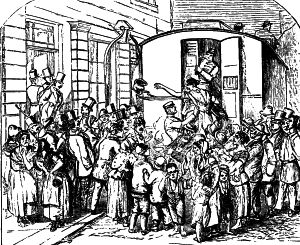
LOADING THE PRISON VAN.
A not uncommon sight in the vicinity of police offices and petty Courts, in London, is the noisy, brawling discharge of prisoners, who are turned out on the streets in the morning, after having been locked up all night for trifling offences, or disorderly conduct and intoxication.
Their unlucky companions, who have received sentences of imprisonment, are taken from the Courts to the places of confinement in which they are to pay the penalty of their indiscretion or crime. Every morning there is a dreadful row and confusion at the Bow street police office, when the prisoners are brought out to be placed in the prison wagon or "van," in which they are transported to Holloway, Milbank or Newgate prisons. A large crowd assembles daily to witness the embarkation of these poor wretches for their new residences. Fighting women, squalling children, patient policemen, and drunken blackguards are among the details of these assemblages. There is a strong able bodied virago, with her dress hanging to her form in shreds, who has just tossed her soiled bonnet madly among the crowd, with a series of shrieks, and three policemen are hardly sufficient to restrain her, while she is being helped into the "Van." At last she is locked up with other unruly personages inside of the iron door, in a dark box, where she may swear away to her heart's content for a ride of five to ten miles.
And now let us take a look at the Justice Room of the Mansion House, which is only a few rods distant from the Old Bailey.
THE MANSION HOUSE.
Be it known to all my readers that the Mansion House, or Guildhall, is to London what the City Hall is to New York—the Hotel de Ville to Paris or Brussels—and the Stadt Haus to Amsterdam. It is here that the Lord Mayor of London lives and here he deals out justice to his constituents. The Guildhall or Mansion House of London is one of the finest public buildings in the city, and has a noble gallery, dining hall, and a service of municipal gold and silver plate, which is used by the Lord Mayor on state occasions, besides a splendid collection of paintings.
But it is of the Justice Court, a small room in the Mansion House, that we have to speak on this occasion, and not of the plate, or of the Lord Mayor's annual show.
The Mansion House is just opposite the Bank of England and the Royal Exchange, in the very heart of moneyed London, Lombard street being but a very short distance around the corner, with its horde of money changers, bill discounters brokers, and bankers.
This Court is not opened before noonday, as the Lord Mayor of London is too mighty a magnate to be hurried in his daily duties for any command or Court of Justice.
Accordingly at noon, I find myself below the steps leading to the Mansion House, and presently I begin to ascend the broad staircase of stone, with a small crowd of policemen, officers of the Court, witnesses, and lawyers. I am questioned as to my business by an officer at the door, but being in company with detective Irving, of New York City (who is about to appear before the Lord Mayor, in the case of Clement Harwood, the celebrated forger, whom the former had captured at New York on board of an English steamer, before she had touched her dock, and had him brought back to London for trial), I am admitted, and after one or two turnings, find myself in a well-lighted room of moderate size, with a high ceiling and two windows looking out on the Poultry and Threadneedle street.
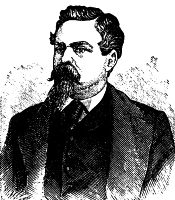
DETECTIVE IRVING.
Between those two windows is a throne or dais, gorgeous enough for a monarch, and behind the throne are emblazoned the municipal mace and sword, and the motto of the City of London, "Domine Dirige Nos," surmounted by the lion and unicorn, the arms of Great Britain. This is the Lord Mayor's Chair of Justice, but the awful being to whom it appertains has not yet made his appearance, and I have leisure to look around me.
There are two rows of desks, for the reporters, and behind them sit representatives of the Times, Daily News, Daily Telegraph, Standard, Morning Advertiser, and other leading journals, the evening papers, with the exception of the Echo, Pall Mall Gazette and Globe not being represented, the others always copying their police reports from the morning journals.
THE RICH RASCAL.
There are two or three high desks in the centre of the room, a square iron railing, and a number of police waiting to make charges, but the prisoners are kept below in the lockup and will presently appear through a trap door in the floor when they are called to answer to the charges on the sheet.
The American detective has just finished his business regarding Harwood's case, and saunters in carelessly with his hat in his hand to take a look around him.
Presently there is a bustle and commotion, and a man looking like a drum major of a band, with scarlet and gold facings on his coat, whom I am informed enjoys the dignity of Mayor's Marshal, marches into the room like a peacock, with his big staff of office, and cries out:
"Make way there, for the Right Honorable the Lud Mayor."
Then enters the awful being himself, in a furred robe of heavy cloth, like one of Rembrandt's burgomasters, a blazing gold chain depending from his neck and covering his waistcoat, and having taken his seat, the charge sheet is examined by him in a dignified way, and the first case is called.
This is the case of the forger Harwood, a young man, the son of the senior partner of one of the largest banking firms in London, who has forged his father's name for the amount of £15,000.
The trap door opens and discloses a fashionably-dressed and good-looking young fellow, with a police officer on each side. The case had excited great interest in London, and the prisoner having fled to New York was captured before the steamer got to her dock, and brought back to London. Harwood had been brought to justice because the junior member of the firm, to protect its interests, had been compelled to the unwilling task of making the charge against his partner's son.
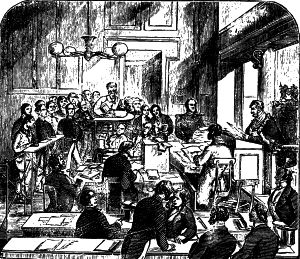
BEFORE THE "LORD MAYOR."
Harwood has the air of a languid and haughty "swell," or exquisite, and is most fashionably dressed. There is no flinching in his blonde and whiskered face as he is brought up for sentence, having been previously convicted. Out of £15,000, detective Irving recovered over £11,000 from the forger, and it seems the charge is to be hushed up. The father of the culprit is a wealthy citizen, and the counsel for the prisoner makes his point that the greater part of the money having been recovered, and the prisoner having "suffered much anguish of mind" for his crime, has offered to go to America if released, and make amends for his "fault" by leading a new and repentant life.
I looked at the exquisite, who stood there as cool as a cucumber, and it seemed to me rather doubtful that he had suffered much anguish of mind. I also doubted if he would be willing to lead a very virtuous life in America. As he stood there with his assured and rather contemptuous look and insolent face, he was quite a contrast to the pale, weak-looking lad, who stood the day before in the dock of the Old Bailey to receive with trembling lips his sentence of twelve long years penal servitude, and just as the thought struck me, Irving, the detective, whispered to me:
"He looks very sorry, don't he? Of course! Cheese things."
THE POOR RASCAL.
Then the Lord Mayor plucked up a proper spirit, threw back his furred sleeves, put on a look of profound wisdom, consulted with the prisoner's counsel, and making up his judicial mind that Harwood had "suffered enough,"—poor young man—the forger was released and set at liberty in order to allow him to become a virtuous citizen of the United States. Nothing was said about the deficit of two or three thousand pounds; the young man's family was wealthy and respectable. But who is this poor rascal at the bar now, who appears as the friends of the wealthy forger gather in a knot to congratulate him. Why it is a low ruffian of a pickpocket who has been caught in the act of abstracting a lady's reticule valued at fourteen shillings. The villain! He has no wealthy friends, so let him take eighteen months imprisonment at Hollaway prison, and there let him repent while on the treadmill.
I left the Lord Mayor's Court with mixed feelings, and the remarks of the detective failed to reassure me as to the honesty of the method of administering justice by his Worship, the Lord Mayor of London.
CHAPTER XLI.
TWO RIVALS—CANTERBURY AND ROME.
ETROPOLITAN Life has its religious phases, also. London contains about 410,000 dwelling-houses, places of business, and public buildings, and in this vast agglomeration of brick, stone, and mortar—there are about seven hundred edifices devoted to public worship. In this number are comprised places of worship for all sects: Roman Catholics, Protestants of the Established Church of England, Baptists, Presbyterians, Independents, Jews, Greeks, Moravians, Quakers, Socinians, Wesleyan-Methodists, and even Hindoos, who have a temple of their own.

There are two hundred and eighteen parishes in the Metropolis, under the jurisdiction of vestries and parochial bodies who, in turn, are subject to the Bishop of London, sitting as a temporal and spiritual peer in the House of Lords. He is Provincial Dean of Canterbury, and Dean of the Chapels Royal at Whitehall and the Savoy.
The Bishop of London ranks next to the Archbishop of York and Canterbury, and has an income of £10,000, annually, and the free gift of one hundred and nine livings, ranging in value from £2,000 to £30 a year. As Dean of Canterbury his income amounts to £2,000 a year. The clergymen of the Established Church receiving the largest salaries in the City of London, whose livings are in the gift of the Bishop of London, are those of St. Botolph, Bishopsgate, £2,290, St. Olave's, Hart street, Bloomsbury, £1,891, and St. Giles, Cripplegate, £1,580.
The smallest salary is that received by the pastor of St. Bartholomew the Less, who only gets £30 a year, although his work is far harder than that of the Dean of Westminster, who receives £4,000 a year. The salary of the Archbishop of Canterbury is £20,000, and he has half a dozen palaces throughout the country. The Archbishop of York receives about £15,000 a year, and has two Episcopal and palatial residences.
SPURGEON AND "APOCALYPSE" CUMMING.
Spurgeon, the great Baptist divine, who ranks somewhat like Henry Ward Beecher, receives a salary of $18,000 a year for his preaching, and his congregation, in 1860, erected for him a grand tabernacle at Newington, on the Surrey side of the Thames near the Elephant and Castle, and in one of the roughest districts of London, at a cost of £25,000. The design is simple; the dimensions 85 by 174 feet, and here, every Sunday evening, nearly six thousand persons assemble to listen to the vehement eloquence of Spurgeon, who has his congregation drilled like a company of infantry, and can move them to tears or laughter, as he chooses.
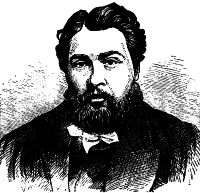
SPURGEON.
In Crown Court, Strand, is the Free Church of Scotland, a well-built and commodious edifice, where the Scottish Presbyterians attend. The pastor of this church is known all over the world by his writings and his prophetic denunciations of the coming destruction of the world, as "Apocalypse" Cumming. Thousands of pages have been written by this eminent divine, and hundreds of sermons have been preached by him, in which he has identified the Pope of Rome with the "Scarlet Woman" and the "Beast," having the mark on her forehead, yet at the call of the Ecumenical Council, he was the first Protestant divine in England, who, in a manner acknowledged the Pope's jurisdiction by writing to him for admission to the Council as a Priest or "Presbyter." Dr. Cumming is a very energetic preacher, and his services are always well attended by the disciples of his church, as well as by strangers, in London, who manifest a great desire to hear the illustrious Scotch divine.
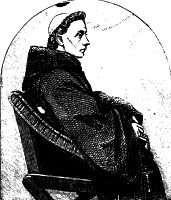
FATHER IGNATIUS.
One of the most talked-about people in London is the famous "Father Ignatius," whose design is to bring over English Episcopalians to the Roman Catholic Church, although he does not say so ostensibly. This man is evidently sincere in his efforts to bring back the English Church to the place of its departure, for the Reformation—as far as the ceremonial goes. It is very little different, that old-fashioned church of St. Mary-le-Strand—where I saw Father Ignatius officiating one Sunday afternoon, in the midst of incense, ringing of silver bells, and kneeling worshippers, who went through all the most devout genuflections of Roman Catholicism—from the Mother Church, in its ceremonial. Father Ignatius wore a vestment, with a huge cross down the back, his head was shaved on the top like that of a monk, and his face and eyes, as he descended the steps of the altar, which was surmounted with a Gothic cross, covered with flowers, and blazing with lights, had an ascetic aspect, which is not commonly seen in the features or eyes of a clergyman of the State Church. At every motion of the body he made a low reverence to the Crucifix over the altar. This Father Ignatius does not believe in a married Clergy, or in Lay or Congregational administration of a Church—in fact he does everything that a Roman Catholic Priest does, including the hearing of confessions, yet he dares not acknowledge the Supremacy of the Bishop of Rome, excepting in a negative sense. He is an advanced soldier of a large and growing party in the Church of England, who gravitate with tremendous strides daily towards the Church of Rome, but do not know that they are thus gravitating, or knowing, will not acknowledge the fact. This puny, slab-faced, and livid-looking Priest, has suffered, too, with steadiness, has been stoned and mobbed by angry crowds, yet he perseveres in his work, and has many thousand followers, male and female, among the brightest, best, bravest, and most cultivated of England's aristocracy.
THE CHURCH OF ENGLAND.
It is a strange, old-fashioned, and conservative Church, this State Church of Great Britain. It has lasted three hundred years, with its feasts and fasts, its liturgy, its prelates, spiritual peers, and Thirty-Nine Articles.
Englishmen have always, until of late days, been conservative, and this old-fashioned Church, with its grave ceremonial, its Canons, and Deaneries, with its Westminster Abbey, its St. Paul's Cathedral, and its Universities of Oxford and Cambridge, has, in every way, satisfied the English people—at any rate, it has served the purposes of the ruling classes.
But the Church of England, like all other things in this world, has received some heavy blows in the course of its existence.
First came the Great Civil War, in which Charles I lost his head, and with him the Church of England lost its revenues, and its great prestige departed when Laud ascended the scaffold.
Then came the Restoration, which brought with it a dissolute King, a dissolute nobility, and worst of all a dissolute clergy. The horse-riding, beer-drinking, and gambling parsons of the reigns of Queen Anne, William, and the Georges, such as Thackeray has so well described, in his Parson Sampson, were morally unfit to join issue, in a spiritual encounter, with such earnest, plucky, and aggressive Christians as Wesley, Whitfield, and Bunyan, proved themselves, and consequently the Established Church lost its hold on half of the working men and the agricultural classes of England toward the first decade of the Nineteenth century. In particular, the manufacturing towns lost all respect for the faith of the King and court, and such places as Manchester, Sheffield, Liverpool, and Birmingham, became strongholds of Dissent, while the pews of the rural churches, where the poor of the parishes had never been welcome, since the days of the dissolution of the monasteries, by Henry VIII, were left untenanted, and a brutal ignorance took the place of implicit faith among the English masses.
And to cap the climax, a year ago a bill was brought into Parliament for the destruction of the Established Church of Ireland, a church which never had been accepted by the Irish people, and though the English Churchmen, the Ministers, and the Tory party, rallied to save the doomed edifice, yet it was swept away in a night, despite the maneuvers of the leaders of the House of Lords, who wisely fought the bill as long as they could, believing it to be the first great blow delivered at the Established Church and the English aristocracy since Catholic Emancipation in 1829.
At present there is a terrific struggle going on in the Established Church. One half of the clergy, among whom are the best educated and most scholarly divines, secretly lean to the Catholic Church, and belong to the "Ritualistic" party, with its incense, flowers, banners, and Protestant Sisters of Mercy and Nuns; and the other half are again divided into those who doubt the inspiration of the Scriptures, and openly denounce the entire books of the Bible as a tissue of fables, with Colenso, and a third party, who having sprung from the people, and having no connection with any of the great beneficed Church families, and being incumbents of £100 livings, or less, cannot support their families or educate their children properly. This last faction is a growing one, and though less educated than the other two parties, they are equally earnest, and eagerly await the day when they can join the ranks of the Baptists, Independents, Presbyterians, Wesleyans, or Methodists, for the purpose of forming a "Liberal" or "Broad" English Church, such as Dean Stanley is supposed to represent in his theories.
ROMAN CATHOLIC STATISTICS.
In the mean time the Roman Catholic Clergy are sleepless, indefatigable, and aggressive in their movements, and as they do not hope to convert the middle classes of the English people, who are all staunch Protestants, they have laid siege to the souls of the two extreme bodies, the aristocracy and the very poor and destitute, as well as the working classes. And they are making great progress—in fact alarming progress, as I will show here.
In 1380, when England and Wales had been Catholic countries for more than seven hundred and fifty years, there were more than 14,000 parish churches, and 2,000 religious houses in the kingdom; there was one parish church to every four square miles throughout the kingdom, and one religious house to every thirty square miles; and there were 40,000 priests, monks, and friars. The whole of these churches and convents were taken away or destroyed during the Reformation; and, as I have said, when the church was at last again set free, she had to commence her work anew. In the half century since her hands were fully untied, she has built more than 1,000 churches and chapels, and something like 300 monasteries and convents, and she has over 1,700 priests ministering at her altars. If this be the work of fifty years, how much less is it, proportionately, than the work accomplished by the same church in the first seven hundred and fifty years of her life.
Therefore, the Roman Catholics, while they held supreme sway in England, built 14,000 churches, which is less than twenty in each year, while during the last fifty years they have built 1,000 churches, which is also twenty in each year; but during this period, it must be remembered that the public sentiment of Great Britain had been overwhelmingly Protestant, while in the previous period referred to, a Protestant was unknown.
And now for the social status and influence of the Romanists in England.
There are, in the first place, 33 Catholic peers, 48 Catholic baronets, and 36 Catholic members of Parliament. There are lords and lords, and one lord differeth from another in glory as one star differeth from another. It is unquestionably true that the Roman Catholic peers and baronets are the representatives of the oldest, most noble, and most influential families in the kingdom. The reigns of Edward VI, Elizabeth, James I, and William and Mary, were marked by the extinction of the greater part of the Roman Catholic houses. The nobles, who clung to the ancient faith, were slain by the axe of the executioner, driven into exile, or beggared by the confiscation of their estates, which passed into the hands of the comparatively mushroom aristocracy that sprang up upon the ruins of these illustrious families. But a few of the old nobility contrived to escape the fate of the majority.
There are in the United Kingdom 27 dukes, 32 marquises, 194 earls, 55 viscounts, and 220 barons—in all, 528 noblemen. But as I have ascertained by dint of patiently reading through Burke's peerage, 228 of these are the holders of titles which are the "creations" of the present century; 163 date back only to the eighteenth century; 89 to the seventeenth century; 17 to the sixteenth century; 20 to the fifteenth century; 3 to the fourteenth century; 4 to the thirteenth century; and 1 to the twelfth century. This last is Baron Kingsale, whose title dates from 1181, and who is the twenty-ninth of his name.
The most ancient dukedom is that of the Duke of Norfolk, created in 1483. The Norfolks, throughout all their history, remained faithful to the Roman Catholic church. The present Duke is the fifteenth of the name, and is "Earl Marshal, Premier Duke, and Earl of England." Of the three nobles whose creation dates back to the fourteenth century, two are Roman Catholics; of the twenty who date from the fifteenth century, six are of that religion; and of the seventeen who date from the sixteenth century, three are of the old faith. Out of the four hundred and eighty whose titles are less than 270 years old, only twenty-two are Catholics. And of the forty-eight Roman Catholic baronets, about half of the number are the descendants of gentlemen to whom this hereditary rank was given in the early part of the seventeenth century.
The ancient Roman Catholic hierarchy in England ended in 1584, with the death of Thomas Watson, Bishop of Lincoln, who died in prison in that year. The hierarchy was not restored until Sept. 9, 1850, when the present Pope erected it by establishing all England as the "Province of Westminster," embracing thirteen dioceses, and presided over by an Archbishop. During this interval of 266 years, the Roman Catholic Clergy in England were at first under the direction of an Archpriest.
In Scotland the hierarchy has not yet been restored. It ended with the death of the last Archbishop of Glasgow, who died in exile at Paris in 1603. Since then the Catholic Church in Scotland has been under the charge of Vicars-apostolic.
A SKETCH OF "LOTHAIR."
The greatest conquest made by the Roman Catholic clergy, of late years, is that of the young Marquis of Bute, the original of Mr. Disraeli's "Lothair," in his social and politico-religious novel of that name. This young and noble lord was born on the 12th of September, 1847, and is now in his twenty-third year. His father, the second Marquis of Bute, married Lady Maria North, eldest daughter and co-heir of George Augustus, third Earl of Guilford. This estimable lady died childless, in 1841, and the old Marquis married again in 1845, Lady Sophia-Frederica-Christina Hastings, second daughter of the first Marquis of Hastings. The young Marquis was unfortunate in losing his mother when he was in his twelfth year. Lord Bute has been a great traveler for a man of his age, and being an only child he has had the best of tutors that Europe could afford.
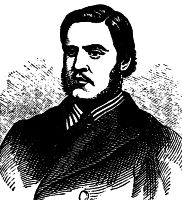
"LOTHAIR," (MARQUIS OF BUTE.)
Nearly every young lady of wealth and rank in England set her cap for the young Marquis when he attained his majority; but this nobleman is very unlike the Marquis of Waterford or the Duke of Hamilton, who by the way are distant relatives of his. He is not fond of dissipation, and since his boyish days he has been of a reflective turn of mind, with deep religious yearnings—yet withal he is not guilty of cant, and does not bore one with his religious views. He is good looking, but is not showy in his dress, and just now he is the lion of fashionable Europe from the fame which attends him everywhere as the hero of Disraeli's novel. The Marquis was reared a Presbyterian with decided Church of England leanings, and was converted one year ago, to the Roman Catholic faith through the efforts of Monsigneur Capel, who has also a niche in "Lothair," under the title of Monsigneur Catesby. He is a most accomplished ecclesiastic, who unites with a fascinating exterior the greatest ability and perseverance.
BUTE, MANNING, AND NEWMAN.
The income of the Marquis is about £380,000 annually, and he has decided to give one year's income, which is nearly two millions of dollars, toward the construction of a Catholic Cathedral at Oxford, in which all the glories of the Medieval Gothic shall be renewed. The roll of this young nobleman's titles is enough to startle an American. They are as follows: John Patrick Crichton-Stuart, Marquis of Bute, Earl of Windsor, Viscount Mountjoy in the Isle of Wight, Baron Mount-Stuart of Wortley and Baron of Cardiff Castle, Wales, in the Peerage of Great Britain. He is also Earl of Dumfries and Bute, Viscount of Ayr and Kingarth, Baron Crichton, Lord Crichton of Sanquhar, Lord Mount-Stuart of Cumbrae and Inchmarnock, and Hereditary Keeper of Rothesay Castle (formerly a Royal residence). Besides, he is a Baronet of Nova Scotia among the Blue-Noses.
Through his mother he is a Crichton, which is a royal House, and by his father he comes of the equally royal House of Stuart, and he holds the title of "Lord of the Isles." The motto of his family is "Avito viret honore." (He flourishes in an honorable ancestry.) The motto of the Hastings family, with which Lord Bute is connected, is "Trust warrants troth."
The most beautiful woman of the English nobility is Lady Victoria-Maria Louisa Hastings, who is now in her thirty-third year. This lady was a great pet of Queen Victoria, and when a child Her Royal Highness, the Duchess of Kent, the mother of the Queen, held the pretty baby in her arms as sponsor at the baptismal font, for the sake of a dear friend, Lady Victoria's mother, who was Stephanie, Duchess of Baden, and a relation of the Emperor Napoleon. The young girl grew up, and is now the wife of John Forbes-Stratford Kirwan, Esq., of Moyne, County Galway, Ireland.
The Marquis of Bute is a relation of the late Baron Stuart de Rothesay, for many years English Ambassador at Paris.
It has been variously hinted and rumored that the Marquis of Bute was at one time engaged to the Lady Albertina Hamilton, a daughter of the Duke of Abercorn, and also to a young lady of the Sutherland-Leveson-Gower family, which has for its head the Duke of Sutherland. It is said that the "Lady Corisande" of "Lothair," is none other than a daughter of the Duchess of Sutherland, the former firm friend of Mrs. Harriet Beecher Stowe.
If the Marquis of Bute was indeed a suitor for the hand of a daughter of the Duke of Abercorn, I am quite sure that he might have succeeded in his endeavor, for I believe that that worthy nobleman has been blessed with ten daughters and four stalwart sons, who can all answer to the Slogan of the Hamiltons.
The young Marquis has residences and castles, and immense domains, at Mt. Stuart; Isle of Bute, at Cardiff Castle, Glamorganshire, at Dumfries House, and he has a town house in London; besides, his name is inscribed on the registers of four London and three Parisian Clubs.
The ablest man in the English Roman Catholic Church is Archbishop Manning, who has been such a firm supporter of the Papal Infallibility in the Ecumenical Council. In due time, no doubt, this prelate will have the Cardinal's red hat conferred upon him for his services.
The greatest scholar in the Roman Catholic Church, in England, is Dr. J.H. Newman, the celebrated Oxford Tractarian, or Puseyite, who became a convert to Catholicism, with Manning, and since 1840 has devoted his brains to the service of his new Mother Church with great learning and zeal. His picture shows one of the most spiritual faces in England—it is almost weird in its nature.
There is a monument erected to a man named Dow, in St. Botolph's Church (Church of England) Aldgate, who bequeathed a sum of money to the clerk of the church, to pay him for ringing a bell at midnight, on the occasion of the execution of a criminal at Newgate. This was to call the attention of the condemned man to his soul.
It was this same Robert Dow who left, by will, in the year 1612, the sum of £1 6s. 8d., annually, as a fee to the Sexton of St. Sepulchres, which is just opposite Newgate Prison, for pronouncing two solemn exhortations to condemned criminals on the night preceding and on the morning of their execution, as they passed the church-door on their way to Tyburn-Tree.
CHAPTER XLII.
THE LEGION OF THE LOST.
ERY different estimates have been made as to the extent of the Social Evil in London, but that made some fifteen months ago by the Right Reverend Dr. Wilberforce, Bishop of Oxford, from facts and figures furnished him by medical men, the police returns, and the minor clergy, places the number of abandoned or public women in London, at the startling aggregate of eighty thousand unfortunates.

This estimate of Vice and Sin is certainly calculated to intimidate and terrify the Christian people of England, were it not for the fact that a hundred agencies are constantly at work, upheld and supported by good men and women, to lessen the number of these fair and frail members of the Legion of the Lost.
The great parade ground of the abandoned women of London, is the Haymarket, when all London is at rest—when bed-room blinds are drawn down, and street doors locked and chained—when lights are rarely seen but in the windows of the sick wards of hospitals—then the Haymarket is in its glory, gay and lively as a ball-room, and swarming with gaudily dressed women sauntering and flaunting up and down its broad pavements, crowding them as on an illumination night. The dissolute and idle, the debauchee and the debauched, pour into this market of sin, this Exchange of Vice and Harlotry, like moths attracted by the glare that must sooner or later utterly destroy them. This street is always at night full of cabs, drunken men, noisy women, jugglers, and thieves.
The Haymarket is the Republic of Vice, where all who enter are hale fellows well met, for every one knows why the other has come here, and caution being cast off for the time, all ranks and stations mingle.
"SCOTT'S" IN THE HAYMARKET.
Outside the tavern doors are gathered clusters of swells talking to the poor souls, who, disguised by some flash dressmaker, have hidden the figure of the servant-maid under the toilette of the mistress. The heir to a title stands bowing to some pretty faced girl, who mixes her bad grammar with oaths. The door of a public house swings back to let the hope of a family enter, who is about to sip wine at the counter with the chip bonnet at his side.
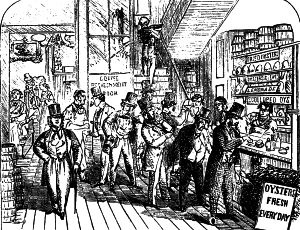
"SCOTT'S" IN THE HAYMARKET.
Let us enter "Scott's" in the Haymarket. "Scott's" is the great Oyster House of London. It is a little cosy, crowded place, and not more than fifty feet deep by half as many feet in width. At any hour of the night and until two o'clock in the morning, it is possible to get oysters, fried, roasted or raw, at "Scott's." They are also cooked with cracker dust, which makes them taste as if they had been broiled in sawdust. Oysters are quite dear at "Scott's," and will cost three shillings a dozen, raw, which is a very high rate when compared with the price of our American oysters. They are small and bitter, and black, and the best of the bivalves come from Ostend in Belgium.
There is a counter at the front of the shop, and behind this counter are exposed all kinds of shell-fish, lobsters, prawns, crabs, periwinkles or "winkles," and oysters, as well as mussels. The bounding clam is unknown in England, however, and is not found amongst the edibles. Behind this counter the proprietor and his wife, and three or four male assistants in white aprons, are busily engaged opening oysters and serving up lobsters and dressed lettuce, to the customers who prefer to eat standing. To eat standing, however, is not the common custom in England, and the majority who wish to eat oysters take seats in the little stalls behind in the back room, which are exactly like our American oyster stalls, only that they are furnished with plush cushions. In these stalls are clerks, swells, men about town, Englishmen and foreigners, eating oysters and drinking Stout, or supping on lobsters and champagne, and as it is now after eleven o'clock, nearly every man in these stalls has a girl of a certain class with him, who is of course eating supper at his expense.
Upstairs there is a room somewhat similar to the one below, which is now densely crowded; but the upper room is more select. I went upstairs, and here I found a number of couples lounging in a free and easy manner, and some were calling loudly upon the waiters for brandy and water. Seated in one of these stalls is a pink-faced boy, fresh from his country home, helping with delicate attention the painted woman beside him to costly viands.
She laughs noisily as a man, flinging her arms about, and as the Champagne foams in her glass, she tosses her head like a Bacchante. But an action that by daylight would seem disgusting to the boy, is charming in the blaze of the Haymarket gaslight, and the lad looks with admiration upon the companion whom on the morrow he would pass without a nod of recognition.
The police returns for the year 1868-9, give the following figures as to the number of public women, or prostitutes, who are known to the police in the metropolitan district of London:
Brothels. Prostitutes.
Within the districts of Westminster, Brompton, and Pimlico, there are, 153 524
St. James, Regent-street, Soho, Leicester-square, 152 318
Marylebone, Paddington, St. John's-wood, 139 526
Oxford-street, Portland-place, New-road, Gray's-inn-lane, 194 546
Covent-garden, Drury-lane, St. Giles's, 45 480
Clerkenwell, Pentonwell, City-road, Shoreditch, 152 349
Spitalfields, Houndsditch, Whitechapel, Ratcliff, 471 1,803
Bethnal-green, Mile-end, Shadwell to Blackwall, 419 965
Lambeth, Blackfriars, Waterloo-road, 377 802
Southwark, Bermondsey, Rotherhithe, 178 667
Islington, Hackney, Homerton, 185 445
Camberwell, Walworth, Peckham, 65 228
Deptford and Greenwich, 148 401
Kilburn, Portland, Kentish, and Camden Towns 88 231
Kensington, Hammersmith, Fulham, 12 106
Waltham-green, Chelsea, Cremorne, 47 209
—— ——
2,825 8,600
For the one public woman here registered there are five who do not reside in brothels, but live alone, hiring lodgings for which they pay from eight shillings to five guineas a week, according to the manner in which the apartments are furnished, and the character of the neighborhood in which they are situated, so that it is calculated that there are seventy to eighty thousand women in London whose names do not appear in the official list of the Lost, yet lead immoral lives, and whose sin is as great in the sight of God, but less in the sight of man, as their infamy is not of that nature that the law can punish them for it.
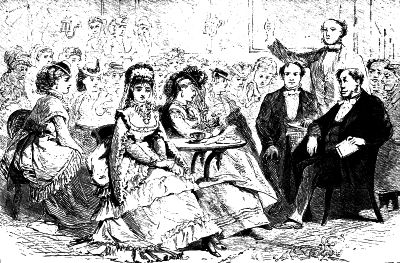
THE MIDNIGHT MISSION.
God knows it is from no persistent desire to uncover the sores and ulcers of the huge city, that I state these facts.
Great and unceasing efforts are being made by the clergy and philanthropic citizens of London to diminish this terrible Traffic in Souls, which is the distinguishing mark of infamy that clings to the Haymarket.
"MIDNIGHT MISSION."
For some years past these unfortunate women have been collected together while plying their avocation, in an apartment in the vicinity of the Haymarket, in which some slight refreshments are prepared for them, ices and cooling but temperate drinks being served up gratis to all who will attend and listen to the words of repentance and hope from the mouths of clergymen who visit this place nightly for the purpose of reclaiming these Lost Ones. This is called the "Midnight Mission," or "Meeting," and the girls are gathered by having circulars presented to them in the street as the hour nears midnight. A great number attend, and they generally listen with patience and decorum. This Mission was founded by the Hon. and Rev. Baptist Noel, who first preached to the unfortunate girls.
A high officer of the London police informed me that there were in that city about seven thousand lost women who are always well dressed, well gloved, and well shod, who live comfortably, and many of them elegantly. These women, of course, are all Free Lances, and prey upon the fashionable young men of London and strangers who visit the great Babylon.
Of this number, he stated that three thousand five hundred were what is called under protection, or kept mistresses. The remainder have hired lodgings for themselves in Pimlico, Fitzroy square, Portman street, Howard street, Winchester street, Sutherland street, Gloucester street, and other respectable localities of the metropolis, paying two or three sovereigns a week for a suite of apartments, and furnishing them at their own expense. This latter class, as a general thing, live individually apart from each other, and keep each a servant of all work, to do their cooking and washing.
Some of these girls have furnished their apartments at a cost of from two to five hundred pounds, ordering the most costly articles of furniture with the extravagance and profusion peculiar to their class. Pictures, etageres, buffets, mirrors, ormolu clocks, tapestry carpets, and the most luxurious articles of bijouterie and the toilet are to be found in their apartments; and, unlike their frail sisters in New York and Paris, these London girls act with complete independence of their landladies, who in the cities mentioned, as a rule, treat the unfortunate women placed in their power more like dogs than human beings. In London, these girls are in the strictest sense their own mistresses, and therefore do not come under any police regulations; nor can they receive the designation of professionals, as they never solicit men on the street, or live in what is called a house of ill-fame. The persons who rent apartments to these girls in the districts which I have thus enumerated, are not supposed to know anything about the occupation or business of tenants, and they never, by any possibility, attempt to interfere with them.
One of the most frequented resorts of Lost Women in London is the Cremorne Gardens at Chelsea, on the Thames river bank, and distant about four miles from the Post Office and St. Paul's Cathedral.
These Gardens comprise about four acres, which are covered with trees, and ornamented with fountains, flower-beds, and statues. This is the maddest place in London, after ten o'clock in the evening. Until that hour, the middle class of London citizens, shopkeepers, tradesmen, and clerks, and their wives and sweethearts, have possession of the Gardens; but at that hour they leave the place, and from thence until one and two o'clock in the morning Cremorne is in the possession of Lost Women and their male friends and abettors.
The Cremorne is in many respects very like the Mabille at Paris, but decency is better enforced, and the women at Cremorne have not such a debased look as their unfortunate sisters of the Mabille.
At Cremorne there is a circular platform on which a band of music is constantly stationed during the evening, and here the dancing is principally done. Between the dances the girls promenade, or take supper with their male friends in the numerous restaurants, which are always crowded to excess by noisy people of both sexes, drinking Champagne and Moselle, or eating lobster or devilled kidneys. Cold suppers are provided for the girls in an upper saloon, for which they are charged two shillings and sixpence a piece, without wine. Then there are fireworks, two or three theatres and music halls, Japanese jugglers, bowling alleys, shooting galleries, and other modes of diversion and amusement.
Swarms of young fashionables from the Opera, where they have been listening to the enchanting strains of a Tietjens, a Nillson, or a Patti, in evening dress with thin overcoats, may be seen here of a warm night, or perhaps they may have come from the clubs in St. James or Piccadilly, to kill time.
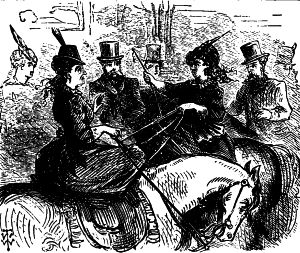
"SKITTLES" AND THE PRINCESS MARY.
"SKITTLES" AND THE PRINCESS MARY.
"Skittles," now dead, who was at one time the most famous woman of her class in London, was very fond of attending Cremorne, where she was in the habit of drinking large quantities of Champagne. "Skittles" was at one time a great personage in London, and bore on her brougham the crest of a Marquis. This audacious woman had the temerity to dispute the way with the Princess Mary of Cambridge, while that member of the Royal family was riding in Rotten Row. "Skittles" was on horseback, being in full riding dress, and the Princess Mary was also on horseback, when they met, and it is said that "Skittles" lifted her dainty little riding whip at the astonished Princess, and demanded that she should give her precedence in the Ride.
Cremorne is a great place for rows between the women and the fast young men who attend the amusements there. While promenading around the Dancing Ring one evening, I noticed a crowd gathering, and heard a female voice uttering screams of distress. The young lady with the unearthly voice I ascertained was a habitue of the place, known as "Mad Rose," and the offending biped was a certain fast baronet named Sir Frederick Johnstone, who has since figured in the Mordaunt Divorce Suit.
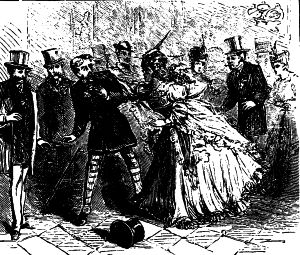
A ROW AT CREMORNE.
It seems that this "Mad Rose" had been at one time under the baronet's protection, and the afternoon before the rencontre he had met her in the Park, and passed her without recognition, although she sought it from him. She was determined to have her revenge for this, besides some old scores she had to settle with him; or it was that he had not settled some old scores with her.
The girl was tall, elegantly shaped, and dressed in a tasteful and rich manner, becoming her blonde hair and complexion. Seeing the baronet with his friends, she stepped up to him, and singling him out, struck him across the face with her gloved hand, which was glittering with diamonds.
A ROW AT CREMORNE.
Then she uttered a scream of feminine distress, and a crowd of swells gathered around her. Then she knocked off his hat and screamed again. The baronet uttered no remonstrance, but backed up against a railing, his hat lying on the ground. Attempting to pick it up, she knocked it off again and screamed. This thing went on for the space of ten minutes, the girl, in a passion—whether fictitious or not, I cannot tell—slapping the exquisite in the face at intervals, knocking off his hat and screaming, but not forgetting to pour volleys of abuse upon the baronet's head in the meanwhile. A great crowd collected and enjoyed the fun. But I noticed that not a man in the assemblage offered to interfere, and the baronet's friends refused to molest her, with the exception of one, who caught hold of her wrists, and he had to let go his hold of her in an instant, as he was attacked in a body by the other girls, who put him to flight immediately. The baronet begged for mercy, but got none; and, finally, a grand charge was made on the crowd by the Cremorne police, and it was dispersed.
This movement relieved the baronet from further persecution, and the mad woman was taken away. One fact was noticeable—not a man in the crowd even attempted to raise his hand to the girl during her repeated assaults. Had it been in America, I am certain she would, under such circumstances, have met with very rough, if not brutal treatment.
CHAPTER XLIII.
SCARLET WOMEN.
E were standing on the smooth, grassy lawn, at Goodwood, a wandering American and the writer, strangers in a strange land, with the bustle and uproar which are always adjuncts to a Race Course in any country, and the Babel exclamations of a multitudinous assemblage sounding in our ears.

GOODWOOD RACES.
It was the first day of the annual races, which are run for three days in every year, at Goodwood, the princely residence and grounds of the Duke of Richmond. This is the most aristocratic race meeting held in England, and it is always frequented by the nobles and people of high social position, with their wives, daughters, and lady friends.
The meeting is divided into three separate days running, each day having a distinctive title, and known to those familiar with equine sport, as the "Stakes Day," the "Cup Day," and the "Duke's Plate Day."
It was a beautiful and unclouded English July noon, and the smell of the hawthorn hedges, and the faint breath of the hollyhocks made a perfume in the air, which banished all humors and sulkiness from the crowds of well dressed and well bred people who had been waiting to hear the saddling bell rung before the start. Lithe and sinewy little jockeys, clad in parti-colored silk shirts, and wearing kaleidoscopic caps of the same material, walked the fresh-looking, silken-maned, and symmetrical-limbed horses, up and down the velvety green sward, to give the high bred English girls an opportunity to inspect their favorites, whose colors predominated in the shades of their gloves, parasols, and gracefully-hung robes, which rustled around their supple and elegant figures.
Under high, sheltering greenwood trees, cosy seats were arranged for the ladies, who made the Lawn picturesque with their bright colored dresses that shone with splendor as their owners gathered in brilliant patches on the velvety turf, gossiping and chatting while Guardsmen, and Clubmen, Heavy Swells, and noisy boys, from Eton and Harrow, gamboled and shouted as if at cricket, and sedate gownsmen from Cambridge, and Double Firsts, and Wranglers, from Oxford, made wagers, and drew from their coat-pockets small betting books to record the sums invested.
The Embankment, a high, long, and well-kept mound of grass-covered earth, was swarming with the fair sex, all of whom had their swan-like necks encircled with white lace ruffs, which serve so well as a setting for a well-shaped and milk-white throat.
Afar off we could observe, through yawning gaps in the ancient and stately trees, which were pierced by the ruddy beams of sunlight, the tall towers and fair proportions of Goodwood House, the magnificent mansion of the Duke of Richmond. Twenty to twenty-five thousand people were gathered in the noble old Park whose vistas stretched off into dells, copses, and woodland nooks, for thousands of acres.
Here were gathered all the well-known aristocratic patrons of the turf in England, men who would hardly be seen at Newmarket or Epsom, and here again were the racing men, whose names are met with everywhere in England, where the warning bell is rung to saddle, and where thousands may be lost and won in an hour—the Westmorelands, the Savilles, Chaplins, Anneslies, Prince Soltykoff, Count de Lagrange, who owned "Gladiateur," Lord Vivian, Sir Frederick Johnstone, Lord Roseberry, Sir Joseph Hawley, Admiral Rous, Captain Hall, Lord Wilton, Lord St. Vincent, Lord Ailesbury, Sir C. Legard, Baron Rothschild, the Duke of Beaufort, Mr. W.S. Crawfurd, Lord Poulett, Lord Falmouth, Lord Calthorpe, Mr. E. Brayley, Lord Strafford, Mr. Bromsgrove, and many others, titled and untitled, who are leaders among the racing aristocracy. The Marquis of Hastings, and the Duke of Newcastle, that day, were absent—the first in his grave, the other beggared by his extravagance, and an outcast among his peers.
As the day grew apace, the swarms of people became more densely packed until all classes of the sporting multitude were represented. There was the "Welcher," who makes bets and does not pay when he loses, a low-sized, stumpy fellow, in cutaway frock coat and drab beaver hat, a huge horse's head pin sticking out of his gaudy, blue scarf, which is dotted with small white balls, and wearing a shaggy moustache, which he twists with the head of his cane, that has for a knob a nag's head, in bone-work.
Yonder, stopping to ask for a noggin of gin from one of the proprietors of the numerous ginger beer and refreshment stands, is the London prize fighter—a model, in his way—thick set, broad in the loins, and having a murderous forehead and a battered face, from some recent encounter, one of those dangerous-looking, suspicious fellows, whom you may meet with any night wandering about the docks in Wapping, or lounging at the notched doorway of a tavern in Shoreditch, or Whitechapel.
Sauntering this way, where I stand in a shady spot with my American friend, are two "heavy swells," dressed in the height of fashion, and mincing their vowels in a feminine manner; yet effeminate as their language sounds, they are both massive-looking fellows, and now I recollect having seen both leaning out of the bow window of the Guard's Club, in Pall Mall, and one of the pair I have also noticed trooping his company at St. James' Palace, at the unusually early hour—for him—of nine o'clock, of a summer's morning.
Men are gambling, and singing, and eating, and drinking, and betting shillings and sovereigns all around us, and my companion seems stunned by the noise and uproar which rises and swells in an indistinct way this hot July day, as we move from place to place seeking a quiet nook where we may commune together.
ENGLISH MINSTRELSY.
There is suddenly a discordant hum and a party of strolling minstrels halt before a carriage and commence to serenade the fair lady listeners, who fling sixpences to them languidly. These minstrels have their faces blacked, and are appareled in hideous check coats with very small bodies, and have very large buttons sewed to the skirts, which are ornamented with ridiculously long tails. The songs generally sung by those wretched minstrels, are slangy, and sound senseless to an American's ear, as witness the following stanza which they chant with wide-mouthed refrain:—
"Button up your waistcoat, button up your shoes, Have another liquor and throw away the blues, Be like me and good for a spree, From now till the day is dawning. For I am a member of the Rollicking Rams, Come and be a member of the Rollicking Rams, The only boys to make a noise, From now till the day is dawning."
The course was lined and packed with every known manner of vehicle and equipage. There were drags, four-in-hands, dog-carts, landaus, tandem teams, ladies' pony chaises, phætons, carryalls, clarences, broughams, and open barouches. Many of the turn-outs were adorned with the crests of noble families, and some few bore the princely cognizances of great Continental houses.
One of these large, roomy, and handsomely-constructed, open barouches, drawn by four grey horses, served as a focus for many glances drawn toward it. Some of the glances bestowed on the female occupants of the handsome barouche were very unfriendly—and when some proud patrician girl rode by, her eyes shot fire at the borrowed splendor of the three Scarlet Women, who reclined lazily upon the softly-cushioned seats, and no less hostile were the glances thrown on the graceful wavy figure of the handsome girl who sat her thoroughbred and silken-eared and shapely chestnut bay mare by the side of the barouche, and who bent over like a reed to chat with the principal female figure leaning back on the cushions.
I looked at these four gaily dressed, handsome women, with their loud chatty manners, their indescribably bold flashes of the eye, their familiar and free conversation with the titled fools and giddy young lordlings, and baronets and rich young commoners, and as I looked I saw that these four women represented the Great Social Plague Spot of England. While I looked, a police inspector, from London, who had come down to this ordinarily quiet, Sussex town, to keep an eye on some distinguished pickpockets who were to attend the races, sauntered to where I stood with my friend, and as I had made his acquaintance in the English capital he was not long in informing me as to the character of the magnificently attired women.
"They are the four gayest women in England, Sir," said he, "Those four ladies—we call them ladies because we dare not call them anything else, they have so many protectors of rank and influence—are "Mabel Grey," "Anonyma," "Baby Hamilton," and "Alice Gordon."
"Mabel Gray?" said my friend enquiringly, "I think I've heard of her before—which is she?"
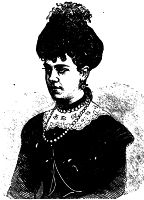
"MABEL GREY."
"That's her, Sir, as is sitting back in the front seat with a plate of chicken on her lap, with the golden butterflies in her lace bonnet, and the splendid diamond cross hanging from her neck—that's the gal with the blue eyes and auburn hair. The gal that's holding the long necked green glass for that swell to pour champagne into it, is "Baby Hamilton"—ah, she is a wild one—many's the thousand pounds the young Jook of Hamilton squandered on her, and so did the poor Marquis of Hastings, poor fellow—wuss for him. The finest looking gal of all is that "Anonyma" gal as some of these fellows that has book eddication has called her—they say it means "No Name," but I know she has a name, for it used to be Kate Bellingham when she came to London first. Oh, she's a high blooded one—just look at how she sits that chestnut mare—I'll warrant you that mare would bring six hundred guineas at Tattersall's—if she'd bring a pound—ye won't ketch her drinking in public, she's too proud of herself to do that—no, Sir, she wouldn't be seen taking a drink from the Prince of Wales himself at a public place like the Race Course. Now there's Alice Gordon," added the police officer, who began to grow loquacious in his description of these fair but frail and giddy beauties, "she's a quiet, orderly, young creature, and as pretty as a peach, poor little thing—God help her—she never knew a mother's care, and she was lost for want of a kind word and a loving heart to guide her young steps."
"THEY ARE OFF."
Now the saddling bell has rung amid the greatest excitement, and the multitude who have been flirting, eating, and drinking, betting, and playing at divers games of chance, become suddenly hushed, and a great quiet comes over the populated fields, stands, and tents, as the jockeys ride forth to the starting point, five famous horses held in the leash and straining their necks with avidity and equine eagerness for the race. The ladies of the demi-monde settled themselves well forward in their seats. "Anonyma" swept by on her chestnut to get a good position for a look at the horses. "Mabel Grey" allowed her knife and fork, which she had been using on the unoffending chicken, to fall into her plate, and the tangled curls of "Baby Hamilton" reclined on her shoulders as a fool of a Guardsman gave her his arm to assist her to stand up in the drag, and handed her his glass to sweep the field. The stately looking footman who is bustling among the dishes and wine bottles, assisting "Anonyma's" butler in preparation for the coming feast, stops in his occupation to listen to the thundering roar of the crowd, and to look at the gallant animals as they come forward to the stand. The butler, who is a grave and elderly personage, receives his orders from "Anonyma," with dignity, and he is lost to sight among the game-hampers and the champagne bottles, and Moselle flasks, for a moment.
Listen to that cheer and long-continued shout! They are off, they are off; and the whole vast swarm of human beings is aroused. The ladies clap their hands and utter weak sounds of joy or distress, and the cadgers, tramps, and more polished pickpockets, are now beginning to reap their harvest in the midst of the excitement and momentary frenzy.
The race is a two-mile stretch, and only five horses are entered. The prize is the Goodwood Cup, valued at three hundred sovereigns.
Two of the horses entered are four-year-olds, and the others are three-year-olds. The great Jewish banker and member of Parliament, Baron Rothschild, has entered "Restitution," a four year old, who is ridden by Daley, an Irish jockey of fame. Sir Frederick Johnstone's entry is "Brigantine," a three year old. Mr. Saville's "Blueskin," Lord Calthorpe's "Robespierre," and Lord Strafford's "Rupert," make up the number of horses who have darted by the Grand Stand in the storm of wild huzzas.
"ANONYMA."
"Anonyma," whose chestnut was pawing the turf in a frisky manner, grips the bridle of the blooded mare, and pulls hardily at her mouth. A number of roughs around a booth salute her with not very choice language, for she is known at the races, and the blood mantles in her cheek and the crimson tide surges up to her temples as a coarse blackguard repeats an opprobious epithet, and before he can draw back she lays his cheek open with her dainty riding-whip, and giving the mare more rope, the crowd opens wide for her with a cheer, and she dashes across the Course on a canter, just as the Rothschild's jockey, with his head bent down to the mane of "Restitution," and his silken cap flying in the hot wind, sweeps by, "Blueskin" following fast, and the great banker's jockey swerving aside from his course, wins, by a miracle; "Restitution" having been for a moment blinded by the long skirts of "Anonyma," in her mad canter across the turf, and now there is a huzza, and a rending, wild hurricane of applause, as Rothschild's colors go forward to the Weighing Stand, and "Restitution" is pronounced winner of the Goodwood Cup of 1869, "Robespierre" being a bad fourth, and "Rupert" coming in last of the field.
Now the principal race of the day is ended, and great acclaim having been given to the victor, the crowds disintegrate and separate into little knots for refreshments, and hard-faced fellows, in flashy costumes, may be seen pulling from capacious pockets, greasy wallets, to settle their debts of "honor," and much beer is drank among the humble people, and floods of costly wines are poured out in drags and dog-carts, and bright eyes and smiling lips meet one everywhere, and there is a clatter of knives and forks, and a popping of corks in the vicinity of the carriages occupied by the Scarlet Women of London, who are here to-day in swarms, and who are caressed and welcomed as if their position was assured and the dark shadow of a Shameful Life had not fallen upon them.
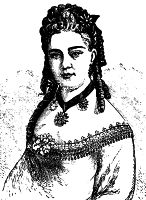
"ANONYMA."
Leaning over the side of the drag, and talking to Mabel Grey, are three of the "fastest" young men in England, Lord Arthur Pelham Clinton (since dead), Courtenay, Earl of Devon, and the Duke of Newcastle, brother to Lord Arthur. All three are bankrupt in fortune as well as in morality. Lord Arthur's mother, a daughter of the former Duke of Hamilton, dishonored her husband, and there seems to be a taint in the blood of the young noble, who has been living on his wits for years. He is a languid-looking fellow, and does not look as if he could fall-to and saw a load of wood.
Mabel Grey says to Lord Arthur, with a lisp: "Clinton, do take a bit of chicken and a glass of fizz. No? Well then, take a glass of hock, like a dear good boy. You look awfully cut. What can be the matter with the man?"
Just under the shadow of the wide-spreading beech-tree, where the drag is stationed, an itinerant preacher is about to commence a phillipic against Vice and Crime. He could not have chosen a better location than this, where the ears of these Painted Women may be filled by him with some truths that they seldom seek after.

"ALICE GORDON."
"Alice Gordon," the fair-haired blonde, with the deep blue eyes, condescends to bestow a glance at the preacher, who, now that he is beginning to draw a crowd by his fiery invective, and denunciatory language, directs a look of scorn and pity at the Lost Women in the drag. The crowd, who naturally dislike women of the class of Lais and Aspasia, give encouragement to the squat-figured and harshly-spoken Boanerges. The swells around the drag, who are now joined by Sir Frederick Johnstone, advise the Scarlet Women to tell the coachman to whip up the horses and "dwive the dwag away from that beastly preacher—the howid little boah."
The preacher thunders at them, "Go, you gaudy libertines, with your harlots and your women of Sodom, England is cursed with such as you. But God will punish you all, and will smite you in your hour of pride. For what says the Book, whose pages you never open:
"The ungodly are forward, even from their mother's womb; as soon as they are born they go astray, and speak lies.
"They are venomous as the poison of a serpent, even like the deaf adder, that stoppeth her ears.
"Break their teeth, O God, in their mouths; smite the jaw-bones of the Lions, O Lord; let them fall away like water that runneth apace; and when they shoot their arrows let them be rooted out."
"Baby Hamilton," one of the women in the drag, shudders at these Inspired Words and grows pale, while "Anonyma," who canters up easily on her chestnut, asks Sir Frederick Johnstone:
"Did you pull off a pot of money on "Brigantine," Sir Frederick?"
"No, the doose of it was I lost two thousand on my own horse. But I hedged and took 'Restitution' against the field, so I am not so badly plucked."
And this is the entertainment and conversation of some of the hereditary rulers of England. Pardon me, reader, if I have brought you into such loose and unprincipled company. I did it to show you who are the female companions of a majority of the young English nobility. It is this class of young men who patronise these Social Pariahs, and look with contempt upon the manners of a respectable girl, and vote the conversation of virtuous women as a bore.
"MABEL GREY."
That woman with the sunny smile, laying back in the drag, toying with her fan—Mabel Grey—was, five years ago, a wretchedly-paid working girl, who eked out an existence as a shoe-binder, in a shop in Oxford street, London, on a pittance of seven shillings a week. Now, the diamonds on her fingers would purchase a comfortable villa, and around her throat, which is white as alabaster, is a necklace of pearls, that cost the Prince of Wales five thousand pounds, it is said. She rides every day in Rotten Row, the famous ride and fashionable drive in Hyde Park, and her skirts often touch the garments of the Princess of Wales as they pass each other in the crowded Row. And certainly the Princess has no reason to look pleasantly at Mabel Grey. Mother to five children, and daughter of the Vikings, with clear, unsullied Norse blood in her veins, she may well question herself, when alone, "Why did I marry a profligate and blackguard?"
Mabel Grey is the original of Boucicault's "Formosa," and it was she who gave a name to Dan Godfrey's famous "Mabel Waltz." Godfrey is the leader of the Guard's band, and the musician thought that it would be received as a delicate compliment by his aristocratic patrons, to call a delicious piece of dance music by the Christian name of the chief of England's Hetairæ.
In every shop-window the features of Mabel Grey are flaunted at one along with the portraits of Nillson, Patti, the Queen, the Princess of Wales, and other virtuous and good women. You may meet her and "Anonyma" at the Opera, at the Chiswick Flower Show, at Kensington Gardens, and other fashionable resorts, mingling unrebuked among the noblest ladies in the land. She has a sumptous villa at St. John's Wood, Brompton, a suburb of London, and in her stables are constantly kept twelve to fifteen blooded animals for the saddle or for driving—these horses being the gifts of her numerous aristocratic admirers. She dines off dishes of silver and gold, and has a host of servants. At Ascot she induced the Prince of Wales to bet on a certain horse, whereby he lost the nice little sum of $100,000, or £20,000.
And it is this bold, brazen, and bad woman, who divides the heart of the Prince of Wales with the Princess Alexandra, his lawful wife and the mother of his children, the other half being owned by Mabel Grey, together with his pocket-book, which he is most apt to keep closed to all others.
She was the cause of the ruin of Captain Milbanke, of the Guards—a distant relation of the deceased wife of Lord Byron, I believe—and she has destroyed dozens of young men in their fortunes, social position, and masculine character.
"MABEL GREY AT HOME."
And here, I suppose, I may be pardoned for giving a pen and ink description of the interior of her palatial residence at St. John's Wood, Brompton, where she resides, by one who saw and conversed with her there:
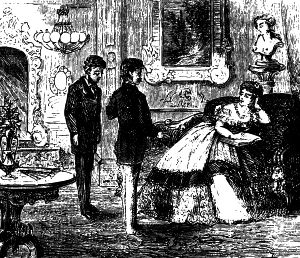
"MABEL GREY AT HOME."
The salon was about sixty feet long by thirty wide, and the ceiling was probably fifteen feet from the velvet carpet. Velvet decorated the walls, hanging in crimson folds somewhat like the arras hangings that I had seen in some of the mildewed chateaux of the French nobles. There was, in the front of the salon, an immense mirror framed in gold, and inside of the golden frame was a sub-frame of crimson velvet. The lounges, chairs, ottomans, and buffets, were trimmed with velvet of the same warm color. The carpet on the floor was a Gobelin, in which was worked a pictured design of the port of Marseilles, at a cost of two thousand pounds. There were richly carved statues of Parian, bronzes, antique and richly-painted vases, shells standing on golden tripods, caricatures of dogs' heads, tigers' heads, and the bodies of serpents, with glistening eyes—all of which articles had more or less of the precious metals in their composition. Pictures of Diana of Poictiers, Margaruite de Valois, Theroigne de Mericourt, Anna Boleyn, Louisa de Valliere, and a supposed mistress of John Wilkes Booth, of whom I had never before heard, adorned the walls of the salon.
These were all done in oil, well painted, and magnificently framed. The place of honor, however, was reserved for Ninon de l'Enclos, the mistress of one of the Bourbon Kings. This picture was a beautiful work of art, and represented the famous beauty of the old French Court, reclining opposite a mirror. There was a small figure piece by Meissonier, and a statue of Minerva of pure marble, from whose spear head depended a small but richly chased gas-chandelier, of six burners, that spread a flood of light all over the salon. A hundred thousand dollars would not have purchased the furniture, carpets, statues, paintings, and ornaments, in this gorgeous apartment, to say nothing of the diamonds which covered the neck and arms of the beautiful but frail mistress of the mansion.
And now for Mabel herself. This distinguished personage, as she lounged on the tiger-skin, looked to me a little above the medium height of women; her hair, of a rich, silky brown, full and lustrous, was looped in coils at the top of the back of her head a la Grecque, and was trimmed with small red flowers. From her ears were pendant long, oval, diamond ear-rings, and from her snowy neck was hung a necklace, of pearl shells interwoven with diamonds, worth a monarch's ransom. Her arms were bare and rounded, and her shoulders were decollete. She was attired in a loosely flowing robe of pink velvet—the only thing pink I saw in the apartment—and at her waist was a plain thin cincture of gold. She wore her dress without hoops, which allowed the folds of her costly robe to fall over her shapely limbs in studied yet artistic confusion. On the different fingers of both hands were rings of topaz, sapphire, ruby, emerald, amethyst, and opal, fastened by golden keepers. She had crimson slippers, embroidered in gold, and in her right hand she waved lazily, to and fro, a fan of costly feathers. The woman herself was a magnificent animal to look at, with a spice of the tiger shining out of her clear, lustrous eyes.
PERSONNEL.
The neck was well poised and finely cut, as were the face and shoulders. The mouth was large and full of good, white, regular teeth, which she displayed often during the conversation to advantage. The nose was irregular, pert, and snubbish, and her chin was like the cone of a ripe peach. Something there was brazen in this woman's face, despite the magnificence reigning in the apartment. Her voice was loud and sharp, and her gestures were unladylike, though she endeavored to atone for these defects by a studied ease which occasionally lapsed into a masculine freedom. She was continually showing her rings, her fan, and her slippers—and seemed careless of the little prudential details that go to make up the manner of a virtuous woman.
"Anonyma" is, in many respects, a different woman from Mabel Grey. This celebrated Lorette, unlike her frail sisters, has a taste, or perhaps affects to have a taste, for literature. Originally a clergyman's daughter, and born and bred in Sussex, she had, when she came first to London, all the charms of a fresh country girl, and, although exposed for a long time to temptation in her station as a governess in the family of a rich commoner, whose name is now often before the public, she held on her way firmly as she could, and would have succeeded had not she met a man who outraged her by a false or mock marriage.
The poor girl, whose real name is Brandling, when she found that she was deserted with a few pounds in her pocket, went almost mad. But she had to starve or else become what she is now. Her father, overworked in his curacy at £150 a year, and having a family of five children, refused to admit her to his home, and gave as a reason that it would be setting a bad example to his parishioners, which he, as a minister of the Gospel could not do. Driven from her birthplace, with despair in her heart, she fled to London, and, sinking at once into the slough of iniquity, was not heard of for a year, when she emerged in grandeur at the opera in the company of a wealthy banker, who has since failed and fled the country.
The girl, from her reticent disposition, her lady-like manner, and the mystery attending her appearance in the world—no one being able to tell her exact position—received the name of "Anonyma" from the Saturday Review. Unlike the other women of her sex, this girl was never formerly seen in the company of any woman whose position was affected by the slightest breath of reproach. In the Park she never made acquaintances, and all notes sent to her were sent back to the writers. To become acquainted with "Anonyma," though the seeker after her intimacy were a prince, it was necessary to have a formal introduction to the lady.
The "Kitten" is a young lady well known at the Cremorne Gardens for her expensive suppers, loud voice, and magnificent pony carriage, before which she drives sometimes a brace of Shetland ponies, three in a tandem. At the Cremorne she always puts ice-cream in her champagne, and never drinks any light or thin wines, as she says that they do not agree with her constitution. I saw her at the Ascot Races in company with Mabel Grey, the "Kitten" being mounted on a splendid roan, which she managed with the skill of an old army officer, and a dozen men belonging to the best known clubs in London were clustering about her, and assisting her to luncheon, looking after the wine, or doing a hundred little errands which women of her character always find for men to do in a public place. The "Kitten" is a blonde, with black eyes, a pretty, babyish face, a dimpled chin, a profusion of golden hair which is not dyed, and a capital seat in the saddle. She is always gloved to a nicety, and her ensemble is of the best kind. She has a pert fashion of saying sharp or impudent things, and this seems to be the chief accomplishment of all this class of shameless women. They know the stable-talk and the slang of the betting ring, and of the hunt, but nothing more. The "Kitten," five years ago—she is now 22—was a coryphee in the ballet of a London theatre, at the magnificent salary of fifteen shillings a week, and now she has an annuity of £2,000 settled upon her by a young fool of a lord, who has no better use for his money.
The wardrobe of Alice Gordon, another of the Hetairæ, is valued at £12,000. She is a brilliant horse woman.
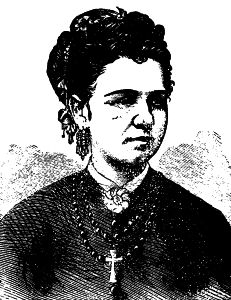
"BABY HAMILTON."
"BABY HAMILTON."
"Baby Hamilton" is another celebrity of the Half-World. Many stories are told about the recklessness of this girl. She forced her way to a meeting in one of the shires when the hounds were all assembled, and followed the hunt, despite the remonstrances of the master, and regardless of the fact that more than half the ladies who were present left the field on her appearance in a hunting costume. She made a bet while in Paris with a wild young duke that she would get a recognition from the Empress Eugenie. The stake was a thoroughbred of the young duke's which she desired to have for her own use. The bet was made, and while the Empress was riding in the Bois, the "Baby," magnificently dressed and mounted, placed herself in the way of the Empress, and bowed quite reverentially. The Empress looked at her for an instant, and, thinking that it was some English lady of rank, bowed very graciously in return. The young duke—who is, by the way, a relative of the Empress by marriage—saw the salutation. It was too good to keep, and accordingly, before the next night, the "Baby" had to leave Paris, by order of the Prefect of Police.
CHAPTER XLIV.
CHEAP LODGING HOUSES.
NE night, having made an appointment with one of the Scotland Yard detectives, I met him as I had promised, punctually, at the India House, which is situated at the junction of Victoria and Dean streets, Westminster.
Be it remembered, that Westminster is a borough, and sends two Members of Parliament, yet it is a part and a portion of the metropolis of London.
He came muffled in his coat, and, having saluted me, asked me if I was ready to accompany him, to visit some of the low lodgings houses that abound in a certain part of Westminster, at the back of Millbank Prison, which fronts the river between Vauxhall and Lambeth Bridges.
It was the night before the great Derby Race, at which nearly all England is represented, peer and peasant, tradesman, beggar, burglar, and pickpocket. On such a night all the London lodging-houses were sure to be full of tramps.
Briefly, I said I was ready to accompany him and without further conversation we penetrated to the darkest recesses of the borough of Westminster, going down Dean into Orchard street, through Orchard street into New-Pye street, down Great Peter street, through Holland street, and so into a short, dark street, called Medway street, at the back of the Greycoats School.
All these streets which I have named have low lodging houses, and were filled this night with tramps, vagrants, peddlers, itinerant showmen, vagabonds, and thieves. Great Peter street is so called to distinguish it from Little Peter street, and both streets being within a stone's throw of the Abbey of Westminster, derive their names from the dedicatory title of the ancient and world-renowned abbey which was called, at one time, and is yet known in official documents, as the "Abbey Church of St. Peter's, Westminster."
Medway street leads into the Horseferry Road, which is at one end a continuation of Lambeth Bridge, and at the other end is flanked by Holland street.
My blue-coated friend said to me, after pulling out a small dark lantern, which he used in these dark rookeries and streets by the water side:
THE WESTMINSTER SLUMS.
"The worst place I can take you to in Westminster, and perhaps in London, Sir, barrin always 'Paddy's Goose,' in Ratcliffe Highway, is the lodging house kept by 'Jack Scrag,' or 'Damnable Jack,' as he is called on account of his swearin'—in Medway street. I can't guarantee that you will bring your watch or pocket-book back, but I will save your life if you get in a row, and that will be as much as I can do. If there are any thieves there they will be afraid of me, but the roughs and tramps, who are out of the law's reach, are up to anything, and will break your leg or arms, or mine either, without talking twice about it."
On our way to the Slums of Westminster I entered a cheap lodging house, in which the lodgers were preparing their evening meal, for which they paid four-pence to the proprietor. A potato was given each person with a small junk of broiled or fried meat, and a tin-skittle full of washy tea or coffee, such as is given to steerage passengers at sea, was handed to the tramps and beggars, who frequented the place.
The room was large and lofty, with smoky rafters, and a number of men, women, and boys, were sitting, standing, and reclining on the floor or on chairs, but nearly all were eating like ravenous beasts from tin-plates or earthen-ware platters.
A man might purchase a herring for a half-penny at any of the refuse sales in the markets, and bring it here and toast it over the huge fire for an additional half-penny, and many of the occupants of this gipsy-looking place were employed in the pleasing occupation of cooking as we left the place on our journey after an adventure.
Medway street, as I have before mentioned, is quite short, and therefore it was not long before I saw a light of more brilliancy than those around it, bursting from the window of the first story of a brick building, the bricks being set off about the windows with trimmings of dark blue stone. Above the door were painted the emblems of the Lion and the Unicorn, which are everywhere displayed in English cities, and a lamp of a square shape projected from the doorway, throwing a dead and unwholsome-like light upon the street and sidewalk. In the window a sign was painted, indicating that lodgings were to be had for four-pence a night for single persons, and also a notification that "boiling water" was "always ready."
AT MR. SCRAGG'S.
The house was probably a hundred years old, as near as I could tell by its old beams, which were bare, the besmeared and notched lintels on which names, effigies, and initials, had been carved, from time immemorial, by lodgers, thieves, and cadgers. There was a bar, and glistening beer-pumps, and pewter noggins, and copper measures, were hung up behind the counter. Against the walls, which were environed by brass railing to keep intruders from making too free or breaking the glasses if a fight should occur, was inscribed on a tin plate of greasy hue the words:
John Scragg & Co., Wine and Liquor Merchants. Beds, 4d. a Night.
The proprietor, a fellow with beetle brows, a furzy black beard, and a fustian jacket well greased, sat on a worn bench near the beer pump.
"Good evenin, Mr. Scragg," said the detective to the rascally-looking fellow.
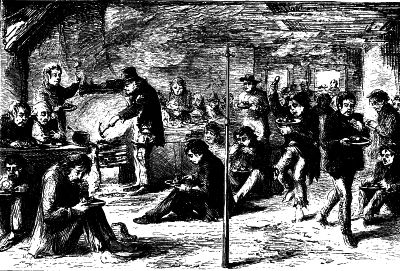
A MEAL AT A CHEAP LODGING HOUSE.
"Good evenin—the same to you, Bobby—are you lookin for lodgins to-night?" said he in reply.
"Well, not exzackly—I came with a friend o' mine to take a look at the Crib—have you many lodgers to-night, Jack?"
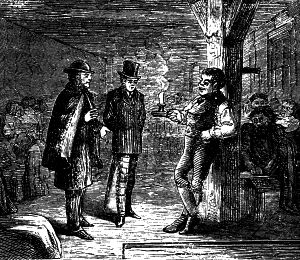
"DAMNABLE JACK."
"Mayhap a matter o' fifty or more. So you wants to look at the Crib, do ye? Well, I ha' no hobjections so as ye don't disturb my lodgers. They are a precious set o' lambs, and belong to the best families in the Kingdom, so I keeps heverythink quiet, sort a like, as they have a great deal a money bet on the races at the Darby, to-morrow."
"Could you give my friend a bed, to-night, and he'll pay you well. He doesn't want to go back to his hotel it's so far at the West End, and he might lose hiself in this big city.
"Give yer friend a bed? D—n my heyes, I should think I could! A dozen beds if he likes—and yourself, too, me hearty."
"But no pocket-picking, Jack—no 'plant' agin him. Keep hoff yer 'Bug-hunters,' or ye'll get in trouble for it, Jack."
"Do I look like a man 'ud permit sich goings on in my 'Ouse," said Damnable Jack, indignantly, and looking with an injured face at the policeman, "Wot, in my 'ouse, vich is patronized by the Nobility and Gentry? I hopes not. Ye'll not find a man or woman 'ere as would 'crack a case', or 'break a drum,' and the 'Kidsmen' are, all on them, as perlite as young Swells, they is, on me 'onor."
I followed Mr. Scragg through an unpaved hall-way or passage, and into a small court, from which the lodging house keeper diverged to the right, and knocking at a door in an extension of the main building, it was opened to us, and we entered the apartment. The apartment had a low roof, and the stench from the place was most terrible. In a room about fifty feet long by thirty in width, at least sixty persons were sleeping, or sitting up on their coarse, common flock beds, some smoking, others eating and drinking, and a few were playing cards.
There was a high, old-fashioned fireplace, in the apartment, without coals, and the walls of plaster were very dirty, and broken in many places, showing the bare laths.
Prints of highwaymen adorned the walls, among which was conspicuous Claude Duval leaping a five-barred gate on horseback, and a posse of constables, in bobwigs, in full chase. There was also a daub of paint representing the execution of a wife-murderer, at Newgate, and a copy of the murderer's last speech, framed alongside of the other print. These, with a cheap engraving of Sir Robert Peel, completed the list of works of art in the place.
There was a murmur which grew into quite a hub-bub as I entered the apartment, and not a few of the lodgers vented their surprise or disgust at my appearance, jointly with that of the "Peeler," as they called the policeman.
THE DIRTY CADGER.
"Wot the blazes does that Swell want in 'ere," said an old cadger, who was reclining on a bed on the floor, trimming his toe-nails with a jack-knife preparatory to going to bed, much to the edification of a young girl who sat by his side on the bed, and could not have been more than fifteen years of age.
"Mebbe he's a swell pickpocket, or fogle-hunter (handkerchief thief,)" said the innocent young creature.
"Hit stands to reason he can't be a fogle hunter, 'cos he's with the blessed Peeler," said the Cadger.
"Well, mebbe he's wiring for the perlice," said the young girl, "and wants to ketch some on us for a 'dummy.'"
"Never mind, Moll, he doesn't want us, and we'll go to sleep, cos we've got to be on the tramp, early in the morning, for the Darby."