Chapter IX · (continued 2)
Reading edition
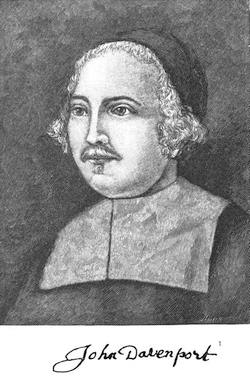
[The editor is indebted to Professor F. B. Dexter, of Yale College, for a photograph of the original picture, which is in New Haven, painted on panel, and bears the inscription, “J. D. obiit, 1670.” Davenport left Connecticut in 1668 to become the successor of John Wilson in Boston, and died as the pastor of the First Church in Boston, March 11, 1670. Cf. Memorial History of Boston, i. 193, and the important paper on Davenport by Professor Dexter, printed in the New Haven Historical Society’s Papers, vol. ii.—Ed.]
In 1638 a settlement was made at Quinnipiack, afterward called New Haven, under the lead of John Davenport. The emigrants, principally from Massachusetts,—like those of the river towns,—had no patent or title to the land on which they planted, but made a number of purchases from the Indians. Here, in April, under the shelter of an oak, they listened to a sermon by Davenport, and a few days afterward formed a “plantation covenant,” as preliminary to a more formal engagement,—all agreeing to be ordered by the rule of Scripture. This colony, as well as that just described, sympathized substantially in religious views with Massachusetts.
On the 4th of June, 1639, all the free planters met in a barn “to consult about settling civil government according to God.” Mr. Davenport prayed and preached, and they then proceeded, by his advice, to form a government. They first decided that none but church members should be free burgesses. Twelve men were then chosen, who out of their own number chose seven to constitute a church and on the “seven pillars” thus chosen rested also the responsibility of forming the civil government. On October 29 these seven persons met, and, after a solemn address to the Supreme Being, proceeded to form the body of freemen, and to elect their civil officers. Theophilus Eaton was chosen to be governor for that year; indeed, he continued to be rechosen to the office for nearly twenty years, till his death. This was the original, fundamental constitution of New Haven. A few general rules were adopted, but no code of laws established. The Word of God was to be taken as the rule in all things.
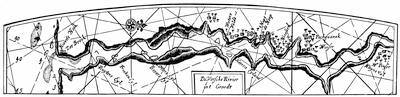
CONNECTICUT RIVER, 1661.
[This is taken from a Dutch map which appeared at Middleburgh and the Hague in 1666, in a tract belonging to the controversy between Sir George Downing and the States General. It follows the fac-simile given in the Lenox edition of Mr. H. C. Murphy’s translation of the Vertoogh van Nieu Nederland. It also is found as a marginal map in the Pas Kaart van de Zee Kusten van Nieu Nederland, published at Amsterdam by Van Keulen, which shows the coast from Narragansett Bay to Sandy Hook, where is also a portion of the map of the Hudson given in the notes following Mr. Fernow’s chapter in Vol. IV. The Pas Kaart is in Harvard College Library (Atlas 700, No. 9). No. 10 of the same atlas is Pas Kaart van de Zee Kusten inde Boght van Nieu Engeland, which shows the coast from Nantucket to Nova Scotia.—Ed.]
This year settlements were made at Milford and at Guilford, each for a time being independent of any other plantation. Connecticut had also interposed two new settlements between New Haven and the Dutch, at Fairfield and at Stratford.
In 1642 the capital laws of Connecticut were completed and put upon record; and in May, 1650, a code of laws known as “Mr. Ludlow’s Code” was adopted. In 1643 Connecticut and New Haven were both included in the New England Confederation, as mentioned on an earlier page, and the articles of union were printed in 1656, with the code of laws which was adopted by New Haven, as drawn up by Governor Eaton, the manuscript having been sent to England to be printed.
The old patent of Connecticut mentioned in the agreement with Fenwick seems never to have been made over to the colony; and they were very anxious, on the restoration of Charles II. in 1660, for a royal charter, which would secure to them a continuance and confirmation of their rights and privileges. Governor John Winthrop was appointed as agent to represent the colony in England, for this purpose; and in April, 1662, he succeeded in procuring a charter, which included the colony of New Haven. The charter conveyed most ample powers and privileges for colonial government, and confirmed or conveyed the whole tract of country which had been granted to Lord Say and Sele and others. Mr. Davenport and other leading men of that colony were entirely opposed to a union with Connecticut; and the acceptance of the new charter was resisted till 1665, when the opposition was overcome, and the colonies became united, and at the general election in May of that year John Winthrop was elected to be governor.
It is needless to say that the church polity of Connecticut and New Haven, from the beginning, was substantially that of Massachusetts. Their clergymen assisted in framing the Cambridge Platform in 1648, which was the guide of the churches for many years. Hooker’s Survey and Cotton’s Way of the Churches Cleared (London, 1648) were published under one general titlepage covering both works. After a few years the harmony of the churches was seriously disturbed by a set of new opinions which sprang up in the church at Hartford, and which finally culminated in the adoption by a general council of Connecticut and Massachusetts churches, held in Boston in 1657, of the “Half-Way Covenant.” New Haven held aloof. Political motives lent their influence in the spread of the new views; and while the government of Connecticut attempted to enforce the resolutions of the synod, the churches long refused to comply.[541]
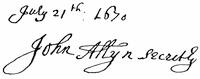
The union of the two communities under one charter gave strength to both, and the colony prospered, while Winthrop felt the strong control of a robust spirit in John Allyn, the secretary of the colony.[542] There were of course constant occasions of annoyance and dissension, both civil and religious. Their wily foe, the Indian, did not cease wholly to disturb their repose. But during Philip’s War, which was so disastrous to Massachusetts, Plymouth, and Rhode Island, there was less suffering in Connecticut. Conflicts of jurisdiction, both east and west, growing out of the uncertain boundaries of its grant, though it ran west to the South Sea, were of long duration. No sooner had the commissioners, appointed by the King in 1683, made a favorable decision for Connecticut in her controversy with Rhode Island in regard to the Narragansett country, than a new claimant arose. At the division of the grand patent in 1635, James, Marquis of Hamilton, had assigned to him the country between the Connecticut and the Narragansett rivers; but his claim slumbered only to be revived by his heirs at the Restoration,—and now a second time, through Edward Randolph, the watchful and untiring enemy of New England. The prior grant to Lord Say and Sele, confirmed by the charter of April 23, 1662, and the settlement of the country under it, was cited by Connecticut in their answer; and, in an opinion on the case a few years later, Sir Francis Pemberton said that the answer was a good one.
When James II. continued the attacks on the New England charters begun by the late king, with a view to bring all the colonies under the crown, Connecticut did not escape. A quo warranto was issued against the Governor and Company in July, 1685, and this was followed by notices to appear and defend; but the colony resisted, and petitioned, and final judgment was never entered. The colony’s language to the King in one of its addresses to him was, however, construed as a surrender. Andros went from Boston to Hartford in October, 1687, and at a meeting of the Assembly, which was prolonged till midnight, demanded its charter. The story goes, that, by a bold legerdemain, the parchment, after the lights were blown out, was spirited away and hidden in the hollow of an oak-tree; nevertheless Andros assumed the government of the colony, under his commission. Thus matters continued till the Revolution of 1689, when the colony resumed its charter.
Rhode Island.—Rhode Island was settled by Roger Williams in 1636, he having been banished from Massachusetts the year before. Professor George Washington Greene, in his Short History of Rhode Island, remarks, that in the settlement of the New England colonies the religious idea lay at the root of their foundation and development; that in Plymouth it took the form of separation, or a simple severance from the Church of England; in Massachusetts Bay it aimed at the establishment of a theocracy and the enforcement of a vigorous uniformity of creed and discipline; and that from the resistance to this uniformity came Rhode Island and the doctrine of soul-liberty.
Williams was banished from Massachusetts principally for political reasons. His peculiar opinions relating to soul-liberty were not fully developed until after he had taken up his residence in Rhode Island. Five persons accompanied him to the banks of the Mooshausic, and there they planted the town of Providence. Williams here purchased, or received by gift, a tract of land from the Indians, and he had no patent or other title to the soil. Additions were soon made to the little settlement, and he divided the land with twelve of his companions, reserving for them and himself the right of extending the grant to others who might be admitted to fellowship. An association of civil government was formed among the householders or masters of families, who agreed to be governed by the orders of the greater number. This was followed by another agreement of non-householders or single persons, who agreed to subject themselves to such orders as should be made by the householders, but “only in civil things.” This latter is the earliest agreement on the records of the colony. In 1639, to meet the wants of an increasing community, five disposers or selectmen were chosen, charged with political duties,—their actions being subject to revision by the superior authority of the town meetings.
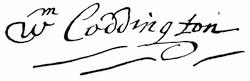
Meanwhile two other colonies had been planted on the shores of Narragansett Bay. The first, partly from the ranks of the Antinomians of Massachusetts, led by William Coddington and John Clarke, who settled at Pocasset (Portsmouth), in the northern part of the Island of Aquedneck in March, 1637/38; and their number so increased that in the following year, 1639, a portion of them moved to the south part of the island, and settled the town of Newport. Like Roger Williams, the settlers had no other title to the land than what was obtained from the natives. Another colony was planted at Shawomet (Warwick), in January, 1642/43, by Samuel Gorton,—a notorious disturber of the peace,—with about a dozen followers, who also secured an Indian title to their lands. Gorton had been in Boston, Plymouth, Portsmouth, and in Providence, and was an unwelcome resident in all, and at Portsmouth he had been whipped.
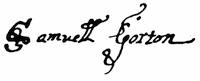
About 1640, with some followers, he came to Pawtuxet, in the south part of Providence, and, taking sides in some previous land quarrel there, prevailed. The weaker party appealed to Massachusetts for protection, and finally subjected themselves and their lands to that government; upon which Gorton and his followers fled south to Shawomet. Soon afterward, by the surrender to Massachusetts of a subordinate Indian chief, who claimed the territory there, purchased by Gorton of Miantonomi, that Government made a demand of jurisdiction there also; and as Gorton refused their summons to appear at Boston, Massachusetts sent soldiers, and captured the inhabitants in their homes, took them to Boston, tried them, and sentenced the greater part of them to imprisonment for blasphemous language to the Massachusetts authorities. They were finally liberated, and banished; and as Warwick was included in the forbidden territory, they went to Rhode Island. Gorton and two of his friends soon afterward went to England.
The inhabitants on the island formed themselves into a voluntary association of government, as they had done at Providence. The community at Warwick was at first without any form of government.
Feeling a sense of a common danger, the little settlements of Providence and Rhode Island sent Roger Williams to England, in 1643, to apply for a charter. He found the King at open war with the Parliament; but from the Parliamentary commissioners, with the Earl of Warwick at their head, he procured a charter of “Incorporation of Providence Plantations in the Narragansett Bay in New England,” dated March 14, 1643; that is, 1644 (N. S.). Three years were allowed to pass before the charter was formally accepted by the plantations; but in May, 1647, the corporators met at Portsmouth, and organized a government; and Warwick, whither Gorton and his followers had now returned, though not named in the charter, was admitted to its privileges. This franchise was a charter of incorporation, as its title indicates; but it contained no grant of land. It recites the purchase of lands from the natives; and the Government under it claimed the exclusive right to extinguish the Indian title to lands still owned by the tribes within its boundaries. The code of laws adopted when the charter was accepted is an attempt to codify the common and statute laws of England, or such parts as were thought binding or would suit their condition.
Williams’s principle of liberty of conscience was sometimes interpreted in the community to mean freedom from civil restraint, and harmony did not always prevail. This gave cause to his enemies to exult, while his friends feared lest their hope of reconciling liberty and law should fail.
The attempt of Massachusetts to bring the territory of the colony under her jurisdiction was a source of great annoyance. During this contest an appeal to the authorities in England resulted in the triumph of the weaker colony. Then came the “Coddington usurpation,”—an unexplained episode in the history of Rhode Island, by which the island towns in 1651 were severed from the government of the colony; and Coddington, by a commission from the Council of State in England, was made governor for life. This revolution seemed for a time successful; but the friends of the colony did not despair. Williams and John Clarke were sent to England as agents,—the one in behalf of the former charter, and the other to ask for a revocation of Coddington’s commission. They were both successful; and in the following year the old civil status was fully restored.
As civil dissensions ceased, there was danger of another Indian war, which for the time was arrested by the sagacity of Williams. The refusal of the United Colonies to admit Rhode Island to their confederacy placed her at great disadvantage. Yet though causes of dissension remained, the colony grew in industry and strength. Newport especially increased in population and in wealth. Not every inhabitant, however, was a freeman. The suffrage was restricted to ownership in land, and there was a long process of initiation to be passed through before a candidate could be admitted to full citizenship.
Changes were taking place in England. Cromwell died, and his son Richard soon afterward resigned the Protectorship. The restoration of Charles II. followed by acclamation. The colony hastened to acknowledge the new King; the acts of the Long Parliament were abrogated, and a new charter was applied for through John Clarke, who still remained in England. This instrument, dated Nov. 24, 1663, was evidently drawn up by Clarke, or was prepared under his supervision. It confirmed to the inhabitants freedom of conscience in matters of religion. It recounted the purchase of the land from the natives, but it equally asserted the royal prerogative and the ultimate dominion of the lands in the Crown,—a provision which Williams had strenuously objected to and preached against in the Massachusetts charter. The holding was from the King, as of the manner of East Greenwich. This gave the colony, in English law, an absolute title to the soil as against any foreign State or its subjects. It operated practically as a pre-emptive right to extinguish the Indian title. The charter created a corporation by the name of “The Governor and Company of the English Colony of Rhode Island and Providence Plantations in New England in America.”
THE MASSACHUSETTS PROPRIETORS OF THE NARRAGANSETT COUNTRY.
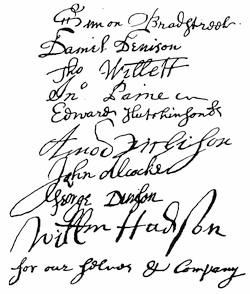
This charter gave the whole of the Narragansett country to the colony, which the year before had been given to Connecticut; but it did not bring peace. That colony still clamored for her charter boundary; while a body of land speculators from Massachusetts, known as the Atherton Company, who had, in violation of Rhode Island law, bought lands at Quidnesett and Namcook, now insisted upon being placed under Connecticut jurisdiction. The King’s commissioners, who arrived in the country in 1664, charged with the duty of settling all disputes, came into Rhode Island. They received the submission of the Narragansett chiefs to the King, confirmatory of the same act performed in 1644, and they set apart the Narragansett country, extending from the bay to the Pawcatuck River, and named it King’s Province, and established a royal government over it. Some other matters in dispute were happily settled. The royal commissioners were well satisfied with the conduct of Rhode Island.
The colony still grew, but it continued poor. About the year 1663 schools were established in Providence,—a tardy following of Newport, which had employed a teacher in 1640. The colony was kept poor by the great expense incurred in employing agents to defend itself from the surrounding colonies, that wished to crush it. But another trouble arose. A fearful war was impending, the bloodiest which the colony had yet waged with the Indians. We have no space for the story; but Philip’s War fell most heavily on Rhode Island, which furnished troops, but was not consulted as to its management. Peace was at length restored, and the Indians subdued; though they were still turbulent.
Connecticut had not yet renounced her claims on the Narragansett country. Rhode Island set up her authority in the province, and appointed officers for its government. Both colonies appealed to the King. Within the colony itself now arose a most bitter controversy respecting the limits and extent of the original Providence and Pawtuxet purchase, which was not finally settled till the next century. It grew out of the careless manner in which Roger Williams worded the deeds to himself from the Indians, and also those which he himself gave to the colony.
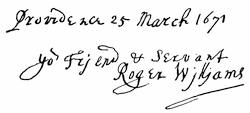
The appeal of Connecticut and Rhode Island to the King resulted in a commission, in 1683, headed by the notorious Cranfield, Governor of New Hampshire, and including the no less notorious Edward Randolph. They quarrelled with the authorities of Rhode Island, and decided in favor of Connecticut.
In due time Rhode Island was a common sufferer with the rest of New England, under the imposition of Andros and his commission. He came into Rhode Island, and was kindly received. He broke the colony seal, but the parchment charter was put beyond his reach. The colony surrendered, and petitioned the King to preserve her charter, and then fell back upon a provisional government of the towns. At the revolution she resumed her charter, and later it was decided in England that it had never been revoked and remained in full force.
CRITICAL ESSAY ON THE SOURCES OF INFORMATION.
THE Council for New England.—Chalmers, Annals, 1780, p. 99, says concerning the great patent of Nov. 3, 1620, “This patent which has never been printed because so early surrendered, is in the old entries of New England in the Plant. off.” I saw the parchment enrolment of this charter in her Majesty’s Public Record Office, in Fetter Lane, London, and described it in full in Amer. Antiq. Soc. Proc., for April, 1867, p. 54. It was first printed by Hazard, Historical Collections, vol. i. 1792, pp. 103-118, probably from a manuscript copy in the Superior Court files, N. H.[543]
The petition of the Northern Colony for a new charter, dated March 3, 1619/20, and the warrant to his Majesty’s Solicitor-General to prepare such a patent, dated July 23, 1620, may be seen in Brodhead’s Documents, etc., iii. 2-4. The warrant is also in Gorges’ Briefe Narration, p. 21.
The opposition of the Virginia Company to the granting of this patent may be seen in their records as published by Neill., History of the Virginia Company of London, 1869, passim; also in Gorges’ Briefe Narration, pp. 22-31; in the Council’s Briefe Relation,[544] pp. 18-22; and in Brodhead’s Documents, iii. 4. The opposition of the House of Commons to the patent, after it had passed the seals, may be best seen in the printed Journals of the House for the sessions of 1621 and 1624. Chalmers’ extracts are to the point, but are not full. See also Gorges, and the Briefe Relation, as above. For the answer to the French ambassador, see also Sainsbury’s Calendar, Colonial, p. 61. The history of the transactions of the Council may be largely gathered from their extant records as published in Amer. Antiq. Soc. Proc., for April, 1867, and for October, 1875; from Gorges, and from the Briefe Relation. Cf. Palfrey, i. 193.
Probably no complete record exists of all the patents issued by the Council; and of those known to have been granted, the originals, or even copies of all of them, are not known to be extant. As full a list of these as has been collected may be seen in a Lecture read before the Massachusetts Historical Society, Jan. 15, 1869, by Samuel F. Haven, LL. D., entitled History of Grants under the Great Council for New England, etc.,—a valuable paper with comments and explanations, with which compare Dr. Palfrey’s list in his History of New England, i. 397-99.[545] Since Dr. Palfrey wrote, new material has come to light respecting some of these grants. The patent of Aug. 10, 1622, which Dr. Belknap supposed was the Laconia patent, and which he erroneously made the basis of the settlements of Thomson and of the Hiltons, and of later operations on the Piscataqua, is found not to be the Laconia patent, which was issued seven years later, namely, Nov. 17, 1629.[546] Later writers have copied him. Again, Dr. Palfrey refers the early division of the territory by the Council, from the Bay of Fundy to Cape Cod, among twenty associates, to May 31, 1622. By the recovery of another fragment of the records of the Council in 1875, we are able to correct all previous errors respecting that division, which really took place on Sunday, July 29, 1623. This fact has appeared since Dr. Haven wrote.[547]
An object of interest would be the map of the country on which the different patents granted were marked off. Some idea from it might be formed of the geographical mistakes by which one grant overlapped another, or swallowed it up entirely. I know of no published map existing at that time that would have served the purpose. The names of the places on the coast from Penobscot to Cape Cod, mentioned by Captain Smith in his tract issued in 1616, were rarely indicated on his map which accompanied the tract. They had been laid down on the manuscript draft of the map, but were changed for English names by Prince Charles.[548] Quite likely the Council had manuscript maps of the coast. Of the division of 1623, the records say it was resolved that the land “be divided according as the division is made in the plot remaining with Dr. Goche.” Smith, speaking of this division, says that the country was at last “engrossed by twenty patentees, that divided my map into twenty parts, and cast lots for their shares,” etc. Smith’s map was probably the best published map of the coast which existed at that time; but the map on which the names were subsequently engrossed and published was Alexander’s map of New England, New France, and New Scotland, published in 1624, in his Encouragement to Colonies, and also issued in the following year in Purchas, vol. iv. p. 1872. This record, as the fac-simile shows,[549] is a mere huddling together of names, with no indication as to a division of the country, as it was not possible there should be on such a map as this, where the whole New England coast, as laid down, is limited to three inches in extent, with few natural features delineated upon it.
The greatest trouble existed among the smaller patents. A large patent, like that to Gorges, for instance, at the grand division, with well-defined natural boundaries on the coast, between the Piscataqua and the Sagadahoc, or the Penobscot, would not be likely to be contested for lack of description; but there had been many smaller patents issued within these limits, which ran into and overlapped each other, and some were so completely annihilated as to cause great confusion.
Some of these smaller patents had alleged powers of government granted to the settlers,—powers probably rarely exercised by virtue of such a grant, and which the Council undoubtedly had no authority to confer.[550] The people of Plymouth, for instance, in their patent of 1630, were authorized, in the language of the grant, to incorporate themselves by some usual or fit name and title, with liberty to make laws and ordinances for their government. They never had a royal charter of incorporation during their separate existence, though they strove hard to obtain one. The Council for New England might from the first have taken the Pilgrims under their own government and protection; and Governor Bradford, in letters to the Council and to Sir Ferdinando Gorges, written in 1627 and 1628, acknowledges that relation, and asks for their aid.[551]
SEAL OF THE COUNCIL FOR NEW ENGLAND.
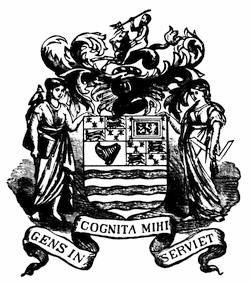
The records of the Council, so far as they are extant, contain no notice of the adoption of a common seal, and we are ignorant as to the time of its adoption. In the earliest patent known to have been issued by the Council, which was an indenture between them and John Peirce and his associates, dated June 1, 1621, the language is, “In witness whereof the said President and Council have to the one part of this present Indenture set their seals.” This is signed first by the Duke of Lenox, who I think was the first President of the Council, and by five other members of the Council, with the private seal of each appended to his signature. But in a grant to Gorges and Mason, of Aug. 10, 1622, which is also an indenture, the language is, that to one part “the said President and Council have caused their common seal to be affixed.” Here we have a “common seal” used by the Council in issuing their subsequent grants. But it is very singular, that of the many original grants of the Council extant no one of them has the wax impression of the seal intact or unbroken; usually it is wholly wanting. It is believed, however, that the design of the seal has been discovered in the engraving on the titlepage of Smith’s Generall Historie; and the reasons for this opinion may be seen in Mass. Hist. Soc. Proc., March, 1867, pp. 469-472.[552] A delineation of it is given herewith.
In the absence of any record of the organization of the Council, or of any rules or by-laws for the transaction of its business, we do not know what officers, or what number of the Council, were required for the issuing of patents, or for authorizing the use of the Company’s seal. The only name signed to the Plymouth Patent of Jan. 13, 1629/30 is that of the Earl of Warwick, who was then the President of the Council.
Massachusetts.[553]—The Massachusetts Colony had its origin in a grant of land from the Council of New England, dated March 19, 1627, in old style reckoning.[554] So far as is known, it is the first grant of any moment made after the general division in 1623, but probably it was preceded by the license to the Plymouth people of privileges on the Kennebec. This patent to the Massachusetts Colony is not extant, but it is recited in the subsequent charter. There is some mystery attending the manner of its procurement, as well as about its extent. The business was managed, in the absence of Sir Ferdinando Gorges, by the Earl of Warwick, who was friendly to the patentees.[555] The royal charter of Massachusetts was dated March 4, 1628 (O.S.). For the forms used in issuing it, see Mass. Hist. Soc. Proc., December, 1869, pp. 167-196. A discussion of the charter itself as a frame of government for a commonwealth is found in Hutchinson’s History of Massachusetts, i. 414, 415; Judge Parker’s Lecture before the Massachusetts Historical Society, Feb. 9, 1869, entitled The First Charter, etc.; and Memorial History of Boston, i. 329-382, and the authorities there cited. As to the right of the Company to transfer the government and charter to the soil, see Judge Parker, as above; Dr. Palfrey, New England, i. 301-308; Barry, History of Massachusetts, i. 174-186, and the authorities cited by them. The original charter, on parchment, is in the State House in Boston. A heliotype of a section of it is given in the Memorial History of Boston, i. 329.[556] The duplicate or exemplification of the charter, which was originally sent over to Endicott in 1629, is now in the Library of the Salem Athenæeum. The charter was first printed, and from the “dupl.” parchment, “by S. Green, for Benj. Harris, at the London Coffee-House, near the Town-House, in Boston, 1689.” It is entitled A Copy of the Massachusetts Charter.[557]
The archives of the State are rich in the materials of its history. The records of the government from its first institution in England down to the overthrow of the charter are almost a history in themselves. The student is no longer required to decipher the ancient writing, for in 1853-54 the Records were copied and printed under the editorial care of Dr. N. B. Shurtleff.[558] A large mass of manuscripts remains at the State House, and is known as the Massachusetts Archives. The papers were classified by the late Joseph B. Felt.[559] They are the constant resource of antiquaries and historians, few of whom, however, but regret the too arbitrary arrangement given to them by that painstaking scholar.[560] The City of Boston, by its Record Commission, is making accessible in print most valuable material which has long slumbered in manuscript. The Archives of the Massachusetts Historical Society are specially rich in early manuscripts, a catalogue of which is now preparing, and its publishing committees are constantly at work converting their manuscripts into print, while the sixty-seven volumes of its publications, as materials of history, are without a rival.[561]
The first general History of Massachusetts Bay was written by Thomas Hutchinson, afterward governor of the province, in two volumes, the first of which, covering the period ending with the downfall of Andros, was published in Boston in 1764. The second volume, bringing the history down to 1750, was published in 1767. Each volume was issued in London in the year following its publication here. The author had rich materials for his work, and was judicious in the use of them. He had a genius for history, and his book will always stand as of the highest authority. A volume of Original Papers, which illustrate the first volume of the history, was published in 1769.[562] Hutchinson died in England in 1780. Among his manuscripts was found a continuation of his history, vol. iii., bringing the events down to 1774, in which year he left the country. This was printed in London in 1828.[563] Some copies of vol. i., London ed., were wrongly dated MDCCLX.
In 1798 was published, in two volumes, a continuation of Hutchinson’s second volume, by George Richards Minot,[564] bringing the history down to 1764. The work was left unfinished, and Alden Bradford, in 1822-1829, published, in three volumes, a continuation of that to the year 1820.
The next most considerable attempt at a general History of Massachusetts was by John Stetson Barry, who published three volumes in 1855-1857. It is a valuable work, written from the best authorities, and comes down to 1820.
Palfrey’s History of New England, the first three volumes of which were published in 1858-1864, and cover the period ending with the downfall of Andros, must be regarded altogether as the best history of this section of our country yet written, as well for its luminous text as for the authorities in its notes.[565]
I will now go back and mention a few other general histories of New England, including those works in which the history of Massachusetts is a prominent feature.
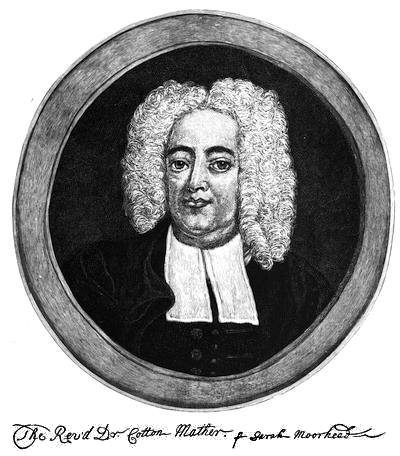
Cotton Mather’s Ecclesiastical History of New England, better known as his Magnalia, from the head-line of the titlepage, Magnalia Christi Americana, was published in London in 1702, in folio. Although relating generally to New England, it principally concerns Massachusetts. While the book is filled with the author’s conceits and puns, and gives abundant evidence of his credulity, it contains a vast amount of valuable historical material, and is indispensable in any New England library. It is badly arranged for consultation, for it is largely a compilation from the author’s previous publications, and it lacks an index. It has been twice reprinted,—in 1820 and 1853.[566]
John Oldmixon, Collector of Customs at Bridgewater, England, compiled and published at London, in 1708, his British Empire in America, in two volumes. About one hundred pages of the first volume relate to New England, and while admitting that he drew on Cotton Mather’s Magnalia for most of his material, omitting the puns, anagrams, etc., the author nevertheless vents his spleen on this book of the Boston divine. Mather was deeply hurt by this indignity, and he devoted the principal part of the Introduction to his Parentator, 1724, to this ill-natured writer. He says he found in eighty-six pages of Oldmixon’s book eighty-seven falsehoods. A second edition of The British Empire in America was published in 1741, with considerable additions and alterations. In the mean time the Rev. Daniel Neal had published in London his History of New England, which led Oldmixon to rewrite, for this new edition, his chapters relating to New England. Oldmixon’s work is of little value. He was careless and unscrupulous.[567]
Mr. Neal’s History of New England, already mentioned, first appeared in 1720, in two volumes, but was republished with additions in 1747.[568] It contains a map “according to the latest observations,” or, as he elsewhere observes, “done from the latest surveys,” in one corner of which is an interesting miniature map of “The Harbour of Boston.” This book must have supplied a great want at the time of its appearance, and though Hutchinson says it is little more than an abridgment of Dr. Mather’s history,—which is not quite true, as see his authorities in the Preface,—it gave in an accessible form many of the principal facts concerning the beginning of New England. It of course relates principally to Plymouth and Massachusetts. Neal was an independent thinker, and differed essentially from Cotton Mather on many subjects.
The Rev. Thomas Prince published in Boston in 1736 A Chronological History of New England in the Form of Annals, in one volume, 12º, of about four hundred pages. The author begins with the creation of the world, and devotes the last two hundred and fifty pages to New England, coming down only to September, 1630, or to the settlement of Boston. After an interval of about twenty years the work was resumed, and three numbers, of thirty-two pages each, of vol. ii. were issued in 1755, bringing the chronology down to August, 1633, when for want of sufficient encouragement the work ceased. Prince was very particular in giving his authorities for every statement, and he professed to quote the very language of his author.[569]
In 1749 was published the first volume of a Summary, Historical and Political, ... of the British Settlements in North America, by William Douglass, M.D. The book had been issued in numbers, beginning in January, 1747. The titlepage of the second volume bears date 1751. The author died suddenly Oct. 21, 1752, before his work was finished. A large part of the book relates to New England. It contains a good deal of valuable information from original sources, but it is put together without system or order, and the whole work appears more like a mass of notes hastily written than like a history. Dr. Douglass was a Scotchman by birth, and coming to Boston while a young man, he attained a reputable standing as a physician. In the small-pox episode in 1721 he took an active part as an opposer of inoculation. He was fond of controversy, was thoroughly honest and fearless, and gave offence in his Summary by his freedom of speech. The Summary was republished in London in 1755 and in 1760, each edition with a large map.[570] The Boston edition was reissued with a new title, dated 1753.
For the origin of the brief settlement at Cape Ann, which drew after it the planting at Salem and the final organization of the Massachusetts Company, and for the narrative of those several events,—namely, the formation in London of the subordinate government for the colony, “London’s Plantation in Massachusetts Bay,” with Endicott as its first governor, and his instructions; the emigration under Higginson in 1629; the establishment of the church in Salem, and the difficulty with the Browns; and the emigration under Winthrop in 1630,—see John White’s Planter’s Plea,[571] Hubbard’s New England, chap. xviii.; the Colony Records; Morton’s Memorial, under the year 1629; Higginson’s Journal, and his New England Plantation;[572] Dudley’s Letter to the Countess of Lincoln;[573] and Winthrop’s own Journal. For the principal part of these documents and others of great value the reader is referred to Dr. Alexander Young’s Chronicles of the First Planters of the Colony of Massachusetts Bay,—a convenient manual for reference, of the highest authority, containing ample bibliographical notes and illustrations, which need not be repeated here. This book, which was published in 1846, was unfortunately thrown into chapters as of one narrative, as had been that relating to the Plymouth Colony, published in 1841, whereby the original authorities, which should be the prominent feature of the book, are subordinated to an editorial plan.
For the original authorities of the history of the scattered settlements in Massachusetts Bay, prior to the Winthrop emigration, I cannot do better than refer to a paper on the “Old Planters,” so called, about Boston Harbor, by Charles Francis Adams, Jr., in Mass. Hist. Soc. Proc., June, 1878, p. 194; and to Mr. Adams’s chapter in Memorial History of Boston, i. 63.
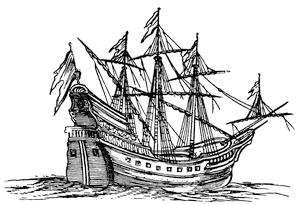
SHIP OF XVIITH CENTURY.
[This fac-simile is from a map in Dudley’s Arcano del Mare, 1647.—Ed.]
In Captain John Smith’s Advertisements for the unexperienced Planters of New England, or anywhere, London, 1631, he has two chapters (xi. and xii.) on the settlement of Salem and Charlton (Charlestown), and an account of the sad condition of the colony for months after the Winthrop emigration. This is Smith’s last book, and his best in a literary point of view, and was published the year of his death.[574]
The New England’s Prospect, by William Wood, London, 1634, is the earliest topographical account of the Massachusetts Colony, so far as the settlements then extended. It also has a full description of its fauna and flora, and of the natives. It is a valuable book, and is written in vigorous and idiomatic English. The writer lived here four years, returning to England Aug. 15, 1633. His book is entered in the Stationers’ Register, “7 Julii, 1634.” Alonzo Lewis, author of the History of Lynn, thinks that he came over again to the colony in 1635, as a person of that name arrived that year in the “Hopewell.”[575]
The New English Canaan, by Thomas Morton, Amsterdam, 1637, “written upon ten years’ knowledge and experiment of the country,” is a sort of satire upon the Plymouth and Massachusetts people, who looked upon the author as a reprobate and an outlaw. He came over, probably, with Weston’s company in 1622, and on the breaking up of that settlement may have gone back to England. In 1625 he is found here again with Captain Wollaston’s company on a plantation at “Mount Wollaston,” where he had his revels. He was twice banished the country, and before his final return hither wrote this book. His description of the natural features of the country, and his account of the native inhabitants are of considerable interest and value, and the side-light which he throws upon the Pilgrim and Puritan colonies will serve at least to amuse the reader.[576] Morton’s book, though printed in Holland “in the yeare 1637,” was entered in the Stationers’ Register in London, “Nov. 18, 1633,” in the name of Charles Greene as publisher; and a copy of the book is now (1882) in the library of the Society for the Propagation of the Gospel in Foreign Parts, 19 Delahay Street, Westminster, London, bearing this imprint: “Printed for Charles Greene, and are sold in Paul’s Church-Yard;” no date, but “1632” written in with a pen. See White Kennett’s Bibliothecæ Americanæ Primordia, p. 77, where this copy is entered, and where the manuscript date is printed in the margin. This date is, of course, an error.[577] Morton’s book was not written till after the publication of Wood’s New England’s Prospect, to which reference is frequently made in the New English Canaan. The New England’s Prospect was entered at the Stationers’, “7 Julii, 1634,” and was published the same year. Morton’s book is dedicated to the Commissioners for Foreign Plantations,—a body not created till April 28, 1634. The book must have been entered at the Stationers’ some time in anticipation of its printing; and when printed, some copies were struck off bearing the imprint of Charles Greene, though only one copy is now known with his name on the titlepage.
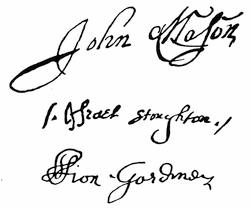
AUTOGRAPHS OF LEADERS IN THE WAR.
The first serious trouble with the Indians, which had been brewing for some years, culminated in 1637, when the Pequots were annihilated. This produced a number of narrations, two of which were published at the time, and in London,—one by Philip Vincent,[578] in 1637, and one by Captain John Underhill, in 1638.[579] The former is not known to have been in New England at the time, but the minute particulars of his narrative would lead one to suppose that he had been in close communication with some persons who had been in the conflict. He could hardly have been present himself. Captain John Underhill, the writer of the second tract, was commander of the Massachusetts forces at the storming of the fort, so that he narrates much of what he saw. He prefaces his account with a description of the country, and of the origin of the troubles with the Pequots. Both these narratives are reprinted in 3 Mass. Hist. Coll., vi.
I may add here that there were other narratives of the Pequot War written by actors in it. A narrative by Major John Mason, the commander of the Connecticut forces, was left by him on his death, in manuscript, and was communicated by his grandson to the Rev. Thomas Prince, who published it in 1736. It is the best account of the affair written. Some two or three years after the death of Mason, Mr. Allyn, the Secretary of the colony of Connecticut, sent a narrative of the Pequot War to Increase Mather, who published it in his Relation of the Troubles, etc., 1677, as of Allyn’s composition. Having no preface or titlepage, Mather did not know that it was written by Major Mason, as was afterward fully explained by Prince, who had the entire manuscript from Mason’s grandson.[580]
Lyon Gardiner, commander of the Saybrook fort during the Pequot War, also wrote an account of the action, prefacing it with a narrative of recollections of earlier events. It was written in his old age. It was first printed in 3 Mass. Hist. Coll., iii. 136-160.[581]
For the history of the Antinomian controversy which broke out about this time and convulsed the whole of New England, see the examination of Mrs. Hutchinson in Hutchinson’s Massachusetts Bay, ii. 482; Welde’s Short Story, etc., London, 1644; Chandler’s Criminal Trials, Boston, 1841, vol. i.[582]
A small quarto volume published in London in 1641, entitled An Abstract of the Lawes of New England as they are now Established, was one of the results of an attempt to form a body of standing laws for the colony. I may premise, that, at the first meeting of the Court of Assistants at Charlestown, certain rules of proceeding in civil actions were established, and powers for punishing offenders instituted. In the former case equity according to circumstances was the rule; and in punishing offences they professed to be governed by the judicial laws of Moses where such laws were of a moral nature.[583] But such proceedings were arbitrary and uncertain, and the body of the people were clamorous for a code of standing laws. John Cotton had been requested to assist in framing such a code, and in October, 1636, he handed in to the General Court a copy of a body of laws that he had compiled “in an exact method,” called “Moses his Judicials,” which the Court took into consideration till the next meeting. The subject occupied attention from year to year, till in December, 1641, the General Court established a body of one hundred laws, called the Body of Liberties, which had been composed by the Rev. Nathaniel Ward,[584] of Ipswich. No copy of these laws was known to have been preserved on the records of the colony; and of the earliest printed digest of the laws, in 1648, which no doubt substantially conformed to the Body of Liberties, no copy is extant.

The Abstract above recited, published in 1641, was therefore for many years regarded as the Body of Liberties, or an abstract of them, passed in that year. About forty years ago Francis C. Gray, Esq., noticed in the library of the Boston Athenæum a manuscript code of laws entitled “A Copy of the Liberties of the Massachusetts Colonie in New England,” which he caused to be printed in 3 Mass. Hist. Coll., viii. 216-237, with a learned introduction, in which he showed conclusively that this body of laws was the code of 1641, and that the Abstract printed that year in London was John Cotton’s code, Moses his Judicials, which the General Court never adopted. A copy having found its way to England, it was sent to the press under a misapprehension, and an erroneous titlepage prefixed to it. Indeed, that John Cotton was the author of the code published in London in 1641 had been evident from an early period, by means of a second and enlarged edition published in London by William Aspinwall in 1655, from a manuscript copy left by the author. Aspinwall, then in England, in a long address to the reader, says that Cotton collected out of the Scriptures, and digested this Abstract, and commended it to the Court of Massachusetts, “which had they then had the heart to have received, it might have been better both with them there and us here than now it is.” The Abstract of 1641, with Aspinwall’s preface to the edition of 1655, was reprinted in 1 Mass. Hist. Coll., v. 173-192. Hutchinson, Papers, 1769, pp. 161-179, had already printed the former.[585]
The religious character of the colony was exemplified by the publication, in 1640, of the first book issued from the Cambridge press, set up by Stephen Daye the year before; namely, The Whole Booke of Psalmes Faithfully Translated into English Metre, by Richard Mather, Thomas Welde, and John Eliot. Prince, in the preface to his revised edition of this book, 1758, says that it “had the honor of being the First Book printed in North America, and, as far as I can find, in this whole New World.” Prince was not aware that a printing press had existed in the City of Mexico one hundred years before.[586] He was right, however, in the first part of his sentence. Eight copies of the book are known to be extant, of which two are in Cambridge, where it was printed. Within a year or two a copy has been sold for fifteen hundred dollars.[587] The first thing printed by Daye was the freeman’s oath, the next was an almanac made for New England by Mr. William Peirce, mariner,—so says Winthrop. What enterprising explorer of garrets and cellars will add copies of these to our collections of Americana? Probably one of the last books printed by Daye was the first digest of the laws of the colony, which was passing through the press in 1648. Johnson says it was printed that year. Probably 1649 was the date on the titlepage. Not a single copy is known to be in existence. Daye was succeeded in 1649 by Samuel Green, who issued books from the Cambridge press for nearly fifty years.[588]
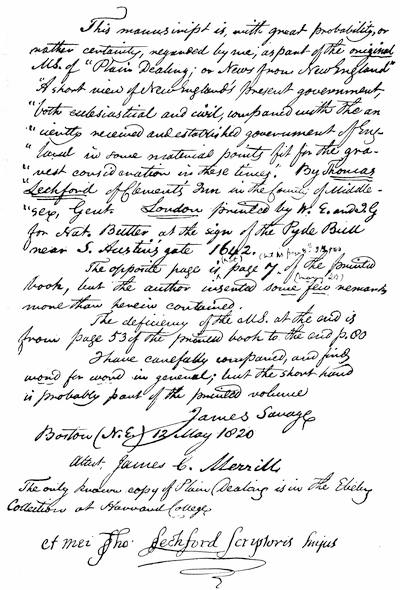
One of the most interesting and authentic of the early narratives relating to the colony is Thomas Lechford’s Plain Dealing, London, 1642. Lechford came over here in 1638, arriving June 27, and he embarked for home Aug. 3, 1641. He was a lawyer by profession, and he came here with friendly feelings toward the Puritan settlement. But lawyers were not wanted in the colony. He was looked upon with suspicion, and could barely earn a living for his family. He did some writing for the magistrates, and transcribed some papers for Nathaniel Ward, the supposed author of the Body of Liberties, to whom he may have rendered professional aid in that work. He prepared his book for the press soon after his return home. It is full of valuable information relating to the manners and customs of the colony, written by an able and impartial hand.[589]
To the leading men in the colony, religion, or their own notion concerning religion, was the one absorbing theme; and they sought to embody it in a union of Church and State. In this regard John Cotton[590] seems to have been the mouthpiece of the community. He came near losing his influence at the time of the Antinomian controversy but by judicious management he recovered himself. He was not averse to discussion, had a passion for writing, and his pen was ever active. The present writer has nearly thirty of Cotton’s books,—the Carter-Brown Catalogue shows over forty,—written in New England, and sent to London to be printed. Some of these were in answer to inquiries from London concerning their church estate, etc., here, and were intended to satisfy the curiosity of friends, as well as to influence public opinion there. Cotton had a long controversy with Roger Williams relating to the subject of Williams’s banishment from this colony. Another discussion with him, which took a little different form, was the “Bloudy Tenet” controversy, which had another origin, and in which the question of persecution for conscience’ sake was discussed. Williams, of course, here had the argument on the general principle. Cotton was like a strong man struggling in the mire.[591] Cotton’s book on the Keyes of the Kingdom of Heaven shows his idea of the true church polity. His answer to Baylie’s Dissuasive in The Way of the Congregational Churches Cleared is really a valuable historical book, in which, incidentally, he introduces information concerning persons and events which relate to Plymouth as well as to Massachusetts. This book furnished to the present writer the clew to the fact that John Winthrop was the author of the principal part of the contents of Welde’s Short Story, published in London in 1644, relating to the Antinomian troubles and Mrs. Hutchinson. The Rev. Thomas Hooker, of Hartford, entered with Cotton into the church controversy. His Survey of the Summe of Church Discipline, etc., written in answer to Rutherford, Hudson, and Baylie, Presbyterian controversialists, was published within the same cover with Cotton’s book last cited, and one general titlepage covered both, with the imprint of London, 1648.
Well known among Cotton’s other productions is his Milk for Babes, drawn out of the Breasts of both Testaments, chiefly for the Spiritual Nourishment of Boston Babes in either England, but may be of like Use for any Children, London, 1646.[592]
The discussion of Cotton and others having confirmed the colony in its church polity,—“From New England,” says Baylie, writing in London in 1645, “came Independency of Churches hither, which hath spread over all parts here,”—it was thought best to embody the system in a platform. So a synod was called for May, 1646, which by sundry meetings and adjournments completed the work in August, 1648. The result was the famous “Cambridge Platform,” which continued the rule of our ecclesiastical polity, with slight variations, till the adoption of the constitution of 1780. It was printed at Cambridge, in 1649, by Samuel Green,—probably his first book,—and was entitled A Platform of Church Discipline, etc. A copy of the printed volume was sent over to London by John Cotton (who probably had the largest agency in preparing the work)[593] to Edward Winslow, then in England, who procured it to be printed in 1653, with an explanatory preface by himself.[594]
The important political union of the New England colonies, or a portion of them, in 1643, has been already referred to. The Articles of Confederation were first printed in 1656 in London, prefixed to Governor Eaton’s code of laws entitled New Haven’s Settling in New England,[595] to be mentioned further on.
The trouble of Massachusetts with Samuel Gorton was brought about by the unwarrantable conduct of the colony towards that eccentric person. Gorton appealed to England, and Edward Winslow, the diplomatist of Plymouth and Massachusetts, was sent over to defend the Bay colony. Gorton’s Simplicitie’s Defence, published in London in 1646, was answered by Winslow’s Hypocrasie Unmasked, issued the same year. This was reissued in 1649, with a new titlepage, called The Danger of tolerating Levellers in a Civill State, the Dedication to the Earl of Warwick, in the former issue, being omitted.[596]
Winslow had his hands full, about this time, in defending Massachusetts. The colony was never without a disturbing element in its own population, and about the time of the trouble with Gorton a number of influential persons who held Presbyterian views of church government were clamorous for the right of suffrage, which was denied them. The controversy of the Government with Dr. Robert Child, Samuel Maverick, and others, in 1646, need not be repeated here. An appeal was made to England. Child and some of his associates went thither, and published a book in 1647, in London, called New England’s Jonas cast up at London, edited by Child’s brother, Major John Child, whose name appears upon the titlepage. A postscript comments unfavorably on Winslow’s Hypocrasie Unmasked. This book was replied to by Winslow in a tract called New England’s Salamander Discovered, etc., London, 1647. These books are important as illustrating Massachusetts history at this period.[597]
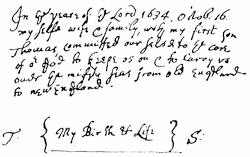
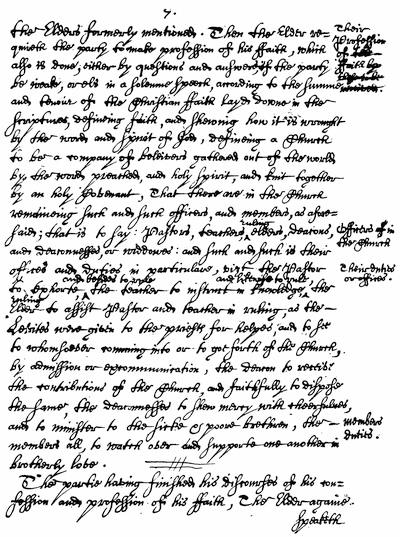
SHEPARD’S AUTOBIOGRAPHY.
[A fac-simile of the opening of the little book, which contains Thomas Shepard’s autobiography, now the property of the Shepard Memorial Church in Cambridge.—Ed.]
During this visit of Winslow to England, from which he never returned to New England, he performed a grateful service in behalf of the natives. By his influence a corporation was created by Parliament, in 1649, for propagating the gospel among the Indian tribes in New England, and some of the accounts of the progress of the missions, sent over from the colony, were published in London by the corporation. The conversion of the natives was one object set forth in the Massachusetts charter; and Roger Williams had, while a resident of Massachusetts and Plymouth, taken a deep interest in them, and in 1643, while on a voyage to England, he drew up A Key unto the Language of America,[598] published that year in London. In that same year there was also published in London a small tract called New England’s First-Fruits, first in respect to the college, and second in respect to the Indians.[599] Some hopeful instances of conversion among the natives were briefly given in this tract. In 1647 a more full relation of Eliot’s labors was sent over to Winslow, who the year before had arrived in England as agent of Massachusetts, and printed under the title, The Day breaking, if not the Sun rising, of the Gospel with the Indians in New England. In the following year, 1648, a narrative was published in London, written by Thomas Shepard, called The Clear Sunshine of the Gospel breaking forth upon the Indians, etc., and this in 1649 was followed by The Glorious Progress of the Gospel amongst the Indians in New England, setting forth the labors of Eliot and Mayhew. The Rev. Henry Whitfield, who had been pastor of a church in Guilford, Conn., returned to England in 1650; and in the following year he published in London The Light appearing more and more towards the Perfect Day, and in 1652, Strength out of Weakness, both containing accounts, written chiefly by Eliot, of the progress of his labors. This last tract was the first of those published by the Corporation, which continued thenceforth, for several years, to publish the record of the missions as they were sent over from the colony. In 1653 a tract appeared under the title of Tears of Repentance, etc.; in 1655, A late and further Manifestation of the Progress of the Gospel, etc.; in 1659, A further Accompt, etc.; and in 1660, A further Account still.[600] Eliot’s literary labors in behalf of the Massachusetts Indians culminated in the translation of the Bible into their dialect, and its publication through the Cambridge press. The Testament was printed in 1661, and the whole Bible in 1663; and second editions of each appeared,—the former in 1680, and the latter in 1685.[601]
Eliot was imbued with the enthusiasm of the time. As John Cotton had deduced a body of laws from the Scriptures, which he offered to the General Court for the colony, so in like manner Eliot drew from the Scriptures a frame of government for a commonwealth. It was entitled The Christian Commonwealth; or, the Civil Polity of the Rising Kingdom of Jesus Christ, which he sent to England during the interregnum, and commended to the people there. He had drawn up a similar form for his Indian community, and had put it in practice. His manuscript, after slumbering for some years, was printed in London in 1659, and some copies came over to the colony. The Restoration soon followed. Eliot had in his treatise reflected on kingly government, and in May, 1661, the General Court ordered the book to be totally suppressed; and all persons having copies of it were commanded either to cancel or deface the same, or deliver them to the next magistrate. Eliot acknowledged his fault under his own hand, saying he sent the manuscript to England some nine or ten years before. Hutchinson, commenting on this whole proceeding, says, “When the times change, men generally suffer their opinions to change with them, so far at least as is necessary to avoid danger.” How many copies of the book were destroyed by this order of the court, we cannot tell. A few years ago the only copy known was owned by Colonel Thomas Aspinwall, then residing in London; and from this copy a transcript was made, and it was printed in 1846 in 3 Mass. Hist. Coll., ix. 129.[602]
Eliot was not the only distinguished citizen whose book came under the ban of the Massachusetts authorities. William Pynchon, of Springfield, wrote a book which was published in London in 1650, entitled The Meritorious price of our Redemption, etc., copies of which arrived in Boston during the session of the General Court in October of that year. The Court immediately condemned it, and ordered it to be burned the next day in the market-place, which was done; and Mr. Norton was asked to answer it. Norton obeyed, and the book he wrote was ordered to be sent to London to be published. It was A Discussion of that Great Point in Divinity, the Sufferings of Christ, etc., 1653. Pynchon in the mean time was brought before the Court, and was plied by several orthodox divines. He admitted that some points in his book were overstated, and his sentence was postponed. Not liking his treatment here he went back to England in 1652, and published a reply to Norton in a work with a title similar to that which gave the original offence, London, 1655. Pynchon held that Christ did not suffer the torments of hell for mankind, and that he bore not our sins by imputation. A more full answer to Norton’s book was published by him in 1662, called the Covenant of Nature.[603]
John Winthrop died March 26, 1649. No man in the colony was so well qualified as he, either from opportunity or character, to write its history. Yet he left no history. But he left what was more precious,—a journal of events, recorded in chronological order, from the time of his departure from England in the “Arbella,” to within two months of his death. This Journal may be called the materials of history of the most valuable character. The author himself calls it a “History of New England.” From this, for the period which it covers, and from the records of the General Court for the same period, a history of the colony for the first twenty years could be written. For over one hundred years from Winthrop’s death no mention is made of his Journal. Although it was largely drawn upon by Hubbard in his History (1680), and was used by Cotton Mather in his Magnalia, it was cited by neither, and was first mentioned by Thomas Prince on the cover of the first number of the second volume of his Annals, in 1755. Among his list of authorities there given, he mentions “having lately received” this Journal of Governor Winthrop. Prince made but little use of this manuscript, as the three numbers only which he issued of his second volume ended with Aug. 5, 1633. Prince probably procured the Journal from the Winthrop family in Connecticut. It was in three volumes. The first and second volumes were restored to the family, and were published in Hartford in 1790, in one volume, edited by Noah Webster.[604] The third volume was found in the Prince Library, in the tower of the Old South Church, in 1816, and was given to the Massachusetts Historical Society. It was published, together with volumes one and two, in 1825 and 1826, in two volumes, edited by James Savage.[605] Volume two of the manuscript was destroyed by a fire which, Nov. 10, 1825, consumed the building in Court Street, Boston, in which Mr. Savage had his office.[606]
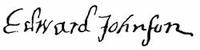
The earliest published narrative—we can hardly call it a history—relating generally to Massachusetts, is Edward Johnson’s “Wonder-Working Providence of Sion’s Saviour in New England,”—the running title to the book, which on the titlepage is called a History of New England, etc., London, 1654. The book does not profess to give an orderly account of the settlement of New England, or even of Massachusetts, to which it wholly relates, but describes what took place in the colony under his own observation largely, and what would illustrate “the goodness of God in the settlement of these colonies.” The book is supposed to have been written two or three years only before it was sent to England to be published. It is conjectured that the titlepage was added by the publisher.[607] The book has a value, for it contains many facts, but its composition and arrangement are bad.[608]
The Quaker episode produced an abundant literature. Several Rhode Island Baptists had previously received rough usage here; and Dr. John Clarke, one of the founders of Rhode Island, who had a personal experience to relate, published in London, in 1652,—whither he had gone with Roger Williams the year before,—a book against the colony, called Ill-Newes from New-England, or a Narrative of New-England’s Persecution, etc.[609]
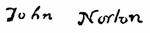
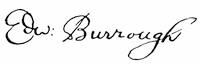
In 1654, two years before the Quakers made their appearance, the colony passed a law against any one having in his possession the books of Reeve and Muggleton, “the two Last Witnesses and True Prophets of Jesus Christ,” as they called themselves. Some of the books of these fanatics had been printed in London in 1653, and had made their way to the colony, and the executioner was ordered to burn all such books in the market-place on the next Lecture day. In 1656 the Quakers came and brought their books, which were at once seized and reserved for the fire; while sentence of banishment was passed against those who brought them. The Quakers continued to flock to the colony in violation of the law now passed against them. They were imprisoned, whipped, and two were hanged in Boston in October, 1659, one in June, 1660, and one in March, 1661. Some of the more important books which the Quaker controversy brought forth must now be named. An account of the reception which the Quakers met with here soon found its way to London, and to the hands of Francis Howgill, who published it with the title, The Popish Inquisition Newly Erected in New England, etc., London, 1659. Another tract appeared there the same year as The Secret Works of a Cruel People Made Manifest. In the following year appeared A Call from Death to Life, letters written “from the common goal of Boston” by Stephenson and Robinson (who were shortly after executed); and one “written in Plymouth Prison” by Peter Pearson, a few weeks later, giving an account of the execution of the two former. In October, 1658, John Norton had been appointed by the Court to write a treatise on the doctrines of the Quakers, which he did, and the tract was printed in Cambridge in 1659, and in London in 1660, with the title, The Heart of New England Rent at the Blasphemies of the Present Generation. After three Quakers had been hanged, the colony, under date of Dec. 19, 1660, sent an “Humble Petition and Address of the General Court ... unto the High and Mighty Prince Charles the Second,” defending their conduct. This was presented February 11, and printed, and was replied to by Edward Burroughs in an elaborate volume, which contains a full account of the first three martyrs. This was followed this year, 1661, by a yet more important volume, by George Bishope, called New England Judged, in which the story of the Quaker persecution from the beginning is told. Bishope lived in England, and published in a first volume the accounts and letters of the sufferers sent over to him. A second volume was published in 1667, continuing the narrative of the sufferings and of the hanging of William Leddra, in March, 1661. A general History of the Quakers was written by William Sewel, a Dutch Quaker of Amsterdam, published there in his native tongue, in 1717, folio. Sewel’s grandfather was an English Brownist, who emigrated to Holland. The book was translated by the author himself into English, and published in London in 1722.[610] Joseph Besse’s book,—A Collection of the Sufferings of the People called Quakers, for the Testimony of a Good Conscience, 1753,—contains a mass of most valuable statistics about the Quakers. Hutchinson’s History of Massachusetts Bay has an excellent summarized account, as do the histories of Dr. Palfrey and Mr. Barry.[611]
The records of the colony, as I have frequently had occasion to observe, afford the richest materials for the colony’s history, and never more so than in regard to the trials which the colony experienced from the period following the Restoration to the time of Dudley and Andros. The story of the visit of the royal commissioners here in 1665 is no where so fully told as there. Indeed, the principal source of the history of Maine and of New Hampshire while they were for many years a component part of the colony of Massachusetts is told in the records of the old Bay State.
During the trouble with the Quakers Massachusetts was afflicted by a wordy controversy, imported from Connecticut, but which did not reach its culminating point till 1662. I refer to the “Half-way Covenant,” for the discussion of which a council of ministers from both colonies was called in 1657, in Boston, which pronounced in favor of the system in question. A synod of Massachusetts churches in 1662 confirmed the judgment here given, and the Half-way Covenant system prevailed extensively in New England for more than a century. After the synod was dissolved, and the result was published by order of the General Court, the discussion continued, and several tracts were issued from the Cambridge press, pro and con, in 1662, 1663, and 1664.[612] Of Morton’s New England’s Memorial mention has already been made in the preceding chapter, as it concerns chiefly the Plymouth Colony. It contains, however, many things of interest about Massachusetts; recording the death of many of her worthies, and embalming their memories in verse. It ends with the year 1668, with a notice of the death of Jonathan Mitchel, the minister of Cambridge, and of that of John Eliot, Jr., the son of the apostle, at the age of thirty-two years. There are five unpaged leaves after “finis,” containing “A Brief Chronological Table.”
There was printed in London in 1674 An Account of Two Voyages to New England, by John Josselyn, Gent., a duodecimo volume of 279 pages. This author and traveller was a brother of Henry Josselyn, of Black Point, or Scarborough, in Maine, and they are said to have been sons of Sir Thomas Josselyn, of Kent, knight. John came to New England in 1638, and landed at Noddle’s Island, and was a guest of Samuel Maverick; thence he went to Scarborough, stayed with his brother till the end of 1639, and then returned home. In 1663 he came over again, and stayed till 1671; and then went home and wrote this book. His own observations are valuable, but his history is often erroneous. He frequently cites Johnson. At the end of his book is a chronological table running back before the Christian era. His New England’s Rarities, published in 1672, giving an account of the fauna and flora of the country, has been reprinted with notes in the American Antiquarian Society’s Transactions, vol. iv., edited by Edward Tuckerman.[613]
The interest of John Ogilby’s large folio on America is almost solely a borrowed one, so far as concerns New England history, arising from the use he made of Wood, Johnson, and Gorges.[614]
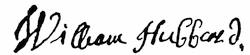
The modern student will find a very interesting series of successive bulletins, as it were, of the sensations engendered by the progress of the Indian outbreak of 1675-76, known as “Philip’s War,” and of the events as they occurred, in a number of tracts, mostly of few pages, which one or more persons in Boston sent to London to be printed. They are now among the choicest rarities of a New England library.[615] It was to make an answer to one of these tracts that Increase Mather hastily put together and printed in Boston,[616] in 1676, his Brief History of the War, which was reprinted in London in the same year.[617] The year after (1677) the war closed,[618] Foster, the new Boston printer, also printed William Hubbard’s Narrative of the Troubles with the Indians, which likewise came from the London press the same year with a changed title, The Present State of New England, being a Narrative, etc.,—a book not, however, confined to Philip’s War, but going back, as the Boston title better showed, over the whole series of the conflicts with the natives.[619]
In the year 1679 it became known to the members of the General Court that the Rev. William Hubbard, of Ipswich, had compiled a History of New England, and in June of that year they ordered that the Governor and four other persons be a committee “to peruse the same,” and make return of their opinion thereof by the next session, in order “that the Court may then, as they shall then judge meet, take order for the impression thereof.” Two years afterward, in October, the Court thankfully acknowledged the services of Mr. Hubbard in compiling his History, and voted him fifty pounds in money, “he transcribing it fairly into a book that it may be the more easily perused.” There was no further movement made for the printing of the volume. The transcript made agreeably to this order is now in the Library of the Massachusetts Historical Society. The preface and some leaves of the text are wanting. This was by far the most important history of New England which had then been written. The compiler had the benefit of Bradford’s History and Winthrop’s Journal, though, after the fashion of the time, he makes no mention of them, only acknowledging in a general way his indebtedness to “the original manuscripts of such as had the managing of those affairs under their hands.” The manuscript was first printed in 1815 by the Massachusetts Historical Society; and a second edition, “collated with the original MS.,” was printed in 1848.[620]
The history of the struggles of the colony to maintain its charter during the period immediately preceding the loss of it is largely told in the pages of its records, and in a large mass of documents published in Hutchinson’s volume of Papers, and cited in Chalmers’ Annals and in Palfrey’s New England. Reference may also be made to a paper by the present writer in vol. i. of Memorial History of Boston, on this struggle to maintain the charter.
The history of the Dudley and Andros administrations may be gathered from numerous publications which came from the press just after the Revolution; and, without mentioning their titles, I cannot do better than refer to them as published in three volumes by the Prince Society of Boston, called the Andros Tracts, edited with abundant notes by William H. Whitmore.[621] Palfrey’s History should be read in connection with these memorials. The original papers of the “Inter-charter Period” are largely wanting, though some volumes of the Massachusetts Archives are so entitled.[622]
As materials for the history of the State it should be remembered that there are many town histories which contain matter of more than mere local interest. The history of the town of Boston is in a great degree the history of the colony and State, and the several histories of that town, notably those by Caleb H. Snow (to 1825) and Samuel G. Drake (to 1770), and the Description of N. B. Shurtleff,[623] may be specially mentioned; while the recently published Memorial History of Boston, edited by Mr. Justin Winsor, is indispensable to any student who wishes to know a large part of the story of Massachusetts.[624] The History of Salem, by Dr. J. B. Felt, gives many documents of the first importance relating to the settlement of that ancient town, where the colony had its birth; and the same writer’s Customs of New England, Boston, 1853, has a distinctive value.
The Bibliography of the Local History of Massachusetts, by Jeremiah Colburn, Boston, 1871, a volume of 119 pages, deserves a place in every New England library,[625] and it may be supplemented by the brief titles included in Mr. F. B. Perkins’s Check List of American History.[626] There is a good list of local histories in the Brinley Catalogue, no. 1,558, etc. The Sketches of the Judicial History of Massachusetts, by the late Emory Washburn, is a most important book for that phase of the subject.
Maine.[627]—The documentary history of Maine properly begins with the grant to Sir Ferdinando Gorges. The previous operations under the Laconia Company were partly, as we have seen, on the territory of Maine, while in part also their history is preserved in the archives of New Hampshire.[628]
The patent issued to Gorges at the general division, in 1635, of the territory which he named “New Somersetshire,” is not extant. An organization, as we have already said, took place under this grant, and a few records are extant in manuscript.[629]
The royal charter of Maine, dated April 3, 1639, was transcribed into a book of records of the Court of Common Pleas and Sessions for the county of York, and, with the commissions to the officers, has been printed by Sullivan in his History of Maine, Boston, 1795, Appendix No. 1.
The first government organized under the charter[630] was in 1640, and the manuscript records are also at Alfred with the commissions to the officers. Extracts from the records were made by Folsom, as above, pp. 53-57. After the submission of Maine to Massachusetts in 1653, courts were held at York under the authority of the latter. Afterward, when the royal commissioners came over and went into Maine, a portion of the inhabitants were encouraged to rebel against the authority of Massachusetts, and courts were temporarily set up under a commission from Sir Robert Carr. Some records of their doings exist.[631]
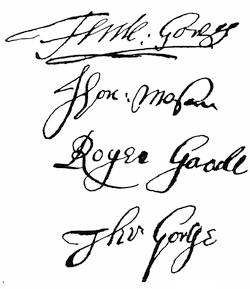
AUTOGRAPHS.
[Mason was the proprietor of New Hampshire. Mr. C. W. Tuttle was engaged at his death on a memoir of Mason, upon whom he delivered addresses, reported in the Boston Advertiser, June 22, 1871, and Boston Globe, April 4, 1872. Garde was the mayor of Gorgeana. Thomas Gorges was the deputy-governor of Maine.—Ed.]
The Records of Massachusetts for the years 1652-53 show the official relations which existed between the two colonies. The State-paper offices of England contain a large quantity of manuscripts illustrating the claims of Ferdinando Gorges, the grandson of the original proprietor; and the principal part of these may be seen either in abstracts, or at full length in Folsom’s Catalogue of Original Documents[632] relating to Maine (New York, 1858), prepared by the late H. G. Somerby.[633] Many of these papers may also be found in Chalmers’ Annals, 1780, who had great facilities for consulting the public offices in England.[634]
Of general histories of Maine, the earliest was that of James Sullivan, entitled The History of the District of Maine, Boston, 1795, the territory having been made a Federal district in 1779. Judge Sullivan was too busy a man to write so complicated a history as that of Maine; and he fell into some errors, and came short of what would be expected of a writer at the present day. He was one of the founders and at that time president of the Massachusetts Historical Society, and doubtless felt the obligation to do some such work. The next important History of Maine is that of Judge William D. Williamson, published at Hallowell, 1832, in two volumes. This contains a vast amount of material indispensable to the student; but there are serious errors in the work, made known by the discovery of new matter since its publication. In 1830 there was published at Saco, Maine, a small 12º volume, by George Folsom,[635] called History of Saco and Biddeford, with Notices of other Early Settlements, etc. Although a history of two comparatively small towns, now cities, yet they were early settlements; and the author, who had a faculty for history, made his work the occasion of writing a brief but authentic sketch of the history of Maine under all her multiform governments and varying fortunes. It was the best town history then written in New England, as it was also the best history of the Province of Maine..
I might mention a volume of Sketches of the Ecclesiastical History of Maine from the Earliest Period, by the Rev. Jonathan Greenleaf of Wells, published at Portsmouth, 1821.
In 1831-33 William Willis published his History of Portland, in two parts. The work embraced also sketches of several other towns, and it was prefaced by an account of the early patents and settlements in Maine; while the second edition, issued in 1865, is yet more full on the general history of the province.
There are other valuable town histories, and I cannot do better than refer the reader to Mr. William Willis’s “Descriptive Catalogue of Books relating to Maine,” in Norton’s Literary Letter, No. 4, for 1859, and as enlarged in Historical Magazine, March, 1870.[636]
The Collections of the Maine Historical Society,[637] in eight volumes, contain a large amount of material which illustrates this early period. The first volume was issued in 1831, and in fact forms the first part of Willis’s History of Portland. The Collections of the Massachusetts Historical Society, and especially vol. vii. of the fourth series, should be cited as of special interest here.
The Relation of the Council for New England, the narratives in Purchas, Winthrop’s Journal, Hubbard’s Indian Wars, and that author’s History of New England and the Two Voyages of Josselyn, have already been referred to, and they should be again noted in this place, as should Dr. Palfrey’s History of New England especially. Gorges’ Briefe Narration, 1658, is most valuable as coming from the original proprietor himself. Its value is seriously impaired by its want of chronological order and of dates, and by its errors in date. In what condition the manuscript was left by its author, and to what extent the blemishes of the work are attributable to the editor or the printer, can never be known. Sir Ferdinando died in May, 1647. The work was written not long before his death, and was published some twelve years afterward, with two compilations by his grandson and the sheets of Johnson’s Wonder-Working Providence.[638] Notwithstanding its blemishes, the tract has great value; but it should be read in connection with other works which furnish unquestionable historical data.
The Memorial Volume of the Popham Celebration, Aug. 20, 1862 (Portland, 1862), contains a good deal of historical material; but a large part of it was, unfortunately, prepared under a strong theological and partisan bias. In its connection with the settlement at Sabino, it has been mentioned in an earlier chapter.
A valuable historical address was delivered at the Centennial Exhibition at Philadelphia, Nov. 4, 1876, by Joshua L. Chamberlain, President of Bowdoin College, entitled Maine, Her Place in History, and was published in Augusta in 1877.
New Hampshire.—New Hampshire was probably first settled by David Thomson, in the spring of 1623. The original sources of information concerning him are the Records of the Council for New England; a contemporaneous indenture, 1622, recently found among the Winthrop Papers, and since published; Winslow’s Good News, London, 1624, p. 50; Bradford’s Plymouth Plantation, p. 154; Hubbard’s New England, pp. 89, 105, 214, 215; Levett’s Voyage[639] to New England in 1623/24; Pratt’s Narrative, in 4 Mass. Hist. Coll., iv. 486, and Gorges’ Briefe Narration, p. 37. All these authorities are summarized by the present writer in a note, on page 362 of Mass. Hist. Soc. Proc., May, 1876, to a paper on “David Thomson and the Settlement of New Hampshire.”
For the settlement of the Hiltons on Dover Neck, and for the later history of the town, see Records of the Council; Hubbard; a Paper on David Thomson in Mass. Hist. Soc. Proc., as above; 1 Mass. Hist. Coll., iii. 63; Provincial Papers of New Hampshire, i. 118, and the authorities (A. H. Quint and others) there cited; cf. Mr. Hassam’s paper in N. E. Hist. and Geneal. Reg., January, 1882, p. 40; Winthrop’s Journal, i. 276.
For the doings of the Laconia Company, and the settlement of Portsmouth, see Belknap’s New Hampshire, who errs respecting the Laconia patent and the date of the operations of the Company; Hubbard as above; Provincial Papers, where the extant Laconia documents are printed at length; Jenness’s Isles of Shoals, 2d ed., New York, 1875, and his privately printed (1878) Notes on the First Planting of New Hampshire; the paper on David Thomson, as above; Adams’s Annals of Portsmouth; N. E. Hist. and Geneal. Reg., ii. 37.
For the history of the settlements of Exeter and Hampton see Belknap, as above; and cf. Farmer’s edition, who holds to the forgery of the Wheelwright deed of 1629; Provincial Papers as above, pp. 128-153. For a discussion of the genuineness of the Wheelwright deed, it will be sufficient, perhaps, to refer to Mr. Savage’s argument against it in Winthrop’s Journal, i. Appendix, which the present writer thinks unanswerable, and Governor C. H. Bell’s able defence of it in the volume of the Prince Society on John Wheelwright.[640]
Concerning the several patents issued by the Council to cover the territory of New Hampshire, or parts of it, which afterward appeared in history, one was made to John Mason, of Nov. 7, 1629, of territory between the Merrimac and Piscataqua, which, “with consent of the Council, he intends to name New Hampshire” (Mason was governor of Portsmouth co. Hants). This grant[641] was printed in Hazard, vol. i., from “New Hampshire files,” and is in Provincial Papers, i. 21. The Laconia grant of Nov. 17, 1629, to Gorges and Mason, was the basis of a trading company, as we have already seen, and those associates took out a new patent, Nov. 3, 1631, of land near the mouth of the Piscataqua. The Laconia patent is in Massachusetts Archives, and is printed in Provincial Papers, i. 38. The second grant is printed in Jenness’s Notes, above cited, Appendix ii. Hilton’s patent of Dover Neck, or wherever it may have extended, of March 12, 1629/30, is cited in the Council Records, and is printed in extenso in Jenness’s Notes, Appendix i., which also should be read for a discussion relative to its boundaries.[642] At the grand division in 1635 Mason had assigned to him the territory between Naumkeag and Piscataqua, dated April 22, “all which lands, with the consent of the Counsell, shall from henceforth be called New Hampshire.” Hazard (i. 384) printed the grant from the “records of the Province of Maine,” and it is also printed in Provincial Papers, i. 33. Mason never improved this grant. All his operations in New Hampshire, or Piscataqua, as the place was called, was as a member of the unfortunate Laconia Company. He died soon after this last grant was issued, and bequeathed the property ultimately to his grandchildren John and Robert Tufton, whose claims were used to annoy the settlers on the soil who had acquired a right to their homesteads by long undisputed possession.[643]
After the union of the New Hampshire towns with Massachusetts, their history forms part of the history of that colony, and the General Court Records may be consulted for information. John S. Jenness’s Transcripts of Original Documents in the English Archives relating to New Hampshire, privately printed, New York, 1876, is a volume of great value. An early map of Maine and New Hampshire, of about the period of 1655, is prefixed to the book. The Appendix to Belknap’s New Hampshire also contains documents of great value. The Collections of the New Hampshire Historical Society, consisting of eight volumes, 1824-1866, are rich in material relating to the State; and the three volumes of Collections published by Farmer and Moore,[644] 1822-1824, in semi-monthly and then in monthly numbers, should not be overlooked; nor should the Collections of the Massachusetts Historical Society.
Of the general histories, that of Dr. Belknap is the first and the only considerable History of New Hampshire, Philadelphia and Boston, 1784-92, 3 vols. The work early acquired the name of “the elegant History of New Hampshire,” which it deserved. As a writer, Dr. Belknap’s style was simple and “elegant.” Perhaps after Franklin he was the best writer of English prose which New England had produced; and there has been since little improvement upon him. He had the true historical spirit, and was a good investigator.[645] He fell into an error respecting some of the early grants of New Hampshire, and the early part of his History needs revision. He probably never doubted the genuineness of the Wheelwright deed; but John Farmer, the editor of a new edition (1831) of his work, believed that document to be a forgery, and made his book to conform to this idea, though other errors were not corrected. Palfrey’s New England is of the first authority here after Belknap.[646]
Connecticut.—“Quinni-tuk-ut, ‘on long river,’—now Connecticut,—was the name of the valley, or lands on both sides of the river. In one early deed (1636) I find the name written Quinetucquet; in another of the same year, Quenticutt.”[647]
The name “Connecticut,” as designating the country or colony on the river of that name, was used by Massachusetts in their commission of March 3, 1635/36,[648] and it was early adopted by the colonists.[649]
Quinnipiac,—the Indian name of New Haven, written variously, and by President Stiles, on the authority of an Indian of East Haven, Quinnepyooghq,—is probably “longwater place.”[650] The name New Haven was substituted by the Court Sept. 5, 1640.[651]
The first English settlement was made by the Plymouth people at Windsor in October, 1633, when they sent out a barque with materials for a trading-house, and set it up there against the remonstrances of the Dutch, who had themselves established a trading-house at Hartford some time before.[652] The history of this business is well told by Bradford (pp. 311-314), with whose narrative compare Winthrop (pp. 105, 181) and Hubbard (pp. 170, 305 et seq.).
The story of the settlement of the three towns on the Connecticut River by emigrants from Massachusetts is told by Winthrop, passim, and by Trumbull; and the Records of Massachusetts show the orders passed in relation to their removal, and define their political status during the first year of the settlement, and indeed to a later period. The Connecticut Colonial Records give abundant information as to their political relations until the arrival of the Winthrop charter of 1662, when, after some demurring on the part of New Haven, the two small jurisdictions were merged into one.[653] A spirited letter from Mr. Hooker to Governor Winthrop of Massachusetts, written in 1638, disclosing his suppressed feelings towards some in the Bay Colony for alleged factious opposition to the emigration to Connecticut, may be seen in Conn. Hist. Soc. Coll., i. 3-18. What is called the original Constitution of Connecticut, adopted by the three towns Jan. 14, 1638/39, may be seen in the printed Colonial Records, i. 20-25.[654]
The story of John Winthrop’s second arrival from England, in October, 1635, with a commission from Lord Say and Sele, and Lord Brook and others, and with £2,000 in money, to begin an independent settlement and erect a fortification near the mouth of the Connecticut River, and to be governor there for one year, is told in Winthrop’s Journal (i. 170, 173); and is repeated in full by Trumbull, vol. i. Possession was taken in the following month. The patent to Lord Say and others, which was the basis of this movement, is known as the “old patent of Connecticut,” and may be seen, with Winthrop’s commission, in Trumbull’s History, vol. i., both editions. It purports to be a personal grant from the Earl of Warwick, then the President of the Council for New England, bearing date March 19, 1631 (1632 N.S.). Although the authority by which the grant is made is not given in the document itself, as is usually the case, it has been confidently asserted that the Earl of Warwick had received the previous year a patent for the same territory from the Council for New England, which was subsequently confirmed by the King.[655] The grant was interpreted to convey all the territory lying west of the Narragansett River, one hundred and twenty miles on the Sound, thence onward to the South Sea.[656]
The first and second agreements with Fenwick, the agent of the proprietors, dated Dec. 5, 1644, and Feb. 17, 1646, were first printed by Trumbull.[657] The account of Fenwick’s arrival in the colony, in 1639, with his family, and his settlement, and the naming of Saybrook, may be seen in Winthrop.[658]
The “Capital Laws,” established by Connecticut, Dec. 1, 1642, the first “Code of Laws,” and the court orders, judgments, and sentences of the General and Particular Courts, from 1636 to 1662, are printed in Connecticut Colonial Records.[659]
The contemporaneous accounts of the Pequot War have already been mentioned under “Massachusetts.” What relates specially to Connecticut is largely told in the Colonial Records. Mason’s narrative is by far the best of the original accounts which have been published. The dispute with Massachusetts respecting the division of the conquered territory; the allotments of the same to the soldiers; the account of the younger Winthrop’s settlement in the Pequot country, and his claim to the Nehantick country by an early gift of Sashions, not allowed by the United Colonies,—may be seen in the records of Massachusetts and Connecticut, and in the records of the United Colonies.[660]
The account of the settlement of New Haven by emigrants from Massachusetts—indirectly from the city of London,—in 1638; of their purchases of lands from the natives, and of the formation of their government,—church and civil,—may be seen in Winthrop,[661] and in New Haven Colonial Records.[662]
The Fundamental Articles, or Original Constitution, of the Colony of New Haven, June 4, 1639, which continued in force till 1665, was printed in Trumbull’s History, vol. i., in 1797, in Appendix, no. iv., as also in the later edition, and in the Colonial Records, i. 11-17, in which volume the legislative and judicial history of the colony is recorded for many years. The orders of the General Court, the civil and criminal trials before the Court of Magistrates, with the evidence spread out on the pages of the record, and the sentences following, being, in criminal cases, based on the Laws of Moses, furnish an unpleasant exhibition; perhaps not more so, however, than other primitive colonies would have shown if their record of crimes had been as well preserved. From April, 1644, to May, 1653, the Records of New Haven jurisdiction are lost.
What is known as Governor Eaton’s[663] Code of Laws was sent to London to be printed under the supervision of Governor Hopkins, who had returned to England a few years before; and an edition of five hundred copies appeared in 1656, under the title of New Haven’s Settling in New England, etc. The code was first reprinted by Mr. Royal R. Hinman, at Hartford, in 1838, in a volume entitled The Blue Laws of New Haven Colony, usually called Blue Laws of Connecticut, Quaker Laws of Plymouth and Massachusetts, etc.; and again, in 1858, at the end of the second volume of New Haven Records, from a rare copy in the Library of the American Antiquarian Society.[664] The “Articles of Confederation” of the United Colonies of 1643, whose records are a mine of history in themselves, were prefixed to this code, and were here printed for the first time. The Records were first printed by Hazard in 1794, from the Plymouth copy, and they have more recently been reprinted by the State of Massachusetts in a volume of the Plymouth Records. Each colony had a copy of those records, but the only ones preserved are those of Plymouth and of Connecticut. The latter, containing some entries wanting in the former, are printed at the end of vol. iii. of the Connecticut Colonial Records.
The Quakers gave little disturbance to either of these colonies. While the people in Connecticut were divided with the “Half-Way Covenant” controversy, the Quakers, in July, 1656, made their appearance in Boston. The United Colonies recommended the several jurisdictions to pass laws prohibiting their coming, and banishing those who should come. Connecticut and New Haven took the alarm, and acted upon the advice given. New Haven subsequently increased the penalties at first prescribed, yet falling short in severity of the legislation of Massachusetts.[665]