Chapter XII
Reading edition
THE FOUNDING OF PENNSYLVANIA.
BY FREDERICK D. STONE,
Librarian of the Historical Society of Pennsylvania.
THE founding of Pennsylvania was one of the immediate results of Penn’s connection with West Jersey; but the causes which led to the settlement of both colonies can be clearly traced to the rise of the religious denomination of which he was a distinguished member. This occurred in one of the most exciting periods of English history. The Long Parliament was in session. Events were directly leading to the execution of the King. All vestiges of the Church of Rome had been well-nigh swept away in a country in which that Church had once held undisputed sway, and its successor was faring but little better with the armies of the Commonwealth. The conflict between Presbyterians and Churchmen,—in the efforts of the former to change the Established Church, and of the latter to maintain their position,—was scarcely more bitter in spirit than the temper with which the Independents denounced all connection between Church and State. Other dissenting congregations at the same time availed themselves of a season of unprecedented religious liberty to express their views, and religious discussions became the daily talk of the people.
It was under these circumstances that the ministry of George Fox began. Born in the year 1624, a native of Leicestershire, he was from his youth noted for “a gravity and stayedness of mind and spirit not usual in children.” As he approached manhood, he became troubled about the condition of his soul, and passed through an experience similar to that which tried his contemporary, John Bunyan, when he imagined that he had sinned against the Holy Ghost. His friends had advised him to marry or to join the army; but his immediate recourse was rather to spiritual counsel. He naturally sought this from the clergymen of the Established Church, in which he had been bred; but they failed to satisfy his mind.
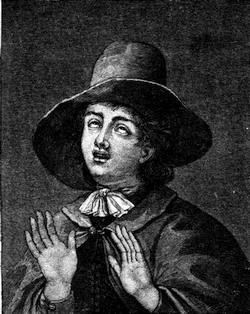
GEORGE FOX.
[This follows Holmes’s engraving of the portrait of Fox, by Honthorst, in 1654, when Fox was in his thirtieth year. This Dutch painter, if Gerard Honthorst, was born in Utrecht in 1592, was at one time in England, and died in 1660; if his brother William, he died in 1683, aged 73. The original canvas was recently offered for sale in England. A view of Swarthmore Hall, where Fox lived, is in Gay’s Popular History of the United States, ii. 173.—Ed.]
The first whom he consulted repeated to his servants what George had said, until the young man was distressed to find that his troubles were the subjects of jests with the milk-maids. Another told him to sing psalms and smoke a pipe. A third flew into a violent passion because, as the talk turned upon the birth of Christ, Fox inadvertently placed his foot upon the flower-bed. A fourth bled and physicked him. Such consolations, presented while he was earnestly seeking to comprehend the greatest question of life, disgusted him. He then turned for comfort to the Dissenters; but they, as he tells us, were unable to fathom his condition. From this time he avoided professors and teachers of all kinds. He read the Scriptures diligently, and strove, by the use of the faculties which God had given him, to understand their true meaning. He was not a man of learning, and was obliged to settle all questions as they arose by such reasonings as he could bring to bear upon them. The anguish which he experienced was terrible, and at times he was tempted to despair; but his strong mind held him to the truth, and his wonderfully clear perception of right and wrong led him step by step towards the goal of his desires. By degrees the ideas which had been taught him in childhood were put aside. It became evident to him that it was not necessary for a man to be bred at Oxford or Cambridge to become a minister of Christ; and he felt as never before the meaning of the words, “God dwelleth not in temples made with hands.” To one of his understanding such convictions seemed as revelations from Heaven. That all men are capable of receiving the same Light to guide them, and that all who would follow this Light would be guided to the same end, became his belief; and to preach this faith constituted his mission. He also felt that they who were guided by this Inner Light should be known by the simplicity of their speech and manners; that as the temples of the Lord were the hearts of his people, the ceremonies of the prevailing modes of worship were empty forms; that tithes for the support of a ministry, and taxes for the promotion of war and like measures, should not be paid by persons who could not approve of the purposes for which they were collected; and that the taking of an oath, even to add weight to testimony, was contrary to the teachings of the Scriptures.
These, in brief, were the views of the people called Quakers. That a movement so purely spiritual in its aims should have exercised a political influence seems remarkable. But the principles upon which the movement was founded claimed for the mind a perfect freedom; they counted as nought the privileges of rank, and demanded an entire separation of Church and State.
The first followers of George Fox were from the neighborhood of his own home; but his views soon spread among the yeomanry of the adjoining counties. His theology may have been crude, his grammar faulty, and his appearance ludicrous; yet there was a personal magnetism about the man which drew to him disciples from all classes.
Nothing could check the energy with which he labored, or silence the voice which is yet spoken of as that of a prophet. In his enthusiasm the people seemed to him like “fallow ground,” and the priests but “lumps of clay,” unable to furnish the seed for a harvest. Jeered at and beaten by cruel mobs, reviled as a fanatic and denounced as an impostor, he travelled from place to place, sometimes to be driven forth to sleep under haystacks, and at other times to be imprisoned as a disturber of the peace. But through all trials his faith remained unshaken, and he denounced what he believed to be the falsehoods of the times, until, as he says, the priests fled when they heard that “the man in leathern breeches is come.”
In 1654, but ten years after George Fox had begun to preach, his followers were to be found in most parts of England, Ireland, and Scotland. Notwithstanding the persecutions with which an avowal of Quakerism was met, they adhered to their convictions with a steadfastness equal to that of their leader. Imprisonment, starvation, and the lash, as the penalties of their religion, had no fears for them. Their estates were wasted for tithes and taxes which they felt it wrong to pay. Their meetings were dispersed by armed men, and all laws that could be so construed were interpreted against them. All such persecution, however, was of no avail. “They were a people who could not be won with either gifts, honors, offices, or place.” Nor is it surprising that their desire to share equally such sufferings in the cause of truth should have touched the heart of one educated in the severe school of the Commonwealth. When Fox lay in Lanceston jail, one of his people called upon Cromwell and asked to be imprisoned in his stead. “Which of you,” said Cromwell, turning to his Council, “would do so much for me if I were in the same condition?”
Satisfied in their hearts with the strength which their faith gave them, the Quakers could not rest until they had carried the glad tidings to others. In 1655, Fox tells us, “many went beyond the sea, where truth also sprung up, and in 1656 it broke forth in America and many other places.”
It has ever been one of the cardinal principles of the followers of Fox to obey the laws under which they live, when doing so does not interfere with their consciences. When this last is the case, their convictions impel them to treat the oppressive measures as nullities, not even so far recognizing the existence of such statutes as to cover their violation of them with a shadow of secrecy. It was against what Fox considered ecclesiastical tyranny that the weight of his ministry was directed. Those who lived under church government he believed to be in as utter spiritual darkness as it is the custom of Christendom to regard the other three-fourths of mankind; and it was with a feeling akin to that which will to-day prompt a missionary to carry the Bible to the wildest tribes of Africa, that the Quakers of 1656 came to the Puritan commonwealths of America.
The record of the first landing of the Quakers in this country belongs to another chapter,[775] and the historians of New England must tell the sad story, which began in 1656, of the intrusive daring for conviction’s sake which characterized the conduct of these humble preachers. In June, 1657, six of a party of eight Quakers who had been sent back to England the year previous, re-embarked for America. They were accompanied by five others, and on October 1 five of them landed at New Amsterdam. The rest remained on the vessel, and on the 3d instant arrived at Rhode Island. It was chiefly through the labors of this little band that the doctrines of the Quakers were spread through the British colonies of North America.
It was in 1661 that the first Yearly Meeting of Friends in America was established in Rhode Island, and in 1672 the government of the colony was in their hands. The Dutch of New Amsterdam did not hold as broad views of religious liberty as were entertained by their kinsfolk in Holland; but while the Quakers were severely dealt with in that city, on Long Island they were allowed to live in comparative peace. In Maryland the treatment of the Friends, severe at times, grew more and more tolerant, and when Fox visited them in 1672 he found many to welcome him; and probably the first letter from a Meeting in England to one in America was directed to that of Maryland. In Virginia the Episcopalians were less liberal than their neighbors in other provinces. The intolerance with which Dissenters were met drove many beyond her borders, and thus it was that some Friends gathered in the Carolinas.
The outbreak of the Fifth Monarchy men in 1660, immediately after the restoration of Charles II., dispelled any hopes which the Quakers might have gathered from that monarch’s proclamation at Breda, since they were suspected of being connected with that party. It is at this time that we find the first evidence that Fox and his followers wished to obtain a spot in America which they could call their own; and the desire was obviously the result of the troubles which they encountered, both in England and America. Before this was accomplished, however, the Quakers experienced many trials. In 1661 Parliament passed an Act for their punishment, denouncing them as a mischievous and dangerous people.
In 1672 Charles II. issued his second declaration regarding liberty of conscience, and comparative quiet was for a few years enjoyed by his Dissenting subjects. In 1673 Parliament censured the declaration of the King as an undue use of the prerogative. The sufferings of the Quakers were then renewed. It is unnecessary to repeat in detail the penalties inflicted under the various Acts of Parliament. Fox was repeatedly imprisoned, and many of his followers died in confinement from ill usage. In 1675 West Jersey was offered for sale. The advantages its possession would afford were at once appreciated by the men of broad views who had obtained control of the Quaker affairs. Fox favored the scheme. Some of his followers felt that to emigrate was to fly from persecution and to desert a cause; but Fox, with more wisdom, had as early as 1660 proposed the purchase of a tract of land in America. Between 1656 and 1675 he and his devoted followers were from time to time braving all kinds of danger in the propagation of their faith throughout the English colonies in America. Their wanderings often brought them into contact with the Indians, and this almost always led to the friendliest of relations.[776]
William Penn possessed more influence with the ruling class of England than did any other of the followers of Fox. His joining the Friends in 1668 is a memorable event in the history of their Society. The son of Admiral Sir William Penn, the conqueror of Jamaica, and of his wife Margaret, daughter of John Jasper, of Amsterdam, he was born in London Oct. 14, 1644, the year in which Fox began to preach to his neighbors in Leicestershire. The Admiral was active in bringing about the restoration of the Stuarts, and this, together with his naval services, gave him an influence at Court which would have enabled him to advance the interests of his son.
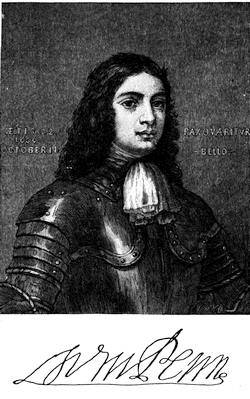
[There are papers on the portraits of Penn in Scribner’s Monthly, xii. 1, by F. M. Etting, and in the Mag. of Amer. Hist., October, 1882. Cf. also Penn. Mag. of Hist. vol. vi. pp. 174, 252. The above cut represents him at twenty-two. It follows a large private steel plate, engraved by S. A. Schoff, of Boston, with the aid of a crayon reduction by William Hunt, and represents an original likeness painted in oils in 1666 by an unknown artist, possibly Sir Peter Lely. It was one of two preserved at Stoke Poges for a long time, and this one was given in 1833 by Penn’s grandson, Granville Penn, to the Historical Society of Pennsylvania. (Catalogue of Paintings, etc., belonging to the Historical Society, 1872, no. 50.) There are other engravings of it in the Pennsylvania Magazine of History, i. 361; in Janney’s Life of Penn; in Stoughton’s William Penn; and in Watson’s Annals of Philadelphia. A portrait by Francis Place, representing Penn at fifty-two, is engraved from the National Museum copy of the original in Gay’s Popular History of the United States, ii. 487. It was discovered in England in 1874, and its story is told in Mr. Etting’s paper. There is another engraving of it in Egle’s Pennsylvania. Maria Webb’s Penns and Peningtons (1867) gives an account of a recently discovered crayon likeness. (Cf. Catalogue of Paintings, etc., belonging to the Historical Society, 1872, p. 27.) A steel engraving was issued in Germany some years since, purporting to be from a portrait by Kneller,—which is quite possible,—and this engraving is reproduced a little larger than the German one in the Mag. of Amer. Hist., October, 1882. The likeness best known is probably the one introduced by West in his well-known picture of the making of the Treaty. In this, West, who never saw Penn, seemingly followed one of the medallions or busts made by Sylvanus Bevan, a contemporary of Penn, who had a natural skill in cutting likenesses in ivory. One of these medallions is given in Smith and Watson’s American Historical and Literary Curiosities, i. pl. xv., and in the Mag. of Amer. Hist., October, 1882. Bevan’s bust was also the original of the head of the statue, with a broad-brim hat, which has stood in the grounds of the Pennsylvania Hospital since John Penn, son of the Proprietary, bought it from the estate of Lord Le Despenser at High Wycombe, and gave it to the hospital. The same head was again used as the model of the wooden bust which was in the Loganian Library, but was destroyed by fire in 1831. Proud’s History of Pennsylvania (1797) gives an engraving of it; and the likeness in Clarkson’s Life of Penn is also credited to one of Bevan’s busts. Inman’s picture, which appears in Janney’s Penn and in Armor’s Governors of Pennsylvania, is to be traced to the same source, as also is the engraving in the Encyclopædia Londiniensis.
Penn is buried in the graveyard at Jordan’s, twenty miles or so from London; and the story of an unsuccessful effort by the State of Pennsylvania to secure his remains, encased in a leaden casket, is told in The Remains of William Penn, by George L. Harrison, privately printed, Philadelphia, 1882, where is a view of the grave and an account of the neighborhood. There is a picture of the grave in the Pennsylvania Historical Society. Cf. Catalogue of Paintings, etc., belonging to the Historical Society (1872), no. 151; and Mrs. S. C. Halls article in National Magazine, viii. 109; and Mag. of Amer. Hist., October, 1882, p. 661.—Ed.]
But while a student at Oxford, the young Penn chanced to hear the preaching of Thomas Loe, a Quaker, and so impressed was he by it that he ceased to attend the religious services of his College. For this he was expelled from the University. His father, after a brief impulse of anger which this disgrace caused, sent him to Paris, and in that gay capital the impressions made by the Quaker preacher were nearly effaced. From Paris he went to Saumur and became a pupil of Moses Amyrault, a learned professor of the French Reformed Church. At the conclusion of his studies he travelled in France and Italy, and in 1664 returned to England,—a fashionable gentleman, with an “affected manner of speech and gait.” The dreadful scenes which occurred the next year in London during the Plague again turned his thoughts from worldly affairs. To overcome this seriousness his father sent him to Ireland. While there, an insurrection broke out among the soldiers at Carrickfergus Castle, and he served as a volunteer under Lord Arran in its suppression. The Viceroy of Ireland was willing to reward this service by giving him a military command, but Admiral Penn refused his consent. It was at this time that the accompanying portrait was painted. While in Ireland, Penn again came under the influence of the preaching of Loe, and in his heart became a Quaker. He was shortly afterwards arrested with others at a Quaker meeting. His conduct alienated his father from him, but a reconciliation followed when the Admiral learned how sincere the young Quaker was in his views.
Penn wrote industriously in the cause, and endeavored by personal solicitation at Court to obtain for the Quakers more liberal treatment. Imprisoned in the Tower for heresy, he passed his time in writing No Cross, No Crown. Released through his father’s influence with the Duke of York, he was soon again arrested under the Conventicle Act for having spoken at a Quaker meeting, and his trial for this offence is a celebrated one in the annals of English law.
In September, 1670, his father died, leaving him an ample fortune, besides large claims on the Government. But the temptations of wealth had no influence on Penn. He continued to defend the faith he had embraced, and in the latter part of the year was again in Newgate. There he wrote The Great Case of Liberty of Conscience debated. Had his services to humanity been no greater than those rendered by the pen, they would have secured for him a lasting remembrance; but the experience he gained in defending the principles of the Friends was fitting him for higher responsibilities. His mind, which was naturally bright, had been improved by study. In such rough schools of statesmanship as the Old Bailey, Newgate, and the Tower, he imbibed broad and liberal views of what was necessary for the welfare of mankind, which in the end prompted him to attempt a practical interpretation of the philosophy of More and Harrington. His interest in West Jersey[777] led him to make extensive investments in the enterprise; but notwithstanding the zeal and energy with which it was pushed, the result was far from satisfactory. The disputes between Fenwick and the creditors of Byllynge, and the transfer by the former of a large portion of his interest to Eldridge and Warner in security for a debt, left a cloud upon the title of land purchased there, and naturally deterred people from emigrating. False reports detrimental to the colony were also circulated in England, while the claim of Byllynge, that his parting with an interest in the soil did not affect his right to govern, and the continued assumption of authority by Andros over East Jersey and the ports on the Delaware, added to the feeling of dissatisfaction. This is clearly shown in a pamphlet published in 1681, the preface of which says it was put forth “to contradict the Disingenuous and False Reports of some men who have made it their business to speak unjustly of New Jersey and our Proceedings therein: As though the Methods of Settlement were confused and Uncertain, no man Knowing his own Land, and several such idle Lying Stories.”[778]
It was in this condition of affairs that Penn conceived the idea of obtaining a grant of land in America in settlement of a debt of £16,000 due the estate of his father from the Crown. We have no evidence showing when this thought first took form in his mind, but his words and actions prove that it was not prompted in order to better his worldly condition. Certain it is that the eyes of the Friends had long been turned to what is now Pennsylvania as a spot upon which they might find a refuge from persecution. In 1660, when George Fox first thought of a Quaker settlement in America, he wrote on this subject to Josiah Coale, who was then with the Susquehanna Indians north of Maryland. The reply from Maryland is dated “eleventh month, 1660,” and reads,—
“Dear George,—As concerning Friends buying a piece of Land of the Susquehanna Indians, I have spoken of it to them, and told them what thou said concerning it; but their answer was that there is no land that is habitable or fit for situation beyond Baltimore’s liberty till they come to or near the Susquehanna’s fort.”
In 1681 Penn, in writing about his province, said: “This I can say, that I had an opening of joy as to these parts in the year 1661 at Oxford twenty years since.” The interest which centred in West Jersey caused the scheme to slumber, until revived by Penn in 1680.
The petition to the King was presented about the 1st of June, 1680. It asked for a tract of land “lying North of Maryland, on the East bounded with Delaware River, on the West limited as Maryland is, and Northward to extend as far as plantable, which is altogether Indian.” This, “his Majty being graciously disposed to gratify,” was referred to the Lords of Trade and Plantations, and if it should meet with their approval, they were to consider “such restrictions, limitations, and other Clauses as were fitting to be inserted in the Grant.”
The proceedings which followed prevented the issue of the charter for some time. “A caution was used,” says Chalmers, “in proportion to the inattention with which former patents had been given, almost to every petitioner. Twenty years had now taught circumspection, and the recent refractoriness of Massachusetts had impressed the ministers with a proper sense of danger, at least of inconvenience.” The agents of the Duke of York and of Lord Baltimore were consulted about the proposed boundaries, and the opinions of Chief-Justice North and the Attorney-General were taken on the same subjects, as well as on the powers that were to be conferred. The charter as granted gave to Penn and his successors all the territory between the fortieth and forty-second degrees of latitude, extending through five degrees of longitude west from the Delaware River, with the exception of that part which would fall within a circle drawn twelve miles around New Castle, the northern segment of which was to form the boundary between Penn’s province and the Duke of York’s colonies of Delaware. It was supposed that such a circle would be intersected on the west by the fortieth degree of latitude, the proposed boundary between Pennsylvania and Maryland. This erroneous opinion was the cause of a prolonged litigation. The allegiance of the Proprietary and of the inhabitants was reserved to the Crown. The right to govern was vested in Penn. He could appoint officers, and with the consent of the people make such laws as were necessary; but to insure their unison with those of England they were to be submitted to the Crown within five years for approval. He could raise troops for the defence of his province, and collect taxes and duties; but the latter were to be in addition to those ordered by Parliament. He could pardon all crimes except treason and wilful murder, and grant reprieves in such cases until the pleasure of the King should be known. The Bishop of London had the power to appoint a chaplain on the petition of twenty of the inhabitants, and an agent was to reside near the Court to explain any misdemeanor that might be committed.
The charter was signed March 4, 1681, and on the next day Penn wrote to Robert Turner,—
“After many waitings, watchings, solicitings, and disputes in Council, this day my country was confirmed to me under the Great Seal of England, with large powers and privileges, by the name of Pennsilvania, a name the King would have given in honor of my father. I chose New Wales, being as this a pretty hilly country, ... for I feared lest it should be looked as a vanity in me and not as a respect in the King, as it truly was, to my father, whom he often mentions with praise. Thou mayst communicate my graunt to friends, and expect shortly my proposals; ‘tis a clear and just thing; and my God, that has given it me through many difficulties, will, I believe, bless and make it the seed of a nation. I shall have a tender care to the government, that it will be well laid at first.”
On the 2d of April a royal proclamation, addressed to those who were already settled within the province, informed them of the granting of the patent, and its character. Six days afterwards Penn prepared a letter to be read to the settlers by his representative, couched in language of friendship and affection. He told them frankly that government was a business he had never undertaken, but that it was his wish to do it uprightly. You are “at the mercy of no governor,” he said, “who comes to make his fortune great; you shall be governed by laws of your own making, and live a free and, if you will, a sober and industrious people.” On the same day he gave to his kinsman, William Markham, whom he had selected to be his deputy-governor, and who was to precede him to Pennsylvania, instructions regarding the first business to be transacted. Two days afterwards he furnished him with his commission and more explicit directions, and Markham shortly afterwards sailed for America, and probably landed in Boston, where his commission is recorded. By the 15th of June he had reached New York, and Brockholls on the 21st issued an order addressed to the civil officers within the limits of Pennsylvania, yielding to Markham his authority as the representative of the Duke of York. Markham carried letters from the King and from Penn to Lord Baltimore. The former recommended “the infant colony and its leader to his friendly aid.” He also required the patentee of Maryland “to make a true division of the two provinces according to the boundaries and degrees expressed in their patents.” The letter of Penn authorized Markham to settle the boundaries. Markham met Lord Baltimore in August, 1681, and while at his house was taken so ill that nothing was decided upon.
Soon after the confirmation of his charter, Penn issued a pamphlet, in which the essential parts of that instrument were given, together with an account of the country and the views he entertained for its government. The conditions on which he proposed to dispose of land were, a share of five thousand acres free from any Indian incumbrance for £100, and one shilling English quit-rent for one hundred acres, the quit-rent not to begin until after 1684. Those who hired were to pay one penny per acre for lots not exceeding two hundred acres. Fifty acres per head were allowed to the masters of servants, and the same quantity was given to every servant when his time should expire. A plan for building cities was also suggested, in which all should receive lots in proportion to their investments.
The unselfishness and purity of Penn’s motives, and the religious feelings with which he was inspired, are evident from his letters. On the 12th of April, 1681, he wrote to three of his friends,—
“Having published a paper with relation to my province in America (at least what I thought advisable to publish), I here inclose one that you may know and inform others of it. I have been these thirteen years the servant of truth and Friends, and for my testimony sake lost much, not only the greatness and preferments of this world, but £16,000 of my estate, that had I not been what I am I had long ago obtained. But I murmur not; the Lord is good to me, and the interest his truth has given me with his people may more than repair it; for many are drawn forth to be concerned with me: and perhaps this way of satisfaction has more the hand of God in it than a downright payment.... For the matter of liberty and privilege, I propose that which is extraordinary, and to leave myself and successors no power of doing mischief,—that the will of one man may not hinder the good of an whole country. But to publish those things now and here, as matters stand, would not be wise, and I was advised to reserve that until I came there.”
To another he wrote,—
“And because I have been somewhat exercised at times about the nature and end of government among men, it is reasonable to expect that I should endeavor to establish a just and righteous one in this province, that others may take example by it,—truly this my heart desires. For the nations want a precedent.... I do, therefore, desire the Lord’s wisdom to guide me, and those that may be concerned with me, that we may do the thing that is truly wise and just.”
And again,—
“For my country, I eyed the Lord in obtaining it, and more was I drawn inward to look to him, and to owe it to his hand and power than to any other way. I have so obtained it, and desire to keep it that I may not be unworthy of his love, but do that which may answer his kind Providence and serve his truth and people, that an example may be set up to the nations. There may be room there, though not here, for such an holy experiment.”
The scheme grew apace, and, as Penn says, “many were drawn forth to be concerned with him.” His prominence as a Quaker attracted the attention of Quakers in all quarters. He had travelled in their service in Wales, and from thence some of the first settlers came. Two visits to Holland and Germany had made him known to the Mennonites and like religious bodies there. His pamphlet was reprinted at Amsterdam, and the seed sown soon brought forth abundantly. By July 11, 1681, matters had so far progressed that it was necessary to form a definite agreement between Penn and the purchasers, and a paper known as “Certain Conditions or Concessions” was executed.
By this time also (July, 1681) troubles with Lord Baltimore were anticipated in England, and some of the adventurers were deterred from purchasing. Penn at once began negotiations for the acquirement of the Duke of York’s interests on the Delaware. Meanwhile, in the face of all these rumors, Penn refused to part with any of his rights, except on the terms and in the spirit which he had announced. Six thousand pounds were offered for a monopoly of the Indian trade, but he declined it; “I would not,” are his words, “so defile what came to me clean.”
William Crispin, John Bezar, and Nathaniel Allen were commissioned by Penn (Sept. 30, 1681) to assist Markham. They were to select a site for a town, and superintend its laying out. William Haige was subsequently added to the number. By them he sent to the Indians a letter of an affectionate character, and another to be read to the Swedes by their ministers.
The first commissioners probably sailed on the “John Sarah,” which cleared for Pennsylvania in October. She is supposed to have been the first vessel to arrive there after Penn received his grant.
On August 24, 1682, Penn acquired from the Duke of York the town of New Castle and the country twelve miles around it, and the same day the Duke conveyed to him the territory lying south of New Castle, reserving for himself one half the rents. The first of these gifts professed to have been made on account of the Duke’s respect for the memory of Sir William Penn. A deed was also obtained from the Duke (August 20) for any right he might have to Pennsylvania as a part of New Netherland.
Having completed his business in England, Penn prepared to sail for America. On the 4th of August, from his home at Worminghurst, he addressed to his wife and children a letter of singular beauty, manliness, and affection. It is evident from it that he appreciated the dangers before him, as well as the responsibilities which he had assumed. To his wife, who was the daughter of Sir William Springett, he wrote: “Remember thy mother’s example when thy father’s public-spiritedness had worsted his estate, which is my case.” To his children, fearing he would see them no more, he said: “And as for you who are likely to be concerned in the government of Pennsylvania and my parts of East Jersey, especially the first, I do charge you before the Lord God and His holy angels, that you be lowly, diligent, and tender, fearing God, loving the people, and hating covetousness.” To both, in closing, he wrote: “So farewell to my thrice-dearly beloved wife and children. Yours as God pleaseth, in that which no waters can quench, no time forget, nor distance wear away.”
On the 30th of August he wrote to all faithful friends in England, and the next day there “sailed out of the Downs three ships bound for Pennsylvania, on board of which was Mr. Pen, with a great many Quakers who go to settle there.” Such was the announcement in the London Gazette of September 4, of the departure of those who were to found one of the most prosperous of the British colonies in America.
With the exception of a narrow strip of land along the Delaware, on which were scattered a few Swedish hamlets, the tract covered by the royal grant to Penn was a wilderness. It contained, exclusive of Indians, about five hundred souls. The settlements extended from the southern limits of the province for a few miles above the mouth of the Schuylkill, and then there was nothing until Crewcorne was reached, opposite the Falls of Delaware. None of these settlements rose to the dignity of a village, unless it was Upland, at which place the Court was held. The territory acquired from the Duke of York contained about the same number of persons as did Pennsylvania. Many, however, who lived in either section were Swedes or Finns. A few Dutch had settled among them, and some Quaker families had crossed from New Jersey and taken up land.
Penn found the Swedes “a strong, industrious people,” who knew little beside the rudiments of agriculture, and cared not to cultivate beyond their needs.[779] The fertile country in which they dwelt yielded adequate supply with moderate labor, and to the English settlers it appeared to be a paradise. The reports which Penn’s people sent home encouraged others to come, and although their accounts were highly colored, none of the new-comers seem to have been disappointed. The first descriptions we have of the country after it became Pennsylvania are in the letters of Markham. To his wife he wrote, Dec. 7, 1681,—
“It is a very fine Country, if it were not so overgrown with Woods, and very Healthy. Here people live to be above one hundred years of Age. Provisions of all sorts are indifferent plentiful, Venison especially; I have seen four Bucks bought for less than 5s. The Indians kill them only for their Skins, and if the Christians will not buy the Flesh they let it hang and rot on a Tree. In the Winter there is mighty plenty of Wild Fowl of all sorts. Partridges I am cloyed with; we catch them by hundreds at a time. In the fall of the leaf, or after Harvest, here are abundance of wild Turkeys, which are mighty easie to be Shot; Duck, Mallard, Geese, and Swans in abundance, wild; Fish are in great plenty. In short, if a Country Life be liked by any, it might be here.”
Markham, after his arrival, had taken such steps as were necessary to establish the authority of Penn. On the 3d of August nine of the residents, selected by him, took the oath to act as his council. A court was held at Upland September 13, the last court held there under the authority of the Duke of York having adjourned until that time. By Penn’s instructions, all was to be done “according to the good laws of England. But the new court during the first year of its existence failed to comply with these laws in a very essential particular,—persons were put upon trial without the intervention of a grand jury. No provision was made under the Duke’s laws for the safeguard of the citizen, and the new justices acted for a time in accordance with former usage. A petit jury, so rare under the former court, now participated in every trial where facts were in dispute. In criminal cases the old practice was adhered to, of making the prosecutor plaintiff.”[780]
During 1681 at least two vessels arrived with settlers. Of the commissioners who were sent out in October to assist Markham, Crispin died at Barbadoes. April 23, 1682, Thomas Holme, bearing a commission of surveyor-general, sailed from England, and arrived about June. Already the site for Philadelphia had been selected, as James Claypoole, who was in England, wrote, July 14, that he “had one hundred acres where our capital city is to be, upon the river near Schuylkill.” July 15, 1682, Markham purchased from the Indians a tract of land on the Delaware below the Falls.
The first Welsh emigrants arrived on the 13th of August, 1682. They were Quakers from Merionethshire who had felt the hand of persecution. They had bought from Penn in England five thousand acres of unsurveyed land, and had been promised by him the reservation of a large tract exclusively for Welsh settlers, to the end that they might preserve the customs of their native land, decide all debates “in a Gospel order,” and not entangle themselves “with laws in an unknown tongue.” At Philadelphia they found a crowd of people endeavoring to have their farms surveyed, for although the site of the city was chosen, the town lots were not laid out. In a few days the Welshmen had the first part surveyed of what became known as the Welsh Barony. It lay on the west side of the Schuylkill, north of Philadelphia. The warrant for surveying the entire tract, which contained forty thousand acres, was not issued until 1684. Special privileges appear to have been accorded to these settlers. Township officers were not chosen for their districts until 1690, and their Friends’ Meetings exercised authority in civil affairs. From these facts it is possible that the intention was to protect the Welsh in the rights of local self-government by erecting the tract into a manor. By a clause in the royal charter, Penn could erect “manors, to have and to hold a court baron, with all things whatsoever to a court baron do belong.” To a company known as the “Free Society of Traders” he had (March 20, 1682) granted these extraordinary privileges, empowering them to hold courts of sessions and jail deliveries, to constitute a court-leet, and to appoint certain civil officers for their territory. This was known as the Manor of Frank. To Nicholas More, the president of the Company, the Manor of Moreland was granted, with like privileges; but neither More nor the Company seem to have exercised their rights as rulers. Whatever special rights the Welshmen had, were reserved until 1690, when regular township officers were appointed. Goshen, Uwchlan, Tredyffren, Whiteland, Newtown, Haverford, Radnor, and Merion,—the names these ancient Britons gave to their townships—show what parts of the present counties of Delaware, Chester, and Montgomery the Welsh tract covered. Some of these people settled in Philadelphia and Bucks County. They were chiefly Quakers, although Baptists were found among them.
The ship which bore Penn to America was the “Welcome.” The small-pox made its appearance among the passengers when they had been out a short time, and nearly one-third of them died. Two vessels which left England after Penn had sailed, arrived before him; but at last, after a trying voyage of nearly two months, the “Welcome” came within the Capes of Delaware. Penn dated his arrival from the 24th of October, 1682, but it was not until the 27th that the vessel lay opposite New Castle. The next day he exhibited his deeds from the Duke of York, and took formal possession of the town and surrounding country. He received a pledge of submission from the inhabitants, issued commissions to six justices of the peace, and empowered Markham to receive in his name possession of the country below, which was done on November 7. The 29th of October (O. S.) found him within the bounds of Pennsylvania, at the Swedish village of Upland, the name of which, tradition says, he then changed to Chester. From this point notices were sent out for the holding of a court at New Castle on the 2d of November. At this meeting the inhabitants of the counties of Delaware were told that their rights and privileges should be the same as those of the citizens of Pennsylvania, and that an assembly would be held as soon as convenient.
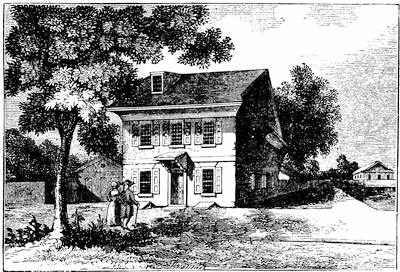
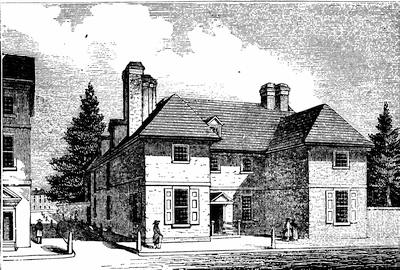
LETITIA COTTAGE.
A city residence for Penn was begun by his commissioners before he arrived. Parts of it were prepared in England. A portion of it still stands on the west side of Letitia Street, south of Market. The above cut is a fac-simile of the view given in Watson’s Annals of Philadelphia (1845), p. 158. Cf. Gay’s Popular History of the United States, ii. 492.
The attention which Penn gave to the constitution of his province was a duty which had for him a particular interest. His thoughts had necessarily dwelt much on the subject, and his experience had made him acquainted with the principles of law and the abuses of government. The drafts of this paper which have been preserved show how deeply it was considered. Henry Sidney, Sir William Jones, and Counsellor Bamfield were consulted, and portions of it were framed in accordance with the wishes of the Quakers. In the Introduction to this remarkable paper, the ingenuousness of its author is clearly discernible. Recognizing the necessity of government, and tracing it to a divine origin, Penn continues,—
“For particular frames and models, it will become me to say little, and comparatively I will say nothing. My reasons are, first, that the age is too nice and difficult for it, there being nothing the wits of men are more busy and divided upon.... Men side with their passions against their reason, and their sinister interests have so strong a bias upon their minds, that they lean to them against the good of the things they know.
“I do not find a model in the world that time, place, and some singular emergencies have not necessarily altered, nor is it easy to frame a civil government that shall serve all places alike. I know what is said by the several admirers of monarchy, aristocracy, and democracy, which are the rule of one, a few, and many, and are the three common ideas of government when men discourse on that subject. But I choose to solve the controversy with this small distinction, and it belongs to all three,—any government is free to the people under it (whatever be the frame) where the laws rule and the people are a party to those laws; and more than this is tyranny, oligarchy, or confusion.... Liberty without obedience is confusion, and obedience without liberty is slavery.”
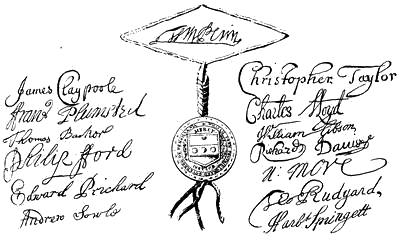
SEAL AND AND SIGNATURES TO THE FRAME OF GOVERNMENT.
[This is reduced from the fac-simile in Smith and Watson’s American Historical and Literary Curiosities, pl. lvii.; and another reduction will be found in Mag. of Amer. Hist., October, 1882; cf. Lossing’s Fieldbook of the Revolution, ii. 256.—Ed.]
The good men of a nation, he argues, should make and keep its government, and laws should bind those who make laws necessary. As wisdom and virtue are qualities that descend not with worldly inheritances, care should be taken for the virtuous education of youth.
The Frame of Government which followed these remarks was signed by Penn on the 25th of April, 1682. By this Act the government was vested in the governor and freemen, in the form of a provincial council and an assembly. The provincial council was to consist of seventy-two members. The first election of councilmen was to be held on the 20th of February, 1682-83, and they were to meet on the 10th of the following month. One-third of the number were to retire each year when their successors were chosen. An elaborate scheme was devised for forming the council into committees to attend to various duties.
The assembly for the first year was to consist of all the freemen of the province, and after that two hundred were to be annually chosen. They were to meet on April 20; the governor was to preside over the council. Laws were to originate with the latter, and the chief duty of the assembly was to approve such legislation. The governor and council were to see the laws executed, inspect the treasury, determine the situation of cities and ports, and provide for public schools.
On May 5 forty laws were agreed upon by the purchasers in England as freemen of the province. By these all Christians, with the exception of bound servants and convicts, who should take up land or pay taxes were declared freemen. The merits of this proposed form, which was to be submitted for approval to the first legislative body assembling in Pennsylvania, have been widely debated. Professor Ebeling says it “was at first too highly praised, and afterwards too lightly depreciated.” It was without doubt too elaborate in some of its details, and the number proposed for the council and assembly were out of all proportion to the wants of a new country.
Shortly after his arrival, Penn found circumstances to require that the laws should be put in force with as little delay as possible. He therefore decided to call an assembly before the time provided, and extended to the inhabitants of the Delaware counties the right to participate in it. Writs were issued to the sheriffs of those parts to hold elections on the 20th of November for the choice of delegates to meet at Chester on the 4th of December, and the inhabitants of Pennsylvania were notified to attend.
The Assembly met at the appointed time. Upon petition from the lower counties, an Act uniting them with Pennsylvania was passed, and at the request of the Swedes a bill of naturalization became a law. Penn submitted to the House the Frame of Government and the code of laws agreed upon in England, together with a new series which he had prepared. In doing this he acted without the advice of a provincial council. The laws agreed upon in England, “more fully worded,” were passed, together with such others as were thought to be necessary, and the Assembly adjourned for twenty-one days. The members, however, do not appear to have met again.
In January Penn issued writs for an election, to be held on the 20th of February, of seventy-two members of the provincial council, and gave notice that an assembly would be held as provided in the Frame of Government. This was not strictly in accord with that document, as it provided that the seventy-two councilmen should be chosen from the province of Pennsylvania, and Penn made the passage apply equally to the Delaware counties, over which he had had no jurisdiction at the time the Frame was signed.
Before the election took place, it was discovered that the number proposed for the council was much larger than could be selected, and that a general gathering of the inhabitants would not furnish such an assembly as the organization of the government demanded. On the suggestion of Penn twelve persons, therefore, were elected from each of the six counties; and through their respective sheriffs the freemen petitioned the Governor that as the number of the people was yet small, and but few were acquainted with public business, those chosen should be accepted to represent them in both council and assembly,—three in the former, and nine in the latter. The Council met at the appointed time, the petitions of the freemen were duly presented by the sheriffs, and the prayers granted by the Governor. It was then moved by one of the members that, as the charter granted by the Governor had again fallen into his hands by the negligence of the freemen to fulfil their part, he should be asked that the alterations which had been made should not affect their chartered rights. The Governor answered that “they might amend, alter, or add for the Public good, and he was ready to settle such foundations as might be for their happiness and the good of their Posterities.” Those selected for the Assembly then withdrew, and, although the time for them to meet had not arrived (March 12), chose Thomas Wynne their Speaker, and proceeded to business. During the session an “Act of Settlement,” reciting the circumstances which made these changes necessary, and reducing the number of members of the Provincial Council and Assembly, was passed by the House, having been proposed by the Governor and Council. By the Frame of Government first agreed upon, Penn had surrendered his right to have an overruling voice in the government, reserving for himself or representative a triple vote in the Council. Fearing that his charter might be invalidated by some action of the majority of the Council and Assembly, he now asked that the veto power should be restored to him, which was accordingly done. The right to appoint officers, which by the first Frame had been vested in the Governor and Council, was given to Penn for life. Other laws necessary for good government were enacted, and to the whole the Frame of Government was appended, with modifications and such alterations as made it applicable to the Delaware counties. On April 2, in the presence of the Council, Assembly, and some of the citizens of Philadelphia, Penn signed and sealed this new charter, solemnly assuring them that it was “solely by him intended for the good and benefit of the freemen of the province, and prosecuted with much earnestness in his spirit towards God at the time of its composure.” It was received by the Speaker of the Assembly on behalf of the freemen; and in their name that officer thanked the Governor for his great kindness in granting them a charter “of more than was expected liberty.”
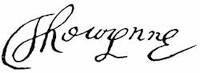
All that had been irregularly done was thus in a manner legalized; but the matter was not allowed to pass unquestioned. Nicholas More was reprimanded by the Council for having spoken imprudently regarding the course which had been taken, and for saying that hundreds in England and their children after them would curse them for what they had done.
Under the constitution and laws thus formed, the government was administered until 1696. The chief features of local government which had existed under the Duke of York were lost sight of in the new order of affairs, the authority being vested in the provincial or county officers in place of those of the township. True to the doctrines which they had preached, and to the demands which they had made of others, the Quakers accorded to all a perfect liberty of conscience, intending, however, “that looseness, irreligion, and Atheism” should not creep in under pretence of conscience. The observance of the Sabbath was provided for. On that day people were to “abstain from their usual and common toil and labor, ... that they may better dispose themselves to read the Scriptures of truth at home, or frequent such meetings of religious worship abroad as may best suit their respective persuasions.” Profanity, drunkenness, health-drinking, duelling, stage-plays, masques, revels, bull-baiting, cock-fighting, cards, dice, and lotteries were all prohibited. Clamorous scolding and railing were finable offences. The property of thieves was liable for fourfold the value of what they had taken; and if they should have no estates, they were to labor in prison until the person they had injured was satisfied. A humane treatment of prisoners was insured. The poor were under the protection of the county courts. Peacemakers were chosen in the several counties to decide differences of a minor character. Malt liquors were not to be sold at above two pennies sterling for a full Winchester quart. The court records were to be kept in plain English characters, and laws were to be taught in the schools.
“All judicial power, after Penn’s arrival, was vested in certain courts, the judges of which were appointed by the Proprietary, presiding in the Provincial Council.[781]
“The practice in these courts was simple but regular. In criminal cases an indictment was regularly drawn up, and a trial by jury followed. In civil cases the complications of common-law pleading were disregarded. The filing of a simple statement and answer put each cause at issue, and upon the trial the rules of evidence were not observed. Juries were not always empanelled, the parties being frequently content to leave the decision of their causes to the Court. In equity proceedings the practice was substantially that in vogue in the Court of Chancery, simplified to suit the requirements of the province.
“Large judicial powers were also vested in the Provincial Council,—a state of things not infrequently observed in the early stages of a country’s growth, before the executive and judicial functions of government have been clearly defined. Prior to the establishment of the Provincial Court, all cases of great importance, whether civil or criminal, were tried before the Council. The principal trials thus conducted were those of Pickering for coining, and of Margaret Mattson for witchcraft. The latter terminated in a verdict of ‘guilty of having the common fame of being a witch, but not guilty in manner and form as she stands indicted.’ This is the only regular prosecution for witchcraft which is found in the annals of Pennsylvania. Prior to the establishment of the Provincial Court, the Council also entertained appeals in certain cases from the inferior courts. Subsequent to 1684, however, the extent of its judicial power was limited to admiralty cases, to the administration of decedents’ estates, which, although more properly the business of the Orphans’ Courts, was often neglected by those tribunals, and to the general superintendence and control of the various courts, so as to insure justice to the suitors.[782]
“The legal knowledge among the early settlers was scanty. The religious tenets of the Society of Friends rendered them very averse to lawyers, and distrustful of them. There was, therefore, comparatively little demand for skilled advocates or trained judges. John Moore and David Lloyd were almost the only professional lawyers of the seventeenth century. Nicholas More, Abraham Man, John White, Charles Pickering, Samuel Hersent, Patrick Robinson, and Samuel Jennings, with some others, however, practised in the courts with some success; but by insensible degrees, as population increased and the commercial interests of the community grew more extensive and complicated, a trained Bar came into existence.”[783]
Markham not having agreed with Baltimore, 1681, regarding the boundaries of Pennsylvania and Maryland, the two met again in September of the following year at Upland, and Penn visited the latter at West River, Dec. 13, 1682. In May, 1683, Penn again met Lord Baltimore at New Castle, on the same business, but nothing was decided upon. This dispute was a consequence of the lack of geographical information at the time their grants were made. Baltimore’s patent was for the unoccupied land between the Potomac and the fortieth degree of latitude, bounded on the east by Delaware Bay and the Atlantic Ocean, with the exception of that part of the Delaware peninsula which was south of a direct line drawn from Watkin’s Point on the Chesapeake to the sea. The southern boundary of Penn’s province was the fortieth degree and a circle of twelve miles around New Castle. When both patents were issued, it was supposed that the fortieth degree would fall near the head of Delaware Bay; but it was afterward found to be so far to the northward as to cross the Delaware River at the mouth of the Schuylkill. If the letter of the Maryland charter was to interpret its meaning, Penn would be deprived of considerable river frontage, which it was clearly the intention of the Lords of Trade to grant him; and he insisted that the boundary-line should be where it was supposed the fortieth degree would be found. This was resisted by Baltimore, who claimed ownership also to that part of the peninsula on the Delaware which Penn had received from the Duke of York. To enforce his claims, Baltimore sent to the Lords of Plantation a statement of what had taken place between Penn and himself. He also ran a line in his own interest between the provinces, and offered to persons who would take up land in the Delaware counties under his authority more advantageous terms than Penn gave. In 1684 Baltimore sent Colonel Talbot into the disputed territory to demand it in his name, and then sailed for England to look after his interests in that quarter.
Penn, when he learned all that had been done, wrote to the Lords of Trade, giving his version of the transaction; but before long he found the business would require his presence in England. Having empowered his Council to act in his absence, he sailed August, 1684.
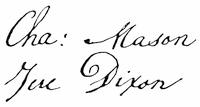
The Lords of Trade rendered a decision Nov. 7, 1685, which secured to Penn the portion claimed by him of the Delaware peninsula, but which left undefined the southern boundary of Pennsylvania. The Maryland boundary was finally settled in 1760, upon an agreement which had been entered into in 1732 between the heirs of Lord Baltimore and those of Penn.[784] By this a line was to be drawn westward from Cape Henlopen[785] to a point half way between the bays of Delaware and Chesapeake. From thence it was to run northward so as to touch the most western portion of a circle of twelve miles radius around New Castle, and continue in a due northerly course until it should reach the same latitude as fifteen English statute miles directly south of the most southern part of Philadelphia. From the point thus gained the line was to extend due west. These lines were surveyed by Charles Mason and Jeremiah Dixon. They commenced their work in 1763 and suspended it in 1767, when they had reached a point two hundred and forty-four miles from the Delaware River.
The Indians who inhabited Pennsylvania were of the tribe of the Lenni Lenape. Some of them retained the noble characteristics of their race, but the majority of them, through their intercourse with the Dutch, the Swedes, and the English, had become thoroughly intemperate. Penn desired that his dealings with them should be so just as to preserve the confidence which Fox and Coale had inspired. Besides the letter written by his commissioners, he had sent to them messages of friendship through Holme and others. In all the agreements he had entered into with purchasers, the interests of the Indians had been protected; and he was far in advance of his time in hoping to establish relations with them by which all differences between the white men and the red should be settled by a tribunal wherein both should be represented. The possibility of their civilization under such circumstances was not absent from his mind, and in his first contract with purchasers he stipulated that the Indians should have “the same liberties to improve their grounds and provide for the sustenance of their families as the planters.” Following the just precedent which had been laid down by settlers in many parts of the country, and the advice of the Bishop of London, he would allow no land to be occupied until the Indian title had been extinguished. To obtain the land which was required by the emigrants, a meeting with the principal Indian chiefs was held at Shackamaxon June 23, 1683. The territory then purchased was considerable; but what was of equal importance to the welfare of the infant colony was the friendship then established with the aborigines. Poetry, Art, and Oratory have pictured this scene with the elevating thoughts which belong to each; but no more graphic representation of it has been made than that which is suggested by the simple language of Penn used in describing it. “When the purchase was agreed,” he writes, “great promises passed between us of kindness and good neighborhood, and that the Indians and English must live in love as long as the sun gave light. Which done, another made a speech to the Indians in the name of all the Sachamakers, or kings: first, to tell them what was done; next, to charge and command them to love the Christians, and particularly live in peace with me, and the people under my government; that many governors had been in the river, but that no governor had come himself to live and stay here before; and having now such an one that had treated them well, they should never do him or his any wrong,—at every sentence of which they shouted and said amen in their way.”[786]
“On the 6th of October, 1683, there arrived in Philadelphia, from Crefeld and its neighborhood, a little colony of Germans. They were thirteen men with their families, in all thirty-three persons, and they constituted the advance-guard of that immense emigration which, confined at first to Pennsylvania, has since been spread over the whole country. They were Mennonites, some of whom soon after, if not before, their arrival, became identified with the Quakers. Most of them were linen-weavers.
Among the first to purchase lands upon the organization of the province were several Crefeld merchants, headed by Jacob Telner, who secured fifteen thousand acres. The purchasers also included a number of distinguished persons in Holland and Germany, whose purchase amounted to twenty-five thousand acres, which became vested in the Frankfort Land Company, founded in 1686. The eleven members of this latter Company were chiefly Pietists and people of learning and influence, among whom was the celebrated Johanna Eleanora von Merlau. Their original purpose was to come to Pennsylvania themselves; but this plan was abandoned by all except Francis Daniel Pastorius, a young lawyer, son of a judge at Windsheim, skilled in the Greek, Latin, German, French, Dutch, English, and Italian languages, and carefully trained in all the learning of the day. On the 24th of October, 1683, Pastorius, as the agent for the Crefeld and Frankfort purchasers, began the location of Germantown. Other settlers soon followed, and among them, in 1685, were several families from the village of Krisheim, near Worms, where more than twenty years before the Quakers had made some converts among the Mennonites, and had established a meeting. In 1688 Gerhard Hendricks, Dirck op den Graeff, Francis Daniel Pastorius, and Abraham op den Graeff sent to the Friends’ Meeting a written protest against the buying and selling of slaves. It was the first public effort made in this direction in America, and is the subject of Whittier’s poem, The Pennsylvania Pilgrim.”[787]
The progress made in the settlement of the Province between 1681 and 1689 was remarkable, and was largely owing to Penn’s energy. On the 29th of December, 1682, he wrote from Chester: “I am very well, ... yet busy enough, having much to do to please all.... I am casting the country into townships.” On the 5th of the next month he wrote: “I am day and night spending my life, my time, my money, and am not a sixpence enriched by this greatness.... Had I sought greatness, I had stayed at home.” The English were the most numerous among the settlers; but in 1685, when the population numbered seven thousand two hundred, in which French, Dutch, Germans, Swedes, Finns, and Scotch-Irish were represented, Penn did not estimate his countrymen at above one half of the whole.
Twenty-three ships bearing emigrants arrived during the fall of 1682 and the winter following, and trading-vessels soon began to frequent the Delaware. The counties of Philadelphia, Chester, and Bucks were organized in the latter part of 1682, but were not surveyed until 1685. Philadelphia, named before she was born, and first laid out in August or September, 1682,[788] contained in the following July eighty houses, such as they were, and by the end of the year this number had increased to one hundred and fifty. The founders of the city lived in caves dug out of the high embankment by the river, and the houses which succeeded these primitive habitations were probably of the very simple character described in Penn’s advice to settlers.[789] In July, 1683, a weekly post was established. Letters were carried from Philadelphia to the Falls of Delaware for 3d., to Chester 2d., to New Castle 4d., to Maryland 6d. Notices of its departure were posted on the Meeting-House doors and in other public places.
On the 26th of December of the same year the Council arranged with Enoch Flower, who had had twenty years’ experience as a teacher in England, to open a school. Four shillings per quarter was the charge for those who were taught to read English; six shillings, when reading and writing were studied; and eight shillings, when the casting of accounts was added. For boarding scholars and “scooling,” he was to receive “Tenn” pounds per annum.
[This was the house in Philadelphia in which Penn lived after his return to the colony in 1699. It stood on the southeast corner of Second Street and Norris’s Alley, and was demolished in 1868. A view of it taken just before its demolition is given in Gay’s Popular History of the United States, iii. 171, with an earlier view, ii. 496. There is an account of it by Mr. Townsend Ward, with a view, in the Pennsylvania Magazine of History, iv. 53; but the most extended account is in Lippincott’s Magazine, vol. i. pp. 29, 191, 298, by General John M. Read, Jr. For other views, see Egle’s Pennsylvania, p. 1016, and Day’s Historical Collections of Pennsylvania, p. 556. The above cut is a fac-simile of one given by Watson in his Annals of Philadelphia, 1845 edition, p. 158; 1857 edition, p. 158. It is lithographed in his 1830 edition, p. 151. Drawings of the interior are in the possession of the Hist. Soc. of Pennsylvania.—Ed.]
The demand in trade at first was for articles of the greatest utility, like mill and “grindle” stones, iron kettles, and hardware. One of the women ordered shoes, and stipulated that they should be stout and large. James Claypoole sent his silver-hafted knives to his brother in Barbadoes, and consigned to him some beaver hats for which he could find at home no sale. But in less than a year a trade sprang up with some of the West India Islands, and rum, sugar, and negroes were ordered, in exchange for pipe-staves and horses. The silver from a Spanish wreck and peltries furnished the means of an exchange with Europe, and soon word was sent out to send “linnen, serges, crape, and Bengall, and other slight stuffs; but send no more shoes, gloves, stockings, nor hats.” Before Penn sailed for England in 1684, Philadelphia contained three hundred and fifty-seven houses, many of them three stories high, with cellars and balconies. Samuel Carpenter, one of the most enterprising of the early merchants, had a quay at which a ship of five hundred tons could lie. Trades of all kinds flourished; vessels had been built; brick houses soon began to be seen; and shop windows enlivened the streets.
In 1685 William Bradford established his printing-press in Philadelphia, the first in the middle colonies of North America. Its earliest issue was an almanac entitled the Kalendarium Pennsilvaniense, printed in 1685 for the succeeding year.
By 1690 brick and stone houses were the kind usually erected, while only the poorer classes built of wood. Manufactures also began to flourish. That year William Ryttenhouse, Samuel Carpenter, William Bradford, and others built a paper mill on the Schuylkill. The woollen manufactures offered such encouragement that there was “a public flock of sheep in the town, and a sheepheard or two to attend them.” The rural districts were also prosperous. The counties were divided into townships of about five thousand acres, in the centre of which villages were laid out. In 1684 there were fifty such settlements in the colony. At first the cattle were turned loose, and the ear-marks of their respective owners were registered at the county courts. Roads were surveyed and bridges built. The first mill was started in 1683 at Chester by Richard Townsend and others. The reports regarding the crops show them to have been enormous for the labor bestowed, and the development of the whole country seems to have been correspondent to the increased wealth of Philadelphia, where, in 1685, the poorest lots were worth four times what they cost, and the best forty-fold. At the beginning of the year 1684 Penn wrote: “I have led the greatest colony into America that ever any man did upon a private credit, and the most prosperous beginnings that ever were in it are to be found among us.”
The early ecclesiastical annals of Pennsylvania are meagre. The wave of religious excitement which swept over England during the days of the Commonwealth spent itself on the banks of the Delaware. Men and women with intellects too weak to grasp the questions which moved them, or possibly instigated by cunning, wandered through the country prophesying or disputing. One declared “that she was Mary the mother of the Lord;” another, “that she was Mary Magdalen, and others that they were Martha, John, etc.,—scandalizers,” wrote a traveller in 1679, “as we heard them in a tavern, who not only called themselves, but claimed to be, really such.”
The Swedish congregations, neglected by the churches in Sweden, were in 1682 falling into decay. The congregations at Tranhook, near Upland, and at Tinnicum, were under the charge of Lars Lock, that at Wicaco under Jacob Fabritius. The former was a cripple, the latter blind. Their salaries were scantily paid, and they were miserably poor. The Dutch had but one church, which was at New Castle.
The first meeting of Quakers for religious worship in Pennsylvania was no doubt held at the house of Robert Wade, near Upland. William Edmundson, the Quaker preacher, speaks of such meetings in 1675. It was then that Wade came to America with Fenwick. In Bucks County meetings are said to have been held as early as 1680 at the houses of Quakers who had settled there. The first meeting near Philadelphia was at Shackamaxon, at the house of Thomas Fairman, in 1682; but it was soon removed to Philadelphia, where one was established in 1683. Early in that year no less than nine established meetings existed in Pennsylvania.
As early as 1684 or 1685 the Baptists established a church at Cold Spring, in Bucks County, about three miles above Bristol. The pastor was the Rev. Thomas Dungan. In 1687 they established a second congregation at Pennepeck, in Philadelphia County, of which the Rev. Elias Keach was the first minister. The Episcopalians and Presbyterians did not own places of worship until a later date.
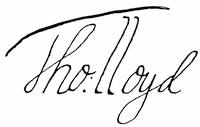
The early political annals of the colony show a condition of affairs perfectly consistent with the circumstances under which the constitution was formed. While Penn remained in the country his presence prevented any excess such as might be expected from men inexperienced in self-government. In 1684, however, Penn was obliged to return to England, and he empowered the Provincial Council to act in his stead. Thomas Lloyd was the president of that body, and was also commissioned Keeper of the Seal. He was a man of prudence, and seems to have justified the confidence placed in him by Penn. Arrogance on the part of some of the other officers of the government soon awakened feelings of jealousy among the people, who were prompt to resent any violation of their rights. Nicholas More, the Chief-Justice, was impeached by the Assembly for gross partiality and overbearing conduct. He was styled by the Speaker an “aspiring and corrupt minister of state,” and the Council was requested to remove him from office. He was expelled from the Assembly, of which he was a member, for having thrice entered his protest against a single bill. Patrick Robinson, the clerk of the Court, refused to submit to the House the records of the Court in the case of More, and was restrained for his “divers insolences and affronts.” When brought before the Assembly, he stretched himself at full length on the ground, and refused to answer questions put to him, telling the House that it “acted arbitrarily” and without authority. The Council was also requested to remove him; but neither in his case nor in that of More were the prayers granted. “I am sorry at heart for your animosities,” wrote Penn, when he heard of these troubles; “cannot more friendly and private courses be taken to set matters to rights in an infant province whose steps are numbered and watched? For the love of God, me, and the poor country, be not so governmentish, so noisy and open in your dissatisfactions.” It was the love of government, the seeds of which Penn had himself planted, which caused these troubles, and he it was who was to suffer most in that period of political growth. Hundreds, he said, had been prevented from emigrating by these quarrels, and that they had been to him a loss of £10,000. His quit-rents, which in 1686 should have amounted to £500 per annum, were unpaid. They were looked upon as oppressive taxes, for which the Proprietary had no need; but the year previous he wrote: “God is my witness.... I am above six thousand pounds out of pocket more than ever I saw by the province.”
The want of energy shown by the Council in managing his affairs caused Penn to lessen the number in which the executive authority rested. In 1686 he commissioned five of the Council, three of whom were to be a quorum, to attend to his proprietary affairs. By the slothful manner in which the Council had conducted the public business, the charter, he argued, had again fallen into his hands, and he threatened to dissolve the Frame of Government “if further occasion be given.” Under these commissioners but little improvement was made, and in 1688 Penn appointed Captain John Blackwell his lieutenant-governor.

CRITICAL ESSAY ON THE SOURCES OF INFORMATION.
The Earliest Tracts and Books.—During the first thirty years after the granting of Penn’s charter (1681), there were various publications of small and moderate extent, which are the chief source of our information.
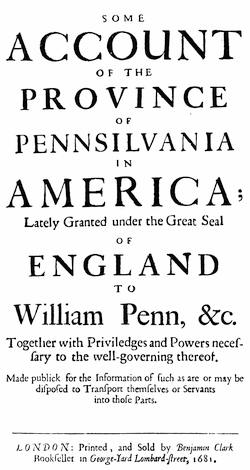
REDUCED FAC-SIMILE OF TITLE TO “SOME ACCOUNT.”
The first of these is Penn’s own Some Account,[790] issued in 1681, soon after he received his grant. “It is introduced by a preface of some length, being an argument in favor of colonies,” which is followed by a description of the country, gathered from such sources as he considered reliable, and by the conditions on which he proposed to settle it. Information for those desiring to emigrate, and extracts from the royal charter, are also given.
This tract appeared at once in Dutch[791] and German[792] editions. The latter edition contains also letters of Penn to Friends in Holland and Germany prior to his receiving his grant, which fact tends to show that the relations he had established by his travels there attracted the attention of persons in Germany to his efforts in America.
In the same year (1681) appeared César de Rochefort’s account,[793] which is usually found joined to his Description des Antilles. Next year (1682) Penn published, under the title of A Brief Account,[794] a short description of his province, giving additional information. Of the same date is William Loddington’s Plantation Work,[795]—a tract, however, by some attributed to George Fox. It was written in favor of Quaker emigration at a time when many Quakers feared that such action might be prompted by a desire to escape persecution. In it we have the earliest descriptions preserved of Pennsylvania after it was given to Penn. These are presented in letters of Markham, written soon after his arrival, the date of which is also indicated. The extracts from Markham’s letters are printed in Pennsylvania Magazine of History, vi. 175.
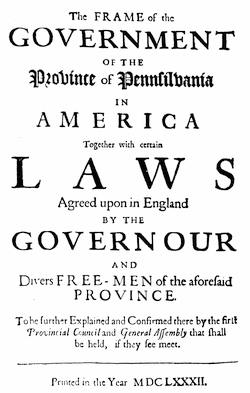
REDUCED FAC-SIMILE OF TITLE OF “THE FRAME OF GOVERNMENT.”
The constitution which Penn proposed for his colony, together with certain laws which were accepted by purchasers in England as citizens of Pennsylvania, were issued the same year as The Frame of Government.[796] Both constitution and laws underwent considerable alteration before going into effect; although this fact has been frequently overlooked. A little brochure, of probably a like date, Information and Direction,[797] covers a description of the houses which it was supposed would be the most convenient for settlers to build.
The Free Society of Traders purchased of Penn twenty thousand acres. The Society was formed for the purpose of developing this tract, which was to be known as the Manor of Frank. Nicholas More was president, and James Claypoole treasurer. The letter-book of the latter is in the Historical Society of Pennsylvania. The charter of the Society will be found in Hazard’s Annals (p. 541), with other information regarding the Society; and in the same volume (p. 552) a portion of a tract[798] which is printed in full with a reduced fac-simile of titlepage in Pennsylvania Magazine of History, v. 37.
A Vindication of William Penn, by Philip Ford, in two folio pages, was published in London in 1683, to contradict stories which were circulated after Penn had sailed, to the effect that he had died upon reaching America, and had closed his career professing belief in the Church of Rome. It contains abstracts of the first letters written by Penn from America.[799]
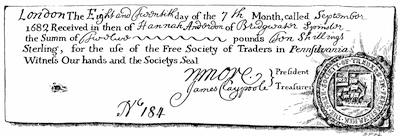
RECEIPT AND SEAL OF THE FREE SOCIETY OF TRADERS.
The most important of all the series is a Letter from William Penn,[800] printed in 1683. It was written after Penn had been in America over nine months (dated August 16), and may be considered as a report from personal observation of what he found his colony to be. It passed through at least two editions in London; one of which contains a list of the property-holders in Philadelphia, with numbers affixed to their names indicating the lots they held, as is shown on a plan of that city which accompanies the publication, and of which a heliotype is herewith given. The letter appeared the next year (1684) in a Dutch translation[801] (two editions). Of the same date is a new description of the province, of which we have a German[802] and a French[803] text. The pamphlet contains an extended extract from Penn’s letter to the Free Society of Traders, the letter of Thomas Paschall from Philadelphia, dated Feb. 10, 1683 (N. S.), and other interesting papers, many of which were published in A Brief Account. All information in it that is not readily accessible has been lately translated by Mr. Samuel W. Pennypacker from the French edition, and is printed with fac-simile of title in the Pennsylvania Magazine of History, vi. 311.
A small tract, giving letters from a Dutch and Swiss sojourner in and near Philadelphia, was printed at Rotterdam, in 1684, as Twee Missiven.[804] The only copy of this tract which we know of is in the Library of Congress, and will be shortly published by the Historical Society of Pennsylvania. The copy at Washington, we are told, contains but one letter. Another, or possibly the same, copy is catalogued in Trömel’s Bibliotheca Americana, Leipzig (1861), no. 390.
The Planter’s Speech[805] (1684) and Thomas Budd’s Good Order established in Pennsylvania, etc. (1685),[806] which have been referred to in another chapter, are of like importance to Pennsylvania history. What is called “William Bradford’s Printed Letter” (1685) is quoted in the first edition of Oldmixon’s British Empire in America, p. 158. We have, however, never met with the original publication.
Another Dutch description of the country was printed the same year (1685) at Rotterdam, Missive van Cornelis Bom,[807] and has become very rare.
In 1685 Penn also printed A Further Account of his grant, signing his name to the tract, which appeared in quarto in separate editions of twenty and sixteen pages, followed the same year by a Dutch translation.[808] After Penn’s letter to the Free Society (1683) this is the most important of these early tracts.
In 1686 the series only shows a brief Dutch tract;[809] but in 1687 we derive from A Letter from Dr. More,[810] etc., partly the work of Nicholas More, president of the Free Society of Traders, an idea of the growth of the province at that date. Of a similar character is a tract printed four years later (1691), Some Letters, etc.[811] In the following year (1692) we have a poetical description[812] of the province, which contains many interesting facts. Little is known of the author, Richard Frame. It is said that he was a teacher in the Friends’ School of Philadelphia. He was certainly a resident of Pennsylvania, and the first of her citizens to give his thoughts to the public in the form of verse. The first four lines will suffice to show its merits as a poem:—
“To all our Friends that do desire to know What Country ‘t is we live in—this will show. Attend to hear the Story I shall tell: No doubt but you will like this country well.”
The pamphlet was a colonial production. It appeared on paper which was possibly made here, and was printed by William Bradford.
Soon after the appearance of Frame’s verses, the poetic fever seized upon John Holme, and he wrote “A true Relation of the Flourishing State of Pennsylvania.” The poetic taste of the community was either satiated by the effort of Frame, or Holme shrank from the honors of authorship, for his poem did not see the light until published by the Historical Society of Pennsylvania in the thirteenth number of its Bulletin in 1847.
In 1695 one of the party who emigrated with Kelpius gave the public an account of his voyage and arrival,[813] under the pseudonym of “N. N.” He dated his letter “from Germantown, in the Antipodes, Aug. 7, 1694.”
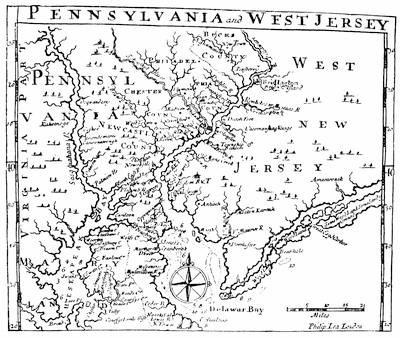
GABRIEL THOMAS’S MAP, 1698.
In addition to Mr. Whitehead’s remarks regarding Gabriel Thomas’s Account of Pennsylvania (see chap. xi.), we will add that the portion relating to Pennsylvania covers fifty-five pages, besides eight pages which are devoted to the preface and title. A person by the name of the author, probably the same, was in America in 1702, and was then solicitous of a commission as collector of quit-rents, etc., within the county of Newcastle. In 1698 he inveighed against George Keith and his followers, and in 1702 sided with Colonel Quarry in his disputes with Penn. Most of the statements in his book can be relied on, but some passages are marked by exaggeration and others by satire. As some of the buildings in Philadelphia mentioned by Thomas were not erected until after he wrote, Mr. Westcott, in his History of Philadelphia, suggests that possibly there was more than one edition of the work bearing the same date.[814]
In 1700 was printed a Beschreibung der Provintz Pennsylvaniæ,[815] the work of Francis Daniel Pastorius, agent of the Frankfort Land Company, and the most active and intelligent of the first German settlers, which is of great interest, as it contains the views of one thoroughly identified with the German movement to America. The descriptions of the country and of the form of government, the advice to emigrants, etc., which it contains, are gathered from letters written to his father. A translation of portions of the work by Lewis H. Weiss is given in Memoir of Historical Society of Pennsylvania, vol. iv. part ii. p. 83. The original edition is generally found bound up with a German edition of Thomas’s Pennsylvania, printed in 1702, and the tract by Falkner hereafter mentioned. While the works bear different dates, there appears to have been some connection in the series. The information in Thomas, originally printed in 1698, supplements to a great extent what will be found in Pastorius, printed in 1700. The titlepage of the German edition of Thomas (1702) speaks of it, therefore, as a continuation of Pastorius, and the same shows Falkner’s tract to have appeared as a supplement to the German edition of Thomas.
An agent of the Frankfort Company, who was in Pennsylvania in 1694 and 1700, issued at Frankfort in 1702 a little book, Curieuse Nachricht,[816] which gives some information in the form of questions and answers, one hundred and three in number. The subjects touched upon are the country in general, its soil, climate, etc; the inhabitants, their manners, customs, and religions; the Indians; how to go to America, etc.
The last of the works to be considered as original authority is J. Oldmixon’s British Empire in America, as it is known that the author got some of his information from Penn himself.[817] It was first issued at London in 1708, and again in 1741. The editions differ materially in the sections on Pennsylvania, so that both need to be consulted.
The Rise and Progress of the Quakers.—As we have traced the history of Penn’s colony from the origin of the religious society which had such an influence on the formation of his character, and to which Pennsylvania owes its existence quite as much as to Penn himself, a few references must be made to the chief sources of information from which a history of the Quakers can be gathered. The most prominent of these is the Journal of George Fox,[818] the founder of the Quaker Church. It relates, in passages of alternate vividness and ambiguity, the experiences of his life. So different, however, are the opinions entertained, that while Macaulay says that “his gibberish was translated into English, meanings which he would have been unable to comprehend were put on his phrases, and his system so much improved that he would not have known it again,” Sir James Mackintosh, on the contrary, calls the Journal “one of the most extraordinary and instructive narratives in the world, which no reader of competent judgment can peruse without revering the virtues of the writer, pardoning his self-delusions, and ceasing to smile at his peculiarities.”
W. Edmundson made three voyages to America before 1700, the first with Fox, in 1671; his Journal[819] has been often printed.
Penn’s own statements about the sect’s origin were given in his Brief Account of the Rise and Progress of the People called Quakers, published at London in 1695, and in his Primitive Christianity Revived, 1696 and 1699.
Robert Barclay is considered the most able exponent of the Quaker belief among early writers of that sect, and his Apology[820] is his chief work. He was the son of “Barclay of Ury,” of whom Whittier has sung, and was governor of East Jersey (see chap. xi.).
The Sufferings of the People called Quakers,[821] by Joseph Besse, is, as its title indicates, an account of their persecutions in various parts of the world. It is written from a Quaker standpoint, but its accuracy can seldom be questioned. It has passed through two editions.
Sewel’s History of the Quakers[822] is a work which possesses great value, not only on account of its freedom from error, but because it was written at an early period in the history of the Society of Friends. Its author was a native of Amsterdam, and was born about 1650. His history was written to correct the misrepresentations in Historia Quakeriana,[823] by Gerard Croese, which had been largely circulated. Sewel’s work was published in Dutch at Amsterdam in 1717, and a translation by the author was issued in London, 1722. Gough’s History of the Quakers is a compilation of nearly all that was accessible at the time of its publication. The Portraiture of Quakerism,[824] by Clarkson, treats of the discipline and customs of the Society. The History of Friends in the Seventeenth Century, by Dr. Charles Evans, contains nearly everything that most readers will require. It is an excellent compilation, and presents the subject in a compact, useful form. The same can be said of a History of the Religious Society of Friends from its rise to the year 1828,[825] by Samuel M. Janney. The author was a follower of Elias Hicks, and his work contains a history of the separation of the meetings caused by the doctrines preached by the latter. In Barclay’s Inner Life of the Religious Societies of the Commonwealth[826] the attempt has been made to trace the origin of the Society of Friends to an earlier period than the preaching of Fox. The author of the work was Robert Barclay, of the same family as “the Apologist.” The work, which is an able one, was reviewed by Dr. Charles Evans.[827] A terse criticism was lately made on the book by a Friend, who in conversation remarked, “Robert Barclay seemed to know more of what George Fox believed than George himself.”
The chief manuscript depository of the Friends is in Devonshire House, Friends’ Meeting-House, 12 Bishopsgate Street Without, London, E.C., England, where what is known as the Swarthmore manuscripts are preserved. The collection was made under the direction of George Fox, and many of the papers are indorsed in his handwriting. It consists “of letters addressed to Swarthmore Hall from the Preachers in connection with Fox, giving an account of their movements and success, to Margaret Fell, and through her to Fox. Up to 1661 Swarthmore Hall was secure from violation, and these letters range over the period from 1651 to 1661.”
John Whiting’s Catalogue of Friends’ Books, published in 1708, is the earliest gathering of titles concerning the Quakers. The work, however, has been fully done in our own day by Joseph Smith, who published, in 1867, at London, A Descriptive Catalogue of Friends’ Books, in two volumes, with critical remarks and occasional biographical notices; and in 1873, his Bibliotheca Anti-Quakeriana; or, a Catalogue of Books adverse to the Society of Friends; with Biographical Notices of the Authors: with Answers.[828]
In following the history of the Quakers, particularly in America, the recorder of their career in Pennsylvania must leave unnamed some of the most important books, because their contents concern chiefly or solely the story of their persecutions and progress in the other colonies, particularly New England.[829] Bowden’s History of Friends in America, as it is the most important of the late works, must also be mentioned. Its author enjoyed great advantages in preparing it, having the manuscripts deposited in Devonshire House at his command. In it many original documents of the greatest interest are printed for the first time, among which we may mention a letter of Mary Fisher to George Fox, from Barbadoes, dated Jan. 30, 1655, regarding Quaker preachers coming to America, and of Josiah Coale to the same person, in 1660, in relation to the purchase of a tract of land, now a portion of Pennsylvania. The work is spirited and readable, and while it is written in entire sympathy with the Quakers, its statements are so carefully weighed that but little exception can be taken to them, and then only in cases where the fundamental views of the author and of his readers are at variance.
A defence of the early Friends in America will be found in Colonial History of the Eastern and some of the Southern States, by Job R. Tyson; see Memoirs of Historical Society of Pennsylvania, vol. iv. part ii. p. 5. For the colonies other than New England, a few references will suffice. For New York, O’Callaghan’s History of New Netherland and Brodhead’s New York can be consulted. For those at Perth Amboy, 1686-1688, see Historical Magazine, xvii. 234. The Annals of Hempstead, by Henry Onderdonk, Jr., treats of the Quakers on Long Island and in New York from 1657 to 1826; cf. also the American Historical Record, i. 49; ii. 53, 73. The Early Friends (or Quakers) in Maryland, by J. Saurin Norris, and Wenlock Christison and the Early Friends in Talbot County, Maryland, by Samuel A. Harrison, are the titles of instructive addresses delivered before the Maryland Historical Society, and included in its Fund publications; compare also E. D. Neill’s “Francis Howgill and the Early Quakers,” in his English Colonization in North America, chap. xvii., and his Terra Mariæ, chap. iv. Henning’s Statutes at Large give the laws passed in Virginia to punish the Quakers. The Journals and Travels of Burnyeat, Edmundson, and Fox should also be consulted. A far from flattering picture of the Quakers living on the Delaware shortly before the settlement of Pennsylvania, will be found in the Journal of Dankers and Sluyter, two followers of John Labadie, who travelled in America in 1679-1680. Their account of the condition of the country on the Delaware at that time is very interesting.[830] A Retrospect of Early Quakerism: being Extracts from the Records of the Philadelphia Yearly Meeting, etc., by Ezra Michener, Philadelphia, 1860, is also a useful work, as it gives the dates when meetings were established.
William Penn.—The collected works of William Penn have passed through four editions;[831] these contain but few of his letters in relation to Pennsylvania.[832] The biographical sketch which accompanies the edition of 1726 is attributed to Joseph Besse. It appeared but eight years after Penn’s death, and has been the groundwork of nearly everything which has since been written concerning him. The Memoirs of the Private and Public Life of William Penn, by Thomas Clarkson,[833] was for many years the standard Life. Later evidence has shown that in some particulars the author erred; but it is generally accurate. It however treats more of William Penn the Quaker than of William Penn the founder of Pennsylvania. The same criticism is applicable to The Life of William Penn by Samuel M. Janney.[834] It also is a trustworthy book. All that was in print at the time it was written was used in its preparation, and it is to-day, historically, the best work on the subject. It contains more of his letters regarding the settlement of Pennsylvania than any other work we know of, and they are given in full. The “Life of William Penn,” by George E. Ellis, D.D., in Sparks’s American Biography, second series, vol. xii., is an important and spirited production, the result of careful thought and study.