Chapter XI · (continued 2)
Reading edition
In 1748 the acts of the General Assembly of New Jersey, from the time of the surrender of the government to the Crown in the second year of Queen Anne, were published under the supervision of Samuel Nevill, second Judge of the Supreme Court of the Province, and, in consequence, the popular party were aroused into having the early grants and concessions also arranged and published. About 1750 a committee was appointed to collate the early manuscripts connected with the proprietary grants, and subsequently Aaron Leaming and Jacob Spicer were empowered to have them printed, and to them does the credit belong of giving to their fellow-citizens the admirable compilation that is generally quoted under their names.[733] It contains all the agreements, deeds, concessions, and public acts from 1664 to 1702, and the object in view by their compilation and the estimate in which they were held are apparent from a remark of the compilers in their preface. “If our present system of government,” say they, “should not be judged so equal to the natural rights of a reasonable creature as the one that raised us to the dignity of a colony, let it serve as a caution to guard the cause of liberty.”
This volume has been of great value to members of the Bar and of the Legislature, as well as to the historian, as it has preserved many documents the original depository of which is not now to be found.[734] At the present time, however, the State of New Jersey is publishing, under the direction of a committee of the Historical Society, a series of volumes entitled the New Jersey Archives, which is intended to include all important documents referring to the colonial history of the State, however widely the originals may be scattered in other depositories,—including all of interest now preserved in the Public Record Office of England,—and will probably be the authoritative reference hereafter for documentary evidence relating to the whole colonial period.[735]
The first volume issued by the New Jersey Historical Society as their Collections was published in 1846, and contained “East Jersey under the Proprietary Governments.”[736] The author wrote his work fully sensible of the necessity for verifying much that had been allowed to pass as history, by seeking for and using original sources of information; and the volume elucidates many events that are alluded to in the preceding chapter.

Editorial Note.—The New Jersey Archives will contain every essential document noted in An Analytical Index to the Colonial Documents of New Jersey in the state-paper offices of England, compiled by Henry Stevens, edited with notes and references to printed works and manuscripts in other depositories, by William A. Whitehead, New York, 1858.
In 1843 a movement was made in the State Legislature to emulate the action of New York in securing from the English Archives copies of its early historical documents; and in the next year the judiciary committee made a report on the subject, which is printed in the preface of this Index, p. vii. This, however, failed of effect, as did a movement in 1845; but it made manifest the necessity of an historical society, as a source of influence for such end; and the same year the New Jersey Historical Society was formed, of which Mr. Whitehead has been the corresponding secretary from the start. This society reinforced the movement in the State Legislature; but no result being reached, it undertook of its own action the desired work, and in 1849 gave a commission to Mr. Henry Stevens to make an analytical index of the documents relating to New Jersey to be found in England. This being furnished, the State legislature failing to respond in any co-operative measures for the enlargement of it from the domestic records of the State, Mr. Whitehead undertook the editing, as explained in the title, and appended to the volume a bibliography of all the principal printed works relating to New Jersey up to 1857. Mr. Stevens’s enumeration began with 1663-64, the editor adding two earlier ones of 1649 and 1651. But a small part of the list, however (13 pp. out of 470), refers to the period covered by the present chapter, and many of those mentioned had already been printed.
The Sparks Catalogue shows “Papers relating to New Jersey, 1683-1775,” collected by George Chalmers, which are now in Harvard College Library.
Some of the later general histories of the State may be mentioned:—
The History of New Jersey from its Discovery to the Adoption of the Federal Constitution, by Thomas F. Gordon, Trenton, 1834. There is a companion volume, a Gazetteer.
Civil and Political History of New Jersey, by Isaac S. Mulford, Camden, 1848. The author says “no claim is advanced for originality or learning,” his object being to make accessible scattered information in a “simple and compendious narrative,” which is not altogether carefully set forth. A new edition was issued in 1851 in Philadelphia.
The History of New Jersey, by John O. Raum, 2 vols. Philadelphia, 1877, is simply, so far as the early chronicles are concerned, a repetition mostly of Smith and Gordon, though no credit is given to those authorities.
A few of the local histories also deserve some notice:—
Contributions to the Early History of Perth Amboy and adjoining Country, by William A. Whitehead, New York, 1856. The author says, “No attempt has been made to clothe with the importance of history these desultory gleanings.” It has a map of the original laying-out, following what is presumed to have been an original survey of 1684.
An Historical Account of the First Settlement at Salem in West Jersey, by John Fenwicke, Esq., chief proprietor of the same; with R. S. Johnson, Philadelphia, 1839, 24º. pp. 173. Mr. Johnson’s memoir of Fenwicke is in the New Jersey Hist. Soc. Proc. iv.
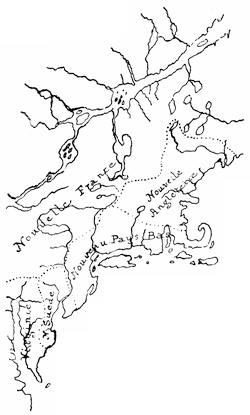
COLONIAL BOUNDS, 1656.
The Hon. John Clement, of Haddonfield, has prepared a History of Fenwicke’s Colony.
The two hundredth anniversary of the settlement of Burlington was celebrated Dec. 6, 1877, when the late Henry Armitt Brown delivered an oration, presenting the early history in a rhetorical way.
Reminiscences of Old Gloucester, ... New Jersey, by Isaac Mickle, Philadelphia, 1845.
History of Elizabeth, New Jersey, including the Early History of Union County, by the Rev. Edwin F. Hatfield, New York, 1868. The author differs from the writer of the present chapter with respect to the merits of the conflict between the Proprietors and the people. The foot-note references are ample.
History of the County of Hudson from its Earliest Settlement, by Charles H. Winfield, New York, 1874.
Historical Sketch of the County of Passaic, especially of the First Settlements and Settlers. Privately printed, by William Nelson, Paterson, 1877.
The History of Newark, New Jersey, being a Narrative of its Rise and Progress from May, 1666, by Joseph Atkinson, Newark, 1878; a book giving, however, only in a new garb, the older chronicles of the place. It gives a map of the town as laid out in 1666.
The annexed sketch-map is an extract from a map entitled, Le Canada, ou Nouvelle France, etc., par N. Sanson d’Abbeville, geographe ordinaire du Roy, Paris, 1656, and by its dotted lines shows the limits conceded by the French to the different colonies of the northern seaboard of the present United States, a few years before the establishment of New Caesaria. New England was defined on the east by the height of land between the waters of the Penobscot and the Kennebec, and on the northwest by a similar elevation that turned the rainfall to the St. Lawrence. New Netherland stretched from Cape Cod to the Delaware, where it met New Sweden, which lay between it and Virginia,—the Maryland charter not being recognized; nor was the absorption of the territory of the Swedes the year before (1655), by the Dutch, made note of. The map-maker, in defining these limits, pretends to have worked on English and Dutch authorities; but the Plymouth colonists would have hardly allowed the annihilation to which they were subjected, and the settlers of Massachusetts would scarcely have recognized the names attached to their headlands and harbors, and never having any existence but in Smith’s map, which the royal geographer seems to have fallen in with.

NOTE ON NEW ALBION.
BY GREGORY B. KEEN.
Late Professor of Mathematics in the Theological Seminary of St. Charles Borromeo, Corresponding Secretary of the Historical Society of Pennsylvania.
THE English did not attain supreme dominion in New York, New Jersey, Pennsylvania, or Delaware until the grant of King Charles II. to his royal brother, the Duke of York, in 1664; yet the history of these States and that of Maryland would not be complete without specific mention of the antecedent attempt to settle this part of America, made by the unsuccessful colonist Sir Edmund Plowden.
This person was a member of a Saxon family of Shropshire, England, whose antiquity is sufficiently intimated by the meaning of its surname, “Kill-Dane,”—being the second son of Francis Plowden, Esq., of Plowden, Salop, and grandson of the celebrated lawyer and author of the Commentaries, Serjeant Edmund Plowden, a Catholic, who declined the Lord-Chancellorship of England, offered him by Queen Elizabeth, lest he should be forced to countenance her Majesty’s persecutions of his Church.[737] In 1632, this gentleman, who like his ancestors and other relatives was a Catholic,[738] and at that time resided in Ireland,[739] in company with “Sir John Lawrence, Kt. and Bart., Sir Boyer Worsley, Kt., John Trusler, Roger Pack, William Inwood, Thomas Ryebread, Charles Barret, and George Noble, adventurers,” petitioned King Charles I. for a patent, under his Majesty’s seal of Ireland, for “Manitie, or Long Isle,” and “thirty miles square of the coast next adjoining, to be erected into a County Palatine called Syon, to be held of” his “Majesty’s Crown of Ireland, without appeal or subjection to the Governor or Company of Virginia, and reserving the fifth of all royal mines, and with the like title, dignity, and privileges to Sir Edmund Plowden there as was granted to Sir George Calvert, Kt., in New Foundland by” his “Majesty’s royal father, and with the usual grants and privileges to other colonies,” etc. And a modified form of this prayer was subsequently presented to the monarch, in which the island spoken of is called “Isle Plowden,” and the county palatine “New Albion,” and the latter is enlarged to include “forty leagues square of the adjoining continent,” the supplicants “promising therein to settle five hundred inhabitants for the planting and civilizing thereof.” The favor sought was immediately conceded, and the King’s warrant, authorizing the issue of a patent to the petitioners, and appointing Sir Edmund Plowden “first Governor of the Premises,” was given at Oatlands, July 24, the same year;[740] in accordance with which, a charter was granted to Plowden and his associates above mentioned, by writ of Privy Seal, witnessed by the Deputy-General of Ireland, at Dublin, June 21, 1634.[741] In this document the boundaries of New Albion are so defined as to include all of New Jersey, Maryland, Delaware, and Pennsylvania embraced in a square, the eastern side of which, forty leagues in length, extended (along the coast) from Sandy Hook to Cape May, together with Long Island, and all other “isles and islands in the sea within ten leagues of the shores of the said region.” The province is expressly erected into a county palatine, under the jurisdiction of Sir Edmund Plowden as earl, depending upon his Majesty’s “royal person and imperial crown, as King of Ireland;” and the same extraordinary privileges are conferred upon the patentee as had been bestowed two years before upon Lord Baltimore, to whose charter for Maryland that for New Albion bears very close resemblance.
Two of the petitioners, Worsley and Barret, afterward dying, “the whole estate and interest” in the grant became vested in the seven survivors, and of these, Ryebread, Pack, Inwood, and Trusler, in consideration of gifts of five hundred acres of land in the province, abandoned their claims, Dec. 20, 1634, in favor of “Francis, Lord Plowden, son and heir of Sir Edmund, Earl Palatine,” and George and Thomas Plowden, two other of his sons, their heirs and assigns, forever. The same year, apparently,[742] Plowden granted to Sir Thomas Danby a lease of ten thousand acres of land, one hundred of which were “on the northeast end or cape of Long Island,” and the rest in the vicinity of Watsessett, presumed to be near the present Salem, New Jersey, with “full liberty and jurisdiction of a court baron and court leet,” and other privileges for a “Town and Manor of Danby Fort,” conditioned on the settlement of one hundred “resident planters in the province,” not suffering “any to live therein not believing or professing the three Christian creeds commonly called the Apostolical, Athanasian, and Nicene.”
The plans of the Earl Palatine were simultaneously advanced by the independent voyages of Captain Thomas Yong, of a Yorkshire family, and his nephew and lieutenant, Robert Evelin, of Wotton, Surrey, undertaken in virtue of a special commission from the King, dated Sept. 23, 1633, to discover parts of America not “actually in the possession of any Christian Prince.”[743] These persons sailed from Falmouth, Friday, May 16, 1634, and arriving between Capes Charles and Henry the 3d of July, left Virginia on the 20th to explore the Delaware for a “Mediterranean Sea,” said by the Indians “to be four days’ journey beyond the mountains,” from which they hoped to find an outlet to the Pacific Ocean, affording a short passage to China and the East Indies. On the 25th they entered Delaware Bay and proceeded leisurely up the river (which Yong named “Charles,” in honor of his sovereign), conversing and trading with the savages, as far as the present Trenton Falls, which they reached the 29th of August, and where they were obliged to stop, on account of the rocks and the shallowness of the water. On the 1st of September they were overtaken here by some “Hollanders of Hudson’s River,” whom Yong entertained for a few days, but finally required to depart under the escort of Evelin, who afterward explored the coast from Cape May to Manhattan, and on his return made a second ineffectual attempt to pass beyond the rocks in the Delaware.[744] Both Yong and Evelin “resided several years” on this river, and undertook to build a fort there at “Eriwomeck,” in the present State of New Jersey. Tidings of their actions were frequently reported to Sir Edmund Plowden, and in 1641 was printed a Direction for Adventurers and Description of New Albion,[745] in a letter addressed to Lady Plowden, written by Evelin. Books concerning the province were likewise published, it is said,[746] in 1637 and 1642.
About the close of 1641, the Earl Palatine at length visited America in person, and, according to the testimony of Lord Baltimore,[747] “in 1642 sailed up Delaware River,” one of his men, named by Plantagenet “Master Miles,” either then or about that time “swearing the officers” of an English settlement of seventy persons, at “Watcessit” (doubtless the New Haven colonists at Varkens Kil, now Salem Creek, New Jersey[748]), to “obedience” to him “as governor.” Plowden’s residence was chiefly in Virginia, where, it is recorded, he bought a half-interest in a barque in 1643;[749] and it is probable that he had communication with Governor Leonard Calvert, of Maryland, since a maid-servant belonging to him accompanied Margaret Brent, the intimate friend of the latter, on a visit to the Isle of Kent, in Chesapeake Bay.[750] The longest notice of him during his sojourn on our continent occurs in a report of Johan Printz, Governor of New Sweden, to the Swedish West India Company, dated at Christina (now Wilmington, Delaware), June 20, 1644,[751] the importance of which induces the writer to translate the whole of it. Says Printz,—
“In my former communications concerning the English knight, I have mentioned how last year, in Virginia, he desired to sail with his people, sixteen in number, in a barque, from Heckemak to Kikathans;[752] and when they came to the Bay of Virginia, the captain (who had previously conspired with the knight’s people to kill him) directed his course not to Kikethan, but to Cape Henry, passing which, they came to an isle in the high sea called Smith’s Island, when they took counsel in what way they should put him to death, and thought it best not to slay him with their hands, but to set him, without food, clothes, or arms, on the above-named island, which was inhabited by no man or other animal save wolves and bears; and this they did. Nevertheless, two young noble retainers, who had been brought up by the knight, and who knew nothing of that plot, when they beheld this evil fortune of their lord, leaped from the barque into the ocean, swam ashore, and remained with their master. The fourth day following, an English sloop sailed by Smith’s Island, coming so close that the young men were able to hail her, when the knight was taken aboard (half dead, and as black as the ground), and conveyed to Hackemak, where he recovered. The knight’s people, however, arrived with the barque May 6, 1643, at our Fort Elfsborg, and asked after ships to Old England. Hereupon I demanded their pass, and inquired from whence they came; and as soon as I perceived that they were not on a proper errand, I took them with me (though with their consent) to Christina, to bargain about flour and other provisions, and questioned them until a maid-servant (who had been the knight’s washerwoman) confessed the truth and betrayed them. I at once caused an inventory to be taken of their goods, in their presence, and held the people prisoners, until the very English sloop which had rescued the knight arrived with a letter from him concerning the matter, addressed not alone to me, but to all the governors and commandants of the whole coast of Florida. Thereupon I surrendered to him the people, barque, and goods (in precise accordance with the inventory), and he paid me 425 riksdaler for my expenses. The chief of these traitors the knight has had executed. He himself is still in Virginia, and (as he constantly professes) expects vessels and people from Ireland and England. To all ships and barques that come from thence he grants free commission to trade here in the river with the savages; but I have not yet permitted any of them to pass, nor shall I do so until I receive order and command to that effect from my most gracious queen, her Royal Majesty of Sweden.”
Printz’s opposition to Plowden’s encroachment within his territory was never relaxed, and was entirely successful. In the course of his residence in America, the Earl Palatine of New Albion visited New Amsterdam, “both in the time of Director Kieft and in that of General Stuyvesant,” and, according to the Vertoogh van Nieu Nederland,[753] “claimed that the land on the west side of the North River to Virginia was his by gift of King James [Charles] of England, but said he did not wish to have any strife with the Dutch, though he was very much piqued at the Swedish governor, John Printz, at the South River, on account of some affront given him, too long to relate; adding that when an opportunity should offer, he would go there and take possession of the river.” Before re-crossing the ocean, he went to Boston, his arrival being recorded in the Journal of Governor John Winthrop, under date of June 4, 1648, having “been in Virginia about seven years. He came first,” says the Governor, “with a patent of a County Palatine for Delaware Bay, but wanting a pilot for that place, went to Virginia, and there having lost the estate he brought over, and all his people scattered from him, he came hither to return to England for supply, intending to return and plant Delaware, if he could get sufficient strength to dispossess the Swedes.”
Immediately on reaching Europe, Plowden set about this task, and, to obtain the greater credit for his title as “Earl Palatine of New Albion,” both in and out of that province, as well as recognition of the legality and completeness of his charter, submitted a copy of the latter to Edward Bysshe, “Garter Principal King of Arms of Englishmen,” who received favorable written opinions on the subject from several serjeants and doctors of laws, which, with the letters patent, were recorded by him Jan. 23, 1648/9, “in the office of arms, there to remain in perpetual memory.”[754] At the same time (December, 1648) there was published another advertisement of Plowden’s enterprise, entitled A Description of the Province of New Albion,[755] by “Beauchamp Plantagenet, of Belvil, in New Albion, Esquire,” purporting to contain “a full abstract and collection” of what had already been written on the theme, with additional information acquired by the Earl Palatine during his residence in America.
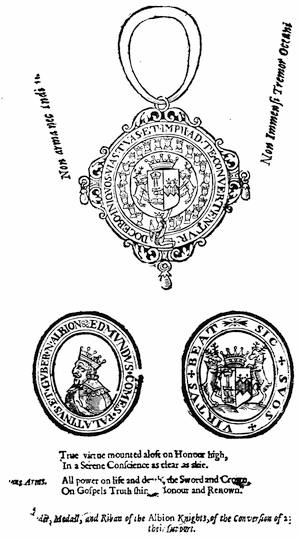
The work is dedicated “To the Right Honourable and mighty Lord Edmund, by Divine Providence Lord Proprietor, Earl Palatine, Governour, and Captain-Generall of the Province of New Albion, and to the Right Honourable the Lord Vicount Monson of Castlemain, the Lord Sherard, Baron of Letrim, and to all other the Vicounts, Barons, Baronets, Knights, Gentlemen, Merchants, Adventurers, and Planters of the hopefull Company of New Albion, in all 44 undertakers and subscribers, bound by Indenture to bring and settle 3,000 able trained men in our said severall Plantations in the said Province,”—the author, himself “one of the Company,” professing to “have had the honour to be admitted as” the “familiar” of Plowden, and to “have marched, lodged, and cabbined” with him, both “among the Indians and in Holland.”[756] It opens with a short treatise “of Counts or Earls created, and County Palatines,” followed by an adulatory account of the family of the Proprietor, and a defence of his title to his province, comprising some original statements with regard to the Dutch[757] and Swedes. Specific mention is made of several tribes of Indians dwelling in New Albion, and of numerous “choice seats for English,” some of which have been approximately identified.[758] “For the Politique and Civill Government, and Justice,” says the writer, “Virginia and New England is our president: first, the Lord head Governour, a Deputy Governour, Secretary of Estate, or Sealkeeper, and twelve of the Councell of State or upper House; and these, or five of them, is also a Chancery Court. Next, out of Counties and Towns, at a free election and day prefixed, thirty Burgesses, or Commons. Once yearly these meet, as at a Parliament or Grand Assembly, and make Laws.... and without full consent of Lord, upper and lower House, nothing is done.” “For Religion,” observes the author, “I conceive the Holland way now practised best to content all parties: first, by Act of Parliament or Grand Assembly, to settle and establish all the Fundamentals necessary to salvation.... But no persecution to any dissenting, and to all such, as to the Walloons, free Chapels; and to punish all as seditious, and for contempt, as bitterly rail and condemn others of the contrary: for this argument or perswasion of Religion, Ceremonies, or Church-Discipline, should be acted in mildnesse, love, and charity, and gentle language, not to disturb the peace or quiet of the Inhabitants, but therein to obey the Civill Magistrate,”—the latter remarkable programme of universal tolerance in matters of faith being probably designed to protect Catholic colonists in the same manner as the famous “Act concerning Religion” passed by the Maryland Assembly the following year. The book closes with some practical advice to “Adventurers,” and promises all such “of £500 to bring fifty men shall have 5,000 acres, and a manor with Royalties, at 5s. rent; and whosoever is willing so to transport himself or servant at £10 a man shall for each man have 100 acres freely granted forever.”
The only evidence we possess that any result flowed from this fresh attempt to promote emigration to New Albion is derived from documents in the Public Record Office at London,[759] stating that March 21, 1649-50, a “Petition of the Earl of New Albion relating to the plantation there” was “referred to the consideration of the Committee of Council;” that April 3, 1650, it was “referred to the Committee for Plantations, or any three of them, to confer with the Earl of Albion concerning the giving good security to Council, that the men, arms, and ammunition, which he hath now shipped in order to his voyage to New Albion, shall go thither, and shall not be employed either there or elsewhere to the disservice of the public;” and that June 11, 1650, “a pass” was “granted for Mr. Batt and Mr. Danby, themselves and seven score persons, men, women, and children, to go to New Albion.” We have no other proof of the sailing of these people, nor any knowledge of their arrival in America.
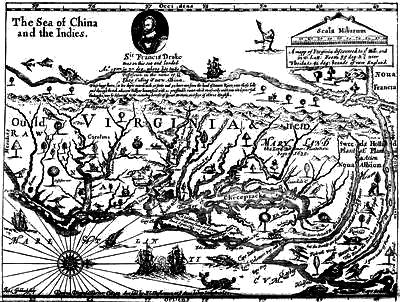
In 1651, there was offered for sale in London, A mapp of Virginia, compiled by “Domina Virginia Farrer,”[760] designating the territory on the Delaware as “Nova Albion,” as well as “Sweeds’ Plantation,” with a note: “This River the Lord Ployden hath a Patten of, and calls it New Albion; but the Sweeds are planted in it, and have a great trade of Furrs.” On the Jersey side of the stream are indicated the sites of “Richnek Woods,” “Raritans,” “Mont Ployden,” “Eriwoms,” and “Axion,” and on the sea-coast “Egg Bay,” all of which are mentioned in Plantagenet’s New Albion.
At that time Plowden was still in England,[761] and we do not know that he ever returned to his province. In his will, dated July 29, 1655, he styles himself “Sir Edmund Plowden, of Wansted, in the County of Southton [Southampton], Knight, Lord, Earle Palatine, Governor and Captain-Generall of the Province of New Albion in America,” and thinks “it fit that” his “English lands and estates be settled and united to” his “Honour, County Palatine, and Province of New Albion, for the maintenance of the same.” In consequence of the “sinister and undue practises” of his eldest son, Francis Plowden, by whom, he says, “he had been damnified and hindered these eighteene yeares,” “his mother, a mutable woman, being by him perverted,” he bequeaths all his titles and property in England and America, including his “Peerage of Ireland,” to his second son, Thomas Plowden, specially mentioning “the province and County Palatine of New Albion,” whereof, he says, “I am seized as of free principality, and held of the Crowne of Ireland, of which I am a Peere, which Honor and title and province as Arundell, and many other Earledomes and Baronies, is assignable and saleable with the province and County Palatine as a locall Earledome.” He provides for the occupation and cultivation of New Albion as follows: “I doe order and will that my sonne Thomas Plowden, and after his decease his eldest heire male, and if he be under age, then his guardian, with all speed after my decease, doe imploy, by consent of Sir William Mason, of Greys Inne, Knt., otherwise William Mason, Esquire, whom I make a Trustee for this my Plantation, all the cleare rents and profits of my Lands, underwoods, tythes, debts, stocks, and moneys, for full ten yeares (excepted what is beqeathed aforesaid), for the planting, fortifying, peopling, and stocking of my province of New Albion; and to summon and enforce, according to Covenants in Indentures and subscriptions, all my undertakers to transplant thither and there to settle their number of men with such as my estate yearly can transplant,—namely, Lord Monson, fifty; Lord Sherrard, a hundred; Sr Thomas Danby, a hundred; Captain Batts, his heire, a hundred; Mr. Eltonhead, a Master in Chancery, fifty; his eldest brother Eltonhead, fifty; Mr. Bowles, late Clerke of the Crowne, forty; Captain Claybourne, in Virginia, fifty; Viscount Muskery, fifty; and many others in England, Virginia, and New England, subscribed as by direction in my manuscript bookes since I resided six yeares there, and of policie a government there, and of the best seates, profits, mines, rich trade of furrs, and wares, and fruites, wine, worme silke and grasse silke, fish, and beasts there, rice, and floatable grounds for rice, flax, maples, hempe, barly, and corne, two crops yearely; to build Churches and Schooles there, and to indeavour to convert the Indians there to Christianity, and to settle there my family, kindred, and posterity.”
To each of eleven parishes in England, where he owned land, he left forty pounds; and directs that he be buried in the chapel of the Plowdens at Ledbury, in Salop, under a stone monument, with “brasse plates” of his “eighteene children had affixed at thirty or fourty powndes charges, together with” his “perfect pedigree as is drawne at” his “house.” He “died,” says “Albion,” “at Wanstead, county of Southampton, in 1659,” his will being admitted to probate in the Prerogative Court of Canterbury, July 27 of that year.[762] Thomas Plowden survived his father forty years, but what benefit he derived from the inheritance of New Albion does not appear. His own will is dated May 16, 1698, and was admitted to probate in the Prerogative Court of Canterbury the 10th of the following September. In it he describes himself as “Thomas Plowden, of Lasham, in the county of Southton, Gent;” and after leaving all his children and grandchildren “ten shillings a piece of lawfull English money,” proceeds: “I do give and bequeath unto my son Francis Plowden the Letters Pattent and Title, with all advantages and profitts thereunto belonging, And as it was granted by our late Sovereign Lord King Charles the first over England, under the great Seal of England, unto my ffather, Sir Edmund Plowden, of Wansted, in the County of Southton, now deceased, The province and County palatine of New Albion, in America, or in North Virginia and America, which pattent is now in the custody of my son-in-law, Andrew Wall, of Ludshott, in the said County of Southton, who has these severall years wrongfully detained it, to my great Loss and hinderance. And all the rest and residue of my goods, chattles, and personall Estate, after my debts and Legacies be paid and funerall discharged, I give and devise unto my wife, Thomazine Plowden, of Lasham.”[763]
That Plowden’s claim to the territory of New Albion was not forgotten in America, appears from the following allusions to it. In a conversation recorded by the Swedish engineer, Peter Lindström,[764] as occurring in New Sweden, June 18, 1654, between the Swedes and “Lawrence Lloyd, the English Commandant of Virginia,” concerning the rights of their respective nations to jurisdiction over the Delaware, the latter laid particular stress upon the fact that “Sir Edward Ployde and Earl of Great Albion had a special grant of that river from King James.” On the other hand, on occasion of the embassy of Augustine Herman and Resolved Waldron on behalf of the Director-General of New Netherland to the Governor of Maryland, in October, 1659, Plowden’s title was spoken of by them as “subretively and fraudulently obtained” and “invalid;” while Secretary Philip Calvert affirmed that “Ployten had had no commission, and lay in jail in England on account of his debts, relating that he had solicited a patent for Novum Albium from the King, but it was refused him, and he thereupon applied to the Viceroy of Ireland, from whom he had obtained a patent, but that it was of no value,”[765]—allegations, it is understood, of interested parties, which therefore possess less weight as testimony against the rights of Plowden. At the same time the title of the Earl Palatine to his American province was recognized in the last edition of Peter Heylin’s Cosmographie, which was revised by the author, and published in London in 1669,[766] and in Philips’s enlarged edition of John Speed’s Theatre of the Empire of Great Britain and Prospect of the Most Famous Parts of the World, printed in London in 1676.[767]
From this period the history of New Albion is more obscure. There is proof, however, of the residence in Maryland, in May, 1684, of certain Thomas and George Plowden, affirmed, on grounds of family tradition, by persons who claim to be descended from one of them, to be sons of a son of the original patentee, who had brought his wife and children to America to take possession of his estates, but had been murdered by the Indians. That the ancestral jurisdiction over the province was never entirely lost sight of, is shown by the circumstance that the title peculiar to it was constantly retained by later generations of this race.[768] Just before the American Revolution, Charles Varlo, Esq., of England, purchased the third part of the Charter of New Albion, and in 1784 visited this country with his family, “invested with proper power as Governor to the Province, ... not doubting,” as he says, “the enjoyment of his property.” He made an extended tour through Long Island, New Jersey, Pennsylvania, Delaware, and Maryland, and distributed among the inhabitants a pamphlet,[769] comprising a translation in English of the Latin charter enrolled at Dublin, copies of the lease to Danby, and the release of Ryebread and others, before referred to, an address of the “Earl Palatine of Albion” to the public, and conditions for letting or selling land in New Albion. He likewise issued “a proclamation, in form of a handbill, addressed to the people of New Albion, in the name of the Earl of Albion,”[770] and published in the papers of the day (July, 1785) “A Caution to the Good People of the Province of New Albion, alias corruptly called, at present, The Jerseys,” not to buy or contract with any person for any land in said province.[771] He formed the acquaintance of Edmund (called by him Edward) Plowden, representative of St. Mary’s County in the Legislature of Maryland, a member of the family already mentioned, and endeavored to interest that gentleman in his schemes. Finding his land settled under the grant to the Duke of York, he also sought counsel of William Rawle, a distinguished lawyer of Philadelphia, and “took every step possible,” he affirms, “to recover the estate by law in chancery, but in vain, because judge and jury were landowners therein, consequently parties concerned. Therefore, after much trouble and expense,” he “returned to Europe.”[772] Varlo’s last act was to indite two letters to the Prince of Wales, reciting his grievances and appealing for redress, but conceived in such a tone as would seem to have precluded a response.[773] Thus ended this curious episode in the history of English colonization in America.[774]
