Chapter IX
Reading edition
NEW ENGLAND.
BY CHARLES DEANE, LL. D.,
Vice-President of the Massachusetts Historical Society.
The Council for New England.—This body was incorporated in the eighteenth year of the reign of James I., on the 3d of November, 1620, under the name of the “Council established at Plymouth, in the County of Devon, for the planting, ruling, ordering, and governing of New England, in America.” The corporation consisted of forty patentees, the most of whom were persons of distinction: thirteen were peers, some of the highest rank. The patentees were empowered to hold territory in America extending from the fortieth to the forty-eighth degree of north latitude, and westward from the Atlantic to the Pacific, and they were authorized to settle and govern the same. This charter is the foundation of most of the grants which were afterward made of the territory of New England.
This Company was substantially a reincorporation of the adventurers or associates of the Northern Colony of Virginia, with additional privileges, placing them on a footing with their rivals of the Southern Colony, whose franchise had been twice enlarged since the issuing of the original charter of April 10, 1606, which incorporated both companies. A notice of this earlier enterprise will but briefly detain us.
While the Southern Colony had attracted the wealth and influence of leading adventurers who represented the more liberal party in the government, and were enabled to prosecute their plans of colonization with vigor to a good degree of success, the Northern Colony had signally failed from the beginning. The former had established at Jamestown, in 1607, the first permanent English Colony in America. The latter produced no greater results than the abortive settlement at Sabino, known as the Popham Colony.[522] The discouragement following upon its abandonment prompted the withdrawal of many of the adventurers, though the organization of the patentees still survived; but of their meetings and records we have no trace. Sir Ferdinando Gorges himself would not despair, but engaged his private fortune in fishing, trading, and exploring expeditions, and in making attempts at settlement. Many of these enterprises he speaks of as private ventures, while the Council for New England, in their Briefe Relation, of 1622, which I have sometimes thought was written by Gorges himself, speaks of them in the name of the Company. The probability is that Gorges was the principal person who kept alive the cherished scheme of settling the country, and by his influence a few other persons were engaged, and the name of the Council covered many of these enterprises.
Gorges now conceived the scheme of a great monopoly. King James had reigned since 1614 without a parliament, and during the following years down to the meeting of the next parliament, in January, 1620/21, a large part of the business of the country had been monopolized by individuals or by associations that had secured special privileges from the Crown. Gorges was a friend of the King and of the “prerogative.” Under the plea of desiring a new incorporation of the adventurers of the Northern Colony, in order to place them on an equality of privileges with the Southern Colony, Gorges had devised the plan of securing a monoply of the fishing in the waters of New England for the patentees of the new corporation, and for those who held or purchased license from them. He had the adroitness to enlist in his favor a large number of the principal noblemen and gentlemen. Relative to his proceedings, Gorges himself says: “Of this, my resolution, I was bold to offer the sounder considerations to divers of his Majesty’s honorable Privy Council, who had so good liking thereunto as they willingly became interested themselves therein as patentees and councillors for the managing of the business, by whose favors I had the easier passage in the obtaining his Majesty’s royal charter to be granted us according to his warrant to the then solicitor-general,” etc. The petition for the new charter was dated March 3, 1619/20; the warrant for its preparation, July 23; and it passed the seals Nov. 3, 1620.
An inspection of the several patents granted by King James will show that, in those of 1606 and 1609, among the privileges conferred is that of “fishings.” But the word is there used in connection with other privileges appertaining to and within the precincts conveyed, such as “mines, minerals, marshes,” etc., and probably meant “fishings” in rivers and ponds, and not in the seas. In the patent of Nov. 3, 1620, a similar clause ends, “and seas adjoining,” which may be intended to cover the alleged privilege. In this patent, as in the others, there is no clause forbidding free fishing within the seas of New England; but all persons without license first obtained from the Council are, in the patent of Nov. 3, 1620, forbidden to visit the coast, and the clause of forfeiture of vessel and cargo is inserted. This prevented fishermen from landing and procuring wood for constructing stages to dry their fish.
A few days after the petition of Gorges and his associates had been presented to the King for a new charter, with minutes indicating the nature of the privileges asked for, the Southern Colony took the alarm, and the subject was brought before its members by the treasurer, Sir Edwin Sandys, at a meeting on the 15th of March, 1619/20, at which a committee was appointed to appear before the Privy Council the next day, to protest against the fishing monopoly asked for by the Northern Colony. The result of the conference, at which Gorges was present, was a reference to two members of the Council,—the Duke of Lenox and the Earl of Arundell, both patentees in the new patent; and they decided or recommended that each colony should fish within the bounds of the other, with this limitation,—“that it be only for the sustentation of the people of the colonies there, and for the transportation of people into either colony.” This order gave satisfaction to neither party. The Southern Colony protested against being deprived of privileges which they had always enjoyed. Gorges contended that the Northern Colony had been excluded from the limits of the rival company, and he only desired the same privilege of excluding them in turn. The matter came again before the Privy Council on the 21st of July following, and that board confirmed the recommendation of the 16th of March. Two days later, on the 23d of July, the warrant to the solicitor-general for the preparation of the patent was issued, and it passed the seals, as already stated, on the 3d of November.
On the following day, November 4, Sir Edwin Sandys announced at a meeting of the Southern Colony, or what was now known as the Virginia Company, that the patent of Sir Ferdinando Gorges, containing certain words which contradicted a former order of the Lords of the Council, had passed the seals, and that the adventurers of the Northern Colony by this grant had utterly excluded the Southern Colony from fishing on that coast without their leave and license first sought and obtained. By a general consent it was resolved to supplicate his Majesty for redress, and Sir Thomas Roe was desired to present the petition which had been drawn.
On the 13th Sir Thomas Roe reported that he had attended to that duty, and that the King had said that if anything was passed in the New England patent prejudicial to the Southern Colony, it was surreptitiously done, and without his knowledge, and that he had been abused thereby by those who pretended otherwise unto him. This was confirmed by the Earl of Southampton, who further said that the King gave command to the Lord Chamberlain, then present, that if this new patent were not sealed, to forbear the seal; and if it were sealed and not delivered, to keep it in hand till they were better informed. His Lordship further signified that on Saturday last they had been with the Lord Chancellor about it, when were present the Duke of Lenox, the Earl of Arundell, and others, who, after hearing the allegations on both sides, ordered that the patent should be delivered to be perused by some of the Southern Colony, who were to report what exceptions they found thereunto against the next meeting. Two days later it was announced through the Earl of Southampton that, at a recent conference with Gorges, it was agreed that for the present “the patent of Sir Ferdinando Gorges should be sequestered and deposited in my Lord Chancellor’s hands according to his Majesty’s express command.”
The Council for New England, in their Briefe Relation (1622) of these proceedings, recounting the opposition of the Virginia Company, say that “lastly, the patent being passed the seal, it was stopped, upon new suggestions to the King, and by his Majesty referred to the Council to be settled, by whom the former orders were confirmed, the difference cleared, and we ordered to have our patent delivered us.”
The modifications suggested or directed by the Privy Council appear not to have been embodied in the instrument itself as it passed the seals. Gorges’ friends were very strong in the council board, some of the members being patentees in the grant, and they carried matters with a high hand. But before the order came for the final delivery of the patent, Gorges and his patentees were called to encounter a still more formidable opposition. Gorges himself tells us that his rivals had plainly told him that “howsoever I had sped before the Lords, I should hear more of it the next Parliament;” and that this body was no sooner assembled than he found it too true wherewith he had been formerly threatened.
The Parliament met Jan. 16, 1620/21, it being the first time for more than seven years, and at once adjourned to the 30th of that month. On its assembling, the House of Commons immediately proceeded to present the public grievances of the kingdom, prominent among which were the monopolies that had sprung up like hydras during the last few years under the royal prerogative. On the 17th of April “An Act for the freer liberty of fishing voyages, to be made and performed on the sea-coast and places of Newfoundland, Virginia, New England, and other the sea-coasts and parts of America,” was introduced. On the 25th this was repeated, and a debate followed, opened by Sir Edwin Sandys, who called attention to the new grant obtained for what had now come to be called New England, with a sole privilege of fishing; also to the fact that the King, who had been made acquainted with it, had stayed the patent; that the Virginia Company desired no appropriation of this fishing to them; that it was worth one hundred thousand pounds per annum in coin; that the English “little frequent this, in respect of this prohibition, but the Dutch and French.” He therefore moved for “a free liberty for all the King’s subjects for fishing there,” saying it was pitiful that any of the King’s subjects should be prohibited, since the French and Dutch were at liberty to come and fish there notwithstanding the colony.
The debate was continued. Secretary Calvert “doubteth the fishermen the hinderers of the plantation; that they burn great store of woods, and choke the havens;” that he “never will strain the King’s prerogative against the good of the commonwealth;” and that it was “not fit to make any laws here for those countries which not as yet annexed to the Crown.”
The bill was committed to Sir Edwin Sandys, and a full hearing advertized to all burgesses of London, York, and the port towns, who might wish to testify, that day seven-night, in the Exchequer Chamber.
On the 4th of June Parliament adjourned to the 14th of November, and in the intermission Sir Edwin Sandys was arrested and thrown into prison. It is significant that, notwithstanding this opposition in the House of Commons, the Privy Council, on the 18th, ordered that the sequestered patent be delivered to Gorges, in terms which provided that each colony (the Northern and the Southern) should have the additional freedom of the shore for the drying of their nets and the taking and saving of their fish, and to have wood for their necessary uses, etc.; also that the patent of the Northern plantation be renewed according to the premises, while those of the Southern plantation were to have a sight thereof before it be engrossed, and that the former patent be delivered to the patentees.
I have already remarked that the orders of the Privy Council early directed certain modifications to be made in the proposed patent which were not embodied in it when first drawn; nor were they ultimately included, although Gorges himself admitted, when afterward summoned before the Committee of the House of Commons, that the patent yet remained in the Crown office, “where it was left since the last Parliament” (he meant, since the last session of Parliament), “for that it was resolved to be renewed for the amendment of some faults contained therein.”
No doubt the intention was that a new patent should be drawn, and that the delivery of the existing parchment was provisional only.[523] The patent, however, never was renewed, though a scheme for a renewal of a most radical character was seriously contemplated all through the year following the dissolution of the Parliament in 1622; and Sir Henry Spelman and John Selden were consulted in regard to land tenures, the rights of the Crown, and the like, in reference thereto.
On the reassembling of Parliament in November, the subject was once again approached in the Commons. It was charged that since the recess Gorges had executed a patent. One had been issued, dated June 1, 1621, to John Peirce for the Plymouth people. He had also, by patent or by verbal agreement, by the King’s request, released to Sir William Alexander all the land east of St. Croix, known as Nova Scotia, confirmed to him by a royal charter September 10 of this year.[524] It was also charged that Gorges was threatening to use force in restricting the right to fish; and accordingly on the 20th an order was passed directing his patent to be brought in to the Committee on Grievances.[525]
The result was that on the 21st of December an Act for freer liberty of fishing passed the Commons, while previously, on the 18th, “Sir Ferdinando Gorges and Sir Jo. Bowcer, the patentees for fishing in and about New England, to be warned to appear here the first day of next Access, and to bring their patent, or a copy thereof.” Parliament then adjourned to the 8th of February; but it was subsequently prorogued and dissolved. Before the adjournment, in the afternoon, the Commons, foreseeing their dissolution, entered on their records a protestation in vindication of their rights and privileges; but the record is here mutilated by having the obnoxious passage torn out by the hands of the King, who sent for the Journal of the House and placed this mark of his tyranny upon it. Gorges himself, at this session of the Parliament, twice appeared before the Committee of the House, and had a preliminary examination without his counsel. He was questioned by Sir Edward Coke about his patent, which Coke called a grievance of the commonwealth, and complained of as “a monopoly, and the color of planting a colony put upon it for particular ends and private gain.” Gorges says he was treated with great courtesy, but was told that “the Public was to be respected before all particulars,” and that the patent must be brought into the House. Gorges replied by defending the plan of the adventurers, which he said was undertaken for the advancement of religion, the enlargement of the bounds of the nation, the increase of trade, and the employment of many thousands of people. He rehearsed what had already been done in the discovery and seizure of the coast, told of the failures and discouragements encountered, and explained the present scheme of regulating the affairs of the intended plantation for the public good. As for the delivery of the patent, he had not the power to do it himself, as he was but a particular person, and inferior to many. Besides, the patent still remained, for aught he knew, in the Crown Office, where it was left for amendment. He was then told to be prepared to attend further at a future day, and with counsel. In the end, also, the breaking up of Parliament prevented the bill for free fishing, which had passed the Commons, from becoming a law.
Of course, the opposition encountered—first from the Virginia Company and then from the House of Commons, the latter representing largely the popular sentiment—was a serious hindrance to the operations of the Council for New England. The disputes with the former, the Council themselves say, “held them almost two years, so as all men were afraid to join with them.”
The records of the Council, so far as they are extant, begin on “Saturday, the last of May, 1622,” at “Whitehall,” at which there were seven persons present, “the Lord Duke of Lenox” heading the list. Some business was transacted before this date, as the first day’s record here refers to it. The record of the organization of the Council is wanting; and two persons named as present at this meeting—Captain Samuel Argall and Dr. Barnabe Goche—were not included in the list of the forty patentees. They must have been elected since, in the place of others who had resigned. Goche was now elected treasurer in the place of Sir Ferdinando Gorges. I think that the Duke of Lenox was the first president of the Council. In the patent granted to John Peirce, mentioned above as taken out on behalf of the Pilgrims, dated June 1, 1621,—which, I may add, was nearly a year before the date of any known record of the Council,—purporting to be signed by “the President and Counsell,” who have “set their seals” to the same, were the names of Lenox, Hamilton, Ro. Warwick, Sheffield, Ferd. Gorges, in the order here given, and one other name indistinct, with their separate seals.[526]
It is not improbable, therefore, that the business transactions of the Council, in this inchoate and uncertain period of its existence, were so few that they were preserved only in loose minutes, or files of papers, which were never recorded, and are now lost.
After they had freed their patent, they first considered how they should raise the means to advance the plantation, and two methods were suggested. One contemplated a voluntary contribution by the patentees; and the other, the ransoming the freedoms of those who were willing to partake of present profits arising by the trade or fishing on the coast. The patentees, in the one case, agreed to pay one hundred pounds apiece (the records say £110); in the other, inducements were offered to the western cities and towns to form joint-stock associations for trade and fishing, from which a revenue in the shape of royalty might be derived to the Council: and, in order to further this latter project, letters were to be issued to those cities, by the Privy Council, prohibiting any not free of that business from visiting the coast, upon pain of confiscation of ship and goods. This last scheme was not favorably received. The letters produced an effect contrary to what was expected, since the restraining of the liberty of free fishing gave alarm; and, as the Parliament of 1621 was about to meet, every possible influence was brought to bear against this great monopoly, with what effect we have already seen.
While the plan of voluntary associations failed, the business of exacting a tax from individual fishermen was prosecuted with vigor, and probably; in some instances with success. A proclamation against disorderly trading, or visiting the coasts of New England without a license from the Council, was issued. A grand scheme for settling the coast of New England by a local government was marked out, and the Platform of the Government was put into print.[527]
The project of laying out a county on the Kennebec River; forty miles square, for general purposes, and building a great city at the junction of the Kennebec and Androscoggin Rivers, was part of the great plan. A ship and pinnace had been built at Whitby, a seaport in Yorkshire, at large expense, for use in the colony; and others were contemplated. They were to lie on the coast for the defence of the merchants and fishermen, and to convoy the fleets as they went to and from their markets. Sir Ferdinando Gorges, who had been treasurer of the Council, was now chosen governor, and was destined for New England; but the Company were seriously embarrassed for funds, and finally were obliged to mortgage the ship to some of their individual members. The assessments of £110 each were not all paid in, and patentees who did not intend to pay were asked to resign, so that others might take their places. Constant complaints were made of merchants who were violating the privileges of the Company by sending out vessels for fishing and trading on the coast; and orders were passed for applying remedies. The plan for the new patent is constantly referred to in the records, and the present patentees are to be warned that they will have no place in it, unless they pay up their past dues. The inducement to be held out is, that all who actually pay £110 may have a place in the new grant, provided they “be persons of honor or gentlemen of blood, except only six merchants to be admitted by us for the service, and especial employments of the said Council in the course of trade and commerce,” etc. But their schemes were not realized.
In the Council’s prospectus already cited, issued in the summer of 1622, they say, “We have settled, at this present, several plantations along the coast, and have granted patents to many more that are in preparation to be gone with all conveniency.” The bare fact, however, is that the Pilgrims at Plymouth were the only actual settlers, and they had landed within the patent limits by the merest chance. There may have been some other bodies of men, in small numbers, living on the coast, such as Gorges used to hire, at large expense, to spend the winter there. His servant, Richard Vines, a highly respectable man, was sent out to the coast for trade and discovery, and spent some time in the country; and he is supposed to have passed one winter during a great plague among the Indians,—perhaps that of 1616-17,—at the mouth of the Saco River.[528] Vines and John Oldham afterward had a patent of Biddeford, on that river. Several scattering plantations were begun in the following year.
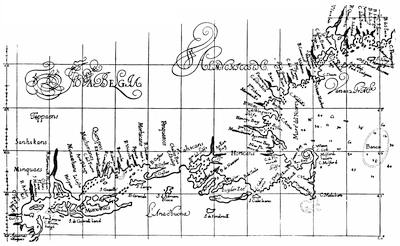
FROM DUDLEY’S ARCANO DEL MARE.
The complaints to the Council of abuses committed by fishermen and other interlopers, who without license visited the coast, and by their conduct caused the overthrow of the trade and the dishonor of the government, led to the selection of Robert Gorges, the younger son of Sir Ferdinando Gorges, and who was recently returned from the Venetian wars, to be sent to New England for the correction of these abuses. He was commissioned as lieutenant-general, and there were appointed for his council and assistants Captain Francis West as admiral, Christopher Levett, and the governor of Plymouth for the time being. Robert Gorges had but recently become a shareholder in the grand patent, and he had also a personal grant of a tract of land on the northeast side of Massachusetts Bay, ten miles along the coast, and extending thirty miles into the interior. This was made to him partly in consideration of his father’s services to the Company.
West was commissioned in November, 1622; and his arrival at Plymouth, in New England, is noticed by Bradford “as about the latter end of June.” He had probably been for some time on the Eastern coast as he related his experiences to Bradford, who says he “had a commission to be admiral of New England, to restrain interlopers and such fishing ships as came to fish and trade without a license from the Council of New England, for which they should pay a round sum of money. But he could do no good of them, for they were too strong for him, and he found the fishermen to be stubborn fellows.... So they went from hence to Virginia.” West returned from Virginia in August, and probably joined Captain Gorges, who made his appearance in the Bay of Massachusetts in August or September of this year, having “sundry passengers and families, intending there to begin a plantation, and pitched upon the place Mr. Weston’s people had forsaken,” at Wessagusset. By his commission he and his council had full power “to do and execute what to them should seem good, in all cases, capital, criminal, and civil.”
This sending out of young Gorges with authority was probably a temporary expedient for the present emergency, preparatory to the great scheme of government set forth, a few months before he sailed, in the Council’s Briefe Relation. Captain Gorges had a private enterprise to look after while charged with these public duties. The patent which he brought over, issued to himself personally, provided for a government to be administered “acording to the great charter of England, and such Lawes as shall be hereafter established by public authority of the State assembled in Parliament in New England,” all decisions being subject to appeal to the Council for New England, “and to the court of Parliament hereafter to be in New England aforesaid.”
Gorges remained here but a short time,—probably not quite a year,—having during his stay a sharp conflict with the notorious Thomas Weston, whom Governor Bradford, in pity to the man, attempted to shield from punishment. In speaking of Gorges’ return to England, Bradford says that he “scarcely saluted the country in his government, not finding the state of things here to answer his quality and condition.” His people dispersed: some went to England, and some to Virginia. Sir Ferdinando Gorges himself assigns another reason for his son’s speedy abandoning the country. He says that Robert was sent out by Lord Gorges and himself,—meaning, I suppose, that he came at their personal charge,—and that he was disappointed in not receiving supplies from “divers his familiar friends who had promised as much; but they, hearing how I sped in the House of Parliament, withdrew themselves, and myself and friends were wholly disabled to do anything to purpose.” The report of these proceedings coming to his son’s ears, he was advised to return home till better occasion should serve.
The records of the Council show that for the space of one year their business was pursued with considerable vigor by the few members who were interested.[529] Sir Ferdinando Gorges, of course, was the mainstay of the enterprise. The principal business was to prepare to put their plans into operation. The money did not come in, and a large number of the patentees fell off. Much time was spent in inducing new members to engage, and pay in their money; and the efforts to bring the merchant fishermen to acknowledge the claims of the Council, and to take out licenses for traffic and fishing, were untiring.
Finally, in the summer of 1623, the Council resolved to divide the whole territory of New England among the patentees, “in the plot remaining with Dr. Goche,” the treasurer. The reasons given for this step are, “For that some of the adventurers excuse their non-payment in of their adventures because they know not their shares for which they are to pay, which much prejudiceth the proceedings, it is thought fit that the land of New England be divided in this manner; viz., by 20 lots, and each lot to contain 2 shares. And for that there are not full 40 and above 20 adventurers, that only 20 shall draw those lots.” Provision was accordingly made that each person drawing two shares should part with one share to some member who might not have drawn, or some one else who shall thereafter become an adventurer, to the end that the full “number of forty may be complete.” The meeting for the drawing was held on Sunday, June 29, 1623, at Greenwich, at which the King was present.[530]
The “plot” of New England, on which this division is shown, with the names set down according as the lots were drawn, was published the next year in Sir William Alexander’s Encouragement to Colonies; and on page 31 of his book the writer speaks of hearing that “out of a generous desire by his example to encourage others for the advancement of so brave an enterprise he [Sir Ferdinando Gorges] is resolved shortly to go himself in person, and to carry with him a great number well fitted for such a purpose; and many noblemen in England (whose names and proportions as they were marshalled by lot may appear upon the map), having interested themselves in that bounds, are to send several colonies, who may quickly make this to exceed all other plantations.”
Alexander must have been well informed of the intentions of the Company, certainly familiar with those of Gorges himself; and it must have been with their knowledge and approbation that the act above recorded was thus published.
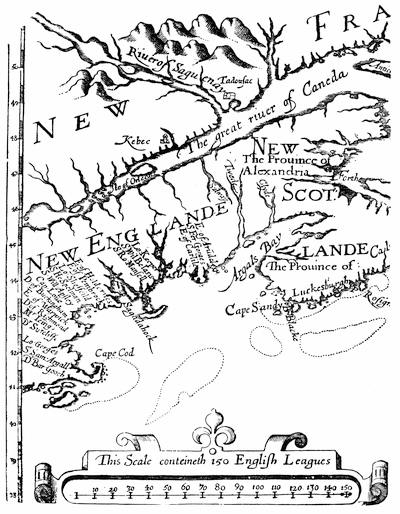
ALEXANDER’S MAP, 1624.
[This is a fac-simile of a part of the map, as reproduced in Purchas’s Pilgrims.—Ed.]
The meeting at which the division was made is the last of which we have any record for a number of years, and the history of the Company during these years must be gathered from other sources. The grand colonial scheme intended to be put in operation never went into effect; and at a late period the Council say, concerning this division, that hitherto they have never been confirmed in the lands so allotted.
A new Parliament was summoned to meet February 12, 1623/24, and on the 24th we find this minute: “Mr. Neale delivereth in the bill for free liberty of fishing upon the coasts of America.” “Five ships of Plymouth under arrest, and two of Dartmouth, because they went to fish in New England. This done by warrant from the Admiralty. To have these suits staid till this bill have had its passage. This done by Sir Ferdinando Gorges his Patent. Ordered, that this patent be brought into the Committee of Grievances upon Friday next.” March 15, 1623/24, an Act for freer liberty of fishing, as previously introduced, was committed to a large committee, of which Sir Edward Coke was chairman. On the 17th, Sir Edward reported from this committee that they had condemned one grievance, namely, “Sir Ferdinand Gorges his patent for a plantation in New England. Their council heard, the exceptions being first delivered them. Resolved by consent, that, notwithstanding the clause in the patent dated 3d November, 18th Jac., that no subject of England shall visit the coast upon pain of forfeiture of ship and goods, the patentees have yielded that the Englishmen shall visit, and that they will not interrupt any fisherman to fish there.” Finally it was enacted by the House that the clause of forfeiture, being only by patent and not by act of Parliament, was void.
Gorges himself gives a graphic picture of the scene when he, with his counsel, was before the Committee of the House, and he spoke so unavailingly in defence of his patent. This patent was the first presented from the Committee of Grievances. “This their public declaration of the Houses ... shook off all my adventurers for plantation, and made many of the patentees to quit their interest;” so that in all likelihood he would have fallen under the weight of so heavy a burden, had he not been supported by the King, who would not be drawn to overthrow the corporation he so much approved of, and Gorges was advised to persevere. Still he thought it better to forbear for the present, though the bill did not become a law of the realm. Soon afterward the French ambassador made a challenge of all those territories as belonging of right to the King of France, and Gorges was called to make answer to him; and his reply was so full that “no more was heard of that their claim.”
Being unable to enforce the claim whence was to come the principal source of its income, and the larger part of the patentees having abandoned the enterprise, the Great Council for New England, whose patent had been denounced by the House of Commons as a monopoly and opposed to the public policy and the general good, became a dead body. In the following year, 1625, we hear of Gorges as commander of one of the vessels in the squadron ordered by Buckingham to Dieppe for the service of the King of France. Finding on his arrival that the vessels were destined to serve against Rochelle, which was then sustaining a siege, Gorges broke through the squadron, and returned to England with his ship.
In the summer of 1625 the Plymouth people were in great trouble by reason of their unhappy relations to the Adventurers in London, and Captain Standish was sent over to seek some accommodation with them. At the same time he bore a letter from Governor Bradford to the Council of New England, urging their intervention in behalf of the colony “under your government.” But Bradford says that, by reason of the plague which that year raged in London, Standish could do nothing with the Council for New England, for there were no courts kept or scarce any commerce held.
Two years later, in the summer of 1627, Governor Bradford again wrote to the Council for New England, under whose government he acknowledged themselves to be, and also to Sir Ferdinando Gorges himself, advising them of the encroachments of the Dutch, and also making complaints of the disorderly fishermen and interlopers, who, with no intent to plant, and with no license, foraged the country and were off again, to the great annoyance of the Plymouth settlers.
After a patent to Christopher Levett, of May 5, 1623, the Council appear to have made no grants of land till, in 1628, two patents were issued,—one to the Plymouth people of land on the Kennebec River, and one to Rosewell, Young, Endicott, and others, patentees of Massachusetts. These were followed by a grant to John Mason, of Nov. 7, 1629, the Laconia grant of Nov. 17, 1629, that to Plymouth Colony of Jan. 13, 1629/30, and sundry grants of territory in the present States of Maine and New Hampshire.
The records of the Council, of which there is a hiatus of over eight years in the parts now extant (and the latter portion is a transcript with probably many omissions), begin on the 4th of November, 1631, with the Earl of Warwick as president, and contain entries of sundry patents granted, and of the final transactions of the Company during its existence. Precisely when the Earl of Warwick was chosen president we do not know. His name appears in the Plymouth patent of Jan. 13, 1629/30, as holding that office, and it is quite likely that he was president when the Massachusetts patent was issued, he being chiefly instrumental in passing that grant. The Council seem now to have revived their hopes as they did their activity. As late as Nov. 6, 1634, divers matters of moment were propounded: “First, that the number of the Council be with all convenient speed filled. [It appears by a previous meeting that there were now but twenty-one members in all, whereas the patent called for no less than forty.] Second, that a new patent from his Majesty be obtained.” Also, that no ships, passengers, nor goods be permitted to go to New England without license from the President and Council; and that fishermen should not be allowed to trade with savages, nor with the servants of planters, nor to cut timber for stages, without license. This, surely, is a revival of the old odious policy. We do not know if any of these orders were adopted.
There seems at this time to have arisen a serious misunderstanding or quarrel between the Council and their President, the Earl of Warwick. It first appears at a meeting held June 29, 1632. The President was not present at this meeting, though it was held, as the meetings had been held for some years past, at “Warwick House.” An order was adopted “that the Earl of Warwick should be entreated to direct a course for finding out what patents have been granted for New England.” At the same meeting the clerk was sent to the Earl for the Council’s great seal, which was in his lordship’s keeping; and word came back that he would send it when his man came in. It was also ordered that the future meetings of the Council be held at the house of Captain Mason, in Fenchurch Street. But the seal was not sent, and two more formal requests were made for it during the next six months. Captain John Mason was chosen vice-president Nov. 26, 1632. The records for 1633 and 1634 are wanting. Early in 1635 the Council resolved to resign their patent into the hands of the King; preparatory to which they made a new partition of the territory of New England, dividing it among themselves, or, according to the records, among eight of their number. Of what precise number the Council consisted at this time we have no means of knowing. The division was made at a meeting held Feb. 3, 1634/35, and to the description of each particular grant the members on the 14th of April affixed their signatures, each person withholding his signature to his own share. In making this division it was ordered that every one who had lawful grants of land, or lawfully settled plantations, should enjoy the same, laying down his jura regalia to the proprietor of this division, and paying him some small acknowledgment. A memorandum is also made that “the 22d day of April several deeds of feoffment were made unto the several proprietors.”
The act of surrender passed June 7, 1635. Lord Gorges had been chosen president April 18. The Company seem to have been kept alive till some years later, as there is an entry as late as Nov. 1, 1638, at which it was agreed to augment the grants of the Earl of Sterling and Lord Gorges and Sir F. Gorges, the two latter to have “sixty miles more added to their proportions further up into the main land.” Of course, in making this division the whole patent of Nov. 3, 1620, was not divided, for that ran from sea to sea. It was a division on the New England coast, running back generally sixty miles inland. It was part of the plan to procure from the King, under the great seal of England, a confirmation of these several grants. Lord Sterling’s grant included also Long Island, near Hudson’s River.
The intention in this division was to ride over the Massachusetts patent of 1628, which had been confirmed the following year by a charter of incorporation from the King, and legal proceedings were soon afterward instituted by a writ of quo warranto for vacating their franchises. The notorious Thomas Morton was retained as a solicitor to prosecute this suit. The grants issued in this division to Sir Ferdinando Gorges and to John Mason are the only ones with which subsequent history largely deals.[531]
The King, in accepting the resignation of the Grand Patent, resolved to take the management of the affairs of New England into his own hands, and to appoint as his general governor Sir Ferdinando Gorges, who himself, or by deputy, was to reside in the country. But “the best laid schemes o’ mice and men gang aft a-gley.” The attempt to vacate the charter of Massachusetts Bay, a fundamental thing to be done, was not accomplished. The patentees to whom several of the divisions of the territory of New England were assigned appear to have wholly neglected their interest, and, except in the case of Sir Ferdinando Gorges, before referred to, royal charters were granted to none.
Massachusetts, Maine, New Hampshire, and Connecticut were settled under grants, or alleged grants, from the Council for New England. The grant of the territory of Massachusetts Bay of March 19, 1627/28, was in the following year confirmed by the Crown, with powers of government. The grant to Sir Ferdinando Gorges in the general division of February, 1634/35, with an additional sixty miles into the interior subsequently added, was confirmed by the Crown April 3, 1639, with a charter constituting him Lord Proprietor of the Province of Maine, and giving him extraordinary powers of government. The territory issued to John Mason at the general division, which was to be called New Hampshire, the parchment bearing date April 22, 1635, was never confirmed by the King, nor were any powers of government granted. The first settlements in Connecticut,—namely, those of the three towns on the river of that name, in 1635 and 1636,—were made under the protection of Massachusetts, as though the territory had been part of that colony. But the inhabitants subsequently acquired a quasi claim to this territory, under what is known as the “old patent of Connecticut,” impliedly proceeding from the Council for New England, through the Earl of Warwick, to Lord Say and Sele and his associates. The settlers of Quinnipiack, afterward called New Haven, in 1638 and 1639, had no patent for lands, but made a number of purchases from the Indians. Plymouth Colony, of which an account is given here by another hand, received a roving patent from the Council, dated June 1, 1621, with no boundaries; and another patent, dated Jan. 13, 1629/30, defining their limits, but with no powers of government. The territory of Rhode Island was not a grant from the Council to the settlers.
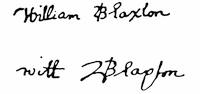
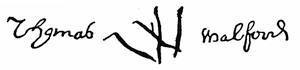
Massachusetts.—There were scattered settlements in Massachusetts Bay prior to the emigration under the patent of 1627/28. Thomas Weston began a settlement at what is now Weymouth Fore-River, in the summer of 1622, which lasted scarcely one year. Robert Gorges, as we have seen, took possession of the same place, in September, 1623, for his experimental government, but the colony broke up the next spring, leaving, it is thought, a few remnants behind, which proved a seed for a continuous settlement. Persons are found temporarily at Nantasket in 1625, and perhaps earlier; at Mount Wollaston the same year, and at Thompson’s Island in 1626. The solitary William Blaxton, clerk, is traced to Shawmut, (Boston) in 1625 or 1626, and the equally solitary Samuel Maverick, at Noddles’ Island, about the same time; while Walford, the blacksmith, is found at Charlestown in 1629. The last three named are reasonably conjectured to have formed part of Robert Gorges’ company at Weymouth, in 1623/24.

The Dorchester Fishing Company, in England, of which the Rev. John White, a zealous Puritan minister of that town, was a member, resolved to make the experiment of planting a small colony somewhere upon the coast, so that the fishing vessels might leave behind in the country all the spare men not required to navigate their vessels home, who might in the mean time employ themselves in planting, building, etc., and be ready to join the ships again on their return to the coast at the next fishing season. Cape Ann was selected as the site of this experiment, and in the autumn of 1623 fourteen men were left there to pass the winter. In the latter part of the year 1625 Roger Conant, who had been living at Plymouth and at Nantasket, was invited to join this community as its superintendent, and he remained there one year. The scheme proving a financial failure, the settlement broke up in the autumn of 1626, most of the men returning home; but Conant and a few others removed to Naumkeag (Salem), where they were found by Endicott, who, under the authority of the Massachusetts patentees, arrived there Sept. 6, 1628. These old settlers joined the new community.
Endicott was sent out as agent or superintendent of a large land company, of which he was one of the proprietors, colonization being, of course, a prominent feature in their plans. In the following year, March 4, 1628-29, the patentees and their associates received a charter of incorporation, with powers of government, and with authority to establish a subordinate government on the soil, and appoint officers of the same. This local government, entitled “London’s Plantation in Massachusetts Bay in New England,” was accordingly established, and Endicott was appointed the first resident governor. The charter evidently contemplated that the government of the Company should be administered in England. In a few months, however, the Company resolved to transfer the charter and government from London to Massachusetts Bay; and Matthew Cradock, who had been the first charter governor, resigned his place, and John Winthrop, who had resolved to emigrate to the colony, was chosen governor of the Company in his stead. On the transfer of the Company to Massachusetts by the arrival of Winthrop, the subordinate government, of which Endicott was the head, was silently abolished, and its duties were assumed by its principal, the corporation itself, which took immediate direction of affairs. As the successor of Cradock, Winthrop was the second governor of the Massachusetts Company, yet he was the first who exercised his functions in New England.
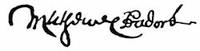
The Massachusetts charter was not adapted for the constitution of a commonwealth; therefore, as the colony grew in numbers it became necessary for it to assume powers not granted in that instrument. Between the years 1630 and 1640 about twenty thousand persons arrived in the colony, after which, for many years, it is supposed that more went back to England than came thence hither. Previous to the year last named the colony had furnished emigrants to settle the colonies of Connecticut, New Haven, and Rhode Island.
The charter gave power to the freemen to elect annually a governor, deputy-governor, and eighteen assistants, who should make laws for their own benefit and for the government of the colony; and provision was made for general courts and courts of assistants, which exercised judicial as well as legislative powers. But at the first meeting of the general court in Boston, in October, 1630, it was ordered that the governor and deputy-governor should be chosen by the assistants out of their own number. This rule was of short duration, as in May, 1632, the freemen resumed the right of election, and the basis of a second house of legislature was laid.
The colonists, though Puritans, were Church of England men, and were fearful of rigid separation; but Winthrop and his party,—among whom was John Wilson, a graduate of King’s College, Cambridge, and destined to become their first minister,—found on their arrival a church already established at Salem on the basis of separation. Thenceforward, following that example, the Massachusetts colony became a colony of congregational churches. It has been a favorite saying with eulogists of Massachusetts, that the pious founders of the colony came over to this wilderness to establish here the principle of civil and religious liberty, and to transmit the same inviolate to their remotest posterity. Probably nothing was further from their purpose, which was simply to find a place where they themselves, and all who agreed with them, could enjoy such liberty. This was a desirable object to attain, and they made many sacrifices for it, and felt that they had a right to enjoy it.
The banishment of Roger Williams, and of Mrs. Hutchinson and her sympathizers, was no doubt largely due to the feeling that the peace of the community was endangered by their presence. In the unhappy episode of the Quakers, at a later period, the colonial authorities were wrought into a frenzy by these “persistent intruders.” It seemed to be a struggle on both sides for victory; but though four Quakers were hanged on Boston Common, the Quakers finally conquered. In the second year of the settlement, in order to keep the government in their own hands, or, in the language of the Act, “to the end the body of the commons may be preserved of honest and good men,” the Court ordered that thenceforward no one should be elected a freeman unless he was a member of one of the churches of the colony. Probably there were as good men outside the churches as there were inside, and by and by a clamor was raised by those who felt aggrieved at being denied the rights of freemen; but the rule was not modified till after the Restoration.
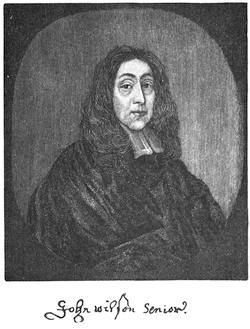
[This portrait of the first minister of Boston hangs in the gallery of the Massachusetts Historical Society. Its authenticity has been in turn questioned and maintained. Cf. Mass. Hist. Soc. Proc. September, 1867, and December, 1880.—Ed.]
A few unsavory persons whom Winthrop and his company found here and speedily sent away, on their arrival home failed not to make representations injurious to the Puritan settlement, and they were seconded by the influence of Sir Ferdinando Gorges and John Mason. Attempts were made in 1632 to vacate the colony’s charter; but these attempts proved unsuccessful. A more serious effort was made a few years later, when the Council for New England resigned its franchises into the hands of the King; but owing to the trouble which environed the government in England, and to other causes not fully explained, the colony then escaped, as it also escaped at the same time the impending infliction of a general governor for New England.
In 1640 some of the colony’s friends in England wrote to the authorities here advising them to send some one to England to solicit favors of the Parliament. “But, consulting about it,” says Winthrop, “we declined the motion, for this consideration,—that if we should put ourselves under the protection of Parliament, we must then be subject to all such laws as they should make, or at least such as they might impose upon us; in which course, though they should intend our good, yet it might prove very prejudicial to us.” From 1640 to 1660 the colony was substantially an independent commonwealth, and during this period they completed a system of laws and government which, taken as a whole, was well adapted to their wants. Their “Body of Liberties” was established in 1641, and three editions of Laws were published by authority, and put in print in 1649, in 1660, and in 1672. The first law establishing public schools was passed in October, 1647. Harvard College had already, in 1637, been established at Cambridge.
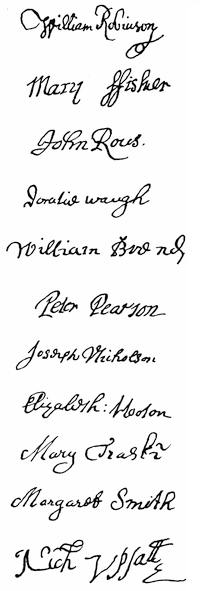
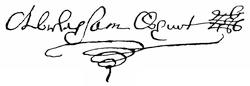
QUAKER AUTOGRAPHS.
[This group gives the names of some of the victims of the judicial extremities practised in Boston. See Bowden’s Friends in America, and the Memorial History of Boston. Cf. the note on the treatment of the early Quakers in New England, in chapter xii.—Ed.]
The ecclesiastical polity of the churches, embodied in the “Cambridge Platform,” was drawn up in 1648, and printed in the following year, and was finally approved by the General Court in 1651.
The community was obliged to feel its way, and adapt its legislation rather to its exigencies than to its charter. The aristocratical element in the society early cropped out in the institution of a Council for life, which may have had its origin in suggestions from England; but it met with little favor.
The confederation of the United Colonies, first proposed by Connecticut, was an act of great wisdom, foreshadowing the more celebrated political unions of the English race on this continent, for they all have recognized the common maxim, that “Union is strength.” The colonists were surrounded by “people of several nations and strange language,” and the existence of the Indian tribes within the boundaries of the New England settlements was the source of ceaseless anxiety and alarm. The Pequot War had but recently ended, and it had left its warning. It would have been an act of grace to admit the Maine and Narragansett settlements to this union, but it was probably impracticable.
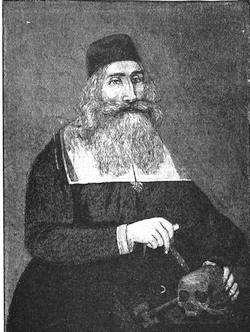
DR. JOHN CLARK.
[This portrait of a leading physician of the colony hangs in the gallery of the Massachusetts Historical Society, and is inscribed “Ætatis suæ 66 ann. suo,” and purports to be a Dr. John Clark, and is probably the physician of that name of Newbury and Boston, who died in 1664. His son John, likewise a physician, was also a prominent public man in Boston, and died in 1690. That it is the former is believed by Dr. Thacher in his American Medical Biography, and by Coffin in his History of Newbury, both of whom give lithographs of the picture. Dr. Appleton, who printed an account of the Society’s portrait in its Proceedings, September, 1867, also took this view; while the Rev. Dr. Harris, in the Society’s Collections, third series, vii. 287, finds the year 1675 in the inscription, which is not there, and identifies the subject of the picture with another Dr. John Clark, who was prominent in Rhode Island history. There was still a third Dr. John Clark, son of John, and of Boston, who died in 1728. It is not probably determinable beyond doubt which of the earlier two this is; and Savage, in his Genealogical Dictionary, gives twenty-five John Clarks as belonging to New England before the end of the first century; but of these only four are physicians, as above named. Cf. Massachusetts Historical Society’s Proceedings, July, 1844, p. 287.—Ed.]
The conversion of the Indian tribes to Christianity was a subject which the colony had much at heart, and a number of its ministers had fitted themselves for the work: the special labors of the Apostle Eliot need only be mentioned. Through the instrumentality of Edward Winslow, a society for propagating the gospel among the Indians was incorporated in England in 1649, and the Commissioners of the United Colonies were made the agents of its corporation as long as the union of the colonies lasted.
The Massachusetts colonists were at first seriously tasked for the means of subsistence; but these anxieties soon passed away. Industry took the most natural forms. Agriculture gave back good returns. To the invaluable Indian maize were added all kinds of English grain, as well as vegetables and fruits. Some were indigenous to the soil. English seeds of hay and of grain returned bountiful crops. All animals with which New England farms are now stocked then well repaid in increase the care bestowed upon them. The manufacture of clothing was of slower growth. Thread and yarn were spun and knit by the women at home; but in a few years weaving and fulling mills were set up, and became remunerative. The manufacture of salt, saltpetre, gunpowder, and glassware gave employment to many, while the brickmaker, the mason, the carpenter, and indeed all kindred trades found occupation. The forests were a source of income. Boards, clapboards, shingles, staves, and, at a later period, masts had a ready sale. Furs and peltry, received in barter from the Indians, became features of an export trade. The fisheries should be specially enumerated as a source of wealth, and this industry led to the building of ships, which were the medium of commerce with the neighboring colonies, the West Indies, and even with Spain.[532]
After the coin brought over by the settlers had gone back to England to pay for supplies, the colony was greatly embarrassed for a circulating medium, and Indian corn and beaver-skins were early used as currency, while wampum was employed in trade with the Indians. The colony, however, in 1652 established a mint, where was coined, from the Spanish silver which had been introduced from the West Indies, and from whatever bullion and plate might be sent in from any quarter, the New England money so well known in our histories of American coinage.[533] The relation of the colony to the surrounding New England plantations is noticed further on in the brief accounts given of those settlements.
Events in England moved rapidly onward. The execution of King Charles occurred about two months before the death of Winthrop, which happened on the 26th of March, 1648/49, and it is certain that the latter never heard of the tragic end of his old master. The colonists prudently acknowledged their subjection to the Parliament, and afterward to Cromwell, so far as was necessary to keep upon terms with both. Hutchinson says that he had nowhere met with any marks of disrespect to the memory of the late king, and that there was no room to suppose they bore any disaffection to his son; and if they feared his restoration, it was because they expected a change in religion, and that a persecution of all Nonconformists would follow. Charles II. was tardily proclaimed in the colony, owing, perhaps, to a lack of definite information as to the state of politics in England, and to rumors that the people there were in an unsettled condition.
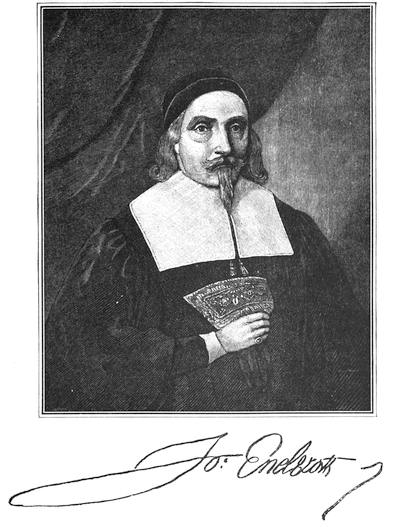
[See note on this portrait in the Memorial History of Boston, i. 309.—Ed.]
A loyal address was finally agreed upon and sent; but he was not proclaimed till August of the following year, 1661. The Restoration brought trouble to the colony. Among those who laid their grievances before the King in Council were Mason and Gorges, each a grandson and heir of a more distinguished proprietor of lands in New England. They alleged that the colony had, in violation of the rights of the petitioners, extended its jurisdiction over the provinces of New Hampshire and Maine. The Quakers and some of the Eastern people also had their complaints to make against the colony.
To the humble address made to the King a benignant answer was received; but an order soon afterward came that persons be sent over authorized to make answer for the colony to all complaints alleged against it. These agents on their return brought a letter from the King to the colony, in which he promised to preserve its patent and privileges; but he also required of the colony that its laws should be reviewed, and such as were against the King’s authority repealed; that the oath of allegiance and the forms of justice be administered in the King’s name; that no one who desired to use the book of Common Prayer should be prejudiced thereby as to the baptism of his children or admission to the sacrament or to civil privilege.
These requirements were grievous to the people of Massachusetts; but worse was to come. In the spring of 1664 intelligence was brought that several men-of-war were coming from England with some gentlemen of distinction on board, and preparations were made to receive them. At the next meeting of the General Court a day of fasting and prayer was appointed, and their patent and its duplicate were brought into Court and committed to the charge of four trusty men for safe-keeping. The ships arrived in July, with four commissioners having authority for reducing the Dutch at Manhados, and for visiting the several New England colonies, and hearing and determining all matters of complaint, and settling the peace and security of the country. Proceeding on their errand to the Manhados, the Dutch surrendered on articles.[534] In the mean time an address was agreed upon by the Court to be sent to the King, in which was recounted the sacrifices and early struggles of the colonists, while they prayed for the preservation of their liberties. Colonel Nichols remaining in New York, the other commissioners returned to New England, and, having despatched their business elswhere, came to Boston in May, 1665, after they had been joined by Colonel Nichols. Governor Endicott had died the preceding March, and Mr. Bellingham, the deputy-governor, stood in his place. The commissioners laid their claim before the Court, and demanded an answer. There was skirmishing on both sides. It is a long story, filling many pages of the colony records. The envoys asked to have their commission acknowledged by the government; but this would have overridden the charter of the colony, and placed the inhabitants at the mercy of their enemies. In short, the authorities refused to yield, and the commissioners, after being defeated in other attempts to effect their purpose, were called home. Several letters and addresses followed. Thus ended for a time the contest with the Crown. For nearly ten years there was an almost entire suspension of political relations between New England and the mother country. But the projects of the Home Government were not given over. Gorges and Mason persisted in their claims. In the mean time New England was ravaged by an Indian war, known as Philip’s War. The distress was great, and the loss of life fearful. During its progress Edward Randolph, the evil genius of New England, appeared on the scene, prepared for mischief.
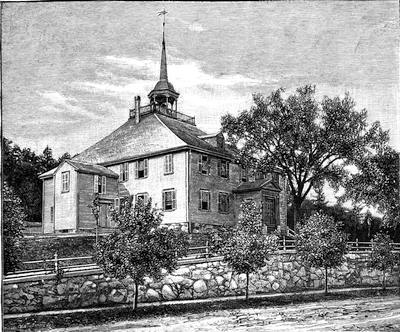
MEETING-HOUSE AT HINGHAM.
[This is considered the oldest meeting-house in present use in New England. It was erected in 1681. Cf. The Commemorative Services of the First Parish in Hingham on the Two Hundredth Anniversary of the Building of its Meeting-House, Aug. 8, 1881 (Hingham, 1882), with another view of the building,—a photograph; also E. A. Horton’s Discourse, Jan. 8, 1882. A meeting-house of similar type, erected in Lynn in 1682, is represented in Lynn, Her First Two Hundred and Fifty Years, p. 117.
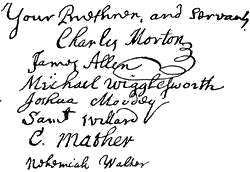
The annexed autographs, taken from a document in the Trumbull Manuscripts, in the Massachusetts Historical Society’s Cabinet, and dated 1690, represent some of the leading ministers of the colony at the close of the colonial period. Morton was of Charlestown; Allen of Boston; Wigglesworth, the author of the Day of Doom, a sulphurous poem greatly famous in its day, was of Malden; Moodey was of Portsmouth; Willard and Mather of Boston; and Walter of Roxbury.—Ed.]
He arrived in July, 1676, with a letter from the King and with complaints from Mason and Gorges, and armed with a royal order for agents to be sent to England to make answer. This was but the beginning of the end. The legal authorities in England, before whom the case was brought, decided that neither Maine nor New Hampshire was within the chartered limits of Massachusetts, and that the title of the former was in the grandson of the original proprietor. Whereupon the agent of Massachusetts bought the patent of Maine from its proprietor for £1,250, and stood in his shoes as lord paramount.
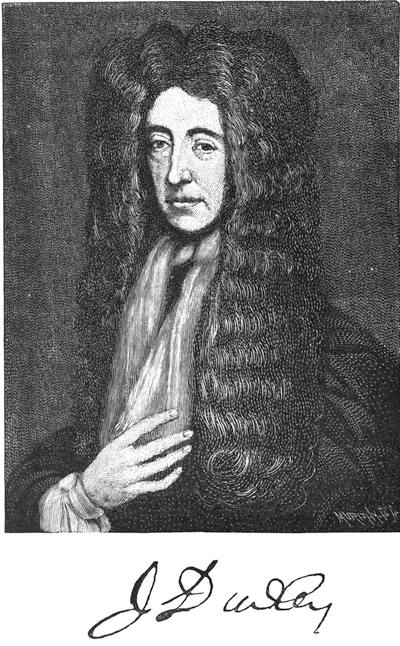
This greatly displeased the King, and the hostility to the colony continued. Additional charges, such as illegal coining of money, violations of the laws of trade and navigation, and legislative provisions repugnant to the laws of England and contrary to the power of the charter, were now alleged against the colony. The agents of the colony and the emissaries of the Crown crossed and recrossed the ocean with apologies on the one hand and requisitions on the other; but nothing would satisfy the Crown but the subjugation of the colony. A quo warranto against the Governor and Company was issued in 1683; and finally, by a new suit of scire facias brought in the Court of Chancery, judgment against the Company was entered up Oct. 23, 1684. Intelligence of this was not officially received till the following summer. Meantime the new king, James II., was proclaimed, April 20, 1685. The government of the colony was expiring. The “Rose” frigate arrived in Boston May 14, 1686, bringing a commission for Joseph Dudley as President of the Council for Massachusetts Bay, New Hampshire, and Maine, and the Narraganset country, or King’s Province. There was no House of Deputies to oppose him. Dudley was succeeded by Sir Edmund Andros on the 19th of December, who had arrived in the frigate “Kingfisher,” with a commission for the government of New England. He was detested by the colony, and the people only needed a rumor of the revolution in England, which reached Boston in the spring of 1689, to provoke a rising, and he was thrown into prison.[535] A provisional government, with the old charter-officers, was instituted, and continued till the new charter of 1691 was inaugurated.
Maine.—There were many settlements on the coast of Maine prior to the grant to Gorges from the Council in 1635, and consequently before his subsequent charter from the King. Indeed, very little was done by Gorges as Lord Proprietor of Maine. The patents from the Council to the year 1633 had embraced the whole territory from Piscataqua to Penobscot, thus including the territory on both sides the Kennebec, which was claimed by the Pilgrims of Plymouth under their patent of Jan. 13, 1629/30. In various places settlements had already been begun. In the royal charter to Gorges, whose grant extended from Piscataqua to Sagadahoc, the rights of previous grantees were reserved to them, they relinquishing or laying down their jura regalia.
The earliest permanent settlement in this State, on the mainland, would seem to have been made at Pemaquid. One John Brown, of New Harbor, bought land in that quarter of the Indians as early as July 15, 1625, the acknowledgment of the deed being taken by Abraham Shurt, of Pemaquid, in the same month in the following year, if there is no error in Shurt’s deposition. Shurt says that he came over as the agent of the subsequent proprietors, Aldsworth and Elbridge, who had a grant of Pemaquid from the Council, issued Feb. 29, 1631/32, and that he bought for them the Island of Monhegan, on which a fishing settlement, temporarily broken up in 1626, was made three years before.
The settlement at the mouth of the Saco River must have begun soon after Richard Vines took possession of his grant there in 1630. During the same year Cleeves and Tucker settled near the mouth of the Spurwink; but in two years they removed to the neck of land on which Portland now stands, and laid the foundation of that city. In applications to the Council for grants of land made respectively to Walter Bagnall and John Stratton, Dec. 2, 1631, the former represents himself to have lived in New England “for the space of seven years,” and the latter “three years last past.” Bagnall’s patent included Richmond Island, where he had lived some three years at least. He was killed by the Indians two months before the Council acted upon his application. Stratton’s grant was located at Cape Porpoise. Bagnall probably had been one of Thomas Morton’s unruly crew at Mt. Wollaston, in Boston Harbor.
In 1630 what is known as the “Plough Patent” was issued by the Council. The original parchment is lost, and it is nowhere recorded. The grant was bounded on the east by Cape Elizabeth, and on the west by Cape Porpoise, a distance of some thirty miles on the sea-coast. This included the patents on the Saco River previously granted, against which Vines protested. There was early a dispute as to its extent. The holders of it came over in the ship “Plough,” in 1631. They went to the eastward; but not liking the place, came to Boston. They subsequently fell out among themselves, and, as Winthrop says, “vanished away.” Afterward the patent fell into the hands of others, and played an important part for a number of years in the history of Maine, of which notice will be taken further on.
On Dec. 2, 1631, a grant of land of twenty-four thousand acres in extent was made to a number of persons, including Ferdinando Gorges, a grandson of Sir Ferdinando, then some three years of age. This territory was on both sides of the Acomenticus River. Some settlements were made here about this time, and April 10, 1641, after the Gorges government was established, the borough of Acomenticus was incorporated, and in the following March the place was chartered as the city of “Gorgeana.”
There were other early settlements on the coast of Maine, but we have no space for their enumeration. The inhabitants, really or nominally, for the most part sympathized with the Loyalist party as well in politics as in religion, and it was the policy of the proprietor of Maine to foster no opposing views. They were subjected to no external government until the arrival of Captain William Gorges, in 1636, as deputy-governor, with commissions to Richard Vines and others as councillors of the province, to which the name of “New Somersetshire” was given. The first meeting of the commissioners was held at Saco, March 25, 1636, where the first provincial jurisdiction in this section of New England was exercised. The records of this province do not extend beyond 1637, and it is uncertain whether the courts continued to be held until the new organization of the government of Maine in 1640. In 1636 George Cleeves, a disaffected person who lived at Casco, went to England, and next year returned with a commission from Sir Ferdinando Gorges, authorizing several persons in Massachusetts Bay to govern his province of New Somersetshire, and to oversee his servants, etc. The authorities of the Bay declined the service, and the matter “passed in silence.” Winthrop says they did not see what authority Gorges had to grant such commissions.
The charter of Maine, which covered the same territory as New Somersetshire, having been granted to Sir Ferdinando Gorges, he issued a commission for its government. This included a number of his kinsmen, with Thomas Gorges as deputy-governor. The first General Court under this government was held at Saco, June 25, 1640, under an earlier commission and before the arrival of the deputy-governor. This Court exercised the powers of an executive and legislative, as well as of a judicial, body, in the name of “Sir Ferdinando Gorges, Knight, Lord Proprietor of the Province of Maine.” The second term of the Court was held in September, when the Deputy-Governor was present. He made his headquarters at Gorgeana. The records of the courts between 1641 and 1644, inclusive, are not preserved. Deputy-Governor Gorges sailed for England in 1643, leaving Richard Vines at the head of the government. At a meeting held at Saco in 1645, the Court, not having heard from the proprietor, appointed Richard Vines deputy-governor for one year, and if he departed within the year, Henry Josselyn was to take his place. The civil war was raging in England at this time, and Sir Ferdinando Gorges was active for the King, and was in Prince Rupert’s army at the siege of Bristol. When that city was retaken by the Parliamentary forces, in 1645, he was plundered and imprisoned. Under these circumstances he had no time to give to his distant province. In 1645 the Court ordered that Richard Vines shall have power to take possession of all goods and chattels of Sir Ferdinando Gorges, and to pay such debts as Gorges may owe.
But Gorges’ authority was not, meanwhile, without its rival. Not long after the government under the charter of 1639 had been organized, George Cleeves, of Casco, again went to England, and induced Alexander Rigby, “a lawyer and Parliament-man,” from Wigan, Lancashire, to purchase the abandoned Plough patent before mentioned, which he did, April 7, 1643; and Cleeves received a commission from him, as deputy, to administer its affairs. By the following January he had returned, and, landing at Boston, he solicited the aid of the Massachusetts Government against the authority of Gorges; but that Government declined to interfere. Cleeves claimed that Casco was within the bounds of his patent, and he immediately set up his authority as “Deputy-President of the Province of Lygonia,” extending his jurisdiction over a large part of the Province of Maine, which was then under the administration of Richard Vines, as deputy for Gorges. This produced a collision, and both parties appealed to Massachusetts, which declined, as before, to act; but finally, in 1646, after Vines had left the country, the Bay Government consented to serve as umpire; but no conclusion was reached. Winthrop says that both parties failed of proof; and as a joint appeal had been made to the Commissioners for Foreign Plantations in England, they were advised in the mean time to live peaceably together. Rigby’s position and influence in Parliament secured a decision in his favor, while Gorges at that time was in no position to protect his interests. The decision of the Commissioners, which was given in 1646, terminated Gorges’ jurisdiction over that part of Maine included in the Province of Lygonia, embracing the settlements from Casco to Cape Porpoise, and including both. The last General Court under the authority of Gorges, of which any record exists, was held at Wells, in July of this year.
At length, in 1649, the inhabitants of the western part of this province, between Cape Porpoise and Piscataqua River,—including Wells, Gorgeana, and Piscataqua,—having had intelligence in 1647 of the death of the proprietor (Gorges died in May of that year, and was buried on the fourteenth of the month), and finding no one in authority there, and having in vain written to his heirs to ascertain their wishes, formed a combination among themselves. Mr. Edward Godfrey was chosen governor, the style of the “Province of Maine” being still retained. This state of things continued till 1652/53, when the towns were annexed to Massachusetts. The inhabitants then living between Casco and the Kennebec were few in number. Thomas Purchase, one of the proprietors of the Pejepscot patent, had, in 1639, conveyed a large tract to Massachusetts with alleged powers of government over it. The people living within the Kennebec patent were regarded as belonging to the jurisdiction of New Plymouth.
In the mean time the inhabitants under the Lygonia government quietly submitted to its authority. Alexander Rigby died in August, 1650, and the proprietorship of Lygonia fell to his son Edward. In brief, the government was soon at an end. The inhabitants of Cape Porpoise and Saco submitted to Massachusetts in 1652, and the remaining settlements in 1658. Thus was accomplished what the Bay Colony had for some time been aiming to effect,—the bringing of these eastern settlements under her jurisdiction. Having decided that the northern boundary of her patent extended three miles above the northernmost head of the Merrimac River, the commissioners appointed on a recent survey showed that the northern line, as run by them, terminated at Clapboard Island (about three miles eastward of Casco peninsula); and this brought the Maine settlements within the bounds of the Massachusetts charter. This state of things continued till after the restoration of Charles II., when the hopes of those favorable to the Gorges interest began to revive. Young Ferdinando Gorges, the grandson and heir of the old proprietor, petitioned the Crown to be restored to his inheritance. His agent, Mr. Archdale, came into the province, and appointed magistrates to act under his authority, but the Government of Massachusetts speedily repressed all such movements. Charles II., however, soon directed his attention to New England. He appointed four commissioners to proceed thither, charged with important duties and clothed with large powers. They, or three of them, visited the province in the summer of 1665, and at York issued a proclamation to the inhabitants of Maine, requiring them to submit to the immediate protection and government of the King; and in his Majesty’s name forbidding the magistrates either of Massachusetts or of the claimant to exercise jurisdiction there, until his Majesty’s pleasure should be further known. A provisional government was therefore established, and the revival of the Church of England was encouraged.
In the previous year the Duke of York received a charter of the Province of New York, and, embraced within the same document, was a grant of the territories between the St. Croix and Pemaquid, which was interpreted to include Pemaquid and its dependencies; and a government was subsequently erected there under the name of Cornwall County. After the Duke became King it was a royal province. This was beyond the eastern bounds of the Province of Maine. There had scarcely been even a pretence of a civil government here under the old patents. The Royal Commissioners speak of the low moral condition of the people of this region. “For the most part,” they say, “they are fishermen, and share in their wives as they do in their boats.” The government under the Duke of York was of an uncertain character, and was subject to the contingencies of political changes; and in 1674 the Government of Massachusetts, on the petition of the inhabitants, took them for a time under its protection. During the Indian wars which scourged the eastern settlements, in the latter part of that century, the Pemaquid country was wholly depopulated.

The Government established by the Royal Commissioners in the Province of Maine never possessed any permanent principle or power to give sanction to its authority, and in 1668 it had nearly died out; at this time the inhabitants there looked to the wise and stable Government of Massachusetts for relief, and so petitioned to be again taken under its jurisdiction. Four commissioners, therefore, accompanied by a military escort were sent from the Bay, and reaching York in July, 1668, assumed jurisdiction “by virtue of their charter.” There were a few prominent individuals who did not quietly submit, but they were summarily dealt with. Renewed exertions were now made by the proprietor and his friends for a recognition of his title, and at length they so far prevailed as to obtain letters from the King, dated March 10, 1675/76, requiring the Massachusetts Colony to send over agents with full instructions to answer all complaints. The agents appeared within the time specified, and after a full hearing the authorities decided that neither Maine nor New Hampshire was within the chartered limits of Massachusetts, and that the government of Maine belonged to the heir of Sir Ferdinando Gorges. Soon after this decision an agent of Massachusetts made a proposition for the purchase of the province, which was accepted; and in March, 1677/78, Ferdinando Gorges transferred his title for £1,250, and Massachusetts became lord-paramount of Maine. This proceeding was a surprise to the inhabitants of the province, and, as might have been expected, gave offence to the King, who ineffectually demanded that the bargain should be cancelled. Massachusetts, as the lawful assign of Ferdinando Gorges, now took possession of the province. A proclamation to that effect was issued March 17, 1679/80; and a government was set up at York, of which Thomas Danforth was deputed to be president for one year. This state of things continued till the accession of James II., when the events in Maine were shaped by the revolution which took place in Massachusetts, and Danforth was in the end provisionally restored, as Bradstreet had been in the Bay.
New Hampshire.—The first settlement in New Hampshire was made by David Thomson, a Scotchman, in the spring of 1623, at Little Harbor, on the south side of the mouth of Piscataqua River. He had received a patent from the Council of New England the year before, and came over in the ship “Jonathan,” of Plymouth, under an indentured agreement with three merchants of Plymouth in England. He lived at Little Harbor till 1626, when he removed to an island in Boston Harbor, which now bears his name. By 1628 he had died, leaving a wife and child. There is reason to believe that the settlement at Little Harbor was continued after Thomson left the place.
Following Thomson,—perhaps about 1627,—came Edward Hilton, a fishmonger of London, who settled six miles up the river, on a place afterward called Hilton’s Point, or Dover Neck. Here he was joined by a few others, including his brother William and his family, who had been at New Plymouth. In 1630 Hilton and his associates received from the Council a patent of the place on which he was settled. This was dated March 12, 1629 (O. S.), and the whole or part of it they soon sold to some merchants of Bristol in England. Two years later the patent, or a large interest in it, was purchased by Lord Say, Lord Brook, and other gentlemen friendly to Massachusetts. This latter agreement was effected through the agency of Thomas Wiggin, who had gone over to England in 1632, and who in the following year returned, bringing with him a large accession to the settlement, which included a “worthy Puritan divine,” who soon left for want of adequate support. Other ministers came, and some laymen, all of whom had been in bad repute in Massachusetts. Although the inhabitants went through the form of electing magistrates, there was no authorized government. The original proprietor of the patent had left the place, and scenes of confusion, both civil and ecclesiastical, sometimes highly amusing, characterized the settlement for a number of years. In 1637 the people combined into a body politic, which seems not to have received general sanction, and the notorious George Burdett supplanted Wiggin, the former governor; but the troubles which subsequently ensued led to a new combination, Oct. 22, 1640, signed by forty-two persons, or nearly every resident. Massachusetts had for some years desired to bring the several governments on the Piscataqua and its branches under her jurisdiction, and had, by an early revision of the northern boundary of her patent, decided that it included them. The inhabitants here desired to be under a stable government, and on June 14, 1641, they submitted to the Massachusetts authorities, and the Act of Union was passed by that Government, Oct. 9 following.[536]
The next independent settlement was made by the Laconia Company in 1630. This company was formed soon after the Laconia patent of Nov. 17, 1629, was granted to Sir Ferdinando Gorges and John Mason. It was an unincorporated association of nine persons, most of whose names appear in a subsequent grant of land, to be presently mentioned. Some of these associates had been members of the Canada Company, of which Sir William Alexander was the head, who had undertaken the conquest of Canada as a private enterprise, under the command of Sir David Kirke. The fur-trade of that province was the tempting prize. The sudden peace which followed the conquest, with the stipulation that all articles captured should be restored, brought the Canada Company to grief. Ten days after the return of the expedition, Sir Ferdinando Gorges and John Mason took out the patent above mentioned. The purpose of the Company was to engage in the fur-trade; to send cargoes of Indian truck-goods to the Piscataqua and unlade them at their factories near the mouth of the river, and thence to transport them in boats or canoes up the river to Lake Champlain, to be bartered there for peltries for the European market. Their patent was a grant of a vaguely bounded territory on the lakes of the Iroquois, which they named Laconia. The first vessel despatched to Piscataqua was the barque “Warwick,” which sailed from London the last of March, 1630, and which by the first of June had arrived, with Walter Neal, governor, and Ambrose Gibbons, factor, and some others. They took possession of the house and land at Odiorne’s Point, Little Harbor, which Thomson had left in 1626,—perhaps by an agreement with his associates. In the following year others were sent. Stations for the Company’s operations were also established at Strawberry Bank (Portsmouth), and at Newichwaneck (South Berwick), on the eastern side of the river. Captain Neal was charged with the duty of penetrating into the interior of the country in search of the lakes of Laconia. This he finally attempted, but without success. Hubbard says that “after three years spent in labor and travel for that end, or other fruitless endeavors, and expense of too much estate, they returned back to England with a non est inventa Provincia.” The Company also attempted to carry on, in connection with the peltry business, the manufacture of clapboards and pipe-staves, and the making of salt from sea-water. A fishing station was also set up at the Isles of Shoals. Large quantities of truck-goods were sent over, which were put off to advantage for furs brought to the factories by the Indians. In order to afford the Company greater facilities, and to secure to themselves what they had already gained, they had, on Nov. 3, 1631, procured a grant from the Council of a tract of land on each side of the Piscataqua River, in which the Isles of Shoals were included.
But success did not attend their operations. The returns were inadequate to the outlay, and there was bad management and alleged bad faith on the part of the employés; the larger part of the associates became discouraged, and at the end of the third year they decided to proceed no further till Captain Neal should return and report upon the condition of affairs. Neal left Piscataqua July 15, 1633, and sailed from Boston in August. His report was probably not encouraging, for the Company proceeded later to wind up its affairs, and in December following they divided their lands on the east side of the river. In May, 1634, a further division was made, by which it appears that Gorges and Mason, by purchase from their partners, had acquired one half of the shares; and of this part Mason owned three fourths. Gibbons, their factor, was now directed to discharge all the servants and pay them off in beaver. Mason next sent over a new supply of men, and set up two saw-mills on his own portion of the lands; but after this we have no account of anything being done by him or by any other of the adventurers on the west side. Neither have we seen evidence of any division of lands having been made on the west side. Hubbard says that in some “after division” Little Harbor fell to Mason, who mentions it in his will. But Mason in that instrument claims and bequeaths his whole grant of New Hampshire of April 22, 1635, which included the part mentioned by Hubbard. Mason died before the close of the year 1635. What course was taken by his late partners or by the heirs of Mason during the two following years, there are but few contemporary documents to tell us. In 1638 Mrs. Mason, the executrix of John Mason’s estate, appointed Francis Norton her general attorney to look after her interests in those parts. But the expenses were found to be so great and the income so small, and the servants were so clamorous for their arrears of pay, that she was obliged to relinquish the care of the plantation, and tell the servants to shift for themselves. Upon this they shared the goods and cattle, while some kept possession of the buildings and improvements, claiming them as their own. Charges were afterward brought against her agents and servants for embezzling the estate. Some years later suits were brought in her name and in that of the other proprietors in the courts of Massachusetts against the inhabitants of Strawberry Bank and of Newichwaneck, for encroaching upon the lands in the Laconia patent. As a conclusion of this summary sketch of the Laconia Company, it may be added that the records of the old Court of Requests of London show that, on the dissolution of the Company, suits sprang up among the adventurers themselves, which were for a long time in litigation.
After Captain Neal went to England the Company appointed Francis Williams to be governor in his place. As Strawberry Bank (the place was not called Portsmouth till 1653) had no efficient government during all this time, the inhabitants now by a written instrument, signed by forty-one persons, formed a combination among themselves, as Dover had done, and Francis Williams was continued governor. The people belonged principally to the Church of England, and during this combination they set apart fifty acres of land for a glebe, committing it in trust to two church wardens.[537] Reference has already been made to the successful attempts of the Massachusetts Government to bring all the Piscataqua settlements under her jurisdiction. The people of Strawberry Bank were as successfully wrought upon as those of Dover were, and the same agreement of June 14, 1641, included the submission of both, and certain proprietors named, in behalf of themselves and of the other partners of the two patents, subscribed to the paper.
Of no one of the grants issued to John Mason, or in which he had a joint interest, covering the territory of New Hampshire (except those connected with the Laconia Company) did he make any improvement,—and these grants were that of Aug. 10, 1622, with Gorges, between the Merrimac and Sagadahoc; that of Nov. 7, 1629, between the Merrimac and the Piscataqua; and that of April 22, 1635, between Naumkeag and the Piscataqua. The territory now known as New Hampshire was never called by that name, except by Mason in his last will, till 1661, when, through the discussions consequent upon the claims of the heir of Mason, this designation was introduced for the first time.
The independent settlement at Exeter was made in 1638 by John Wheelwright and others; and of these pioneers Wheelwright himself with some companions had been banished from Massachusetts in the previous year. They bought their lands in April of that year from the Indians. On the 5th of June, 1639, they formed a combination as a church and as subjects of King Charles, promising to submit to all laws to be made. It was signed by thirty-one persons, of whom fourteen made their marks. In 1643 they came under Massachusetts. The order of the General Court of that colony recites, under date of September 7, that, finding themselves within the bounds of Massachusetts, the inhabitants petitioned to be taken under her jurisdiction. Wheelwright then removed to Wells, in the Province of Maine.
Hampton, where the “bound-house” was built by Massachusetts in 1636, was considered from the first as belonging to the jurisdiction of Massachusetts. A union having been thus formed between the settlements on the Piscataqua River and its branches and the colony of Massachusetts, their history for the next forty years is substantially the same. These plantations were governed by the general laws of Massachusetts, and the terms of union were strictly observed.[538]
But Massachusetts was destined to be arraigned by the heir of the old patentee of New Hampshire, Robert Tufton Mason, who at the Restoration pressed his claim on the attention of the Crown. Finally, after a long struggle, the judges in 1677 advised that Mason had no right to the government of New Hampshire, but that the four towns of Portsmouth, Dover, Exeter, and Hampton were beyond the bounds of Massachusetts, whose northern boundary was thereby driven back to its old limits, while its charter of 1629 was held to be valid. In 1679 a revised opinion was given by the attorney, Jones, to the effect that Mason’s title to the soil must be tried on the spot, where the ter-tenants could be summoned. A new government was now instituted by the Crown for New Hampshire, and a commission was issued to John Cutt as president for one year.
This form of government, the administration of which was arbitrary and very unpopular throughout the province, continued till the time of Dudley and Andros, whose commissions rode over all others preceding. On the downfall of Andros New Hampshire was for a short time again united to Massachusetts.
Connecticut.—Connecticut was settled in 1635 and 1636 by emigrants from three towns in Massachusetts,—namely, Dorchester, Watertown, and Newtown (Cambridge); those from Newtown arriving in 1636. Their places of settlement on the Connecticut River bore for a while the names of the towns in Massachusetts whence the emigrants came; but in February, 1637, the names of Windsor, Wethersfield, and Hartford were substituted.
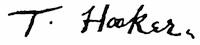
The Rev. Thomas Hooker and the Rev. Samuel Stone accompanied the people from Newtown. The Rev. John Warham joined his people at Windsor, and the Rev. Henry Smith was chosen pastor of the church at Wethersfield. These several communities, though beyond the borders of Massachusetts, were instituted under her protection, and for one year they were governed by a commission issuing from the General Court of that colony. Springfield, settled in 1636, was in this commission united with the lower plantations. This provisional arrangement was found to be inconvenient, and at the end of the year the several towns took the government into their own hands, and a General Court was held at Hartford, May 1, 1637. Preparations were now made for the impending Pequot war, which called out all the strength of the feeble settlements. On its conclusion, after arrangements had been made for future security from savage foes, and for the purchase of food till the new fields should become productive, the inhabitants of these towns—Springfield, now suspected, and soon afterward declared, to be within the bounds of Massachusetts, excepted—formed a constitution among themselves, bearing date Jan. 14, 1638/39. This instrument has been called “the first example in history of a written constitution,—a distinct organic law constituting a government and defining its powers.”[539] It contained no recognition of any external authority, and provided that all persons should be freemen, who should be admitted as such by the freemen of the towns, and should take the oath of allegiance. It continued in force, with little alteration, for one hundred and eighty years.
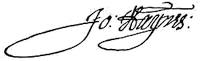
John Haynes[540] was the first governor; and he and Edward Hopkins held the office during most of the time for the next fifteen years. In 1657 John Winthrop, son of the Massachusetts governor, was chosen, and continued to serve till the acceptance of the new charter by New Haven, when he was continued in that office.
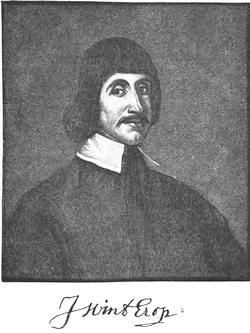
[This portrait hangs in the gallery of the Massachusetts Historical Society. A heliotype of it will be found in the Winthrop Papers, Part iv., and in Bowen’s Boundary Disputes of Connecticut.—Ed.]
Meanwhile, in October, 1635, this same John Winthrop, Jr., had returned from England with a commission from Lord Say and Sele, Lord Brook, and others, their associates, patentees of Connecticut, constituting him “governor of the River Connecticut, with the places adjoining,” for the space of one whole year. He was instructed to build a fort near the mouth of the river, and to erect habitations; and he was supplied with means to carry out this purpose. He brought over with him one Lion Gardiner, an expert engineer, who planned the fortifications, and was appointed lieutenant-governor of the fort. It was expected that a number of “gentlemen of quality” would come over to the colony, and some disposition was at first shown to remove the settlers of the towns on the river who had “squatted” on the lands of the Connecticut patentees.
In the summer of 1639 George Fenwick, who was interested in the patent, and his family came over in behalf of the patentees, and took possession of the place, intending to build a town near the mouth of the river. A settlement was made, and named Saybrook, in honor of the two principal patentees. The government of the town was entirely independent of Connecticut till 1644/45, when Fenwick, as agent of the proprietors, transferred by contract to that government the fort at Saybrook and its appurtenances, and the land upon the river, with a pledge to convey all the land thence to Narragansett River, if it came into his power to convey it.