Chapter V · (continued 2)
Reading edition
Other original documents may be found in Hening’s Statutes at Large, vol. ii.; in the appendix of Burk’s Virginia; and in the Aspinwall Papers, i. 162, 189, published in the Mass. Hist. Coll. An Historical Account of some Memorable Actions, particularly in Virginia, etc., by “Sir Thomas Grantham, Knight” (London, 1716), was reprinted in fac-simile with an Introduction by the present writer (Carlton McCarthy & Co., Richmond, 1882).[320] The fragment of the records of the General Court of Virginia, cited as being in the Collections of the Virginia Historical Society, contains details of the trial of the participants in the “rebellion” not included in Hening, and the abstracts from the English State-Paper Office, furnished by Mr. Sainsbury to the State Library of Virginia, give unpublished details. Extracts from the same source are in the library of the present writer. There are various papers in the early volumes of the Hist. Mag.; see April, 1867, for a contemporary letter. Massachusetts Bay proclaimed the insurgents rebels.[321]
The earliest History of Virginia after John Smith’s was an anonymous one published in London in 1705, with De Bry’s pictures reduced by Gribelin. When it was translated into French, and published two years later (1707) both at Amsterdam and Orleans (Paris), the former issue assigned the authorship to D. S., which has been interpreted D. Stevens, and so it remained in other editions, some only title editions, printed at Amsterdam in 1712, 1716, and 1718, though the later date may be doubtful. (Sabin, ii. 5112.) The true author, a native of Virginia and a Colonial official, had meanwhile died there in 1716. This was Robert Beverley.[322] The book is concisely written, and is not without raciness and crispness; but its merits are perhaps a little overestimated in Tyler’s American Literature, ii. 264. His considerate judgment of the Indians is not, however, less striking than praiseworthy. For the period following the Restoration he may be considered the most useful, though he is not independent of a partisan sympathy.
Sir William Keith’s History of Virginia was undertaken, at the instance of the Society for the Encouragement of Learning, as the beginning of a series of books on the English plantations; but no others followed. It was published in 1738 with two maps,—one of America, the other of Virginia,—and he depended almost entirely on Beverley, and brings the story down to 1723.[323] Forty years after Beverley the early history of the colony was again told, but only down to 1624, by the Rev. William Stith, then rector of Henrico Parish; being, however, at the time of his death (1755), the president of William and Mary College. He seems to have been discouraged from continuing his narrative because the “generous and public-spirited” gentlemen of Virginia were unwilling to pay the increased cost of putting into his Appendix the early documents which give a chief value to his book to-day. He had the use of the Collingwood transcript of the records of the Virginia Company. His book, History of the First Discovery and Settlement of Virginia, was published at Williamsburg in 1747, and there are variations in copies to puzzle the bibliographer.[324] Stith’s diffuseness and lack of literary skill have not prevented his becoming a high authority with later writers, notwithstanding that he implicitly trusts and even praises the honesty of Smith.[325]
The somewhat inexact History of Virginia by John Burk has some of the traits of expansive utterance which might be expected of an expatriated Irishman who had been implicated in political hazards, and who was yet to fall in a duel in 1808.[326] This book, which was published in three volumes at Petersburg (1804-5), was dedicated to Jefferson. A fourth volume, by Skelton Jones and Louis Hue Girardin, was added in 1816; but as the edition was in large part destroyed by a fire, it is rarely found with the other three.[327] Burk used the copy of the Virginia Company records which had belonged to John Randolph, as well as some collections made by Hickman (which Randolph had had made when it was his intention to write on Virginian history), and Colonel Byrd’s Journal.
The name of Campbell is twice associated with the history of Virginia. J. W. Campbell published in 1813 at Petersburg a meagre and unimportant History of Virginia, coming down to 1781. The best known, however, is the work of Charles Campbell, his son, who in 1847, at Richmond, published a well-written Introduction to the History of Virginia, and in 1860, at Philadelphia, a completed History of the Colony and Ancient Dominion of Virginia, coming down to 1783,—a book written before John Smith was called a romancer. The book, however defective in arrangement and execution, is thought to be the best general authority.[328]
The most comprehensive History of Virginia is that of Robert R. Howison, vol. i. coming down to 1763, being published at Philadelphia in 1846, and vol. ii., ending in 1847, being published at Richmond the next year. He is a pleasing writer, but sacrifices fact to rhetoric, though he makes an imposing display of references.
To these may be added, in passing, William H. Brockenbrough’s Outline of History of Virginia to 1754; Martin’s Gazetteer, 1835, and Howe’s Historical Collections of Virginia, printed in Charleston, 1856.
Respecting the religious history of the colony, besides the general historians, there have been several special treatments. Mr. Neill has written upon the Puritan affinities in Hours at Home, November, 1867, and on Thomas Harrison and the Virginia Puritans in his English Colonization, where is also a chapter on the planting of the Church of England.
Patrick Copland’s sermon, Virginia’s God be thanked, was preached before the Company in London, April 18, 1622; a copy of which is in Harvard College Library. Cf. Mr. Neill’s Memoir of Rev. Patrick Copland, New York, 1871, p. 52, and his English Colonization, p. 104.
Further, see Hawkes’s Contributions to the Ecclesiastical History of the United States, “Virginia,” 1836; Hening’s Statutes; Papers relating to the History of the Church in Virginia, 1650-1770, by W. S. Perry, 1870; Hammond’s Leah and Rachel, 1656; Bishop Meade’s Old Churches, etc., 1855; “Notes on the Virginia Colonial Clergy” in the Episcopal Recorder, and reprinted separately by E. D. Neill, 1877; Savage’s Winthrop’s History of New England, and Anderson’s Church of England in the Colonies, 1856.
The writer has also in his possession the Records of the Monthly Meeting of Henrico County, June 10, 1699-1797, which he designs to use in a history of the Society of Friends in Virginia. He has also earlier isolated records, and a partial registry of births, marriages, and deaths of those of the faith of the Society in Henrico and Hanover counties in the eighteenth century.
For an account of early manufactures in Virginia, see Bishop’s History of American Manufactures, 1866. For a view of the early agriculture, see a paper by the present writer on the History of Tobacco in Virginia from its Settlement to 1790; Statistics, Agriculture, and Commerce, prepared for the Tenth Census; History of Agriculture in Virginia, by N. F. Cabell, 1857; the Farmers’ Register, 1833-42; Transactions of the State Agricultural Society of Virginia, 1855; and “Virginia Colonial Money and Tobacco’s Part therein,” by W. L. Royall, in Virginia Law Journal, August, 1877.
For a view of slavery in the colony, see Bancroft, ch. v.; O’Callaghan’s Voyages of the Slavers; Wilson’s Rise and Fall of the Slave Power; Cobb’s Inquiry; and the works of Cabell, Fitzhugh, Fletcher, Hammond, Ross, Stringfellow, and general histories.
It is evident that no single author has yet given an adequate history of Virginia; and while it is true that much precious material therefor has perished, it is believed that the original record is yet not wanting for such a representation of the past of the State as would be at once more intelligible as to the motives which occasioned events, and more convincingly just in the recital of them.


EDITORIAL NOTES.
A. Maps of Virginia or the Chesapeake.—There seem to have been visits of the Spaniards to the Chesapeake at an early day (1566-1573), and they may have made a temporary settlement (1570) on the Rappahannock. (Robert Greenhow in C. Robinson’s Discoveries in the West, p. 487, basing on Barcia’s Ensayo Chronologico; Historical Magazine, iii. 268, 318; J. G. Shea in Beach’s Indian Miscellany.) In the map which De Bry gave with the several editions of Hariot in 1590, the bay appears as “Chesepiooc Sinus;” but in the more general maps, shortly after, the name Chesipooc, or some form of it, is applied rather wildly to some bay on the coast, as by Wytfliet’s in 1597, or earlier still by Thomas Hood, 1592, where the “B. de S. Maria” of the Spaniards, if intended for the Chesapeake, is given an outline as vague as the rest of the neighboring coast, where it appears as shown in the sketch in chapter vi. between the Figs. 1 and 2. It may be, as Stevens contends (Historical and Geographical Notes), that not before Smith were the entangling Asian coast-lines thoroughly eliminated from this region; but certainly there was no wholly recognizable delineation of the bay till Smith recorded the results of the explorations which he describes in his Generall Historie, chs. v. and vi. Smith indicates by crosses on the affluents of the bay the limits of his own observations. Strachey’s Historie of Travaile, p. 42.
In Smith’s Map of Virginia, with a Description of the Country, etc., Oxford, 1612, W. S., or William Strachey, eked out the little tract with an appendix of others’ contributions. Strachey afterwards adopted a considerable part in his Historie of Travaile. Mr. Deane, in his edition of the True Relation, p. xxi, has given a full account of this tract. Smith reprinted it in his Generall Historie with some changes and additions and small omissions. Purchas reprinted it in his Pilgrimes, but not without changes and omissions of small extent, and with some additions, which he credits on the margin to Smith; and he had earlier given an abstract of it in his Pilgrimage. There is a copy of the original in the Lenox Library. Tyler, American Literature, i. 30, notices it.
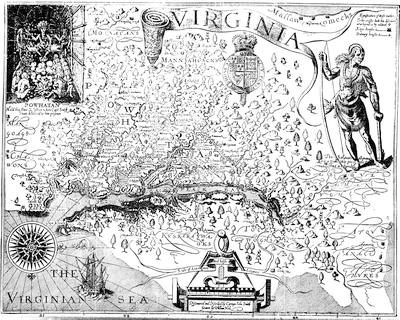
The map accompanying this tract, engraved by W. Hole, appeared in three impressions (Stevens’s Bibliotheca Historica, 1870, no. 1,903). It was altered somewhat, and the words, “Page 41, Smith,” were put in the lower right-hand corner, when it was next used in the Generall Historie, 1624 and later; and in 1625 it was again inserted at pp. 1836-37 of Purchas’s Pilgrimes, vol. iv. De Bry next re-engraved it in part xiii. of his Great Voyages, printed in German, 1627, and in Latin 1634; and in part xiv. in German in 1630 (Carter-Brown Catalogue, i. 370-71). It was also re-engraved for Gottfriedt’s Newe Welt, published at Frankfort, and marked “Erforshet und beschriben durch Capitain Iohan Schmidt.” The compiler of this last book was J. Ph. Abelin, who had been one of De Bry’s co-workers, and he made this work in some sort an abridgment of De Bry’s, use being made of his plates, often inserting them in the text, the book being first issued in 1631, and again in 1655. (Muller’s Books on America, 1872, no. 636, and (1877) no. 1,269.)
The map was next used in two English editions of Hondy’s Mercator, “Englished by W. S.” 1635, etc., but with some fanciful additions, as Mr. Deane says (Bohn’s Lowndes, p. 1103). The map of the coast in De Laet, 1633 and 1640, was, it would seem, founded upon it for the Chesapeake region; cf. also the map of Virginia and Florida called “par Mercator,” of date 1633, and the maps by Blaeu, of 1655 and 1696.
Once more Smith’s plot adorned, in 1671, Ogilby’s large folio on America, p. 193, as it had also found place in the prototype of Ogilby, the Amsterdam Montanus of 1671 and 1673. In these two books (1671-73) also appeared the map “Virginiæ, partis australis et Floridæ, partis orientalis, nova descriptio,” which shows the coast from the Chesapeake down to the 30th degree of north latitude.
Smith’s was finally substantially copied as late as 1735, as the best available source, in A Short Account of the First Settlement of the Provinces, etc., London, 1735,—a contribution to the literature of the boundary dispute, and was doubtless the basis of the map in Keith’s Virginia in 1738; but it finally gave place to Fry and Jefferson’s map of the region in 1750.
A phototype fac-simile, reduced about one quarter, of the earliest state of the original map in the Harvard College copy of the Oxford tract of 1612 is given herewith. A similar fac-simile, full size, is given in Mr. Deane’s reprint of the True Relation, though it was not published in that tract. A lithographic fac-simile, full size, but without the pictures in the upper corners, is given in the Hakluyt Society’s edition of Strachey, p. 23. Other reproductions will be found in Scharf’s Maryland, i. 6, Scharf’s Baltimore City and County, 1881, p. 38, and in Cassell’s United States, p. 27. That in the Richmond (1819) reprint of the Generall Historie is well done, full size, on copper. This copperplate was rescued in 1867 from the brazier’s pot by the late Thomas H. Wynne, and at the sale of his library in 1875 was purchased for the State Library of Virginia.
Neill, in his Virginia Company, p. 191, mentions “A mapp of Virginia, discovered to ye Hills and its latt. from 35 deg. and ½ neer Florida to 41 deg. bounds of New England. Domina Virginia Ferrar collegit, 1651,” and identifies this compiler of the map as a daughter of John Ferrar. The map we suppose to be the one engraved by Goddard. This map is associated with a London publication of 1650, called Virgo triumphans, or Virginia richly and truly valued, which is usually ascribed to Edward Williams, but is held nevertheless to be in substance the work of John Ferrar of Geding. There were two editions of this year (1650): Brinley Catalogue no. 3,816; Quaritch, General Catalogue, no. 12,535, held at £36 John Ferrar’s copy of the first edition, with his notes, and the original drawing of the map, inserted by Ferrar to make up a deficiency in the first edition, of which he complains. Quaritch prices a good copy without such annotations at £25. The second edition (1650) had additions, as shown in the title, Virginia, more especially the South part thereof, second edition, with addition of the discovery of silkworms, etc. In this the same map appeared engraved as above, and the Huth copy of it has it in two states, one without, and the other with an oval portrait of Sir Francis Drake. (Huth Catalogue, v. 1594.) The Harvard College copy lacks the map, which is described by Quaritch (no. 12,536, who prices this edition at £32) in a copy from the Bathurst Library, as a folding sheet exhibiting New Albion as well as Virginia, with the purpose of showing an easy northern passage to the Pacific, the text representing the Mississippi as dividing the two countries, and flowing into the South Sea; see also Menzies’ Catalogue, no. 2,143, and the note in Major’s edition of Strachey, p. 34, on a map published in 1651 in London. This second edition was the one which Force followed in reprinting it in his Tracts, vol. iii. no. 11. The Huth Catalogue notes a third edition, Virginia in America richly valued, 1651. The map is given on a later page.
B. The Virginia Historical Society.—From 1818 to 1828 the eleven volumes of the Evangelical and Literary Magazine, edited at Richmond by John Holt Rice, D.D., had contained some papers on the early history of the State, but no organized effort was made to work in this direction before the Virginia Historical and Philosophical Society was formed, in December, 1831, with Chief Justice Marshall as president, and under its auspices a small volume of Collections was issued in 1833; but from February, 1838, to 1847 the Society failed to be of any influence. Meanwhile, from 1834 to 1864 the Southern Literary Messenger afforded some means for the local antiquaries and historical students to communicate with one another and the public.
In December, 1847, a revival of interest resulted in a reorganization of the old Association as the Virginia Historical Society, with the Hon. William C. Rives as president. Promptly ensuing, Maxwell’s Virginia Historical Register was started as an organ of the Society, and was published from 1848 to 1853,—six volumes. The Society laid a plan of publishing the annals of the State, and, as preliminary, intrusted to Conway Robinson, Esq., the preparation of a volume which was published in 1848 as An Account of the Discoveries in the West until 1529, and of Voyages to and along the Atlantic Coast of North America from 1520 to 1573. This was an admirable summary, and deserves wider recognition than it has had. It subsequently published, besides various addresses, The Virginia Historical Reporter, 1854-1860, which contained accounts of the Society’s meetings. The Civil War interrupted its work, but in 1867 the Society was again resuscitated, and it has been under active management since. There is a bibliography of its publications in the Historical Magazine, xvii. 340. Its historical students have contributed to the files of the Richmond Standard since Sept. 7, 1878, much early reprinted and later original matter relating to Virginia.
NOTE.—Since this chapter was completed has appeared Mr. George W. Williams’s Negro Race in America, which has a chapter on the history of Slavery in the colony of Virginia; and also Mr. J. A. Doyle’s The English in America, Virginia, Maryland, and the Carolinas, London, 1882.