Chapter XII · (continued 2)
Reading edition
William Penn: an Historical Biography,[835] by William Hepworth Dixon, is probably the most popular account that has appeared. Its style is agreeable, and it is full of interesting facts picturesquely grouped. In some cases, however, the authorities quoted do not support the inferences which have been drawn from them, and the historical value of the book has been sacrificed in order to add to its attractiveness. Those chapters which speak of the interest taken by Algernon Sidney in the formation of the constitution of Pennsylvania are clearly erroneous. These views are based on the part which Penn took in Sidney’s return to Parliament, and in a letter of Penn to Sidney, Oct. 13, 1681. Without this last, the argument falls. No reference is given to where the letter will be found. It was first printed as addressed to Algernon Sidney, in vol. iii. part i. p. 285 of the Memoirs of the Historical Society of Pennsylvania. In vol. iv. ibid. (part i. pp. 167-212) other letters of Penn are printed, one of which is addressed to Henry Sidney, the brother of Algernon. To this a note is appended, stating that the letter in the former volume was undoubtedly written to the same person. As Mr. Dixon used extracts from these letters, it was, to say the least, unfortunate that he should have overlooked the importance of the note. La Vie de Guillaume Penn,[836] par J. Marsillac, is a meritorious compilation, but its chief interest centres around its author, who styles himself “Député extraordinaire des Amis de France à l’Assemblée Nationale, etc.” He was of noble birth, and an officer in the French army. He joined the Friends in 1778. Being convinced of the unlawfulness of war by the arguments in Barclay’s Apology, he determined “to change his condition of a destroyer to that of a preserver of mankind,” and studied medicine. During the French Revolution he took refuge in America, and resided in Philadelphia. He afterward returned to France, “and threw off at the same time the garb and profession of a Friend. He devoted himself in Paris to the practice of his profession, and obtained under Napoleon a situation in one of the French hospitals.”
Chapters in Janney’s Life of Penn and in Dixon’s Biography are devoted to a refutation of the charges of worldliness and insincerity brought against Penn by Macaulay in his History of England. We append below the titles of other publications of the same character, as well as of additional works which can be consulted with profit by students of his life.[837] The Penn Papers, or manuscripts in the possession of the Historical Society of Pennsylvania, relate chiefly to the history of the province while under the governorship of Penn’s descendants. There are, however, in the collection some papers of personal interest in relation to Penn, and some of his controversial writings and documents connected with the history of the province at the time of its settlement. The history of this collection presents another instance of the perils to which manuscripts are exposed. After having been preserved for a number of years by one branch of the Penn family with comparative care, subject only to the depredations of time, they were sold to a papermaker, through whose discrimination they were preserved. They were catalogued and offered for sale by Edward G. Allen and James Coleman, of London, in 1870.[838] The collections were purchased by the Historical Society of Pennsylvania, but not until some papers had been obtained by persons more favorably situated. The general interest of the whole, however, was but little lessened by this misfortune. From 1700 until the Revolution the series is remarkably complete, and there are but few incidents in the colonial history of Pennsylvania that cannot be elucidated by its examination. A portion of the papers (about twenty thousand documents) have been bound and arranged, and fill nearly seventy-five folio volumes.[839]
General Histories of Pennsylvania.—The first historian of Pennsylvania was Samuel Smith, author of the well-known History of New Jersey; but his work up to the present time has not appeared in a complete form. It is a history of the Society of Friends, or Quakers, in New Jersey and Pennsylvania. Smith’s manuscripts are in the Library of the New Jersey Historical Society. What appears to be a duplicate of the Pennsylvania portion is in that of the Historical Society of Pennsylvania. Hazard printed the latter in his Register of Pennsylvania, vols. vi. and vii.[840]
Robert Proud’s History of Pennsylvania[841] has long enjoyed a high reputation, but no more so than its merits entitle it to. For years it was the only history of the State. In its preparation the manuscript of Smith’s History was used, and in it extracts are given from pamphlets that have since been printed in full. Nevertheless, there is much in it that cannot be found elsewhere. Passages are quoted from letters of Penn which have never been printed entire, and the notes regarding the early settlers are of especial value. The care taken in the preparation of the book is so evident that its statements can as a rule be accepted. The author, a native of England, was a teacher of the classics in the Friends’ School, Philadelphia.[842]
Professor Ebeling’s volume on Pennsylvania in his Erdbeschreibung und Geschichte von America, Hamburg, 1793-1799, in five volumes, is another valuable contribution. Portions of it, translated by Duponceau, will be found in Hazard’s Register of Pennsylvania, i. 340, 353, 369, 385, 401.
Thomas F. Gordon’s History of Pennsylvania[843] gives the history of the colony down to the Declaration of Independence. That part which treats of the eighteenth century does so more fully than any other work. It has never enjoyed much popularity. Its style is labored. The author was one who thought that “the names of the first settlers are interesting to us only because they were first settlers,” and that nothing could attract the public in men “whose chief, and perhaps sole, merit consisted in the due fulfilment of the duties of private life.” There is a tone of antagonism to Penn in some parts of the book which lacks the spirit of impartiality. It was reviewed by Job R. Tyson. See “Examination of the Various Charges brought by Historians against William Penn,” etc.,—Memoirs of the Historical Society of Pennsylvania, vol. ii. part ii. p. 127.
The second volume of Bowden’s History of Friends in America[844] is the best Quaker history of Pennsylvania that has appeared.
Sherman Day’s Historical Collections (1843) and An Illustrated History of the Commonwealth of Pennsylvania,[845] by William H. Egle, M.D., both give the history of the State down to the time of their respective publications. In them the histories of the counties are treated in separate chapters, general histories of the State being given by way of introductions,—that by Dr. Egle being very full.
The Historical Review of the Constitution and Government of Pennsylvania, from its Origin, which is attributed to Franklin, belongs properly to a later period of the history of the province than we are now considering, and, as it was written to serve a political purpose, has but slight historical claims. In it, however, the attempt is made to trace some of the alleged abuses of power back to the foundation of the colony. It was published in London in 1759, and is included by both Duane and Sparks in their editions of Franklin’s writings.
Bancroft’s chapters on the Quakers in the United States and on Pennsylvania are excellent. Grahame’s Colonial History of the United States is less flattering in the estimate given of Penn and his followers, although far from unappreciative of their efforts. Burke’s Account of the European Settlements in America[846] gives nothing that is new in connection with the settlement of Pennsylvania; but the opinions of its distinguished author in regard to William Penn as a legislator will be read with pleasure by Penn’s admirers. The remarks on the settlement of Pennsylvania in Wynne’s General History of the British Empire in America,[847] are copied bodily from Burke; but no quotation marks are given, and nothing indicates their origin. Douglass’s Summary gives nothing on the subject that will not be found in the charter and a few documents of similar character. From William M. Cornell’s History of Pennsylvania, 1876, nothing new will be gathered regarding the settlement of the province. It is a mere compilation, in which Weems’s Life of Penn is quoted as an authority.
Local Histories.—It is only in the history of the counties first settled that information on the period treated of in this chapter can be sought. John F. Watson’s Annals of Philadelphia[848] is one of the chief authorities. The plan of the work is not one that can be approved of at the present day, as sufficient care has not been taken in all cases to follow the original language of documents quoted, or to give references to authorities. Nevertheless, it is doubtful if any work in America has done more to cultivate a taste for historical study. There is a charm about its gossipy pages which has attracted to it thousands of readers, and provoked more serious investigations. It contains much regarding the domestic life of the first settlers and the building of Philadelphia which has been universally accepted, and many traditions gathered from old persons which there is no reason to question. The most important History of Philadelphia is that by Mr. Thompson Westcott, now printing in the columns of the Sunday Despatch. Eight hundred and ten chapters have appeared up to the present time. It is an encyclopædia on the subject. Some of the early chapters treat of the period under review. A History of the Townships of Byberry and Moreland, in Philadelphia County, by Joseph C. Martindale, M.D.,[849] treats largely of the earliest settlers in that section of the State. The present Montgomery County is formed of a portion of the original County of Philadelphia, and the history of some of its sections treats of the settlement of the colony. For such information, see History of Montgomery County, within Schuylkill Valley,[850] by William J. Buck. Mr. Buck prepared also the Historical Introduction to Scott’s Atlas of Montgomery County, Philadelphia, 1877. The History of Delaware County, by George Smith, M.D.,[851] is by far the best county history of Pennsylvania yet published. It is thoroughly trustworthy, and treats fully of the settlement of the county. Extracts from the records of Markham’s court are given in it. Chester and its Vicinity, Delaware County, Pennsylvania,[852] by John Hill Martin, is a meritorious work.
The history of Bucks County has been twice written; first by William J. Buck, in 1855. His investigations were contributed to a county paper, and were subsequently published in a volume of one hundred and eighteen pages, to which was appended a History of the Township of Wrightstown, by Charles W. Smith, M.D., contained in twenty-four pages. A later History of Bucks County,[853] is that by General W. W. H. Davis, an excellent work.
The History of Chester County, Pennsylvania,[854] by J. Smith Futhey and Gilbert Cope, is a work of merit, being the production of two thorough students, deeply imbued with the love of their subject. The historical and genealogical portions of it are written with care and judgment. It contains extracts from the records of the first courts held in Pennsylvania.
Constitutional History.—Hazard’s Annals of Pennsylvania,[855] 1609-1682, Votes of the Assembly,[856] vol. i., Colonial Records,[857] vol. i., Pennsylvania Archives,[858] vol. i., and Duke of York’s Laws[859] are the chief collections of documents relating to the constitutional history of the colony. The correspondence which preceded the issuing of the royal charter, together with the Proceedings of the Lords of Trade, etc., is in the Votes of the Assembly, vol. i. pp. vii-xiii; the same will be found in chronological order in Hazard’s Annals. The royal charter is given in Votes of Assembly, vol. i. p. xviii; Hazard’s Annals, p. 488; Colonial Records, vol. i. (1st ed.) p. ix, (2d ed.) p. 17; Hazard’s Register, i. 293. A fac-simile of the engrossed copy at Harrisburg is also given as an Appendix to vol. vii., second series, of Pennsylvania Archives, and is in the Duke of York’s Laws in the same form, as well as being printed in that volume on page 81. The paper known as “Certain Conditions or Concessions,” agreed upon in England between the purchasers of land and Penn, July 11, 1681, will be found in Hazard’s Annals, p. 516, Colonial Records, vol. i. (1st ed.), p. xvii (2d ed.), p. 26, Votes of Assembly, vol. i. p. xxiv, and Proud’s Pennsylvania, vol. ii. Appendix. Penn’s instructions to his commissioners—Crispin, Bezar, and Allen—are printed in Hazard’s Annals, p. 527. The original paper is in the possession of the Historical Society of Pennsylvania. His instructions to his fourth commissioner, William Haige, are in Hazard’s Annals of Pennsylvania, p. 637. The Frame of Government and laws agreed upon in England May 5, 1682, were printed at the time. They are also given in Hazard’s Annals, p. 558, Colonial Records, vol. i. (1st ed.) p. xxi (2d ed.) p. 29, Votes of the Assembly, vol. i. p. xxvii, Duke of York’s Laws, p. 91, and Proud’s Pennsylvania, vol. ii. Appendix. There are a number of rough drafts of the Frame of Government, etc., in the Penn Papers of the Historical Society. One of these is indorsed as the work of Counsellor Bamfield; another bears the name of C. Darnall. Oldmixon says (edition of 1708) that “the Frame” was the work of “Sir William Jones and other famous men of the Long Robe.” Penn’s letter to Henry Sidney (Oct. 13, 1681) shows that Sidney was consulted regarding it; and Chalmers says (on the authority of Markham), that portions of it were formed to suit the Quakers.
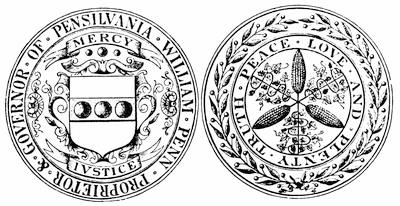
THE SEAL OF PENNSYLVANIA.
The Frame of Government, passed in 1683, will be found in Votes of the Assembly, vol. i. part i., Appendix 1, Colonial Records, vol. i. (1st ed.) xxxiv, and (2d ed.) p. 42; Duke of York’s Laws, p. 155; Proud’s Pennsylvania, vol. ii. Appendix 3. There was an edition of it printed in 1689 at Philadelphia, entitled The Frame of the Government of the Province of Pennsilvania and Territories thereunto annexed in America, 8º, 16 pp. But one copy of this edition is known to have been preserved,—it is in the Friends’ Library in Philadelphia. It has no titlepage or printer’s name; but there can be no doubt that it is from the press of William Bradford; and it was for printing this that Bradford was summoned before the Council by Governor Blackwell, on the 19th of April, 1689. Sabin gives an edition printed in London in 1691, by Andrew Sowle. Cf. Sabin’s Dictionary, no. 59,697; also, Collection of Charters, etc., relating to Pennsylvania, Philadelphia (B. Franklin), 1740.
Literature relating to the Laws of the Province.—Under this head may be classed various works, the titles of which as a rule indicate their characters, and we note them below.[860]
Landing of Penn.—In 1824 a society was formed in Philadelphia for the commemoration of the landing of William Penn. Its first meeting was held November 4, in the house in which he had once lived, in Letitia Court. An address was delivered by Peter S. Duponceau, and the eighteen members of the Society dined together. In selecting the day to be celebrated, the Society was guided by the passage in Penn’s letter to the Lords of Plantation, dated August, 1683, in which he states that he arrived on “the 24th of October last.” Ten days should have been added to this date to correct the error in computing time by the Julian calendar, which was in vogue when Penn landed, and November 3 should have been considered the anniversary. Through an erroneous idea of the way in which such changes should be calculated, eleven days were added, and November 4 was fixed upon. The next year, however, the Society celebrated the 24th of October, and continued to do so until 1836, the last year that we are able to trace the existence of the organization.[861] Subsequent investigations have shown that Penn did not arrive before Newcastle until October 27 (see Newcastle Court Records in Hazard’s Annals of Pennsylvania, p. 596), and did not land until the following day.[862] It is probable, therefore, that Penn dated his arrival from the time he came in sight of land or passed the Capes of Delaware. The first evidences we have of his being within the bounds of the present State of Pennsylvania are letters dated Upland, October 29, and this day, allowing ten days for the change of time, bringing it to November 8, is the one that it is customary to celebrate.
Nov. 8, 1851, Edward Armstrong delivered before the Historical Society of Pennsylvania, at Chester, an able address, which contains nearly all that is known regarding the landing of Penn. In it will be found the names of his fellow-passengers in the “Welcome;” but a more extended list by the same writer is given in the Appendix to the 2d ed., Memoirs of Historical Society of Pennsylvania, vol. i. In 1852 an address was also delivered on the same anniversary before the Historical Society by Robert T. Conrad.
Penn’s Treaty with the Indians.—This was the subject of a report made to the Historical Society of Pennsylvania by Peter S. Duponceau and J. Francis Fisher. It will be found in Memoirs of Historical Society, vol. iii. part ii. p. 141. In it the opinion is expressed that the treaty which tradition says Penn held with the Indians at Shackamaxon was not one for the purchase of land, but was a treaty of amity and friendship, and was held in November, 1682. This report has been followed by historians generally, and has been accepted by nearly all the biographers of Penn. The subject, however, is one that will bear further investigation. The writer of this chapter published in the Pennsylvania Magazine of History, vi. 217, an article to show that the treaty which has attracted so much attention was that described in Penn’s Letter to the Free Society of Traders, dated August 16, 1683; that it was held on June 23 of that year; that not only “great promises of friendship” passed between Penn and the Indians, but that land was purchased, the records of which are in the Land Office at Harrisburg.[863] In connection with this subject, Mr. John F. Watson’s paper on the “Indian Treaty for Lands now the Site of Philadelphia” (see Memoirs of Historical Society of Pennsylvania, vol. iii. part ii. p. 129) should be read, as well as “Memoir of the Locality of the Great Treaty between William Penn and the Indians,” by Roberts Vaux (see Ibid., i. 79; 2d ed., p. 87). The proceedings of the Historical Society upon the occasion of the presentation to it of a belt of wampum by Granville John Penn, which is said to have been given to William Penn by the Indians at the treaty at Shackamaxon,[864] will be found in Memoirs of Historical Society of Pennsylvania, vi. 205, with a large colored lithograph of the belt. Cf. Historical Magazine, i. 177, and Gay’s Popular History of the United States, ii. 498.
Penn-Baltimore Controversy, and the Southern Boundary of Pennsylvania.—In the “Penn Papers” in the Library of the Historical Society of Pennsylvania there are several volumes of documents bearing upon this subject, being the copies of those used in the suit between Lord Baltimore and John Thomas and Richard Penn, decided in 1750. Interesting papers are in the State Paper Office, London, giving accounts of the meetings between Baltimore and Markham and Penn and Baltimore in 1682 and 1683. Copies are in the Library of the Historical Society of Pennsylvania, and will shortly be printed. The following printed volumes and essays treat of the subject:[865]
The Case of William Penn, Esq., as to the Proprietory Government of Pennsylvania; which, together with Carolina, New York, etc., is intended to be taken away by a bill in Parliament. (London, 1685.) Folio, 1 leaf. Cf. Sabin’s Dictionary, no. 59,686.
The Case of William Penn, Proprietary and Governor-in-Chief of the Province of Pennsylvania and Territories, against the Lord Baltimore’s Pretentions to a Tract of Land in America, Granted to the said William Penn in the year 1682, by his then Royal Highness James Duke of York, adjoyning to the said Province, commonly called the Territories thereof. (n. p. 1682 to 1720.) Folio, 1 leaf. Cf. Sabin’s Dictionary, no. 59,688.
The Case of Hannah Penn, the Widow and Executrix of William Penn, Esq., late Proprietor and Governor of Pennsylvania (against the pretensions of Lord Sutherland, London, 1720). Folio, 1 leaf. Cf. Sabin’s Dictionary, no. 59,672.
Articles of Agreement made and concluded upon between the Right Honourable the Lord Proprietary of Maryland and the Honourable the Proprietary of Pennsylvania, etc., touching the Limits and Boundaries of the Two Provinces, with the Commission constituting certain Persons to execute the Same. Philadelphia (B. Franklin), 1733, folio, 19 pp. and map. In the Library of the Historical Society of Pennsylvania.
Another edition was issued from same press in 1736, with the Report of the Commissioners. Cf. C. R. Hildeburn’s List of the Issues of the Press in Pennsylvania, 1685-1759.
The Case of Messieurs Penn and the People of Pennsilvania, and the three lower Counties of Newcastle, Kent, and Sussex on Delaware, in relation to a Series of Injuries and Hostilities made upon them for several Years past by Thomas Cressap and others, by the Direction and Authority of the Deputy-Governor of Maryland (London, 1737). Folio, 8 pp. Cf. Sabin’s Dictionary, no. 5,985.
Penn against Lord Baltimore. In Chancery. Copy of Minutes on Hearing, May 15, 1750. 8º, 15 pp. n. t. p. In the Library of the Historical Society of Pennsylvania.
Breviate in the case of Penn vs. Baltimore. Cf. also the title, with its two maps, given in Sabin’s Dictionary, ix. 34,416.
Indenture of Agreement, 4th July, 1760, Between Lord Baltimore and Thomas and Richard Penn, Esquires, settling the limits and boundaries of Maryland, Pennsylvania, and the Three Lower Counties of Newcastle, Kent, and Sussex. Philadelphia, 1851, folio, 31 pp. and map. Privately printed for Edward D. Ingraham.
“Memoir of the Controversy between Penn and Lord Baltimore.” By James Dunlop (read Nov. 10, 1825), in Memoirs of Historical Society of Pennsylvania, i. 161, or 2d ed. p. 163.
Lecture upon the Controversy between Pennsylvania and Virginia about the Boundary Line. By Neville B. Craig. Pittsburgh, 1843, 8º. 30 pp.
Appendix to Case in the Circuit Court of the United States for the Third Circuit, containing the Pea Patch, or Fort Delaware Case. Reported by John William Wallace. Philadelphia, 1849, 8º, 161 pp. Cf. U. S. Senate, Exec. doc., no. 21, 30th Congress, 1848.
History of Mason and Dixon’s Line. Contained in an address delivered by John H. B. Latrobe before the Historical Society of Pennsylvania, Nov. 8, 1854. Philadelphia, 1855, 8º, 52 pp.
Colonel Graham’s Report on Mason and Dixon’s Line. Chicago, 1859, 8º. Cf. Pennsylvania Senate Journal, 1850, ii. 475.
Mason and Dixon’s Line. By James Veech, 1857.
One of the original manuscript reports of Mason and Dixon, signed by them, is in the possession of the Historical Society of Pennsylvania.
Immigrations.—Independent of the Welsh and Germans, no large bodies of emigrants came to Pennsylvania during the first decade of its existence, except from England and some Quakers from Ireland. The prosperity of the new colony attracted settlers from other parts of British America and the West Indies; but nearly all, judging from the religious annals of the community, were either Quakers or in sympathy with them. In studying the Welsh emigration, John ap Thomas and his Friends: a Contribution to the Early History of Merion, Pa., by James J. Levick, M.D., should be read; see Pennsylvania Magazine of History, iv. 301. It is a history of the first company which came from Wales, in 1682. The History of Delaware County by Dr. George Smith contains much on the subject, with a map of the early settlements; cf. B. H. Smith’s Atlas of Delaware County, with a History of Land-Titles, Philadelphia, 1880. The agreement entered into between an emigration party from Wales and the captain of a vessel in 1697-1698 will be found in the Pennsylvania Magazine of History, i. 330.
The German or Dutch emigration can be studied in The Settlement of Germantown, and the Causes which led to it, by Samuel W. Pennypacker; see Pennsylvania Magazine of History, iv. 1. It is a thorough examination of the question, showing how the emigrants came from the neighborhood of Crefeld, a city of the Lower Rhine, near Holland. The several publications we have mentioned printed in Dutch and German must also be consulted. William Penn’s Travels in Holland and Germany, by Professor Oswald Seidensticker, already mentioned (see Pennsylvania Magazine of History, ii. 237), shows how naturally the event came about. Professor Seidensticker has also contributed “Pastorius und die Grundung von Germantown” to the Deutsche Pionier, vol. iii. pp. 8, 56, 78, and “Francis Daniel Pastorius” to the Penn Monthly, vol. iii. pp. 1, 51.
Special Subjects.—There remain a few monographs worthy of mention.
History of Manners and Customs of the Indian Nations who once inhabited Pennsylvania and the Neighboring States, by the Rev. John Heckewelder, Philadelphia, 1819, 8º. This work was first published as vol. i. of the Transactions of the Historical and Literary Committee of the American Philosophical Society. It was reprinted by the Historical Society of Pennsylvania, with notes by the Rev. William C. Reichel, in 1876, and forms vol. xii. of its Memoirs. Opinions regarding this work differ widely. It was favorably reviewed by Nathan Hale in the North American Review, ix. 178, and severely criticised by General Lewis Cass in the same publication, xxvi. 366. “A Vindication” of the History by William Rawle will be found in the Memoirs of the Historical Society of Pennsylvania, i. 258; 2d ed. p. 268. There is a portrait of Heckewelder in the American Philosophical Society, and a copy of it in the Historical Society; see Catalogue of Paintings, etc., belonging to the Historical Society, no. 85. As a further contribution to the aboriginal history, we may mention Notes respecting the Indians of Lancaster County, Pa., by William Parker Foulke; see Memoirs of the Historical Society of Pennsylvania, vol. iv. part ii. p. 189. This treats largely of the Susquehannocks.
Contributions to the Medical History of Pennsylvania, by Caspar Morris, M.D.; see Memoirs of the Historical Society of Pennsylvania, i. 337, or 2d ed., p. 347.
Notices of Negro Slavery as connected with Pennsylvania, by Edward Bittle; see Ibid., i. 351, or 2d ed., p. 365; cf. also Williams’s Negro Race in America.
Address delivered at the Celebration by the New York Historical Society, May 20, 1863, of the Two Hundredth Birthday of William Bradford, who introduced the Art of Printing into the Middle Colonies, etc., by John William Wallace. Albany, 1863, 8º, p. 114. Together with the report made by Horatio Gates Jones at the same time. Cf. Thomas I. Wharton’s “Notes on the Provincial Literature of Pennsylvania,” in the Memoirs of the Historical Society of Pennsylvania, i. 99, or 2d ed., p. 107; and J. W. Wallace’s paper on the “Friends’ Press” in Pennsylvania Magazine of History, iv. 432. The Brinley Catalogue, no. 3,367, gives a considerable enumeration of the issues of Bradford’s press.
“Historical Sketch of the Lower Dublin (or Pennepek) Baptist Church, Philadelphia,” etc., by Horatio Gates Jones, in Historical Magazine, August, 1868, p. 76.
“Local Self-Government in Pennsylvania,” by E. R. L. Gould, of Johns Hopkins University, in Pennsylvania Magazine of History, vi. 156. It is a comparison of present local administration in Pennsylvania with that under the Duke of York’s government.
Maps.—A Portraiture of the City of Philadelphia, in the Province of Pennsylvania, in America, by Thomas Holme, Surveyor-General. Sold by John Thornton in the Minories, and Andrew Sowle in Shoreditch, London. 18½ × 11¾ inches.
The original, of which a reduced heliotype is given in this chapter will be found in Penn’s Letter to the Free Society of Traders, printed in 1683, which also contains a description of Philadelphia, in which the map is referred to. In one of the editions of the Letter to the Free Society a list of the lot-owners in Philadelphia is given, with numbers referring to property marked on the map. This is the earliest map of Pennsylvania. All issued previous to it show the country while under a different dominion.
A Map of the Province of Pennsylvania, containing the three counties of Chester, Philadelphia, and Bucks, as far as yet surveyed and laid out. The divisions or distinctions made by the different coullers respecting the settlements by way of townships. By Thomas Holme, Surveyor-General. Sold by Robert Green, at the Rose and Crown in Budge Row, and by John Thornton at the Platt in the Minories, London.
This is the most important of all the early maps issued shortly after 1681. It contains the names of many of the early settlers, and shows Penn’s idea of settling the country. In some cases the lots front on a square, which it is presumed was dedicated to public uses. This feature is still noticeable in one or two of the original settlements. It was republished at Philadelphia by Lloyd P. Smith in 1846, and by Charles L. Warner in 1870.
A Mapp of ye Improved parts of Pennsilvania, in America, Divided into Countyes, Townships, and Lotts. Surveyed by Tho. Holme. It is dedicated to William Penn by Jno. Harris, who, it is presumed, was the publisher. It measures 16 × 21½ inches, and is a reduction of the larger map by Holme.
A map to illustrate the successive purchases from the Indians was published by the Historical Society of Pennsylvania in 1875. Cf. Egle’s Pennsylvania, p. 208.
Pennsylvania Historical Society.—[The chief instrumentality in the fostering of historical studies in the State rests with the Pennsylvania Historical Society, which dates from 1824; and in 1826 it printed the first volume of its Memoirs, which was, under the editing of Edward Armstrong, reprinted in 1864. The objects of the Society were set forth by William B. Reed in a discourse in 1848; and again at the dedication of its new hall in 1872, Mr. J. W. Wallace delivered an address. Besides its occasional addresses and its Memoirs, and the work it has done in prompting the State to the printing of its documentary history, it has also supported the publication of the Pennsylvania Magazine of History.—Ed.]

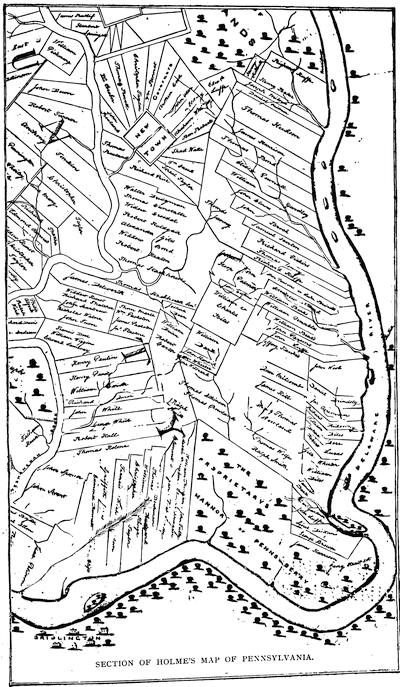
SECTION OF HOLME’S MAP OF PENNSYLVANIA.