Chapter XIII
Reading edition
THE ENGLISH IN MARYLAND, 1632-1691.
BY WILLIAM T. BRANTLY,
Of the Maryland Historical Society.
MARYLAND was the first Proprietary colony established in America; and its charter contained a more ample grant of power than was bestowed upon any other English colony. To Maryland also belongs the honor of having been the first government which proclaimed and practised religious toleration. The charter was granted in 1632, by Charles I., to Cecilius, second Lord Baltimore. But the true founder of Maryland was George Calvert, the first Lord Baltimore, a man of singular merit, whose influence upon the fortunes of the colony was such that his character and career belong to its history.
George Calvert was descended from a Flemish family which had long been settled in Yorkshire, where he was born in the year 1582. Graduating Bachelor of Arts at Oxford, he travelled on the Continent, and then entered public life under the patronage of Sir Robert Cecil. Calvert filled various offices until Cecil became Lord High Treasurer, when he was appointed clerk of the Privy Council. He was knighted in 1617, and, upon the disgrace of Sir Thomas Lake, in February, 1619, he was appointed by James I. one of the two principal secretaries of state. He was selected for this important post because there was work to be done, and he had made himself valued in public life for his industry and ability. It is true, indeed, that his theory of the Constitution was similar to that held by the King. He had always been allied with the Court as distinguished from the Country party, and was a stanch supporter of the prerogatives of the Crown. In the Parliament of 1621 he was the leader of the Government forces, and the immediate representative of the King in the House of Commons. When he came to draw the charter of Maryland he framed such a government as the Court, during this period, conceived that England ought to be.
Calvert was not altogether friendly to Spain.[866] It is a mistake to suppose that his political fortunes were so bound up with the success of the Spanish match, that, upon its final rupture in 1623, his position became untenable. He did not resign his secretaryship until February, 1625; and there is no sufficient reason for believing that he did not then do so voluntarily.
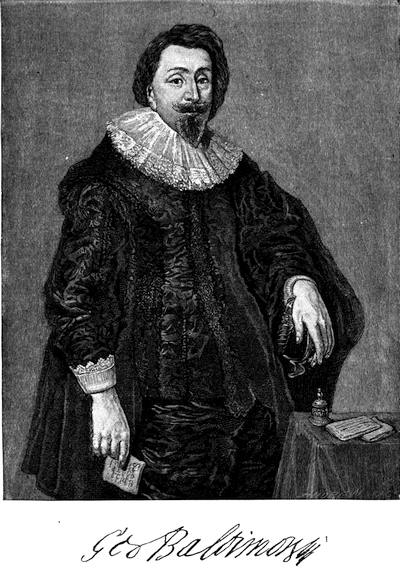
See an account of this picture of the first Lord Baltimore, in the Critical Essay.
Fuller, the chief contemporary authority, says that “he freely confessed to the King that he was then become a Roman Catholic, so that he must be wanting in his trust or violate his conscience in discharging his office.” It is certain that he had not forfeited the favor of the King, nor incurred the enmity of the all-powerful Buckingham. He was allowed to sell his secretaryship to his successor for £6,000, and was retained in the Privy Council. A few weeks after his withdrawal from office he was created Baron of Baltimore in the Irish peerage; and in 1627 Buckingham summoned him to a special conference with Charles I. upon foreign affairs. The date of his conversion to the Church of Rome has been the subject of much discussion, but there is no satisfactory evidence that it preceded, for any length of time, the open profession of his new faith.
From early manhood Sir George Calvert had been interested in schemes of colonization. He was a member of the Virginia Company until its dissolution, and was, as secretary of state, one of the committee of the Council for Plantation Affairs. While secretary he determined to become himself the founder of a colony, and in 1620 he purchased from Sir William Vaughan the southeastern peninsula of Newfoundland. In the following year he sent a body of settlers to this region, and expended a large amount of money in establishing them at Ferryland. James I. granted him in 1623 a patent constituting him the Proprietary of this portion of Newfoundland which was called Avalon,—a patent which afterwards became the model of the charter of Maryland. The fertility and advantages of Avalon had been described to Lord Baltimore with the usual exaggeration of discoverers. He made a short visit to it in the summer of 1627, and in the following year he went there, accompanied by several members of his family, with the intention of remaining permanently; but the severity and long duration of the winter convinced him that the attempt to plant an agricultural colony on that inhospitable shore was doomed to failure. In August, 1629, he wrote to the King that he found himself obliged to abandon Avalon to fishermen, and to seek for himself some warmer climate in the New World. He also announced his determination to go with some forty persons to Virginia, and expressed the hope that the King would grant him there a precinct of land, with privileges similar to those he enjoyed in Newfoundland. Charles I., in reply, advised him to desist from further attempts and to return to England, where he would be sure to enjoy such respect as his former services merited,—“well weighing,” added the King, “that men of your condition and breeding are fitter for other employments than the framing of new plantations which commonly have rugged and laborious beginnings.”
Without waiting for an answer to his letter Lord Baltimore sailed for Virginia, where he arrived in October, 1629. To the Virginians he was not a welcome visitor. They either honestly objected to receiving Catholic settlers, being proud of their conformity to the Church of England, or were apprehensive that he had designs upon their territory. They tendered to him and his followers the oaths of allegiance and supremacy. The latter was one which no Catholic could conscientiously take, and it was therefore refused by Baltimore. His offer to take a modified oath was rejected by the council, and they requested him to leave the colony.
While in Virginia Lord Baltimore learned that the northern and southern portions of the territory comprised within the old charter limits of the colony had not been settled, and he determined to ask for an independent grant of a part of this unsettled region. Upon his return to England he learned that the King was willing to accede to his request. Baltimore finally selected for his new colony the country north of the Potomac, and prepared a charter to be submitted to the King, modelled upon the Avalon patent. The name of the colony was left to the choice of the King, who desired that it should be called Terra Mariæ—in English, Maryland—in honor of his Queen Henrietta Maria. This name was accordingly inserted in the patent; but before it passed the seals Lord Baltimore died. His death took place April 15, 1632, and he was buried beneath the chancel of St. Dunstan’s Church. But his great scheme did not die with him. His rights were transmitted to his son and heir Cecilius, second Lord Baltimore, to whom the charter was finally issued, June 20, 1632.
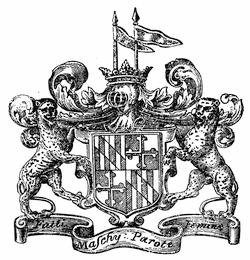
THE BALTIMORE ARMS.
[This is a fac-simile of the arms as engraved on the map accompanying the Relation of 1635. The motto was also that of the great seal, furnished to the Province in 1648 by the second Lord Baltimore, which, by a vote of the legislature in 1876, was re-established on the seal of the State. See the Critical Essay.
It is worthy of remark that when an agent of Virginia was sent to London in 1860, to discover papers relating to the bounds between that State and Maryland, he found the representative of the Calverts, and possessor of their family papers, a prisoner in the Queen’s Bench prison, in a confinement for debt which had then lasted twenty years. Colonel McDonald’s Report, March, 1861.—Ed.]
The territory granted was defined with accuracy. The southern boundary was the further bank of the Potomac, from its source to its mouth in the Bay of Chesapeake, and ran thence to the promontory called Watkins Point, and thence east to the ocean. The eastern boundary was the ocean and Delaware Bay to the fortieth degree of latitude; and the northern boundary was a right line, on the fortieth degree of latitude, to the meridian of the fountain of the Potomac, where the southern boundary began. It will be seen that Maryland, as originally defined, comprised all of the present State of Delaware and a large part of what is now Pennsylvania.
The country described in the charter was expressly erected into a Province of the empire; and the Baron of Baltimore, his heirs and assigns, were constituted the absolute lords and proprietaries of the soil. Their tenure was the most liberal known to the law. They held the Province directly of the kings of England, in free and common socage, by fealty only, yielding therefor two Indian arrows, on the Tuesday of Easter week, to the King at the Castle of Windsor. The Province was made a county palatine; and the Proprietary was invested with all the royal rights, privileges, and prerogatives which had ever been enjoyed by any Bishop of Durham within his county palatine. To the Proprietary was also given all the power that any captain-general of an army ever had; and he was authorized to call out the whole fighting population, to wage war against all enemies of the Province, to put captives to death, and, in case of rebellion or sedition, to exercise martial law in the most ample manner. He was empowered to establish courts and appoint judges, and to pardon crimes. He had also the right to constitute ports of entry and departure, to erect towns into boroughs and boroughs into cities with suitable immunities, and to levy duties and tolls upon ships and merchandise exported and imported. He could make grants of land to be held directly of himself, and erect portions of the land granted into manors with the right to hold courts baron and leet. It was further provided that, lest in so remote a region all access to honors might seem to be barred to men well born, the Proprietary might confer rewards upon deserving provincials, and adorn them with any titles and dignities except such as were then in use in England. All laws were to be made by the Proprietary with the advice and assent of the freemen, who should be called together, personally or by their deputies, for the framing of laws in the manner chosen by the Proprietary. In the event of sudden accidents the Proprietary might make ordinances for the government of the Province, provided they should not deprive offenders of life, limb, or property. Freedom of trade to all English ports was guaranteed.
Liberty to emigrate to the Province and there settle was given to all subjects of the Crown, and all colonists and their children were to enjoy the rights and liberties of native-born liegemen. There was an express covenant on the part of the Crown that at no time should any tax or custom be imposed upon the inhabitants or their property, or upon any merchandise to be laden or unladen within the Province. The charter concluded by directing that, in case any doubt should arise concerning the true sense of any word or clause, that interpretation should always be made which would be most beneficial to the Proprietary, “provided, always, that no interpretation thereof be made whereby God’s holy and true Christian religion, or the allegiance due to us, our heirs and successors, may in anywise suffer by change, prejudice, or diminution.”
It is especially to be remarked that the charter contained no provision requiring the provincial laws to be submitted to the Crown for approval. Nothing was reserved to the Crown except the allegiance of the inhabitants and the fifth part of all the gold and silver ore which might be found within the limits of the Province. But the powers conferred on the Proprietary were of a sovereign character; he was lord of the soil, the fountain of honor, and the source of justice. These privileges were the work of a friend of high prerogative; yet the rights of the people were not neglected. The freemen of the Province were entitled to participate in the law-making power, to enjoy freedom of trade, exemption from Crown taxation, and all the rights and liberties of native-born Englishmen. All the laws of the Province must be consonant with reason and not repugnant to the laws of England. If it be true that the powers given to the Proprietary were greater than those ever conferred on any other Proprietary, it is equally true that the rights secured to the inhabitants were greater than an in any other charter which had then been granted.
The charter expressly separated the Province from Virginia and made it immediately dependent on the Crown. The entire territory of Maryland had been included in the grants made in 1609, and subsequently to the London company for the first colony of Virginia. This company became obnoxious both to the Crown and the colonists, and, in 1624, a writ of quo warranto was issued against its patents, the judgment upon which revoked all the charters and restored to the Crown all the franchises formerly granted. Virginia then became a royal colony, and there could be no question of the right of the King to partition its territory at pleasure. But the grant of Maryland nevertheless caused a great discontent in Virginia. Although no permanent settlements had been made north of the Potomac, the Virginians regarded all the territory comprised within the old charter limits as still belonging to them, and objected to having it partitioned.
One member of the Virginia company had, indeed, established stations for traffic with the Indians on Kent Island, almost in the centre of Maryland, and on Palmer’s Island, at the mouth of the Susquehanna River. This man was William Clayborne, destined to become famous in the early history of the Province. He had been Secretary of the Virginia colony and one of the Council. Before the visit of the first Lord Baltimore to Jamestown, Clayborne had been commissioned to explore the great bay and to trade with the Indians. He may then have set up trading stations upon Kent and Palmer’s islands. In May, 1631, he obtained from Charles I. a license authorizing him to trade for furs and other commodities in all the coasts “in or near about those parts of America for which there is not already a patent granted to others for sole trade.” This license, which was merely passed under the privy signet of Scotland, could not be construed as granting any title to the soil or government. In Baltimore’s charter Maryland was described as hitherto unsettled,—hactenus inculta,—and this unlucky phrase was afterwards the source of innumerable difficulties. At the time of his visit to Virginia the region was probably unsettled so far as he could learn.
When intelligence of the grant of Maryland reached Virginia the planters were moved to sign a petition to the King, in which they remonstrated against the grant of a portion of the lands of the colony which would cause a “general disheartening” to them. The petition was referred to the Privy Council, which, after hearing both parties, decided, in July, 1633, that Lord Baltimore should be left to his patent and the Virginians to the course of law; and that, in the mean time, the two colonies should “assist each other on all occasions as becometh fellow-subjects.”
There can be no doubt that, from the outset, Lord Baltimore intended that Maryland should be a place of refuge for the English Catholics, who had as much reason as the Puritans to flee from persecution. The political and religious hatred with which the mass of the English people regarded the Church of Rome was increasing in bitterness, and the Parliament of 1625 had besought the King to enforce more strictly the penal statutes against recusants. Soon after the grant of his charter Lord Baltimore treated with the Provincial of the Society of Jesus, in England, for his assistance in establishing a mission in the new colony. At the same time he wrote to the General of the Order asking him to designate certain priests to accompany the first emigration, whose duty it should be to confirm the Catholics in their faith, convert the Protestant colonists, and propagate the Roman faith among the savages. These requests were granted, and the first expedition was accompanied by two Jesuits.
But Maryland was to be something more than a Catholic colony. Lord Baltimore had already determined that it should be a “free soil for Christianity.” When the charter was granted, it was well known that Baltimore purposed to settle Maryland with Catholics. How came it to pass that, under these circumstances, a Protestant king made a grant of such large powers to a Catholic nobleman? Different views have been taken of the clauses of the charter relating to religion. One view is that by the patent the Church of England was established, and any other form of worship was unlawful; another that the glory of Maryland toleration is due to the charter, and under it no persecution of Christians was lawful; while a third view is that the charter left the whole matter vague and undetermined, and therefore within the control of the Proprietary and his colonists. The only references to religion in the charter that need be considered are two: the first, in the fourth section, giving the Proprietary the advowsons of all churches which might happen to be built, together with the liberty of erecting churches and causing the same to be consecrated according to the ecclesiastical laws of England; the second, in the twenty-second section, providing that no law should be made prejudicial to God’s holy and true Christian religion.
These are the exact phrases used in the Avalon patent, which was issued to Sir George Calvert while still a member of the Church of England. In that case they probably operated as an establishment of that church. But these phrases were not retained in the charter granted to a Roman Catholic without good reason. The fourth section merely empowered the Proprietary to dedicate the churches which might be built; it did not compel him to build them: and the fact of being a Catholic did not then disable one from presenting to Anglican churches. There is, moreover, nothing in this section disabling the Proprietary from building churches of other faiths. The proviso in the twenty-second section was conveniently vague. It cannot be held either to establish the Church of England or to prohibit the exercise of any other worship. No such construction was ever placed upon it by the Crown, or the Proprietary, or the people. It is certain that Baltimore would not have accepted a charter requiring the establishment of a church from which he and those whom he intended to be his colonists dissented. It is still more certain that he would not have accepted a charter prohibiting the exercise of the Catholic worship.
The most plausible view of these provisions is that they covered a secret understanding between the Proprietary and the King, to the effect that both Catholics and members of the Established Church should enjoy the same religious rights in Maryland.[867] The opinion entertained by some that the charter itself enforced toleration is altogether untenable. These provisions did not prevent the Church of England from being afterwards established in Maryland nor avert disabilities from Catholics and Dissenters. Apart from the supposed agreement between Baltimore and the King, any persecution of Conformists in the Province would have been extremely impolitic; it would have resulted in the speedy loss of the patent. But Baltimore could without danger have prohibited the immigration of Puritans, and could have discouraged in many ways the settlement even of Conformists. Not only did he not do any of these things, but he invited Christians of every name to settle in Maryland. It is the glory of Lord Baltimore and of the Province that, from the first, perfect freedom of Christian worship was guaranteed to all comers. Because the event proved that this magnanimity was the truest wisdom and resulted in populating the Province, there have not been wanting those who declare that it was not magnanimity at all, but only enlightened self-interest.
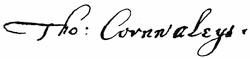
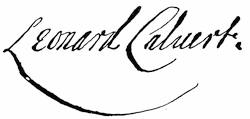
By the decision of the Privy Council in July, 1633, upon the petition of the Virginia planters, Lord Baltimore achieved his first victory in the long struggle he was destined to wage with the enemies of his colony. Regarding his title to the territory as unquestionable, he now hastened his preparations for its colonization. He had purposed to lead the colonists in person, but, finding it necessary to abandon this intention, he confided the expedition to the care of his brother, Leonard Calvert, whom he commissioned as Lieut.-General. Jerome Hawley and Thomas Cornwallis were associated as councillors, and George Calvert, another brother of the Proprietary, was one of the emigrants. Lord Baltimore provided two vessels,—the “Ark,” of about three hundred and fifty tons burden, and the “Dove,” a pinnace of about fifty tons. In October, 1633, the colonists,—“gentlemen adventurers and their servants,”—to the number of about two hundred, embarked at Gravesend. The vessels stopped at the Isle of Wight, where Fathers White and Altham (the Jesuits who had been designated for the service) and some other emigrants were received on board. They finally set sail from Cowes on the twenty-second day of November, 1633, and took the old route by the Azores and West Indies.
Soon after their departure Lord Baltimore wrote to his own and his father’s friend, the Earl of Strafford, that, after having overcome many difficulties, he had sent a hopeful colony to Maryland with a fair expectation of success. “There are two of my brothers gone,” he added, “with very near twenty other gentlemen of very good fashion, and three hundred laboring men well provided in all things.”
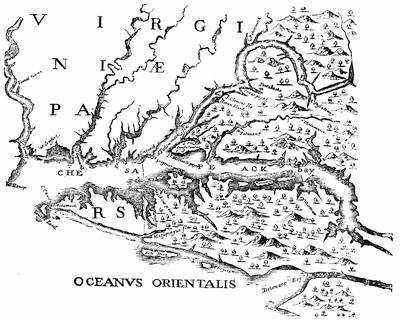
MAP OF MARYLAND, 1635.
This is a reduced fac-simile of the map accompanying A Relation of Maryland, 1635. See Critical Essay. Compare the heliotype of Smith’s map of Virginia, in chapter v.
The vessels remained for some time at Barbadoes, and did not arrive at Point Comfort until the 27th of February, 1634. Here the colonists were received by Governor Harvey, of Virginia, “with much courtesy and humanity,” in obedience to letters from the King. Fresh supplies having been procured in Virginia, the “Ark” and “Dove” weighed anchor and sailed up the bay to the mouth of the Potomac, which they entered and proceeded up about fourteen leagues, to an island which they called St. Clement’s. The emigrants landed here, and took formal possession of Maryland “for our Saviour, and for our Sovereign Lord the King of England.”
Governor Calvert left the “Ark” at the island and sailed up the river with two pinnaces, in order to explore the country and conciliate the Indian chieftains. He was accompanied by Captain Henry Fleet, of the Virginia colony, who was versed in the Indian tongues and acquainted with the country. They assured the chiefs that the strangers had not come to make war upon them, but to impart the arts of civilization and show their subjects the way to heaven. Not deeming it prudent to seat the first colony so far in the interior, Calvert returned down the river and was conducted by Captain Fleet up a tributary stream which flows into the Potomac, from the north, a few miles above its mouth. This river, which is now called the St. Mary’s, is a deep and wide stream. Six or seven miles above its mouth the Governor’s exploring party came to an Indian village, situate on a bluff on the left bank. They determined to settle here, but, instead of forcibly dispossessing the feeble tribe in possession, they purchased thirty miles of the land from them for axes, hatchets, and cloth, and established the colony with their consent. And thus the method of William Penn was antedated by half a century. By the terms of the agreement the Indians were to give up at once one half of the town to the English and part of the growing crops, and at the end of the harvest to leave the place altogether. The “Ark” was sent for, and on the 27th of March, 1634, amid salvoes of artillery from the ships, the emigrants disembarked and took possession of their new home, which they called St. Mary’s.
Attention was first given to building a guardhouse and a general storehouse, their intercourse meanwhile with the natives being of the most genial character. The Indian women taught them how to use corn meal, and with the Indian men they hunted deer and were initiated into the mysteries of woodcraft. They planted the cleared land, and in the autumn of the same year were able to send a cargo of corn to New England in exchange for salt fish and other provisions. From Virginia the colonists procured swine and cattle; and, within a few months after landing, the settlement was enjoying a high degree of prosperity. The English race had now learned the art of colonization.
Although Governor Harvey visited St. Mary’s and seems always to have been friendly to the new colony, the Virginians were bitterly hostile. Captain Young wrote to Sir Tobie Matthew from Jamestown, in July, 1634, that it was there “accounted a crime almost as heinous as treason to favor, nay, to speak well of, that colony” of Lord Baltimore. Sympathy with what they regarded as Clayborne’s wrongs increased their enmity. Soon after the “Ark” and “Dove” left Point Comfort, Clayborne informed the Governor and Council of Virginia that Calvert had notified him that the settlement upon Kent Island would henceforth be deemed a part of Maryland, and requested the opinion of the Board as to his duty in the premises. The Board expressed surprise at the question. and said that there was no more reason for surrendering Kent Island than any other part of the colony; and that, the validity of Lord Baltimore’s patent being yet undetermined, they were bound to maintain the rights of their colony. It was probably on account of remonstrances from Virginia that the committee of the Privy Council for plantations wrote to the Virginians in July, 1634, that there was no intention to affect the interests which had been settled when Virginia was under a corporation, and that for the present they might enjoy their estates with the same freedom as before the recalling of their patents. This letter, which was merely designed to show that Baltimore’s charter should not invade any individual right, appears to have been regarded by Clayborne as justifying his resistance to Calvert’s claim of jurisdiction over his trading stations.
Clayborne endeavored at once to incite the Indians to acts of hostility against the colony. He told them that the new-comers were Spaniards, enemies of the English, and had come to rob them. These insinuations caused a change in the demeanor of the Indians, which greatly alarmed the people of St. Mary’s. The suspicions of the natives, however, were soon dispelled and friendly relations with them were renewed. Clayborne now resolved to wage an open war against the colony. Early in 1635 a casus belli was found in the capture by the Maryland authorities of a pinnace belonging to Clayborne, upon the ground that it was a Virginia vessel trading in Maryland waters without a license. Clayborne thereupon placed an armed vessel under the command of Lieutenant Warren, with orders to seize any of the ships belonging to St. Mary’s. Governor Calvert determined to show at once that this seditious opposition would not be tolerated. He equipped two small vessels and sent them against Kent Island. A naval engagement between the hostile forces took place in April, 1635, which resulted in the killing of one of the Maryland crew, and of Lieutenant Warren and two others of the Kent Island crew. Clayborne’s men then surrendered and were carried to St. Mary’s. Clayborne himself took refuge in Virginia, and Governor Calvert demanded his surrender. This demand was not granted, and two years later Clayborne went to England. He presented a petition to the King, complaining that Baltimore’s agents had sought to dispossess him of his plantations, killing some of his men and taking their boats. He offered to pay the King £100 per annum for the two islands, and prayed for a confirmation of his license and an order directing Lord Baltimore not to interfere with him.
This petition was referred to a committee of the Privy Council, before which Clayborne appeared in person, and arguments upon both sides were heard. The committee decided, in April, 1638, that Clayborne’s license to trade, under the signet of Scotland, gave him no right or title to the Isle of Kent, or to any other place within the limits of Baltimore’s patent, and did not warrant any plantation, and that no trade with the Indians ought to be allowed within Maryland without license from Lord Baltimore. As to the wrongs complained of, the committee found no reason to remove them, but left both sides to the ordinary course of justice. Clayborne returned to Virginia, postponing but not abandoning his vengeance, and Kent Island was subjected to the government of St. Mary’s, Captain George Evelyn being appointed commander of the isle. In the same year Palmer’s Island was seized, and Clayborne’s property there confiscated.
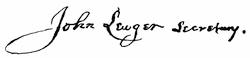
In February, 1635, the first legislative assembly of the Province was convened. Owing to the destruction of most of the early records during Ingle’s Rebellion, no account of the proceedings of this Assembly has come down to us. The charter required the assent of the Proprietary to the laws, and when the acts of this Assembly were laid before Lord Baltimore he disallowed them. In April, 1637, he sent over a new commission, constituting Leonard Calvert the lieut.-general, admiral, and commander, and also the chancellor and chief-justice of the Province. In certain cases, he was directed to consult the council, which was composed of Jerome Hawley, Thomas Cornwallis, and John Lewger. The governor was directed to assemble the freemen of the Province, or their deputies, upon the 25th of January ensuing, and signify the Proprietary’s dissent from the laws made at the previous assembly, and at the same time to submit to them a body of laws which he would himself send over. John Lewger, the new member of the council, and secretary of the Province, came to St. Mary’s in November, 1637, accompanied by his family and several servants. He was distinguished as a scholar at Oxford, and had been converted to Catholicism by the celebrated controversialist Chillingworth. His appointment is an evidence of the solicitude shown by the Proprietary for the affairs of his plantation. During the first years of the settlement he and his friends expended above £40,000 in sending over colonists and providing them with necessaries, of which sum at least £20,000 was out of Baltimore’s own purse.
There can be no doubt that the Proprietary contemplated the foundation of an aristocratic State, with large tracts of land in the hands of individuals who would be interested in upholding his authority. He published, from time to time, certain “conditions of plantation,” stating the quantity of land to which emigrants would be entitled. In the conditions issued in 1636 he directs that to every first adventurer, for every five men brought into the Province in 1634, there should be granted two thousand acres of land for the yearly rent of four hundred pounds of wheat; and to each bringing a less number, one hundred acres for himself, and one hundred acres for his wife and each servant, and fifty acres for every child, under the rent of ten pounds of wheat for each fifty acres. The conditions offered to subsequent adventurers were, naturally, less favorable. All these grants were of fee-simple estates of inheritance, and the colonists received in addition grants of small lots in the town of St. Mary’s. Each tract of a thousand acres or more was erected into a manor, with the right to hold courts baron and leet, and the other privileges belonging to manors in England. A large number of manors were laid off in the Province, and in some instances courts baron and leet were held.[868]
It was only in this regard that the design of transplanting the institutions of expiring feudalism to the New World was carried out. Political and social equality resulted from the conditions of the environment. The “freemen,” who were entitled to make laws, were early held to include all but indented servants, whether they owned a freehold or not. The second Assembly, which met in January, 1638, was a pure democracy. Writs of summons had been issued to every freeman directing his personal attendance. The governor presided as speaker, and the council sat as members. Those freemen who did not choose to attend gave proxies. Proclamation was made that all persons omitted in the writs should make their claim to a voice in the Assembly, “whereupon claim was made by John Robinson, carpenter, and was admitted.” Upon the question of the adoption of the body of laws proposed by Lord Baltimore, the Speaker and Lewger (who counted by proxies fourteen voices) were in the affirmative, and all the rest of the Assembly, being thirty-seven voices, in the negative. Thus was begun a constitutional struggle between the people and the Proprietary. The latter held that, under the charter, the right of originating legislation belonged exclusively to him. For this reason, he had rejected the laws made in 1635, and had himself proposed a number of bills. The colonists were unwilling to concede this claim, and now rejected, in turn, the propositions of the Proprietary. This early evidence of the persistence with which a handful of emigrants maintained what they conceived to be their rights possesses a peculiar interest. The immediate result of the contest was to leave the colony without any laws under which criminal jurisdiction could be exercised. This subject next occupied the attention of the House. Subsequently a number of laws were made, but with the exception of an act of attainder against Clayborne, their titles only remain. They were sent to Lord Baltimore, who promptly exercised his veto power upon them. In February, 1638, a county court was held at which Thomas Smith, who had been captured in the naval engagement described above, and subsequently held a prisoner, was indicted by a grand jury for murder and piracy. There being no court legally constituted to try Smith, he was arraigned and tried before the Assembly, Secretary Lewger acting as the prosecuting attorney. The House found him guilty, with but one dissenting voice, and he was sentenced to be hanged.
Soon after Lord Baltimore had for the second time rejected the acts of the Assembly, he wisely determined to yield his claim of the right to originate legislation. Accordingly he wrote to his brother in August, 1638, giving him power to assent to such laws as he might approve. The assent of the governor was to give force to the laws till the dissent of the Proprietary should be signified. This double veto power was similar to that which existed in most of the royal colonies, where the first negative was in the governor and the second in the king. In a Palatinate government, like Maryland, the Proprietary exercised the royal prerogative. There being no further obstacle to legislation an Assembly was called to meet in February. 1639, which body was composed partly of delegates elected by the people, and partly of freemen specially summoned by the governor’s writ. It was also held that any freeman, who had not participated in the election of deputies, might sit in his individual right. The laws passed at this session provided principally for the administration of justice in criminal and civil cases. It was enacted that the inhabitants should have all their rights and liberties according to the Great Charter.
One of the acts declared that “Holy Church within this Province shall have all her rights and liberties.” A similar law was made in the following year. Both are founded upon the first clause of Magna Charta and must be held to apply to the Roman Church, since the phrase “Holy Church” was never used in speaking of the Church of England. But these acts can hardly be regarded as evidence of an intention to establish the Roman Church. They do not seem to have had any practical effect whatever. We have seen that Lord Baltimore purposed to make all creeds equal in Maryland. Apart from this fixed purpose, from which he never swerved, the impolicy of granting any peculiar privileges to the Catholic Church, in a province subject to England, was so apparent that it was recognized by the Jesuits themselves. Among the Stonyhurst Manuscripts there is preserved the form of an agreement between the Provincial of the Society of Jesus, and Lord Baltimore, in which, after a statement of the manner in which Maryland had been obtained and settled, it is recited that it is “evident that, as affairs now are, those privileges, etc., usually granted to ecclesiastics of the Roman Catholic Church by Catholic princes in their own countries, could not possibly be granted here without grave offence to the King and State of England (which offence may be called a hazard both to the Baron and especially to the whole colony).” The agreement then binds the members of the society in Maryland not to demand any such privileges except those relating to corporal punishments.[869]
It is certain that, from the time the emigrants first landed at St. Mary’s, religious toleration was the established custom of the Province. The history of Maryland toleration does not begin with the famous Act of 1649. That was merely a legislative confirmation of the unwritten law. Long before that enactment, at a time when intolerance and martyrdom was almost the law of Christendom, and while the annals of the other colonies of the New World were being stained with the record of crimes committed in the name of religion, in Maryland the doctrine of religious liberty was clearly proclaimed and practised. It is the imperishable glory of Lord Baltimore and of the State. For the first time in the history of the world there was a regularly constituted government under which all Christians possessed equal rights. All churches were tolerated, none was established. To this “land of the sanctuary” came the Puritans who were whipped and imprisoned in Virginia, and the Prelatists who were persecuted in New England. In 1638 one William Lewis was fined by the council five hundred pounds of tobacco, and required to give security for his good behavior, because he had abused Protestants and forbidden his servants to read Protestant books. The Puritans were invited to settle in Maryland. In 1643 Lord Baltimore wrote to Captain Gibbons of Boston, offering land to any inhabitants of New England that would remove to his province, with liberty in matter of religion, and all other privileges.[870]
It appears from a case that came before the Assembly in 1642 that there was at that time no Protestant clergyman in Maryland. The only religious guides were the Jesuit missionaries, and they formed the only Catholic mission ever established in any of the English colonies in America. Two priests, as we have seen, accompanied the first emigration. In 1636 the mission numbered four priests and one coadjutor. They labored among the Indians in the spirit of Xavier, establishing stations at points distant from St. Mary’s. Their efforts to elevate the savage were not without success. One of their converts was Tayac, the chief of the Piscataways. He and his wife were baptized in 1640, when Governor Calvert and many of the principal men of the colony were present at the ceremony. The Jesuits also succeeded in converting many Protestants. The annual letter of 1638, as communicated to their Superior, states that nearly all the Protestants who came from England in that year, and many others, had been converted.
Although the missionaries did much towards conciliating the Indians, and a fair and gentle treatment of them was the constant policy of the colony, it was yet impossible to preserve a perfect peace with all the tribes. The increase of the colonists began to alarm them, and they were constantly committing petty depredations. All the inhabitants capable of bearing arms were trained in military discipline, and a certain quantity of arms and ammunition was required to be kept at each dwelling-house. Expeditions were frequently made for the purpose of punishing particular tribes which had committed “sundry insolencies and rapines.” Scarcely anything is known of the details of these Indian wars. It was made a penal offence for the colonists to supply any Indian with arms, but the Swedes on the Delaware had no scruples in this respect.
In 1640 another Assembly was held. St. Mary’s County had now been divided into hundreds, and conservators of the peace appointed for each hundred. In addition to the burgesses elected in each hundred, the governor summoned certain freemen by special writ, as had been previously done. The theory upon which this Assembly and those held in the following years proceeded, in framing laws, was that justice should be done according to the law of England, except in so far as changed by provincial enactments.
The Civil War was now at its height in England, and that mighty convulsion filled all the colonies with alarm and uncertainty. The supremacy of the Puritans foreboded danger to the colony of a Catholic nobleman, who still adhered to the cause of the King. Governor Calvert determined to consult his brother personally in regard to the course to be pursued in this crisis. Delegating his powers to Giles Brent, he sailed for England and soon after joined his brother at Oxford. They received from the King a commission to seize any London ships that might come to St. Mary’s. Baltimore sent this commission to Maryland; and in January, 1644, when one Richard Ingle appeared in the Province with an armed ship from London, Governor Brent seized the vessel, and issued a proclamation against Ingle, charging him with treason to the King. Ingle was taken, but soon after made his escape and returned to England. Governor Calvert arrived in September, 1644, and found the Province torn with internal feuds and harassed by Indian incursions. Many thought that the triumph of Parliament would put an end to the Proprietary dominion. Clayborne availed himself of the confusion to renew his designs upon Kent Island, and, by the end of the year, he had regained his former possession. Ingle soon after arrived in another ship, with parliamentary letters of marque. The Proprietary was as powerless as the King with whose fortunes his own were thought to be linked. Ingle landed his men, allied himself with the disaffected, and easily took possession of the government. Governor Calvert fled to Virginia, and the insurgents were undisturbed. The records of the Province brand Ingle as a pirate. To plunder seems indeed to have been his main purpose, and it is not clear that he even professed to act on behalf of the Commonwealth. He afterwards alleged, in a petition to Parliament, that, when he arrived in Maryland, he found that the governor had received a commission from Oxford to seize all London ships, and to execute a tyrannical power against Protestants; and that, therefore, he felt himself to be conscientiously obliged to come to the help of the Protestants against the Papists and Malignants. His only statement as to his proceedings in the Province is that “it pleased God to enable him to take divers places from them, and to make him a support to the well-affected.” It is, however, certain that the period of Ingle’s usurpation was marked with much oppression and extortion. The Jesuits were sent in chains to England, and most of those deemed loyal to the Proprietary were deprived of their property and banished.
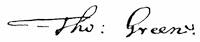
Towards the close of 1646 Governor Calvert, who had been watching the progress of events from Virginia, deemed that the time was ripe for a counter revolution. He appeared at St. Mary’s, at the head of a small force levied in Virginia, and regained the government without resistance. Ingle left the Province, and the body of the people returned to their allegiance with marked alacrity. The most permanent evil caused by this usurpation—commonly called Clayborne and Ingle’s Rebellion, although they do not appear to have acted in concert—was the destruction of the greater part of the then existing records. The entire period is, consequently, involved in obscurity; and it is impossible to determine why it was that so many of the inhabitants were ready to join Ingle in what they afterwards called his “heinous rebellion.” Kent Island alone held out, and Governor Calvert went there in person, and brought back the island to subjection. The entire Province was now tranquillized; but Leonard Calvert did not live to enter upon his labors. On the 9th of June, 1647, he died at the little capital of St. Mary’s, which he had founded seventeen years before, and where he had long exercised, with wisdom and moderation, the highest executive and judicial functions. He had led out the colony from England when a young man of twenty-six years, and in the discharge of various offices he had, in the language of his commission, displayed “such wisdom, fidelity, industry, and other virtues as rendered him capable and worthy of the trust reposed in him.” Upon his death-bed he named Thomas Greene his successor, who now assumed the duties of governor. Greene proclaimed a general pardon to those in the Province who had “unfortunately run themselves into a rebellion,” and a pardon to those who had fled the Province, “acknowledging sorrow for his fault,” except “Richard Ingle, mariner.”[871]
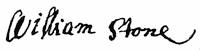
The cause of the monarchy was now prostrate in England, and in the supremacy of Parliament Lord Baltimore saw great danger threatening his colonial dominion. It was necessary to put it out of the power of his enemies to say that Maryland was a Catholic colony, and at the same time he felt bound to protect his co-religionists. He therefore determined to pursue at once a policy of conciliation to the Puritans and of protection to the Catholics. The course he adopted was one well calculated to attain this double end. In August, 1648, he removed Greene, who was a Catholic, and appointed William Stone governor. Stone was a Virginian, and well known as a zealous Protestant and adherent of the Parliament. Lord Baltimore at the same time issued a new commission of the Council of State appointing five councillors, three of whom were Protestants, and he also appointed a Protestant secretary. Accompanying the commissions were oaths to be taken by the governor and councillors. Each was required to swear that he would not trouble or molest any person in the Province professing to believe in Jesus Christ, “and in particular no Roman Catholick for, or in respect of, his or her religion.” While the usual power to assent to laws in the name of the Proprietary was given to Stone, his commission contained a proviso that he should not assent to the repeal of any law—already made or which should thereafter be made—which might in any way concern matters of religion, without special warrant under the seal of the Proprietary. The object of this restriction was to prevent the repeal, by subsequent legislatures, of the act of religious toleration which Lord Baltimore purposed to have passed by the next Assembly. By this act he did not design to have the custom of religious liberty, which had prevailed from the settlement, at all enlarged, but only to be a law of the land beyond the reach of alteration. This security was the more necessary since Stone had agreed to procure five hundred settlers to reside in Maryland, and these might create an overwhelming Protestant majority.
The new governor and council entered upon their duties in the beginning of 1649, and in April of that year the Assembly met. The first law made was the famous “act concerning religion;” which, at least so far as it related to toleration, was doubtless one of the sixteen proposed laws which Lord Baltimore had sent over in the preceding year with the new commissions. The memorable words of this act, the first law securing religious liberty that ever passed a legally constituted legislature, provide that—
“Whereas, the inforcing of the conscience in matters of religion hath frequently fallen out to bee of dangerous consequence in those commonwealths where it hath beene practised, and for the more quiet and peaceable government of this province, and the better to preserve mutuall love and unity amongst the inhabitants here,” it was enacted that no person “professing to believe in Jesus Christ shall, from henceforth, be any waies troubled, molested, or discountenanced for, or in respect of, his or her religion, nor in the free exercise thereof within this province, ... nor any way compelled to the beleefe or exercise of any other religion, against his or her consent.”
The Assembly was composed of sixteen members, nine burgesses, the governor, and six councillors. Their faith has been a matter of dispute, but the most recent investigations make it certain that a majority were Catholics. The governor, three of the council, and two of the burgesses were, without doubt, Protestants. It is equally certain that three of the council and five burgesses were Catholics. The faith of the remaining two members is doubtful; and there is also doubt whether the governor and council sat as a distinct upper house or not.
By the other sections of the “act of toleration,” blasphemy, and denying the divinity of Christ, or the Trinity, were made punishable with death; and those using reproachful words concerning the Virgin Mary or the Apostles, or in matters of religion applying opprobrious epithets to persons, were punishable by a fine, and in default of payment by imprisonment or whipping. It does not appear that any of these penalties were ever inflicted. The toleration established by this act is so far in advance of all contemporary legislation, that it would be invidious to reproach the law-givers because they were not still more enlightened. It may have been that they regarded any broader toleration as prohibited by the provision of the charter respecting the Christian religion, or as likely to excite the animadversion of the Puritans in England. Parliament had recently passed a law (Act of 1648, chapter 114) for the preventing of the growth of heresy and blasphemy, by which the “maintaining with obstinacy” of any one of a number of enumerated heresies—such as that Christ is not ascended into heaven bodily, or that the bodies of men shall not rise again after they are dead—was made a felony punishable with death.
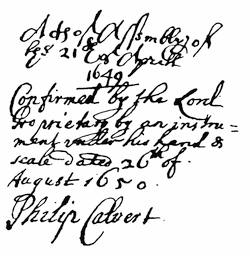
ENDORSEMENT OF THE TOLERATION ACT.
In 1649 Governor Stone invited a body of Puritans who were banished from Virginia, on account of their refusal to conform to the Church of England, to settle in Maryland. These Puritans, the fruits of a mission which had been sent from New England to “convert the ungodly Virginians,” numbered over one hundred. Stone having promised them liberty in the matter of religion and the privileges of English subjects, they accepted the invitation, and in this year settled at a place which they called Providence,—now the site of Annapolis. The settlement was, at the next Assembly, erected into a county, and named Anne Arundel, in honor of Lord Baltimore’s wife, recently deceased, who was a daughter of the Earl of Arundel. The conditions of plantation required every person taking up land in the Province to subscribe an oath of fidelity to his lordship, acknowledging him to be “the true and absolute lord and Proprietary of this province.” The Puritans objected to this oath as being against their consciences, because it required them to acknowledge an absolute power, and bound them to obey a government which countenanced the Roman religion. It is clear that these refugees from intolerance were eager to be intolerant themselves. During a temporary absence of Stone in November, 1649, Greene, the deputy-governor, foolishly proclaimed Charles II. king, and granted a general pardon in furtherance of the common rejoicing. Although this act was promptly disavowed, it afterwards became a formidable weapon against Lord Baltimore.
Notwithstanding their scruples, the Providence Puritans sent two burgesses to the Assembly of 1650, one of whom was elected speaker of the lower house. At this session there was first made a permanent division of the Assembly into two houses, which lasted till the Revolution of 1776. The lower house consisted of the burgesses, and the upper of the governor, secretary, and council. The majority of this Assembly were Protestants; but they made a law enacting, as “a memorial to all posterities” of their thankfulness, fidelity, and obedience to the Proprietary, that, “being bound thereunto by the laws both of God and man,” they acknowledged him “to be the true and absolute lord and Proprietary of this province,” and declaring that they would maintain his jurisdiction till “the last drop of our blood be spent.” Another act was passed altering the oath of fidelity prescribed by the conditions of plantation. The new oath afforded ample opportunity for mental reservation. By it the subscribers bound themselves to maintain “the just and lawful” right and dominion of the Proprietary, “not in any wise understood to infringe or prejudice liberty of conscience in point of religion.”
Lord Baltimore’s trimming at this crisis aroused the displeasure of Charles II. Although a powerless exile, he deposed the Proprietary, and appointed Sir William Davenant royal governor of Maryland, on the ground that Baltimore “did visibly adhere to the rebels in England, and admitted all kinds of sectaries and schismatics and ill affected persons into the plantation.” Baltimore afterwards used this assertion to prove his fidelity to Parliament. Sir William collected a force of French and sailed for Maryland, but was captured in the channel.
Lord Baltimore was soon after threatened from a much more formidable quarter. The revolt of the island of Barbadoes called the attention of Parliament to the necessity of subjecting the colonies to its power, and by an act passed Oct. 3, 1650, for reducing Barbadoes, Antigua, “and other islands and places in America” to their due obedience, the Council of State was authorized to send ships to any of the plantations, and to commission officers “to enforce all such to obedience as do or shall stand in opposition to Parliament.” When the news of this act reached Maryland, the Puritans of Providence thought that the days of the Proprietary dominion were numbered, and they consequently refused to send burgesses to the Assembly which met in March, 1651. Upon information of their conduct and of the perturbed state of the Province being transmitted to Lord Baltimore, he sent in August, 1651, a long message to the governor and Assembly. He declared that the reports concerning the dissolution of his government were unfounded, and directed that in case any of the inhabitants should persist in their refusal to send burgesses to the Assembly, they should be proceeded against as rebels. He also requested the governor and council to use their best endeavors to suppress such false rumors, and suggested that a law be made punishing those spreading false news.
But they who asserted that the Proprietary dominion was about to fall, did not “spread false news.” That steps were not immediately taken to execute the Act of 1650 was probably owing to the fact that Scotland was now in arms under the banner of Charles II. But after the “crowning mercy” of the battle of Worcester, the Council of State, Sept. 20, 1651, appointed two officers of the navy, and Richard Bennett and William Clayborne of Virginia, commissioners under the act. They were directed to use their “best endeavors to reduce all the plantations within the Bay of Chesapeake to their due obedience to the Parliament and the Commonwealth of England.” Maryland was at first expressly named in these instructions; but before they were issued, Baltimore went before the committee of the Council and showed that Governor Stone had always been well affected to Parliament; proved by merchants, who traded to Maryland, that it was not in opposition, and declared that when the friends of the Commonwealth had been compelled to leave Virginia he had caused them to be well received in his province. The name of Maryland was thereupon stricken out of the instructions; but when they were finally issued, a term was used under which the Province might be included.
Clayborne and Bennett were in Virginia; the other commissioners soon after sailed with a fleet carrying a regiment of men, and one hundred and fifty Scotch prisoners who were to be sold as servants in Virginia. A part of the fleet finally reached Jamestown in March, 1652. The commissioners speedily came to terms with Sir William Berkeley, and then turned their attention to Maryland. They appeared at St. Mary’s toward the last of March, and demanded submission in two particulars: first, that all writs and proclamations should be issued in the name of the Keepers of the Liberties of England, and not in that of the Proprietary; and second, that all the inhabitants should subscribe the test, called “the engagement,” which was an oath of allegiance to Parliament. The instructions of the commissioners expressly authorized them to insist upon these terms. The governor and council acceded to the second demand, but refused the first on the ground that process in Maryland had never run in the name of the king, and that it was not the intention of Parliament to deprive Lord Baltimore of his rights in the Province. The commissioners immediately removed Stone and appointed a council of six to govern the Province independently of the Proprietary. Bennett and Clayborne then returned to Virginia, where they appointed themselves respectively governor and secretary of that colony. A few months later Stone, deeming that he could best subserve the interests of the Proprietary by temporizing, submitted to the terms of the commissioners, who, finding that Stone was too popular a man to be disregarded, reinstated him in his office June 28, 1652.
Now that Virginia and Maryland were both under the authority of the same commissioners, the Virginians thought that the time had arrived when an attempt to regain their lost territory was likely to prosper. In August, 1652, a petition was presented to Parliament praying that Virginia might have its ancient limits as granted by the charters of former kings, and that Parliament would grant a new charter in opposition to those intrenching upon these limits. This petition was referred to the committee of the navy with directions to consider what patent was proper to be granted to Virginia. The committee reported Dec. 31, 1652. They found that Kent Island had been settled three years before the settlement of Maryland; that Clayborne had been unlawfully dispossessed of it; that Baltimore had exacted oaths of fealty to himself; that several laws of Maryland were repugnant to the statutes of England, such as the one protecting Papists; that persons of Dutch, French, and Italian descent enjoyed equal privileges with the English in Maryland; and that in March, 1652, the governor and council of Maryland had refused to issue writs in the name of the Keepers of the Liberties of England. No action was taken upon this report. Baltimore had previously presented a paper containing reasons of state why it would be more advantageous for the Commonwealth to keep Maryland under a separate government than to join it to Virginia. These reasons were adapted to the existing condition of affairs, and are sufficiently ingenious.
The Province seems to have been quiet during the year 1653. In England, Cromwell turned Parliament out of doors, and the whole strength of the nation was devoted to the Dutch War. Lord Baltimore thought the time propitious for an attempt to recover his colony. Accordingly, in the latter part of the year, he directed Stone to cause all persons who had failed to sue out patents for their land, or had not taken the amended oath of fidelity to the Proprietary, to do so within three months upon pain of forfeiture of their land. Stone was also directed to issue all writs and processes in the name of the Proprietary. In pursuance of these instructions Stone issued a proclamation in February, 1654, requiring those seated upon lands to obtain patents, and swear allegiance to Lord Baltimore. A few weeks later he commanded all officers of justice to issue their writs in the name of the Proprietary, and showed that this change would not infringe their “engagement” to the Commonwealth. In May he proclaimed Cromwell Lord Protector. But the Puritans were not mollified by this act. Before the proclamation of February had been issued, information as to Baltimore’s instructions had reached the Puritans on the Severn and Patuxent; and they had sent petitions to Bennett and Clayborne, in which they complained that the oath of fidelity to be required of them was “a very real grievance, and such an oppression as we are not able to bear,” and prayed for relief according to the cause and power wherewith the commissioners were intrusted. The open disaffection of the Puritans caused Stone in July, 1654, to issue a proclamation in which he charged Bennett and Clayborne, and the whole Puritan party, with leading the people into “faction, sedition, and rebellion against the Lord Baltimore.” The commissioners, still acting under their old authority, resolved again to reduce Maryland. They put themselves at the head of the Providence party, and advanced against St. Mary’s. At the same time a force levied in Virginia, threatened an invasion from the south. Stone, deeming resistance hopeless, submitted. The commissioners deposed him, and by an order dated Aug. 1, 1654, committed the government of the Province to Captain Fuller and a Puritan council. An Assembly was called to meet in the ensuing October for which Roman Catholics were disabled from voting or being elected members. And thus the fugitives from oppression proceeded to oppress those who had given them an asylum. “Ingratitude to benefactors is the first of revolutionary virtues.” The new Assembly met at the house of an adherent on the Patuxent River. Its first act was one denying the right of Lord Baltimore to interfere in the affairs of the Province. An act concerning religion was passed, declaring that none who professed the Popish religion could be protected in the Province, “but to be restrained from the exercise thereof.”
When the news of the deposition of his officers reached Lord Baltimore he despatched a special messenger with letters to Stone, upbraiding him for having yielded the Province without striking a blow, and directing him to make every effort to re-establish the proprietary government. Stone, thus commanded, resolved to dispute the possession of the government with the Puritans. He armed the population of St. Mary’s, and caused the records, which had been removed to the Patuxent, and a quantity of ammunition to be seized. In March, 1655, he advanced against Providence with about two hundred men and a small fleet of bay craft. He sent ahead of him envoys with a demand for submission which was rejected. The Puritans obtained the aid of Roger Heamans, master of the “Golden Lion,” an armed merchantman lying in the port, and prepared for resistance. Stone landed his men near the town on the evening of the 24th of March, and on the next morning the hostile forces advanced against each other. The battle-cry of the Puritans was, “In the name of God fall on!” that of their opponents, “Hey for St. Mary’s!” The fight was short and decisive. The Puritans were completely victorious. About fifty of Stone’s men were killed or wounded, and nearly all the rest, including Stone himself, who was wounded, were taken prisoners. The loss of the Puritans was trifling, but they did not use their victory with moderation. A drum-head court-martial condemned ten prisoners to death, upon four of whom the sentence was executed. Among those thus tried and condemned was Governor Stone, but the soldiers themselves refused to take his life. It is said that the intercessions of the women caused the lives of the others to be spared. They were however kept in confinement, and the estates of the “delinquents” were confiscated.
Each party was now anxious to find favor in the sight of the Protector. Lord Baltimore presented the affidavit of certain Protestants in the Province as to the high-handed proceedings of the Puritans; while the commissioners transmitted documents to prove that he was hostile to the Protector. In the course of the year several pamphlets were published on either side of the controversy. Cromwell, however, does not appear to have concerned himself about the dispute, since both parties acknowledged his supremacy. In January, 1655, Baltimore had obtained from him a letter to Bennett, directing the latter to forbear disturbing the Proprietary or his people in Maryland. Soon after the receipt of this letter Bennett abandoned the governorship of Virginia and went to England. He there made such representations to the Protector, that, in September, 1655, Cromwell wrote to the “Commissioners of Maryland,” explaining that his former letter related only to the boundary disputes between Maryland and Virginia. After the battle of Providence, Cromwell referred the matter to the Commissioners of the Great Seal, and declared his pleasure that in the mean time the government of Maryland should remain as settled by Clayborne. The Commissioners of the Great Seal reported to the council of state in the following year. This report was not acted upon, but was itself referred to the Commissioners for Trade. It was probably favorable to Lord Baltimore, for he made another effort to wrest his Province from the hands of the Puritans. In July, 1656, he appointed Josias Fendall governor of the Province, with all the powers formerly exercised by Stone. Fendall was in reality only a persistent and unscrupulous revolutionist, but his activity had hitherto been exercised on behalf of the Proprietary. Even before his appointment his conduct had excited the suspicions of the Puritan council. He was arrested by them on the charge of “dangerousness to the public peace,” and kept in confinement till September, 1656, when he was released upon taking an oath not to disturb the existing government until the matter was determined in England.
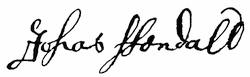
On the 16th of September, 1656, the Commissioners of Trade reported to the Lord Protector entirely in favor of Baltimore. The report was not acted upon, and Bennett and Matthews, the agents of the Puritans, continued the contest. In October they sent to the Protector a paper entitled, Objections against Lord Baltimore’s patent, and reasons why the government of Maryland should not be put into his hands. These objections merely recite the old grievances. Baltimore did not wait for the report to be confirmed, but, confident that his province would be restored to him, directed Fendall to assume the administration of affairs. He also directed large grants of land to be made to those who had been conspicuous for their fidelity to him, and instructed the Council to make provision, out of his own rents, for the widows of those who had lost their lives in his service. Towards the close of the year the Proprietary sent his brother, Philip Calvert, to Maryland as a member of the Council and secretary of the Province. Maryland was now divided between the rival governments. The Puritans held undisputed sway over Anne Arundel, Kent Island, and most of the settlements, while Fendall’s authority seems to have been confined to St. Mary’s County. But there were no acts of hostility between the opposing factions. In September, 1657, the Puritans held another Assembly at Patuxent, at which they again passed an act in recognition of their own authority, and imposed taxes for the payment of the public charges.
Such was the posture of affairs when an agreement was reached by Lord Baltimore and the Puritan agents in England. The favor with which the Protector regarded the old nobility, and his failure to notice the remonstrances which the Puritan agents had addressed to him, caused the latter to despair of setting aside the adverse report of the Commissioners of Trade. The new agent of Virginia, Digges, acted as the intermediary between Baltimore and Bennett and Matthews, and the articles of agreement were signed on the 30th of November, 1657. After reciting the controversies and the “very sad, distracted, and unsettled condition” of the Province, they provide for the submission of those in opposition to the Proprietary and their surrender of the records and great seal. Lord Baltimore, on his part, promised “upon his honor” that he would punish no offenders, but would grant land to all having claims under the conditions of plantation, and that any persons desiring to leave the Province should have liberty to do so. The Puritans now desired the protection of the Toleration Act, and Lord Baltimore therefore stipulated that he would never assent to its repeal. Fendall, who had gone to England for the purpose of consulting the Proprietary, immediately returned to Maryland with a copy of this agreement. At the same time Bennett wrote to Captain Fuller, apprising him of the engagement which had been made on behalf of his party. Fendall arrived in the Province in February, 1658; and the Providence council were requested to meet the officers of Lord Baltimore in order to treat for the performance of the agreement. A meeting of the rival councillors accordingly took place in March. The Puritans, fatigued by the long struggle, were not unwilling to submit, but insisted upon making some changes in the articles of surrender. Fendall accepted their terms, and the new agreement was signed on the 24th of March, 1658. It was stipulated that the oath of fidelity should not be pressed upon the people then resident in the Province, but that, in its place, each person should subscribe an engagement to submit to Lord Baltimore, according to his patent, and not to obey any in opposition to him. It was further agreed that no persons should be disarmed; that there should be a general indemnity for all acts done since December, 1649, and that the proceedings of the Puritan assemblies and courts, in cases relating to property rights, should not be annulled. Proclamation was then made of this agreement and of the governor’s commission, and writs were issued for an Assembly to be held in the ensuing April. At this Assembly the articles of surrender were confirmed. And thus, after six years of civil broils, the Proprietary sway was re-established.
But the spirit of that revolutionary epoch was not yet extinct in Maryland. Another attempt to subvert the authority of Lord Baltimore was made in the following year. This time the leader was Fendall himself, who, after having broken faith with the Puritans, now broke faith with the Proprietary. Upon the confusion which followed the death of Cromwell, Fendall thought that the opportune moment had come for shaking off the rule of his feudal lord. At a session of the Assembly held in March, 1660, the burgesses, in pursuance of Fendall’s scheme, sent to the upper house a message, in which they claimed to be a lawful assembly, without dependence on any other power, and the highest court of judicature. “If any objection can be made to the contrary,” the message concluded, “we desire to hear it.” A conference between the houses was held, at which Fendall stated that he was only commissioned to confirm laws till the Proprietary should declare his dissent, but that in his opinion the true meaning of the charter was that the laws made by the freemen and published by them in his lordship’s name should at once be of full force. On the same day the lower house came in a body to the upper, and declared that they would not permit the latter to continue its sittings, but that its members might take seats among them. Fendall then dissolved the upper house, and, surrendering the powers he had received from the Proprietary, accepted a new commission from the burgesses. Philip Calvert protested against the proceedings, and left the house. The burgesses sought to fortify their authority by making it a felony to disturb the government as established by them.
Lord Baltimore made short work of these treacherous proceedings. As soon as the tidings reached him, in the following June, he appointed Philip Calvert governor. Soon after he obtained from Charles II. a letter commanding all the inhabitants of the Province to submit to his authority. Philip Calvert was sworn in at the Provincial Court held at Patuxent in December, 1660, and had no difficulty in obtaining control of the Province. No one ventured to disobey the commands of a monarch who had just been restored to the throne amid universal enthusiasm. Fendall, indeed, attempted to excite an insurrection, but, failing in this, surrendered himself voluntarily. Lord Baltimore had instructed his deputy not to permit Fendall to escape with his life; and subsequently, while proclaiming a general amnesty, he excepted Hatch and “that perfidious and perjured fellow Fendall, whom we lately entrusted to be our lieutenant of Maryland.” Notwithstanding these instructions, Fendall was punished only by a fine and disfranchisement.
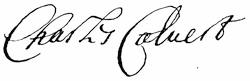
Charles II. was duly proclaimed, and the power of King and Proprietary permanently revived. The tranquillity which now came to the exhausted colony was destined to last, without interruption, till the mighty wave of another revolution in England proved fatal to the lord paramount of Maryland. Clayborne, who has been called the evil genius of the Province, now disappears from its history. His courage and energy have won the admiration of some writers; but, according to the settled principles of public law, his claim upon Kent Island was entirely without foundation. Towards the close of 1661 Charles Calvert, the eldest son of the Proprietary, was appointed governor, and remained in that office till the death of his father. The history of the Province becomes the record of peaceful progress under his wise and just administration. The population, which in 1660 was 12,000, had increased, five years later, to 16,000. In 1676 Lord Baltimore wrote to the Privy Council that the population was 20,000. The provincial assemblies continued to be held at St. Mary’s, and new counties were from time to time erected.
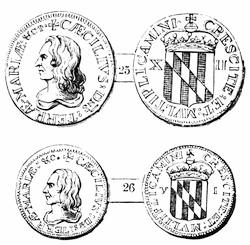
THE BALTIMORE COINS.
[See a “Sketch of the Early Currency of Maryland and Virginia,” by S. F. Streeter, in Historical Magazine, February, 1858, vol. ii. p. 42; and Crosby’s Early Coins of America, from which we have been permitted to borrow our cuts. Specimens of the coins were given by the late George Peabody to the Maryland Historical Society; but they have been surreptitiously removed. Other originals are in the cabinet of William S. Appleton, Esq., of Boston.—Ed.]
The cultivation of tobacco was, from the earliest period, the main occupation of the colonists. Indeed, the prosperity of all the middle colonies reposed chiefly upon this foundation. It was almost the sole export of Maryland. There were no manufactures and no large towns in the Province. It was an agricultural community, scattered along the shores of the noble bay, and of the Potomac and other tributary streams which intersected the country in every direction. The abundance of these natural highways relieved the infant State from a large part of the burden of maintaining roads. Every large planter had at his own door a boat-landing, where he received his supplies, and from which his tobacco was taken to be shipped upon foreign-bound vessels. The high price of tobacco in the second quarter of the seventeenth century (ten times its present value), and the large demand for it by Dutch traders, led the colonists to devote themselves so exclusively to its cultivation, that, on more than one occasion, they suffered from a scarcity of food. Beginning in 1639, numerous acts were passed to enforce the planting of cereals. In order to maintain the excellence of the tobacco exported, the Assembly in 1640 enacted the first tobacco-inspection law,—and thus began a system which has, in some form, been maintained down to the present day. According to the Act of 1640, no tobacco could be exported till scaled by a sworn viewer; and when a hogshead was found bad for the greater part, it was to be burned.
Tobacco was not only the great staple of the Province, but also its chief currency. Taxes were assessed, fines imposed, and salaries paid in tobacco. After the Restoration the restrictive measures, to which we shall refer, and the overproduction of tobacco caused great depreciation in the value of the article. The consequent inconvenience was such that in 1661 the Assembly prayed the Proprietary to establish a mint for the coining of money. Lord Baltimore, by a doubtful stretch of his palatinate prerogatives, caused a large quantity of shillings, sixpences, and groats to be coined for the Province. These coins were put into circulation under an act, passed in 1662, requiring every freeman to take up ten shillings’ worth of them per poll for every taxable person in his custody, and to pay for the same in tobacco at the rate of two pence per pound. But their introduction did not give permanent relief, and tobacco continued to be the chief medium of exchange. Its value decreased so much, that, early in 1663, commissioners were appointed by Virginia and Maryland to consider the evil and its remedy. They could only suggest a diminution of the quantity raised. In the following year the Virginia agents represented to the Privy Council the necessity of lessening the cultivation of tobacco in Virginia and Maryland, and offered proposals for effecting it. These proposals did not meet the approval of Lord Baltimore. The Privy Council ordered that there should be no cessation of the planting of tobacco; but, in order to encourage the planters in cultivating other articles, directed that pitch, tar, and hemp, of the production of those colonies, should be imported into England free of duty for five years. In 1666 an agreement was made between delegates from Virginia, Maryland, and Carolina, providing for a total cessation in the planting of tobacco for one year. The legislatures of these colonies passed acts to enforce this agreement; but the Maryland act was vetoed by Lord Baltimore, upon the ground that it would work great injury to the poorer sort of planters, as well as cause a loss of revenue to the Crown. For various reasons these efforts to control the market by limiting the supply never succeeded.
The colonists did not then fully perceive where the root of the evil lay. There was not too much tobacco but too few buyers; and the number of buyers had been artificially lessened. The real cause of this colonial distress was the famous Navigation Act and the statutes which had been made in pursuance of the policy then begun. The Navigation Act, passed by the Long Parliament in October, 1651, provided that no goods should be imported from Asia, Africa, or America but in English vessels, under the penalty of the forfeiture of both goods and ship. Originally designed as a blow at the commercial supremacy of the Dutch, this Act became, to use the language of Burke, the corner-stone of the policy of England with regard to the colonies. This Act was supplemented by still more restrictive statutes passed in 1660 and in 1663 (15 Car. II. c. 7). The result of these regulations was that the colonists could buy nothing except from English merchants, and could sell nothing except to English merchants. They were not even permitted to export their own goods in their own vessels. They suffered from a triple monopoly of sale, of purchase, and of transportation. They bought in the dearest and sold in the cheapest market.
The chief source of the revenue derived by the Proprietary from the Province arose from the quit-rents which, from the earliest period, had been charged on all grants of land. These rents were at first payable in wheat. In later grants they were made payable in money or the commodities of the country, at the option of the Proprietary, until 1671, when an export duty of two shillings per hogshead was imposed on all tobacco, one half of which went to the support of the government, and the other half was granted to the Proprietary in consideration of his commuting his money quit-rents and alienation fines for tobacco, at the rate of two pence per pound. After 1658 another source of Proprietary revenue was an alienation fine of one year’s rent, which was made a condition precedent to the validity of every conveyance. In 1661 there was given to the Proprietary a port and anchorage duty of half a pound of powder and three pounds of shot on all foreign vessels trading to the Province. The fines and forfeitures imposed in courts of justice inured to the Proprietary as the fountain of justice and standing in loco regis. The royal nature of the Proprietary dominion was also shown in the use of his name in all writs and processes, as the name of the king was used in England. Provincial laws were enacted in his name, by and with the advice and consent of the upper and lower houses. Indictments, including those upon the penal statutes of England, charged the offences to be against his peace, good rule, and government.
The first mention of negro slaves occurs in an act passed in 1664; but they had probably been previously introduced into the Province from Virginia, where slavery existed before the settlement of Maryland. In 1671 an act was passed to encourage their importation, and slavery was thenceforth established. It was long, however, before slaves took the place of indented servants, who formed a large part of the population down to the time of the Revolution. They at first consisted of those who had signed an indenture of service for a limited number of years and were brought into the Province by the masters themselves. Subsequently the traffic in servants was taken up by shipowners and others, who sold them for the remainder of their term to the highest bidders. The term of service, which was at first five years, was reduced by the Act of 1638 to four years. Upon the expiration of his indenture a servant was entitled to fifty acres of land and a year’s supply of necessaries. These servants were called “Redemptioners,” and many of them became valuable citizens. After the Restoration the practice of kidnapping men in English seaports and selling them as servants in the colonies became very common. Among the Maryland papers is the petition of one Mrs. Beale to the king, complaining that the master of a ship had taken her brother as his apprentice on a voyage to Maryland, and there sold him as a servant. The lord mayor and aldermen of London complained to the Council that “certain persons, called spirits, do inveigle, and, by lewd subtilities, entice away” youth to be sold as servants in the plantations. Owing to its equable climate, Maryland had more of these indented servants than any other colony, and the statute book contains many acts relating to them. The practice of sending convicts to America, however, was warmly resisted, and in 1676 an act was passed to prevent it.
A temporary exception to the universal religious toleration, which was a capital principle of government in Maryland, occurred in the case of the Quakers. The first Quaker missionaries appeared in Maryland in 1657. Two years later other preachers of that sect visited the Province and caused “considerable convincement.” Their refusal to bear arms, or to subscribe the engagement of fidelity, or to give testimony, or to serve as jurors, was mistaken for sedition.
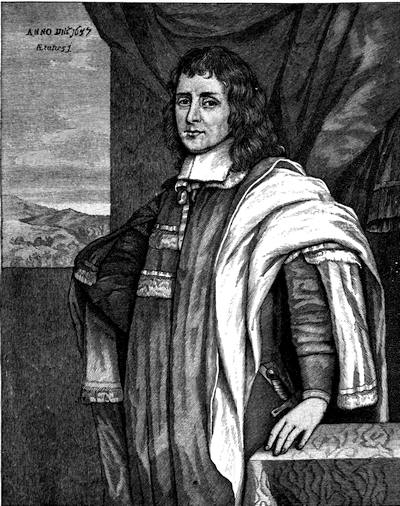
CECIL, SECOND LORD BALTIMORE.
[See the Critical Essay for an account of this picture.—Ed.]
On July 23, 1659, under Fendall’s administration, an order was passed directing that if “any of the vagabonds and idle persons known by the name of Quakers” should again come into the Province, the justices of the peace should arrest them and cause them to be whipped from constable to constable out of the Province. There is no evidence that this penalty was ever enforced. The most active Quaker missionary simply received a sentence of banishment; and after the suppression of Fendall’s rebellion there was no persecution of the Quakers. They found a refuge in Maryland from the intolerance of New England and Virginia. In 1672 George Fox arrived in the Province and attended two “general meetings for all Maryland Friends,” which he describes in his journal as having been largely attended, not only by Quakers but by “other people, divers of whom were of considerable quality in the world’s account.” Maryland was also sought by many French, Bohemian, and Dutch families. In 1666 the first act of naturalization was passed admitting certain French and Bohemians to the rights of citizenship, and from that time forward numerous similar acts were passed.
On the 30th of November, 1675, died Cecilius, Lord Baltimore, after having inscribed his name upon one of the fairest pages in the history of America. The magnificent heritage left him by his father was beset with difficulties; but his courage, perseverance, and skill had triumphed over the hostility of Virginia and the intrigues of Clayborne, over domestic insurrection and Puritan hatred. The first ruler who established and maintained religious toleration is entitled to enduring honor in the eyes of posterity. His name is that of one of the most enlightened and magnanimous statesmen who ever founded a commonwealth.
In the year following his death, Governor Charles Calvert, now the Lord Proprietary, called an assembly at which a thorough revision of the laws of the Province was made. Among the laws continued in force was the Toleration Act of 1649. In the same year Lord Baltimore appointed Thomas Notley deputy-governor, and then sailed for England, where he remained three years. Upon his arrival he found that a clergyman of the Church of England, named Yeo, residing in Maryland, had written to the Archbishop of Canterbury, under the date of 25th May, 1676, begging him to solicit from Lord Baltimore an established support for the Protestant ministry. “Here are ten or twelve counties,” he writes, “and in them at least twenty thousand souls, and but three Protestant ministers of the Church of England. The priests are provided for, and the Quakers take care of those that are speakers, but no care is taken to build up churches in the Protestant religion. The Lord’s day is profaned. Religion is despised, and all notorious vices are committed, so that it is become a Sodom of uncleanness and a pest-house of iniquity.” There is reason to believe that this letter was an exaggerated libel. At any rate the writer considered it easy to cure the evil. It would be sufficient to impose an established church upon the Province. The Archbishop referred the letter to the Bishop of London, who asked the Privy Council to “prevail with Baltimore to settle a revenue for the ministry in his province.” The Privy Council wrote to Baltimore communicating the unfavorable information with regard to the dissolute life of the inhabitants of his province, and desiring an account of the number of Established and Dissenting ministers there. Lord Baltimore replied that in every county of the Province there were a sufficient number of churches which were supported by the voluntary contributions of those attending them, and that there were, to his knowledge, four clergymen of the Church of England in the Province. He also urged that at least three fourths of the inhabitants were Presbyterians, Independents, Baptists, and Quakers, the members both of the Church of England and of the Church of Rome being the fewest, “so that it will be a most difficult task to draw such persons to consent unto a law which shall compel them to maintain ministers of a contrary persuasion to themselves, they having already assurance by an Act for Religion that they shall have all freedom in point of religion and divine worship, and no penalties imposed upon them in that particular.” The Council, however, directed that some provision should be made for the ministry of the Church of England, and that the laws against vice should be enforced. Baltimore returned to Maryland in 1680, but nothing was done to carry out the orders of the Council.
Soon after his return the restless Fendall, in conjunction with John Coode, attempted to stir up an insurrection of the Protestants against the Proprietary. Baltimore, having early notice of the proceedings, arrested Fendall. He was punished by fine and banishment, and the enterprise ended almost as soon as it began. The great preponderance of the Protestant population, and the course of affairs in England were fast making the position of a Catholic Proprietary untenable. Complaints of the favor shown to Catholics were constantly sent to England. In October, 1681, the Privy Council wrote to Baltimore that impartiality must be shown in admitting Catholics and Protestants to the council and in the distribution of arms. In reply to these complaints a declaration was issued in May, 1682, signed by twenty-five Protestants of the Church of England residing in the Province. This declaration certified that places of honor, trust, and profit were conferred on the most qualified, without any regard to the religion of the participants, and that in point of fact most of the offices were filled with Protestants, one half of the council, and by far the greater part of the justices of the peace and militia officers, being Protestants. The subscribers published to the world the general freedom and privilege which all the inhabitants of the Province enjoyed in their lives, liberties, and estates, and in the free and public exercise of their religion.
The first Proprietary had finally come off successful in the long contest for his territory with Virginia and Clayborne. The second Proprietary was now called upon to begin a longer and less successful struggle with William Penn. The charter limits of Maryland included the present State of Delaware and a large part of Pennsylvania. In 1638 a settlement of Swedes was made on the Delaware, which was brought under subjection to the government of the States General in 1655.[872] In 1659 the governor and council, in pursuance of Lord Baltimore’s instructions, ordered Colonel Utie to “repair to the pretended governor of a people seated on the Delaware Bay, within his lordship’s province, and to require them to depart the province.” Utie had an interview with the authorities of New Amstel, and threatened them with war in case of a refusal to leave. They replied that the matter must be left to their principals in England and Holland. Towards the close of the year the Dutch sent Augustine Hermann and Resolved Waldron as ambassadors to Maryland. They had an interview with the governor and council in which the claim of Holland to the territory in question was formally presented. The governor asserted the title of Lord Baltimore and demanded the submission of the settlements. This demand was rejected and the interview terminated. The Dutch power in America was soon after brought to an end by the Duke of York, to whom Charles II. in 1664 granted all the territory between the Connecticut and Delaware rivers.[873] In 1680 Penn asked for a grant of the territory west of the Delaware and north of Maryland. In his patent, which passed the seals in March, 1681, the southern boundary of his province was a “circle of twelve miles drawn around New Castle to the beginning of the forty degrees of latitude,”—a description which it was impossible to gratify. In April, 1681, the King wrote to Baltimore notifying him of Penn’s grant, and directing him to aid Penn in seating himself, and to appoint some persons to make a division between the provinces, in conjunction with Penn’s agents.[874] Lord Baltimore met Penn’s deputy, in September, 1682, at Upland (now Chester), when it was found, by a precise observation, that the fortieth degree of latitude was beyond Upland itself. The knowledge of this fact caused Penn to be anxious to obtain a grant of Delaware. Though the Duke of York’s grant did not extend south of the Delaware, Penn, by dint of importunity, obtained from him in August, 1682, a grant of the territory twelve miles around New Castle, and southward, along the river, to Cape Henlopen. Penn asked for that which he knew to be within the boundaries of Maryland, and beyond the power of the Duke to grant. He also received a release of the Duke’s claim to the territory of Pennsylvania, and soon afterwards sailed for his province.
On August 19, 1682, he had procured from the King a letter to Baltimore directing the latter to hasten the adjustment of the boundaries. An interview between the two Proprietaries took place in December, when Penn handed to Lord Baltimore the King’s letter. Baltimore insisted upon the fortieth degree as his northern boundary, and the conference was fruitless. They had another interview, at New Castle, in the following year, which also made it apparent that no agreement between the rival Proprietaries was possible. Penn now raised against the Maryland charter an objection similar to that which had been urged by Virginia and Clayborne,—that Delaware had been settled by the Dutch before the grant of the charter, and that, if this were not the case, Baltimore had forfeited his rights by failure to extend his settlements there.
Both Penn and Lord Baltimore now resolved to go to England to contest the matter before the King and Council. Baltimore called an assembly—the last over which he presided in person—in April, 1684. He acquainted them with the necessity he was under of going to England, and assured them that his stay would be no longer than requisite for the decision of the differences between Penn and himself. The Assembly then proceeded to revise the laws of the Province; after which the Proprietary appointed a council of nine, under the presidency of William Joseph, to govern the Province during his absence, and sailed for England. Baltimore found that he was no match in court influence for Penn. In November, 1685, the Board of Trade decided that the Maryland charter included only “lands uncultivated and inhabited by savages, and that the territory along the Delaware had been settled by Christians antecedently to his grant, and was therefore not included in it;” and they directed that the peninsula between the two bays should be divided equally by a line drawn from the latitude of Cape Henlopen to the fortieth degree, and that the western portion was Baltimore’s and the eastern Penn’s. The Revolution, however, came in time to prevent the execution of this decision, and the vexed question was not finally settled till the middle of the following century.
The accession of James II. brought increased danger to Lord Baltimore. To a king who designed the subversion of the liberties of the colonies as well as of England, the liberal charter of Maryland was especially odious. In April, 1687, an order in Council was made directing the prosecution of a writ of quo warranto against the Maryland charter. In that age the issuing of such a writ seldom failed to achieve its object; but before judgment could be obtained against Baltimore the Revolution of 1688 had occurred, and the Stuart dynasty was at an end. The tidings that a writ had been issued against Baltimore’s charter alarmed the imaginations of the provincials. When the Assembly met in November, 1688, President Joseph sought to counteract this state of feeling in a manner which only served to increase the anxiety. In his opening speech he claimed his right to rule jure divino, tracing it from God to the King, from the King to the Proprietary, and from the Proprietary to himself. He then took the unprecedented step of demanding an oath of fidelity from the Houses. The burgesses at first refused, and were with difficulty persuaded to yield. The Assembly showed its loyalty to the monarch, who was then a fugitive from his kingdom, by passing an act for a perpetual thanksgiving for the birth of the prince, and fixed a commemoration of it each succeeding tenth day of June.