Chapter VI · (continued 2)
Reading edition
Harrisse[1108] points out an allusion to the expedition of Cortés and a description of those of Córdoba and Grijalva, in Ein Auszug ettlicher Sendbrieff ... von wegen einer new gefunden Inseln, published at Nuremberg in March, 1520;[1109] and Harrisse supposes the information is derived from Peter Martyr.[1110] Bancroft[1111] points out a mere reference in a publication of 1522,—Translationuss hispanischer Sprach, etc.
II. The Second Letter, Oct. 30, 1520. We possess four early editions of this,—two Spanish (1, 2) and one Latin (3), and one Italian (4).
1. The earliest Spanish edition was published at Seville Nov. 8, 1522, as Carta de relaciō, having twenty-eight leaves, in gothic type.[1112]
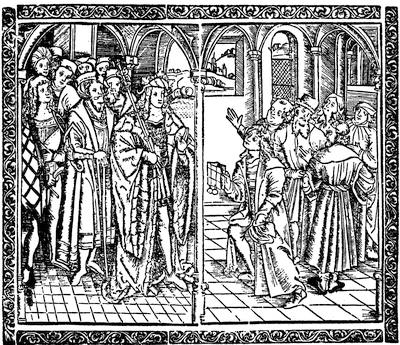
2. The second Spanish edition, Carta de relacion, was printed at Saragossa in 1524. It is in gothic letter, twenty-eight leaves, and has a cut of Cortés before Charles V. and his Court, of which a reduced fac-simile is herewith given.[1113]
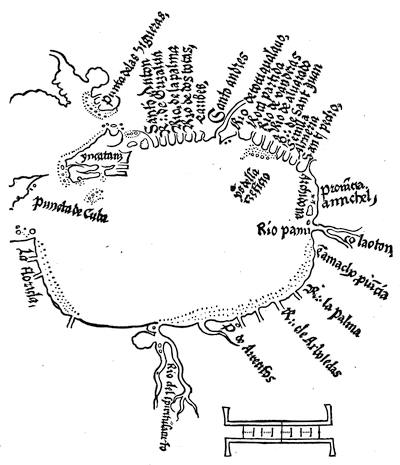
CORTÉS’ GULF OF MEXICO.
This fac-simile follows the reproduction given by Stevens in his American Bibliographer, p. 86, and in his Notes, etc., pl. iv. Dr. Kohl published in the Zeitschrift für allgemeine Erdkunde, neue Folge, vol. xv., a paper on the “Aelteste Geschichte der Entdeckung und Erforschung des Golfs von Mexico durch die Spanier von 1492 bis 1543.” Cf. also Oscar Peschel’s Zeitalter der Entdeckungen (1858), chap. vii., and Ruge’s Geschichte des Zeitalters der Entdeckungen, p. 355.
3. The first Latin edition was published in folio at Nuremberg, in August, 1524, in roman type, with marginal notes in gothic, and was entitled: Præclara Ferdinādi Cortesii de noua maris Oceani Hypania narratio. It was the work of Pierre Savorgnanus.[1114]
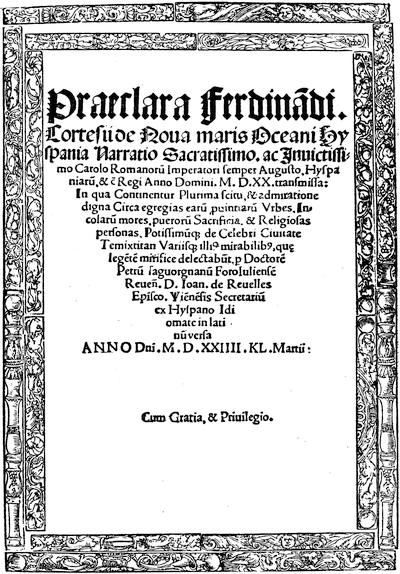
TITLE OF THE LATIN CORTÉS, 1524.—REDUCED.
ARMS, ON THE REVERSE OF TITLE, OF THE LATIN CORTÉS, 1524.
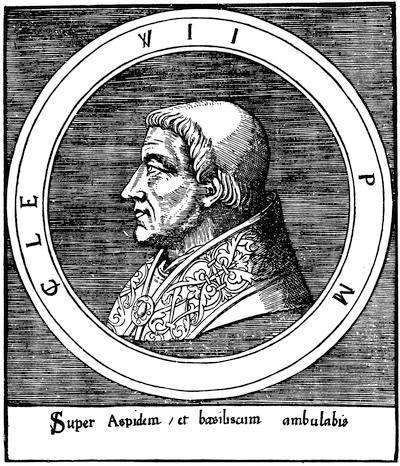
CLEMENT VII.
Fac-simile of a cut in the Latin Cortés of 1524. It was this Pope who was so delighted with the Indian jugglers sent to Rome by Cortés. The Conqueror also made His Holiness other more substantial supplications for his favor, which resulted in Cortés receiving plenary indulgence for his and his companions’ sins (Prescott, iii. 299).
4. The Italian edition, La preclara narratione di Ferdinando Cortese della Nuova Hispagna del Mare Oceano ... per Nicolo Liburnio con fidelta... tradotta, was printed at Venice in 1524. It follows the Latin version of Savorgnanus, and includes also the third letter.
This edition has a new engraving of the map in the Nuremberg edition, though Quaritch and others have doubted if such a map belongs to it. Leclerc (no. 151) chronicles copies with and without the map.[1115] An abstract of the second letter in Italian, Noue de le Isole et Terra Ferma nouamente trouate, had already appeared two years earlier, in 1522, at Milan.[1116]
There were other contemporary abstracts of this letter. Sigmund Grimm, of Augsburg, is said to be the author of one, published about 1522 or 1523, called Ein schöne newe Zeytung, so kayserlich Mayestet auss India yetz newlich zūckommen seind. It is cited in Harrisse and the Bibliotheca Grenvilliana; and Ternaux (no. 5) is thought to err in assigning the date of 1520 to it, as if printed in Augsburg. Of about the same date is another described by Sabin (vol. iv. no. 16,952) as printed at Antwerp, and called Tressacree Imperiale et Catholique Mageste ... eust nouvelles des marches ysles et terre ferme occeanes. This seems to be based, according to Brunet, Supplément (vol. i. col. 320), on the first and second letters, beginning with the departure, in 1519, from Vera Cruz, and ending with the death of Montezuma.[1117]
The second letter forms part of various collected editions, as follows:—
In Spanish. Bancroft (Mexico, i. 543) notes the second and third letters as being published in the Spanish Thesóro de virtudes in 1543.
Barcia’s Historiadores primitivos (1749); also edited by Enrique de Vedia, Madrid, 1852-1853.
Historia de Nueva España, escrita por su esclarecido Conquistador Hernan Cortés, aumentada con otros documentos y notas por Don Francisco Antonio Lorenzana, arzobispo de México, Mexico, 1770. This important work, embracing the second, third, and fourth letters, has a large view of the great temple of Mexico, a map of New Spain,[1118] and thirty-one plates of a hieroglyphic register of the tributaries of Montezuma,—the same later reproduced in better style by Kingsborough. Lorenzana was born in 1722, and rising through the gradations of his Church, and earning a good name as Bishop of Puebla, was made Archbishop of Toledo shortly after he had published the book now under consideration. Pius VI. made him a cardinal in 1789, and he died in Rome in 1804. Icazbalceta was not able to ascertain whether the Bishop had before him the original editions of the letters or Barcia’s reprint; but he added to the value of his text by numerous annotations. In 1828 an imperfect reprint of this book, “á la ortografía moderna,” was produced in New York for the Mexican market, by Manuel del Mar, under the title of Historia de Méjico,[1119] to which a life of Cortés, by R. C. Sands, was added.[1120] Icazbalceta notes some of the imperfections of this edition in his Coleccion, vol. i. p. xxxv.[1121]
Cartas y relaciones al Emperador Carlos V., colegidas é ilustradas por P. de Gayangos, Paris, 1866. Besides the Cortés letters, this distinguished scholar included in this book various other contemporary documents relating to the Conquest, embracing letters sent to Cortés’ lieutenants; and he also added an important introduction. He included the fifth letter for the first time in the series, and drew upon the archives of Vienna and Simancas with advantage.[1122]
The letters were again included in the Biblioteca histórica de la Iberia published at Mexico in 1870.
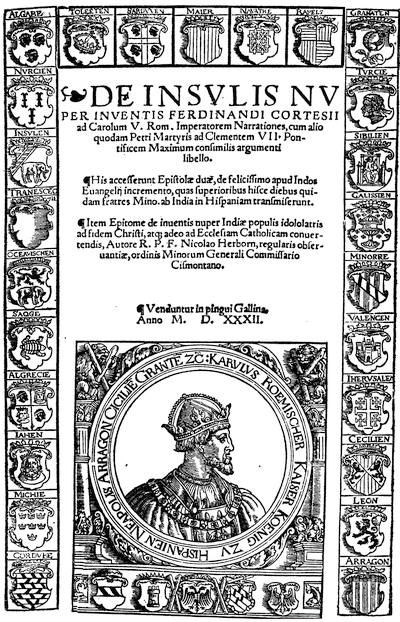
In Latin. The second and third letters, with the account of Peter Martyr, were issued at Cologne in 1532, with the title De insulis nuper inventis, etc., as shown in the annexed fac-simile of the title, with its portrait of Charles V. and the escutcheons of Spanish towns and provinces.[1123]
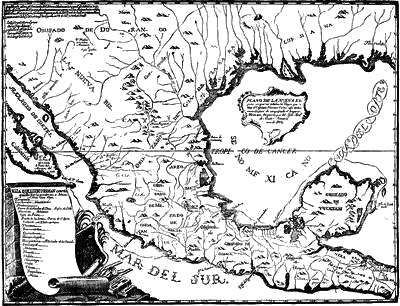
LORENZANA’S MAP OF NEW SPAIN.
In French. Harrisse (Bibl. Amer. Vet., Additions, no. 73) notes a French rendering of a text, seemingly made up of the first and second letters, and probably following a Spanish original, now lost, which was printed at Antwerp in 1523.[1124] This second letter is also epitomized in the French Extraict ou recueil des isles nouvellement trouvées of Peter Martyr, printed at Paris in 1532, and in Bellegarde’s Histoire universelle des voyages (Amsterdam, 1708), vol. i.
The principal French translation is one based on Lorenzana, abridging that edition somewhat, and numbering the letters erroneously first, second, and third. It was published at Paris in 1778, 1779, etc., under the title Correspondance de Fernand Cortes avec l’Empereur Charles Quint, and was translated by the Vicomte de Flavigny.[1125] The text of Flavigny’s second letter is included in Charton’s Voyageurs, iii. 368-420. There were also editions of Flavigny printed in Switzerland and at Frankfort.
In German. A translation of the second and third letters, made by Andrew Diether and Birck, was published at Augsburg in 1550 as Cortesi von dem Newen Hispanien. After the second letter, which constitutes part i., the beginning of part ii. is borrowed from Peter Martyr, which is followed by the third letter of Cortés; and this is succeeded in turn, on folios 51-60, by letters from Venezuela about the settlements there (1534-1540), and one from Oviedo written at San Domingo in 1543. There are matters which are not contained in any of the Spanish or Latin editions.[1126]
The second, third, and fourth letters—translated by J. J. Stapfer, who supplied a meritorious introduction and an appendix—were printed at Heidelberg in 1779 as Eroberung von Mexico, and again at Berne in 1793.[1127] Another German version, by Karl Wilhelm Koppe,—Drei Berichte des General-Kapitäns Cortes an Karl V.,—with an introduction and notes, was published at Berlin in 1834. It has the tribute-registers and map of New Spain, as in Lorenzana’s edition.[1128]
In Dutch and Flemish. Harrisse (Bibl. Amer. Vet., Additions, no. 72) notes a tract of thirty leaves, in gothic letter, called De Contreyen vanden Eylanden, etc., which was printed in Antwerp in 1523 (with a French counterpart at the same time), and which seems to have been based on the first and second letters, combined in a Spanish original not now known. There is a copy in the National Library at Paris. There was a Dutch version, or epitome, in the Dutch edition of Grynæus, 1563, and a Flemish version appeared in Ablyn’s Nieuwe Weerelt, at Antwerp, 1563. There was another Dutch rendering in Gottfried and Vander Aa’s Zee-en landreizen (1727)[1129] and in the Brieven van Ferdinand Cortes, Amsterdam, 1780.[1130]
In Italian. In the third volume of Ramusio.
In English. Alsop translated from Flavigny the second letter, in the Portfolio, Philadelphia, 1817. George Folsom, in 1843, translated from Lorenzana’s text the second, third, and fourth letters, which he published as Despatches written during the Conquest, adding an introduction and notes, which in part are borrowed from Lorenzana.[1131] Willes in his edition of Eden, as early as 1577, had given an abridgment in his History of Travayle.[1132] (See Vol. III. p. 204.)
III. The Third Letter, covering the internal, Oct. 30, 1520, to May 15, 1522. It is called Carta tercera de relaciō, and was printed (thirty leaves) at Seville in 1523.[1133]
The next year, 1524, a Latin edition (Tertia narratio) appeared at Nuremberg in connection with the Latin of the second letter of that date.[1134] This version was also made by Savorgnanus, and was reprinted in the Novus orbis of 1555.[1135]
This third letter appeared also in collective editions, as explained under the head of the second letter. This letter was accompanied by what is known as the “secret letter,” which was first printed in the Documentos inéditos, i. 11, in Kingsborough, vol. viii., and in Gayangos’ edition of the letters.
IV. The Fourth Letter, covering the interval, May, 1522, to October, 1524. There were two Spanish editions (a, b).
a. La quarta relacion (Toledo, 1525), in gothic letter, twenty-one leaves.[1136]
b. La quarta relaciō (Valencia, 1526), in gothic type, twenty-six leaves.[1137]
This letter was accompanied by reports to Cortés from Alvarado and Godoy, and these are also included in Barcia, Ramusio, etc.
A secret letter (dated October 15) of Cortés to the Emperor,—Esta es una carta que Hernando Cortés escrivio al Emperador,—sent with this fourth letter, is at Simancas. It was printed by Icazbalceta in 1855 (Mexico, sixty copies),[1138] who reprinted it in his Coleccion, i. 470. Gayangos, in 1866, printed it in his edition (p. 325) from a copy which Muñoz had made. Icazbalceta again printed it sumptuously, “en caracteres góticos del siglo XVI.,” at Mexico in 1865 (seventy copies).[1139] This letter also appears in collections mentioned under the second letter. It was in this letter that Cortés explained to the Emperor his purpose of finding the supposed strait which led from the Atlantic to the south sea.
V. The fifth letter, dated Sept. 3, 1526. It pertains to the famous expedition to Honduras.[1140] It is called Carta quinta de relacion, and was discovered through Robertson’s instrumentality, but not printed at length till it appeared in the Coleccion de documentos inéditos (España), iv. 8-167, with other “relaciones” on this expedition. George Folsom reprinted it in New York in 1848 as “carta sexta ... publicada ahora por primera vez” by mistake for “carta quinta.”[1141] It was translated and annotated by Gayangos for the Hakluyt Society in 1868.[1142] Gayangos had already included it in his edition of the Cartas, 1866, and it had also been printed by Vedia in Ribadeneyras’ Biblioteca de autores Españoles (1852), vol. xxii., and later in the Biblioteca histórica de la Iberia (1870). Extracts in English are given in the appendix of Prescott’s Mexico, vol. iii. Mr. Kirk, the editor of Prescott, doubts if the copy in the Imperial Library at Vienna is the original, because it has no date. A copy at Madrid, purporting to be made from the original by Alonzo Diaz, is dated Sept. 3, 1526,[1143] and is preferred by Gayangos, who collated its text with that of the Vienna Library. Various other less important letters of Cortés have been printed from time to time.[1144]
In estimating the letters of Cortés as historical material, the soldierly qualities of them impressed Prescott, and Helps is struck with their directness so strongly that he is not willing to believe in the prevarications or deceits of any part of them. H. H. Bancroft,[1145] on the contrary, discovers in them “calculated misstatements, both direct and negative.” It is well known that Bernal Diaz and Pedro de Alvarado made complaints of their leader’s too great willingness to ignore all others but himself.[1146]
B. Three Contemporary Writers,—Gomara, Bernal Diaz, and Sahagun.—Fortunately we have various other narratives to qualify or confirm the recitals of the leader.
In 1540, when he was thirty years old, Francisco Lopez Gomara became the chaplain and secretary of Cortés. In undertaking an historical record in which his patron played a leading part, he might be suspected to write somewhat as an adulator; and so Las Casas, Diaz, and many others have claimed that he did, and Muñoz asserts that Gomara believed his authorities too easily.[1147] That the Spanish Government made a show of suppressing his book soon after it was published, and kept the edict in their records till 1729, is rather in favor of his honest chronicling. Gomara had good claims for consideration in a learned training, a literary taste, and in the possession of facilities which his relations with Cortés threw in his way; and we find him indispensable, if for no other reason, because he had access to documentary evidence which has since disappeared. His questionable reputation for bias has not prevented Herrera and other later historians placing great dependence on him, and a native writer of the beginning of the seventeenth century, Chimalpain, has translated Gomara, adding some illustrations for the Indian records.[1148]
Gomara’s book is in effect two distinct ones, though called at first two parts of a Historia general de las Indias. Of these the second part—La conquista de México—appeared earliest, at Saragossa in 1552, and is given to the Conquest of Mexico, while the first part, more particularly relating to the subjugation of Peru, appeared in 1553.[1149] What usually passes for a second edition appeared at Medina del Campo, also in 1553;[1150] and it was again reprinted at Saragossa in 1554, this time as two distinct works,—one, Cronica de la Nueva España con la conquista de México; and the other, La historia general de las Indias y Nuevo Mundo.[1151] The same year (1554) saw several editions in Spanish at Antwerp, with different publishers.[1152] An Italian edition followed in 1555-1556, for one titlepage, Historia del ... capitano Don Ferdinando Cortés, is dated 1556, and a second, Historia de México, has 1555,—both at Rome.[1153]
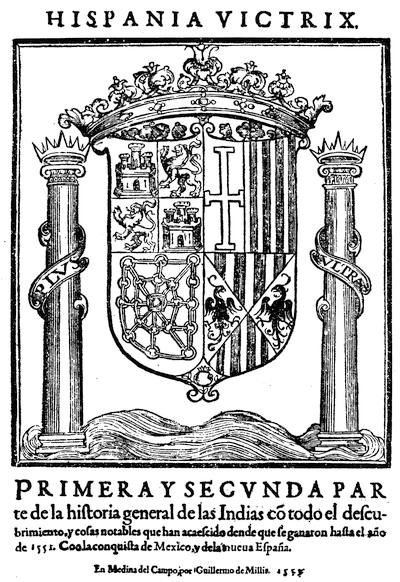
Other editions, more or less complete, are noted as published in Venice in 1560, 1564, 1565, 1566, 1570, 1573, 1576, and 1599.[1154] The earliest French edition appeared at Paris in 1568 and 1569, for the two dates and two imprints seem to belong to one issue; and its text—a not very creditable translation by Fumée—was reproduced in the editions of 1577, 1578, 1580, and with some additions in 1584, 1587, 1588, and 1597.[1155] The earliest edition in English omits much. It is called The Pleasant Historie of the Conquest of the Weast India, now called New Spayne, atchieved by the worthy Prince Hernando Cortes, Marques of the valley of Huaxacac, most delectable to reade, translated out of the Spanishe tongue by T[homas] N[icholas], published by Henry Bynneman in 1578.[1156] Gomara himself warned his readers against undertaking a Latin version, as he had one in hand himself; but it was never printed.[1157]
Gomara had, no doubt, obscured the merits of the captains of Cortés in telling the story of that leader’s career. Instigated largely by this, and confirmed in his purpose, one of the partakers in the glories and hardships of the Conquest was impelled to tell the story anew, in the light of the observation which fell to a subordinate. He was not perhaps so much jealous of the fame of Cortés as he was hurt at the neglect by Gomara of those whose support had made the fame of Cortés possible.
This was Bernal Diaz del Castillo, and his book is known as the Historia verdadera de la conquista de la Neuva España, which was not printed till 1632 at Madrid, nor had it been written till half a century after the Conquest, during which interval the name of Cortés had gathered its historic prestige. Diaz had begun the writing of it in 1568 at Santiago in Guatemala, when, as he tells us, only five of the original companions of Cortés remained alive.[1158] It is rudely, or rather simply, written, as one might expect. The author has none of the practised arts of condensation; and Prescott[1159] well defines the story as long-winded and gossiping, but of great importance. It is indeed inestimable, as the record of the actor in more than a hundred of the fights which marked the progress of the Conquest. The untutored air of the recital impressed Robertson and Southey with confidence in its statements, and the reader does not fail to be conscious of a minute rendering of the life which made up those eventful days. His criticism of Cortés himself does not, by any means, prevent his giving him great praise; and, as Prescott says,[1160] he censures his leader, but he does not allow any one else to do the same. The lapse of time before Diaz set about his literary task did not seem to abate his zeal or check his memory; but it does not fail, however, to diminish our own confidence a good deal. Prescott[1161] contends that the better the acquaintance with Diaz’ narrative, the less is the trust which one is inclined to put in it.[1162] The Spanish text which we possess is taken, it is said, directly from the original manuscript, which had slumbered in private hands till Father Alonso Rémon found it, or a copy of it, in Spain, and obtained a decree to print it,[1163] about fifty years after Diaz’ death, which occurred in 1593, or thereabouts.
The nearest approach among contemporaries to a survey of the story of the Conquest from the Aztec side is that given by the Franciscan, Sahagun, in connection with his great work on the condition of the Mexican peoples prior to the coming of the Spaniards. Sahagun came to Mexico in 1529. He lived in the new land for over sixty years, and acquired a proficiency in the native tongue hardly surpassed by any other of the Spaniards. He brought to the new field something besides the iconoclastic frenzy that led so many of his countrymen to destroy what they could of the literature and arts of the Aztecs,—so necessary in illustration of their pagan life and rites. This zealous and pious monk turned aside from seeking the preferments of his class to study the motives, lives, and thoughts of the Aztec peoples. He got from them their hieroglyphics; these in turn were translated into the language of their speech, but expressed in the Roman character; and the whole subjected more than once to the revising of such of the natives as had, in his day, been educated in the Spanish schools.[1164] Thirty years were given to this kind of preparation; and when he had got his work written out in Mexican, the General of his Order seized it, and some years elapsed before a restitution of it was made. Sahagun had got to be eighty years old when, with his manuscript restored to him, he set about re-writing it, with the Mexican text in one column and the Spanish in another. The two huge volumes of his script found their way to Spain, and were lost sight of till Muñoz discovered them in the convent of Tolosa in Navarre, not wholly unimpaired by the vicissitudes to which they had been subjected. The Nahuatl text, which made part of it, is still missing.[1165]
It was not long afterward (1829-1830) printed by Cárlos María Bustamante in three volumes as Historia general de las cosas de Nueva España,[1166] to which was added, as a fourth volume, also published separately, Historia de la conquista de México, containing what is usually cited as the twelfth book of Sahagun. In this, as in the other parts, he used a copy which Muñoz had made, and which is the earlier draft of the text as Sahagun formed it. It begins with a recital of the omens which preceded the coming of Grijalva, and ends with the fall of the city; and it is written, as he says, from the evidence, in large part, of the eye-witnesses, particularly on the Aztec side, though mixed, somewhat confusedly, with recollections from old Spanish soldiers. Harrisse[1167] speaks of this edition as “castrated in such a way as to require, for a perfect understanding of this dry but important book, the reading of the parts published in vols. v. and vi. of Kingsborough.” The text, as given in Kingsborough’s Mexico, began to appear about a year later, that edition only giving, in the first instance, book vi., which relates to the customs of the Aztecs before the Conquest; but in a later volume he reproduced the whole of the work without comment. Kingsborough had also used the Muñoz text, and has made, according to Simeon, fewer errors in transcribing the Nahuatl words than Bustamante, and has also given a purer Spanish text. Bustamante again printed, in 1840, another text of this twelfth book, after a manuscript belonging to the Conde de Cortina, appending notes by Clavigero and others, with an additional chapter.[1168] The Mexican editor claimed that this was the earlier text; but Prescott denies it. Torquemada is thought to have used, but without due acknowledgment, still another text, which is less modified than the others in expressions regarding the Conquerors. The peculiar value of Sahagun’s narrative hardly lies in its completeness, proportions, or even trustworthiness as an historical record. “His accuracy as regards any historical fact is not to be relied on,” says Helps.[1169] Brevoort calls the work of interest mainly for its records of persons and places not found elsewhere.[1170] Prescott thinks that this twelfth book is the most honest record which the natives have left us, as Sahagun embodies the stories and views prevalent among the descendants of the victims of the Conquest. “This portion of the work,” he says, “was rewritten by Sahagun at a later period of his life, and considerable changes were made in it; yet it may be doubted if the reformed version reflects the traditions of the country as faithfully as the original draft.”[1171] This new draft was made by Sahagun in 1585, thirty years after the original writing, for the purpose, as he says, of adding some things which had been omitted, and leaving out others. Prescott could not find, in comparing this later draft with the earlier, that its author had mitigated any of the statements which, as he first wrote them, bore so hard on his countrymen. The same historian thinks there is but little difference in the intrinsic value of the two drafts.[1172]
The best annotated edition of Sahagun is a French translation, published in Paris in 1880 as Histoire générale des choses de la Nouvelle Espagne, seemingly from the Kingsborough text, which is more friendly to the Spaniards than the first of Bustamante. The joint editors are Denis Jourdanet and Remi Siméon, the latter, as a Nahuatl scholar, taking charge of those portions of the text which fell within his linguistic range, and each affording a valuable introduction in their respective studies.[1173]
C. Other Early Accounts.—The Voyages, Relations, et Mémoires of Ternaux-Compans (Paris, 1837-1840) offer the readiest source of some of the most significant of the documents and monographs pertaining to early Mexican history. Two of the volumes[1174] gather some of the minor documents. Another volume[1175] is given to Zurita’s “Rapport sur les différentes classes des chefs de la Nouvelle Espagne.” Three others[1176] contain an account of the cruelties practised by the Spaniards at the Conquest, and the history of the ancient kings of Tezcuco,—both the work of Ferdinando d’Alva Ixtlilxochitl.[1177] The former work, not correctly printed, and called, somewhat arbitrarily, Horribles crueldades de los Conquistadores de México, was first published by Bustamante, in 1829, as a supplement to Sahagun. The manuscript (which was no. 13 of a number of Noticias, or Relaciones históricas, by this native writer) had been for a while after the writer’s death (about 1648) preserved in the library of the Jesuit College in Mexico, and had thence passed to the archive general of the State. It bears the certificate of a notary, in 1608, that it had been compared with the Aztec records and found to be correct. The original work contained several Relaciones, but only the one (no. 13) relating to the Conquest was published by Bustamante and Ternaux.[1178]
The other work of Ixtlilxochitl was first printed (after Veytia’s copy) in Spanish by Kingsborough, in his ninth volume, before Ternaux, who used another copy, included it in his collection under the title of Histoire des Chichimeque ou des anciens Rois de Tezcuco. This is the only work of Ixtlilxochitl which has been printed entire. According to Clavigero, these treatises were written at the instance of the Spanish viceroy; and as a descendant of the royal line of Tezcuco (the great great-grandson, it is said, of the king of like name) their author had great advantages, with perhaps great predispositions to laudation, though he is credited with extreme carefulness in his statements;[1179] and Prescott affirms that he has been followed with confidence by such as have had access to his writings. Ixtlilxochitl informs us that he has derived his material from such remains of his ancestral documents as were left to him. He seems also to have used Gomara and other accessible authorities. He lived in the early part of the seventeenth century, and as interpreter of the viceroy maintained a respectable social position when many of his royal line were in the humblest service. His Relaciones are hardly regular historical compositions, since they lack independent and compact form; but his Historia Chichimeca is the best of them, and is more depended upon by Prescott than the others are. There is a certain charm in his simplicity, his picturesqueness, and honesty; and readers accept these qualities often in full recompense for his credulity and want of discrimination,—and perhaps for a certain servility to the Spanish masters, for whose bounty he could press the claims of a line of vassals of his own blood.[1180]
D. Native Writers.—The pious vandalism of the bishops of Mexico and Yucatan, which doomed to destruction so much of the native records of days antecedent to the Conquest,[1181] fortunately was not so ruthlessly exercised later, when native writers gathered up what they could, and told the story of their people’s downfall, either in the language of the country or in an acquired Spanish.[1182] Brasseur de Bourbourg, in the introduction to his Nations civilisées du Mexique (Paris, 1857-1859), enumerates the manuscript sources to which he had access,[1183] largely pertaining to the period anterior to the Spaniards, but also in part covering the history of the Conquest, which in his fourth volume[1184] he narrates mainly from the native point of view, while he illustrates the Indian life under its contact with the Spanish rule.
Brasseur was fortunate in having access to the Aubin Collection of manuscripts,[1185] which had originally been formed between 1736 and 1745 by the Chevalier Lorenzo Boturini Benaduci; and that collector in 1746 gave a catalogue of them at the end of his Idea de una nueva historia general de la America septentrional, published at Madrid in that year.[1186] Unfortunately, the labors of this devoted archæologist incurred the jealousy of the Spanish Government, and his library was more or less scattered; but to him we owe a large part of what we find in the collections of Bustamante, Kingsborough, and Ternaux. Mariano Veytia[1187] was his executor, and had the advantages of Boturini’s collections in his own Historia Antigua de Mejico.[1188] Boturini’s catalogue, however, shows us that much has disappeared, which we may regret. Such is the Cronica of Tlaxcala, by Juan Ventura Zapata y Mendoza, which brought the story down to 1689, which Brinton hopes may yet be discovered in Spain.[1189] One important work is saved,—that of Camargo.
Muñoz Camargo was born in Mexico just after the Conquest, and was connected by marriage with leading native families, and attained high official position in Tlaxcala, whose history he wrote, beginning its composition in 1576, and finishing it in 1585. He had collected much material. Ternaux[1190] printed a French translation of a mutilated text; but it has never been printed in the condition, fragmentary though it be, in which it was recovered by Boturini. Prescott says the original manuscript was long preserved in a convent in Mexico, where Torquemada used it. It was later taken to Spain, when it found its way into the Muñoz Collection in the Academy of History at Madrid, whence Prescott got his copy. This last historian speaks of the work as supplying much curious and authentic information respecting the social and religious condition of the Aztecs. Camargo tells fully the story of the Conquest, but he deals out his applause and sympathy to the conquerors and the conquered with equal readiness.[1191]
Other manuscripts have not yet been edited. Chimalpain’s Cronica Mexicana, in the Nahuatl tongue, which covers the interval from A. D. 1068 to 1597, is one of these. Another Nahuatl manuscript in Boturini’s list is an anonymous history of Culhuacan and Mexico. An imperfect translation of this into Spanish, by Galicia, has been made in Mexico. Brasseur copied it, and called it the Codex Chimalpopoca.[1192] In 1879 the Museo Nacional at Mexico began to print it in their Anales (vol. ii.), adding a new version by Mendoza and Solis, under the title of Anales de Cuauhtitlan.[1193]
Bancroft’s list, prefixed to his Mexico, makes mention of most of these native Mexican sources. Of principal use among them may be mentioned Fernando de Alvaro Tezozomoc’s Cronica Mexicana, or Histoire du Mexique, written in 1598, and published in 1853, in Paris, by Ternaux-Compans.[1194]
Brinton has published in the first volume of his library of Aboriginal American Literature (1882, p. 189) the chronicle of Chac-xulub-chen, written in the Maya in 1562, which throws light on the methods of the Spanish Conquest.
There was a native account, by Don Gabriel Castañeda, of the conquest of the Chichimecs by the Viceroy Antonio de Mendoza in 1541; but Brinton[1195] says all trace of it is lost since it was reported to be in the Convent of Ildefonso in Mexico.
Perhaps the most important native contribution to the history of Guatemala is Francisco Ernandez Arana Xahila’s Memorial de Tecpan Atitlan, written in 1581 and later in the dialect of Cakchiquel, and bringing the history of a distinguished branch of the Cakchiquels down to 1562, from which point it is continued by Francisco Gebuta Queh. Brasseur de Bourbourg loosely rendered it, and from this paraphrase a Spanish version has been printed in Guatemala; but the original has never been printed. Brinton (in his Aboriginal American Authors, p. 32) says he has a copy; and another is in Europe. It is of great importance as giving the native accounts of the conquest of Guatemala.[1196] An ardent advocacy of the natives was also shown in the Historia de las Indias de Nueva España of the Padre Diego Duran, which was edited by Ramirez, so far as the first volume goes, in 1867, when it was published in Mexico with an atlas of plates after the manuscript; but this publication is said not to present all the drawings of the original manuscript. The overthrow of Maximilian prevented the completion of the publication. The incoming Republican government seized what had been printed, so that the fruit of Ramirez’s labor is now scarce. Quaritch priced the editor’s own copy at £8 10s. The editor had polished the style of the original somewhat, and made other changes, which excited some disgust in the purists; and this action on his part may have had something to do with the proceedings of the new Government. Ramirez claimed descent from the Aztecs, and this may account for much of his stern judgment respecting Cortés.[1197] The story in this first volume is only brought down to the reign of Montezuma. The manuscript is preserved in the royal library at Madrid.[1198] Duran was a half-breed, his mother being of Tezcuco. He became a Dominican; but a slender constitution kept him from the missionary field, and he passed a monastic life of literary labors. He had finished in 1579 the later parts of his work treating of the Mexican divinities, calendars, and festivals; and then, reverting to the portions which came first in the manuscript, he tells the story of Mexican history rather clumsily, but with a certain native force and insight, down to the period of the Honduras expedition. The manuscript of Duran passed, after his death in 1588, to Juan Tovar, and from him, perhaps with the representations that Tovar (or Tobar) was its author, to José de Acosta, who represents Tovar as the author, and who had then prepared, while in Peru, his De Natura Novi Orbis.
E. The Earlier Historians.—José de Acosta was born about 1540 in Spain; but at fourteen he joined the Jesuits. He grew learned, and in 1571 he went to Peru, in which country he spent fifteen years, becoming the provincial of his Order. He tarried two other years in Mexico—where he saw Tovar—and in the islands. He then returned to Spain laden with manuscripts and information, became a royal favorite, held other offices, and died as rector of Salamanca in 1600,[1199] having published in his books on the New World the most popular and perhaps most satisfactory account of it up to that time; while his theological works give evidence, as Markham says, of great learning.
Acosta’s first publication appeared at Salamanca in 1588 and 1589, and was in effect two essays, though they are usually found under one cover (they had separate titles, but were continuously paged), De natura Novi Orbis libri duo, et de promulgatione evangelii apud barbaros, ... libri sex. In the former he describes the physical features of the country, and in the latter he told the story Of the conversion of the Indians.[1200] Acosta now translated the two books of the De natura into Spanish, and added five other books. The work was thus made to form a general cosmographical treatise, with particular reference to the New World; and included an account of the religion and government of the Indians of Peru and Mexico. He also gave a brief recital of the Conquest. In this extended form, and under the title of Historia natvral y moral de las Indias, en qve se tratan las cosas notables del cielo, y elementos, metales, plantas, y animales dellas; y los ritos, y ceremonias, leyes, y gouierno, y guerras de los Indios, it was published at Seville in 1590.[1201]
Two other accounts of this period deserve notice. One is by Joan Suarez de Peralta, who was born in Mexico in 1536, and wrote a Tratado del descubrimiento de las Yndias y su conquista, which is preserved in manuscript in the library at Toledo in Spain. It is not full, however, on the Conquest; but is more definite for the period from 1565 to 1589. It was printed at Madrid in 1878, in the Noticias históricas de la Nueva España publicadas con la protection del ministerio de fomento por Don Justo Zaragoza. The other is Henrico Martinez’ Repertorio de los Tiempos y historia natural de la Nueva España, published at Mexico in 1606. It covers the Mexican annals from 1520 to 1590.[1202]
One of the earliest to depend largely on the native chroniclers was Juan de Torquemada, in his Monarquía Indiana. This author was born in Spain, but came young to Mexico; and was a priest of the Franciscan habit, who finally became (1614-1617) the provincial of that Order. He had assiduously labored to collect all that he could find regarding the history of the people among whom he was thrown; and his efforts were increased when, in 1609, he received orders to prepare his labors for publication. His book is esteemed for the help it affords in understanding these people. Ternaux calls it the most complete narrative which we possess of the ancient history of Mexico. He took the history, as the native writers had instructed him, of the period before the Conquest, and derived from them and his own observation much respecting the kind of life which the conquerors found prevailing in the country. In his account of the Conquest, which constitutes the fourth book in vol. i., Torquemada seems to depend largely on Herrera, though he does not neglect Sahagun and the native writers. Clavigero tells us that Torquemada for fifty years had known the language of the natives, and spent twenty years or more in arranging his history. He also tells us of the use which Torquemada made of the manuscripts which he found in the colleges of Mexico, of the writings of Ixtlilxochitl, Camargo, and of the history of Cholula by another writer of native origin, Juan Batista Pomar. Another book of considerable use to him was the work of a warm eulogist of the natives, if not himself of their blood; and this was the Historia Eclesiástica Indiana, a work written by Gerónimo de Mendieta near the end of the sixteenth century. Mendieta was in Mexico from 1554 to 1571,[1203] and his work, finished in 1596, after having remained for two hundred years in manuscript, was printed and annotated by Icazbalceta at Mexico, in 1870.[1204]
The Monarquía Indiana, in which these and other writers were so freely employed as to be engrafted in parts almost bodily, was first printed in three volumes at Madrid in 1615; but before this the Inquisition had struck out from its pages some curious chapters, particularly, says Rich, one comparing the migration of the Toltecs to that of the Israelites. The colophon of this edition shows the date of 1614.[1205] It is said that most of it was lost in a shipwreck, and this accounts, doubtless, for its rarity. The original manuscript, however, being preserved, it served Barcia well in editing a reprint in 1723, published at Madrid, which is now considered the standard edition.[1206] Torquemada doubtless derived something of his skill in the native tongue from his master, Fray Joan Baptista, who had the reputation of being the most learned scholar of the Mexican language in his time.[1207]
The Teatro Mexicano of Augustin de Vetancurt, published at Mexico in 1697-1698,[1208] is the next general chronicle after Torquemada. Vetancourt, also, was a Franciscan, born in Mexico in 1620, and died in 1700. He had the literary fecundity of his class; but the most important of his works is the one already named; and in the third part of the first volume we find his history of the Conquest. He seldom goes behind his predecessor, and Torquemada must stand sponsor for much of his recital.
F. Modern Historians.—The well-known work of Solis (Historia de la Conquista de México,[1209] published at Madrid in 1684) is the conspicuous precursor of a long series of histories of the Conquest, written without personal knowledge of the actors in this extraordinary event. Solis ended his narrative with the fall of the city, the author’s death preventing any further progress, though it is said he had gathered further materials; but they are not known to exist. A work by Ignacio Salazar y Olarte, continuing the narrative down to the death of Cortés, is called a second part, and was published at Cordova in 1743, under the title of Historia de la conquista de México, poblacion y progressos de la América septentrional conocida por el nombre de Nueva España. This continuation was reprinted at Madrid in 1786, and in the opinion of Bancroft[1210] abounds “in all the faults of the superficial and florid composition of Solis.”
Solis, who was born at Alcala in 1610, was educated at Salamanca, and had acquired a great reputation in letters, when he attracted the attention of the Court, and was appointed historiographer of the Indies. Some time afterward (1667) he entered the Church, at fifty-six; but to earn his salary as official chronicler,—which was small enough at best,—he turned, with a good deal of the poetic and artistic instinct which his previous training had developed, to tell the story of the Conquest, with a skill which no one before had employed upon the theme. The result was a work which, “to an extraordinary degree,” as Ticknor[1211] says, took on “the air of an historical epic, so exactly are all its parts and episodes modelled into a harmonious whole, whose catastrophe is the fall of the great Mexican Empire.” The book was a striking contrast to the chronicling spirit of all preceding recitals.
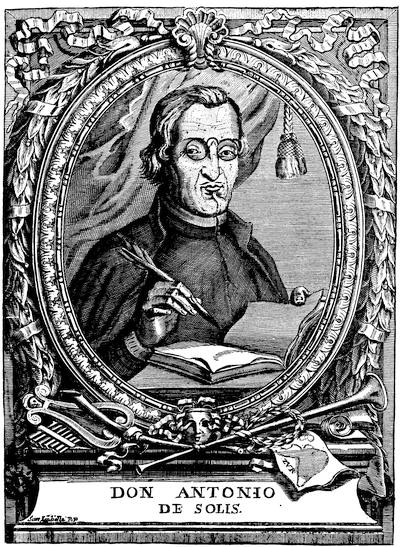
SOLIS.
Fac-simile of engraving in his Historia, published at Venice in 1715. There are other likenesses in the Madrid (1783) edition, and in Cumplido’s Mexican edition of Prescott’s Mexico, vol. iii.
The world soon saw—though the sale of the book was not large at once, and the author died very poor two years later (1686)—that the strange story had been given its highest setting. Solis gives no notes; and one needs to know the literature of the subject, to track him to his authorities. If this is done, however, it appears that his investigation was far from deep, and that with original material within his reach he rarely or never used it, but took the record at second hand. Robertson, who had to depend on him more or less, was aware of this, and judged him less solicitous of discovering truth than of glorifying the splendor of deeds. This panegyrical strain in the book has lowered its reputation, particularly among foreign critics, who fail to share the enthusiasm which Solis expresses for Cortés. We may call his bitter denunciations of the natives bigotry or pious zeal; but Ticknor accounts for it by saying that Solis “refused to see the fierce and marvellous contest except from the steps of the altar where he had been consecrated.” The religion and national pride of the Spaniards have not made this quality detract in the least from the estimation in which the book has long been held; but all that they say of the charm and purity of its style, despite something of tiresomeness in its even flow, is shared by the most conspicuous of foreign critics, like Prescott and Ticknor. Rich, who had opportunities for knowing, bears evidence to the estimation in Spain of those qualities which have insured the fame of Solis.[1212]
The story was not told again with the dignity of a classic,—except so far as Herrera composed it,—till Robertson, in his History of America, recounted it. He used the printed sources with great fidelity; but he was denied a chance to examine the rich manuscript material which was open to Solis, and which Robertson would doubtless have used more abundantly. In a Note (xcvii.) he enumerates his chief authorities, and they are only the letters of Cortés and the story as told by Gomara, Bernal Diaz, Peter Martyr, Solis, and Herrera.[1213] Of Solis, Robertson says he knows no author in any language whose literary fame has risen so far beyond his real merits. He calls him “destitute of that patient industry in research which conducts to the knowledge of truth, and a stranger to that impartiality which weighs evidence with cool attention.... Though he sometimes quotes the despatches of Cortés, he seems not to have consulted them; and though he sets out with some censure on Gomara, he frequently prefers his authority—the most doubtful of any—to that of the other contemporary historians.” Robertson judged that Herrera furnished the fullest and most accurate information, and that if his work had not in its chronological order been so perplexed, disconnected, and obscure, Herrera might justly have been ranked among the most eminent historians of his country. William Smyth, in the twenty-first section of his Lectures on Modern History, in an account which is there given of the main sources of information respecting the Conquest, as they were accessible forty or fifty years ago, awards high praise—certainly not undeserved for his time—to Robertson. Southey accused Robertson of unduly depreciating the character and civilization of the Mexicans; and others have held the opinion that he had a tendency to palliate the crimes of the invaders. Robertson, in his later editions, replied to such strictures, and held that Clavigero and others had differed from him chiefly in confiding in the improbable narratives and fanciful conjectures of Torquemada and Boturini.
Francisco Saverio Clavigero was a Jesuit, who had long resided in Mexico, being born at Vera Cruz in 1731; but when expelled with his Order, he took up his abode in Italy in 1767. He had the facilities and the occasion for going more into detail than Robertson. His Storia antica del Messico cavata da’ migliori storici spagnuoli, e da’ manoscritti; e dalle pitture antiche degl’Indiani: divisa in dieci libri, e corredata di carte geografiche, e di varie figure: e dissertazioni sulla terra, sugli animali, e sugli abitatori del Messico,[1214] was published in four volumes at Cesena in 1780-1781. He gives the names of thirty-nine Indian and Spanish writers who had written upon the theme, and has something to say of the Mexican historical paintings which he had examined. H. H. Bancroft esteems him a leading authority,[1215] and says he rearranged the material in a masterly manner, and invested it with a philosophic spirit, altogether superior to anything presented till Prescott’s time.[1216] It is in his third volume that Clavigero particularly treats of the Conquest, having been employed on the earlier chronicles and the manners and customs of the people in the first and second, while the fourth volume is made up of particular dissertations. Clavigero was not without learning. He had passed three years at the Jesuit College at Tepozotlan, and had taught as a master in various branches. At Bologna, where he latterly lived, he founded an academy; and here he died in 1787, leaving behind him a Storia della California, published at Venice in 1789.[1217]
Fifteen years ago it was the opinion of Henry Stevens,[1218] that all other books which have been elaborated since on the same subject, instead of superseding Clavigero’s, have tended rather to magnify its importance.[1219]
The most conspicuous treatment of the subject, in the minds of the elders of the present generation, is doubtless that of Prescott, who published his Conquest of Mexico in 1843, dividing it into three distinct parts,—the first showing a survey of the Aztec civilization; the second depicting the Conquest; while the final period brought down the life of Cortés to his death. Charton[1220] speaks of Solis as a work “auquel le livre de Prescott a porté un dernier coup.” Prescott was at great expense and care in amassing much manuscript material never before used, chiefly in copies, which Rich and others had procured for him, and he is somewhat minute in his citations from them. They have since been in large part printed, and doubtless very much more is at present accessible in type to the student than was in Prescott’s day.[1221]
Prescott was of good New England stock, settled in Essex County, Massachusetts, where (in Salem) he was born in 1796. His father removed to Boston in 1808, and became a judge of one of the courts. A mischance at Harvard, in a student’s frolic, deprived young Prescott of the use of one eye; and the other became in time permanently affected. Thus he subsequently labored at his historical studies under great disadvantage,[1222] and only under favorable circumstances and for short periods could he read for himself. In this way he became dependent upon the assistance of secretaries, though he generally wrote his early drafts by the aid of a noctograph.
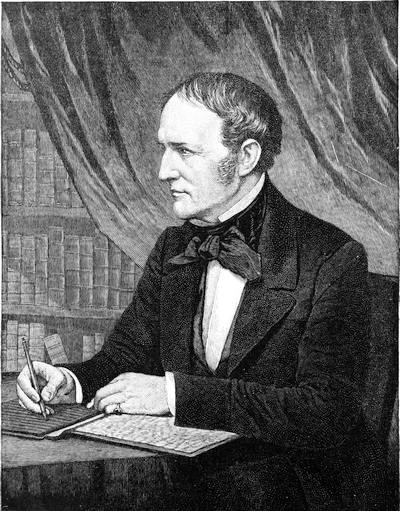
WILLIAM H. PRESCOTT.
This cut follows an engraving in mezzotint in the Eclectic Magazine (1858), and shows him using his noctograph. The likeness was thought by his wife and sister (Mrs. Dexter) to be the best ever made, as Mr. Arthur Dexter informs me. See other likenesses in Ticknor’s Life of Prescott; Mass. Hist. Soc. Proc., iv. 167; and N. E. Hist. and Geneal. Reg. (1868), p. 226.
From 1826 to 1837 he was engaged on his Ferdinand and Isabella, and this naturally led him to the study of his Mexican and Peruvian themes; and Irving, who had embarked on them as a literary field, generously abandoned his pursuit to the new and rising historian.[1223] The Conquest of Mexico appeared in 1843,[1224] and has long remained a charming book, as fruitful in authority as the material then accessible could make it.
In the Preface to his Mexico Mr. Prescott tells of his success in getting unpublished material, showing how a more courteous indulgence was shown to him than Robertson had enjoyed. By favor of the Academy of History in Madrid he got many copies of the manuscripts of Muñoz and of Vargas y Ponçe, and he enjoyed the kind offices of Navarrete in gathering this material. He mentions that, touching the kindred themes of Mexico and Peru, he thus obtained the bulk of eight thousand folio pages. From Mexico itself he gathered other appliances, and these largely through the care of Alaman, the minister of foreign affairs, and of Calderon de la Barca, the minister to Mexico from Spain. He also acknowledges the courtesy of the descendants of Cortés in opening their family archives; that of Sir Thomas Phillipps, whose manuscript stores have become so famous, and the kindness of Ternaux-Compans.
To Mr. John Foster Kirk, who had been Prescott’s secretary, the preparation of new editions of Prescott’s works was intrusted, and in this series the Mexico was republished in 1874. Kirk was enabled, as Prescott himself had been in preparing for it, to make use of the notes which Ramirez had added to the Spanish translation by Joaquin Navarro, published in Mexico in 1844, and of those of Lúcas Alaman, attached to another version, published also in Mexico.[1225]
Almost coincident with the death of Prescott, was published by a chance Mr. Robert Anderson Wilson’s New History of the Conquest of Mexico.[1226] Its views were not unexpected, and indeed Prescott had been in correspondence[1227] with the author. His book was rather an extravagant argument than a history, and was aimed to prove the utter untrustworthiness of the ordinary chroniclers of the Conquest, charging the conquerors with exaggerating and even creating the fabric of the Aztec civilization, to enhance the effect which the overthrow of so much splendor would have in Europe. To this end he pushes Cortés aside as engrafting fable on truth for such a purpose, dismisses rather wildly Bernal Diaz as a myth, and declares the picture-writings to be Spanish fabrications. This view was not new, except in its excess of zeal. Albert Gallatin had held a similar belief.[1228] Lewis Cass had already seriously questioned, in the North American Review, October, 1840, the consistency of the Spanish historians. A previous work by Mr. Wilson had already, indeed, announced his views, though less emphatically. This book had appeared in three successive editions,—as Mexico and its Religion (New York, 1855); then as Mexico, its Peasants and its Priests (1856); and finally as Mexico, Central America, and California.
It was easy to accuse Wilson of ignorance and want of candor,—for he had laid himself open too clearly to this charge,—and Mr. Prescott’s friend, Mr. George Ticknor, arraigned him in the Mass. Hist. Soc. Proc., April, 1859.[1229] He reminded Wilson that he ought to have known that Don Enrique de Vedia, who had published an edition of Bernal Diaz in 1853, had cited Fuentes y Guzman, whose manuscript history of Guatemala was before that editor, as referring in it to the manuscript of Bernal Diaz (his great-grandfather), which was then in existence,—a verity and no myth. Further than this, Brasseur de Bourbourg, who chanced then to be in Boston, bore testimony that he had seen and used the autograph manuscript of Bernal Diaz in the archives of Guatemala.
In regard to the credibility of the accounts which Prescott depends upon, his editor,[1230] Mr. Kirk, has not neglected to cite the language of Mr. E. B. Tylor, in his Anahuac,[1231] where he says, respecting his own researches on the spot, that what he saw of Mexico tended generally to confirm Prescott’s History, and but seldom to make his statements appear improbable. The impeachment of the authorities, which Wilson attacks, is to be successful, if at all, by other processes than those he employs.
Meanwhile Arthur Helps,[1232] in tracing the rise of negro slavery and the founding of colonial government in Spanish America, had published his Conquerors of the New World and their Bondsmen (London, 1848-1852),—a somewhat speculative essay, which, with enlargement of purpose and more detail, resulted in 1855-1861 in the publication of his Spanish Conquest in America, reprinted in New York in 1867. He gives a glowing account of the Aztec civilization, and, excerpting the chapters on the Conquest, he added some new details of the private life of Cortés, and published it separately in 1871 as an account of that leader, which is attractive as a biography, if not comprehensive as a history of the Conquest. “Every page affords evidence of historic lore,” says Field, “and almost every sentence glows with the warmth of his philanthropy.”[1233] Helps has himself told the object and method of his book, and it is a different sort of historical treatment from all the others which we are passing in review. “To bring before the reader, not conquest only, but the results of conquest; the mode of colonial government which ultimately prevailed; the extirpation of native races, the introduction of other races, the growth of slavery, and the settlement of the encomiendas on which all Indian society depended,—has been the object of this history.”[1234]
Among the later works not in English we need not be detained long. The two most noteworthy in French are the Histoire des nations civilisées du Mexique of Brasseur de Bourbourg, more especially mentioned on another page, and Michel Chevalier’s Mexique avant et pendant la Conquête, published at Paris in 1845.[1235] In German, Theodor Arnim’s Das Alte Mexico und die eroberung Neu Spaniens durch Cortes, Leipsic, 1865, is a reputable book.[1236] In Spanish, beside the Vida de Cortés given by Icazbalceta in his Coleccion, vol. i. p. 309, there is the important work of Lúcas Alaman, the Disertaciones sobre la Historia de la República Mejicana, published at Mexico in three volumes in 1844-1849, which is a sort of introduction to his Historia de Méjico, in five volumes, published in 1849-1852.[1237] He added not a little in his appendixes from the archives of Simancas, and the latter book is considered the best of the histories in Spanish. In 1862 Francisco Carbajal Espinosa’s Historia de México, bringing the story down from the earliest times, was begun in Mexico. Bancroft calls it pretentious, and mostly borrowed from Clavigero.[1238]
Returning to the English tongue, in which the story of Mexico has been so signally told more than once from the time of Robertson, we find still the amplest contribution in the History of Mexico, a part of the extended series of the History of the Pacific States, published under the superintendence of Hubert H. Bancroft. Of Bancroft and these books mention is made in another place. The Mexico partakes equally of the merits and demerits attaching to his books and their method. It places the student under more obligations than any of the histories of the Conquest which have gone before, though one tires of the strained and purely extraneous classical allusions,—which seem to have been affected by his staff, or by some one on it, during the progress of this particular book of the series.
G. Yucatan.—With the subsequent subjugation of Yucatan Cortés had nothing to do. Francisco de Montejo had been with Grijalva when he landed at Cozumel on the Yucatan coast, and with Cortés when he touched at the same island on his way to Mexico. After the fall of the Aztecs, Montejo was the envoy whom Cortés sent to Spain, and while there the Emperor commissioned him (Nov. 17, 1526) to conduct a force for the settlement of the peninsula. Early in 1527 Montejo left Spain with Alonso de Avila as second in command. For twenty years and more the conquest went on, with varying success. At one time not a Spaniard was left in the country. No revolts of the natives occurred after 1547, when the conquest may be considered as complete. The story is told with sufficient fulness in Bancroft’s Mexico.[1239] The main sources of our information are the narrative of Bernal Diaz, embodying the reports of eye-witnesses, and the histories of Oviedo and Herrera. Bancroft[1240] gives various incidental references. The more special authorities, however, are the Historia de Yucathan of Diego Lopez Cogolludo, published at Madrid in 1688,[1241] who knew how to use miracles for his reader’s sake, and who had the opportunity of consulting most that had been written, and all that had been printed up to his time. He closes his narrative in 1665.[1242] The Bishop of Yucatan, Diego de Landa, in his Relation des choses de Yucatan, as the French translation terms it, has left us the only contemporary Spanish document of the period of the Conquest. The book is of more interest in respect to the Maya civilization than as to the progress of the Spanish domination. It was not printed till it was edited by Brasseur de Bourbourg, with an introduction, and published in Paris in 1864.[1243]
Landa was born in 1524, and was one of the first of his Order to come to Yucatan, where he finally became Bishop of Mérida in 1572, and died in 1579. Among the books commonly referred to for the later period is the first part (the second was never published) of Juan de Villagutierre Sotomayor’s Historia de la Conquista de la provincia de el Itza, etc., Madrid, 1701. It deals somewhat more with the spiritual and the military conquests, but writers find it important.[1244]
The latest English history of the peninsula is that by Charles St. J. Fancourt, History of Yucatan, London, 1854;[1245] but a more extended, if less agreeable, book is Ancona’s Historia de Yucatan desde la época mas remota hasta nuestros dias, published at Mérida in four volumes in 1878-1880. It gives references which will be found useful.[1246]
H. Bibliography of Mexico.—The earliest special bibliography of Mexico of any moment is that which, under the title of Catalogo de sa museo historico Indiano, is appended to Boturini Benaduci’s Idea de una nueva historia general de la America septentrional (Madrid, 1746), which was the result of eight years’ investigations into the history of Mexico. He includes a list of books, maps, and manuscripts, of which the last remnants in 1853 were in the Museo Nacional in Mexico.[1247] Of the list of New Spain authors by Eguiara y Eguren, only a small part was published in 1755 as Bibliotheca Mexicana.[1248] It was intended to cover all authors born in New Spain; but though he lived to arrange the work through the letter J, only A, B, and C were published. All titles are translated into Latin. Its incompleteness renders the bibliographical parts of Maneiro’s De Vitis Mexicanorum (1791) more necessary, and makes Beristain’s Bibliotheca Hispano-Americano Septentrional,[1249] of three volumes, published at Mexico in 1816, 1819, and 1821, of more importance than it would otherwise be. Beristain, also, only partly finished his work; but a nephew completed the publication. It has become rare; and its merits are not great, though its notices number 3,687.
Of more use to the student of the earlier history, however, is the list which Clavigero gives in his Storia del Messico published in 1780. A Jesuit, and a collector, having a book-lover’s keen scent, he surpassed all writers on the theme who had preceded him, in amassing the necessary stores for his special use. Since his day the field has been surveyed more systematically both by the general and special bibliographers. The student of early Spanish-Mexican history will of course not forget the help which he can get from general bibliographers like Brunet, from the Dictionary of Sabin, the works of Ternaux and Harrisse, the Carter-Brown Catalogue, not to speak of other important library catalogues.
The sale catalogues are not without assistance. Principal among them are the collections which had been formed by the Emperor Maximilian of Mexico,—which was sold in Leipsic in 1869 as the collection of José Maria Andrade,[1250]—and the Bibliotheca Mexicana formed by José Fernando Ramirez, which was sold in London in 1880.[1251]
All other special collections on Mexico have doubtless been surpassed by that which has been formed in San Francisco by Mr. Hubert Howe Bancroft, as a component part of his library pertaining to the western slope of America. Lists of such titles have been prefixed to his histories of Central America and of Mexico, and are to be supplemented by others as his extended work goes on. He has explained, in his preface to his Mexico (p. viii), the wealth of his manuscript stores; and it is his custom, as it was Prescott’s, to append to his chapters, and sometimes to passages of the text, considerable accounts, with some bibliographical detail, of the authorities with which he deals.[1252] Helps, though referring to his authorities, makes no such extended references to them.[1253]

DISCOVERIES
ON THE
PACIFIC COAST OF NORTH AMERICA.
BY THE EDITOR.
THE cartographical history of the Pacific coast of North America is one of shadowy and unstable surmise long continued.[1254] The views of Columbus and his companions, as best shown in the La Cosa and Ruysch maps,[1255] precluded, for a considerable time after the coming of Europeans, the possibility of the very existence of such a coast; since their Asiatic theory of the new-found lands maintained with more or less modification a fitful existence for a full century after Columbus. In many of the earliest maps the question was avoided by cutting off the westerly extension of the new continent by the edge of the sheet;[1256] but the confession of that belief was still made sometimes in other ways, as when, in the Portuguese portolano, which is placed between 1516 and 1520, Mahometan flags are placed on the coasts of Venezuela and Nicaragua.[1257]
In 1526 a rare book of the monk Franciscus, De orbis situ ac descriptione Francisci epistola,[1258] contained a map which represented South America as a huge island disjoined from the Asiatic coast by a strait in the neighborhood of Tehuantepec, with the legend, “Hoc orbis hemisphærium cedit regi Hispaniæ.”[1259] A few years later we find two other maps showing this Asiatic connection,—one of which, the Orontius Finæus globe, is well known, and is the earliest engraved map showing a return to the ideas of Columbus. It appeared in the Paris edition of the Novus Orbis of Simon Grynæus, in 1532,[1260] and was made the previous year. It is formed on a cordiform projection, and is entitled “Nova et integra universi orbis descriptio.” It is more easily understood by a reference to Mr. Brevoort’s reduction of it to Mercator’s projection, as shown in another volume.[1261] The same map, with a change in the inserted type dedication, appeared in the Pomponius Mela of 1540,[1262] and it is said also to be found much later in the Geografia of Lafreri published at Rome, 1554-1572.
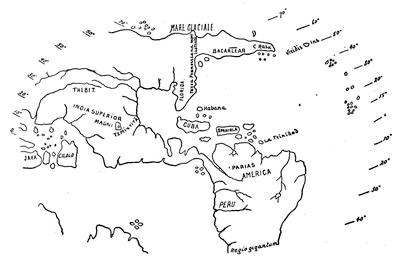
SLOANE MANUSCRIPTS, 1530.
This follows a drawing in Kohl’s Washington Collection.
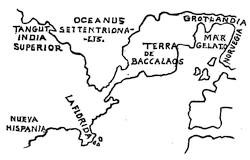
RUSCELLI, 1544.
This follows a sketch given by Dr. Kohl in his Discovery of Maine, pl. xv., which is also copied in Bancroft’s Central America, vol. i. p. 148. Cf. Lelewel, p. 170; Peschel, Geschichte der Erdkunde (1865), p. 371.
The other of the two maps already referred to belongs to a manuscript, De Principiis Astronomiæ, preserved in the British Museum among the Sloane manuscripts.[1263] It closely resembles the Finæus map. The authorities place it about 1530, or a little later. In 1533, in his Opusculum Geographicum, Schöner maintained that the city of Mexico was the Quinsay of Marco Polo; and about the same time Francis I., in commissioning Cartier for his explorations, calls the St. Lawrence valley a part of Asia.
What is known as the Nancy Globe preserved the same idea, as will be seen by the sketch of it annexed, which follows an engraving published in the Compte Rendu of the Congrès des Américanistes.[1264]
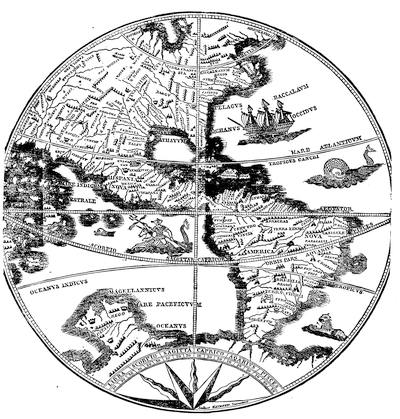
THE NANCY GLOBE.
The same view is maintained in a manuscript map of Ruscelli, the Italian geographer, preserved in the British Museum. Perhaps the earliest instance of a connection of America and Europe, such as Ruscelli here imagines, is the map of “Schondia,” which Ziegler the Bavarian published in his composite work at Strasburg in 1532,[1265] in which it will be observed he makes “Bacallaos” a part of Greenland, preserving the old notion prevailing before Columbus, as shown in the maps of the latter part of the fifteenth century, that Greenland was in fact a prolongation of northwestern Europe, as Ziegler indicates at the top of his map, the western half of which only is here reproduced.
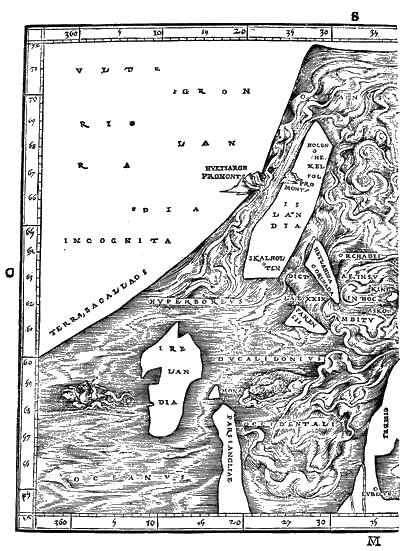
ZIEGLER’S SCHONDIA, 1532.
This is a fac-simile made from Mr. Charles Deane’s (formerly the Murphy) copy. Cf. Dr. A. Breusing’s Leitfaden durch das Wiegenalter der Kartographie bis zum Jahre 1600, Frankfurt a. M., 1883, p. 11.
In this feature, as in others, there is a resemblance in these maps of Ziegler and Ruscelli to two maps by Jacopo Gastaldi, “le coryphée des géographes de péninsule italique,” as Lelewel[1266] calls him. These maps appeared in the first Italian edition of Ptolemy, published at Venice in 1548.[1267]
The first (no. 59), inscribed “Dell’universale nuova,” is an elliptical projection of the globe, showing a union of America and Asia, somewhat different in character of contour from that represented in the other (no. 60), a “Carta Marina Universale,” of which an outline sketch is annexed.
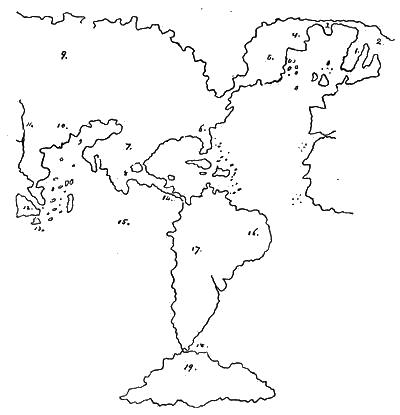
CARTA MARINA, 1548.
The key is as follows:
1. Norvegia. 2. Laponia. 3. Gronlandia. 4. Tierra del Labrador. 5. Tierra del Bacalaos. 6. La Florida. 7. Nueva Hispania. 8. Mexico. 9. India Superior. 10. La China. 11. Ganges. 12. Samatra. 13. Java. 14. Panama. 15. Mar del Sur. 16. El Brasil. 17. El Peru. 18. Strecho de Fernande Magalhaes. 19. Tierra del Fuego.
This map is also reproduced in Nordenskiöld’s Bröderna Zenos, Stockholm, 1883.
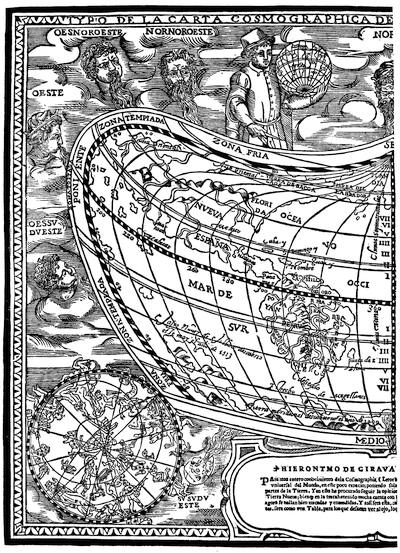
VOPELLIO, 1556. (Reduction of western half.)
This same map was adopted (as no. 2) by Ruscelli in the edition of Ptolemy which he published at Venice in 1561,[1268] though in the “Orbis descriptio” (no. 1) of that edition Ruscelli hesitates to accept the Asiatic theory and indicates a “littus incognitum,” as Gastaldi did in the map which he made for Ramusio in 1550.
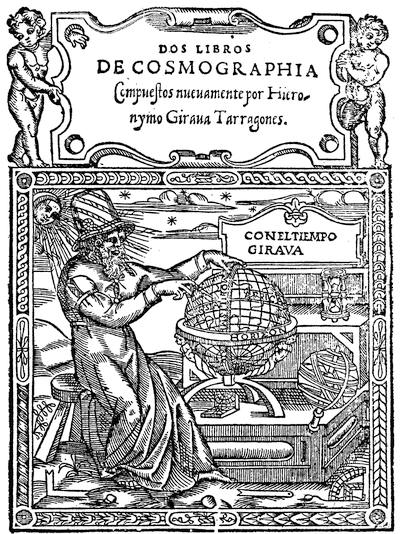
Wuttke[1269] has pointed out two maps preserved in the Palazzo Riccardi at Florence, which belong to about the year 1550, and show a similar Asiatic connection.[1270] The map of Gaspar Vopellius, or Vopellio (1556), also extended the California coast to the Ganges. It appeared in connection with Girava’s Dos Libros de Cosmographia, Milan, 1556,[1271] but when a new titlepage was given to the same sheets in 1570, it is doubtful if the map was retained, though Sabin says it should have the map.[1272] The Italian cartographer, Paulo de Furlani, made a map in 1560, which according to Kohl is preserved in the British Museum. It depicts Chinamen and elephants in the region of the Mississippi Valley.
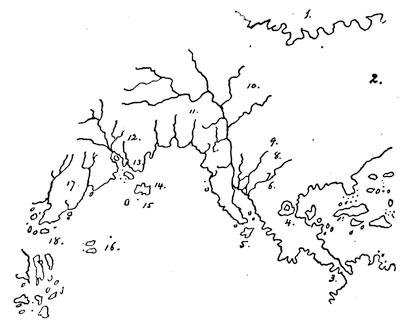
PAULO DE FURLANI’S MAP, 1560.
The key is this:
1. Oceano settentrionale. 2. Canada. 3. panaman. 4. Mexico. 5. s. tomas. 6. Nova Ispania. 7. Cipola. 8. Le sete cita. 9. Topira. 10. tontontean. 11. Zangar. 12. Tebet. 13. Quisai. 14. Cimpaga. 15. Golfo de Tonza. 16. Ys. de las ladrones. 17. mangi. 18. mar de la china.
From Kohl’s sketch, preserved in his manuscript in the library of the American Antiquarian Society, the annexed outline is drawn. Furlani is reported to have received it from a Spanish nobleman, Don Diego Hermano, of Toledo.[1273] The connection with Asia is again adhered to in Johannes Myritius’s Opusculum geographicum, where the map is dated 1587, though the book was published at Ingolstadt in 1590.[1274] Just at this time Livio Sanuto, in his Geografia distinta (Venice, 1588), was disputing the Asiatic theory on the ground that the Mexicans would not have shown surprise at horses in Cortés’ time, if they had formerly been inhabitants of a continent like Asia, where horses are common. Perhaps the latest use of the type of map shown in the “Carta Marina” of 1548 was just a half century later, in 1598, in an edition of Ortelius, Il Theatro del mondo, published at Brescia. The belief still lingered for many years yet in some quarters; and Thomas Morton in 1636 showed that in New England it was not yet decided whether the continent of America did not border upon the country of the Tartars.[1275] Indeed, the last trace of the assumption was not blown away till Behring in 1728 passed from the Pacific to the Arctic seas.
Such is in brief the history of the inception and decline of the belief in the prolongation of Asia over against Spain, as Toscanelli had supposed in 1474, and as had been suspected by geographers at intervals since the time of Eratosthenes.[1276] The beginning of the decline of such belief is traced to the movements of Cortés. Balboa in 1513 by his discovery of the South Sea, later to be called the Pacific Ocean,[1277] had established the continental form of South America, whose limits southward were fixed by Magellan in 1520; but it was left for Cortés to begin the exploration to the north which Behring consummated.
After the Congress of Badajos had resolved to effect a search for a passage through the American barrier to the South Sea, the news of such a determination was not long in reaching Cortés in Mexico, and we know from his fourth letter, dated Oct. 15, 1524, that it had already reached him, and that he had decided to take part in the quest himself by despatching an expedition towards the Baccalaos on the hither side; while he strove also to connect with the discoveries of Magellan on the side of the South Sea.[1278] Cortés had already been led in part by the reports of Balboa’s discovery, and in part by the tidings which were constantly reaching him of a great sea in the direction of Tehuantepec, to establish a foothold on its coast, as the base for future maritime operations. So his explorers had found a fit spot in Zacatula, and thither he had sent colonists and shipwrights to establish a town and build a fleet,[1279] the Emperor meanwhile urging him speedily to use the vessels in a search for the coveted strait, which would open a shorter passage than Magellan had found to the Spice Islands.[1280] But Cortés’ attention was soon distracted by his Honduras expedition, and nothing was done till he returned from that march, when he wrote to the Emperor, Sept. 3, 1526, offering to conduct his newly built fleet to the Moluccas.
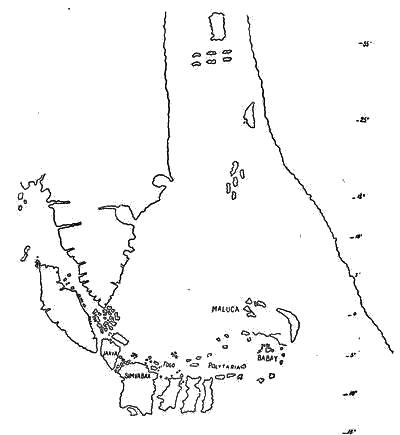
THE PACIFIC, 1513.
Kohl gives this old Portuguese chart of the Pacific in his Washington Collection, after an original preserved in the military archives at Munich, which was, as he thinks possible, made by some pilot accompanying Antonio da Miranda de Azevedo, who conducted a Portuguese fleet to the Moluccas in 1513 to join the earlier expedition (1511) under D’Abreu and Serraō. A legend at Maluca marks these islands as the place “where the cloves grow,” while the group south of them is indicated as the place “where nutmegs grow.” The coast on the right must stand for the notion then prevailing of the main of America, which was barring the Spanish progress from the east.
Of the early maps of the Moluccas, there is one by Baptista Agnese in his portolano of 1536, preserved in the British Museum; one by Diego. Homem in a similar atlas, dated 1558, likewise in the Museum; and one of 1568, by J. Martines. Copies of these are all included in Kohl’s Washington Collection.
But two other fleets were already on the way thither,—one under Garcia de Loaysa which left Spain in August, 1525, and the other under Sebastian Cabot, who stopped on the way at La Plata, had left in April, 1526. So Cortés finally received orders to join with his fleet that of Loaysa, who had indeed died on his voyage, and of his vessels only one had reached the Moluccas. Another, however, had sought a harbor not far from Zacatula, and had brought Cortés partial tidings at least of the mishaps of Loaysa’s undertaking.[1281] What information the rescued crew could give was made use of, and Cortés, bearing the whole expense, for a reimbursement of which he long sued the home Government, sent out his first expedition on the Pacific, under the command of his cousin Alvaro de Saavedra Ceron, armed with letters for Cabot, whose delay at La Plata was not suspected, and with missives for sundry native potentates of the Spice Islands and that region.[1282]
After an experimental trip up the coast, in July, 1527,[1283] two larger vessels and a brigantine set sail Oct. 31, 1527. But mishap was in store. Saavedra alone reached the Moluccas, the two other vessels disappearing forever. He found there a remnant of Loaysa’s party, and, loading his ship with cloves, started to return, but died midway, when the crew headed their ship again for the Moluccas, where they fell at last into Portuguese prisons, only eight of them finally reaching Spain in 1534.
It will be remembered that the Portuguese, following in the track of Vasco da Gama, had pushed on beyond the great peninsula of India, and had reached the Moluccas in 1511, where they satisfied themselves, if their longitude was substantially correct, that there was a long space intervening yet before they would confront the Spaniards, pursuing their westerly route. It was not quite so certain, however, whether the line of papal demarcation, which had finally been pushed into the mid-ocean westerly from the Azores, would on this opposite side of the globe give these islands to Spain or to themselves. The voyage of Magellan, as we shall see, seemed to bring the solution near; and if we may believe Scotto, the Genoese geographer, at about the same date (1520) the Portuguese had crossed the Pacific easterly and struck our northwest coast.[1284] The mishaps of Loaysa and Saavedra, as well as a new understanding between the rival crowns of the Iberian peninsula, closed the question rather abruptly through a sale in 1529—the treaty of Saragossa—by Spain, for 350,000 ducats, to Portugal of all her rights to the Moluccas under the bull of demarcation.[1285]
Cortés, on his return from Spain (1530), resolved to push his discoveries farther up the coast. The Spaniards had now occupied Tehuantepec, Acapulco, and Zacatula on the sea, and other Spaniards were also to be found at Culiacan, just within the Gulf of California on its eastern shore. The political revolutions in Cortés’ absence had caused the suspension of work on a new fleet, and Cortés was obliged to order the construction of another; and the keels of two were laid at Tehuantepec, and two others at Acapulco. In the early part of 1532 they were launched, and in May or June two ships started under Hurtado de Mendoza, with instructions which are preserved to us. It is a matter of doubt just how far he went,[1286] and both vessels were lost. Nuño de Guzman, who held the region to the north,[1287] obstructed their purpose by closing his harbors to them and refusing succor; and Cortés was thus made to feel the deadliness of his rivalry. The conqueror now himself repaired to Tehuantepec, and superintended in person, working with his men, the construction of two other ships. These, the “San Lazaro” and “Concepcion,” under Diego Becerra, left port on the 29th of October, 1533, and being blown to sea, they first saw land in the latitude of 29° 30´ north on the 18th of December, when, coasting south and east, they developed the lower parts of the Californian peninsula. Mutiny, and attacks of the natives, during one of which the chief pilot Ximenes was killed, were the hapless accompaniments of the undertaking, and during stress of weather the vessels were separated. The “San Lazaro” finally returned to Acapulco, but the “Concepcion” struggled in a crippled condition into a port within Guzman’s province, where the ship was seized. A quarrel ensued before the Audiencia, Cortés seeking to recover his vessel; but he prospered little in his suit, and was driven to undertake another expedition under his own personal lead. Sending three armed vessels up the coast to Chiametla, where Guzman had seized the “Concepcion,” Cortés went overland himself, accompanied by a force which Guzman found it convenient to avoid. Here he joined his vessels and sailed away with a part of his land forces to the west; and on the 1st of May, 1535, he landed at the Bay of Santa Cruz, where Ximenes had been killed. What parts of the lower portion of the Californian peninsula Cortés now coasted we know from his map, preserved in the Spanish Archives,[1288] which accompanied the account of his taking possession of the new land of Santa Cruz, “discovered by Cortés, May 3, 1535,” as the paper reads. The point of occupation seems to have been the modern La Paz, called by him Santa Cruz. The notary’s account of the act of possession goes on to say,[1289]—
“On the third day of May, in the year of our Lord 1535, on the said day, it may be at the hour of noon, be the same less or more, the very illustrious Lord don Hernando Cortés, Marquis of the Valley of Guaxaca, Captain-general of New Spain and of the Southern Sea for his Majesty, etc., arrived in a port and bay of a country newly discovered in the same Southern Sea, with a ship and armament of the said Lord Marquis, at which said port his Lordship arrived with ships and men, and landed on the earth with his people and horses; and standing on the shore of the sea there, in presence of me Martin de Castro, notary of their Majesties and notary of the Administration of the said Lord Marquis, and in presence of the required witnesses, the said Lord Marquis spoke aloud and said that he, in the name of His Majesty, and in virtue of his royal provision, and in fulfilment of His Majesty’s instructions regarding discovery in the said Southern Sea, had discovered with his ship and armament the said land, and that he had come with his armament and people to take possession of it.”
Finding his men and horses insufficient for the purposes of the colony which he intended to establish, Cortés despatched orders to the main for assistance, and, pending its arrival, coursed up the easterly side of the gulf, and opportunely fell in with one of his vessels, much superior to his own brigantine. So he transferred his flag, and, returning to Santa Cruz, brought relief to an already famishing colony.
News reaching him of the appointment of Mendoza as viceroy, Cortés felt he had greater stake in Mexico, and hurriedly returned.[1290] Not despairing of better success in another trial, and spurred on by indications that the new viceroy would try to anticipate him, he got other vessels, and, putting Francisco de Ulloa in charge, despatched them (July 8, 1539) before Guzman’s plan for their detention could be put into execution. Ulloa proceeded up the gulf nearly to its head, and satisfied himself that no practicable water passage, at least, could bring him to the ocean in that direction, as Cortés had supposed.[1291] Ulloa now turned south, and following the easterly coast of the peninsula rounded its extremity, and coursed it northerly to about 28° north latitude, without finding any cut-off on that side. So he argued for its connection with the main.[1292]
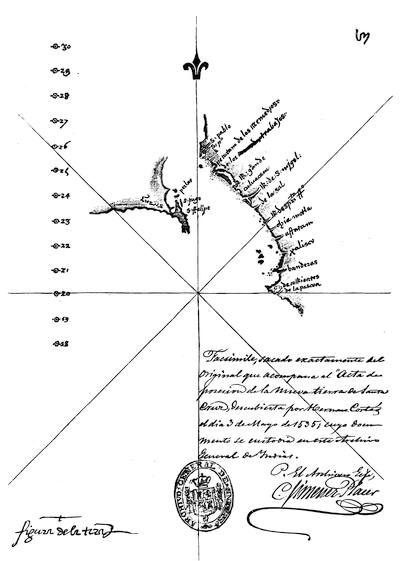
CORTES’ MAP OF THE GULF OF CALIFORNIA.
And here Cortés’ connection with discoveries on the Pacific ends; for Mendoza, who had visions of his own, thwarted him in all subsequent attempts, till finally Cortés himself went to Spain. The name which his captains gave to the gulf, the Sea of Cortés, failed to abide. It grew to be generally called the Red Sea, out of some fancied resemblance, as Wytfliet says, to the Red Sea of the Old World. This appellation was supplanted in turn by the name of California, which, it is contended, was given to the peninsula by Cortés himself.[1293]
The oldest map which we were supposed to possess of these explorations about the gulf,[1294] before Dr. Hale brought the one, already mentioned, from Spain, was that of Castillo, of which a fac-simile is herewith given as published by Lorenzana in 1770, at Mexico, in his Historia de Nueva España. Castillo was the pilot of the expedition, sent by Mendoza to co-operate by sea with the famous expedition of Coronado,[1295] and which the viceroy put under the command of Hernando d’Alarcon. The fleet, sailing in May, 1540, reached the head of the gulf, and Alarcon ascended the Colorado in boats; but Marcou[1296] thinks he could not have gone up to the great cañon, which however he must have reached if his supposed latitude of 36° is correct. He failed to open communication with Coronado, but buried some letters under a cross, which one of that leader’s lieutenants subsequently found.[1297]
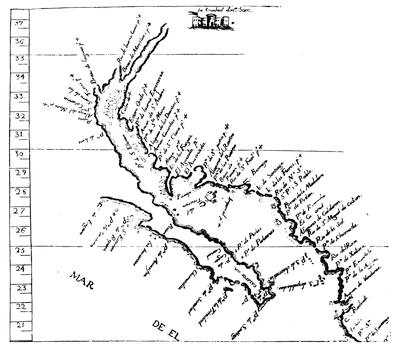
CASTILLO’S MAP, 1541.
This map is marked “Domingo del Castillo, piloto me fecit en Mexico, año del nacimiento de N. S. Jesu Christo de M. D. XLI.” Bancroft, Central America, vol. i. p. 153, gives a sketch of this map, and again in North Mexican States, i. 81; but he carries the outer coast of the peninsula too far to the west.
In 1542 and 1543 an expedition which started under Juan Rodriguez Cabrillo, a Portuguese in the Spanish service, explored the coast as far as 44° north,[1298] reaching that point by coasting from 33°, where he struck the land. He made a port which he calls San Miguel, which Bancroft is inclined to believe is San Diego; but the accounts are too confused to track him confidently,[1299] and it is probable that Cabrillo’s own vessel did not get above 38°, for Cabrillo himself died Jan. 3, 1543, his chief pilot, Ferrelo (or Ferrer), continuing the explorations.[1300] Bancroft does not think that the pilot passed north of Cape Mendocino in 40° 26´.
Thus from the time when Balboa discovered the South Sea, the Spanish had taken thirty years to develop the coast northerly, to the latitude of Oregon. In this distance they had found nothing of the Straits of Anian, which, if Humboldt[1301] is correct, had begun to take form in people’s minds ever since Cortereal, in 1500, had supposed Hudson’s Straits to be the easterly entrance of a westerly passage.[1302]
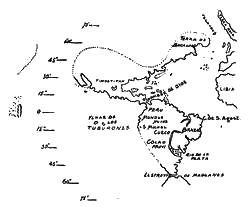
HOMEM, ABOUT 1540.
This follows Kohl’s drawing, of which a portion is also given in his Discovery of Maine, p. 298. It is evidently of a later date than another of his in which the west coast is left indefinite, and which is assigned to about 1530. In the present map he apparently embodied Cabot’s discoveries in the La Plata, but had not heard of Orellana’s exploration of the Amazon in 1542; though he had got news of it when he made his map of 1558. A marked peculiarity of the map is the prolongation of northwestern Europe as “Terra Nova,” which probably means Greenland,—a view entertained before Columbus.
There seems to have been a general agreement among cartographers for some years yet to consider the newly discovered California as a peninsula, growing out of the concurrent testimony of those who, subsequent to Cortés’ own expedition, had tracked both the gulf and the outer coast. The Portuguese map given by Kunstmann[1303] shows it as such, though the map cannot be so early as that geographer places its anterior limit (1530), since the development of the gulf could not have been made earlier than 1535; unless by chance there were explorations from the Moluccas, of which we have no record. The map in this part bears a close resemblance to a manuscript chart in the British Museum, placed about 1536, and it seems probable that this is the approximate date of that in Kunstmann. The California peninsula is shown in much the same way in a map which Major ascribes to Baptista Agnese, and places under 1539.[1304] It belongs (pl. iv.) to what has been sometimes spoken of as an atlas of Philip II. inscribed to Charles V., but in fact it was given to Philip by Charles.[1305] Its essential features were almost exactly reproduced in a draft of the New World (preserved in the British Museum) assigned to about 1540, and held to be the work of the Portuguese hydrographer Homem.
Apian[1306] and Münster[1307] in 1540, and Mercator in 1541,[1308] while boldly delineating a coast which extends farther north than Cabrillo had reached in 1542, wholly ignore this important feature. Not so, however, Sebastian Cabot in his famous Mappemonde of 1544, as will be seen by the annexed sketch. The idea of Münster, as embodied in his edition of Ptolemy in 1540,[1309] already referred to, was continued without essential change in the Basle edition of Ptolemy in 1545.[1310] In 1548 the “carta marina” of Gastaldi as shown on a previous page,[1311] clearly defined the peninsula, while merging the coast line above into that of Asia. The peninsula was also definitely marked in several of the maps preserved in the Riccardi palace at Florence, which are supposed to be of about the middle of the sixteenth century.[1312]
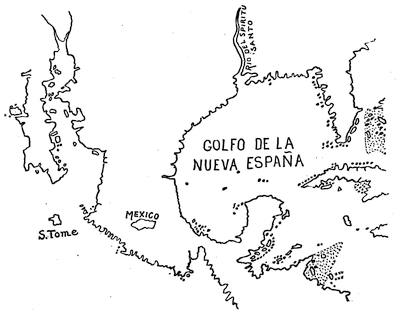
CABOT, 1544.
Sketched from a photograph of the original mappemonde in the great library at Paris.
In the map of Juan Freire, 1546, we have a development of the coast northward from the peninsula, for which it is not easy to account; and the map is peculiar in other respects. The annexed sketch of it follows Kohl’s drawing of an old portolano, which he took from the original while it was in the possession of Santarem. Freire, who was a Portuguese hydrographer, calls it a map of the Antipodes, a country discovered by Columbus, the Genoese. It will be observed that about the upper lake we have the name “Bimini regio,” applied to Florida after the discovery of Ponce de Leon, because of the supposition that the fountain of youth existed thereabout. The coasts on both sides of the gulf are described as the discovery of Cortés. There seems to be internal evidence that Freire was acquainted with the reports of Ulloa and Alarcon, and the chart of Castillo; but it is not so clear whence he got the material for his draft of the more westerly portions of the coast, which, it will be observed, are given much too great a westerly trend. The names upon it do not indicate any use of Cabrillo’s reports; though from an inscription upon this upper coast Freire credits its discovery to the Spaniards, under orders from the emperor, conducted by one Villalobos. Kohl could not find any mention of such an explorer, but conjectured he was perhaps the one who before Cabrillo, as Herrera mentions, had named a river somewhere near 30° north latitude “Rio de Nuestra Señora,” and which Cabrillo sought. Kohl also observes that though the coast line is continuous, there are places upon it marked “land not seen,” with notes of its being again seen west of such places; and from this he argues that the expedition went up and not down the coast. It not unlikely had some connection with the fleet which Ruy Lopez de Villalobos conducted under Mendoza’s orders, in November, 1542, across the Pacific to the islands on the Asiatic coast.[1313]
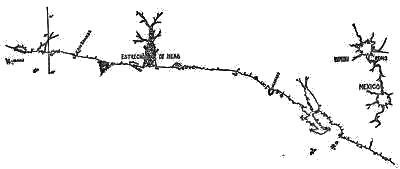
FREIRE, 1546.
This is sketched from a drawing in the Kohl Collection at Washington.
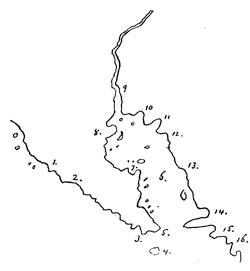
PTOLEMY, 1548.
Key:
1. Basos. 2. Ancoras. 3. po. balenas. 4. S. Tomas. 5. C:+ 6. Mar Vermeio. 7. b: canoas. 8. po. secōdido. 9. R. tontonteanc. 10. po. tabursa. 11. puercos. 12. s. franco. 13. b: de s.+ 14. Vandras. 15. Ciguata. 16. s. tiago.
In 1554 Agnese again depicts the gulf, but does not venture upon drawing the coast above the peninsula, which in turn in the Vopellio map of 1556,[1314] and in that in Ramusio the same year,[1315] is made much broader, the gulf indenting more nearly at a right angle. The Homem map of 1558, preserved in the British Museum, returns to the more distinctive peninsula,[1316] though it is again somewhat broadened in the Martines map of about the same date, which also is of interest as establishing a type of map for the shores of the northern Pacific, and for prefiguring Behring’s Straits, which we shall later frequently meet. Mention has already been made of the Furlani map of 1560 for its Asiatic connections, while it still clearly defined the California peninsula.[1317] The Ruscelli map in the Ptolemy of 1561 again preserves the peninsula, while marking the more northerly coasts with a dotted line, in its general map of the New World; but the “Mar Vermeio” in its map of “Nueva Hispania” is the type of the gulf given in the 1548 edition. The Martines type again appears in the Zaltieri map of 1566, which is thought to be the earliest engraved map to show the Straits of Anian.[1318]
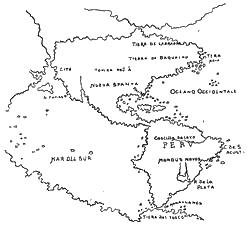
MARTINES, 155-(?).
This sketch follows a copy by Kohl (Washington Collection) of the general map of the world, contained in a manuscript vellum atlas in the British Museum (no. 9,814), from the collection of the Duke de Cassano Serra. It is elaborately executed with miniatures and figures. The language of the map is chiefly Italian, with some Spanish traces. Kohl believes it to be the work of Joannes Martines, the same whose atlas of 1578 is also in the Museum, and whose general map (1578) agrees in latitudes and other particulars with this. The present one lacks degrees of longitude, which the 1578 map has, as well as the name “America,” wanting also in this. Kohl places it not long after the middle of the sixteenth century. In the Catalogue of Manuscript Maps, i. 29, the atlas of 1578 is mentioned as containing the following numbers relating to America: 1. The world. 2. The two hemispheres. 3. The world in gores. 10. West coast of America. 11. Coast of Mexico. 12-13. South America. 14. Gulf of Mexico. 15. Part of the east coast of North America.
In the Museum manuscripts, no. 22,018, is a portolano by Martines, dated 1579; and another, of date 1582, is entered in the 1844 edition of the Catalogue of Manuscript Maps, i. 31. Kohl’s Washington Collection includes two Martines maps of 1578.
The manuscript map of Diegus (Homem) of 1568, in the Royal Library in Dresden, gives the peninsula, but turns the more northerly coast abruptly to the east, connecting it with the archipelago, which stands for the St. Lawrence in his map of 1558.[1319]
The great Mappemonde of Mercator, published at Duisburg in 1569, in which he introduced his new projection,[1320] as will be seen by the annexed sketch,[1321] keeps to the Martines type; and while it depicts the Straits of Anian, it renders uncertain, by interposing a vignette, the passage by the north from the Atlantic to the Pacific.[1322] The next year Ortelius followed the same type in his Theatrum orbis terrarum,—the prototype of the modern atlas.[1323]
A similar western coast[1324] is defined by Porcacchi, in his L’ isole piu famose del mondo, issued at Venice in 1572.[1325]
The peninsula of California, but nothing north of it, is again delineated in a Spanish mappemonde of 1573, shown in Lelewel.[1326] The Mercator type is followed in the maps which are dated 1574, but which appeared in the Theatri orbis terrarum enchiridion of Philippus Gallæus, published at Antwerp in 1585.[1327]
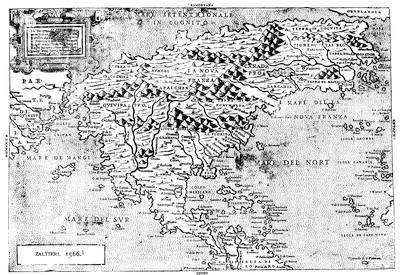
ZALTIERI, 1566.
It was published at Venice, and was in part followed by Ortelius in 1570. It is also sketched in Vol. IV. p. 93.
In the same year the Italian cartographer Furlani, or Forlani, showed how he had advanced from the views which he held in 1560, in a map of the northern Pacific, which is annexed.[1328] It is the earliest map in which Japan has been noted as having its greatest length east and west; for Ortelius and others always give it an extension on the line of the meridian.
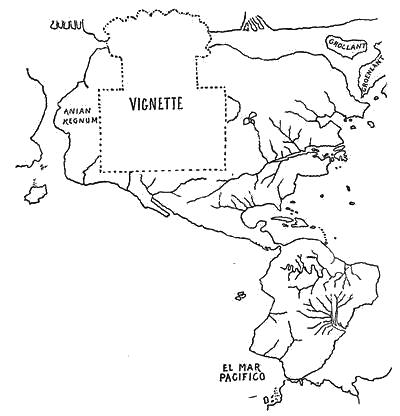
MERCATOR, 1569.
Sir Humphrey Gilbert’s map in 1576 gives the straits, but he puts “Anian” on the Asiatic side, and does not indicate the Gulf of California, unless a forked bay in 35° stands for it.[1329] The map in Best’s Frobisher makes the Straits of Anian connect with “Frobisher’s straightes” to give a through passage from ocean to ocean, and depicts a distorted California peninsula.[1330]
Mention has already been made on a previous page of a Martines map of 1578. It has a similar configuration to that already shown as probably the earliest instance of its type.
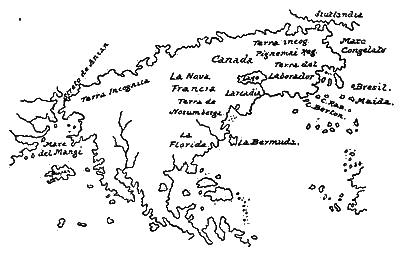
PORCACCHI, 1572.
Of the explorations of Francis Drake in 1579 we have no cartographical record, except as it may be embodied in the globe of Molineaux, preserved in the Middle Temple, London, which is dated 1592, and in the map of the same cartographer, dated 1600.[1331] Molineaux seemingly made use of the results of Cabrillo’s voyage, as indicated by the Spanish names placed along the coast. It was one of the results of Drake’s voyage that the coast line of upper California took a more northerly trend. The map of Dr. Dee (1580) evidently embodied the views of the Spanish hydrographers.[1332]
In 1582 Popellinière[1333] repeated the views of Mercator and Ortelius; but in England Michael Lok in this same year began to indicate the incoming of more erroneous views.[1334] The California gulf is carried north to 45°, where a narrow strip separates it from a vague northern sea, the western extension of the sea of Verrazano.
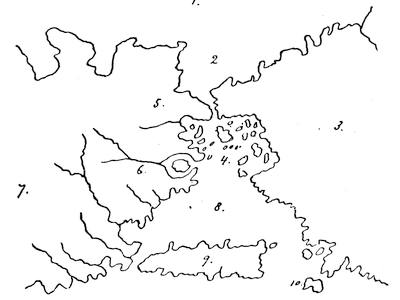
MAP OF PAULO DE FURLANI, 1574.
Furlani is said to have received this map from a Spaniard, Don Diego Hermano de Toledo, in 1574. The sketch is made from the drawing in Kohl’s manuscript in the American Antiquarian Society Library. The key is as follows:
1. Mare incognito. 2. Stretto di Anian. 3. Quivir. 4. Golfo di Anian. 5. Anian regnum. 6. Quisau. 7. Mangi Prov. 8. Mare de Mangi. 9. Isola di Giapan. 10. Y. de Cedri.
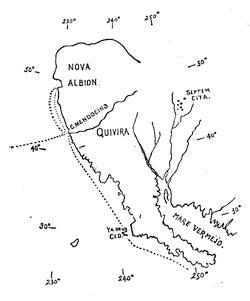
FROM MOLINEAUX’S GLOBE, 1592.
This is sketched from a draught in the Kohl Collection. Cf. Vol. III. pp. 196, 212. The dotted line indicates the track of Drake. There has been much controversy over the latitude of Drake’s extreme northing, fixed, as it will be seen in this map, at about 48°, which is the statement of the World Encompassed, and by the Famous Voyage, at 43°. The two sides were espoused warmly and respectively by Greenhow in his Oregon and California, and by Travers Twiss in his Oregon Question, during the dispute between the United States and Great Britain about the Oregon boundary. Bancroft (Northwest Coast, vol. i. p. 144), who presents the testimony, is inclined to the lower latitude.
After the Spaniards had succeeded, in opposition to the Portuguese, in establishing a regular commerce between Acapulco and Manilla (Philippine Islands), the trade-winds conduced to bring upper California into better knowledge. The easterly trades carried their outward-bound vessels directly west; but they compelled them to make a détour northward on their return, by which they also utilized the same Japanese current which brought the Chinese to Fusang[1335] many centuries before. An expedition which Don Luis de Velasco had sent in 1564, by direction of Philip II., accompanied by Andres de Urdaneta, who had been in those seas before with Loaysa in 1525, had succeeded in making a permanent occupation of the Philippines for Spain in 1564. It became now important to find a practicable return route, and under Urdaneta’s counsel it was determined to try to find it by the north. One of the galleons deserted, and bearing northerly struck the California coast near Cape Mendocino, and arrived safe at Acapulco three months before Urdaneta himself had proved the value of his theory. The latter’s course was to skirt the coast of Japan till under 38°, when he steered southerly; and after a hard voyage, in which he saw no land and most of his crew died, he reached Acapulco in October.[1336] Other voyages were made in succeeding years, but the next of which we have particular account was that of Francisco Gali, who, returning from Macao in 1584, struck the California coast in 37° 30´, and marked a track which other navigators later followed.[1337]