Chapter VI
Reading edition
CORTÉS AND HIS COMPANIONS.
BY JUSTIN WINSOR,
The Editor.
GRIJALVA had returned in 1518 to Cuba from his Western expedition,[1057] flushed with pride and expectant of reward. It was his fate, however, to be pushed aside unceremoniously, while another was sent to follow up his discoveries. Before Grijalva had returned, the plan was formed; and Hernando Cortés distanced his competitors in suing for the leadership of the new expedition. Cortés was at this time the alcalde of Santiago in Cuba, and about thirty-three years old,—a man agile in mind, and of a frame well compacted for endurance; with a temper to please, and also to be pleased, if you would but wait on his wishes. He had some money, which Velasquez de Cuellar, the Governor, needed; he knew how to decoy the intimates of the Governor, and bait them with promises: and so the appointment of Cortés came, but not altogether willingly, from Velasquez.
Cortés was born in Spain,[1058] of humble, respectable stock. Too considerable animal spirits had made him an unprofitable student at Salamanca, though he brought away a little Latin and a lean store of other learning. A passion for the fairer sex and some military ardor, dampened with scant income all the while, characterized the following years; till finally, in 1504, he sailed on one of the fleets for the New World. Here he soon showed his quality by participating in the suppression of an Indian revolt. This got him a small official station, and he varied the monotony of life with love intrigues and touches of military bravado. In 1511, when Diego Columbus sent Velasquez on an expedition to Cuba, Cortés joined it as the commander’s executive officer. A certain adroitness turned a quarrel which he had with Velasquez (out of which grew his marriage with a fair Catalina) to his advantage with the Governor, who made him in the end the alcalde of Santiago,—a dignity which mining and stock-raising luckily enabled the adventurer to support. He was in this condition when all schemes worked happily, and Velasquez was induced to commission him commander-in-chief of the new expedition.
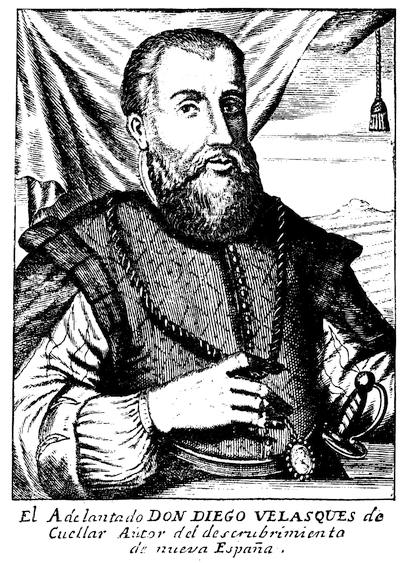
VELASQUEZ.
Fac-simile of an engraving in Herrera, i. 298. It is lithographed in Cabajal’s México, ii. 21.
The Governor gave him instructions on the 23d of October, 1518. Cortés understood, it turned out, that these were to be followed when necessary and disregarded when desirable. There seemed, indeed, to have been no purpose to confine the business of the expedition to exploration, as the instructions set forth.[1059] Cortés put all his substance into ships and outfits. He inveigled his friends into helping him. Velasquez converted what Government resources he could to the purpose of the expedition, while at the same time he seems to have cunningly sold to Cortés his own merchandise at exorbitant prices. Twenty thousand ducats apparently went into somebody’s pockets to get the expedition well started.[1060] Three hundred men, including some of position, joined him. The Governor’s jester, instigated, as is supposed, by Velasquez’ relatives, threw out a hint that Cortés was only preparing to proclaim his independence when he reached the new domain. The thought worried the Governor, and seems in part to have broken the spell of the admiration which he entertained for Cortés; yet not so much so but he could turn a cold shoulder to Grijalva when he arrived with his ships, as happened at this juncture.
Cortés could not afford to dally; and secret orders having been given for all to be in readiness on the evening of the 17th of November, on the next morning the fleet sailed.[1061] There were six vessels composing it, and a seventh later joined them. At Trinidad (Cuba) his force was largely augmented with recruits from Grijalva’s men. Here messengers arrived from Velasquez, ordering the authorities to depose Cortés and put another in command. Cortés had, however, too strongly environed himself; and he simply took one of the messengers into his service, and sent back the other with due protestations of respect. Then he sailed to San Cristóbal (Havana), sending a force overland to pick up horses. The flagship met a mishap on the way, but arrived at last. Cortés landed and displayed his pomp. Letters from Velasquez still followed him, but no one dared to arrest him. He again sailed. His fleet had now increased to twelve vessels, the largest measuring one hundred tons; his men were over six hundred, and among them only thirteen bore firelocks; his artillery consisted of ten guns and four falconets. Two hundred natives, men and women, were taken as slaves. Sixteen horses were stowed away on or below deck.[1062] This was the force that a few days later, at Guaguanico, Cortés passed in review, while he regaled his men with a specious harangue, steeped in a corsair’s piety. On the 18th of February they steered boldly away on the mission which was to become famous.
Looking around upon his officers, Cortés could discover, later if not then, that he had some stanch lieutenants. There was Pedro de Alvarado, who had already shown his somewhat impetuous quality while serving under Grijalva. There was Francisco de Montejo, a good administrator as well as a brave soldier. Names not yet forgotten in the story of the Conquest were those of Alonso de Avila, Cristóbal de Olid, and the youngest of all, Gonzalo de Sandoval, who was inseparable from his white stallion Motilla. Then there were Velasquez de Leon, Diego de Ordaz, and others less known to fame.
The straggling vessels gathered again at Cozumel Island, near the point of Yucatan. Cortés sent an expedition to discover and ransom some Christians who were in the interior, as he heard. The mission failed; but a single one of the wanderers, by some other course, found the Spaniards, and was welcomed as an interpreter. This man reported that he and another were the sole survivors of a ship’s company wrecked on the coast eight years before.
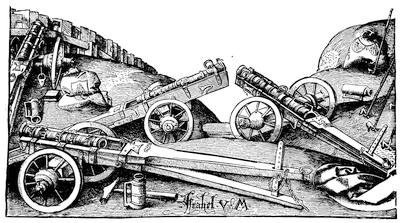
CANNON OF CORTÉS’ TIME.
As represented in a cut by Israel van Mecken, which is here reduced from a fac-simile in A. O. Essenwein’s Kulturhistorischer Bilder Atlas, ii., Mittelalter (Leipsic, 1883), pl. cxv. It will be observed that the pieces have no trunnions, and are supported in a kind of trough. They were breech-loaders by means of chambers, three of which, with handles, are seen (in the cut) lying on the ground, and one is in place, in the gun on the right. In the Naval Museum at Annapolis there are guns captured in the Mexican war, that are supposed to be the ones used by Cortés. A search of the records of the Ordnance Department at Washington, instituted for me by Commodore Sicard, at the suggestion of Prof. Charles E. Munroe of the Naval Academy, has not, however, revealed any documentary evidence; but a paper in the Army and Navy Journal, Nov. 22, 1884, p. 325, shows such guns to have been captured by Lieutenant Wyse in the “Darien.” The guns at Annapolis are provided with like chambers, as seen in photographs kindly sent to me. Similar chambers are now, or were recently, used in firing salutes on the Queen’s birthday in St. James’s Park. Cf. Stanley’s De Gama’s Voyages (Hakluyt Society), p. 227.
Early in March the fleet started to skirt the Yucatan shore, and Cortés had his first fight with the natives at Tabasco,—a conflict brought on for no reason but that the town would not supply provisions. The stockade was forced, and the place formally occupied. A more signal victory was required; and the Spaniards, getting on shore their horses and artillery, encountered the savage hordes and dispersed them,—aided, as the veracious story goes, by a spectral horseman who shone upon the field. The native king only secured immunity from further assaults by large presents. The Spaniards then re-embarked, and next cast anchor at San Juan de Ulloa.
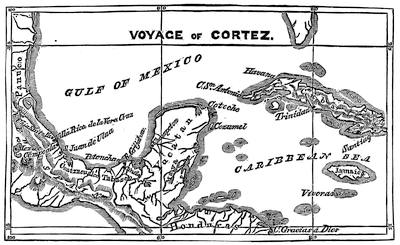
CORTÉS’ VOYAGE TO MEXICO.
This is a reproduction of the map in Arthur Helps’s Spanish Conquest, ii. 236.
Meanwhile the rumors of the descent of the Spaniards on the coast had certainly hurried to Montezuma at his capital; and his people doubtless rehearsed some of the many portents which are said to have been regarded.[1063] We read also of new temples erected, and immense sacrifices of war-captives made, to propitiate the deities and avert the dangers which these portents and forebodings for years past had indicated to the believing.
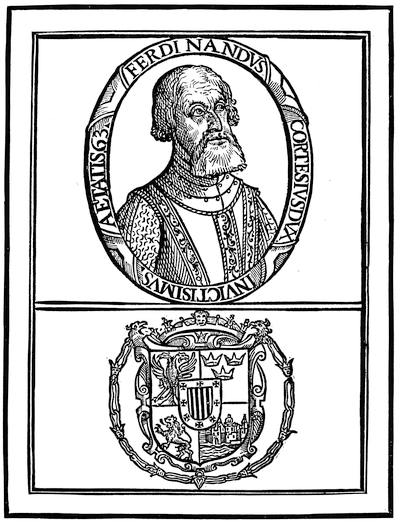
CORTÉS AND HIS ARMS.
Copied from a cut in Gabriel Lasso de la Vega’s Cortés valeroso,—a poem published at Madrid in 1588. There is a copy in Harvard College Library; cf. Carter-Brown, i. 377. The same cut is also used in the edition published in 1594, then called Mexicana.
The men of Grijalva had already some months earlier been taken to be similar woful visitants, and one of Montezuma’s officers had visited Grijalva’s vessel, and made report of the wonders to the Mexican monarch. Studied offices of propitiation had been ordered, when word came back that the ship of the bearded men had vanished.
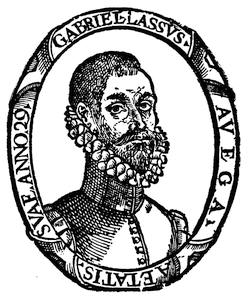
GABRIEL LASSO DE LA VEGA.
Fac-simile of the portrait in Cortés valeroso.
The coming of Cortés was but a dreaded return. While his ship lay at Juan de Ulloa, two canoes came from the main, and their occupants climbed to his deck. No one could understand them. The rescued Spaniard who had been counted on as an interpreter was at a loss. At last a female slave, Marina by name, taken at Tabasco, solved the difficulty. She could understand this same Spaniard, and knew also Aztec.[1064] Through this double interpretation Cortés now learned that the mission of his visitors was one of welcome and inquiry. After the usual interchange of gifts, Cortés sent word to the cacique that he would soon confer with him. He then landed a force, established a camp, and began to barter with the natives. To a chief, who soon arrived, Cortés announced his intention to seek the presence of Montezuma and to deliver the gifts and messages with which he was charged as the ambassador of his sovereign. Accordingly, bearing such presents as Cortés cared to send forward, native messengers were sent to Montezuma to tell tales of the sights they had seen,—the prancing horses and the belching cannon. The Mexican king sought to appease the eagerness of the new-comers by returning large stores of fabrics and gold, wishing them to be satisfied and to depart. The gold was not a happy gift to produce such an end.
Meanwhile Cortés, by his craft, quieted a rising faction of the party of Velasquez which demanded to be led back to Cuba. He did this by seeming to acquiesce in the demand of his followers in laying the foundations of a town and constituting its people a municipality competent to choose a representative of the royal authority. This done, Cortés resigned his commission from Velasquez, and was at once invested with supreme power by the new municipality. The scheme which Velasquez had suspected was thus brought to fruition. Whoever resisted the new captain was conquered by force, persuasion, tact, or magnetism; and Cortés became as popular as he was irresistible.
At this point messengers presented themselves from tribes not far off who were unwilling subjects of the Aztec power. The presence of possible allies was a propitious circumstance, and Cortés proceeded to cultivate the friendship of these tribes. He moved his camp day by day along the shore, inuring his men to marches, while the fleet sailed in company. They reached a large city, and were regaled. Each chief told of the tyranny of Montezuma, and the eyes of Cortés glistened. The Spaniards went on to another town, slaves being provided to bear their burdens. Here they found tax-gatherers of Montezuma collecting tribute. Emboldened by Cortés’ glance, his hosts seized the Aztec emissaries and delivered them to the Spaniards. Cortés now played a double game. He propitiated the servants of Montezuma by secretly releasing them, and added to his allies by enjoining every tribe he could reach to resist the Aztec collectors of tribute.
The wandering municipality, as represented in this piratical army, at last stopped at a harbor where a town (La Villa Rica de Vera Cruz) sprang up, and became the base of future operations.[1065]
Montezuma and his advisers, angered by the reports of the revolt of his subjects, had organized a force to proceed against them, when the tax-gatherers whom Cortés had released arrived and told the story of Cortés’ gentleness and sympathy. It was enough; the rebellion needed no such active encounter. The troops were not sent, and messengers were despatched to Cortés, assuring the Spanish leader that Montezuma forbore to chastise the entertainers of the white strangers. Cortés now produced other of the tax-gatherers whom he had been holding, and they and the new embassy went back to Montezuma more impressed than before; while the neighboring people wondered at the deference paid by Montezuma’s lieutenants to the Spaniards. It was no small gain for Cortés to have instigated the equal wonder of two mutually inimical factions.
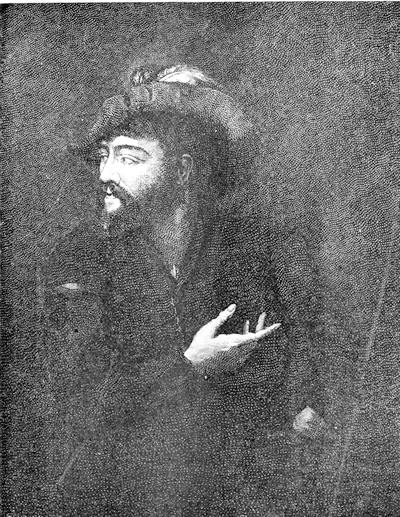
CORTÉS.
After a picture on panel in the Massachusetts Historical Society’s gallery. It is described in the Catalogue of the Cabinet of that Society as “Restored by Henry Sargent about 1831, and again by George Howorth about 1855.” Cf. Proceedings, i. 446, where it is said to have been given by the family of the late Dr. Foster, of Brighton, who received it by inheritance from a Huguenot family who brought it to New England after the Revocation of the Edict of Nantes.
The Spanish leader took occasion to increase his prestige by despatching expeditions hither and thither. Then he learned of efforts made by Velasquez to supplant him. To confirm his rule against the Cuban Governor he needed the royal sanction; and the best way to get that was to despatch a vessel with messages to the Emperor, and give him earnest of what he might yet expect in piles of gold thrown at his feet. So the flagship sailed for Spain; and in her in command and to conduct his suit before the throne, Cortés sent faithful servitors, such as had influence at court, to outwit the emissaries of Velasquez. Sailing in July, touching at Cuba long enough to raise the anger of Velasquez, but not long enough for him to catch them, these followers of Cortés reached Spain in October, and found the agents of Velasquez ready for them. Their vessel was seized, and the royal ear was held by Bishop Fonseca and other friends of the Cuban Governor; yet not so effectually but that the duplicate letters of Cortés’ messengers were put into the Emperor’s hand, and the train of natives paraded before him.
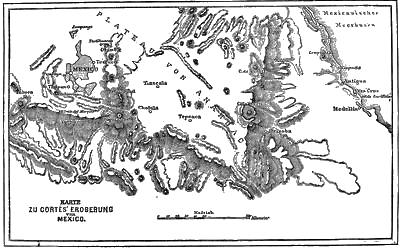
THE MARCH OF CORTÉS ON MEXICO.
A reproduction of the map in Ruge’s Zeitalter der Entdeckungen, p. 363. Similar maps are given by Prescott, Helps, and Bancroft. Cabajal (México, ii. 200) gives a map of the route followed from the Gulf, with a profile of the country traversed. Bancroft (Mexico, vol. ii.) gives a map of New Spain as known to the Conquerors. Early maps of Nova Hispania, or New Spain, are not infrequent. Cf. Blaeu’s Atlas, De Bry, several issued by Vander Aa, of Amsterdam, the Brussels edition (1704) of Solis, Lorenzana’s Cortés (1770), and various others.
Now came the famous resolve of Cortés. He would band his heterogeneous folk together—adherents of Cortés and of Velasquez—in one common cause and danger. So he adroitly led them to be partners in the deed which he stealthily planned.[1066] Hulk after hulk of the apparently worm-eaten vessels of the fleet sank in the harbor, until there was no flotilla left upon which any could desert him. The march to Mexico was now assured. The force with which to accomplish this consisted of about four hundred and fifty Spaniards, six or seven light guns, fifteen horses, and a swarm of Indian slaves and attendants. A body of the Totonacs accompanied them.[1067] Two or three days brought them into the higher plain and its enlivening vegetation. When they reached the dependencies of Montezuma, they found orders had been given to extend to them every courtesy. They soon reached the Anahuac plateau, which reminded them not a little of Spain itself. They passed from cacique to cacique, some of whom groaned under the yoke of the Aztec; but not one dared do more than orders from Montezuma dictated. Then the invaders approached the territory of an independent people, those of Tlascala, who had walled their country against neighboring enemies. A fight took place at the frontiers, in which the Spaniards lost two horses. They forced passes against great odds, but again lost a horse or two,—which was a perceptible diminution of their power to terrify. The accounts speak of immense hordes of the Tlascalans, which historians now take with allowances, great or small. Cortés spread what alarm he could by burning villages and capturing the country people. His greatest obstacle soon appeared in the compacted army of Tlascalans arrayed in his front. The conflict which ensued was for a while doubtful. Every horse was hurt, and sixty Spaniards were wounded; but the result was the retreat of the Tlascalans. Divining that the Spanish power was derived from the sun, the enemy planned a night attack; but Cortés suspected it, and assaulted them in their own ambush.
Cortés now had an opportunity to display his double-facedness and his wiles. He received embassies both from Montezuma and from the senate of the Tlascalans. He cajoled each, and played off his friendship for the one in cementing an alliance with the other. But to Tlascala and Mexico he would go, so he told them.
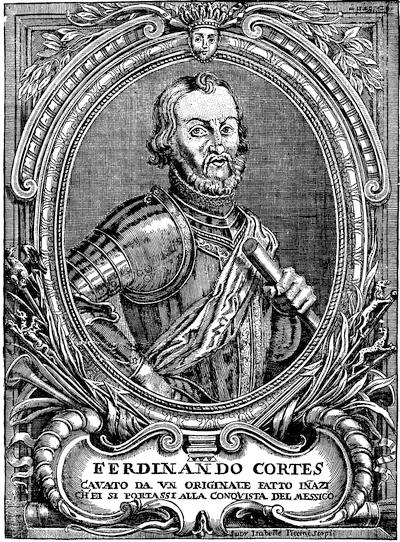
CORTÉS.[1068]
The Tlascalans were not averse, for they thought it boded no good to the Aztecs if he could be bound to themselves. Montezuma dreaded the contact, and tried to intimidate the strangers by tales of the horrible difficulties of the journey.
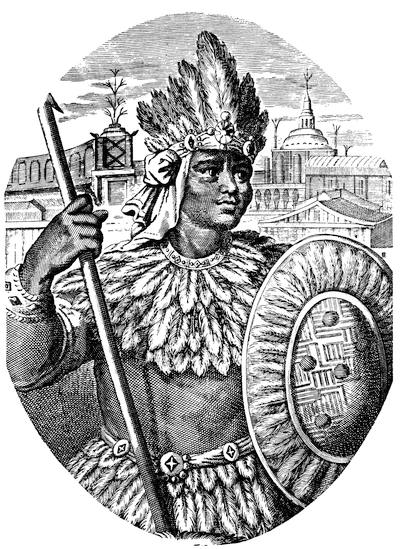
MONTEZUMA.
This cut of the “Rex ultimus Mexicanorum” is a fac-simile from Montanus and Ogilby, p. 253. The source of the likeness is not apparent, and the picture seems questionable. Prescott, in his second volume, gives a likeness, which belonged to the descendants of the Aztec king, the Counts of Miravalle. It is claimed to have been painted by an artist, Maldonado, who accompanied Cortés; but, on the other hand, some have represented it as an ideal portrait painted after the Conquest. Prescott (vol. ii. p. 72) makes up his description of Montezuma from various early authorities,—Diaz, Zuazo (MS.), Ixtlilxochitl, Gomara, Oviedo, Acosta, Sahagun, Toribio, etc., particularizing the references. H. H. Bancroft (Mexico, i. 285) also depicts him from the early sources. He is made of an age from forty to fifty-four by different writers; but the younger period is thought by most to be nearest. Bancroft refers to the prints in Th. Armin’s Das alte Mexico (Leipsic, 1865) as representing a coarse Aztec warrior, and the native picture in Carbajal Espinosa’s Historia de México (Mexico, 1862) as purely conventional. The same writer thinks the colored portrait, “peint par ordre de Cortes,” in Linati’s Costûmes et mœurs de Mexique (Brussels) conforms to the descriptions; while that in Clavigero’s Storia antica del Messico (1780) is too small to be satisfactory. The line of Montezuma’s descendants is traced in Prescott, Mexico, ii. 339, iii. 446, and in Bancroft, Mexico, i. 459. Cf. also the portrait of Montezuma, “d’après Sandoval,” given in Charton’s Voyageurs, iii. 393, and that in Cumplido’s Mexican edition of Prescott’s Mexico vol. iii.
Presently the army took up its march for Tlascala, where they were royally received, and wives in abundance were bestowed upon the leaders. Next they passed to Cholula, which was subject to the Aztecs; and here the Spaniards were received with as much welcome as could be expected to be bestowed on strangers with the hostile Tlascalans in their train. The scant welcome covered treachery, and Cortés met it boldly. Murder and plunder impressed the Cholulans with his power, and gave some sweet revenge to his allies. Through the wiles of Cortés a seeming reconciliation at last was effected between these neighboring enemies. But the massacre of Cholula was not a pastime, the treachery of Montezuma not forgotten; and the march was again resumed, about six thousand native allies of one tribe and another following the army. The passage of a defile brought the broad Valley of Mexico into view; and Montezuma, awed by the coming host, sent a courtier to personate him and to prevail upon Cortés to avoid the city. The trick and the plea were futile. On to one of the aquatic cities of the Mexican lakes the Spaniards went, and were received in great state by a vassal lord of Montezuma, who now invited the Spanish leader to the Aztec city. On they went. Town after town received them; and finally, just without his city, Montezuma, in all his finery and pomp, met the Spanish visitors, bade them welcome, and committed them to an escort which he had provided. It was the 8th of November, 1519. Later in his own palace, in the quarters which had been assigned to Cortés, and on several occasions, the two indulged in reciprocal courtesies and watched each other. Cortés was not without fear, and his allies warned him of Aztec treachery. His way to check foul designs was the bold one of seizing Montezuma and holding him as a hostage; and he did so under pretence of honoring him. A chieftain who had attacked a party of the Spaniards by orders of Montezuma some time before, was executed in front of the palace. Montezuma himself was subjected for a while to chains. Expeditions were sent out with impunity to search for gold mines; others explored the coast for harbors. A new governor was sent back to Villa Rica, and he sent up shipwrights; so it was not long before Cortés commanded a flotilla on the city lakes, and the captive king was regaled with aquatic sports.
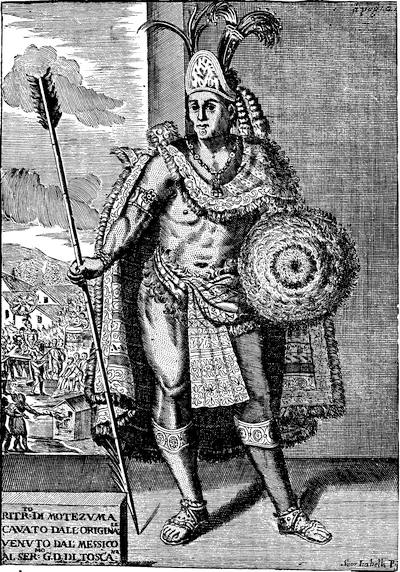
MONTEZUMA.[1069]
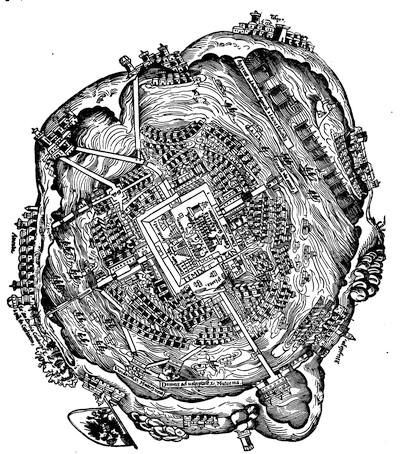
MEXICO BEFORE THE CONQUEST.
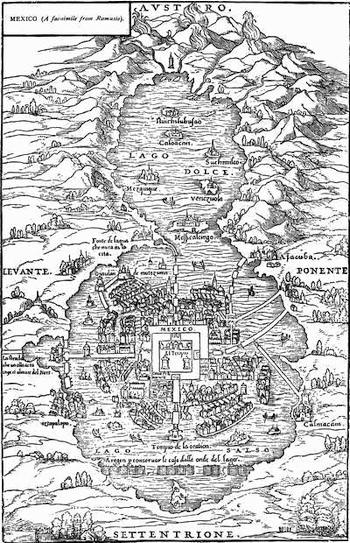
This is reduced from the cut in Henry Stevens’s American Bibliographer, p. 86, which in turn is reproduced from the edition of Cortés’ letters published at Nuremberg in 1524. Bancroft in his Mexico (vol. i. p. 280) gives a greatly reduced sketch of the same plan, and adds to it a description and references to the various sources of our information regarding the Aztec town; and this may be compared with the same author’s Native Races, ii. 560. Helps describes the city in his Spanish Conquest (New York ed., ii. 277, 423), where he thinks that the early chroniclers failed to make clear the full number of the causeways connecting the town with the main, and traversing the lake. Prescott describes it in his Mexico (Kirk’s ed., ii. 101), and discredits the plan given in Bullock’s Mexico as one prepared by Montezuma for Cortés. This last plan is also given in Carbajal’s Historia de México (1862), ii. 221. The nearly equal distance on all sides at which the shores of the lake stand from the town is characteristic of this earliest of the plans (1524); and in this particular it is followed in various plans and bird’s-eye views of the town of the sixteenth century, and in some of a later date. The Aztec town had been founded in 1325, and had been more commonly called Tenochtitlan, which the Spaniards turned into Temixtitan and Tenustitan, the term Mexico being properly applied to one of the principal wards of the city. The two names were first sometimes joined, as Temixtitlan-Mexico (1555); but in the end the more pronounceable part survived, and the rest was lost. Cf. Bancroft, Mexico, i. 12-14, with references. The correspondence of sites in the present city as compared with those of the Aztec time and of the conquerors, is examined in Alaman’s Discertaciones sobre la historia de la república Méjicana (Mexico, 1844-1849), ii. 202, 246; Carbajal Espinosa’s Historia de México, ii. 226, and by Ramirez in the Mexican edition of Prescott. Cf. Ant. du Pinet’s Descriptions de plusieurs villes et forteresses, Lyon, 1564.
Then came symptoms of conspiracy among the native nobles, with the object of overthrowing the insolent strangers; and Cacama, a nephew of Montezuma and a chief among them, indulged the hope of seizing the throne itself. Montezuma protested to his people that his durance was directed by the gods, and counselled caution. When this did not suffice, he gave orders, at the instigation of Cortés, to seize Cacama, who was brought to Mexico and placed in irons. The will of Cortés effected other displacements of the rural chiefs; and the allegiance of Montezuma to the Spanish sovereign became very soon as sure and abject as forms could make it.
Tribute was ordered, and trains bore into the city wealth from all the provinces,—to be the cause of heart-burnings and quarrels in the hour of distribution. The Aztec king and the priests were compelled to order the removal of idols from their temples, and to see the cross and altar erected in their places.
Meanwhile the difficulties of Cortés were increasing. The desecration of the idols had strengthened the party of revolt, and Montezuma was powerless to quiet them. He warned the Spaniards of their danger. Cortés, to dispel apprehension, sent men to the coast with the ostensible purpose of building ships for departure. It was but a trick, however, to gain time; for he was now expecting a response to his letters sent to Spain, and he hoped for supplies and a royal commission which might enable him to draw reinforcements from Cuba.
The renegade leader, however, had little knowledge of what was planning at this very moment in that island. Velasquez de Cuellar, acting under a sufficient commission, had organized an expedition to pursue Cortés, and had given the command of it to Panfilo de Narvaez. The friends of Cortés and those who dreaded a fratricidal war joined in representations to the audiencia, which sent Lucas Vasquez de Aillon to prevent an outbreak. The fleet under Narvaez left Cuba, Aillon on board, with instructions to reach a peaceable agreement with Cortés; but this failing, they were to seek other regions. In April, 1520, after some mishaps, the fleet, which had been the largest ever seen in those waters, anchored at San Juan de Ulloa, where they got stories of the great success of Cortés from some deserters of one of his exploring parties. On the other hand, these same deserters, learning from Narvaez the strength and purpose of the new-comers,—for the restraint of Aillon proved ineffectual,—communicated with the neighboring caciques; and the news was not slow in travelling to Montezuma, who heard it not long after the mock submission of Cortés and the despatching of the ship-builders to the coast.
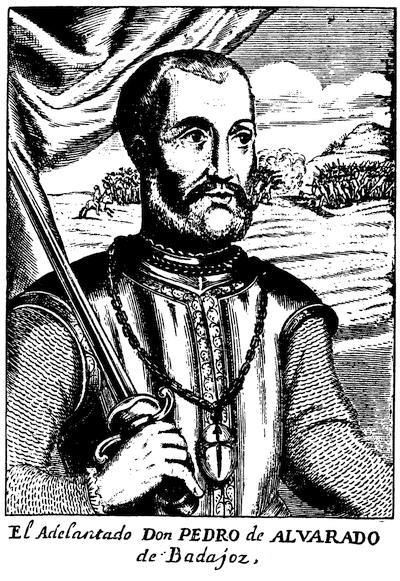
Fac-simile of an engraving in Herrera, ii. 274. For appearance and other portraits, see Bancroft, Mexico, i. 75. One of a sinister aspect often engraved, but which Ramirez distrusts, is given in Cabajal’s México, ii. 341; in the Proceso de residencia contra Pedro de Alvarado (Mexico, 1847); and in Cumplido’s Mexican edition of Prescott’s Mexico, vol. iii.
Narvaez next tried, in vain, to swerve Velasquez de Leon from his fidelity to Cortés,—for this officer was exploring with a party in the neighborhood of the coast. Sandoval, in command at Villa Rica, learned Narvaez’ purposes from spies; and when messengers came to demand the surrender of the town, an altercation ensued, and the chief messengers were seized and sent to Cortés. The Conqueror received them kindly, and, overcoming their aversion, he sent them back to Narvaez with letters and gifts calculated to conciliate. While many under Narvaez were affected, the new leader remained stubborn, seized Aillon, who was endeavoring to mediate, and sent him on shipboard with orders to sail for Cuba. Thus the arrogance of Narvaez was greatly helping Cortés in his not very welcome environment.
Cortés now boldly divided his force; and leaving Alvarado behind with perhaps one hundred and forty men,—for the accounts differ,[1070]—and taking half that number with him, beside native guides and carriers, marched to confront Narvaez. Velasquez de Leon with his force joined him on the way, and a little later Sandoval brought further reinforcements; so that Cortés had now a detachment of nearly three hundred men. Cortés had prudently furnished them long native lances, with which to meet Narvaez’ cavalry, for his own horsemen were very few. Adroitness on the part of Cortés and a show of gold had their effect upon messengers who, with one demand and another, were sent to him by Narvaez. Velasquez was sent by Cortés to the enemy’s camp; but the chief gain to Cortés from this manœuvre was a more intimate knowledge of the army and purpose of Narvaez. He then resolved to attack the intruder,—who, however, became aware of the intention of Cortés, but, under the stress of a storm, unaccountably relaxed his precautions. Cortés took advantage of this carelessness; and attacking boldly by night, carried everything before him, and captured the rival leader. The loss was but small to either side. The followers of the invader now became adherents of Cortés, and were a powerful aid in his future movements.[1071] The same good fortune had given him possession of the invader’s fleet.
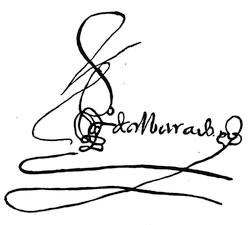
AUTOGRAPH OF PEDRO DE ALVARADO.
Copied from a fac-simile in Cabajal’s México, ii. 686.
Meanwhile there were stirring times with Alvarado in Mexico. The Aztecs prepared to celebrate a high religious festival. Alvarado learned, or pretended to learn, that the disaffected native chiefs were planning to rise upon the Spaniards at its close. So he anticipated their scheme by attacking them while at their worship and unarmed. Six hundred or more of the leading men were thus slain. The multitude without the temple were infuriated, and the Spaniards regained their quarters, not without difficulty, Alvarado himself being wounded. Behind their defences they managed to resist attack till succor came.
Cortés, who had learned of the events, was advancing, attaching to himself the peoples who were inimical to the Aztecs; but as he got within the Aztec influence he found more sullenness than favor. When he entered Mexico he was not resisted. The city seemed almost abandoned as his force made their way to the Spanish fort and entered its gates.
As a means of getting supplies, Cortés ordered the release of a brother of Montezuma, who at once used his liberty to plan an insurrection. An attack on the Spanish quarters followed, which Cortés sought to repel by sorties; but they gained little. The siege was so roughly pressed that Cortés urged Montezuma to present himself on the parapet and check the fierceness of the assault. The captive put on his robes of state and addressed the multitude; but he only became the target of their missiles, and was struck down by a stone.[1072] The condition of the Spaniards soon became perilous in the extreme. A parley with the chief of the Aztecs was of no avail; and Cortés resolved to cut his way along the shortest causeway from the city, to the mainland bordering the lake. In this he failed. Meanwhile a part of his force were endeavoring to secure the summit of a neighboring pyramid, from which the Mexicans had annoyed the garrison of the fort. Cortés joined in this attack, and it was successful. The defenders of the temples on its summit were all killed or hurled from the height, and Cortés was master of the spot.
Events followed quickly in this June of 1520. There was evidently a strong will in command of the Mexicans. The brother of Montezuma was a doughtier foe than the King had been. The temporary success on the pyramid had not diminished the anxiety of Cortés. Montezuma was now dying on his hands. The King had not recovered from the injuries which his own people had inflicted, and sinking spirits completed the work of the mob. On the 30th of June he died, at the age of forty-one, having been on the throne since 1503.[1073] Cortés had hoped for some turn of fortune from this event; but none came. He was more than ever convinced of the necessity of evacuating the city. Another sortie had failed as before; and the passage of the causeway was again planned for the evening of that day.[1074] The order of march, as arranged, included the whole Spanish force and about six thousand allies. Pontoons of a rough description were contrived for bridging the chasms in the causeway. As many jewels and gold as would not encumber them were taken, together with such prisoners of distinction as remained to them, besides the sick and wounded.
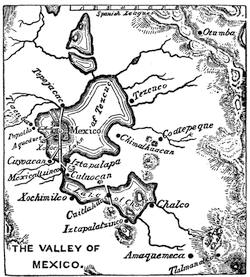
HELPS’S MAP.
This is the map given by Helps in his Spanish Conquest. One of the differences in the variety of maps which have been offered of the Valley of Mexico, to illustrate the conquest by Cortés, consists in the number and direction of the causeways. The description and the remains of the structures themselves have not sufficed to make investigators of one mind respecting them. Prescott (Kirk’s ed., vol. ii.) does not represent so many causeways as Helps does. The map in Bancroft (vol. i. p. 583) is still different in this respect. There is also a plan of the city and surrounding country in Cabajal’s México (vol. ii. p. 538); and two others have been elsewhere given in the present volume (pp. 364, 379).
A drizzling rain favored their retreat; but the Mexicans were finally aroused, and attacked their rear. A hundred or more Spaniards were cut off, and retreated to the fort, where they surrendered a few days later, and were sacrificed. The rest, after losses and much tribulation, reached the mainland. Nothing but the failure of the Mexicans to pursue the Spaniards, weakened as they were, saved Cortés from annihilation. The Aztecs were too busy with their successes; for forty Spaniards, not to speak of numerous allies, had been taken, and were to be immolated; and rites were to be performed over their own dead.
Cortés the next morning was marshalling the sorry crowd which was left of his army, when a new attack was threatened. His twelve hundred and fifty Spaniards and six thousand allies had been reduced respectively to five hundred and two thousand;[1075] and he was glad to make a temple, which was hard by, a place of refuge and defence. Here he had an opportunity to count his losses. His cannon and prisoners were all gone. Some of his bravest officers did not respond to his call. He could count but twenty-four of his three or four score of horses. After dark he resumed his march. His pursuers still worried him, and hunger weakened his men. He lost several horses at one point, and was himself badly wounded. Reaching a plain on the 7th of July, the Spaniards confronted a large force drawn up against them. Cortés had but seven muskets left, and no powder; so he trusted to pike and sabre. With these he rushed upon them; but the swarm of the enemy was too great. At last, however, making a dash with some horsemen at the native commander, who was recognized by his state and banner, the Mexican was hurled prostrate and killed, and the trophy captured. The spell was broken, and the little band of Spaniards and their allies hounded the craven enemy in every direction. This victory at Otumba (Otompan) was complete and astounding.
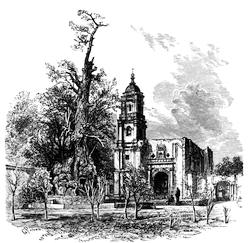
TREE OF TRISTE NOCHE.
This cut is borrowed from Harper’s Magazine, January, 1874, p. 172, and represents the remains of the tree under which Cortés and his followers gathered after that eventful night. There is another view of this tree in Tour du monde, 1862, p. 277.
The march was resumed; and not till within the Tlascalan borders was there any respite and rest. In the capital of his allies Cortés breathed freer. He learned, however, of misfortunes to detached parties of Spaniards which had been sent out from Villa Rica. He soon got some small supplies of ammunition and men from that seaport. Amid all this, Cortés himself succumbed to a fever from his wounds, and barely escaped death.
Meantime Cuitlahuatzin, the successful brother of Montezuma, had been crowned in Mexico, where a military rule (improved by what the Spaniards had taught them) was established. The new monarch sent ambassadors to try to win the Tlascalans from their fidelity to Cortés; but the scheme failed, and Cortés got renewed strength in the fast purpose of his allies. His prompt and defiant ambition again overcame the discontents among his own men, and induced him to take the field once more against the Tepeacans, enemies of the Tlascalans, who lived near by. It took about a month to subdue the whole province. Other strongholds of Aztec influence fell one by one. The prestige of the Spanish arms was rapidly re-established, and the Aztec forces went down before them here and there in detachments. New arrivals on the coast pronounced for Cortés, and two hundred men and twenty horses soon joined his army. The small-pox, which the Spaniards had introduced, speedily worked more disaster than the Spaniards, as it spread through the country; and among the victims of it was the new monarch of the Aztecs, leaving the throne open to the succession of Quauhtemotzin, a nephew and son-in-law of Montezuma.
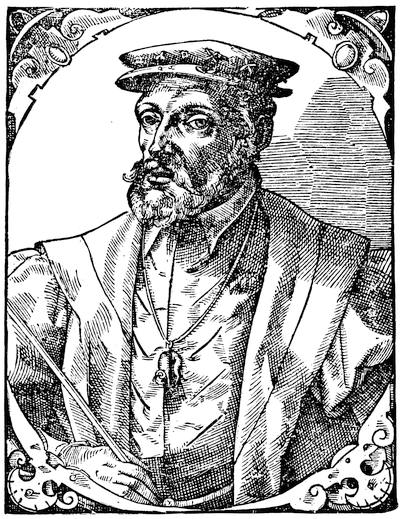
CHARLES V.
Fac-simile of a woodcut of Charles V. in Pauli Jovii elogia virorum bellica virtute illustrium, Basle, 1575, p. 365, and 1596, p. 240.
On the 30th of October, 1520, Cortés addressed his second letter to the Emperor Charles V. He and his adherents craved confirmation for his acts, and reinforcements. Other letters were despatched to Hispaniola and Jamaica for recruits and supplies. Some misfortunes prevented the prompt sailing of the vessel for Spain, and Cortés was enabled to join a supplemental letter to the Emperor. The vessels also carried away some of the disaffected, whom Cortés was not sorry to lose, now that others had joined him.

AUTOGRAPH OF CHARLES V.
Meanwhile Cortés had established among the Tepeacans a post of observation named Segura; and from this centre Sandoval made a successful incursion among the Aztec dependencies. Cortés himself was again at Tlascala, settling the succession of its government; for the small-pox had carried off Maxixcatzin, the firm friend of the Spaniards. Here Cortés set carpenters to work constructing brigantines, which he intended to carry to Tezcuco, on the Lake of Mexico, where it was now his purpose to establish the base of future operations against the Aztec capital. The opportune arrival of a ship at Villa Rica with supplies and materials of war was very helpful to him.
Cortés first animated all by a review of his forces, and then went forward with the advance toward Tezcuco. He encountered little opposition, and entered the town to find the inhabitants divided in their fears and sympathies. Many had fled toward Mexico, including the ruler who had supplanted the one given them by Cortés and Montezuma. Under the instigation of Cortés a new one was chosen whom he could trust.
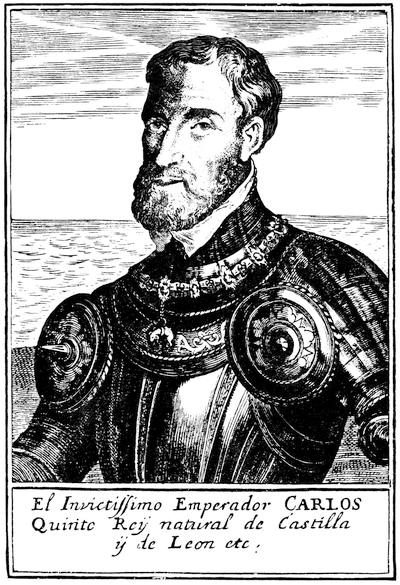
CHARLES V.
Fac-simile of an engraving in Herrera, iii. 84. Cf. the full-length likeness given in Cumplido’s Mexican edition of Prescott’s Mexico, vol. iii., and various other portraits of the Emperor.
Cortés began his approach to Mexico by attacking and capturing, with great loss to the inhabitants, one of the lake towns; but the enemy, cutting a dike and flooding the place, forced the retirement of the invaders, who fell back to Tezcuco. Enough had been accomplished to cause many of the districts dependent on the Aztecs to send in embassies of submission; and Cortés found that he was daily gaining ground. Sandoval was sent back to Tlascala to convoy the now completed brigantines, which were borne in pieces on the shoulders of eight thousand carriers. Pending the launching of the fleet, Cortés conducted a reconnoissance round the north end of the lakes to the scene of his sorrowful night evacuation, hoping for an interview with an Aztec chief.
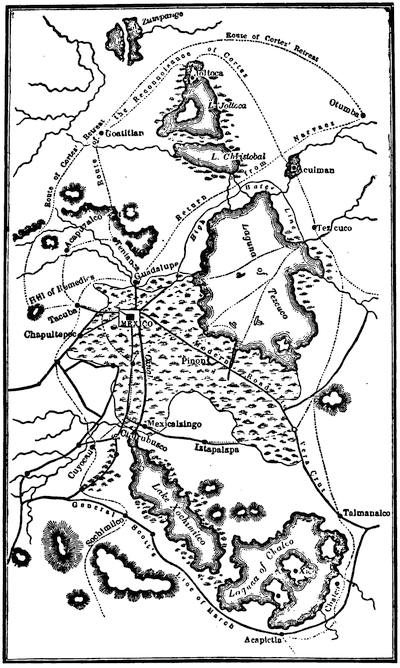
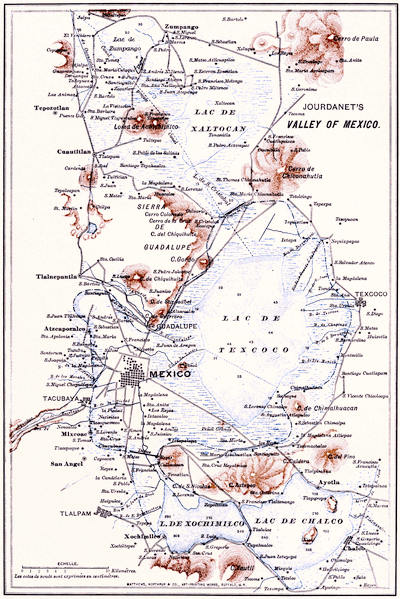
TOPOGRAPHY OF THE MEXICAN VALLEY.
This is the map given in Wilson’s New Conquest of Mexico, p. 390, in which he makes the present topography represent that of Cortés’ time, in opposition to the usual view that at the period of the Conquest the waters of the lake covered the parts here represented as marsh. The waters of Tezcuco are at present seven or eight feet (Prescott says four feet) below the level of the city, and Wilson contends that they did not in Cortés’ time much exceed in extent their present limits; and it is one of his arguments against Cortés’ representations of deep water about the causeways that such a level of the lake would have put the town of Tezcuco six or seven feet under water. Wilson gives his views on this point at length in his New Conquest, pp. 452-460. The map will be seen also to show the line of General Scott’s approach to the city in 1847. (Cf. Prof. Henry Coppée on the “Coincidences of the Conquests of Mexico, 1520-1847,” in the Journal of the Military Service Institution, March, 1884.) The modern city of Mexico lies remote by several miles from the banks of the lake which represents to-day the water commonly held to have surrounded the town in the days of the Conquest. The question of the shrinking of the lagunes is examined in Orozco y Berra’s Mémoire pour la carte hydrographique de la Vallée de Mexico, and by Jourdanet in his Influence de la pression de l’air sur la vie de l’homme, p. 486. A colored map prepared for this latter book was also introduced by Jourdanet in his edition of Sahagun (1880), where (p. xxviii) he again examines the question. From that map the one here presented was taken, and the marsh surrounding “Lac de Texcoco” marks the supposed limits of the lake in Montezuma’s time. Jourdanet’s map is called, “Carte hydrographique de la Vallée de Mexico d’après les travaux de la Commission de la Vallée en 1862, avec addition des anciennes limites du Lac de Texcoco.”
Humboldt in his Essai politique sur la Nouvelle Espagne, while studying this problem of the original bounds of the water, gives a map defining them as traced in 1804-1807; and this is reproduced in John Black’s translation of Humboldt’s Personal Essay on the Kingdom of New Spain, third edition, London, 1822. Humboldt gives accounts of earlier attempts to map the valley with something like accuracy, as was the case with the Lopez map of 1785. Siguenza’s map of the sixteenth century, though false, has successively supplied, through the publication of it which Alzate made in 1786, the geographical data of many more modern maps. Cf. the map in Cumplido’s edition of Prescott’s Mexico (1846), vol. iii., and the enumeration of maps of the valley given in Orozco y Berra’s Cartografia Mexicana, pp. 315-316.
A map of Mexico and the lake also appeared in Le petit atlas maritime (Paris, 1764); and this is given in fac-simile in the Proceedings of the American Philosophical Society, xxi. 616, in connection with a translation of the Codex Ramirez by Henry Phillips, Jr.
There is reason to believe that the decrease in the waters had begun to be perceptible in the time of Cortés; and Humboldt traces the present subsidence to the destruction of neighboring forests. Bernal Diaz makes record of the changes observable within his recollection, and he wrote his account fifty years after the Conquest.
The geographers of the eighteenth century often made the waters of the valley flow into the Pacific. The map in the 1704 edition of Solis shows this; so do the maps of Bower and other English cartographers, as well as the map from Herrera on a later page (p. 392).
The inundations to which the city has been subjected (the most serious of which was in 1629), and the works planned for its protection from such devastations are the subject of a rare book by Cepeda and Carillo, Relacion universal del sitio en que esta fundada la ciudad de México (Mexico, 1637). Copies are found complete and incomplete. Cf. Carter-Brown, ii. 441; Leclerc, no. 1,095, complete, 400 francs, and no. 1,096, incomplete, 200 francs; Quaritch, incomplete, £10.
In this, however, he failed, and returned to Tezcuco. Then followed some successful fighting on the line of communication with the coast, which enabled Cortés to bring up safely some important munitions, besides two hundred soldiers, who had lately reached Villa Rica from the islands whither he had sent for help the previous autumn.
The Spanish leader now conducted another reconnoissance into the southern borders of the Mexican Valley,—a movement which overcame much opposition,—and selected Coyohuacan as a base of operations on that side against the Aztec city. After this he returned to Tezcuco, and was put to the necessity of quelling an insurrection, in which his own death had been planned.
At last the brigantines were launched. At the command of Cortés the allies mustered. On the 28th of April, 1521, the Spanish general counted his own countrymen, and found he had over nine hundred in all, including eighty-seven horsemen. He had three heavy guns, and fifteen smaller ones, which were mostly in the fleet. Cortés kept immediate charge of the brigantines, and allotted the main divisions of the army to Alvarado, Olid, and Sandoval. The land forces proceeded to occupy the approaches which the reconnoissances had indicated,—Alvarado at Tlacopan, Olid at Coyohuacan, on the westerly shores of the lake, and, later, Sandoval at Iztapalapan, on the eastern side. Each of these places commanded the entrance to causeways leading to the city. The land forces were no sooner in position than Cortés appeared with his fleet. The Aztecs attacked the brigantines with several hundred canoes; but Cortés easily overcame all, and established his naval supremacy. He then turned to assist Olid and Alvarado, who were advancing along their respective causeways; and the stronghold, Xoloc, at the junction of the causeway, was easily carried. Here the besiegers maintained themselves with an occasional fight, while Sandoval was sent to occupy Tepeyacac, which commanded the outer end of the northern causeway. This completed the investment. A simultaneous attack was now made from the three camps. The force from Xoloc alone succeeded in entering the city; but the advantage gained was lost, and Cortés, who was with this column, drew his forces back to camp. His success, however, was enough to impress the surrounding people, who were watching the signs; and various messengers came and offered the submission of their people to the Spaniards. The attacks were renewed on subsequent days; and little by little the torch was applied, and the habitable part of the town grew less and less. The lake towns as they submitted furnished flotillas, which aided the brigantines much in their incursions into the canals of the town. For a while the Mexicans maintained night communication across the lake for supplies; but the brigantines at last stopped this precarious traffic.
Alvarado on his side had made little progress; but the market of Tlatelulco was nearer him, and that was a point within the city which it was desirable to reach and fortify. Sandoval was joined to Alvarado, who increased the vigor of his assault, while Cortés again attacked on the other side. The movement failed, and the Mexicans were greatly encouraged. The Spaniards, from their camps, saw by the blaze of the illuminations on the temple tops the sacrifice of their companions who had been captured in the fight. The bonds that kept the native allies in subjection were becoming, under these reverses, more sensibly loosened day by day, and Cortés spared several detachments from his weakened force to raid in various directions to preserve the prestige of the Spanish power.
The attack was now resumed on a different plan. The fighting-men led the way and kept the Mexicans at bay; while the native auxiliaries razed every building as they went, leaving no cover for the Aztec marauders. The demolition extended gradually to the line of Alvarado’s approach, and communication was opened with him. This leader was now approaching the great market-place, Tlatelulco. By renewed efforts he gained it, only to lose it; but the next day he succeeded better, and formed a junction with Cortés. Not more than an eighth part of the city was now in the hands of its inhabitants; and here pestilence and famine were the Spaniards’ prompt allies.
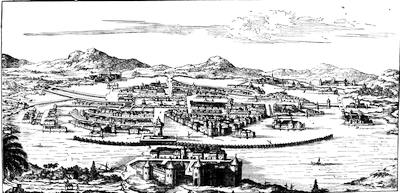
MEXICO UNDER THE CONQUERORS.
This is the engraving given in the Nieuwe Weereld (1670) of Montanus, which was repeated in Ogilby’s America, and is familiar from reproductions elsewhere. It may be traced back as a sketch to the much less elaborate one given by Bordone in his Libro of 1528, later called his Isolario, which was accompanied by one of the earliest descriptions by a writer not a conqueror. Bancroft (Mexico, ii. 14) gives a small outline engraving of a similar picture, and recapitulates the authorities on the rebuilding of the city by Cortés. The Cathedral, however, was not begun till 1573, and was over sixty years in building (Ibid., iii. 173).
One of the most interesting of the early accounts, accompanied as it was with a plan of the town and lake, made part of the narrative of the “Anonymous Conqueror.” This picture has been reproduced by Icazbalceta in his Coleccion (i. 390) from the engraving in Ramusio, whence we derive our only knowledge of this anonymous writer. The Ramusio plan is also given on the next page.
The plate used in the 1572 edition of Porcacchi (p. 105) served for many successive editions. Another plan of the same year showing an oval lake surrounding the town, is found in Braun and Hogenberg’s Civitates orbis terrarum (Cologne, 1572), and of later dates, and the French edition, Théâtre des cités du monde (Brussels, 1574), i. 59. A similar outline characterizes the small woodcut (6×6 inches) which is found in Münster’s Cosmographia (1598), p. dccccxiiii.
Later views and plans appeared in Gottfriedt’s Newe Welt (1655); in Solis’s Conquista (1704), p. 261, reproduced in the English edition of 1724; in La Croix’ Algemeene Weereld Beschryving (1705); in Herrera (edition of 1728), p. 399; in Clavigero (1780), giving the lake and the town (copied in Verne’s De’couverte de la Terre, p. 248), and also a map of Anahuac, both reproduced in the London (1787) and Philadelphia (1817) editions, as well as in the Spanish edition published at Mexico in 1844; in Solis, edition of 1783 (Madrid), where the lake is given an indefinite extension; in Keating’s edition of Bernal Diaz, besides engraved plates by the Dutch publisher Vander Aa.
The account of Mexico in 1554 written by Francisco Cervantes Salazar, and republished with annotations by Icazbalceta in 1875 (Carter-Brown, i. 595) is helpful in this study of the ancient town. Cf. “Mexico et ses environs en 1554,” by L. Massbieau, in the Revue de géographie, October, 1878.
A descriptive book, Sitio, naturaleza y propriedades de la ciudad de México, by Dr. Diego Cisneros, published at Mexico in 1618, is become very rare. Rich in 1832 priced a copy at £6 6s.,—a great sum for those days (Sabin, vol. iv. no. 13,146; Carter-Brown, ii. 199).
Still the Aztec King, Quauhtemotzin, scorned to yield; and the slaughter went on from day to day, till finally, on the 13th of August, 1521, the end came. The royal Aztec was captured, trying to escape in a boat; and there was no one left to fight. Of the thousand Spaniards who had done the work about a tenth had succumbed; and probably something like the same proportion among the many thousand allies. The Mexican loss must have been far greater, perhaps several times greater.[1076] The Spaniards were no sooner in possession than quarrels began over the booty. Far less was found than was hoped for, and torture was applied, with no success, to discover the hiding-places. The captive prince was not spared this indignity. Cortés was accused of appropriating an undue share of what was found, and hot feelings for a while prevailed.
The conquest now had to be maintained by the occupation of the country; and the question was debated whether to build the new capital on the ruins of Mexico, or to establish it at Tezcuco or Coyohuacan. Cortés preferred the prestige of the traditional site, and so the new Spanish town rose on the ruins of the Aztec capital; the Spanish quarter being formed about the square of Tenochtitlan (known in the early books usually as Temixtitan), which was separated by a wide canal from the Indian settlement clustered about Tlatelulco. Two additional causeways were constructed, and the Aztec aqueduct was restored. Inducements were offered to neighboring tribes to settle in the city, and districts were assigned to them. Thus were hewers of wood and drawers of water abundantly secured. But Mexico never regained with the natives the dominance which the Aztecs had given it. Its population was smaller, and a similar decadence marked the fate of the other chief towns; Spanish rule and disease checked their growth. Even Tezcuco and Tlascala soon learned what it was to be the dependents of the conquerors.
Cortés speedily decided upon further conquests. The Aztec tribute-rolls told him of the comparative wealth of the provinces, and the turbulent spirits among his men were best controlled in campaigns. He needed powder, so he sent some bold men to the crater of Popocatepetl to get sulphur. They secured it, but did not repeat the experiment. Cortés also needed cannon. The Aztecs had no iron, but sufficient copper; and finding a tin mine, his craftsmen made a gun-metal, which soon increased his artillery to a hundred pieces.
Expeditions were now despatched hither and thither, and province after province succumbed. Other regions sent in their princes and chief men with gifts and words of submission. The reports which came back of the great southern sea opened new visions; and Cortés sent expeditions to find ports and build vessels; and thus Zacalula grew up. Revolts here and there followed the Spanish occupancy, but they were all promptly suppressed.
While all this was going on, Cortés had to face a new enemy. Fonseca, as patron of Velasquez, had taken occasion in the absence of the Emperor, attending to the affairs of his German domain, to order Cristóbal de Tapia from Hispaniola to take command in New Spain and to investigate the doings of Cortés. He arrived in December, 1521, with a single vessel at Villa Rica, and was guardedly received by Gonzalo de Alvarado, there in command. Tapia now despatched a messenger to Cortés, who replied with many blandishments, and sent Sandoval and others as a council to confer with Tapia, taking care to have among its members a majority of his most loyal adherents.
They met Dec. 12, 1521, and the conference lasted till Jan. 6, 1522. It resulted in a determination to hold the orders borne by Tapia in abeyance till the Emperor himself could be heard. Tapia protested in vain, and was quickly hustled out of the country. He was not long gone when new orders for him arrived,—this time under the sign-manual of the Emperor himself. This increased the perplexity; but Cortés won the messenger in his golden fashion. Shortly afterwards the same messenger set off for Spain, carrying back the letters with him. These occurrences did not escape notice throughout the country, and Cortés was put to the necessity of extreme measures to restore his prestige; while in his letter to the Emperor he threw the responsibility of his action upon the council, who felt it necessary, he alleged, to take the course they did to make good the gains which had already been effected for the Emperor. In a spirit of conciliation, however, Cortés released Narvaez, who had been confined at Villa Rica; and so in due time another enemy found his way to Spain, and joined the cabal against the Conqueror of Mexico.
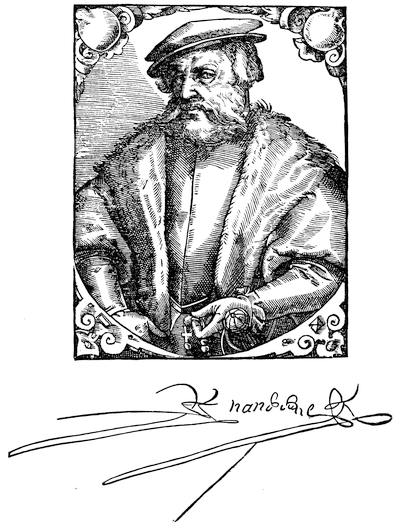
CORTÉS.
Fac-simile of a woodcut in Pauli Jovii elogia virorum bellica virtute illustrium (Basle, 1575), p. 348, and 1596, p. 229, called a portrait of Cortés.
The autograph follows one given by Prescott, revised ed., vol. iii. Autographs of his proper name, and of his title, Marques del Valle, are given in Cumplido’s edition of Prescott, vol. iii. An original autograph was noted for sale in Stevens (Bibliotheca geographica, no. 760), which is given in fac-simile in some of the illustrated copies of that catalogue. Prescott (vol. i. p. 447) mentions a banner, preserved in Mexico, though in rags, which Cortés is said to have borne in the Conquest. But compare Wilson’s New Conquest, p. 369.
In the spring (1522) Cortés was cheered by a report from the Audiencia of Santo Domingo, confirming his acts and promising intercession with the Emperor. To support this intercession, Cortés despatched to Spain some friends with his third letter, dated at Coyohuacan May 15, 1522. These agents carried also a large store of propitiatory treasure. Two of the vessels, which held most of it, were captured by French corsairs,[1077] and the Spanish gains enriched the coffers of Francis I. rather than those of Charles V. The despatches of Cortés, however, reached their destination, though Fonseca and the friends of Velasquez had conspired to prevent their delivery, and had even appropriated some part of the treasure which a third vessel had securely landed. Thus there were charges and countercharges, and Charles summoned a council to investigate. Cortés won. Velasquez, Fonseca, and Narvaez were all humiliated in seeing their great rival made, by royal command, governor and captain-general of New Spain.
Meanwhile Cortés, hearing of a proposed expedition under Garay to take possession of the region north of Villa Rica, conducted a force himself to seize, in advance, that province known as Pánuco, and to subjugate the Huastecs who dwelt there. This was done. The plunder proved small; but this disappointment was forgotten in the news which now, for the first time, reached Cortés of his late success in Spain. The whole country was jubilant over the recognition of his merit; and opportunely came embassies from Guatemala bringing costlier tributes than the Spaniards had ever seen before. This turned their attention to the south. There was apprehension that the Spaniards who were already at Panamá might sooner reach these rich regions, and might earlier find the looked-for passage from the Gulf to the south sea. To anticipate them, no time could be lost. So Alvarado, Olid, and Sandoval were given commands to push explorations and conquests southward and on either shore. Before the expeditions started, news came that Garay, arriving from Jamaica, had landed with a force at Pánuco to seize that region in the interests of the Velasquez faction. The mustered forces were at once combined under Cortés’ own lead, and marched against Garay,—Alvarado in advance. Before Cortés was ready to start, he was relieved from the necessity of going in person by the receipt of a royal order from Spain confirming him in the possession of Pánuco and forbidding Garay to occupy any of Cortés’ possessions. This order was hurriedly despatched to Alvarado; but it did not reach him till he had made some captives of the intruders. Garay readily assented to lead his forces farther north if restitution should be made to him of the captives and munitions which Alvarado had taken. This was not so easily done, for plunder in hand was doubly rich, and Garay’s own men preferred to enlist with Cortés. To compose matters Garay went to Mexico, where Cortés received him with ostentatious kindness, and promised him assistance in his northern conquests. In the midst of Cortés’ hospitality his guest sickened and died, and was buried with pomp.
While Garay was in Mexico, his men at Pánuco, resenting the control of Garay’s son, who had been left in charge of them, committed such ravages on the country that the natives rose on them, and were so rapidly annihilating them that Alvarado, who had left, was sent back to check the outbreak. He encountered much opposition; but conquered as usual, and punished afterward the chief ringleaders with abundant cruelty. Such of Garay’s men as would, joined the forces of Cortés, while the rest were sent back to Jamaica.
The thoughts of Cortés were now turned to his plan of southern exploration, and early in December Alvarado was on his way to Guatemala.[1078] Desperate fighting and the old success attended Cortés’ lieutenant, and the Quiché army displayed their valor in vain in battle after battle. It was the old story of cavalry and arquebusiers. As Alvarado approached Utatlan, the Quiché capital, he learned of a plot to entrap him in the city, which was to be burned about his ears. By a counterplot he seized the Quiché nobles, and burned them and their city. By the aid of the Cakchiquels he devastated the surrounding country. Into the territory of this friendly people he next marched, and was received royally by King Sinacam in his city of Patinamit (Guatemala), and was soon engaged with him in an attack on his neighbors, the Zutugils, who had lately abetted an insurrection among Sinacam’s vassals. Alvarado beat them, of course, and established a fortified post among them after they had submitted, as gracefully as they could. With Quichés and Cakchiquels now in his train, Alvarado still went on, burned towns and routed the country’s defenders, till, the rainy season coming on, he withdrew his crusaders and took up his quarters once more at Patinamit, late in July, 1524. From this place he sent despatches to Cortés, who forwarded two hundred more Spanish soldiers for further campaigns.
The Spanish extortions produced the usual results. The Cakchiquels turned under the abuse, deserted their city, and prepared for a campaign. The Spaniards found them abler foes than any yet encountered. The Cakchiquels devastated the country on which Alvarado depended for supplies, and the Spaniards found themselves reduced to great straits. It was only after receiving reinforcements sent by Cortés that Alvarado was enabled to push his conquests farther, and possess himself of the redoubtable fortress of Mixco and successfully invade the Valley of Zacatepec.
The expedition to Honduras was intrusted to Cristóbal de Olid, and started about a month after Alvarado’s to Guatemala. Olid was given a fleet; and a part of his instructions was to search for a passage to the great south sea. He sailed from the port now known as Vera Cruz on the 11th of January, 1524, and directed his course for Havana, where he was to find munitions and horses, for the purchase of which agents had already been sent thither by Cortés. While in Cuba the blandishments of Velasquez had worked upon Olid’s vanity, and when he sailed for Honduras he was harboring thoughts of defection. Not long after he landed he openly announced them, and gained the adherence of most of his men. Cortés, who had been warned from Cuba of Olid’s purpose, sent some vessels after him, which were wrecked. Thus Casas, their commander, and his men fell into Olid’s hands. After an interval, an opportunity offering, the captive leader conspired to kill Olid. He wounded and secured him, brought him to a form of trial, and cut off his head. Leaving a lieutenant to conduct further progress, Casas started to go to Mexico and make report to Cortés.
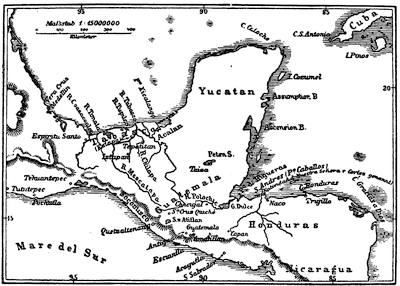
GUATEMALA AND HONDURAS.
Following the map given in Ruge’s, Zeitalter der Entdeckungen, p. 391. Cf. map in Fanshawe’s Yucatan.
Meanwhile, with a prescience of the mischief brewing, and impelled by his restless nature, Cortés had determined to march overland to Honduras; and in the latter part of October, 1524, he set out. He started with great state; but the difficulties of the way made his train a sorry sight as they struggled through morass after morass, stopped by river after river, which they were under the necessity of fording or bridging. All the while their provisions grew less and less. To add to the difficulties, some Mexican chieftains, who had been taken along as hostages for the security of Mexico, had conspired to kill Cortés, and then to march with their followers back to Mexico as deliverers. The plot was discovered, and the leaders were executed.[1079] Some of the towns passed by the army had been deserted by their inhabitants, without leaving any provisions behind. Guides which they secured ran away. On they went, however, hardly in a condition to confront Olid, should he appear, and they were now approaching his province. At last some Spaniards were met, who told them of Casas’ success; and the hopes of Cortés rose. He found the settlers at Nito, who had been decimated by malaria, now engaged in constructing a vessel in which to depart. His coming cheered them; and a ship opportunely appearing in the harbor with provisions, Cortés purchased her and her lading. He then took steps to move the settlement to a more salubrious spot. Using the newly acquired vessel, he explored the neighboring waters, hoping to find the passage to the south sea; and making some land expeditions, he captured several pueblos, and learned, from a native of the Pacific coast whom he fell in with, that Alvarado was conducting his campaign not far away. Finally, he passed on to Trujillo, where he found the colony of Olid’s former adherents, and confirmed the dispositions which Casas had made, while he sent vessels to Cuba and Jamaica for supplies.
At this juncture Cortés got bad news from Mexico. Cabal and anti-cabal among those left in charge of the government were having their effect. When a report reached them of the death of Cortés and the loss of his army, it was the signal for the bad spirits to rise, seize the government, and apportion the estates of the absentees. The most steadfast friend of Cortés—Zuazo—was sent off to Cuba, whence he got the news to Cortés by letter. After some hesitation and much saying of Masses, Cortés appointed a governor for the Honduras colony; and sending Sandoval with his forces overland, he embarked himself to go by sea. Various mishaps caused his ship to put back several times. Discouraged at last, and believing there was a divine purpose in keeping him in Honduras for further conquest, he determined to remain a while, and sent messengers instead to Mexico. Runners were also sent after Sandoval to bring him back.
Cortés now turned his attention to the neighboring provinces; and one after another he brought them into subjection, or gained their respect by interfering to protect them from other parties of marauding Spaniards. He had already planned conquests farther south, and Sandoval had received orders to march, when a messenger from Mexico brought the exhortations of his friends for his return to that city. Taking a small force with him, including Sandoval, he embarked in April, 1526. After being tempest-tossed and driven to Cuba, he landed late in May near Vera Cruz, and proceeded in triumph to his capital.
Cortés’ messenger from Honduras had arrived in good time, and had animated his steadfast adherents, who succeeded very soon in overthrowing the usurper Salazar and restoring the Cortés government. Then followed the request for Cortés’ return, and in due time his arrival. The natives vied with each other in the consideration which they showed to Malinche, as Cortés was universally called by them. Safe in their good wishes, Cortés moved by easy stages toward Mexico. Everybody was astir with shout and banner as he entered the city itself. He devoted himself at once to re-establishing the government and correcting abuses.
Meanwhile the enemies of Cortés at Madrid had so impressed the Emperor that he ordered a judge, Luis Ponce de Leon, to proceed to Mexico and investigate the charges against the Governor, and to hold power during the suspension of Cortés’ commission. Cortés received him loyally, and the transfer of authority was duly made,—Cortés still retaining the position of captain-general. Before any charges against Cortés could be heard, Ponce sickened and died, July 20, 1526; and his authority descended to Marcos de Aguilar, whom he had named as successor. He too died in a short time; and Cortés had to resist the appeals of his friends, who wished him to reassume the governorship and quiet the commotions which these sudden changes were producing. Meanwhile the enemies of Cortés were actively intriguing in Spain, and Estrada received a royal decree to assume alone the government, which with two others he had been exercising since the death of Aguilar. The patience of Cortés and his adherents was again put to a test when the new ruler directed the exile of Cortés from the city. Estrada soon saw his mistake, and made advances for a reconciliation, which Cortés accepted.
But new developments were taking place on the coast. The Emperor had taken Pánuco out of Cortés’ jurisdiction by appointing Nuño de Guzman to govern it, with orders to support Ponce if Cortés should resist that royal agent. Guzman did not arrive on the coast till May 20, 1527, when he soon, by his acts, indicated his adherence to the Velasquez party, and a disposition to encroach upon the bounds of New Spain. He was forced to deal with Cortés as captain-general; and letters far from conciliatory in character passed from Guzman to the authorities in Mexico. Estrada had found it necessary to ask Cortés to conduct a campaign against his ambitious neighbor; but Cortés felt that he could do more for himself and New Spain in the Old, and so prepared to leave the country and escape from the urgency of those of his partisans who were constantly trying to embroil him with Estrada. A letter from the new President of the Council of the Indies urging his coming, helped much to the determination. He collected what he could of treasure, fabric, and implement to show the richness of the country. A great variety of animals, representatives of the various subjugated peoples, and a showy train of dependents, among them such conspicuous characters as Sandoval and Tapia, with native princes and chieftains, accompanied him on board the vessels.

AUTOGRAPH OF SANDOVAL.
After a fac-simile in Cabajal, México, ii. 686.
Cortés, meanwhile, was ignorant of what further mischief his enemies had done in Spain. The Emperor had appointed a commission (audiencia) to examine the affairs of New Spain, and had placed Guzman at the head. It had full power to assume the government and regulate the administration. In December, 1528, and January, 1529, all the members assembled at Mexico. The jealous and grasping quality of their rule was soon apparent. The absence of Cortés in Spain threatened the continuance of their power; for reports had reached Mexico of the enthusiasm which attended his arrival in Spain. They accordingly despatched messengers to the Spanish court renewing the charges against Cortés, and setting forth the danger of his return to Mexico. Alvarado and other friends of Cortés protested in vain, and had to look on and see, under one pretext or another, all sorts of taxes and burdens laid upon the estates of the absent hero. He was also indicted in legal form for every vice and crime that any one might choose to charge him with; and the indictments stood against him for many years.
Guzman was soon aware of the smouldering hatred which the rule of himself and his associate had created; and he must have had suspicions of the representations of his rapacity and cruelty which were reaching Madrid from his opponents. To cover all iniquities with the splendor of conquest, he gathered a formidable army and marched to invade the province of Jalisco.
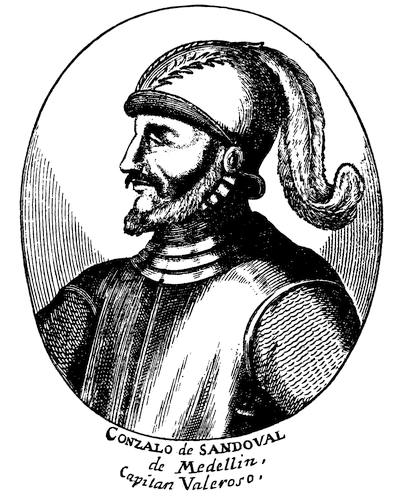
SANDOVAL.
Fac-simile of an engraving in Herrera, ii. 32. It is dressed up in Cabajal’s México, ii. 254.
Cortés, with his following, had landed at Palos late in 1528, and was under the necessity, a few days later, of laying the body of Sandoval—worn out with the Honduras campaign—in the vaults of La Rabida. It was a sad duty for Cortés, burdened with the grief that his young lieutenant could not share with him the honors now in store, as he made his progress to Toledo, where the Court then was. He was received with unaccustomed honor and royal condescensions,—only the prelude to substantial grants of territory in New Spain, which he was asked to particularize and describe. He was furthermore honored with the station and title of Marqués del Valle de Oajaca. He was confirmed as captain-general; but his reinstatement as governor was deferred till the reports of the new commission in New Spain should be received. He was, however, assured of liberty to make discoveries in the south sea, and to act as governor of all islands and parts he might discover westward.
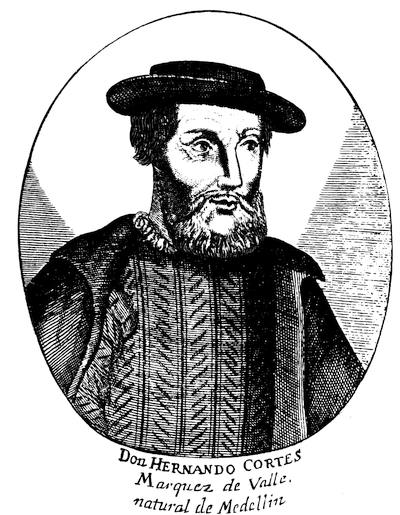
CORTÉS.
Fac-simile of an engraving in Herrera, ii. 1. There is also a portrait which hangs, or did hang, in the series of Viceroys in the Museo at Mexico. This was engraved for Don Antonio Uguina, of Madrid; and from his engraving the picture given second by Prescott is copied. Engravings of a picture ascribed to Titian are given in Townsend’s translation of Solis (London, 1724) and in the Madrid edition of Solis (1783). Cf. H. H. Bancroft, Mexico, i. 39, note. The Spanish translation of Clavigero, published in Mexico in 1844, has a portrait; and one “after Velasquez” is given in Laborde’s Voyage pittoresque, vol. iv., and in Jules Verne’s Découverte de la Terre.
A small copperplate representing Cortés in armor, with an uplifted finger and a full beard (accompanied by a brief sketch of his career) is given in Select Lives collected out of A. Thevet, Englished by I. S. (Cambridge, 1676), which is a section of a volume, Prosopographia (Cambridge, 1676), an English translation of Thevet’s Collection of Lives. The copper may be the same used in the French original.
The wife of Cortés, whom he had left in Cuba, had joined him in Mexico after the conquest, and had been received with becoming state. Her early decease, after a loftier alliance would have become helpful to his ambition, had naturally raised a suspicion among Cortés’ traducers that her death had been prematurely hastened.
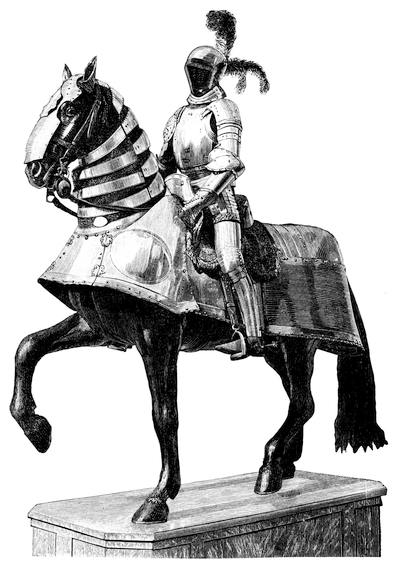
CORTÉS’ ARMOR.
Copied from an engraving (in Ruge’s Das Zeitalter der Entdeckungen, p. 405) of the original in the Museum at Madrid. Wilson refers to some plate armor in the Museum at Mexico, which he, of course, thinks apocryphal (New Conquest, p. 444).
He had now honors sufficient for any match among the rank of grandees; and a few days after he was ennobled he was married, as had been earlier planned, to the daughter of the late Conde de Aguilar and niece of the Duque de Béjar,—both houses of royal extraction.
Cortés now prepared to return to Mexico with his new titles. He learned that the Emperor had appointed a new audiencia to proceed thither, and it promised him better justice than he had got from the other. The Emperor was not, however, satisfied as yet that the presence of Cortés in Mexico was advisable at the present juncture, and he ordered him to stay; but the decree was too late, and Cortés, with a great retinue, had already departed. He landed at Vera Cruz, in advance of the new judge, July 15, 1530.
His reception was as joyous as it had been four years before; and though an order had reached him forbidding his approach within ten leagues of Mexico till the new audiencia should arrive, the support of his retinue compelled him to proceed to Tezcuco, where he awaited its coming, while he was put in the interim to not a little hazard and inconvenience by the efforts of the Guzman government to deprive him of sustenance and limit his intercourse with the natives.
Near the end of the year the new Government arrived,—or all but its president, Fuenleal, for he was the Bishop of Santo Domingo, whom the others had been ordered to take on board their vessel on the way; but stress of weather had prevented their doing this. The Bishop did not join them till September. In Mexico they took possession of Cortés’ house, which they had been instructed to appropriate at an appraisement.
AUTOGRAPH OF FUENLEAL (Episcopus Sancti Dominici).
The former Government was at once put on trial, and judgment was in most cases rendered against them, so that their property did not suffice to meet the fines imposed. Cortés got a due share of what they were made to disgorge, in restitution of his own losses through them. Innumerable reforms were instituted, and the natives received greater protection than ever before.
Guzman, meanwhile, was on his expedition toward the Pacific coast, conducting his rapacious and brutal conquest of Nueva Galicia. He refused to obey the call of the new audiencia, while he despatched messengers to Mexico to protect, if possible, his interests. By them also he forwarded his own statement of his case to the Emperor. Cortés, vexed at Guzman’s anticipation of his own intended discoveries toward the Pacific, sent a lieutenant to confront him; but Guzman was wily enough to circumvent the lieutenant, seized him, and packed him off to Mexico with scorn and assurance.
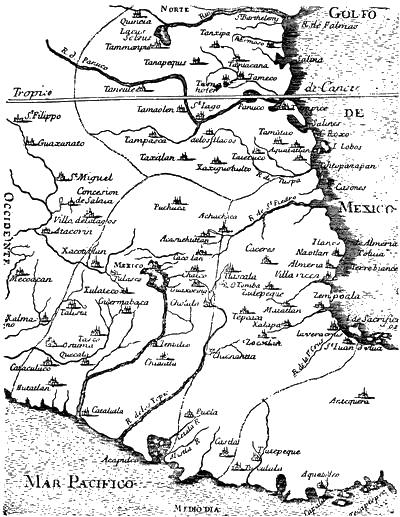
MEXICO AND ACAPULCO.
Fac-simile of a map in Herrera, i. 408.
It was his last hour of triumph. His force soon dwindled; his adherents deserted him; his misdeeds had left him no friends; and he at last deserted the remnant of his army, and starting for Pánuco, turned aside to Mexico on the way. He found in the city a new régime. Antonio de Mendoza had been sent out as viceroy, and to succeed Fuenleal at the same time as president of the audiencia. He had arrived at Vera Cruz in October, 1535. His rule was temperate and cautious. Negroes, who had been imported into the country in large numbers as slaves, plotted an insurrection: but the Viceroy suppressed it; and if there was native complicity in the attempt, it was not proved. The Viceroy had received from his predecessors a source of trial and confusion in the disputed relations which existed between the civil rulers and the Captain-General. There were endless disputes with the second audiencia, and disagreements continued to exist with the Viceroy, about the respective limits of the powers of the two as derived from the Emperor.
Cortés had been at great expense in endeavoring to prosecute discovery in the Pacific, and he had the vexation of seeing his efforts continually embarrassed by the new powers. Previous to his departure for Spain he had despatched vessels from Tehuantepec to the Moluccas to open traffic with the Asiatic Indies; but the first audiencia had prevented the despatch of a succoring expedition which Cortés had planned. On his return to New Spain the Captain-General had begun the construction of new vessels both at Tehuantepec and at Acapulco; but the second audiencia interfered with his employment of Indians to carry his material to the coast. He however contrived to despatch two vessels up the coast under Hurtado de Mendoza, which left in May, 1532. They had reached the coast to the north, where Guzman was marauding, who was glad of the opportunity of thwarting the purpose of his rival. He refused the vessels the refuge of a harbor, and they were subsequently lost. Cortés now resolved to give his personal attention to these sea explorations, and proceeding to Tehuantepec, he superintended the construction of two vessels, which finally left port Oct. 29, 1533. They discovered Lower California. Afterward one of the vessels was separated from the other, and fell in distress into the hands of Guzman while making a harbor on the coast. The other ship reached Tehuantepec. Cortés appealed to the audiencia, who meted equal justice in ordering Guzman to surrender the vessel, and in commanding Cortés to desist from further exploration. An appeal to the Emperor effected little, for it seems probable that the audiencia knew what support it had at court. Cortés next resolved to act on his own responsibility and take command in person of a third expedition.
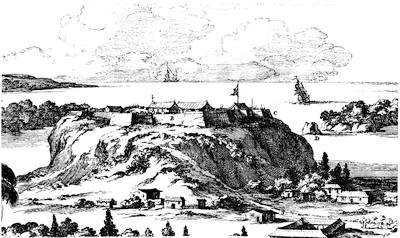
ACAPULCO.[1080]
So, in the winter of 1534-1535, he sent some vessels up the coast, and led a land force in the same direction. Guzman fled before him. Cortés joined his fleet at the port where Guzman had seized his ship on the earlier voyage, and embarked. Crossing to the California peninsula, he began the settlement of a colony on its eastern shore. He left the settlers there, and returned to Acapulco to send forward additional supplies and recruits.
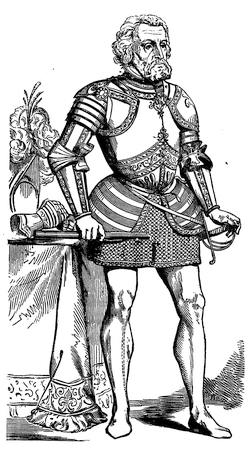
CORTÉS.
This follows a sketch of the picture, in the Hospital of Jesus at Mexico, which is given in Charton’s Voyageurs, iii. 359. Prescott gives an engraving after a copy then in his own possession. The picture in the Hospital is also said to be a copy of one taken in Spain a few years before the death of Cortés, during his last visit. The original is not known to exist. The present descendants of the Conqueror, the family of the Duke of Monteleone in Italy, have only a copy of the one at Mexico. Another copy, made during General Scott’s occupation of the city, is in the gallery of the Pennsylvania Historical Society (Catalogue, no. 130). The upper part of the figure is reproduced in Carbajal’s Historia de México, ii. 12; and it is also given entire in Cumplido’s edition of Prescott’s Mexico, vol. iii.
At this juncture the new Viceroy had reached Mexico; and it was not long before he began to entertain schemes of despatching fleets of discovery, and Cortés found a new rival in his plans. The Captain-General got the start of his rival, and sent out a new expedition from Acapulco under Francisco de Ulloa; but the Viceroy gave orders to prevent other vessels following, and his officers seized one already at sea, which chanced to put into one of the upper ports. Cortés could endure such thraldom no longer, and early in 1540 he left again for Spain to plead his interests with the Emperor. He never saw the land of his conquest again.
We left Guzman for a while in Mexico, where Mendoza not unkindly received him, as one who hated Cortés as much or more than he did. Guzman was bent on escaping, and had ordered a vessel to be ready on the coast. He was a little too late, however. The Emperor had sent a judge to call him to account, and Guzman suddenly found this evil genius was in Mexico. The judge put him under arrest and marched him to prison. A trial was begun; but it dragged along, and Guzman sent an appeal forward to the Council for the Indies, in which he charged Cortés with promoting his persecution. He was in the end remanded to Spain, where he lingered out a despised life for a few years, with a gleam of satisfaction, perhaps, in finding, some time after, that Cortés too had found a longer stay in New Spain unprofitable.
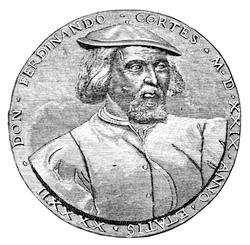
CORTÉS MEDAL.
This follows the engraving in Ruge’s Das Zeitalter der Entdeckungen (p. 361) of a specimen in the Royal Cabinet at Berlin. The original is of the same size.
Cortés had reached Spain in the early part of 1540, and had been received with honor by the Court; but when he began to press for a judgment that might restore his losses and rehabilitate him in his self-respect, he found nothing but refusal and procrastination. He asked to return to Mexico, but found he could not. With a reckless aim he joined an expedition against Algiers; but the ship on which he embarked was wrecked, and he only saved himself by swimming, losing the choicest of his Mexican jewels, which he carried on his person. Then again he memorialized the Emperor for a hearing and award, but was disregarded. Later he once more appealed, but was still unheard. Again he asked permission to return to New Spain. This time it was granted; but before he could make the final preparations, he sank under his burdens, and at a village near Seville Cortés died on the 2d of December, 1547, in his sixty-second year.[1081]

CRITICAL ESSAY ON THE DOCUMENTARY SOURCES OF MEXICAN HISTORY.
MR. H. H. BANCROFT, in speaking of the facilities which writers of Spanish American history now have in excess of those enjoyed by the historian of thirty years ago, claims that in documentary evidence there are twenty papers for his use in print to-day for one then.[1082] These are found in part in the great Coleccion of Pacheco and others mentioned in the Introduction. The Mexican writer Joaquin Garcia Icazbalceta (born 1825) made a most important contribution in the two volumes of a Coleccion de documentos para la historia de México which passes by his name and which appeared respectively in 1858 and 1866.[1083] He found in Mexico few of the papers which he printed, obtaining them chiefly from Spain.
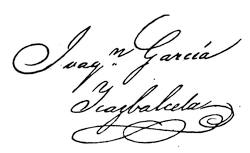
Of great interest among those which he gives is the Itinerario of Grijalva, both in the Italian and Spanish text.[1084] Of Cortés himself there are in this publication various letters not earlier made public. The quarrel between him and Velasquez is illustrated by other papers. Here also we find what is mentioned elsewhere as “De rebus gestis Cortesii” printed as a “Vida de Cortés,” and attributed to C. Calvet de Estrella. The recital of the so-called “Anonymous Conqueror,” held by some to be Francisco de Terrazas, is translated from Ramusio (the original Spanish is not known), with a fac-simile of the plan of Mexico.[1085] There is also the letter from the army of Cortés to the Emperor; and in the second volume various other papers interesting in connection with Cortés’ career, including the memorial of Luis de Cárdenas, etc. Two other papers have been recognized as important. One of these in the first volume is the Historia de los Indios de Nueva España of Fray Toribio Motolinia, accompanied by a Life of the Father by Ramirez, with a gathering of bibliographical detail. Toribio de Benavente—Motolinia was a name which he took from a description of him by the natives—had come over with the Franciscans in 1523. He was a devoted, self-sacrificing missionary; but he proved that his work did not quiet all the passions, for he became a violent opponent of Las Casas’ views and measures.[1086] His labors took him the length and breadth of the land; his assiduity acquired for him a large knowledge of the Aztec tongue and beliefs; and his work, besides describing institutions of this people, tells of the success and methods secured or adopted by himself and his companions in effecting their conversion to the faith of the conquerors. Robertson used a manuscript copy of the work, and Obadiah Rich procured a copy for Prescott, who ventured the assertion, when he wrote, that it had so little of popular interest that it would never probably be printed.[1087]
Bancroft[1088] calls the Relacion of Andrés de Tápia one of the most valuable documents of the early parts of the Conquest. It ends with the capture of Narvaez; recounting the antecedent events, however, with “uneven completeness.” It is written warmly in the interests of Cortés. Icazbalceta got what seemed to be the original from the Library of the Academy of History in Madrid, and printed it in his second volume (p. 554). It was not known to Prescott, who quotes it at second hand in Gomara.[1089]
The next most important collection is that published in Mexico from 1852 to 1857,[1090] under the general title of Documentos para la historia de México. This collection of four series, reckoned variously in nineteen or twenty-one volumes, is chiefly derived from Mexican sources, and is largely illustrative of the history of northwestern Mexico, and in general concerns Mexican history of a period posterior to the Conquest.
There have been two important series of documents published and in part unearthed by José Fernando Ramirez, who became Minister of State under Maximilian. The first of these is the testimony at the examination of the charges which were brought against Pedro de Alvarado, and some of those made in respect to Nuño de Guzman,—Procesos de residencia,[1091] which was published in Mexico in 1847;[1092] the other set of documents pertain to the trial of Cortés himself. Such of these as were found in the Mexican Archives were edited by Ignacio L. Rayon under the title of Archivo Mexicano; Documentos para la historia de México, and published in the city of Mexico in 1852-1853, in two volumes. At a later day (1867-1868) Ramirez discovered in the Spanish Archives other considerable portions of the same trial, and these have been printed in the Coleccion de documentos inéditos de las Indias, vols. xxvi.-xxix.
The records of the municipality of Mexico date from March 8, 1524, and chronicle for a long time the sessions as held in Cortés’ house; and are particularly interesting, as Bancroft says,[1093] after 1524, when we no longer have Cortés’ own letters to follow, down to 1529. Harrisse has told us what he found in the repositories of Italy, particularly at Venice, among the letters sent to the Senate during this period by the Venetian ambassadors at Madrid.[1094] Three volumes have so far been published of a Coleccion de documentos para la historia de Costa-Rica at San José de Costa-Rica, under the editing of León Fernández, which have been drawn from the Archives of the Indies and from the repositories in Guatemala. A few letters of Alvarado and other letters of the Conquest period are found in the Coleccion de documentos antiguous de Guatemala published at Guatemala in 1857.[1095]
No more voluminous contributor to the monographic and documentary history of Mexico can be named than Carlos Maria de Bustamante. There will be occasion in other connections to dwell upon particular publications, and some others are of little interest to us at present, referring to periods as late as the present century. Bustamante was a Spaniard, but he threw himself with characteristic energy into a heated advoracy of national Mexican feelings; and this warmly partisan exhibition of himself did much toward rendering the gathering of his scattered writings very difficult, in view of the enemies whom he made and of their ability to suppress obnoxious publications when they came into power. Most of these works date from 1812 to 1850, and when collected make nearly or quite fifty volumes, though frequently bound in fewer.[1096] The completest list, however, is probably that included in the enumeration of authorities prefixed by Bancroft to his Central America and Mexico, which shows not only the printed works of Bustamante, but also the autograph originals,—which, Bancroft says, contain much not in the published works.[1097] Indeed, these lists show an extremely full equipment of the manuscript documentary stores relating to the whole period of Mexican history,[1098] including a copy of the Archivo general de México, as well as much from the catalogues of José Maria Andrade and José Fernando Ramirez, records of the early Mexican councils, and much else of an ecclesiastical and missionary character not yet put in print.[1099]
Of particular value for the documents which it includes is the Historia de la fundacion y discurso de la provincia de Santiago de México, de la orden de predicadores, por las vidas de sus varones insignes y casos notables de Nueva España, published in Madrid in 1596.[1100] The author, Davilla Padilla, was born in Mexico in 1562 of good stock; he became a Dominican in 1579, and died in 1604. His opportunities for gathering material were good, and he has amassed a useful store of information regarding the contact of the Spanish and the Indians, and the evidences of the national traits of the natives. His book has another interest, in that we find in it the earliest mention of the establishment of a press in Mexico.[1101]
One of the earliest of the modern collections of documents and early monographs is the Historiadores primitivos de las Indias occidentales of Andres Gonzales de Barcia Carballido y Zuniga (known usually as Barcia), published at Madrid in 1749 in three volumes folio, and enriched with the editor’s notes. The sections were published separately; and it was not till after the editor’s death (1743) that they were grouped and put out collectively with the above distinctive title. In this form the collection is rare, and it has been stated that not over one or two hundred copies were so gathered.[1102]
First among all documents respecting the Conquest are the letters sent by Cortés himself to the Emperor; and of these a somewhat detailed bibliographical account is given in the Notes following this Essay, as well as an examination of the corrective value of certain other contemporaneous and later writers.

NOTES.
A. The Letters of Cortés.—I. The Lost First Letter, July 10, 1519. The series of letters which Cortés sent to the Emperor is supposed to have begun with one dated at Vera Cruz in July, 1519, which is now lost, but which Barcia and Wilson suppose to have been suppressed by the Council of the Indies at the request of Narvaez. There are contemporaneous references to show that it once existed. Cortés himself mentions it in his second letter, and Bernal Diaz implies that it was not shown by Cortés to his companions. Gomara mentions it, and is thought to give its purport in brief. Thinking that Charles V. may have carried it to Germany, Robertson caused the Vienna Archives to be searched, but without avail; though it has been the belief that this letter existed there at one time, and another sent with it is known to be in those Archives. Prescott caused thorough examinations of the repositories of London, Paris, and Madrid to be made,—equally without result.
Fortunately the same vessel took two other letters, one of which we have. This was addressed by the justicia y regimiento of La Villa Rica de la Vera Cruz, and was dated July 10, 1519. It was discovered, by Robertson’s agency, in the Imperial Library at Vienna. It rehearses the discoveries of Córdoba and Grijalva, and sustains the views of Cortés, who charged Velasquez with being incompetent and dishonest. This letter is sometimes counted as the first of the series; for though it was not written by Cortés, he is thought to have inspired it.[1103]
The other letter is known only through the use of it which contemporary writers made. It was from some of the leading companions in arms of Cortés, who, while they praised their commander, had something to say of others not quite to the satisfaction of Cortés. The Conqueror, it is intimated, intrigued to prevent its reaching the Emperor,—which may account for its loss. Las Casas and Tapia both mention it.[1104]
Beside the account given in Gomara of Cortés’ early life and his doings in the New World up to the time of his leaving Cuba in 1519, there is a contemporary narrative, quite in Cortés’ interest, of unknown authorship, which was found by Muñoz at Simancas.[1105] The Latin version is called “De rebus gestis Ferdinandi Cortesii;” but it is called “Vida de Hernan Cortés” in the Spanish rendering which is given by Icazbalceta in his Coleccion de documentos, i. 309-357.[1106]
A publication of Peter Martyr at Basle in 1521 is often taken as a substitute for the lost first epistle of Cortés. This is the De nuper sub D. Carolo repertis insulis ... Petri Martyris enchiridion, which gives a narrative of the expeditions of Grijalva and Cortés, as a sort of supplement to what Peter Martyr had written on the affairs of the Indies in his Three Decades. It was afterward included in his Basle edition of 1533 and in the Paris Extraict of 1532.[1107]