FOOTNOTES:
Reading edition
“The English reader,” writes Irving in 1828, when he had published his own Life of Columbus, “hitherto has derived his information almost exclusively from the notice of Columbus in Dr. Robertson’s History; this, though admirably executed, is but a general outline.”—Life of Irving, ii. 313.
“Jacet extra sidera tellus,” etc.,
is in the Geographia of Henricus Glareanus, published at Basle in 1527. Cf. also Gravier, Les Normands sur la route des Indes, Rouen, 1880, p. 24; Harrisse, Bibl. Am. Vet. 262. Mr. Murphy, in placing the 1472 edition of Strabo’s De Situ orbis in his American collection, pointed to the belief of this ancient geographer in the existence of the American continent as a habitable part of the globe, as shown when he says: “Nisi Atlantici maris obstaret magnitudo, posse nos navigare per eundem parallelum ex Hispania in Indiam, etc.” Cf. further, Charles Sumner’s Prophetic Voices concerning America; also in his Works; Bancroft’s Native Races, v. 68, 122; Baldwin’s Prehistoric Nations, 399; Fontaine’s How the World was peopled, p. 139; Las Casas, Historia general; Sherer, Researches touching the New World, 1777; Recherches sur la géographie des anciens, Paris, 1797-1813; Memoirs of the Lisbon Academy, v. 101; Paul Gaffarel, L’Amérique avant Colomb, and his “Les Grecs et les Romains, ont ils connu l’Amérique?” in the Revue de Géographie (1881), ix. 241, etc.; Ferdinand Columbus’ life of his father, and Humboldt’s examination of his views in his Examen critique; Brasseur de Bourbourg’s Introduction to his Popul-Vuh.
Glareanus, above referred to, was one of the most popular of the condensed cosmographical works of the time; and it gave but the briefest reference to the New World, “de regionibus extra Ptolemæum.” Its author was under thirty when he published his first edition in 1527 at Basle. There is a copy in the Carter-Brown Library (Catalogue, i. 90). Cf. also Bibl. Amer. Vet., 142; Huth, ii. 602; Weigel, 1877, p. 82, priced at 18 marks. It was reprinted at Basle, the next year, 1528 (Trömel, 3), and again in 1529. (Bibl. Amer. Vet., 143, 147.) Another edition was printed at Freiburg (Brisgau) in 1530, of which there are copies in Harvard College and Carter-Brown (Catalogue, no. 95) libraries. (Cf. Bibl. Amer. Vet., 147; Muller, 1877, no. 1,232.) There were other Freiburg imprints in 1533, 1536, 1539, 1543, and 1551. (Bibl. Amer. Vet., 183, 212, 248; Additions, 121; Carter-Brown, i. 160; White Kennett, p. 12; Trömel, no. 12; Murphy, 1049.) There were Venice imprints in 1534, 1537, 1538, 1539, and 1544. (Bibl. Amer. Vet., 225, 228, 259; Additions, 120; Lancetti, Buchersaal, i. 79.) An edition of Venice, without date, is assigned to 1549. (Catalogue of the Sumner Collection in Harvard College Library.) Editions were issued at Paris in 1542, with a folded map, “Typus cosmographicus universalis,” in 1550 (Court, 144), and in 1572, the last repeating the map. (Bibl. Amer. Vet., 139.) The text of all these editions is in Latin. Sabin, vol. vii. no. 27,536, etc., enumerates most of the editions.
It seems to be a fact that Behaim made a map showing the straits passed by Magellan, which Pigafetta refers to; and it is also clear that Schöner, in globes made earlier, also indicated a similar strait; and Schöner might well have derived his views from Behaim. What we know of Behaim’s last years, from 1494 to 1506, is not sufficient to fill the measure of these years; and advocates are not wanting who assign to them supposed voyages, on one of which he might have acquired a personal knowledge of the straits which he delineated. Such advocates are met, and will continue to be answered, with the likelier supposition, as is claimed, of the Straits in question being a happy guess, both on Behaim’s and Schöner’s part, derived from the analogy of Africa,—a southern extremity which Behaim had indeed delineated on his globe some years before its actual discovery, though not earlier than the existence of a prevalent belief in such a Strait. Cf. Wieser, Magalhâes-Strasse.
Cf. Nuñez de la Peña’s Conquista y antiguedades de las Islas de la Gran Canaria, Madrid, 1676, and reprint, Santa Cruz de Tenerife, 1847; Cristóval Perez de el Christo, Las siete Islas de Canaria, Xeres, 1679 (rare, Leclerc, no. 644,—100 francs); Viera y Clavijo, Historia general de las Islas de Canaria, Madrid, four volumes, 1772-1783 (Leclerc, no. 647, calls it the principal work on the Canaries); Bory de Saint Vincent, Essais sur les Isles Fortunées, Paris, an xi. (1803); Les Iles Fortunées, Paris, 1869. D’Avezac, in 1846, published a Note sur la première expéditien de Béthencourt aux Canaries, and his “Isles d’Afrique” in the Univers pittoresque may be referred to.
“Portugal,” says Professor Seeley, “had almost reason to complain of the glorious intrusion of Columbus. She took the right way, and found the Indies; while he took the wrong way, and missed them.... If it be answered in Columbus’s behalf, that it is better to be wrong and find America, than to be right and find India, Portugal might answer that she did both,”—referring to Cabral’s discovery of Brazil (Expansion of England, p. 83).
The earliest compiled account from the same sources which appeared in print was issued, while Columbus was absent on his last voyage, in the Nouissime Hystoriarum omnium repercussiones, que supplementum Supplementi Cronicarum nuncupantur ... usque in annum 1502, of Jacopo Filippo Foresti (called Bergomenses, Bergomas, or some other form), which was dated at Venice, 1502 (colophon, 1503), and contained a chapter “De insulis in India,” on leaf 441, which had not been included in the earlier editions of 1483, 1484, 1485, 1486, and 1493, but is included in all later editions (Venice, 1506; Nuremberg, 1506; Venice, 1513, 1524; Paris, 1535), except the Spanish translation (Harrisse, Bibl. Amer. Vet., nos. 42, 138, 204, and Additions, nos. 11, 75; Sabin, vol. vi. nos. 25,083, 25,084; Stevens, 1870, no. 175, $11; Carter-Brown, vol. i. nos. 19, 27; Murphy, no. 226; Quaritch, no. 11,757, £4). There are copies in the Library of Congress, the Carter-Brown and Lenox libraries, and in the National Library in Paris.
The inference from Columbus’ final testamentary language is certainly against the lady’s chastity. In his codicil he enjoins his son Diego to provide for the respectable maintenance of the mother of Ferdinand, “for the discharge of my conscience, for it weighs heavy on my soul.” Irving and others refer to this as the compunction of the last hours of the testator. De Lorgues tries to show that this codicil was made April 1, 1502 (though others claim that the document of this date was another will, not yet found), and only copied at Segovia, Aug. 25, 1505, and deposited in legal form with a notary at Valladolid, May 19, 1506. Columbus dying May 20,—the effect of all which is only to carry back, much to Columbus’ credit, the compunction to an earlier date. The will (1498), but not the codicil, is given in Irving, app. xxxiv. Cancellieri, in his Dissertazioni, gives it imperfectly; but it is accurately given in the Transactions of the Genoa Academy. Cf. Harrisse (Notes on Columbus) p. 160; Torre’s Scritti di Colombo; Colon en Quisqueya, Santo Domingo (1877), pp. 81, 99; Cartas y testamento, Madrid, 1880; Navarrete, Coleccion; and elsewhere.

There is a list of the books in B. Gallardo’s Ensayo de una bibliotheca de libros españoles raros. Harrisse gives the fullest account of Ferdinand and his migrations, which can be in part traced by the inscriptions in his books of the place of their purchase; for he had the habit of so marking them. Cf. a paper on Ferdinand, by W. M. Wood, in Once a Week, xii. 165.
“A Castilla y á Leon Nuevo Mundo dió Colon,”—
said to have been put on his tomb, there is no evidence that it ever was actually used, being only proposed in the Elegías of Castellanos, 1588.
As to the work which has been done in the geographical societies of Germany, we shall have readier knowledge when Dr. Johannes Müller’s Die wissenschaftlichen Vereine und Gesellschaften Deutschlands,—Bibliographie ihrer Veröffentlichungen, now announced in Berlin, is made public. One of the most important sale-catalogues of maps is that of the Prince Alexandre Labanoff Collection, Paris, 1823,—a list now very rare. Nos. 1-112 were given to the world, and 1480-1543 to America separately.
Johann Stoeffler was a leading authority on the methods of defining latitude and longitude in vogue in the beginning of the new era; cf. his Elucidatio fabricæ ususque astrolabii, Oppenheim, 1513 (colophon 1512), and his edition of In Procli Diadochi sphæram omnibus numeris longe absolutissimus commentarius, Tübingen, 1534, where he names one hundred and seventy contemporary and earlier writers on the subject. (Stevens, Bibl. Geog., nos. 2,633-2,634.)
It is a fact that good luck or skill of some undiscernible sort enabled Cabot to record some remarkable approximations of longitude in an age when the wildest chance governed like attempts in others. Cabot indeed had the navigator’s instinct; and the modern log-book seems to have owed its origin to his practices and the urgency with which he impressed the importance of it upon the Muscovy Company.
In 1714 the English Government, following an example earlier set by other governments, offered a reward of £20,000 to any one who would determine longitude at sea within half a degree. It was ultimately given to Harrison, a watchmaker who made an improved marine chronometer. An additional £3,000 was given at the same time to the widow of Tobias Meyer, who had improved the lunar tables. It also instigated two ingenious mechanicians, who hit upon the same principle independently, and worked out its practical application,—the Philadelphian, Thomas Godfrey, in his “mariner’s bow” (Penn. Hist. Soc. Coll., i. 422); and the Englishman, Hadley, in his well-known quadrant.
It can hardly be claimed to-day, with all our modern appliances, that a ship’s longitude can be ascertained with anything more than approximate precision. The results from dead-reckoning are to be corrected in three ways. Observations on the moon will not avoid, except by accident, errors which may amount to seven or eight miles. The difficulties of making note of Jupiter’s satellites in their eclipse, under the most favorable conditions, will be sure to entail an error of a half, or even a whole, minute. This method, first tried effectively about 1700, was the earliest substantial progress which had been made; all the attempts of observation on the opposition of planets, the occultations of stars, the difference of altitude between the moon and Jupiter, and the changes in the moon’s declination, having failed of satisfactory results (Humboldt, Cosmos, Eng. tr., ii. 671). John Werner, of Nuremberg, as early as 1514, and Gemma Frisius, in 1545, had suggested the measure of the angle between the altitude of the moon and some other heavenly body; but it was not till 1615 that it received a trial at sea, through the assiduity of Baffin. The newer method of Jupiter’s satellites proved of great value in the hands of Delisle, the real founder of modern geographical science. By it he cut off three hundred leagues from the length of the Mediterranean Sea, and carried Paris two and a half degrees, and Constantinople ten degrees, farther west. Corrections for two centuries had been chiefly made in a similar removal of places. For instance, the longitude of Gibraltar had increased from 7° 50´ W., as Ptolemy handed it down, to 9° 30´ under Ruscelli, to 13° 30´ under Mercator, and to 14° 30´ under Ortelius. It is noticeable that Eratosthenes, who two hundred years and more before Christ was the librarian at Alexandria and chief of its geographical school, though he made the length of the Mediterranean six hundred geographical miles too long, did better than Ptolemy three centuries later, and better even than moderns had done up to 1668, when this sea was elongated by nearly a third beyond its proper length. Cf. Bunbury, History of Ancient Geography, i. 635; Gosselin, Géog. des Grecs, p. 42. Sanson was the last, in 1668, to make this great error.
The method for discovering longitude which modern experience has settled upon is the noting at noon, when the weather permits a view of the sun, of the difference of a chronometer set to a known meridian. This instrument, with all its modern perfection, is liable to an error of ten or fifteen seconds in crossing the Atlantic, which may be largely corrected by a mean, derived from the use of more than one chronometer. The first proposition to convey time as a means of deciding longitude dates back to Alonzo de Santa Cruz, who had no better time-keepers than sand and water clocks (Humboldt, Cosmos, Eng. tr., ii. 672).
On land, care and favorable circumstances may now place an object within six or eight yards of its absolute place in relation to the meridian. Since the laying of the Atlantic cable has made it possible to use for a test a current which circles the earth in three seconds, it is significant of minute accuracy, in fixing the difference of time between Washington and Greenwich, that in the three several attempts to apply the cable current, the difference between the results has been less than 7/100 of a second.
But on shipboard the variation is still great, though the last fifty years has largely reduced the error. Professor Rogers, of the Harvard College Observatory, in examining one hundred log-books of Atlantic steamships, has found an average error of three miles; and he reports as significant of the superior care of the Cunard commanders that the error in the logs of their ships was reduced to an average of a mile and a half.
1. Columbus, Aug. 3, 1492—March 15, 1493.
2. Columbus, Sept. 25, 1493—June 11, 1496.
3. Columbus, May 30, 1498—Nov. 25, 1500.
4. Alonzo de Ojeda, May 20, 1499—June, 1500, to the Orinoco.
5. Piro Alonzo Niño and Christoval Guerra, June, 1499—April, 1500, to Paria.
6. Vicente Yañez Pinzon, December, 1499—September, 1500, to the Amazon.
7. Diego de Lepe, December, 1499 (?)—June, 1500, to Cape St. Augustin.
8. Rodrigo de Bastidas, October, 1500—September, 1502, to Panama.
In 1561 the edition published at Basle, De cosmogaphiæ rudimentis libri VIII., was rather tardily furnished with new maps better corresponding to the developments of American geography. (Muller, 1877, no. 1,459.) The Tiguri publishers still, however, adhered to the old plates in their editions of 1565 (Carter-Brown, no. 257; Sabin, no. 32,797); and the same plates again reappeared in an edition, without place, published in 1570 (Muller, 1877, no. 1,457), in another of Tiguri in 1583, and in still another without place in 1590 (Murphy, no. 1,253; Muller, 1872, no. 763; Sabin, no. 32,799).
This “L. F. 1522” map (see p. 175), as well as the “Admiral’s map,” was reproduced in the edition of 1535, edited by Servetus, of which there are copies in the Astor, the Boston Public, and the College of New Jersey libraries, and in the Carter-Brown and Barlow collections. A copy is also noted in the Murphy Catalogue, no. 2,057, which is now at Cornell University.
The American maps of these editions were again reproduced in the Ptolemy, published at Vienna in 1541, of which there are copies in the Carter-Brown, Brevoort, and Kalbfleisch collections. Cf. Winsor’s Bibliography of Ptolemy.
[Dr. Shea, in 1846, published a paper in the United States Catholic Magazine, v. 604 (translated into German in Die Katolische Kirche in den V. S. von Nordamerika, Regensburg, 1864, pp. 202-209), on the Segura mission; and another in 1859 in the Historical Magazine, iii. 268, on the Spanish in the Chesapeake from 1566 to 1573; and his account of a temporary Spanish settlement on the Rappahannock in 1570 is given in Beach’s Indian Miscellany, or the “Log Chapel on the Rappahannock” in the Catholic World, March, 1875. Cf. present History, Vol. III. p. 167, and a paper on the “Early Indian History of the Susquehanna,” by A. L. Guss, in the Historical Register; Notes and Queries relating to the Interior of Pennsylvania, 1883, p. 115 et seq. De Witt Clinton, in a Memoir on the Antiquities of the Western Parts of New York, published at Albany in 1820, expressed an opinion that traces of Spanish penetration as far as Onondaga County, N. Y., were discoverable; but he omitted this statement in his second edition. Cf. Sabin, vol. iv. no. 13,718.—Ed.]
The engravings were reproduced in heliotypes; and with the text translated by Frederick B. Perkins, it was published in Boston in 1875 as the Narrative of Le Moyne, an Artist who accompanied the French Expedition to Florida under Laudonnière, 1564. These engravings have been in part reproduced several times since their issue, as in the Magazin pittoresque, in L’univers pittoresque, in Pickett’s Alabama, etc.—Ed.]
b. In the Bibliothèque Nationale, no. 1,886. Printed by Ternaux-Compans in his Recueil, etc., p. 301, and by Gaffarel, p. 483, collated with the other manuscripts and translated into English in French’s Historical Collections of Louisiana and Florida, ii. 267. This copy bears the name of Robert Prévost; but whether as author or copyist is not clear, says Parkman (p. 142).
c. In the Bibliothèque Nationale, no. 2,145. Printed at Bordeaux in 1867 by Ph. Tamizey de Larroque, with preface and notes, and giving also the text marked e below.
d. In the Bibliothèque Nationale, no. 3,384. Printed by Taschereau in the Revue rétrospective (1835), ii. 321.
e. In the Bibliothèque Nationale, no. 6,124. See c above.
The account in the Histoire notable is called an abridgment by Sparks, and of this abridgment there is a Latin version in De Bry, part ii.,—De quarta Gallorum in Floridam navigatione sub Gourguesio. See other abridgments in Popellinière, Histoire des trois mondes (1582), Lescarbot, and Charlevoix.]
There is a curious article, “Dominique de Gourgues, the Avenger of the Huguenots in Florida, a Catholic,” in the Catholic World, xxi. 701.
It is true that scattered over all the ably-wrought pages of Mr. Prescott’s volumes are expressions of the sternest judgment and the most indignant condemnation passed upon the most signal enormities of these incarnate spoilers, who made a sport of their barbarity. But those who have most severely censured the author upon the matter now in view have done so under the conviction that cruelty unprovoked and unrelieved was so awfully dark and prevailing a feature in every stage and incident of the Spanish advance in America, that no glamour of adventure or chivalric deeds can in the least lighten or redeem it. The underlying ground of variance is in the objection to the use of the terms “Conquest” and “Conquerors,” as burdened with the relation of such a pitiful struggle between the overmastering power of the invaders and the abject helplessness of their victims.
As I am writing this note, my eye falls upon the following extract from a private letter written in 1847 by that eminent and highly revered divine, Dr. Orville Dewey, and just now put into print: “I have been reading Prescott’s Peru. What a fine accomplishment there is about it! And yet there is something wanting to me in the moral nerve. History should teach men how to estimate characters; it should be a teacher of morals; and I think it should make us shudder at the names of Cortez and Pizarro. But Prescott does not; he seems to have a kind of sympathy with these inhuman and perfidious adventurers, as if they were his heroes. It is too bad to talk of them as the soldiers of Christ; if it were said of the Devil, they would have better fitted the character” (Autobiography and Letters of Orville Dewey, D.D. p. 190).
It was this formidable opponent—a personal enemy also in jealousy and malignity—whom Las Casas confronted with such boldness and earnestness of protest before the Court and Council. It was evidently the aim of Sepulveda to involve the advocate of the Indians in some disloyal or heretical questioning of the prerogatives of monarch or pope. It seemed at one time as if the noble pleader for equity and humanity would come under the clutch of the Holy Office, then exercising its new-born vigor upon all who could be brought under inquisition for constructive or latent heretical proclivities. For Las Casas, though true to his priestly vows, made frequent and bold utterances of what certainly, in his time, were advanced views and principles.
The Cancionero spiritual, printed at Mexico in 1546, is not assigned to Bartholomew Las Casas in Ticknor’s Spanish Literature, iii. 44, but it is in Gayangos and Vedia’s Spanish translation of Ticknor. Cf. also Sabin, vol. x. no. 39,122; Harrisse, Bib. Am. Vet., Additions, No. 159.—Ed.]
The initial work of Sepulveda, Democrates Secundus, defending the rights of the Crown over the natives, was not published, though he printed his Apologia pro libro de justis belli causis, Rome, 1550 (two copies of which are known), of which there was a later edition in 1602; and some of his views may be found in it. Cf. Ticknor, Spanish Literature, ii. 37; Harrisse, Notes on Columbus, p. 24, and Bib. Amer. Vet., no. 303; and the general histories of Bancroft, Helps, and Prescott. The Carter-Brown Catalogue, no. 173, shows a MS. copy of Sepulveda’s book. It is also in Sepulveda’s Opera, Cologne, 1602, p. 423; Carter-Brown, vol. ii. no. 15.—Ed.]
The 1646 reprint, above referred to, has sometimes a collective title, Las Obras, etc., but most copies, like the Harvard College copy, lack it. As the titles of the separate tracts (printed in this edition in Roman) retained the original 1552 dates, this reprint is often called a spurious edition. It is usually priced at from $15 to $30. Cf. Sabin, no. 13; Field, p. 216; Quaritch, no. 11,856; Carter-Brown, i. 173; ii. 584; Stevens, Hist. Coll., i. 312; Cooke, iii. 370.
Some of the Tracts are included in the Obras escogidas de filósofos, etc. Madrid, 1873.—Ed.]
1. Memorial de Don Diego Colon sobre la conversion de las gentes de las Yndias. With an Epistle to Dr. Reinhold Pauli. It is Diego Colon’s favorable comment on Las Casas’s scheme of civilizing the Indians, written at King Charles’s request. Cf. Stevens, Hist. Coll., i. 881.
2. Carta, dated 1520, and addressed to the Chancellor of Charles, in which Las Casas urges his scheme of colonization of the Indians. Mr. Stevens dedicates it to Arthur Helps in a letter. Cf. Stevens, Hist. Coll., i. 882; the manuscript is described in his Bibl. Geog., no. 598.
3. Paresçer o determinaciō de los señores theologos de Salamanca, dated July 1, 1541. This is the response of the Faculty of Salamanca to the question put to them by Charles V., if the baptized natives could be made slaves. Mr. Stevens dedicates the tract to Sir Thomas Phillipps. Cf. Stevens, Hist. Coll., i. 883.
4. Carta de Hernando Cortés. Mr. Stevens, in his Dedication to Leopold von Ranke, supposes this to have been written in 1541-1542. It is Cortes’ reply to the Emperor’s request for his opinions regarding Encomiendas, etc., in Mexico. Cf. Stevens, Hist. Coll., i. 884.
5. Carta de Las Casas, dated Oct. 22, 1545, with an abstract in English in the Dedication to Colonel Peter Force. It is addressed to the Audiencia in Honduras, and sets forth the wrongs of the natives. Cf. Stevens, Hist. Coll., i. 885. The manuscript is now in the Huth Collection, Catalogue, v. 1,681.
6. Carta de Las Casas to the Dominican Fathers of Guatemala, protesting against the sale of the reversion of the Encomiendas. Mr. Stevens supposes this to have been written in 1554, in his Dedication to Sir Frederick Madden. Cf. Stevens, Hist. Coll., i. 886. A set of these tracts is worth about $25. The set in the Cooke Sale (vol. iii. no. 375) is now in Harvard College Library; another set is shown in the Murphy Catalogue, no. 488, and there is one in the Boston Public Library.—Ed.]
There seem to be two varieties of the German edition of 1665, Umbständige warhafftige Beschreibung der Indianischen Ländern. Cf. Carter-Brown, ii. 957; Sabin, no. 55; Field, no. 882. Sabin (no. 56) also notes a 1790 and other editions.—Ed.]
The Heidelberg edition of 1664, Regionum Indicarum per Hispanos olim devastatarum descriptio, omits the sixteen pages of preliminary matter of the early editions; and the plates, judging from the Harvard College and other copies, show wear. Sabin, no. 59; Carter-Brown, ii. 944.—Ed.]
For an account of the family and descendants of Cortés, see Bancroft, ii. 480; Prescott, iii. 336. The latter traces what little is known of the later life of Marina (vol. iii. p. 279).
The Orders of friars are made the subject of special treatment in Bancroft’s Mexico. The Franciscans were the earliest to arrive, coming, in response to the wish of Cortés, in 1524. There are various histories of their labors,—Francisco Gonzaga’s De origine seraphicæ religionis Franciscanæ, Rome, 1587 (Carter-Brown, i. 372); sections of Torquemada and the fourth part of Vetancour’s Teatro Mexicano, Mexico, 1697-1698; Francisco Vasquez’ Chronica ... de Guatemala, 1714; Espinosa’s Chronica apostolica, 1746 (Sabin, vi. 239; Carter-Brown, iii. 827), etc. Of the Dominicans we have Antonio de Remesal’s Historia de la S. Vincent de Chyapa, Madrid, 1619 (Bancroft, Central America, ii. 339, 736), and Davilla Padilla’s Santiago de México, mentioned in the text. Of the Augustinian friars there is Juan de Grijalva’s Cronica, Mexico, 1624. Of the books on the Jesuits who came late (1571, etc.), there is a note in Bancroft’s Mexico, iii. 447, showing as of chief importance Francisco de Florencia’s Compañia de Jesus (Mexico, 1694), while the subject was taken up under the same title by Francisco Javier Alegre, who told the story of their missions from 1566 in Florida to 1765. The manuscript of this work was not printed till Bustamante edited it in 1841.
The legend or belief in our Lady of Guadalupe gives a picturesque and significant coloring to the history of missions in Mexico, since from the day of her apparition the native worship, it is said, steadily declined. It is briefly thus: In 1531 a native who had received a baptismal name of Juan Diego, passing a hill neighboring to the city of Mexico, was confronted by a radiant being who announced herself as the Virgin Mary, and who said that she wished a church to be built on the spot. The native’s story, as he told it to the Bishop, was discredited, until some persons sent to follow the Indian saw him disappear unaccountably from sight.
It was now thought that witchcraft more than a heavenly interposition was the cause, until, again confronting the apparition, Diego was bidden to take some roses which the Lady had handled and carry them in his mantle to the Bishop, who would recognize them as a sign. When the garment was unrolled, the figure of the Virgin was found painted in its folds, and the sign was accepted. A shrine was soon erected, as the Lady had wished; and here the holy effigy was sacredly guarded, until it found a resting-place in what is thought to be the richest church in Mexico, erected between 1695 and 1709; and there it still is. It has been at times subjected to some ecclesiastical scrutiny, and there have been some sceptics and cavillers. Cf. Bancroft, Mexico, ii. 407, and authorities there cited. Lorenzana in his Cartas pastorales (1770) has given a minute account of the painting (Carter-Brown, vol. iii. no. 1,749; Sabin, vol, xii. no. 56,199; and the Coleccion de obras pertenecientes a la milagrosa aparicion de Nuestra Señora de Guadalupe).
The subject of early printing in Mexico has been investigated by Icazbalceta in the Diccionario universal de historia y de geografia, v. 961 (published in Mexico in 1854), where he gives a list of Mexican imprints prior to 1600 (Carter-Brown, i. 129, 130). A similar list is given in connection with an examination of the subject by Harrisse in his Bibl. Amer. Vet., no. 232. Mr. John Russell Bartlett gives another list (1540 to 1600) in the Carter-Brown Catalogue, i. 131, and offers other essays on the subject in the Historical Magazine, November, 1858, and February, 1865, and again in the new edition of Thomas’s History of Printing (Worcester, 1875), i. 365, appendix.
The earliest remaining example of the first Mexican press which we have is a fragmentary copy of the Manual de adultos of Cristóbal Cabrera, which was originally discovered in the Library of Toledo, whence it disappeared, to be again discovered by Gayangos on a London bookstall in 1870. It is supposed to have consisted of thirty-eight leaves, and the printed date of Dec. 13, 1540, is given on one of the leaves which remain (Bibl. Amer. Vet., no. 232; Additions, no. 123, with fac-similes, of which a part is given in the Carter-Brown Catalogue, i. 131). Harrisse, perhaps, is in error, as Quaritch affirms (Ramirez Collection, 1880, no. 339), in assigning the same date, 1540, to an edition of the Doctrina Christiana found by him at Toledo; and there seem to have been one or two other books issued by Cromberger (Catalogue Andrade, nos. 2,366, 2,367, 2,369, 2,477) before we come to an acknowledged edition of the Doctrina Cristiana—which for a long time was held to be the earliest Mexican imprint—with the date of 1544. It is a small volume of sixty pages, “impressa en México, en casa de Juan Cromberger” (Rich, 1832, no. 14; Sabin, vol. iv, no. 16,777; Carter-Brown, i. 134, with fac-similes of title; Bookworm, 1867, p. 114; Quaritch, no. 321, sub 12,551). Of the same date is Dionisio Richel’s Compendio breve que tracta a’ la manera de como se hā de hazer las processiones, also printed, as the earlier one was, by command of Bishop Zumarraga, this time with a distinct date,—“Año de M. D. xliiij.” A copy which belonged to the Emperor Maximilian was sold in the Andrade sale (no. 2,667), and again in the Brinley sale (no. 5,317). Quaritch priced Ramirez’ copy in 1880 at £52.
The lists above referred to show eight separate issues of the Mexican press before 1545. Icazbalceta puts, under 1548, the Doctrina en Mexicano as the earliest instance known of a book printed in the native tongue. Up to 1563, with the exception of a few vocabularies and grammars of the languages of the country, of the less than forty books which are known to us, nearly all are of a theological or devotional character. In that year (1663) Vasco de Puga’s Collection of Laws—Provisiones, cédulas, instrucciones de su Majestad—was printed (Quaritch, Ramirez Collection, 1880, no. 236, £30). Falkenstein in his Geschichte der Buchdruckerkunst (Leipsic, 1840) has alleged, following Pinelo and others, that a Collection of Laws—Ordinationes legumque collectiones—was printed in 1649; but the existence of such a book is denied. Cf. Thomas, History of Printing, i. 372; Harrisse, Bibl. Amer. Vet., no. 288.
One of the news-sheets of the time, circulated in Europe, is preserved in the Royal Library at Berlin. A photo-lithographic fac-simile was published (one hundred copies) at Berlin in 1873. It is called: Newe Zeittung. von dem lande. das die Sponier funden haben ym 1521. iare genant Iucatan. It is a small quarto in gothic type, of four unnumbered leaves, with a woodcut. Cf. Bibl. Amer. Vet., no. 70, with fac-simile of title; Carter-Brown, i. 69; Muller (1877), no. 3,593; Sobolewski, no. 4,153.
Of the despatches which Alvarado sent to Cortés, we know only two. Bandelier (American Antiquarian Society’s Proceedings, October, 1880) says that Squier had copies of them all; but Bancroft (Central America, vol. i. p. 666), who says he has all of Squier’s papers, makes no mention of any beyond the two,—of April 11 and July 28, 1524,—which are in print in connection with Cortés’ fourth letter, in Ramusio’s version, except such as are of late date (1534-1541), of which he has copies, as his list shows (Cf. also Ternaux, vol. x., and Barcia, vol. i. p. 157). Ternaux is said to have translated from Ramusio. Oviedo uses them largely, word for word. Herrera is supposed to have used a manuscript History of the Conquest of Guatemala by Gonzalo de Alvarado.
The French editions followed rapidly: Paris, by R. Regnault, 1597 (Brunet, Markham); 1598 (Leclerc, no. 10—100 francs; Dufossé, 125 francs, 140 francs, 160 francs); 1600 (Leclerc, no. 11; Bishop Huet’s copy in the Bibliothèque Nationale at Paris has notes which are printed by Camus in his book on De Bry); 1606 (Leclerc, nos. 12, 13); 1616 (Carter-Brown, ii. 177; Leclerc, no. 2,639—50 francs); 1617 (Leclerc, no. 14); 1619 (Sabin); 1621 (Rich). An Italian version, made by Gallucci, was printed at Venice in 1596 (Leclerc, no. 15).
There were more liberties taken with it in German. It was called Geographische und historische Beschreibung der America, when printed at Cologne in 1598, with thirty maps, as detailed in the Carter-Brown Catalogue, i. 520. Antonio (Biblioteca Hispana Nova) gives the date 1599. At Cologne again in 1600 it is called New Welt (Carter-Brown, i. 548), and at Wesel, in 1605, America oder West India, which is partly the same as the preceding (Carter-Brown, ii. 31). Antonio gives an edition in 1617.
The Dutch translation, following the 1591 Seville edition, was made by Linschoten, and printed at Haarlem in 1598 (Leclerc, no. 16); and again, with woodcuts, in 1624 (Carter-Brown, ii. 287; Murphy, no. 9). It is also in Vander Aa’s collection, 1727. It was from the Dutch version that it was turned (by Gothard Arthus for De Bry in his Great Voyages, part ix.) into German, in 1601; and into Latin, in 1602 and 1603.
The first English translation did not appear till 1604, at London, as The naturall and morall historie of the East und West Indies. Intreating of the remarkable things of Heaven, of the Elements, Mettalls, Plants, and Beasts which are proper to that Country; Together with the Manners, Ceremonies, Lawes, Governements, and Warres of the Indians. Written in Spanish by Ioseph Acosta, and translated into English by E[dward] G[rimston]. Rich priced it fifty years ago at £1 16s.; it is usually priced now at from four to eight guineas (cf. Carter-Brown, ii. 21; Field, no. 8; Menzies, no. 4; Murphy, no. 8). It was reprinted, with corrections of the version, and edited by C. R. Markham for the Hakluyt Society in 1880.
It is worth while to note how events in the New World, during the early part of the sixteenth century, were considered in their relation to European history. Cf. for instance, Ulloa’s Vita dell’imperator Carlo V. (Rome, 1562), and such chronicles as the Anales de Aragon, first and second parts. Harrisse (Bibl. Amer. Vet. and Additions), and the Carter-Brown Catalogue (vol. i.) will lead the student to this examination, in their enumeration of books only incidentally connected with America. To take but a few as representative:
Maffeius, Commentariorum urbanorum libri, Basle, 1530, with its chapter on “loca nuper reperta.” (Harrisse, Additions, no. 93; edition of 1544, Bibl. Amer. Vet. no. 257, and Additions, no. 146. Fabricius cites an edition as early as 1526.)
Laurentius Frisius, Der Cartha Marina, Strasburg, 1530. (Harrisse, Bibl. Amer. Vet., no. 151; Additions, no. 90.)
Gemma Phrysius, De Principiis Astronomiæ et Cosmographicæ, with its cap. xxix., “De insulis nuper inventis.” (Harrisse, Bibl. Amer. Vet., Additions, no. 92.) There are later editions in 1544 (Bibl. Amer. Vet., no. 252), 1548; also Paris, in French, 1557, etc.
Sebastian Franck, Weltbuch, Tübingen, 1533-1534, in which popular book of its day a separate chapter is given to America. The book in this first edition is rare, and is sometimes dated 1533, and again 1534. (Cf. Harrisse, Bibl. Amer. Vet., nos. 174, 197; Sabin, vi. 570; Carter-Brown, i. 111; Muller, 1877, no. 1,151; H. H. Bancroft, Mexico, i. 250.) There was another edition in 1542 (Bibl. Amer. Vet., no. 238; Stevens, Bbliotheca Historica, no. 738), and later in Dutch and German, in 1558, 1567, 1595, etc. (Leclerc, nos. 212, 217, etc.).
George Rithaymer, De orbis terrarum, Nuremberg, 1538, with its “De terris et insulis nuper repertis” (Bibl. Amer. Vet., Additions, no. 119).
Achilles P. Gassarum, Historiarum et chronicarum mundi epitomes libellus, Venice, 1538, with its “insulæ in oceano antiquioribus ignotæ.”
Ocampo, Chronica general de España, 1543, who, in mentioning the discovery of the New World, forgets to name Columbus (Bibl. Amer. Vet., no. 242; Sabin, vol. xiii.).
Guillaume Postel, De orbis terræ concordia, Basle, about 1544 (Bibl. Amer. Vet., Additions, no. 145).
John Dryander, Cosmographiæ introductio, 1544 (Bibl. Amer. Vet., Additions, no. 147).
Biondo, De ventis et navigatione, Venice, 1546, with cap. xxv. on the New World (Bibl. Amer. Vet., no. 274).
Professor J. R. Seeley, in his Expansion of England (p. 78), has pointed out how events in the New World did not begin to react upon European politics, till the attacks of Drake and the English upon the Spanish West Indies instigated the Spanish Armada, and made territorial aggrandizement in the New World as much a force in the conduct of politics in Europe as the Reformation had been. The power of the great religious revolution gradually declined before the increasing commercial interests arising out of trade with the New World.
In Spanish. Barcelona, 1691, accompanied by a Life of Solis, by Don Juan de Goyeneche, Madrid, 1704, a good edition; Brussels, 1704, with numerous plates; Madrid, 1732, two columns, without plates; Brussels, 1741, with Goyeneche’s Life; Madrid, 1748, said to have been corrected by the author’s manuscript; Barcelona, 1756; Madrid, 1758; Madrid, 1763; Barcelona, 1771; Madrid, 1776; Madrid, 1780; Madrid, 1783-1784,—a beautiful edition, called by Stirling “the triumph of the press of Sancha” (cf. Ticknor Catalogue, p. 335; Carter-Brown, vol. ii. no. 1,300); Barcelona, 1789; Madrid, 1791, 1798, 1819, 1822; Paris, 1827; Madrid, 1828, 1829, 1838; Barcelona, 1840; Paris, 1858, with notes. Sabin (vol. iv. nos. 16,944-16,945) gives abridged editions,—Barcelona, 1846, and Mexico, 1853. An edition, London, 1809, is “Corregida por Augustin Luis Josse,” and is included in the Biblioteca de autores españoles, in 1853.
In French. The earliest translation was made by Bon André de Citri et de la Guette, and appeared with two different imprints in Paris in 1691 in quarto (Carter-Brown, vol. ii. 1427-1428). Other editions followed,—La Haye, 1692, in 12mo; Paris, 1704, with folding map and engravings reduced from the Spanish editions; Paris, 1714, with plates; Paris, 1730, 1759, 1774, 1777, 1844, etc.; and a new version by Philippe de Toulza, with annotations, published in Paris in 1868.
In Italian. The early version was published at Florence in 1699, with portraits of Solis, Cortés, and Montezuma (Carter-Brown, vol. ii. no. 1,577). An edition at Venice in 1704 is without plates; but another, in 1715, is embellished. There was another at Venice in 1733.
In Danish. Copenhagen, 1747 (Carter-Brown, vol. iii. no. 859).
In English. Thomas Townsend’s English version was published in London in 1724, and was reissued, revised by R. Hooke in 1753, both having a portrait of Cortés, by Vertue, copied “after a head by Titian,” with other folding plates based on those of the Spanish editions (Carter-Brown, vol. iii. nos. 350, 588; Field, Indian Bibliography, nos. 1,464, 1,465). There were later editions in 1753.
It was when he was twenty-eight years old, that Prescott took his first lesson in Spanish history in reading Solis, at Ticknor’s recommendation.
Among the plays,—Dryden’s Indian Emperor (Cortés and Montezuma); Lope de Vega’s Marquez del Valle; Fernand de Zarate’s Conquista de México; Canizares, El Pleyto de Fernan Cortes; F. del Rey, Hernand Cortez en Tabasco; Piron, Cortes; Malcolm MacDonald, Guatemozin (Philadelphia, 1878), etc.
no. 1, “Orbis Descriptio;”
no. 2, “Carta Marina;”
no. 3, a reproduction of the Zeni map;
no. 4, “Schonlandia” (Greenland region, etc.);
no. 5, South America;
no. 6, New Spain;
no. 7, “Tierra nueva,” or eastern coast of North America;
no. 8, Brazil;
no. 9, Cuba;
no. 10, Hispaniola.
These maps were repeated in the 1562, 1564, and 1574 editions of Ptolemy. The copies in America of these editions known to the Editor are in the following libraries: Library of Congress, 1561, 1562, 1574; Boston Public Library, 1561; Harvard College Library, 1562; Carter-Brown Library, 1561, 1562, 1564, 1574; Philadelphia Library, 1574; Astor Library, 1574; S. L. M. Barlow’s, 1562, 1564; James Carson Brevoort’s, 1562; J. Hammond Trumbull’s, 1561; Trinity College (Hartford), 1574; C. C. Baldwin’s (Cleveland) 1561; Murphy Catalogue, 1561, 1562, 1574,—the last two bought by President A. D. White of Cornell University. These editions of Ptolemy’s Geographica are described, and their American maps compared with the works of other contemporary cartographers, in Winsor’s Bibliog. of Ptolemy’s Geography (1884).
“Know that on the right hand of the Indies there is an island called California, very close to the side of the Terrestrial Paradise; and it was peopled by black women, without any man among them, for they lived in the fashion of Amazons. They were of strong and hardy bodies, of ardent courage and great force. Their island was the strongest in all the world, with its steep cliffs and rocky shores. Their arms were all of gold, and so was the harness of the wild beasts which they tamed to ride; for in the whole island there was no metal but gold. They lived in caves wrought out of the rock with much labor. They had many ships, with which they sailed out to other countries to obtain booty.”
That this name, as an omen of wealth, struck the fancy of Cortés is the theory of Dr. Hale, who adds “that as a western pioneer now gives the name of ‘Eden’ to his new home, so Cortés called his new discovery ‘California.’” (Cf. Hale in Amer. Antiq. Soc. Proc., April 30, 1862; in Historical Magazine, vi. 312, Oct. 1862; in His Level Best, p. 234; and in Atlantic Monthly, xiii. 265; J. Archibald in Overland Monthly, ii. 437, Prof. J. D. Whitney in article “California” in Encyclopædia Britannica.) Bancroft (North Mexican States, vol. i. p. 82; and California, vol. i. p. 64) points out how the earliest use of the name known to us was in Preciado’s narrative (Ramusio, vol. iii. p. 343) of Ulloa’s voyage; and that there is no evidence of its use by Cortés himself. It was applied then to the bay or its neighborhood, which had been called Santa Cruz or La Paz.
It is sometimes said (see Bancroft, Northwest Coast, vol. i. p. 55) that the belief in the Straits of Anian sprang from a misinterpretation of a passage in Marco Polo; but Bancroft (p. 53) cannot trace the name back of 1574, as he finds it in one of the French (Antwerp) editions of Ortelius of that year. Ortelius had used the name, however, in his edition of 1570, but only as a copier, in this as in other respects, of Mercator, in his great map of 1569, as Bancroft seems to suspect. Porcacchi (1572), Furlani or Forlani (1574), and others put the name on the Asian side of the strait, where it is probable that it originally appeared. Bancroft (p. 81) is in error in saying that the name “Anian” was “for the first time” applied to the north and south passage between America and Asia, as distinct from the east and west passage across the continent, in the “Mercator Atlas of 1595;” for such an application is apparent in the map of Zalterius (1566), Mercator (1569), Porcacchi (1572), Forlani (1574), Best’s Frobisher (1578),—not to name others.
a. Typus universalis,—an elliptical map, showing America on the left, but with a part of Mexico (Temistitan) carried to the right of the map, with a strait—“per hoc fretū iter patet ad molucas”—separating America from India superior on the northwest.
b. Novæ insulæ,—the map reproduced in Vol. IV. p. 41.
There are copies of this 1540 edition of Ptolemy in the Astor Library, in the collections of Mr. Barlow, Mr. Deane, and President White of Cornell, while one is noted in the Murphy Catalogue, no. 2,058, which is now in the library of the American Geographical Society. This edition was issued the next year with the date changed to 1541. Cf. Winsor’s Bibliography of Ptolemy. The same maps were also used in the Basle edition of 1542, with borders surrounding them, some of which were designs, perhaps, of Holbein. There are copies of this edition in the Astor Library, and in the collections of Brevoort, Barlow, and J. H. Trumbull, of Hartford. The Murphy Catalogue shows another, no. 2,066.
There are copies of the Ptolemy of 1545 in the libraries of Congress and of Harvard College, and in the Carter-Brown Collection. One is also owned by J. R. Webster, of East Milton, Mass., and another is shown in the Murphy Catalogue, no. 2,078.
Copies of the 1552 edition are in the libraries of Congress, of New York State, and of Cornell University. The Sobolewski copy is now in the collection of Prof. J. D. Whitney, Cambridge, Mass. Dr. O’Callaghan’s copy was sold in New York, in December, 1882; the Murphy copy is no. 2,065 of the Murphy Catalogue.
The maps were again reproduced in the Ptolemy of 1555.
Two of its maps show America, but only one gives the western coast, while both have the exaggerated continental Tierra del Fuego. The map sketched in the text is given in fac-simile in Stevens’s Notes. Both maps were repeated in the 1576 edition (Venice, with 1575 in the colophon). This edition shows forty-seven maps; and pp. 157-184 (third book) treat of America. Besides a map of the world it has a “carta da navigar” (p. 198), maps of Cuba and other islands, and a plan of Mexico and its lake. There are copies in the Boston Public and Harvard College libraries, Mr. Deane’s Collection, etc. Cf. Stevens, Historical Collections, vol. i. no. 82; Carter-Brown, vol. i. no. 309; Muller (1872), no. 1,255.
Another edition was issued at Venice in 1590. Cf. Boston Public Library Catalogue, no. 6271.14, Carter-Brown, i. 393; Murphy, no. 2,010. Later editions were issued at Venice in 1604 (forty-eight maps); in 1605 (Carter-Brown, ii. 40); and in 1620 (Carter-Brown, ii. 241; Cooke, no. 2,858, now in Harvard College Library), which was published at Padua, and had maps of North America (p. 161), Spagnolla (p. 165), Cuba (p. 172), Jamaica (p. 175), Moluccas (p. 189), and a mappemonde (p. 193). The last edition we have noted was issued at Venice in 1686, with the maps on separate leaves, and not in the text as previously.
The question of the harbor in which Drake refitted his ship for his return voyage by Cape of Good Hope has been examined in another place (Vol. III. pp. 74, 80). Since that volume was printed, H. H. Bancroft has published vol. i. of his History of California; and after giving a variety of references on Drake’s voyage (p. 82) he proceeds to examine the question anew, expressing his own opinion decidedly against San Francisco, and believing it can never be settled whether Bodega or the harbor under Point Reyes (Drake’s Bay of the modern maps) was the harbor; though on another page (p. 158) he thinks the spot was Drake’s Bay, and in a volume previously issued (Central America, vol. ii. p. 419) he had given a decided opinion in favor of it. In his discussion of the question, he claims that Dr. Hale and most other investigators have not been aware that the harbor behind Point Reyes was discovered in 1595 by Cermeñon (p. 96), and then named San Francisco; and that it is this old San Francisco, visited by Viscaino in 1603, and sought by Portolá in 1769, when this latter navigator stumbled on the Golden Gate, which is the San Francisco of the old geographers and cartographers, and not the magnificent harbor now known by that name (p. 157). He adds that the tradition among the Spaniards of the coast has been more in favor of Bodega than of Drake’s Bay; while the modern San Francisco has never been thought of by them. Beyond emphasizing the distinction between the old and new San Francisco, Mr. Bancroft has brought no new influence upon the solution of the question. He makes a point of a Pacific sea-manual of Admiral Cabrera Bueno, published at Manilla in 1734 as Navegacion Especulation, being used to set this point clear for the first time in English, when one of his assistants wrote a paper in the Overland Monthly in 1874. The book is not very scarce; Quaritch advertised a copy in 1879 for £4. Bancroft (p. 106) seems to use an edition of 1792, though he puts the 1734 edition in his list of authorities. Various documents from the Spanish Archives relating to Drake’s exploits in the Pacific have been published (since Vol. III. was printed) in Peralta’s Costa Rica, Nicaragua y Panamá en el siglo XVI, Madrid, 1883, p. 569, etc.
No. 2. A folding map of the two spheres, drawn by Hieronymus Porro from the map which Rumoldus Mercator based on his father’s work.
Nos. 28 and 32. Asia, showing the opposite American shores.
Nos. 34-35. America, of the Mercator type, but less accurate than Ortelius. There are copies of this edition in the library of the Massachusetts Historical Society, and in Mr. Brevoort’s collection. (Walckenaer, no. 2,257; Stevens, Nuggets, no. 2,259; Graesse, vol. v. p. 502.)
This same edition is sometimes found with the imprint of Arnheim, and copies of this are in the Library of Congress and in the Carter-Brown Collection. (Cf. Carter-Brown, vol. i. no. 514; Graesse, v. 502.)
An edition in Italian, 1598 (with 1597 in the colophon), embodying the works of Magini and Porro, was published at Venice; and there are copies of this in the Library of Congress and in the Philadelphia Library; also in the collections of J. Carson Brevoort, President White of Cornell University, and C. C. Baldwin, of Cleveland.
The text of Ruscelli, edited by Rosaccio, was printed at Venice in 1599, giving three maps of the world and nine special American maps. There is a copy of this edition in the Carter-Brown Library, and one was sold in the Murphy sale (no. 2,077). The Magini text was again printed at Cologne in 1608, and of this there are copies in the Harvard College and Carter-Brown libraries.
The English translation by Wolfe (1598) is mentioned in Vol. III. p. 206. It was so rare in 1832 that Rich priced it at £8 8s.; and yet Crowninshield bought his copy in 1844 at a Boston auction for $10.50. The Roxburgh copy had brought £10 15s., and the Jadis copy the same. Smith, the London dealer, in 1874 advertised one for £7 15s. 6d. The Menzies copy (no. 1,254) brought $104. There was a copy sold in the Beckford sale, 1883, no. 1,813, and another in the Murphy sale, no. 1,498.
The first Latin edition, Navigatio ac Itinerarium, was printed in 1599, its first part being translated, with some omissions, from the Dutch, and the description of America being omitted from the second part. It was reissued with a new title in 1614,—an edition very rare; but there are copies in the Lenox and Carter-Brown libraries. Cf. Carter-Brown, vol. i. no. 542, vol. ii. no. 167; Leclerc, no. 360—150 francs; Murphy, no. 1,499; Tiele, no. 81; Muller, 1872, no. 2,196; 1877, nos. 1,890, 1,891; and Rosenthal (Munich, 1883)—100 marks.
The earliest French edition, Histoire de la Navigation, etc., bears two different imprints of Amsterdam, 1610, though it is thought to have been printed by De Bry at Frankfort. A second is dated Amsterdam, 1619 (part i. being after the French edition of 1610, and parts ii. and iii. being translated from the Dutch). It has usually appended to it a Description de l’Amérique (Amsterdam, 1619), pp. 88 and map. America is also described in the Beschryvinge van verscheyde landen (Amsterdam, 1619), included in the Saegman Collection (Carter-Brown, vol. ii. no. 1,024). A third French edition, “augmentée,” but a reprint of the 1619 edition, appeared at Amsterdam in 1638. Cf. Carter-Brown, vol. ii. nos. 104, 105, 214, 454; Leclerc, 362 (1610 edition)—130 francs; Trömel, no. 58; Tiele, nos. 83, 87, 89; Muller (1872), no. 2,193 (1877), nos. 1,887, 1,888, 1,889; Field, Indian Bibliography, no. 941; Leclerc, no. 2,845 (1638 edition)—250 francs; Rich, 1832 (1638 edition), no. 219—£1 10s.; Murphy, nos. 2,977, 2,978; Quaritch (1638 edition)—£8 10s.
There are copies of the editions of 1596, 1598, and 1599 in Mr. Deane’s collection. The Dutch editions are rarely in good condition; this is said to be on account of the general use made of them as sea-manuals. The Latin and German texts in De Bry are not much prized. (Camus, p. 189; Tiele, p. 90.) Sabin (Dictionary, vol. x. p. 375) gives the bibliography of Linschoten. His life is portrayed in Van Kampen’s Levens van beroemde Nederlanders, Haarlem, 1838-1840. He was with Barentz on his first and second Arctic voyages. Cf. Voyagie ofte Schipvaert by Noorden, 1601; again, 1624; Tiele, no. 155; Murphy, no. 1,497; Muller, 1872, no. 2,064, and 1877, no. 1,893. His voyages are included in Verscheyde Oost-Indische Voyagien, Amsterdam, circa 1663.
Page 2. The two Americas.
Page 7. The West India Islands.
Page 21. The Audiencia of New Spain.
Page 33. The Audiencia of Guatemala.
Page 38. South America.
Page 47. Audiencia of Quito.
Page 63. The Chile coast.
Jefferys, in his Northwest Passage, gives a fac-simile of the American hemisphere.
The Quadus map of 1600, showing the California peninsula, is sketched in Vol. IV. p. 101.
The Japanese map, showing the west coast, which Kaempfer gave to Hans Sloane, and which figures so much in the controversy of the last century over the “mer de l’ouest,” is supposed to have been drawn between 1580 and 1600.
Nicolas Sanson died in 1667, and two years later (1669), his son Guillaume reissued his father’s map, still with the island and the interjacent land, which in Blome’s map, published in his Description (1670), and professedly following Sanson, is marked “Conibas.” Later, in 1691, we have another Sanson map; but though the straits still bound easterly the “Terre de Jesso,” they are without name, and open easterly into a limitless “mer glaciale.” Hennepin at a later day put a special draught of it in the margin of his large map (1697), where it has something of continental proportions, stretching through forty degrees of longitude, north of the thirty-eighth parallel; and from Hennepin Campanius copied it (1702) in his Nya Swerige, p. 10, as shown herewith (p. 464).
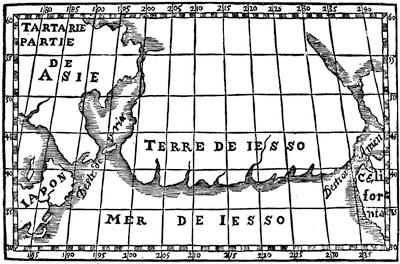
TERRE DE IESSO.
It is also delineated in 1700 in the map of the Dutchman, Lugtenberg. The idea was not totally given up till Cook’s map of his explorations in 1777-1778 appeared, which was the first to give to the peninsula of Alaska and the Aleutian islands a delineation of approximate accuracy; and this was fifty years after Behring, in 1728, had mapped out the Asiatic shore of this region.
Muller’s book was also published in French at Amsterdam in 1766. Cf. also William Coxe’s Account of the Russian discoveries between Asia and America (2d ed. rev.), London, 1780, and later editions in 1787 and 1803; also, see Robertson’s America, note 43.
“My good Lord Governor, Have pity on our woes; For here remains the butcher, To Panamá the salesman goes.”
Prescott (Peru, vol. i. p. 257) has thus rendered them into English:—
“Look out, Señor Governor, For the drover while he’s near; Since he goes home to get the sheep For the butcher, who stays here.”
(b) Pedro de Candia, a Greek, who had charge of Pizarro’s artillery, consisting of two falconets; an able and experienced officer. After the death of Pizarro he joined the younger Almagro, who, suspecting him of treachery, ran him through at the battle of Chupas. He left a half-caste son, who was at school at Cusco with Garcilasso de la Vega.
(c) Cristóval de Peralta, a native of Baeza, in Andalusia. He was one of the first citizens of Lima when that city was founded,—in 1535.
(d) Alonzo Briceño, a native of Benavente. He was at the division of Atahualpa’s ransom, and received the share of a cavalry captain.
(e) Nicolas de Ribera, the treasurer, was one of the first citizens of Lima in 1535. He passed through all the stormy period of the civil wars in Peru. He deserted from Gonzalo Pizarro to the side of the president, Gasca, and was afterwards captain of the Guard of the Royal Seal. He is said to have founded the port of San Gallan, the modern Pisco. Ribera was born at Olvera, in Andalusia, of good family. He eventually settled near Cusco, and died, leaving children to inherit his estates.
(f) Juan de la Torre, a native of Benavente, in Old Castile. He was a stanch adherent of Gonzalo Pizarro, and was at the battle of Anaquito, where he showed ferocious enmity against the ill-fated viceroy, Blasco Nuñez de Vela. He married a daughter of an Indian chief near Puerto Viejo, and acquired great wealth. After the battle of Sacsahuana, in 1548, he was hanged by order of the president, Gasca. He was a citizen of Arequipa, and left descendants there.
(g) Francisco de Cuellar, a native of Cuellar; but nothing more is known of him.
(h) Alonzo de Molina, a native of Ubeda. He afterwards landed at Tumbez, where it was arranged that he should remain until Pizarro’s return; but he died in the interval.
(i) Domingo de Soria Luce, a native of the Basque Provinces, probably of Guipuzcoa; but nothing more is known of him.
(j) Pedro Alcon. He afterwards landed on the coast of Peru, fell in love with a Peruvian lady, and refused to come on board again. So the pilot Ruiz was obliged to knock him down with an oar, and he was put in irons on the lower deck. Nothing more is known of him.
(k) Garcia de Jerez (or Jaren). He appears to have made a statement on the subject of the heroism of Pizarro and his companions, Aug. 3, 1529, at Panamá. Documentos inéditos, tom. xxvi. p. 260, quoted by Helps, vol. iii. p. 446.
(l) Anton de Carrion. Nothing further is known of him.
(m) Martin de Paz. Nothing further is known of him.
(n) Diego de Truxillo (Alonzo, according to Zarate). He was afterwards personally known to Garcilasso at Cusco. He appears to have written an account of the discovery of Peru, which is still in manuscript. Antonio, ii. 645; also, Leon Pinelo.
(o) Alonzo Ribera (or Geronimo) was settled at Lima, where he had children.
(p) Francisco Rodriguez de Villa Fuerte was the first to cross the line drawn by Pizarro. He was afterwards a citizen of Cusco, having been present at the siege by the Ynca Manco, and at the battle of Salinas. Garcilasso knew him, and once rode with him from Cusco to Quispicanchi, when he recounted many reminiscences of his stirring life. He was still living at Cusco in 1560, a rich and influential citizen. [Mr. Markham has given the number as sixteen in his Reports on the Discovery of Peru, p. 8, together with his reasons for it, which do not commend themselves, however, to Kirk, the editor of Prescott (History of the Conquest of Peru, edition of 1879, i. 303). Helps dismisses the story of the line as the melodramatic effort of a second-rate imagination. Cf. also Markham’s Travels of Cieza de Leon, p. 419.—Ed.]
Prescott (Peru, ii. 473, 480) prints several of the contemporary accounts of the seizure and execution of Atahualpa. He says that Garcilasso de la Vega “has indulged in the romantic strain to an unpardonable extent in his account of the capture; ... yet his version has something in it so pleasing to the imagination, that it has ever found favor with the majority of readers. The English student might have met with a sufficient corrective in the criticism of the sagacious and sceptical Robertson.” There are the usual stories of a comet at the time of the death of the Ynca. Cf. Humboldt, Views of Nature, pp. 421, 429.—Ed.]
(a) Hernando de Soto, the explorer of Florida and discoverer of the Mississippi.
(b) Francisco de Chaves, a native of Truxillo. He was murdered at Lima, in 1541, in attempting to defend the staircase against the assassins of Pizarro. Zarate says that when he died he was the most important personage in Peru, next to Pizarro.
(c) Diego de Chaves, brother of Francisco, whose wife, Maria de Escobar, introduced the cultivation of wheat into Peru.
(d) Francisco de Fuentes, in the list of those who shared the ransom.
(e) Pedro de Ayala. Diego de Mora, afterwards settled at Truxillo on the coast of Peru. The president, Gasca made him a captain of cavalry, and he was subsequently corregidor of Lima.
(g) Francisco Moscoso.
(h) Hernando de Haro, taken prisoner by the Ynca Titu Atauchi, but treated kindly.
(i) Pedro de Mendoza, in the list of those who shared the ransom.
(j) Juan de Rada, a stanch follower of Almagro. He accompanied his chief on his expedition to Chili, and avenged his death by the assassination of Pizarro.
(k) Alonzo de Avila.
(l) Blas de Atienza was the second man who ever embarked on the Pacific, when he served under Vasco Nuñez de Balbóa in 1513. He settled at Truxillo; and his daughter Inez accompanied Pedro de Ursua in 1560 in his ill-fated expedition to discover El Dorado. His son Blas was a friar, who published a book called Relacion de los Religiosos, at Lima, in 1617.
[Cf. also note in Markham’s Reports on the Discovery of Peru, p. 104.—Ed.]