Chapter VIII
Reading edition
PIZARRO, AND THE CONQUEST AND SETTLEMENT OF PERU AND CHILI.
BY CLEMENTS R. MARKHAM, F.R.S.
Honorary Secretary of the Hakluyt Society.
WHEN the Isthmus of Darien was discovered by Vasco Nuñez de Balbóa, during the six years between 1511 and 1517, there can be little doubt that tidings, perhaps only in the form of vague rumors, were received of the greatness and the riches of the Empire of the Yncas. The speech which the son of the Cacique Comogre is said to have made to the gold-seeking followers of the discoverer of the South Sea most probably had reference to Peru; and still more certainly, when the Cacique of Tumaco told Vasco Nuñez of the country far to the south which abounded in gold, and moulded the figure of a llama in clay, he gave tidings of the land of the Yncas. There was a chief in the territory to the south of the Gulf of San Miguel, on the Pacific coast, named Biru, and this country was visited by Gaspar de Morales and Francisco Pizarro in 1515. For the next ten years Biru was the most southern land known to the Spaniards; and the consequence was that the unknown regions farther south, including the rumored empire abounding in gold, came to be designated as Biru, or Peru. It was thus that the land of the Yncas got the name of Peru from the Spaniards, some years before it was actually discovered.[1467]
Pedro Arias de Avila, the governor of the mainland called Castilla del Oro, founded the city of Panamá. He went there from the Pearl Islands, in the vessels which had been built by his victim Vasco Nuñez, while Gaspar de Espinosa, the Alcalde Mayor, led the rest of the colony by land. The city was founded in 1519. The governor divided the land among four hundred settlers from Darien. Among them were Pascual de Andagoya, Hernando Luque (a priest), Francisco Pizarro, and Diego de Almagro. Nombre de Dios, on the Atlantic side of the isthmus, was settled towards the end of the same year by a captain named Diego Alviles, in obedience to orders from Pedro Arias.[1468]
In the year 1522 Pascual de Andagoya, who had come out to Darien with Pedro Arias in 1514 and was a cavalier of good family from the province of Alava, was appointed inspector-general of the Indians on the isthmus. He made a journey to a district called Chuchama, south of the Gulf of San Miguel, where the chief told him that a certain people from a province called Biru, farther south, came to make war upon them in canoes at every full moon. Andagoya sent to Panamá for reinforcements, in order to comply with the prayer of the people of Chuchama that he would defend them, as well as to discover what there was farther south. Having received an addition to his forces, he set out with the chief of Chuchama, and in six days arrived at the province called Biru. It had already been visited by Morales and Pizarro. After capturing their principal stronghold, several chiefs of Biru made their submission to Andagoya. From these people he collected information respecting the great empire of the Yncas, and he then descended a river and continued the examination of the coast in a small vessel which had followed him from Chuchama. But he was attacked by a severe illness caused by having been capsized in a canoe, and then kept for several hours in his wet clothes. He therefore returned to Panamá, to report the knowledge he had acquired, giving up his intention of conducting discovery to the southward in person. It was fully three years before Andagoya had so far recovered as to be able to ride on horseback.
The governor, Pedro Arias, therefore requested Andagoya to hand over the enterprise to three partners who formed a company at Panamá. These were Pizarro, Almagro, and Luque.
Francisco Pizarro was born about the year 1470[1469] in the province of Estremadura, and was the illegitimate son of Gonzalo Pizarro, a soldier who had served under the Great Captain in Italy. He had arrived at Darien in the expedition of Alonzo de Ojeda in 1509. During fifteen years he had been diligently serving as a brave, steady, much-enduring man-at-arms; and on two or three occasions he found himself in important and responsible positions. In 1524 he was a citizen of Panamá with very limited means, but endowed with indomitable energy and perseverance, and fifty-four years of age. Diego Almagro is said to have been a foundling. At all events his parentage is unknown. He had probably served for some years on the isthmus, but his name does not occur until he entered into this partnership. Almagro is described as a man of short stature, with a very plain face, and was at least as old as Pizarro. He was hasty in temper, but generous and warm-hearted, and his fine qualities attracted to him many faithfully attached adherents. Luque had been schoolmaster at Darien, and was now the principal parochial clergyman at Panamá, holding valuable property on the adjacent island of Taboga, and in an influential position in the colony.
Pizarro was to command the expedition; Almagro was to keep open communications with Panamá and bring supplies; while Luque acted as agent, and obtained the needful funds.
One of the small vessels which had been built for Vasco Nuñez was obtained, and a force of eighty men (one hundred and twelve, according to Xeres) and four horses was collected. Pizarro prepared to sail with this single vessel and two canoes, having received all the information and instructions that Andagoya could give him, and taking with him the interpreters brought from Biru by that officer. It was arranged that large trees near the sea-shore should be blazed, as guides to the course taken by Pizarro, when his partner Almagro should follow with supplies.
Pizarro sailed from Panamá Nov. 14, 1524, and after enduring terrible sufferings on the coast of Biru, including famine, and losing twenty-seven of his men, he went back to Chuchama, and sent the treasurer Nicolas de Ribera to Panamá with the gold which he had collected. Meanwhile Almagro had followed in another vessel with provisions, and went on the traces of his companion by means of the trees that had been marked, until he reached the Rio San Juan in 4° north. Finding no further traces of Pizarro he returned, having lost an eye in an encounter with natives. He also lost upwards of seventy men;[1470] but he obtained some gold.
After this failure it was more difficult to obtain money and recruits for a second attempt. Fortunately, the Alcalde Mayor, who was impressed with the promising character of the undertaking, came forward with the necessary funds, which he advanced through the agency of Luque. Gaspar de Espinosa thus became one of the partners. The agreement between the partners was signed March 10, 1526. Luque signed as the agent of Espinosa. Pizarro and Almagro could neither read nor write. One Juan de Pares signed on the part of Pizarro, and Alvaro del Quiro for Almagro.
The second expedition sailed in 1526. It consisted of two vessels commanded by Pizarro and Almagro respectively, with a very able and gallant sailor named Bartolomé Ruiz, of Moguer, as pilot. There were one hundred and sixty men all told. The adventurers made direct for the river of San Juan, the farthest point reached by Almagro during the previous voyage. Here Pizarro landed with his troops. Almagro returned to Panamá in one vessel, for recruits and provisions, while Ruiz proceeded on a voyage of discovery to the southward in the other.
Ruiz made a remarkable voyage, having rounded Cape Passado and reached 1° south. He was thus the first European to cross the equator on the southern passage. He also fell in with a raft under sail, which belonged to Tumbez in Peru, and thus obtained several curious specimens of Ynca art, and some additional information. Almagro made a prosperous voyage back to Panamá, and returned with supplies.
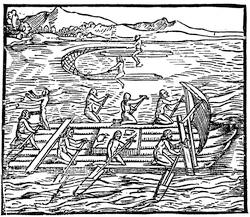
NATIVE RAFTS.
[This is Benzoni’s sketch of the rafts and boats used by the native on the Pacific coast of the northern parts of South America. Edition of 1572, p. 165.—Ed.]
Pizarro had been left on a forest-covered, fever-haunted coast, which has changed very little from that day to this. Hoping to find a better country inland, he undertook long marches through the tangled forest; but many of his men perished, and his party returned to the coast, suffering from disease and famine. In this sorry plight the all-enduring Pizarro was found, when Almagro and Ruiz returned.
Almagro had found a new governor installed at Panamá. Pedro de los Rios had superseded Pedro Arias, who was transferred to Nicaragua, where he died in 1532. With the new governor’s sanction, about eighty recruits were collected, and with these and a fresh supply of stores Almagro returned to the Rio de San Juan.
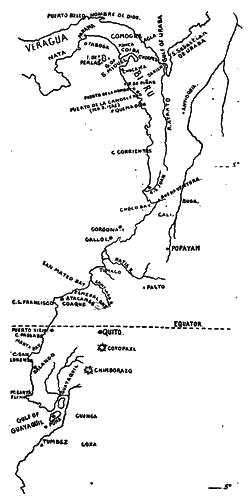
SKETCH MAP OF THE CONQUEST OF PERU.
[This map and map No. 2 show the modern geography. The development of the cartography of Peru may be traced in Ramusio (1556) in the map of the parts of the world newly discovered; in Ortelius (1584 and 1592) and De Bry, part iii. (1592, a map of South America corrected in 1624); in Wytfliet, 1597 (see map on a later page); in Van Baerle’s edition of Herrera (1622); in Sanson, with the course of the Amazon (1656); in Dudley’s Arcano del mare (carta xxviii. 1647), for the coast; in Vander Aa (1679), and in Boudouin’s translation of Garcilasso de la Vega, published at Amsterdam in 1737. Markham, in his Reports on the Discovery of Peru, gives a map showing the marches of Francisco and Hernando Pizarro, May, 1532, to May, 1533. Other maps are given by Prescott, H. H. Bancroft, and Helps. The best, however, is in Markham’s Travels of Cieza de Leon.—Ed.]
The two partners then embarked, and under the guidance of the pilot Ruiz they advanced along the coast as far as Atacames. They were now in the province of Quito, a part of the Ynca empire. Here were large towns, much ground under cultivation, and a formidable array of well-armed troops to oppose their depredations. It was evident that the Spanish force was too weak to make a successful settlement. Pizarro proposed a return; Almagro opposed him, and there was a violent quarrel, which was outwardly reconciled, leaving a permanent feeling of suppressed jealousy and ill-will on both sides. Finally it was resolved that Pizarro and part of the force should remain on the island of Gallo, which had been discovered by Ruiz in 1° 57´ north, while Almagro should return once more for recruits. The arrangements caused much discontent. The men complained that they were being left to starve. Some wrote letters home to Panamá, full of complaints, which were seized by Almagro. One, however, named Saravia, concealed a note in a large ball of cotton sent as a present to the governor’s wife. It contained the following lines:—
“Pues Señor Gobernador, Mírelo bien por entero, Que allá va el recogedor, Y acá queda el carnicero.”[1471]
Pizarro, soon after Almagro’s departure, sent off the other ship with the most mutinous of his followers. But the governor, Los Rios, was much incensed at the result of the expedition. He refused to give any further countenance to the enterprise, and sent two vessels, under the command of Don Pedro Tafur, of Cordova, to Gallo, with orders to take every Spaniard off the island and bring them back to Panamá. Meanwhile Pizarro and his people were suffering from famine and disease, and from the incessant rains. Nearly all had lost every feeling of desire for hazardous adventures. They longed only to be relieved from their sufferings, and hailed the arrival of Tafur with unconcealed joy.
Then it was that Pizarro displayed that heroic resolution which has made the famous act of himself and his sixteen companions immortal. The story is differently told. Herrera says that Tafur stationed himself in one part of the vessel, and drawing a line, placed Pizarro and his soldiers on the other side of it. He then told those who wished to return to Panamá to come over to him, and those who would remain, to stay on Pizarro’s side of the line. But Garcilasso de la Vega tells us that when Pizarro saw his men electing to return in the ship, he drew his sword and made a long line with the point along the sand. Then, turning to his men, he said, “Gentlemen! This line signifies labor, hunger, thirst, fatigue, wounds, sickness, and every other kind of danger that must be encountered in this conquest until life is ended. Let those who have the courage to meet and overcome the dangers of this heroic achievement cross the line, in token of their resolution, and as a testimony that they will be my faithful companions. And let those who feel unworthy, return to Panamá; for I do not wish to put force upon any man. I trust in God that, for his greater honor and glory, his Eternal Majesty will help those who remain with me, though they be few, and that we shall not miss those who forsake us.” Of the two accounts, that of Garcilasso is probably nearer the truth, because it is unlikely that the embarkation would have taken place before the election was made. It would naturally be made on the beach, before going on board. Most of the authorities give the number of those who crossed the line at thirteen. Xeres, Pizarro’s secretary, says there were sixteen. Herrera gives the names of thirteen heroic men, Garcilasso supplying the remaining three; and they deserve to be held in memory.[1472]
Nothing could shake the resolution of Pizarro. He would not return until he had achieved greatness, and he found sixteen good men and true to stand by him in his great need. They removed from Gallo to the island of Gorgona, where there was some game and better water; while the others returned with Tafur to Panamá.
The governor looked upon Pizarro’s conduct as an act of madness, and refused all succor; but at length yielding to the entreaties of Luque and Almagro, he allowed one vessel to be sent to Gorgona, with strict orders to return in six months. So a small vessel was fitted out under the command of the pilot Ruiz, and after seven weary months the little forlorn hope at Gorgona descried the white sail, and joyfully welcomed their friends with a supply of food and stores. Full of hope, Pizarro and his gallant friends embarked; and the expert Ruiz, guided by information obtained from the Peruvian sailors on the raft, made direct for the Gulf of Guayaquil, performing the voyage in twenty days. The year 1527 was now well advanced. Anchoring off the island of Santa Clara, they stood across to the town of Tumbez on the following day. Here they saw the undoubted signs of a great civilization, betokening the existence of a powerful empire. Their impressions were confirmed by a subsequent cruise along the Peruvian coast as far as Santa, in 9° south latitude. They learned enough to justify a return to Panamá with the report of a great discovery, the importance of which would justify an application to the Spanish Government for some valuable concession to Pizarro and his partners. Pizarro took with him, from Tumbez, a lad who was to act as interpreter,—called Felipillo by the Spaniards,—and also a few llamas. He then made the best of his way back to Panamá; and it was agreed that he should proceed to Spain and make a direct application to the Crown for authority to undertake the conquest of the empire of the Yncas. In the spring of 1528, after having collected the necessary funds with much difficulty, Pizarro set out for Spain, accompanied by Pedro de Candia. Luque and Almagro waited at Panamá for the result.
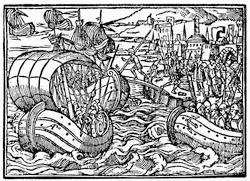
EMBARKING.
[Fac-simile of a cut made to do duty in various connections in Antwerp publications of the last half of the sixteenth century. It is copied in this case from fol. 23 of De Wonderlijcke ende warachtighe Historie (Zarate), published by Willem Silvius in 1573.—Ed.]
Francisco Pizarro was well received by the Emperor Charles V. in an interview at Toledo; but the sovereign set out for Italy immediately afterwards, and subsequent arrangements were made with the Government of the queen-mother. The capitulation was signed on the 26th of July, 1529. Pizarro was appointed captain-general and adelantado, and was decorated with the order of Santiago. He was also granted a coat-of-arms, and thirteen out of the sixteen who crossed the line at Gallo were ennobled by name. Almagro was made governor of Tumbez, and afterwards received the title of marshal. Luque was to be bishop of Tumbez, and protector of the Indians. Ruiz received the title of grand pilot of the South Sea. Candia was appointed commander of the artillery. Pizarro visited Estremadura, and from his home took back with him to Peru his four brothers. Hernando, the eldest and only legitimate son of his father, was a big tall man, with thick lips and very red nose, brave and proud, with an uncompromising temper, and ruthlessly cruel. Juan and Gonzalo were illegitimate, like Francisco, and Francisco Martin de Alcantara was a uterine brother. His young cousin Pedro Pizarro, the future historian, then only fifteen, went out as the conqueror’s page; Fray Vicente de Valverde, a fanatical Dominican, also went out; and Pizarro set sail from San Lucar on the 19th of January, 1530. On arriving at Panamá, he was upbraided by Almagro for not having attended fairly to his (Almagro’s) interests, while careful to secure everything for himself. From that time the old partners were never really friends, and there was ill-concealed enmity between Almagro and Hernando Pizarro. Meanwhile preparations for the expedition were busily proceeded with at Panamá; and, as on former occasions, Almagro was to follow with supplies and reinforcements.
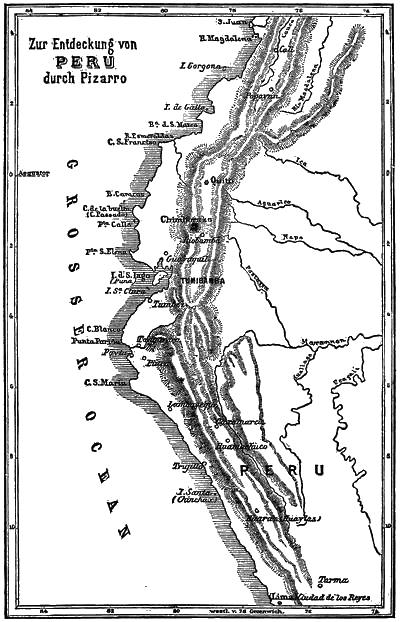
PIZARRO’S DISCOVERIES.
[The map given in Ruge’s Zeitalter der Entdeckungen, p. 436.—Ed.]
Pizarro sailed from Panamá on the 28th of December, 1531, with three small vessels carrying one hundred and eighty-three men and thirty-seven horses. In thirteen days he arrived at the bay of San Mateo, where he landed the horses and soldiers to march along the shore, sending back the ships to get more men and horses at Panamá and Nicaragua. They returned with twenty-six horses and thirty more men. With this force Pizarro continued his march along the sea-coast, which was well peopled; and on arriving at the bay of Guayaquil, he crossed over in the ships to the island of Puna. Here a devastating war was waged with the unfortunate natives, and from Puna the conqueror proceeded again in his ships to the Peruvian town of Tumbez. The country was in a state of confusion, owing to a long and desolating war of succession between Huascar and Atahualpa, the two sons of the great Ynca Huayna Capac, and was thus an easy prey to the invaders. Huascar had been defeated and made prisoner by the generals of his brother, and Atahualpa was on his way from Quito to Cusco, the capital of the empire, to enjoy the fruits of his victory. He was reported to be at Caxamarca, on the eastern side of the mountains; and Pizarro, with his small force, set out from Tumbez on the 18th of May, 1532.
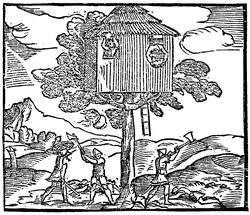
NATIVE HUTS IN TREES.
[Benzoni’s sketch of the native habitations on the coast towards Peru. Edition of 1572, p. 161.—Ed.]
The coast of Peru is a rainless region of desert, crossed at intervals by fertile valleys which follow the courses of the streams from the Andes to the sea. Parallel with this coast region, to the eastward, is the sierra, or mountainous country of the cordilleras of the Andes, the cradle and centre of the civilized tribes of Peru. Still farther to the eastward are the great rivers and vast forests or montaña of the basin of the Amazons.[1473] Thus the length of Peru is divided into three very different and distinctly marked regions,—the coast, the sierra, and the montaña.
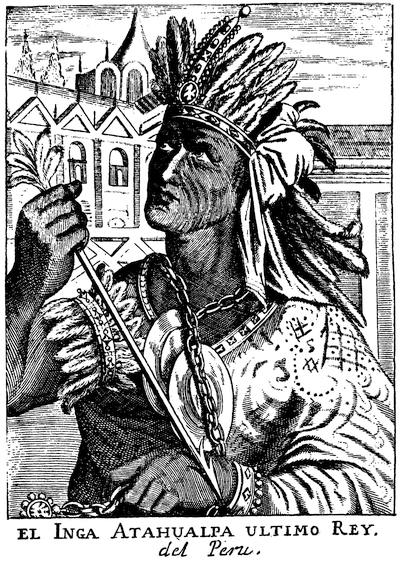
ATAHUALPA.
[From Herrera (1728), vol. iii. p. 5. Quaritch in 1870 (Catalogue, 259, no. 651) held at £105 the original oil paintings from which the likenesses of thirteen Incas in Herrera’s Hechos de los Castellanos were engraved, in 1599, with an extra one of Atahualpa, which was not given in Herrera. The previous thirteen are given in small marginal engravings in the border of the frontispiece of Herrera’s fifth and sixth Decades, and copied in the edition of Barcia, who throws discredit on the engravings which De Bry had given. These last are reproduced in Tschudi’s Antiquedades Peruanas. Cf. Catalogue of Gallery of the New York Historical Society, No. 378.—Ed.]
The first part of Pizarro’s march was southward from Tumbez, in the rainless coast region. After crossing a vast desert he came to Tangarara, in the fertile valleys of the Chira, where he founded the city of San Miguel, the site of which was afterwards removed to the valley of Piura. The accountant Antonio Navarro and the royal treasurer Riquelme were left in command at San Miguel, and Pizarro resumed his march in search of the Ynca Atahualpa on the 24th of September, 1532. He detached the gallant cavalier, Hernando de Soto, into the sierra of Huancabamba, to reconnoitre, and pacify the country. De Soto rejoined the main body after an absence of about ten days. The brother of Atahualpa, named Titu Atauchi, arrived as an envoy, with presents, and a message to the effect that the Ynca desired friendship with the strangers.
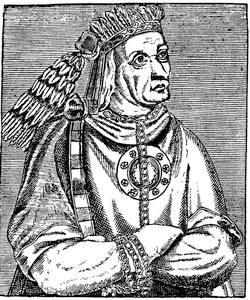
ATAHUALPA.
[Fac-simile of the copperplate in the English edition of Thevet’s Pourtraitures and Lives appended to North’s Plutarch, Cambridge, England, 1676, p. 66. A somewhat famous picture by a Peruvian artist, Monteros, representing the Spanish soldiers hustling the wailing women out of the hall while the funeral rites over Atahualpa were in progress, is heliotyped in the second volume of Hutchinson’s Two Years in Peru.—Ed.]
Crossing the vast desert of Sechura, Pizarro reached the fertile valley of Motupe, and marched thence to the foot of the cordilleras in the valley of the Jequetepeque. Here he rested for a day or two, to arrange the order for the ascent. He took with him forty horses and sixty foot, instructing Hernando de Soto to follow him with the main body and the baggage. News arrived that the Ynca Atahualpa had reached the neighborhood of Caxamarca about three days before, and that he desired peace. Pizarro pressed forward, crossed the cordillera, and on Friday, the 15th of November, 1532, he entered Caxamarca with his whole force. Here he found excellent accommodation in the large masonry buildings, and was well satisfied with the strategic position. Atahualpa was established in a large camp outside, where Hernando de Soto had an interview with him. Atahualpa announced his intention of visiting the Christian commander, and Pizarro arranged and perpetrated a black act of treachery. He kept all his men under arms. The Ynca, suspecting nothing, came into the great square, walking in grand regal procession. He was suddenly attacked and made prisoner, and his people were massacred.
The Ynca offered a ransom, which he described as gold enough to fill a room twenty-two feet long and seventeen wide, to a height equal to a man’s stature and a half. He undertook to do this in two months, and sent orders for the collection of golden vases and ornaments in all parts of the empire.[1474] Soon the treasure began to arrive, while Atahualpa was deceived by false promises; and he beguiled his captivity by acquiring Spanish and learning to play at chess and cards.
Meanwhile Pizarro sent an expedition under his brother Hernando, to visit the famous temple of Pachacamac on the coast; and three soldiers were also despatched to Cusco, the capital of the empire, to hurry forward the treasure. They set out in February, 1533, but behaved with so much imprudence and insolence at Cusco as to endanger their own lives and the success of their mission. Pizarro therefore ordered two officers of distinction, Hernando de Soto and Pedro del Barco, to follow them and remedy the mischief which they were doing. On Easter eve, being the 14th of April, 1533, Almagro arrived at Caxamarca with a reinforcement of one hundred and fifty Spaniards and eighty-four horses.
On the 3d of May it was ordered that the gold already arrived should be melted down for distribution; but another large instalment came on the 14th of June. An immense quantity consisted of slabs, with holes at the corners, which had been torn off the walls of temples and palaces; and there were vessels and ornaments of all shapes and sizes. After the royal fifth had been deducted, the rest was divided among the conquerors. The total sum of 4,605,670 ducats would be equal to about £3,500,000 of modern money.[1475] After the partition of the treasure, the murder of the Ynca was seriously proposed as a measure of good policy. The crime was committed by order of Pizarro, and with the concurrence of Almagro and the friar Valverde.[1476] It was expected that the sovereign’s death would be followed by the dispersion of his army, and the submission of the people. This judicial murder was committed in the square of Caxamarca on the 29th of August, 1533. Hernando de Soto was absent at the time, and on his return he expressed the warmest indignation. Several other honorable cavaliers protested against the execution. Their names are even more worthy of being remembered than those of the heroic sixteen who crossed the line on the sea-shore at Gallo.[1477]
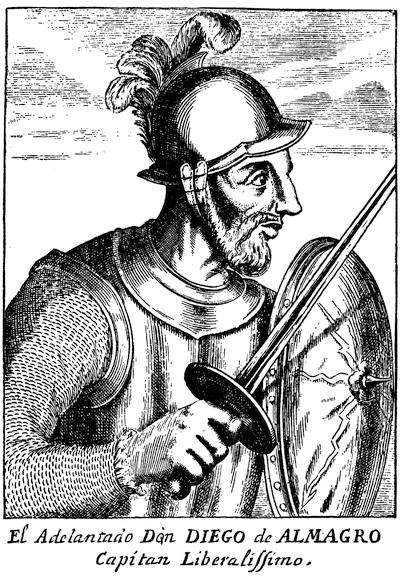
DIEGO DE ALMAGRO.
[From Herrera (1728) vol. ii. p. 285. An original manuscript letter of Almagro, Jan. 1, 1535, addressed to the Emperor, and asking for a province beyond Pizarro’s, is noted in Stevens, Bibliotheca geographica, no. 109.—Ed.]
Pizarro at first set up a son of Atahualpa as his successor; but the boy died within two months. A more important matter was the despatch of the treasure to Spain, with tidings of the conquest. The first ship, laden with Peruvian gold, arrived at Seville on the 5th of December, 1534. The second ship followed in January, having on board, besides the treasure, Hernando Pizarro, the conqueror’s brother. The excitement caused by these arrivals was intense; and there was an eager desire among adventurers, both of high and low degree, to become settlers in this land of promise.
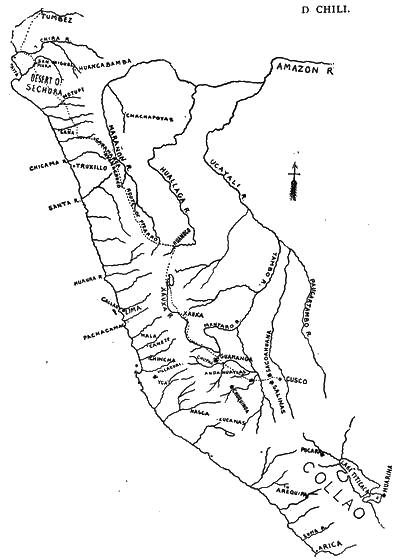
SKETCH MAP OF THE CONQUEST OF PERU. NO. 2.
In September Pizarro began his march from Caxamarca to Cusco, the capital of the empire, with five hundred Spaniards and about one hundred and fifty horses. The artilleryman Candia had charge of two falconets. The march was along the lofty valleys and over the passes of the sierra, by Huamachuco, Huánuco, Xauxa, and Huamanga. The rear-guard was attacked by Titu Atauchi, brother of Atahualpa, with six thousand men; and eight Spaniards were taken prisoners, among them Francisco de Chaves and Hernando de Haro, who had protested against the murder of the Ynca Atahualpa, and Sancho de Cuellar, who had been clerk to the court at the mock trial. They were taken to Caxamarca, which had been abandoned by the Spaniards. Chaves and Haro were treated with the greatest kindness. Cuellar was strangled on the spot where Atahualpa was put to death. Hernando de Soto and Almagro led the van of the Spanish army, and they had to fight a well-contested battle beyond the Apurimac, with a native army led by one of the generals of Atahualpa. Leaving a garrison at Xauxa, Pizarro followed more leisurely; and on forming a junction with Almagro on the great plain of Sacsahuana, near Cusco, he perpetrated another great crime. Challcuchima, one of Atahualpa’s ablest generals, who had been taken prisoner, was burned alive. Soon afterward the Ynca Manco, son of Huayna Capac, and the rightful heir to the sovereignty, arrived at the Spanish camp to make his submission and claim protection. His rights were recognized; and on the 15th of November, 1533, the conqueror Pizarro entered the city of Cusco in company with the rightful sovereign. The Ynca Manco was inaugurated with the usual ceremonies and rejoicings; but in March, 1534, his beloved city of Cusco was converted into a Spanish town, and a municipality was established. The palaces and spacious halls were appropriated as churches and private houses of the conquerors. The Dominicans received the great Temple of the Sun as their monastery; and Friar Valverde, who became the first bishop of Cusco, in 1538, took the spacious palace of the Ynca Uira-ccocha, in the great square, for his cathedral.
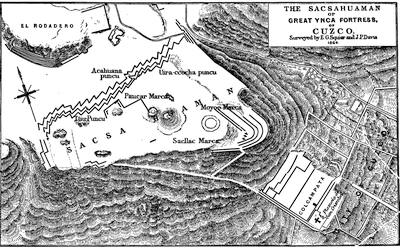
PLAN OF YNCA FORTRESS NEAR CUSCO. (From Markham’s Royal Commentaries of the Yncas, vol. ii. p. 305.)
It was not long before the fame of the riches of Peru brought more conquerors to seek for a share of the spoils. In March, 1534, Pedro de Alvarado, one of the conquerors of Mexico, landed at Puerto Viejo, close to the equator, with five hundred Spaniards, half of whom were mounted. Among them was the noble cavalier Garcilasso de la Vega, father of the future historian. After suffering dreadful hardships in passing through the forests of the coast, the adventurers reached Riobamba, with a loss of one fourth of their number. Pizarro, leaving a garrison of ninety men under his brother Juan at Cusco, proceeded to the sea-coast, where he had an interview with Alvarado at Pachacamac. It was agreed that Alvarado should return to his government of Guatemala, while many of his surviving followers attached themselves to the fortunes of Pizarro.
The conqueror now resolved to fix the principal seat of his government within a short distance of some convenient seaport. He finally selected a site in the valley of the Rimac, six miles from the shores of the Pacific Ocean. Here Pizarro founded the city of Lima on the festival of Epiphany, the 6th of January, 1535. It was called “Ciudad de los Reyes” (the city of the kings) in honor of Charles V. and his mother Juana, and also in memory of the day. The city was laid out on a regular plan, which has been little altered down to the present time, with broad streets, at right angles, and a spacious square near the centre, one side of which was to be occupied by the cathedral and another by the palace. Pizarro appointed municipal officers, collected laborers, and with great energy pushed on the work of building.
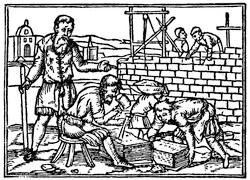
BUILDING OF A TOWN.
[Fac-simile of a cut made to do duty in various Antwerp imprints on Peru of the latter half of the sixteenth century. It is copied in this case from folio eighteen (reverse) of De Wonderlijcke ende Warachtighe Historie (Zarate), published by Willem Silvius, 1573.—Ed.]
Hernando Pizarro, arriving with such welcome treasure, was very graciously received in Spain. Charles V. confirmed all his brother’s previous grants, and created him a marquis;[1478] while Almagro, with the title of marshal, was empowered to discover and occupy territory for two hundred leagues, beginning from the southern boundary of Pizarro’s government. Hernando himself was created a knight of Santiago, and was authorized to enlist recruits, and equip a fleet for his return to Peru. The return of Hernando was the signal for the breaking out of a feud between the old partners. Almagro and his friends declared that Cusco itself was to the south of the boundary assigned to the territory of Pizarro. The conqueror hurried from his work of building at Lima to Cusco, and made a solemn reconciliation with Almagro, by a written agreement dated June 12, 1535.
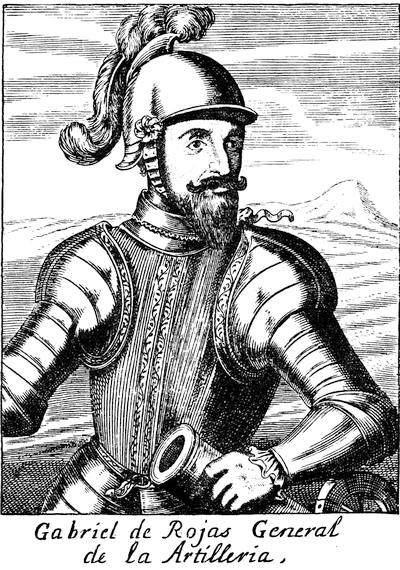
GABRIEL DE ROJAS.
[Fac-simile of an engraving in Herrera, vol. iv. p. 260. He was one of the distinguished cavaliers of the Conquest, to whom Muñoz—erroneously, as Prescott thinks—assigned the authorship of the Relacion primera of Ondegardo. He was distinguished at the defence of Cusco, when that town was besieged by the Indians. Later, as governor of Cusco for Almagro, he had charge of Gonzalo Pizarro while he was held a prisoner, and had, later still, command of the artillery under Gasca. He died at Charcas.—Ed.]
Almagro was induced to undertake an expedition for the discovery and conquest of Chili. He was accompanied by a large army of Indians, led by two Yncas of the blood royal; and he had with him about two hundred Spaniards. He set out from Cusco in the autumn. Pizarro then returned to the coast, to push forward the building of Lima, and to found the cities of Truxillo (1535), Chachapoyas (1536), Huamanga (1539), and Arequipa (1540). Hernando Pizarro, on his return, was sent to join his brothers Juan and Gonzalo at Cusco, and to take command of that city and fortress.
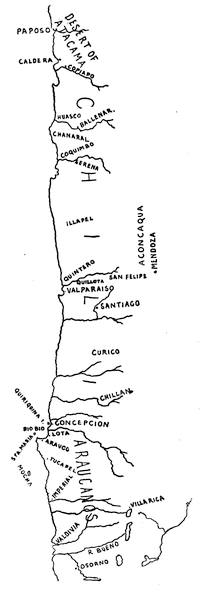
SKETCH MAP OF THE CONQUEST OF CHILI.
The Spaniards had already begun to look upon the natives as their slaves, and the young Ynca Manco was not only treated with neglect, but exposed to every kind of humiliating insult. He escaped from Cusco, and put himself at the head of a great army of his subjects in the valley of Yucay. This was a signal; and immediately the whole country was in revolt against the invaders. Juan Pizarro was driven back into Cusco, and the city was closely besieged by the armies of the Ynca from February, 1536. The besiegers succeeded in setting the thatched roofs of the halls and palaces on fire, and the Spanish garrison was reduced to the greatest straits. The Yncas had occupied the fortress which commands the town, and Juan Pizarro was killed in an attempt to carry it by storm. Finally Hernando Pizarro himself captured the fortress, after a heroic defence by the Ynca garrison. Still the close siege of the city continued, and the garrison was reduced to the last straits by famine. Month after month passed away without tidings. At last the season for planting arrived, and in August the Ynca was obliged to raise the siege.
Chili, the long strip of land along the west coast of South America, to the south of Peru, had been conquered by the Yncas as far as the river Maule. Beyond that limit were the indomitable tribes of Araucanian Indians. Bounded on one side by the cordillera of the Andes, and on the other by the sea, the country enjoys a temperate climate, suited for the cultivation of wheat and the rearing of cattle. It can be approached from Peru either by traversing the great desert of Atacama on the coast, or by marching over the snowy plateaus and rocky passes of the Andes. Almagro chose the latter route. The Indian auxiliaries, led by Paullu, the brother of Ynca Manco, and by the Uillac Umu, or high-priest, marched first, carrying provisions and making arrangements for their supply, taking the road through the Collao and Charcas (the modern republic of Bolivia). The Indian contingent was followed by one hundred Spaniards under Don Juan Saavedra; and this advanced party waited at Paria, in the south of Charcas, for the main body. This was commanded by Don Rodrigo Orgoñez, a native of Oropesa, who had served under the constable Bourbon at the sack of Rome. He was a brave and experienced commander, ever faithful to his chief, the marshal Almagro. The whole force, when united in the distant valley of Jujuy, consisted of five hundred Spaniards, with two hundred horses. The march across the Andes to Coquimbo, in Chili, during the winter of 1536, was a time of intense suffering and hardship bravely endured; but it was stained by the most revolting cruelties to the people of Charcas and Jujuy.
Almagro advanced from Coquimbo to the southward, and his Peruvian contingent suffered a defeat from an army of Promauca Indians. He was reinforced by Orgoñez and Juan Rada, another faithful adherent, who brought with them the royal order appointing Almagro to be adelantado, or governor, of New Toledo, which was to extend two hundred leagues from the southern limit of Pizarro’s government of New Castile. The explorers now desired to return and occupy this new government, which they claimed to include the city of Cusco itself. Almagro had arranged that three small vessels should sail from Callao, the port of Lima, for the Chilian coast, with provisions. Only one ever sailed, named the “Santiaguillo,” having a cargo of food, clothing, and horse-shoes. She arrived in a port on the coast of Chili; and when the tidings reached Almagro, he sent the gallant Juan de Saavedra, the leader of his vanguard, with thirty horsemen, to communicate with her. Saavedra found the little vessel anchored in a bay surrounded by rugged hills covered with an undergrowth of shrubs, and having a distant view of the snowy cordillera. In some way it reminded him of his distant Spanish home. Saavedra was a native of the village of Valparaiso, near Cuenca, in Castile. He named the bay, where the principal seaport of Chili was destined to be established, Valparaiso. This was in September, 1536. Landing the much-needed supplies, Saavedra rejoined his chief, and the expedition of Almagro began its painful return journey by the desert of Atacama. On arriving at Arequipa, Almagro first heard of the great insurrection of the Yncas. Marching rapidly to Cusco, his lieutenant, Orgoñez, defeated the Ynca Manco in the valley of Yucay; and Almagro entered the ancient city, claiming to be its lawful governor.
The royal grant had given Pizarro all the territory for two hundred and seventy leagues southward from the river of Santiago, in 1° 20´ north, and to Almagro two hundred leagues extending from Pizarro’s southern limit. Herrera says that there were seventeen and one half leagues in a degree. This would bring Pizarro’s boundary as far south as 14° 50´, and would leave Cusco (13° 30´ 55″ south) well within it. But neither the latitudes of the river Santiago nor of Cusco had been fixed, and the question was open to dispute.
Almagro seized upon Cusco on the 8th of April, 1537, and placed the brothers Hernando and Gonzalo Pizarro, who had defended the place against the Yncas, in confinement. News then came that a large body of men under Alonzo de Alvarado, sent by the governor Pizarro from Lima, was approaching Cusco. Alvarado, with about five hundred men, had advanced as far as the river Abancay, where he was surprised and defeated by Orgoñez on the 12th of July, 1537. Meanwhile some reinforcements were arriving at Lima, in reply to the appeals of Pizarro for help against the native insurrection.
The ecclesiastic Luque had died; but the other partner who advanced the money for the original expedition, the licentiate Gaspar de Espinosa, still lived; and he now joined Pizarro at Lima, with a force of two hundred and fifty men. Cortés also despatched a vessel with supplies and military stores from Mexico.
The Marquis—as Pizarro was now styled—sent an embassy to Almagro at Cusco, under the licentiate Espinosa, in the hope of settling the dispute amicably. Almagro, elated by his successes, was in no mood for moderating his demands; and, unfortunately, Espinosa died very suddenly in the midst of the negotiation. It was broken off; and Almagro declared his intention of retaining Cusco and marching to the coast, in order to establish for himself a seaport. Orgoñez had again defeated the Ynca Manco, dispersed his army, and forced him to take refuge, with his family and little court, in the mountainous fastness of Vilcabamba. Leaving Gonzalo Pizarro in prison at Cusco, Almagro marched to the valley of Chincha, on the sea-coast, taking Hernando Pizarro with him. At Chincha he began to lay out a city, to be called Almagro, which was to rival Lima, one hundred miles to the northward. Chincha is nearly in the same latitude as Cusco.
While he was at Chincha, Almagro received news that Gonzalo Pizarro and Alonzo de Alvarado had escaped from their Cusco prison, and reached the camp of the marquis, near Lima. After some correspondence, it was agreed that a friar named Francisco de Bobadilla should arbitrate, and that Pizarro and Almagro should have a personal interview in the little town of Mala, near the coast, between Lima and Chincha. The meeting took place on the 13th of November, 1537. There was a furious altercation. They parted in anger; indeed Almagro, fearing treachery, rode off very hastily. A cavalier of Pizarro’s party had hummed two lines of an old song in his hearing,—
“Tiempo es el cavallero, Tiempo es de andar de aqui.”
It was the last time the old partners ever saw each other. The friar’s award was that a skilful pilot should be sent to fix the latitude of the river of Santiago, and that meanwhile Almagro should deliver up Cusco, and Hernando Pizarro should be set at liberty. But in order to secure the safety of his brother, the marquis made the concession that Almagro should hold Cusco until the boundaries were fixed. Hernando was then allowed to leave the camp of Almagro.
But the marquis had no intention of allowing his rival to retain Cusco. Too old to take the field himself, he intrusted the command of his army to his brother Hernando. His rival was also broken down by age and infirmities, and Rodrigo de Orgoñez became the actual commander of Almagro’s forces. He retreated by short marches towards Cusco, the old marshal being carried in a litter, and requiring long intervals of rest. The marquis led his army down the coast to Yca, where he took leave of it, and returned to Lima. His brother Hernando then proceeded still farther along the coast to Nasca, and ascended the cordilleras by way of Lucanas, reaching the neighborhood of Cusco in April, 1538. Almagro had arrived at Cusco ten days before.
Orgoñez took up a position at a place called Salinas, about three miles from Cusco, with a force of five hundred men and about two hundred horses. His artillery consisted of six falconets, which, with the cavalry, he stationed on the flanks of his infantry. On Saturday, the 26th of April, 1538 (or the 6th, the day of Saint Lazarus, according to Garcilasso), Hernando Pizarro began the attack. The infantry was led by his brother Gonzalo, and by Pedro de Valdivia, the future governor of Chili. Crowds of Indians watched the battle, and rejoiced to see their oppressors destroying one another. The cavalry charged at full gallop, the infantry fought desperately; but Orgoñez was killed, and after an hour the fortune of the day turned against the marshal. His soldiers fled to Cusco, followed by the victorious party, and Almagro himself was put in chains and confined in the same prison where he had put the Pizarros. His young son Diego,—by an Indian girl of Panamá,—to whom the old man was devotedly attached, was sent at once to the camp of the marquis at Lima, in charge of Alcantara, the half-brother of the Pizarros. Hernando then prepared a long string of accusations against his defeated foe, obtained his condemnation, and caused him to be garroted in the prison. Almagro was buried in the church of La Merced at Cusco, in July, 1538.
The Marquis Francisco Pizarro received the young Almagro with kindness, and sent him to Lima, ordering him to be treated as his son. The governor himself remained for some time at Xauxa, and then proceeded to Cusco, where he confiscated the property of Almagro’s followers. He sent his brother Gonzalo to conquer the people of Charcas. In 1539 Hernando Pizarro set out for Spain; but the friends of Almagro were before him. He was coldly received, and eventually committed to prison for his conduct at Cusco, and lingered in captivity for upwards of twenty years.
Pizarro returned to Lima, and despatched numerous expeditions in various directions for discovery and conquest. Gomez de Alvarado was intrusted with the settlement of Huánuco; Francisco de Chaves, of Conchucos; Vergara and Mercadillo were to explore Bracamoras and Chachapoyas; and Pedro de Candia was to settle the Collao. Gonzalo Pizarro himself undertook an expedition to the land of cinnamon,—the forest-covered region to the eastward of Quito. Leaving Pedro de Puelles in command at Quito, Gonzalo entered the forests with three hundred and fifty Spaniards and four thousand Indians on Christmas Day, 1539. The hardships and sufferings of these dauntless explorers have seldom been equalled by any body of men on record. Descending the rivers Coca and Napo, Gonzalo intrusted the command of a small vessel to Francisco de Orellana to go on in advance and seek for supplies. But Orellana deserted his starving comrades, discovered the whole course of the river Amazon, and returned to Spain. Out of the three hundred and fifty Spaniards that started, fifty deserted with Orellana, two hundred and ten died of hunger and disease, and the miserable remnant eventually returned to Quito with their intrepid leader, Gonzalo Pizarro, in June, 1542.
The marquis had also resolved to renew the attempt to conquer Chili, which had been abandoned by Almagro. A cavalier had actually been sent out from Spain, named Pedro Sanchez de Hoz, to undertake this service. The marquis associated with him a commander on whose judgment, resolution, and fidelity he could better rely. Pedro de Valdivia was a native of Serena in Estremadura. He had seen much service in Italy; was at the taking of Milan and at the battle of Pavia. He had arrived in Peru in 1535, having been sent from Mexico by Hernando Cortés when the governor of Peru appealed for help to resist the Ynca revolt. He did important service for the Pizarros at the battle of Salinas.
Having collected one hundred and fifty soldiers at Cusco, Valdivia began his march for Chili in March, 1540. His camp-master was Pedro Gomez; his standard-bearer, Pedro de Mayor; his chief of the staff, Alonso Monroy. Francisco de Aguirre and Jeronimo de Alderete were his captains of cavalry; Francisco de Villagran led the arquebusiers, and Rodrigo de Quiroga the pikemen. Two priests, named Bartolomé Rodrigo and Gonzalo Marmolejo, accompanied the expedition. Before starting, Valdivia went to the cathedral of Cusco, and swore, in presence of Bishop Valverde, that the first church he built should be dedicated to Our Lady of the Assumption, the patroness of Cusco, and that the first city he founded should be named Santiago, after the patron of Spain. Valdivia marched by way of the desert of Atacama, and at the very outset he made an agreement with Sanchez de Hoz that the sole command should rest with himself.
Valdivia had for a guide the friar Antonio Rondon, who had accompanied Almagro’s expedition; and with his aid he overcame all the difficulties of the march, and safely reached Copiapo in Chili. Advancing by Huasco and Coquimbo, he defeated a large army of natives in the valley of Chili or Aconcagua, and eventually selected a site for the foundation of a new city on the banks of the river Mapocho, in the territory of the Cacique Huelen-Guala. The foundation of the church, dedicated to the Assumption, in accordance with the vow made at Cusco, was laid on the 12th of February, 1541. The plan of the city was laid out, and it received the name of Santiago. The officers of the municipality were elected on the 7th of March, to remain in office for one year.
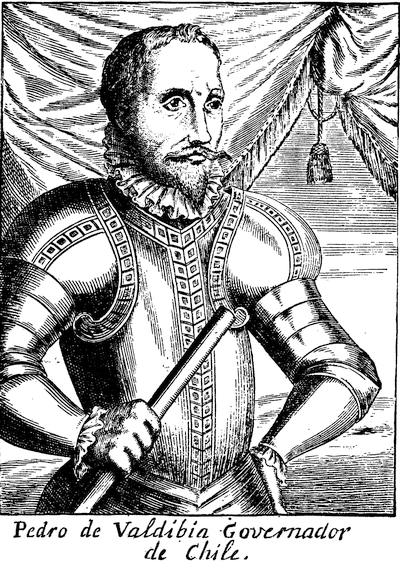
PEDRO DE VALDIVIA.
[From Herrera (1728), iv. 200.—Ed.]
It was not long before the natives of Chili took up arms to oppose the intruders. Valdivia marched against a large body, leaving Monroy in command at Santiago. But another force of Indians attacked the city itself, with desperate valor, during fifteen days, killing four Spaniards and twenty-three horses, and setting fire to the houses. Valdivia hastily returned; and although the whole country was in insurrection, Monroy nobly volunteered to make his way to Peru and return with reinforcements and supplies. He set out Jan. 28, 1542. Valdivia began to cultivate the land near Santiago, and to sow wheat, in the hope of raising crops; and on the hill of Santa Lucia he constructed a fort where provisions and valuables could be stored. But the little colony continued to suffer much from scarcity of provisions. Monroy, hiding in the woods during the day and travelling at night, escaped from Chili and reached Cusco in safety. He succeeded in getting a small vessel sent from the port of Arequipa to Valparaiso, while he himself returned by the desert of Atacama, reaching Santiago in December, 1543. Valdivia was now able to assume the offensive, and the armed Indians retired to a distance from Santiago.
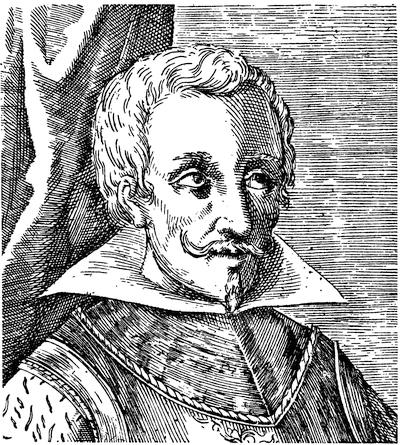
VALDIVIA.
[Fac-simile of a part of a copperplate, which appears in Ovalle’s Historica Relacion de Chile, Rome, 1648.—Ed.]
The chief pilot of Panamá, an experienced Genoese seaman named Juan Bautista Pastene, with Juan Calderon de la Barca, was ordered to undertake a voyage of discovery along the coast of Chili at about the same time. He sailed from Callao in July, 1544, and arrived at the port of Valparaiso in August, in his little vessel the “San Pablo.”
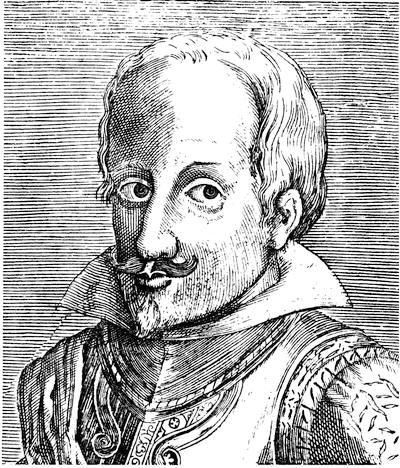
PASTENE.
[Fac-simile of part of a copperplate in Ovalle’s Hist. Rela. de Chile, Rome, 1648.—Ed.]
Here he was visited by Valdivia, who confirmed the name of Valparaiso and officially declared it to be the port of Santiago. Valdivia proclaimed the foundation of the town of Valparaiso on the 3d of September, 1544, and appointed Pastene his lieutenant in command of the Chilian seas. The two little vessels “San Pedro” and “Santiaguillo” then took some men-at-arms on board, and proceeded on a voyage of discovery to the southward on the 4th of September. Pastene went as far as 41° south, discovering a harbor which was named Valdivia, the mouths of several rivers, the island of Mocha and the Bay of Penco. He returned to Valparaiso on the 30th of September, and reported his success to the governor, who now had two hundred Spaniards at Santiago, besides women and children. In the same year Valdivia sent a captain named Bohan to found a town in the valley of Coquimbo, to serve as a refuge and resting-place on the road between Santiago and Peru. It was named La Serena, after the native place of Valdivia. The “San Pedro” was sent to Coquimbo to be caulked and otherwise repaired.
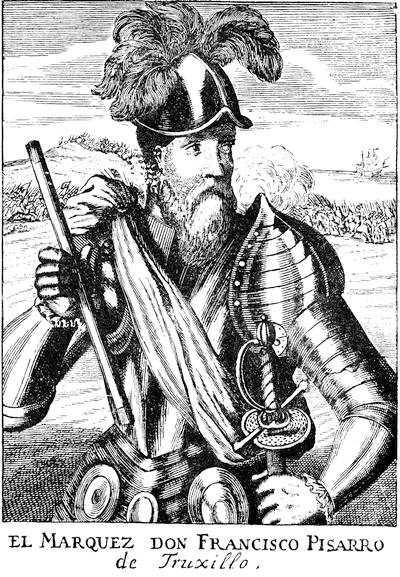
PIZARRO.
[Fac-simile of engraving in Herrera, vol. ii. p. 280. De Bry (part vi.) gives a small medallion likeness. Cf. Verne’s La Découverte de la Terre. Prescott (vol. i.) gives an engraving after a painting in the series of the line of the viceroys, preserved at that time in the viceregal palace at Lima. It gives the conqueror in civic costume, with cap and cloak, and a letter in one hand and a glove in the other. A colored representation of the royal standard borne by Pizarro is given in El General San Martin, Buenos Ayres, 1863. They continue to show, or did exhibit till recently, a body claimed to be that of Pizarro, in the cathedral at Lima. (Hutchinson’s Two Years in Peru, vol. i. p. 309.)—Ed.]
The governor then undertook an expedition to the south, crossed the river Maule, defeated a large body of Indians at a place called Quilacara, and advanced as far as the banks of the river Biobio, returning to Santiago, after an absence of forty days, in March, 1546. Pastene had made another voyage to Callao, taking with him the gallant Alonso Monroy, who died on the passage. He returned to Valparaiso, with a melancholy account of the disturbed state of Peru, Dec. 1, 1547; and Valdivia determined, after much deliberation, to take up arms against Gonzalo Pizarro, as a loyal servant of the Spanish Crown. He went on board Pastene’s ship, made sail Dec. 10, 1547, and arrived at Callao, the port of Lima. He had founded a new colony, and left it securely established in Chili.
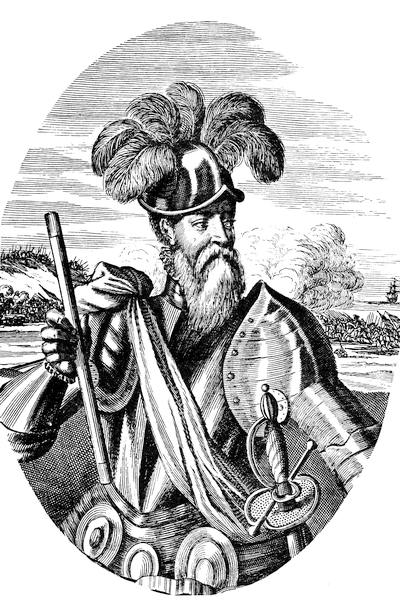
PIZARRO.
[Fac-simile of the engraving as given in Montanus and Ogilby.—Ed.]
During the seven years of Valdivia’s absence in Chili, stirring events had occurred in the land of the Yncas. The marquis returned to Lima, where he was busily engaged in the work of building, and in administering the affairs of his vast command. Many of the ruined followers of Almagro were there also, driven to desperation by the confiscation of their property. They were called, in derision, the “men of Chili.” Pizarro treated them with contemptuous indifference, and expelled the young Almagro from his house.
The most conspicuous of the malcontents was Juan de Rada; and he matured a plot for the assassination of the governor. On the 26th of June, 1541, the conspirators, headed by Rada, ran across the great square during the dinner hour, and entered the court of Pizarro’s house.[1479] The marquis had just dined, and his brother Martin de Alcantara, the judge Velasquez, Francisco de Chaves, and others were with him. Being unarmed, several of those present, on hearing the outcry, let themselves down into a garden from the corridor, and escaped. Chaves went out on the stairs, where he was murdered by the conspirators, who were running up. The marquis had thrown off his robe, put on a cuirass, and seized a spear. He was past seventy. His brother, a cavalier named Gomez de Luna, and two pages were with him. The assassins numbered nineteen strong men. Pizarro fought valiantly, until Rada thrust one of his companions on the spear and rushed in. Alcantara, Luna, and the two pages were despatched. Pizarro continued to defend himself until a wound in the throat brought him to the ground. He made the sign of the cross on the floor, and kissed it. He then breathed his last. The conspirators rushed into the street shouting, “The tyrant is dead!” The houses of the governor and his secretary were pillaged. Juan de Rada coerced the municipality and proclaimed Diego Almagro, the young half-caste lad, governor of Peru. The body of Pizarro was buried in the cathedral, by stealth, and at night.
But the colonists did not immediately submit to the new rule. Alvarez de Holguin, one of Pizarro’s captains, held Cusco with a small force, and Alonzo de Alvarado opposed the conspiracy in the north of Peru. The bishop Valverde, of Cusco, and the judge Velasquez were allowed to embark at Callao in November, 1541; but they fell into the hands of the Indians on the island of Puna, in the Gulf of Guayaquil, and were both killed.
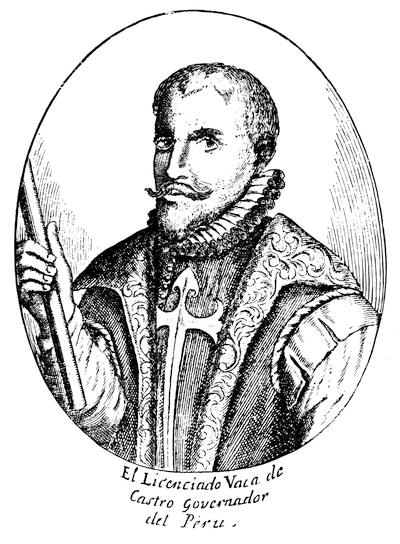
VACA DE CASTRO.
[From Herrera (1728), vol. iv. p. 1.—Ed.]
The followers of Almagro the lad, as he was called, determined to march from Lima in the direction of Cusco, so as to get between Alvarado and Holguin. At Xauxa the youthful adventurer had the misfortune to lose his most trusty adherent. Juan de Rada died of fever. The two most influential of his supporters who remained were Cristóval de Sotelo and Garcia de Alvarado,—and they had quarrelled with one another. Their delays enabled Holguin to pass to the north, and unite his forces with Alvarado’s. Almagro then established himself at Cusco, where Sotelo was murdered by his rival Alvarado; and the latter was put to death by the young Almagro, who assumed the direction of his own affairs. He was barely twenty-two years of age.
The Emperor Charles V., long before the death of Pizarro, had decided upon sending out a royal judge to act as the old conqueror’s coadjutor and adviser, especially with regard to the treatment of the Indians. For this delicate post the emperor’s choice fell upon Dr. Don Cristóval Vaca de Castro, a Judge of the Audience of Valladolid. After a long voyage the new judge had landed at Buenaventura, a town recently founded by Pascual de Andagoya, near that river San Juan where Pizarro had waited in such dire distress during his first voyage. He had a royal order to assume the post of governor of Peru in the event of Pizarro’s death; and on arriving at Popayan he received tidings of the assassination. He then proclaimed his commission as governor, and advanced southwards, by way of Quito, along the Peruvian coast. At Huara he was joined by Alvarado and Holguin with their forces. He entered Lima, and then proceeded, by way of Xauxa, in search of the assassins. Young Almagro had a force of five hundred Spaniards, with two hundred horses; and he had a park of artillery consisting of sixteen pieces under the direction of the veteran Pedro de Candia. With this force he left Cusco in July, 1542. Vaca de Castro marched in great haste to Guamanga, in order to secure that important post before Almagro could reach it from Cusco. The rebels, as they must be called, took a route along the skirts of the cordillera, until they reached an elevated plateau called Chupas, above and a little to the south of the newly built town of Guamanga. Their object appears to have been to cut off the communications of Vaca de Castro with the coast. In order to approach them, it was necessary for the royal army to evacuate Guamanga, and ascend a very steep slope to the terrace-like plateau where Almagro’s army was posted. It was the 16th of September, 1542, and the ascent from Guamanga must have occupied the greater part of the day. The army of Vaca de Castro was marshalled by the veteran Francisco de Carbajal, an old soldier who had seen forty years’ service in Italy before he crossed the Atlantic. Carbajal led the troops into action with such skill that they were protected by intervening ground until they were close to the enemy; and when Almagro’s artillery opened fire on them, the guns were so elevated as to do no execution. This led young Almagro to suspect Pedro de Candia of treachery, and he there and then ran the old gunner through the body, and pointed one of the guns himself with good effect. The royal army now began to suffer severely from the better-directed artillery fire. Then the opposing bodies of cavalry charged, while Carbajal led a desperate attack with the infantry, and captured Almagro’s guns. Holguin fell dead; Alvarado was driven back, and young Almagro behaved with heroic valor. Yet when night closed in, the army of Vaca de Castro was completely victorious, and five hundred were left dead on the field. It was a desperately contested action. Almagro fled to Cusco with a few followers, where he was arrested by the magistrates. Vaca de Castro followed closely, and on arriving in the city he condemned the lad to death. Almagro suffered in the great square, and was buried by the side of his father in the church of La Merced.
Vaca de Castro assumed the administration of affairs in Peru as royal governor. In the same year the Dominican Friar Geronimo de Loaysa, a native of Talavera, became bishop of Lima. He was promoted to the rank of archbishop in 1545. Another Dominican, Juan de Solano, succeeded Valverde as bishop of Cusco in 1543. Gonzalo Pizarro, when he returned from his terrible expedition in the forests east of Quito, was induced by the governor to retire peaceably to his estates in Charcas. The efforts of Vaca de Castro as an administrator were directed to regulating the employment of the natives, and to improving communications.
When the good Bartolomé Las Casas returned to Spain, in 1538, he published his famous work on the destruction of the native race of America. He protested against the Indians being given to the Spaniards in encomienda, or vassalage for personal service.[1480] At last the emperor appointed a committee consisting of churchmen and lawyers of the highest position, to sit at Valladolid in 1542, and to consider the whole subject. The result was the promulgation of what were called the “New Laws.”
I. After the death of the conquerors, the repartimientos of Indians, given to them in encomienda, were not to pass to their heirs, but be placed directly under the king. Officers of his majesty were to renounce the repartimientos at once.
II. All encomenderos in Peru who had been engaged in the factious wars between the Pizarros and Almagros were to be deprived.
III. Personal service of the Indians was to be entirely abolished.
Blasco Nuñez Vela was appointed viceroy of Peru to enforce the “New Laws,” assisted by a court of justice, of which he was president, called the Audiencia of Lima. There were four other judges, called oidores, or auditors, named Cepeda, Zarate, Alvarez, and Tejada. The viceroy and his colleagues embarked at San Lucar on the 3d of November, 1543. Leaving the judges sick at Panamá, the viceroy landed at Tumbez on the 4th of March, 1544, with great magnificence, and proceeded by land to Lima, proclaiming the “New Laws” as he advanced. The Spanish conquerors were thrown into a state of dismay and exasperation. They entreated Gonzalo Pizarro to leave his retirement and protect their interests, and when he entered Cusco he was hailed as procurator-general of Peru. He seized the artillery at Guamanga, and assembled a force of four hundred men, while old Francisco de Carbajal, the hero of the battle of Chupas, became his lieutenant.
The viceroy was a headstrong, violent man, without judgment or capacity for affairs. His first act after entering Lima was to imprison the late governor, Vaca de Castro. The principal citizens entreated him not to enforce the “New Laws” with imprudent haste. But he would listen to no arguments; and when the auditors arrived from Panamá, he quarrelled with them, and acted in defiance of their protests. At last the auditors ventured upon the bold step of arresting the viceroy in his palace, and placing him in confinement. He was sent to the island of San Lorenzo, and a government was formed with the auditor Cepeda as president, who suspended the “New Laws” until further instructions could be received from Spain. The auditor Alvarez was commissioned to embark on board a vessel with the viceroy, and take him to Panamá.
Meanwhile Gonzalo Pizarro was approaching Lima by rapid marches, and he entered the capital on the 28th of October, 1544, at the head of twelve hundred Spaniards and several thousand Indians dragging the artillery, which had formed the special strength of young Almagro. The Audiencia submitted; the judges administered the oaths, and Gonzalo was declared governor and captain-general of Peru. At the same time Vaca de Castro persuaded the captain of a vessel on board of which he was confined in Callao Bay to get under way and convey him to Panamá. Accusations were brought against him in Spain, and he was kept in prison for twelve years, but was eventually acquitted and reinstated.
As soon as the ship conveying the viceroy to Panamá was at sea, the judge Alvarez liberated him. He landed at Tumbez in October, 1544, denounced Gonzalo Pizarro and the judge Cepeda as traitors, and called upon all loyal subjects to support him. Volunteers arrived, and Blasco Nuñez raised his standard at San Miguel de Piura. Gonzalo Pizarro assembled a rival force at Truxillo; but the viceroy retreated before him towards Quito, Carbajal pressing closely on his rear. The retreat was almost a rout. Passing through Quito, the viceroy took refuge at Pasto, within the jurisdiction of Sebastian Benalcazar, the governor of Popayan. Early in January, 1546, having received reinforcements, Blasco Nuñez ventured to advance once more towards Quito. Gonzalo Pizarro took up a strong position outside; but the viceroy, now accompanied by Benalcazar, made a detour and entered Quito. On the 18th of January, 1546, the viceroy led his followers to the plains of Anaquito, near the town, where his enemy was posted, seven hundred strong. The battle was not long doubtful. Alvarez the judge was mortally wounded. Benalcazar was left for dead on the field. The viceroy was unhorsed and wounded, and while lying on the ground his head was struck off by order of Pedro de Puelles, Pizarro’s governor of Quito. The slaughter was terrific. Cruel old Carbajal never showed any mercy, and no quarter was given. Benalcazar, when he recovered, was allowed to return to Popayan; and Gonzalo Pizarro attended as chief mourner at the funeral of the viceroy in the cathedral of Quito.
Leaving a garrison at Quito, under Puelles, Gonzalo began his journey southwards in July, 1546, and entered Lima in triumph. The only resistance throughout Peru was from an officer in Charcas named Diego Centeno, a native of Ciudad Rodrigo, who had come to Peru in 1534 with Pedro Alvarado. He declared in favor of the viceroy at Chucuito; but Alonzo Toro, who had been left in command at Cusco by Gonzalo Pizarro, marched against him, and he fled into the fastnesses of Chichas, in the far south. Pizarro was undisputed master of Peru, and his lieutenant Carbajal retired to Charcas to work the silver mines.
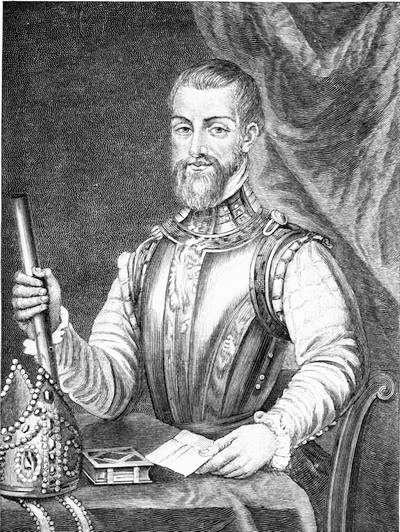
GASCA.
[This follows the engraving given by Prescott (History of the Conquest of Peru) of the portrait hanging in the sacristy of Saint Mary Magdalene at Valladolid,—an inscription on which says that Gasca died in 1567 at the age of seventy-one.—Ed.]
News of the revolt had reached Spain, and the licentiate Pedro de la Gasca, an astute and very able ecclesiastic, was appointed to proceed to Peru, and mediate between the viceroy and the malcontents. He received very full powers, with large discretion, and was entitled president of the Audiencia. He was very ugly, with a dwarfish body and exceedingly long, ungainly legs. The president sailed from Spain on the 26th of May, 1546, and received the news of the viceroy’s death on his arrival at the isthmus. He brought out with him the announcement of the revocation of the “New Laws,” owing to the dangerous spirit of discontent they had caused throughout the Indies. They were withdrawn by a decree dated at Malines on the 20th of October, 1545.
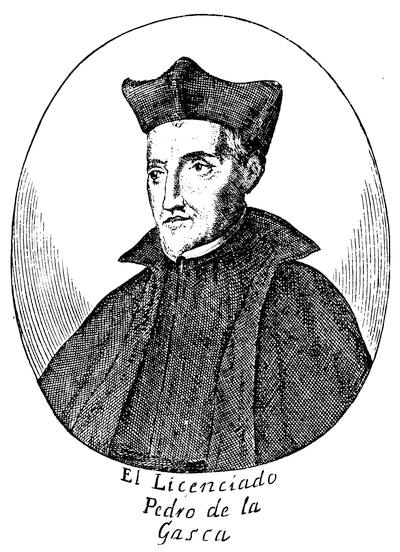
PEDRO DE LA GASCA.
[From Herrera (1728), vol. iv. p. 215.—Ed.]
The president arrived at Panamá on the 11th of August, 1546, where he found the fleet of Gonzalo Pizarro, under the command of Pedro de Hinojosa. Soon afterward Lorenzo de Aldana arrived as an envoy from Pizarro, but was induced to submit to the president’s authority. Hinojosa followed the example, and thus Gasca gained possession of the fleet. When the offer of pardon reached Lima, Gonzalo was advised by his lieutenant Carbajal to accept the terms; but the auditor Cepeda, who had turned against the viceroy and administered the oaths of office to a rebel, felt that there could be no pardon for him. The mad ambition of Pizarro induced him to listen to Cepeda rather than to Carbajal, and he finally rejected the offer of pardon; but many of his old followers deserted him.
Lorenzo de Aldana was despatched from Panamá, with several vessels, in February, 1547, and arrived in Callao Bay; while Diego Centeno once more rose in the south, and began to collect troops. Gonzalo Pizarro resolved to abandon Lima and march to Arequipa with only five hundred men, so numerous had been the desertions from his ranks. Aldana then entered the capital, while Gasca himself sailed from Panamá on the 10th of April, 1547, landing at Tumbez on the 13th of June. He advanced to Xauxa, and great numbers flocked to his standard. Pedro de Valdivia, the governor of Chili, had landed at Callao, and overtook the president, on his march towards Cusco, at Andahuaylas.
Gonzalo Pizarro, despairing of being able to make head against the president Gasca with all the prestige of royal approval on his side, had determined to retreat into Chili. But he feared to leave Centeno hanging on his rear, and thought it necessary first to disperse his forces. Centeno occupied a position near Huarina, at the southeastern angle of Lake Titicaca, upwards of twelve thousand feet above the level of the sea. Pizarro’s troops advanced to the attack over an open plain. He had about four hundred and eighty men, the strength of his army being in his infantry armed with arquebuses, and disciplined under the direct supervision of Carbajal. Centeno had a larger force, and was accompanied by Solano, the bishop of Cusco. Carbajal waited for the attack of the enemy, and then poured a deadly volley into their ranks. Centeno’s footmen broke and fled; but his cavalry defeated Pizarro, and would have won the day, if they too had not been repelled and broken by the admirable steadiness of Carbajal’s arquebusiers. As it was, Pizarro’s victory was complete, and three hundred and fifty of Centeno’s followers were killed. All fugitives taken by Carbajal were put to death without mercy.
The doomed Pizarro now abandoned all idea of retreating into Chili. He marched in triumph to Cusco, while the president Gasca approached by leisurely marches, gathering reinforcements by the way. With him were the bishops of Lima and Cusco, the marshal Alonzo de Alvarado, the veteran Hinojosa, Pascual de Andagoya the first adventurer in search of Peru, Valdivia the governor of Chili, Centeno, escaped from Huarina, Cieza de Leon the future historian, and many others well known to fame. The president’s army crossed the river Apurimac, and advanced to the plain of Sacsahuana, near Cusco, whither Gonzalo Pizarro came out to meet him. On the morning of the 9th of April, 1548, the commanders of both armies made ready for battle. But soon there were symptoms of desertion on Pizarro’s side. An important cavalier, Garcilasso de la Vega, galloped across to the army of Gasca. He was followed by the treacherous auditor Cepeda. Soldiers began to follow in small parties. Old Carbajal was humming two lines of an old song,—
“Estos mis cabellicos madre, Dos á dos me los lleva el ayre.”
Then desertions took place by companies and squadrons. Pizarro sorrowfully took his way to the royal camp and gave himself up. Carbajal was seized by the soldiers. He was hanged and quartered the following day, and soon afterwards Gonzalo Pizarro was executed in presence of the army.
The president entered Cusco on the 12th of April, and began a bloody assize. Scarcely a day passed without followers of Gonzalo Pizarro being hanged, flogged, or sent in large batches to the galleys. Two priests were executed. A canon of Quito, who was tutor to Gonzalo Pizarro’s little son, was hanged for writing a book called De bello justo. At length, sated with blood, the president left Cusco on the 11th of July with Archbishop Loaysa, and went to a small village called Huayna-rimac in the neighborhood. He retired into this seclusion to escape the importunities of his partisans. Here he proceeded to arrange the distribution of encomiendas, or grants of lands and Indians, among his followers. He allowed a tenth of the Indians to be employed on forced labor in the mines, thus reversing the humane legislation advocated by Las Casas. Having completed his work, the president sent the archbishop to announce his awards at Cusco, and they caused a howl of rage and disappointed greed. Gasca himself went down to Lima by the unfrequented route of Nasca, and when a positive order from the emperor arrived, that all personal service among the Indians should be abolished, he suspended its publication until he was safe out of Peru. In January, 1550, the president Gasca sailed for Panamá, leaving the country in the greatest confusion, and all the most difficult administrative points to be solved by his successors. The municipality of Lima wrote a complaint to the emperor, representing the untimely departure of the president. His abilities and his services have been much overstated. He himself is the witness to his own revolting cruelties at Cusco.
Gasca left the government of Peru, with none of the difficulties settled, in the hands of the auditors or judges of the royal Audiencia, of which Don Andres de Cianca was president. His colleagues were Melchor Bravo de Sarabia, Hernando de Santillan, and Pedro Maldonado. The judges were in charge of the executive from January, 1550, to the 23d of September, 1551, when Don Antonio de Mendoza arrived from Mexico as viceroy. They had taken steps to organize a systematic plan for the instruction of the natives, under the auspices of Archbishop Loaysa, Friar Thomas de San Martin, and the indefatigable friar Domingo de Santo Tomas, the first Quichua scholar. They worked harmoniously under the viceroy Mendoza, who was a statesman of high rank and great experience. He promulgated the royal order against the enforced personal service of Indians, anticipating serious discontents and troubles, which he was resolved to meet and overcome. But his premature death at Lima, on the 21st of July, 1552, left the country once more in the hands of the judges, who had to meet a storm which would sorely test their administrative abilities.
The ringleader of the malcontents was a cavalier of good family named Francisco Hernandez Giron. Born at Caceres, in Estremadura, he crossed the Atlantic in 1535, and joined the unfortunate viceroy Blasco Nuñez de Vela at Quito, fighting under his banner in the fatal battle of Anaquito. He also did good service in the army of President Gasca, and was in the left wing at the rout of Sacsahuana. Gasca had assigned the plain of Sacsahuana to him, as his repartimiento; but he grumbled loudly, and all the malcontents looked upon him as their leader. The promulgation of the abolition of personal service was received with a howl of execration among the conquerors, who looked forward to the accumulation of wealth by the use of forced labor in the silver mines. Troubles broke out in Charcas, and Giron resolved to raise the standard of revolt at Cusco.
The 12th of November, 1553, was the wedding day of Don Alonzo de Loaysa, a nephew of the archbishop, who married a young lady named Maria de Castilla. The corregidor of Cusco and most of the leading citizens were at the supper. Suddenly Giron presented himself in cuirass and helmet, with his sword drawn, and a crowd of conspirators behind him. The street was occupied by a body of cavalry under his lieutenant, Tomas Vasquez. The guests sprang from their seats, but Giron told them not to fear, as he only wished to arrest the corregidor. He and the others then put out the lights and drew their swords. The corregidor took refuge with the ladies in the drawing-room, and shut the doors. Two guests were stabbed. Many escaped by the windows and climbed a wall at the back of the house. The corregidor and other officials were seized and imprisoned. Giron issued a proclamation declaring that the conquerors would not be robbed of the fruits of their labors. He soon had a respectable force under his command; but most of the leading citizens fled to Lima. The rebel declared that his object was the public good, and to induce the king to listen to the prayers of his subjects. The Audiencia was called upon to restore matters to the state they were in at the time of Gasca’s departure. Tomas Vasquez was sent to Arequipa, and Guamanga also declared in favor of Giron.
The governing judges were in great perplexity at Lima. After some hesitation they put the archbishop Loaysa in command of their army, with the judge Bravo de Saravia as his colleague. The marshal Alonzo de Alvarado was in upper Peru, and he also got some loyal cavaliers round him, and assembled a small force. Giron entered Guamanga Jan. 27, 1554, where he was joined by Tomas Vasquez, from Arequipa; and he then marched down to the coast. The judges encamped at Até, outside Lima, with five hundred arquebusiers, four hundred and fifty pikemen, three hundred cavalry, and fourteen field-pieces. Giron arrived at Pachacamac on the shores of the Pacific, and the judges advanced to Surco. But instead of boldly attacking, the rebels turned their backs and marched southwards along the coast to Yca, followed by a detachment under an officer named Meneses. Giron turned, and defeated his pursuers at Villacuri, in the desert between Pisco and Yca, but continued his retreat to Nasca. He had lost a great opportunity.
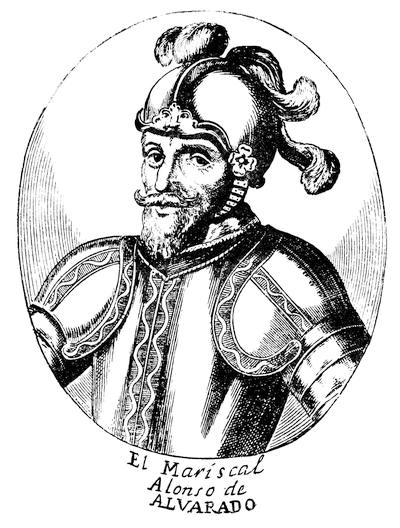
ALONZO DE ALVARADO.
[Fac-simile of engraving in Herrera, iii. 235.—Ed.]
The royal army advanced to Chincha; but the archbishop quarrelled with Bravo de Saravia, and where so many commanded, and none were military men, efficient operations were impossible. Meanwhile Alvarado had assembled an army for the judges, of seven hundred men, the rendezvous being La Paz in upper Peru. With this force he entered Cusco on the 30th of March, 1554, and continued his march in search of Giron, who remained at Nasca, on the coast, until the 8th of May. On that day the rebels once more ascended the wild passes of the cordillera to Lucanas, and were soon in the neighborhood of Alvarado’s army, which now numbered eleven hundred men. The rebels encamped at Chuquinga, in the wildest part of the Andes, on a mountain terrace by the side of a deep ravine, with the river Abancay in front. The marshal Alvarado was on the other side of the ravine, and was advised not to attack, but to harass the retreat of Giron. But on the 21st of May, under every possible disadvantage, he ordered the river to be forded, and an attack to be made. The river was crossed, but the men could not form on the other side in the face of an active enemy. They fell back, and the retreat was soon converted into a rout. Alvarado was wounded, but contrived to escape with Lorenzo de Aldana and the learned Polo de Ondegardo who accompanied him, leaving seventy dead on the field, and two hundred and eighty wounded.
Giron entered Cusco in triumph. The judges, on receiving news of the disastrous battle of Chuquinga, decided that their army should advance to Xauxa, and eventually towards Cusco. The Audiencia now consisted of Dr. Melchor Bravo de Saravia, Hernando de Santillan, Diego Gonzalez Altamirano, and Martin Mercado. Altamirano was to remain in charge of the government at Lima, while the other judges marched with the army, preceded by their officer Pablo de Meneses with the royal standard. In July, 1554, the three judges, Saravia, Santillan, and Mercado reached Guamanga, and in August they entered Cusco, having met with no opposition. Giron had retreated to Pucara, near Lake Titicaca, a very strong position consisting of a lofty rock rising out of the plain. The royal army encamped in front of the rock, and the judges sent promises of pardon to all who would return to their allegiance. Giron hoped that the royal army would attack him, repeating the error at Chuquinga; but the judges had resolved to play a waiting game. A night attack led by Giron was repulsed. Then desertions began, Tomas Vasquez setting the example. The unfortunate rebel could trust no one. He feared treachery. He bade a heart-rending farewell to his noble-minded wife, Doña Mencia, leaving her to the care of the judge Saravia. He rode away in the dead of night, almost alone, and Pucara was surrendered. Meneses was sent in chase of Giron, who was captured near Xauxa. He was brought to Lima, Dec. 6, 1554, and beheaded. His head was put in an iron cage, and nailed up by the side of those of Gonzalo Pizarro and Carbajal. Ten years afterward a friend of his wife secretly took all three down, and they were buried in a convent. Doña Mencia, the widow of Giron, founded the first nunnery in Lima,—that of “La Encarnacion,”—and died there as abbess.
Thus the judges succeeded in putting down this formidable insurrection, and were able to hand over the country, in a state of outward tranquillity, to the great viceroy who now came out to establish order in Peru.
Don Andrea Hurtado de Mendoza, Marquis of Cañete, was nominated by Charles V., at Brussels, to be viceroy of Peru for six years. He came out with the intention of checking with a firm hand the turbulence of the military adventurers who were swarming over the country. Writing to the emperor before he sailed, May 9, 1555, he said that there were eight thousand Spaniards in Peru, of whom four hundred and eighty-nine held repartimientos, and about one thousand were employed officially or otherwise. A large portion desired to live in idleness. He proposed to employ them on expeditions into unknown regions, and he submitted that no more Spaniards ought to be allowed to come to Peru without good cause assigned. In a letter to his daughter, the governess Juana, the emperor approved the policy sketched out by the new viceroy.
The Marquis of Cañete landed at Payta, and travelling by land, entered Lima on the 29th of June, 1556. He assumed office with unprecedented state and solemnity. He was fully resolved to put down sedition once and for all. He ordered that no Spaniard should leave his town without permission of the authorities, and for good cause. As regards the Audiencia, he reported to the emperor that the judges were hostile to each other, and that they lived in such discord that all peace was hopeless. He spoke favorably of two, and requested that the others might be recalled. He also reported that the corregidors maintained quantities of idle soldiers waiting for opportunities of mischief. He estimated the number of the idlers at three thousand, and said that the peace of the country was endangered by the immorality, license, and excesses of these men. The viceroy kept all the artillery in the country under his own eye, ordering guns to be seized and brought to him wherever they could be found; and he formed a permanent guard of four hundred arquebusiers. He then sent for a number of settlers, of turbulent antecedents, who came to Lima joyfully, expecting that they were about to receive repartimientos. But he disarmed them, shipped them at Callao, and sent them out of the country. Among these banished men were included the most notorious disturbers of the peace in the late civil wars. Altogether thirty-seven were sent to Spain. Tomas Vasquez and Juan Piedrahita, the chief supporters of Giron, were beheaded, and the corregidors were authorized to seize and execute any turbulent or dangerous persons within their jurisdictions. These were very strong measures, but they were necessary. The intolerable anarchy under which Peru had groaned for so many years was thus stamped out. Moderate encomiendas were then granted to deserving officers.
While the turbulence and cruelty of the Spanish conquerors were checked with relentless severity, the policy of the Marquis of Cañete towards the people and their ancient rulers was liberal and conciliatory. In both courses of action there was wisdom. After the siege of Cusco, the Ynca Manco, with his family and chief nobles, had taken refuge in the mountain fastness of Vilcabamba, and there he met his death in 1553, after a disastrous reign of twenty years. He was succeeded by his son Sayri Tupac, who continued in his secluded hiding-place. The viceroy thought it important, for the tranquillity of the country and the peace of mind of the Indians, that the descendant of their ancient kings should be induced to reside among the Spaniards. The negotiation was intrusted to the Ynca’s aunt, a princess who had married a Spanish cavalier, and to Juan de Betanzos, an excellent Quichua scholar. It was settled that the Ynca should receive the encomienda forfeited by Giron (the valley of Yucay near Cusco, where he was to reside), together with a large pension. All was finally arranged, and on the 6th of January, 1558, the Ynca entered Lima, and was most cordially received by the viceroy. From that time he resided in the valley of Yucay, surrounded by his family and courtiers, until his death in 1560.
Several of the Spanish conquerors had married Ynca ladies of the blood royal, and a number of half-caste youths were growing up in the principal cities of Peru, who formed links between the Yncas and their conquerors. There was a school at Cusco where they were educated, and the Ynca Garcilasso de la Vega records many anecdotes of his early days, and enumerates the names of most of his school-fellows. The Marquis of Cañete also founded schools at Lima and Truxillo, and took great pains to supply the Indians with parochial clergy of good conduct, who were strictly prohibited from trading. In 1558 the curacas, or native chiefs, who had proved their rights by descent before the Audiencia, were allowed to exercise jurisdiction as magistrates.
The Marquis of Cañete founded the towns of Cuenca in the province of Quito, of Santa on the coast to the north of Lima, and of Cañete in a rich and fertile valley to the south. He also established the hospital of San Andres at Lima, and built the first bridge over the Rimac. Very great activity was shown in the introduction of useful plants and domestic animals. Vines were sent out from Spain and the Canaries, and a harvest of grapes was reaped near Cusco in 1555. Wheat was first reaped in the valley of Cañete by a lady named Maria de Escobar, and olives were planted in 1560. Other fruit trees and garden vegetables soon followed.
The king, Philip II., determined to supersede this able viceroy in 1560, appointing a young nobleman named Diego Lopez de Zuñiga y Velasco, Conde de Nieva, in his place. But the Marquis of Cañete died at Lima before his successor arrived, on the 30th of March, 1561, having governed nearly five years. He was buried in the church of San Francisco, but his bones were afterwards taken to Spain and deposited with those of his ancestors at Cuenca. The Conde de Nieva entered Lima on the 27th of April,—a month after the death of the marquis. He was a handsome young cavalier, of loose morals, and fond of every sort of pleasure. There is very little doubt that he lost his life owing to a powerful husband’s jealousy. He was set upon in the street, after leaving the lady’s house, in the dead of night. He was found dead on the 20th of February, 1564, and the matter was hushed up to prevent scandal. The judges of the Audiencia took charge of the government until the arrival of a successor.
During this period the Chilian colony was holding its own, with difficulty, against the indomitable Araucanian Indians. After the rout of Sacsahuana, the governor Valdivia took his leave of the president Gasca, and embarked at Arica on the 21st of January, 1549, with two hundred men. His lieutenant, Francisco de Villagra, had ruled at Santiago in his absence, vigilantly thwarting a plot of Alonzo de Hoz, whom he executed, and suppressing a revolt of the Indians of Coquimbo and Copiapo. He met Valdivia on his landing at Valparaiso and accompanied him to the capital. The first expedition of the governor, after his return, was undertaken with a view to establishing Spanish influence in the south of Chili. In January, 1550, with two hundred men, he crossed the Biobio, and intrenched himself in the valley of the Penco, where he founded the town of Concepcion, repulsing an attack from a large army of Indians with great slaughter. In the following year he founded the towns of Imperial and Valdivia still farther south.
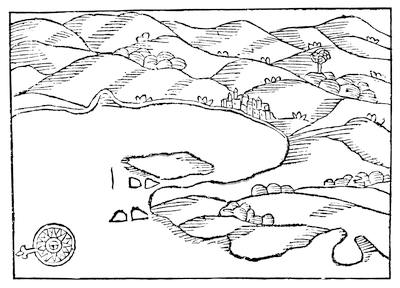
CONCEPTION BAY.
[Fac-simile of a cut in Ovalle’s Historica Relacion de Chile, Rome, 1648.—Ed.]
The Araucanians now flew to arms in defence of their fatherland, at the call of their aged chief, Colo-colo. A younger but equally brave leader, named Caupolican, was elected toqui, or general, of the army; and they began operations by attempting to destroy a Spanish fort at Tucapel. Valdivia hurried from Concepcion, at the head of fifty cavalry, and attacked the Araucanian host. The governor had with him a young Indian lad of eighteen, named Lautaro, as groom. There was great slaughter among the Araucanians, and they were beginning to give way, when all the best feelings of Lautaro were aroused at the sight of his countrymen in peril. On the instant he felt the glow of ardent patriotism. He went over to the enemy, exhorted them to rally, and led them once more to the attack. The Spanish force was annihilated, and the governor was taken prisoner. Led before the toqui, young Lautaro interceded for his master, and the generous Caupolican listened favorably; but the savage chief Leucaton protested, and felled Valdivia by a deadly blow with a club on the back of the head. This disaster took place on the last day of December, 1553. Don Pedro de Valdivia was in his fifty-sixth year, and by his conquest and settlement of Chili he won a place in history side by side with Cortés and Pizarro. He was childless.
Francisco de Villagra succeeded his old chief as governor of Chili, and made preparations to repair the disaster. Lautaro became the second leader of his countrymen, under Caupolican. Their tactics were to allow the Spaniards to penetrate into their country as far as they pleased, but to cut off supplies, and harass their retreat. Thus Villagra easily marched from Arauco to Tucapel; but he was attacked by an immense army under Lautaro, which stopped his retreat, and he suffered such severe loss in the battle of Mariguanu that the town of Concepcion was abandoned in November, 1555. There was hard fighting again in 1556, in defence of the garrisons at Imperial and Valdivia. Early in the following year Lautaro was intrenched with an army on the banks of the Mataquito, when he was surprised at dawn by Villagra. He made a gallant defence, but was killed; and six hundred warriors fell with him. Thus died one of the noblest patriots of the American race.
In the same year the viceroy, Marquis of Cañete, appointed his son, Don Garcia Hurtado de Mendoza, a youth barely twenty-two years of age, to be governor of Chili. His cavalry, under Luis de Toledo, marched by land over the desert of Atacama, while the young governor embarked at Callao, and sailed for Chili with three vessels conveying seven hundred infantry. Among the officers was Don Alonso de Ercilla, whose epic poem records the events of this famous war. Don Garcia landed at Coquimbo on the 25th of April, 1557, and the cavalry arrived on the following day. After having assumed the government at Santiago, and ungratefully dismissed Villagra, to secure the tranquillity of his own rule, he continued the interminable war. His first operation was to occupy the island of Quiriquina, off Talcahuano, and to build the fort of Pinto on the west side of the valley of the Penco. Here he was attacked by Caupolican with a great army. There were marvellous individual acts of bravery on both sides; Don Garcia himself was wounded, and two thousand Araucanians were slain. The governor then crossed the river Biobio and fought another great battle, Caupolican retreating with heavy loss. Don Garcia disgraced his victory by hanging twelve captive chiefs, including the heroic Galvarino.
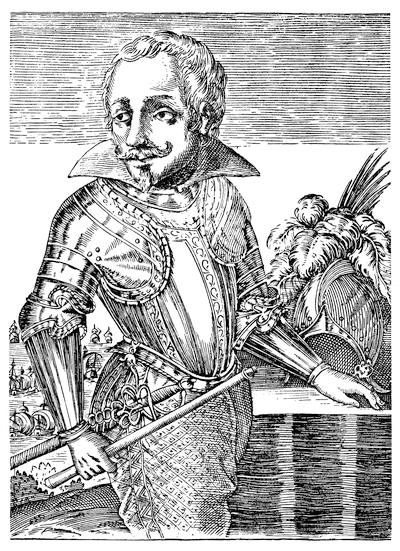
GARCIA HURTADO DE MENDOZA.
[Fac-simile of a copperplate in Ovalle’s Historica Relacion de Chile, Rome, 1648.—Ed.]
Penetrating far to the south, the town of Osorno was founded beyond Valdivia, and the archipelago of Chiloe was discovered. During the governor’s absence in the far south, the toqui Caupolican was betrayed into the hands of Alonso de Reinosa, the captain in command at Tucapel, who put him to a horrible death by impalement.
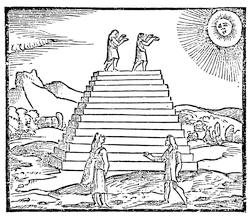
PERUVIANS WORSHIPPING THE SUN.
[After the sketch in Benzoni, edition of 1572, p. 168.—Ed.]
There was now a brief interval of peace. Don Garcia had brought with him to Chili the good licentiate Gonzalez Marmolejo, afterwards first bishop of Santiago, who prepared rules for the humane treatment of the peaceful natives. Only a sixth were allowed to be employed at the mines; no one was to work who was under eighteen or over fifty; no laborer was to be forced to work on feast days, and all were to be paid and supplied with food. On the 5th of February, 1561, Don Garcia Hurtado de Mendoza embarked at Valparaiso and left Chili, being succeeded by Francisco de Villagra, the old companion in arms of Valdivia. Villagra died in 1563, and was succeeded by Rodrigo de Quiroga. In 1563 the bishopric of Santiago was founded, and in 1565 the royal Audiencia of Chili was instituted, with Dr. Melchor Bravo de Saravia as its first president. Its seat was fixed in the city of Concepcion.
We must now return to the course of events in Peru. The scandalous death of the viceroy Conde de Nieva seems to have induced the king to choose his successor from among men learned in the law rather than from the nobility, and to drop the title of viceroy. Lope Garcia de Castro had been a judge of the Audiencia of Valladolid, and afterwards a member of the council of the Indies. He was appointed governor and captain-general of Peru, and president of the Audiencia of Lima, where he made his public entry Sept. 22, 1564. To avoid scandal, the belief had been encouraged that the Conde de Nieva had been murdered in bed. But everybody knew that he had been struck to the ground by several stout negroes with bags full of sand; that the blows had been continued until life was extinct; and that after the murder people came out of the house of the Zarates, and carried the body to the palace. The culprit was Don Rodrigo Manrique de Lara, a powerful citizen of proud lineage, who had discovered love passages between his young wife and her near relative the viceroy. But the judges thought there would be grave scandal if the delinquent was brought to justice, and the new governor took the same view. The affair was hushed up.
Lope de Castro established a mint, imposed the almojarifazgo, or customs dues, and organized the work at the newly-discovered quicksilver mines of Huancavelica, and at the silver mines. In 1567 the Jesuits arrived in Peru, and in the same year the second council of Lima was convoked by Archbishop Loaysa, the governor assisting as representative of the king. The first council was in 1552. At the second the decisions of the council of Trent were accepted, and the parochial arrangements were made; while the governor proceeded with the work of fixing the divisions of land among the Indians, and marking out the country into corregimientos, or provinces, under corregidors. In 1567 Castro despatched an expedition from Callao, under the command of his nephew, Alvaro de Mendaña, who discovered the Solomon Islands. Lope Garcia de Castro governed Peru for five years, handing over his charge to his successor, in 1569, to return to Spain and resume his seat at the council board of the Indies.
Don Francisco de Toledo, second son of the third Count of Oropesa, was the king’s major-domo, and was advanced in years when he was selected to succeed the licentiate Lope de Castro. In his case the title of viceroy was revived, and was retained by his successors until the independence. Landing at Payta, the viceroy Toledo travelled along the coast, closely observing the condition both of Spaniards and Indians; and he then made up his mind to visit every province within his government. He made his public entrance into Lima on the 26th of November, 1569.
Toledo was assisted by statesmen of great ability and experience, who warmly sympathized with the aboriginal races, and were anxious for their welfare. Chief among his advisers was the licentiate Polo de Ondegardo, who had now been several years in Peru, had filled important administrative posts,—especially as corregidor of Charcas and of Cusco,—and had studied the system of the government and civilization of the Yncas with minute attention, especially as regards the tenures of land, and always with a view to securing justice to the natives. The licentiate Juan Matienzo was another upright and learned minister who had studied the indigenous civilization and the requirements of colonial policy with great care; while in affairs relating to religion and the instruction of the people, the viceroy consulted the accomplished Jesuit author, José de Acosta.