Chapter IV
Reading edition
ANCIENT FLORIDA.
BY JOHN GILMARY SHEA, LL.D.
THE credit of being the first to explore our Atlantic coast has not yet been positively awarded by critical historians. Ramusio preserves the report of a person whom he does not name, which asserts that Sebastian Cabot claimed for his father and himself, in the summer of 1497, to have run down the whole coast, from Cape Breton to the latitude of Cuba; but the most recent and experienced writer on Cabot treats the claim as unfounded.[792]
The somewhat sceptical scholars of our day have shown little inclination to adopt the theory of Francisco Adolpho de Varnhagen, that Americus Vespucius on his first voyage reached Honduras in 1497, and during the ensuing year ran along the northern shore of the Gulf of Mexico, doubled the Florida cape, and then sailed northward along our Atlantic coast to the Gulf of St. Lawrence, where he built a vessel and sailed to Cadiz.[793]
Although Columbus made his first landfall on one of the Bahamas, and Cuba was soon after occupied, no definite knowledge seems to have been obtained of the great mainland so near them. There is nothing in narrative or map to betray any suspicion of its existence prior to the year 1502, when a map executed in Lisbon at the order of Cantino, an Italian merchant, for Hercules d’Este, shows a mainland north of Cuba, terminating near that island in a peninsula resembling Florida. The tract of land thus shown has names of capes and rivers, but they can be referred to no known exploration. To some this has seemed to be but a confused idea of Cuba as mainland;[794] by others it is regarded as a vague idea of Yucatan. But Harrisse in his Corte-Real, where he reproduces the map, maintains that “between the end of 1500 and the summer of 1502 navigators, whose name and nationality are unknown, but whom we presume to be Spaniards, discovered, explored, and named the part of the shore of the United States which from the vicinity of Pensacola Bay runs along the Gulf of Mexico to the Cape of Florida, and, turning it, runs northward along the Atlantic coast to about the mouth of the Chesapeake or Hudson.”[795]
But leaving these three claims in the realm of conjecture and doubt, we come to a period of more certain knowledge.
The Lucayos of the Bahamas seem to have talked of a great land of Bimini not far from them. The Spaniards repeated the story; and in the edition of Peter Martyr’s Decades published in 1511 is a map on which a large island appears, named “Illa de Beimeni, parte.”[796]
Discovery had taken a more southerly route; no known Spanish vessel had passed through the Bahama channel or skirted the coast. But some ideas must have prevailed, picked up from natives of the islands, or adventurous pilots who had ventured farther than their instructions authorized. Stories of an island north of Hispaniola, with a fountain whose waters conferred perpetual youth, had reached Peter Martyr in Spain, for in the same edition of his Decades he alludes to the legends.
John Ponce de Leon, who had accompanied Columbus on his second voyage, and had since played his part bravely amid the greatest vicissitudes, resolved to explore and conquer Bimini. He had friends at Court, and seems to have been a personal favorite of the King, who expressed a wish for his advancement.[797] The patent he solicited was based on that originally issued to Columbus; but the King laughingly said, that it was one thing to grant boundless power when nothing was expected to come of it, and very different to do so when success was almost certain. Yet on the 23d of February, 1512, a royal grant empowered John Ponce de Leon “to proceed to discover and settle the Island of Bimini.”[798] The patent was subject to the condition that the island had not been already discovered. He was required to make the exploration within three years, liberty being granted to him to touch at any island or mainland not subject to the King of Portugal. If he succeeded in his expedition he was to be governor of Bimini for life, with the title of adelantado.[799]
The veteran immediately purchased a vessel, in order to go to Spain and make preparations for the conquest of Bimini. But the authorities in Porto Rico seized his vessel; and the King, finding his services necessary in controlling the Indians, sent orders to the Council of the Indies to defer the Bimini expedition, and gave Ponce de Leon command of the fort in Porto Rico.[800]
Thus delayed in the royal service, Ponce de Leon was unable to obtain vessels or supplies till the following year. He at last set sail from the port of San German in Porto Rico in March, 1513,[801] with three caravels, taking as pilot Anton de Alaminos, a native of Palos who had as a boy accompanied Columbus, and who was long to associate his own name with explorations of the Gulf of Mexico. They first steered northeast by north, and soon made the Caicos, Yaguna, Amaguayo, and Manigua. After refitting at Guanahani, Ponce de Leon bore northwest; and on Easter Sunday (March 27) discovered the mainland, along which he ran till the 2d of April, when he anchored in 30° 8’ and landed. On the 8th he took possession in the name of the King of Spain, and named the country—which the Lucayos called Cancio—Florida, from Pascua Florida, the Spanish name for Easter Sunday.
The vessels then turned southward, following the coast till the 20th, when Ponce landed near Abayoa, a cluster of Indian huts. On attempting to sail again, he met such violent currents that his vessels could make no headway, and were forced to anchor, except one of the caravels, which was driven out of sight. On landing at this point Ponce found the Indians so hostile that he was obliged to repel their attacks by force. He named a river Rio de la Cruz; and, doubling Cape Corrientes on the 8th of May, sailed on till he reached a chain of islands, to which he gave the name of the Martyrs. On one of these he obtained wood and water, and careened a caravel. The Indians were very thievish, endeavoring to steal the anchors or cut the cables, so as to seize the ships. He next discovered and named the Tortugas. After doubling the cape, he ran up the western shore of Florida to a bay, in 27° 30’, which for centuries afterward bore the name of Juan Ponce. There are indications that before he turned back he may have followed the coast till it trended westward. After discovering Bahama he is said to have despatched one caravel from Guanima under John Perez de Ortubia, with Anton de Alaminos, to search for Bimini, while he himself returned to Porto Rico, which he reached September 21. He was soon followed by Ortubia, who, it is said, had been successful in his search for Bimini.
Although Ponce de Leon had thus explored the Florida coast, and added greatly to the knowledge of the Bahama group, his discoveries are not noted in the editions of Ptolemy which appeared in the next decade, and which retained the names of the Cantino map. The Ribeiro map (1529) gives the Martyrs and Tortugas, and on the mainland Canico,—apparently Cancio, the Lucayan name of Florida. In the so-called Leonardo da Vinci’s Mappemonde, Florida appears as an island in a vast ocean that rolls on to Japan.[802]
Elated with his success, John Ponce de Leon soon after sailed to Spain; and, obtaining an audience of the King,—it is said through the influence of his old master, Pero Nuñez de Guzman, Grand Comendador of Calatrava,—gave the monarch a description of the attractive land which he had discovered. He solicited a new patent for its conquest and settlement; and on the 27th of September, 1514, the King empowered him to go and settle “the Island of Brimini and the Island Florida” which he had discovered under the royal orders. He was to effect this in three years from the delivery of the asiento; but as he had been employed in His Majesty’s service, it was extended so that this term was to date from the day he set sail for his new province. After reducing the Caribs, he was empowered to take of the vessels and men employed in that service whatever he chose in order to conquer and settle Florida. The natives were to be summoned to submit to the Catholic Faith and the authority of Spain, and they were not to be attacked or captured if they submitted. Provision was made as to the revenues of the new province, and orders were sent to the viceroy, Don Diego Columbus, to carry out the royal wishes.[803]
The Carib war was not, however, terminated as promptly as the King and his officers desired. Time passed, and adventurers in unauthorized expeditions to Florida rendered the Indians hostile.[804] It was not till 1521 that Ponce de Leon was able to give serious thought to a new expedition. His early hopes seem to have faded, and with them the energy and impulsiveness of his youth. He had settled his daughters in marriage, and, free from domestic cares, offered himself simply to continue to serve the King as he had done for years. Writing to Charles V. from Porto Rico on the 10th of February, 1521, he says:—
“Among my services I discovered, at my own cost and charge, the Island Florida and others in its district, which are not mentioned as being small and useless; and now I return to that island, if it please God’s will, to settle it, being enabled to carry a number of people with which I shall be able to do so, that the name of Christ may be praised there, and Your Majesty served with the fruit that land produces. And I also intend to explore the coast of said island further, and see whether it is an island, or whether it connects with the land where Diego Velasquez is, or any other; and I shall endeavor to learn all I can. I shall set out to pursue my voyage hence in five or six days.”[805]
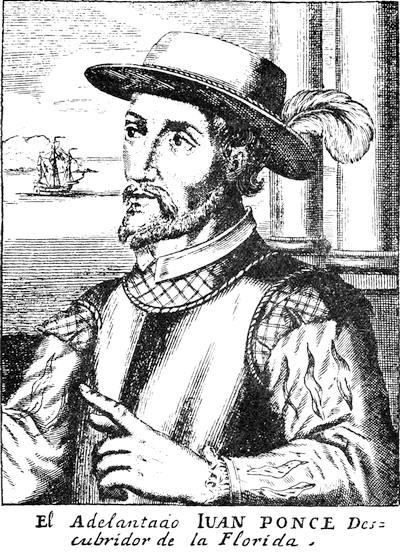
PONCE DE LEON.
Fac-simile of an engraving in Herrera, edition of 1728.
As he wrote to the Cardinal of Tortosa, he had expended all his substance in the King’s service; and if he asked favors now it was “not to treasure up or to pass this miserable life, but to serve His Majesty with them and his person and all he had, and settle the land that he had discovered.”[806]
He went prepared to settle, carrying clergymen for the colonists, friars to found Indian missions, and horses, cattle, sheep, and swine. Where precisely he made the Florida coast we do not know; but it is stated that on attempting to erect dwellings for his colonists he was attacked by the natives, who showed great hostility. Ponce himself, while leading his men against his assailants, received so dangerous an arrow wound, that, after losing many of his settlers by sickness and at the hands of the Indians, he abandoned the attempt to plant a colony in Florida, which had so long been the object of his hopes; and taking all on board his vessels, he sailed to Cuba. There he lingered in pain, and died of his wound.[807]
John Ponce de Leon closed his long and gallant career without solving the problem whether Florida was an island or part of the northern continent. Meanwhile others, following in the path he had opened, were contributing to a more definite knowledge. Thus Diego Miruelo, a pilot, sailed from Cuba in 1516 on a trading cruise; and running up the western shore of the Floridian peninsula, discovered a bay which long bore his name on Spanish maps, and was apparently Pensacola. Here he found the Indians friendly, and exchanged his store of glass and steel trinkets for silver and gold. Then, satisfied with his cruise, and without making any attempt to explore the coast, he returned to Cuba.[808]
The next year Francis Hernandez de Cordova[809] sent from Cuba on the 8th of February two ships and a brigantine, carrying one hundred and ten men, with a less humane motive than Miruelo’s; for Oviedo assures us that his object was to capture on the Lucayos, or Bahama Islands, a cargo of Indians to sell as slaves. His object was defeated by storms; and the vessels, driven from their course, reached Yucatan, near Cape Catoche, which he named. The Indians here were as hostile as the elements; and Hernandez, after several sharp engagements with the natives, in which almost every man was wounded, was sailing back, when storms again drove his vessels from their course. Unable to make the Island of Cuba, Alaminos, the pilot of the expedition, ran into a bay on the Florida coast, where he had been with Ponce de Leon on his first expedition. While a party which had landed were procuring water, they were attacked with the utmost fury by the Indians, who, swarming down in crowds, assailed those still in the boats. In this engagement twenty-two of the Indians were killed, six of the Spaniards in the landing party were wounded,—including Bernal Diaz, who records the event in his History,—and four of those in the boats, among the number Anton de Alaminos, the pilot. The only man in the expedition who had come away from Yucatan unwounded, a soldier named Berrio, was acting as sentry on shore, and fell into the hands of the Indians. The commander himself, Hernandez de Cordova, reached Cuba only to die of his wounds.
This ill-starred expedition led to two other projects of settlement and conquest. Diego Velasquez, governor of Cuba, the friend and host of Hernandez, obtained a grant, which was referred to by Ponce de Leon in his final letter to the King, and which resulted in the conquest of Mexico;[810] and Francis de Garay, governor of Jamaica, persuaded by Alaminos to enter upon an exploration of the mainland, obtained permission in due form from the priors of the Order of St. Jerome, then governors of the Indies, and in 1519 despatched four caravels, well equipped, with a good number of men, and directed by good pilots, to discover some strait in the mainland,—then the great object of search.
Alonzo Alvarez de Pineda, the commander of the expedition, reached the coast within the limits of the grant of Ponce de Leon, and endeavored to sail eastward so as to pass beyond and continue the exploration. Unable, from headwinds, to turn the Cape of Florida, he sailed westward as far as the River Pánuco, which owes its name to him. Here he encountered Cortés and his forces, who claimed the country by actual possession.
The voyage lasted eight or nine months, and possession was duly taken for the King at various points on the coast. Sailing eastward again, Garay’s lieutenant discovered a river of very great volume, evidently the Mississippi.[811] Here he found a considerable Indian town, and remained forty days trading with the natives and careening his vessels. He ran up the river, and found it so thickly inhabited that in a space of six leagues he counted no fewer than forty Indian hamlets on the two banks.
According to their report, the land abounded in gold, as the natives wore gold ornaments in their noses and ears and on other parts of the body. The adventurers told, too, of tribes of giants and of pigmies; but declared the natives to have been friendly, and well disposed to receive the Christian Faith.
Wild as these statements of Pineda’s followers were, the voyage settled conclusively the geography of the northern shore of the Gulf, as it proved that there was no strait there by which ships could reach Asia. Florida was no longer to be regarded as an island, but part of a vast continent. The province discovered for Garay received the name of Amichel.
Garay applied for a patent authorizing him to conquer and settle the new territory, and one was issued at Burgos in 1521. By its tenor Christopher de Tapia, who had been appointed governor of the territory discovered by Velasquez, was commissioned to fix limits between Amichel and the discoveries of Velasquez on the west and those of Ponce de Leon on the east. On the map given in Navarrete,[812] Amichel extends apparently from Cape Roxo to Pensacola Bay.
After sending his report and application to the King, and without awaiting any further authority, Garay seems to have deemed it prudent to secure a footing in the territory; and in 1520 sent four caravels under Diego de Camargo to occupy some post near Pánuco. The expedition was ill managed. One of the vessels ran into a settlement established by Cortés and made a formal demand of Cortés himself for a line of demarcation, claiming the country for Garay. Cortés seized some of the men who landed, and learned all Camargo’s plans. That commander, with the rest of his force, attempted to begin a settlement at Pánuco; but the territory afforded no food, and the party were soon in such straits that, unable to wait for two vessels which Garay was sending to their aid, Camargo despatched a caravel to Vera Cruz to beg for supplies.[813]
In 1523 Garay equipped a powerful fleet and force to conquer and settle Amichel. He sailed from Jamaica at the end of June with the famous John de Grijalva, discoverer of Yucatan, as his lieutenant. His force comprised thirteen vessels, bearing one hundred and thirty-six cavalry and eight hundred and forty infantry, with a supply of field-pieces. He reached Rio de las Palmas on the 25th of July, and prepared to begin a settlement; but his troops, alarmed at the unpromising nature of the country, insisted on proceeding southward. Garay yielded, and sailed to Pánuco, where he learned that Cortés had already founded the town of San Esteban del Puerto. Four of his vessels were lost on the coast, and one in the port. He himself, with the rest of his force, surrendered to Cortés. He died in Mexico, while still planning a settlement at Rio de las Palmas; but with his death the province of Amichel passed out of existence.
Thus the discoveries of Ponce de Leon and of Garay, with those of Miruelos, made known, by ten years’ effort, the coast-line from the Rio Grande to the St. John’s in Florida.
The next explorations were intended to ascertain the nature of our Atlantic coast north of the St. John’s.
In 1520 Lucas Vasquez de Ayllon, one of the auditors of the Island of St. Domingo, though possessed of wealth, honors, and domestic felicity, aspired to the glory of discovering some new land, and making it the seat of a prosperous colony. Having secured the necessary license, he despatched a caravel under the command of Francisco Gordillo, with directions to sail northward through the Bahamas, and thence strike the shore of the continent. Gordillo set out on his exploration, and near the Island of Lucayoneque, one of the Lucayuelos, descried another caravel. His pilot, Alonzo Fernandez Sotil, proceeded toward it in a boat, and soon recognized it as a caravel commanded by a kinsman of his, Pedro de Quexos, fitted out in part, though not avowedly, by Juan Ortiz de Matienzo, an auditor associated with Ayllon in the judiciary. This caravel was returning from an unsuccessful cruise among the Bahamas for Caribs,—the object of the expedition being to capture Indians in order to sell them as slaves. On ascertaining the object of Gordillo’s voyage, Quexos proposed that they should continue the exploration together. After a sail of eight or nine days, in which they ran little more than a hundred leagues, they reached the coast of the continent at the mouth of a considerable river, to which they gave the name of St. John the Baptist, from the fact that they touched the coast on the day set apart to honor the Precursor of Christ. The year was 1521, and the point reached was, according to the estimate of the explorers, in latitude 33° 30′.[814]
Boats put off from the caravels and landed some twenty men on the shore; and while the ships endeavored to enter the river, these men were surrounded by Indians, whose good-will they gained by presents.[815]
Some days later, Gordillo formally took possession of the country in the name of Ayllon, and of his associate Diego Caballero, and of the King, as Quexos did also in the name of his employers on Sunday, June 30, 1521. Crosses were cut on the trunks of trees to mark the Spanish occupancy.[816]
Although Ayllon had charged Gordillo to cultivate friendly relations with the Indians of any new land he might discover,[817] Gordillo joined With Quexos in seizing some seventy of the natives, with whom they sailed away, without any attempt to make an exploration of the coast.
On the return of the vessel to Santo Domingo, Ayllon condemned his captain’s act; and the matter was brought before a commission, presided over by Diego Columbus, for the consideration of some important affairs. The Indians were declared free, and it was ordered that they should be restored to their native land at the earliest possible moment. Meanwhile they were to remain in the hands of Ayllon and Matienzo.
The latter made no attempt to pursue the discovery; but Ayllon, adhering to his original purpose, proceeded to Spain with Francisco,—one of the Indians, who told of a giant king and many provinces,[818]—and on the 12th of June, 1523, obtained a royal cédula.[819] Under this he was to send out vessels in 1524, to run eight hundred leagues along the coast, or till he reached lands already discovered; and if he discovered any strait leading to the west, he was to explore it. No one was to settle within the limits explored by him the first year, or within two hundred leagues beyond the extreme points reached by him north and south; the occupancy of the territory was to be effected within four years; and as the conversion of the natives was one of the main objects, their enslavement was forbidden, and Ayllon was required to take out religious men of some Order to instruct them in the doctrines of Christianity. He obtained a second cédula to demand from Matienzo the Indians in his hands in order to restore them to their native country.[820]
On his return to the West Indies, Ayllon was called on the King’s service to Porto Rico; and finding it impossible to pursue his discovery, the time for carrying out the asiento was, by a cédula of March 23, 1524, extended to the year 1525.[821]
To secure his rights under the asiento, he despatched two caravels under Pedro de Quexos to the newly discovered land early in 1525. They regained the good-will of the natives and explored the coast for two hundred and fifty leagues, setting up stone crosses with the name of Charles V. and the date of the act of taking possession. They returned to Santo Domingo in July, 1525, bringing one or two Indians from each province, who might be trained to act as interpreters.[822]
Meanwhile Matienzo began legal proceedings to vacate the asiento granted by the King to Ayllon, on the ground that it was obtained surreptitiously, and in fraud of his own rights as joint discoverer. His witnesses failed to show that his caravel had any license to make a voyage of exploration, or that he took any steps to follow up the discovery made; but the suit embarrassed Ayllon, who was fitting out four vessels to sail in 1526, in order to colonize the territory granted to him. The armada from Spain was greatly delayed; and as he expected by it a store of artillery and muskets, as well as other requisites, he was at great loss. At last, however, he sailed from Puerto de la Plata with three large vessels,—a caravel, a breton, and a brigantine,—early in June, 1526.[823] As missionaries he took the famous Dominican, Antonio de Montesinos, the first to denounce Indian slavery, with Father Antonio de Cervantes and Brother Pedro de Estrada, of the same Order. The ships carried six hundred persons of both sexes, including clergymen and physicians, besides one hundred horses.
They reached the coast, not at the San Juan Bautista, but at another river, at 33° 40´, says Navarrete, to which they gave the name of Jordan.[824] Their first misfortune was the loss of the brigantine; but Ayllon immediately set to work to replace it, and built a small vessel such as was called a gavarra,—the first instance of ship-building on our coast. Francisco, his Indian guide, deserted him; and parties sent to explore the interior brought back such unfavorable accounts that Ayllon resolved to seek a more fertile district. That he sailed northward there can be little doubt; his original asiento required him to run eight hundred leagues along the coast, and he, as well as Gomez, was to seek a strait or estuary leading to the Spice Islands. The Chesapeake was a body of water which it would be imperative on him to explore, as possibly the passage sought. The soil of the country bordering on the bay, superior to that of the sandy region south of it, would seem better suited for purposes of a settlement. He at last reached Guandape, and began the settlement of San Miguel, where the English in the next century founded Jamestown.[825]
Here he found only a few scattered Indian dwellings of the communal system, long buildings, formed of pine posts at the side, and covered with branches, capable of holding, in their length of more than a hundred feet, a vast number of families. Ayllon selected the most favorable spot on the bank, though most of the land was low and swampy. Then the Spaniards began to erect houses for their shelter, the negro slaves—first introduced here—doing the heaviest portion of the toil. Before the colonists were housed, winter came on. Men perished of cold on the caravel “Catalina,” and on one of the other vessels a man’s legs were frozen so that the flesh fell off. Sickness broke out among the colonists, and many died. Ayllon himself had sunk under the pestilential fevers, and expired on St. Luke’s Day, Oct. 18, 1526.
He made his nephew, John Ramirez, then in Porto Rico, his successor as head of the colony, committing the temporary administration to Francis Gomez. Troubles soon began. Gines Doncel and Pedro de Bazan, at the head of some malcontents, seized and confined Gomez and the alcaldes, and began a career of tyranny. The Indians were provoked to hostility, and killed several of the settlers; the negroes, cruelly oppressed, fired the house of Doncel. Then two settlers, Oliveros and Monasterio, demanded the release of the lawful authorities. Swords were drawn; Bazan was wounded and taken, Doncel fled, but was discovered near his blazing house. Gomez and his subordinates, restored to power, tried and convicted Bazan, who was put to death.
Such were the stormy beginnings of Spanish rule in Virginia. It is not to be wondered at that with one consent the colonists soon resolved to abandon San Miguel de Guandape. The body of Ayllon was placed on board a tender, and they set sail; but it was not destined to reach a port and receive the obsequies due his rank. The little craft foundered; and of the five hundred who sailed from Santo Domingo only one hundred and fifty returned to that island.
Contemporaneous with the explorations made by and under Ayllon was an expedition in a single vessel sent out by the Spanish Government in 1524 under Stephen Gomez, a Portuguese navigator who had sailed under Magallanes, but had returned in a somewhat mutinous manner. He took part in a congress of Spanish and Portuguese pilots held at Badajoz to consider the probability of finding a strait or channel north of Florida by which vessels might reach the Moluccas. To test the question practically, Charles V. ordered Gomez to sail to the coast of Bacallaos, or Newfoundland and Labrador, and examine the coast carefully, in order to ascertain whether any such channel existed. Gomez fitted out a caravel at Corunna, in northern Spain, apparently in the autumn of 1524, and sailed across. After examining the Labrador coast, he turned southward and leisurely explored the whole coast from Cape Race to Florida, from which he steered to Santiago de Cuba, and thence to Corunna, entering that port after ten months’ absence. He failed to discover the desired channel, and no account in detail of his voyage is known; but the map of Ribeiro,[826] drawn up in 1529, records his discoveries, and on its coast-line gives names which were undoubtedly bestowed by him, confirming the statement that he sailed southerly. From this map and the descriptions of the coast in Spanish writers soon after, in which descriptions mention is made of his discoveries, we can see that he noted and named in his own fashion what we now know as Massachusetts Bay, Cape Cod, Narragansett Bay, the Connecticut, Hudson, and Delaware rivers.
This voyage completed the exploration of our coast from the Rio Grande to the Bay of Fundy; yet Sebastián Cabot in 1536 declared that it was still uncertain whether a single continent stretched from the Mississippi to Newfoundland.[827]
The success of Cortés filled the Spanish mind with visions of empires in the north rivalling that of Mexico, which but awaited the courage of valiant men to conquer.
Panfilo de Narvaez, after being defeated by Cortés, whom he was sent to supersede,[828] solicited of Charles V. a patent under which he might conquer and colonize the country on the Gulf of Mexico, from Rio de Palmas to Florida. A grant was made, under which he was required to found two or more towns and erect two fortresses. He received the title of adelantado, and was empowered to enslave all Indians who, after being summoned in due form, would not submit to the Spanish King and the Christian Faith. In an official document he styles himself Governor of Florida, Rio de Palmas, and Espiritu Santo,—the Mississippi.[829]
Narvaez collected an armament suited to the project, and sailed from San Lucar de Barrameda, June 17, 1527, in a fleet of five ships carrying six hundred persons, with mechanics and laborers, as well as secular priests, and five Franciscan friars, the superior being Father Juan Xuarez. On the coast of Cuba his fleet was caught by a hurricane, and one vessel perished. After refitting and acquiring other vessels, Narvaez sailed from Cuba in March with four vessels and a brigantine, taking four hundred men and eighty horses, his pilot being Diego Miruelo, of a family which had acquired experience on that coast.
The destination was the Rio de Palmas; but his pilot proved incompetent, and his fleet moved slowly along the southern coast of Cuba, doubled Cape San Antonio, and was standing in for Havana when it was driven by a storm on the Florida coast at a bay which he called Bahia de la Cruz, and which the map of Sebastian Cabot identifies with Apalache Bay.[830] Here Narvaez landed a part of his force (April 15), sending his brigantine to look for a port or the way to Pánuco,—much vaunted by the pilots,—and if unsuccessful to return to Cuba for a vessel that had remained there. He was so misled by his pilots that though he was near or on the Florida peninsula, he supposed himself not far from the rivers Pánuco and Palmas. Under this impression he landed most of his men, and directed his vessels, with about one hundred souls remaining on them, to follow the coast while he marched inland. No steps were taken to insure their meeting at the harbor proposed as a rendezvous, or to enable the brigantine and the other ship to follow the party on land. On the 19th of April Narvaez struck inland in a northward or northeasterly direction; and having learned a little of the country, moved on with three hundred men, forty of them mounted. On the 15th of the following month they reached a river with a strong current, which they crossed some distance from the sea. Cabeza de Vaca, sent at his own urgent request to find a harbor, returned with no encouraging tidings; and the expedition plodded on till, on the 25th of June, they reached Apalache,—an Indian town of which they had heard magnificent accounts. It proved to be a mere hamlet of forty wretched cabins.
The sufferings of Narvaez’ men were great; the country was poverty-stricken; there was no wealthy province to conquer, no fertile lands for settlement. Aute (a harbor) was said to be nine days’ march to the southward; and to this, after nearly a month spent at Apalache, the disheartened Spaniards turned their course, following the Magdalena River. On the 31st of July they reached the coast at a bay which Narvaez styled Bahia de Cavallos; and seeing no signs of his vessels, he set to work to build boats in which to escape from the country. The horses were killed for food; and making forges, the Spaniards wrought their stirrups, spurs, and other iron articles into saws, axes, and nails. Ropes were made of the manes and tails of the horses and such fibres as they could find; their shirts were used for sailcloth. By the 20th of September five boats, each twenty-two cubits long, were completed, and two days afterward the survivors embarked, forty-eight or nine being crowded into each frail structure. Not one of the whole number had any knowledge of navigation or of the coast.
Running between Santa Rosa Island and the mainland, they coasted along for thirty days, landing where possible to obtain food or water, but generally finding the natives fierce and hostile. On the 31st of October they came to a broad river pouring into the Gulf such a volume of water that it freshened the brine so that they were able to drink it; but the current was too much for their clumsy craft. The boat commanded by Narvaez was lost, and never heard of; that containing Father Xuarez and the other friars was driven ashore bottom upward; the three remaining boats were thrown on the coast of western Louisiana or eastern Texas. The crews barely escaped with life, and found themselves at the mercy of cruel and treacherous savages, who lived on or near Malhado Island, and drew a precarious living from shellfish and minor animals, prickly-pears and the like. They were consequently not as far west as the bison range, which reached the coast certainly at Matagorda Bay.[831] Here several of the wretched Spaniards fell victims to the cruelty of the Indians or to disease and starvation, till Alvar Nuñez Cabeza de Vaca, the treasurer of the expedition, escaping from six years’ captivity among the Mariames, reached the Avavares, farther inland, with two companions, Castillo and Dorantes, and a negro slave. After spending eight months with them, he penetrated to the Arbadaos, where the mesquite is first found, near the Rio Grande; and skirting the San Saba Mountains, came to the bison plains and the hunter nations; then keeping westward through tribes that lived in houses of earth and knew the use of cotton and mined the turquoise, he finally came upon some Spanish explorers on the River Petatlan; and thus on the 1st of April, 1536, with hearts full of joy and gratitude, the four men entered the town of San Miguel in Sinaloa.
The vessels of Narvaez, not finding the alleged port of the pilots, returned to the harbor where they had landed him, and were there joined by the two vessels from Cuba; but though they remained nearly a year, cruising along the coast of the Gulf, they never encountered the slightest trace of the unfortunate Narvaez or his wretched followers. They added nothing apparently to the knowledge of the coast already acquired; for no report is extant, and no map alludes to any discovery by them.
Thus ended an expedition undertaken with rashness and ignorance, and memorable only from the almost marvellous adventures of Cabeza de Vaca and his comrades, and the expeditions by land which were prompted by his narrative.
The wealth of Mexico and Peru had inflamed the imagination of Spanish adventurers; and though no tidings had been received of Narvaez, others were ready to risk all they had, and life itself, in the hope of finding some wealthy province in the heart of the northern continent. The next to try his fortune was one who had played his part in the conquest of Peru.
Hernando de Soto, the son of an esquire of Xerez de Badajoz, was eager to rival Cortés and Pizarro. In 1537 he solicited a grant of the province from Rio de las Palmas to Florida, as ceded to Narvaez, as well as of the province discovered by Ayllon; and the King at Valladolid, on the 20th of April, issued a concession to him, appointing him to the government of the Island of Cuba, and requiring him in person to conquer and occupy Florida within a year, erect fortresses, and carry over at least five hundred men as settlers to hold the country. The division of the gold, pearls, and other valuables of the conquered caciques was regulated, and provision made for the maintenance of the Christian religion and of an hospital in the territory.
The air of mystery assumed by Cabeza de Vaca as to the countries that he had seen, served to inflame the imagination of men in Spain; and Soto found many ready to give their persons and their means to his expedition. Nobles of Castile in rich slashed silk dresses mingled with old warriors in well-tried coats of mail. He sailed from San Lucar in April, 1538, amid the fanfaron of trumpets and the roar of cannon, with six hundred as high-born and well-trained men as ever went forth from Spain to win fame and fortune in the New World. They reached Cuba safely, and Soto was received with all honor. More prudent than Narvaez, Soto twice despatched Juan de Añasco, in a caravel with two pinnaces, to seek a suitable harbor for the fleet, before trusting all the vessels on the coast.[832]
Encouraged by the reports of this reconnoitring, Soto, leaving his wife in Cuba, sailed from Havana in May, 1539, and made a bay on the Florida coast ten leagues west of the Bay of Juan Ponce. To this he gave the name of Espiritu Santo, because he reached it on the Feast of Pentecost, which fell that year on the 25th of May.[833] On the 30th he began to land his army near a town ruled by a chief named Uçita. Soto’s whole force was composed of five hundred and seventy men, and two hundred and twenty-three horses, in five ships, two caravels, and two pinnaces. He took formal possession of the country in the name of the King of Spain on the 3d of June, and prepared to explore and subject the wealthy realms which he supposed to lie before him. Though the chief at his landing-place was friendly, he found that all the surrounding tribes were so hostile that they began to attack those who welcomed him.
Ortiz, a Spaniard belonging to Narvaez’ expedition, who in his long years of captivity had become as naked and as savage as were the Indians, soon joined Soto.[834] He was joyfully received; though his knowledge of the country was limited, his services were of vital necessity, for the Indians secured by Añasco, and on whom Soto relied as guides and interpreters, deserted at the first opportunity.
Soto had been trained in a bad school; he had no respect for the lives or rights of the Indians. As Oviedo, a man of experience among the conquistadores, says: “This governor was very fond of this sport of killing Indians.”[835]
The plan of his march showed his disregard of the rights of the natives. At each place he demanded of the cacique, or head chief, corn for his men and horses, and Indians of both sexes to carry his baggage and do the menial work in his camp. After obtaining these supplies, he compelled the chief to accompany his army till he reached another tribe whose chief he could treat in the same way; but though the first chief was then released, few of the people of the tribe which he ruled, and who had been carried off by Soto, were so fortunate as ever to be allowed to return to their homes.
On the 15th of July Soto, sending back his largest ships to Cuba, moved to the northeast to make his toilsome way amid the lakes and streams and everglades of Florida. Before long his soldiers began to suffer from hunger, and were glad to eat water-cresses, shoots of Indian corn, and palmetto, in order to sustain life; for native villages were few and scattered, and afforded little corn for the plunderers. The natives were met only as foe-men, harassing his march. At Caliquen the Indians, to rescue their chief, whom Soto was carrying to the next town, made a furious onslaught on the Spaniards; but were driven to the swamps, and nearly all killed or taken. Their dauntless spirit was, however, unbroken. The survivors, though chained as slaves, rose on their masters; and seizing any weapon within their reach, fought desperately, one of them endeavoring to throttle Soto himself. Two hundred survived this gallant attempt, only to be slaughtered by the Indian allies of the Spanish commander. Soto fought his way westward step by step so slowly that at the end of three months, Oct. 30, 1539, he had only reached Agile,—a town in the province of Apalache. Añasco, sent out from this point to explore, discovered the port where Narvaez had embarked,—the remains of his forges and the bones of his horses attesting the fact. Soto despatched him to Tampa Bay. Añasco with a party marched the distance in ten days; and sending two caravels to Cuba, brought to Soto in the remaining vessels the detachment left at his landing-place. Before he reached his commander the Indians had burned the town of Anaica Apalache, of which Soto had taken possession.[836]
A good port, that of Pensacola, had been discovered to the westward; but Soto, crediting an Indian tale of the rich realm of Yupaha in the northeast, left his winter quarters March 3, 1540, and advanced in that direction through tribes showing greater civilization. A month later he reached the Altamaha, receiving from the more friendly natives corn and game. This was not sufficient to save the Spaniards from much suffering, and they treated the Indians with their wonted cruelty.[837]
At last Soto, after a march of four hundred and thirty leagues, much of it through uninhabited land, reached the province ruled by the chieftainess of Cofitachiqui. On the 1st of May she went forth to meet the Spanish explorer in a palanquin or litter; and crossing the river in a canopied canoe, she approached Soto, and after presenting him the gifts of shawls and skins brought by her retinue, she took off her necklace of pearls and placed it around the neck of Soto. Yet her courtesy and generosity did not save her from soon being led about on foot as a prisoner. The country around her chief town, which Jones identifies with Silver Bluff, on the Savannah, below Augusta,[838] tempted the followers of Soto, who wished to settle there, as from it Cuba could be readily reached. But the commander would attempt no settlement till he had discovered some rich kingdom that would rival Peru; and chagrined at his failure, refused even to send tidings of his operations to Cuba. At Silver Bluff he came upon traces of an earlier Spanish march. A dirk and a rosary were brought to him, which were supposed, on good grounds, to have come from the expedition of Ayllon.
Poring over the cosmography of Alonzo de Chaves, Soto and the officers of his expedition concluded that a river, crossed on the 26th of May, was the Espiritu Santo, or Mississippi. A seven days’ march, still in the chieftainess’s realm, brought them to Chelaque, the country of the Cherokees, poor in maize; then, over mountain ridges, a northerly march brought them to Xualla, two hundred and fifty leagues from Silver Bluff. At the close of May they were in Guaxule, where the chieftainess regained her freedom. It was a town of three hundred houses, near the mountains, in a well-watered and pleasant land, probably at the site of Coosawattie Old Town. The chief gave Soto maize, and also three hundred dogs for the maintenance of his men.
Marching onward, Soto next came to Canasagua, in all probability on a river even now called the Connasauga, flowing through an attractive land of mulberries, persimmons, and walnuts. Here they found stores of bear oil and walnut oil and honey. Marching down this stream and the Oostanaula, into which it flows, to Chiaha, on an island opposite the mouth of the Etowa, in the district of the pearl-bearing mussel-streams, Soto was received in amity; and the cacique had some of the shellfish taken and pearls extracted in the presence of his guest. The Spaniards encamped under the trees near the town, leaving the inhabitants in quiet possession of their homes. Here, on the spot apparently now occupied by Rome, they rested for a month. A detachment sent to discover a reputed gold-producing province returned with no tidings to encourage the adventurers; and on the 28th of June Soto, with his men and steeds refreshed, resumed his march, having obtained men to bear his baggage, though his demand of thirty women as slaves was refused.[839]
Chisca, to which he sent two men to explore for gold, proved to be in a rugged mountain land; and the buffalo robe which they brought back was more curious than encouraging. Soto therefore left the territory of the Cherokees, and took the direction of Coça, probably on the Coosa river. The cacique of that place, warned doubtless by the rumors which must have spread through all the land of the danger of thwarting the fierce strangers, furnished supplies at several points on the route to his town, and as Soto approached it, came out on a litter attired in a fur robe and plumed headpiece to make a full surrender. The Spaniards occupied the town and took possession of all the Indian stores of corn and beans, the neighboring woods adding persimmons and grapes. This town was one hundred and ninety leagues west of Xualla, and lay on the east bank of the Coosa, between the mouths of the Talladega and Tallasehatchee, as Pickett, the historian of Alabama, determines. Soto held the chief of Coça virtually as a prisoner; but when he demanded porters to bear the baggage of his men, most of the Indians fled. The Spanish commander then seized every Indian he could find, and put him in irons.
After remaining at Coça for twenty-five days, Soto marched to Ullibahali, a strongly palisaded town, situated, as we may conjecture, on Hatchet Creek. This place submitted, giving men as porters and women as slaves. Leaving this town on the 2d of September, he marched to Tallise, in a land teeming with corn, whose people proved equally docile.[840] This submission was perhaps only to gain time, and draw the invaders into a disadvantageous position.
Actahachi, the gigantic chief of Tastaluza, sixty leagues south of Coça, which was Soto’s next station, received him with a pomp such as the Spaniards had not yet witnessed. The cacique was seated on cushions on a raised platform, with his chiefs in a circle around him; an umbrella of buckskin, stained red and white, was held over him. The curveting steeds and the armor of the Spaniards raised no look of curiosity on his stern countenance, and he calmly awaited Soto’s approach. Not till he found himself detained as a prisoner would he promise to furnish the Spaniards with porters and supplies of provisions at Mauila[841] to enable Soto to continue his march. He then sent orders to his vassal, the chief of Mauila, to have them in readiness.
As the Spaniards, accompanied by Actahachi, descended the Alabama, passing by the strong town of Piache, the cacique of Mauila came to meet them with friendly greetings, attended by a number of his subjects playing upon their native musical instruments, and proffering fur robes and service; but the demeanor of the people was so haughty that Luis de Moscoso urged Soto not to enter the town. The adelantado persisted; and riding in with seven or eight of his guard and four horsemen, sat down with the cacique and the chief of Tastaluza, whom, according to custom, he had brought to this place. The latter asked leave to return to his own town; when Soto refused, he rose, pretending a wish to confer with some chiefs, and entered a house where some armed Indians were concealed. He refused to come out when summoned; and a chief who was ordered to carry a message to the cacique, but refused, was cut down by Gallego with a sword. Then the Indians, pouring out from the houses, sent volleys of arrows at Soto and his party. Soto ran toward his men, but fell two or three times; and though he reached his main force, five of his men were killed, and he himself, as well as all the rest, was severely wounded. The chained Indian porters, who bore the baggage and treasures of Soto’s force, had set down their loads just outside the palisade. When the party of Soto had been driven out, the men of Mauila sent all these into the town, took off their fetters, and gave them weapons. Some of the military equipments of the Spaniards fell into the hands of the Indians, and several of Soto’s followers, who had like him entered the town, among them a friar and an ecclesiastic, remained as prisoners.
The Indians, sending off their caciques, and apparently their women, prepared to defend the town; but Soto, arranging his military array into four detachments, surrounded it, and made an assault on the gates, where the natives gathered to withstand them. By feigning flight Soto drew them out; and by a sudden charge routed them, and gaining an entrance for his men, set fire to the houses. This was not effected without loss, as the Spaniards were several times repulsed by the Indians. When they at last fought their way into the town, the Indians endeavored to escape. Finding that impossible, as the gates were held, the men of Mauila fought desperately, and died by the sword, or plunged into the blazing houses to perish there.
The battle of Mauila was one of the bloodiest ever fought on our soil between white and red men in the earlier days. The Adelantado had twenty of his men killed, and one hundred and fifty wounded; of his horses twelve were killed and seventy wounded. The Indian loss was estimated by the Portuguese chronicler of the expedition at twenty-five hundred, and by Rangel at three thousand. At nightfall Biedma tells us that only three Indians remained alive, two of whom were killed fighting; the last hung himself from a tree in the palisade with his bowstring.[842] The Gentleman of Elvas states Soto’s whole loss up to his leaving Mauila to have been one hundred and two by disease, accident, and Indian fighting. Divine worship had been apparently offered in the camp regularly up to this time; but in the flames of Mauila perished all the chalices and vestments of the clergy, as well as the bread-irons and their store of wheat-flour and wine, so that Mass ceased from this time.[843]
Soto here ascertained that Francisco Maldonado was with vessels at the port of Ichuse (or Ochuse) only six days’ march from him, awaiting his orders. He was too proud to return to Cuba with his force reduced in numbers, without their baggage, or any trophy from the lands he had visited. He would not even send any tidings to Cuba, but concealed from his men the knowledge which had been brought to him by Ortiz, the rescued follower of Narvaez.
Stubborn in his pride, Soto, on the 14th of November, marched northward; and traversing the land of Pafallaya (now Clarke, Marengo, and Greene counties), passed the town of Taliepatua and reached Cabusto, identified by Pickett with the site of the modern town of Erie, on the Black Warrior. Here a series of battles with the natives occurred; but Soto fought his way through hostile tribes to the little town of Chicaça, with its two hundred houses clustered on a hill, probably on the western bank of the Yazoo, which he reached in a snow-storm on the 17th of December. The cacique Miculasa received Soto graciously, and the Spanish commander won him by sending part of his force to attack Sacchuma, a hostile town. Having thus propitiated this powerful chief, Soto remained here till March; when, being ready to advance on his expedition in search of some wealthy province, he demanded porters of the cacique. The wily chief amused the invader with promises for several days, and then suddenly attacked the town from four sides, at a very early hour in the morning, dashing into the place and setting fire to the houses. The Spaniards, taken by surprise, were assailed as they came out to put on their armor and mount their horses. Soto and one other alone succeeded in getting into the saddle; but Soto himself, after killing one Indian with his spear, was thrown, his girths giving way.
The Indians drew off with the loss of this one man, having killed eleven Spaniards, many of their horses, and having greatly reduced their herd of swine. In the conflagration of the town, Soto’s force lost most of their remaining clothing, with many of their weapons and saddles. They at once set to work to supply the loss. The woods gave ash to make saddles and lances; forges were set up to temper the swords and make such arms as they could; while the tall grass was woven into mats to serve as blankets or cloaks.
They needed their arms indeed; for on the 15th of March the enemy, in three divisions, advanced to attack the camp. Soto met them with as many squadrons, and routed them with loss.
When Soto at last took up his march on the 25th of April, the sturdy Alibamo, or Alimamu, or Limamu, barred his way with a palisade manned by the painted warriors of the tribe. Soto carried it at the cost of the lives of seven or eight of his men, and twenty-five or six wounded; only to find that the Indians had made the palisade not to protect any stores, but simply to cope with the invaders.[844]
At Quizquiz, or Quizqui, near the banks of the Mississippi, Soto surprised the place and captured all the women; but released them to obtain canoes to cross the river. As the Indians failed to keep their promise, Soto encamped in a plain and spent nearly a month building four large boats, each capable of carrying sixty or seventy men and five or six horses. The opposite shore was held by hostile Indians; and bands of finely formed warriors constantly came down in canoes, as if ready to engage them, but always drawing off.
The Spaniards finally crossed the river at the lowest Chickasaw Bluff, all wondering at the mighty turbid stream, with its fish, strange to their eyes, and the trees, uprooted on the banks far above, that came floating down.[845] Soto marched northward to Little Prairie in quest of Pacaha and Chisca, provinces reported to abound in gold. After planting a cross on St. John’s Day[846] at Casqui, where the bisons’ heads above the entrances to the huts reminded them of Spain, he entered Pacaha June 29, as Oviedo says. These towns were the best they had seen since they left Cofitachiqui. Pacaha furnished them with a booty which they prized highly,—a fine store of skins of animals, and native blankets woven probably of bark. These enabled the men to make clothing, of which many had long been in sore want. The people gradually returned, and the cacique received Soto in friendly guise, giving him his two sisters as wives.
While the army rested here nearly a month, expeditions were sent in various directions. One, marching eight days to the northwest through a land of swamps and ponds, reached the prairies, the land of Caluça, where Indians lived in portable houses of mats, with frames so light that a man could easily carry them.[847]
Despairing of finding his long-sought El Dorado in that direction, Soto marched south and then southwest, in all a hundred and ten leagues, to Quiguate, a town on a branch of the Mississippi. It was the largest they had yet seen. The Indians abandoned it; but one half the houses were sufficient to shelter the whole of Soto’s force.
On the first of September the expedition reached Coligua,—a populous town in a valley among the mountains, near which vast herds of bison roamed. Then crossing the river again,[848] Soto’s jaded and decreasing force marched onward. Cayas, with its salt river and fertile maize-lands, was reached; and then the Spaniards came to Tulla, where the Indians attacked them, fighting from their housetops to the last. The cacique at last yielded, and came weeping with great sobs to make his submission.
Marching southeast, Soto reached Quipana; and crossing the mountains eastward, wintered in the province of Viranque, or Autiamque, or Utianque, on a branch of the Mississippi, apparently the Washita.[849] The sufferings of the Spaniards during a long and severe winter were terrible, and Ortiz, their interpreter, succumbed to his hardships and died. Even the proud spirit of Soto yielded to his disappointments and toil. Two hundred and fifty of his splendid force had left their bones to whiten along the path which he had followed. He determined at last to push to the shores of the Gulf, and there build two brigantines, in order to send to Cuba and to New Spain for aid.
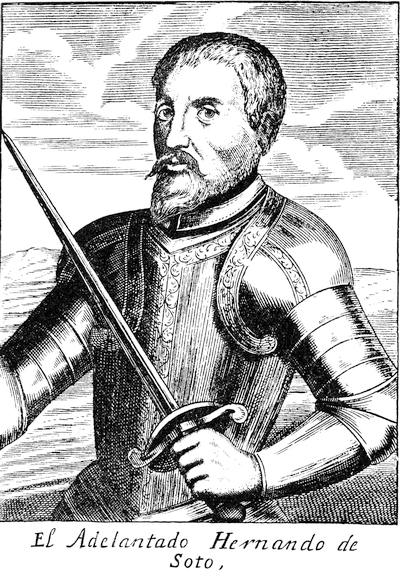
SOTO.
Fac-simile of an engraving in Herrera (1728), iv. 21.
Passing through Ayays and the well-peopled land of Nilco, Soto went with the cacique of Guachoyanque to his well-palisaded town on the banks of the Mississippi, at the mouth of the Red River, arriving there on Sunday, April 17, 1542. Here he fell ill of the fever; difficulties beset him on every side, and he sank under the strain. Appointing Luis de Moscoço as his successor in command, he died on the 21st of May. The Adelantado of Cuba and Florida, who had hoped to gather the wealth of nations, left as his property five Indian slaves, three horses, and a herd of swine. His body, kept for some days in a house, was interred in the town; but as fears were entertained that the Indians might dig up the corpse, it was taken, wrapped in blankets loaded with sand, and sunk in the Mississippi.[850]

AUTOGRAPH OF SOTO.
Muscoço’s first plan was to march westward to Mexico. But after advancing to the province of Xacatin, the survivors of the expedition lost all hope; and returning to the Mississippi, wintered on its banks. There building two large boats, they embarked in them and in canoes. Hostile Indians pursued them, and twelve men were drowned, their canoes being run down by the enemy’s periaguas. The survivors reached the Gulf and coasted along to Pánuco.[851]
The expedition of Soto added very little to the knowledge of the continent, as no steps were taken to note the topography of the country or the language of the various tribes. Diego Maldonado and Gomez Arias, seeking Soto, explored the coast from the vicinity of the Mississippi nearly to Newfoundland; but their reports are unknown.
Notwithstanding the disastrous result of Soto’s expedition, and the conclusive proof it afforded that the country bordering on the Gulf of Mexico contained no rich kingdom and afforded little inducement for settlements, other commanders were ready to undertake the conquest of Florida. Among these was Don Antonio de Mendoza, the viceroy of New Spain, who sought, by offers of rank and honors, to enlist some of the survivors of Soto’s march in a new campaign. In a more mercantile spirit, Julian de Samano and Pedro de Ahumada applied to the Spanish monarch for a patent, promising to make a good use of the privileges granted them, and to treat the Indians well. They hoped to buy furs and pearls, and carry on a trade in them till mines of gold and silver were found. The Court, however, refused to permit the grant.[852]

ANTONIO DE MENDOZA, Viceroy of New Spain.
Yet as a matter of policy it became necessary for Spain to occupy Florida. This the Court felt; and when Cartier was preparing for his voyage to the northern part of the continent,[853] Spanish spies followed his movements and reported all to their Government. In Spain it was decided that Cartier’s occupation of the frozen land, for which he was equipping his vessels, could not in any way militate against the interests of the Catholic monarch; but it was decided that any settlement attempted in Florida must on some pretext be crushed out.[854] Florida from its position afforded a basis for assailing the fleets which bore from Vera Cruz the treasures of the Indies; and the hurricanes of the tropics had already strewn the Florida coast with the fragments of Spanish wrecks. In 1545 a vessel laden with silver and precious commodities perished on that coast, and two hundred persons reached land, only to fall by the hands of the Indians.[855]
The next Spanish attempt to occupy Florida was not unmixed with romance; and its tragic close invests it with peculiar interest. The Dominicans, led by Father Antonio de Montesinos and Las Casas,—who had by this time become Bishop of Chiapa,—were active in condemning the cruelties of their countrymen to the natives of the New World; and the atrocities perpetrated by Soto in his disastrous march gave new themes for their indignant denunciations.[856]
One Dominican went further. Father Luis Cancer de Barbastro, when the Indians of a province had so steadily defied the Spaniards and prevented their entrance that it was styled “Tierra de Guerra,” succeeded by mild and gentle means in winning the whole Indian population, so that the province obtained the name of “Vera Paz,” or True Peace. In 1546 this energetic man conceived the idea of attempting the peaceful conquest of Florida. Father Gregory de Beteta and other influential members of his Order seconded his views. The next year he went to Spain and laid his project before the Court, where it was favorably received. He returned to Mexico with a royal order that all Floridians held in slavery, carried thither by the survivors of Soto’s expedition, should be confided to Father Cancer to be taken back to their own land. The order proved ineffectual. Father Cancer then sailed from Vera Cruz in 1549 in the “Santa Maria del Enzina,” without arms or soldiers, taking Father Beteta, Father Diego de Tolosa, Father John Garcia, and others to conduct the mission. At Havana he obtained Magdalen, a woman who had been brought from Florida, and who had become a Christian. The vessel then steered for Florida, and reaching the coast, at about 28°, on the eve of Ascension Day, ran northward, but soon sailed back. The missionaries and their interpreter landed, and found some of the Indians fishing, who proved friendly. Father Diego, a mission coadjutor, and a sailor, resolved to remain with the natives, and went off to their cabins. Cancer and his companions awaited their return; but they never appeared again. For some days the Spaniards on the ship endeavored to enter into friendly relations with the Indians, and on Corpus Christi Fathers Cancer and Garcia landed and said Mass on shore. At last a Spaniard named John Muñoz, who had been a prisoner among the Indians, managed to reach the ship; and from him they learned that the missionary and his companions had been killed by the treacherous natives almost immediately after reaching their cabins. He had not witnessed their murder, but declared that he had seen the missionary’s scalp. Magdalen, however, came to the shore and assured the missionaries that their comrade was alive and well.
It had thus become a serious matter what course to pursue. The vessel was too heavy to enter the shallow bays, the provisions were nearly exhausted, water could not be had, and the ship’s people were clamoring to return to Mexico. The missionaries, all except Father Cancer, desired to abandon the projected settlement, but he still believed that by presents and kindness to the Indians he could safely remain. His companions in vain endeavored to dissuade him. On Tuesday, June 25, he was pulled in a boat near the shore. He leaped into the water and waded towards the land. Though urged to return, he persevered. Kneeling for a few minutes on the beach, he advanced till he met the Indians. The sailors in the boat saw one Indian pull off his hat, and another strike him down with a club. One cry escaped his lips. A crowd of Indians streamed down to the shore and with arrows drove off the boat. Lingering for awhile, the vessel sailed back to Vera Cruz, after five lives had thus rashly been sacrificed.[857]
On the arrival of the tidings of this tragic close of Cancer’s mission a congress was convened by Maximilian, King of Bohemia, then regent in Spain; and the advocates of the peace policy in regard to the Indians lost much of the influence which they had obtained in the royal councils.[858]
The wreck of the fleet, with rich cargoes of silver, gold, and other precious commodities, on the northern shore of the Gulf of Mexico in 1553, when several hundred persons perished, and the sufferings of the surviving passengers, among whom were several Dominicans, in their attempt to reach the settlements; and the wreck of Farfan’s fleet on the Atlantic coast near Santa Elena in December, 1554,—showed the necessity of having posts on that dangerous coast of Florida, in order to save life and treasure.[859]
The Council of the Indies advised Philip II. to confide the conquest and settlement of Florida to Don Luis de Velasco, viceroy of New Spain, who was anxious to undertake the task. The Catholic monarch had previously rejected the projects of Zurita and Samano; but the high character of Velasco induced him to confide the task to the viceroy of Mexico. The step was a gain for the humanitarian party; and the King, on giving his approval, directed that Dominican friars should be selected to accompany the colonists, in order to minister to them and convert the Indians. Don Luis de Velasco had directed the government in Mexico since November, 1550, with remarkable prudence and ability. The natives found in him such an earnest, capable, and unwavering protector that he is styled in history the Father of the Indians.
The plans adopted by this excellent governor for the occupation of Florida were in full harmony with the Dominican views. In the treatment of the Indians he anticipated the just and equitable methods which give Calvert, Williams, and Penn so enviable a place in American annals.[860]
The occupation was not to be one of conquest, and all intercourse with the Indians was to be on the basis of natural equity. His first step was prompted by his characteristic prudence.[861] In September, 1558, he despatched Guido de Labazares, with three vessels and a sufficient force, to explore the whole Florida coast, and select the best port he found for the projected settlement. Labazares, on his return after an investigation of several months, reported in favor of Pensacola Bay, which he named Felipina; and he describes its entrance between a long island and a point of land. The country was well wooded, game and fish abounded, and the Indian fields showed that Indian corn and vegetables could be raised successfully.[862] On the return of Labazares in December, preparations were made for the expedition, which was placed under the command of Don Tristan de Luna y Arellano. The force consisted of fifteen hundred soldiers and settlers, under six captains of cavalry and six of infantry, some of whom had been at Coça, and were consequently well acquainted with the country where it was intended to form the settlement. The Dominicans selected were Fathers Pedro de Feria, as vicar-provincial of Florida, Dominic of the Annunciation, Dominic de Salazar, John Maçuelas, Dominic of Saint Dominic, and a lay brother. The object being to settle, provisions for a whole year were prepared, and ammunition to meet all their wants.
The colonists, thus well fitted for their undertaking, sailed from Vera Cruz on the 11th of June, 1559; and by the first of the following month were off the bay in Florida to which Miruelo had given his name. Although Labazares had recommended Pensacola Bay, Tristan de Luna seems to have been induced by his pilots to give the preference to the Bay of Ichuse; and he sailed west in search of it, but passed it, and entered Pensacola Bay. Finding that he had gone too far, Luna sailed back ten leagues east to Ichuse, which must have been Santa Rosa Bay. Here he anchored his fleet, and despatched the factor Luis Daza, with a galleon, to Vera Cruz to announce his safe arrival. He fitted two other vessels to proceed to Spain, awaiting the return of two exploring parties; he then prepared to land his colonists and stores.[863] Meanwhile he sent a detachment of one hundred men under captains Alvaro Nyeto and Gonzalo Sanchez, accompanied by one of the missionaries, to explore the country and ascertain the disposition of the Indians. The exploring parties returned after three weeks, having found only one hamlet, in the midst of an uninhabited country.[864] Before Luna had unloaded his vessels, they were struck, during the night of September 19,[865] by a terrible hurricane, which lasted twenty-four hours, destroying five ships, a galleon and a bark, and carrying one caravel and its cargo into a grove some distance on land. Many of the people perished, and most of the stores intended for the maintenance of the colony were ruined or lost.
The river, entering the Bay of Ichuse, proved to be very difficult of navigation, and it watered a sparsely-peopled country. Another detachment,[866] sent apparently to the northwest, after a forty days’ march through uncultivated country, reached a large river, apparently the Escambia, and followed its banks to Nanipacna, a deserted town of eighty houses. Explorations in various directions found no other signs of Indian occupation. The natives at last returned and became friendly.
Finding his original site unfavorable, Tristan de Luna, after exhausting the relief-supplies sent him, and being himself prostrated by a fever in which he became delirious, left Juan de Jaramillo at the port with fifty men and negro slaves, and proceeded[867] with the rest of his company, nearly a thousand souls, to Nanipacna, some by land, and some ascending the river in their lighter craft. To this town he gave the name of Santa Cruz. The stores of Indian corn, beans, and other vegetables left by the Indians were soon consumed by the Spaniards, who were forced to live on acorns or any herbs they could gather.
The Viceroy, on hearing of their sufferings, sent two vessels to their relief in November, promising more ample aid in the spring. The provisions they obtained saved them from starvation during the winter, but in the spring their condition became as desperate as ever. No attempt seems to have been made to cultivate the Indian fields, or to raise anything for their own support.[868]
In hope of obtaining provisions from Coça, Jaramillo sent his sergeant-major with six captains and two hundred soldiers, accompanied by Father Dominic de Salazar and Dominic of the Annunciation, to that province. On the march the men were forced to eat straps, harnesses, and the leather coverings of their shields; some died of starvation, while others were poisoned by herbs which they ate. A chestnut wood proved a godsend, and a fifty days’ march brought them to Olibahali (Hatchet Creek), where the friendly natives ministered to their wants.[869]
About the beginning of July they reached Coça, on the Coosa River, then a town of thirty houses, near which were seven other towns of the same tribe. Entering into friendly intercourse with these Indians, the Spaniards obtained food for themselves and their jaded horses. After resting here for three months, the Spaniards, to gain the good-will of the Coosas, agreed to aid them in a campaign against the Napochies,—a nation near the Ochechiton,[870] the Espiritu Santo, or Mississippi. These were in all probability the Natchez. The Coosas and their Spanish allies defeated this tribe, and compelled them to pay tribute, as of old, to the Coosas. Their town, saved with difficulty from the flames, gave the Spaniards a supply of corn. On their return to Coça, the sergeant-major sent to report to Tristan de Luna; but his messengers found no Spaniard at Nanipacna, save one hanging from a tree. Tristan de Luna, supposing his men lost, had gone down to Ochuse Bay, leaving directions on a tree, and a buried letter.[871] Father Feria and some others had sailed for Havana, and all were eager to leave the country.[872] Tristan de Luna was reluctant to abandon the projected settlement, and wished to proceed to Coça with all the survivors of his force. His sickness had left him so capricious and severe, that he seemed actually insane. The supplies promised in the spring had not arrived in September, though four ships left Vera Cruz toward the end of June. Parties sent out by land and water found the fields on the Escambia and Mobile[873] forsaken by the Indians, who had laid waste their towns and removed their provisions. In this desperate state George Ceron, the maestro de campo, opposed the Governor’s plan,[874] and a large part of the force rallied around him. When Tristan de Luna issued a proclamation ordering the march, there was an open mutiny, and the Governor condemned the whole of the insurgents to death. Of course he could not attempt to execute so many, but he did hang one who deserted. The mutineers secretly sent word to Coça, and in November the party from that province with the two missionaries arrived at Pensacola Bay.[875] Don Tristan’s detachment was also recalled from the original landing, and the whole force united. The dissensions continued till the missionaries, amid the solemnities of Holy Week, by appealing to the religious feelings of the commander and Ceron, effected a reconciliation.[876]
At this juncture Angel de Villafañe’s fleet entered the harbor of Ichuse. He announced to the people that he was on his way to Santa Elena, which Tristan de Luna had made an ineffectual effort to reach. All who chose were at liberty to accompany him. The desire to evacuate the country where they had suffered so severely was universal. None expressed a wish to remain; and Tristan de Luna, seeing himself utterly abandoned, embarked for Havana with a few servants. Villafañe then took on board all except a detachment of fifty or sixty men who were left at Ichuse under Captain Biedma, with orders to remain five or six months; at the expiration of which time they were to sail away also, in case no instructions came.
Villafañe, with the “San Juan” and three other vessels and about two hundred men, put into Havana; but there many of the men deserted, and several officers refused to proceed.[877]
With Gonzalo Gayon as pilot, Villafañe reached Santa Elena—now Port Royal Sound—May 27, 1561, and took possession in the name of the King of Spain. Finding no soil adapted for cultivation, and no port suitable for planting a settlement, he kept along the coast, doubled Cape Roman, and landing on the 2d of June, went inland till he reached the Santee, where he again took formal possession. On the 8th he was near the Jordan or Pedee; but a storm drove off one of his vessels. With the rest he continued his survey of the coast till he doubled Cape Hatteras. There, on the 14th of June, his caravel well-nigh foundered, and his two smaller vessels undoubtedly perished. He is said to have abandoned the exploration of the coast here, although apparently it was his vessel, with the Dominican Fathers, which about this time visited Axacan, on the Chesapeake, and took off a brother of the chief.[878]
Villafañe then sailed to Santo Domingo, and Florida was abandoned. In fact, on the 23d of September the King declared that no further attempt was to be made to colonize that country, either in the Gulf or at Santa Elena, alleging that there was no ground to fear that the French would set foot in that land or take possession of it; and the royal order cites the opinion of Pedro Menendez against any attempt to form settlements on either coast.[879]
As if to show the fallacy of their judgment and their forecast, the French (and what was worse, from the Spanish point of view, French Calvinists) in the next year, under Ribault, took possession of Port Royal,—the very Santa Elena which Villafañe considered unfitted for colonization. Here they founded Charlesfort and a settlement, entering Port Royal less than three months after the Spanish officers convened in Mexico had united in condemning the country.
Pedro Menendez de Aviles had, as we have seen, been general of the fleet to New Spain in 1560, and on his return received instructions to examine the Atlantic coast north of the very spot where the French thus soon after settled. In 1561 he again commanded the fleet; but on his homeward voyage a terrible storm scattered the vessels near the Bermudas, and one vessel, on which his only son and many of his kinsmen had embarked, disappeared. With the rest of his ships he reached Spain, filled with anxiety, eager only to fit out vessels to seek his son, who, he believed, had been driven on the Florida coast, and was probably a prisoner in the hands of the Indians. At this critical moment, however, charges were brought against him; and he, with his brother, was arrested and detained in prison for two years, unable to bring the case to trial, or to obtain his release on bail.
When Menendez at last succeeded in obtaining an audience of the King, he solicited, in 1564, permission to proceed with two vessels to Bermuda and Florida to seek his son, and then retire to his home, which he had not seen for eighteen years. Philip II. at last consented; but required him to make a thorough coast-survey of Florida, so as to prepare charts that would prevent the wrecks which had arisen from ignorance of the real character of the sea-line. Menendez replied that his Majesty could confer no higher boon upon him for his long and successful services on the seas than to authorize him to conquer and settle Florida.
Nothing could be in greater accordance with the royal views than to commit to the energy of Menendez[880] the task which so many others had undertaken in vain. A patent, or asiento, was issued March 20, 1565, by the provisions of which Menendez was required to sail in May with ten vessels, carrying arms and supplies, and five hundred men, one hundred to be capable of cultivating the soil. He was to take provisions to maintain the whole force for a year, and was to conquer and settle Florida within three years; explore and map the coast, transport settlers, a certain number of whom were to be married; maintain twelve members of religious Orders as missionaries, besides four of the Society of Jesus; and to introduce horses, black cattle, sheep, and swine for the two or three distinct settlements he was required to found at his own expense.[881] The King gave only the use of the galleon “San Pelayo,” and bestowed upon Menendez the title of Adelantado of Florida, a personal grant of twenty-five leagues square, with the title of Marquis, and the office of Governor and Captain-General of Florida.
While Menendez was gathering, among his kindred in Asturias and Biscay, men and means to fulfil his part of the undertaking, the Court of Spain became aware for the first time that the Protestants of France had quietly planted a colony on that very Florida coast. Menendez was immediately summoned in haste to Court; and orders were issued to furnish him in America three vessels fully equipped, and an expeditionary force of two hundred cavalry and four hundred infantry. Menendez urged, on the contrary, that he should be sent on at once with some light vessels to attack the French; or, if that was not feasible, to occupy a neighboring port and fortify it, while awaiting reinforcements. The Government, by successive orders, increased the Florida armament, so that Menendez finally sailed from Cadiz, June 29, with the galleon “San Pelayo” and other vessels to the number of nineteen, carrying more than fifteen hundred persons, including farmers and mechanics of all kinds.
The light in which Spaniards, especially those connected with commerce and colonies, regarded the Protestants of France was simply that of pirates. French cruisers, often making their Protestantism a pretext for their actions, scoured the seas, capturing Spanish and Portuguese vessels, and committing the greatest atrocities. In 1555 Jacques Sorie surprised Havana, plundered it, and gave it to the flames, butchering the prisoners who fell into his hands. In 1559 Megander pillaged Porto Rico, and John de la Roche plundered the ships and settlements near Carthagena.[882]
It seems strange, however, that neither in Spain nor in America was it known that this dreaded and hated community, the Huguenots of France, had actually, in 1562, begun a settlement at the very harbor of Santa Elena where Villafañe had taken possession in the name of the Spanish monarch a year before. Some of the French settlers revolted, and very naturally went off to cruise against the Spaniards, and with success; but the ill-managed colony of Charlesfort on Port Royal Sound had terminated its brief existence without drawing down the vengeance of Spain.
When the tidings of a French occupancy of Florida startled the Spanish Court, a second attempt of the Huguenots at settlement had been made,—this time at the mouth of St. John’s River, where Fort Caroline was a direct menace to the rich Spanish fleets, offering a safe refuge to cruisers, which in the name of a pure gospel could sally out to plunder and to slay. Yet that settlement, thus provoking the fiercest hostility of Spain, was ill-managed. It was, in fact, sinking, like its predecessor, from the unfitness of its members to make the teeming earth yield them its fruits for their maintenance. René Laudonnière, the commandant, after receiving some temporary relief from the English corsair Hawkins,[883] and learning that the Spaniards meditated hostilities, was about to burn his fort and abandon the country, when John Ribault arrived as commandant, with supplies and colonists, as well as orders to maintain the post. His instructions from Coligny clearly intended that he should attack the Spaniards.[884]
The two bitter antagonists, each stimulated by his superiors, were thus racing across the Atlantic, each endeavoring to outstrip the other, so as to be able first to assume the offensive. The struggle was to be a deadly one, for on neither side were there any of the ordinary restraints; it was to be a warfare without mercy.
After leaving the Canaries, Menendez’ fleet was scattered by storms. One vessel put back; the flagship and another were driven in one direction, five vessels in another. These, after encountering another storm, finally reached Porto Rico on the 9th of August, and found the flagship and its tender there.[885]
The other ships from Biscay and Asturias had not arrived; but Menendez, fearing that Ribault might outstrip him, resolved to proceed, though his vessels needed repairs from the injuries sustained in the storm. If he was to crush Fort Caroline, he felt that it must be done before the French post was reinforced; if not, all the force at his disposal would be insufficient to assume the offensive. He made the coast of Florida near Cape Cañaveral on the 25th of August; and soon after, by landing a party, ascertained from the natives that the French post was to the northward. Following the coast in that direction, he discovered, on the 28th, a harbor which seemed to possess advantages, and to which he gave the name of the great Bishop of Hippo, Augustine, who is honored on that day. Sailing on cautiously, he came in sight of the mouth of the St. John’s River about two o’clock in the afternoon of the 4th of September. The ten days he had lost creeping along the coast were fatal to his project, for there lay the four vessels of Ribault, the flagship and its consort flinging to the breeze the colors of France.
Menendez’ officers in council were in favor of running back to Santo Domingo till the whole force was united and ready to assume the offensive; but Menendez inspired them with his own intrepidity, and resolved to attack at once. A tremendous thunderstorm prevented operations till ten at night, when he bore down on the French, and ran his ship, the “Pelayo,” between the two larger vessels of Ribault. To his hail who they were and what they were doing there, the reply was that John Ribault was their captain-general, and that they came to the country by order of the King of France; and the French in return asked what ships they were, and who commanded them. To quote his own words, “I replied to them that I was Peter Menendez, that I came by command of the King of Spain to this coast and land to burn and hang the French Lutherans found in it, and that in the morning I would board his ships to know whether he belonged to that sect; because if he did, I could not avoid executing on them the justice which his Majesty commanded. They replied that this was not right, and that I might go without awaiting the morning.”
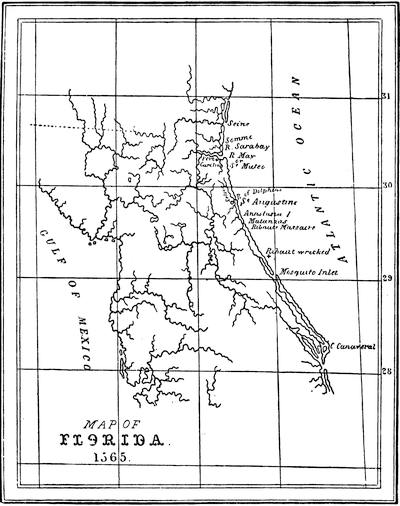
FLORIDA.
[This sketch-map of the scene of the operations of the Spanish and the French follows one given by Fairbanks in his History of St. Augustine. Other modern maps, giving the old localities, are found in Parkman, Gaffarel etc.—Ed.]
As Menendez manœuvred to get a favorable position, the French vessels cut their cables and stood out to sea. The Spaniards gave chase, rapidly firing five cannon at Ribault’s flagship,—which Menendez supposed that he injured badly, as boats put off to the other vessels. Finding that the French outsailed him, Menendez put back, intending to land soldiers on an island at the mouth of the river and fortify a position which would command the entrance; but as he reached the St. John’s he saw three French vessels coming out, ready for action.
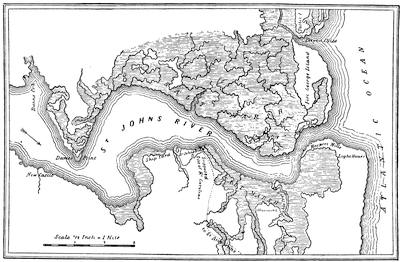
SITE OF FORT CAROLINE.
[After a map in Fairbanks’s History of St. Augustine; but his view of the site is open to question.—Ed.]
His project was thus defeated; and too wily to be caught at a disadvantage by the returning French vessels, Menendez bore away to the harbor of St. Augustine, which he estimated at eight leagues from the French by sea, and six by land. Here he proceeded to found the oldest city in the present territory of the United States.
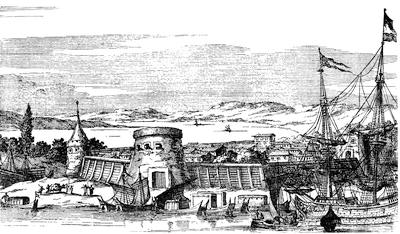
ST. AUGUSTINE.
[This view of Pagus Hispanorum, as given in Montanus and Ogilby, represents the town founded by Menendez at a somewhat later period, if it is wholly truthful of any period. The same view was better engraved at Leide by Vander Aa.—Ed.]
Two hundred mail-clad soldiers, commanded by Captain John de San Vicente and Captain Patiño, landed on the 6th of September, 1565. The Indians were friendly, and readily gave the settlers the large house of one of the caciques which stood near the shore of the river. Around this an intrenchment was traced; and a ditch was soon dug, and earthworks thrown up, with such implements as they had at hand, for the vessel bearing their tools had not yet arrived.
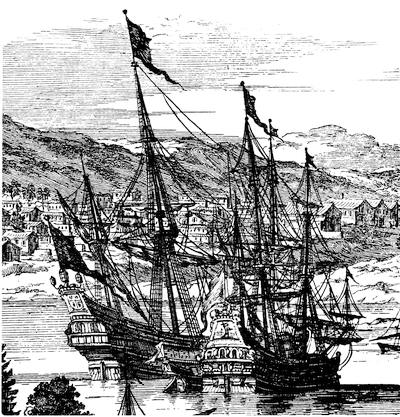
SPANISH VESSELS. (From the Pagus Hispanorum in Montanus.)
The next day three of the smaller vessels ran into the harbor, and from them three hundred more of the soldiers disembarked, as well as those who had come to settle in the country,—men, women, and children. Artillery and munitions for the fort were also landed. The eighth being a holiday in the Catholic Church,—the Nativity of the Blessed Virgin,—was celebrated with due solemnity. Mass was offered for the first time at a spot ever after held in veneration, and where in time arose the primitive shrine of Nuestra Señora de la Leche.
Then the work of debarkation was resumed; one hundred more persons landed; and great guns, precious stores of provisions, and munitions were brought to the new fort.
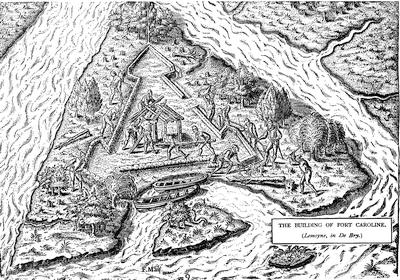
THE BUILDING OF FORT CAROLINE.
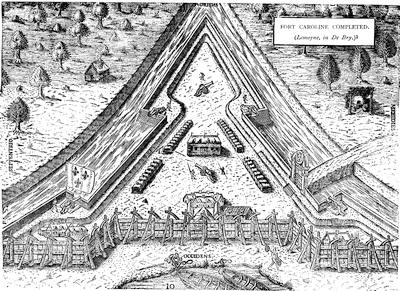
FORT CAROLINE COMPLETED. (Lemoyne, in De Bry.)
[Two pictures of Fort Caroline accompany the Brevis narratio of Lemoyne,—one the beginning of work upon it, and the other the completed structure, “a more finished fortification than could possibly have been constructed, but to be taken as a correct outline,” as Fairbanks (p. 54) presumes. The engraving of the completed fort is reproduced in Fairbanks’s St. Augustine, Stevens’s Georgia, etc. Another and better view of it, called “Arx Carolina—Charlesfort sur Floride,” was engraved at Leide by Vander Aa, but it is a question if it be truthful. No traces of the fort have ever been recorded by subsequent observers, but Fairbanks places it near a place called St. John’s Bluff, as shown in the accompanying map. Others have placed it on the Bell River (an estuary of the St. Mary’s River), at a place Called Battle Bluff. Cf. Carroll’s Hist. Coll., i. p. xxxvi.—Ed.]
Amid all this bustle and activity the Spaniards were startled by the appearance of two large French vessels[886] in the offing, evidently ready for action. It was no part of Menendez’ plan to engage them, and he waited till, about three in the afternoon, they bore away for the St. John’s. Then he prepared to land in person. As his boat left the vessel with banners unfurled, amid the thunder of cannon and the sounds of warlike music, Mendoza Grajales, the first priest of St. Augustine, bearing a cross, went down at the head of those on shore to meet the adelantado, all chanting the Te Deum. Menendez proceeded at once with his attendants to the cross, which he kissed on bended knee.
Formal possession of the land was then taken in the name of Philip II., King of Spain. The captains of the troops and the officers of the new colony came forward to take the oath to Peter Menendez de Aviles as governor, captain-general, and adelantado of Florida and its coasts under the patents of the Spanish King. Crowds of friendly Indians, with their chieftains, gathered around.
From them the Spanish commander learned that his position was admirably taken, as he could, at a short distance, strike the river on which the French lay, and descend it to assail them. Here then he resolved to make his position as strong as possible, till the rest of his armament arrived. His galleon “San Pelayo,” too large to enter the port, rode without, in danger from the sudden storms that visit the coast, and from the French. Putting on board some French prisoners whom he had captured in a boat, he despatched her and another vessel to Santo Domingo. He organized his force by appointing officers,—a lieutenant and a sergeant-major, and ten captains. The necessity of horses to operate rapidly induced him to send two of his lighter vessels to Havana to seek them there; and by this conveyance he addressed to Philip II. his first letter from Florida.[887]
The masts of his vessels could scarcely have vanished from the eyes of the Spanish force, when the French vessels appeared once more, and nearly captured Menendez himself in the harbor, where he was carrying to the shore, in the smaller vessels that he had retained, some artillery and munitions from the galleons. He escaped, however, though the French were so near that they called on him to surrender. And he ascribed his deliverance rather to prayer than to human skill; for, fierce seaman as he was, he was a man of deep and practical religious feeling, which influenced all his actions.
Menendez’ position was now one of danger. The force at his command was not large, and the French evidently felt strong enough, and were determined to attack him. He had acknowledged his inability to cope with them on the ocean, and could not have felt very sanguine of being able to defend the slight breastworks that had been thrown up at St. Augustine.
Fortune favored him. Ribault, after so earnestly determining to assume the offensive, fatally hesitated. Within two days a tremendous hurricane, which the practised eye of Menendez had anticipated, burst on the coast. The French were, he believed, still hovering near, on the lookout for his larger vessels, and he knew that with such a norther their peril was extreme. It was, moreover, certain that they could not, for a time at least, make the St. John’s, even if they rode out the storm.
This gave him a temporary superiority, and he resolved to seize his opportunity. Summoning his officers to a council of war, he laid before them his plan of marching at once to attack Fort Caroline, from which the French had evidently drawn a part of their force, and probably their most effective men. The officers generally, as well as the two clergymen in the settlement, opposed his project as rash; but Menendez was determined. Five hundred men—three hundred armed with arquebuses, the rest with pikes and targets—were ordered to march, each one carrying rations of biscuit and wine. Menendez, at their head, bore his load like the rest. They marched out of the fort on the 16th of September, guided by two caciques who had been hostile to the French, and by a Frenchman who had been two years in the fort. The route proved one of great difficulty; the rain poured in torrents, swelling the streams and flooding the lowlands, so that the men were most of the time knee-deep in water. Many loitered, and, falling back, made their way to St. Augustine. Others showed a mutinous disposition, and loudly expressed their contempt for their sailor-general.
On the 29th, at the close of the day, he was within a short distance of the French fort, and halted to rest so as to storm it in the morning. At daybreak the Spaniards knelt in prayer; then, bearing twenty scaling-ladders, Menendez advanced, his sturdy Asturians and Biscayans in the van. Day broke as, in a heavy rain, they reached a height from which their French guide told them they could see the fort, washed by the river. Menendez advanced, and saw some houses and the St. John’s; but from his position could not discover the fort. He would have gone farther; but the Maese de Campo and Captain Ochoa pushed on till they reached the houses, and reconnoitred the fort, where not a soul seemed astir. As they returned they were hailed by a French sentinel, who took them for countrymen. Ochoa sprang upon him, striking him on the head with his sheathed sword, while the Maese de Campo stabbed him. He uttered a cry; but was threatened with death, bound, and taken back. The cry had excited Menendez, who, supposing that his officers had been killed, called out: “Santiago! at them! God helps us! Victory! The French are slaughtered! Don Pedro de Valdes, the Maese de Campo, is in the fort, and has taken it!”