Chapter I · (continued 2)
Reading edition
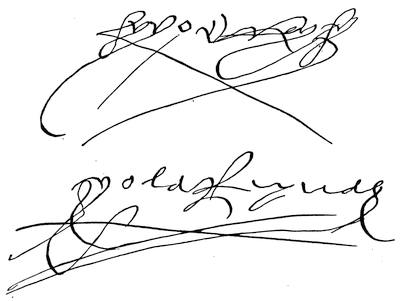
SIGN-MANUALS OF FERDINAND AND ISABELLA.
What is thought to be the earliest mention in print of the new discoveries occurs in a book published at Seville in 1493.—Los tratados del Doctor Alonso Ortiz. The reference is brief, and is on the reverse of the 43d folio.[198] Not far from the same time the Bishop of Carthagena, Bernardin de Carvajal, then the Spanish ambassador to the Pope, delivered an oration in Rome, June 19, 1493, in which he made reference to the late discovery of unknown lands towards the Indies.[199] These references are all scant; and, so far as we know from the records preserved to us, the great event of the age made as yet no impression on the public mind demanding any considerable recognition.
Not so directly cognizant of events, but getting his information at second hand from Guglielmo Coma,—a noble personage in Spain,—was Nicolas Scyllacius, of Pavia, who translated Coma’s letters into Latin, and published his narrative, De insulis meridiani atque indici maris nuper inventis, dedicating it to Ludovico Sforza, at Pavia (Brunet thinks Pisa), in 1594 or 1595. Of this little quarto there are three copies known. One is in the Lenox Library; and from this copy Mr. Lenox, in 1859, reprinted it sumptuously (one hundred and two copies[201]), with a translation by the Rev. John Mulligan. In Mr. Lenox’s Introduction it is said that his copy had originally belonged to M. Olivieri, of Parma, and then to the Marquis Rocca Saporiti, before it came into Mr. Lenox’s hands, and that the only other copy known was an inferior one in the library of the Marquis Trivulzio at Milan. This last copy is probably one of the two copies which Harrisse reports as being in the palace library at Madrid and in the Thottiana (Royal Library) at Copenhagen, respectively.[202] Scyllacius adds a few details, current at that time, which were not in Coma’s letters, and seems to have interpreted the account of his correspondent as implying that Columbus had reached the Indies by the Portuguese route round the Cape of Good Hope. Ronchini has conjectured that this blunder may have caused the cancelling of a large part of the edition, which renders the little book so scarce; but Lenox neatly replies that “almost all the contemporaneous accounts are equally rare.”
Another second-hand account—derived, however, most probably from the Admiral himself—is that given by Peter Martyr in his first Decade, published in 1511, and more at length in 1516.[203]
Accompanying Columbus on this voyage was Bernardus Buell, or Boil, a monk of St. Benoit, in Austria, who was sent by Pope Alexander VI as vicar-general of the new lands, to take charge of the measures for educating and converting the Indians.[204] It will be remembered he afterward became a caballer against the Admiral. What he did there, and a little of what Columbus did, one Franciscus Honorius Philoponus sought to tell in a very curious book, Nova typis transacta navigatio novi orbis Indiæ occidentalis,[205] which was not printed till 1621. It is dedicated to Casparus Plautius, and it is suspected that he is really the author of the book, while he assumed another name, more easily to laud himself. Harrisse describes the book as having “few details of an early date, mixed with much second-hand information of a perfectly worthless character.”
So far as we know, the only contemporary references in a printed book to the new discoveries during the progress of the second voyage, or in the interval previous to the undertaking of the third voyage, in the spring of 1498, are these: The Das Narrenschiff (Ship of Fools) of Sebastian Brant, a satire on the follies of society, published at Basle in 1494,[206] and reprinted in Latin in 1497, 1498, and in French in 1497, 1498, and 1499,[207] has a brief mention of the land previously unknown, until Ferdinand discovered innumerable people in the great Spanish ocean. Zacharias Lilio, in his De origine et laudibus scientiarum, Florence, 1496,[208] has two allusions. In 1497 Fedia Inghirami, keeper of the Vatican Archives, delivered a funeral oration on Prince John, son of Ferdinand and Isabella, and made a reference to the New World. The little book was probably printed in Rome. There is also a reference in the Cosmographia of Antonius Nebrissensis, printed in 1498.[209]
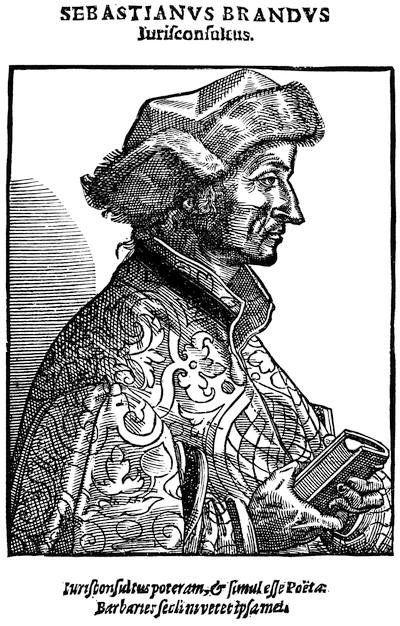
SEBASTIAN BRANT.
Fac-simile of cut in Reusner’s Icones, Strasburg, 1590.
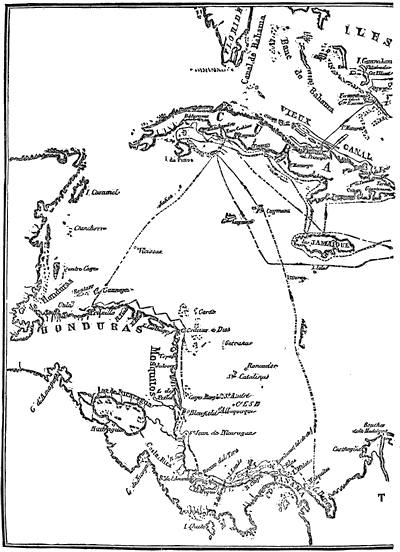
MAP OF COLUMBUS’ FOUR VOYAGES (WESTERN PART).
A reproduction of the map in Charton’s Voyageurs, iii. 179.
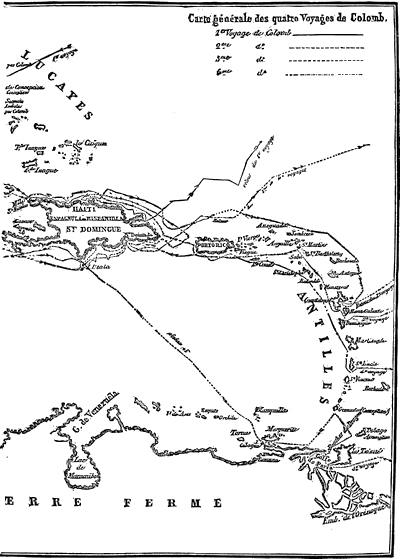
MAP OF COLUMBUS’ FOUR VOYAGES (EASTERN PART.)
A reproduction of the map in Charton’s Voyageurs, iii. 178.
While Columbus was absent on this voyage, as already mentioned, Bergomas had recorded the Admiral’s first discoveries.[218]
In 1509 there is reference to the discoveries in the Opera nova of the General of the Carmelites, Battista Mantuanus.[227] Somewhere, from 1510 to 1519, the New Interlude[228] presented Vespucius to the English public, rather than Columbus, as the discoverer of America, as had already been done by Waldseemüller at St. Dié.
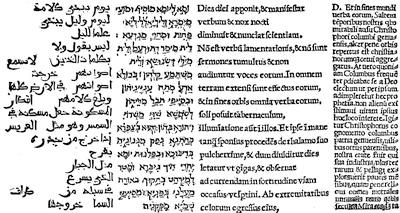
THE GIUSTINIANI PSALTER.
Fac-simile of a portion of the page of Giustiniani Psalter, which shows the beginning of the marginal note on Columbus.
In 1511 Peter Martyr, in his first Decade, and Sylvanus, in his annotations of Ptolemy, drew attention to the New World; as did also Johannes Sobrarius in his Panegyricum carmen de gestis heroicis divi Ferdinandi Catholici.[229] The Stobnicza (Cracow) Appendix to Ptolemy presented a new map of the Indies in 1512; and the Chronicon of Eusebius, of the same date, recorded the appearance of some of the wild men of the West in Rouen, brought over by a Dieppe vessel. Some copies, at least, of Antonio de Lebrija’s edition of Prudentii opera, printed at Lucca, 1512, afford another instance of an early mention of the New World.[230] Again, in 1513, a new edition of Ptolemy gave the world what is thought to have been a map by Columbus himself; and in the same year there was a Supplementum supplementi of Jacobo Philippo, of Bergomas.[231] In 1514 the De natura locorum (Vienna), of Albertus Magnus, points again to Vespucius instead of Columbus;[232] but Cataneo, in a poem on Genoa,[233] does not forget her son, Columbus.
These, as books have preserved them for us, are about all the contemporary references to the life of the great discoverer for the first ten years after his death.[234] In 1516, where we might least expect it, we find the earliest small gathering of the facts of his life. In the year of Columbus’ death, Agostino Giustiniani had begun the compilation of a polyglot psalter, which was in this year (1516) ready for publication, and, with a dedication to Leo X., appeared in Genoa. The editor annotated the text, and, in a marginal note to verse four of the nineteenth Psalm, we find the earliest sketch of Columbus’ life. Stevens[235] says of the note: “There are in it several points which we do not find elsewhere recorded, especially respecting the second voyage, and the survey of the south side of Cuba, as far as Evangelista, in May, 1494. Almost all other accounts of the second voyage, except that of Bernaldez, end before this Cuba excursion began.”
Giustiniani, who was born in 1470, died in 1536, and his Annali di Genoa[236] was shortly afterward published (1537), in which, on folio ccxlix, he gave another account of Columbus, which, being published by his executors with his revision, repeated some errors or opinions of the earlier Psalter account. These were not pleasing to Ferdinand Columbus,[237] the son of the Admiral,—particularly the statement that Columbus was born of low parentage,—“vilibus ortus parentibus.” Stevens points out how Ferdinand accuses Giustiniani of telling fourteen lies about the discoverer; “but on hunting them out, they all appear to be of trifling consequence, amounting to little more than that Columbus sprang from humble parents, and that he and his father were poor, earning a livelihood by honest toil.”[238]
To correct what, either from pride or from other reasons, he considered the falsities of the Psalter, Ferdinand was now prompted to compose a Life of his father,—or at least such was, until recently, the universal opinion of his authorship of the book. As to Ferdinand’s own relations to that father there is some doubt, or pretence of doubt, particularly on the part of those who have found the general belief in, and pretty conclusive evidence concerning, the illegitimacy of Ferdinand an obstacle in establishing the highly moral character which a saint, like Columbus, should have.[239]
Ferdinand Columbus, or Fernando Colon, was born three or four years before his father sailed on his first voyage.[240] His father’s favor at Court opened the way, and in attendance upon Prince Juan and Queen Isabella he gained a good education. When Columbus went on his fourth voyage, in 1502, the boy, then thirteen years of age, accompanied his father. It is said that he made two other voyages to the New World; but Harrisse could only find proof of one. His later years were passed as a courtier, in attendance upon Charles V. on his travels, and in literary pursuits, by which he acquired a name for learning. He had the papers of his father,[241] and he is best known by the Life of Columbus which passes under his name. If it was written in Spanish, it is not known in its original form, and has not been traced since Luis Colon, the Duque de Veraguas, son of Diego, took the manuscript to Genoa about 1568. There is some uncertainty about its later history; but it appeared in 1571 at Venice in an Italian version made by Alfonzo de Ulloa, and was entitled Historie del S. D. Fernando Colombo; nelle quali s’ ha particolare & vera relatione della vita, & de’ fatti dell’Ammiraglio D. Christoforo Colombo, suo padre. It is thought that this translation was made from an inaccurate copy of the manuscript, and moreover badly made. It begins the story of the Admiral’s life with his fifty-sixth year, or thereabout; and it has been surmised that an account of his earlier years—if, indeed, the original draft contained it—was omitted, so as not to obscure, by poverty and humble station, the beginnings of a luminous career.[242] Ferdinand died at Seville, July 12, 1539,[243] and bequeathed, conditionally, his library to the Cathedral. The collection then contained about twenty thousand volumes, in print and manuscript; and it is still preserved there, though, according to Harrisse, much neglected since 1709, and reduced to about four thousand volumes. It is known as the Biblioteca Colombina.[244] Spotorno says that this Luis Colon, a person of debauched character, brought this manuscript in the Spanish language to Genoa, and left it in the hands of Baliano de Fornari, from whom it passed to another patrician, Giovanni Baptista Marini, who procured Ulloa to make the Italian version in which it was first published.[245]
Somewhat of a controversial interest has been created of late years by the critiques of Henry Harrisse on Ferdinand Columbus and his Life of his father, questioning the usually accepted statements in Spotorno’s introduction of the Codice of 1823. Harrisse undertakes to show that the manuscript was never in Don Luis’ hands, and that Ferdinand could not have written it. He counts it as strange that if such a manuscript existed in Spain not a single writer in print previous to 1571 refers to it. “About ten years ago,” says Henry Stevens,[246] “a society of Andalusian bibliographers was formed at Seville. Their first publication was a fierce Hispano-French attack on the authenticity of the Life of Columbus by his second son, Ferdinand, written by Henri Harrisse in French, and translated by one of the Seville bibliófilos, and adopted and published by the Society. The book [by Columbus’ son] is boldly pronounced a forgery and a fraud on Ferdinand Columbus. Some fifteen reasons are given in proof of these charges, all of which, after abundant research and study, are pronounced frivolous, false, and groundless.” Such is Mr. Stevens’s view, colored or not by the antipathy which on more than one occasion has been shown to be reciprocal in the references of Stevens and Harrisse, one to the other, in sundry publications.[247] The views of Harrisse were also expressed in the supplemental volume of his Bibliotheca Americana Vetustissima, published as Additions in 1872. In this he says, regarding the Life of Columbus: “It was not originally written by the son of the bold navigator; and many of the circumstances it relates have to be challenged, and weighed with the utmost care and impartiality.”
The authenticity of the book was ably sustained by D’Avezac before the French Academy in a paper which was printed in 1873 as Le livre de Ferdinand Colomb: Revue critique des allégations proposées contre son authenticité. Harrisse replied in 1875 in a pamphlet of fifty-eight pages, entitled L’histoire de C. Colomb attribuée à son fils Fernand: Examen critique du mémoire lu par M. d’Avezac à l’Académie, 8, 13, 22 Août, 1873. There were other disputants on the question.[248]
The catalogue of the Colombina Library as made by Ferdinand shows that it contained originally a manuscript Life of the Admiral written about 1525 by Ferdinand Perez de Oliva, who presumably had the aid of Ferdinand Columbus himself; but no trace of this Life now exists,[249] unless, as Harrisse ventures to conjecture, it may have been in some sort the basis of what now passes for the work of Ferdinand.
For a long time after the Historie of 1571 there was no considerable account of Columbus printed. Editions of Ptolemy, Peter Martyr, Oviedo, Grynæus, and other general books, made reference to his discoveries; but the next earliest distinct sketch appears to be that in the Elogia virorum illustrium of Jovius, printed in 1551 at Florence, and the Italian version made by Domenichi, printed in 1554.[250] Ramusio’s third volume, in 1556, gave the story greater currency than before; but such a book as Cunningham’s Cosmographical Glasse, in its chapter on America, utterly ignores Columbus in 1559.[251] We get what may probably be called the hearsay reports of Columbus’ exploits in the Mondo nuovo of Benzoni, first printed at Venice in 1565. There was a brief memorial in the Clarorum Ligurum elogia of Ubertus Folieta, published at Rome in 1573.[252] In 1581 his voyages were commemorated in an historical poem, Laurentii Gambaræ Brixiani de navigatione Christophori Columbi, published at Rome.[253] Boissard, of the De Bry coterie at Frankfort in 1597, included Columbus in his Icones virorum illustrium;[254] and Buonfiglio Costanzo, in 1604, commemorated him in the Historia Siciliana, published at Venice.[255]
Meanwhile the story of Columbus’ voyages was told at last with all the authority of official sanction in the Historia general of Herrera. This historian, or rather annalist, was born in 1549, and died in 1625;[256] and the appointment of historiographer given him by Philip II. was continued by the third and fourth monarchs of that name. There has been little disagreement as to his helpfulness to his successors. All critics place him easily first among the earlier writers; and Muñoz, Robertson, Irving, Prescott, Ticknor, and many others have united in praise of his research, candor, and justness, while they found his literary skill compromised in a measure by his chronological method. Irving found that Herrera depended so much on Las Casas that it was best in many cases to go to that earlier writer in preference;[257] and Muñoz thinks only Herrera’s judicial quality preserved for him a distinct character throughout the agglutinizing process by which he constructed his book. His latest critic, Hubert H. Bancroft,[258] calls his style “bald and accurately prolix, his method slavishly chronological,” with evidence everywhere in his book of “inexperience and incompetent assistance,” resulting in “notes badly extracted, discrepancies, and inconsistencies.” The bibliography of Herrera is well done in Sabin.[259]
Herrera had already published (1591) a monograph on the history of Portugal and the conquest (1582-1583) of the Azores, when he produced at Madrid his great work, Historia general de los hechos de los Castellanos, in eight decades, four of which, in two volumes, were published in 1601, and the others in 1615.[260] It has fourteen maps; and there should be bound with it, though often found separate, a ninth part, called Description de las Indias occidentales.[261] Of the composite work, embracing the nine parts, the best edition is usually held to be one edited by Gonzales Barcia, and supplied by him with an index, which was printed in Madrid during 1727, 1728, 1729, and 1730, so that copies are found with all those dates, though it is commonly cited as of 1730.[262]
The principal chronicles of Spanish affairs in the seventeenth century contributed more or less to Columbus’ fame;[263] and he is commemorated in the Dutch compilation of Van den Bos, Leven en Daden der Zeehelden, published at Amsterdam in 1676, and in a German translation in 1681.[264]
There were a hundred years yet to pass before Robertson’s History of America gave Columbus a prominence in the work of a historian of established fame; but this Scotch historian was forced to write without any knowledge of Columbus’ own narratives.
In 1781 the earliest of the special Italian commemorations appeared at Parma, in J. Durazzo’s Elogi storici on Columbus and Doria.[265] Chevalier de Langeac in 1782 added to his poem, Colomb dans les fers à Ferdinand et Isabelle, a memoir of Columbus.[266]
The earliest commemoration in the United States was in 1792, on the three hundredth anniversary of the discovery, celebrated by the Massachusetts Historical Society, when Dr. Jeremy Belknap delivered an historical discourse,[267] included later with large additions in his well-known American Biography. The unfinished history of Muñoz harbingered, in 1793, the revival in Europe of the study of his career. Finally, the series of modern Lives of Columbus began in 1818 with the publication at Milan of Luigi Bossi’s Vita di Cristoforo Colombo, scritta e corredata di nuove osservazioni.[268] In 1823 the introduction by Spotorno to the Codice, and in 1825 the Coleccion of Navarrete, brought much new material to light; and the first to make use of it were Irving, in his Life of Columbus, 1828,[269] and Humboldt, in his Examen critique de l’histoire de la géographie du nouveau continent, published originally, in 1834, in a single volume; and again in five volumes, between 1836 and 1839.[270] “No one,” says Ticknor,[271] “has comprehended the character of Columbus as Humboldt has,—its generosity, its enthusiasm, its far-reaching visions, which seemed watchful beforehand for the great scientific discovery of the sixteenth century.” Prescott was warned by the popularity of Irving’s narrative not to attempt to rival him; and his treatment of Columbus’ career was confined to such a survey as would merely complete the picture of the reign of Ferdinand and Isabella.[272]
In 1844 there came the first intimation of a new style of biography,—a protest against Columbus’ story being longer told by his natural enemies, as all who failed to recognize his pre-eminently saintly character were considered to be. There was a purpose in it to make the most possible of all his pious ejaculations, and of his intention, expressed in his letter to the Pope in 1502, to rescue the Holy City from the infidel, with his prospective army of ten thousand horse and a hundred thousand foot. The chief spokesman of this purpose has been Roselly de Lorgues. He first shadowed forth his purpose in his La croix dans les deux mondes in 1844. It was not till 1864 that he produced the full flower of his spirit in his Christophe Colomb, Histoire de sa vie et de ses voyages d’après des documents authentiques tirés d’Espagne et d’Italie.[273] This was followed, in 1874, by his L’ambassadeur de Dieu et le Pape Pie IX. All this, however, and much else by the abetters of the scheme of the canonization of Columbus which was urged on the Church, failed of its purpose; and the movement was suspended, for a while at least, because of an ultimate adverse determination.[274]
Of the other later lives of Columbus it remains to mention only the most considerable, or those of significant tendency.
The late Sir Arthur Helps wrote his Spanish Conquest of America with the aim of developing the results—political, ethnological, and economic—of the conquest, rather than the day-by-day progress of events, and with a primary regard to the rise of slavery. His Life of Columbus is simply certain chapters of this larger work excerpted and fitted in order.[275] Mr. Aaron Goodrich, in A History of the so-called Christopher Columbus, New York, 1874, makes a labored and somewhat inconsiderate effort, characterized by a certain peevish air, to prove Columbus the mere borrower of others’ glories.[276]
In French, mention may be made of the Baron de Bonnefoux’s Vie de Christophe Colomb, Paris, 1853,[277] and the Marquis de Belloy’s Christophe Colomb et la découverte du Nouveau Monde, Paris, 1864.[278]
In German, under the impulse given by Humboldt, some fruitful labors have been given to Columbus and the early history of American discovery; but it is only necessary to mention the names of Forster,[279] Peschel,[280] and Ruge.[281]
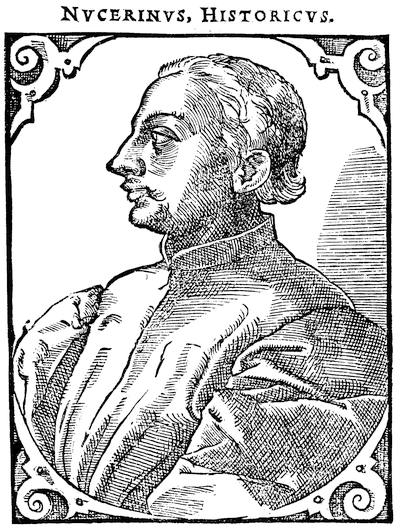
PAULUS JOVIUS.
Fac-simile of cut in Reusner’s Icones, Basle, 1589. There is another cut in Pauli Jovii elogia virorum bellica virtute illustrium, Basle, 1575 (copy in Harvard College Library).
These are the test with which to challenge the very numerous so-called likenesses of Columbus; and it must be confessed not a single one, when you take into consideration the accessories and costume, warrants us in believing beyond dispute that we can bring before us the figure of the discoverer as he lived. Such is the opinion of Feuillet de Conches, who has produced the best critical essay on the subject yet written.[283]
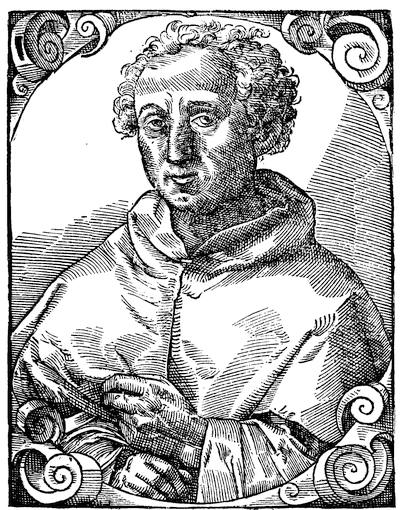
COLUMBUS (after Giovio).
Fac-simile of the woodcut in Paolo Giovio’s Elogia virorum bellica virtute illustrium (Basle, 1596), p. 124. There are copies in the Boston Athenæum and Boston Public Library. It is also copied in Charton’s Voyageurs, iii. 81, from whom Hazard (Santo Domingo, New York, 1873, p. 7) takes it. The 1575 edition is in Harvard College Library, and the same portrait is on p. 191. This cut is also re-engraved in Jules Verne’s La découverte de la terre, p. 113.
A vignette on the map of La Cosa, dated 1500, represents Saint Christopher bearing on his shoulders the infant Christ across a stream. This has been considered symbolical of the purpose of Columbus in his discoveries; and upholders of the movement to procure his canonization, like De Lorgues, have claimed that La Cosa represented the features of Columbus in the face of Saint Christopher. It has also been claimed that Herrera must have been of the same opinion, since the likeness given by that historian can be imagined to be an enlargement of the head on the map. This theory is hardly accepted, however, by the critics.[284]
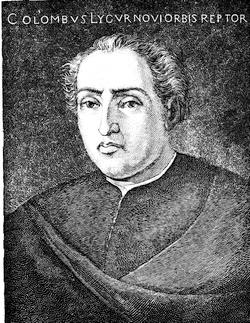
THE YANEZ COLUMBUS (National Library, Madrid).
This picture was prominently brought before the Congress of Américanistes which assembled at Madrid in 1881, and not, it seems, without exciting suspicion of a contrived piece of flattery for the Duke of Veraguas, then presiding over this same congress. Cf. Cortambert, Nouvelle histoire des voyages, p. 40.
Discarding the La Cosa vignette, the earliest claimant now known is an engraving published in the Elogia virorum illustrium (1575)[285] of Paolo Giovio (Paulus Jovius, in the Latin form). This woodcut is thought to have been copied from a picture which Jovius had placed in the gallery of notable people which he had formed in his villa at Lake Como. That collection is now scattered, and the Columbus picture cannot be traced; but that there was a portrait of the discoverer there, we know from the edition of Vasari’s Lives of the Painters printed by Giunti at Florence (1568), wherein is a list of the pictures, which includes likenesses of Vespucius, Cortes, and Magellan, besides that of “Colombo Genovese.” This indicates a single picture; but it is held by some that Jovius must have possessed two pictures, since this woodcut gives Columbus the garb of a Franciscan, while the painting in the gallery at Florence, supposed also to follow a picture belonging to Jovius, gives him a mantle. A claim has been made that the original Jovius portrait is still in existence in what is known as the Yanez picture, now in the National Library in Madrid, which was purchased of Yanez in Granada in 1763. It had originally a close-fitting tunic and mantle, which was later painted over so as to show a robe and fur collar. This external painting has been removed; and the likeness bears a certain resemblance to the woodcut and to the Florence likeness. The Yanez canvas is certainly the oldest in Spain; and the present Duque de Veraguas considers it the most authentic of all the portraits.[286] The annexed cut of it is taken from an engraving in Ruge’s Geschichte des Zeitalters der Entdeckungen (p. 235). It bears the inscription shown in the cut.[287]
The woodcut (1575) already mentioned passes as the prototype of another engraving by Aliprando Capriolo, in the Ritratti di cento capitani illustri, published at Rome in 1596.[288]
The most interesting of all pictures bearing a supposed relation to the scattered collection at Lake Como is in the gallery at Florence, which is sometimes said to have been painted by Cristofano dell’Altissimo, and before the year 1568. A copy of it was made for Thomas Jefferson in 1784, which was at Monticello in 1814; and, having been sent to Boston to be disposed of, became the property of Israel Thorndike, and was by him given to the Massachusetts Historical Society, in whose gallery it now is; and from a photograph of it the cut (p. 74) has been engraved.[289] It is perhaps the most commonly accepted likeness in these later years.[290]
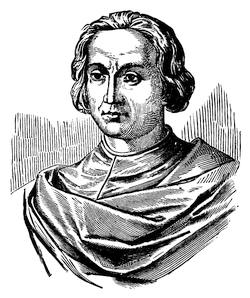
COLUMBUS (after Capriolo).
This is a reproduction of the cut in Charton’s Voyageurs, iii. 85. It is also copied in Carderera, and in the Magasin pittoresque, troisième année, p. 316.
After the woodcut of 1575, the next oldest engraved likeness of Columbus is the one usually called the De Bry portrait. It shows a head with a three-cornered cap, and possesses a Dutch physiognomy,—its short, broad face not corresponding with the descriptions which we find in Oviedo and the others. De Bry says that the original painting was stolen from a saloon in the Council for the Indies in Spain, and, being taken to the Netherlands, fell into his hands. He claims that it was painted from life by order of Ferdinand, the King. De Bry first used the plate in Part V. of his Grands Voyages, both in the Latin and German editions, published in 1595, where it is marked as engraved by Jean de Bry. It shows what seem to be two warts on the cheek, which do not appear in later prints.[291] Feuillet de Conches describes a painting in the Versailles gallery like the De Bry, which has been engraved by Mercuri;[292] but it does not appear that it is claimed as the original from which De Bry worked.[293]
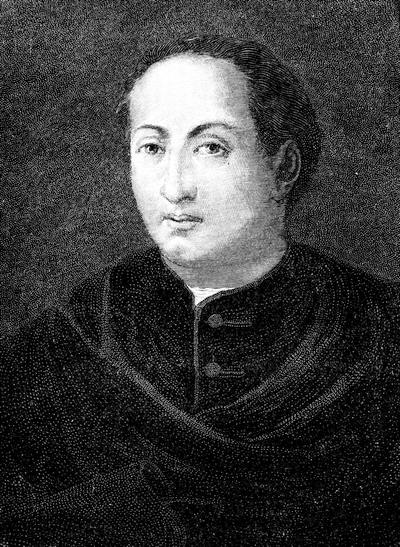
COLUMBUS (the Jefferson copy of the Florence picture).
Jomard, in the Bulletin de la Société de Géographie (3d series), iii. 370, printed his “Monument à Christophe Colomb: son portrait,”[294] in explanation and advocacy of a Titianesque canvas which he had found at Vicenza, inscribed “Christophorus Columbus.”
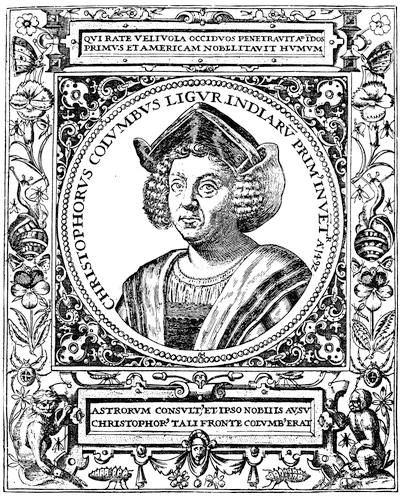
THE DE BRY PORTRAIT OF COLUMBUS.
He claimed that the features corresponded to the written descriptions of Columbus by his contemporaries and accounted for the Flemish ruff, pointed beard, gold chain, and other anachronous accessories, by supposing that these had been added by a later hand. These adornments, however, prevented Jomard’s views gaining any countenance, though he seems to have been confident in his opinion. Irving at the time records his scepticism when Jomard sent him a lithograph of it. Carderera and Feuillet de Conches both reject it.
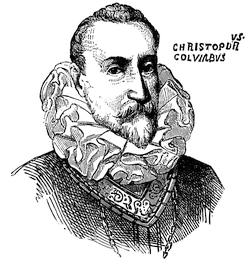
JOMARD’S PICTURE OF COLUMBUS.
This is a reproduction of the cut in Charton’s Voyageurs, iii. 87.
A similar out-of-date ruff and mustache characterize the likeness at Madrid associated with the Duke of Berwick-Alba, in which the finery of a throne makes part of the picture. The owner had a private plate engraved from it by Rafael Esteve, a copy of which, given by the engraver to Obadiah Rich, who seems to have had faith in it, is now in the Lenox Library.[295]
A picture belonging to the Duke of Veraguas is open to similar objections,—with its beard and armor and ruff; but Muñoz adopted it for his official history, the plate being drawn by Mariano Maella.[296]
A picture of a bedizened cavalier, ascribed to Parmigiano (who was three years old when Columbus died), is preserved in the Museo Borbonico at Naples, and is, unfortunately, associated in this country with Columbus, from having been adopted by Prescott for his Ferdinand and Isabella,[297] and from having been copied for the American Antiquarian Society.[298] It was long since rejected by all competent critics.
A picture in the Senate chamber (or lately there) at Albany was given to the State of New York in 1784 by Mrs. Maria Farmer, a granddaughter of Governor Jacob Leisler, and was said to have been for many years in that lady’s family.[299] There are many other scattered alleged likenesses of Columbus, which from the data at hand it has not been easy to link with any of those already mentioned.[300]
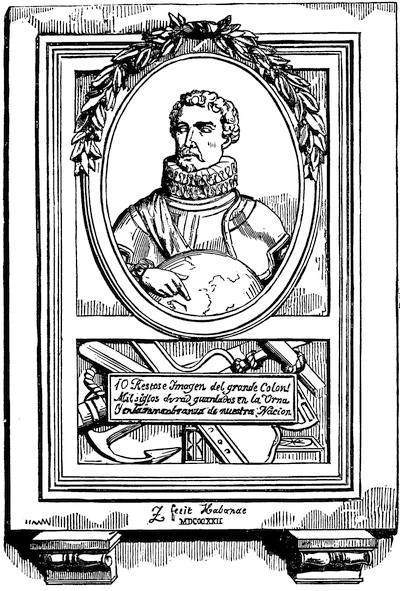
COLUMBUS.—THE HAVANA MEDALLION.
Reproduced from a cut in Charton’s Voyageurs, iii. 188.
The best known, probably, of the sculptured effigies of Columbus is the bust of Peschiera, which was placed in 1821 at Genoa on the receptacle of the Columbus manuscripts.[301] The artist discarded all painted portraits of Columbus, and followed the descriptions of those who had known the discoverer.[302]
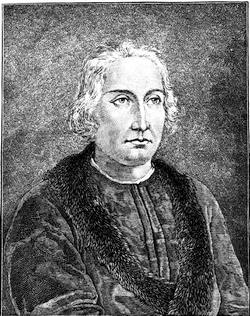
COLUMBUS.
This is copied from one given in Ruge’s Geschichte des Zeitalters der Entdeckungen, p. 234, which follows a photograph of the painting in the Ministry of Marine at Madrid.
The most imposing of all the memorials is the monument at Genoa erected in 1862 after a design by Freccia, and finished by Michel Canzio.[303]
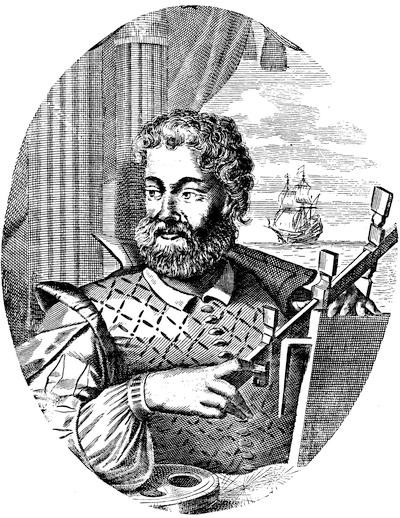
COLUMBUS (from Montanus).
His family were desirous of carrying out that wish; but it seemed to require three royal orders to make good the project, and overcome objections or delays. These orders were dated June 2, 1537, Aug. 22, 1539, and Nov. 5, 1540.[306] It has been conjectured from the language of Ferdinand Columbus’ will, in 1539, that the remains were still in the cuevas; and it is supposed that they were carried to Santo Domingo in 1541,—though, if so, there is no record of their resting-place from 1536,—when they are said, in the Convent’s Records,[307] to have been delivered up for transportation. The earliest positive mention of their being in the Cathedral at Santo Domingo is in 1549;[308] and it is not till the next century that we find a positive statement that the remains of Diego were also removed.[309] Not till 1655 does any record say that the precise spot in the Cathedral containing the remains was known, and not till 1676 do we learn what that precise spot was,—“on the right of the altar.” In 1683 we first learn of “a leaden case in the sanctuary, at the side of the platform of the high altar, with the remains of his brother Don Luis on the other side, according to the tradition of the aged in this island.”[310] The book from which this is extracted[311] was published in Madrid, and erred in calling Luis a brother instead of grandson, whose father, Diego, lying beside the Admiral, seems at the time to have been forgotten.[312]
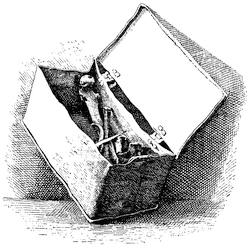
COFFER AND BONES.
This follows an engraving given in John G. Shea’s “Where are the Remains of Columbus?” in Magazine of American History, January, 1883, and separately. There are other engravings in Tejera, pp. 28, 29, and after a photograph in the Informe de la Real Academia, p. 197. The case is 16⅝ x 8½ x 8⅛ inches.
Just a century later, in 1783, Moreau de Saint-Méry, prefacing his Description topographique of Santo Domingo,[313] sought more explicit information, and learned that, shortly before his inquiry, the floor of the chancel had been raised so as to conceal the top of the vault, which was “a case of stone” (containing the leaden coffin), on the “Gospel side of the sanctuary.” This case had been discovered during the repairs, and, though “without inscription, was known from uninterrupted and invariable tradition to contain the remains of Columbus;” and the Dean of the Chapter, in certifying to this effect, speaks of the “leaden urn as a little damaged, and containing several human bones;” while he had also, some years earlier, found on “the Epistle side” of the altar a similar stone case, which, according to tradition, contained the bones of the Admiral’s brother.[314]
A few years later the treaty of Basle, July 22, 1795, gave to France the half of Santo Domingo still remaining to Spain; and at the cost of the Duke of Veraguas, and with the concurrence of the Chapter of the Cathedral, the Spanish General, Gabriel de Aristazabal, somewhat hurriedly opened a vault on the left of the altar, and, with due ceremony and notarial record,[315] took from it fragments of a leaden case and some human bones, which were unattested by any inscription found with them. The relics were placed in a gilt leaden case, and borne with military honors to Havana.[316] It is now claimed that these remains were of Diego, the son, and that the vault then opened is still empty in the Cathedral, while the genuine remains of Columbus were left undisturbed.
In 1877, in making some changes about the chancel, on the right of the altar, the workmen opened a vault, and found a leaden case containing human bones, with an inscription showing them to be those of Luis, the grandson. This led to a search on the opposite, or “Gospel, side” of the chancel, where they found an empty vault, supposed to be the one from which the remains were taken to Havana. Between this and the side wall of the building, and separated from the empty vault by a six-inch wall, was found another cavity, and in it a leaden case. There seem to have been suitable precautions taken to avoid occasion for imputations of deceit, and with witnesses the case was examined.[317] In it were found some bones and dust, a leaden bullet,[318] two iron screws, which fitted the holes in a small silver plate found beneath the mould in the bottom of the case.[319] This casket bore on the outside, on the front, and two ends—one letter on each surface—the letters C. C. A. On the top was an inscription here reduced:—
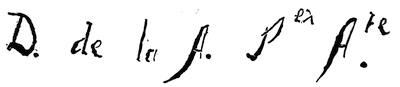
This inscription is supposed to mean “Discoverer of America, first Admiral.” Opening the case, which in this situation presented the appearance shown in the cut on page 80, the under surface of the lid was found to bear the following legend:—
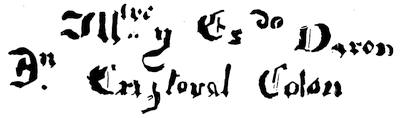
This legend is translated, “Illustrious and renowned man, Christopher Columbus.”[320] A fac-simile of the inscription found on the small silver plate is given on page 82, the larger of which is understood to mean “A part of the remains of the first Admiral, Don Christopher Columbus, discoverer.”[321] The discovery was made known by the Bishop, Roque Cocchia, in a pastoral letter,[322] and the news spread rapidly.[323] The Spanish King named Señor Antonio Lopez Prieto, of Havana, to go to Santo Domingo, and, with the Spanish consul, to investigate. Prieto had already printed a tract, which went through two editions, Los restos de Colon: exámen histórico-critico, Havana, 1877.
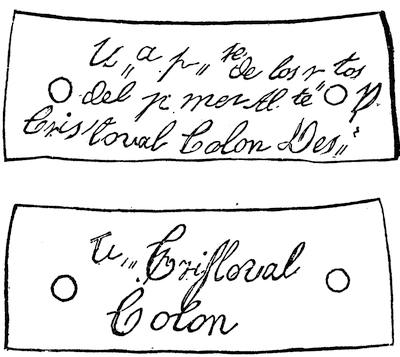
In March, 1878, he addressed his Official Report to the Captain-general of Cuba, which was printed in two editions during the same year, as Informe sobre los restos de Colon. It was an attack upon the authenticity of the remains at Santo Domingo. Later in the same year, Oct. 14, 1878, Señor Manuel Colmeiro presented, in behalf of the Royal Academy of History of Madrid, a report to the King, which was printed at Madrid in 1879 as Los restos de Colon: informe de la Real Academia de la Historia, etc. It reinforced the views of Prieto’s Report; charged Roque Cocchia with abetting a fraud; pointed to the A (America) of the outside inscription as a name for the New World which Spaniards at that time never used;[324] and claimed that the remains discovered in 1877 were those of Christopher Columbus, the grandson of the Admiral, and that the inscriptions had been tampered with, or were at least much later than the date of reinterment in the Cathedral.[325] Besides Bishop Roque Cocchia, the principal upholder of the Santo Domingo theory has been Emiliano Tejera, who published his Los restos de Colon en Santo Domingo in 1878, and his Los dos restos de Cristóbal Colon in 1879, both in Santo Domingo. Henry Harrisse, under the auspices of the “Sociedad de Bibliófilos Andaluces,” printed his Los restos de Don Cristóval Colon at Seville in 1878, and his Les sépultures de Christophe Colomb: revue critique du premier rapport officiel publié sur ce sujet, the next year (1879) at Paris.[326] From Italy we have Luigi Tommaso Belgrano’s Sulla recente scoperta delle ossa di Colombo (Genoa, 1878). One of the best and most recent summaries of the subject is by John G. Shea in the Magazine of American History, January, 1883; also printed separately, and translated into Spanish. Richard Cortambert (Nouvelle histoire des voyages, p. 39) considers the Santo Domingo theory overcome by the evidence.
In favor of the earliest date—which, with variations arising from the estimates upon fractions of years, may be placed either in 1435, 1436, or 1437—are Navarrete, Humboldt, Ferdinand Höfer,[333] Émile Deschanel,[334] Lamartine,[335] Irving, Bonnefoux, Roselly de Lorgues, l’Abbé Cadoret, Jurien de la Gravière,[336] Napione,[337] Cancellieri, and Cantù.[338] This view is founded upon the statement of one who had known Columbus, Andres Bernaldez, in his Reyes católicos, that Columbus was about seventy years old at his death, in 1506.
The other extreme—similarly varied from the fractions between 1455 and 1456—is taken by Oscar Peschel,[339] who deduces it from a letter of Columbus dated July 7, 1503, in which he says that he was twenty-eight when he entered the service of Spain in 1484; and Peschel argues that this is corroborated by adding the fourteen years of his boyhood, before going to sea, to the twenty-three years of sea-life which Columbus says he had had previous to his voyage of discovery, and dating back from 1492, when he made this voyage.
A middle date—placed, according to fractional calculations, variously from 1445 to 1447—is held by Cladera,[340] Bossi, Muñoz, Casoni,[341] Salinerio,[342] Robertson, Spotorno, Major, Sanguinetti, and Canale. The argument for this view, as presented by Major, is this: It was in 1484, and not in 1492, that this continuous sea-service, referred to by Columbus, ended; accordingly, the thirty-seven years already mentioned should be deducted from 1484, which would point to 1447 as the year of his birth,—a statement confirmed also, as is thought, by the assertion which Columbus makes, in 1501, that it was forty years since he began, at fourteen, his sea-life. Similar reasons avail with D’Avezac, whose calculations, however, point rather to the year 1446.[343]
A similar uncertainty has been made to appear regarding the place of Columbus’ birth. Outside of Genoa and dependencies, while discarding such claims as those of England,[344] Corsica,[345] and Milan,[346] there are more defensible presentations in behalf of Placentia (Piacenza), where there was an ancestral estate of the Admiral, whose rental had been enjoyed by him and by his father;[347] and still more urgent demands for recognition on the part of Cuccaro in Montferrat, Piedmont, the lord of whose castle was a Dominico Colombo,—pretty well proved, however, not to have been the Dominico who was father of the Admiral. It seems certain that the paternal Dominico did own land in Cuccaro, near his kinspeople, and lived there as late as 1443.[348]
In consequence of these claims, the Academy of Sciences in Genoa named a commission, in 1812, to investigate them; and their report,[349] favoring the traditional belief in Genoa as the true spot of Columbus’ birth, is given in digest in Bossi.[350] The claim of Genoa seems to be generally accepted to-day, as it was in the Admiral’s time by Peter Martyr, Las Casas, Bernaldez, Giustiniani, Geraldini, Gallo, Senaraya, and Foglietto.[351] Columbus himself twice, in his will (1498), says he was born in Genoa; and in the codicil (1506) he refers to his “beloved country, the Republic of Genoa.” Ferdinand calls his father “a Genoese.”[352] Of modern writers Spotorno, in the Introduction to the Codice diplomatico Colombo-Americano (1823), and earlier, in his Della origine e della patria di Colombo (1819), has elaborated the claim, with proofs and arguments which have been accepted by Irving, Bossi, Sanguinetti, Roselly, De Lorgues, and most other biographers and writers.
There still remains the possibility of Genoa, as referred to by Columbus and his contemporaries, signifying the region dependent on it, rather than the town itself; and with this latitude recognized, there are fourteen towns, or hamlets as Harrisse names them,[353] which present their claims.[354]
Ferdinand Columbus resented Giustiniani’s statement that the Admiral was of humble origin, and sought to connect his father’s descent with the Colombos of an ancient line and fame; but his disdainful recognition of such a descent is, after all, not conducive to a belief in Ferdinand’s own conviction of the connection.
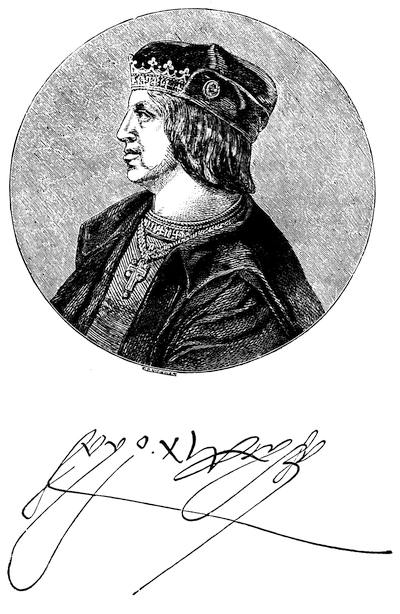
FERDINAND OF SPAIN.
This follows an ancient medallion as engraved in Buckingham Smith’s Coleccion. Cf. also the sign-manual on p. 56.
There seems little doubt that his father[355] was a wool-weaver or draper, and owned small landed properties, at one time or another, in or not far from Genoa;[356] and, as Harrisse infers, it was in one of the houses on the Bisagno road, as you go from Genoa, that Columbus was perhaps born.[357]
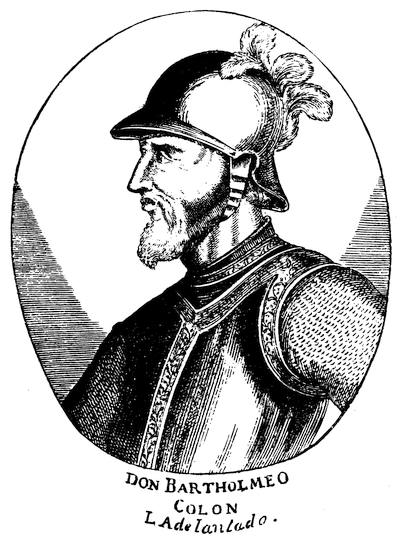
BARTHOLOMEW COLUMBUS.
This is a fac-simile of an engraving in Herrera (Barcia’s edition). There is a vignette likeness on the title of vol i., edition of 1601. Navarrete’s Memoir of Bartholomew Columbus is in the Coleccion de documentos inéditos, vol. xvi.
The pedigree (p. 87) shows the alleged descent of Columbus, as a table in Spotorno’s Della origine e della patria di Colombo, 1819, connects it with other lines, whose heirs at a later day were aroused to claim the Admiral’s honors; and as the usual accounts of his immediate descendants record the transmission of his rights. After Columbus’ death, his son Diego demanded the restitution of the offices and privileges[358] which had been suspended during the Admiral’s later years.
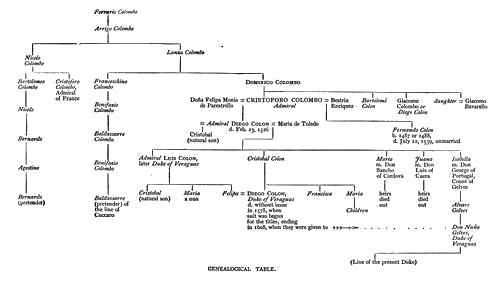
GENEALOGICAL TABLE.
He got no satisfaction but the privilege of contending at law with the fiscal minister of the Crown, and of giving occasion for all the latent slander about the Admiral to make itself heard. The tribunal was the Council of the Indies; the suit was begun in 1508, and lasted till 1527. The documents connected with the case are in the Archives of the Indies. The chief defence of the Crown was that the original convention was against law and public policy, and that Columbus, after all, did not discover Terra firma, and for such discovery alone honors of this kind should be the reward. Diego won the Council’s vote; but Ferdinand, the King, hesitated to confirm their decision. Meanwhile Diego had married a niece of the Duke of Alva, the King’s favorite, and got in this way a royal grant of something like vice-royal authority in the Indies, to which he went (1509) with his bride, prepared for the proper state and display. His uncles, Bartholomew and Diego, as well as Ferdinand Columbus, accompanied him. The King soon began to encroach on Diego’s domain, creating new provinces out of it.[359] It does not belong to this place to trace the vexatious factions which, through Fonseca’s urging, or otherwise created, Diego was forced to endure, till he returned to Spain, in 1515, to answer his accusers. When he asked of the King a share of the profits of the Darien coast, his royal master endeavored to show that Diego’s father had never been on that coast. After Ferdinand’s death (Jan. 23, 1516), his successor, Charles V., acknowledged the injustice of the charges against Diego, and made some amends by giving him a viceroy’s functions in all places discovered by his father. He was subjected, however, to the surveillance of a supervisor to report on his conduct, upon going to his government in 1520.[360] In three years he was again recalled for examination, and in 1526 he died. Don Luis, who succeeded to his father Diego, after some years exchanged, in 1556, his rights of vice-royalty in the Indies for ten thousand gold doubloons and the title of Duque de Veraguas (with subordinate titles), and a grandeeship of the first rank;[361] the latter, however, was not confirmed till 1712.
His nephew Diego succeeded to the rights, silencing those of the daughter of Don Luis by marrying her. They had no issue; and on his death, in 1578, various claimants brought suit for the succession (as shown in the table), which was finally given, in 1608, to the grandson of Isabella, the granddaughter of Columbus. This suit led to the accumulation of a large amount of documentary evidence, which was printed.[362] The vexations did not end here, the Duke of Berwick still contesting; but a decision in 1790 confirmed the title in the present line. The revolt of the Spanish colonies threatened to deprive the Duke of Veraguas of his income; but the Spanish Government made it good by charging it upon the revenues of Cuba and Porto Rico, the source of the present Duke’s support.[363]
POSTSCRIPT.
After the foregoing chapter had been completed, there came to hand the first volume of Christophe Colomb, son origine, sa vie, ses voyages, sa famille, et ses descendants, d’après des documents inédits tirés des Archives de Gênes, de Savone, de Séville, et de Madrid, études d’histoire critique par Henry Harrisse, Paris, 1884.
The book is essentially a reversal of many long-established views regarding the career of Columbus. The new biographer, as has been shown, is not bound by any respect for the Life of the Admiral which for three hundred years has been associated with the name of Ferdinand Columbus. The grounds of his discredit of that book are again asserted; and he considers the story as given in Las Casas as much more likely to represent the prototype both of the Historia general of this last writer and of the Historie of 1571, than the mongrel production which he imagines this Italian text of Ulloa to be, and which he accounts utterly unworthy of credit by reason of the sensational perversions and additions with which it is alloyed by some irresponsible editor. This revolutionary spirit makes the critic acute, and sustains him in laborious search; but it is one which seems sometimes to imperil his judgment. He does not at times hesitate to involve Las Casas himself in the same condemnation for the use which, if we understand him, Las Casas may be supposed, equally with the author or editor of the Historie, to have made of their common prototype. That any received incident in Columbus’ career is only traceable to the Historie is sufficient, with our critic, to assign it to the category of fiction.
This new Life adds to our knowledge from many sources; and such points as have been omitted or slightly developed in the preceding chapter, or are at variance with the accepted views upon which that chapter has been based, it may be well briefly to mention.
The frontispiece is a blazon of the arms of Columbus, “du cartulaire original dressé sous ses yeux à Seville en 1502,” following a manuscript in the Archives of the Ministry of Foreign Affairs at Paris. The field of the quarter with the castle is red; that of the lion is silver; that of the anchors is blue; the main and islands are gold, the water blue. It may be remarked that the disposition of these islands seems to have no relation to the knowledge then existing of the Columbian Archipelago. Below is a blue bend on a gold field, with red above (see the cut, ante, p. 15).
In writing in his Introduction of the sources of the history of Columbus, Harrisse says that we possess sixty-four memoirs, letters, or extracts written by Columbus, of which twenty-three are preserved in his own autograph. Of these sixty-four, only the Libro de las profecias has not been printed entire, if we except a Memorial que presentó Cristóbal Colon á los Reyes Catolicos sobre las cosas necesarias para abastecer las Indias which is to be printed for the first time by Harrisse, in the appendix of his second volume. Las Casas’ transcript of Columbus’ Journal is now, he tells us, in the collection of the Duque d’Osuna at Madrid. The copy of Dr. Chanca’s relation of the second voyage, used by Navarrete, and now in the Academy of History at Madrid, belonged to a collection formed by Antonio de Aspa. The personal papers of Columbus, confided by him to his friend Gaspar Gorricio, were preserved for over a century in an iron case in the custody of monks of Las Cuevas; but they were, on the 15th of May, 1609, surrendered to Nuño Gelves, of Portugal, who had been adjudged the lawful successor of the Admiral. Such as have escaped destruction now constitute the collection of the present Duque de Veraguas; and of them Navarrete has printed seventy-eight documents. Of the papers concerning Columbus at Genoa, Harrisse finds only one anterior to his famous voyage, and that is a paper of the Father Dominico Colombo, dated July 21, 1489, of whom such facts as are known are given, including references to him in 1463 and 1468 in the records of the Bank of St. George in Genoa. Of the two letters of 1502 which Columbus addressed to the Bank, only one now exists, as far as Harrisse could learn, and that is in the Hôtel de Ville. Particularly in regard to the family of Columbus, he has made effective use of the notarial and similar records of places where Columbus and his family have lived. But use of depositions for establishing dates and relationship imposes great obligation of care in the identification of the persons named; and this with a family as numerous as the Colombos seem to have been, and given so much to the repeating of Christian names, is more than usually difficult. In discussing the evidence of the place and date of Columbus’ birth (p. 137), as well as tracing his family line (pp. 160 and 166), the conclusion reached by Harrisse fixes the humble origin of the future discoverer; since he finds Columbus’ kith and kin of the station of weavers,—an occupation determining their social standing as well in Genoa as in other places at that time. The table which is given on a previous page (ante, p. 87) shows the lines of supposable connection, as illustrating the long contest for the possession of the Admiral’s honors. His father’s father, it would seem, was a Giovanni Colombo (pp. 167-216), and he the son of a certain Luca Colombo. Giovanni lived in turn at Terrarossa and Quinto. Domenico, the Admiral’s father, married Susanna Fontanarossa, and removed to Genoa between 1448 and 1551, living there afterward, except for the interval 1471-1484, when he is found at Savona. He died in Genoa not far from 1498. We are told (p. 29) how little the Archives of Savona yield respecting the family. Using his new notarial evidence mainly, the critic fixes the birth of Columbus about 1445 (pp. 223-241); and enforces a view expressed by him before, that Genoa as the place of Columbus’ birth must be taken in the broader sense of including the dependencies of the city, in one of which he thinks Columbus was born (p. 221) in that humble station which Gallo, in his “De navigatione Columbi,” now known to us as Printed in Muratori (xxiii. 301), was the first to assert. Giustiniani, in his Psalter-note, and Senarega, in his “De rebus Genuensibus” (Muratori, xxiv. 354) seem mainly to have followed Gallo on this point. There is failure (p. 81) to find confirmation of some of the details of the family as given by Casoni in his Annali della republica di Genova (1708, and again 1799). In relation to the lines of his descendants, there are described (pp. 49-60) nineteen different memorials, bearing date between 1590 and 1792—and there may be others—which grew out of the litigations in which the descent of the Admiral’s titles was involved.
The usual story, told in the Historie, of Columbus’ sojourn at the University of Pavia is discredited, chiefly on the ground that Columbus himself says that from a tender age he followed the sea (but Columbus’ statements are often inexact), and from the fact that in cosmography Genoa had more to teach him than Pavia. Columbus is also kept longer in Italy than the received opinion has allowed, which has sent him to Portugal about 1470; while we are now told—if his identity is unassailable—that he was in Savona as late as 1473 (pp. 253-254).
Documentary Portuguese evidence of Columbus’ connection with Portugal is scant. The Archivo da Torre do Tombo at Lisbon, which Santarem searched in vain for any reference to Vespucius, seem to be equally barren of information respecting Columbus, and they only afford a few items regarding the family of the Perestrellos (p. 44).
The principal contemporary Portuguese chronicle making any reference to Columbus is Ruy de Pina’s Chronica del Rei Dom João II., which is contained in the Colleccão de livros ineditos de historia Portugueza, published at Lisbon in 1792 (ii. 177), from which Garcia de Resende seems to have borrowed what appears in his Choronica, published at Lisbon in 1596; and this latter account is simply paraphrased in the Decada primeira do Asia (Lisbon, 1752) of João de Barros, who, born in 1496, was too late to have personal knowledge of earlier time of the discoveries. Vasconcellos’ Vida y acciones del Rey D. Juan al segundo (Madrid, 1639) adds nothing.
The statement of the Historie again thrown out, doubt at least is raised respecting the marriage of Columbus with Philippa, daughter of Bartholomeu Perestrello; and if the critic cannot disprove such union, he seems to think that as good, if not better, evidence exists for declaring the wife of Columbus to have been the daughter of Vasco Gil Moniz, of an old family, while it was Vasco Gill’s sister Isabel who married the Perestrello in question. The marriage of Columbus took place, it is claimed there is reason to believe, not in Madeira, as Gomara and others have maintained, but in Lisbon, and not before 1474. Further, discarding the Historie, there is no evidence that Columbus ever lived at Porto Santo or Madeira, or that his wife was dead when he left Portugal for Spain in 1484. If this is established, we lose the story of the tie which bound him to Portugal being severed by the death of his companion; and the tale of his poring over the charts of the dead father of his wife at Porto Santo is relegated to the region of fable.
We have known that the correspondence of Toscanelli with the monk Martinez took place in 1474, and the further communication of the Italian savant with Columbus himself has always been supposed to have occurred soon after; but reasons are now given for pushing it forward to 1482.
The evidences of the offers which Columbus made, or caused to be made, to England, France, and Portugal,—to the latter certainly, and to the two others probably,—before he betook himself to Spain, are also reviewed. As to the embassy to Genoa, there is no trace of it in the Genoese Archives and no earlier mention of it than Ramusio’s; and no Genoese authority repeats it earlier than Casoni in his Annali di Genova, in 1708. This is now discredited altogether. No earlier writer than Marin, in his Storia del commercio de’ Veneziani (vol. vii. published 1800), claims that Columbus gave Venice the opportunity of embarking its fortunes with his; and the document which Pesaro claimed to have seen has never been found.
There is difficulty in fixing with precision the time of Columbus’ leaving Portugal, if we reject the statements of the Historie, which places it in the last months of 1484. Other evidence is here presented that in the summer of that year he was in Lisbon; and no indisputable evidence exists, in the critic’s judgment, of his being in Spain till May, 1487, when a largess was granted to him. Columbus’ own words would imply in one place that he had taken service with the Spanish monarchs in 1485, or just before that date; and in another place that he had been in Spain as early as January, 1484, or even before,—a time when now it is claimed he is to be found in Lisbon.
The pathetic story of the visit to Rábida places that event at a period shortly after his arriving in Spain; and the Historie tells also of a second visit at a later day. It is now contended that the two visits were in reality one, which occurred in 1491. The principal argument to upset the Historie is the fact that Juan Rodriguez Cabezudo, in the lawsuit of 1513, testified that it was “about twenty-two years” since he had lent a mule to the Franciscan who accompanied Columbus away from Rábida!
With the same incredulity the critic spirits away (p. 358) the junto of Salamanca. He can find no earlier mention of it than that of Antonio de Remesal in his Historia de la Provincia de S. Vincente de Chyapa, published in Madrid in 1619; and accordingly asks why Las Casas, from whom Remesal borrows so much, did not know something of this junto? He counts for much that Oviedo does not mention it; and the Archives of the University at Salamanca throw no light. The common story he believes to have grown out of conferences which probably took place while the Court was at Salamanca in the winter of 1486-1487, and which were conducted by Talavera; while a later one was held at Santa Fé late in 1491, at which Cardinal Mendoza was conspicuous.
Since Alexander Geraldinus, writing in 1522, from his own acquaintance with Columbus, had made the friar Juan Perez, of Rábida, and Antonio de Marchena, who was Columbus’ steadfast friend, one and the same person, it has been the custom of historians to allow that Geraldinus was right. It is now said he was in error; but the critic confesses he cannot explain how Gomara, abridging from Oviedo, changes the name of Juan Perez used by the latter to Perez de Marchena, and this before Geraldinus was printed. Columbus speaks of a second monk who had befriended him; and it has been the custom to identify this one with Diego de Deza, who, at the time when Columbus is supposed to have stood in need of his support, had already become a bishop, and was not likely, the critic thinks, to have been called a monk by Columbus. The two friendly monks in this view were the two distinct persons Juan Perez and Antonio de Marchena (p. 372).
The interposition of Cardinal Mendoza, by which Columbus secured the royal ear, has usually been placed in 1486. Oviedo seems to have been the source of subsequent writers on the point; but Oviedo does not fix the date, and the critic now undertakes to show (p. 380) that it was rather in the closing months of 1491.
Las Casas charges Talavera with opposing the projects of Columbus: we have here (p. 383) the contrary assertion; and the testimony of Peter Martyr seems to sustain this view. So again the new biographer measurably defends, on other contemporary evidence, Fonseca (p. 386) as not deserving the castigations of modern writers; and all this objurgation is considered to have been conveniently derived from the luckless Historie of 1571.
The close student of Columbus is not unaware of the unsteady character of much of the discoverer’s own testimony on various points. His imagination was his powerful faculty; and it was as wild at times as it was powerful, and nothing could stand in the way of it. No one has emphasized the doleful story of his trials and repressions more than himself, making the whole world, except two monks, bent on producing his ignominy; and yet his biographer can pick (p. 388) from the Admiral’s own admissions enough to show that during all this time he had much encouragement from high quarters. The critic is not slow to take advantage of this weakness of Columbus’ character, and more than once makes him the strongest witness against himself.
It is now denied that the money advanced by Santangel was from the treasury of Aragon. On the contrary, the critic contends that the venture was from Santangel’s private resources; and he dismisses peremptorily the evidence of the document which Argensola, in his Anales de Aragon (Saragossa, 1630), says was preserved in the archives of the treasury of Aragon. He says a friend who searched at Barcelona in 1871, among the “Archivo general de la Corona de Aragon,” could not find it.
Las Casas had first told—guardedly, to be sure—the story of the Pinzons’ contributing the money which enabled Columbus to assume an eighth part of the expense of the first voyage; but it is now claimed that the assistance of that family was confined to exerting its influence to get Columbus a crew. It is judged that the evidence is conclusive that the Pinzons did not take pecuniary risk in the voyage of 1492, because only their advances of this sort for the voyage of 1499 are mentioned in the royal grant respecting their arms. But such evidence is certainly inconclusive; and without the evidence of Las Casas it must remain uncertain whence Columbus got the five hundred thousand maravedis which he contributed to the cost of that momentous voyage.
The world has long glorified the story in the Historie of 1571 about the part which the crown jewels, and the like, played in the efforts of Isabella to assist in the furnishing of Columbus’ vessels. Peter Martyr, Bernaldez, and others who took frequent occasion to sound the praises of her majesty, say nothing of it; and, as is now contended, for the good reason that there was no truth in the story, the jewels having long before been pledged in the prosecution of the war with the Moors.
It is inferred (p. 417) from Las Casas that his abridgment of Columbus’ Journal was made from a copy, and not from the original (Navarrete, i. 134); and Harrisse says that from two copies of this abridgment, preserved in the collection of the Duque d’Osuna at Madrid, Varnhagen printed his text of it which is contained in his Verdadera Guanahani. This last text varies in some places from that in Navarrete, and Harrisse says he has collated it with the Osuna copies without discovering any error. He thinks, however, that the Historie of 1571, as well as Las Casas’ account, is based upon the complete text; and his discrediting of the Historie does not prevent him in this case saying that from it, as well as from Las Casas, a few touches of genuineness, not of importance to be sure, can be added to the narrative of the abridgment. He also points out that we should discriminate as to the reflections which Las Casas intersperses; but he seems to have no apprehension of such insertions in the Historie in this particular case.
The Ambrosian text of the first letter is once more reprinted (p. 419), accompanied by a French translation. In some appended notes the critic collates it with the Cosco version in different shapes, and with that of Simancas. He also suggests that this text was printed at Barcelona toward the end of March, 1493, and infers that it may have been in this form that the Genoese ambassadors took the news to Italy when they left Spain about the middle of the following month.
The closing chapter of this first volume is on the question of the landfall. The biographer discredits attempts to settle the question by nautical reasoning based on the log of Columbus, averring that the inevitable inaccuracies of such records in Columbus’ time is proved by the widely different conclusions of such experienced men as Navarrete, Becher, and Fox. He relies rather on Columbus’ description and on that in Las Casas. The name which the latter says was borne in his day by the island of the landfall was “Triango;” but the critic fails to find this name on any earlier map than that first made known in the Cartas de Indias in 1877. To this map he finds it impossible to assign an earlier date than 1541, since it discloses some reminders of the expedition of Coronado. He instances other maps in which the name in some form appears attached to an island of the Bahamas,—as in the Cabot mappemonde of 1544 (Triangula), the so-called Vallard map (Triango), that of Gutierrez in 1550 (Trriango), that of Alonso de Santa Cruz in his Islario of 1560 (Triangulo). Unfortunately on some of the maps Guanahani appears as well as the name which Las Casas gives. Harrisse’s solution of this conjunction of names is suggested by the fact that in the Weimar map of 1527 (see sketch, ante, p. 43) an islet “Triango” lies just east of Guanahani, and corresponds in size and position to the “Triangula” of Cabot and the “Triangulo” of Santa Cruz. Guanahani he finds to correspond to Acklin Island, the larger of the Crooked Island group (see map, ante, p. 55); while the Plana Cays, shown east of it, would stand for “Triango.” Columbus, with that confusion which characterizes his writings, speaks in one place of his first land being an “isleta,” and in another place he calls it an “isla grande.” This gives the critic ground for supposing that Columbus saw first the islet, the “Triango” of Las Casas, or the modern “Plana Cays,” and that then he disembarked on the “isla grande,” which was Acklin Island. So it may be that Columbus’ own confused statement has misled subsequent writers. If this theory is not accepted, Fox, in selecting Samana, has, in the critic’s opinion, come nearer the truth than any other.
THE EARLIEST MAPS
OF THE
SPANISH AND PORTUGUESE DISCOVERIES.
BY THE EDITOR.
THE enumeration of the cartographical sources respecting the discoveries of the earlier voyagers began with the list, “Catalogus auctorum tabularum geographicarum, quotquot ad nostram cognitionem hactenus pervenere; quibus addidimus, ubi locorum, quando et a quibus excusi sunt,” which Ortelius in 1570 added to his Theatrum orbis terrarum, many of whose titles belong to works not now known. Of maps now existing the best-known enumerations are those in the Jean et Sébastian Cabot of Harrisse; the Mapoteca Colombiana of Uricoechea; the Cartografia Mexicana of Orozco y Berra, published by the Mexican Geographical Society; and Gustavo Uzielli’s Elenco descritto degli Atlanti, planisferi e carte nautiche, originally published in 1875, but made the second volume, edited by Pietro Amat, of the new edition of the Studi biografici e bibliografici della Società Geografica Italiana, Rome, 1882, under the specific title of Mappamondi, carte nautiche, portolani ed altri monumenti cartografici specialmente Italiani dei secoli XIII-XVII.[364]
The Editor has printed in the Harvard University Bulletin a bibliography Of Ptolemy’s geography, and a calendar, with additions and annotations, of the Kohl collection of early maps, belonging to the Department of State at Washington, both of which contributions called for enumerations of printed and manuscript maps of the early period, and included their reproductions of later years.
The development of cartography is also necessarily made a part of histories of geography like those of Santarem, Lelewel, St.-Martin, and Peschel; but their use of maps hardly made chronological lists of them a necessary part of their works. Santarem has pointed out how scantily modern writers have treated of the cartography of the Middle Ages previous to the era of Spanish discovery; and he enumerates such maps as had been described before the appearance of his work, as well as publications of the earlier ones after the Spanish discovery.[365]
To what extent Columbus had studied the older maps from the time when they began to receive a certain definiteness in the fourteenth century, is not wholly clear, nor how much he knew of the charts of Marino Sanuto, of Pizignani, and of the now famous Catalan map of that period; but it is doubtless true that the maps of Bianco (1436) and Mauro (1460) were well known to him.[366] “Though these early maps and charts of the fifteenth century,” says Hallam,[367] “are to us but a chaos of error and confusion, it was on them that the patient eye of Columbus had rested through long hours of meditation, while strenuous hope and unsubdued doubt were struggling in his soul.”
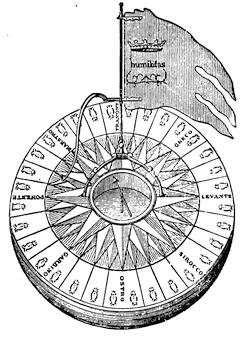
EARLY COMPASS.
This follows the engraving in Pigafetta’s Voyage and in the work of Jurien de la Gravière. The main points were designated by the usual names of the winds, Levante, east; Sirocco, southeast, etc.
A principal factor in the development of map-making, as of navigation, had been the magnet. It had been brought from China to the eastern coast of Africa as early as the fourth century, and through the Arabs[368] and Crusaders it had been introduced into the Mediterranean, and was used by the Catalans and Basques in the twelfth century, a hundred years or more before Marco Polo brought to Europe his wonderful stories.[369] In that century even it had become so familiar a sight that poets used it in their metaphors. The variation of its needle was not indeed unknown long before Columbus, but its observation in mid-ocean in his day gave it a new significance. The Chinese had studied the phenomenon, and their observations upon it had followed shortly upon the introduction of the compass itself to Western knowledge; and as early as 1436 the variation of the needle was indicated on maps in connection with places of observation.[370]
The earliest placing of a magnetic pole seems due to the voyage of Nicholas of Lynn, whose narrative was presented to Edward III. of England. This account is no longer known,[371] though the title of it, Inventio fortunata, is preserved, with its alleged date of 1355. Cnoyen, whose treatise is not extant, is thought to have got his views about the regions of the north and about the magnetic pole from Nicholas of Lynn,[372] while he was in Norway in 1364; and it is from Cnoyen that Mercator says he got his notion of the four circumpolar islands which so long figured in maps of the Mercator and Finæus school. In the Ruysch map (1508) we have the same four polar islands, with the magnetic pole placed within an insular mountain north of Greenland. Ruysch also depended on the Inventio fortunata. Later, by Martin Cortes in 1545, and by Sanuto in 1588, the pole was placed farther south.[373]
Ptolemy, in the second century, accepting the generally received opinion that the world as known was much longer east and west than north and south, adopted with this theory the terms which naturally grew out of this belief, latitude and longitude, and first instituted them, it is thought, in systematic geography.[374]
Pierre d’Ailly, in his map of 1410,[375] in marking his climatic lines, had indicated the beginnings, under a revival of geographical inquiry, of a systematic notation of latitude. Several of the early Ptolemies[376] had followed, by scaling in one way and another the distance from the equator; while in the editions of 1508 and 1511 an example had been set of marking longitude. The old Arabian cartographers had used both latitude and longitude; but though there were some earlier indications of the adoption of such lines among the European map-makers, it is generally accorded that the scales of such measurements, as we understand them, came in, for both latitude and longitude, with the map which Reisch in 1503 annexed to his Margarita philosophica.[377]
Ptolemy had fixed his first meridian at the Fortunate Islands (Canaries), and in the new era the Spaniards, with the sanction of the Pope, had adopted the same point; though the Portuguese, as if in recognition of their own enterprise, had placed it at Madeira,—as is shown in the globes of Behaim and Schöner, and in the map of Ruysch. The difference was not great; the Ptolemean example prevailed, however, in the end.[378]
In respect to latitude there was not in the rude instruments of the early navigators, and under favorable conditions, the means of closely approximate accuracy. In the study which the Rev. E. F. Slafter[379] has made on the average extent of the error which we find in the records of even a later century, it appears that while a range of sixty geographical miles will probably cover such errors in all cases, when observations were made with ordinary care the average deviation will probably be found to be at least fifteen miles. The fractions of degrees were scarcely ever of much value in the computation, and the minute gradation of the instruments in use were subject to great uncertainty of record in tremulous hands. It was not the custom, moreover, to make any allowance for the dip of the horizon, for refraction or for the parallax; and when, except at the time of the equinox, dependence had to be placed upon tables of the sun’s declination, the published ephemerides, made for a series of years, were the subjects of accumulated error.[380]
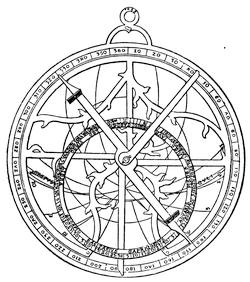
REGIOMONTANUS’ ASTROLABE.
This cut follows the engravings in Ruge’s Geschichte des Zeitalters der Entdeckungen, p. 106, and in Ghillany’s Ritter Behaim, p. 40. Cf. Von Murr, Memorabilia bibliothecarum Norimbergensium, i. 9.
With these impediments to accurate results, it is not surprising that even errors of considerable extent crept into the records of latitude, and long remained unchallenged.[381] Ptolemy, in A. D. 150, had placed Constantinople two degrees out of the way; and it remained so on maps for fourteen hundred years. In Columbus’ time Cuba was put seven or eight degrees too far north; and under this false impression the cartography of the Antilles began.
The historic instrument for the taking of latitude was the astrolabe, which is known to have been in use by the Majorcan and Catalanian sailors in the latter part of the thirteenth century; and it is described by Raymond Lullius in his Arte de navegar of that time.[382] Behaim, the contemporary of Columbus, one of the explorers of the African coast, and a pupil of Regiomontanus, had somewhat changed the old form of the astrolabe in adapting it for use on shipboard. This was in 1484 at Lisbon, and Behaim’s improvement was doubtless what Columbus used. Of the form in use before Behaim we have that (said to have belonged to Regiomontanus) in the cut on page 96; and in the following cut the remodelled shape which it took after Behaim.
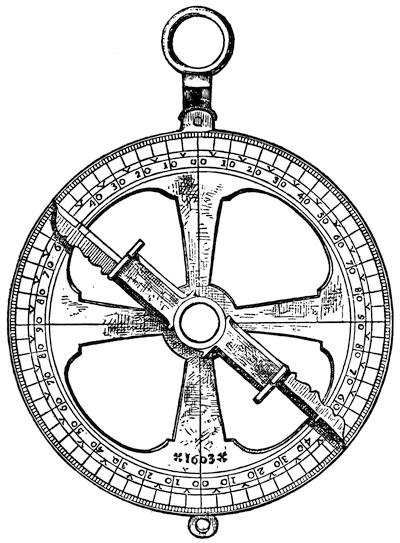
LATER ASTROLABE.
This cut follows an engraving (Mag. of Amer. Hist., iii. 178) after a photograph of one used by Champlain, which bears the Paris maker’s date of 1603. There is another cut of it in Weise’s Discoveries of America, p. 68. Having been lost by Champlain in Canada in 1613, it was ploughed up in 1867 (see Vol. IV. p. 124; also Canadian Monthly, xviii. 589). The small size of the circle used in the sea-instrument to make it conveniently serviceable, necessarily operated to make the ninety degrees of its quarter circle too small for accuracy in fractions. On land much larger circles were sometimes used; one was erected in London in 1594 of six feet radius. The early books on navigation and voyages frequently gave engravings of the astrolabe; as, for instance, in Pigafetta’s voyage (Magellan), and in the Lichte der Zee-Vaert (Amsterdam, 1623), translated as The Light of Navigation (Amsterdam, 1625). The treatise on navigation which became the most popular with the successors of Columbus was the work of Pedro de Medina (born about 1493), called the Arte de navegar, published in 1545 (reprinted in 1552 and 1561), of which there were versions in French (1554, and Lyons, 1569, with maps showing names on the coast of America for the first time), Italian (1555 with 1554, at end; Court Catalogue, no. 235), German (1576), and English (1591). (Harrisse, Bibl. Amer. Vet., no. 266.) Its principal rival was that of Martin Cortes, Breve compendio de la sphera y de la arte de navegar, published in 1551. In Columbus’ time there was no book of the sort, unless that of Raymond Lullius (1294) be considered such; and not till Enciso’s Suma de geografia was printed, in 1519, had the new spirit instigated the making of these helpful and explanatory books. The Suma de geografia is usually considered the first book printed in Spanish relating to America. Enciso, who had been practising law in Santo Domingo, was with Ojeda’s expedition to the mainland in 1509, and seems to have derived much from his varied experience; and he first noticed at a later day the different levels of the tides on the two sides of the isthmus. The book is rare; Rich in 1832 (no. 4) held it at £10 10s. (Cf. Harrisse, Notes on Columbus, 171; Bibl. Amer. Vet., nos. 97, 153, 272,—there were later editions in 1530 and 1546,—Sabin, vol. vi. no. 22,551, etc.; H. H. Bancroft, Central America, i. 329, 339; Carter-Brown, vol. i. no. 58, with a fac-simile of the title: Cat. Hist. do Brazil, Bibl. Nac. do Rio de Janeiro, no. 2.) Antonio Pigafetta in 1530 produced his Trattato di navigazione; but Medina and Cortes were the true beginners of the literature of seamanship. (Cf. Brevoort’s Verrazano, p. 116, and the list of such publications given in the Davis Voyages, p. 342, published by the Hakluyt Society, and the English list noted in Vol. III. p. 206, of the present History.) There is an examination of the state of navigation in Columbus’ time in Margry’s Navigations Françaises, p. 402, and in M. F. Navarrete’s Sobre la historia de la náutica y de las ciencias matemáticas, Madrid, 1846,—a work now become rare.
The rudder, in place of two paddles, one on each quarter, had come into use before this time; but the reefing of sails seems not yet to have been practised. (Cf. De Gama’s Voyages, published by the Hakluyt Society, p. 242.) Columbus’ record of the speed of his ship seems to have been the result of observation by the unaided eye. The log was not yet known; the Romans had fixed a wheel to the sides of their galleys, each revolution of which threw a pebble into a tally-pot. The earliest description which we have in the new era of any device of the kind is in connection with Magellan’s voyage; for Pigafetta in his Journal (January, 1521), mentions the use of a chain at the hinder part of the ship to measure its speed. (Humboldt, Cosmos, Eng. tr., ii. 631; v. 56.) The log as we understand it is described in 1573 in Bourne’s Regiment of the Sea, nothing indicating the use of it being found in the earlier manuals of Medina, Cortes, and Gemma Frisius. Humfrey Cole is said to have invented it. Three years later than this earliest mention, Eden, in 1576, in his translation of Taisnier’s Navigatione, alludes to an artifice “not yet divulgate, which, placed in the pompe of a shyp, whyther the water hath recourse, and moved by the motion of the shypp, with wheels and weyghts, doth exactly shewe what space the shyp hath gone” (Carter-Brown Catalogue, i. no. 310),—a reminiscence of the Roman side-wheels, and a reminder of the modern patent-log. Cf. article on “Navigation” in Encyclopedia Britannica, ninth ed. vol. xvii.
An instrument which could more readily adapt itself to the swaying of the observer’s body in a sea-way, soon displaced in good measure the astrolabe on shipboard. This was the cross-staff, or jackstaff, which in several modified forms for a long time served mariners as a convenient help in ascertaining the altitude of the celestial bodies. Precisely when it was first introduced is not certain; but the earliest description of it which has been found is that of Werner in 1514. Davis, the Arctic navigator, made an improvement on it; and his invention was called a backstaff.
While the observations of the early navigators in respect to latitude were usually accompanied by errors, which were of no considerable extent, their determinations of longitude, when attempted at all, were almost always wide of the truth,[383]—so far, indeed, that their observations helped them but little then to steer their courses, and are of small assistance now to us in following their tracks. It happened that while Columbus was at Hispaniola on his second voyage, in September, 1494, there was an eclipse of the moon.[384] Columbus observed it; and his calculations placed himself five hours and a half from Seville,—an error of eighteen degrees, or an hour and a quarter too much. The error was due doubtless as much to the rudeness of his instruments as to the errors of the lunar tables then in use.[385]
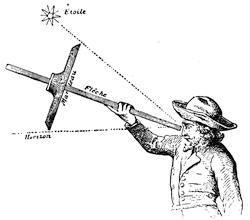
THE JACKSTAFF.
The removal of the Line of Demarcation from the supposed meridian of non-variation of the needle did not prevent the phenomena of terrestrial magnetism becoming of vast importance in the dispute between the Crowns of Spain and Portugal. It characterizes the difference between the imaginative and somewhat fantastic quality of Columbus’ mind and the cooler, more practical, and better administrative apprehension of Sebastian Cabot, that while each observed the phenomenon of the variation of the needle, and each imagined it a clew to some system of determining longitude, to Columbus it was associated with wild notions of a too-ample revolution of the North Star about the true pole.[386] It was not disconnected in his mind from a fancy which gave the earth the shape of a pear; so that when he perceived on his voyage a clearing of the atmosphere, he imagined he was ascending the stem-end of the pear; where he would find the terrestrial paradise.[387] To Cabot the phenomenon had only its practical significance; and he seems to have pondered on a solution of the problem during the rest of his life, if, as Humboldt supposes, the intimations of his death-bed in respect to some as yet unregistered way of discovering longitude refer to his observations on the magnetic declination.[388]
The idea of a constantly increasing declination east and west from a point of non-variation, which both Columbus and Cabot had discovered, and which increase could be reduced to a formula, was indeed partly true; except, as is now well known, the line of non-variation, instead of being a meridian, and fixed, is a curve of constantly changing proportions.[389]
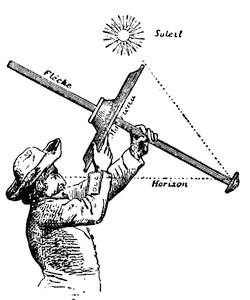
THE BACKSTAFF.
The earliest variation-chart was made in 1530 by Alonzo de Santa Cruz;[390] and schemes of ascertaining longitude were at once based on the observations of these curves, as they had before been made dependent upon the supposed gradation of the change from meridian to meridian, irrespective of latitude.[391] Fifty years later (1585), Juan Jayme made a voyage with Gali from the Philippine Islands to Acapulco to test a “declinatorum” of his own invention.[392] But this was a hundred years (1698-1702) before Halley’s Expedition was sent,—the first which any government fitted out to observe the forces of terrestrial magnetism;[393] and though there had been suspicions of it much earlier, it was not till 1722 that Graham got unmistakable data to prove the hourly variation of the needle.[394]
The earliest map which is distinctively associated with the views which were developing in Columbus’ mind was the one which Toscanelli sent to him in 1474. It is said to have been preserved in Madrid in 1527;[395] and fifty-three years after Columbus’ death, when Las Casas was writing his history, it was in his possession.[396] We know that this Italian geographer had reduced the circumference of the globe to nearly three quarters of its actual size, having placed China about six thousand five hundred miles west of Lisbon, and eleven thousand five hundred miles east. Japan, lying off the China coast, was put somewhere from one hundred degrees to one hundred and ten degrees west of Lisbon; and we have record that Martin Pinzon some years later (1491) saw a map in Rome which put Cipango (Japan) even nearer the European side.[397]
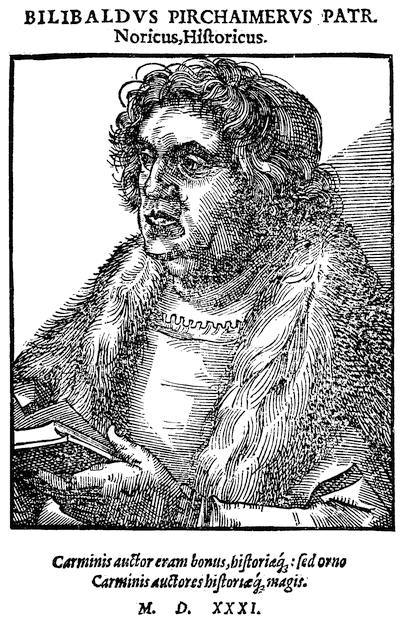
PIRCKEYMERUS.
Fac-simile of a cut in Reusner’s Icones, Strasburg, 1590, p. 42. This well-known cosmographical student was one of the collaborators of the series of the printed Ptolemies, beginning with that of 1525. There is a well-known print of Pirckeymerus by Albert Dürer, 1524, which is reproduced in the Gazette des Beaux-Arts, xix. 114. Cf. Friedrich Campe’s Zum Andenken Wilibald Pirkheimers, Mitglieds des Raths zu Nürnberg (Nürnberg, 58 pp., with portrait), and Wilibald Pirkheimer’s Aufenthalt zu Neunhof, von ihm selbst geschildert; nebst Beiträgen zu dem Leben und dem Nachlasse seiner Schwestern und Töchter, von Moritz Maximilian Meyer (Nürnberg, 1828).
A similar view is supposed to have been presented in the map which Bartholomew Columbus took to England in 1488;[398] but we have no trace of the chart itself.[399]
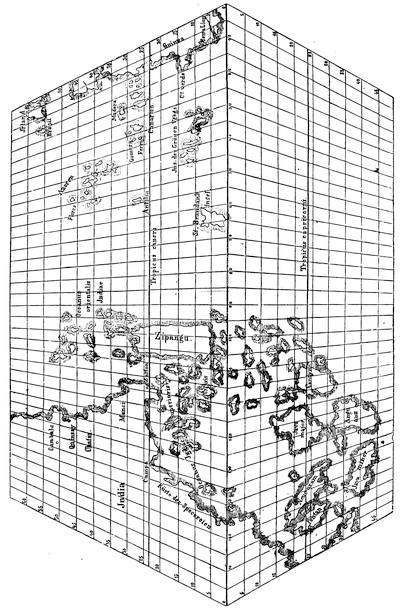
TOSCANELLI’S MAP.
This is a restoration of the map as given in Das Ausland, 1867, p. 5. The language of the original was doubtless Latin. Another restoration is given in St. Martin’s Atlas, pl. ix.
It has always been supposed that in the well-known globe of Martin Behaim we get in the main an expression of the views held by Toscanelli, Columbus, and other of Behaim’s contemporaries, who espoused the notion of India lying over against Europe.
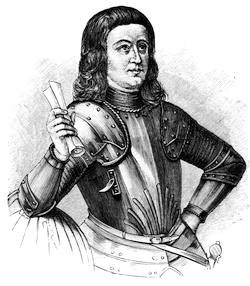
MARTIN BEHAIM.
This cut follows the engravings in Ghillany’s Behaim, and in Ruge’s Geschichte des Zeitalters der Entdeckungen, p. 105.
Eratosthenes, accepting the spherical theory, had advanced the identical notion which nearly seventeen hundred years later impelled Columbus to his voyage. He held the known world to span one third of the circuit of the globe, as Strabo did at a later day, leaving an unknown two thirds of sea; and “if it were not that the vast extent of the Atlantic Sea rendered it impossible, one might even sail from the coast of Spain to that of India along the same parallel.”[400]
Behaim had spent much of his life in Lisbon and the Azores, and was a friend of Columbus. He had visited Nuremberg, probably on some family matters arising out of the death of his mother in 1487. While in this his native town, he gratified some of his townspeople by embodying in a globe the geographical views which prevailed in the maritime countries; and the globe was finished before Columbus had yet accomplished his voyage. The next year (1493) Behaim returned to Portugal; and after having been sent to the Low Countries on a diplomatic mission, he was captured by English cruisers and carried to England. Escaping finally, and reaching the Continent, he passes from our view in 1494, and is scarcely heard of again.
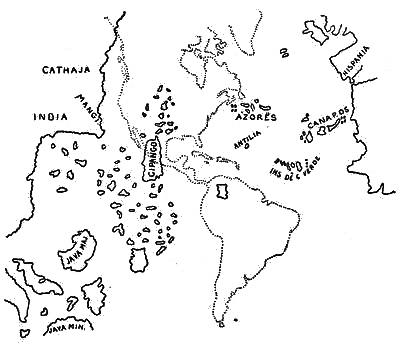
SECTION OF BEHAIM’S GLOBE.
This globe is made of papier-maché, covered with gypsum, and over this a parchment surface received the drawing; it is twenty inches in diameter. It having fallen into decay, the Behaim family in Nuremberg caused it to be repaired in 1825. In 1847 a copy was made of it for the Dépôt Géographique (National Library) at Paris; the original is now in the city hall at Nuremberg. The earliest known engraving of it is in J. G. Doppelmayr’s Historische Nachricht von den nürnbergischen Mathematikern und Künstlern (1730), which preserved some names that have since become illegible (Stevens, Historical Collection, vol. i. no. 1,396). Other representations are given in Jomard’s Monuments de la géographie; Ghillany’s Martin Behaim (1853) and his Erdglobus des Behaim und der des Schöner (1842); C. G. von Murr’s Diplomatische Geschichte des Ritters Behaim (1778, and later editions and translations); Cladera’s Investigaciones (1794); Amoretti’s translation of Pigafetta’s Voyage de Magellan (Paris, 1801); Lelewel’s Moyen-âge (pl. 40; also see vol. ii. p. 131, and Epilogue, p. 184); Saint-Martin’s Atlas; Santarem’s Atlas, pl. 61; the Journal of the Royal Geographical Society, vol. xviii.; Kohl’s Discovery of Maine; Irving’s Columbus (some editions); Gay’s Popular History of the United States, i. 103; Barnes’ Popular History of the United States; Harpers’ Monthly, vol. xlii.; H. H. Bancroft’s Central America, i. 93. Ruge, in his Geschichte des Zeitalters der Entdeckungen, p. 230, reproduces the colored fac-simile in Ghillany, and shows additionally upon it the outline of America in its proper place. The sketch in the text follows this representation. Cf. papers on Behaim and his globe (besides those accompanying the engravings above indicated) in the Journal of the American Geographical Society (1872), iv. 432, by the Rev. Mytton Maury; in the publications of the Maryland Historical Society by Robert Dodge and John G. Morris; in the Jahresbericht des Vereins für Erdkunde (Dresden, 1866), p. 59. Peschel, in his Zeitalter der Entdeckungen (1858), p. 90, and in the new edition edited by Ruge, has a lower opinion of Behaim than is usually taken.
Of Columbus’ maps it is probable that nothing has come down to us from his own hand.[401] Humboldt would fain believe that the group of islands studding a gulf which appears on a coat-of-arms granted Columbus in May, 1493, has some interest as the earliest of all cartographical records of the New World; but the early drawings of the arms are by no means constant in the kind of grouping which is given to these islands.[402] Queen Isabella, writing to the Admiral, Sept. 5, 1493, asks to see the marine chart which he had made; and Columbus sent such a map with a letter.[403] We have various other references to copies of this or similar charts of Columbus. Ojeda used such a one in following Columbus’ route,[404] as he testified in the famous suit against the heirs of Columbus. Bernardo de Ibarra, in the same cause, said that he had seen the Admiral’s chart, and that he had heard of copies of it being used by Ojeda, and by some others.[405] It is known that about 1498 Columbus gave one of his charts to the Pope, and one to René of Lorraine. Angelo Trivigiano, secretary of the Venetian Ambassador to Spain, in a letter dated Aug. 21, 1501, addressed to Dominico Malipiero, speaks of a map of the new discoveries which Columbus had.[406]
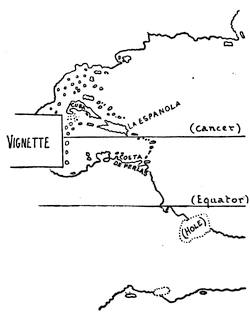
LA COSA, 1500.
Three or four maps at least have come down to us which are supposed to represent in some way one or several of these drafts by Columbus. The first of these is the celebrated map of the pilot Juan de la Cosa,[407] dated in 1500, of which some account, with a heliotype fac-simile of the American part of the map, is given in another place.[408] After the death (April 27, 1852) of Walckenaer (who had bought it at a moderate cost of an ignorant dealer in second-hand articles), it was sold at public auction in Paris in the spring of 1853, when Jomard failed to secure it for the Imperial Library in Paris, and it went to Spain, where, in the naval museum at Madrid, it now is.
Of the next earliest of the American maps the story has recently been told with great fulness by Harrisse in his Les Cortereal, accompanied by a large colored fac-simile of the map itself, executed by Pilinski. The map was not unknown before,[409] and Harrisse had earlier described it in his Cabots.[410]
We know that Gaspar Cortereal[411] had already before 1500 made some explorations, during which he had discovered a mainland and some islands, but at what precise date it is impossible to determine;[412] nor can we decide upon the course he had taken, but it seems likely it was a westerly one. We know also that in this same year (1500) he made his historic voyage to the Newfoundland region,[413] coasting the neighboring shores, probably, in September and October. Then followed a second expedition from January to October of the next year (1501),—the one of which we have the account in the Paesi novamente retrovati, as furnished by Pasqualigo.[414] There was at this time in Lisbon one Alberto Cantino, a correspondent—with precisely what quality we know not—of Hercule d’Este, Duke of Ferrara; and to this noble personage Cantino, on the 19th of October, addressed a letter embodying what he had seen and learned of the newly returned companions of Gaspar Cortereal.[415]
The Report of Cantino instigated the Duke to ask his correspondent to procure for him a map of these explorations. Cantino procured one to be made; and inscribing it, “Carta da navigar per le Isole novamte tr.... in le parte de l’India: dono Alberto Cantino Al S. Duca Hercole,” he took it to Italy, and delivered it by another hand to the Duke at Ferrara. Here in the family archives it was preserved till 1592, when the reigning Duke retired to Modena, his library following him. In 1868, in accordance with an agreement between the Italian Government and the Archduke Francis of Austria, the cartographical monuments of the ducal collection were transferred to the Biblioteca Estense, where this precious map now is. The map was accompanied when it left Cantino’s hands by a note addressed to the Duke and dated at Rome, Nov. 19, 1502,[416] which fortunately for us fixes very nearly the period of the construction of the map. A much reduced sketch is annexed.
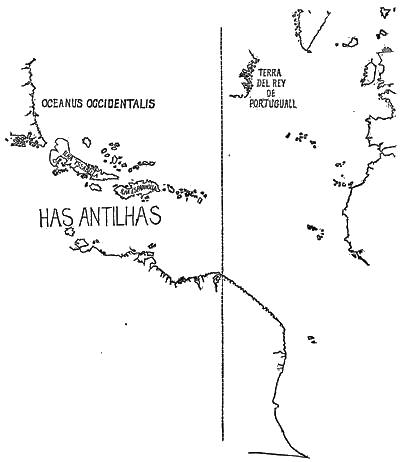
THE CANTINO MAP.
This is sketched from Harrisse’s fac-simile, which is of the size of the original map. The dotted line is the Line of Demarcation,—“Este he omarco dantre castella y Portuguall,”—which has been calculated by Harrisse to be at 62° 30´ west of Paris.
For the northern coast of South America La Cosa and Cantino’s draughtsmen seem to have had different authorities. La Cosa attaches forty-five names to that coast: Cantino only twenty-nine; and only three of them are common to the two.[417] Harrisse argues from the failure of the La Cosa map to give certain intelligence of the Atlantic coast of the United States (here represented in the north and south trend of shore, north of Cuba), that there was existing in October, 1500, at least in Spanish circles, no knowledge of it,[418] but that explorations must have taken place before the summer of 1502 which afforded the knowledge embodied in this Cantino map. This coast was not visited, so far as is positively known, by any Spanish expedition previous to 1502. Besides the eight Spanish voyages of this period (not counting the problematical one of Vespucius) of which we have documentary proof, there were doubtless others of which we have intimations; but we know nothing of their discoveries, except so far as those before 1500 may be embodied in La Cosa’s chart.[419] The researches of Harrisse have failed to discover in Portugal any positive trace of voyages made from that kingdom in 1501, or thereabout, records of which have been left in the Cantino map. Humboldt had intimated that in Lisbon at that time there was a knowledge of the connection of the Antilles with the northern discoveries of Cortereal by an intervening coast; but Harrisse doubts if Humboldt’s authority—which seems to have been a letter of Pasqualigo sent to Venice, dated Oct. 18, 1501, found in the Diarii of Marino Sanuto, a manuscript preserved in Vienna—means anything more than a conjectural belief in such connection. Harrisse’s conclusion is that between the close of 1500 and the summer of 1502, some navigators, of whose names and nation we are ignorant, but who were probably Spanish, explored the coast of the present United States from Pensacola to the Hudson. This Atlantic coast of Cantino terminates at about 59° north latitude, running nearly north and south from the Cape of Florida to that elevation. Away to the east in mid-ocean, and placed so far easterly as doubtless to appear on the Portuguese side of the Line of Demarcation, and covering from about fifty to fifty-nine degrees of latitude, is a large island which stands for the discoveries of Cortereal, “Terra del Rey du Portuguall;” and northeast of this is the point of Greenland apparently, with Iceland very nearly in its proper place.[420] This Cantino map, now positively fixed in 1502, establishes the earliest instance of a kind of delineation of North America which prevailed for some time. Students of this early cartography have long supposed this geographical idea to date from about this time, and have traced back the origin of what is known as “The Admiral’s Map”[421] to data accumulated in the earliest years of the sixteenth century. Indeed Lelewel,[422] thirty years ago, made up what he called a Portuguese chart of 1501-1504, by combining in one draft the maps of the 1513 Ptolemy, with a hint or two from the Sylvanus map of 1511, acting on the belief that the Portuguese were the real first pursuers, or at least recorders, of explorations of the Floridian peninsula and of the coast northerly.[423]