Chapter V · (continued 2)
Reading edition

CRITICAL ESSAY ON THE SOURCES OF INFORMATION.
THE subject of this chapter is so nearly exclusively concerned with the personal history, the agency, and the missionary work of Las Casas, both in the New World and at the Court of Spain, that we are rather to welcome than to regret the fact that he is almost our sole authority for the statements and incidents with which we have had to deal.
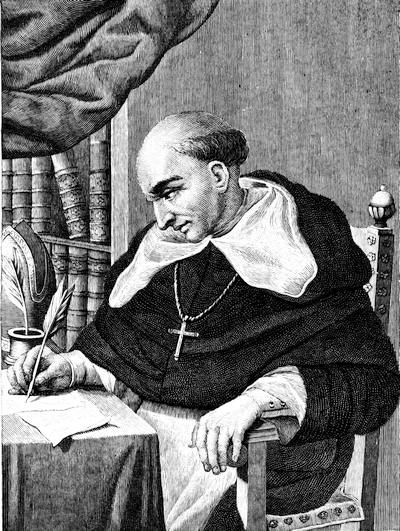
LAS CASAS.
Giving due allowance to what has already been sufficiently recognized as his intensity of spirit, his wildness of imagination, and his enormous overstatement in his enumeration of the victims of Spanish cruelty, he must be regarded as the best authority we could have for the use which he serves to us.[1024] Free as he was from all selfish and sinister motives, even the daring assurance with which he speaks out before the monarch and his councillors, and prints on his titlepages the round numbers of these victims, prompts us to give full credit to his testimony on other matters, even if we substitute thousands in place of millions. As to the forms and aggravations of the cruel methods in which the Spaniards dealt with the natives, the recklessness and ingenuity of the work of depopulation,—which was as naturally the consequence of the enslaving of the Indians as of their indiscriminate slaughter,—Las Casas’ revelations seem to have passed unchallenged by even his most virulent enemies.
Sepulveda may be received by us as the representative alike in spirit and in argument of the opposition to Las Casas. He was an acute and able disputant, and would readily have availed himself of any weak points in the positions of the apostle. It is observable that, instead of assailing even the vehement and exaggerated charges alleged by Las Casas against the Spanish marauders for their cruelty, he rather spends his force upon the maintenance of the abstract rights of Christian champions over the heathen and their territory. The Papal and the Royal prerogatives were, in his view, of such supreme and sweeping account in the controversy, as to cover all the incidental consequences of establishing them. He seemed to argue that heathens and heathenism invited and justified conquest by any method, however ruthless; that the rights of the Papacy and of Christian monarchs would be perilled by allowing any regards of sentiment or humanity to stand in the way of their assertion; and that even the sacred duty of conversion was to be deferred till war and tyranny had obtained the absolute mastery over the natives.
The eight years spent by Las Casas in retirement in the Dominican convent at San Domingo were used by him in study and meditation. His writings prove, in their references and quotations from the classics, as well as from Scripture, that his range was wide, and that his mind was invigorated by this training.
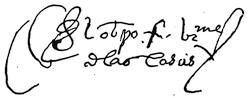
AUTOGRAPH OF LAS CASAS.
In 1552-1553, at Seville, Las Casas printed a series of nine tracts, which are the principal source of our information in relation to his allegations against the Spanish oppressors of the Indians. It is only necessary to refer the reader to the bibliographies[1025] for the full titles of these tracts, of which we simply quote enough for their identification, while we cite them in the order in which they seem to have been composed, following in this the extensive Note which Field has given in his Indian Bibliography:—
1. Breuissima relacion de la destruycion de las Indias ... año 1552; 50 unnumbered leaves.
The series of tracts is usually cited by this title, which is that of the first tract,[1026] for there is no general printed designation of the collection. Four folios appended to this, but always reckoned as a distinct tract, are called,—
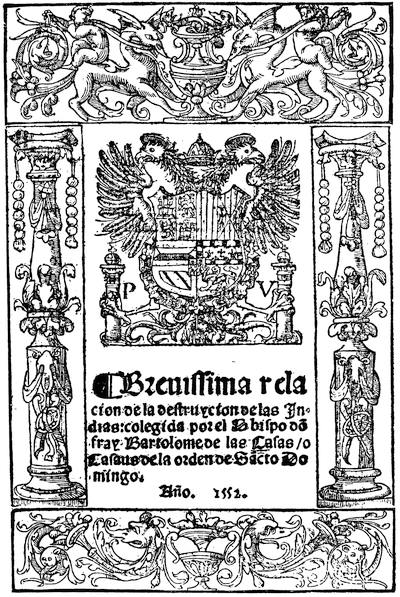
TITLE OF FIRST TRACT.
2. Lo que se sigue es vn pedaço de vna carta, etc. It records the observations of a Spanish traveller upon the enormities practised on the natives.[1027]
3. Entre los remedios ... para reformaciō de las Indias; 1552; 53 unnumbered leaves. It gives the eighth of the proposed remedies, assigning twenty reasons against the enslaving of the natives.[1028]
4. Aqui se cōtienē vnos auisos y reglas para los confessores, etc; 1552; 16 unnumbered leaves. It gives the rules for the confessors of his bishopric of Chiapa to deny the offices of the Church to such as held repartimientos.[1029]
5. Aqui se contiene vna disputa ... entre el obispo ... y el doctor Gines de Sepulveda; 1552; 61 unnumbered leaves. This strong enunciation of Las Casas’ convictions grew out of his controversy with Sepulveda.[1030] It contains, first, a summary by Domingo de Soto of the differences between the two disputants; second, the arguments of Sepulveda; and third, the replies of Las Casas,—twelve in all.
6. Este es vn tratado ... sobre la materia de los Yndios, que se han hecho en ellas esclauos; 1552; 36 unnumbered leaves. This contains reasons and judicial authorities on the question of the restitution of the natives to freedom.[1031]
7. Aqui se cōtienē treynta proposiciones ...; 1552; 10 leaves. These are the Propositions, mentioned on a preceding page, as Las Casas’ reply to those who objected to the rigor of his rules for his confessors.[1032]
8. Principia quedā ex quibus procedendum, etc; 1552; 10 leaves. This gives the principles on which he conducts his defence of the rights of the natives.[1033]
9. Tratado cōprobatorio del imperio soberano, etc.; 80 unnumbered leaves. The title-date is 1552, but that in the colophon is 1553. The purpose is “to prove the sovereign empire and universal dominion by which the kings of Castile and Leon hold the West Indies.”[1034]
Complete sets of these tracts have become very rare, though it is not uncommon to find, in current catalogues, single copies of some of those less scarce.[1035]
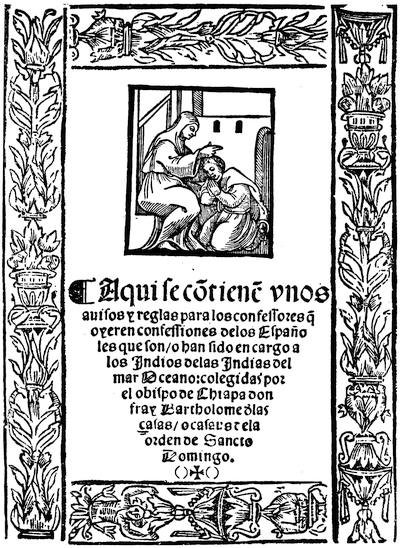
TITLE OF THE FOURTH TRACT.
[From the copy in Harvard College Library.—Ed.]
In 1571, five years after Las Casas’ death, what is sometimes called a tenth part was printed at Frankfort, under the title of Explicatio questionis utrum Reges vel Principes jure aliquo.... Cives ac subditos a regia corona alienare? This further showing of the arguments of Las Casas is even rarer than its predecessors.[1036] Its authorship, without much reason, has been sometimes denied.[1037] It is translated, however, in Llorente’s edition, as is also a letter of Las Casas which he wrote in 1555 to the Archbishop of Toledo, protesting against the contemplated sale of Encomiendas in perpetuity, which, being communicated to the King, led to the prohibition of the plan.
In 1854 Henry Stevens printed, in a style corresponding to that of the tracts of 1552, a series of six papers from original manuscripts in his possession, interesting as contributions to the history of Las Casas and his work;[1038] and there is also a letter of Las Casas in the volume a few years since printed by the Spanish Government as Cartas de Indias. There is an enumeration of thirteen other treatises, noted as still in manuscript, which is to be found in Sabin’s Dictionary or in his separate Works of Las Casas; but Mr. Field is inclined for one reason or another to reduce the number to five, in addition to the two which were published by Llorente.[1039] There are also two manuscripts recorded in the Carter-Brown Catalogue.[1040]
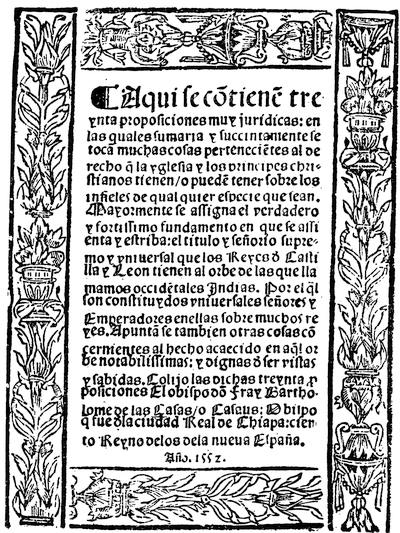
TITLE OF THE SEVENTH TRACT.
[From a copy in the Harvard College Library.—Ed.]
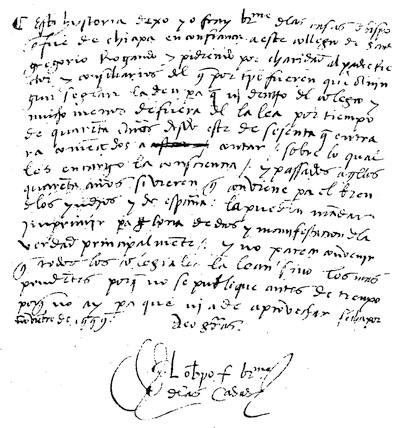
LAS CASAS’ INDORSEMENT ON THE MANUSCRIPT OF HIS “HISTORIA”.
[This is slightly reduced from the fac-simile given in vol. iii. of the 1875 (Madrid) edition of the Historia.—Ed.]
The most labored of Las Casas’ books was his Historia de las Indias,—the original manuscript of which is still preserved, according to Helps, in the library of the Academy of History at Madrid.[1041] Las Casas began this work while in his convent in 1527,[1042] and seems to have worked upon it, without finishing it, up to 1561. It has all the fervor and vigor of his nature; and so far as it is the result of his own observation, its character is unimpeachable. It is in large part, as Helps has remarked, autobiographic; but it does not bring the story down later than 1520. Its style is characteristically rambling and awkward, and more or less confused with extraneous learning, the result of his convent studies, and interjected with his usual bursts of a somewhat tiresome indignation. Outside of his own knowledge he had large resources in documents, of which we have no present knowledge. He seems to have had a prescience of the feelings in his countrymen which would long keep the manuscript from the printing-office, for he left instructions at his death that no one should use it for forty years. The injunction did not prevent Herrera having access to it; and when this latter historian published his book in 1601, the world got a large part of Las Casas’ work,—much of it copied by Herrera verbatim,—but extracted in such a way that Las Casas could have none of his proper effect in ameliorating the condition of the Indians and exposing the cruelty of their oppression. In this way Las Casas remained too long eclipsed, as Irving says, by his copyist. Notwithstanding the publication of the book was prohibited, various manuscript copies got abroad, and every reputable historian of the Spanish rule has made use of Las Casas’ labors.[1043] Finally, the Royal Academy of History at Madrid undertook the revision of the manuscript; but that body was deterred from putting their revision on the press by the sentiments, which Spanish scholars had always felt, adverse to making public so intense an arraignment of their countrymen.[1044] At last, however, in 1875-1876, the Academy finally printed it in five volumes.[1045] The Historia was of course not included, nor were two of the tracts of the issues of 1552 (nos. 4 and 8) embraced, in the edition of Las Casas’ Obras which Llorente issued in Paris in 1822 in the original Spanish, and also in the same year in a French translation, Œuvres de Las Casas.[1046] This work is dedicated “Au modèle des virtues héréditaires, A. M. le Comte de las Casas.” Sufficient recognition has been made in the preceding narrative of this work of Llorente. As a Spaniard by birth, and a scholar well read in the historical literature of his own country, as one trained and exercised in the priestly office, though he had become more or less of a heretic, and as a most ardent admirer of the virtues and the heroic services of the great Apostle to the Indians, he had the attainments, qualifications, and motives for discharging with ability and fidelity the biographical and editorial task which he undertook. It is evident from his pages that he devoted conscientious labor in investigation, and a purpose of strict impartiality to its discharge. He is not an undiscriminating eulogist of Las Casas, but he penetrates with a true sympathetic admiration to the noble unselfishness and the sublime constancy of this sole champion of righteousness against powerful forces of iniquity.
The number of versions of all or of part of the series of the 1552 tracts into other languages strikingly indicates the interest which they created and the effect which they produced throughout Europe. None of the nations showed more eagerness to make public these accusations against the Spaniards by one of their own number, than the Flemings and Dutch. The earliest of all the translations, and one of the rarest of these publications, is the version of the first tract, with parts of others, which appeared in the dialect of Brabant, in 1578,—the precursor of a long series of such testimonies, used to incite the Netherlanders against the Spanish rule.[1047] The French came next with their Tyrannies et cruautéz des Espagnols, published at Antwerp in 1579, in which the translator, Jacques de Miggrode, softened the horrors of the story with a due regard for his Spanish neighbors.[1048] A somewhat bolder venture was a new version, not from the originals, but from the Dutch translation, and set out with all the horrors of De Bry’s seventeen engravings, which was supplied to the French market with an Amsterdam imprint in 1620. It is a distorted patchwork of parts of the three of the 1552 tracts. In a brief preface, the translator says that the part relating to the Indies is derived from the original, printed at Seville by Sebastian Trugillo in 1552, the writer “being Las Casas, who seems to be a holy man and a Catholic.” There were still other French versions, printed both in France and in Holland. The earliest English translation is a version signed by M. M. S., entitled The Spanish Colonie, or Briefe Chronicle of the Acts and Gestes of the Spaniardes in the West Indies, called the Newe Worlde, for the Space of XL. Yeeres, issued in London in 1583.[1049] The best-known of the English versions is The Tears of the Indians, “made English by J. P.,” and printed in London in 1656.[1050] “J. P.” is John Phillips, a nephew of John Milton. His little book, which contains a terse translation of Las Casas’s “Cruelty,” etc., without his controversy with Sepulveda, is dedicated to Oliver Cromwell. It is prefaced by a glowing appeal “To all true Englishmen,” which rehearses the proud position they hold in history for religion, liberty, and human rights, and denounces the Spaniards as “a Proud, Deceitful, Cruel, and Treacherous Nation, whose chiefest Aim hath been the Conquest of this Land,” etc., closing with a call upon them to aid the Protector in the threatened contest for the West Indies.
While Phillips places the number of the slaughtered Indians at twenty millions, these are reckoned at forty millions by the editor of another English version, based upon the French Tyrannies et cruautéz, which was printed at London, in 1699, as A Relation of the First Voyages and Discoveries made by the Spaniards in America.[1051] The earliest German edition appeared, in 1597, as Newe Welt: warhafftige Anzeigung der Hispanier grewlichen ... Tyranney.[1052] The Latin edition appeared at Frankfort, in 1598, as Narratio regionum Indicarvm per Hispanos qvosdam deuastatarum verissima.[1053] This Latin translation has a brief introduction, mainly a quotation from Lipsius, commenting on these atrocities. The version is spirited and faithful, covering the narrative of Las Casas and his discussion with Sepulveda. The engravings by De Bry are ghastly and revolting, and present all too faithfully the shocking enormities related in the text. It is a fearful parody of deception and truth which introduces a hooded friar as holding a crucifix before the eyes of one under torment by fire or mutilation. We can scarcely regret that the circumstances under which the indiscriminate slaughter was waged but rarely allowed of this desecration of a sacred symbol. The artist has overdrawn his subjects in delineating heaps of richly wrought and chased vessels as brought by the hounded victims to appease their tormentors.
To close this list of translations, it is only necessary to refer to the sundry ways in which Las Casas was helped to create an influence in Italy, the Italian text in these publications usually accompanying the Spanish.[1054]

EDITORIAL NOTE.
THE most important distinctive lives of Las Casas are those of Llorente, prefixed to his edition of Las Casas’ Œuvres; that which Quintana (born, 1772; died, 1857) gives in his Vidas de Españoles célebres, vol. iii., published at Madrid in 1833, and reprinted, with Quintana’s Obras, in the Biblioteca de autores Españoles in 1852; and the Vida y escritos de Las Casas of A. M. Fabié, published at Madrid in 1879, in two volumes, with a large number of unpublished documents, making vols. 70 and 71 of the Documentos inéditos (España). The life which was constructed mainly by the son of Arthur Helps out of The Spanish Conquest in America by the father, is the most considerable account in English. The larger work was written in a spirit readily appreciative of the character of Las Casas, and he is made such a centre of interest in it as easily to favor the excision of parts of it to form the lesser book. This was hardly possible with the broader connections established between Las Casas and his times which accompany the portrayal of his career in the works of Prescott and H. H. Bancroft. The great friend of the Indian is mainly, however, to be drawn from his own writings.
Las Casas was by no means alone in his advocacy of the rights of the natives, as Harrisse (Bibl. Am. Vet. Add., p. 119) has pointed out; naming Julian Garces, Francis of Vittoria, Diego de Avendaño, Alonzo de Noreña, and even Queen Isabel herself, as evinced by her will (in Dormer, Discursos varios, p. 381). The fame of Las Casas was steadfastly upheld by Remesal in his Historia de Chyapa, etc., 1619 (cf. Bancroft, Central America, ii. 339); and the great apostle found a successor in his labors in Juan de Palafox y Mendoça, whose appeal to the King, printed about 1650, and called Virtudes del Indio, é naturaleza y costumbres de los Indios de Nueva España, has become very rare. (Cf. Carter-Brown, vol. ii. no. 691.) Brasseur de Bourbourg, in the fourth volume of his Nations civilisées du Mexique, set forth in all their enormity the barbarities of the Spanish conquerors; but he seeks to avoid all imputations of exaggeration by shunning the evidence drawn from Las Casas.
The opponents of Las Casas—who became in due time the best-hated man in the Spanish colonies—were neither few nor powerless, as the thwarting of Las Casas’ plans constantly showed. The Fray Toribio Motolinia took issue with Las Casas, and Ramirez, in his Life of Motolinia contained in Icazbalceta’s Coleccion, undertakes to show (p. lvii) the difference between them. Cf. B. Smith’s Coleccion, p. 67.
The most conspicuous of his fellow-observers, who reached conclusions constantly quite at variance with Las Casas, was Gonzalo Fernandez de Oviedo y Valdes,—to give his full name, though Oviedo is the one by which he is usually cited. Oviedo was but a few years younger than Las Casas. He had seen Columbus’ triumph at Barcelona, and had come to America with Pedrarias ten years after Las Casas, and spent thirty-four of the next forty years in the New World, holding part of the time the office of inspector of the gold-smeltings at Darien, and latterly living at Hispaniola. He is thought to have begun his historical studies as early as 1520, and he published his first book, usually called the Sumario, in 1526, on his return from his second voyage. It is a description of the West Indies and its natives. Returning to Spain in 1530, he was after a while made the official chronicler of the Indies, and in 1535 began the publication of his great Historia de las Indias. On this chief labor Ticknor (Spanish Literature, ii. 33) traces him at work certainly as late as 1548, and he may have added to it down to 1555. He had the royal direction to demand of the various governors whatever document and aid he might need as he went on. Ticknor calls him the first authorized chronicler of the New World,—“an office,” he adds, “which was at one time better paid than any other similar office in the kingdom, and was held at different times by Herrera, Tamayo, Solis, and other writers of distinction, and ceased (he believed) with the creation of the Academy of History.” Oviedo was a correspondent of Ramusio, and found the acquaintance helpful. He knew Cortes, and exchanged letters with him. Ticknor, after speaking of the scope of the Historia as taxing the powers of Oviedo beyond their strength, still accounts the work of great value as a vast repository of facts, and not wholly without merit as a composition.
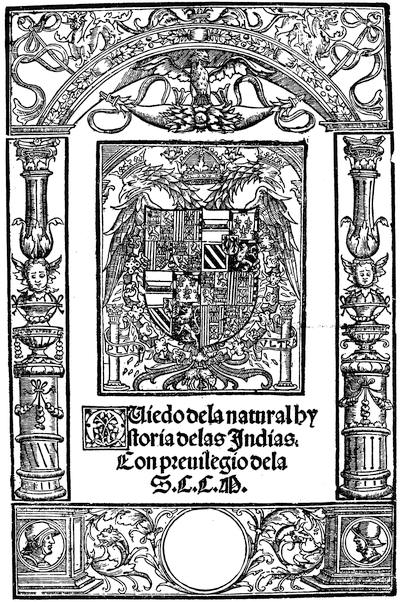
TITLE OF OVIEDO, 1526, REDUCED.
In the estimates commonly made of Oviedo there is allowed him but scant scholarship, little power of discrimination,—as shown in his giving at times as much weight to hearsay evidence as to established testimony,—a curious and shrewd insight, which sometimes, with his industry, leads him to a better balance of authorities than might be expected from his deficient judgment. His resources of material were uncommon; but his use of them is generally tedious, with a tendency to wander from his theme. Ternaux sees in him the prejudices of his times,—and these were not certainly very friendly to the natives. Las Casas could no more endure him than he could bear with the average conquistador. The bishop charges the historian with constantly bearing false witness against the Indians, and with lying on every page. Oviedo died at Valladolid in 1557. (Cf. Prescott’s Mexico, ii. 283; Irving’s Columbus, App. xxviii.; H. H. Bancroft, Chroniclers, p. 20, and Central America, i. 309, 463-467.)
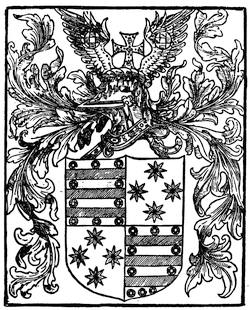
ARMS OF OVIEDO.
Reduced from the cut at the end of the edition of Oviedo, 1535.
The bibliography of Oviedo deserves to be traced. His initial publication, De la natural hystoria de las Indias, was printed at Toledo in 1526,—not in 1525, as the Real Academia says in their reprint, nor 1528, as Ticknor gives it. It is often cited as Oviedo’s Sumario, since that is the first word of the secondary title. (Cf. Sabin, Dictionary, vol. xiv. no. 57,987; Harrisse, Notes on Columbus, p. 12; and Bibl. Amer. Vet., no. 139; Ternaux, no. 35; Rich, 1832, no. 6, £12 12s.; Carter-Brown, i. 89.) There are also copies in the Library of Congress and Harvard College. The Spanish text is included in Barcia’s Historiadores primitivos and in Vedia’s Hist. prim. de Indias, 1858, vol. i. It is in large part translated into English in Eden’s Decades of the New World, 1555 (chap. 18), and this version is condensed in Purchas’s Pilgrimes, iv. 5. There is an Italian version in Ramusio’s Viaggi, iii. 44.
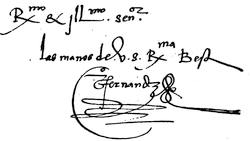
The publication of Oviedo’s great work, which is quite different from the 1526 book, was begun at Seville, in 1535, under the title of Historia general de las Indias. In this he gave the first nineteen books, and ten chapters of book 20. At the end is a carta missiva, to which the author usually attached his own signature, and that annexed is taken (slightly reduced) from the copy in Harvard College Library. (Cf. Sabin, vol. xiv. no. 57,988; Harrisse, Bibl. Am. Vet., no. 207; Murphy, nos. 1886-87; Carter-Brown, i. 114, with fac-simile of title.) Ramusio translated these nineteen books. In 1547, what purports to be a summary, but is in fact a version, of Xeres by Jacques Gohory, appeared in Paris as L’histoire de la terre neuve du Péru en l’Inde occidentale. (Cf. Bib. Am. Vet., no. 264; Ternaux, no. 52; Sabin, vol. xiv. no. 57,994.)
In 1547 a new edition of the Spanish, somewhat increased, appeared at Salamanca as Coronica de las Indias; la hystoria general de las Indias agora nueuamente impressa, corregida, y emendada. Sometimes it is found in the same cover with the Peru of Xeres, and then the title varies a little. The book is rare and costly. Rich, in 1832 (no. 17), priced it at £10 10s.; it has been sold recently at the Sunderland sale for £61, and in the library of an old admiral (1883, no. 340) for £40; Quaritch has priced it at £63, and Maisonneuve (Leclerc, no. 432), at 1,000 francs. There is a copy in Harvard College Library. (Cf. Sabin, vol. xiv. no. 57,989; Carter-Brown, i. 145; Bibl. Am. Vet., no. 278; Additions, no. 163; and Murphy, no. 1885.)

A full French translation of ten books, made by Jean Poleur, appeared in Paris under the title of Histoire naturelle et généralle des Indes, without the translator’s name in 1555, and with it in 1556. (Cf. Sabin, vol. xiv. no. 57,992-93; Ternaux, no. 47; Carter-Brown, i. 214; Beckford, iii. 342; Murphy, no. 1884; Leclerc, no. 434, 130 francs, and no. 2,888, 350 francs; Quaritch, no. 12,313, £7 10s.) There is a copy in Harvard College Library.
The twentieth book, Libro xx de la segunda parte de la general historia de las Indias appeared for the first time and separately at Valladolid in 1557; the death of the author while his book was in press prevented the continuance of its publication. (Cf. Rich, 1832, no. 34, £6 6s.; Sabin, vol. xiv. no. 57,991; Carter-Brown, i. 219.)
The fate of the remaining parts of the manuscript was for a while uncertain. Rich, in 1832, said that books xxi. to xxviii., which were in the printer’s hands at Oviedo’s death, were not recovered, while he knew of manuscript copies of books xxix. to xlviii. in several collections. Irving says he found a copy of the unprinted parts in the Colombina Library at Seville. Harrisse (Notes on Columbus and Bibl. Am. Vet., no. 207) says the manuscript was scattered, but was brought together again after some vicissitudes. Another statement places it in the Casa de la Contratacion after Oviedo’s death; whence it was transferred to the Convent of Monserrat. Meanwhile sundry manuscript copies were taken. (Cf. Notes on Columbus, p. 17.) In 1775 the publication of it was ordered by Government; but it was not till 1851-1855 that the Real Academia de la Historia at Madrid issued the fifty books, complete in four volumes folio, under the editing of José Amador de los Rios, who added to the publication several maps, a bibliography, and the best Life of Oviedo yet written. (Cf. Sabin, vol. xiv. no. 57,990; the set is worth about $20. See further, Brunet, iv. 299; Ternaux, no. 46; Panzer, vii. 124; Stevens, Nuggets, ii. 2,067.) Ternaux had already, in 1840, published in French, as a Histoire de Nicaragua (in his second series, vol. iii.) thirteen chapters of book xlii.
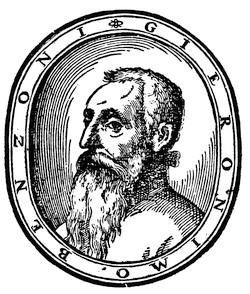
There was an Italian traveller in the Spanish provinces between 1541 and 1556 who, while he thought that Las Casas mistook his vocation in attempting to administer a colony, bears evidence to the atrocities which Las Casas so persistently magnified. This wanderer was a Milanese, Girolamo Benzoni, who at the early age of twenty-two had started on his American travels. He did not altogether succeed in ingratiating himself with the Spaniards whom he encountered, and perhaps his discontent colored somewhat his views. He was not much of a scholar, yielded not a little to credulity, and picked up mere gossip indeed, but of a kind which gives us much light as to the conditions both of the Europeans and natives. (Cf. Field, Indian Bibliography, no. 117; Bancroft, Central America, ii. 232; Admiral Smith’s Introduction to the Hakluyt Society edition.) After his return he prepared and published—prefixing his own likeness, as shown here in fac-simile—the results of his observations in his Historia del Mondo Nuovo, which was issued at Venice in 1565. It became a popular book, and spread through Europe not only in the original Italian, but in French and Latin versions. In Spanish it never became current; for though it so greatly concerns that people, no one of them ventured to give it the help of a translation into their vernacular; and as be had not said much in praise of their American career, it is not altogether strange.
The bibliography of the book merits explanation. It is treated at length in Sabin’s Dictionary, vol. ii. no. 4,791, and in the Studi biog. e bibliog. della Società Geografica Italiana, i. 293 (1882). The original Italian edition, La Historia del Mondo Nuovo, laqual tratta dell’ Isole & Mari nuovamente ritrovati, & delle nuove Citta da lui proprio vedute, per acqua & per terra in quattordeci anni, was published at Venice in 1565. There are copies in Harvard College, Cornell University, and the Carter-Brown libraries. Cf. Rich (1832), no. 43—£1 1s. 0d.; Leclerc (1878), no. 59—120 francs; A. R. Smith (1874), £2 2s. 0d.; Brinley, no. 10; Carter-Brown, i. 253; Huth, i. 132; Field, Indian Bibliography, no. 117; Sparks, no. 240; Stevens (1870), no. 171. A second Italian edition—Nuovamente ristampata... con la giunta d’alcune cose notabile dell’Isole di Canaria—was issued at Venice in 1572. Cf. Rich (1832), no. 49, £1 1s. 0d.; Carter-Brown, i. 289; Stevens, no. 172; Muller (1877), no. 285; Sunderland, no. 1,213; H. C. Murphy, no. 2,838; Huth, i. 132; J. J. Cooke, nos. 219, 220.
The first Latin edition Novæ Novi Orbis Historiæ, translated by Urban Chauveton (who added an account of the French expedition to Florida), was published at Geneva in 1578; followed by a second in 1581; a third in 1586, with Lery’s book on Brazil added; others in 1590 (no place); 1598 and 1600 (Geneva); (Coloniæ Allobrogum), 1612, with three other tracts; and at Hamburg in 1648. Besides these the Latin version appeared in De Bry, parts iv., v., and vi., printed at Frankfort in 1592, 1593, 1594, 1595, and at Oppenheim in 1617. Cf. Carter-Brown, i. 318, 338, 365; ii. 123, 629; Stevens, Nuggets, 2,300; Bibl. Hist., no. 173-174; Muller (1872), nos. 78, 79; (1877), 287; Sunderland, no. 1,214; Cooke, nos. 218, 222; Pinart, no. 97; Huth, i. 132; Field, p. 119. There are copies of the 1578 edition in the Boston Public and Harvard College libraries.
The French editions were issued at Geneva in 1579 and 1589. The notes are different from those of the Latin editions; and there are no notes to book iii., as in the Latin. Cf. Carter-Brown, i. 326; Cooke, no. 221; Court, no. 32.
There are two German versions. The first was by Nicholas Höniger, and was printed at Basle, in 1579, as Der Newenn Weldt. It was reissued, with tracts of Peter Martyr and others, in 1582. The version of Abel Scherdigers was issued at Helmstadt in 1590, 1591, again at Frankfort in 1595, and at Wittenberg in 1606. There were in addition some later imprints, besides those included in De Bry and in Saeghman’s Voyagien. Cf. Rich, no. 61; Carter-Brown, i. 344, 388, ii. 44, 917; Muller (1872), nos. 80, 1880, (1877), 286.
The first Dutch edition appeared at Haarlem in 1610; there was an abridged issue at Amsterdam in 1663. Cf. Tiele, nos. 276, 277; Muller (1872), nos. 81, 82; Carter-Brown, ii. 97.
Purchas gave an abstract in English; but there was no complete English version till Admiral Smith’s was published by the Hakluyt Society in 1857. This has fac-similes of the cuts of the 1572 edition; and De Bry also followed the early cuts.
In 1542 and 1543 Las Casas largely influenced the royal decrees relating to the treatment of the Indians, which were signed by the monarch, Nov. 20, 1542, and June 4, 1543, and printed at Alcala in 1543 as Leyes y Ordenanças. This book stands as the earliest printed ordinances for the New World, and is rare. Rich in 1832 (no. 13) priced it at £21. (Cf. Bib. Am. Vet., no. 247; Carter-Brown, vol. i. no. 130; Sabin, vol. x. p. 320.) There were later editions at Madrid in 1585,[1055] and at Valladolid in 1603. Henry Stevens, in 1878, issued a fac-simile edition made by Harris after a vellum copy in the Grenville Collection, accompanied by a translation, with an historical and bibliographical introduction.
The earliest compilation of general laws for the Indies, entitled Provisiones, cedulas, instrucciones de su Magestad, was printed in Mexico in 1563. This is also very rare; Rich priced it in 1832 at £16 16s. It was the work of Vasco de Puga, and Helps calls it “the earliest summary of Spanish colonial law.” The Carter-Brown copy (Catalogue, i. 242) was sent to England for Mr. Helps’s use, there being no copy in that country, so far as known.
The next collection was Provisiones, cédulas, etc., arranged by Diego de Encinas, and was printed at Madrid in 1596. The work early became scarce, and Rich priced it at £5 5s. in 1832 (no. 81). It is in Harvard College and the Carter-Brown Library (Catalogue, vol. i. no. 502). The bibliography of the general laws, particularly of later collections, is sketched in Bancroft’s Central America, i. 285, and Mexico, iii. 550; and in chap. xxvii. of this same volume the reader will find an examination of the administration and judicial system of the Spaniards in the New World;[1056] and he must go chiefly to Bancroft (Central America, i. 255, 257, 261, 285; Mexico, ii. 130, 516, 563, etc.) and Helps (Spanish Conquest and Life of Las Casas) for aid in tracing the sources of the subject of the legal protection sought to be afforded to the natives, and the attempted regulation of the slavery which they endured. Helps carefully defines the meaning and working of the encomienda system, which gave in effect a property value to the subjection of the natives to the Conquerors. Cf. Spanish Conquest (Am. ed.), iii. 113, 128, 157, 212.