Part 1 — XXIV. GAULIN.
Reading edition
One day there was an India woman who have a daughter, an' when the gal born she born with a gold ring on her finger. An' everybody hear about it but they never see it.
An' Mr. Annancy was very crave to got the gal to be his wife.
An' Annancy study a plan an' take up his bands of music an' go down to the gal yard, an' when him go down they admit Mr. Annancy.
An' when they admit him Annancy beguns to play all different tune just to see if the gal would laugh with him. But the gal was very sad, neither would laugh nor smile, until Annancy see there was no good, an' tell good bye an' go home back.
Annancy when him goes home back, met his friend Mr. Rabbit in the road.
Rabbit ask him:—"Brother Annancy, where you is comin' from?"
An' Annancy begun to tell Rabbit.
So Rabbit make a bargain with Annancy that he is going to try his luck.
So Annancy say:—"As you being such a clean an' white gentleman I think you will succeed. So if you succeed, when you coming home back you must make me know; then you can take me to be your servant."
That time Rabbit didn' know what Annancy study. Annancy mean was to take away the gal from Rabbit.
So Rabbit start to the yard, an' when him go they admit him in.
An' the mumma ask Rabbit what he come about.
Rabbit says he is looking for a courtier.
An' the mumma say to Rabbit:—"Oh, my dear Mr. Rabbit, I am very sorry! You is only but a meat,[44] so I can't give you my daughter."
An' Rabbit spend a little time till he tell goodbye.
Meanwhile Annancy wouldn' go home. Him sit in the road till Rabbit coming home back. An' him ask Rabbit if him succeed.
Rabbit say:—"Oh no!"
So they begin to talk. An' by this time Sea-gaulin was passing an' hear what they are saying.
An' when Gaulin go home back, him 'tudy between himself that, if him only get a bus an' dress himself tidy an' drive to the gal yard, she'll sure be his wife.
An' Sea-gaulin goes down, an' the gal was very glad to see him an' invite him inside the house, an' they begun to arrange to be married.
An' there was a old-witch boy which was brother to the gal whisper to her:—"That one is Gaulin."
An' the gal say:—"Oh no, it is my dear love."
So the boy say to then:—"Never mind, one day you will find out if he is not Mr. Gaulin."
So, when Gaulin tell goodbye an' go home to his yard back, the boy follow him an' go to the river side where Gaulin is fishening, an' he climb a tree which hung over the water.
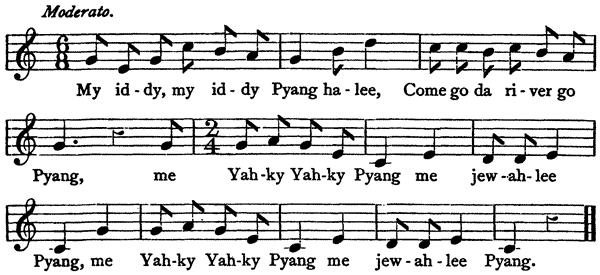
An' when Gaulin come down the river he 'tart a singing:—
[Listen] [XML]
My iddy, my iddy Pyang halee, Come go da river go Pyang, me Yahky Yahky Pyang me jewahlee Pyang, me Yahky Yahky Pyang me jewahlee Pyang.
An' that time Gaulin didn' know that the boy was on the tree hearing him.
When he first sing his hat fall off.
An' he sing again his jacket was off.
That time the boy was seeing every bit.
An' he sing again an' his shirt was off.
Sing an' sing till the trousies drop off.
An' as he done he find himself inside the water begun to fishening.
An' as him put him head under a stone-hole the boy come down off the tree an' find himself back to his yard.
An' next Wednesday when Gaulin come to get married, the boy provide for him to sing that very same tune when they are on the cake table.
An the boy say:—"Ladies and gentlemen will you like to hear a song?"
An' everybody say "Yes."
An' that time the boy was a fiddler, an' he tune up his violin an' beguns to play "My iddy, my iddy Pyang halee."
Gaulin say:—"Oh no, my brother, stop that tune. That same very tune kill my grandfather, an' when you sing it you let me remember my old grandfather."
An' the boy never stop sing an' play till all Gaulin clothes drop off.
An' Gaulin fly out the door mouth an' find himself right up in the air.
An' from that day that's what make Gaulin fly so high.
Jack Mantora me no choose none.
NOTES.
Gaulin, the Egret. In stormy weather the egrets leave the seaside and fly up into the country to fish in the streams. They are especially fond of the small crabs which abound in the mountain rivulets. The words of the song have been spelt so as to convey as nearly as possible their right sound. Halee rhymes in both syllables to the stali of the Venetian gondolier. Jewahlee is Jubilee with a different middle syllable. Pyang with French a made as short as possible is the Egret's cry. It should be accented and brought out strongly.
When him goes home back, as he was going home.
white gentleman. This counts many points in the estimation of the Negro.
Rabbit spend a little time. Most characteristic. After the rebuff one would have expected him to go away at once, but that is not the Negro's way. He is never abashed, and after the curtest refusal of any favour he has come to ask, will sit on and talk of other things, finally taking his leave as if nothing had happened.
bus, the buggies which ply for hire in Kingston are so called.
Wednesday, the favourite day for weddings. The bridegroom is accompanied to church by a godmother, not the baptismal one but another specially appointed for the occasion.[45] They ride to church, which is usually at some distance from the yard. The bride also rides from her yard, accompanied by a godfather and two bridesmaids between the ages of eight and eleven. The ceremony and signing of the register over, the newly-wedded couple mount and gallop to the wife's yard, the rest of the company following more leisurely. Arrived there, the bride proceeds to put on her wedding-clothes and the guests are received by the godfather and given sugar-water and bread. When the bride has donned her satin gown and veil (she was married in her riding-habit) and with much sorrow pinched her feet into white shoes too small for them, the company sit down to the cake table. This has upon it two cakes, two fantastically fashioned loaves of shewbread, triumphs of the baker's art with their doves and true lovers' knots, and three vases of cut flowers. The bread is not eaten then but is distributed (distribbled, as they have it,) to friends on the days following the wedding. One cake is cut. A knife and fork being handed to a bridesmaid she takes off the cake-head, which is a small top tier or addition to the cake proper. This is put aside and afterwards sent to the officiating minister. The godfather then proceeds to the more serious work of cutting up the cake, giving pieces first to the bride and bridegroom and then to the guests. The second cake is left intact. Wine is poured out, and there are speeches and toasts and hymns. Then follows dinner, which is over about five o'clock. They then begin to play Sally Water (see introduction to the Ring tunes) which goes on for an hour or two, and as night falls dancing is started. This goes on all night and does not end, at the earliest, till dusk on the following day, Thursday. It is often kept up until Friday evening or even until Saturday, the dancers and musicians appearing to require no rest. The latter are well supplied with rum and when they get sleepy they beg for an extra tot to rub their eyes, which burns them and keeps them awake. The whole of this time refreshments are supplied to the guests, and as long as these hold out they do not disperse, or as they put it:—"till hungry bite them they no go 'way."
The Sunday after the wedding is 'turn t'anks (return thanks). The married couple and their friends get all the beasts, i.e. horses and mules, they can muster, and ride to church dressed in their best. The bride and bridegroom, attended by the godfather and godmother, sit in "couple bench," the rest of the party going to their own pews. After service the whole cavalcade gallops as hard as it can, regardless of the precipices which skirt all Jamaica mountain paths, up hill and down hill to the husband's yard. There wine is provided, and the second cake is cut and eaten. Dinner follows at three, and then Sally Water is again played until midnight, when dancing recommences and goes on till four or five o'clock on Monday afternoon. This is the end of the festivities, which sometimes cost twenty pounds or more.
[Omitted note]
provide for him, prepared himself.
door mouth includes not only the opening, but also the whole space just outside the door.