Part 4 — APPENDIX.
Reading edition
A. Traces of African Melody in Jamaica.
I have been asked to read through this book in proof, with the object of ascertaining whether the Jamaican songs bear any traces of an African origin.
Unfortunately, it must be confessed at the outset that our knowledge of African music is scantier than that of almost any other kind of primitive music. In other regions of the globe the phonograph has been effectively utilised in acquiring accurate records of songs and dances. These records have been brought back to Europe, where they have been studied at leisure and their peculiarities of interval and rhythm have been precisely determined.
But in the case of African music (apart from a few imperfectly studied records in my own possession) we have to rely entirely on the versions which travellers have taken down for us in the field. We have to assume, in the first place, the correctness of their 'musical ear,' and in the second place, the possibility of expressing in European notation those delicate shades of pitch and time in which the characteristics of primitive music so essentially consist. And both these are unwarrantable assumptions.
However, from our study of comparative music elsewhere, we may make one statement with certainty, namely, that an African music does not exist. There must be almost as many styles of native music in Africa as in Europe—varieties differing not only broadly in general form and structure, but also more minutely in the intervals and rhythms which are employed.
I have been informed by travellers in West Africa that surprising differences occur in the degree of development of musical art even in closely neighbouring regions. In one district hardly any music is to be heard at all; in another the music is most uncouth; in a third it is highly agreeable to the European ear; while some parts of West Africa have advanced to the stage of part-singing.
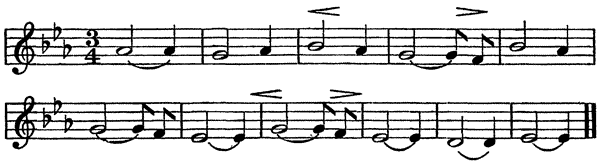
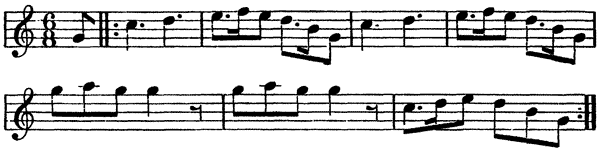
The most erroneous notions have been expressed as to the nature of African music. I have seen it stated that African songs consist in a gradual descent from a higher to a lower pitched note. That this is far from being usually the case is shown in the following specimens, which I have gathered from various narratives of African travel.
I.
Boat Song. Congo District.

[Listen] [XML]
II.
Boat Song. Congo District.

[Listen] [XML]
III.
Song of Bawili Women.

[Listen] [XML]
IV.
Funeral Song. Angola.
[Listen] [XML]
V.
Song. Angola.

[Listen] [XML]
VI.
Song. M. Balunda.

[Listen] [XML]
VII.
Dance-Song. M. Balunda.

[Listen] [XML]
VIII.
Boat Song. Guinea Coast.

[Listen] [XML]
IX.
Song. I. of Bimbia.
[Listen] [XML]
Songs I. and II. from La route du Tchad. Jean Dybowski. Paris. 1893. pp. 198-9.
Songs III.-VII. from Aus West-Afrika. Hermann Soyaux. Leipzig. 1879.
Song VIII. from Einige Notizen über Bonny. Göttingen. 1848.
Song IX. from A Narrative of the Expedition ... to the River Niger. London. 1848.
A great deal might be said about the general character of these songs, e.g. the simplicity and brevity of the phrases, and the fondness for triple measure.
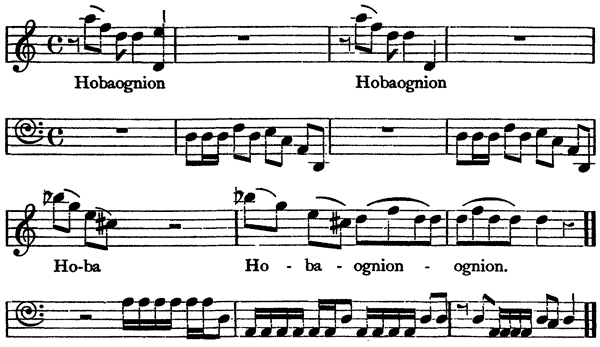
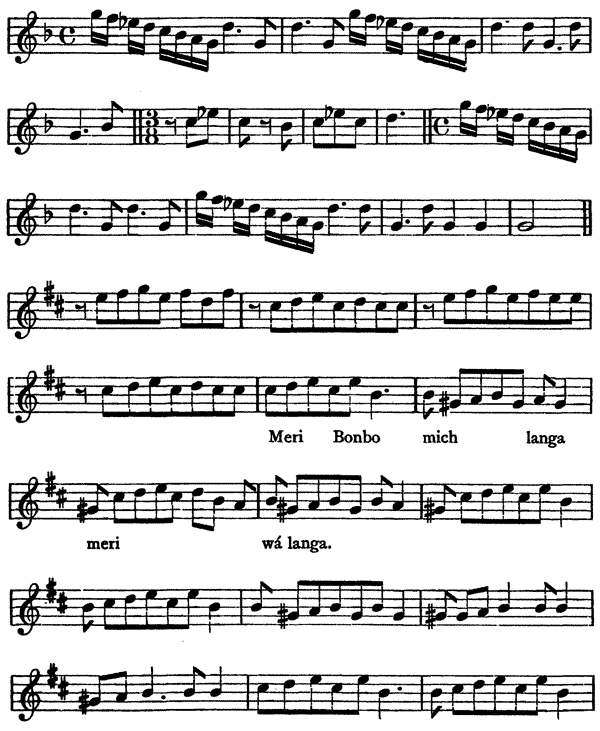
But I pass on to consider three very interesting examples of Jamaican music which, thanks to my friend Mr. N.W. Thomas, I have found recorded in 1688 in Sir Hans Sloane's Voyage to Jamaica. "Upon one of the Festivals where a great many of the Negro Musicians were gathered together," he writes, "I desired Mr. Baptiste, the best musician there, to take the words they sung and set them to Musick which follows."
X.
Angola Song.
[Listen] [XML]
Hobaognion Hobaognion Hoba Hobaognion ognion.
XI.
Papa Song.

[Listen] [XML]
XII.
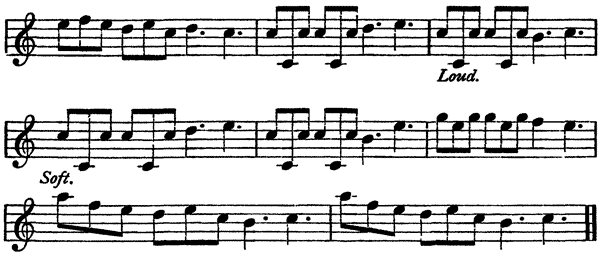
Koromanti Songs.

[Listen] [XML]
[Listen] [XML]
Meri Bonbo mich langa meri wá langa.
From A Voyage to ... Jamaica ... by Hans Sloane, M.D. London. 1707. Vol. i. pp. l, li.
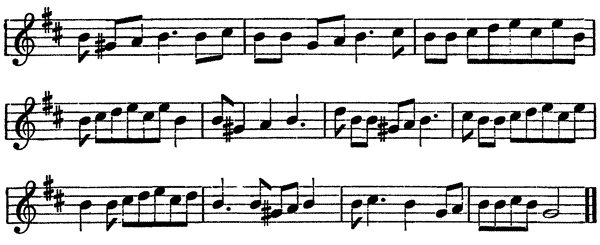
The words of these songs are Hobaognion, ognion and Meri Bonbo mich langa meri wá langa. Sir Hans Sloane observes that the Jamaican negroes of that time had their native instruments: (i) gourds with necks and strung with horsehair, (ii) a "hollow'd Timber covered with Parchment," having a bow for its neck, the strings tied longer or shorter.
These songs, however inaccurately recorded, are of the greatest value for the hint they give us of Jamaican music as it existed over two centuries ago. It will be observed that the songs are named 'Angola' and 'Koromanti,' according to their African provenance. In the present collection of modern songs, reference is made in Song CI. to Koromanti ('Cromanty'). So, too, the word 'Bungo' in Song CXXVII. no doubt refers to the large Bongo district of Africa (cf. 'Bungo talk,' p. 12, n.).
We can hardly expect to find considerable traces of this aboriginal African music after two centuries of missionary and of trade influence. African travellers have repeatedly told us how prone the negro is to introduce fresh tunes from other villages and to adapt them to his own purposes. Indeed, the contaminating influence which the Arabs and Portuguese have exercised upon primitive African music makes the study of the latter especially difficult.
But a community does not adopt exotic music without at the same time exercising selection. Those melodies have the greatest chance of success which, to some degree at least, follow the current canons of public taste. Revolutionary innovations are rare. The gradual changes in taste which take place are the result of such selective adoption of foreign music as we have indicated.
There is one feature in the above-quoted 'Angola' song which is also shared by the modern songs of this collection, namely, the presence of 'bobbins' or short refrains.
The simplicity in structure of the songs is still a feature of Jamaican music. I may be allowed to call attention to the repetition of single phrases in Song XVIII. and to the building up of simple phrases in Songs LXXVII. and LXXIX.
I had hoped that some light might be thrown on the antiquity of certain songs by the presence of nonsense words; but in this I was disappointed.
I quite agree with Miss Broadwood (see next page) that the majority of the songs are of European origin. The negroes have learnt them from hearing sailors' chanties or they have adopted hymn tunes.
But adoption always involves adaptation. A song is modified to suit the current canons of taste. In Song L. I observe 'Home, Sweet Home' and (in the latter half) a hymn tune which I frequently heard in the Torres Straits. Song CXXXIX. is doubtless 'The British Grenadiers.' But it, again, has not been adopted without modification.
Needless to say, a detailed study of these modifications would throw light on the characteristics of modern Jamaican music.
In Song XXXI. a typical non-European modification is the insertion of an extra (the fifth) bar, so that the phrase consists of nine bars. The five time in Song XI., the change of accent at the close of Song XXIV. and in Song XLI., are no doubt the expression of African delight in the complexities of rhythm.
In the already-quoted 'Koromanti song,' we may observe the curious temporary change of rhythm in the second air, and the characteristic measure which prevails throughout the third air with its syncopation and almost baffling changes. Such features are precisely what we should expect to meet with among a primitive people who more than two centuries ago doubtless possessed in a still higher degree that delight in complication of rhythm which according to Mr. Jekyll (p. 6) persists among their descendants of to-day. For a more detailed study of this aspect of the subject I may perhaps refer enquirers to my "Study of Rhythm in Primitive People" (British Journal of Psychology, vol. i. pp. 397-406).
The present taste and preferences of the Jamaican negroes may perhaps be gauged by the similarities and differences in the first bars of Songs LXIII., LXIV., and LXXVIII., by the similarity of Songs I. and VIII., XV. and XXVII., and of the bobbins in LIV. and LXVIII.
But it is not my intention to make a detailed analysis of the songs of the present volume. My object has been rather to emphasize our present ignorance of African music, and to indicate the lines along which a more intimate acquaintance with African and Jamaican songs may be expected to lead to conclusions as to their relation to one another.
C.S. Myers.
B. English Airs and Motifs in Jamaica.
By far the greater part of these Jamaican tunes and song-words seem to be reminiscences, or imitations, of European sailors' "chanties" of the modern class; or of trivial British nursery-jingles adapted, as all such jingles become adapted.
Except in the cases specified below, I have not found one Jamaican tune which is entirely like any one English or European tune that I happen to know. But unrecorded folk-tunes are essentially fluid, and pass through endless transformations. In all countries any one traditional ballad may be sung to dozens of distinct traditional tunes, each of these again having variants. It is therefore quite possible that versions of some of the older-sounding Jamaican airs are being sung unrecorded at this moment in the British Islands or elsewhere.
I note below such instances of modal tunes as occur in this collection. I should perhaps explain that by "Modes" are meant those ancient scales (other than our major and minor scales) which amongst European composers fell into disuse at the beginning of the 17th century, but which survive still in the ancient Church Music (popularly called "Gregorian"), and in the Folk Music of most European countries, and notably that of the British Isles.
III. King Daniel, p. 14.
Cf. the old ballads "May Colvin" and "Young Hunting." In the latter the parrot reveals a murder. In both ballads the lady makes the same promises to the bird (see Child's English and Scottish Popular Ballads).
VII. The Three Sisters, p. 26.
Although the story of the monster outwitted by the maiden he tries to carry off is an almost world-wide motif, and is found in Africa among other countries, this particular version has evidently been in contact with European (English or Scottish) sources. This is shown not only by the fact that the suitor proves to be the Devil, but by the question and answer (misplaced by the story-teller):
"What is roguer than a womankind?"
"The Devil is roguer than a womankind."
This riddle appears in three versions of the ballad of "The Three Sisters," otherwise "The Elfin Knight," or "Riddles wisely Expounded" (Child, English and Scottish Popular Ballads, vol. i. pp. 1-6), as:
"O what is greener than the grass? Or what is worse than e'er woman was?" "O poison's greener than the grass, And the Devil's worse than e'er woman was...." "As soon as she the fiend did name, He flew away in a blazing flame,"
says one version, but in the rest there is no disenchantment, and the youngest sister wins the visitor as her husband by her ready wit in replying, which Professor Child (Additions and Corrections, vol. v. p. 283), thinks a modernization of the original story. He quotes a manuscript version taken from a book of Henry VI.'s time, wherein the "Elfin Knight" is the foul fiend himself undisguised.
For similar survivals of Riddle Songs and Tales see "There was a Lady in the West" and "Scarborough Fair" in English County Songs, and Kidson's Traditional Tunes, and "The Lover's Task" in Songs of the West, etc.
The tune is evidently an old ballad air. It is in the Aeolian Mode.
XVII. Man Crow, p. 54.
The tune is the same as that sung in Worcestershire by children to "A finger and thumb keep moving."
XVIII. Saylan, p. 59.
This is a version of "The Maid freed from the Gallows," "The Golden Ball," or "The Prickly Bush." For the latter see English County Songs. Child gives very exhaustive notes on the story and its variants; also a tune, noted in North Carolina, "The Prickly Bush" has a tune quite unlike Child's, and the Jamaican air is quite distinct from both.
XXI. Tacoma and the Old Witch Girl, p. 65.
Cf. "The Keys of Heaven" in English County Songs, "Blue Muslin" in Songs of the West, and "Madam I will gi'e you," etc., in Journal of the Folk-Song Society, No. 7. All these airs are distinct from each other, and from the Jamaican tune.
XXIX. Parson Puss and Parson Dog, p. 91.
This tune is the first half of the old French air "Ah, vous dirai-je, Maman?" used so often by English children in their games. See note in Moffat and Kidson's Children's Songs and Games of Long Ago, p. 42. Other adaptations of the same tune are CXVI. (p. 215), CLXXVII. (p. 264), and CLXXXIX. (p. 272).
XXXI. Pretty Poll, p. 96.
Cf. "King Daniel." This is again the story of "May Colvin" or "The Outlandish Knight." The tune "Come, pretty Poll" here given is rather reminiscent of one traditional air to the ballad sung still in different parts of England (where numerous tunes to the favourite story have been noted). See "The Outlandish Knight" in Songs of Northern England (Stokoe and Reay) for the type of tune referred to, but plentiful variants from Hertfordshire, the West of England, Yorkshire, etc., exist in MS.
XXXVI. Leah and Tiger, p. 108.
The tune is in the Aeolian Mode.
LXIII. Oh, Samuel, oh, p. 168.
This tune is in the Mixolydian Mode.
LXXXVIII. War down a Monkland, p. 187.
The tune is in the Dorian Mode. By far the most interesting tune in this collection. It is a fine Dorian air, I should think an old traditional tune imported by English or Irish.
There are slight modal influences in other tunes, viz.: "Bad homan oh," "Bell oh," "A Somerset me barn," "Whé me loon dé," "Me da lí," and "Since Dora Logan a wahk with Gallawoss" (Nos. 56, 57, 85, 91, 100, 122).
CXI., p. 209.
This tune is a variant of the well-known children's game-song, "Here come three Dukes a-riding."
CXIX., p. 218.
The tune is a variant of one commonly sung in the North of England and in various parts of Scotland, to a children's game, "Hullaballoo ballie," in which reference is made to lifting the right foot and the left foot.
CXXVII., p. 225.
This air is the first part of the tune of "O dem Golden Slippers," the negro revival song of some twenty years ago.
CXXX., p. 227.
This is a reminiscence of the Scotch dance-tune usually sung to the words "There's nae luck aboot the hoose."
CLXXVIII., p. 264.
This is a well-known old English dance-tune, known also in Scotland.
CLXXXII., p. 267.
The second part of this tune is merely a reminiscence of "We won't go home till morning."
CLXXXVII., p. 271.
This tune is the first part of a very commonplace modern Italian popular composition called "La Mandolinata," played on every conceivable instrument, and sung also, about the year 1876 and for some years afterwards.
L.E. Broadwood.