Part 3 — XCI.
Reading edition
The negro is a born actor, and to give emphasis to his words by appropriate gestures comes naturally to him. The little comedy which follows suits him to perfection:—
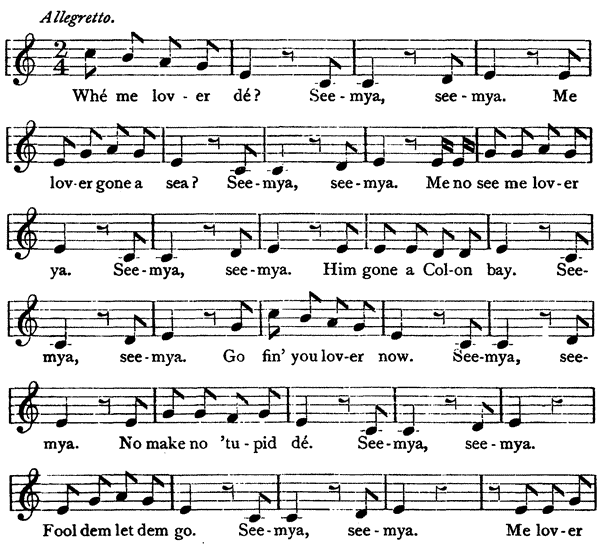
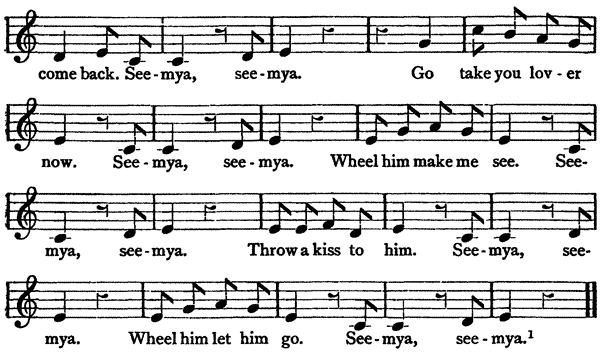
[Listen] [XML]
Whé me lover dé? Seemya, seemya. Me lover gone a sea? Seemya, seemya. Me no see me lover ya. Seemya, seemya. Him gone a Colon bay. Seemya, seemya. Go fin' you lover now. Seemya, seemya. No make no 'tupid dé. Seemya, seemya. Fool dem let dem go. Seemya, seemya. Me lover come back. Seemya, seemya. Go take you lover now. Seemya, seemya. Wheel him make me see. Seemya, seemya. Throw a kiss to him. Seemya, seemya. Wheel him let him go. Seemya, seemya.[52]
A ring is formed, and a girl is put in the middle. She asks:—"Where is my lover?" and the ring answers in chorus:—"See him here." "Has my lover gone to sea?" and the answer comes again:—"See him here." The gal goes on:—"I do not see my lover; has he gone to Colon bay?" and then, as though speaking to herself:—"Go, find your lover now. There! don't pretend to be stupid." At this point she takes the hand of a boy in the ring as if she were going to dance with him, but immediately pushes him back, and says, still speaking to herself:—"Fool them, let them go." Then simulating contrition and breaking the hitherto even rhythm:—"My lover, come back!" At "Go take your lover now" she goes again to the same boy, takes him out of the ring-circle and dances with him. They wheel at the words "Wheel him make me see," which mean, "Let me see you wheel him." Finally at "Wheel him let him go" they part hands.
Frequent references will be found to Colon. Jamaica labourers used to go there in large numbers to work on the Panama canal.