Part 4 — CXCVI.
Reading edition
We end with the pretty flowing melody:—
Schottische.
[Listen] [XML]
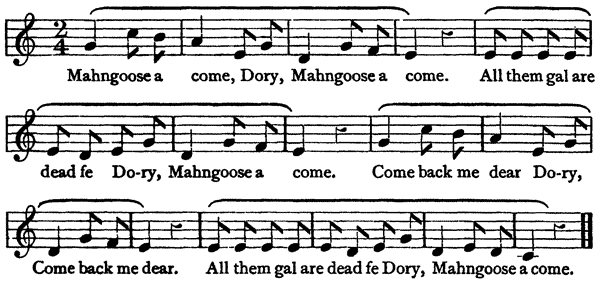
Mahngoose a come, Dory, Mahngoose a come. All them gal are dead fe Dory, Mahngoose a come. Come back me dear Dory, Come back me dear. All them gal are dead fe Dory, Mahngoose a come.
The mongoose was introduced into Jamaica to kill the rats. Unfortunately rats sleep in the day and the mongoose sleeps at night, so they never met. How the mongoose took instead to killing chickens has been often told. Dory is having a private interview with a girl who has another admirer. This man has announced his intention of chastising Dory. "Mongoose has come" is a preconcerted formula which means, "the other man has come, Dory, look out!" When a gang of labourers is working and one of them catches sight of his master in the distance, he will sing this song and the others understand that they must pretend to be busy.
The End.
Note.—(Accidentally omitted on page 77: Cf. Nos. 56, 66, 132, 133).
Marriage is, unhappily, often a failure. The woman, in marrying, has attained the goal of her ambition. Now that she is Mrs. Smith she "sits down" and refuses to help her husband, provision-ground food is not good enough for her, and she is always calling out for a new frock. In a few years the couple separate and the home is broken up, with disastrous consequences to the children. In the old days the custom was to defer the ceremony (as Constantine deferred his baptism) to a very late period. This plan worked very well. The couple did not marry till they knew for certain that they suited each other, and often their well-brought-up children and grandchildren danced at the wedding.