Part 2 — LXXVIII.
Reading edition
Sambo, that we had just now, is the shortest of bobbins. Here we have a long one of four bars.
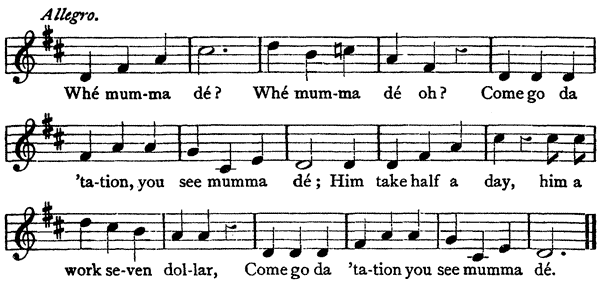
[Listen] [XML]
Whé mumma dé? Whé mumma dé oh? Come go da 'tation, you see mumma dé; Him take half a day, him a work seven dollar, Come go da 'tation you see mumma dé.
Mamma has got into trouble, owing to a failing unhappily too common in Jamaica, inability to distinguish between what is mine and what is yours. Her pay for half a day was a "bit" (fourpence halfpenny) and she has managed to "work" (sarcastic use of the word, for it means to get by working) seven dollars—twenty-eight shillings—and has been taken to the police station.
"Whé mumma dé," literally, "where mamma is?" This has been already noted as the usual form of question. The vowel in whé, dé, is the French é. We have the sound in English in the words, debt, west and many others, but we always make it very short, and when it is lengthened, as it should be here, it generally changes in English mouths to the a of date, waste, which is wrong.
The C sharp on the word "dé" is peculiar and striking.
The second "dé" stands for "there."