Part 1 — XV. DRY-BONE.
Reading edition
One day Rabbit invite Guinea-pig to his yard.
An' when Guinea-pig go, Rabbit ask Guinea-pig to go an hunting.
An' Rabbit meet up Dry-bone.
An' when him meet up Dry-bone, him t'row down his gun an' him call to Guinea-pig an' tell him:—"I meet with a luck."
An' Guinea-pig tell Rabbit:—"I won't carry none of the Dry-bone, but you must make me carry the birds what we kill."
Rabbit wasn't agree to let him carry the birds, but Guinea-pig coax him until Rabbit consent an' they fix up the bargain: Rabbit was to carry Dry-bone, an' Guinea-pig was to carry the birds.
So they put Dry-bone into the bag, an' Rabbit ask Guinea-pig to help him up.
An' Guinea-pig help him up an' pick up the gun an' carry it.
An' they start home to their yard.
An' when Rabbit got half part the road he found the load getting heavier an' heavier, an' him ask Guinea-pig to take it for a while.
Guinea-pig tell him that he made no promise was to help him with Dry-bone.
Rabbit walk on till the load get so heavy him begin to cry, say that him going to t'row down Dry-bone.
An' Dry-bone fasten on his head an' begin to talk.
He say to Rabbit:—"You take me up you take up trouble."
An' that time Guinea-pig was laughing after Rabbit.
Just then that cravin' fellah Mr. Annancy was passing an' see Rabbit with his load. He thought that it was something good, an' he ask Rabbit that he will help him carry it.
An' Rabbit was very glad to get relief of his trouble.
So Annancy take Dry-bone from Rabbit an' put him on his own head.
An' when Annancy 'tart, he t'ought that Rabbit was coming.
An' Rabbit turn back an' hide a bush an' leave the trouble to Annancy.
When Annancy get home to his yard him find that it was Dry-bone, an' it vex him in a him heart.
An' Annancy want to leave Dry-bone an' go away.
An' Dry-bone find out what Annancy mean to do.
Annancy have a cock in the yard.
Dry-bone tell him that him must watch Annancy, keep him a yard, an' he will pay him.
An' the Cock ask Dry-bone:—"What is your name?"
An Dry-bone say:—"'Tis Mr. Winkler."
So Dry-bone live in Annancy yard.
An' one day Annancy ask him if him don't want to warm sun.
Dry-bone say:—"Yes."
An' Annancy tell him that to-morrow he will put him out a door.
Annancy went away an' make a bargain with Fowl-hawk, that him have a man name of Mr. Dry-bone, him must come to-morrow an' take him up an' carry him an' drop him in the deepest part of the wood.
An' so Fowl-hawk did do.
When the Cock see Fowl-hawk take up Mr. Winkler him sing out:—

[Listen] [XML]
Mister Winkler, Winkler come give me me pay.
An' Annancy look up a 'ky an' sing:—
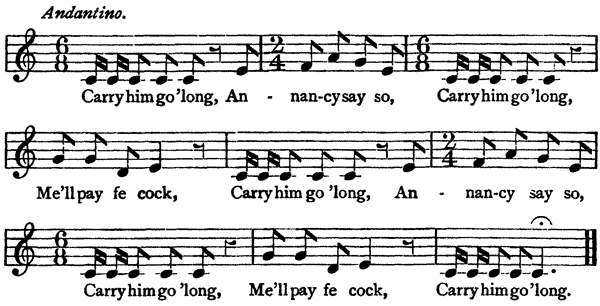
[Listen] [XML]
Carry him go 'long, Annancy say so, Carry him go 'long, Me'll pay fe cock, Carry him go 'long, Annancy say so, Carry him go 'long, Me'll pay fe cock, Carry him go 'long.
Jack Mantora me no choose any.
NOTES.
help him up, to get the load on to his head. In this story and some others the load once taken up cannot be put down. It sticks to the head of the bearer and, until it reaches its destination, can only be transferred to another head.
cravin', craving, greedy, often sounds like craven. A man who is cravin' is generally cubbich, covetous. This has lost its original meaning of desiring possession of other people's things and is used only in the sense of close-fisted. A cravin' man wants to get hold of what others have got, a cubbich (ends with the sound of rich) one will not part with what he has.
laughing after, laughing at.
him must watch. The Cock must watch Annancy and not let him leave the yard; Dry-bone is helpless, and requires attention.
to warm sun, to warm himself in the sun. So they have:—"Puss warm fire," the cat warms herself by the fire.
a 'ky, in the sky.
Me'll pay fe cock, I will pay the Cock's wages which Dry-bone agreed to give. We pay a person for a thing, but the Negro pays for the person as well.
Walk, talk, warm, hawk, all have the vowel ah. This story refers to the time of slavery. It is almost indisputable that in certain cases, when a slave was in a weak state owing to incurable illness or old age, he was carried out and left to die. To his pitiful remonstrance, "Massa me no dead yet," the overseer made no reply, but went on with his directions to the bearers, "Carry him go along." This kind of barbarity was not practised by owners living in Jamaica. By them the slaves were well treated and such a thing would have been impossible. But when the masters went away they left the control in the hands of overseers, men of low caste who had neither scruples nor conscience.