1831–1833. SCHOOL BILL.
Reading edition
The following bill illustrates both the prices for tuition in 1831, and the custom of taking merchandise instead of money in the days when money was scarce. Also the amount contributed by each scholar toward the cost of the exhibition[74] usually held at the close of the term.
John Grant
To J. P. Brace Dr.
Tuition $10.
School expenses „42
$10„42
Exhibition tax „12½
10„54½
Received of Mrs. H. Grant wood 9 3
Due 1—51
Litchfield April 19th 1831
Rec’d payment
L. E. Brace
Signed by Mrs. Brace.
New York, Tuesday, Jan’y 27th,
(1831, ’32 or 33.)
My Dear Miss Pierce:
Your kindness and that of all your family towards me and mine last summer, induces me to think a letter from me would not be unacceptable.
I often think with satisfaction of the quiet, healthful and pleasant time I passed at Litchfield, and feel a strong desire to know something of the friends and acquaintances I made there. After your own family, no one recurs to my mind with so much interest as Miss Sheddon. I felt myself peculiarly fortunate to find in the same house so amiable and intelligent a companion—if she is near you this winter pray present my best regards to her, and tell her I shall take it very unkind of her if she ever came to New York without giving me the pleasure of seeing her at my house.
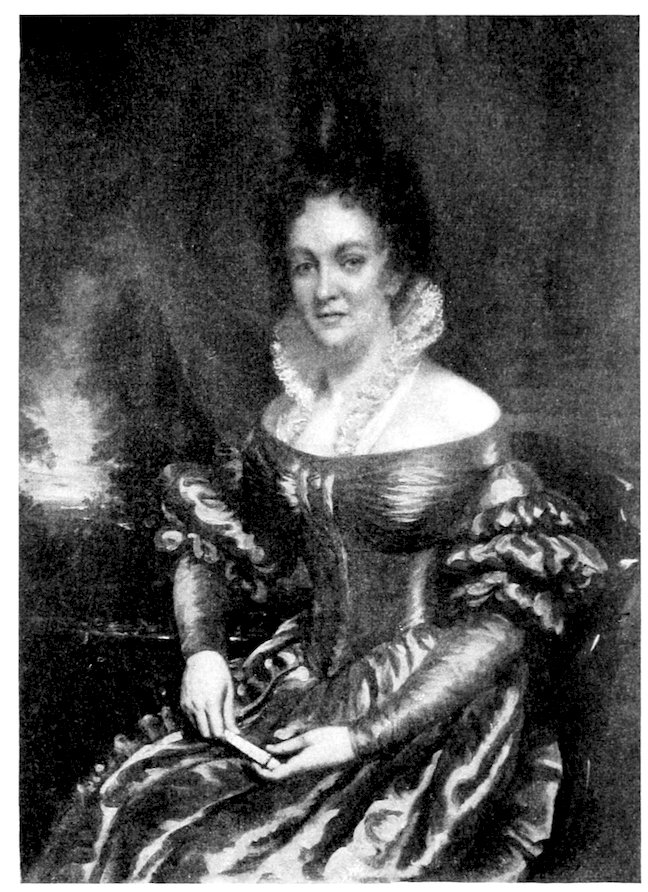
Pl. LVIII.—Maria Adams (Mrs. Henry Tallmadge), Pupil, 1802 From oil portrait
301Aunt Sally is in the full enjoyment of all her faculties and of her health, which is uncommonly good this winter—I hope you are as much delighted as she is with the life of Hannah Moore. I remember you were very impatient for its appearance; she is most enthusiastic in its praise—it ever lays open on her table. I want to know your opinion of it, though I think it cannot but be favorable, but my paper admonishes me to have done, and I have more messages than I have room for from Pendleton to the Miss Braces, and from Edmund to the little Abbeys—I would fain send some myself to my kind Dr. Buel—do, if you see him, tell him his little patient is grown a fat robust fellow, nor would I omit Mrs. Talmadge, Mrs. Wolcott and her family, and Mrs. Harrison—I hope Mrs. Jones too and her son are well. If circumstances permit I hope to find myself under her roof next summer, though I fear I shall have to go another way—Edmund is very desirous to go to Mrs. Jones for he wants to go again for Dr. Abbey’s cows, & Phil thinks he will by that time be old enough to be of the party, and besides he thinks Mrs. Jones has got no little boy now to read to her in the bible—and help her pick cucumbers—
I hope that your health, (never very robust), has at least been as good as usual this winter, my dear Miss Pierce—present my warmest regards to Miss Mary Pierce and your excellent Brother, together with all the good wishes of the New Year for a continuance of your present earthly happiness—I hope you will occupy some leisure half hour in giving me the gratification of a letter from you—
believe me your sincerely attached—
Anna P. Rogers.
My Dear Aunt:[75]
It has been my intention for some time to address a letter to you, but circumstances have hitherto prevented, and as nothing very interesting has occurred it has seemed almost useless for me to attempt to amuse or interest you. The desire to write to one I so highly esteem and dearly love overcomes every obstacle, and the anticipation of its being acceptable to you inspires me with confidence to proceed.
I need not dwell on the beauties of this place, or its agreeable inhabitants to prove how much and truly I have enjoyed myself for the past month. To one who has spent the brightest and loveliest part of life amid its delightful scenes, can readily realise the pleasure of rambling through its woods, or following the wandering course of its streams. Although the groves are robing themselves in their autumn livery and 302reminding us that ere long we too, shall be in “the sear and yellow leaf,” there is a pleasing pensiveness steals over the soul in contemplating their varied hues, so nearly resembling the chequered scenes of life, emphatically calling upon us, so to spend the summer of our days, that when the winter storms of time howl fearfully around us, we may with “an unwavering faith, enwrap the drapery of our couch around us and lie down to pleasant dreams.” ...
Miss S. Pierce desired me to say to Aunt for her, that she should be very happy to have her come to Litchfield and make her house her home. I wish sincerely, dear Aunt, you would come up with Pa and Ma when they come for us, as we hope they certainly will with little Henry....
Miss Lucretia Deming called and favored us with a ride a few days since. Mrs. Beach (Lucy Sheldon that was) invited us to tea and also Miss Pierce. We passed a delightful evening at Mrs. Dr. Buel’s with the young people of the village last evening. I have written too long a letter already and will close by requesting the favour of a [torn] answer [torn] return if you consider it worth the trouble. [torn]ry unites with me in much love to Uncle, Aunt and Cousins, and believe me
your most affectionate niece.
Cornelia E. Tallmadge.
Litchfield, Wednesday A. M. 3rd Oct. ’32.
M— D[worn]id Wooster aged 75 was buried yesterday. I took tea at Miss Pierce’s on Saturday evening with the rest of the family, and was introduced to Misses Twining, Ferris and Catlin, cousins to a former friend of mine. Miss T——ng resembles him very much and I happened to sit next to her all the evening. I found her quite agreeable—she quite as well satisfied I believe. I write this, dear Aunt, not that it can be very amusing to you, except as you are acquainted with a few peculiar circumstances connected with the family, etc. I send this letter rather than with another, merely to change the date. I hope it will be no less acceptable on this account. Excuse the unshapely appearance of this addition, dear Aunt, and remember,
me your truly affectionate niece,
Cornelia.
Oct. 8th, Monday evening.
303
FAREWELL ADDRESS ON LEAVING LITCHFIELD ACADEMY, OCTOBER 23, 1832.
It is always a solemn & interesting moment for a teacher to close a term of his exertions & instructions. To give the last information to those who are entering the world to perform their parts on the great theatre of action; to feel that all that he can do for their improvement & usefulness, their benefit here, & their welfare hereafter, has been done; to realize that the account of his influence over them, has been sealed up by the recording angel, & entered in heaven’s dread chancery, to be opened no more until the great day of reckoning brings all things to light; to feel that he has bidden adieu to those, whose welcome faces, for years, have surrounded his desk, & constituted his happiness or misery by their conduct; to feel all this clouds his brow with gloom, & fills his heart with sorrow, when the anticipations of home & friends, & the buoyant hope of future usefulness, & the false glare of expected admiration, causes every eye to sparkle, & every heart to throb among the pupils around him—It is then, that looking on the past, the feelings of regret, at neglected opportunities for their welfare, once enjoyed, and now lost forever; at all that he might have done to have made his pupils more useful, better fitted for the stormy trials of this world, & the greater trial hereafter; of all his mistakes & errors in intellect; of his follies in conduct and obliquities in temper; of his example, shining but to betray, & his influence, powerful, but to mislead; of all that he has done to injure, or omitted to do to benefit, rush upon his mind, in a tide of overwhelming sorrow—
At such a time, the most faithful in intellectual discipline, the most devoted to the future usefulness of his pupils, & the one most willing “to spend & be spent” in the service of his greater master, feels his past neglect, & grieves over his deficiences.
If such be the feelings & the regrets at the close of an ordinary term, how much more shall he feel, the principal of this Academy, who, after eighteen years devoted to its interests, on this night, with this act, closes his connection with it, & enters on a new, & almost untried field of usefulness.
The audience generally, & his pupils in particular, will excuse him for occupying their attention, a few moments, in a detail of the plan of his instructions, the motives for the resignation of his present office, & the regrets that crowd upon his mind in standing for the last time at the head of the Litchfield Female Academy—
It has always been our belief, that the female intellect was as susceptible of as high & extensive cultivation as that of man; though, from 304her different destination in Society, & her various employments, a different education must be pursued—
It is not now necessary to enter into a discussion of the question whether the abilities of the sexes are naturally equal; it is sufficient to notice, that the circumstances of life require a varied exercise of these abilities—The employments of man & woman are so dissimilar, that no one will pretend to say that an education for these employments must be conducted upon the same plan: but the discipline of the mind, the formation of these intellectual habits, which are necessary to one sex, are equally so to the other—The difference in their employments requires a diversity of personal qualifications, but not a difference of intellectual exertions—it is equally important to both sexes, that the memory should be stored with facts; that the imagination should be chastened & confined within its due & regular limits; that habits of false judgement, the results of prejudice, ignorance, or error, should be destroyed or counteracted; that the reasoning faculty should be trained to nice discrimination, & powerful & rapid research.
It has, therefore, been our endeavor to fling into that course of study & employments which may be considered peculiar to women; as many of the mental avocations of the other sex, as were necessary to all that development of intellectual energy, which woman, in her situation may require—To this course of discipline & improvement we have endeavoured, uniformly to adhere with no more variations than were necessary to keep pace with the changing state of many of the sciences, with the gradual improvement of our country, & the rapid “march of mind” in the present century—
During the forty years of the existence of this Seminary, other similar schools have arisen & fallen; have had their day of reputation, & have ceased their operations—Fashion has led, during this long period, at one time to place an undue stress on external accomplishments; at another, to the study, exclusively of intellectual philosophy; at another, on the physical sciences; while we have endeavoured to mingle all that was useful in the existent fashion, with the regular course of study so long pursued—
A teacher of a large & promiscuously collected school is obliged to act upon other principles, in the motives & incentives placed before the mind, than if he were conducting the education of a solitary individual or a single family or early discipline; the course pursued by parents; the difference of original constitution; the diversity of prejudice & feelings, occasion such a contrariety of character among his pupils that he can find but few motives that will operate alike upon all.
Were human nature perfect, did all act up to the light they have 305received, did the great principles of the divine law “thou shalt love thy neighbour as thyself,” operate on the heart, the teacher would have an easy task, a delightful labour—In the ruined state of the human heart, when the holiest motives are unknown, he is obliged to seize upon the best that remain to accomplish the great object of public instruction.
He has the stupid to arouse; the sluggish to excite; the idle to leave or drive into a life of industry; the irregular to habituate to a life of method—
To accomplish these important objects, & to induce our pupils to make the greatest possible improvement of the time and advantages allowed them, we have adopted a system of rewards & punishments founded on the principle of an emulation to excel. Our utmost endeavours have always been made to prevent this system of emulation from engendering an unholy ambition, and the approbation of parents, & the plaudits of an approving conscience, have been the motives most frequently exhibited, and most affectionately urged upon the minds of our scholars.
Our object has been, not to make learned ladies, or skilful metaphysical reasoners, or deep read scholars in physical science: there is a more useful, tho’ less exalted, and less brilliant station that woman must occupy; there are duties of incalculable importance that she must perform: that station is home; these duties, are the alleviation of the trials of her parents; the soothing of the labours & fatigues of her partner; & the education for time & eternity of the next generation of immortal beings—Our design has been, to give our pupils enough of science to conduct the early education of their children and to relish the conversation of the scientific around them. Our greater aim has been, however, to cultivate the judgement & improve the taste, to produce a relish for reading, & especially to create a correct & elegant style in conversation & letters, where alone, with few exceptions, women can manifest the extent of their information.
The formation of character; the acquisition of correct habits; the controul of tempers, & the restraint of appetites; the discipline of mind, that will lead to perseverance & industry, to order & system hereafter, are of more importance than the principles of science, than the refinements of manners, or the elegancies of Literature—
To these objects have our exertions been extended—Every moral precept that could be drawn from science or literature; from the rewards & punishments of the school, from the daily occurrences of life, is applied to these great purposes—Feeling as we do, the importance 306of forming the habits & the character, at such early periods, we use all our endeavours to fulfill the responsible duties devolved upon us—
There is yet one other subject, of higher & holier moment, that forms a part of these responsible duties: the direction to be given to our pupils to comply with the great object of their creation, & glorify their Maker. In our religious instruction, bestowed often upon them, we have endeavoured to point them to that Saviour, provided for them, & to impress upon them the duty of repentance & faith required in the gospel. We trust we have not done this, in a sectarian spirit, & that we have equally encouraged every sect “who love our Lord Jesus Christ in sincerity & truth.”
But feeling, as we do, the deep wickedness of the human heart, the necessity of a change of that disposition to an entrance into the kingdom of heaven, & the agency of the Spirit of God in accomplishing that change, we must press these subjects upon our pupils, & to show them their guilt, their danger, their remedy & their duty; praying that the Spirit of God would accompany these exhortations with saving power to their hearts—
Such is very slightly the outlines of the motives, that have guided our public career & we hope that on looking back over the long list of immortal beings entrusted to our charge, at the most important & responsible part of their existence, we can be excused the assertion that we have attempted to do the good required of us, “in our day & generation”—
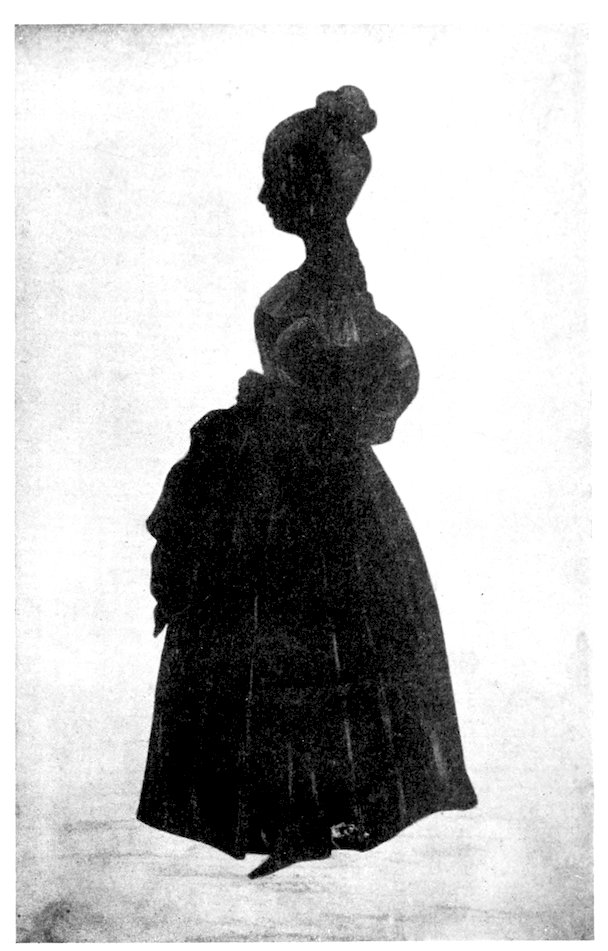
Pl. LIX.—Silhouette of a Litchfield Girl of about 1830
Will the patrons of this school, now, pardon me in giving a detail of the reasons that have led me to relinquish my charge as the associate principal in this Institution—These are, very concisely, (for I do not wish to occupy public attention by an egotistical exhibition of my private movements,) the diminution in the number of my pupils, occasioned by the numerous other establishments of a similar description, springing up all around us; the increased facilities of travelling to other places which nature has denied as an access to this village; & the offer to a station, where with less of physical exertion, a more certain & ample support for my increasing family, can be obtained, & a greater amount of usefulness be in my power, from the increased number of pupils, & the enlarged sphere of action—But in relinquishing this office, let me be believed, when I assert that I never can efface from my memory, the kindness of those by whom, I have been surrounded & supported for so many years—The stream of time may roll many things into oblivion, but whether it stagnate in its course, or rush on with a cataract’s velocity, it can never bury beneath its waves, or hurry 307from my heart, the recollection of all that has been done & felt for me, by the people of my native village—
I am going among strangers, & I shall miss your kindly sympathy. I shall miss the tones of friendship, heard from childhood until now. I shall miss these advisers on whose arms I have leaned until age has almost bowed them to the silent & narrow house, & sprinkled my locks with gray—I shall miss those pupils, who, though years have elapsed since they heard my instructions, still beam upon me as they pass, with their kindly faces, & look as if satisfied, that they too were educated in the Litchfield School—I am going to a land of strangers to acquire new friends, to lean on new advisers, to see the faces of new pupils, at an age when change is the most dreaded, & old associations the most powerfully felt—It would be a gratification in this hour, to feel that I might retain that friendship, & those regards, I have held so long & prized so highly—
Permit me to express a hope that the Institution to which I have given my hopes & my fears, for nearly 20. years, will still be preserved on its former footing, & that yet very many more may be added to the list of the 3000 of its former pupils, & that the declining years of her, who, for forty years, has superintended its operations, & who was the pioneer in the march of female education in this whole land, may be soothed by the success of that which has been her object in life, & will be the “crown of her rejoicing, in the day of her Lord”—
To the pupils of this term, I return my grateful thanks, for their attention & their kindness; for their progress in science, & their improvement in character—I hope that their conduct in this world will be such as to reflect honour on the Institution, that educated them, & that their preparation for another will be founded on those gospel principals that will unite them around the throne of God forever.—
The time will soon arrive, when all of us shall have done with all that is mortal & earthly; when the tongue that utters this farewell, & the ears that hear it, shall be alike motionless in dust; & when a few grassy hillocks by the graves of our fathers shall be all that earth has left to us; shall we not, all of us, then, make that preparation which will fit us for scenes beyond this world, & its perishing employments, when the realities of Eternity, will be around us, & nothing but the faith of the gospel, be of abiding benefit?—
308
EXTRACT FROM ADDRESS ON ASSUMING CHARGE OF THE HARTFORD FEMALE SEMINARY.
December 2nd 1832
It is useless for me, from this desk & at this period of the history of education in our country & of the march of the human mind, to enter a laborious investigation of the uses of information, of the advantages of study, of the pleasures of intellectual enjoyment. The fountains of pure happiness which education has opened in our land, are no longer locked up from the female sex, but all are equally invited to drink of their waters & in no way is the superiority of our favoured country more notedly manifest than in the blessings of mental discipline being poured upon the heads of the female sex. Have you ever, my dear young friends, as your eyes glanced over the map of the world, & your memories were stored with the facts of Geography. felt your hearts rise in aspirations of gratitude to your heavenly Father, that you were not like the unhappy females of which you read; compelled to the lowest & meanest pitch of outward degradation, & the darkest night of mental ignorance; condemned by “man, imperial man” alternately, to be the slave of his passions, & the victim of his tyranny; condemned to the toil & labour & suffering of a life of barbarity, the galley slave of ignorance & brutality, with no other prospect at its close, but to mount the funeral pile of your lord & master, & with no hope of the brightness of that “life & immortality,” which the gospel has brought to light. The religion of Christ & the influence of education have made this difference in your happiness here, & your prospects hereafter. and it is useless for me to occupy your time one moment in any laboured proof of the value of education to you. It was not always so. Eighteen years ago, well can I remember the prejudices, the fashions, the antipathies with which I had to contend. The taste for frivolous accomplishments was to be crushed, & something besides the embellishment of the exterior was to be forced upon the consideration of the light & trifling. The singular prejudice of some of the good & pious of the community, that all information beyond that of the Bible, was profane & useless, was to be softened down & modified. The false idea that the exclusive station of woman was the kitchen, & her exclusive discipline an acquaintance with culinary concerns was to be counteracted, & a better feeling of her value & her influence to be created. But that time has passed, & the full importance of female improvement, & the culture of female intellect have been justly appreciated, & the numerous seminaries that crowd our land, show that “scattering the seed” of female education is an object of the highest utility.
309There are many, at the present time who suppose that the discipline of the female mind should be the same as that of the other sex, & that the same mode of education will answer for either. With this opinion I cannot entirely coincide: not because I have any doubts on the natural equality of the female intellect, or any jealousy of their superior mental attainments, or any prejudice against intellectual cultivation, but my belief is that mental discipline must be accommodated to the different stations, that man & woman are destined to occupy, & that many studies & employments, proper in the education of man, will be useless in that of woman. Still, the same general habits of intellectual exertion, the same attention to the cultivation of the powers of the mind are necessary to both. In both cases the memory is to be stored with useful facts, but not crowded with the unnecessary furniture, that a more technical knowledge of names would give; the imagination is to be checked in its career, & placed subordinate to the reason; habits of nice discrimination and deep research, of laborious & painful investigation, of accurate classification are necessary to both. Instructors are often asked by their pupils “of what use will the knowledge of such a science be to us?” The answer should be always ready “to discipline the mind,” & if it produce that effect, its aim is gained, tho’ of no radical utility in after life. Even if some royal road could be discovered to the acquisition of science, I still doubt its use to the young mind which needs the patient investigation of a difficult and abstruse study to strengthen its capacities, invigorate its faculties, & prepare it for similar contests in after life.—Every study, therefore, that will, in the education of man, produce this mental discipline, may be employed with equal advantage, in giving the same heathful tone & vigor to the female intellect. After this great object is attained, the most important in education, aside from the moral discipline of the heart, then the different employments & stations of the different sexes must be taken into consideration. The difference in their employments requires a diversity of personal qualifications, but not a difference of intellectual exertions. The object of female education is not to qualify woman to controul the councils of our nation, to command armies for our defence, to move forward the wheels of government, by their eloquence in the legislative hall, to regulate the science & literature of our universities, or to direct from the pulpit the immortal destinies of perishing sinners: no: the station of woman is less exposed, but not less valued. Her hall of legislation is the quiet home of her nursery, & her eloquence the power that moulds & forms the rising hopes of our country, & of the church. The whole duty of early education devolves upon her; & every thing, in her own discipline of 310mind, should tend to that one great point. Her own amusements the desire of shining & dazzling in the world, the desire, even of pleasing, should be all held subordinate to the great destiny of the sex, their controul over the infant intellect, & to a preparation for their fitness to discharge this great, this all important duty. Intellectual habits, the influence of science, & literature, & accomplishments; the formation of the temper, all should be bent in a direction towards this one object. With these views, my aim in life, has not been so much to form scientific & literary ladies, as useful members of society, & to show to my pupils that their greatest happiness should be found in the quiet domestic circle, & their greatest exertion a preparation for all the duties of forbearance, patience, and fortitude, which they are called upon to exhibit in life. Hence I have always felt, that the moral influence of their studies was of more importance than the intellectual, & that the formation of character was superior in its value to the cultivation of intellect—
Pittsfield Mass.
June 3rd 1892
My Dear Mrs. Skinner
I was very much pleased to get your letter last week. I look back at my school days with so much pleasure—and regret, and so much gratitude to your father, that I am glad indeed to be remembered by you. I owe to your father[76] the greater share of whatever power to write I possess, and I have often wished I could see the notes he used in his composition class lectures. I think they would make such a useful book.
I should like to attend the reunion but I am not able....
I thank you much for your letter and am
Yours cordially
Rose Terry Cooke.
LITCHFIELD FEMALE SEMINARY.
The summer term of this Institution will commence on Wednesday May 15th.
Terms of instruction in the highest department including Natural and Moral Philosophy, Logic, Chemistry, Principles of Taste, Criticism and Rhetoric ... $10.75
Second department, embracing History, Grammar, Arithmetic, and Composition ... $8.75
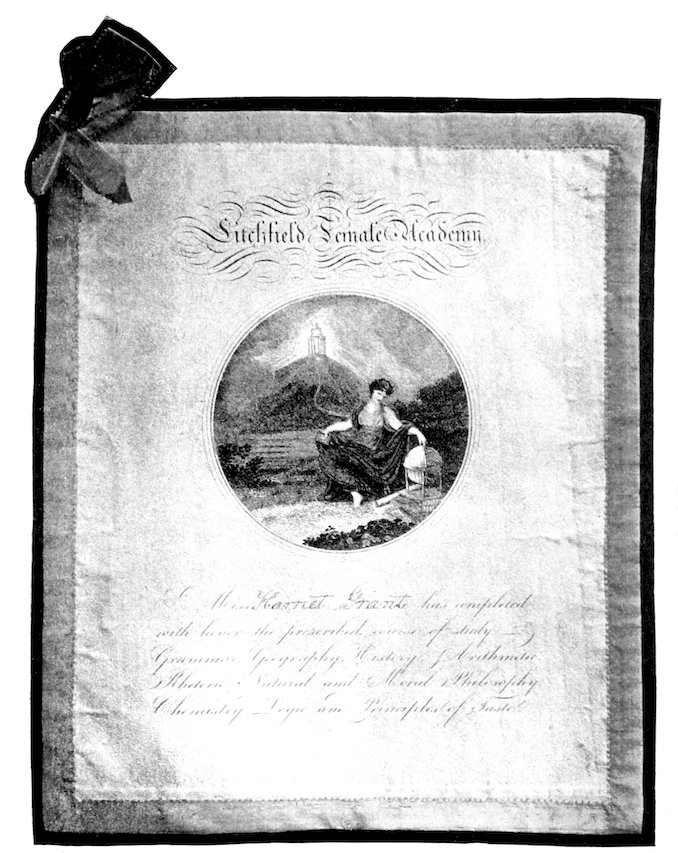
Pl. LX.—Last School Diploma, White Satin bound with Blue Ribbon Engraved by Pelton
311The lowest department, including Writing, Reading, Spelling and Geography ... $6.75
French per quarter 5.00
Drawing do 5.00
Music do 10.00
No pupil will be received for less than one term and no deduction made except for sickness.
The morals and manners of the young ladies will receive particular attention.
Board in respectable families may be obtained from $1.75 to $2.00 per week exclusive of lights and washing.
Litchfield, April 25th 1833.
LETTERS OF MISS SARAH PIERCE FROM 1802–1842.
Jan. 4. 1802
My Dear James[77]
Another year has dawned upon us—May it prove more happy, & more to our Eternal interest than the last.
Yesterday Mr. Huntington gave us an excellent sermon upon the New Year. The Discourse tended to wean us from the world by shewing us that we were not born for ourselves, but for God.
He mentioned that there had been but nine persons died out of his Congregation, & those chiefly aged persons. I felt that ten were gone. The idea that our dear brother was one who tho’ he was no more, was uncounted in his Native Village church struck me to the heart.
“tho’ no weeping friends around thy tomb.
The unfading wreaths of virtue there shall bloom.
And when the last great Day shall wake thy dust.
Thou there wilt meet the honors of the just.
Ah, what is earthly pomp compared with this.
What the world’s glory or its present bliss.”
... I suppose Mary has left you before this. I am sorry Mamma can’t do with out her. I should be glad to supply her place, but my family & school are so large, I can hardly find time to run in & see her once or twice in a week. Tell sister Pierce I hope she has not forgotten the promise she made me of sending the copy of poetry, concluding Parnell’s Hermit. Tell her I shan’t use my brains at spinning poetry for her again if she serve me thus.
My love to all friends, adieu.
Sally Pierce.
312[No date]
My Dear James.
... I have found loaf sugar so amazingly dear that I wish you would get a few loaves and send with Wadsworth’s goods. I am sorry that I am not there to spend a little money, I have so many wants.
Yours affectionately.
M. Pierce.
Litchfield. Jan. 4th. 1819.
My Dear James.
The first use I make of my pen this new year is to wish my only brother a happy new year. May this year see you as ardently engaged in the cause of your Maker & Redeemer, as you have hitherto been in the walks of science & the cares of the world. Every new era of time reminds me of the approach of Death. My days appear to me to be numbered & nearly finished. May the evening of my life be as serene as the meridian has been. How many mercies has our family to recount. Fifteen years have elapsed since we have been called to weep over the grave of a beloved friend, but how short that period appears. it seems as but yesterday, & what have we done in that time to prepare us to follow our relatives to that region of joy where we have reason to hope they are gone. What a flood of knowledge & glory they must have travelled through, since they were released from this prison of flesh. With what pity they must cast a look on us, & wonder that the cares & the silly trifles of time can so engross our thoughts & hearts as they do. Could we but for one moment feel what blessed spirits feel, who are purified from the infirmities of mortality, how we should long to fly away, & be a partaker with them of the bliss of heaven. We had a letter from Ann on Saturday, she & her husband were tolerably well, though she complains of the high seasoned food, parties, as not benefitting her appetite, or her husbands eyes. Our neighbors & friends are generally well, except hard colds which are very common though the season has been uncommonly fine. I have at last completed a history in question & answer for the use of schools, beginning at the creation & reaching to the Destruction of Jerusalem by Titus. The intention of the work, is to unite Sacred & Profane history with moral instruction & designed for the use of schools. If you are acquainted with any bookseller whom you think would like to take a number of them to sell upon commission I wish you would speak to him about them & let me know of it & I will forward them, by the first conveyance.
313Mr. Diderrer wanted a set for Eliza, if there is any way of sending them to him I would forward them. I thought that it was best to have some deposited in N. York for those who wished to purchase. Should you see any of my friends remember me to them & believe me as ever your affectionate sister.
Sarah Pierce.
LETTERS FROM MISS S. PIERCE TO MR. JOHN P. BRACE, HARTFORD, CONN.[78]
Dec. 7. 1832.
Dear John.
I hope you will keep your mind from despondency, even if you should have a small school this winter. Should you not have sufficient scholars to pay the salary of your Teachers I think you must call them together, & state the case to them, & I am sure they will be reasonable enough, either to accept a smaller compensation, or resign their places. You will soon see who you can best spare, & by another Term arrange your school to your own liking. I hope you will never forget to love your native Village, but I should be sorry to have you unhappy because you are obliged to quit it. And as for becoming rich, if you are a child of God, as I trust you are, He will give you as much wealth as is best for your eternal interest, and no more. Cast therefore all your care upon God, for he careth for you. Do good, & verily thou shalt be fed. We regret your absence as much as you regret leaving us. “We miss you in our days of woe. We miss you in our mirth,” but chiefly we miss you on Sabbath eve, at the Bible class....
I am glad to hear by your letter of last evening, that your school is increasing, if you can get along with out lessening your Teachers for this winter, it will be better for you, as every Teacher who is dismissed will use her tongue to your disadvantage, if they have not more grace than the generality of our race. I want you should always remember that curious eyes are watching all your actions, & be careful to take as much notice of the greatest dunce in school, as of the finest intellect. Never forget the lessons of the last year, & let prudence, not fancy guide your actions. What an evil world we live in, our time, our talents, and even our affections must be devoted to earning our daily bread, if it was only the sweat of the brow, I would not care, but we must smile, and court those we do not care a pin about, or be called 314partial, impolite, &c.—but it teaches us one scripture lesson, to be patient towards all men. I would warn you against walking up to L’d unless you accustom yourself to walk ten miles every day, then you could do it with out making you sick. I do not know but you might do it, if you accustom yourself to walk 5 or 6 miles a day, but one fit of sickness would be dreadful.
S. Pierce.
Feby 1, 1833.
My Dear Nephew.
I have the pleasure to inform you that your daughter Mary begins to repay us all, for the care we have bestowed upon her, she reads her history to me in the morning, & is careful to correct every wrong pronunciation when pointed out to her. She recites her lessons perfectly, practises two hours every day with great care and attention, & is never out of temper when any little fault is pointed out to her. Mrs. H—— is much delighted with the manner & intelligence displayed in Sabbath school. She is the joy of her mother’s heart, by the respect & attention she shews her on all occasions—and has more than repayed me for the many hours I have labored to help you to give her a genteel education. I think you will be justly proud of such a daughter, & she will, by her conduct in your present Seminary, be a living recommendation to your skill in forming the female character.
July 1833.
My Dear John.
Miss Sheddon told us yesterday, of some trouble you have had among your Teachers. I had hoped that their places & employments were so definitely arranged as to preserve harmony, but I find selfishness will prevent happiness in this world, how glad I am that it cannot enter Heaven. We are not without our trouble here the same spirit of fault finding as prevailed last winter has begun to show itself. Miss J is the sufferer, as she has the care of the older scholars, who are ambitious, & there is one who has risen by her superior mind far above her companions, & several have become jealous of her, & of Miss J, & accuse her of partiality. Miss Landon says there never was a more faithful & conscientious teacher, but she thinks the persecution she suffers will drive her back to Geneva, where they are constantly soliciting her return. I am afraid that the next generation of women, instead of being improved by their superior advantages, will be a poor, weak, inefficient & selfish race, as parents will listen 315to all their whims & indulge them in sloth & petulance. They are not allowed to endure any hardships any privations, to give up their own comforts to accommodate others, or to be willing that others should be wiser, more genteel, or handsomer than themselves. I am afraid that the next generation instead of showing the hardy Roman virtues, will be mere Italians, without energy, patriotism or humility—& all this originated in the indulgence & overweening fondness of parents, & school Teachers cannot overcome it, & therefore it is a most undesirous employment. I am thankful I lived in an age of parental discipline, Or I would never have discharged the duties of my office as many years as I have done. & that in my old age I am not obliged to continue the employment, & have only the trouble of sympathising with all the Teachers in our country. When are you and Mr. Van —— coming to L’d—or had you rather come alone, we want to see you very much, & hope you will be able to come up some Sunday, as the stage runs so conveniently for you. L’d looks very handsome this summer, & is filled with company. Most of the L’d boys have been here with their wives, & some are here now, the two Child’s—James Seymour, John Adams, Mr. Clark, & E. Gould—I have not become acquainted with any of their wives, but Mr. Gould, but am told they are all quite as good as their husbands. Did you know that S. A. Vanderheysen and her husband were both dead—that the brother & remaining sister were apparently on the decline, & that Jane is far from well. How can that family value property when their lives are so precarious.
S. P.
July. 10. 1833.
Dear John & Lucy
... We had a queer celebration here on the fourth. E. Ford commanded the troops which consisted chiefly of the young mechanics, but he had the art to draw in all our most respectable men to walk in the procession. Mr. Hickok & Mr. Pallen, Col Tallmadge & Mr. Wolcott, Dr. Buel, &c. Mr. H. was so much engaged in talking with Mr. P. when they passed our house, we agreed he was making the first oration. The procession reached up as far as the corner, & I suppose equally as far in the South St. I think the exercise was rather fatigueing, in the middle of such a hot day. The ladies had been invited to secure themselves seats in the meeting house, where they waited two hours, for the orator of the day, & lost sight of the best part of the entertainment. The musick of the band, & the procession. The orator was a young man from the West. I think Kentucky. He is very young, & his oration discovered his age. 316Mary & Ann Landon were to have had a party in the evening, & Mary Ann Wolcott asked Mr. Landon after the oration was over, if his daughters would accept some flowers from their garden to dress their room, Mr. Landon groaned out, you may send one pink, not more, for I cannot bear any more flowers today. The two Childs, & their brides are making a figure here, they have a grand party tomorrow. The Dr. & Col. look very happy, & their wives appear genteel. My love to all your family.
S. Pierce.
Sept. 3. 1833
Dear John.
... I have given up the management of the school to them (the trustees), & they desired me to write to a French Lady who had made application for her daughter to come & teach musick, french & drawing. The mother is a good house keeper, & wishes to take boarders. Should they come, I expect they will take your house, perhaps for a number of years, & will be profitable tenants....
When I go past your home, it looks so natural it seems as if I must step in & see you all, & when I do go in it looks so lonesome I can’t bear to stay. Mr. Hickok improves every day, & we hope the church is beginning to awake.
Give my love to all the young ladies, & to all the children, & to Lucy if she has not gone on to Boston. May the best of heavens blessings rest upon you & yours, & may we all meet together in heaven, when the toilsome day of life is past.
S. Pierce.
Litchfield. May 13. 1834
My Dear Nephew
... I should think Mary would prefer being at home, as both her parents are there, and the money she would have spent in going to Newark, will nearly bear her mother’s expenses to Boston, & as Mary is young & healthy, & does not need a jaunt to set her up for the summer, & her mother does, I hope she will rejoice to stay at home for the present, & urge her mother to spend all the spare cash upon herself....
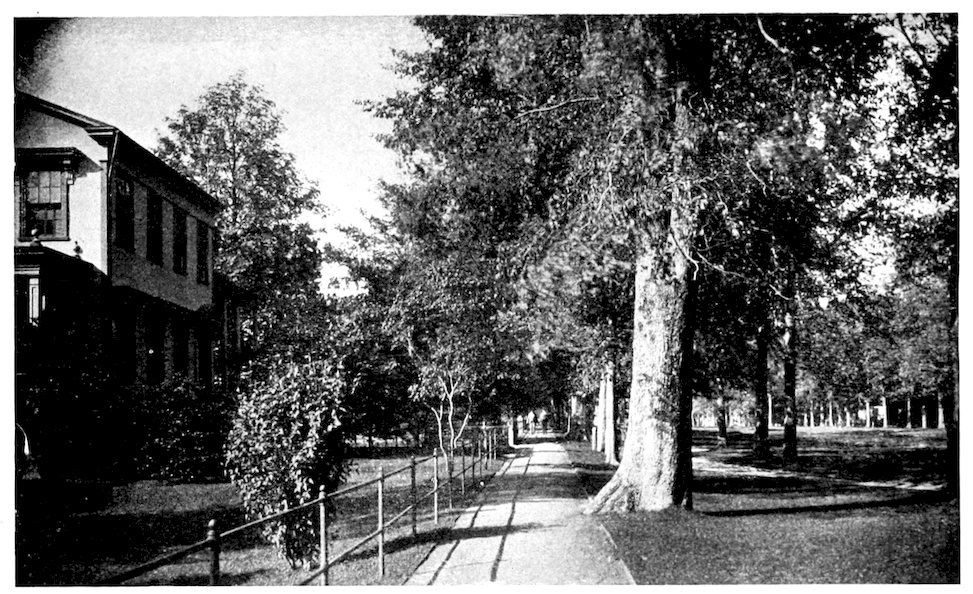
Pl. LXI.—Pathway in front of the School
I am sorry that you have got that whim into your head, that you do not appear well to strangers. When you take the trouble to please strangers, they are always pleased with you, but as you are no beauty, you must like a plain woman seek to please by your conversational talents. I am afraid you have again remitted your exertions to please 317acquaintances, & are sinking down into your old taciturn habits. You don’t know how much the exertion you made last year to please, raised you in the estimation of all who saw you, Miss L. Miner among the rest came home from H— full of your praises. I don’t think it absolutely necessary for you to take a journey every vacation, but I do think it necessary for you to gain a great many acquaintances....
S. Pierce.
June 1834.
My Dear Nephew.
... I think Mr. Strong has charged very high for the binding of my book, I never gave but 17 cts, per vol—for binding the first & second vols together—& he has charged me 3 Dol. for the dozen, which is the price I set them at—as he has had the binding of so many, I think he ought not to ask as much as the book is worth for the binding, I asked to have a cheap binding, because I cannot sell them for much. I wish you would see him, & ask him to reduce his price. I had a letter from H R— last week, she is still employed in doing good, her sister instructs a Sabbath school of black children & those who belong to them are educated in the knowledge of the Bible. Love to Lucy & the children.
S. Pierce
Litchfield, July 29. 1834.
Dear John.
Last evening we had the melancholy intelligence of the death of our dear sister Pierce. (Col. John Pierce’s widow) she with her nephew & niece Mr. & Mrs. Pendleton set out the latter part of June to visit Green Pendleton.
They reached Cincinnati the 2nd of July, she bore the journey very well, wrote a long & cheerful letter to Mrs. Muirson, the next day was attacked with cholera murbus, which terminated in a dysentry, & she died on the 10th, had her reason to the last, & died full of faith & hope....
Mr. Kirk spent a day with us, I suppose Mary has written that he made a strong impression upon the whole school, in six or seven instances it appeared as if the feeling would be permanent—but like the wayside hearers they do not appear to have root within, & are again laughing & playing with the thoughtless & gay....
S. Pierce
318Litchfield, Sep. 21 1835.
Dear John.
... Are there any little girls who want to learn the French language, in or near Hartford—I want to procure Mrs. Gimbrede a few boarders, it is an excellent place for young ladies from eight to fourteen, she loves young girls, takes great pains with their manners, & it is the only way to learn to speak French well to live in a French family. I fear Mrs. G— will leave us this fall if she does not get boarders, & I do not know as we should be able to let your house if she leaves it....
S. Pierce.
Litchfield. Jan. 13. 1842.
My Dear Emma
You must not expect that your old aunt will be able to write to you very often, as her bodily weakness is great, & her eyes very poor. I was glad to see your last letter written so handsomely & without any mistakes in the spelling. I hope you will be careful to acquire a good style, & a handsome mode of writing letters & notes, as they show a womans education on more occasions than almost any thing else she is called to perform.
I suppose Mary had troops of gentlemen on N. Year, the gentlemen made calls here, which was quite a new thing, but there are so few of them, they did not take up much of our time.
We had a very affecting death here on Christmas, Henrietta Beers, cousin to Julia, & who had been adopted by Mr. Beers as a daughter died on that morning, her funeral was attended on Monday morning. All Miss Jones’ scholars walked in procession to the grave, she was very handsome, & very much beloved. Her friends have hope that she was prepared for death, if so she is now singing the praises of her Redeemer. May you be prepared to meet your death, at whatever period the king of terrors may summon you to depart. The Methodist church has had a protracted meeting which has continued about three weeks, a number of young people have become hopefully pious, & a few old.
The temperance cause seems to be gaining. Mr. Kirchon (?) from N. Haven has been laboring here, & a number of drunkards have signed the pledge, & we hope they may continue firm to their oath. Tell Mary I will send Charles’ stocking the first opportunity, I have not finished your Father’s stockings yet, while at C— I knit for your 319aunt Ruthy & since that I have gone on slowly as there are but few evenings when I can keep my eyes open, but they are nearly done.
Love to Mary, Charles & James, to Isabella also—& take a great deal for your self—from your affectionate aunt
S. P.
Litchfield. March. 14. 1842.
Dear John
I am sorry that your congregation have got into such a bad state, but it seems to be the state of the present time to run into extremes, a few years past, it was with difficulty that we could get a decent house to worship in, & now people are for emulating Romanists, in building, & decorating their churches, there is no religion in it, but as Dinah used to say, “needless pride.” Satan was never more active than at the present day, fomenting contention in churches, where he has not as yet been able to introduce false principles. I think it a great sin in these hard times to lay out money needlessly when so many benevolent institutions are suffering for funds.
... I think you would not do wisely to buy a lot to build on, as it is always expensive to build, & there is always in the course of every year, houses to sell at a low rate. Love to the children, tell James we hope to see him as soon as the mud is dried up, & the weather warm enough to play out door.
S. P.
Litchfield. June 23. 1842.
My Dear Nephew.
James was very homesick for a few days, but after the cold rain passed off, & he became acquainted with a few boys, & could run about & play in the street with them, he was quite happy, till yesterday, when he received your letter, the disease broke out afresh. I set him to study a geography lesson, & it cured him for the time, but if he is not fully employed, either in play or study, he is unhappy. I am sorry that the school I spoke of has broken up, but he recites good lessons to me, & if we could get him interested in the garden, & hay making, he would improve both in mind, & body very fast, but he does not as yet take any pleasure in rural occupations. I want he should acquire a taste for the garden, & other beauties of nature, & learn to depend on himself for amusement, & hope yet he will be contented to remain with us during the summer, as I have so much more time to attend to the cultivation of his heart, & mind than you have. I expect to send on by this conveyance the money we have received for the rent of your house....
S. P.
320June 24. 1842
My Dear Emma.[79]
... Tomorrow I shall (if I live) be 75 years old. God has given me long life, & many, very many blessings, that you may meet with as many, is the sincere wish of your affectionate aunt,
S. P.