1818. ADDRESS AT THE CLOSE OF SCHOOL, OCTOBER 29, 1818.
Reading edition
By MISS PIERCE.
Nothing is so indicative to us of the rapidity of time as the many times we have from this place dismissed class after class of those who have laboured under our instruction to the employments and cares of life. There is a peculiar solemnity now attendant upon that feeling at the idea that we now bestow upon so large a class the last honours of the school. A peculiar feeling is always attached to the “last time” in which any of our employments are performed, the last time we bid adieu to friends; the last words spoken by those who are dear to us, tell strongly to the heart that fickle as a changeful dream are all earthly pursuits. This is one of those seasons. You are now assembled together for the last time until a voice mightier than man’s shall summon you from the tomb. Permit us then at this time in our last address particularly to that class who now receive our final honours to recapitulate your studies and comment upon your improvement. It is not now necessary to enter into a discussion of the question whether the abilities of the sexes are naturally equal; it is sufficient to notice that the circumstances of life require a different exercise of those abilities. The employments of man and woman are so dissimilar that 177no one will pretend to say that an education for these employments must be conducted upon the same plan: but the discipline of the minds, the formation of those intellectual habits which are necessary to one sex are equally so to the other. The difference in their employments requires a difference of personal qualifications but not a difference of intellectual exertion. It is equally important to both sexes that memory should be stored with facts that the imagination should be chastened and confined within its due and regular limits that habits of false judgment the result of prejudice, ignorance or error, should be destroyed or counteracted that the reasoning faculties should be trained to nice discriminations and powerful and regular research. Hence then all those sciences and all those exercises which serve in our sex for those important purposes should be part of a well regulated female education. To many these observations may appear unnecessary for they are fully convinced of the importance of this subject; but there are some who by their assertions and more by their practice who hold the contrary opinion and think woman occupies an inferior rank in creation. To confute this opinion and to practically vindicate the equality of female intellect has been our object in the course of study prescribed for you. A few observations on that course will now occupy our attention. The memory being one of the first faculties of the mind which unfolds itself, necessarily, the first studies in a course of education are directed to the improvement of that faculty. The sciences of geography and grammar, with some others, in addition, to their peculiar uses have a powerful effect on this faculty. The one by the seeming arbitrariness of its rules strengthens the retentive part of memory; the other by its connected parts more particularly assists the principle of association, upon which the quickness of memory depends. The books studied in geography and the course of the examination have a tendency to introduce methods without which the retentiveness and quickness of memory would be of no service. With method the weakest memory may become retentive and without it the greatest readiness is of little service. The hope of the progress you have made in these studies will show the correctness of the principle that the power of action and the readiness of memory which results from association can exist in the same mind and that altho the moral lessons of geography have been passed by unheeded by some yet that its intellectual effects will long show themselves in your understanding.
To the improvement of memory succeeds the culture of the imagination a faculty which at your age requires the constant care of some guardian power. It is still problematical whether the possession of a 178vivid imagination be of service and how far the light which it throws over the darkness and roughness of the path of life should be followed without hesitation. Imagination is a dangerous faculty where no control exists over its exercise and if accompanied in its unshackled efforts as it too often is by warm feelings it often hurries the possessor to the very brink of imprudence. But imagination when controlled gives a gift to every situation in life and throws a moonlight radiance over every feeling. To direct this faculty in its proper course we have put Universal History into your hands. In addition to the effect which this science has upon the memory the advantage it gives to the imagination is immense, it destroys that sickly relish for fictitious writings which are so justly considered the bane of imagination; it places before the imagination the contemplation of the scenes of real life and by giving a relish for such scenes takes away that morbid restlessness for something new and interesting in life which the readers of fictitious works so constantly desire. Still farther to regulate this faculty and especially to create or direct the taste we have been particularly anxious for your improvement in rhetoric and composition. Besides the ordinary requisitions in this branch we have endeavored to initiate you into the very popular and pleasing theory of Addison and tho’ you may sometimes think he carries the principles of association rather too far yet you must acknowledge that his reasonings are founded on experience. To improve those general principles of morality upon which all ought to act you have studied Paley’s Moral Philosophy and I trust that you will find that in the knowledge it has given you of your duty and the motives for its performance it has not been an unnecessary or useless part of your education. Chemistry with its useful effects on human life and its importance at present in a course of study has not been neglected and the practical advantages you will gain from it as women may be small yet you must have acquired many new ideas on that subject which will be of service to you in the business of life. But all these employments and studies are but subservient to that great and important end the cultivation of the reasoning faculty.
This should be the aim of every course of education and the object of all improvement. We cannot but hope that you yourselves see the improvement which these faculties have received in the habits of investigation attention and reasoning which you have acquired by the regimen you have passed thro. But we have but just placed you on the threshold of improvement and it is to your after exertions that you must owe the acuteness of excellent reasoning. The rules of the mathematics and logic can be of little service unless the mind is kept in continual practice by subjects fitted to call out its powers. No man ever became an acute reasoner except by practice. We trust therefore that under whatever circumstances you may be placed it will be your aim to acquire the practical management of the powers of mind which you all possess.
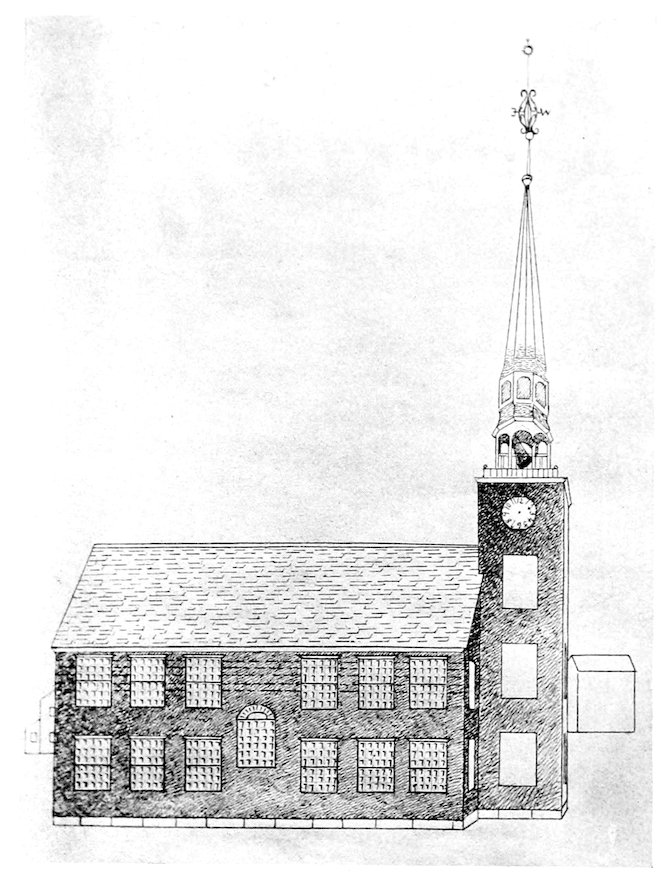
Pl. XXX.—Where Lyman Beecher preached From pencil drawing by Mary Ann Lewis
179
CONNECTION OF REV. LYMAN BEECHER WITH THE SCHOOL.
The Rev. Lyman Beecher was called to the Congregational Church in Litchfield, and moved there in 1810. From his autobiography, and the writings of members of his family, and the autobiography of Edward Mansfield, the following passages have been culled to show his friendship for Miss Pierce, and his marked influence on the school for some years.
His daughter, Miss Catherine E. Beecher, writes:[43]
“Among those associated most intimately with my father, (Rev Lyman Beecher) and his family during his whole Litchfield life was Miss Sarah Pierce, a woman of more than ordinary talent, sprightly in conversation, social and full of benevolent activity. She was an earnest Christian, and, being at the head of a large school of young ladies, found frequent occasions for seeking counsel and aid from her pastor. In return she gave gratuitous schooling to as many of our children as father chose to send, for occasionally young boys found admission.
“Her school house was a small building of only one room, probably not exceeding 30 ft by 70, with small closets at each end, one large enough to hold a piano, and the others used for bonnets and over garments. The plainest pine desks, long plank benches, a small table and an elevated teacher’s chair, constituted the whole furniture. When I began school there, she was sole teacher, aided occasionally by her sister in certain classes, and by her brother in law in penmanship. At that time the ‘higher branches’ had not entered female schools. Map-drawing, painting, embroidery and the piano, were the accomplishments sought, and history was the only study added to geography, grammar and arithmetic. In process of time her nephew, Mr. John Brace became her associate and introduced a more extended course. At the time father came, the reputation of Miss Pierce’s school exceeded that of any other in the country.
“Thus while Judge Reeves’s law school attracted the young men 180from all quarters, the town was radiant with blooming maidens both indigenous and from abroad.
“Miss Pierce had a great admiration of the English classics and inspired her pupils with the same. She was a good reader, and often quoted or read long passages of poetry, and sometimes required her pupils to commit to memory choice selections. Her daily counsels were interspersed with quotations from English classics. Even the rules of her school, read aloud every Saturday, were rounded off in Johnsonian periods, which the roguish girls sometimes would most irreverently burlesque.
“Her great hobby was exercise for health in which she set her example by a morning and evening walk, exhorting her pupils to the same. In consequence every pleasant evening witnessed troops of young people passing and repassing through the broad and shaded street to and from the favorite Prospect Hill. Of course the fashion extended to the law students, and thus romances in real life abounded on every side. Multitudes of fathers and mothers in this nation have narrated to their children these evening strolls as the time when their mutual attachment began.
“Miss Pierce had a quiet relish for humor and fun that made her very lenient towards one who was never any special credit to her as a pupil. There was one custom in Puritan New England at that day which was a curious contrast to other points of strictness and that was to close a school term with a dramatic exhibition. Miss Pierce not only patronized this, but wrote several very respectable dramas herself for such occasions in her school, and when the time approached, all other school duties were intermitted. A stage was erected, scenery was painted and hung in true theatre style, while all wardrobes of the community were ransacked for stage dresses.”
His daughter, Mrs. Harriet Beecher Stowe, writes:[44]
“Compositions of a graver cast, romantic or poetic, were also much in vogue in the literary coteries of Litchfield. The history and antiquities of the Bantam Indians formed the themes of several ballads and poetical effusions, one of which by Miss Catharine Beecher, and two by the head teacher of the Female Academy, Mr. John P. Brace, were in the mouths and memories of many persons.
“The poetic compositions of this gentleman were constantly circulating among the young ladies of his school and the literati of the place, and there was a peculiar freshness of enjoyment and excitement in this species of native unpublished literature.
181“Mr. Brace was one of the most stimulating and inspired instructors of the Academy. He was widely informed, an enthusiast in botany, mineralogy and the natural sciences generally, besides being well read in English classical literature. The constant conversation which he kept up on these subjects tended more to develop the mind and inspire a love of literature than any mere routine studies. The boys were also incited by his example to set up mineralogical cabinets, and my brother George tramped over the hills in the train of his teacher, with his stone-hammer over his shoulder, for many delightful hours. Many more were spent in recounting to me the stores of wisdom derived from Mr. Brace, who, he told me with pride, corresponded with geologists and botanists in Europe, exchanging specimens with them.
“This school is the only one I ever knew which really carried out a thorough course of ancient & modern history. Miss Pierce, with great cleverness had compiled an abridgment of ancient history, from the best sources, in four volumes, for the use of her pupils; after which, Russell’s ‘Modern Europe,’ with Coot’s continuation, and Ramsay’s ‘American Revolution,’ brought us down nearly to our own times.
“The interest of those historical recitations with a preceptor so widely informed, and so fascinating in conversation as Mr. Brace, extended farther than the class. Much of the training and inspiration of my early days consisted, not in the things which I was supposed to be studying, but in hearing while seated unnoticed at my desk, the conversation of Mr. Brace with the older classes.
“There from hour to hour I listened with eager ears to historical criticisms and discussions, or to recitations in such works as ‘Paley’s Moral Philosophy,’ Blair’s ‘Rhetoric,’ Alison’s ‘On Taste,’ all full of most awakening suggestions.
“Mr. Brace exceeded all teachers I ever knew in the faculty of teaching composition. The constant excitement in which he kept the minds of his pupils—the wide and varied regions of thought into which he led them, formed a preparation for teaching composition, the main requisite for which, whatever people may think, is to have something which one feels interested to say.
“His manner was to divide his school of about a hundred into divisions of three or four, one of which was to write every week. At the same time, he inspired an ambition by calling every week for volunteers, and there were some who volunteered to write every week.
“I remember I could have been but nine years old, and my handwriting hardly formed, when the enthusiasm he inspired led me, greatly to his amusement to volunteer to write every week.
“The first week the subject of composition chosen by the class was 182‘The Difference between the Natural and Moral Sublime.’ One may smile at this for a child of nine years of age, but it is the best account I can give of his manner of teaching to say that the discussion which he held in the class not only made me understand the subject as thoroughly as I do now, but so excited me that I felt sure I had something to say upon it; and that first composition, though I believe half the words were misspelled, amused him greatly.
“As you may see, our subjects were not trashy or sentimental, such as are often supposed to be the style for female schools.”
Having thus begun what was to her the fascinating work of writing compositions, in her tenth year, so rapidly did Mrs. Stowe progress, that her essay was one of the two or three selected to be read at the school exhibition held when she was twelve years old. These exhibitions attracted to them an august assembly of visitors. Of this event Mrs. Stowe writes:[45]
“I remember well the scene at that exhibition, to me so eventful. The hall was crowded with all the literati of Litchfield. Before them all our compositions were read aloud. When mine was read I noticed that father, who was sitting on high by Mr. Brace, brightened and looked interested, and at the close I heard him ask, ‘Who wrote that composition?’ ‘Your daughter, sir,’ was the answer. It was the proudest moment of my life. There was no mistaking father’s face when he was pleased, and to have interested him was past all juvenile triumphs.”
“That composition has been carefully preserved, and on the old yellow sheets the cramped childish handwriting is still distinctly legible. The subject was certainly a grave one to be handled by a child of twelve.”
In the personal reminiscences of Edwin D. Mansfield, we find the following passage:
“Professor Stowe, then a comparatively young man, was also present, and contributed his share to the conversation. He is the best Biblical scholar I ever knew. In recent years he has published his ‘History of the Books of the Bible’ a work of great learning and great utility. His first wife, a New England lady, quite handsome and interesting, also attended the reunions. His present wife, then 183Miss Harriet Beecher, was just beginning to be known for her literary abilities. Two or three years after this time, I published in the Cincinnati Chronicle what, I believe, was her first printed story. I had heard her read at Miss Pierce’s school, In Litchfield, Connecticut, her first public composition. It surprised every one so much that it was attributed to her father, but was in fact only the first exhibition of her remarkable talents. In the reunion I speak of, she was not distinguished for conversation, but when she did speak, showed something of the peculiar strength and humour of her mind. Her first little story published in the Chronicle immediately attracted attention, and her writings have always been popular. Notwithstanding the world wide renown of ‘Uncle Tom’s Cabin,’ her real genius and characteristics were as much exhibited in her short stories as in her larger books.”
“There was no boarding-house connected with Miss Pierce’s school, and as it brought many young ladies into the place, they were obliged to be distributed in the families of the town. It was ever a great object with Miss Pierce to secure places for her pupils in the best families, who should have a good influence in forming their characters. Mrs. Beecher was already celebrated for her success in this respect, her scholars at East Hampton were perfectly under her influence through life. Some of them had even followed her to Litchfield. Miss Pierce was therefore very desirous she should take some of the young ladies into her family and this she did.”[46]
Written after the wedding of Mr. Mason and Miss Betsey Burr, by Miss C. E. Beecher:
Gray twilight now, fair harbinger of night.
Sprinkled with orient pearl her tresses light,
When gods and goddesses in state,
Assembled on Olympus’ pate,
Great Jupiter, Lord of the sky,
In a great chair erected high,
After his nod and shake of hair,
Did thus his high bequest declare.
Tomorrow night, ye gods ye know,
A famous wedding is below,
When lovely Betsey’s fate is given,
Into the hands of solemn Stephen.
184I’ve puzzled long my royal brains,
In trying different ways & means,
By which we all might present be,
The ceremony great to see.
If in our usual forms we go,
T’will terrify poor mortals so,
They’ll scamper off like frightened rats,
When followed by pursuing cats.
Therefore I’ve thought our Godheads veiled,
And in some human shape concealed,
Might dare to go; so if t’is best,
We’ll take the form each of some guest,
As I am first ’mong sons of light,
First choice is mine, and equal right,
So, as the most important guest,
I’ll be the officiating Priest.
A shout of laughter and applause,
Which shook Olympus’ base, arose,
Each God said something wondrous smart,
And every one then chose his part.
Mars said he’d be the bridegroom’s father,
And Mercury said he’d be his brother,
And Vulcan rose and stammered out,
That he would be the servant stout.
With playful action Venus rose,
And to the sire of heaven she bows;
“With your high mightiness’ good leave,”
Quoth Madam, “I’ll be Mrs. Reeve.”
Laughing Apollo bet his eyes,
She ne’er could swell to such a size,
But if she did, he thought that he
Should like her honored spouse to be.
Momus the god of wit and mirth,
Vowed then that he would visit earth,
And go as grooms-man, when he’d be
The spirit of the company.
185Huntress Diana, bow in hand,
Declared that she would bridesmaid stand,
And if they did oppose her there,
As mad she’d be as a March hare.
Up rose the Ruler of the skies,
“T’is supper time,” the Monarch cries,
“Think all are met in Yankee clime,
So we must drink but little wine,
And certainly be home by nine.
Also be still as any mice,
Or you’ll be sent off in a trice;
For tho’ it’s time for toleration,
Still steady habits rule the nation.”
He spake, & turned to seek the feast,
And likewise so did all the rest.
At length arrived the eventful night,
And though the stars shone cold & bright,
Tho’ Boreas piped his loudest blast,
And snow’s chill mantle earth o’ercast,
The gods, who fear not wind nor weather,
In mortal shapes soon flocked together.
And sure no maker of a feast,
Was ever like the Parson blest,
For his great room from six till nine,
Was filled with company divine.
There in Louisa’s graceful mien,
Was silver footed Iris seen,
Spring’s lovely goddess you might spy
In Theo’s ever laughing eye.
Minerva wise, the warrior maid,
Was in Miss Pierce’s form arrayed,
And Juno, as the parson’s spouse,
Did do the honours of the house.
Momus in shape of Mr. Brace,
Came laughing in & took his place,
Diana at the bride’s right hand,
In Catherine’s form was seen to stand.
186Ah, honest bridegroom, & fair bride,
Ye little ken who graced your side!
Little ye thought these Yankee duds,
Clothed naught but goddesses & gods,
Venus from mortal eye close veiled,
All her immortal charms concealed,
Toiled on in shape of Mrs. Reeve,
The Gods their eyes could scarce believe,
And every one laughed in his sleeve.
And many a wink, & many a nod,
Was sent by Goddess & by God,
And scarce they could contain their glee,
Their strange & altered shapes to see.
Now entered high imperial Jove,
Father of all the Gods’ above,
From Ida’s top, Tho’ form & feature
Acknowledged him as Dr. Beecher.
With reverend look & solemn pace,
He stepped before the bridegroom’s face,
“Are the banns ready to be tied?”
“Ready, aye ready,” Stephen cried.
Then instantly by Jove’s command,
The groom did take the fair bride’s hand,
“Before these people who are met,
You Stephen take for wife your Bet,
And then to make the bargain even,
You loving Betsey take him Stephen.”
She curtisied, & his head he bent,
In sign of mutual consent,
For farther rites no more they tarried,
But all agreed that they were married.
Jove, who had learnt that t’was the fashion,
Next gave the pair an exhortation,
“Stephen, as you’ve now taken a wife,
Make it the study of your life,
Never to cross, or fret, or tease her,
But always, do your best to please her,
187And if you don’t you are forlorn,
Better that you had ne’er been born,
For if you once in duty fail,
Mop-sticks & broom-sticks thick as hail,
And all the heaviest thumps of fate,
Shall fall on your devoted pate.”
“Betsey your interest & your ease,
Require that you your husband please,
But do in all things him obey,
Or he will give his rod full sway,
For know, by right he keeps a stick,
With which he’ll give you many a lick,
To teach you in the married state,
Some joys, but many crosses wait.”
Down in her chair, sad Betsey sat,
As melancholy as any cat,
And Stephen looked as if he thought,
The neighbo’ring blessing dearly bought.
When Juno whispered, “T’ is too bad,
To frighten this poor lass & lad.
You make it ten times worse than t’ is.
See how you lengthen out their Phiz.”
Then turned she to the married pair.
And whispered comfort in their ear.
“Now don’t be scared, & don’t be flurried,
For t’ is a fine thing to be married,
I’ve tried it, & of course know best,
And husband certain is in jest,”
And now the immortal company
Jocund & lively ’gan to be;
Some joked, some laughed & kissed the bride,
And, to make poetry, some tried.
Some put cake through the wedding ring,
And some did talk, & some did sing,
When, oh! most awful to relate,
Urged on by some relentless fate,
Old Capt, Smith the bell did ring,
And all like frightened birds took wing,
And as my muse among them soared,
I cannot write another word.
On a little gingerbread man that Miss C. Beecher gave Louisa Wait on New Years:
A happy New Year to Louisa my dear,
And many a blessing her heart to cheer,
As I very well know, you hate a live beau,
I send you one, thats made of dough,
You’ll like him much, (as Bill say’s) “by thunder,”
For such a fine fellow, is really a wonder,
He’s a miracle Louisa, without any doubt,
And when his good qualities you shall find out,
Soon as modesty sweet, will allow you to meet him,
You’ll love him so dearly, I fear you will eat him.
188