1811–1820. (continued 2)
Reading edition
And fix’d attention to thy slightest wish
Can sooth the sorrows of thy woe worn heart
Tirzah will spend her life to make thine tranquil.
(Enter Attendant.)
Attendant.
The worthy Agnes with her three sweet children
Desire to see thee.
Elizabeth.
I bade her come. Promis’d her feeble age
Should find protection in my native country
I dread to see her; her tears will melt
Her gratitude oppress me.
(Enter Agnes and her three grandchildren)
140Agnes.
Did I then visit Israel’s land for this.
(To Jephthah who during this scene is walking in a gloomy but determined silence in the back part of the stage.)
Can’st thou who taught our savage race humanity
Can’st thou infringe its inviolable rights
And must Elizabeth, the kind the good,
She at whose presence ev’ry sorrow fled
At whose approach even misery smiled
Must she be sacrificed?
Ye powers of kindness melt his heart to pity
Oh how the poor will rue this dire event
I bro’t you here dear babes to thank your generous friend
But she no more will cheer your fainting souls
No more with her own hands your forms adorn
She’s going to join her kindred angels
Lift up you [little innocent] hands with mine sweet babes
Perhaps our prayers may move stern Jephthah’s heart
Come let us kneel and urge him to relent.
(As Agnes and the children kneel Jephthah goes out.)
Elizabeth.
(Raising Agnes and the children.)
My good old friend, I thank thy honest zeal
But do not by thy grief distress my father
Thy little innocents, shall ne’er want friends
My mother do not say that thou art childless
I give these helpless orphans, for thy children
Guard them I pray thee for Eliza’s sake.
From ev’ry vice, and form their minds to virtue.
Bethulah.
Sweet babes ye ne’er shall want a mother’s care
While sad Bethulah owns this wretched being.
Elizabeth.
Tirzah wilt thou attend the little guests.
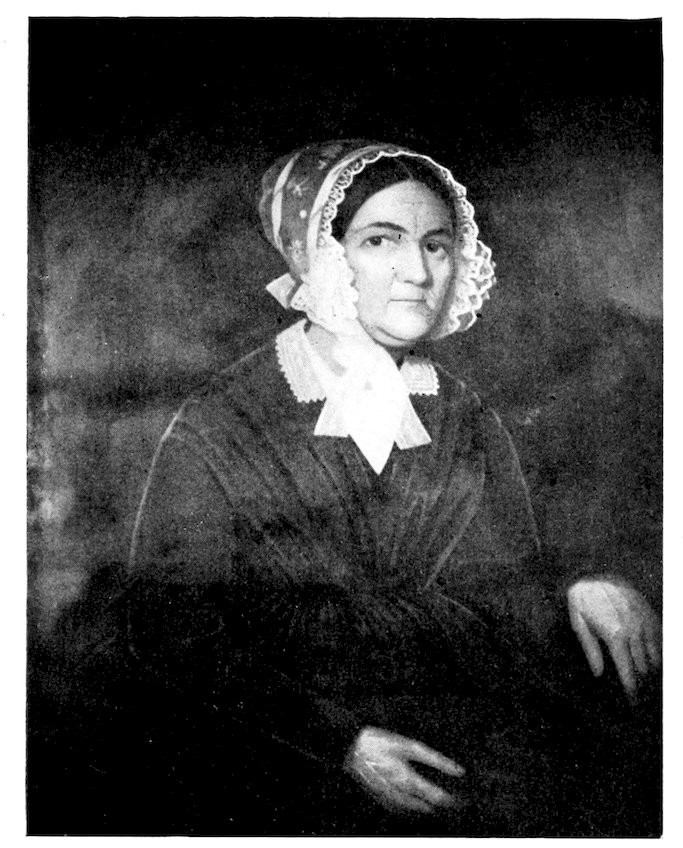
Pl. XXVI.—Julia Chittenden, Pupil, 1800
141(Tirzah leads the children to the back part of the stage.)
Elizabeth.
Mother I have one more request to make
If thou wilt grant it, I shall leave the world
With less regret, without one secret pang.
Bethulah.
What can’st thou ask my darling child
Which thy fond mother will not joy to give.
Elizabeth.
I fear thou hast not forgiven my father
The hasty vow which binds me to the tomb
Forgive him my dear mother I entreat
It wrings my heart to see my parent’s coldness
Oh let no tears of hatred bathe my tomb.
Bethulah.
My dearest child, I have I will forgive him.
Elizabeth.
Then let us seek him that I may view once more.
Returning peace and love within this dwelling.
(Exit Bethulah leaning on her daughter.)
Agnes.
Sweet flower untimely torn from life
In virtues course mature
Short is thy race, but glorious as the sun(light)
Thy innocence more fragrant than the morn
Shall rise in spotless incense to the skies
Sweet babes imprint her image on your hearts
Copy her bright unsullied life in yours
Her smile was charity her heart all love
Her lips drop’d comfort to the wounded heart
Oh may her parting pangs be few
Few as the stains, which sully her pure life.
142Act
Scene I.
(A grove.)
(Elizabeth, Tirzah.)
Elizabeth.
Farewell sweet fields deck’d in the pride of spring
No more thy verdant charms shall meet my view
Ye harmless flocks, no more my fond companions
Shall ye delight me with your sportive gambols
Another now must watch your tender lambs
Another hand must guide you to the field
And thou fair sun, bright image of our Maker
No more thy beams shalt wake the joyous morn
And light my eyes to greet this beauteous earth
Farewell oh world, thy joys I know are fleeting
But still entwine frail man around thy heart
And is it Tirzah, is it a crime to love
The tender reverend name of parent
With such affection, such unbounded fondness
That this torn heart, drawn by the ties of nature
Cleaves fast to earth, and loses sight of heaven
If tis a crime to love with so much ardour
Why rests so many virtues on the passion
And if our friendship ends with mortal being
Why glows its flame more bright at death’s approach.
Tirzah.
Friendship and filial love my dear Elizabeth
Will find a place no doubt in heavenly bosoms
And if our fondness for our earthly friends
Does not exceed the love of our Creator
Tis innocent, nay more a lovely virtue
A duty which commands a blessing on it.
Elizabeth.
It is no crime I’m sure, to love a mother
Fond and good as mine, to revere a father
Whose stern virtues yield, in melting tenderness
143Towards his child. All other ties I quit
Without a struggle, but these, these tear my heart
And melt me quite to weakness.
Tirzah.
I oft have wonder’d at thy fortitude
How can thy heart so firmly meet thy fate
The wisest best of men tho’ bent with age,
Grown callous of the earth and all its pleasures
Tremble at death’s approach, and cling to life
With eager fondness. Then how canst thou my friend
Adorned with ev’ry grace, courted by ev’ry bliss
The earth affords, resign these pleasures
And scarce breath a sigh.
Elizabeth.
Bred in obscurity I feel no bliss
Allied to greatness, except the praise of virtue
Perhaps I had not met a common fate
With equal firmness. But when the world looks on
And applauds the deed, shame nerv’s the feelings
And we meet great evils with firmer patience
Than the triffling sorrows, the secret woes
Which daily rend the heart, which borne with patience
Oft make private life a scene of virtue
Worth an angel’s praise.
(Enter Pedazar, and a number of young women.)
Pedazar.
The people wait the priests are ready.
Elizabeth.
A moment more, Tirzah support my mother
I fear my fate will bend her to the tomb
Oh watch her evening hours with tender care
Try to assuage her grief, bid her remember
We soon shall meet again never to part.
And ah my friend remember
That when a few more waning suns have roll’d
Their silent course, thou too must join me in the narrow tomb
I love thee Tirzah, thou hast many virtues
144But earthly joys too much engross thy heart
Forget not my last words, sweet friend and sister
Life’s but a day a short and wintry day
Then do not waste it in forgetfulness
Of that eternal glorious morn which follows
Receive my last embrace, my last adieu
Farewell my young companions, weep not for me
To that last dwelling whither I am going
Ye all will shortly follow. Then dry your tears
Or weep for your sins, or those of Israel
Thro’ death’s dark vale we pass to realms of bliss
Seek then to adorn your souls in virtue’s robes
By faith prepare to meet the bless’d in heaven
Where I trust this day to find a happy home
Beyond the limits of yon glorious orb
With soul enlarg’d, made pure from earth’s defilement
With saints and angels, sing redeeming love
Glory on glory opening to our view,
Thro’ the never ending ages of eternity
My lov’d companions, my earliest friends
Reject not this my last, my dying counsel
Flee ev’ry pleasure hurtful to the soul
Live here as strangers, bound to a better land
Then we shall meet where sorrow never comes
Where happiness is lasting, as tis pure.
(Enter Jephthah, Elzaphan and attendant priests.)
Jephthah.
(Leading his daughter forward.)
My friends and countrymen behold your chief
Thus justly punished for his cruel vow
Here I devote my child, my only child.
Except her, I have no son or daughter
Her spotless life has been my chief delight
Sum up perfection in a female form
And you name Jephthah’s daughter. Thus to fulfill
My vow to God, I give this sacred life,
A life more dear, more precious than my own.
Let my example teach you to beware
Of rash resolves, of breaking sacred oaths
Each one here present owes a life to God
145A life of virtue, you have sworn with me
To obey his statutes, follow all his laws
Let not this precious blood be spilt in vain
But let this offering teach you to resign
Each selfish wish, each token of rebellion
And silent bend before that power who gives
Not only life but all its dear possessions.
(Jephthah hands his daughter to Elzaphan, who leads her out. A procession of young women follow. Solemn music.)
Note 1. xxx
These sentiments of Elzaphan are not to be considered as agreeing with the laws of Moses truly expounded, but we must suppose that not only Jephthah but those priests who were about him must have mistaken the meaning of the 28th and 29th verses of the 27th chapter of Leviticus, otherwise they would not have permitted Jephthah to have sacrificed his amiable daughter to his unlawful vow. Not only Jephthah but the leaders of Israel appear to have been tinctured by the idol worship so long prevalent in Israel. Saul seems also to have made a similar mistake when he devoted Jonathan. And all Israel fell into a like error when they devoted the tribe of Benjamin to destruction. The punishment in all these cases, fell on the offender, and doubtless taught the nation the true meaning of the law. See Scott’s notes on Jephthah’s sacrifice.
MRS. STOWE’S REMINISCENCES IN AUTOBIOGRAPHY OF LYMAN BEECHER.[40]
“On one occasion of this kind I had a hand in a merry joke enacted at one of the rehearsals of Miss Pierce’s favorite drama of ‘Jephtha’s Daughter.’
“It was when Jephtha, adorned with a splendid helmet of gilt paper and waving ostrich plumes, was awaiting the arrival of his general, Pedazar—his daughter’s lover—who was to enter and say,
“‘On Jordan’s banks proud Ammon’s banners wave.’
Miss Pierce stood looking on to criticise, when having prearranged the matter, a knock was heard, and I ran forward, saying, ‘Walk in, Mr. Pedazar.’ In he came, helmet and all, saying, ‘How are you, Jep?’ who replied, ‘Hulloo, old fellow! Walk in and take a chair.’ Miss Pierce was in no way discomfited, but seemed to relish the joke as much as we young folks.
“On one occasion of this sort father came in late, and the house being packed, he was admitted by the stage entrance. Either from accident or fun, just as he was passing over the stage, the curtain rose, and the law students spied him and commenced clapping. Father stopped, bowed low, amid renewed clapping and laughter, and then passed on to his seat.”
146