1792–1793. CONTEMPORARY NOTICES OF MISS PIERCE AND HER SCHOOL.
Reading edition
We know very little about the early stages of the school, and therefore the following extracts from contemporary writers give us all that can be learned about its origin and the reasons for its establishment. Tradition says it was begun with one pupil in Miss Pierce’s dining-room in 1792.
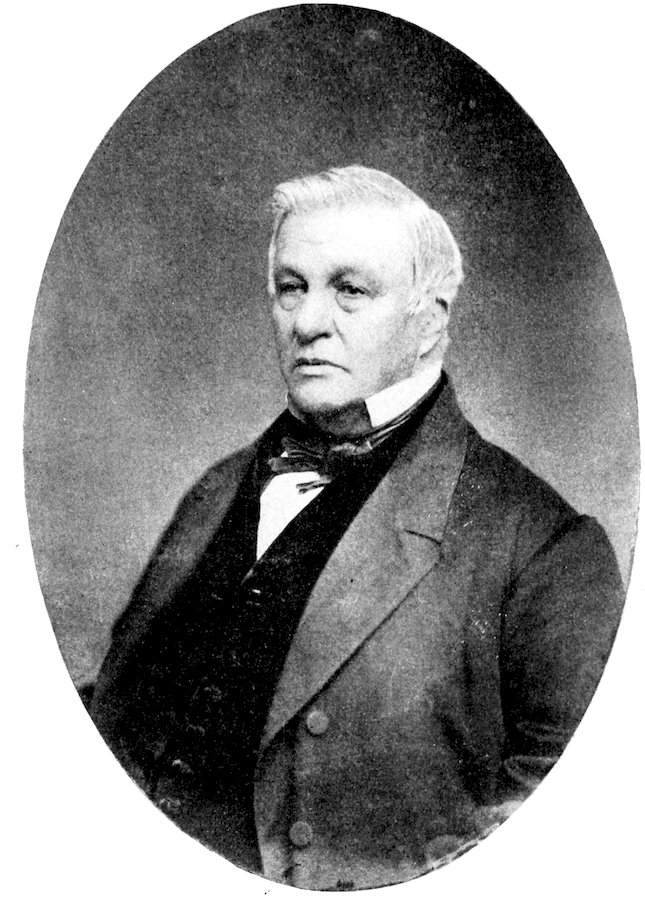
Pl. II.—John Pierce Brace
7[From the History of the Town of Litchfield, by the Hon. George C. Woodruff.]
“Miss Sarah Pierce opened a School in this town for the instruction of Females, in the year 1792, which has very justly merited and acquired a distinguished reputation.”[2] The school continued under her superintendence for nearly forty years, and its reputation has since been well sustained by her successors. It was incorporated in the year 1827, by the name of “The Litchfield Female Academy.”
[From Hollister’s History of Connecticut.]
To this pleasant little village among the hills came the very flower and nobility of American genius. Here might be seen Calhoun, Clayton, Mason, Loring, Woodbury, Hall, Ashley, Phelps, and a host of others, who were preparing themselves for the high places of the cabinet, the senate and the bench.
The influence of these sages upon the laws of the country was almost rivalled by the efforts of Miss Sarah Pierce, in another department of learning. This lady opened a school for the instruction of females in the year 1792, while the law school was in successful operation, and continued it under her own superintendence for nearly forty years. During this time she educated between fifteen hundred and two thousand young ladies.[3] This school was for a long period the most celebrated in the United States, and brought together a large number of the most gifted and beautiful women of the continent. They were certain to be methodically taught and tenderly cared for, and under her mild rule they could hardly fail to learn whatever was most necessary to fit them for the quiet but elevated spheres which so many of them have since adorned. Miss Pierce lived to the advanced age of 83. She was small in person, of a cheerful, lively temperament, a bright eye, and a face expressive of the most active benevolence. She was in the habit of practicing herself all the theories that she taught to her pupils, and, until physical infirmities confined her to her room, would take her accustomed walk in the face of the roughest March wind that ever blew across our hills. The intelligence of her death cast a shade of sadness, over many a domestic circle, and caused many a silent tear to fall.
While these two schools were in full and active life, Litchfield was 8famed for an intellectual and social position, which is believed to have been at that time unrivalled in any other village or town of equal size in the United States.
[From an Address by the Hon. Samuel Church, Chief Justice of Connecticut, at the Centennial Celebration of Litchfield, Aug. 13, 1851.]
A new tone to female education was given by the establishment of a Female Seminary, for the instruction of females in this village, by Miss Sarah Pierce, in 1792. This was an untried experiment. Hitherto the education of young ladies, with few exceptions, had been neglected. The district school had limited their course of studies. Miss Pierce saw and regretted this, and devoted herself and all of her active life to the mental and moral culture of her sex. The experiment succeeded entirely. This Academy soon became the resort of young ladies from all portions of the country—from the cities and the towns. Then the country was preferred, as most suitable for female improvement, away from the frivolities and dissipation of fashionable life. Now, a different, not a better practice, prevails. Many of the grandmothers and mothers of the present generation were educated as well for genteel as for useful life, in this school, and its influence upon female character and accomplishments was great and extensive. It continued for more than forty years, and its venerable Principal and her sister assistant now live among us, the honored and honorable of their sex.
John Pierpont in his Centennial Poem (1851), says:
Still, for her shrewdness, must the “Nutmeg State”
As Number One, among her sisters rate;
And which, of all her counties, will compare,
For size or strength, for water, soil or air,
With our good mother county?—which has sown
Her children, broad-cast, o’er a wider zone,
Around the Globe? And has she not, by far,
Out-done the rest, in giving, to the bar,
And to the bench,—for half of all her years—
The brightest names of half the hemispheres?
Nor have “Creation’s lords” engrossed her care;
Creation’s ladies have received their share:—
For, when to Reeve and Gould the former came,
To Pierce the latter:—Pierce, an honored name!
9Yea, thrice and four times honored, when it stands
Beside his name, who comes, with bloody hands,
From fields of battle; though the applauding shout
From myriad mouths—and muskets—call it out;
Though by him, armies were to victory led,
And groves of laurel grow upon his head!
Bloodless the honors that to Pierce are paid:
Bloodless the garlands on her temples laid.
To them, reproachful, no poor widow turns;
No sister’s heart bleeds, and no mother mourns
To see them flourish. Ne’er shall they be torn
From off her honored brows. Long be they worn,
To show the world how a good Teacher’s name
Out-weighs, in real worth, the proudest warrior’s fame!—
One of the earliest mentions of Miss Sarah Pierce occurs in a letter dated September 3, 1793, from Mrs. Dothee Cutler to her sister, Mrs. Huldah Sheldon, first wife of Dr. Daniel Sheldon, one of the most prominent physicians of the State. Her little daughter Nancy (aged eight) had died at Miss Pierce’s school. After writing of her grief at her loss she says:—
“The amiable Miss Pierce is going home. I fear I Shall be Still more lonely, but I will try to be cheerful. I esteem Sally for her goodness of heart. She is a good Girl and I think I Shall not forget her kindness to me or the attention She paid that much loved child.”
[Litchfield Eagle, June 23, 1823.]
The Law School in this place has not for a number of years been as full and as flourishing as at this time. The names of the Students will be published as heretofore, at the end of the term, and we believe the same remarks as to its healthy and flourishing state may be also applied to the Female Academy.
The reputation of each of these schools stands extremely high.—The number of either we do not know, but it is believed they have not for many years been better filled. It will be recollected that each of these schools have always depended solely on individual effort and talent, for their success. They have, with the aid of these alone continued to flourish while others of similar object have dwindled, remained stationary, or ceased to exist with all the Legislative aid, or College endowments they could obtain.
10