1825. MARY PECK—HER ALBUM.
Reading edition
The name of Mary W. Peck occurs in the list of pupils for the year 1811, and is placed among that of the teachers for the year 1825 as instructor of drawing. She was the step-daughter of Dr. Abel Catlin, and lived with him in the Frederick Deming house. She married Edward D. Mansfield, whose account of his coming to Litchfield to study law is given earlier in this book. That he found something there to study besides law is evident.
Mr. Mansfield gave Miss Peck an album on January 8, 1825, which is filled with a large collection of delicate paintings showing great skill in the use of her brush, with many locks of the hair of her friends, arranged ingeniously and tastefully, and with extracts or original articles written by friends, many of them noted residents of Litchfield.
The following are the autographs in the Album of Mary W. Peck:
Catherine Beecher
Mary H. Bishop, New Haven.
Mary F. Beecher
Mr. Thomas C. Perkins
H. Beecher (Henry Ward Beecher)
John P. Brace
Lucy E. Brace
H. Buel
F. Bronson
Louisa W. Bishop, New Haven.
Dr. Abel Catlin
Flora Catlin
Mary Catlin
Geo. Catlin
242George Younglove Cutler
Mary Deming
Lucretia Deming
Charles Deming
Wm Deming
H. W. Delafield
Charles Davies West Point, May, 1827.
J. G. (James Gould)
Julia Gould
James R. Gould
Edward S. Gould
Geo. Gould
Henry G. Gould
Sally M. C. Gould
H. Holmes
Uriel Holmes
Stephen T. Hosmer, Judge Superior Court, Connecticut.
John P. Jackson, New Jersey.
Mary Lord
E. A. Lord
M. E. Landon
John R. Landon
N. Landon
Ann Elizabeth Landon
B. H. Langdon
M. A. Lewis
Jane R. Lewis
L. C. Lewis
E. W. Leavenworth Great Barrington, Massachusetts
Anna Marr Providence, Rhode Island
A. C. O. or A. C. V.
Clarissa Perkins
Henry A. Perkins President Bank, Hartford, Connecticut.
John Pierpont, poet.
Sarah Pierce (original poems)
J. Pierce
Mary Pierce
Lucy Parmelee
A. V. Parsons, Massachusetts.
Wm N. Peck
H. H. Riddel
E. Reeve (and Judge Reeve’s hair)
Wm Sheldon
Dr. Sheldon
Jane E. Shedden
Mary Smith
E. C. Stiles
David C. Sanford, New Milford Judge Superior Court, Connecticut.
Origen S. Seymour Judge Superior Court Connecticut
Henrietta S. Seymour (Mrs. G. C. Woodruff)
Benjamin Tallmadge, Colonel, Revolutionary Army.
M. Tallmadge
Susan Tracy
Oliver Wolcott, Governor,
S. W. Wolcott Connecticut.
H. H. Wolcott
E. Wolcott
M. G. Wolcott
Frederick Wolcott
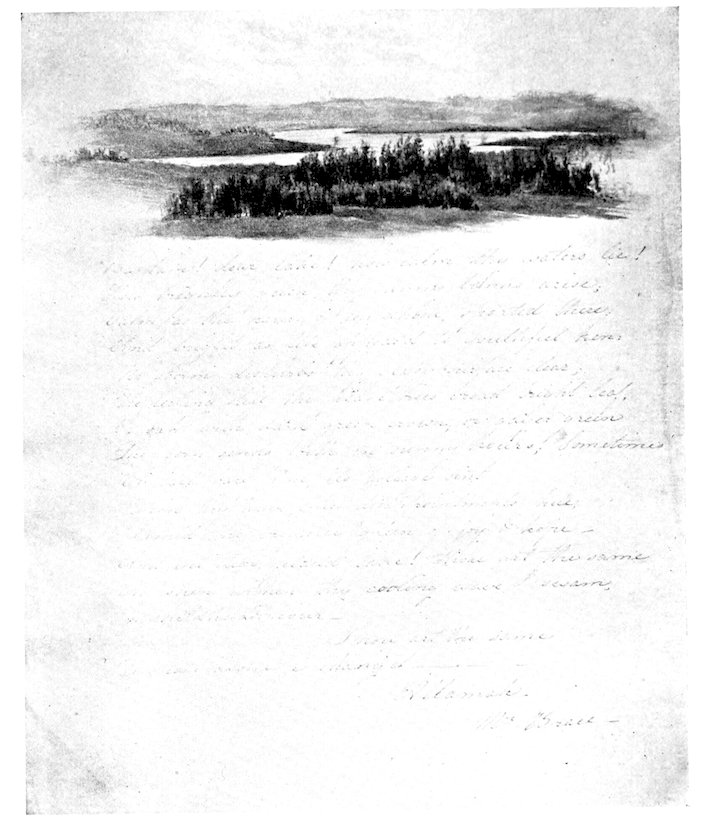
Pl. XLIV.—Bantam Lake, with Poem by Mr. Brace From Album of Mary Peck
243
EXTRACTS.
Dear Miss Mary Peck
I hardly know in what manner to comply with your kind request that I would insert in this beautiful Album a specimen of my handwriting and signature. I find it nearly filled with fine drawings and Poetical effusions which illustrate the elegant accomplishments of yourself and your numerous friends. It would be vain for me to attempt to rival so much excellence. Though I delight to peruse the works of the great Masters of human intellect yet I am no Poet.
At the present time and before my old eyes the aspect of nature has faded and I live chiefly in the recollection of Scenes that have passed. I however cherish a constant & firm belief of the future Glories which await my beloved Country and especially of their full accomplishment in the fertile regions of the American Hesperia.
I request you to remain assured that the most ardent of your young Friends cannot exceed me in sincere wishes that you may long live happy, amiable, contented and prosperous.
Oliver Wolcott.
Litchfield, April 5, 1827.
Bantam! dear lake! how calm thy waters lie!
How brightly green, thy sunny banks arise;
Calm as the hours of childhood, sported there:
And bright as life, appear’d to youthful ken;
No storm disturbs thy glassy surface clear;
Reflecting still the plane tree’s broad bright leaf,
Or oak with dark green crown; or gayer green
The corn sends forth in sunny hours; Sometimes
A tall bare pine, its foliage sent
Upon thy wave, like disappointments here,
Amid the brighter green of joy and hope—
And yet clear, placid lake! thou art the same
As when within thy cooling wave I swam,
In childhood’s hour — — — —
— — — Thou art the same
’Tis man alone is chang’d — — —
Altamah.
Mr. Brace.
244The following lines were written by Miss C. Beecher upon hearing that measures were taken to remove the remaining Indians in our country across the Mississippi:
THE INDIAN’S LAMENT.
I go from all my heart loves best,
On to the dark Pacific wave,
For the poor Indian ne’er can rest,
But in his grave!
From every well known wood, & wild
Where every dearest hope was born
From all that charm’d me since a child,
I go, forlorn!
My smiling fields, where harvest waves,
My peaceful hut, I love so well;
My fathers bones, and mossgrown graves,
A long farewell!
My outcast babes, that lingering stand
And weep to leave your mothers grave,
From the oppressors greedy hand—
What power can save?—
Thou great good Spirit whom we fear
Are thy red children all forgot?
Dost Thou not mark each bitter tear,
Nor heed our lot?
We go from all our hearts love best
On to the dark Pacific wave
And the poor Indian ne’er can rest
But in his grave!
“Few people comparatively are capable of Friendship; and still fewer have all the qualifications one would choose in a Friend—The fundamental point is a virtuous disposition but to that should be added a good understanding, a solid judgment, sweetness of temper steadiness of mind, freedom of behaviour, & Sincerity of heart” Seldom as these are found united I have been so fortunate as to find them blended in my friend Mary—
Ann Elizabeth Landon
Litchfield March 24, 1826.
245ON SEEING A PICTURE DRAWN BY A LADY.
How soft the tints, how sweet the face,
How mild expression glows and beams;
Beyond the fairest of our race,
Beyond the most extatic dreams.
No face so fair the painter knew,
That glow’d with feeling so refin’d,
When from abroad her eye withdrew;
And found the picture in her mind.
Stephen T Hosmer,
March 7th, 1826—
“When gathering clouds around I view
And days are dark & friends are few;
On him I lean, who not in vain
Experienced every human pain;
He knows my wants, allays my fears
And counts & treasures all my tears.
“When painful thoughts within me rise
And sore dismayed, my spirit dies,
Yet he who once vouchsafed to bear
The sickening anguish of dispair,
Shall sweetly soothe, shall gently dry
The throbbing heart, the streaming eye.
“When sorrowing o’er some stone I bend,
That covers all that was a friend,
And from his love, his voice, his smile
Divides me for a little while;
Thou Saviour mark’st the tears I shed
For thou didst weep o’er Laz’rus dead
“And Oh! when I have safely past
Through every conflict, but the last,
Still, still unchanging watch beside
My painful bed—for thou hast died,
Then point to realms of endless day,
And wipe the latest tear away
Your sincere friend
H. Beecher
246May you my dear Mary, when delighted you stray,
Where the beams of the West, shed a bright genial ray
Remember the friends, you have loved in your youth,
Whose bosoms still glow, with affection and truth.
May the home you shall choose, and the new friends you find,
Be as constant and faithful, as tender and kind,
And may you to them, be a pearl of great price,
The supporter of Truth, the suppressor of vice.
And when Time, shall have sprinkled your tresses with snow,
May the Sun of religion, cast such light on your brow,
So placid and lovely, so pure and benign,
That the beauties of youth, all with pleasure resign,
And when over your grave, is placed the green sod,
May the tears of the poor, the regrets of the good,
Pay a tribute of praise, to your mem’ry more dear,
Than is paid to the hero, or statesman’s proud bier
When the last solemn trumpet, resounds thro’ the skies,
May the friends of your heart, with the Saviour arise,
And join the bless’d throng, assembled above
In the region of holiness, glory, and Love
S Pierce
O fear not thou to die!
Far rather fear to live, for Life
Has thousand snares thy feet to try
By peril, pain, and strife—
Brief is the work of Death;
But Life! the spirit shrinks to see
How full ere Heaven recalls the breath,
The cup of wo may be.
O fear not thou to die!
No more to suffer or to sin;
No snares without thy faith to try—
No traitor heart within:
But fear, oh! rather fear
The gay, the light, the changeful scene,
The flattering smiles that greet thee here
From Heaven thy heart may wean.
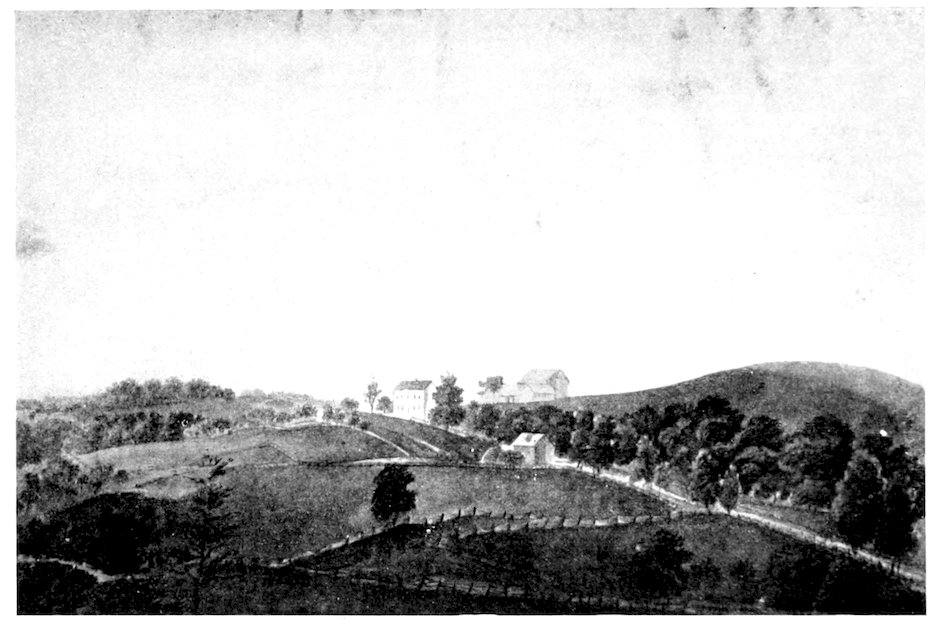
Pl. XLV.—Prospect Hill in Water-Color From Mary Peek’s Album
247O fear not thou to die!
To die and be that blessed one,
Who in the bright and beauteous sky
May feel her conflict done,—
Who feels that never more
The tear of grief, of shame shall come
For thousand wanderings from the Power
Who loved, and called her home!
Sarah Pierce
Oh often wilt thy heart be fill’d
With gleeful mirth and rapture wild;
But when thy youth has flown.
There will be heav’nly seasons mild.
When thou wilt weep alone,
And make thy sorrows all thy own.
Then welcome those delicious tears
When the faint blush of evening wears
An aspect pure and meek;
And painful thoughts of brighter years
Alleviation seek,
In joys which only tears can speak—
Oft oer thy cheeks may such “drops roll”;
Oft mayst thou feel this “flow of soul”
And weep in extacy;—
But shouldst thou think who lov’d a stroll;
In solitude; like thee;
Shed half a tear to G. Y. C.—
Geo Y. Cutler
THE GRAVES OF A HOUSEHOLD.
“They grew in beauty, side by side,
They filled our house with glee—
Their graves are severed far & wide,
By mount, and stream, and sea!
The same fond mother bent at night
O’er each fair sleeping brow;
She had each folded flower in sight—
Where are those dreamers now?
248One mid’st the forest of the west
By a dark stream is laid;
The Indian knows his place of rest,
Far in the cedar shade.
The sea, the blue lone sea, hath one,
He lies, where pearls lie deep;
He was the lov’d of all, yet none
O’er his low bed may weep.
One sleeps where southern vines are dress’d
Above the noble slain,
He wrapt his colours round his breast,
On a blood-red field of Spain.
And one, o’er her the myrtle showers
Its leaves, by soft winds fann’d,
She faded ’midst Italian bowers,
The last of that bright band,
And parted thus, they rest, who played
Beneath the same green tree,
Whose voices mingled as they pray’d
Around one parent knee!
They that with smiles lit up the hall,
And cheer’d with song the hearth—
Alas for Love! if thou wert all,
And nought beyond on earth!”
“Peace be around thee, wherever thou rovest,
May life be for thee one summer’s day,
And all that thou wishest, & all that thou lovest
Come smiling around thy sunny way—
If sorrow e’er this calm should break
May ee’n thy tears pass off so lightly,
That like spring show’rs, they’ll only make
The smiles that follow shine more brightly.
As half in shade, and half in sun,
This world along its path advances,
May that side the sun’s upon
Be all that e’er shall meet thy glances.”
E Wolcott Litchfield
May 20th 1826:
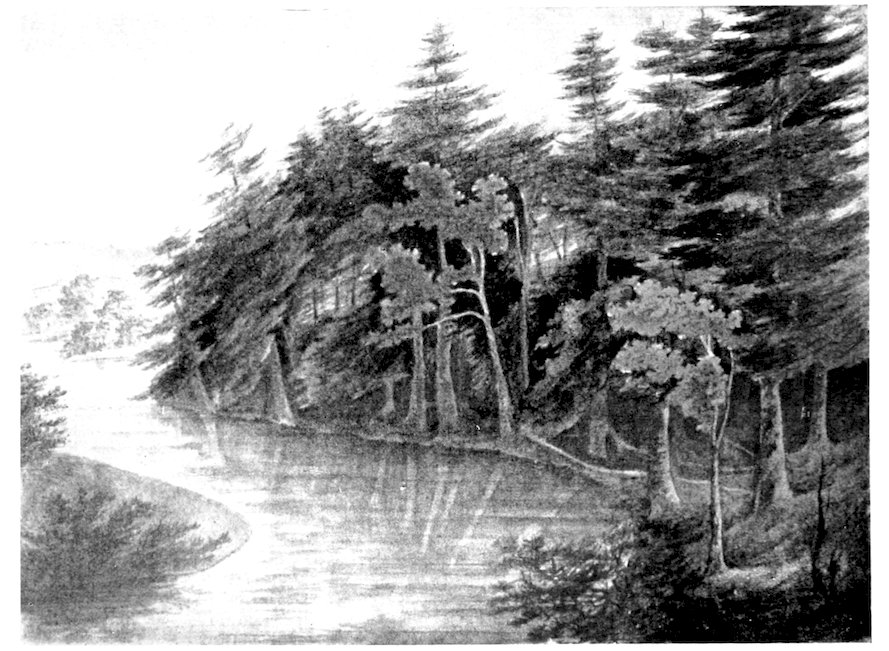
Pl. XLVI.—Love Grove or Love’s Altar on the Bantam, in Water-Color From Album of Mary Peck
249“The charms which blooming beauty shews
From faces heavenly fair,
We to the lily & the rose,
With semblance apt, compare.
With semblance apt; for ah! how soon,
How soon they all decay!
The lily droops, the rose is gone,
And beauty fades away.
But when bright Virtue shines confess’d,
With sweet discretion join’d,
When mildness calms the peaceful breast,
And wisdom guides the mind.
Beyond the reach of time or fate
These graces shall endure,
Still, like the passion they create,
Eternal, constant, pure.—”
Litchfield May 27th 1826 Frederick Wolcott
“I have nothing of my own Miss Peck, more worthy of a place in your album than the alternations of winter weather here in Litchfield which I have thus “done into English verse.””
JNO Pierpont
How dark are these skies! a deep drapery of cloud
Oer the smiling young face of the morning was flung:—
Noon gave not his light; and the same gloomy shroud
Round the throne of the moon, all the evening has hung.
Yet these dark skies have drest the earth
In a white robe that knows no stain.
So white-robed Virtue has her birth
In days of gloom, and nights of pain.
How sad are these skies! Their bright hues are all dead!
The morning and evening no longer are fair!
They mourn their lost sun;—and the tears, that they shed,
Are frozen, as they fall through the sorrowful air.
Yet these sad skies, whose hosts of light
Have all their glittering banners furled,
These skies are sending down, to-night,
Their treasured jewels to our world.
250So, in the hours when most we grieve,—
The hours of sadness and of sighs,
Believe me Mary,—we receive
The choicest blessings of the skies.
How cold are these skies! Hoary Winter, reclined
On his snow-wreaths, the charms of earth’s bosom deforms;
And the fields, and the groves, and the heavens are resigned
To the rule, and the wrath of the Spirit of Storms,
Yet these cold skies the earth have drest
In saint like vesture, white and warm;
And spread a mantle o’er her breast
To shield it from the freezing storm.
So not the coldest blast that flies
O’er hope’s young flowers the heart shall chill,
If in the storm, it lowly lies,
And waits the All-Ruling Spirit’s will.
How clear are these skies!—no heaven-ward mist
Going up from the earth, their bright arch dims.
Not a cloud, all the morning their fair face kissed;
Not a cloud, now at noon, in their blue depth swims.
Yet these clear skies, so pure, so bright,
So smiling,—o’er a cold world bend;—
A world where many a freezing night
And wintry day we’re doomed to spend.
Then, when the world looks cold on you,
And your lone heart with grief is swelling,
Look up!—for all the pure and true,
There is a high and holy dwelling.
14 Jany. 1827.—
HYMN FOR A DYING BED.
Composed by C. Beecher, for L. Waite.
And is there one who knows each grief,
And counts the tears his children shed,
Whose soothing hand can bring relief
And smooth, and cheer their painful bed?
Saviour, invisible, yet dear!
Friend of the helpless, art thou near?
251Forgive the faltering faith, & fears
Of this weak heart that seeks thine aid,
Forgive these often flowing tears,
Thou! who has fainted, wept, & pray’d—
Ah! who so well our wants can know,
As He who felt each human woe!
Yes, Thou has felt the with’ring power
Of mortal weakness, & distress,
And Thou hast known the mournful hour.
Of desolating loneliness—
Hast mourn’d thy friends, so faithless fled,
And wept in anguish o’er the dead.
Cast out to seek the lowliest shed,
The rich, the great despised thy name,
And thou didst seek thy daily bread,
Mid poverty, reproach, & shame—
Forgive a heart that can repine
To share a lot more blest than Thine—
And Thou hast tried the Tempter’s power
And felt his false & palsying breath,
Hast known the gloomy fears that wait
Along the shadowy vale of Death—
And what the dreadful pangs must be
Of life’s last parting agony.
My only Hope! My Stay, My Shield!
Thy fainting creature looks to Thee—
Thy soothing peace, thy guidance yield
In this, my last extremity;—
With Thy dear, guardian hand to save
I venture downward to the grave!
THE WATER LILY.
This flower that so lovelily pleads for a sigh
Unnotic’d was born unnurtur’d to bloom;
Its fate had decreed it to wither and die
Where no heart of affection might weep o’er its tomb.
252But chance has bequeath’d it in beauty to thee;
And in beauty it lives on the page of thy heart;
And while memory lingers or life shall endure
That flower from remembrance can never depart.
And thus, when between us Time’s current shall roll,
When mountains and waters our fortunes shall sever,
On thy tablets of Friendship my name I’d enrol
To live in thy cherish’d remembrance forever.
Edward S. Gould
Litchfield 25, Jany, 1826.
Tho’ in distant lands we sigh
Parched beneath a burning sky
Tho’ the deep between us rolls
Friendship shall Unite our Souls,
And in fancy’s wide domain
There may we both meet again
When the dreams of life are fled
When its wasted lamps are dead
When in cold oblivious shade
Beauty, Wealth, and Fame are laid
Where immortal spirits reign
There may we all meet again
E Reeve
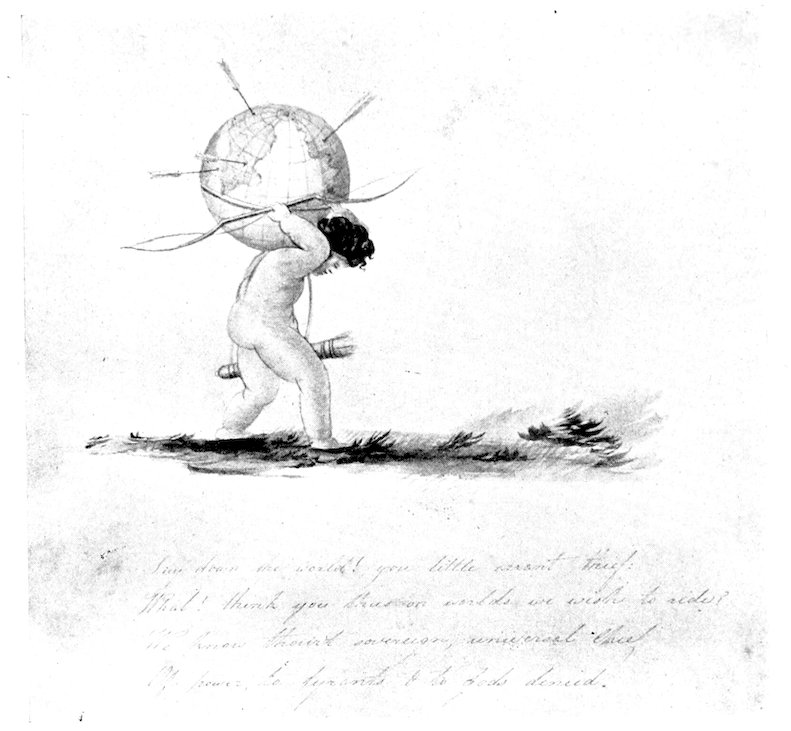
Pl. XLVII.—Love carrying the World By George Catlin, painter of Indian Pictures in Smithsonian Institute From Mary Peck’s Album
Oh can you forget, when you stood round the bed
When Helen address’d you with ardour & love,
How your Souls hung in rapture on all that she said,
When she urg’d you to place your affections above?
Clarinda[65] has died, on the bed where I lie;
“And what is the profit that you have receiv’d?
“And now must Young Helen be summon’d to die
“And no lasting benefit hence be atchiev’d?
“Must Victim on Victim go down to the Grave,
“To teach their Survoivors the shortness of life;
“And will you not strive, dear Companions, to save
253“That precious betrustment[66] which time must survive?
“Believe dying Helen; this world is a snare;
“Its pleasures & Honors can never suffice;
“Of all its fair promises ever beware,
“And place your best treasure secure in the Skies.”
But all is now silent. The Spirit has fled
To Mansions of Glory, or Shades of despair;
The body now sleeps in the Tomb of the dead,
Awaiting the Sound of the Trump to appear.
Benjn. Tallmadge
ON THE DEATH OF MISS HELEN PECK.
Can an earthly mind tell, when the plants of life wither
They will flourish again, in a kindlier soil?
Can an earthly eye trace the bright journey thither,
When the soul has escap’d from the world’s sin & toil?
’Tis the gospel alone, when an earthly plant dies,
Shows it blooming and fresh in a heavenly bower;
’Tis the gospel alone marks the Soul as it flies
To the regions of light, by omnipotent power—
Then; think not that She, who once bloom’d on this earth,
As fair as the flower that in Eden first grew,
Has lost the least tinge of her mildness and worth:
Death cannot distroy them, or alter their hue—
The stream, that once flow’d in this storm beaten vale
Tho’ its passage is stop’d, yet, in source, is not dried;
It will burst forth anew, unreach’d by the gale,
While the river of life rolls its waves by its side.
Tho’ she sank, like the leaf, when in spring time, it falls,
Yet she has not endur’d the last death pang in vain:
For her moment of life, Oh! how loudly it calls,
To look, as she look’d, from this region of pain.
J. P. Brace—
254Perhaps we part, no more to meet,
And who, my friend, can show
What scenes of sorrow, or of joy,
Await us here below?
Though life to you is in its morn,
And youthful pleasures court
Its fairest rose conceals a thorn,
Its longest space is short.
But Oh! there is a better state,
Where hopes unfading bloom,
There is a brighter land that gleams
Across the darken’d tomb.
There may we meet, in that blest home,
Where none shall sigh with pain,
Where hours of parting never come,
Now human frailties stain.
M Tallmadge
Bantam! dear lake! how calm thy waters lie!
How brightly green, thy sunny banks arise;
Calm as the hours of childhood, sported there:
And bright as life appear’d to youthful ken:
No storm disturbs thy glassy surface clear;
Reflecting still the plane trees broad bright leaf,
Or oak with dark green crown; or gayer green
The corn send forth in sunny hours; Sometimes
A tall bare pine, its foliage sent
Upon thy wave, like disappointments hue,
Amid the brighter green of joy & hope—
And yet clear, placid lake! thou art the same
As when within thy cooling wave I swam,
In childhoods hour — — —
— — — Thou art the same
’Tis man alone is chang’d—
Altamah.
Mr. Brace
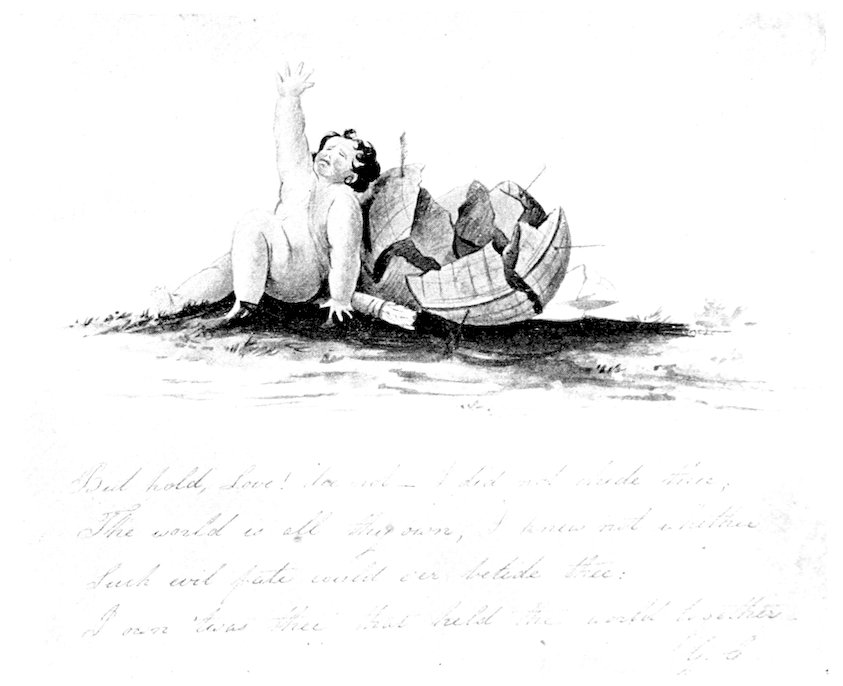
Pl. XLVIII.—Love’s Fall By George Catlin, in Mary Peck’s Album
255
THE RULES OF LITCHFIELD ACADEMY. 1825—
From the copy made by a pupil, Charlotte Phelps, who married George D. Cowles, of Farmington.
1st. You are expected to rise early, be dressed neatly and to exercise before breakfast. You are to retire to rest when the family in which you reside request you. You must consider it a breach of politeness to be requested a second time to rise in the morning or retire of an evening.
2nd. You are requested not only to exercise in the morning but also in the evening sufficiently for the preservation of health.
3rd. It is expected that you never detain the family by unnecessary delay; either at meals or family prayer. To be absent when a blessing is asked at table, or when the family have assembled to read the word of God, and to solicit his favor, discovers a want of reverence to his name, and shows that you have a cold heart destitute of gratitude to the author of all good.
4th. It is expected as rational and immortal beings that you read a portion of Scripture, both morning and evening with meditation and prayer. That you never read the word of God carelessly or make use of any Scripture phrase in a light or trifling manner
5th. It is expected that you attend public worship every Sabbath, except some unavoidable circumstance prevent, which you will dare to present as a sufficient apology at the day of judgment.
6th. Your deportment must be grave and decent while in the house of God; all light conduct in a place of worship is not only offensive to God but an indication of ill breeding; and highly displeasing both to the good and the polite.
7th. The Sabbath must be kept holy, no part wasted in sloth, frivolous conversation or light reading. Remember that for all our time, but particularly for the hours of the Sabbath, you must give an account.
8th. Every hour during the week must be fully occupied either in useful employments, or necessary recreation. Two hours must be faithfully devoted to close study each day, while out of school: and every hour in school must be fully occupied. (For every hour wasted in school you must give yourselves a whole miss under the rules.) The ladies where you board must mention if you do not study your two hours each day.
9th. You must never interrupt your companions by talking, or any 256other disturbance during the hours of school, or those set apart for study.
10th. The hours appointed for any particular study or occupation must not be employed in any other way, but the appointed lesson.
11th. You must suppress all emotions of anger, fretfulness and discontent. Bear always in your memory the many blessings God is continually bestowing upon you, for which he requires not only contentment but a cheerful temper.
12th. The truth must be spoken at all times though it might seem more advantageous to tell a falsehood.
13th. You are expected to be polite in your manners, neat in your persons and rooms, careful of your books, clothes and every article of use.
14th. Tale bearing and scandal are odious vices and must be avoided: neither must you flatter your companions by any remarks on their beauty, dress or any accomplishment, in order to increase their vanity, and let every one thus flattered remember that such compliments are an insult offered to the understanding.
15th. While you are forbidden to repeat anything to the disadvantage of your companions, you are also requested to inform one of the teachers if you observe anything amiss in your school fellows which your teachers can correct. This not to be done from malice, but from a sincere desire for their reformation.
16th. Every scholar is bound to conform to the regulations of the family in which she resides. They are never to go out of an evening without permission from the lady who has the charge of them; are not to read any book, or engage in any amusement without her approbation.
17th. No young lady is allowed to attend any public ball, or sleigh party till they are more than 16 years old.
18th. Speaking or moving once in school hours either with or without liberty will take off a part of the extra—unless they move to recite or practice, or write at the tables—Speaking more than once will take off the whole extra and often give you a quarter of a miss.
19th. You must write a letter to be corrected and sent home to your friends once in four weeks—except excused. You must not write a careless note, or any careless writing. You must write a composition once in a fortnight, of 200 words. You must write at least 30 good lines in a week.
20th. You must have a lesson ready to recite when you first come into school.
21st. You must come in or go out of the school in a quiet genteel manner—you must not talk or laugh loud in the street.
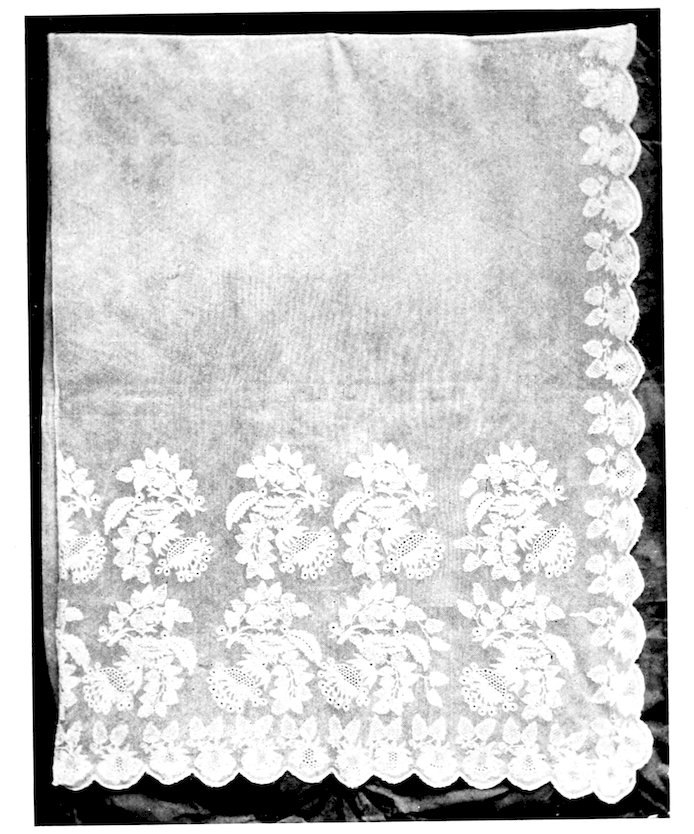
Pl. XLIII.—White Lace Veil worked by Mary Peck and worn by her at her Wedding
25722nd. You must not wear your party dresses, or any handsome lace, neither your best hats or shawls to school.
23rd. You must not walk for pleasure after 9 o’clock in the evening. A reward will be given to those who do not waste any money, books, clothes, paper or quills, during the term. To those who have their duties performed at the proper time. To those who have not been peevish, homesick or impolite. To those who always attend meeting or church. To those who never write carelessly.
CUSTOM OF EXCHANGING CHILDREN.
A custom quite general in New England in the early part of this century, there being no boarding schools, was that of friends in different parts of the country exchanging children for a certain length of time, shorter or longer. The advantages were sometimes for the sake of change of air, and sometimes for the intellectual training of the children and are known to have worked well. The following extract from a letter from one of the pupils on the list of 1825, now living, makes the custom more clear.
“My connection with the school was only for two or three months and rather accidental. A friend of my mother wishing to send a young son to New Haven for the summer of 1825 Proposed an exchange of children for the time. I was a child of such slender form and far from vigorous and my parents were glad to send me into the country. Hoping the fine climate of Litchfield would benefit me, yet not wishing me to study; but as I wanted something to do I was permitted to attend Miss Pierce’s school with the daughter of Judge Wollcott in whose family I was staying.”
Extract from a paper read May 4, 1896, before the Village Library Company of Farmington, on “Farmington Society One Hundred Years Ago,” by Julius Gay.
One of the first results of increasing wealth was a desire for a better education than the district school afforded. Already in 1792 Miss Sally Pierce had established her famous school in Litchfield under the patronage of Chief Justice Tapping Reeve, Gov. Wolcott, Col. Tallmadge, and other distinguished men, probably the first female seminary in America. Here were sent the young ladies of this village until the Farmington Academy was established. E. D. Mansfield LL.D., once connected with the “Old Red College” of Deacon Hooker, gives 258us in his “Personal Memories” an outside view of the school as it appeared a few years later, on his first visit to Litchfield.
“One of the first objects which struck my eyes was interesting and picturesque. This was a long procession of school girls, coming down North Street, walking under the lofty elms, and moving to the music of a flute and flageolet. The girls were gayly dressed and evidently enjoyed their evening parade, in this most balmy season of the year. It was the school of Miss Sally Pierce, one of the earliest and best of the pioneers in American female education. That scene has never faded from my memory. The beauty of nature, the loveliness of the season, the sudden appearance of this school of girls, all united to strike and charm the mind of a young man, who, however varied his experience, had never beheld a scene like that.”
He was about to enter the Litchfield Law School, a famous institution which gathered numerous brilliant young men, especially from the South. Their proximity might have been a disturbing element in the quiet of the young ladies school had Miss Pierce lacked the wisdom to manage discreetly what would have ruined a weaker administration. The young men were allowed to call on certain evenings, but woe to the man who transgressed ever so slightly the laws of strict decorum. To be denied admission to Miss Sally Pierce’s parlor was the deepest disgrace which could befall a young man. A school girl writes home that a “Mr. Lyde was very attentive to Miss Norton (of Farmington) and gazed at her so much that it mortified Miss Norton, and Miss Sally spoke to him and he has not been in the house since March.” It was only after much correspondence and penitence that Mr. Lyde was reinstated. On leaving the school, each girl was expected to bring home to her admiring parents some evidence of proficiency in her studies. Those who could, exhibited elaborate water-color drawings which have hung ever since on the walls of Farmington parlors. Others less gifted were advised to paint their family coat of arms, and, if they had never heard of any, they soon learned how all this could be remedied without any correspondence with the Herald’s College. One Nathan Ruggles who advertised in the Connecticut Courant “at his Looking Glass and Picture Store, Main Street, opposite the State House, city of Hartford,” had somehow come in possession of the huge volume of Edmonson’s Complete Body of Heraldry, and allowed anyone to select from its vast assortment of heraldic monsters, “Gorgons, and Hydras, and Chimeras dire,” such as suited her taste. His sole charge was the promise of being employed to frame the valuable work when done. I have seen several of these devices which were brought home from Litchfield, some done in water-colors and some in embroidery, with combinations of color which would make a herald stare. They had however just as good right to them as ninety nine out of a hundred of the families who flaunt coat-armor and pictures of English castles and all that in their published genealogies. There is no reason to suppose Miss Pierce had anything to do in obtaining these designs. Most of the embroidered arms are of a later date and were executed at a young ladies school in Hartford. Those in water-colors were most if not all of Litchfield origin. Nathan Ruggles who was responsible for all this spurious heraldry, came to an untimely end. In a private display of fireworks at his house, the whole suddenly exploded and brought his heraldic career to an all too brilliant conclusion.
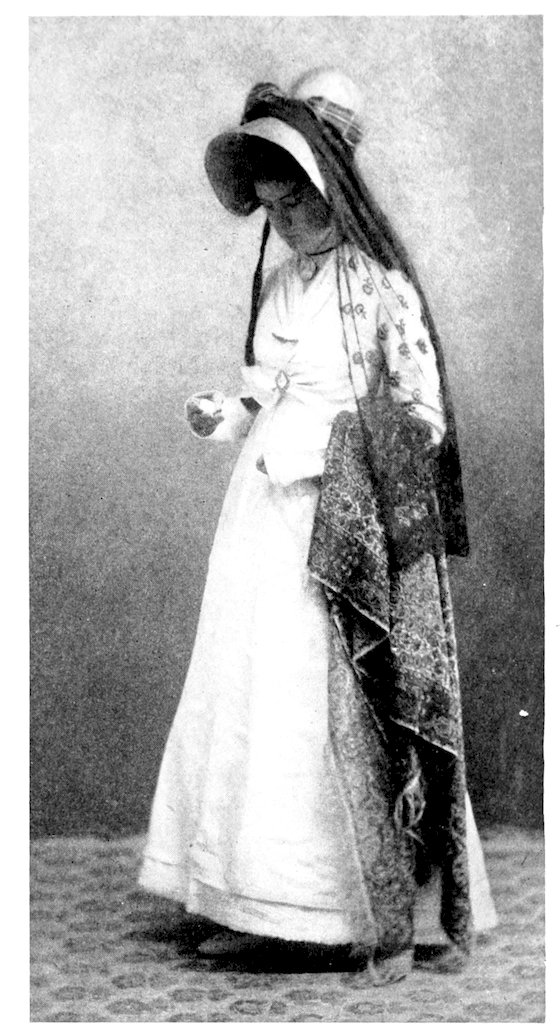
Pl. XLIX.—Old Costume from Roxbury, about 1825
One of Miss Sally Pierce’s pupils from Farmington writes of the school life “We have balls at Miss Pierce’s school better than all the balls at Middletown. We dance once a month. We have a musician and he comes by 6 o’clock and plays till 9.” On Sunday she writes “Our exhibitions are on Tuesday and Wednesday, and Thursday we dance and by Friday night I really think I shall be tired. I have been to meeting all day although it has rained very hard. Mr. Huntington preached. He is a fine preacher, I think, and very handsome.”
259