1815–1816. CATHERINE CEBRA WEBB—HER DIARY.
Reading edition
Catherine Cebra Webb was born at 84 Beekman Street, New York City, January 25, 1801, Daughter of Orange Webb (a shipping merchant of the firm of Webb and Lamb, corner Pearl Street and Burlington Slip, and ruling elder in the Old Brick Church) and Elizabeth Cebra (daughter of Mr. James Cebra, of the Custom House).
Catherine Cebra Webb entered Miss Pierce’s school in the summer of 1815, and boarded at first in the family of Lyman Beecher, until Mrs. Beecher’s death, and then with the Misses Edwards on North Street, nearly opposite the school. Catherine remained only a few months in Litchfield,—the climate proving too severe for her. July 20, 1818, she married Mr. Rensselaer Havens (a shipping merchant of the firm of Perkins and Havens, 198 Front Street, New York City, and ruling elder in the Old Brick Church for thirty years). Mrs. Havens has had eight children, nineteen grandchildren, and twenty four great-grandchildren. She has lived since 1873 in Stamford, Connecticut, and is now in her ninety-sixth year.
Frances Maria Webb, an older sister of Catherine Cebra Webb, also attended Miss Pierce’s school about 1810 or 1811, and met there Alexander Garden Fraser, of Beaufort, South Carolina, a student in Judge Gould’s Law School. Frances M. Webb was born June 5, 1796, and married Alexander G. Fraser, June 5, 1812. Frances M. Webb (Mrs. Fraser) died in Edinburgh, August 5, 1847. She has four children still living.
I left New York, Wednesday, July 11th, 1816, for Litchfield, to enter Miss Pierce’s school. I took a steamboat to New Haven, and went by stage from there to Litchfield. The Rev. Mr. Stockton, a friend of my Father’s, took me up.
I went to board in the family of Dr Lyman Beecher, but stayed there only three weeks, as his wife was so ill they could not have the care of boarders. Miss Catherine Beecher and a Miss Burr, presided over the family. Dr Beecher had a room in the attic for his Study. I had a room with two Misses Wakeman, who were also pupils at Miss 149Pierce’s school. Catherine Beecher had to send a report every Saturday of the conduct of the young ladies in her family, to Miss Pierce.
When Mrs. Beecher’s illness obliged me to leave there, they got another boarding place for me across the street, with the Misses Edwards—two sisters—Miss Nancy and Miss Betsey.
They were very religious women; and as the Sabbath began then at sunset on Saturday, we had to hurry to get our letters from the postoffice, and be back before the sun went down. After supper, the Sabbath began with religious exercises—reading of the Bible and prayer—Sunday we all went to Dr Beecher’s church. On one occasion, some of Judge Gould’s law students were talking during the sermon, when Dr Beecher paused, and looking at the square pew at the right of the pulpit, (where Judge Gould’s pupils sat) said, “I will suspend my remarks until those young gentlemen have finished their conversation.”
There were no Sunday schools in those days. On returning from church, all we had for our dinner was a piece of pie and a mug of milk, as the Misses Edwards considered it wrong to cook on Sunday. We went to an afternoon service, then had a simple tea, and when the sun went down Sunday was over; but we had prayers and went to bed.
School began at nine o’clock, and closed at noon for an hour’s recess, when we went home for our dinner and came back; but I cannot remember how long it kept in the afternoon—whether it was three or four o’clock—
Miss Waite taught me music, and I went into the back parlor of Miss Pierce’s residence, to take my lesson on the piano. I remember “The Battle of Wagram” was one of my pieces. I had a very handsome paint-box which my father had imported from England for me, and I took drawing lessons at Miss Pierce’s, but I cannot recall the teacher’s name.
I did not stay long at Litchfield, as I was a delicate girl, and it was so very cold my Mother was afraid to have me stay. I came home in the Autumn, I remember when Dr Beecher’s wife died. Her name was Roxana Foote; and I heard Dr Beecher preach her funeral sermon, standing in the little tub pulpit, while her coffin stood below it.
Miss Pierce had a nephew, John Pierce Brace, who lived, I think, next door to Miss Pierce’s, and he taught every day in the school.
Miss Mary Pierce did not teach; only Miss Sarah, She was of medium height, rather fine looking and dignified, and very religious. We had school every day; only, it seems to me that on Wednesday and Saturday we had a half-holiday.
150Among the pupils was a Miss Catherine L. Webb, from Cooperstown, (sister of James Watson Webb)—two Misses Farnham from Massachusetts—Miss Phebe Conklin from Poughkeepsie—two Misses Sanford from Jamestown (N. Y.)—and Miss Emmeline Beebe from Connecticut. (She was the one who told Miss Pierce she could not study because the girls kept up such a “cessation” through the room.) There was also a Miss Caroline Delafield, who lived at her Uncle’s, Gen’l Tallmadge’s,[41] and came to certain recitations only.
Old Grove Catlin kept the Hotel in Litchfield, and had a daughter Flora, who was quite a belle. The law students used to quiz him about his daughter’s popularity, and he said, “Yes, my daughter Flora is assassinated most every night” (meaning serenaded)—He also said he wore his old fashioned watch seal “for the antipathy of the thing,” (meaning antiquity)—Dr Beecher had two colored servants named Zillah and Priscilla—I remember their grinding the coffee for breakfast. There was a large sink in the kitchen, and a couple of basins, and we had to go there to wash—It was the only place—so of course we could not take much of a bath—which was a great trial to me.
While I was at Dr Beecher’s, the Rev. Mr. Nettleton, the revivalist, came to visit him, and I remember their drinking cider and pearlash with their breakfast.
CAROLINE CHESTER—HER DIARY—EXTRACTS FROM HER COMMONPLACE BOOK.
Caroline Chester was born in Hartford, Connecticut, 1801, married John Knickerbocker, 1824, and died at Troy, New York, 1870. She was fifteen years old when she attended the school.
DIARY.
Nov. 30, 1815. I left Hartford at eight in the morning and arrived at Litchfield about four, had very pleasant company, Mr. and Mrs. Wheeler of Hartford, and her niece, Mr. Catlin of Litchfield, and several other gentlemen whom I did not know. It rained constantly almost the whole day. West Hartford was the first place we passed through, it is a very pleasant place though a small one. Farmington is much larger, and as we passed through Main street I saw it to the best advantage. Burlington is a small place consisting of a few houses, one store, a blacksmith’s shop, a post office and one meeting house. Harwinton the last town (until we reach Litchfield) is much pleasanter than Burlington, here we left four of our passengers. After riding over many a long hill we arrived at Litchfield which agreeably surprised me. Went immediately to Mrs. Sheldon’s where for the first time I saw her and Miss Lucy.
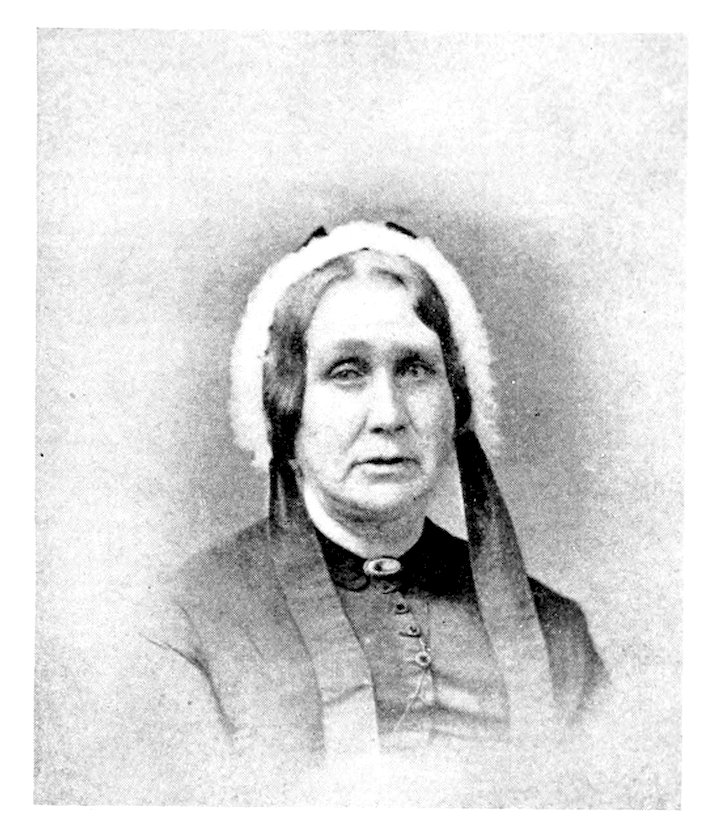
Pl. XXVIII.—Caroline Chester b. January 26, 1801. m. June 2, 1825. d. April 20, 1869
151Dec. 1st. Spent the evening at Miss Wood’s upon condition that I would not visit again for a week. Saturday was spent as usual in studying, sewing and hearing instruction. Mr. Beecher visited the school. I was very much pleased, his doctrine is plain and easy to understand.
Dec. 19th. It is one of Miss Pierce’s rules to have her scholars rise before sunrise and Dr. Swift observes “That he never knew any man come to greatness and eminence who lay in bed of a morning.” It is known that in the 14th century in England and France, people rose much earlier than they do now, and I read yesterday that Buffon said that he was indebted to one of his domestics for ten or a dozen of his works, because he had promised him a crown whenever he would wake him at six and he succeeded in his attempts. Czar Peter a famous philosopher used to rise to see the morning break, and used to say that “he wondered how man could be so stupid as not to rise to see the most glorious sight in the universe; that they took delight in looking at a beautiful picture, the trifling work of a mortal, but neglected one painted by the hand of the Deity.” Dr. Doddridge says that the difference it would make if a person should rise at five or seven for the space of forty years, supposing him to go to bed at the same hour of night, is nearly equivalent to the addition of ten years.
Dec. 20th. Called for Hannah Wolcott, and at her mamma’s request she took me to her Uncle Wolcott’s house. It is elegantly furnished. He has in his sitting room pictures of six old venerable gentlemen, a picture painted by his daughter, and a print. In his library are two large bookcases filled with books, likenesses of his wife, mother, father, daughter and her husband Mr. Gibbs. In his drawing-room are several large prints from Homer’s Iliad, the battle of Bunker’s Hill and death of General Montgomery, a large print called Marc Antony, three or four landscapes painted by Mrs. Gibbs and many others. Hannah showed me some Chinese curios, two men one holding two small boxes of tea, and the other, a curious looking personage, a Chinese woman, a pair of ladies and men shoes, stone cut in various shapes, Ivory globes made in the most elegant manner, a number of boxes, six or seven figures made of plaster of Paris, some baskets, and a beautiful collection of shells.
152Dec. 27th. Miss Mary Hooker, Miss Burr, Miss Reeves and Miss Beecher at tea. In the evening heard a long letter read from Mr. H. Sheldon. He wrote that he had visited the catacombs and asked his guide if Bonaparte had ever been there, he said “No, Bonaparte had never expressed any desire to be with the dead.”
Jan. 1, 1816. Went to school with a determination to improve all in my power, recited in History without a mistake, in the afternoon I went to Mr. Bradley’s tavern in a sleigh with Hannah Huntington, John and Mr. O. Wolcott, W. T. and Mary. Had a most delightful ride, returned with Hannah to tea, in the evening took a sleigh ride and returned home about nine. Had a great many wishes that I might have a Happy New Year.
Jan. 2. After school returned home with Louisa Seymour, and drank tea with her and enjoyed myself extremely. Mrs. Seymour is a very fine woman and endeavored to have our time pass agreeably. I almost froze returning home, for the cold was excessive.
Thursday. After school took a walk with Margaret Hopkins of Philadelphia. I am very much pleased with her, she is not only beautiful, but amiable, kind, generous and sweet tempered. Dr. Fowler drank tea at Dr. Sheldon’s and staid through the night. After studying an hour I went to Mr. Brace’s where I spent the evening most agreeably and saw a plenty of butterflies and spiders. I returned home about nine, attended family prayers and retired to my room.
Thursday. I rose as usual early and exercised, knit and mended my school frock, when it was finished, the cow bell announced that I must prepare for school. * * * Mr. Brace commenced school as usual by reading a portion of Scripture, and prayer. * * * After school I called at Mrs. Wolcott’s, Mrs. Reeves’, and called and gave Mary Deming some of Eliza Royce’s wedding cake. * * * * In the evening I drank tea at Mrs. Deming’s with Miss F. Catlin who is the most beautiful woman in Litchfield, Mary Wells cousin to Mrs. Hudson, she unites to a lovely face all those pleasing qualities which delight and attach and make us love and admire, the two Misses Buel and Miss Landon with several of the students. * * * * The afternoon was spent very pleasantly at Mrs. Aaron Smith’s with her niece Mary, the Misses Hopkins from Philadelphia, Miss Wadsworth from Montreal, Miss Rockwell from Albany and Miss Lewis who resides in Litchfield. * * * The evening was spent very pleasantly in reading a letter from Mr. Henry Sheldon to his sister Lucy. He wrote that he had seen the ascension of two balloons, and that the French surpassed all other people in sublime trifles, that the first ascended in a very fine evening, covered with lamps, conveying a man named Augustine, who was 153afterward found at some distance from Paris almost frozen to death. The next, he wrote was much the most interesting as it conveyed a young heroine of 20 or 25. She cut the cords to her frail bark and every heart ached, while she ascended so far in the air that she was hardly perceived. She suffered no injury and was afterward presented to the King. * * * Hannah Wolcott, Helen Peck, Margaret and Adela Hopkins came and staid about an hour.
Monday. Rose at an early hour and took a long but pleasant walk with Mary. At school I recited a lesson in Sacred History and had the pleasure to hear Miss Pierce say I had said a most excellent lesson. In the afternoon I learnt in my Blair that poetry is the language of passion, or of enlivened imagination, formed most commonly into regular numbers. I also learnt that a person who composed a letter must write with ease and familiarity, simplicity, sprightliness and wit. Our lesson was very interesting and I recited without a mistake, but it fully convinced me that I was not born with a genius for letter writing. After school took a delightful walk with Mary and Charlotte Storrs. Went with dear Theodosia Devaux who is from Camden, S, Carolina to see Harriot Kirby. * * * Went with Mary to take tea with Clarissa Seymour. C. Marsh, E. Welch, E. Storrs and L. Seymour were there. I spent my time very pleasantly. In the evening we recited anecdotes, one was—A man who kept an ale house by a pound was frequently visited by the students who wrote over the door “Ale by the pound.” The Proctor of the university unwilling to have them visit it, complained to the Vice Chancellor who ordered the ale keeper to appear before him. This request was readily complied with, but as soon as he entered the room began spitting and clearing his throat, the Vice Chancellor asked why he did so, he replied—Sir I came here to clear myself. Well how do you do, asked the Vice Chancellor. Very well I thank you. Go! says the Vice Chancellor for an impudent villain. He left him and meeting the Proctor who had complained of him, he told him the Vice Chancellor wished to see him. He went, and the ale keeper spoke and said, Sir you bid me go for an impudent villain and I have brought you one of the worst I ever knew.
Friday. Mrs. Wolcott called and very politely asked Mrs. Sheldon to permit me to take tea with her and Miss Cook, a niece of hers from Danbury for whom she had made the party (I was at school) Mrs. Sheldon gave her permission and I went. Though Mrs. Wolcott was the only married woman in the room, yet no one would have thought her the oldest for she looked very beautiful. The party was large. Some of the ladies were—both the Misses Catlin, Miss Hooker, Reeves, Kirby, Sanford, Beecher, Devaux, Lord, Landon, Burr and the two 154Misses Buel. When the clock struck nine, the girl was carrying round the wine, and I too well knew if I was not at home, the family would be displeased. I spoke to the lady who sat next to me and said I must go, and she said it would be extremely improper in her opinion for me who was the youngest in the room to go first, because if I went, all would go. At about half past nine Miss Burr rose to go, and all the company followed her example. It was very cold and as I crossed the green, the wind blew and I thought, what can be keener? but I found when I reached home that a keener blast awaited me, a blast which will never no never be erased from my memory. I opened the door with a trembling hand, no one was in the room, but soon Dr. came. My heart throbbed violently, and he said—why are you home at this late hour? I told my excuse, he interrupted me by saying that it was but a poor excuse, that I might as well have come as not, for it would have been perfectly proper if I had only been five years old. He concluded by saying that if I ever staid out again he certainly would lock the door if it was after nine. I looked round for a candle but there was none. I asked for one and he said if I wished one I might go up stairs and get one. I spoke and said, Sir I can go to bed in the dark, he made no objection. As I went up stairs I wept as a child and wished I was at home with those friends whom I so dearly dearly loved. Mary was asleep and I thought I should have frozen before I undressed myself, and thus did I pay for my whistle. The party was pleasant but the scolding was not, and sincerely did I wish I had not gone——
CAROLINE CHESTER—HER COMMONPLACE BOOK.[42]
A blush
Like the last beam of evening thrown
On a white cloud just seen and gone
The words of Schenadoah an Indian chief who died lately aged one hundred and thirteen, at Oneida
I am, an aged hemlock; the winds of an hundred years have blown through its branches; it is dead at the top. Those who began life with me have run away from me: Why I am suffered to remain God best knows.
M. W. Peck.
Your own luminous nature surrounds you and seeing through that, you fancy objects bright which only reflect your beams.
S. A. E. V.... n
155Written on the collar of a dog belonging to the Prince of Wales,
I am his highness dog at Kew,
Pray tell me Sir, whose dog are you?
There is no duty, there is no pleasure, there is no sentiment, which does not borrow from enthusiasm—I know not what charm, which is still in perfect unison with the simple beauty of Truth.
A deity believed is joy began,
A deity adored is joy advanced,
A deity beloved is joy matured.
Your friend L. M. B.
“He who breathes must suffer
He who thinks must mourn.”
With quotations from Thomas Moore, Young, Pope, Cooper, Milton, Ossian, Byron, Homer, Savage, Michael Angelo, Bishop Horne, Shakespeare, Cicero, Hannah More.
To a Stone from the island of “the Lady of the Lake”—given by a friend who had visited Loch Katrine.
Thou little brown stone: Ah what hast thou seen
Since the floods roll’d thee up on your island so green,
How many vast ages have travelled thee o’er.
Like wave after wave on thy Lake girdled shore;
How altered are all things; while thou art alone,
Unaltered, unchanged, the same little brown stone,
How many vast trees, have sprung where you lay,
Have grown up, and flourished and mouldered away,
How long was the time, when the deers tread alone,
Tore the branches away which thy Lake had o’ergrown,
When the eagle, alone woke the echo that slept,
On the mountains around, which thy paradise kept,
Ah! what has’t thou seen, since man sway’d thy shore,
Saw’st thou the first boat which that plunderer bore,
Well has’t thou mark’d every change he has made,
Since he first drove thy deer from their far spreading shade,
Wast thou their when fair Ellen first walk’d on thy shore,
Did’st thou see thy proud waves as the Pine flag they bore,
Did’st thou hear the loud shout of the Saxon’s afar,
And saw’st thou thy clan as they fell in the war,
156Or has thy fair Lake never heard the war cry,
Sounding shrill as the bird of thy own native sky,
Is it fiction alone that endears thee to us,
If Scott had not sung, should we feel towards thee thus,
No: thou little brown stone—alone on thy shore,
Thou still would’st have listened to Loch Katrine’s roar,
Unheeded thy heath bell might bloom on thy isle;
And thy Lakelet unlov’d in the sunbeams bright smile,
And the cushat-doves notes, as in days that are past,
Sound back to thy moss rocks the deer hunters blast,
How great is thy power then, thou bard of the north,
When thou giv’st to a pebble a diamonds worth,
When a little brown stone from the Loch Katrine’s shore,
Is valued by us more than crystals or ore,
Sept. 4. 1816——
Composed by Mr. J. P. Brace.
my teacher at Litchfield Conn.
and written here by himself.—
AN OCTOBER EVENING.
The setting sun now shuts the day,
His face no vapors cloak,
No gold-tinged cloud around him play,
His last rays smile not, cheer not, now.
But with a stern and bloody brow,
He wades through seas of smoke.
No blushing beams the path unfold,
In which the monarch treads;
A path where once the living gold,
Fringed every deep with gold with fire
And bade night’s eastern studs retire
Nor show their star crowned heads,
Where once the rosy twilight blushed,
Upon the dark blue sky
The thick smoke has in anger flushed
And in its dun and moveless clouds
The sun his red face sullen shrouds,
Nor backward turns his eye.
No mists fantastic rise and curl,
Upon the glassy lake
157Or on its breast their forms unfurl;
But on its wave the dun cloud lies
Like those which o’er lifes current rise
That hope and joy forsake.
Sear’d is the poplars quivering leaf.
And crisp’d and red the oak
Like life their course as gay and brief;
For always as decay appears
Their gayest robes the forest wears
And smiles at deaths last stroke,
Lifes pleasures are as briefly bright,
As autumn’s leaves so gay.
Then why regard their fickle light;
Tho’ dazzling as they may be now
Like snow-wreaths on the cataracts brow
They soon will melt away,
Now on rides night with quickened pace
A night of cold and gloom,
Her brow no star formed circlets grace;
Now closing round she covers all
With the same sad and darksom pall
A darkness like the tomb.
By Mr. J. P. Brace.
S. Cleavland
FAREWELL TO THEE HYPE.
Away with thee, Hype thou bird of the night;
Unfurl thy dark wing and escape from my breast,
I have nestled thee long, thou ill omend sprite,
No more with your screams shall you drive away rest,
Why should I murmur if sorrow and ill,
Cloud o’er my sun shine and darken my road,
We ca’nt alway travel on pleasures bright hill,
Our path will oft lead us to sorrows abode,
Sometimes at the fire side my friends I can greet;
While each smiling face beams its beauty for me:
Then fondly I’ll love them but if frowns I should meet,
Shall I mourn at their loss or to other friends flee.
158Pray whence is this change once thy heart alway’s sigh’d,
Like the Eolian harp, if a breath struck its string’s
Pray what is the cause that has thus fortified,
Thy breast gainst the sorrow’s that misery brings?
Is it love, that has sung to the breath no more sighs?
Love’s joy is too keen for a calmness like mine;
The sounds that love vibrates variably rise;
The first tone is joys; the next jealousy, thine.
Has friendship then blest thee? No: friends are all gone;
Like summer eve’s clouds they have vanished away.
I had friends once, alas:—but, Hype be done;
I’ll care not: I love’d them, but they would not stay.
Was it wine, that the sharp strings that misery stole;
But pleasure’s not always a guest at the feast;
Tho’ care may escape from the top of the bowl,
Mid the dregs at the bottom he always will rest.
It was that I found, but I will not relate,
What has lightened my spirits of woe’s fancied power;
Suffice that no more I shall murmur at hate;
Nor suffer neglect every pleasure to sour.
Then Hype, farwell and long be the time,
E’er thou fly back to visit this bosom of mine;
The clouds are all past, and a happier clime,
Beams with joy, that is brighter than friendship or wine.
By Mr. J. P. Brace.
Amanda Keeler.
Albany.
VALE OF AVOCA.
There is not in this wide world a valley so sweet,
As the vale on whose bosom the bright waters meet,
Oh! the last ray of feeling and of life shall depart,
E’er the bloom of that valley shall fade from my heart.
Yet it was not that nature had spread o’er the scene
Her purest of chrystals and brightest of green
It was not the soft magic of streamlet or rill,
Oh! no it was something more exquisite still.
159It was, that the friends of my bosom were near
That made every scene of enchantment more dear
Who felt how the blest of nature improves
When we see it reflected from eyes that we love
Sweet vale of Avoca how calmly would I rest
On thy bosom of shade with the friend I love best
When the raging of thy billows would forever cease
And our hearts like your waters be mingled in peace
Litchfield July 16th 1816
PARODY ON THE VALE OF AVOCA
There is not in all Litchfield a damsel so fair
As that girl with the dark eyes and bright auburn hair
The last lingering pulsation of life shall depart
E’re that maidens image shall fade from my heart.
But it was not that beauty had moulded her face
Where the white rose and red rose had mingled their grace
T’ was not the soft glance of a mild beaming eye
T’ was something more lovely than youths roseate dye
It was that virtue and feeling came mingling with truth
That added new graces, and beauty, and youth
And showed how the charms of the person increase,
When virtue and truth with the heart are at peace.
Sweet blossom of Litchfield how calmly my life
Would glide down in its channel with thee for a wife
Then the storms that once lowered forever should cease.
And our hearts like thy virtues be mingled in peace.
Composed by Mr. J. P. Brace.
HOME
What tho’ banish’d from home o’er the world I may roam
Still that home I have left is the first in my love;
There’s no sorrow so great, as its absence to mourn;
No joy that’s so bright as the hope of return.
At home are the friends of my earliest years,
That form’d my first hopes and soothed my first fears;
That taught my young bosom the pleasures of love.
And directed its tho’ts to the heaven above.
Tho’ much I may love other friends I have seen
Tho’ the hills I now tread may be vivid and green
Still the hills of my childhood are brightest and best
And the friends of my home are the first in my breast.
On that mirror full oft other objects may play,
And flash on its surface alluringly gay,
But the joys of my home form a picture more bright
That will glow in the darkness and blaze in the light
For that picture is touched by a pencil most true
And the colours that deck it are loves brightest hue.
Like the vapors that rise from the far spreading main.
Ascend high in air, and in clouds charged with rain
Descend on the mountains, still in rivers their course
They will bend to that ocean, that gave them their source
So my love, tho’ towards friends I have met oft will burn
To that centre, its home it will always return.
The pleasures of home, may be scattered at last
Like the sear’d leaf of autumn borne off by the blast
There’s a home that is better, and brighter than this,
Where no gloom will destroy o’ershadow its bliss;
Ah! how sweet to reflect when the worlds storms are o’er
There’s a haven of joy on eternity’s shore;
Where our tempest toss’d barks will be safe on its breast
And our hearts free from lifes troubles eternally rest.
E. M. Camp.
By Mr. John P. Brace.
160